




Abstract
Aims and objectives:
We aimed to explore the relationship between mood and emotional word processing in the bilingual context, as modulated by participants’ gender.
Methodology:
We presented mood-inducing film clips to 28 female and 28 male unbalanced Polish–English bilinguals to put them in positive and negative moods. Participants were asked to decide if native language (L1) and non-native language (L2) single words were positive, negative, or neutral (an emotive decision task).
Data and analysis:
We analysed participants’ subjective mood ratings pre- and post-experimentally together with speed (a linear mixed-effects model) and accuracy (a generalised mixed-effects model) of their responses to single L1 and L2 words.
Findings:
The results revealed an interaction between mood and language as dependent on word valence, whereby faster reaction times (RTs) were observed to L1 than L2 neutral words only in a positive mood and to L2 positive words in a positive than negative mood. We also observed a response facilitation in a positive compared to negative mood, yet only in females. Finally, we observed faster and more accurate responses to positive and negative compared to neutral words, irrespective of gender and language of operation. Altogether, the results suggest that mood influences how unbalanced bilinguals respond to emotional words and shed a novel light on the role of participants’ gender in emotional word processing.
Originality:
This study extends monolingual research on emotional word processing to the bilingual context and shows how word valence modulates the way unbalanced bilinguals, being put in positive and negative moods, respond to L1 and L2 words. Our results also offer novel insights into research on mood and language, demonstrating that females can be more susceptible to mood changes than males.
Significance:
Our results highlight the importance of controlling participants’ mood and gender in research on emotional language processing in both monolingual and bilingual contexts.
Introduction
Growing evidence has pointed to differences in unbalanced bilinguals exposed to an affective content in their native language (L1) and non-native language (L2), with L2 typically being experienced as less emotionally resonant than L1 (see Jończyk, 2016, for a review). Also, unbalanced bilinguals have been observed to unconsciously activate emotion-regulation mechanisms when using their L2 (Morawetz et al., 2017). Crucially, building upon previous monolingual research (e.g., Chwilla et al., 2011; van Berkum et al., 2013), recent evidence has suggested that one of the factors affecting emotional word processing in the bilingual context might be mood – current affective background state one experiences (Kissler & Bromberek-Dyzman, 2021). Yet, little attention has been devoted to investigating underlying mechanisms governing the relationship between mood and bilingualism in the context of emotional word processing. Interestingly, consistent with previous studies pointing to increased emotional sensitivity and expressiveness in females compared to males (see McCormick et al., 2016, for a review), monolingual research has also suggested that females can be more susceptible to mood effects on language processing than males (Federmeier et al., 2001). Yet, the relationship between mood and gender in the bilingual context has so far been under-investigated. Therefore, the present behavioural study aimed to explore the relationship between mood and emotional word processing in the bilingual context, taking into account possible gender differences. To this end, having watched positive and negative mood-inducing film fragments, unbalanced Polish–English bilingual females and males categorised L1 and L2 words as positive, negative, or neutral (i.e., an emotive decision task).
Affect and bilingualism
A growing body of survey (e.g., Dewaele, 2010), physiological (e.g., Jankowiak & Korpal, 2018), electrophysiological (e.g., Jończyk et al., 2016), and hemodynamic (e.g., Hsu et al., 2015) research has pointed to emotional detachment in unbalanced bilinguals operating in their L2. Such dampened emotional sensitivity in L2 relative to L1 has also been found in relation to decontextualised emotional words (e.g., Degner et al., 2012; Fan et al., 2017; Wu & Thierry, 2012; but see Eilola et al., 2007; Grabovac & Pléh, 2014; Ponari et al., 2015). For instance, in an event-related potential (ERP) study employing an implicit translation-priming paradigm, Wu and Thierry (2012) observed that while reading L2 negative words did not automatically activate L1 translation equivalents in unbalanced Chinese–English bilinguals, reading positive and neutral words resulted in language-coactivation. Researchers have linked such reduced L2 emotionality to different interconnected factors, including late age of L2 acquisition combined with low L2 proficiency (Harris et al., 2006), learning L2 mainly in the instructional (i.e., classroom) and not immersive environment (Degner et al., 2012; Dewaele, 2010), and weaker connection between lexico-semantic representations and affect in L2 due to infrequent use of emotional words (Degner et al., 2012; Opitz & Degner, 2012).
Interestingly, recent studies have also demonstrated that operating in L2 alone may result in the activation of emotion-regulation mechanisms, even when a task at hand is not language-related (e.g., Dylman & Bjärtå, 2019; Morawetz et al., 2017; Thoma, 2021). Morawetz et al. (2017), for instance, found that German–English bilinguals more effectively down-regulated the magnitude of their emotional response to affective pictures through content labelling (i.e., choosing a noun semantically related to a presented picture) in their L2 than L1. Altogether, the available research indicates not only that unbalanced bilinguals process emotional content in L2 less intensively than in L1, but also that they may automatically down-regulate their emotional responses through the active use of L2. It is still unknown, however, if such an emotion-regulation mechanism previously observed during L2 production could also occur during L2 comprehension.
Affect and gender
Previous monolingual research has repeatedly pointed to gender as another factor modulating emotional responding, with women considered as generally more emotional than men, irrespectively of their social status (Fischer, 1993). In line with this assumption, previous neuroimaging studies have found differences between males and females in brain regions responsible for emotional responses (Goldstein et al., 2001), as a result of which they exhibit a stronger physiological reactivity to affective stimuli (e.g., Bianchin & Angrilli, 2012; Codispoti et al., 2008). Compared to men, women have been additionally observed to report a more intense emotional response to external stimuli, irrespectively of their valence (Tobin et al., 2000; Vrana & Rollock, 2002), which was also confirmed by psychophysiological studies showing higher arousal and greater heart rate deceleration to emotional movies in females (e.g., Bianchin & Angrilli, 2012; Codispoti et al., 2008). Altogether, such findings are strongly indicative of an increased attention directed towards affective stimuli in women compared to men.
Interestingly, due to the fact that negative emotions are more strongly perceived by females than males (Fernández et al., 2012), women are assumed to be more prone to mood disorders (e.g., Fischer et al., 2004; Hillman et al., 2004). Although any potential gender differences in the influence of mood on emotional word processing has thus far been little researched, previous studies in cognitive psychology have suggested that females are more affected by mood than males (Luomala & Laaksonen, 2000; Martin, 2003) and are less likely to use cognitive control strategies to counter negative affect (Koch et al., 2007; Thayer et al., 1994).
Surprisingly little attention has, however, been devoted to studying gender differences in emotional language processing (e.g., Abbassi et al., 2019; Bauer & Altarriba, 2008; Schirmer et al., 2002). For instance, in a recent divided visual field priming study by Abbassi et al. (2019), females were observed to process emotional words faster than males, suggesting increased sensitivity of females towards the emotional content of words and, consequently, greater automaticity of emotional compared to neural word processing (e.g., Rodway et al., 2003; Van Strien & Van Beek, 2000). Taken together, while there exists growing evidence pointing to females being more susceptible to the influence of emotional stimuli and mood states, the relationship between gender and emotional word processing has thus far attracted scant scholarly attention.
Mood and emotional words
Mood has been referred to as an unobtrusive, slowly changing, and low-intensity emotional background state, fluctuating across time and ranging from feeling good (a positive mood) to feeling bad (a negative mood; Forgas, 2017; Herz et al., 2020). Mood has also been reported to affect language comprehension (van Berkum, 2018), including emotional word processing. Earlier behavioural studies (e.g., Ferraro et al., 2003; Olafson & Ferraro, 2001) observed that music-induced positive and negative moods facilitate participants’ lexical decision latencies to mood-congruent words. Consistent with the associative network theory (Bower, 1981), the early studies suggested that moods may be represented as distinctive nodes in semantic memory, being linked to the nodes representing mood-congruent words. Yet, later research has revealed a less consistent pattern of results (e.g., Grzybowski et al., 2021; Pratt & Kelly, 2008; Sereno et al., 2015), rarely reporting mood-congruence effects hypothesised by Bower (1981). For instance, in a lexical decision task (LDT) study, Sereno et al. (2015) found that both positive and negative moods facilitated response accuracy and latencies to positive and negative words of low and high frequency compared to the baseline conditions – neutral words and no mood induction. They consequently suggested that mood may exert differential attentional effects on single word processing, with a positive mood broadening and a negative mood narrowing one’s scope of attention.
More recently, in an ERP study, Kissler and Bromberek-Dyzman (2021) have observed that mood interacts with emotional word processing in the bilingual context. Unbalanced German–English bilinguals watched positively and negatively valenced film fragments and were asked to categorise L1 and L2 adjectives as positive, negative, or neutral (an evaluative decision task). Consistent with the research showing dampened emotional sensitivity to negatively valenced content in L2 (e.g., Jończyk et al., 2016; Wu & Thierry, 2012), behavioural results revealed a trend towards longer reaction times (RTs) to negative words in L2 than L1, with no between-language differences in RTs to positive and neutral words. Unlike for the behavioural data, Kissler and Bromberek-Dyzman (2021) observed an interactive mood and language effect within the N1 time window (125–200 ms), where L2 remained unaffected by mood changes, while the N1 (i.e., a neural marker of early lexical access) was left-lateralized over temporal sites in the positive mood condition in L1, with no lateralisation in the negative mood condition, regardless of word valence. The ERP results thus show that language-specific mood effects can be treated as a relevant social communicative context at least for early lexical access to emotional words, indicating that mood might differently modify word processing in L1 and L2. Yet, the role of gender in the interplay between mood and emotional word processing in the context of bilingualism remains under-investigated.
Research aims and hypotheses
The main aim of this study was to explore the relationship between mood (positive vs. negative) and emotional word processing (positive vs. negative vs. neutral) in the bilingual context (L1 vs. L2), focusing additionally on how participants’ gender (female vs. male) modulates the process. Specifically, this study explored potential differences between males and females experiencing positive and negative moods in how fast and accurately they respond to L1 (Polish) and L2 (English) positive, negative, and neutral words. To this end, we experimentally induced positive and negative moods with short animated film clips in proficient Polish–English bilingual women and men and asked them to perform an evaluative decision task (i.e., decide if L1 and L2 words were positive, negative, or neutral) while their behavioural responses (i.e., RTs and accuracy rates) were being recorded.
Building upon the previous research, we put forward three main hypotheses. First, we predicted facilitation (i.e., as indexed by faster RTs) of word processing in the positive compared to negative mood condition (e.g., Chwilla et al., 2011; Hinojosa et al., 2017; van Berkum et al., 2013), the effect being stronger in females than males (e.g., Federmeier et al., 2001; Luomala & Laaksonen, 2000; Martin, 2003). Second, we hypothesised that the processing advantage (as indexed by faster RTs) in the positive compared to negative mood condition would be attenuated in L2 compared to L1 (e.g., Jończyk et al., 2016; Morawetz et al., 2017; Wu & Thierry, 2012). We also exploratorily analysed here if gender may further modulate the relationship between mood and language nativeness. Third, we predicted response facilitation (i.e., as indexed by faster RTs) of positive and negative compared to neutral words (e.g., Chen et al., 2015; Opitz & Degner, 2012; Ponari et al., 2015), the effect being more pronounced in females compared to males (e.g., Abbassi et al., 2019; Rodway et al., 2003; Van Strien & Van Beek, 2000).
Methods
Participants
The original sample included 67 participants, 10 of whom (all females) were excluded from the analyses due to no reported changes in mood (see the Results section) and 1 of them, due to a technical mistake. Consequently, we analysed the data from 56 Polish–English bilinguals (28 females, 28 males) aged 20–26, who were (under-)graduate students of English Studies at the Faculty of English, Adam Mickiewicz University, Poznań, Poland. They acquired their L2 after the age of eight (MAgeOfAcquisition = 8.70, 95% confidence interval [CI] = [7.79, 9.60]) in the formal school setting in Poland and had not lived in the L2 (English) environment. Based on this information and Language History Questionnaire’s (LHQ) dominance scores (Table 1; see Li et al., 2020: 2–4 for details regarding the calculation of the proficiency, dominance, and immersion scores), they were classified as late unbalanced Polish–English bilinguals (see De Groot, 2011). All participants were proficient learners of English (L2), as confirmed by the results of LexTALE (Lemhöfer & Broersma, 2012) and LHQ (Li et al., 2020). All participants were right-handed, did not report any language or mental disorders, and had normal or corrected-to-normal vision and hearing (for more details on participants’ characteristics, see Table 1). Also, all participants were in a good general affective state, reporting low degrees of depression, anxiety, or stress around the time of data collection (see Table 1). Participants received extra credit points for participation.
Participants’ sociolinguistic and biographical data (means with 95% CI).
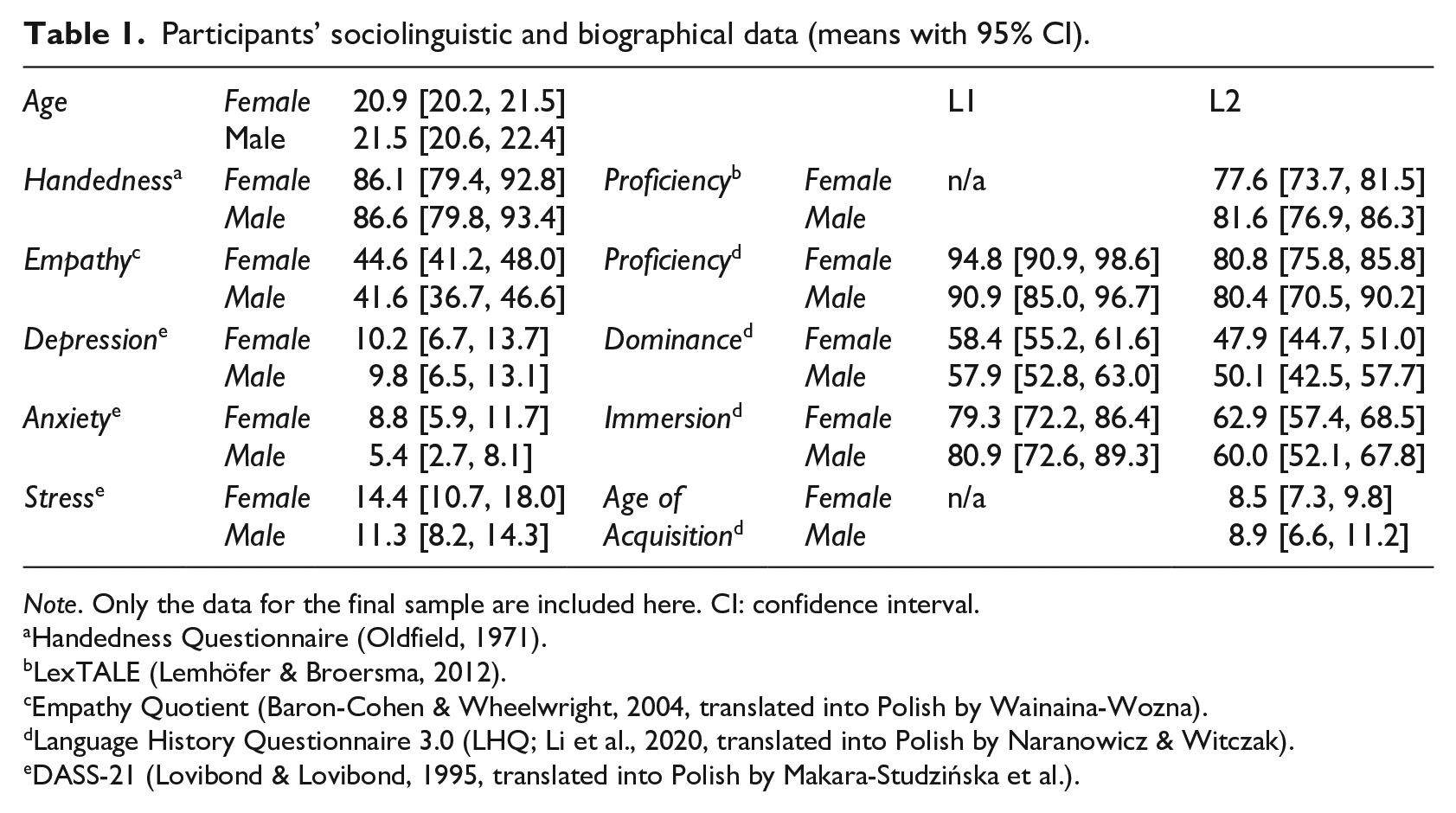
Note. Only the data for the final sample are included here. CI: confidence interval.
Handedness Questionnaire (Oldfield, 1971).
LexTALE (Lemhöfer & Broersma, 2012).
Empathy Quotient (Baron-Cohen & Wheelwright, 2004, translated into Polish by Wainaina-Wozna).
Language History Questionnaire 3.0 (LHQ; Li et al., 2020, translated into Polish by Naranowicz & Witczak).
DASS-21 (Lovibond & Lovibond, 1995, translated into Polish by Makara-Studzińska et al.).
Materials
Mood-inducing stimuli
Highly arousing, 90-second long, animated, affectively evocative film fragments were used to induce the target positive (n = 14) or negative mood (n = 14) (see Supplementary material A ). The fragments had no spoken/written words to avoid priming participants with a language. A norming study was first conducted to ensure the affective evocativeness of the selected excerpts, involving 50 highly proficient Polish–English bilinguals (45 females, 5 males), aged 19–24 (Table 2). To this end, 58 film excerpts were rated on two 7-point Likert-type scales: (1) valence (1 = the film evokes strongly negative emotions, 7 = the film evokes strongly positive emotions) and (2) arousal (1 = the film makes me feel completely unaroused, 7 = the film makes me feel highly aroused). They were divided into six pseudo-randomly ordered sets of 9–10 excerpts each. The two-sample Welch’s t-tests revealed that the film clips selected to induce a positive mood were rated higher on valence than those selected to induce a negative mood (MPositiveMood = 5.34, 95% CI [5.17, 5.52]; MNegativeMood = 1.97, 95% CI [1.78, 2.16]), t(20.98) = –24.94, p < .001, while there was no difference between the two film types in arousal ratings (MPositiveMood = 3.62, 95% CI [3.06, 4.17]; MNegativeMood = 4.27, 95% CI [3.94, 4.59]), t(20.98) = 1.90, p = .071.
Norming studies: participants’ characteristics (means with 95% CI).
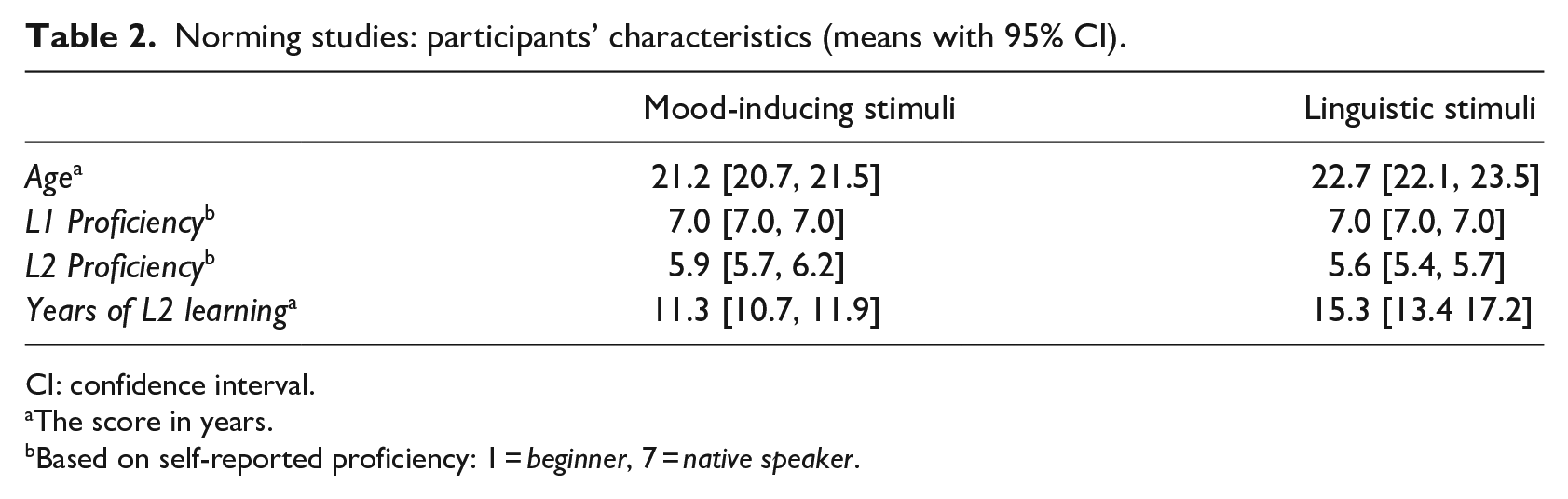
CI: confidence interval.
The score in years.
Based on self-reported proficiency: 1 = beginner, 7 = native speaker.
Linguistic stimuli
The linguistic stimuli included 240 single words: 120 English and 120 Polish abstract adjectives, including 40 negative (e.g., lonely), 40 neutral (e.g., ongoing), and 40 positive words (e.g., awesome) for each language (see Supplementary material B ). The stimuli were controlled for and matched on a number of variables, which are described in detail in Table 2. The words used did not include translation equivalents. Polysemous words, Polish–English cognates and interlanguage homonyms and homographs were excluded from the experimental stimuli. In addition, to match the stimuli on word valence, arousal, and concreteness, a norming study was conducted, involving 60 highly proficient Polish–English bilinguals (51 females, 8 males, 1 non-binary), aged 19–31 (Table 2). None of these participants took part in the experiment proper.
Altogether, 180 Polish and 180 English adjectives were rated on three 7-point Likert-type scales for word valence, arousal, and concreteness. The words with the highest and the lowest scores on the word valence scale were classified as positive and negative, respectively, and 20 words above and below the mean – as neutral. Regarding the concreteness ratings, the words with the scores lower than 3.5 were classified as abstract and, then, included in the final set.
Two-way item-based repeated measures (RM) analysis of variances (ANOVAs) were conducted with Word valence (Positive, Negative, Neutral) and Language (Polish, English) as between-subject factors to test differences in participants’ ratings and word properties (Table 3). For the word valence ratings, the analysis showed a main effect of Word valence, F(2, 234) = 2,281.99, p < .001,
Means (with 95% CI) of all controlled characteristics of the lexical stimuli.
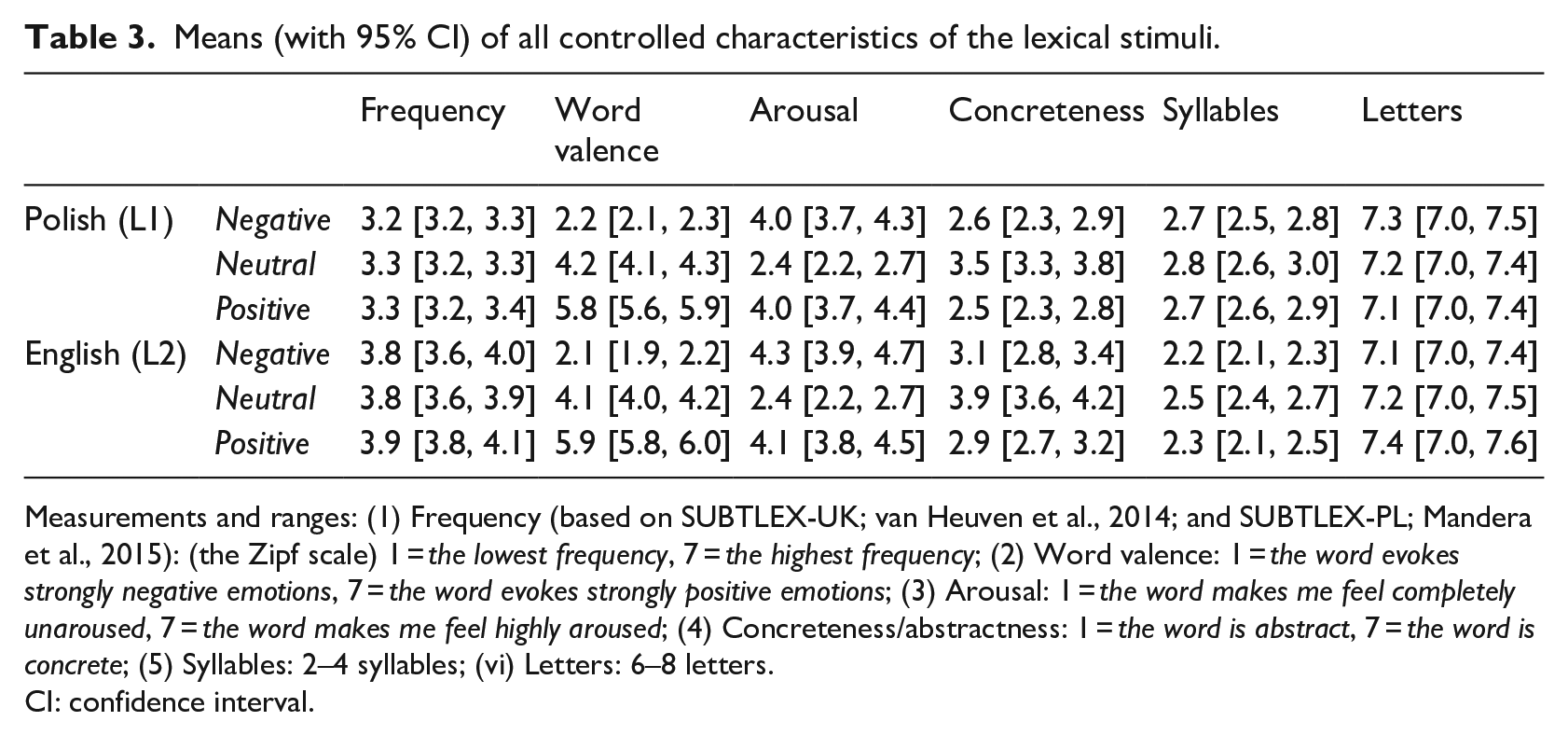
Measurements and ranges: (1) Frequency (based on SUBTLEX-UK; van Heuven et al., 2014; and SUBTLEX-PL; Mandera et al., 2015): (the Zipf scale) 1 = the lowest frequency, 7 = the highest frequency; (2) Word valence: 1 = the word evokes strongly negative emotions, 7 = the word evokes strongly positive emotions; (3) Arousal: 1 = the word makes me feel completely unaroused, 7 = the word makes me feel highly aroused; (4) Concreteness/abstractness: 1 = the word is abstract, 7 = the word is concrete; (5) Syllables: 2–4 syllables; (vi) Letters: 6–8 letters.
CI: confidence interval.
Altogether, these results indicate that emotional words were more arousing than neutral ones, the effect being language-non-specific, which is a frequently reported finding in emotion literature (e.g., Kousta et al., 2009; Opitz & Degner, 2012; Citron et al., 2014).
Procedure
The study was approved by the Human Research Ethics Committee of Adam Mickiewicz University, Poznań, Poland. The experiment was conducted at the Language and Communication Laboratory, Faculty of English, Adam Mickiewicz University, Poznań, Poland. There were two experimental sessions (with a 1-week interval), separately for the positive and negative mood induction (counterbalanced sequence). The same set of linguistic stimuli was used during both sessions. Participants were seated in a dimly lit and quiet booth, 70 cm away from a LED monitor with a screen resolution of 1280 × 1024 pixels.
A battery of questionnaires was first administered to build participants’ linguistic and socio-biographical profiles and to control for potential mood induction adverse effects (see Table 1 for details). Then, participants evaluated their current mood prior to mood manipulation on a 7-point valence and arousal scales and the 20-item Positive and Negative Affect Schedule (PANAS; Watson et al., 1988, translated into Polish by Fajkowska & Marszał-Wiśniewska, 2009). E-prime 2.0 Software was used to present the stimuli and collect the RT and accuracy data. Participants performed an evaluative decision task – an affective categorisation task, wherein they decided if the presented words were positive/negative/neutral using keyboards (counterbalanced designation of keys).
First, participants watched three film excerpts to prime the target mood. Then, they responded to 20 words, followed by a single film excerpt presentation to keep them in the target mood. A fixation cross first appeared in the centre of the screen for 350 ms, followed by the presentation of a target word, which remained on-screen until response, yet no longer than for 2,000 ms, with an intertrial interval (ITI) of 500 ms. All words and film excerpts were presented randomly in cycles until the entire set of words in a given language block was rated. None of the words or film excerpts was repeated throughout one experimental session. Each session included one English (L2) and one Polish (L1) block (counterbalanced order). Finally, participants rated their current mood post-experimentally.
Study design and data analysis
All statistical analyses were performed in the R environment (Version 4.0; R Development Core Team, 2020). First, we analysed the effects of Time of testing (Pre-experiment, Post-experiment) and Film type (Positive, Negative) on participants’ mood ratings. Mood was evaluated by means of the 7-point valence and arousal scales and the PANAS (Watson et al., 1988). For the valence and arousal scales, we used the same procedure as in the norming study (see the Mood-inducing stimuli subsection for details). Regarding the PANAS (Watson et al., 1988), participants self-reported their current emotions experienced on a 5-point Likert-type scale (1 = very slightly or not at all, 5 = extremely) with 10 positive (i.e., active, alert, attentive, enthusiastic, excited, inspired, interested, proud, strong, determined) and 10 negative (i.e., afraid, scared, nervous, jittery, guilty, ashamed, irritable, hostile, upset, distressed) adjectives. Then, the scores for the items signalling positive affect and negative affect were summed separately, and the final score was presented as the ratio of the sum of the positive affect scores and the sum of the negative affect scores. The obtained ratio values allowed us to observe if participants felt more positive (as indicated by positive ratio values) or more negative (as indicated by negative ratio values), and compare these values pre- relative to post-mood induction.
Then, we investigated whether Mood (Positive, Negative), Gender (Females, Males), Word valence (Positive, Negative, Neutral), and Language (Polish, English) had an impact on participants’ response accuracy and log10-transformed RTs, with Mood, Word valence, and Language being within-subject variables and Gender, a between-subject variable. Responses below 200 ms (0.01% of response) and those deviating at least 2.5 standard deviations above and below the mean from all within-subjects (2.05% of outliers) or within-items (2.01% of outliers) factors were excluded from the analyses, resulting in a final rejection of 3.48% of the data. RT and accuracy data were analysed with a linear mixed-effects model (LMM) and a generalised linear mixed-effects model (GLMM), respectively (Baayen et al., 2008; Barr, 2013; Barr et al., 2013; Jaeger, 2008), using the lme4 package for R (Version 1.1–23; Bates et al., 2015). A maximal model was first computed with a full random-effect structure, including subject- and item-related variance components for intercepts and by-subject and by-item random-slopes for fixed effects (Barr et al., 2013). When the data did not support the execution of the maximal model random structure, we reduced the model complexity to arrive at a parsimonious model (Bates et al., 2018). To do so, we computed principal component analyses of the random structure and, then, kept the number of principal components that cumulatively accounted for 100% of the variance. b estimates and significance of fixed effects and interactions (p-values) are based on the Satterthwaite approximation for LMM (the lmerTest package, Version 3.1.2., Kuznetsova et al., 2017). Post hoc analyses were calculated using the emmeans package (Version 1.7.0; Lenth et al., 2022). All R scripts and raw data files used in the analyses are available here: https://osf.io/wf8s7/
Results
Mood induction
Following Rottenberg et al. (2018), 10 non-responders were identified (i.e., participants who reported no in-/decrease in the target mood subsequent to its manipulation) and excluded from the analyses (i.e., the mood manipulation had the intended effect in 85.29% of cases). A mood change was considered meaningful when (1) it exceeded at least one step on the 7-point valence scale in the expected direction pre- relative to post-mood induction in both mood conditions, and (2) the ratio values of summed ratings for positive and negative affect adjectives were positive in the positive mood condition and negative in the negative mood condition and higher pre- relative to post-mood induction in both mood conditions.
The data from the final participant sample were subject to the mixed ANOVA, which yielded a two-way interaction between Time of testing and Film type for both the valence ratings, F(1, 54) = 480.17, p = .001,
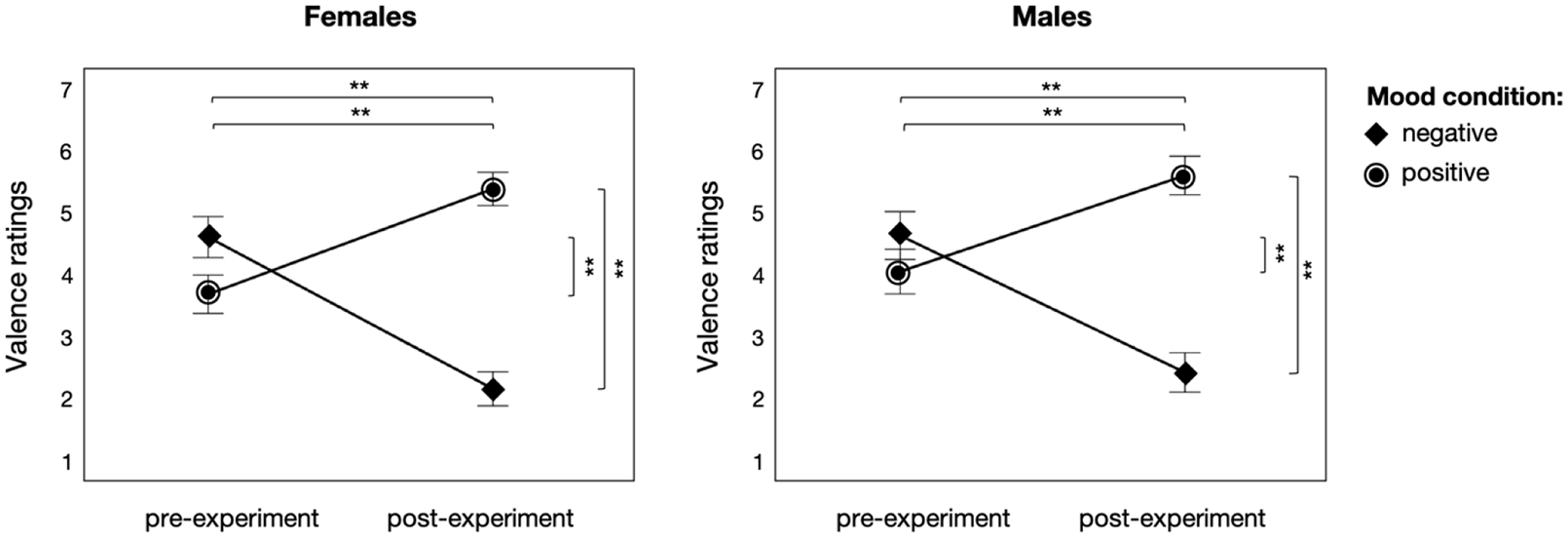
Mood ratings for the valence scale with 95% CI.
Response accuracy data
The analyses performed on accuracy rates revealed a fixed effect of Word valence, whereby neutral words (M = 80.34%, 95% CI [64.56, 96.13]) were responded to with lower accuracy compared to positive words (M = 91.01%, 95% CI [72.31, 100.00]), b = 1.34, standard error (SE) = 0.26, z = 5.08, p < .001, and to negative words (M = 90.45%, 95% CI [71.95, 108.94]), b = 1.04, SE = 0.26, z = 4.05, p < .001. Also, there was no difference in accuracy between positive and negative words, b = 0.30, SE = 0.23, z = 1.32, p = .187.
The analysis also revealed a significant three-way interaction between Language, Word valence, and Gender, b = 0.74, SE = 0.25, z = 3.02, p = .003. Post hoc comparisons revealed that while females responded to English positive words with greater accuracy than to English negative words (MPositive = 92.30%, 95% CI [65.13, 100.00]; MNegative = 89.50%, 95% CI [63.82, 100.00]), b = 0.74, SE = 0.36, z = 2.09, p = .037; there was no such difference for males (MPositive = 91.67%, 95% CI [64.86, 100.00]; MNegative = 91.93%, 95% CI [64.98, 100.00]), b = 0.27, SE = 0.33, z = 0.84, p = .399. All the remaining effects of response accuracy were also statistically non-significant, ps > .05.
RT data
The analyses performed on RTs revealed a fixed effect of Language, such that Polish words (M = 888.60 ms, 95% CI [883.96, 893.24]) were responded to faster than English words (M = 923.50 ms, 95% CI [918.75, 928.24]), b = 0.017, 95% CI [0.005, 0.028], t(251.9) = 2.93, p = .004. The analyses also revealed a fixed effect of Word valence, whereby positive words (M = 837.52 ms, 95% CI [832.45, 842.60]) were responded to faster than negative words (M = 877.94 ms, 95% CI [872.61, 883.27]), b = 0.020, 95% CI [0.005, 0.034], t(234.6) = 2.71, p = .001, as well as neutral words (M = 1,009.99 ms, 95% CI [1,003.85, 1,016.13]), b = 0.084, 95% CI [0.067, 0.101], t(150.9) = 9.60, p < .001. Then, negative words were responded to faster than neutral words, b = 0.064, 95% CI [0.048, 0.080], t(181.6) = 7.76, p < .001.
The analyses also showed a two-way interaction between Mood and Gender, b = –4.18, SE = 1.75, t(5.46) = –2.39, p = .020 (see Figure 2). Post hoc comparisons revealed that, in females, faster RTs were elicited in the positive compared to negative mood condition (MPositiveMood = 861.333 ms 95% CI [855.38, 867.28]; MNegativeMood = 908.59 ms, 95% CI [902.10, 915.09]), b = –0.024, 95% CI [–0.040, –0.007], t(55.8) = –2.89, p = .006, and there was no such between-mood difference in males (MPositiveMood = 937.16 ms, 95% CI [930.24, 944.08]; MNegativeMood = 916.11 ms, 95% CI [909.11, 923.11]), b = –0.013, 95% CI [–0.004, 0.030], t(55.9) = 1.54, p = .130. Also, females responded faster to stimuli in the positive mood condition than males, b = –0.036, 95% CI [–0.064, –0.007], t(54.1) = –2.55, p = .014, and there was no such between-group difference in the negative mood condition, b = 0.001, 95% CI [–0.030, 0.032], t(55.4) = 0.06, p = .949.
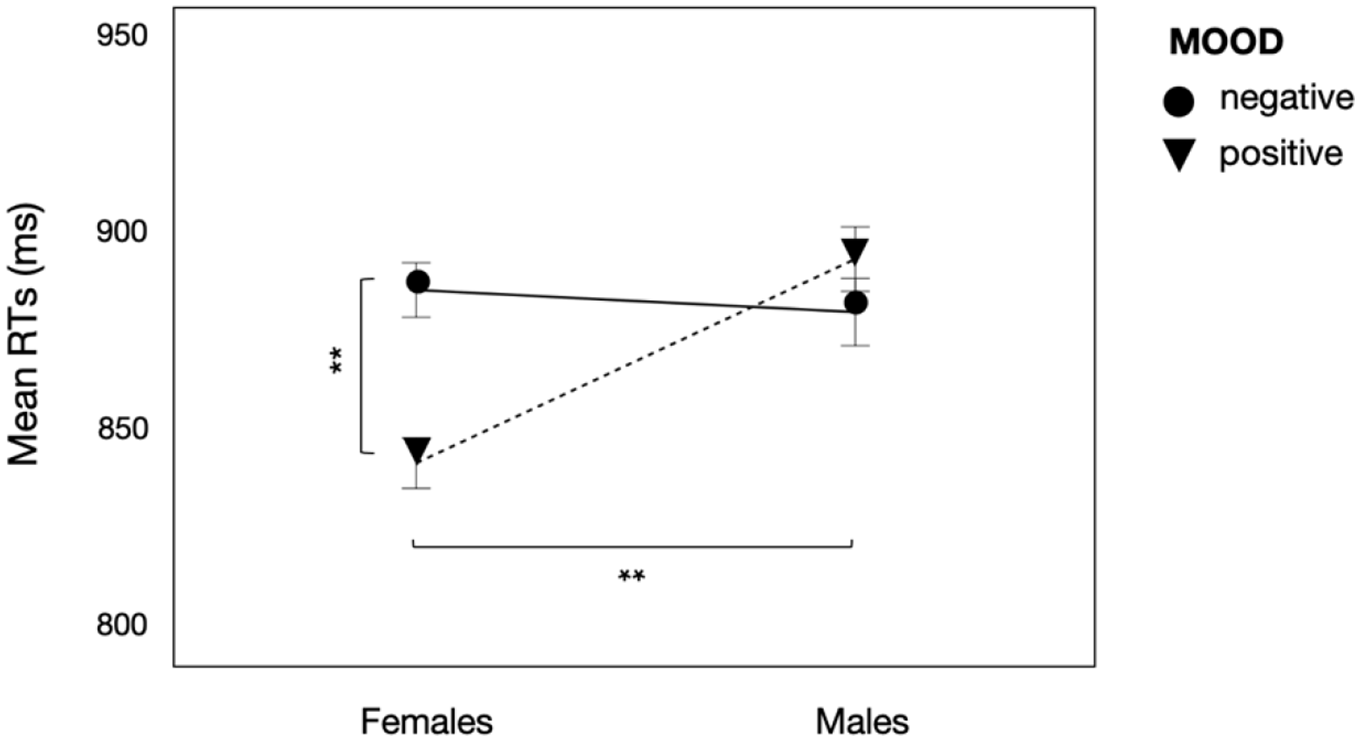
The mean response time data (ms) with 95% CI showing the relationship between mood and gender.
Moreover, a correlational analysis pointed to a gender-dependent linear relationship between participants’ RTs and their arousal ratings in the negative mood condition, with a positive correlation for males, r = .50, 95% CI [0.16, 0.74], t(26) = 2.96, p = .007, and a negative correlation for females, r = –.46, 95% CI [–0.71, –0.10], t(26) = –2.62, p = .014 (see Figure 3).
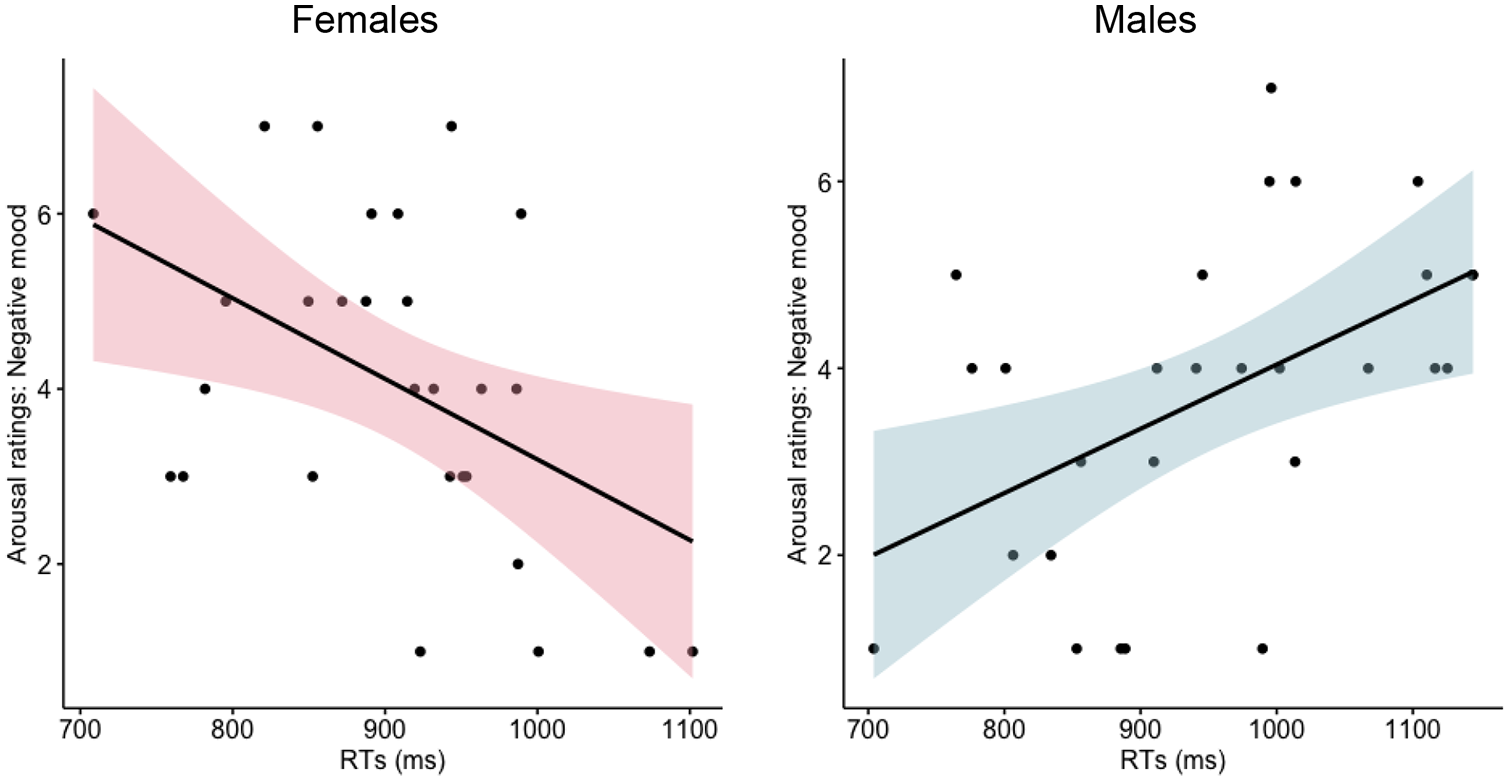
Correlation plots showing the relationship between arousal ratings in the negative mood condition and reaction times in females (left) and males (right).
Finally, the analyses yielded a three-way interaction between Mood, Language, and Word valence, b = –2.03, SE = 7.40, t(2.34) = –2.74, p = .007, (see Figure 4). As regards neutral words, post hoc comparisons showed that Polish relative to English neutral words were responded to faster in the positive mood condition, b = 2.03, 95% CI [1.36, 3.92], t(261.7) = 2.11, p = .036, with no between-language difference in the negative mood condition, b = 1.59, 95% CI [–8.70, 3.04], t(168.6) = 1.27, p = .204 (see Table 4). As for positive words, post hoc comparisons revealed that English positive words in the negative mood condition were responded to slower than in the positive mood condition, b = –1.42, 95% CI [–2.80, –5.32], t(77.1) = –2.07, p = .042 as well as than Polish positive words in both the negative mood condition, b = 1.89, 95% CI [–8.52, 3.79], t(260.6) = 1.96, p = .051, as well as the positive mood condition, b = 2.26, 95% CI [1.50, 4.36], t(248.6) = 2.11, p = .036 (see Table 4). As for negative words, post hoc comparisons revealed that Polish compared to English negative words were responded to faster in the positive mood condition, b = 2.13, 95% CI [1.58, 4.10], t(254.1) = 2.13, p = .034, as well as the negative mood condition, b = 2.12, 95% CI [1.49, 4.10], t(260.2) = 2.12, p = .035 (see Table 4), resembling the main effect of Language reported above.
Mean RTs with 95% CI (the Mood–Language–Word valence interaction).

RTs: reaction times; CI: confidence interval.
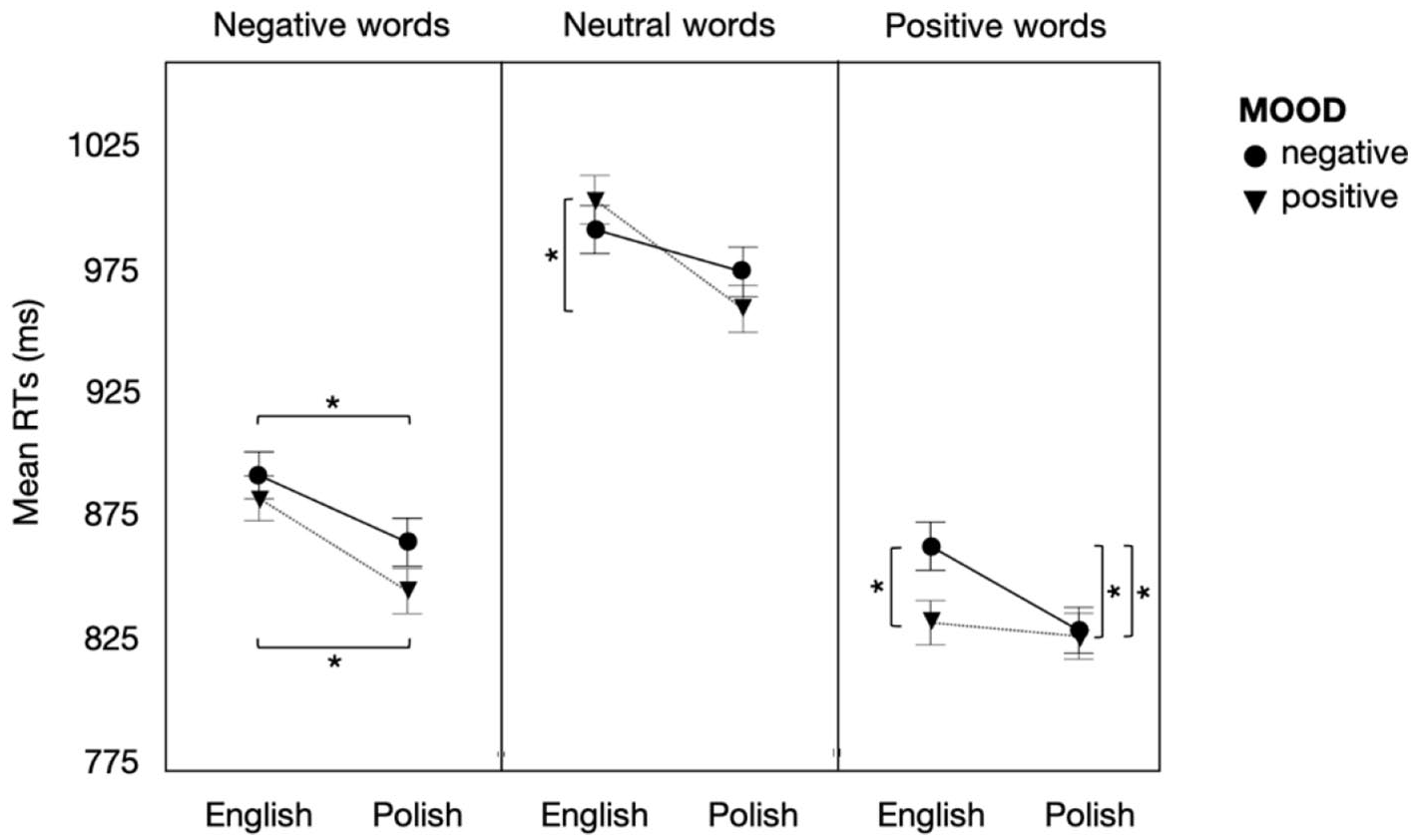
The mean response time data (ms) with 95% CI showing the relationship between mood, language, and valence.
Furthermore, to address Hypothesis 3 predicting potential gender-specific effects of Word valence, we performed planned comparisons that revealed faster RTs to positive words (MFemale = 813.38 ms, 95% CI [734.47, 892.30]; MMale = 861.80 ms, 95% CI [774.03, 949.56]) compared to neutral words (MFemale = 989.99 ms, 95% CI [899.33, 1,080.65]; MMale = 1,028.91 ms, 95% CI [928.04, 1,129.79]) in both females, b = 0.09, 95% CI [0.07, 0.11], t(105.4) = 8.00, p < .001, and males, b = 0.08, 95% CI [0.06, 0.10], t(99.9) = 7.39, p < .001. Similarly, we also observed faster RTs for negative (MFemale = 862.38 ms 95% CI [786.14, 938.63]; MMale = 893.48 ms, 95% CI [802.81, 984.16]) compared to neutral words in both females, b = 0.06, 95% CI [0.04, 0.08], t(124.9) = 6.21, p < .001, and males, b = 0.07, 95% CI [0.05, 0.09], t(117.6) = 6.56, p < .001. All the remaining effects of RTs were statistically non-significant, ps > .05.
Discussion
The aim of the present behavioural study was to extend monolingual research on mood and emotional word processing to the bilingual context, additionally accounting for possible gender differences. To this end, we put unbalanced Polish–English bilingual females and males into positive and negative moods using emotionally evocative film clips and asked them to perform an evaluative decision task on L1 and L2 positive, negative, and neutral words, recording their RTs and response accuracy.
Mood and language nativeness
The key research question addressed in this study was whether mood differently interacts with language in L1 and L2. We expected to observe response facilitation in a positive compared to negative mood being attenuated in L2 compared to L1 (e.g., Wu & Thierry, 2012; Jończyk et al., 2016; Morawetz et al., 2017). Instead, we observed an interaction between mood and language, which was dependent upon word valence. Specifically, we found (1) faster RTs to L1 compared to L2 neutral words in a positive mood, with no such a between-language difference for a negative mood; (2) faster RTs to L2 positive words in a positive compared to negative mood, with no such a between-mood difference in L1; and (3) faster RTs to L1 compared to L2 negative words, irrespective of the mood type.
First, shorter response latencies to L1 relative to L2 neutral words in a positive mood as well as to negative words in both mood conditions are consistent with the temporal delay assumption of the Bilingual Interactive Activation Plus model (BIA+; Dijkstra & van Heuven, 2002), whereby the activation of semantic representations is delayed in L2 compared to L1 due to a lower subjective frequency of L2 items in unbalanced bilinguals (e.g., De Groot et al., 2002; Jankowiak et al., 2017). This has also been confirmed by ERP studies pointing to a delay in the N400 peak latency in L2 compared to L1 (e.g., van Heuven & Dijkstra, 2010; Jankowiak et al., 2017). Crucially, no between-language temporal differences for neutral words in the negative mood condition accords with Clore and Huntsinger’s (2007) observation that many findings in cognitive psychology (e.g., semantic priming, false memories, heuristic processing) are actually observed when participants are not in a negative mood, particularly with relation to neutral stimuli. Therefore, this study offers a novel contribution to research on bilingual language processing by pointing out that the predictions postulated within the interactive activation models might be mostly applicable to neutral word processing. Consequently, it seems crucial for studies on bilingual language processing to consider participants’ emotional state as a potential confounding variable and to control it by collecting mood ratings and detailed information about the history of mood disorders.
Then, relying on substantial evidence showing facilitatory effects of both a positive mood (e.g., Chwilla et al., 2011) and positively laden words (e.g., Ponari et al., 2015), we believe that no between-language temporal differences for positive words in a positive mood observed here could result from the activation of a cumulative positivity-driven mechanism, leading to a strong processing advantage for both L1 and L2 words. Such an interpretation would also accord well with a monolingual ERP study conducted by Pratt and Kelly (2008), who observed enhanced amplitudes at around 400 ms to positive compared to negative words in a positive mood, with no such a difference in a negative mood, pointing to an enhanced comprehension of mood-congruent words, yet only in a positive mood.
Mood and gender
Another important question examined in this study was whether gender is a factor modulating an interaction between mood and language. We predicted that the response facilitation (as indexed by faster RTs) in a positive relative to negative mood would be stronger in females compared to males (e.g., Federmeier et al., 2001; Luomala & Laaksonen, 2000; Martin, 2003). Consistent with our hypothesis, we observed faster RTs to words in the positive compared to negative mood condition only in females, with no such a between-mood effect in males. Crucially, our exploratory analysis showed that this gender effect was not additionally modulated by language nativeness (i.e., the mood–gender interaction was observed irrespective of the language of operation).
The results observed for female participants are consistent with the Affect-as-information hypothesis (Clore & Huntsinger, 2007), whereby being in a positive mood leads to a broader cognitive flexibility, effortless integration of incoming information, and a global focus of attention (Gasper & Clore, 2002), which consequently leads to facilitated problem solving mechanisms (van Berkum et al., 2013). In contrast, a negative mood is strongly associated with extended inhibition of cognitive mechanisms engaged in information processing, as it is assumed to promote a ruminative style of thinking (Bar, 2009; Bolte et al., 2003). Similarly, such a processing advantage in a positive compared to negative mood also accords with previous research showing that, unlike a negative mood, a positive mood may exert facilitatory effects on different areas of language processing (e.g., Chwilla et al., 2011; Pinheiro et al., 2013; van Berkum et al., 2013). For instance, Chwilla et al. (2011) used neutral high and low cloze probability sentences (e.g., The pillows are stuffed with feathers/books . . ., respectively) and induced positive and negative moods via film clips in a sentence reading task. They reported greater N400 amplitude reduction for high cloze probability sentences when participants were in a negative compared to positive mood.
Interestingly, despite many methodological similarities (i.e., similar mood induction procedure, task, stimuli used, and participants’ L2), our results for female participants differ from the behavioural results obtained by Kissler and Bromberek-Dyzman (2021), with the exception of a between-language difference that was observed in both studies (i.e., faster RTs to L1 compared to L2 words). Specifically, contrary to the processing advantage (i.e., faster RTs) of a positive mood observed here in females, in the study by Kissler and Bromberek-Dyzman (2021), German–English bilinguals responded faster to L1 than L2 words irrespectively of the mood polarity. They also observed a trend towards faster RTs to negative words in L2 than L1. The differences between the two studies may be attributed, among others, to a varying proportion of females to males (i.e., 78% of females in Kissler and Bromberek-Dyzman, 2021, and 50% here) and participants’ dissimilar L2 proficiency levels (i.e., MLexTALE = 69.5% in Kissler and Bromberek-Dyzman, 2021; MLexTALE = 79.8% here). This may indicate that emotional responses to words in L1 and L2 may, among others, differ as a function of L2 proficiency, which is in line with previous research pointing to the crucial role of L2 proficiency in emotional responding (e.g., Costa et al., 2014; Harris et al., 2006).
Critically, the female advantage in a positive compared to negative mood observed here is consistent with the ERP study conducted by Federmeier et al. (2001), which first documented gender differences in positive and neutral mood effects on word processing. The researchers used sentence pairs (e.g., They wanted to make the hotel look more like a tropical resort. So, along the driveway they planted rows of . . .) ending with an expected word (e.g., palms), an unexpected word from the same semantic category (a within-category violation; e.g., pines), or from a different yet related semantic category (a between-category violation; e.g., tulips). In females, while N400 amplitudes in the neutral mood condition were the smallest for expected items and, then, smaller for within- compared to between-category violations, no changes in N400 amplitudes were observed between the two types of semantic violations in the positive mood condition. In contrast, in men, no differences in N400 amplitudes were observed between expected items, within-category violations, and between-category violations. These results point to a more profound role of mood in semantic processing in females than males, which could result from females’ greater sensitivity to emotions (e.g., Goldstein et al., 2001; Tobin et al., 2000; Vrana & Rollock, 2002). Such a modulation by gender has also been previously reflected in higher arousal and greater heart rate deceleration to emotional films in females relative to males (e.g., Bianchin & Angrilli, 2012; Codispoti et al., 2008). Altogether, this study extends Federmeier et al.’s (2001) findings by demonstrating that gender may also modulate emotional word processing irrespective of language nativeness in unbalanced bilinguals experiencing positive and negative moods.
Interestingly, our results also indicated that the interaction between mood and gender in negative mood may be moderated by one’s physiological arousal. Our results showed that an increase in arousal ratings in the negative mood condition was accompanied by faster RTs in females and slower RTs in males. Thus, although males have been observed to be better emotion-regulators than females (e.g., McRae et al., 2008), our results indicate that higher arousal in a negative mood may in fact facilitate language-related processes to a greater extent in females than in males. It is therefore vital that future research further explores potential systematic relationships between mood, gender, and different levels of physiological arousal, which would allow us to better understand gender-dependent differences in emotional reactivity and copying with affective disorders.
Word valence and gender
The final research question addressed in this study pertained to the relationship between gender and word valence. We predicted the response facilitation (as indexed by faster RTs) of positive and negative compared to neutral words (e.g., Chen et al., 2015; Opitz & Degner, 2012; Ponari et al., 2015) being more pronounced in females than males (e.g., Abbassi et al., 2019; Rodway et al., 2003; Van Strien & Van Beek, 2000). Although we observed the general processing advantage (i.e., faster RTs and higher accuracy) of both positive and negative over neutral words, the effect was comparably strong in both females and males. Positive words were also responded to faster than negative words irrespective of gender.
Such a gender-independent effect is consistent with previous research pointing to facilitatory mechanisms involved in emotional compared to neutral word processing in both L1 (e.g., Goh et al., 2016; Kissler & Herbert, 2013; Kousta et al., 2009; Vinson et al., 2014) and L2 (e.g., Conrad et al., 2011; Ferré et al., 2013; Grabovac & Pléh, 2014; Opitz & Degner, 2012; Ponari et al., 2015). For instance, in the study by Ponari et al. (2015), early and late bilingual speakers of 14 typologically different languages and native speakers of English showed slower lexical responses to neutral compared to emotional (positive and negative) words in their respective languages. Such results are typically attributed to the Motivated attention and affective states hypothesis (Lang & Bradley, 2013), whereby motivational relevance is modulated by emotional salience, such that negative stimuli evoke threat-related cognitive mechanisms, while positive stimuli elicit appetitive motivation systems that promote sustenance.
Moreover, the observed processing advantage of positive over negative words is also consistent with the Positivity offset hypothesis (e.g., Ito & Cacioppo, 2005), whereby positively laden verbal stimuli involve a higher informational density in the memory system and are therefore processed preferentially (i.e., as indexed by shorter RTs and more pronounced early posterior negativity [EPN] and late positivity complex [LPC] amplitudes relative to negative stimuli; see Kauschke et al., 2019 for a review). For instance, Bayer and Schacht (2014) observed larger EPN and LPC amplitudes as well as faster RTs to positive compared to negative words in a task involving silent reading and an occasional 1-back recognition test (i.e., deciding if a given stimulus and the one preceding it are the same), therefore indicating that positive word processing requires less cognitive effort compared to negative words.
Although previous research has suggested that females process emotional words faster than males due to their increased sensitivity towards the valence of emotional stimuli (e.g., Hofer et al., 2007; Rodway et al., 2003; Van Strien & Van Beek, 2000), the results observed in this study showed that both men and women can exhibit a comparable sensitivity to an affective value of language. One of the possible explanations is a limited nature of behavioural measures (e.g., RTs and accuracy rates), as previous research finding gender differences often adopted both behavioural and electrophysiological (Electroencephalography [EEG]) or functional Magnetic Resonance Imaging (fMRI) measures (e.g., Chentsova-Dutton & Tsai, 2007). This points to the importance of employing neurophysiological methods, such as EEG, which provides a continuous measure of the brain activity and, unlike behavioural measures, reflects a neurobiological response to a stimulus (Cohen, 2014).
Conclusion
This study tested mood effects on emotional word processing in L1 and L2, additionally accounting for gender differences. Our results revealed that the relationship between mood and language nativeness depended on word valence. The observed results suggest that the facilitatory effect of a positive mood and positive words may accumulate, mitigating response time differences between L1 and L2. This includes the temporal delay frequently observed in response to L2 relative to L1 (see Dijkstra & van Heuven, 2002) in unbalanced bilinguals, which may not be observed when bilinguals are in a negative mood. Future research should further explore if such findings can also be observed in broader communicative contexts (e.g., the sentence context) and beyond behavioural measures (e.g., using the EEG or fMRI measures).
In line with gendered perceptions of emotionality (McCormick et al., 2016), our study also revealed that though both females and males experienced comparable mood changes, only females’ responses to isolated words were affected by mood, irrespective of the language of operation. Apart from linking this finding to greater emotional sensitivity in females than males (e.g., Bianchin & Angrilli, 2012), we suggest that it may be modulated by language proficiency and physiological arousal. Crucially, future research should go beyond identifying possible mediating factors, trying to account for such gendered perceptions of emotionality in the context of language processing. Researchers should now theorise about possible reasons behind such a gender-driven finding in the linguistic context by linking it to, for instance, how we define gender as a social construct (e.g., Winter, 2015), gender stereotypes (e.g., Plant et al., 2000), gendered power relationships (e.g., McCormick et al., 2016), or gender-based socialisation processes (e.g., Brody & Hall, 2008).
Supplemental Material
sj-docx-1-ijb-10.1177_13670069221075646 – Supplemental material for Mood and gender effects in emotional word processing in unbalanced bilinguals
Supplemental material, sj-docx-1-ijb-10.1177_13670069221075646 for Mood and gender effects in emotional word processing in unbalanced bilinguals by Marcin Naranowicz, Katarzyna Jankowiak and Katarzyna Bromberek-Dyzman in International Journal of Bilingualism
Footnotes
Acknowledgements
We would like to express our sincere gratitude to Guillaume Thierry, Aina Casaponsa, and Rafał Jończyk for their invaluable help.
Author contributions
M.N. contributed to study design, material preparation, experiment programming, data collection, data analyses, data visualisation, manuscript writing, editing, and reviewing. K.J. contributed to writing, editing, and reviewing the manuscript. K.B.D. contributed to study design and manuscript reviewing.
Declaration of conflicting interests
The author(s) declared no potential conflicts of interest with respect to the research, authorship, and/or publication of this article.
Funding
The author(s) disclosed receipt of the following financial support for the research, authorship, and/or publication of this article: This work was supported by the Polish National Centre for Research and Development under Grant POWR.03.02.00-00-I004/17-01.

Supplemental material
Supplemental material for this article is available online.
Author biographies
References
Supplementary Material
Please find the following supplemental material available below.
For Open Access articles published under a Creative Commons License, all supplemental material carries the same license as the article it is associated with.
For non-Open Access articles published, all supplemental material carries a non-exclusive license, and permission requests for re-use of supplemental material or any part of supplemental material shall be sent directly to the copyright owner as specified in the copyright notice associated with the article.
