



Abstract
Aims and objectives:
This study focuses on Nick Villarreal (1951–2017), a bilingual and bicultural conjunto musician from San Antonio. It ascertains the frequency, formal features, and socio-pragmatic functions of the Spanish/English code-switching found in his songs.
Methodology:
Quantitative and qualitative approaches are utilized to explore Nick Villarreal’s use of code-switching in song lyrics.
Data and analysis:
Nick Villarreal’s commercially available discography (178 non-repeated tracks) was classified by matrix language. All instances of code-switching were identified and classified by type, syntactic category, and function. Song themes were inductively analyzed.
Findings:
Most of Nick Villarreal’s lyrics are in Spanish (73%), while 22% contain code-switching. Lexical insertions are the most common type of switches (65%). Villarreal also employs other contact phenomena, such as fully nativized borrowings, and syntactic and semantic calques. His virtuosity is apparent in his humorous bilingualism, especially in the creative nominalizations of English clauses as nicknames (e.g., la I-didn’t-do-it). The main function performed by switches is poetic—that is, stylistic uses of language, such as rhyming, joking, and puns. He conveys authenticity through code-switching and other enregistered linguistic sources such as border slang, or caló, and working-class/rural Mexican Spanish. He shows loyalty toward a working-class rural Spanish-speaking audience of conjunto that shares his background, while simultaneously appealing to second-generation Mexican Americans through his use of English and references to Anglo culture.
Originality:
Only recently have scholars begun to describe the linguistic features of borderland styles. This study focuses on an artist who has never received scholarly attention before but who turned his music into a meaningful vehicle for linguistic and cultural anti-assimilatory subversion.
Implications:
Villarreal employs strategies common to other borderlands bilingual musicians while innovating creatively. He actively stylizes the local to evoke a sense of authenticity and is thus a meaningful example of the intersection between language representation, class allegiance, linguistic attitudes, and cultural stance.
Keywords
Introduction
This is a study of the representation of Spanish-English code-switching in the lyrical production of Nick Villarreal, a bilingual and bicultural conjunto artist from San Antonio, active from the early 1980s until his passing in 2017. Although less well known than some of his contemporaries (e.g., the internationally renowned Texas Tornados), Villarreal was popular in the San Antonio music scene thanks to his virtuosity on the accordion and his keen ear for local speech. An analysis of his linguistic representation adds to existing descriptions of code-switching in song lyrics. Furthermore, it helps us continue to map the life of Spanish as a public language in the United States by highlighting its presence along the borderlands.
Our work aligns with earlier research on code-switching phenomena in lyrics, or “artistic” codemixing (Picone, 2002), explored in some detail in the section “Language stylization in song lyrics.” We follow a large body of work on bilingual and multilingual song lyrics (Akande, 2013; Androutsopoulos, 2010; Davies & Bentahila, 2008; Loureiro-Rodríguez, 2017; Loureiro-Rodríguez et al., 2018; Moyna & Loureiro-Rodríguez, 2022; Omoniyi, 2009; Sarkar & Allen, 2007; Sarkar & Winer, 2006; Williams, 2010), by adopting the term code-switching to refer to the deliberate alternation of Spanish and English. We have chosen this term over alternatives such as translanguaging (Garcia, 2009b) and codemeshing (Canagarajah, 2009) because these describe a fluid language alternation with no clear structural boundaries, whereas, as we will demonstrate in this paper, in Nick Villarreal’s lyrics the boundaries between the codes are not only clearly identifiable but also pragmatically exploited.
In the context of the United States, ubiquitous code-switching between Spanish and English is a salient feature of contemporary urban styles such as bachata and rap (Flores Ohlson, 2008a, 2011; Hernandez, 2012; Loureiro-Rodríguez, 2017). While the deep historical roots of lyrical code-switching stretch back over a century (Peña, 1985; Wald, 2015), only recently have we begun to describe the linguistic features of these borderland styles (Loureiro-Rodríguez et al., 2018; Moyna & Loureiro-Rodríguez, 2022). The present study continues to piece together the puzzle of border bilingual music by focusing on an artist who turned his music into a meaningful vehicle for linguistic and cultural anti-assimilatory subversion but has never received scholarly attention.
The paper is organized as follows. “Language stylization in song lyrics” provides an overview of language stylization in song lyrics and establishes a baseline for analyzing the formal and pragmatic features of code-switching in Nick Villarreal’s lyrics. “Cultural and social context” describes the historical and social factors that influenced the musical scene of San Antonio, while “The artist” focuses specifically on Nick Villarreal. “Methodology” presents the data collection and a description of the syntactic and pragmatic categories used to classify the instances of lyrical code-switching. “Results” presents the quantitative and qualitative results, and “Discussion and conclusion” discusses these findings.
Language stylization in song lyrics
Artistic language is a form of speech representation whose typical purpose is to create an object of aesthetic appreciation, or “artful performance” (Rampton, 2009, p. 135). It thus differs in important ways from a prosaic speech event, such as an unscripted conversation. For example, a musical performance fixes a speaker/singer and multiple listeners/addressees in non-reciprocal roles and separates them either physically, by a stage, or temporally, through recording and broadcasting (Bell & Gibson, 2011). Moreover, an artistic performance typically generates a commodified product (Coupland, 2009) that capitalizes on the speaker/singer’s virtuosity (Werner, 2012). However, for such performances to sound authentic, the artist’s delivery must be strategically crafted to sound natural, striking a delicate balance between planned execution and genuine expression (Bell & Gibson, 2011; Coupland, 2009), thus ensuring a meaningful connection with the audience.
The study of the significance of singers’ language choice in aligning with audience expectations can be traced back to Trudgill’s (1983) and Simpson’s (1999) seminal studies. They observed a tendency among British pop singers from the 1950s to the 1970s to adopt stereotypical American features, possibly motivated by their desire to sound like the American artists that dominated the industry at the time. By contrast, punk-rock singers in the late 1970s employed features associated with low-prestige English accents to identify with British working-class youth. Subsequent studies have highlighted the influence of the audience on artists’ linguistic choices, particularly within the context of different varieties of English across various genres. For instance, the British rock band Arctic Monkeys incorporates features of the local Sheffield accent to index authenticity, modernity, and an anti-mainstream stance, thus distancing themselves from traditional values and establishing a deeper connection with their audience (Beal, 2009). Similarly, Australian rappers strategically employ phonological features of Australian English to forge connections with their target audience, primarily composed of working-class youth residing in the urban centers of Australia (O’Hanlon, 2006). And while Rihanna’s incorporation of Caribbean English Creole in her pop single “Work” was described as “gibberish” by some critics and fans, it reflects the artist’s connection with her Barbadian heritage (Jansen & Westphal, 2017).
Dialectal features are not the only strategy artists can use to evoke and perform an identity; an equally powerful mechanism can be the use of code-switching to engage with their audience and express bilingual personas. It was Picone (2002) who first coined the term “artistic codemixing” to refer to the alternating use of different languages in songs, and who proposed that it often creates “multiple messages for multiple audiences, based on relative levels of linguistic competence” (Picone, 2002: 201). Later studies have delved into the function of code-switching in the communication between artists and their audiences. For instance, it has been shown that K-pop artists strategically employ bilingualism in their lyrics to negotiate their cultural identities within the global music industry (Lee, 2004), using English to convey an assertive self-indulgent stance, and Korean to represent a more reserved and introspective attitude. This bilingual expression captures the struggles and aspirations of South Korean youth, bridging the gap between global and local dialogues (Lee, 2004). In other contexts, such as in French-speaking Quebec, code-switching in rap lyrics serves as a nod to multicultural local audiences, while challenging traditional monoglossic ideologies and positioning multilingualism as a desirable norm (Sarkar & Allen, 2007; Sarkar & Winer, 2006). In addition, as seen in North African rai and rap (Davies & Bentahila, 2006, 2008), code-switching may play a dual role. In some cases, it acts as a strong in-group marker, where meaning is accessible only to bilingual audiences, while in others, it facilitates inclusivity through certain strategies, such as the translation of verses, which opens up the lyrics to wider audiences. In theory, bilingual artists enjoy the freedom to explore code-switching options, but in reality, they may be limited by social and commercial forces they cannot control as they seek to reach audiences whose linguistic proficiency they cannot anticipate (Bentahila & Davies, 2002).
As a result of these commercial and artistic pressures, songs cannot be taken as an “authentic” source of vernacular data in the variationist sociolinguistic tradition, be it for the analysis of dialectal variation or code-switching. However, lyrics are indeed of interest in themselves, even as they deviate from spontaneous speech (Bell & Gibson, 2011; Trudgill, 1983). In fact, artists’ premeditated choices have sociolinguistic value, as a manifestation of speaker agency, identity construction, and performance, features common to some degree to all variation (Eckert, 2008).
Moreover, it has been noted that, apart from rhyming, code-switching patterns and functions in music closely resemble those found in speech (Bentahila & Davies, 2002; Davies & Bentahila, 2008; Flores Ohlson, 2011; Ohlson, 2007). Lyrical switches often express a bilingual and bicultural identity shared by the artist and at least part of the audience, reflecting the roles of language varieties in contact. Thus, code-switching in lyrics fulfills a range of discourse purposes, such as conveying resistance, sidestepping social conventions, and expressing hybrid identities (Bentahila & Davies, 2002; Lee, 2004; Loureiro-Rodríguez, 2013; Williams, 2010).
These global findings have been corroborated, for the most part, in the research of Spanish-English code-switching in popular music produced in the United States, which started in earnest in the new millennium (Cepeda, 2000; Flores Ohlson, 2008b, 2011; Ohlson, 2007). More recently, entire discographies of artists and groups have started to be considered. For example, in an analysis of the repertoire of Cuban American rapper Pitbull, Loureiro-Rodríguez (2017) found the highest rates of Spanish in songs where hegemonic masculinity was the main topic, with switches into Spanish for emphasis, translation, and to enact a hypermasculine identity consistent with the expectations of the genre. Thus, while Pitbull’s music legitimizes the linguistic practices of Spanish-speaking US Latinos, it also perpetuates gender stereotypes.
In a separate study about code-switching in music along the US–Mexican borderlands (Moyna & Loureiro-Rodríguez, 2022) we analyzed the discography of Eduardo “Lalo” Guerrero (1916–2005), a Mexican American musician and composer from Tucson, Arizona, considered the father of Chicano music. Our analysis found that almost 80% of his songs were exclusively in Spanish, but there was also code-switching. Guerrero’s musical creativity had to operate within the strict constraints imposed by labels unwilling to risk producing records by minority artists in mainstream styles. Consequently, he channeled his creativity into humorous songs, which some might have considered a lesser art form, but which became huge successes. His most sophisticated strategy in these crossover songs for English-speaking audiences was parody, where old melodies were overlaid with lyrics that poked fun at their original’s tone and purpose. He also adopted an exaggerated phonetic style that included morphosyntactic errors, bilingual puns, and lexical mix-ups to create a comical alter ego. Guerrero’s stylistic and thematic choices laid the groundwork for the Chicano artists that followed.
When it comes to Spanish-English mixing in Texas music specifically, the only published study so far focuses on the Texas Tornados, a bilingual/bicultural supergroup from San Antonio (Loureiro-Rodríguez et al., 2018). We found that most of the group’s albums included English and Spanish songs and made little attempt to cater to different audiences separately. While English was dominant, 39% of their songs had code-switching. This linguistic fluidity was well suited to the group’s eclectic musical style and relaxed public image, so any resulting obstacles to comprehension by monolingual English speakers were resolved through humorous translations or tongue-in-cheek “phonetic” transliterations. Their code-switching is never combative but rather reflects a society where two languages and cultures co-exist, with clear linguistic hierarchies and boundaries.
While our earlier studies have offered in-depth analyses of notable bilingual artists, many more still await scholarly attention. In this study, we focus on Nick Villarreal, an artist rooted in the typical working-class conjunto tradition with limited projection outside the regional San Antonio context. Before exploring Villarreal’s profile, it is fruitful to describe the city that nurtured his unique musical talent.
Cultural and social context
As one of the earliest Spanish missions in present-day Texas, San Antonio was a cultural crossroads from the 18th century to well into the 1900s. After the US annexation of Texas, the city continued to be the northernmost tip of an area of unabashedly Mexican influence (Peña, 1985), due to the arrival of refugees during and after the Mexican Revolution. Adding to that cultural and demographic mix was an increasing presence of Central European and German immigrants.
With the arrival of the US railway in 1877, San Antonio’s population boomed and diversified (Fischer, 1996). Gradually, the Mexican-origin population had to contend with marginalization, as White Anglos impinged on their physical space, shut them out from economic opportunities, and criminalized local mores and customs (La Rotta, 2019). Mexican Americans soon faced discrimination and struggled to maintain political and economic power. However, their majority demographic status, both then and now (United States Census Bureau, 2020), and their willingness to hybridize culturally with Anglo newcomers blurred the sharp color lines prevalent in other former confederate areas (Olsen, 2005). What Olsen (2005) describes as the moderate racial climate of San Antonio had a positive effect on the music scene, leading to the development of independent artistic milieus for various ethnic groups, as well as venues where they could cross-pollinate.
One example of the hybrid origins of the area’s music is the South Texas conjunto, known in Mexico as música norteña “Northern music”. In their origin in the late 19th century, conjuntos were small working-class traveling groups that played in towns, villages, and ranches in northern Mexico and South Texas (Palomo Acosta, 2010). They had a fluid composition but were always anchored by the accordion, introduced in the area by Central European and German immigrants in the mid-19th century (Peña, 1985). Conjunto artists, often members of the same working-class population they played for, were generally part-timers for whom music was a sideline business (Peña, 1985). By the end of the 19th century, these ensembles were the preferred music of working-class dances or fandangos.
Between the 1920s and 1930s conjuntos stabilized in their internal composition, with the accordion and the bajo sexto as their core instruments. The music took hold between the Río Grande and San Antonio first, and groups later toured wider areas following worker migrations to California and the Midwest. Eventually, major labels started to record “ethnic” bands, which allowed musicians to professionalize and increase their creative production (Peña, 1985). By the time Mexican American soldiers returned from WWII and began moving to cities, conjunto was already available over the airwaves and in dancehalls.
After the 1980s, conjunto started to appeal to a cross-section of Mexican American classes, including upwardly mobile audiences for whom it meant both a nostalgic return to one’s cultural roots and a statement of ethnic pride and loyalty (Peña, 1985). At the same time, conjunto gained crossover audiences in avant-garde venues beyond its original ethnic enclaves, and it asserted its appeal in the national and international marketplace. However, this geographical and social spread did not result in stylistic innovation (Ragland, 2001, pp. 223–226). Rather, conjunto draws its symbolic power from the traditional working-class and rural values that anchor Mexican American life in the United States, such as the predominance of male performers (Valdez & Halley, 2001).
When it comes to language, a distinguishing feature of the conjunto tradition is the use of Spanish. The earliest conjunto artists performed for working-class Spanish-dominant or monolingual audiences, whose integration into US society was hampered by labor marginalization and low school attendance (Peña, 1985). The musicians themselves were entirely self-taught and had minimal formal education. With increasing urbanization and integration of the Hispanic population into the American mainstream, and as younger Mexican Americans embraced their bilingual identity, the ethnic group’s cultural and linguistic internal cohesion started to splinter (Peña, 1985, p. 202). In this evolving landscape, the predominantly Spanish lyrics were mixed with English. However, the use of language in conjunto has not been documented systematically. Our analysis of Nick Villarreal’s lyrics seeks to start filling this gap.
The artist
Nicolás Zimmerle Villarreal II, known artistically as Nick “el Nicky Snick” Villarreal, was born and raised in San Antonio, and came from a long line of musicians. His great-grandfather, Fritze Zimmerle, was a German immigrant who spawned a musical clan spanning at least four generations (Gurza, 2018). Fritze merged his heritage with the local Tex-Mex tradition, eventually leading the Zimmerles to become fluent in Spanish and abandon German. The most renowned among them was Fred, who led the Trío San Antonio after WWII until his passing in 1998 (Gurza, 2018).
His nephew Nick Villarreal learned to play the accordion and other conjunto instruments, such as the tololoche, bajo sexto, and drums, from his grandfather. He then took his first professional steps with his uncles’ band, eventually starting his own family conjunto. Although Villarreal’s music was steeped in local traditions, his style was influenced by cumbia, blues, and rock. He was one of the most sought-after conjunto musicians in San Antonio parks and local festivals (Valdez & Halley, 2001, p. 204), and toured across the United States and northern Mexico accompanying several well-known Tejano and norteño acts (“An Interview with Nick Villarreal,” 2017). Villarreal was a favorite with crossover audiences due to his bilingual lyrics and musical hybridization and was well known for his humorous down-home cumbias, which featured the use of caló. This linguistic variety is intimately associated with the pachucos, a rebellious counterculture that emerged among young Mexican American men of the borderlands in the 1940s (Garcia, 2009a). In his final years, this larger-than-life, hilarious, magnetic, charismatic, and talented performer (“An Interview with Nick Villarreal,” 2017) suffered from several ailments linked to diabetes, which led to his premature death at 66.
The limited regional reach of Nick Villarreal offers a unique opportunity to explore a repertoire of considerable linguistic interest. Unconstrained by the need to appeal to the American mainstream, Nick Villarreal’s bilingual virtuosity became one of the stylistic signatures of his repertoire, appreciated and enjoyed by his local San Antonio audiences. This study investigates the use of Spanish and English in his lyrics, guided by the following research questions: (a) What is the distribution of Spanish and English across Nick Villarreal’s repertoire, and does it vary across song topics and over time?; (b) What is the frequency of different types of code-switching found in his lyrics?; and (c) What functions does code-switching fulfill in these lyrics?
We approach these questions with expectations based on prior knowledge of Nick Villarreal’s musical persona, stylistic choices, and the broader contextual conditions surrounding his song writing and performances. We anticipate a predominance of Spanish over English in his repertoire, reflecting the association of conjunto music with the Spanish language (Valdez & Halley, 2001). In line with the prior studies on bilingual/bicultural US artists summarized in “Language stylization in song lyrics,” we expect variations in the frequency of code-switching across different songs, with higher occurrences in those about light-hearted themes. In contrast, we predict that more earnest topics such as romantic love will exhibit little or no code-switching. In addition, we anticipate code-switching to manifest primarily as lexical insertions, in line with observations made about other borderland artists like Lalo Guerrero and the Texas Tornados. Finally, considering Nick Villarreal’s background and musical persona, we anticipate code-switching to primarily emphasize his Latino identity and serve stylistic purposes such as humor and rhyming.
We now turn to the methodology employed to address our research questions and confirm or adjust our expectations.
Methodology
Data collection
Villarreal left behind an extensive discography. We had access to 14 records currently available on Spotify, and one compilation album obtained commercially in San Antonio 1 (see Discography). We listened to all songs (n = 255) and discarded instrumental tracks (n = 9). In addition, songs featured in multiple records were examined for differences in the lyrics; if all versions were identical or had differences that did not affect code-switching patterns, only one of the versions was tallied. This culling resulted in a total of 178 unique lyrical songs.
Song lyrics coding
By theme
An inductive process was used to classify all song lyrics by theme. That is, rather than relying on pre-established thematic categories, we summarized the contents of each song with two to three descriptive labels (e.g., blonde woman, love, family opposition). This approach yielded numerous individual topics, which we further consolidated into main recurring themes. The theme of Love includes songs about romantic relationships, such as falling in and out of love. Songs under the Women theme depict or address a specific woman or female type. The complementary theme of Men features songs about heterosexual masculine qualities or the loss of masculinity (due to factors like age or homosexuality), as well as songs about public male figures or male types. All other themes found inductively applied to fewer than five songs and were thus grouped under a single overarching Other theme.
By language
All songs were also categorized into three groups based on their linguistic composition: Spanish monolingual songs, English monolingual songs, and mixed songs (i.e., songs containing code-switching). The data set for the in-depth analysis of code-switching comprises all songs classified as mixed (n = 39).
Mixed lyrics transcription and classification
All mixed songs were divided among the authors for transcription; complex cases were discussed between both before settling on a final version. Following Loureiro-Rodríguez et al.’s (2018) application of Myers-Scotton’s (2002) Matrix Language Frame Model, mixed songs were further classified into English matrix and Spanish matrix, by considering word order and subject-verb agreement. Some songs alternated English and Spanish so evenly between stanzas that no clear matrix language was discernible; those songs were classified as balanced mixed songs.
Code-switching classification
Types of code-switching
Once a matrix language had been established for a song, we identified all instances of code-switching. Following Loureiro-Rodríguez’s (2017) application of Deuchar et al.’s (2007) clause-by-clause approach, any continuous material in another language within the same clause was counted as switched material. Example (1) illustrates this approach; Welsh is considered the matrix language because it dictates the VSO word order and the subject-verb agreement, so the material in English (in italics) counts as a switch.
1. oedden nhw mor desbrad though be.3PL.PST PRO.3PL so desperate “They were so desperate though.”
(Deuchar et al., 2007, p. 310)
Phonological English switches and their nativized forms were considered distinct instances of code-switching (e.g., Koolaid, Koolaicito “Koolaid + diminutive suffix”), and full stanzas in a switched language were counted as a single instance of code-switching.
All code-switching instances identified were tabulated and classified as lexical insertions (Muysken, 2000) when individual words in English were inserted into Spanish lyrics or vice versa; intra-sentential code switching (Poplack, 1980), when the alternation occurred within a sentence or even within a word, and inter-sentential code switching (Myers-Scotton, 1993), when the alternation occurred between sentences or utterances. Each switch was also coded according to its syntactic category (e.g., noun, adjective, noun phrase, prepositional phrase, and verbal phrase).
Functions of code-switching
To investigate the functions of code-switching in Nick Villarreal’s mixed lyrics, we first compiled a list of socio-pragmatic functions previously identified in studies on lyrical (Davies & Bentahila, 2006; Loureiro-Rodríguez, 2017; Sarkar & Winer, 2006) and conversational code-switching (Appel & Muysken, 2005). While some of those functions were not applicable (e.g., Appel & Muysken’s metalinguistic function), most were exemplified in our analysis. These included the poetic function, which involves stylistic language uses such as rhyming, joking, and/or bilingual puns. The expressive function entails the use of in-group markers (e.g., local customs, places, and people) to perform a bilingual or Latino identity and to localize the lyrics. The referential function is represented by switches used to fill lexical gaps where one of the languages is more suitable for a given concept. The organizational function refers to those switches that align the distribution of English and Spanish with structural breaks in the lyrics. The directive function involves switches to address a specific interlocutor. Finally, the emphatic function encompasses switches that underscore a particular fragment of the lyrics through repetition or translation of previous verses or stanzas.
Next, we present the main results from our analysis.
Results
Linguistic configuration of Nick Villarreal’s songs
Most of the lyrics analyzed (n = 178) were found to be monolingual in Spanish (n = 130), while monolingual English songs represented a minor portion (n = 9) (Figure 1). Lyrics displaying instances of code-switching constituted 22% of the corpus (n = 39), and most (n = 35) had Spanish as matrix language. The remaining four songs exhibited a balanced alternation of English and Spanish, divided across stanzas.
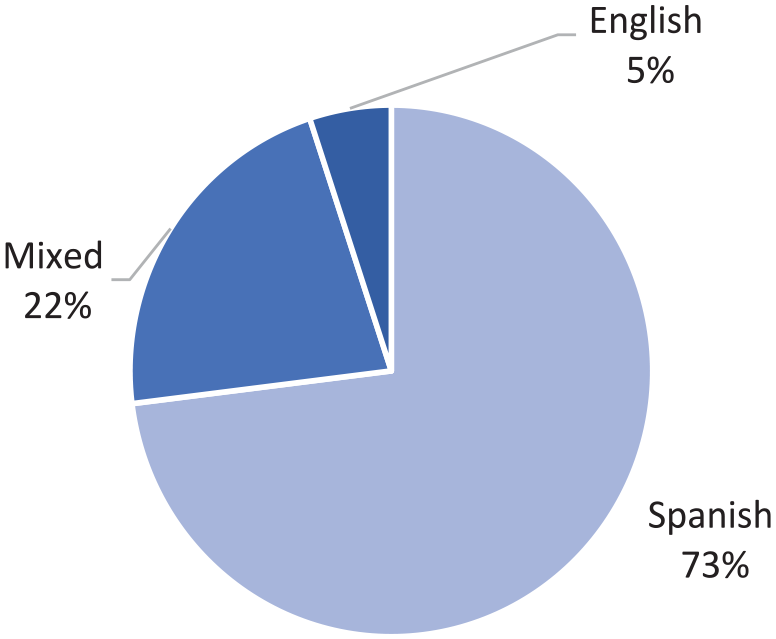
Distribution of songs (n = 178) by language used in the lyrics.
These balanced mixed songs deserve some attention. They include songs by other composers, “Open Up Your Heart” (Buck Owens and The Buckaroos, with Spanish and bilingual versions by Eduardo “Flaco” Jiménez, among others), and a version of “La cumbia vaquera” (Javier Molina). Villarreal’s original contributions, “Mis hermanos los soldados” (2014) and “No me importa” (2011), exhibit a traditional separation of languages by stanza. While the Spanish and English stanzas are not literal translations of each other, they echo similar ideas and sentiments. Thus, the first and second stanzas of “Mis hermanos los soldados” (Example 2) refer to unity and religion, while the third and fourth share references to family and community. However, these adaptations are also quite free, possibly to bypass the constraints imposed by meter and rhyme.
2. “Mis hermanos los soldados” (The Best of Nick Villarreal, 2014)
A mis hermanos los soldados
Yo les hice esta canción
Miren que estamos unidos
Rezándole al señor.
We the united people Of these United States We honor and respect you With all glory and God’s faith.
Sus padres se hacen fuertes
Por respeto y dolor
Que sus hijos estén peleando
Por su tierra con honor.
[. . .] All our mothers and friends, All our daughters and sons They ask you Holy Father, For your blessings evermore. “For my soldier brothers [and sisters] I made this song See that we are united praying to the Lord. [….] Their parents become strong Out of respect and grief Because their children are fighting For their land with honor.”
The examination of language use across time poses challenges. While the albums in our dataset include release dates, it is not always feasible to determine whether they are the first to feature specific songs. Nonetheless, Nick Villarreal’s first monolingual English tracks appear in Crossing Over (1995), a title hinting at an effort to reach beyond his Spanish-speaking audience.
The distribution of songs by language and topic is displayed in Figure 2. Love emerges as the most prominent theme, representing 36% (n = 64) of the songs, closely followed by songs about Women at 27% (n = 48) and Men at 16% (n = 28). The remaining 21% (n = 38) encompass several less frequent themes. An interesting disparity emerges when we compare the different repertoires in terms of the two most common themes, Love and Women: while Spanish love songs outnumber those about women, this trend is reversed in mixed-language lyrics.
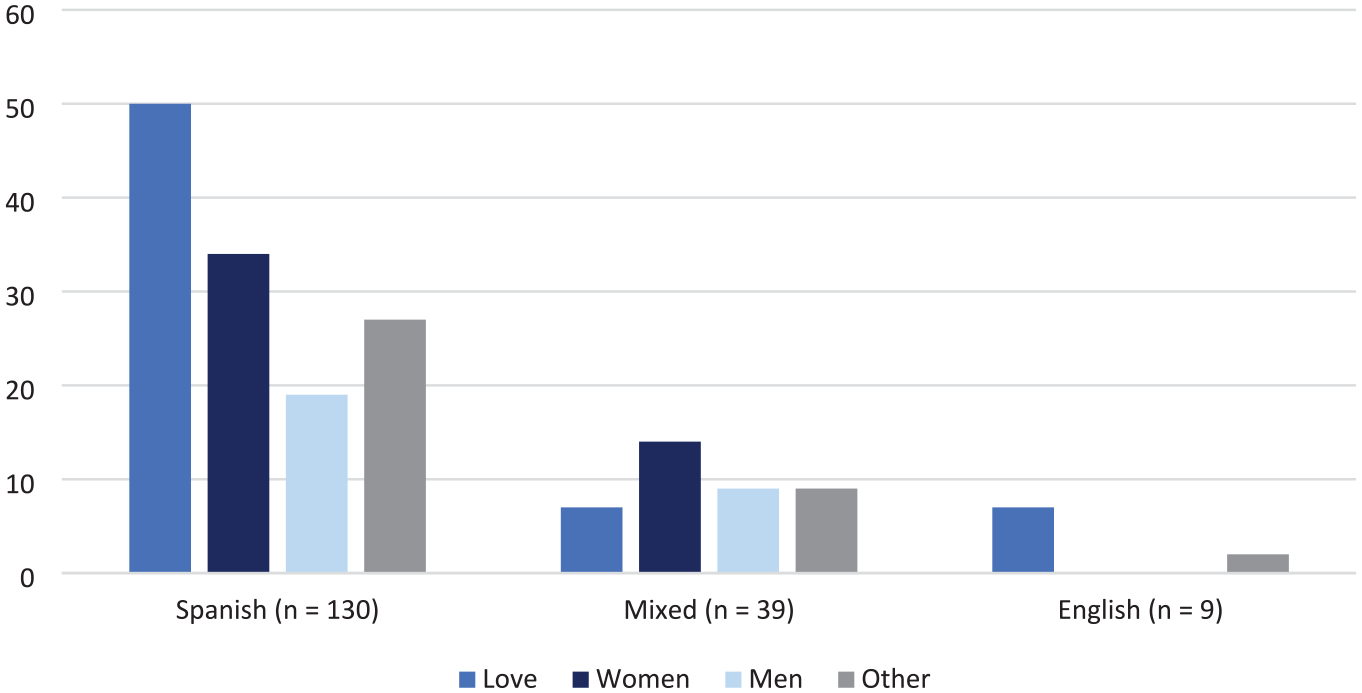
Distribution of song lyrics (n = 178) by language and theme.
Frequency and types of code-switching in Nick Villarreal’s songs
Our analysis reveals 146 individual instances of code-switching distributed across 39 mixed songs, with 128 non-repeated instances. The distribution of these unique code-switches by type is displayed in Figure 3. Lexical insertions emerge as the most prevalent type of code-switching, comprising 65% (n = 83) of all instances. In comparison, inter- and intra-sentential switches occur less frequently, accounting for 19% (n = 24) and 16% (n = 21) of all instances, respectively.
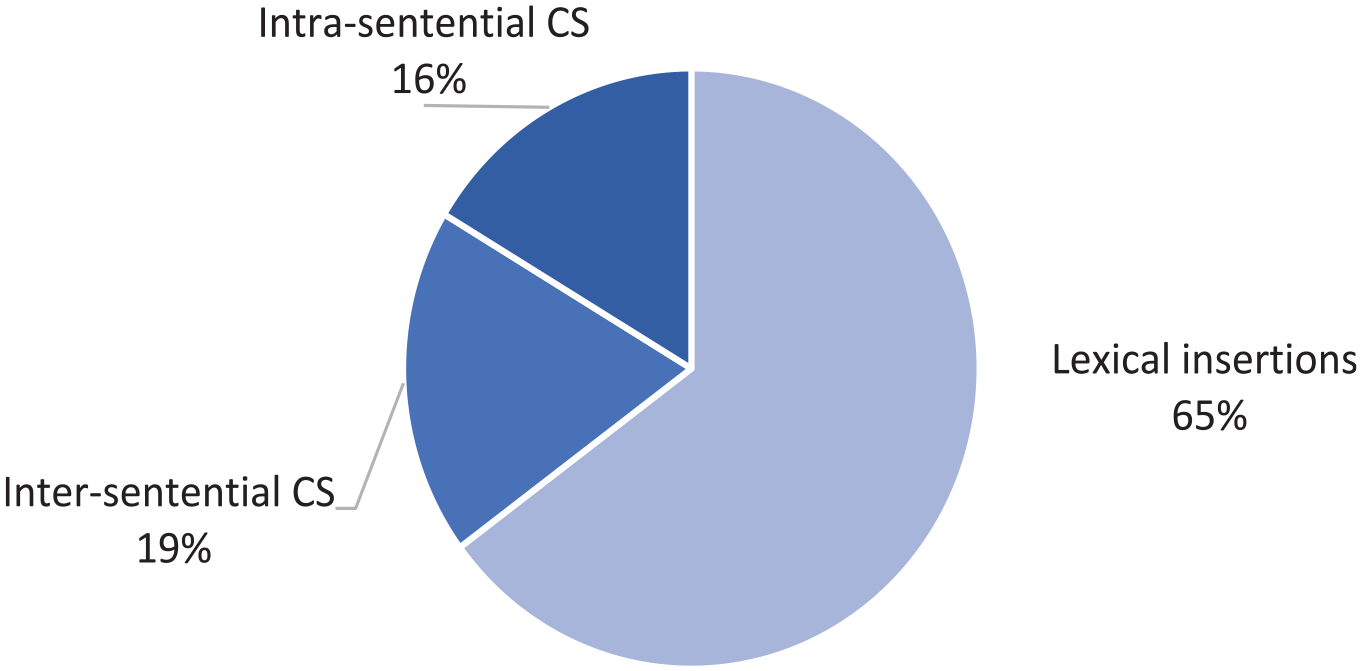
Non-repeated instances of code-switching (n = 128) by type.
Most lexical insertions (n = 71) are common and proper nouns, including nominal phrases (n = 19) that refer to or address male figures, sometimes celebrities (Mr. Clinton, Tiger Woods, [San Antonio Mayor] Henry Cisneros) and real or imaginary acquaintances (mi amigo Bart “my friend Bart,” compadre Dave “my buddy Dave”). Others refer to local placenames (Lubbock, Texas, Georgia), urban landmarks (Highway 90), commercial establishments (Stop-N-Go, Walmart, 7-Eleven), and abstract notions such as law enforcement (DA, 911) and federal programs (welfare, Medicare). Finally, a substantial portion of lexical insertions (n = 37) name everyday objects and entities, such as money, swimming pool, low rider, cigar, VCR, microwave, or six-pack, kinship relationships (brother, father, mother, sister, daddy), and vocatives (honey, man).
Some less common yet distinctive examples of lexical insertions showcase Villarreal’s linguistic creativity. These include nativized English proper names suffixed with the Spanish diminutive -ito to create terms of endearment (Richito, Koolaicito), and nominalized English verb phrases (mis excusemes). In addition, the doublet pronto y quick, an adverb with some currency in border vernacular Spanish, combines English and Spanish synonyms into a distinctive expression that appears frequently in the songs.
Most inter-sentential code-switching occurs into English and consists of independent clauses (9%, or n = 12), such as I don’t care and that I was always there (Example 3). The remaining instances of inter-sentential code-switching involve entire stanzas in English (Example 4).
3. “No me importa” (En bola con el presidente, 2011) Me dejaste for another No me importa I don’t care Tú bien sabes que te lavas Como ropa wash’n’wear [. . .] Tú supiste que te amaba
And that I was always there
Catch you later, alligator
No me importa, I don’t care “You left me for another I don’t care, I don’t care You know that you can be washed Like wash’n’wear clothes. [. . .] You knew I loved you And that I was always there Catch you later, alligator I don’t care, I don’t care.” 4. “El DA” (15 Éxitos, 1987) El DA muy tomado y yo también, I guess. Nos echaron al bote Richito tráeme un juez
We don’t know what to do
Me and Joe from the DA
We didn’t pass the test
Ahora sí nos trae la ley “The DA, very drunk And me too, I guess. We were thrown into jail Richito bring me a judge. [. . .] And now the law is after us.”
Intra-sentential code-switches account for 16% (n = 21) of the total instances. The majority (n = 16) involve English switches into a Spanish matrix; half of these are noun phrases, such as punching bag, my friend and my little darling. In addition, five instances consist of English verb phrases nominalized through the addition of Spanish definite articles. These verb phrases primarily describe female types (La I-gotta-go, La not-to-worry, La pass-it-around, La pick’n’pull [Example 5]), with occasional references to males (El I-used-to).
5. “La viejita pick’n’pull” (El mudo, 1997) Ahí viene la viejita le dicen la pick’n’pull se puso niquis niquis se cayó en el swimming pool “Here comes the old lady They call the pick’n’pull She got drunk [?], And fell in the swimming pool.”
Similar to inter-sentential code-switching, intra-sentential Spanish-into-English switching is rare in Villarreal’s lyrics. We identified only five instances, four of them found in cover versions.
Other language contact phenomena
While our study focuses on code-switching, other language contact phenomena in the mixed songs also present strong evidence of the fusion of Spanish and English linguistic and cultural elements. The most prevalent are nativized borrowings, that is, English words fully adapted to the phonology and morphology of Spanish. While it can be challenging to verify the common currency of such borrowings in the contact vernacular, several have been confirmed in sources such as the Diccionario de americanismos (RAE and ASALE, 2010) and the Diccionario de anglicismos del español estadounidense (Moreno Fernández, 2018). Some of these
2
include the diminutive troquita “little truck” [tɾo.'ki.ta] and puchón “(n) push” [pu.'tʃon] (Example 6), which replace camioneta or camión de carga and empujón respectively in the US contact vernacular.
6. “La troquita” (Qué situación, 1993) Mi troquita está tan linda Que por nada la cambiara Nomás le doy un puchón Y está bien acelerada. “My little truck is so beautiful I wouldn’t change it for anything I just need to give it a push And it goes at full speed.”
Structural or syntactic calques are also quite common in situations of language contact. In these, the lexemes combined are ostensibly in Spanish, but the resulting combination derives idiomatic meaning from a parallel English construction. For example, está en oficina “[he] is in office” applied to San Antonio Mayor Henry Cisneros (Example 7), and anda en agua caliente “[he] is in hot water,” a reference to the Clinton-Lewinski scandal (Example 8).
7. “Mr. Henry Cisneros” (Crossing Over, 1995) No se agüite, Don Cisneros Que San Anto le hace esquina Usted no es un cualquiera Por eso está en oficina. “Don’t worry, Mr. Cisneros You have San Antonio’s support You are not a nobody; That’s why you are in office.” 8. “El Sr. Presidente” (En bola con el presidente, 1995) El presidente, el presidente Anda en agua caliente El presidente, el presidente Es muy machito y no lo miente “The president, the president Is in hot water, The president, the president Is very brave and doesn’t hide it.”
In addition, we identified six instances where Villarreal code-switches at the phonological level without changing language or phrasal structure. We consider these phonological transfers to be stylistic uses of language (Gibson, 2011), as observed in other musicians such as the Texas Tornados (Loureiro-Rodríguez et al., 2018) and Lalo Guerrero (Moyna & Loureiro-Rodríguez, 2022), as well as in airline advertising campaigns (García Vizcaíno, 2011). For example, in “Así es la vida,” Villarreal pronounces the second syllable of amor [a.'moɾ] “love” with an elongated vowel and a retroflex English rhotic [a'mɘ:ɻ] (Example 9), while in “La Happy Hour” gas [gas] is produced as [ges] to rhyme with “guess” (Example 10).
9. “Así es la vida” (Parranda de oso negro, 1986) Así, así, así es el amor [a’mɘ:ɻ] Así vidita mía, así es el amor [a.’mor] “Like that, like that, love is like that Like that, my little darling, love is like that.” 10. “La Happy Hour” (La lotería, 1992) La Happy Hour no quiere cambiar Y ya el esposo la va a dejar Ella le dice ni modo, I guess! Esta es mi vida, ya dale gas [ges] “The Happy Hour doesn’t want to change And her husband is about to leave her She says ‘Too bad, I guess! This is my life, go ahead!”
Functions of code-switching in Nick Villarreal’s songs
Each of the 146 instances of code-switching was analyzed according to its function. As 40 switches fulfilled at least two different functions, each was counted and analyzed separately (see also Montes-Alcalá, 2015), resulting in 185 individual functions. For example, both Medicare and welfare fulfill referential and poetic functions (Example 11), as they denote federal entitlements for which there is no exact Spanish equivalent, while also adhering to the XAXA rhyme scheme of the stanza.
11. “El Sr. Presidente” (El Mudo, 1997) Gracias por sus votos volvió el Medicare no te acabes ni tú Clinton ni tampoco el welfare. “Thanks to his votes Medicare is back. I hope you Clinton never leave us and neither does welfare.”
The poetic function emerges as the most prevalent in our corpus, comprising 42% (n = 77) of all identified individual functions (Figure 4). Examples include creative nominalizations used to describe female types, as illustrated in Example 5, but most (n = 40) involve code-switching to meet metric or rhyming demands. This strategic use of code-switching underscores Villarreal’s linguistic and artistic versatility, demonstrating a deliberate effort to transcend the linguistic boundaries of a musical genre traditionally confined to Spanish.
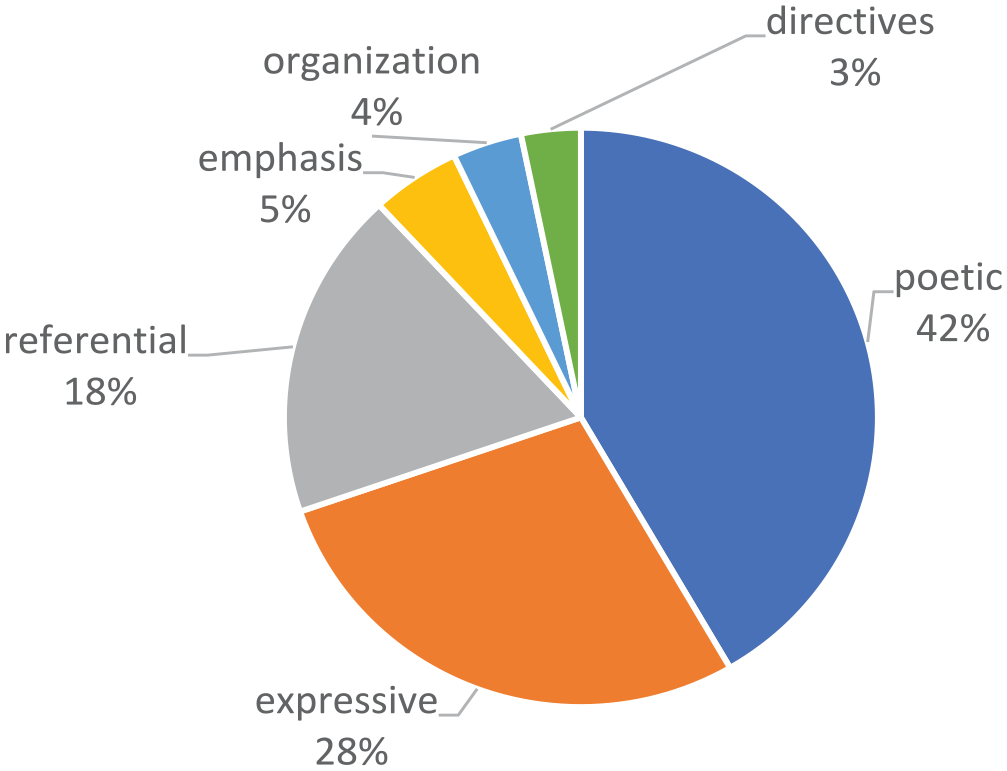
Distribution of functions of CS (n = 185).
The second most common function in our corpus is expressive (28%; n = 52). This involves code-switching used to localize the lyrics through references to local landmarks or people, highlighting and acknowledging the bilingual/bicultural spaces navigated by Nick Villarreal and his audience. For example, in a song ironically entitled “Bilingüe,” a working-class man unsuccessfully attempts to gain the trust of a girl’s family for marriage. To underscore his abilities, the narrator uses English rhymes in most of his verses (Example 12) and explicitly claims bilingual proficiency (me aviento el English y el Spanish “I speak English and Spanish”). However, his claims are undermined by exaggerated Spanish pronunciation (e.g., [e]spanish, [j]ohnny) and extensive use of vernacular borrowings, both nativized (wacha “watch,” bonche “bunch,” ponchar “to punch,” raite “ride,” pari “party”) and non-nativized (punching bag, face, baby, house, kisses).
12. “Bilingüe” (El enamorado, 1985) Ya sabes brother Que quiero a tu sister Pero tu mother Encandiló a tu father Fui punching bag Por el viejo por su daughter Y que me ha dado en todita mi grandmother (x2) Wacha cuñao La face que me ha dejado Por ese bonche que tienes como hermano Quiero a esa baby Yo rondaré su house Aunque me ponchen y me digan Mickey Mouse (x2) Dile a tu daddy Que tengo mucho money Llevo mi feria Por ver el hijo de su honey Y que me aviento el English y el Spanish Que en vez de Juan le voy a hablar de Johnny. “You know brother, That I love your sister, But your mother Has confused your father. I was a punching bag For the old man for his daughter And he hit me In my entire grandmother [= he beat me up] Look, brother-in-law, How he’s left my face Because of that fool That is your brother I love that baby I’ll be around your house Even if they hit me And they call me Mickey Mouse. Tell your daddy That I have a lot of money I’ll give my cash To see his daughter’s son. That I can speak Both English and Spanish And that instead of Juan I will call him Johnny.’’
Villarreal often uses English for concepts lacking direct equivalents in Spanish or more effectively conveyed in English due to cultural associations. These instances exemplify the referential function of code-switching, constituting 18% (n = 34) of the data. Example 11 illustrates this function, as do lexical insertions such as lowrider—a customized car with a lowered suspension and unique artistic designs associated with Mexican American culture—or Highway 90, a major road that crosses San Antonio.
The remaining tokens (12%, n = 22) fulfill a variety of functions. In some instances, code-switching reinforces an earlier idea or reflects the song’s emotional tone (n = 9), as seen in Example 2. In other cases, the alternation between Spanish and English stanzas aligns with structural breaks (n = 7), without additional emphasis or repetition. Finally, some occurrences (n = 6) involve code-switching to address an interlocutor.
Discussion and conclusion
Our analysis conclusively demonstrates that the prevailing language in Villarreal’s repertoire is Spanish, accounting for 93% of his songs. Among these, 73% are monolingual, while 20% have Spanish as matrix language. Songs in English are rare (5%, or n = 9), but the use of this language is highly salient and often taboo, as evinced by “meta-bilingual” comments in the patter (e.g., “too much English”). Finally, only 2% of the songs (n = 3) present English and Spanish in a balanced pattern, such as alternating stanzas. This underscores the profound influence of Villarreal’s socio-cultural background and the significance of Spanish as a means of artistic expression in conjunto music. Villarreal’s patterns of language use are reminiscent of those of Lalo Guerrero (Moyna & Loureiro-Rodríguez, 2022), an artist that preceded him by half a century, and quite different from his San Antonio contemporaries the Texas Tornados (Loureiro-Rodríguez et al., 2018), whose repertoire is predominantly composed of songs with English as matrix language. In fact, Villarreal consistently adheres to conjunto expectations throughout his repertoire and musical career. While there is evidence of attempts at crossing over into English, we lack sales data to gauge the impact of this strategy on the artist’s popularity.
Code-switching appears in 22% (n = 39) of Villarreal’s lyrics. Of these instances, the most prevalent are English lexical insertions (65%), primarily consisting of proper and common nouns, occasionally including other categories such as adjectives and verbs nativized through morphological adaptation. Intra- and inter-sentential switches, mostly noun phrases and clauses, are less common (35%). The higher frequencies of code-switched nouns and noun phrases in Villarreal’s lyrics resemble the syntactic patterns found in bilingual written literary texts (Callahan, 2004, p. 48) and oral code-switching (Pfaff, 1979; Poplack, 1980). Similarly, nouns are among the most commonly switched categories in the lyrics of the Texas Tornados (Loureiro-Rodríguez et al., 2018) and Lalo Guerrero (Moyna & Loureiro-Rodríguez, 2022), as well as in the 1980s–1990s rap songs analyzed by Balam and Shelton (2023), although these rappers favor switching from English into Spanish.
Other stylistic strategies employed by Villarreal to represent bilingualism do not imply an alternation between languages, but rather, hybridization for comedic purposes. In the case of accented speech, Villarreal overlays one language with the stereotypical phonetic features of the other, a technique also used by musicians like Lalo Guerrero (Moyna & Loureiro-Rodríguez, 2022) and the Texas Tornados (Loureiro-Rodríguez et al., 2018), and bilingual stand-up comedians, such as Eugenio (Woolard, 1998) and George López (Wells, 2011). Villarreal’s unique code-switching strategies include bilingual nicknaming practices, as well as references and appeals to fictional friends identified by first name or nickname. Villarreal exploited his most popular songs by producing different versions to update their cultural and situational references, sometimes making intertextual references across songs to enhance realism. For example, la Not-to-Worry and la I-Gotta-Go, who appear in different songs, turn out to be friends in the fictitious San Antonio of Villarreal’s imagination.
Turning to the main functions of code-switching in Villarreal’s lyrics, we find that the most prevalent is the poetic function, which encompasses stylistic uses of language such as rhyming and humorous creativity. Such use of code-switching aligns Nick Villarreal with Spanish-English bilingual poets (Montes-Alcalá, 2015). The expressive and referential functions are the second and third most common in Villarreal’s lyrics, and serve to articulate concepts inherent to US culture, localize the lyrics, and index a shared bilingual/bicultural identity between the artist and his audience. These functions are consistent with the prevalent type identified in bilingual texts (cultural switches in Montes-Alcalá, 2015), and recur in multilingual lyrics within the global hip-hop scene (Omoniyi, 2009; Sarkar & Winer, 2006).
It should be noted that the three abovementioned functions of Villarreal’s code-switching—poetic, expressive, referential—set him apart from Pitbull, who primarily employs it for emphasis and translation (Loureiro-Rodríguez, 2017). The presence of translation, in particular, seems to be linked to the needs of the target audience: while Villarreal can be quite certain of the bilingual abilities of his San Antonio listeners, Pitbull and other national and international artists cannot make similar assumptions. Villarreal’s work also deviates from that of other bilingual artists in that switching languages to address an interlocutor is infrequent in his lyrics, while directives represent one of the most prevalent uses of code-switching in Pitbull (Loureiro-Rodríguez, 2017), and they are also frequent in literary texts (Callahan, 2004).
While isolating code-switching instances in song lyrics is essential for understanding their structure and functions, this narrow focus may inadvertently overlook the fact that this practice intertwines with other features in linguistic stylization. Nick Villarreal adeptly conveys authenticity by leveraging various linguistic resources, which are enregistered (Agha, 2003) or exhibit higher-order indexicality (Silverstein, 2003) within the Mexican American community. Thus, code-switching serves as a marker for Spanish-English US bilinguals, while the inclusion of caló, particularly evident in his stage patter and certain songs (e.g., “El árabe y el camello” “The Arab and the Camel”), indexes a pachuco counterculture that further localizes Villarreal’s performance and sets him apart from the mainstream. Furthermore, his songs incorporate rural, working-class Mexican Spanish phonetic features, such as the neutralization of mid and high vowels (pol
Nick Villarreal crafts an authentic persona that resonates with his audience through the combination of all these enregistered linguistic sources, alongside locally meaningful instrumentation such as the accordion, and sartorial choices associated with traditional southwestern US culture (e.g., he often wears a cowboy hat and a guayabera, a traditional men’s shirt worn untucked and popular throughout Latin America and the Caribbean). Villarreal actively engages in stylizing the local to evoke a sense of authenticity (Bell & Gibson, 2011; Coupland, 2009), a practice that has parallels in artists across diverse genres and contexts, such as Caribbean icon Rihanna (Jansen & Westphal, 2017), British indie band Arctic Monkeys (Beal, 2009), and Australian hip-hop artists (O’Hanlon, 2006). Through the strategic use of linguistic tools familiar to his audience, Nick Villarreal champions local values and showcases pride in his regional and sociocultural roots, forging strong connections with his audience through a strategy of stylization known as audience design (Bell, 1984, 2001).
Ultimately, Nick Villarreal mixes languages and varieties because he can, in a display of lyrical virtuosity. In so doing, he not only shows solidarity with an audience that shares his bicultural/bilingual experience but also legitimizes the use of a stigmatized linguistic practice (Anderson & Toribio, 2007). This fulfills two main purposes. First, it aligns Villarreal’s songs to conjunto and thus draws symbolic power from the working-class and rural values that anchor Mexican American life in the United States, including the use of Spanish (Peña, 1985). Second, it has crossover appeal among upwardly mobile second-generation Mexican Americans by referencing Anglo culture while simultaneously affirming cultural loyalty. Nick Villarreal is thus a fascinating example of the intersection between language representation, class allegiance, linguistic attitudes, and cultural stance.
Footnotes
Authors’ note
We are deeply grateful to the editor, Ad Backus, for invaluable assistance in refining this manuscript and thoughtful suggestions and observations, which have significantly enhanced the quality of our work. We extend our thanks to the attendees who provided feedback at the Linguistic Association of the Southwest 2022 Conference in Cleveland, Ohio, the Third International Symposium on Language Attitudes toward Portuguese, Spanish and Related Languages 2022, online, and the Spanish in the United States 2023 Conference in Dallas, Texas.
Declaration of conflicting interests
The author(s) declared no potential conflicts of interest with respect to the research, authorship, and/or publication of this article.
Funding
This work was partially funded by a Faculty Research Fellowship awarded to the second author in 2018 by the Melbern C. Glasscock Center for Humanities Research, Texas A&M University.
