




Abstract
Background:
Earlier studies have shown that parents may adopt various discourse strategies in response to children’s language mixing, which vary in the extent to which they encourage their child to speak a certain language. Specifically, when the child switches to another language during a conversation, parents may pretend not to understand the child, encourage the child to speak the original language of the conversation, or codeswitch to the other language. Existing work has typically studied the use of such discourse strategies through observations in case studies and focused mostly on child language outcomes.
Aims:
The aims of the current study are to examine (1) what discourse strategies parents use, (2) why they use them, and (3) how their use of these strategies relates to beliefs about child-rearing and attitudes towards multilingualism.
Method and results:
Qualitative data were collected through interviews with eight parents of multilingual children in the Netherlands. The results show that parents largely used strategies that encourage children to maintain the language of conversation, without putting too much pressure on the child. Parents’ reasons for using each of the strategies were diverse and related to, among others, parents’ ideologies about multilingual parenting and impact belief, children’s age, and the circumstances of the situation, such as the presence of other people and the child’s physical or emotional state.
Conclusion:
Taken together, these findings indicate that parents’ choice of strategies depends on a variety of psychological and contextual factors. As such, the findings provide a starting point for future more in-depth studies on how parents socialize their children to become multilingual language users.
A common characteristic of the language use of children who are raised multilingually is codeswitching or language mixing, which occurs when two languages are used within one conversation or within one utterance (Poplack, 1981). Earlier work has shown that parents may respond in different ways if children switch to another language in a conversation. They may, for example, signal that they do not understand their child or encourage them to speak the original language of the conversation (Lanza, 1992, 1997/2004). Lanza (1997/2004) described the ways in which parents may react to children’s codeswitching, and labelled these ‘parental discourse strategies’. Previous work into these strategies has largely examined what strategies parents use through case studies of a few children, mainly focusing on how parents’ strategies are related to children’s mixing rates and their language development (Juan-Garau & Pérez-Vidal, 2001; Lanza, 2007; Lomeu Gomes, 2022; Mishina, 1999). Since Lanza’s (1997/2004) work, the field of family language policy has shifted to the construction and negotiation of family language policy (King, 2016). What has received relatively little attention is why parents use specific discourse strategies and how their use of these strategies relates to their more general ideas about multilingual language development and multilingual upbringing. The current study analyzes interview data from parents in multilingual families, to examine what discourse strategies parents use, why they use these strategies, and how their strategy use relates to their beliefs about multilingual child-rearing and development.
Language mixing has been described as a communicative resource that displays a multilingual person’s sensitivity to formal as well as functional aspects of the languages they are using (e.g., Poplack, 1981). This flexible language use has also been discussed in terms of translanguaging. Translanguaging is a polysemic term, but it generally entails the dynamic and fluid use of communicative resources (García & Wei, 2014; Wei, 2018). The term comes with its own set of theoretical assumptions, for example, that multilingual speakers use one communicative repertoire that goes beyond language boundaries (García & Wei, 2014; Wei, 2018). This makes it less applicable to our context, as multilingual parents and children often establish and negotiate their family language policies based on perceived language boundaries, as discussed below. Moreover, the term is often used in school contexts, and its use in heritage and minority language settings is contested (De Meulder et al., 2019; Jaspers, 2018). For these reasons, we have decided to use the terms language mixing and codeswitching in this paper. Genesee and colleagues (1995, 1996) found that multilingual children as young as 2 years used more of each parent’s preferred language when talking to them and were able to identify and accommodate the linguistic preference of an unfamiliar interlocutor. These findings suggest that, from a very young age onward, multilingual children can keep track of the languages people around them are using and adapt their language use to the linguistic preferences of their interlocutors (De Houwer, 2018).
However, multilingual children may sometimes select a language that is not the preferred language of their interlocutor. Lanza (1992, 1997/2004) examined in detail how parents responded when their child spoke a dispreferred language, yielding a number of ‘parental discourse strategies’ that were initially described in Lanza (1992), based on earlier work by Ochs (1988), and later elaborated on in Lanza (1997/2004, 2007). These discourse strategies partially resemble Döpke’s (1992) ‘insisting strategies’, four of which concerned parents’ attempts to encourage their child’s use of a particular language in a more or less insisting manner (see Döpke, 1992 for more details). Lanza’s (1992, 1997/2004) parental discourse strategies belong to the cornerstones of the field of family language policy that studies how languages are learned, managed, and negotiated in individual families (Curdt-Christiansen, 2018; King, 2018; King & Fogle, 2006; Lanza & Lomeu Gomes, 2020; Schwartz, 2010). Table 1 presents an overview of the proposed strategies.
Parental discourse strategies in response to children’s language mixing.
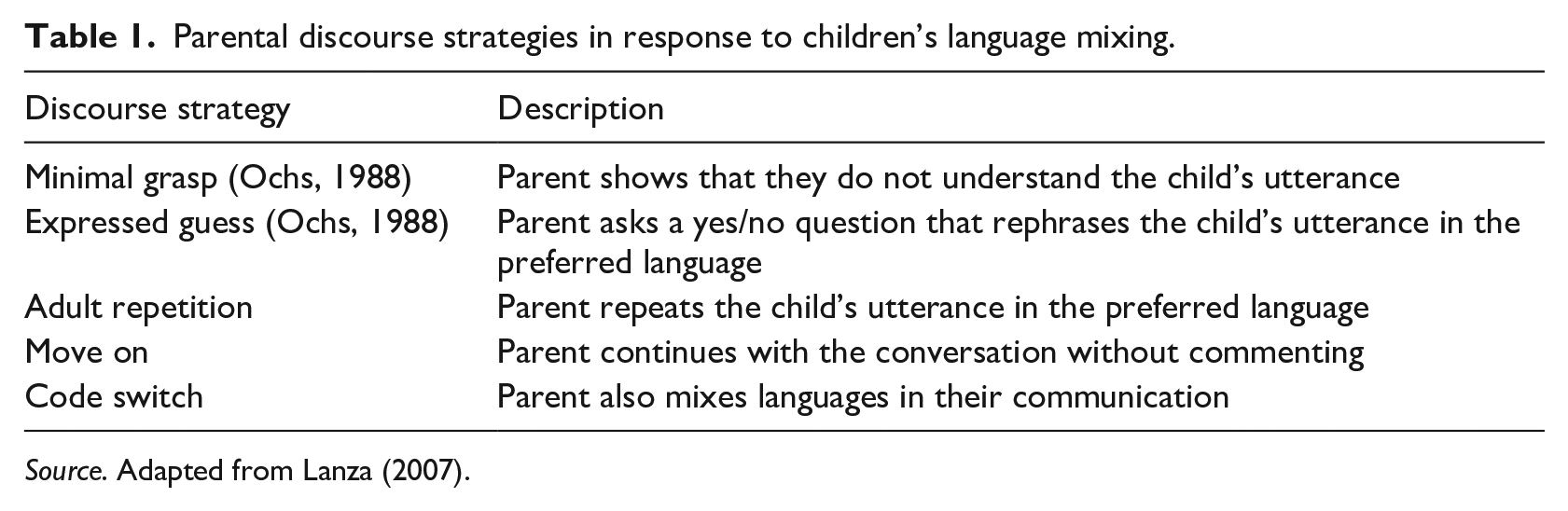
Source. Adapted from Lanza (2007).
The degree to which these strategies signal parents’ approval of the use of the other language increases from the first to the last strategy. ‘Minimal grasp’ is the most restrictive strategy in that it limits communication to a single language and signals to the child that another language is not accepted in the interaction. ‘Expressed guess’ is similarly restrictive but more tolerant to multilingualism, as it communicates to the child the parent’s wish for the use of a particular language while at the same time revealing the parent’s multilingual status, since the parent seems to grasp what the child wishes to express. In ‘adult repetition’, the parent repeats the child’s utterance in the preferred language, revealing a more open approach to language mixing: an alternative response is provided without interrupting the flow of communication. Still, it is stricter than the ‘move on’ strategy which negotiates an open attitude to multilingual communication, conveying the (implicit) message that mixing two languages in speech is both comprehensible and acceptable. Finally, in ‘codeswitching’, the parent switches to the child’s language, too. This establishes that mixing languages is permitted or perhaps even encouraged. While Lanza (1992, 1997/2004, 2007) originally described these discourse strategies in her studies of young children, they have also been found to apply to children of school age (see De Houwer & Nakamura, 2021 for a review). In fact, in a review of earlier studies on children aged 1 to 12 years, De Houwer and Nakamura (2021) concluded that Lanza’s parental discourse strategies can promote active bilingualism in both younger and older children.
Rather than on language outcomes, research on family language policy has focused on the factors that drive parent–child language interactions and negotiations (King, 2016). These factors play a role at different levels, and may be related to parents’ identity (Gharibi & Mirvahedi, 2021), connection to the home country (Gharibi & Mirvahedi, 2021; Wang, 2023), family ties and values (Wang, 2023), children’s language attitudes (Braun & Cline, 2010), child agency and attitudes (Kheirkhah & Cekaite, 2015; Little, 2023; Okita, 2002), emotions (De Houwer, 2020; Sevinç, 2020), home-external factors (Gharibi & Mirvahedi, 2021), children’s proficiency (Little, 2023; Wilson, 2021), parental language awareness and belief (Curdt-Christiansen, 2009; De Houwer & Nakamura, 2021), and parental styles (Curdt-Christiansen, 2009; De Houwer & Nakamura, 2021). Often, these factors may interact (De Houwer & Nakamura, 2021). Also, it is important to realize that family language choices and practices do not always involve conscious decisions on the part of the parents (Lanza, 1992, 2007), but may be related to parents’ proficiency levels (Barron-Hauwaert, 2004; Gharibi & Mirvahedi, 2021; Verhagen et al., 2022).
Building from Spolsky’s (2009) model of language policy, Curdt-Christiansen (2009) constructed a dynamic model of family language policy (see Figure 1). This model includes many of the factors listed above, and shows that family language interventions and practices are shaped by language ideologies, as well as internal factors (related to emotions, identity, family values, impact belief, child agency) and external factors (political, socio-cultural, economic, sociolinguistic factors).
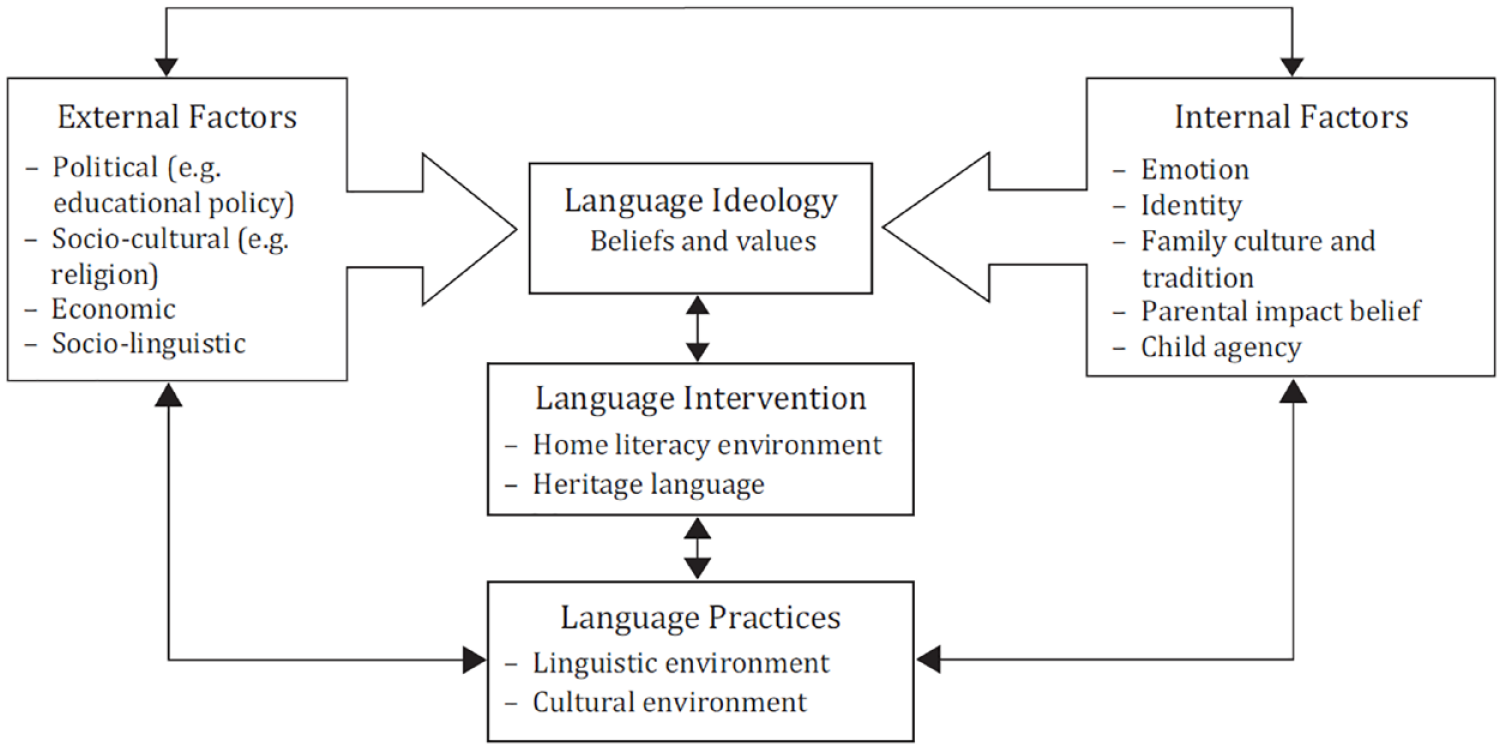
Dynamic model of family language policy (adapted from Curdt-Christiansen, 2009; Spolsky, 2009).
As shown in this figure, language policies in multilingual families are shaped, among others, by language ideologies – beliefs about the structure, acquisition, and use of languages in the world (Woolard, 2020). Multilingual language ideologies are often influenced by parents’ wish to instil cultural values, foster cultural and familial ties, and encourage multilingual development, and by their sense of identity (Curdt-Christiansen, 2018; Lanza, 2007). Language practices in the family are also influenced by family-internal factors, both directly and indirectly (through language ideologies), such as emotions, feelings of identity, and family values and traditions. Parents’ own experiences with multilingualism are known to play a role, too: for instance, parents’ decision to introduce to their child another language at an early age or to insist on the use of a particular language may be linked to their belief that their child will acquire the different languages as naturally as they did (King & Fogle, 2006). Finally, family policy can be influenced by societal beliefs on multilingualism and multilingual upbringing, again both directly and indirectly (through language ideologies). Although multilingualism is increasingly being valued, and multilingual parenting has now become a commonplace ‘trend’ in some western societies (Luk, 2017; Wilson, 2021), parents are still often met with contradicting ideologies about the language policies they should adopt at home (Kirsch, 2012), which are sometimes tied to the prestige of the languages spoken (Ellis et al., 2010). Moreover, family language policy is closely connected to ideologies about ‘good parenting’ (King & Fogle, 2006). For instance, parents might feel an emotional burden trying to transmit the home language while being ‘a good parent’ for their child and helping the child meet societal expectations (Okita, 2002). Thus, a variety of factors play a role in shaping parents’ language ideologies, including factors at the internal or family level (e.g., parents’ knowledge, experience, emotions, sense of identity) and at the external – often societal – level (e.g., language prestige).
How and to what extent parents translate their language ideologies into concrete behaviours may depend – at least in part – on impact belief, that is, their belief that they can affect their children’s language development (De Houwer, 1999). Parents with a strong impact belief are confident that their own language use directly affects that of their children, whereas parents with a weaker impact belief assume that they have little or no control over their children’s language development. In case of high impact belief, parental ideologies could translate into family language policy – the language ‘rules’ or patterns that are implicitly or explicitly put in place (King et al., 2008; Romaine, 1995). In a qualitative analysis of interview data from eight English-speaking parents in Japan, Nakamura (2019) found that parents showed strong impact beliefs that were influenced by four factors: their individual experiences, spousal support, peer influence, and community influence (e.g., through English playgroups).
Yet, parents are not the sole actors and discourse is not produced by parents with children as passive recipients; rather, communication is shaped by both parties (Genesee, 1989; Said & Zhu, 2019; Tuominen, 1999). In fact, earlier work has shown that children are well capable of negotiating their preferred language in communication, already from a young age onward (Gafaranga, 2010; Little, 2023; Slavkov, 2015). Slavkov (2015) observed, for example, that a 2-year-old girl resisted her father’s strategies of requesting a translation by moving on, not switching languages, and showing negative feelings. Because of this, her father started using the move on strategy, so as to provide input in the home language, but not ask for a response from his child. This finding also illustrates that family language policy can directly impact emotional harmony in the child, and consequently in the family (De Houwer, 2015; Kopeliovich, 2013), and that children’s emotions and agency, in turn, might impact parents’ discourse strategies.
To date, earlier studies on parents’ use of discourse strategies (as defined by Lanza, 1992, 2007) have not focused on their language ideologies and impact belief. Rather, the focus was on the strategies that parents used and how these related to their children’s language use and proficiency (King, 2016; see De Houwer & Nakamura, 2021 for a review). Many of these studies suggest that children are sensitive to and adapt their language use to the strategies used (for a review, see De Houwer & Nakamura, 2021). In a longitudinal observation study of an English-Japanese child (aged 1;10 to 2;2), for example, Mishina (1999) found that the child mixed languages less with his monolingual English father who mainly used the minimal grasp strategy than with his bilingual mother who used less restrictive strategies and frequently codeswitched herself when interacting with her child. Juan-Garau and Pérez-Vidal (2001) observed a Catalan-English child from 1;3 to 4;2 years and found that the child showed a sharp decline in language mixing after his father had begun using more restrictive strategies around the age of 3;0. His father’s change in strategy was triggered by a trip to England, and it was followed by a sharp increase in the child’s proficiency in English and a drop in language mixing, which encouraged the father to maintain the use of restrictive strategies. The authors argued that the father and son jointly created a new conversational context in which the key rule was to use only English. Crucially, a certain level of proficiency on the part of the children is needed to bring about such a change.
Not all previous studies found that children adapted their language use in response to their parents’ strategies, however. In an observational study of five French-English families in Montreal with children aged 2;0 to 2;6 years, Nicoladis and Genesee (1998) found abundant codeswitching by children (in about 70% of their utterances), regardless of the discourse strategies used by their parents. In fact, in this study, codeswitching was most frequent in response to the most stringent strategy: minimal grasp (90%). The authors attributed their findings to the specifics of the sociolinguistic context, namely, Montreal being highly bilingual and the parents having at least some proficiency in the other language. However, for a much less bilingual context, Lomeu Gomes (2022) obtained very similar findings: a Portuguese-Norwegian child (3;0 years) in Norway did not produce more Portuguese in response to explicit and restrictive strategies such as requests for translation (see Meng & Miyamoto, 2012 for similar results). The author argued that more tolerant strategies that only implicitly serve as requests to use a particular language might encourage children more to use their weaker language than less tolerant strategies.
Taken together, earlier studies show that family language policies often follow from language ideologies that are based on a conglomerate of factors that can be family-internal (e.g., family values, child agency) or family-external (e.g., political, economic). Parental discourse strategies, as an important part of family language policy, have been shown to be an effective way to foster children to speak a particular language (De Houwer & Nakamura, 2021): earlier studies indicated that children show increased use of parents’ preferred language and less codeswitching when parents’ discourse strategies are more restrictive (Juan-Garau & Pérez-Vidal, 2001; Mishina, 1999). Yet, other studies have found that children might maintain their use of parents’ dispreferred language in response to these strategies, perhaps especially if the larger context is highly bilingual and if their parents understand this language (Nicoladis & Genesee, 1998) or because of individual characteristics of the child related to their sense of agency and proficiency level (Lomeu Gomes, 2022). Interestingly, parental discourse strategies have not received much attention within the field of family language policy (see also De Houwer & Nakamura, 2021 for this claim). Since Lanza’s (1997/2004) work, the field of family language policy research has moved on to focus on the construction and negotiation of family language policies and practices (King, 2016), but discourse strategies have not yet been studied through this lens. Hence, what is currently unknown is why parents opt for certain discourse strategies and how parents’ strategy use relates to their language ideologies and impact belief. The aim of the current study is to address these issues.
This study
We investigated data from parents in multilingual families in the Netherlands, to address three research questions:
What discourse strategies do parents report using?
What are the reasons they give for using these strategies?
How is parents’ use of these strategies related to their impact belief and ideas about multilingual development?
These questions were investigated through a qualitative research design, via interviews. A constructivist approach to grounded theory was taken, in which the researcher sets out with as few assumptions and preformed notions as possible (Glaser & Strauss, 1967). Thus, no hypotheses were formulated for the above questions.
Method
Participants
The participants were 10 parents, each from a different family with multilingual children. Two participants were excluded: one because she had children who had reached adulthood, and thus were considerably older than the other children in the study, and another because she conducted research on language acquisition herself. The ages of the parents in the final sample ranged between 29 and 57 years and the children’s ages ranged between 1 year 5 months and 11 years old. Note that six of the children were relatively young, ranging between 1;5 and 3;6 years, and prior to school age (age 4 in the Netherlands), the remaining two were much older, 8 and 11 years. This overrepresentation of younger children and the absence of children in middle childhood were the outcomes of our sampling method (posts on social media and professional network platforms) rather than an a priori choice. Five mothers and three fathers participated. Of all parents, seven had completed higher education. Half of the parents reported being raised multilingually themselves. All parents in the sample had one child, with two exceptions: Nick, who had twins, and Sherry, who had another daughter who was too young to speak. All families had resided in the Netherlands for at least 2 years at the time of data collection. Table 2 presents a more detailed profile of all participants.
Characteristics of the participating parents.
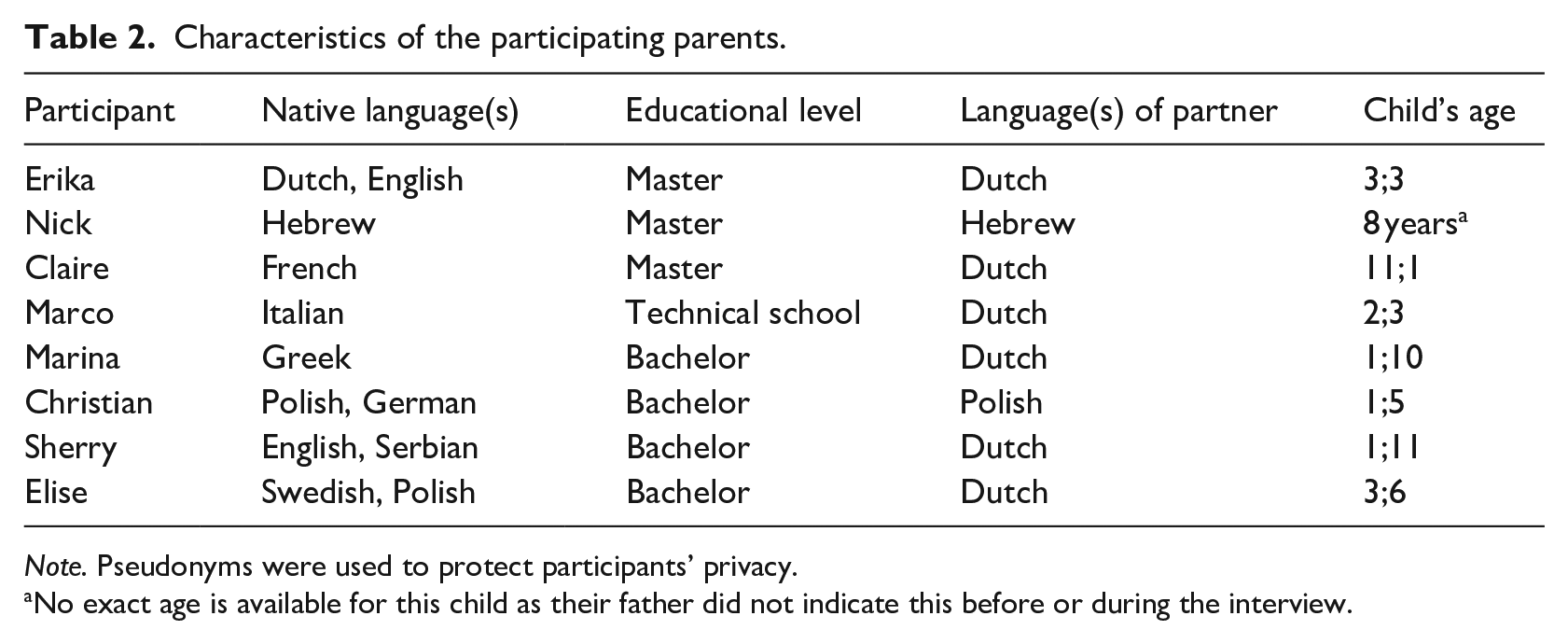
Note. Pseudonyms were used to protect participants’ privacy.
No exact age is available for this child as their father did not indicate this before or during the interview.
Each participant provided written informed consent prior to taking part. The study was approved by the Ethics Committee of the Faculty of Humanities of the University of Amsterdam.
Materials
Online surveys
An online survey was created through the software Qualtrics (Qualtrics, Provo, UT), and shared with the participants prior to the interview. The survey assessed the language(s) that the participants and their partners spoke with their children, the frequency of occurrence of language mixing in their family, as well as biographic information such as the participants’ and children’s ages. By collecting this information through a survey preceding the interview, we were able to obtain the relevant characteristics of participants’ family and language backgrounds in an efficient manner and focus the actual interview on the topic of interest: parents’ practices and ideologies.
Interviews
Following the survey, participants were asked whether they wanted to do the interview at their home, another place (such as a quiet cafe), or via the video call software Zoom. All participants opted for the third option, so all interviews were conducted via Zoom by the first author. The interviews were semi-structured: there were 20 questions asked to all participants, with the researcher also asking follow-up questions specific to each participant’s case (see Appendix A for the interview guide). To make sure that participants felt understood and at ease during the interview and to decrease social desirability bias, we adopted several measures. First, the researcher avoided formal vocabulary and scientific terms where possible, to increase parents’ understanding and to make them feel at ease during the interview. Second, throughout the interview, equal consideration was given to all possible answers and the questions were formulated so as to minimize social desirability bias as much as possible (Holmes & Hazen, 2013). Specifically, formulations of the following type were used: ‘Some parents I have spoken to mentioned X, but then I also had some other parents tell me that they noticed Y. Can you tell me what is closer to your experience?’ (Bergen & Labonté, 2020). Parents were asked to elaborate on their answers by asking, ‘You mentioned X. What was that like for you?’ or ‘How do you feel about Y?’ Finally, during parents’ responses, the researcher encouraged parents to share their ideas and acknowledged these by using affirmative body language. This included nodding in assent, smiling, and keeping a relaxed body posture while listening actively, and showing agreement with their responses by uttering ‘yeah’ or ‘mmm’. Finally, parents were told explicitly that there were no right or wrong answers.
To make sure that parents understood the discourse strategies, parents were shown concrete examples of strategies. Also, examples were given of examples or situations, using the parents’ own language. For example, in the case of Marco, who was from a Dutch-Italian family, the researcher would say, ‘So, your daughter might say something like “Het hondje non c’è” [The dog is not here]’ and you, as a parent, might then show you do not understand by saying, ‘Oh, you mean il cane non c’è’. They were also told that the list of strategies was not exhaustive and that they could add their own.
With one exception, all interviews were conducted in English, which was the strongest, or the only possible, language for most of the parents, and all parents regularly used English in their daily lives. Automatic transcription was used during each interview. An exception to this was an interview in Greek (based on the parent’s preference stated in initial communication) that was transcribed by the first author. Interviews lasted between 40 and 50 minutes. Parents were given a coffee voucher as a small token of appreciation for their participation.
Coding
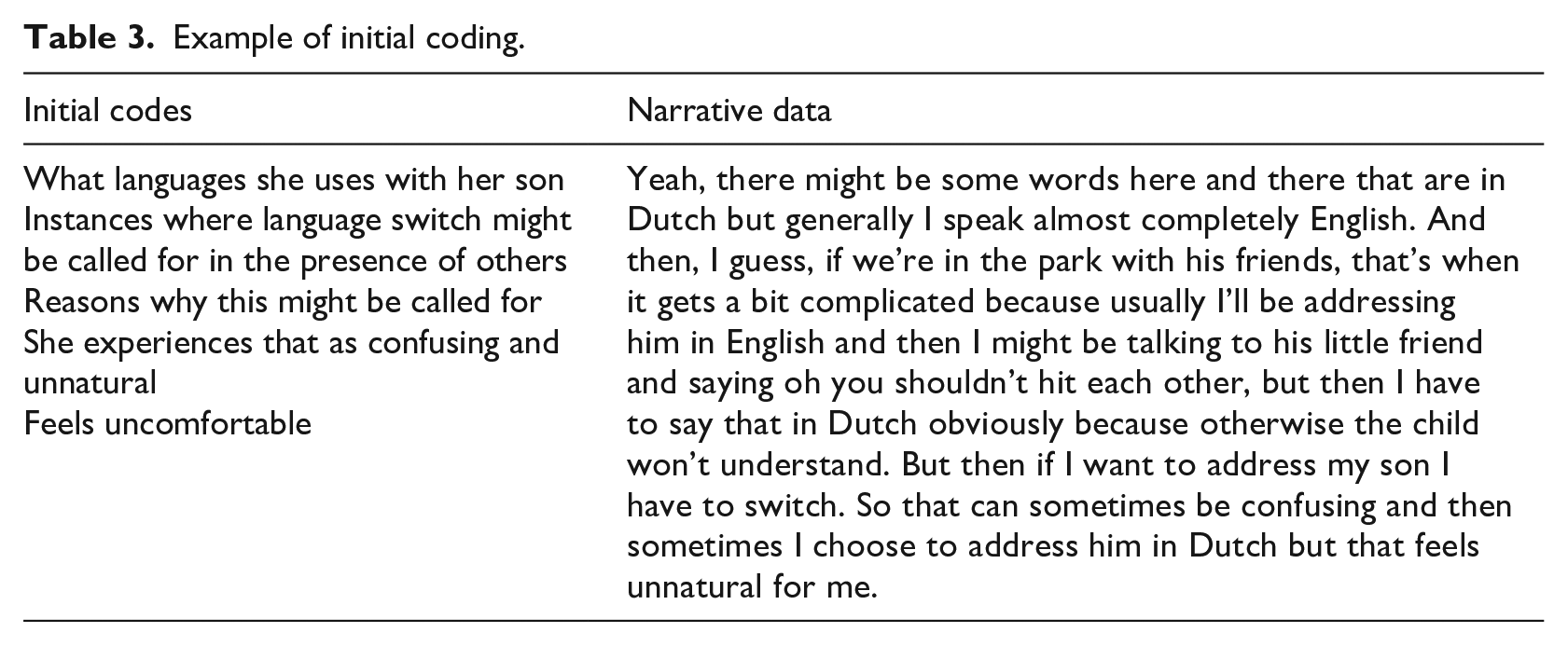
As a first step, line-by-line coding of the data was performed, following Charmaz (2000, 2014). This coding, which is illustrated in Table 3, closely followed the narrative data, but provided a more compact and overall description of what participants expressed.
Example of initial coding.
These initial codes were further reduced in the second stage of coding, through focused coding (Nakamura, 2019). An example of this can be seen in Table 4.
Example of focused coding.
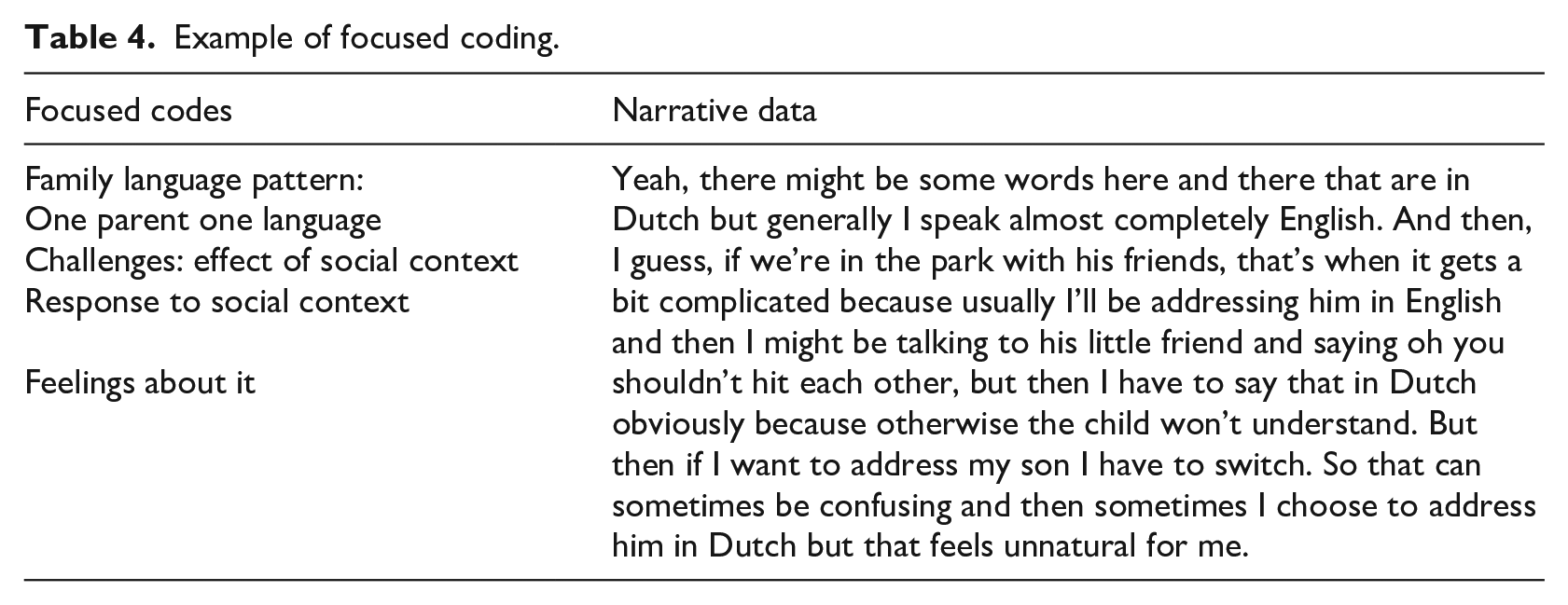
Participants’ codes were compared and, if similar in theme, placed within the same cluster. In case different themes emerged from the data, new clusters were created. These clusters were subsequently sorted into thematic categories such as self-reported use of discourse strategies, notions about multilingualism, and child-rearing and language ideology. In a final stage, the focused codes were placed under the thematic categories they were understood to fit, such as ‘language ideologies’ or ‘ideas about good parenting’. The researcher then compared themes and provided links to relevant theories, which concluded the third stage of the coding process. All coding was done by the first author.
Results
As indicated earlier, we investigated three questions: (1) What discourse strategies are reported by parents in multilingual families? (2) What are the reasons parents give for using these discourse strategies? And, (3) how is parents’ use of these strategies related to their impact belief and ideas about multilingual development? The results for these three questions will be presented in turn below.
Discourse strategies in multilingual families
All eight parents indicated using more than one discourse strategy, and some strategies were reported more often than others. All parents expressed that they used adult repetition, while expressed guess, move on, and codeswitch were each mentioned by five parents. Minimal grasp was reported by two participants. Four parents explained that they also directly asked their child to translate, which was not included in the list with discourse strategies they were shown.
Motivations for using discourse strategies
The reasons parents provided for using each discourse strategy were as diverse as the situations of each family. Nevertheless, there are some common themes that emerged in the interviews. These are presented below for each strategy separately, starting with the most restricting strategy (minimal grasp) to the least restricting strategy (codeswitching).
Minimal grasp
The intentional use of minimal grasp, a strategy in which parents pretend not to understand the child when they switch to another language, was perceived by all parents as very restrictive and, perhaps due to this, as more effective at encouraging balanced bilingualism than the other strategies. During the interview, Marina, who was concerned about her daughter being more dominant in Dutch, mentioned that she would like to start using the minimal grasp strategy, because she found it a good way to encourage her daughter to speak more Greek. Many parents, however, also thought that it may potentially put a strain on their communication with the child. Six parents reported that they saw no use for it, as they could understand their child’s utterance in the other language. More specifically, Erika reported feeling that feigning not to understand was ‘a bit unfair’, especially because she did understand her child. Similarly, Elsie felt that the minimal grasp strategy was unnecessary, since she indicated that her daughter is ‘not stubborn like that’ and eager to talk; it is only because she does not know or has forgotten a word in Swedish that she mixes languages. This points to the parents’ view of minimal grasp as a very strong bid for monolingual communication, to the point where it might be perceived as an indirect reprimand, reserved for children who refuse to speak the preferred language.
The two parents who did report using minimal grasp noted that they resorted to it only when they really could not understand the child because their knowledge of the other language was minimal. In both cases, the child’s other language was the societal one (Dutch). In Sherry’s case, she would ask her 2-year-old daughter, ‘Sorry darling, what did you say?’ and add ‘Sorry, mommy doesn’t understand’. The use of apologies in both Sherry’s utterances further emphasizes the perceived strictness and perhaps harshness of the strategy, which Sherry tried to mitigate through her apologetic tone. Sherry’s daughter would switch, but on the occasions that she did not, Sherry would not insist and turn to her partner for clarification. Claire, whose son was 11 years old, reported a similar approach, as she would tell her son that she does not understand him when he speaks Dutch to her. In some instances, this may have been interpreted as defiance on the part of her son, especially when he was younger. Claire shared that she once received the following response from her son when she insisted that they speak French together: And for a very long time . . . he replied in Dutch to me because he knew that I could understand and actually even once he said, he was very small, maybe three or four he told me, you live in the Netherlands you also need to speak Dutch.
However, Claire also added that she acknowledged she does not always perceive his reluctance to switch to French as defiance on her son’s part: I think it also depends on the mood because you know sometimes [he is] in the mood of speaking only Dutch and doesn’t feel like speaking French because you just added extra effort. But sometimes I also say no. Sometimes there’s only so much you say and then he would say it in French or in English.
When this occurred, Claire reported relying on her partner to explain what was said. These reports indicate that, although parents are often considered the key participants in implementing family language policies, children are also capable of negotiating language in discourse through their emotional and physical state (being moody or tired).
Expressed guess
Asking a yes/no question to elicit a response from the child in the preferred language was reported by five parents. This strategy affords a less strict bid for monolingual communication while at the same time drawing the child’s attention to the parent’s preferred language through the expectation of an answer. For Claire, this strategy provided more exposure to the preferred language and allowed her son to base his response on her own: If he asked me for something and he said it in Dutch, I would like him to say it in French, and I would probably ask him, like what do you mean, this, and then it’s like yes so that he gets [it] into his head.
Marina also reported using the expressed guess strategy as a way to encourage her daughter to associate a word she is familiar with in Dutch with the Greek equivalent, thus helping her child expand her vocabulary in Greek. According to Marco, this strategy was especially helpful since his daughter is too young to make full sentences on her own. He felt that these questions served as a prompt as well as a model for her to base her future responses on: Because, you know, even though you cannot expect yet to let her say sentences, at least she can answer you to your sentence. So from then I think she will start to ask [for example] what tiger means, where is the tiger, so you already pronounce the sentence and knowing what she wants to say so she knows when she wants to say it, how she has to say it.
Adult repetition
The strategy of adult repetition, in which parents repeat the child’s utterance in the parents’ preferred language, was by far the most popular among the parents in the sample. Perhaps due to the less restrictive manner in which it negotiates the language in parent–child interactions, it allows parents to indicate their preferred language without disrupting the flow of the communication. Regarding this discourse strategy, Elsie noted, ‘I make an effort to repeat at least because if you don’t do anything, then it’s not going well for the development’. In this utterance, the use of ‘at least’ is noteworthy, as it indicates that the adult repetition strategy feels like the minimum a parent can do to encourage the use of their preferred language, which points to it being less taxing on the parents as well. For Nick, adult repetitions were employed only when he thought the word or the utterance expressed in the other language was something that his daughter and son should also know in Nick’s preferred language. Thus, in his case, the strategy was employed as a gentle reminder that he still had certain expectations about his child’s level in ‘Nick’s language’. For some parents, adult repetitions also seemed to serve the purpose of making the child aware of the two different languages by means of juxtaposition. Elsie reported repeating her daughter’s utterance, in which she mixed between languages, first in Swedish and straight after that in Dutch so as to emphasize the different languages. Similarly, Erika said she would often repeat her son’s utterance in English, explicitly mentioning what language that is. She would also sometimes ask him to repeat what she has said, as a way to further emphasize the differences between the languages, and foster learning. Specifically, she argued that one of the benefits of the strategy is that ‘it’s helpful for [her son] to practise a whole sentence in English that way’.
Move on
Five parents reported using the more lenient move on strategy, in which the conversation is continued in the language they were using without drawing the child’s attention to the switch. All parents brought up different reasons for using this strategy. Nick considered language mixing acceptable and, in fact, a source of great joy for him and his partner, seeing his children’s mixing as ‘funny’ and ‘adorable’. For the parents who stated that they favoured monolingual communication in their preferred language, children’s age again seemed to play a major role. For example, Erika mentioned using this strategy because her 3-year-old son does not seem to be able to differentiate between the two languages yet. Another reason that was mentioned involved time constraints: Elsie reported using this strategy when busy preparing a meal, for example. Finally, the child’s emotional and physical state were taken into consideration: Marco indicated that he would simply accept his daughter’s mixing when she is sick, moody, or tired, resembling Claire’s hesitance to use minimal grasp when her son was tired, as reported above.
Conversely, for some parents, this strategy felt a bit too lax. Claire stated that she would not generally ‘let it slide’, which suggests she considered moving on with the conversation as failing to implement a clear language policy in the family. However, she also mentioned that she increasingly accepted her son’s preference to speak Dutch, because he is approaching adolescence and becoming more impatient and less responsive to the other discourse strategies.
Code switch
Although most parents expressed their wish to communicate with their child in their preferred language, all parents indicated that they themselves mixed languages as well. However, there were significant differences in the degree and context in which this occurred for each parent. Marco mentioned switching to Dutch to express his love to his daughter as a response to her mixed utterance. When she would say Ik hou van jou ‘I love you’, Marco would reply with Ik hou ook van jou ‘I love you too’. In analysing Marco’s willingness to switch to his nonpreferred language at his daughter’s bid, it is important to consider the context. Where Marco reported a strong sense of responsibility in using his preferred language with his daughter to help her acquire the minority language, he would readily switch to his nonpreferred language to express his love to her, after she had initiated the interaction in Dutch. In this case, Marco’s daughter displays her agency by choosing her (presumably) strongest language to express a strong emotion to her father. By following her lead, Marco recognizes the importance of the message (expressing love) rather than the medium (language) and affirms his daughter’s agentive act.
Marina’s non-Greek-speaking husband would sometimes use Greek words to help stimulate their daughter’s (perceived as) limited vocabulary in Marina’s preferred language. Codeswitching in this case, then, may also be seen through the lens of family intertextuality. Marina’s partner uses Greek words in his interactions with their daughter, even though he is not himself a speaker of that language, aside from understanding a few fixed phrases. More specifically, Marina reported that her partner uses the word ‘skylaki’ (little dog) with their daughter since this is a word the child readily produces in the minority language.
Instruction to translate
A strategy that was also reported but was not part of Lanza’s taxonomy (but see Döpke, 1992) was the explicit instruction to translate where a parent would say Come si dice in Italiano? ‘How do you say this in Italian?’ (Marco to his daughter). Marco reported using this especially straight after his partner explained something to their child in her native language: he would then follow it up with a request for his daughter to translate it into his native language, as a way to help her separate the two languages. This strategy was also mentioned by Nick as a way to quiz his children and make sure that language mixing does not get in the way of acquiring both languages equally well. Once he felt assured that this was not the case, Nick reported discarding this strategy. Claire reported requesting her son to translate his utterance into French more out of necessity so that she would understand him. However, she also expressed that she was aware that this was taxing on him and therefore usually did not insist. Although this strategy was not included in Lanza’s (1992) taxonomy, it can be considered a special type of the minimal grasp strategy: the parent negotiates a monolingual identity from the child by not accepting what is said in the other language and requesting the use of the parent’s preferred language (Lanza, personal communication, 23 November 2023).
Adult repetition in both languages
Another strategy that came up was a slight variation on adult repetition, where parents repeated the child’s utterance in their preferred language as well as in the other language (also referred to by Lanza, 1997/2004, p. 270, example 39). Elsie commented that she believed this to help her daughter ‘hear the difference’ between the two languages. Marco, who also used this strategy, considered it a clever yet ‘lazy’ way to anchor new words and meanings in one language to their equivalents in the other language. He mentioned using this often directly after his partner had explained a word to their daughter in Marco’s nonpreferred language, as a strike-while-it’s-hot approach, allowing optimal use of children’s language learning opportunities.
Impact belief, ideologies and their relation to discourse strategies
All parents in the sample shared the belief that their own language use could have a direct effect on their children’s language development. For Claire, this was another reason why she refused to speak the societal language with her son out of fear that her son might pick up her foreign accent in Dutch or her wrong choice of words. Impact belief also seemed to go hand in hand with parents’ perceived weight of responsibility: Marina frequently mentioned experiencing the pressure to influence her daughter’s acquisition of Greek as a ‘heavy weight’. When her daughter reached language milestones in Dutch, Marina experienced mixed feelings: on the one hand, she felt joy and took pride in her daughter’s language development, but on the other hand she felt stressed that this occurred in the one language only. During the interview, Marina expressed her wish to start using the minimal grasp strategy, as she deemed it more effective in encouraging the use of her preferred language with her daughter. She also shared that she insisted on using Greek, which indicates a strong impact belief (Nakamura, 2019). For Nick, impact belief was linked to his (perceived) parental duty to transmit his minority language onto their children: he mentioned feeling annoyed at his friends whose children only speak the societal language. Marco emphasized that acting on his impact belief was not without effort, when saying: You have to do a job at that moment. And that job is to, especially if it’s like with us, that we don’t have that much of family time . . . having the same schedule, spending some time together, that when you do that . . . even though it is for a short time, to do that properly.
Time and amount of exposure to language were recognized as important by all the parents. Sherry and her Dutch-speaking partner decided to only speak English with their daughter when Sherry was around. This strategy was motivated by Sherry’s distress that she could not fully understand her daughter’s utterances (‘breaks your heart when you can’t understand’) and because she considered it a good way to expose her daughter to English more.
Parents’ beliefs about what constitutes good multilingual upbringing were also linked to their own experiences growing up. Christian, who was raised speaking Polish at home and German in school, reported feeling very confident that Polish ‘would come naturally’ to his daughter and that she would acquire both Polish and Dutch as effortlessly as he acquired Polish and German as a child. So, in his view, insisting on using one language would bring little advantage to the child’s language development. This is also reflected in Sherry’s comment ‘she’ll work it out’ when asked about her daughter’s multilingual upbringing. Sherry, like Christian, was also raised in a multilingual environment, where growing up with more than one language was considered very normal. Nick, on the contrary, was raised monolingual, but reported encouraging language mixing because he believed that juggling many languages opens ‘parallel pathways of thinking’, as an exercise for the brain, and also sees it as another way that children can be playful in their interactions with the world.
Parents’ multilingual upbringing also seemed to influence their view on multilingual practices in a negative way in some cases. An instance of this was found in Marco’s comment on language mixing. Marco himself was raised speaking an Italian dialect that was considered low status. Later, when he went to school, Marco learned Standard Italian which was considered more proper. When asked about his view on his daughter’s language mixing, he replied that it was generally tolerated because it was a matter of his daughter ‘not knowing all the words yet’. He then went on to add that he expected his daughter would eventually learn to differentiate between the two languages and speak without language mixing, which he considered a more ‘proper’ way of talking.
Other emerging themes
Children’s willingness to accept
As discussed above, parents indicated that children were not always openly accepting of their parents’ bid for a particular language. In the current study, Marco’s 2-year-old daughter would immediately repeat her father’s utterance in the preferred language or smile when quizzed about translation. Claire’s young adolescent son, in contrast, would respond with ‘forget about it’ if she requested for translation: When I ask him to explain in French, [it is] much more difficult. So it’s a bit [like he] is pushing back . . . because I think he doesn’t know necessarily always how to express it in French . . . I’m sure he does, but he doesn’t always want to make the effort, and [he] is 11 [years old] so he’s becoming a teenager. So the hormones are kicking in already and then he is easily upset, easily impatient. So he’s not going to bother to try to find things in French. [If Claire insists on her son repeating his utterance in French] then it will be like, forget it.
Younger children may also not accept parents’ more restrictive discourse strategies: Erika reported that her son would make his language preference known by throwing tantrums sometimes, perhaps in part because he was aware of his mother’s bilingual status.
Language choice and exclusion
For some parents, using their preferred language with their child in social situations with other people was viewed as possibly excluding their child from the group. For Elsie, this was another reason – except for fostering her child’s language development – why she would switch to her nonpreferred language with her daughter at the playground. Erika mentioned that speaking English to her son would sometimes elicit puzzled reactions from her son’s peers, since they were aware she also speaks the societal language. She added that speaking English is often perceived as being ‘posh’ and that it is frowned upon, but that she persists because it is important for her to be consistent in her language use with her son. Finally, some parents indicated that a reason for them to switch to the other language is that their partners do not feel excluded.
Changing parenting styles
Both Erika and Marina shared how their initial beliefs about proper parenting changed after their children were born. Erika mentioned feeling set in her ways in the beginning and wanting to implement more clearly delineated rules for language use with her son, such as the one-parent-one-language approach. However, she changed her mind because she felt it was not practical in her family, given that she has a bilingual status that her son is aware of, as she speaks the other language with other children at the playground, for example. Similarly, Marina shared that she quickly swapped her rigid views on parenting when she became a mother for a less black-and-white view on parenting, and thus replaced more restrictive with more tolerant strategies. In her case, this was due to feeling overwhelmed because of a general lack of time and instructions in raising a child.
Language of the partners
Parents who shared the same language with their partners were more confident that their children would eventually acquire both languages. Almost all the other participants (with the exception of Elsie) reported feeling the weight of responsibility for language transmission, since they often had very little support. This was especially true in Marina’s and Erika’s case, who expressed strong feelings of anxiety. It is possible that these feelings may partly account for their willingness to use more restrictive discourse strategies with their children.
Discussion
This study sought out to explore the use of discourse strategies by parents in multilingual families in the Netherlands by addressing three questions: (1) What discourse strategies do parents report? (2) What reasons do parents give for using these strategies? And, (3) how is parents’ strategy use related to their impact belief and ideas about multilingual development? To answer these questions, interview data from eight parents in multilingual families were analysed qualitatively through a constructivist approach to grounded theory (Charmaz, 2000) following the parental discourse strategies as proposed in Lanza (1992), based on earlier work by Ochs (1988), and later elaborated on in Lanza (1997/2004, 2007).
For the first research question, the results showed that the discourse strategies reported were largely congruent with the five strategies proposed by Lanza (1992), as all the parents reported using more than one of these discourse strategies. Specifically, all eight parents reported using adult repetition; five parents reported using expressed guess, move on, and codeswitch; and two parents reported minimal grasp. Instruction to translate was mentioned by four parents, which is a strategy that does not feature in Lanza’s (1992) taxonomy but was mentioned by Döpke (1986). Another strategy that was reported involved a variation on adult repetition, in which the adult repeated the child’s utterance in two languages, as a way to provide children with new vocabulary in one language by anchoring it to existing knowledge in the other language (Lanza, 1997).
Regarding the second research question, the parents reported various reasons for the use of these discourse strategies. Concerning the most restricting strategy–minimal grasp, our data showed that it was typically implemented out of necessity by parents who genuinely did not understand their child’s other language. Of the parents who reported it, one indicated using apologies as a way to alleviate the strictness of the strategy, which is in line with Lanza’s (1997/2004) view that high-constraint strategies are experienced as obstructing the conversation flow and creating breakdowns in communication. Parents described expressed guess as helpful for children whose vocabulary is still limited, as it works as a ‘scaffold’ for children’s language use (Abreu Fernandez, 2019). Clearly, age seemed to play a role here: Marco used this strategy because he thought his daughter was too young to make full sentences on her own. He was more tolerant of language mixing because he believed his daughter did not know all the words yet. Expressed guesses also served to juxtapose languages, and allow children to connect new words in the preferred language to those they already know in the other language. This juxtaposition was also mentioned by parents for other translation-based strategies, such as adult repetition and explicit instruction to translate. These strategies were considered useful by parents to make their children aware of the differences between two languages and keep them separate in their speech. This is in line with Lanza (1988) who pointed out that parents’ requests for translation may facilitate their children’s metalinguistic awareness. In fact, earlier work has shown that children are most likely to speak the parent’s preferred language after such an explicit request for translation (Kasuya, 1998; Tare & Gelman, 2011). In addition, adult repetition was used because for many parents it seemed to strike a balance, still providing input in the preferred language, but not disrupting the flow of the conversation.
Regarding the move on strategy, some parents reported using it when they were busy, as in Elsie’s case who commented that this strategy is the least a parent can do. More generally then, this strategy might be easier to implement for parents than other discourse strategies. As noted by Nakamura (2018), it may be challenging for parents to put more restricting discourse strategies into practice, especially during busy times of the day or week and in situations that are more complicated. Regarding these more complicated situations, Claire reported her preference for move on in deference to her 11-year-old son’s mood, which resonates with earlier studies showing children’s agency and the role of emotions in negotiating the language of the conversation (De Houwer, 2020; Genesee, 1989; Said & Zhu, 2019; Sevinç, 2020; Slavkov, 2015; Tuominen, 1999). Although Claire mentioned that her son may have lacked linguistic competence and therefore preferred not to use French with her, his dismissive response to her bid for French (‘leave it’) is indicative of her son’s agentive role. Her son’s agency in the linguistic negotiation was acknowledged by Claire, who at times chose to ‘let it slide’. The children’s age also played a role: Claire reported that she increasingly used the move on strategy as her son became older and more impatient, while Erika said she used it with her 3-year-old as she believed her son was not yet able to separate the languages. Claire son’s defiance is in line with earlier work which suggests that school-aged children may be more reluctant to oblige and speak a specific language than younger children (De Houwer & Nakamura, 2021; Tokuhama-Espinosa, 2000), even though Erika’s son shows that even children below school age might throw tantrums related to parents’ discourse strategies.
The codeswitch strategy elicited diverse ideas. For some, it was linked to showing love for their child while for others, it was a way to help enrich their children’s vocabulary in the non-dominant language. Marco indicated to follow his daughter’s lead and use his nonpreferred language when expressing love to her. This resonates with Fogle’s (2012, 2013) observation that parents’ desire to foster a bilingual education may contrast with their desire to create an emotional bond with their children (Fogle, 2012, 2013). The latter can also be linked to parents’ willingness to follow children’s agentive acts, as discussed above. Moreover, codeswitching can be related to family intertextuality. Marina reported that her partner codeswitched to her language (Greek) and used the word ‘skylaki’ (little dog) with their daughter, which is similar to the case described in Van Mensel (2018), in which two fathers switched to their partners’ language, thereby actively contributing to a shared family identity. Another parent in our study, in contrast, expressed negative attitudes towards codeswitching, evaluating it as ‘less proper’.
Regarding repetition in both languages, this was seen as a language learning opportunity by Marco and Elsie, similar to a case reported by Said and Zhu (2019). In their study, the father would willingly engage with his two sons in a minority language ‘lesson’ by repeating and correcting their children’s utterances. The boys’ use of the minority language in initiating conversations was an effort to gain their father’s attention, and the father would repeat his sons’ utterance in the correct way and praise them when they produced the correct forms. The boys thus exercised their agency to achieve social goals through their linguistic choices. In a similar way, Marco’s daughter exercised her agency when language mixing. She readily accepted and repeated her father’s utterances in the preferred language. Her language mixing may thus have been motivated by her expectation that her father would provide the ‘correct’ form or utterance so that she could scaffold her own response in that language. It appears that Marco’s practice of correcting his daughter’s utterances and quizzing her became an established norm, one that she presumably enjoyed and used as a way to draw his attention and create her own learning context (Smith-Christmas, 2022). As shown in our results as well as in earlier work, child agency entails more than children ‘rebelling’ (Smith-Christmas, 2022). Children’s language choices can be influenced by more than one factor, as well as interactions between factors, and it is not easy to pinpoint the extent to which each factor plays a role (Punch, 2002). These choices may reflect children’s socialization in the family and wider environment or their linguistic competence, or both (Smith-Christmas, 2022).
Regarding the third research question, the link between parents’ family language policy decisions and ideologies about multilingualism and parenting styles, such as what constitutes ‘good’ parenting (King & Fogle, 2006), was also established in the present study. It was reflected in Nick’s annoyance at his friend’s apparent ‘failure’ to foster multilingualism in their children. From a cultural perspective, Claire cited her French upbringing as an influence on her choice of strict language policies at home. Some parents’ (Marco, Nick) answers reflected an ideology in which language mixing could lead to problems in acquisition or were perceived as ‘less proper’. This finding sits well with earlier results from a parental questionnaire among families in the Netherlands who either adopted a one-parent-one-language approach or mixed languages (Koelewijn et al., 2023). In this study, parents often expressed that they would have liked to be more consistent, leave their children less free, and devote more time and attention to a specific language, especially in the group of parents who mixed their languages. In general, all parents in the current study showed a strong impact belief (De Houwer, 1999) and believed that their parenting decisions impacted the child’s language development, in line with earlier research on family language policy (Curdt-Christiansen, 2016; Koelewijn et al., 2023; Nakamura, 2019).
Parents’ reported beliefs and ideologies might, to a certain extent at least, have been influenced by the way in which the data were collected. In our study, the first author was directly involved in contacting the participants, conducting the interviews, and coding the data. As such, it is important to consider the ways in which the first author’s cultural and linguistic identity might have influenced our results. The first author is a Greek native who was raised in Greece where she acquired Greek (mother tongue) and English. At the time of the research, the first author had resided in the Netherlands for 2.5 years and had been using English as the primary language of communication. As such, the participants were aware that the first author was fluent in at least one other language. Moreover, the first author provided examples of language mixing during the interview by choosing (where possible) the participants’ own language, hence manifesting her multilingual background. It is possible that the researcher’s language background affected the participants’ willingness to share their own experiences with multiple languages in their family, the ways in which they discussed their experiences, as well as – at a later stage in the research cycle – the ways in which the data were interpreted. Furthermore, in the context of sharing her motivation for conducting the present research, the first author told the participants that she is not a parent. This could possibly have affected the participants’ willingness to share, such that they might have felt more inclined to share their experiences with parenthood, felt peer pressure, and adopted a role closer to an authority figure. We tried to mitigate this by giving examples of other parents during the interview and by employing specific strategies to minimize social desirability bias, as specified in our ‘Method’ section. The first author’s background could have also played a role in coding and interpreting the data. We, therefore, recommend future work in constructivist grounded theory to explore ways of establishing intercoder reliability.
The current study has several other limitations. First, and related to the above, the core part of this research involved a one-on-one interview session about a sensitive topic (parenting) and although the instructions and interview questions were formulated in a way that indicated any possible answer as acceptable, social desirability bias could not be ruled out. Future work could examine observational data or cued recall methods to obtain more objective data, and see to what extent the strategies that parents report using align with their actual use. Second, the sample consisted of eight participants only, which allowed for an explorative approach to the research topic only. Also, the small sample size did not enable a thorough investigation of some factors that might have played a role in parents’ use of discourse strategies, such as children’s age and the specific languages spoken in the family. Our findings do suggest, however, that children’s age might play a role in parents’ choice of discourse strategies, for example because they believed their child to be too young to know how to express themselves fully in a language, or because their child became more reluctant to speak a language and more defiant as they got older. It would be interesting to examine in more detail how children’s age relates to parents’ use of discourse strategies as well as their language ideologies and impact belief. Parents are likely to face different challenges as their children grow older, develop proficiency in the language(s) spoken at school, become increasingly verbal, and might experience additional pressure to speak the societal language through school (assessments) or peers (De Houwer & Nakamura, 2021). In the current study, such factors could not be studied due to the sample not only being small, but also unevenly distributed in terms of child age. Future research should, therefore, strive towards a better representation of children at different ages. Moreover, it would be interesting to take a longitudinal approach, and examine how parents adjust their strategies as children grow older. Regarding the specific languages that were spoken, a direction for further research would be to see, for example, how the closeness of the two languages or their perceived prestige influences parents’ language policies and implementation of discourse strategies. Third, the fact that all participants were highly educated may have substantially affected the results. A question to be explored, then, is whether parents who are less highly educated use other strategies. All parents in the current sample had positive attitudes towards multilingualism and high impact belief, and it would be interesting to examine how strategy use differs in parents who have more negative attitudes towards multilingualism or weaker impact belief. Fourth, not all participants were interviewed in their dominant language. Even though they were all fluent in English, and were also recruited through messages in English, it is possible that they would have felt more freedom of expression in another language. That said, there is literature indicating that responding in a second language might in fact help create emotional safety when discussing sensitive topics (Dylman & Bjärtå, 2019). As a final note, at the time of the interviews with the participants, all restrictions related to containing the spread of Covid-19 had eased in the Netherlands. Participants reported that their children were already back to daycare or school and had, more or less, resumed their daily routines. Therefore, the impact of the pandemic lockdowns on the language use in parent–child interactions was not addressed in the present paper. However, there is emerging literature on this topic (Wright, 2024) that points to the lockdowns’ impact on family language practices, the long-term effects of which are well worth investigating further.
Notwithstanding these limitations, the current study offers an in-depth qualitative investigation of the discourse strategies that parents of multilingual children report to use, as well as parents’ considerations for using these. Our findings show that parents navigate cultural and linguistic issues when having multilingual conversations, making choices on the basis of their own experiences, their ideas about multilingual development, age and mood of their child, and the sociolinguistic setting. These findings add to the mixed findings in earlier cases studies on the effects of strategies on children’s language use (Juan-Garau & Pérez-Vidal, 2001; Lanza, 1997/2004; Lomeu Gomes, 2022) by showing that parents may differ in their use of strategies, as well as their motivations for using these. As such, they provide a starting point for future studies that explore in more detail and in more representative samples how impact belief and language ideologies of parents relate to how they socialize their children to become multilingual language users.
Footnotes
Appendix 1
Survey
Declaration of conflicting interests
The author(s) declared no potential conflicts of interest with respect to the research, authorship, and/or publication of this article.
Funding
The author(s) received no financial support for the research, authorship, and/or publication of this article.
