




Abstract
Aim:
We investigate how children in the Sri Lankan Tamil Hindu/Saiva faith community in London learn and use Sanskrit alongside Tamil and/or English and other multimodal and embodied resources to communicate with the Divine.
Methodology:
The data were collected as part of a 3-year multi-sited collaborative team ethnography documenting how migrant children become literate in faith settings.
Data and analysis:
The data consist of participant observations across religious education classes, the Temple, and the home, and interviews with the key participant child, Chantia, her brother and the Chief priest at the Temple. The analysis focuses on instances in the data where sacred language learning and performance are thematised. In addition, we analyse a digital video recording of Chantia’s daily morning prayers using transvisuals.
Findings:
Learning Sanskrit consists of integrating a limited set of Sanskrit religious texts and practices, such as key religious concepts, mantras, and poetic verses in children’s evolving religious repertoire and is embedded in children’s everyday religious socialisation across contexts. Chantia unites and syncretises a range of conventionalised semiotic resources, including religious texts in Sanskrit to communicate with the Divine and personalise her act of worship.
Conclusions:
Children’s religious repertoires are learned, deployed, adapted, and expanded differently depending on the affordances of the socio-cultural context. Chantia’s meaning-making process is much more complex than the rigid categorisation of the different modal resources she deploys, forming an integrated system of communication.
Originality:
Our conceptualisation of Sanskrit sacred language learning is anchored on a multilingual and multimodal perspective that does not privilege Sanskrit over other (sacred) languages nor linguistic over non-linguistic resources.
Significance:
Our paper extends current critique of logocentric perspectives in applied and sociolinguistics to the examination of religious repertoires that are often driven by a communication hierarchy positioning sacred languages at the top and other aspects of communication as secondary.
Introduction
The centrality of religion as a force for learning, socialisation, and personal and collective identification is rapidly becoming an emergent field of inquiry in Applied Linguistics and language education research (see Sarroub & Schroeder, 2023, for an overview). Yet, children’s language and literacy learning across religious contexts is frequently overlooked, marginalised, or deprecated particularly in relation to school literacies (Dávila, 2015). To redress this gap, in this article, we delve into the Sanskrit sacred language learning and performance of 9-year-old Chantia, 1 a Tamil Hindu/Saiva child growing up in London, in the United Kingdom. We draw on participant observations across religious education classes, the Temple, and the home, and interviews with Chantia, her brother and the Chief priest to illuminate Chantia’s Sanskrit language learning experiences across contexts and contextualise and interpret her ritual performance at home captured in a video recording of her daily morning prayers. The data were collected as part of a 3-year multi-sited collaborative team ethnography investigating how migrant children become literate in faith settings (Gregory et al., 2009–2013). Learning in religious settings is unique in that its purpose is not solely the development of language and literacy skills, but building a connection with a higher and eternal being (Gregory et al., 2012). For many children like Chantia, becoming a member of the Tamil Hindu/Saiva faith community in London entails participating in acts of collective and individual worship. From an early age, children are introduced to such acts that highlight among others the appropriate interrelationship between two sacred languages for devotional purposes: Sanskrit, the sacred language of Hinduism used exclusively for religious expression and practice; and Tamil, the sacred language of Tamil Hindu/Saivites central in the development of ancient Tamil religious texts and Tamil/Saiva religious traditions and children’s heritage language. Different visual, auditory, kinaesthetic, tactile, olfactory modes defined as ‘organized sets of semiotic resources for meaning making’ (Jewitt, 2008, p. 246) are also involved in their religious socialisation. The interrelationship of languages and modes transforms collective and individual worship into ‘a sensorial and embodied experience, which exposes Hindu/Saiva children to a wealth of cultural, linguistic, aesthetic and religious signs, symbols, beliefs and dispositions’ (Lytra et al., 2016b, p. 145). The aim of this paper is to examine Sanskrit sacred language learning and performance multilingually and multimodally as a multisensory experience of meaning making in communicating with the Divine.
To do this, we unite a repertoire approach to language and language learning and faith literacies as syncretic practice. This approach conceptualises repertoires as ‘biographically organized complexes of resources’ that ‘follow the rhythms of human lives’ (Blommaert & Backus, 2011, p. 9). It gives us the conceptual lens to examine how children’s religious repertoires are learnt, deployed, adapted, and expanded across sites and over time. Work on syncretism provides us with further guidance to theorise the syncretic nature of children’s faith literacies. It allows us to investigate Sanskrit sacred language learning and performance not in isolation but as it is intertwined and layered with multiple language resources and modes of communication, such as gesture, posture, and movement, for learning and collective and individual worship. Moreover, sacred language learning has been principally investigated in institutional spaces, where such learning commonly takes place, such as mosques and madrassahs, for Muslim children (Rosowsky, 2019), or Hebrew supplementary and day schools, for Jewish children (Avni, 2016). We extend this empirical focus by uniquely combining Chantia’s Sanskrit learning across contexts with her Sanskrit language performance in her daily morning prayers at home. We ask: How is Sanskrit language learning accomplished across contexts in the Sri Lankan Hindu/Saiva faith community in London? How are Sanskrit religious texts combined with other linguistic, multimodal, and embodied resources for the performance of home ritual worship? While we illustrate that Sanskrit language learning and performance is integral to accomplishing acts of collective and individual worship across contexts, it cannot be understood and examined by an exclusive focus on the ‘linguistic’ element of the child’s developing religious repertoire.
The Sri Lankan Tamil Hindu/Saiva faith community in London
Religion plays a key role in supporting the lives of migrants – it fosters a sense of community and belonging in the new country, strengthens immigrant languages and cultures, and provides opportunities to access valuable linguistic and cultural resources (Han, 2014). This article focuses on one such migrant community of Sri Lankan Tamils who has settled in Newham, East London (United Kingdom) since the 1950s. Sri Lankan Tamil migration occurred in four major migration waves (Daniel & Thangaraj, 1995; Lindley & Van Hear, 2007). The first was triggered around and after Sri Lankan independence from British rule in 1948, which propelled the elite, land owning classes to relocate to Britain in pursuit of professional and educational opportunities. The second wave, in the 1960s, was the result of the introduction of discriminatory measures to the Tamil minority by the Singhalese-dominated majority. Legislation was passed that limited the work and educational prospects of the Tamil minority and inter-ethnic relations deteriorated into rival nationalisms. The armed conflict between government forces and the separatist Liberation Tigers of Tamil Ealem (LTTE) from 1983 until 2009 culminated to civil war and the mass exodus of Tamils, many of whom arrived in the United Kingdom as refugees constituting the bulk of the third migration wave. Since the new millennium, there has been an increase in secondary migration in the form of family regroupings and relocations, mainly from other European Union (EU) countries, which has given rise to a more recent fourth migration wave.
Despite important differences in education, socioeconomic status, religious and political affiliation within and across the different migration cohorts, Sri Lankan Tamils have been united by their desire to preserve and keep alive, in the United Kingdom, their contested language, culture, and identity for which they were persecuted in Sri Lanka (Lytra et al., 2016a). Similar to other migrant communities in the United Kingdom (e.g., Polish Catholics – Souza et al., 2016), they have mobilised the iconic link between Τamil language, ethnocultural identity, and Hindu/Saiva religion to achieve this aim, equating Tamil language and religion with ‘Tamilness’ (Suseendirarajah, 1980). Perera (2020, p. 137) has documented the same ‘enduring sense of duty’ due to the threat to Tamil culture in Sri Lanka and the collective drive to maintain the language, religion, and culture in Australia while negotiating new understandings and enactments of Tamil language, identity, and belonging in the diaspora. A small number of existing empirical studies have focused on the evolving language practices and ideologies associated with Tamil language maintenance, use, and change in the Sri Lankan diaspora in the United Kingdom. Canagarajah (2019) examined the mixing of Sri Lankan Tamil with English in family conversational interactions, arguing that ‘the mixed usage had become the unmarked code’ in such contexts (p. 28). Sankaran’s (2021) study on onward migrants to the United Kingdom has demonstrated how multiple migrations have introduced European languages into the diaspora community. This article builds and extends our earlier work on children’s faith literacies and identities in the Sri Lankan Hindu/Saiva faith community that investigated the range of languages, multimodal, and embodied resources children deployed in their text and talk (Lytra et al., 2016b, 2017; Lytra & Ilankuberan, 2020) to explore the learning and performance of Sanskrit for devotional purposes within this faith community.
Theoretical orientations
This paper takes as its starting point the conceptualisation of religion as a social and cultural practice (Lytra, Volk, & Gregory, 2016). A practice view understands religion as embedded in specific historical, socio-political, economic, and ideological contexts and how these contexts in turn mutually shape religious beliefs, practices, and identities across timescales (Badenhorst & Makoni, 2017). It examines religion in situated social activity and in histories of participation in heritages and communities (Barton & Hamilton, 1998; Gregory & Williams, 2000; Heath, 1983). In addition, a practice view of religion integrates the deeply personal ways that religious belief and practice can be experienced with the socio-cultural context into which children are socialised through participation and apprenticeship, often mediated intergenerationally.
This understanding of religion as social and cultural practice aligns with the view of language and language learning from a repertoire perspective in applied and sociolinguistics. Blommaert (2009) has argued that linguistic resources are acquired or lost as part of ‘biographical trajectories that develop in actual histories and topographies’ (p. 424). As such, these resources become part of individuals’ linguistic repertoires shaped by their sociocultural, historical, and political experiences (Blommaert, 2009). Linguistic repertoires can incorporate already enregistered named languages, such as Sanskrit, Tamil, English, as well as linguistic forms such as registers, styles, varieties, and the mixing of linguistic resources. The notion of linguistic repertoire was introduced by Gumperz in the 1960s to refer to the diversity of languages in a particular community (Rymes, 2014). In the 21st century, the notion of repertoire has developed to include individuals embedded in local and global contexts. This iteration moves from viewing languages as being distributed in a stable and static way within a community to regarding linguistic repertoires as resources that are deployed or not in unequal ways in situated communication (Blommaert & Backus, 2011). Furthermore, it highlights that linguistic repertoires change over time and space (Blommaert, 2009; Blommaert & Backus, 2011; Busch, 2012).
A change in space that is relevant to this article relates to the geographical moves that are characteristics of migration. Such a change can have an impact on the meanings and attended ideologies ascribed to one’s linguistic repertoire (Busch, 2012). Indeed, individuals ‘bring with them the history of their life trajectories’ (Busch, 2021, p. 196). More recently, meaning-making has been understood as a dialogical process across different modes, which include objects, spatial arrangements, and the body (Busch, 2021). Scholars working within a repertoire approach have expanded its understanding to include aspects of communication beyond what is commonly understood as ‘language’. Rymes (2014), for example, has introduced the notion of ‘communicative repertoire’ that incorporates a broader range of semiotic resources, such as dress, posture, gesture. Kusters et al. (2017) have argued for expanding the notion of linguistic repertoires to ‘semiotic repertoires’ that incorporate linguistic, multimodal, and embodied resources in communicative practice. This reconceptualisation of repertoire is important for our understanding and examination of children’s religious repertoires as well. It allows us to adopt an integrated multilingual and multimodal perspective, which does not privilege particular communicative resources over others, nor does it draw a distinction between languages and between linguistic and non-linguistic resources in children’s religious learning and performance.
In line with this understanding of religious repertoire, Souza (2016, 2019) describes faith literacies as practices that may include the reading of written texts, the use of oral texts, the performance of faith through actions as well as the theological, geographical, and historical knowledge about the faith. In other words, faith literacy practices are multimodal and often multilingual as they weave together a wide range of semiotic resources, of which sacred languages is one, in their meaning-making process (Souza, 2016). Work on syncretism and syncretic literacies provides us with further guidance for theorising children’s faith literacies. A syncretic lens allows us to examine how different semiotic resources from distinct contexts are combined and reconciled to support the syncretic nature of children’s faith literacies. Syncretism is defined as ‘a creative process in which people reinvent culture as they draw on diverse resources, both familiar and new [focusing] on the activity of transformation’ (Gregory et al., 2004, p. 4). In our previous work, we have applied the concept of syncretism to theorise how children exercise agency over how they make sense of the world through a religious frame and understand the role of religion in their lives (Lytra & Ilankuberan, 2020). While syncretism highlights children’s creativity and intentionality, and emphasises its transformative potential, it also acknowledges that their agency may be limited by social, institutional, or ideological forces (Lytra & Ilankuberan, 2020). As children actively interlace diverse cultural threads, knowledges, and experiences from diverse contexts to create something new, this process is achieved sometimes in harmonious and sometimes in contradictory ways (Gregory et al., 2013). We mobilise a syncretic frame to theorise the different multilingual and multimodal resources Chantia draws upon from her developing religious repertoire to create a highly personalised and unique act of worship.
Methodology
In this paper, first we use participant observations across religious education classes, the Temple, and the home, and interviews with the Chief priest, Chantia and her 11-year-old brother to illustrate how Sanskrit language learning is achieved through a multilingual and multimodal perspective across contexts. The participant observations were recorded in field narratives and analytic vignettes, which were shared with the research team. For the purpose of this paper, we identified instances in the data where sacred language learning and performance were thematised. Second, we focus on a digital video recording of Chantia’s daily morning prayers she and her family shared with the research team with the purpose of illustrating her religious practices at home. Zooming in on Chantia’s performance allows us to investigate how she unites and syncretises a range of linguistic, multimodal, cultural, and affective resources, including Sanskrit, in a unique and highly personalised way in the act of individual worship. For the analysis, we watched the video and selected five stills based on key moments of the morning prayers. More specifically, we chose the beginning of each of the five stages of her act of worship: the Gayatri mantra (one of the holiest Sanskrit verses in Hinduism), the morning śloka (metered and rhymed poetic verses sung to Gods), the morning prayer in English, the Thopukaranam (ritual movements to worship Lord Ganesh), and the Thiruneeru (the application of the sacred ash). These stages illustrate the multitude of senses implicated in the performance of the child’s daily morning prayers. Following Bezemer and Mavers (2011), we used transvisuals (a representation of data that combines the use of scripts and visuals) to analyse the video, as done previously in Souza et al. (2016). In our analysis we addressed the three questions that, according to Bezemer and Mavers (2011), should structure the focus of our representational choices: how the transcripts are framed (original communicational aims of the video and purpose of the selection), what is selected for the transcription (criteria used for choosing the video extracts to be transcribed) and what is highlighted in the transcript (aspects made salient in the specific stills).
The data analysed in this article are drawn from a larger 3-year multi-sited collaborative team ethnography funded by the Economic and Social Research Council in the United Kingdom, between 2009 and 2013 (Gregory et al., 2009–2013). We adopted a case-study approach, working in four research pairs where a new researcher who was a member of the faith community was paired with a more senior research partner who was not. Vally Lytra formed one of the research pairs with Arani Ilankuberan and worked with the children of Sri Lankan Tamil Hindu/Saiva heritage and their families – Chantia being one of the children. Arani Ilankuberan had provided subtitles in English of Chantia’s daily morning prayers and had annotated the video that had been uploaded on the project website prior to the writing of this paper (www.belifs.co.uk). Ana Souza was part of the research team and supported all four research pairs (Bangladeshi Muslim, Ghanaian Pentecostal, Polish Catholic, and Tamil Hindu/Saiva). Ana Souza and Vally Lytra worked together on the analysis and Arani Ilankuberan acted as a ‘critical friend’ commenting on the analysis (Stolle et al., 2018).
Participants were briefed about the wider research project, gave their informed consent and were periodically consulted about their right to withdraw. Permission to observe, interview, photograph, audio and video record children was obtained from parents and all participants signed letters of agreement, allowing project team members to use the data for public dissemination, including uploading a selection of the data on the project website. The project received ethical approval from Goldsmiths Research Ethics and Integrity Sub-Committee.
Learning Sanskrit across Temple, religious education classes, and the home: developing religious repertoires
The first part of the findings draws on participant observations of Sanskrit sacred language learning across Temple, religious education classes, and the home supplemented by interviews with the Chief priest, Chantia and her brother. We illustrate that Sanskrit is learnt and performed alongside other linguistic (e.g., Tamil and/or English) and non-linguistic resources for devotional purposes in the Sri Lankan Hindu/Saiva faith community, and it is embedded in children’s everyday religious socialisation across contexts.
Hinduism is often understood as ‘a way of life’ rather than a religion (Jacobs, 2010, p. 1), a belief repeatedly echoed by the children and families participating in our ethnographic study. Unlike the Abrahamic religions that are based on the Bible, Torah and the Qur’an, Hinduism does not have a founding figure, a foundational date, a set doctrine, neither a definitive religious text. Hinduism encompasses divergent religious practices and conceptions of what it means to be a Hindu, and a wealth of devotional written and oral texts across many languages (Jacobs, 2010). Saivism is a branch of Hinduism. Saivites believe that Lord Shiva is the ultimate deity, and all other deities are avatars (an incarnation or manifestation) of Him. Sanskrit is regarded as the sacred language of Hinduism; the assigned language to communicate with and about the Divine. Sacred languages tend to be reserved for religious practices and are not commonly used for everyday communication (Bennett, 2018). As a consequence, they are often not understood by worshippers, and parents tend to arrange for children to learn sacred languages in places of worship or religious education classes.
Our participant observations indicated that Chantia and other children in our study routinely heard priests chant mantras and other religious hymns and prayers in Sanskrit accompanied by the sounds of drums and bells and the burning of incense during collective worship at the Temple. The chanting of mantras was intertwined with prayers in literate registers of Tamil from different historical periods and traditions. Vernacular varieties of Tamil constituted the children’s heritage language and different literate registers and poetic genres of Tamil constituted the sacred language of Tamil Hindu/Saivites through which religious rituals were practised and transmitted to the next generation. In his interview, the Chief priest confirmed the importance of Tamil and Sanskrit in Temple worship and explained that English was not used, nor did he envision its incorporation in religious practice in the Temple in the near future. The use of the language of the broader society seemed to strip the legitimacy or authenticity of religious practice and its efficacy in Temple worship (cf. Pandharipande, 2010). As the Chief priest further elaborated, Temple priests learned to read, understand, and interpret Sanskrit as part of their religious training. Devotees were not expected to learn to read Sanskrit. Visual stimuli are key semiotic resources in Hinduism (Jacobs, 2010). The shrine of the deity to whom the Temple attended by Chantia and her family was dedicated was the most ornate. In addition, ritual actions in the Temple involved the offering of flowers, incense, and fruit. Learning the significance and use of these semiotic resources, including Sanskrit, was considered crucial for the expression of religious belief and practice in Temple worship.
Children learned to chant mantras and poetic verses in Sanskrit alongside the singing of Tamil devotional hymns in weekly religious education classes. In these classes, we noticed that children learned to orally recite mantras and poetic verses in Sanskrit already in the beginners’ class (for 5–7-year-olds) through repetition, memorisation, and practice. As they progressed in their religious socialisation, in the intermediate (8–10-year-olds) and advanced classes (11–16-year-olds), they were introduced to religious concepts in Tamil and Sanskrit. Our observations indicated that the emphasis of learning chants and mantras in Sanskrit was on the properties of the sounds, on ‘correct’ pronunciation, over referential meaning, and on developing knowledge about what chants to use for which deities and what chants to repeat as part of meditation and prayer for specific purposes, for example, to pray for health, educational achievement, children, wealth. Rosowsky (2023) refers to ‘language performance which sidelines referential meaning’ as ‘ultralingualism’ – that is, ‘where the meaning of the text or utterance is unknown or somehow beyond (“ultra”) the reader or the performer’, a common and meaningful transcendental experience in religious practices. The children developed a wide range of oral and literate abilities in Tamil, primarily in the Tamil complementary school. However, Tamil literacy learning was not the focus of religious education classes and there was an acceptance that linguistic fluency in Tamil was not a requirement for faith learning (Lytra et al., 2016a; Perera, 2020). As documented in the study by Lytra et al. (2016a), religious socialisation in faith lessons was accomplished by mobilising the children’s full linguistic repertoires. For instance, the faith teacher in the advanced class considered the flexible juxtaposition of English and Tamil as ‘a pragmatic and contextual response’ to children’s diverse language and literacy competences and the most significant adaptation of his pedagogic practice in contemporary London (Lytra et al., 2016a, p. 9). The main objective of religious education lessons was in the words of the faith teacher on imparting to children ‘a basic understanding about God and Temple worship’ (Lytra et al., 2016a), which as our observations above indicated, was achieved multilingually and multimodally (see also Perera, 2018, for similar findings at Sri Lankan Tamil Hindu/Saiva religious school classes in Australia).
In our interview with Chantia and her brother, the children reported regularly attending Temple with their parents and participating in the religious education classes run by the Tamil complementary school they attended on Sunday mornings. The two children attended an additional religious education class on Saturdays where religious instruction was delivered mainly in English to accommodate children with diverse ethno-linguistic heritages and where they learned to sing bhajans (devotional songs) in different languages of the Indian sub-continent. This faith practice was unique to this family; none of the other children reported attending additional religious education classes. Due to organisational reasons, the research team were not able to observe the children at their Saturday religious education class. The children prayed daily, together and privately in front of the family prayer altar and kept a spiritual diary in English for their Saturday religious education class to record their daily prayers and other religious practices. The children used Tamil, Sanskrit, and English orally for devotional purposes at home to varying degrees of competence. The children were literate in English, their reported strongest language, and were developing literacy in Tamil in the Tamil complementary school. They routinely used transliterations of hymns and prayers in English at home and in the religious education classes to support their learning and performance of Tamil and Sanskrit religious texts. As Venkanah and Auleear Owodally (2023) have shown in their study of the faith literacy practices of the Telegu community in Mauritius, transliteration functions as a scaffolding resource. In this study, it supported children’s memorisation and oral delivery of these texts using the ‘correct’ pronunciation, without the expectation that children understood the referential meaning.
In this section, we illustrated that learning Sanskrit consisted of integrating a limited set of Sanskrit religious texts and practices, such as key religious concepts, mantras and poetic verses in children’s evolving religious repertoires alongside other linguistic, multimodal, and embodied resources. Learning the significance and use of these resources sufficed to perform acts of individual devotion and fully participate in the faith community to which we now turn.
Performing Sanskrit in daily morning prayers: engaging in syncretic practice
In the second part of the findings, we examine how Chantia unites and syncretises a range of conventionalised semiotic resources, including Sanskrit religious texts, in performing her daily morning prayers. We illustrate how she deploys these semiotic resources to personalise her act of worship in ways that make faith and faith learning relevant to her own life and provide her with a unique way of seeing herself as an individual and faith community member within a Hindu/Saiva spiritual frame. Hindus highly value ceremonial worship (puja), be it at a Temple or at home. We observed that priest-led Temple worship tended to be highly conventionalised, whereas individual worship in the Temple or at home could be more personalised and thus more readily subject to variation and individual adaptation. Our observations are confirmed by Jacobs (2010) who has postulated that the personalisation of religious worship is an inherent feature of Hinduism.
The video recording shows the prayer area where Hindu/Saiva families in our study conducted their puja in their home. Chantia’s family had constructed their family shrine on a cupboard placed on the first-floor landing. As shown in Photo 1, this shrine was made of the following religious artefacts displayed from left to right:
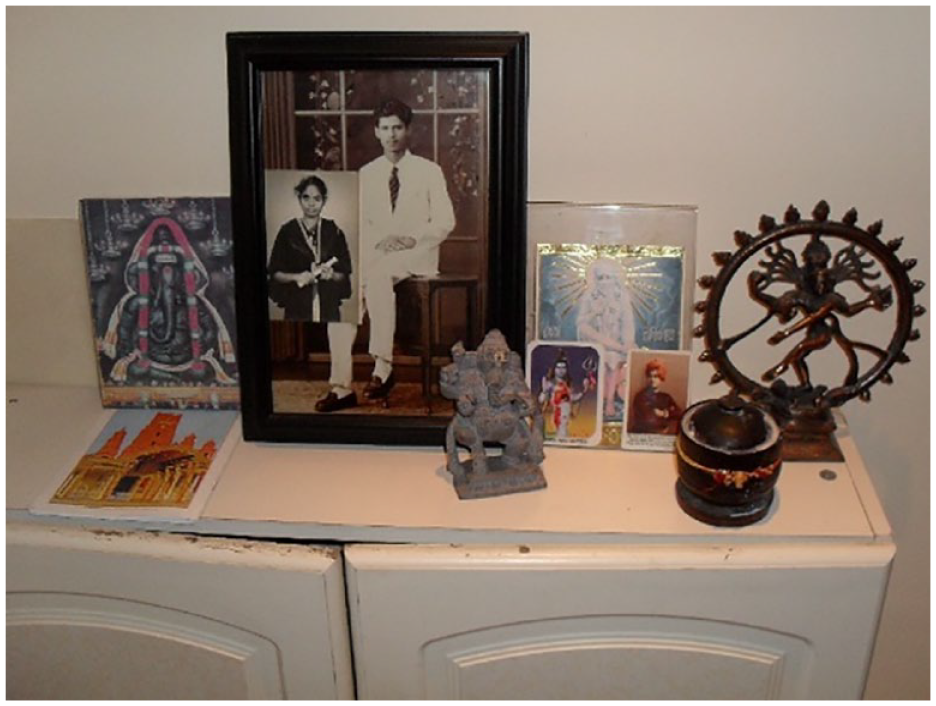
Family prayer altar.
A picture of Lord Ganesh (son of Lord Shiva) in front of which is a Tamil hymn book with the photo of Nalloor Murugan Temple in Sri Lanka on its cover.
Next to the image of Lord Ganesh are two old family photos (paying homage usually to members of the family who have passed away) in front of which is a small stone statue of Lord Ganesh.
Behind this there are two small pictures, the one next to the statue of Lord Ganesh is an image of Lord Shiva (the Supreme God for Hindu Saivites) and Sai Baba (Indian spiritual master, 1838–1918) next to which is an image of Saint Vivekananda (1863–1902). Behind the two smaller images is an image of Saint Ramakrishna (1884–1940).
The last statue is of Lord Nadarajah (the dancing Lord Shiva) who is surrounded by a circle of fire. The pot in front contains Thiruneeru (white holy ash) that is applied to the forehead after prayer.
This home shrine appears in the video recording of Chantia, who performs her daily morning prayers in front of it. The interaction recorded represents an act of worship between Chantia and the Divine. The communicational aim of this interaction is to ask for mental and physical protection and spiritual guidance. Chantia selected the morning prayers and her brother recorded her with the purpose of sharing with the research team an important religious practice for Hindus, the morning puja, and illustrating a religious activity in which the children regularly engaged at home. In this sense, there are two additional audiences to Chantia’s ritual performance: her brother who is digitally recording her prayers, and to whom she turns and establishes eye contact when she completes her prayers, and the researchers for whose benefit the recording is being made.
The video covers the five stages of Chantia’s morning prayers: the Gayatri mantra, the morning śloka, the morning prayer in English, the Thopukaranam, and the Thiruneeru. These stages illustrate the multitude of senses implicated in Hindu prayers. Therefore, they are each represented individually in five video stills selected for discussion in this section. The chosen stills mark the changes in the language being used in the performance.
A number of resources are used for making meaning in the puja. Being socially shaped and culturally given, these resources are here referred to as modes (Jewitt, 2008). More especifically, the following six modes are identified in the transvisuals: (1) artefacts, (2) body movement, (3) body position, (4) hand position, (5) eyes, and (6) language. The complexity of the simultaneous representation of these different modes is addressed in the five transvisuals below. The artefacts (Mode 1) placed in the home shrine are present in all five stages of the puja, which is conducted in front of the shrine. The body movement (Mode 2), or lack of it, is closely linked to specific parts of the puja. The standing-up position (Mode 3), for example, is adopted as a sign of respect to the deities and to the sacredness of the practice. This position is only changed in Stage 4, for the performance of the Thopukaranam (see Transvisual 4, below), which involves movement, the second mode, highlighted in the transvisuals by us with the use of arrows. In fact, the fourth mode, hand position, is the one that changes many times throughout the puja. We indicate the different hand positions with the use of square shapes on the transvisuals. Hands are placed in front of the chest in Stage 1, they are moved to the front of the stomach for Stage 2, they are moved back to the front of the chest in Stage 3, they are then used to hold the earlobes in Stage 4 and, finally, the right hand is used for applying holy ash on the forehead in Stage 4. The eyes (Mode 5) are kept closed for Stages 1 to 3 of the puja and seem to be open for Stages 4 and 5, as we show with the use of oval shapes. The closure of the eyes relates to focussing on the prayers and the communication with the Divine. The eyes are kept open for helping with body balance when squatting and locating the holy ash pot for application on the forehead. The last, but not least, mode to mention is language. Language (Mode 6) is used in the first three stages of the puja. Although we only present subtitles in English in the transvisuals, Sanskrit is used for the mantra and the śloka whereas English is used for the third oral prayer. The last two stages, Thopukaranam and Thineeru, are performed in silence.
As illustrated in Transvisual 1, Chantia stands in front of the altar to recite the Gayatri mantra in Sanskrit. This mantra is one of the holiest Sanskrit verses in Hinduism and a very well-known prayer that the children have regularly recited across the Temple, religious education classes, and the home. It is recited in the start of the day to wish social harmony and wellbeing to the world. With her eyes closed and her hands put upwards with their insides touching each other in front of her chest, she recites the mantra 10 times.
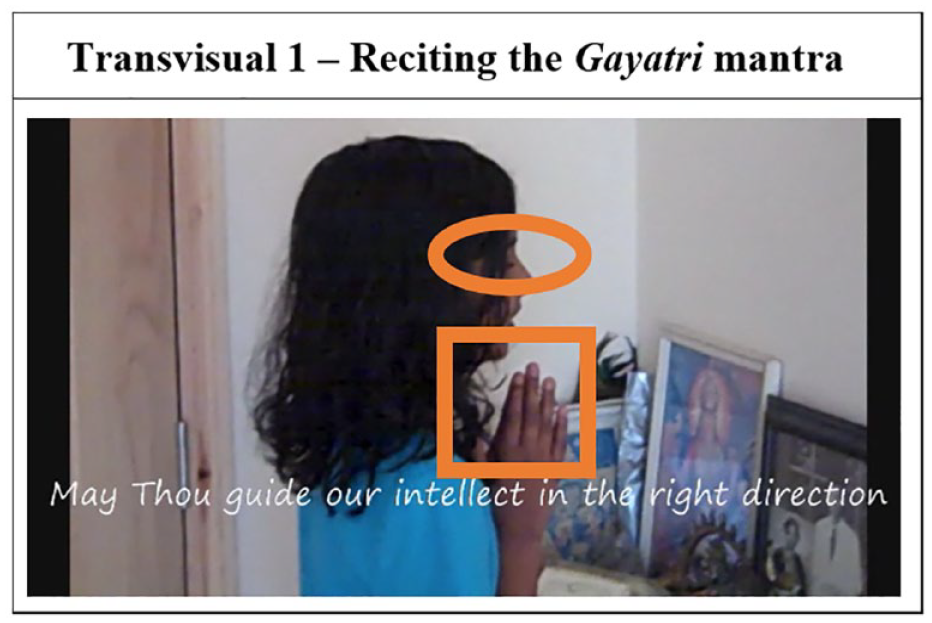
Reciting the Gayatri mantra.
As Chantia finishes reciting the Gayatri mantra, she moves on to the morning śloka (Transvisual 2) also in Sanskrit. Slokas are metered and rhymed poetic verses or phrases in a stotra (prayers to Gods that should be sung). Chantia continues to stand up in front of the altar, but she changes the position of her hands to perform the second stage of the puja. As the tradition recommends, her hands are brought down in front of her stomach. They are placed next to each other, touching on the side, and facing up. Her eyes are still closed.
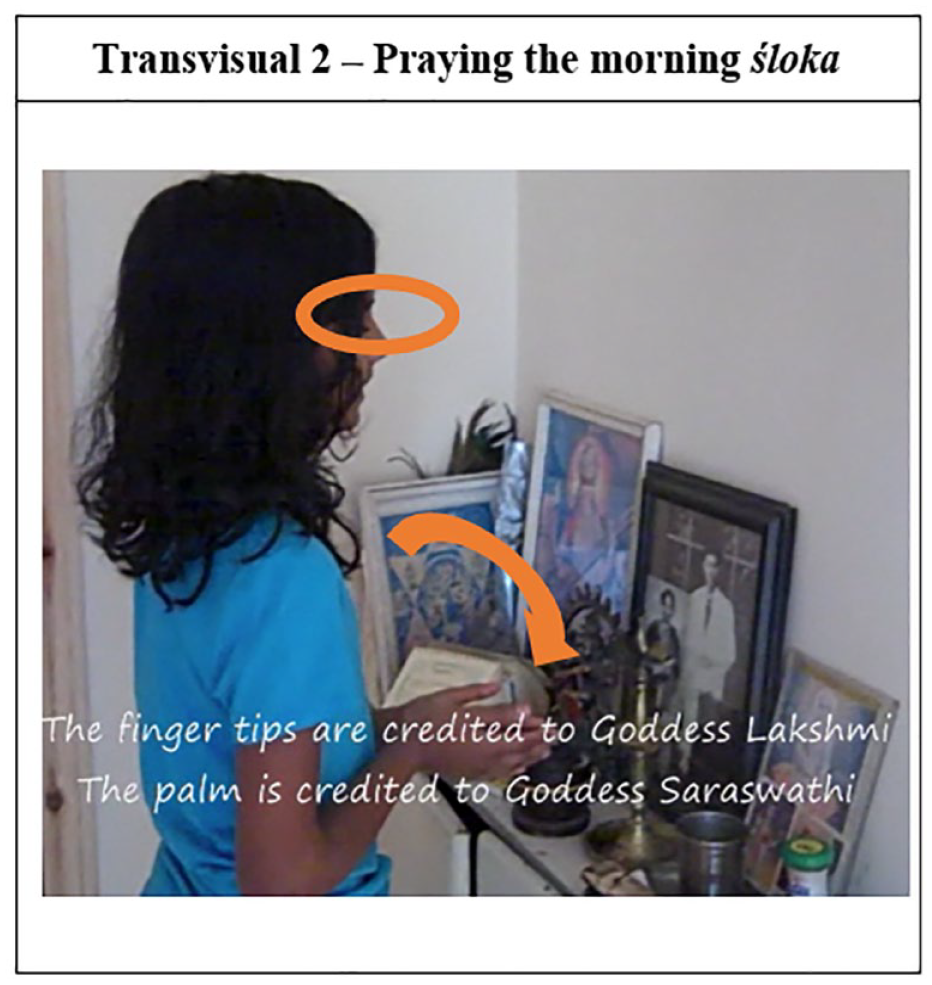
Praying the morning śloka.
With no interruption, Chantia moves to the third stage of her puja, the prayer in English (Transvisual 3), which she has learned and practised in her Saturday religious education class. In this prayer, Chantia offers devotion and asks for purity and guidance for her daily activities. She continues to stand in front of the altar with her eyes closed. However, her hands are moved back to the position they were in the first stage, in the recitation of the Gayatri Mantra described above. In other words, her hands are brought together in front of her chest. Her prayers in Sanskrit and English reveal oral fluency in the recitation of linguistically complex verses and an emphasis on appropriate intonation, volume, and pace, highlighting the sensory modality of sound.
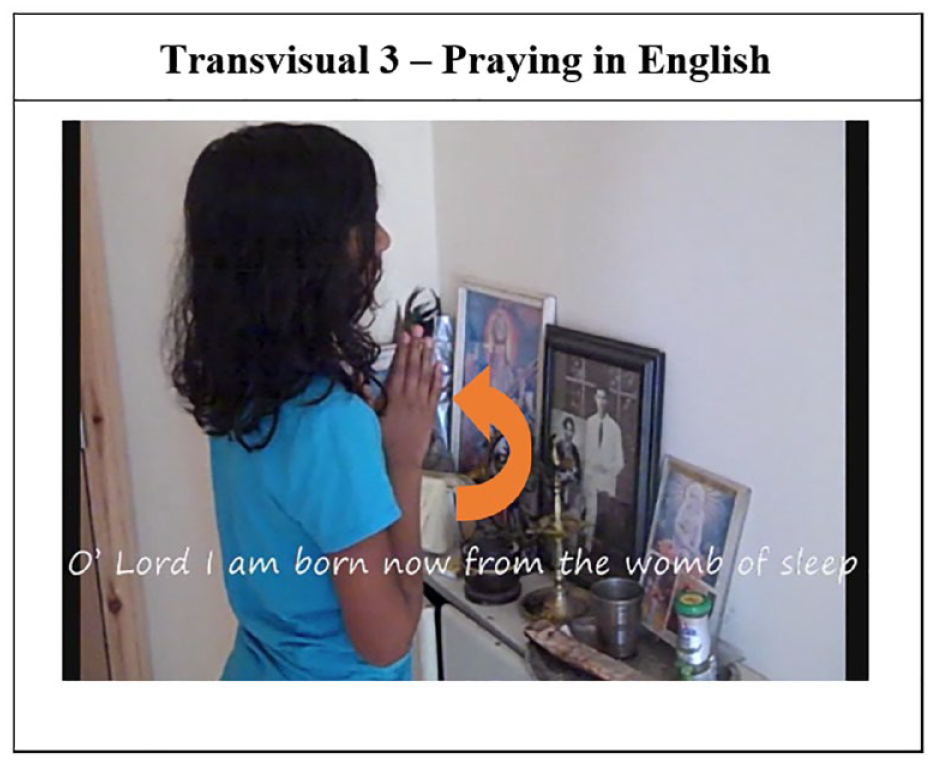
Praying in English.
After the three initial stages of the puja in which verbal language is used, Chantia moves to the Thopukaranam (Transvisual 4), the stage in which worship is done in silence. This stage of the puja involves taking one to two steps to the right, so the altar is not directly in front of Chantia any longer. Thopukaranam means holding the ears with the hands. It involves squatting down and standing back up with the arms crossed in front of the chest and the earlobes being held by the hands. In the context of our study, it is a type of performance adopted to worship Lord Ganesh and be blessed by Him.
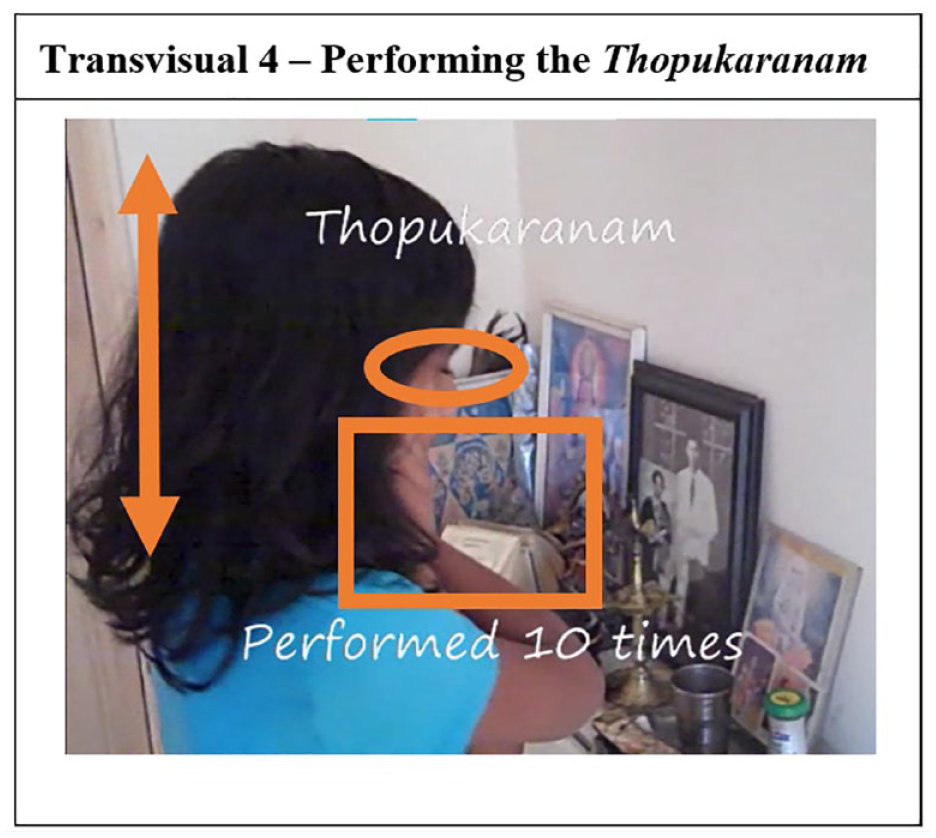
Performing the Thopukaranam.
The fifth and last stage of Chantia’s puja is the Thiruneeru (Transvisual 5). Thiruneeru is the Tamil word for sacred ash. Hindus apply sacred ash on their forehead. They may use different colours and shapes – each having a specific purpose and meaning. Chantia applies a dot of white ash on her forehead to protect herself from selfishness and worldly desires. The holy ash is kept in a pot (indicated by a circle in Transvisual 5). Having completed her puja, Chantia walks away from the family altar to get ready for school.
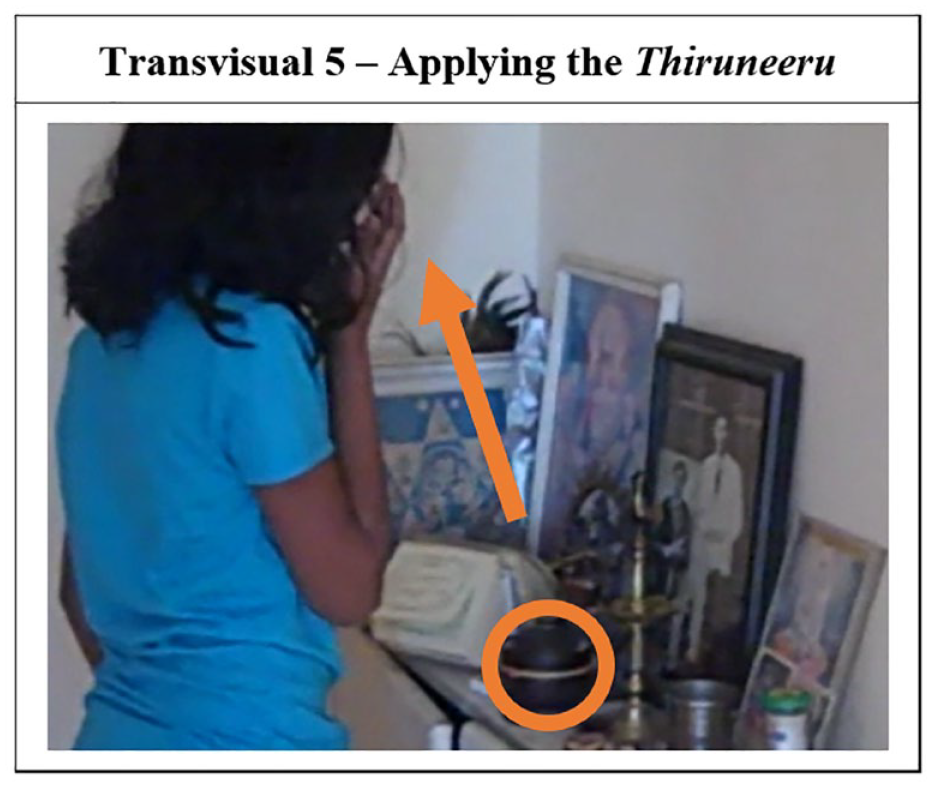
Applying the Thiruneeru.
The detailed analysis of the transvisuals showed how Chantia selected, combined, and interwove a wealth of multilingual, multimodal, and embodied resources; Sanskrit being one of them, she has learned, practised, and performed through her religious socialisation across contexts. Chantia’s syncretic practice highlighted how she brought together religious texts in Sanskrit (the Gayatri mantra and the morning śloka) and English (her prayer) with ritual actions (the performance of the Thopukaranam and the application of the sacred ash). While these religious texts and rituals were highly scripted, Chantia’s morning prayers pointed to the personalisation of religious worship in choosing the constituent elements of her morning prayers including her prayer in English within the same worship ritual. The performance indicated her understanding of procedural knowledge and practices (how to pray appropriately) and historical knowledge (the shared interpretation of Thopukaranam and Thiruneeru). Chantia’s performance of the Gayatri mantra and the morning śloka also emphasised the sensory modality of sound, which resonates with the properties and effects of sounds in Sanskrit as a sacred language reported by Bassetti and Reinboldt (2023). In addition, the fluency of the oral recitation of the prayers and accompanying ritual actions and use of sacred objects pointed to a respectful stance and emotional intensity. The development of these dispositions supports the notion of cultivating a ‘prayerful attitude’ that ‘enables one to communicate with God and be in a position to receive Grace’ (Capps & Ochs, 2002, p. 40).
Discussion and conclusion
Our findings expanded recent critique of logocentric perspectives in applied and sociolinguistics (Ainsworth et al., 2023) to the examination of religious repertoires that are often driven by a communication hierarchy positioning sacred languages, such as Sanskrit and Tamil, at the top and other aspects of communication as secondary. In this paper, we examined Sanskrit sacred language learning and performance from a repertoire approach that advocated expanding our understanding of children’s religious repertoires to include linguistic and non-linguistic resources. This approach provided us with a multilingual and multimodal lens that did not privilege Sanskrit over other (sacred) languages nor linguistic over non-linguistic resources in children’s Sanskrit learning and performance. Our discussion of our participant observations across Temple, religious education classes, and the home as well as interview data illustrated that Sanskrit was one of the semiotic resources available in children’s developing religious repertoire and as such it was examined in interaction with other constituent resources. We showed that a limited set of sacred texts and religious concepts in Sanskrit were learned and used alongside sacred texts and religious concepts in Tamil and/or English together with multimodal and embodied resources for devotional purposes. It is important to note that children’s religious repertoires were learned, deployed, adapted, and expanded differently depending on the affordances of the context. For instance, a flexible approach to language use emerged as the unmarked choice in religious education classes and the home compared to language use for collective Temple worship, echoing language practices observed in diasporic family conversational interactions (Canagarajah, 2019).
Taking a syncretic lens and applying transvisuals, we showed how Chantia strategically selected and combined different semiotic resources of which Sanskrit was a constituent and indispensable part and it was in this combination that meaning was made. Through the creative and transformative process inherent in syncretism, Chantia united these disparate semiotic resources to perform her daily morning prayers and communicate with the Divine. These findings supported our earlier work that has highlighted the role of children as active and knowledgeable meaning-makers in their own right and the interplay of multilingualism and multimodality in their faith literacies and identities (Lytra et al., 2016b, 2017; Lytra & Ilankuberan, 2020). Combining ethnographic observations and interview data with transvisuals foregrounded the layering and interplay of the different modal resources that occurred simultaneously or in sequence. For instance, Chantia’s recitation of the Gayatri mantra (language) occurred while standing still in front of the home shrine (body position) with both hands placed upright in front of the chest with their insides touching each other (hand position). In this respect, Chantia’s meaning-making process was much more complex than the rigid categorisation of the different modal resources she deployed, forming an integrated system of communication. These findings align with Perera’s (2018) study on the interrelationship of gesture and verbal translanguaging at a Sri Lankan Tamil Hindu/Saiva religious education class.
Our findings illustrated that Chantia experienced faith literacies (Souza, 2016) in the nexus of continuity and flexibility of religious belief and practice. They foregrounded how migration and language contact ensured both continuation and change in the linguistic resources of the Sri Lankan Tamil Hindu/Saiva faith community, expanding children’s religious repertoires in specific contexts to encompass English as the language of rituals alongside Sanskrit and Tamil. The multilingualism of Hindu practices, including the introduction of English has also been reported by Pandharipande (2010) in the United States. Chantia’s recitation of her prayers in English was regarded as a legitimate and acceptable faith practice and part of her personalisation of religious worship. This personalisation of religious worship is an inherent feature of Hinduism (Jacobs, 2010) and at the same time it echoes evolving religious practices, pointing to increasingly personalised expressions over institutionalised ones (Davie, 2007). Nevertheless, for the Chief priest, the traditional authority of the faith community, change raised concerns regarding the authenticity and efficacy of collective worship mediated through English, pointing to intergenerational disparities.
While our article draws on the experiences of a small number of children, our findings raise further questions that warrant future research: in migration contexts, what role do children play in continuation and change in the learning and performance of sacred languages? Considering that English as a global language is increasingly being introduced and used in the faith literacy practices of different migrant faith communities worldwide (for example, see Lytra & Auleear Owodally, forthcoming; Souza, 2014, 2019), to what extent and in what ways might it support or hinder children’s continued learning and use of sacred languages in different contexts?
Footnotes
Acknowledgements
We thank the children, parents, faith leaders, and faith teachers for their warm welcome in the four faith settings. A special thanks to Chantia and her brother for sharing their experiences with us. We are very grateful to Arani Ilankuberan for her insightful comments. We also thank the other members of the BeLiFS team: Olga Barradas, Eve Gregory, John Jessel, Charmian Kenner, Amoafi Kwapong, Mahera Ruby, and Malgorzata Woodham.
Declaration of conflicting interests
The author(s) declared no potential conflicts of interest with respect to the research, authorship, and/or publication of this article.
Funding
The author(s) disclosed receipt of the following financial support for the research, authorship, and/or publication of this article: This work was supported by the Economic and Social Research Council, UK (RES-062-23-1613).
