




Abstract
This article draws on qualitative data from a study of young Muslims learning Qur’anic Arabic in the UK to reveal how they engage in sacred language practices that I choose to call ‘ultralingual’. Such practices inevitably foreground linguistic form and performance over meaning, at least in the referential sense. Observable in many faith contexts, the ability to acquire a certain proficiency in an invariably ancient sacred language and then participate, actively and passively, in a range of ritual acts is demonstrated by millions of children globally. Usually attending supplementary forms of education, such children learn to access the code of their respective faiths (e.g., Qur’anic Arabic for Muslims and Biblical Hebrew for Jews) through, usually, a traditional learning approach based initially on systematic instruction in sound-letter correspondences which eventually develops into secure decoding proficiency. An important characteristic of this language practice is the ambivalent role of referential meaning. Often, performers, whether in recitation or in the words uttered in prayers, have partial or no access to the meaning of the words they utter. This article calls this ‘ultralingualism’, a language phenomenon that occurs also in non-religious contexts such as vocal music and multilingual literacy mediation, but which is particularly apparent in faith practices which centre on an ancient text and its language. The young Muslims in this article, however, do not take part in meaningless activities. Much sacred language practice (and some co-sanctified language practice) happens ultralingually, that is, form is emphasised over referential meaning. Evidence in this article argues that such ultralingual practices are accompanied nevertheless by layers of meaning often unrelated to referential or lexical meaning.
Introduction and background
The observation has been made of how ‘minimal familiarity’ with a sacred language ‘has been considered a sine qua non for believers’ (Safran, 2008, p. 186). Although this observation was originally made about Biblical Hebrew, the same ‘minimal familiarity’ can equally apply to other sacred language contexts. This article will argue that this ‘minimal familiarity’ is often an example of what I call ‘ultralingualism’ (Rosowsky, 2021). This term will be explained in detail in the following sections, but a brief definition at this point might be ‘language performance which sidelines referential meaning’. Furthermore, this article uses the term ‘sacred language’ to denote the language variety used for liturgical practice where that variety is (a) invariably archaic or ancient, (b) is centred on a sacred text, and (c) has long since been abandoned as a spoken register (Bennett, 2017). Other terms such as ‘religious classical’ (Fishman, 1989) or ‘sacerdotal language’ (Safran, 2008) can be found in the literature. I myself (Rosowsky, 2008) have used ‘liturgical literacy’ in contexts related to literacy practice.
The acquisition, and the subsequent practices derived therefrom, of sacred languages has certain commonalities across diverse contexts that suggest such acquisition practices are universal across those faiths which hold a sacred language central to their belief and practice. To illustrate, Muslim and Jewish children are inducted into the practices of Qur’anic Arabic and Biblical Hebrew, respectively – the two principal contemporary contexts of liturgical literacy where children are systematically involved from an early age. However, Church Slavonic in the Orthodox Church and Pali in Buddhist contexts are not usually taught in their respective religious communities in such a way. In these contexts, sacred language acquisition is generally for clerics training in seminaries or, nowadays, students in language departments of universities. The acquisition of Church Slavonic by children did happen before 1917, to an extent, but has never been revived in any major or systematic way since then (but see Uvarova, 2017). Certain Buddhist seminaries admit children (Parkes, 2022; Schedneck, 2019), but, again, this is limited in comparison with the widespread examples of Muslim and Jewish children acquiring their sacred languages in community supplementary schools throughout the world. This distinction has been usefully termed ‘demotic’ sacred languages (Qur’anic Arabic and Biblical Hebrew) and ‘hieratic’ sacred languages (Pali and Church Slavonic) by Bennett (2023), and while this article explores demotic sacred language practices, his focus in that volume is on hieratic sacred languages.
In Muslim contexts of diaspora where the sacred language can form a part of a complex linguistic repertoire (vying with South Asian languages such as Punjabi, Gujerati, Urdu, Bengali, or Sylheti; or existing alongside Turkish; or with Somali), it is often the sacred language that manages to avoid any serious attrition or shift to the majority language. Many writers have commented on the staying power of these sacred languages in contrast to the fate of accompanying spoken minority languages in conditions of diaspora (Ferguson, 1982; Fishman, 1989; Rosowsky, 2008; Safran, 2008). Such communities can be observed investing more time in, and funding to, their children’s acquisition of the sacred language than either to the maintenance of the spoken minority language (such as Punjabi or Sylheti) or even to the community literary register (such as Urdu or Bengali).
This article will focus on the sacred language practices of a typical Muslim community of South Asian origin situated in a city in the north of England. For most Muslim children in this community, the acquisition of their sacred language, Qur’anic Arabic, begins early (around the age of 6 or 7) and is completed by their early teens. Qur’anic Arabic is a variety of Classical Arabic (al-ʿarabīyah al-fuṣḥā) and is a necessarily circumscribed form of the more general classical language which encompasses more functions and domains (Versteegh, 2014). Acquisition of this sacred language takes place usually in community-funded supplementary schools often attached to local mosques. The prevailing pedagogy of these schools has been, until recently, a rather traditional one, relying heavily on the systematic instruction of sound-letter correspondences (variously known as ‘building up’ or synthetic phonics) although less-traditional approaches (including digital ones) are now in evidence here and there (Rosowsky, 2021). Tuition, carried out by either mosque personnel (such as the imam, prayer leader) or paid and unpaid volunteers, takes place using a one-to-one model of teaching with some group reading. It usually takes place daily in the late afternoon/early evening on weekdays, and a teaching session can last from 90 minutes to 2 hours. The principal aim of the sacred language tuition is to reach proficiency in the decoding, recitation, and memorisation of the Qur’an to the extent that a child can eventually decode the complete text (604 pages long in Arabic), recite clearly, and memorise enough text and complementary prayers and supplications to perform the canonical prayers correctly. The schools will have other aims such as learning about the basics of the religion, but the acquisition of sacred language proficiency is central and takes up most of the time (Rosowsky, 2008, 2021).
Ultralingualism and meaning
A regular observation of sacred language acquisition practices (Miller, 2010; Rosowsky, 2008; Schachter, 2010) is that little time is or can be spent on comprehension. The language of the Qur’anic text is archaic, 1400 years old, and these South Asian heritage children, unlike Arabic-speaking children who could have a degree of Arabic literacy, have little or no access to the meaning of the words being decoded (even Arabic-speaking children [and many adults] experience a challenge fully understanding the Qur’an). Such learning and practice of sacred texts and associated prayers and supplications have come in for considerable criticism in some religious quarters over a very lengthy period of time. In Matthew 6:7 in the New Testament (King James Bible, n.d.), ‘the heathen’ are described as using meaningless or ‘vain repetitions’ as a way of accusing them of ‘parroting’ prayers, supplications, and litanies they probably do not understand. A very similar accusation was later incorporated by Calvin (n.d.) into Protestant arguments against Catholicism during the Reformation where meaningless (to him) recitation of Latin by Catholic worshippers was deemed to have the same problem (O’Leary, 1996). Later still, Yelle (2013) shows clearly how similar arguments were used by nineteenth-century colonisers in India to deride Islamic, Hindu, and Buddhist religious practices. Cherti and Bradley (2011), writing much more recently, reiterate these accusations by characterising the learning in UK Muslim madrasahs (what I call Muslim ‘supplementary schools’) as ‘rote learning’ (pp. 42–43). As I have argued elsewhere (Rosowsky, 2008, 2011, 2021), such accusations wilfully or innocently misunderstand the purpose of much sacred language practices. In much of this, the simple acquisition and practice of using the sacred language in this ‘minimal’ sense is understood emically as an act of worship in itself and so can be valued as much for its form and performance as for its referential meaning. The rich and complex art form that has become known in the Islamic world as ‘Qur’anic recitation’ or tajweed (Nelson, 2001) illustrates on a higher scale the value placed upon the form of the sacred language. Similarly, in the context of writing, the development of Islamic calligraphy into intricate and elaborate designs whose referential meaning is only accessible to the trained eye often foregrounds form over meaning.
Such an emphasis on form over meaning is neither unusual nor only found in sacred language settings. For example, much creative use of language can move meaning to the background. In poetry, this can often be a complementary process with meaning and form interacting to achieve certain effects. In vocal music, a similar thing occurs. When singing in an unfamiliar language though, meaning and form can be separated significantly, with more (or even all) attention being paid to form alone (Mossop, 2013). Again, religious settings such as singing in Latin in cathedrals or quasi-religious settings such as singing Latin or High German masses in concert halls can be rich sources of form being emphasised over meaning. While most professional opera singers are multilingual and do artfully and successfully combine the meaning and form of the lyrics they sing, many amateur singers and choirs are often restricted to singing only the forms of the pieces they perform. In popular music, too, foregrounding of form over meaning takes place. The Belgian entry for the 2003 Eurovision Song contest was sung in a made-up language unknown to both performers and their audience! In the world of literacy mediation or brokerage, it is not unknown for letter readers to decode and read aloud letters written in languages unknown to them to the letter’s recipient. John Milton had his daughter read to him Greek texts despite her only knowing how to decode the Greek script (Sanchez-Palenica & Almagro, 2000).
These are all examples of what this article calls ‘ultralingualism’ where the meaning of the text or utterance is unknown or somehow beyond (‘ultra’) the reader or the performer. Audiences and listeners, too, can have ultralingual experiences whenever they have little or no access to the meaning of what is being sung or recited. It perhaps goes without saying that singing or reciting with meaning is something to aspire to and is desirable in an ideal world. However, what these examples show is that reading or language performance without engaging referential meaning is not unusual and is even not necessarily a disconcerting experience for those involved.
The children in this article read or perform in this way. They are taught to decode and then articulate their recitation or singing in a generally authentic manner. Most will go on to memorise sections varying in length of the sacred text. And for most of these learners, the progression to reading for meaning in a conventional sense does not occur. There is a ‘minimal familiarity’ which will suffice them for the rest of their religious lives. This is not to say that no one proceeds to a more comprehending experience of the sacred text; some do, but this will occur later as adults, usually in conjunction with a course of formal and institutional learning.
What has always interested me has been the lack of any disconcertedness on the part of these young learners when reading in such a manner. Having been a high school teacher of English for two decades, I can confirm that readers faced with the incomprehension of what they are reading soon give up. Sacred text readers, on the other hand, obviously see a value and purpose in reading in this manner (Badder & Avni, this issue). Ultralingualism argues that meaning in a referential sense, lies elsewhere. However, this does not leave the individual reader or performer (or listener or audience) personally engaged in meaningless activity. The data shared in this article will demonstrate that these young learners perceive meaning to lie in a range of experiences connected to the acquisition and subsequent language practices of their sacred language.
Finally, it is important to recognise, as I have hinted at already, that these sacred language practices (acquisition and others) do not exist in a vacuum. Particularly in multilingual and diasporic settings, they form a part of complex linguistic repertoires involving both the majority and minority languages (in varying states of shift), local and standard varieties of the majority language, spoken and written varieties of both, and increasingly sophisticated use of mobile and digital literacies. All these language varieties exist together in various configurations for diverse functions in a range of domains, with sacred language practices playing a significant part in this interplay and interaction. For example, in the past 20 years in the UK, there has been a discernible linguistic shift in how sacred languages are taught in this community and similar ones. Once, the local (community or heritage) languages were employed by teachers to induct children into the acquisition practice of the sacred text. Today, it is often the majority language of English that is being used for the same purpose. Fishman’s (1991) learning of X (where X is the minority language, and in this context, the sacred language is a special minority language) through Y (the majority language) has shifted – same X but with a different Y. This brings us on to the next part of this article – what sort of theory is relevant here?
Theoretical considerations
There are a number of areas of theory relevant to any discussion of ultralingual sacred language practices in multilingual contexts. I have just briefly mentioned Fishman’s (1991) pedagogy-related notion of how minority languages are often taught not directly but through an existing majority language (the X though Y model) and also how this model can be modified when language shift takes place. Language shift theory is also relevant inasmuch as, again as mentioned earlier, when minority languages shift to the majority language (here, English), the sacred variety is, for a range of complex reasons, not subject to the same social and cultural pressures and has what some have called a ‘staying power’ (Ferguson, 1982). Perhaps the principal reason for avoiding shift is a clear and unambiguous set of agreed functions and domains for sacred language practices. As long as no other language variety is considered appropriate for these domains and functions, the sacred language remains secure. In respect of Islam, there has been an established consensus in the Islamic world for well over a millennium that the canonical prayer and Qur’anic recitation can only take place in the Arabic of the original. Until this consensus changes, shift of this specialised minority language is not likely to take place.
Another area of theory that has relevance for sacred language practice, and from which I have drawn upon extensively in recent work (Rosowsky, 2012, 2013, 2019), is performance theory, particularly the work of Bauman (1975, 2000) and Bauman and Briggs (1990) on performance in the verbal arts. This work has drawn attention to how, in much verbal art (wordplay, poetry, storytelling, and so on), both performer and audience give more attention to form over and above referential meaning. Drawing on Austin’s (1962) linked but quite different notion of ‘performative’ language, Bauman was able to show how language can have value and purpose above and beyond (‘ultra’) referential or semantic meaning. He focused on two elements within any language performance – the act of expression of the performer and the enhancement of experience on the part of the audience. An analysis of sacred text practice (Bauman never discussed sacred text practice), which sits towards the verbatim pole of Bauman’s (1975) continuum of language performance (p. 303), means focusing attention on form and expression. The relevance of this body of theory lies in that sacred text recitation and practice is almost inevitably and regularly evaluated for its fidelity to the accurate form and authentic expression. From the part of the performer or reader, this involves an individual pursuit of ‘getting things right’. A major part of the pedagogical process in sacred text acquisition is an initial decoding followed by a series of regular repetitions carried out individually and self-monitored for accuracy, occasionally reviewed by a teacher. From the part of the listener or audience, recitation or reading is evaluated for artful but also accurate performance. When sacred language is used in prayer, accurate performance is particularly stressed because the audience is understood, emically, as a transcendent one. Bauman’s second element related to performance, the enhancement of experience, is one which resists any notion of ‘rote’ learning. ‘Rote’ suggests a somewhat meaningless or perfunctory process (Hymes, cited in Bauman, 1975, p. 298), whereas sacred language practices are regularly accompanied by or integrated with ritual and ceremony, which enhances their meaning in an emotive or evocative sense. This is not too far away from Kivy’s (2002) understanding of meaning in music as ‘significance’, subsequently developed by Nattiez (cited by Patel, 2008, p. 304) towards a notion of ‘signification in the broadest semiotic sense’, which has been used to account for meaning-making in some forms of music (Patel, 2008). Here, language in its referential sense is not understood as the default model of ‘signification’ but as only one form of meaning-making, and thus signification can denote where ‘the experience of an object/event brings something to mind other than the object/event itself’ (Nattiez, cited in the work of Patel, 2008, p. 304). In the same way that music can, then, bring ‘something to mind other than itself’, ultralingual performance, such as that which occurs in many sacred language contexts, can bring something to mind other than itself (because the referents of the words uttered are not usually available).
This dual nature of ultralingual performance – its quality of evoking beyond referential meaning and its heightened formal quality – is what characterises it best, and as we can see, is not dissimilar to musical performance (Rosowsky, 2021, p. 55).
More recently a body of work has begun to emerge, which proposes the term ‘post-vernacular’ as a descriptor for language performance which often relegates referential meaning to the background. Post-vernacularism is understood as what remains linguistically once a vernacular is no longer (or never) used for wider inter-personal communication. Shandler’s (2004, 2005) exploration of how Yiddish performance can be used to index individual and collective identity has shown how individuals with no formal knowledge of the language use Yiddish in a ‘sonic’, ultralingual, sense with little recourse to semantic meaning. This phenomenon in Yiddish has now been observed in other unrelated contexts such as the use of Arabic in Classical Arab music performances for non–Arabic-speaking audiences (Erez & Karkabi, 2019). This is not to suggest that the contexts for post-vernacular language use is directly applicable to sacred language practice. However, they share with ultralingual practice the emphasis on form over referential meaning.
As mentioned earlier, another area of theory which relates to the ultralingual performance of sacred texts comes from music. The relationship between music and language has been explored extensively (Faudree, 2012; Fine & Ginsborg, 2014; Kivy, 2002; Merlino, 2014; Mossop, 2013; Patel, 2008; Slevc, 2012; Zbikowski, 2012). Alongside the presence of ultralingualism in sacred text practices, a similarly common occurrence is found in vocal music (both religious and secular, both classical and popular). Although professional opera singers are regularly multilingual (Rosowsky, 2001, p. 60) and are expected to have a secure command of the languages they sing in, the same is not always the case for the choirs and choruses, which often accompany them. Much of this singing is carried out in an ultralingual way albeit supported by available translations at the rehearsal stage. In less professional settings, local and regional choirs, for example, can find themselves singing in unknown languages with minimal recourse to referential meaning. This is even more the case when lyrics are not only in an unknown language but also in its higher registers such as Medieval Latin (e.g., most plainsong and Gregorian chant) or High German (Bach oratorios). And how many choir members would comprehend the Vulgar Latin, Middle High German, and Old French of Orf’s Carmina Burana? Earlier, I touched on the issue of meaning and how ultralingualism can evoke ‘signification’, a concept which is borrowed from music (Nattiez, cited by Patel, 2008). Furthermore, there are other complementary practices common across ultralingual performances in music and language. The systematic approaches to preparing or rehearsing to sing in another language are not too dissimilar to approaches to sacred language acquisition. Merlino (2014) explains that, [p]eculiar to the activity of singing (vs. other music performances) is, among other things, the manipulation of linguistic resources and the adjustment of language to music: as a matter of fact, the way in which words are pronounced and segmented is functional to musical relevancies such as melody, intonation and rhythm and, more broadly, to singing itself (Merlino, 2014, p. 420).
Were we to roughly substitute the words ‘singing’, ‘music’, and ‘musical’ with ‘artful recitation’ and ‘devotional performance’, the sentiment in the quotation would be fairly similar (but perhaps not so ‘peculiar’). Language and ‘melody, intonation, and rhythm’ combine to realise devotional acts of worship.
[T]he score includes both the musical features (rhythm, notes, etc.) and the lyrics to be sung: it is the ‘written source’ of the linguistics items that in our data are at the core of the correction sequences. Second, it is a physical object towards which participants orient, not only manipulating it but . . . also gazing at it (as opposed to the director and to the other musicians) (Merlino, 2014, p. 423)
There are also some parallels between the layout and functions of a musical score and those of a sacred text. If we take the example of the Qur’anic Arabic of the Qur’an, for example, we notice immediately that the script of the text, compared to most other texts in that language (old and new) is supplemented not only by diacritic marks differentiating consonants, doubled consonants, vowels, and diphthongs but also by other symbols indicating rules of recitation and prosody such as compulsory or optional pauses, vowel elongation, and elision. This obliges the reader to read vertically as well as horizontally and generally provides the reader with all they need to know to decode accurately and recite artfully following all necessary conventions.
Methodological comments
The data shared in this article were gathered over an extended period of time while the author was acting as a participant-observer in a number of sacred language settings (Aston et al., 2015). The methodology for this study can be characterised as one of ‘gentle’ ethnography (Rosowsky, 2021). This is an approach to understanding sites without necessarily deploying on the part of the researcher or the research team formal questionnaires, surveys, interviews, and observation schedules. In fact, there are no data-collection tools in the conventional sense. Once permission was obtained for being at the site, the participant-observer’s role was to be as unobtrusive as possible. Unscheduled and informal conversations took the place of interviews, unstructured or otherwise; discreet observation took the place of clipboard/notebook hustle and bustle; importantly, one’s ears took the place of digital recording devices (however discreet); and thoughtful reflection before, during, and later was the main mode of being during the researcher’s sojourn at the site. In such ethnographic research, there needs to be an immersion in the site which cannot happen quickly and which needs to involve all the human senses and sensitivities. Understanding grows naturally slowly, with only occasional unexpected insights, and time is the most important resource for the researcher. Such an approach needs a considerable amount of time. Indeed, in some cases, the sojourn never ends, and the researcher’s involvement with the site may continue for many years, even decades.
This, of course, is an approach only available to some researchers in some contexts. But practitioner researchers, from all fields, may perhaps recognise that this is a facet of their professional lives for most of the time, even if they rarely have the opportunity to take advantage of it. Outsider researchers can find such an approach a considerable challenge and, given an outsider’s unavoidable propensity for entering and then leaving a site after a fixed period, maybe even impossible. It is understood that being a participant-observer (with the emphasis on participant) is a major advantage in a gentle ethnography. Indeed, gentle ethnography is often adopted because there is a mutual affinity between researcher and participants who are deemed to be in the category of ‘fellow travellers’ rather than research ‘subjects’. The aims of the project are only loosely articulated by the researcher at first as, in their sharing, the project becomes jointly owned. Often, these can take on the characteristic, for the participants, of redressing perceived and actual injustices in terms of representation and understanding. This, of course, makes the research value-laden from the outset. There is no attempt to disguise the researcher’s purposes neither from the participants nor from any later audiences, academic or other. In contexts experiencing marginalisation and misrepresentation, the role of the researcher often becomes one of the advocate. Moreover, there is no suggestion that the site or sites are necessarily representative of wider contexts. Nevertheless, without quantifying the field in any way, it is still possible and indeed necessary to proceed as if the site or sites are in some way typical. To do otherwise is to marginalise further the activity that takes place and issues that emerge from the ethnography.
Some ultralingual data
The first data set featuring in this article consist of field notes and brief discussions with participants of a supplementary school in a large city in the north of the UK. A supplementary school in the UK context is a school which is outside mainstream provision and is usually community-funded and run in the evenings or weekends. The school consisted of approximately 50 male students of the age range 6–16 years. Discussions were held with the school’s headteacher and assistant headteacher, three teachers, and three students. Here, the focus will be on the regular acquisition of sacred text literacy with a focus on ultralingual practice and its emphasis on form over meaning.
The second data set is the transcript of a digitally audio-recorded discussion held with six Muslim boys (age range 9–12) from a different supplementary school. These boys not only attended the daily sessions of the school but also had rehearsed for and participated in a performance of sacred text recitation and devotional verse held locally for a public audience. Although the topics for discussion ranged more widely, here I share comments that focus on ultralingual practice and the emphasis on form over meaning.
Some of these data appear in the study by Rosowsky (2021). However, here it is analysed specifically through the lens of the article’s main argument, ultralingualism.
One important caveat that should be stated unambiguously is that the practices described here are never what one might consider meaningless. Despite the complete or partial lack of referential meaning which characterises ultralingualism, these activities are suffused with meaning in a number of ways. However, as this is an article which has a focus on ultralingual practice, there will be less exploration of meaning in a wider sense (for more on associated meaning, see Rosowsky, 2021, pp. 138–140)
Data set 1 – the ultralingual acquisition of sacred language
In many Islamic supplementary schools, the sacred language acquisition process is fairly standard (Rosowsky, 2008). Children are inducted into the form (letters and sounds) of the sacred language though a systematic training in letter recognition (letter naming), letter-sound correspondences (decoding), syllabic patterns, whole words, and finally a sequencing of words leading to the recitation of verses. This is done by following a primer (usually the Baghdadi Qaidah or similar: see al-Gindy, 2013). The next step is to read the Qur’an itself. The whole process usually takes about 7 years of regular weekly attendance at the supplementary school.
Throughout, the emphasis is on form. Indeed, when meaning is discussed, this usually happens outside of the sacred language acquisition curriculum in a separate teaching session, sometimes held at the end of school.
At 7 pm Islamic Studies start. There have been at least 90 minutes of Qur’anic recitation and memorisation without a break so it is well timed. (Field notes, September 8, 2015)
One boy (aged 14), when asked, is clear that he comes to acquire the sacred language in an ultralingual manner: When I asked about meaning, [he] said that reading was generally without meaning. On Saturdays he said his dad explained meanings of the Qur’an. He reads the English translation but not much. He also told me that he had no knowledge of spoken Arabic (Field notes, 19 March 2018)
However, there is recognition of the value of acquiring the sacred text in an ultralingual manner (Rosowsky, 2021):
Why do you come then?
For the thawab [an Arabic word meaning ‘reward from God’]. To identify as a Muslim. It’s important to come to learn and pass on the message to others who can’t come. I have memorised the complete Qur’an. I started at the age of six and completed it when I was sixteen. (discussion with student, 22 September 2014)
For the rest of this analysis, I have chosen to focus on what might be called the ‘top class’. These are usually the older boys and some younger ones who have been promoted due to their good progress. There are other groups who are at varying stages in acquisition. Younger children will be working their way through the alphabet and primer while an intermediate group will be applying what they have learnt in the primer to the sacred text itself. In the advanced group however, the business of learning how to decode has ended some time ago, and the emphasis is now on advanced rules of recitation and memorisation.
The method in [this] group is for the boys to settle down to reading aloud sotto voce with [the teacher] tuning in for corrections and modelling. After a while boys come in turn to recite to [the teacher] on an individual basis. This is their ‘lesson’. This they do without the text and they rely on their memories. The first hour proceeds with the emphasis placed on accurate and fluent decoding and accurate recall of memorised passages. (Field notes, September 8, 2015).
The reading aloud aspect of this learning allows for self-monitoring of accuracy and fluency and for the teacher to tune in to various boys even if they are not having their individual lesson in front of him. The usual seating configuration where the boys sit on the floor in a horseshoe formation allows for this (Figure 1).
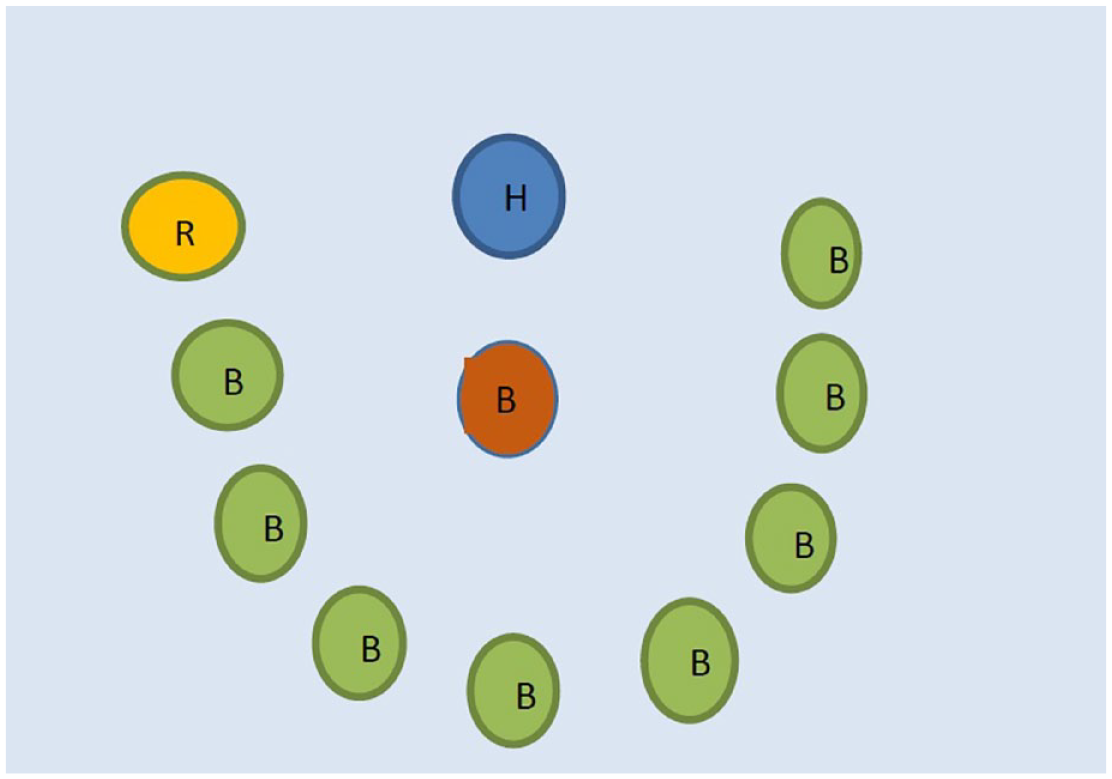
Sitting arrangement of one of the teaching groups (Author’s field notes, 15 September 2014).
The ultralingual aspect of this learning is consistent.
I concentrate on H [the teacher] and note how he ‘tunes in’ to the boys in turn and now and then points something out about their recitation. I later learn that this group would all be accurate decoders and that H was correcting for adherence to the conventions for recitation (the tajweed). If any boy still had mistakes with harakat (letters) or ahkam (rules of pronunciation), he would probably have been sent back to the lower group to work on these matters. H struck me as an obvious hafiz (someone who has memorised the entire Qur’an) as he was able to detect errors with no sight of the text and each boy tended to be reciting a different section. It was very impressive to observe. Impossible to imagine an English teacher listening to groups of children memorising different poems and able to monitor them all at the same time! (Field notes, September 15, 2015)
In these extracts, we observe how a sacred language teacher shares some common skills with a choirmaster or orchestra conductor (Merlino, 2014). He is able to listen to all the boys at the same time and notice errors in the same way his musical counterparts might identify infelicities from their choir and orchestra members.
This particular teacher was even able to do so with boys in other teachers’ groups on the other side of the large prayer hall.
I decide to focus on H’s group first. H, I notice, is able to correct errors in boys’ recitation from even across the prayer hall as he intervenes with a reader in M’s group! I notice also that boys are helping each other in their memorisations. It reminds me of actors learning their lines with other actors. (Field notes, September 15, 2015)
The thought that I had while observing the learning process of the boys in this ‘top class’, that they were similar to actors learning their lines, underlines the ultralingual aspect of this practice. Like the younger boys in Data set 2, the need is predominantly to ‘get things right’ or ‘know the words’ (Bauman, 1975).
Another key characteristic of sacred language acquisition and practice (and of other ultralingual practices) is that it is invariably an aural/oral practice. This ‘aural experience’ (Gent, 2011, 2016) pervades this supplementary school: There is a pleasant ‘hum’ of recitation going on in the main prayer hall. Some really beautiful voices can be heard above the general ‘hum’. I am tempted to record what I can hear but I haven’t asked permission for this so refrain from doing so. I try to describe it in words. There are different voices, of adolescents, some high, some unbroken, some broken, punctuated by the deeper voice of the teacher (H). Some boys recite very quietly (almost silently) whilst other voices dominate (Field notes, September 1, 2015) Today I am again really taken by the sound as it passes around the prayer hall. It has its ebbs and flows – or is like the wind. It eases then starts up again for no outward reason – no reminders from H or anyone else. Perhaps, there is a sense of a pause which is shared by all who can sense how long it should last? It resumes by one boy starting to recite again – the teacher is busy with a student at the front. But they all start again for no obvious reason – a subconscious urge to continue takes over the group and the ‘hum’ resumes. (Field notes, September 15, 2015).
Here again, this is an example of ultralingual experience. Referential meaning of the sacred text can be sought out through translations or through knowledgeable teachers, but for most of those involved, both performers and listeners, the experience remains ultralingual.
Data set 2 – devotional singing ultralingually
As I have argued so far, emphasis in much sacred language acquisition and practice is on form rather than on referential meaning. In this data set, the boys (A–D) are not discussing the sacred text of the Qur’an but their recitation of devotional ‘poem-songs’ in a range of languages in a recent concert. The term ‘poem-songs’ is used here deliberately as ‘singing’ or ‘songs’ are not normally the terms used for the recitation of devotional poetry in this context, even though it might seem like singing to the outsider ear. Here, one of the languages discussed is Urdu which, when used in devotional contexts, can often take on what Fishman (2006) has called co-sanctification properties (i.e., it approaches the status of a sacred language): [T]he Urdu was a bit hard because most of us didn’t know all the words. It wasn’t new but we didn’t know it. We never knew all the words properly. We kept on making mistakes on some of the words. (A, aged 11, October 2018)
Here the young singer understands his devotional poem-song in terms of ‘knowing the words’. This is not unlike, of course, many of us when we try to memorise a song and its words. For these young performers, Bauman’s (1975) reminder that performance in the verbal arts is often about ‘getting things right’ rather than necessarily accessing referential meaning applies.
[I]insistence on word-for-word fidelity to a fixed text do play a part in the performance system of certain communities . . . Performance calls forth special attention on the part of performer and audience alike to the intrinsic qualities of the communicative act, to form . . . [.]’ (p. 303; my emphasis).
Similarly, in the following evaluative comment from one of the boys, the emphasis again is on form, this time in the sense of volume.
It could have been louder. More people could have been louder. The background voices. They needed to know all the words better. (B, 12, October 2018).
Although referential meaning is backgrounded or often absent in such performances, the performers themselves do not consider their efforts to be meaningless. Elsewhere (Rosowsky, 2021), I have argued that in faith, contexts such as these (and in other ultralingual contexts too, particularly in music), meaning is always present but often takes the shape of a very broad form of associative meaning (Leech, 1981).
I don’t know what it (the poem-song) means but I do know why and where and when it was sung. (C, 11, October 2018) [Which language do you sing in that means the most to you?] I’d say Arabic because of the Prophet. And most people recite Arabic as well. (B, 12, October 2018)
In earlier work on sacred language acquisition (Rosowsky, 2008, 2021), when asked, children often had a range of meaningful responses in respect of their ultralingual recitations.
Yeah. We know the naat (the poem-song) but we don’t know what it means. (A, 11, October 2018) Because they [the poem-songs] are for the Prophet. (C, 11, October 2018) [Why is that better in Arabic than it is in English?] Because in Heaven they speak Arabic. Because the first ever language was Arabic. And you can read naats from years ago. And the Arabic language is the language of Islam. (D, 12, October 2018)
In this extract, there is a linguistic rationale given for reciting in Arabic. Although conventional practice is to use Arabic for devotional practice, the boys here have their own reasons for doing so. They cite the need to respect the founder of the faith by using Arabic, and they also express some folk wisdoms about the use of Arabic in Heaven and as the first ever language.
Both these data sets therefore show how, in both sacred language recitation and in the singing of devotional songs, form can often take precedence over meaning in a referential sense.
Concluding thoughts
Much sacred language practice (and some co-sanctified language practice) happens ultralingually, that is, form is emphasised over referential meaning. Given that recitation of a sacred text such as the Qur’an is considered an act of worship in itself, there is nothing disconcerting about this from the perspective of the participants. An outsider view has often been (and often still is) that this is a deficit model of reading or a practice pejoratively called ‘rote’ or ‘meaningless’. There is enough evidence to argue that ultralingual practices are accompanied by layers of meaning often unrelated to referential or lexical meaning. The boys singing in Data set 2 attach considerable meaning to the poems they recite and can articulate this clearly. The learners in Data set 1 see a value in their acquisition of the sacred language in terms of their faith and in terms of legacy ‘It’s important to come to learn and pass on the message to others who can’t come’). The attention given to the secure and competent proficiency of being able to read and recite in the sacred language is considerable and is found in most if not all Muslim communities. I wrote 20 years ago of how communities would prioritise the learning of their sacred language over the learning of other community minority languages by creating supplementary schools for that purpose even in the face of serious economic deprivation. Nothing has changed in the intervening period apart from improved circumstances and thus better opportunities for learning the sacred language. Despite the state’s ‘concern’ (or maybe over-vigilance) for such learning (Cherti & Bradley, 2011), with its misunderstanding of what these supplementary schools are for, the central aim of providing induction into the sacred text remains the same. That the practices in question are often ultralingual does not detract from their status and value to those who participate in them.
Footnotes
Declaration of conflicting interests
The author(s) declared no potential conflicts of interest with respect to the research, authorship, and/or publication of this article.
Funding
The author(s) received no financial support for the research, authorship, and/or publication of this article.
