



Abstract
Aims:
The study investigates the effects of L2 proficiency and L2 exposure on L2-to-L1 cross-language activation (CLA) in L1-dominant bilinguals. In so doing, it tests the predictions made by prominent models of the bilingual lexicon regarding how language experience modulates CLA.
Design:
The participants (27 L1-dominant L1 English–L2 Afrikaans speakers) completed a visual world eye-tracking task, conducted entirely in English, in which they saw four objects on a screen: a target object, which they were instructed to click on; a competitor object, whose Afrikaans label overlapped phonetically at onset with the English target object label; and two unrelated distractors. Language background data were collected using the Language History Questionnaire 3.0.
Analysis:
A growth curve analysis was performed to investigate the extent to which the background variables modulated looks to the Afrikaans competitor item versus to the two unrelated distractor items.
Findings:
Increased L2 exposure was associated with greater CLA, which is consistent with models suggesting that exposure modulates the likelihood and speed with which a linguistic item becomes activated. Moreover, CLA was reduced at higher levels of L2 proficiency, which aligns with accounts of the bilingual lexicon positing that parasitism of the L2 on the L1 is reduced at higher proficiency levels, leading to reduced CLA.
Originality:
L2 activation during L1 processing and the variables that modulate it are not well documented, particularly among L1 speakers with limited proficiency in and exposure to the L2.
Significance:
The findings contribute to the evaluation of competing accounts of bilingual lexical organization.
Language activation in bilingual individuals seems to operate in a nonselective fashion. Even if the context unequivocally requires a response in the one language, elements from the other language’s phonology, syntax, and lexicon are still activated (e.g., Dijkstra et al., 1999; Duyck et al., 2007; Hartsuiker et al., 2016; Spivey & Marian, 1999). A hallmark of this cross-language activation (CLA) is that it goes both ways: Just as elements of the first language (L1) are activated during second language (L2) processing, L2 elements may be activated during L1 processing. The extent to which such CLA occurs is modulated by variables specific to the bilingual experience, such as language proficiency, age of language acquisition (AoA), and exposure (e.g., Berghoff et al., 2021; Bice & Kroll, 2015; Blumenfeld & Marian, 2007; Chaouch-Orozco et al., 2021; Nakayama et al., 2016; Sabourin et al., 2014).
Recently, scholarly interest in these modulating variables has increased; in particular, there have been several calls to examine them from a continuous rather than a dichotomous perspective (e.g., Chaouch-Orozco et al., 2021; van Hell & Tanner, 2012). Existing examinations in this area, which tend to focus on differences at the group level, and moreover on L1 activation during L2 processing, have yielded mixed results (e.g., Brysbaert et al., 2017; Duyck & De Houwer, 2008; Duyck et al., 2007; Hoshino & Kroll, 2008; Hoshino & Thierry, 2011). Less is known about the role of modulating variables in L2 activation during L1 processing, which overall seems to be less consistent and weaker than the L1-to-L2 direction (Wen & van Heuven, 2017). Consequently, it is difficult to tell whether the documented effects of modulating variables are specific to L1 activation during L2 processing or whether they generalize to L2 activation during L1 processing, and thus speak to CLA in bilinguals at a more general level. As long as empirical evidence remains scarce, current models of the bilingual mind will only be moderately informed as to how specific features of the bilingual experience shape different processing outcomes.
The aim of the current study is therefore to contribute with further evidence on the role of modulating variables in L2 activation during L1 lexical processing. In what follows, we first review the findings to date on L2-to-L1 lexical activation in particular and modulating variables in CLA in general. In view of the existing evidence and current models of the bilingual lexicon, we subsequently formulate a set of predictions as to how different features of the L2 experience may influence L1 lexical processing. Using a visual world eye-tracking paradigm that has been widely used to examine CLA in bilinguals (e.g., Spivey & Marian, 1999), we put these predictions to the test, investigating the extent to which proficiency and exposure modulate L2 activation during L1 processing.
Background
L2 activation in L1 lexical processing and modulating variables
In the bilingual lexicon, lexical items in the L1 and L2 are connected by meaning. This meaning-based connection is illustrated by noncognate masked translation priming, where the masked presentation of a lexical item in one language facilitates lexical decision times in response to the translation equivalent in the other language (e.g., see Wen & van Heuven, 2017). Lexical items across languages are also connected by form, both orthographic and phonological. It appears that these connections cannot be selectively muted: A wealth of research indicates that bottom-up phonological or orthographic input activates all matching lexical items regardless of whether the language to which they belong is relevant in the context at hand. An early illustration of this bottom-up, language-nonselective lexical activation was provided by Spivey and Marian (1999), in which L1 Russian–L2 English bilinguals’ eye movements were monitored as they responded to instructions to pick up a target object. When participants in the L2 condition were told to reach for a stamp (marka in Russian), they looked at a competitor object—a marker—that had an English label that overlapped phonetically with the Russian label of the target object more than they looked at a phonologically unrelated distractor object (a ruler, lineika in Russian). Activation of the L2 during L1 processing has subsequently been observed among L2 users of various language-learning backgrounds: balanced bilinguals (e.g., Duñabeitia et al., 2010), unbalanced bilinguals (e.g., Lee et al., 2018), and even those at the very outset of L2 learning (e.g., Bice & Kroll, 2015).
Nonetheless, research on variables that modulate CLA effects suggests that a certain level of proficiency in the nontarget L2 is required for L2-to-L1 activation to be observed. For example, in the visual world eye-tracking task of Blumenfeld and Marian (2013), which, like Spivey and Marian (1999), examined looks to a phonetically related L2 competitor object during L1 processing, a group of higher proficiency bilinguals showed L2-to-L1 CLA effects that were absent in the lower proficiency group. Using a similar task, Mishra and Singh (2016) found that CLA from L2 to L1 was stronger and occurred earlier in their high-proficiency participants than in their low-proficiency participants. In the latter study, however, it must be noted that the two groups also differed significantly in terms of AoA and L2 exposure, making it difficult to isolate the proficiency effect.
Few studies have investigated the effect of exposure on CLA. In the visual world task of Mercier et al. (2014), L1 French–L2 English speakers with high daily English exposure (⩾30%), but not their low-exposure counterparts, experienced more CLA as phonological overlap between the target and competitor items increased. Furthermore, in the low L2 exposure group, CLA from the L1 was modulated by the participants’ inhibitory control abilities. The presence of this effect in the low-exposure group alone may suggest that the high-exposure group had less need to recruit cognitive control mechanisms to suppress the nontarget language when performing this task. Evidence from masked translation priming tasks also indicates that L2-to-L1 priming is stronger for individuals with greater L2 exposure (Chaouch-Orozco et al., 2021; Mok & Yu, 2017; Wang, 2013; Zhao et al., 2011; although see Chaouch-Orozco et al., 2022 for contrary results), suggesting that CLA from the L2 to the L1 increases as L2 exposure increases.
Models of the bilingual lexicon
There are various accounts of the bilingual lexicon in relation to which the above effects can be considered. A prominent model in this area is Multilink (Dijkstra et al., 2019), a connectionist model which incorporates aspects of the earlier Bilingual Interactive Activation Plus model (Dijkstra & van Heuven, 2002) and the Revised Hierarchical Model (RHM; Kroll & Stewart, 1994). Multilink has a layered network architecture, with bidirectionally connected layers incorporating orthographic, phonological, semantic, and language membership information. The model assumes an integrated lexicon, with no separation between L1 and L2 words. Thus, when a word is heard, it activates phonological representations in both L1 and L2, and this activation spreads to other nodes of the lexicon. The likelihood that a particular representation will become activated is influenced by its resting-level activation, which in turn is determined by its frequency of use. L2 proficiency effects, then, manifest as frequency effects, with lower L2 proficiency associated with lower frequency of use of L2 words, which means that L2 words take longer to become activated and transmit their activation to other representations. Furthermore, Multilink incorporates a task/decision subsystem that allows for variation in the input to a decision: For example, while orthographic information is key in a lexical decision task, phonological information is central in a naming task.
While Multilink aims to represent the functioning of the bilingual lexicon in its steady state, the DevLex-II (Zhao & Li, 2010), an emergentist model, instead attempts to simulate the effects of variation in the bilingual experience on lexical organization. Specifically, the DevLex-II uses unsupervised learning algorithms to simulate the effect of AoA and finds that this variable affects the extent to which lexical items from a single language cluster together. In simultaneous acquisition, the model develops distinct representations for the L1 and L2, while in early sequential L2 learning, the resulting organizational pattern is similar, but the L2 lexical space is slightly smaller and more fragmented. However, late sequential L2 learning yields a markedly different result: Here, L2 representations do not cluster together but are parasitic on the L1 representations with which they overlap in form or meaning.
Zhao and Li (2010) attribute the distinctiveness of the late-learning situation to L1 entrenchment: By the time the model encounters L2 words, the representational structure of the L1 has already been consolidated. The L2 is then unable to form its own representational network and has to rely on these pre-established structures instead (i.e., a loss of plasticity has occurred; see also Hernandez & Li, 2007; Li, 2009). The stronger links between late-learned L2 items and the L1 are predicted to result in stronger CLA effects. Other computational modeling approaches (e.g., Cuppini et al., 2013) have yielded parallel findings regarding the effect of proficiency on the bilingual lexicon, where lower L2 proficiency is associated with greater parasitism on the L1. 1
Finally, regarding the effect of L2 exposure, much like the empirical literature, models of the bilingual lexicon tend not to focus on the modulation of CLA by language exposure. On the one hand, Multilink’s assumption of a linear relationship between frequency of use and proficiency would suggest a similar function of exposure: Specifically, increased exposure should lead to increases in resting-level activation and consequently to increased CLA. The DevLex-II, on the other hand, omits exposure from consideration, potentially based on an understanding of exposure as reflective of dynamic, short-term changes in the bilingual experience that do not necessarily have a lasting impact on bilingual lexical organization. Thus, in what follows, we consider only Multilink’s position regarding exposure effects on CLA.
Aims of the current study
The present study investigates the modulating roles of L2 proficiency and L2 exposure in L2 activation during L1 lexical processing. To do so, we use a visual world eye-tracking paradigm that has been widely used to study CLA (e.g., Spivey & Marian, 1999), where participants see four objects displayed in four quadrants of a computer screen: a target object, which they are instructed to click on; a competitor object, the non-target-language label of which overlaps phonetically at onset with that of the target object; and two unrelated distractor items.
Our participants are L1-dominant English speakers with Afrikaans as L2. We target L1-dominant speakers specifically because previous studies have obtained inconsistent results regarding L2-to-L1 CLA, and the studies that have obtained such effects have typically been conducted with either immersed L2 learners (e.g., Chaouch-Orozco et al., 2021) or learners with very high L2 proficiency (e.g., Nakayama et al., 2013, 2016). Few studies have used the visual world paradigm to examine L2-to-L1 CLA in L2 speakers who receive relatively little L2 exposure and have only moderate L2 proficiency. Our study, therefore, adds to the small body of work in this domain and makes a further novel contribution by identifying the L2-experience-related variables that affect CLA among such L2 speakers.
In view of recent accounts of the bilingual lexicon, it is possible to arrive at specific, albeit fairly different, predictions concerning the role of these variables in CLA. Multilink (Dijkstra et al., 2019) predicts that high proficiency in a language will increase the likelihood of its activation in contexts in which it is irrelevant. On this basis, greater L2 proficiency would be predicted to increase the likelihood of L2 activation during L1 processing. However, a different scenario is also possible: According to theories and models of the bilingual lexicon grounded in neural and computational approaches (e.g., Hernandez & Li, 2007; Li, 2009; Zhao & Li, 2010), at low levels of L2 proficiency, L2 representations are parasitic on L1 representations (see also Hernandez et al., 2005; Li, 2009). This raises the possibility that in individuals with low L2 proficiency, L2 representations may be more likely to become activated during L1 processing because of their parasitic relationship with the L1.
Regarding the variable of exposure, Multilink, which equates frequency of use with proficiency, would seem to predict a tight relationship between exposure and proficiency, such that increases in either variable should increase resting-activation levels and thus increase the likelihood of CLA. However, we note findings from the empirical literature that challenge the assumption of a linear relationship between exposure and proficiency: For example, studies of attrition (e.g., Schmid, 2013) show that these variables are often decoupled. We also note that while proficiency may be considered to be a relatively stable feature, exposure is short term and dynamic, thus giving rise to the possibility that the two factors may exert different effects on bilingual lexical access.
Method
Participants
Given the aim of the study—to investigate L2-to-L1 CLA without the participants being aware that they had been selected for their L2 knowledge, thus ensuring that they would be in a monolingual language mode (Grosjean, 2001) during the experiment—our participant recruitment advertisement mentioned only the requirement that participants be L1 speakers of English. Our initial sample comprised 31 individuals, 27 of whom reported knowledge of Afrikaans as L2 and were included in the final sample. 2 It is worth noting that the study’s focus on variation within multicompetent individuals residing in an environment in which most individuals are at least bilingual (e.g., Hill & Bekker, 2014) precludes a comparison between our participants and a monolingual control group.
Language background data were collected using the Language History Questionnaire 3.0 (LHQ; Li et al., 2020). Participant details obtained from the LHQ are presented in Table 1. The LHQ obtains proficiency self-ratings on a scale of 1–7, with 1 being “very poor,” 4 being “functional,” and 7 being “native-like.” The scores reported for the L1 and L2 are an average of participants’ self-ratings for listening, speaking, reading, and writing abilities and are on a scale of 1–7. As for exposure, the LHQ elicits an estimate of hours per day spent on several activities in the L1 and L2. To obtain an individual participant’s daily exposure to the L1 and L2, we summed their daily exposure, in hours, from TV, radio, reading for fun, and reading for school. Table 1 reports the group averages for daily L1 and L2 exposure. Finally, we calculated the L2 exposure ratio ourselves as 100 − ([Afrikaans exposure/English exposure] × 100). Higher numbers indicate more English exposure relative to Afrikaans exposure.
Participant characteristics.
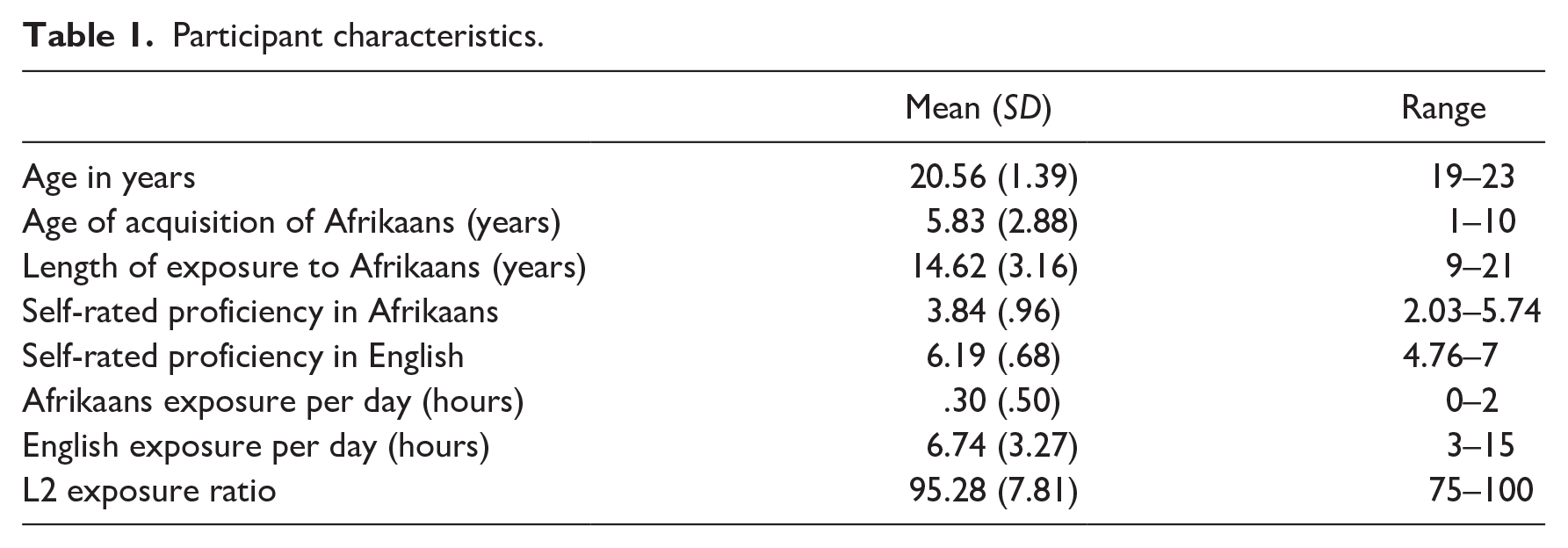
On average, participants started acquiring Afrikaans before 6 years of age. However, it is important to recognize that in the current study, AoA is not equivalent to the onset of immersed L2 acquisition (as would be the case for L2 speakers living in a monolingual target-language setting). Even though the participants live in a setting that is formally bilingual (English and Afrikaans), exposure to Afrikaans may be consistent but of low intensity, which is precisely what the participants’ self-reported daily exposure to Afrikaans reflects. While this situation is different from foreign-language-learning situations, where the target language is typically not present outside of the classroom, an important commonality is the comparatively low amount of L2 exposure that the learner receives. In view of findings that AoA effects are unlikely to arise when L2 exposure is nonimmersive (DeKeyser, 2012; Muñoz, 2006), this variable was not included in the main analysis (see Supplementary Materials for a model including AoA; the key results remain unchanged).
Ethical clearance for the study was obtained from the university’s Research Ethics Committee: Humanities, and all participants signed an informed consent form.
Materials
Visual stimuli
The experimental items were 18 target–competitor pairs, where each target was an English word that overlapped phonetically at word onset with an Afrikaans competitor item (e.g., lion [laɪən]—laai [laɪ] “drawer”). The average phoneme overlap, measured in terms of number of phonemes, in the target–competitor pairs was 2.3 (SD = .5). A further 40 items were used as unrelated distractors in the experimental trials. Target items, competitor items, and distractors in the experimental trials were matched on length and frequency (see Table 2), where English frequency figures were obtained from the Celex database (Centre for Lexical Information, 1993), and Afrikaans frequency figures were obtained from the Virtuele Instituut vir Afrikaans corpus (Virtuele Instituut vir Afrikaans, 2020) of 220.9 million words. The filler trials consisted of an additional 160 items. In each filler trial, a target item appeared alongside three unrelated distractor items.
Characteristics of experimental stimuli.
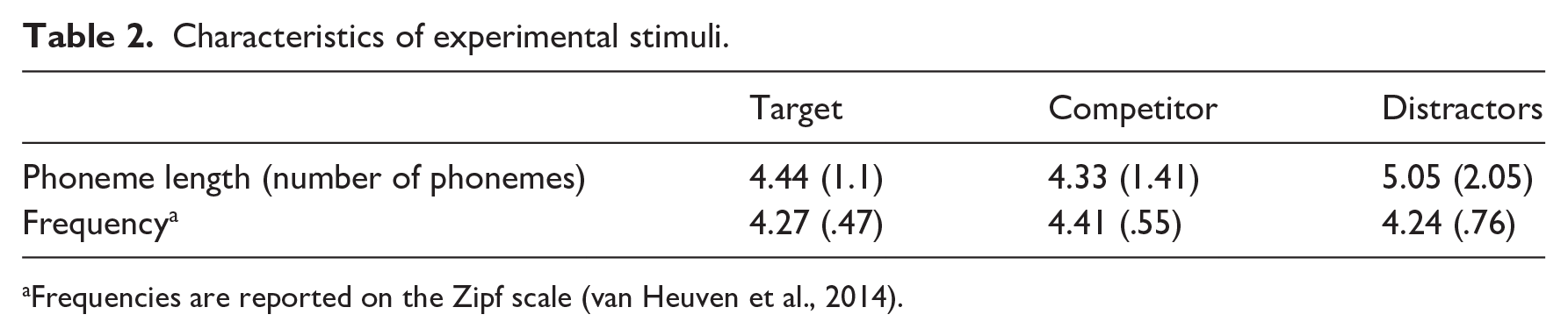
Frequencies are reported on the Zipf scale (van Heuven et al., 2014).
The visual stimuli were 240 black-and-white line drawings. Most of these were obtained from the International Picture Naming Project (IPND; Szekely et al., 2004). Images that were not available in the IPND (n = 16) were drawn in the same style as the IPND pictures. These images were independently normed by 20 L1 English speakers.
Auditory stimuli
The auditory stimuli were recorded in Audacity (Audacity Team, 2019) by a female monolingual L1 speaker of South African English. The lead-in fragment “Click on the . . .” was recorded separately and spliced with the individual target words to ensure consistency in timing across trials.
Procedure
The experiment was administered by a monolingual South African English speaker who used only English to communicate with participants throughout the session and made no reference to participants’ knowledge of other languages. Participants were seated approximately 60 cm from the eye-tracker (the EyeLink 1000 Plus; SR Research, Toronto, Canada), which sampled at 500 Hz, and 80 cm from the computer monitor. The audio stimuli were presented through headphones. Filler and experimental trials were randomly ordered.
At the beginning of each trial, a fixation cross was displayed in the center of the screen for 1500 ms, after which it was replaced by the four stimulus pictures. Following a further 500 ms, the auditory stimulus began. Participants used the computer mouse to click on the target object. After completing the eye-tracking experiment, participants filled in the LHQ (Li et al., 2020).
Results
Response accuracy
Response accuracy on the object selection task was high, with participants selecting the correct image 99.7% of the time. The experimental trials in which participants selected the incorrect image (n = 3) were removed from further analyses.
Time course analysis
In the time course analysis, we examine fixations (defined as any point where the gaze was stable for a minimum of 80 ms) to the competitor item relative to the two distractor items (averaged) from 200 ms to 600 ms following the target word onset. The lower bound of 200 ms accounts for the time taken to program and launch a saccade (Altmann & Kamide, 2004) and is widely used in visual world studies examining CLA (e.g., Canseco-Gonzalez et al., 2010; Mercier et al., 2014; Titone et al., 2021; Veivo et al., 2018). The window duration of 400 ms is based on previous findings that CLA is limited to this relatively short period following the presentation of the target noun (e.g., Shook & Marian, 2012, 2019). Figure 1 compares looks to the competitor versus to the two unrelated distractors (averaged) during this window.
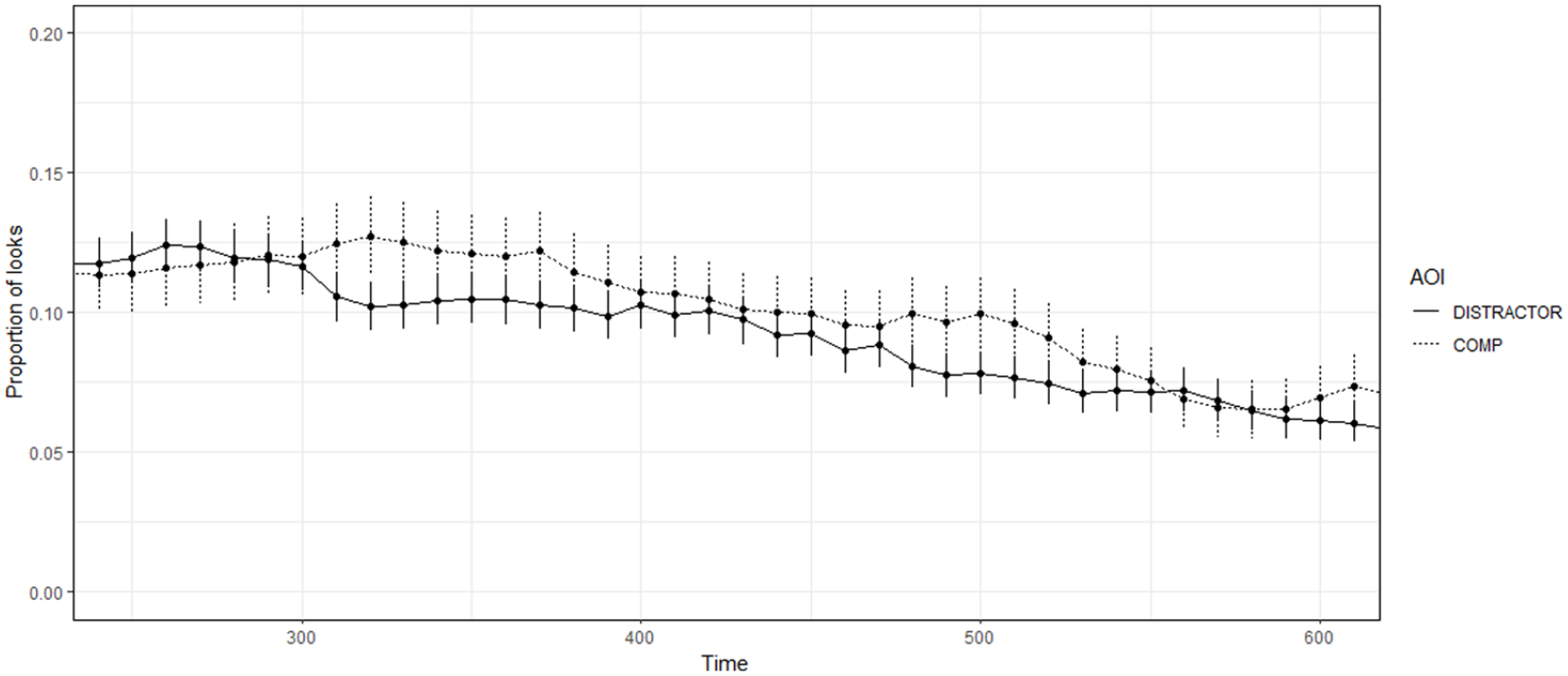
Looks to competitor vs looks to distractor (averaged).
Before the analysis, fixations were collapsed into 10-ms bins, and the empirical logit (Elog) for each bin was calculated, in line with Barr (2008). This was done using the eyetrackingR package (version 0.1.8; Dink & Ferguson, 2018) in R (version 3.6.2; R Core Team, 2019). Grouping fixations into bins reduces the influence of the nonindependence of eye movements on the model outcome.
Following Ito et al. (2018) and Shook and Marian (2019), among others (see Huang & Snedeker, 2020 for discussion of alternative approaches), we then performed a growth curve analysis (GCA) on the eye movement data in R. We ran a mixed-effects model using the lme4 package (version 1.1.21; Bates et al., 2015); p values were obtained via the lmerTest package (version 3.1; Kuznetsova et al., 2017). The GCA examines the effects of the background variables (L2 proficiency and L2 exposure) on the Elog of fixations to the competitor item relative to the Elog of fixations averaged across the two distractor items. Importantly, while L2 proficiency and L2 exposure were moderately correlated (r = −.5), inspection of variance inflation factors (VIFs) demonstrated that collinearity was not an issue in the model (all VIFs < 5).
In addition to the two language experience variables, which were centered around the mean, the model included item type (distractor or competitor, coded as −.5 and .5) as a fixed effect, as well as linear and quadratic orthogonal polynomials to account for the effect of time on fixations (see Mirman et al., 2008). Three-way interactions between each time term, item type, and each of the background variables, respectively, were incorporated. The model included random intercepts for items and participants and by-participants random slopes for item type. In the output (Table 3), we are particularly interested in the interactions between the background variables and item type, as these indicate the extent to which language experience modulated CLA in the participants.
Model output.
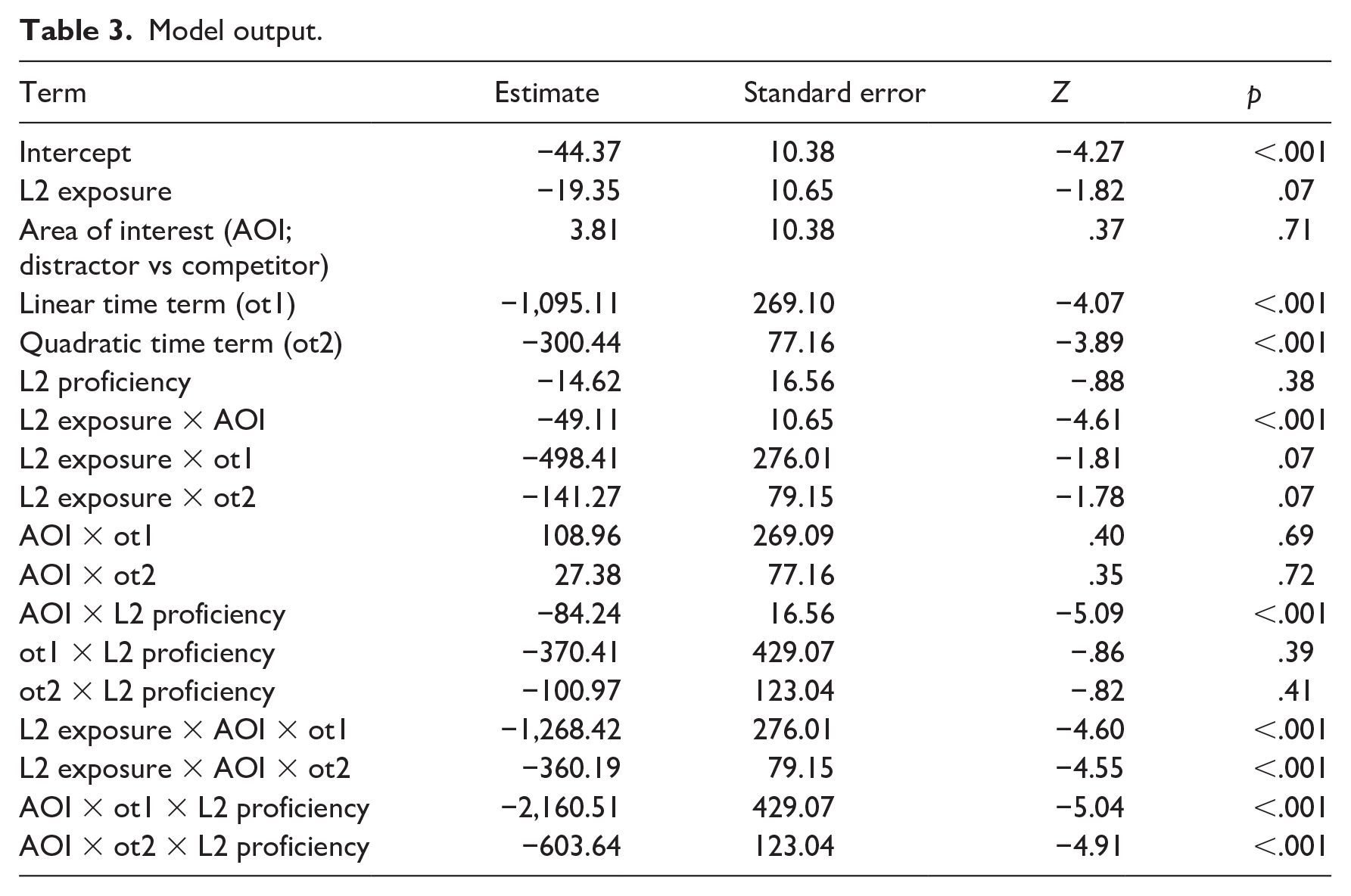
Table 3 shows a significant interaction between L2 proficiency and area of interest (β = −84.24, SE = 16.56, Z = −5.09, p < .001), as well as significant three-way interactions between L2 proficiency, item type, and the linear and quadratic time terms (β = −2,160.51, SE = 429.07, Z = −5.04, p < .001; and β = −603.64, SE = 123.04, Z = −4.91, p < .001, respectively). These interactions reflect that participants with a higher L2 proficiency looked less at the competitor relative to the distractor. Then, there is a significant interaction between L2 exposure and item type (β = −49.11, SE = 10.65, Z = −4.61, p < .001), such that participants with more English relative to Afrikaans exposure looked less at the competitor item than at the distractor item; this effect was also present at the linear and quadratic time terms (β = −1,268.42, SE = 276.01, Z = −4.60, p < .001 and β = −360.19, SE = 79.15, Z = −4.55, p < .001, respectively).
Discussion
This paper explored the effects of two facets of L2 experience—L2 proficiency and L2 exposure—on L2 activation during L1 processing. In what follows, we discuss the findings in relation to the predictions made for each of these variables.
Effects of L2 proficiency
Our results show decreased L2-to-L1 competition in more proficient relative to less proficient L2 speakers, reflected in the fact that higher L2 proficiency was associated with fewer looks to the competitor item than to the two distractor items. This result is compatible with the predictions derived from models of the bilingual lexicon such as the DevLex-II, in which greater L2 proficiency is associated with a more consolidated L2 lexical space that is more independent from, and less parasitic on, the L1 lexicon. This kind of proficiency effect on lexical organization is obtained in the computational model of Cuppini et al. (2013), where under conditions of high L2 proficiency, the L2 lexicon is more unitary and occupies its own space distinct from that of the L1 lexicon. Of particular relevance to our study, computational simulations of lexical activation show that CLA does not occur in a situation where the two lexicons are distinct but is limited to instances in which the L2 lexicon is parasitic on the L1 lexicon.
This finding, where greater L2 proficiency is associated with less CLA overall, mirrors what has been observed in studies of L1 activation during L2 processing and suggests, more generally, that proficiency may have comparable effects on CLA regardless of the direction of the effect. For example, in the visual world task of Berghoff et al. (2021), individuals with higher L2 proficiency showed less activation of the nontarget L1. In interpreting their result, these authors refer to the computational simulations discussed above, as well as to findings from the neurolinguistic literature that show that increased L2 proficiency is associated with less diffuse neural activation, increased automaticity, and reduced effort expenditure during L2 processing (e.g., Sebastian et al., 2011). Of relevance to the present study, this L2 “expertise” (Hernandez, 2013) engenders an L2 system that is more similar to that of the L1 in terms of integrity and efficiency. Thus, while it may initially seem counterintuitive for L2 activation to be decreased at higher levels of L2 proficiency, the observed symmetry in proficiency effects across L1-to-L2 and L2-to-L1 CLA studies is interpretable when viewed through this lens.
Another way in which proficiency might influence lexical activation is via the strengthening of lexical representations. In this respect, we note the differences in phonetic realization between English and Afrikaans, where English has aspirated stops and Afrikaans unaspirated stops, and where Afrikaans lacks the interdental fricatives found in English. Our carrier phrase in the visual world task—“Click on the. . .”—contains both an aspirated stop and an interdental fricative. Participants with greater L2 Afrikaans proficiency may have been more sensitive to the language-specific nature of these phonetic cues, thus reducing the likelihood of Afrikaans activation before the target noun onset. Finally, L2 proficiency has also been proposed to relate to the development of inhibitory control: For example, more proficient L2 speakers have been found to outperform their less proficient counterparts on tests of inhibitory ability such as the Stroop task (Blumenfeld & Marian, 2013). This relationship may arise because more proficient bilinguals have more experience in managing two languages and, as such, have more developed inhibitory control abilities. Our more proficient bilinguals, then, may have been better able to regulate interference from the nontarget language, giving rise to reduced CLA at higher levels of L2 proficiency. However, this proposal remains speculative, as we have no data on our participants’ inhibitory control abilities.
Our finding regarding proficiency differs from that obtained by Blumenfeld and Marian (2013), who also used a visual world task to compare L2-to-L1 CLA across high- and low-proficiency L2 speakers. These authors observed greater L2 activation in the high-proficiency versus low-proficiency group during a time window similar to that examined in our study. Given that very few studies have used the kind of task we utilize to examine L2-to-L1 CLA, it is difficult to interpret the significance of this divergence in findings. However, we note a number of methodological differences between our study and that of Blumenfeld and Marian (2013) that may have contributed to the differing results.
First, participants in the study of Blumenfeld and Marian had a lower average AoA (approximately 2.5 years) than ours. While AoA and proficiency have been found to affect bilingual lexical organization individually (e.g., Berghoff et al., 2021; Nichols & Joanisse, 2016; Oh et al., 2019), the interaction between these two factors is not well understood, and it has been proposed that proficiency effects may differ depending on the individual’s AoA (e.g., Li et al., 2014).
Second, Blumenfeld and Marian used scores on a letter fluency and category fluency task as their proficiency measure, whereas we used a broader measure of average self-rated L2 proficiency across the domains of listening, speaking, reading, and writing. Recent research (e.g., McPhedran & Lupker, 2021) suggests that the various aspects of proficiency specifically and the bilingual experience more generally may differ in their importance as predictors of CLA. As such, using different measures of proficiency might give rise to different proficiency effects, even if the nature of the task is held constant.
Third, while we treat proficiency as a continuous predictor in a linear mixed-effects model, Blumenfeld and Marian (2013), as noted above, split their participants into two groups based on their proficiency scores and use proficiency (high vs low) as a categorical predictor in by-participants and by-items analyses of variance. While we do not expect this difference in analytical approach to yield dramatically different findings, it is nonetheless the case that treating proficiency as categorical precludes insights into the continuous nature of proficiency effects on CLA (van Hell & Tanner, 2012). Future studies using regression-based statistical approaches will deepen our understanding of the role of proficiency in bilingual lexical processing.
Effects of L2 exposure
Our results show a significant relationship between the extent of L2 exposure and L2 activation during L1 processing—specifically, greater L2 exposure is associated with greater activation of the L2. This finding aligns with the general prediction we formulated regarding the role of exposure in CLA and also with the findings from the literature (e.g., Chaouch-Orozco et al., 2021; Mercier et al., 2014). However, the direction of the exposure effect we observe is opposite to that of the proficiency effect. It thus runs counter to what might be predicted by Multilink, which assumes that frequency of use (presumably closely related to exposure) and proficiency exert similar effects on lexical organization and access. In the previous sections, we noted some empirical findings that problematize the idea of a linear relationship between these two factors (e.g., Schmid, 2013), as well as the difference in the timescale at which proficiency and exposure may be thought to act on the lexicon. Regarding the latter, exposure is arguably more dynamic than proficiency, reflecting short-term fluctuations in bilingual experience. That it would yield the same effects on bilingual lexical access is, therefore, not a given.
Our findings prompt further examination of the role of exposure in CLA. In this respect, we acknowledge the limitation of our relatively small sample size and call for more large-scale studies (e.g., Chaouch-Orozco et al., 2022) that control for proficiency while testing for effects of exposure.
Conclusion
This study found that increased L2 proficiency was associated with reduced L2-to-L1 CLA, while increased L2 exposure had the opposite effect. The observed proficiency effect mirrors that found in studies of L1-to-L2 CLA, where CLA is reduced at higher levels of L2 proficiency, and is compatible with accounts of the bilingual lexicon in which greater L2 proficiency is taken to contribute to greater consolidation of the L2 lexicon and reduced parasitism on the L1. Furthermore, the exposure effect aligns with the predictions of general accounts of bilingual development, while challenging the assumption that proficiency and exposure exert parallel effects on lexical organization and access. The study expands our knowledge of the continuous nature of proficiency and exposure effects on bilingual lexical processing and moreover suggests that the mechanisms underlying CLA may be similar regardless of whether it is the L2 affecting the L1 or vice versa.
Supplemental Material
sj-docx-1-ijb-10.1177_13670069231175270 – Supplemental material for L2 activation during L1 processing is increased by exposure but decreased by proficiency
Supplemental material, sj-docx-1-ijb-10.1177_13670069231175270 for L2 activation during L1 processing is increased by exposure but decreased by proficiency by Robyn Berghoff and Emanuel Bylund in International Journal of Bilingualism
Footnotes
Declaration of conflicting interests
The author(s) declared no potential conflicts of interest with respect to the research, authorship, and/or publication of this article.
Funding
The author(s) received no financial support for the research, authorship, and/or publication of this article.

Supplemental material
Supplemental material for this article is available online.
Notes
Author biographies
References
Supplementary Material
Please find the following supplemental material available below.
For Open Access articles published under a Creative Commons License, all supplemental material carries the same license as the article it is associated with.
For non-Open Access articles published, all supplemental material carries a non-exclusive license, and permission requests for re-use of supplemental material or any part of supplemental material shall be sent directly to the copyright owner as specified in the copyright notice associated with the article.
