




Abstract
Aims and objectives:
This study examines fennicisms (i.e., Finnish loanwords and calques) in Finland-Swedish, a Swedish variety spoken in Finland. We investigate how fennicism frequency relates to speakers’ regional backgrounds and fluency in Finnish.
Methodology:
134 participants from four regions in Finland performed a picture-naming task designed to elicit fennicisms. The participants also rated their own fluency in Finnish.
Data and analysis:
A regression analysis with the outcome variable of fennicism frequency and the predictors of region, fluency in Finnish, and gender was performed.
Findings:
Results show that speakers from the more bilingual regions of Southern Finland and Helsinki used significantly more fennicisms than speakers from Ostrobothnia or Swedish-speaking Åland. The study suggests that fluency in Finnish was a strong predictor for fennicism use, as speakers with low or moderate knowledge of Finnish used fewer fennicisms than speakers with high or native(-like) fluency. No significant effect of gender was found.
Originality:
While fennicisms are considered widespread in Finland-Swedish, there is little previous research on their use and distribution.
Implications:
The results demonstrate that while many of the fennicisms are well-established in the Finland-Swedish variety, their use is limited to certain groups and communities.
Introduction
Language contact has long been a focus of linguistic research (e.g., Muysken, 2000; Weinreich, 1953), with much being written about loanwords and codeswitching in the language of bilinguals (see, for example, Eastman, 1992; Myers-Scotton, 1992, 1993; Poplack, 2018; Thomason, 2001). Many studies specifically examine borrowings from dominant to non-dominant varieties within a society, for instance, from French to Dutch in Belgium (e.g., Treffers-Daller, 2005), from English to French in Canada (e.g., Paradis & LaCharité, 2008; Poplack & Dion, 2012), and from English to isiXhosa in South Africa (e.g., Bylund, 2014; Dowling, 2011). Similarly, this study focuses on Finnish borrowed elements in Finland-Swedish, a variety of Swedish spoken by approximately 290,000 native speakers in Finland (Statistics Finland, 2021). Due to long-standing language contact between Swedish and Finnish speakers in Finland, the Finland-Swedish variety exhibits a number of features that can be attributed to influence from the dominant Finnish language. Of interest to this study are the high number of Finnish loanwords and loan translations found in Finland-Swedish, that is,
Finnish is a Finno-Ugric language, characterised by a complex but highly regular morphology, with grammatical functions indicated through a large number of inflectional and derivational affixes (Sulkala & Karjalainen, 1992). Swedish, on the contrary, is a Germanic Indo-European language, with – like English – fewer inflections compared to Finnish. Swedish only makes use of three grammatical cases, compared to 15 in Finnish (Holmes & Hinchliffe, 2008; Sulkala & Karjalainen, 1992). Swedish spoken in Sweden is also generally characterised by its intonation pattern, which makes use of acute and grave accent (see, for example, Bailey, 1988), but this feature is largely absent from Finland-Swedish. 1
Both Finnish and Swedish are official national languages in Finland, but only 5.2% of the population were registered as L1 Swedish speakers in 2020 (Statistics Finland, 2021). The two linguistic groups were historically quite separate, but internal migration due to industrialisation and urbanisation has led to increased language contact, as Finnish-speakers moved from the Finnish-majority inland regions towards traditionally Swedish-speaking communities along the southern and western coastline (e.g., Finnäs, 2015; Strandberg et al., 2021; Strandberg & Gooskens, 2022; Tandefelt, 1996). Today, at least half of the Swedish-speaking population live in Finnish-dominant regions, and, as a result, use of Finland-Swedish in public spaces is often predominantly confined to Swedish-speaking institutions, such as schools, voluntary Swedish-language associations, foundations, or the Swedish People’s Party (SFP) (Liebkind et al., 2007).
Since language is the sole most important factor distinguishing the Finland-Swedish community from the rest of the Finnish population (af Hällström-Reijonen, 2012), the Swedish variety in Finland is often discussed and scrutinised in the public domain as well as by scholars (Reuter et al., 2017). While Finland-Swedish to some extent differs from Sweden-Swedish in terms of phonology and syntax (see Reuter, 2015; Strandberg et al., 2021, 2022), lexical features specific to Finland-Swedish are perhaps the most widely discussed within the community. These finlandisms (Sw. finlandismer) are words or structures specific to the Finland-Swedish variety, i.e., that are found exclusively in Finland-Swedish, or that are used with different meanings than in Standard Swedish (Reuter, 2007). Some finlandisms are considered acceptable, due to them filling a gap in the vocabulary (Reuter, 2015), and many others are thought to be inoffensive in informal contexts, despite being regarded as non-standard or archaic. However, lexical borrowings from Finnish, i.e., fennicisms, are often viewed as deviant features. 2 Whereas other types of finlandisms are accepted to some degree, fennicisms are usually treated with more reservation by scholars as well as the general public (Liljestrand, 1985; Vikør, 2010). As a result of the long-standing language contact in Finland, fennicisms are relatively common in Finland-Swedish, and they are found in the form of loanwords, loan translations or calques, and semantic loans (af Hällström, 2000). Yet, the small number of Finland-Swedish speakers, combined with the widespread dominance of Finnish in society, means that extensive use of fennicisms is often regarded as a sign of eroding Swedish language skills and a threat to the Swedish spoken in Finland (Wide & Lyngfelt, 2009).
While a number of studies have examined the use of finlandisms as a whole in both spoken and written contexts (e.g., af Hällström-Reijonen, 2010, 2011; Bergroth, 2016; Melin-Köpilä, 1996; Tandefelt, 2007), there is limited research specifically on the use of fennicisms in Finland-Swedish. An exception is a study by Strandberg et al. (2022), which explored the use of and attitudes towards fennicisms. The study analysed survey responses from 126 Finland-Swedish individuals, with responses indicating that, although fennicisms are frequently used, they are generally seen as erroneous. Despite negative attitudes towards them, fennicisms were often found to be practical and fun, with participant responses indicating that speakers use fennicisms to suggest a Finland-Swedish linguistic identity (Strandberg et al., 2022). The survey also resulted in a collection of examples of Finnish loanwords and calques that seem to be more or less established in Finland-Swedish.
Despite the study by Strandberg et al. (2022) providing some insight into the use of and attitudes towards fennicisms, it does not supply information on how the use of them is distributed within the community. The present article seeks to shed light on how fennicism frequency varies between different regions of Swedish-speaking Finland. In 1971, Ahlbäck described the inclusion of Finnish loanwords to be noticeable in Finland-Swedish, stating that they were most prominently found on the southern coast of Finland and in the most northern parts of Ostrobothnia. According to Ahlbäck (1971, p. 15), examples of commonly used loanwords in Finland-Swedish dialects included verbs such as kina (Fi. kinata, ‘argue’) and korja (Fi. korjata, ‘fix, clean up’), as well as the noun pukko (Fi. puukko, ‘sheath knife’). 3 Not unexpectedly, Ahlbäck (1971) found that very few Finnish loanwords were used on the monolingually Swedish-speaking Åland Islands. This study examines whether this regional distribution of Finnish loanwords is preserved in the 21st century. Furthermore, we explore the degree to which participants’ experience with Finnish relates to the frequency of fennicisms they use. Indeed, Ahlbäck (1971) argues that the Finnish loanwords he identified in Finland-Swedish have originated in the speech of individuals in bilingual regions and then spread into wider use, as all of the words represent concepts that have a Swedish equivalent. The frequency of fennicism use by Finland-Swedish speakers would thus be expected to relate to the regional background of the individual, as well as their knowledge and use of Finnish. Our research questions can, therefore, be summarised thusly:
Research Question 1 (RQ1). Is the use of well-known fennicisms distributed evenly across Finland-Swedish speakers, or is there an effect of regional background on the frequency of use of fennicisms among Finland-Swedish individuals?
Research Question 2 (RQ2). Does the frequency of use of fennicisms among Finland-Swedish individuals relate to their self-assessed fluency in Finnish at the time of the study?
The following section provides the background information for the study, supplying information about the studied Swedish-speaking regions in Finland, discussing the challenges of defining of borrowing and codeswitching, and examining previous use of picture-naming tasks in loanword research. After this, we outline the methodology, including participant information and data collection, followed by a section comprising the data analysis and results. Finally, the implications of the findings are discussed.
Background
Swedish in Finland
The Swedish-speaking population in Finland has traditionally been found mainly in two coastal regions, Ostrobothnia (Sw. Österbotten, Fi. Pohjanmaa) on the western coast, and the southern coast and archipelago, including the capital Helsinki (Sw. Helsingfors) (Reuter, 1991). Today, however, all historically Swedish-speaking regions on the mainland are officially bilingual, and the only monolingually Swedish-speaking municipalities within Finland are found on the Åland Islands, an autonomous Swedish territory located in the Baltic Sea. The Act of Autonomy of Åland, established in 1921, guarantees the region self-governance and Swedish monolingualism within the otherwise bilingual country of Finland (Act on the Autonomy of Åland, 1144/1991). Due to its geographical position and the linguistic connection with Sweden, many Ålanders have stronger cultural ties to Sweden than to Finland. Regional Swedish monolingualism also means that knowledge of Finnish tends to be lower on Åland than the mainland, and many Ålanders pursue higher education or employment in Sweden, rather than Finland (Kuczynski, 2017, p. 65).
On the Finnish mainland, cultural and linguistic attitudes also vary by region. Finland-Swedes on the southern coast are more likely to live in bilingual or Finnish-majority communities and be fluent L2 Finnish speakers or native Finnish and Finland-Swedish bilinguals (see Strandberg & Gooskens, 2022; Tandefelt & Finnäs, 2007). Finland-Swedes from the southern coast (particularly Helsinki) are thought to have largely accepted the necessity of bilingualism and the fact that Finnish is generally used in society, while Swedish is mainly a home language (Aelbrecht, 2017). By contrast, Finland-Swedes from Ostrobothnia often live in Swedish-speaking communities and have strong cultural ties to Sweden (ÅSUB: Ålands statistik- och utredningsbyrå, 1999). Traditionally, both local dialects and the Finland-Swedish variety itself have a strong position in Ostrobothnia: whereas in Southern Finland, bilingualism tends to be seen as a necessity for the Finland-Swedish individual to function in a Finnish-dominant environment, in Ostrobothnia, there is a higher expectation for the society to be bilingual enough to accommodate a monolingual (Swedish-speaking) individual (Klinkmann, 2017). With these regional differences in mind, we expect to see differences in the frequency of fennicisms among Swedish speakers from various parts of Finland, with lower frequencies expected on Åland and in Ostrobothnia, and higher frequencies in Southern Finland and, specifically, Helsinki.
Borrowing versus codeswitching
In the study of mixed language, one quickly encounters the problematic question: how do we differentiate between words that have been borrowed from one language to another, and instances of codeswitching? The gradual transition theory argues that a new codeswitched word is generally used with the grammatical properties of the donor language, while established loanwords incorporate the grammatical properties of the receiving language. Based on a study on Spanish-English codeswitching and borrowing, Lipski (2005) supports this argument, stating that a word can be considered fully borrowed once it is lexicalised and used consistently, and once it has been adapted to the phonotactics and the morphology of the receiving language. However, in a study on English codeswitching and borrowing in Québecois, Poplack (2018) found that, even when only used for the first time, single words codeswitched in another language very rarely, if ever, retain the grammatical properties of the donor language. Therefore, Poplack (2018) argues, a codeswitched word cannot be distinguished from an established borrowing based on grammatical assimilation to the target language. In practice, it is thus often very difficult to distinguish a codeswitched word from a word that can be considered an established loanword in the receiving lexicon (Backus & Dorleijn, 2012).
Some scholars argue that distinguishing between loanwords and codeswitched elements fails due to lacking methodology (e.g., Eastman, 1992; Thomason, 2001), while others state that the distinction is not necessary because these elements are part of the same continuum (e.g., Clyne, 2003; Myers-Scotton, 1992, 2002; Thomason, 2003). Myers-Scotton (1992) argues that both borrowed and codeswitching forms in the Embedded Language (EL, that is, the donor language) undergo largely the same morphosyntactic procedures that stem from the Matrix Language (ML, that is, the receiving language) during their production, and that borrowings often initially arise as codeswitching forms. She states that they only differ with regard to the constraints of their occurrence, with borrowed forms having become part of the ML mental lexicon, while the codeswitching forms remain donor language material that only occurs within EL morphosyntactic frames during the codeswitching discourse (Myers-Scotton, 1992). Based on this theory, there is little reason to make a distinction between the processes, as ‘no morposyntactic or phonological integration criteria are viable for distinguishing whether embedded language material is a result of borrowing or codeswitching’ (Eastman, 1992, p. 3).
In this study, the focus is on Finnish loanwords in Finland-Swedish. We regard these words as loanwords, rather than instances of codeswitching, because they are found to be in use by various individuals (see Strandberg et al., 2022), and can thus be argued to be an established part of the receiving lexicon. Regardless, both borrowed and native lexical items are highly susceptible to change over time, and borrowed lexical items which are considered established in one bilingual community may be unknown in another (Poplack, 2018). Therefore, we collected fennicism data using a picture-naming task; the task was performed by participants from four different Swedish-speaking areas of Finland, allowing to explore the differences between these communities.
Picture-naming tasks
Although the majority of linguistic studies use picture-naming to examine bilingual control processes (see Declerck & Philipp, 2015 for an overview), the method has also been applied to research on bilingualism and language shift. In her study on English loanwords used by isiXhosa speakers in Cape Town, Dowling (2011) used pictures to represent two types of lexical items: those that might be expected to encounter borrowing from English due to lexical gaps, and those that had isiXhosa equivalents. The results indicated that the participants did not only substitute English words for isiXhosa ones to fill lexical gaps, but also to express emotions or attributes for which the English words seemed more appropriate or concise than isiXhosa forms. Dowling (2011) argues that the speakers often do not perceive the borrowed words as borrowed, but rather as lexical items integral to the receiving language. As such, it is actually the standard word that becomes harder for isiXhosa speakers to retrieve than the borrowed word. Dowling (2011) also found that while nouns and verbs describing everyday actions were less likely to be borrowed, verbs describing emotional content or actions in work situations were more likely to be expressed in English. In addition, the study showed that female participants were more likely than male participants to use English lexical items (Dowling, 2011).
Also investigating isiXhosa in Cape Town, Bylund (2014) used a picture-naming task to examine the use of English loanwords in L1 isiXhosa–L2 English bilinguals. The study explored the relationship between borrowing frequency of English and the frequency with which participants used their L1 (isiXhosa) with their family and friends. Other factors included were linguistic identification, intergenerational L1 and L2 development, and the degree of contact with the participants’ L1 through culture or media. The study also took into consideration the age of arrival of participants in Cape Town, as most had been born in the Eastern Cape Province (Bylund, 2014). The results indicated that interactive use of isiXhosa and age of arrival in Cape Town could reliably predict increased English borrowing frequency: the more participants spoke isiXhosa with friends and family, and the older they were upon arrival in Cape Town, the fewer English loanwords they used (Bylund, 2014).
This study uses picture-naming to assess the relative frequency by which the Finland-Swedish participants use fennicisms to refer to everyday objects. As in the study by Bylund (2014), we expect the language use of the participants to impact the frequency of fennicisms in the data. However, rather than using the frequency of L1 language use as a measure, we include participants’ self-assessed fluency in Finnish as a predictor. Participants who are more fluent in Finnish are thus expected to be more likely to use fennicisms frequently. Furthermore, we predict that the regional background of the participants also predicts their use of fennicisms, as participants from Åland or Ostrobothnia would be expected to use fewer Finnish loanwords than participants from the bilingual regions on the southern mainland.
The study
Participants
This study compares 134 Finland-Swedish speakers 4 from four regions: the Åland Islands (N = 22), Ostrobothnia (N = 37), Southern Finland (N = 35), and Helsinki (N = 40). In all areas, with the exception of Helsinki, participants were recruited both from rural and urban communities, and had lived in these areas for the majority of their lives. The participants were asked to assess their own level of fluency in Finnish as ‘low’ (N = 16), ‘moderate’ (N = 24), ‘high’ (N = 39), or ‘native(-like)’ (N = 55). 5 93 participants identified as female, while 41 identified as male. To allow for examination of possible age-related effects, participants were divided into three age groups, that is, 18–35 years (N = 42), 36–55 years (N = 51), 56 + (N = 41).
Data collection
The data consist of picture-naming tasks performed by the participants; they had first taken part in a sociolinguistic interview (see Strandberg et al., 2021), at the end of which they were asked to name objects in order to examine their use of fennicisms. The participants were shown 40 images of common items (food, animals, clothing, etc.) and were asked what they would refer to these objects as in everyday speech. They were explicitly told that there were no right or wrong answers, and were encouraged to use words that they would spontaneously use with family and friends (cf. Dowling, 2011). The purpose of the task was disclosed to the participants after the interview.
Rather than examining how frequently participants produced Finnish loanwords or loan translations from a randomly selected group of words, the picture-naming task included 18 target objects specifically chosen from the survey study of Strandberg et al. (2022) as ones likely to elicit fennicisms in the speech of Finland-Swedish participants. Table 1 shows the target words used for the analysis. While some of the common fennicisms include verbs, adjectives, and adverbs (see Strandberg et al., 2022), only nouns that could be presented using a clearly identifiable image were included in this study.
Target words in picture-naming task.
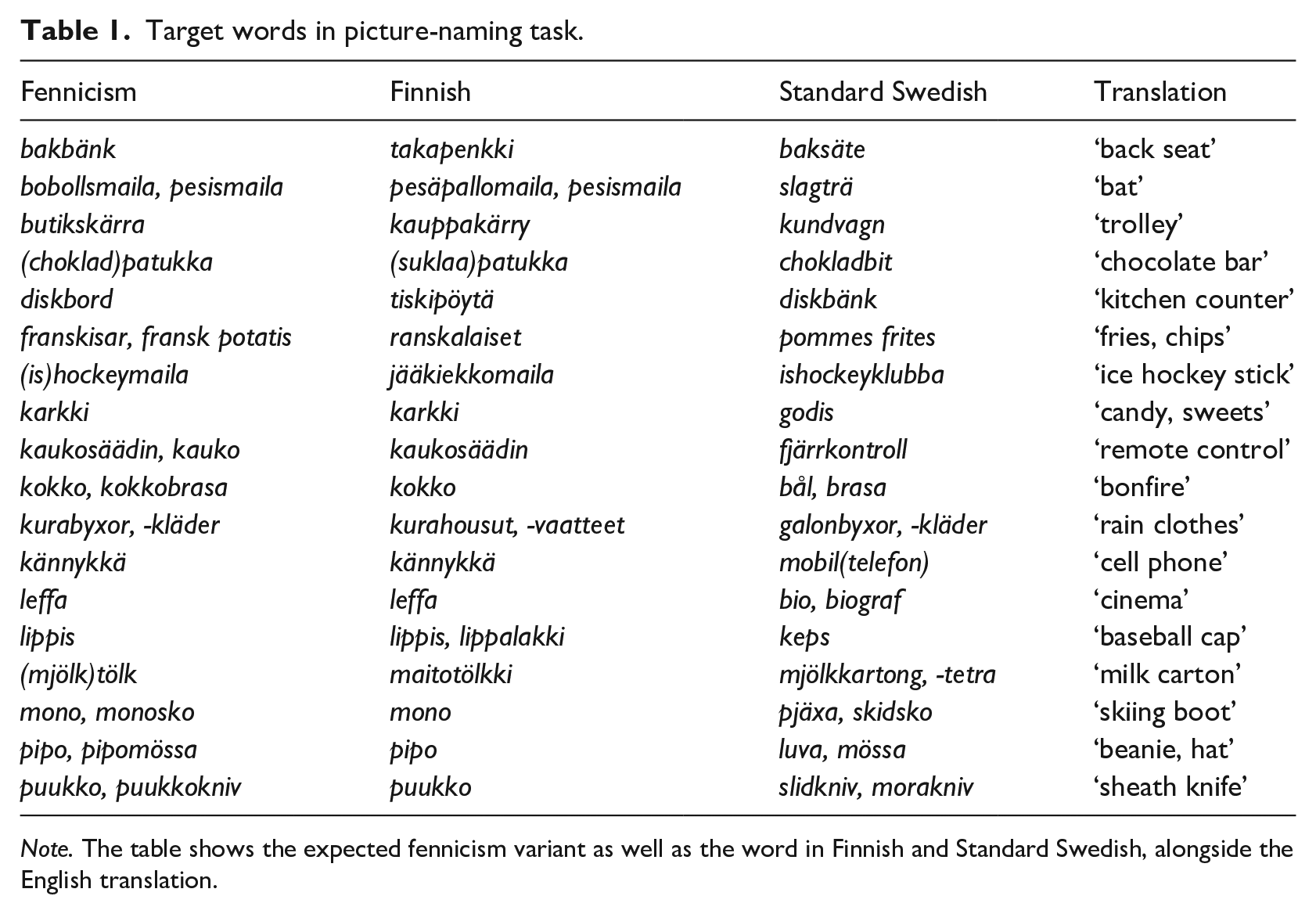
Note. The table shows the expected fennicism variant as well as the word in Finnish and Standard Swedish, alongside the English translation.
The target words in the study consist of three types of fennicisms, that is, direct loanwords (e.g., kännykkä and leffa), loan translations where the words have been translated from Finnish to Finland-Swedish (e.g., franskisar and butikskärra), and mixed nominal compounds, which consist of both a Finnish and Swedish element (e.g., kurabyxor and hockeymaila). These three types are all included under the umbrella term of fennicism in this study, as speakers may interchangeably use several of these types for the same object. For instance, a ‘sheath knife’ can be referred to as pukko/puukko, a direct loan from Finnish, or as puukkokniv, a compound consisting of Finnish puukko and Swedish kniv, (‘knife’).
The participants were encouraged to provide the word for the item that they would spontaneously use with family and friends. The responses were coded according to whether they fell under the term ‘fennicism’, ‘Standard Swedish’, or ‘Finland-Swedish dialect’. The coding option ‘English’ was also added, as some participants referred to certain objects using English words. If an object was erroneously identified or a participant struggled to think of a word for it, the item was coded as missing and excluded.
Data analysis
The outcome variable examined in this study is the number of fennicisms used by the individuals; the maximum number was 18, with the highest number reached per speaker being 13 (72.2%), and the lowest being 0. In Figures 1 to 3, we visualise the median and upper and lower quartiles for the outcome variable by predictor level. The modelling and results of the regression analysis are presented in Table 2.
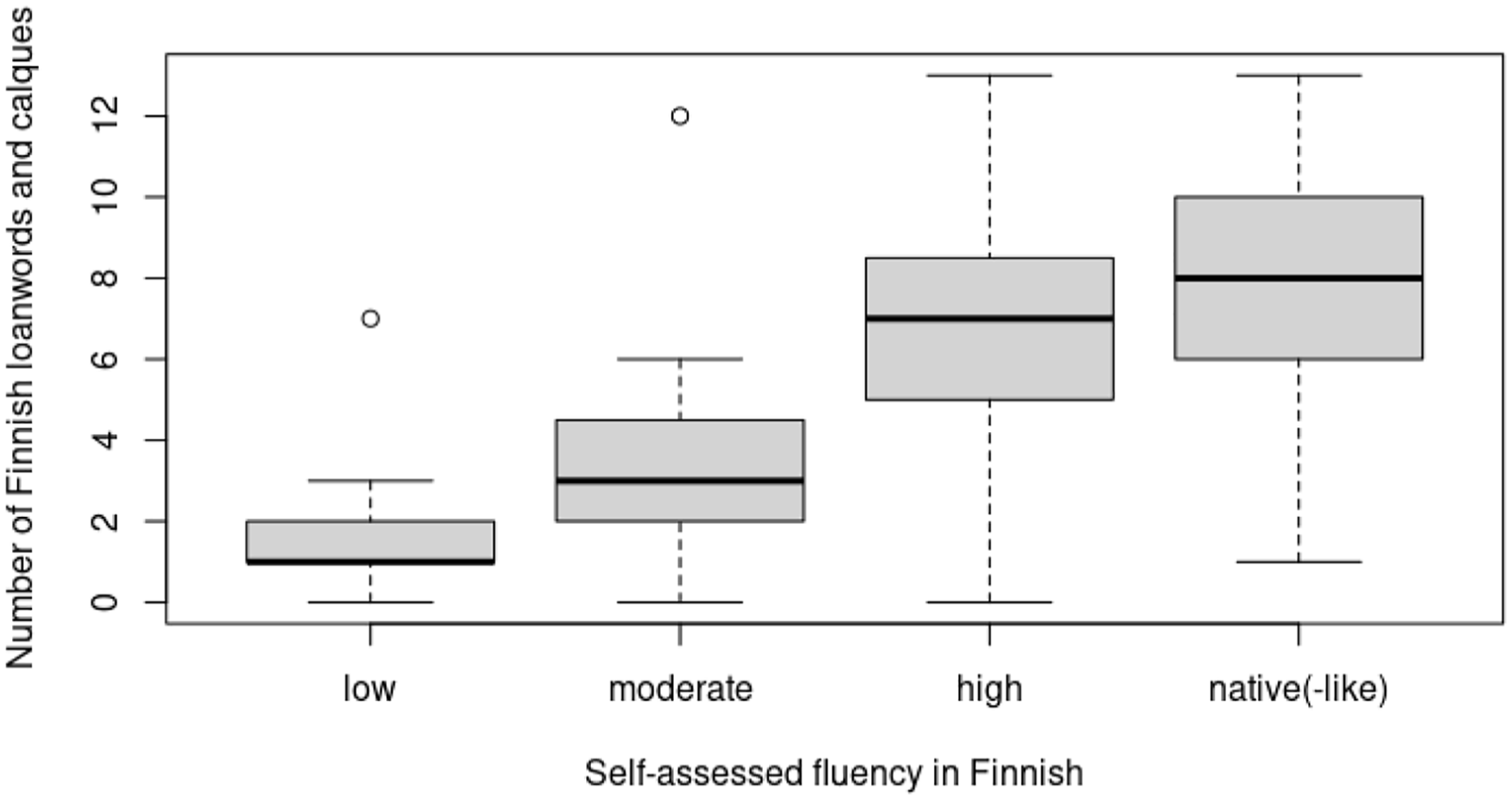
Boxplot showing number of fennicisms plotted by fluency of participants.
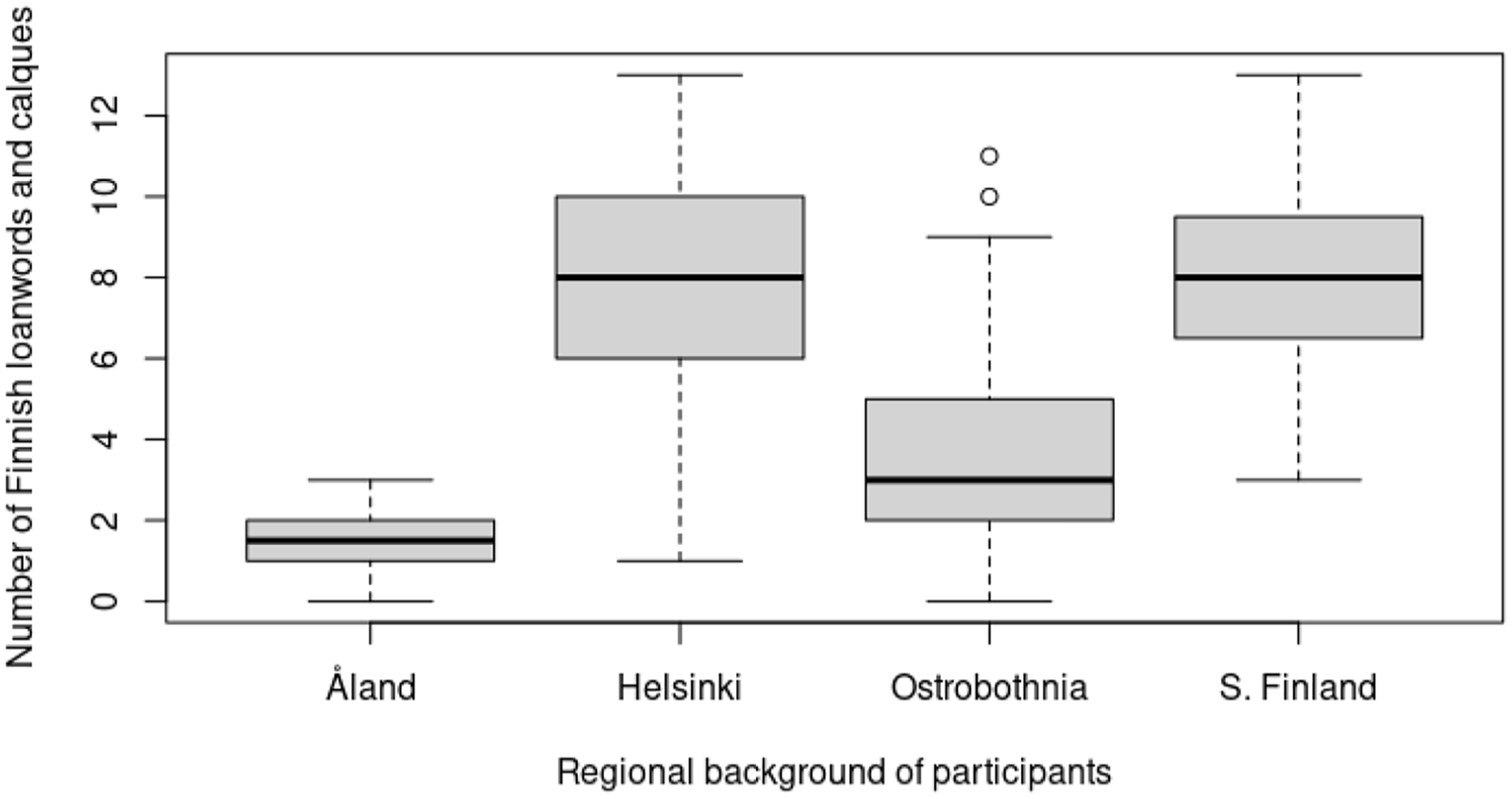
Boxplot showing number of fennicisms plotted by regional background of participants.
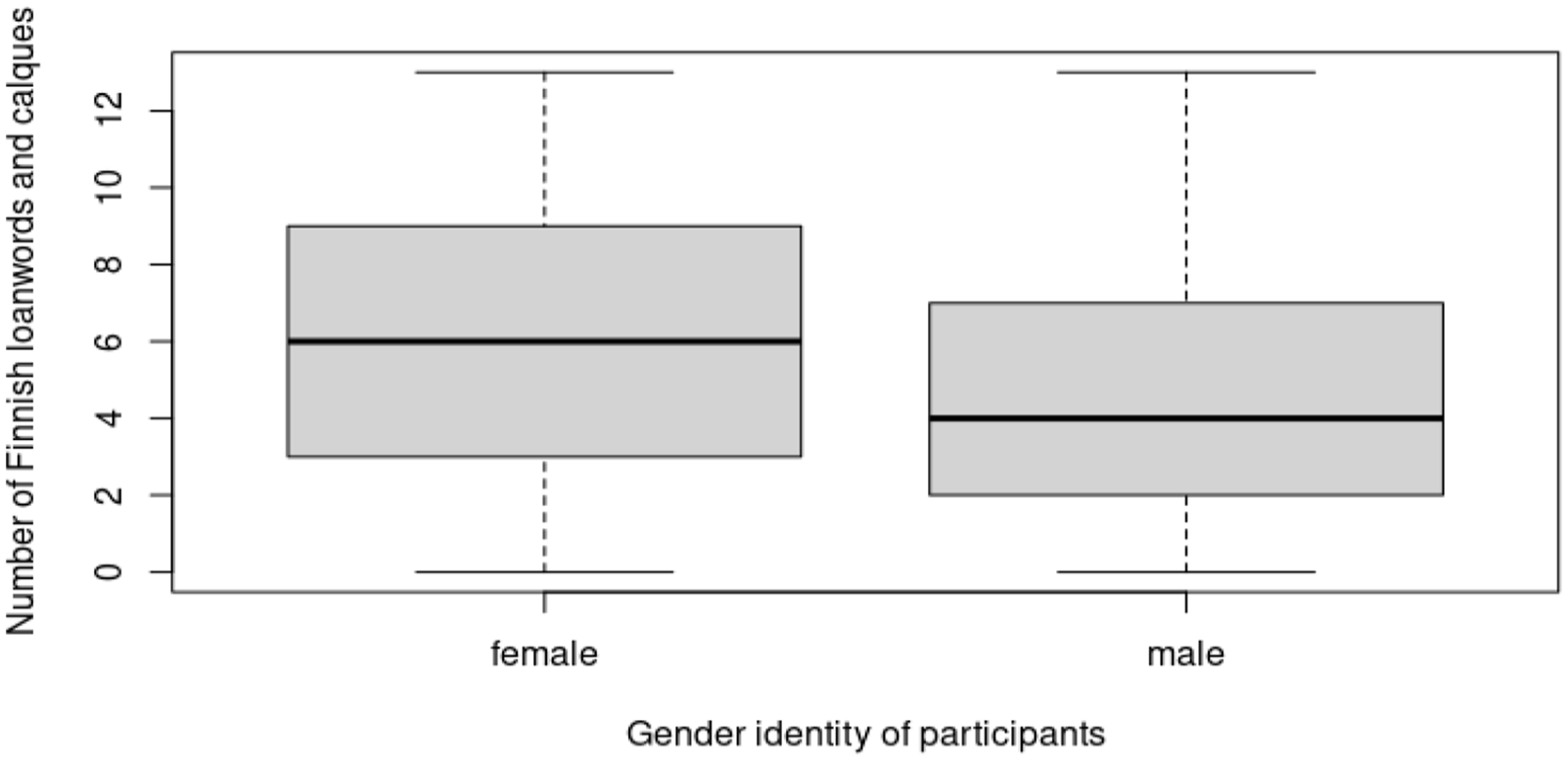
Boxplot showing number of fennicisms plotted by gender of participants.
Summary of Poisson regression predicting number of fennicisms used.
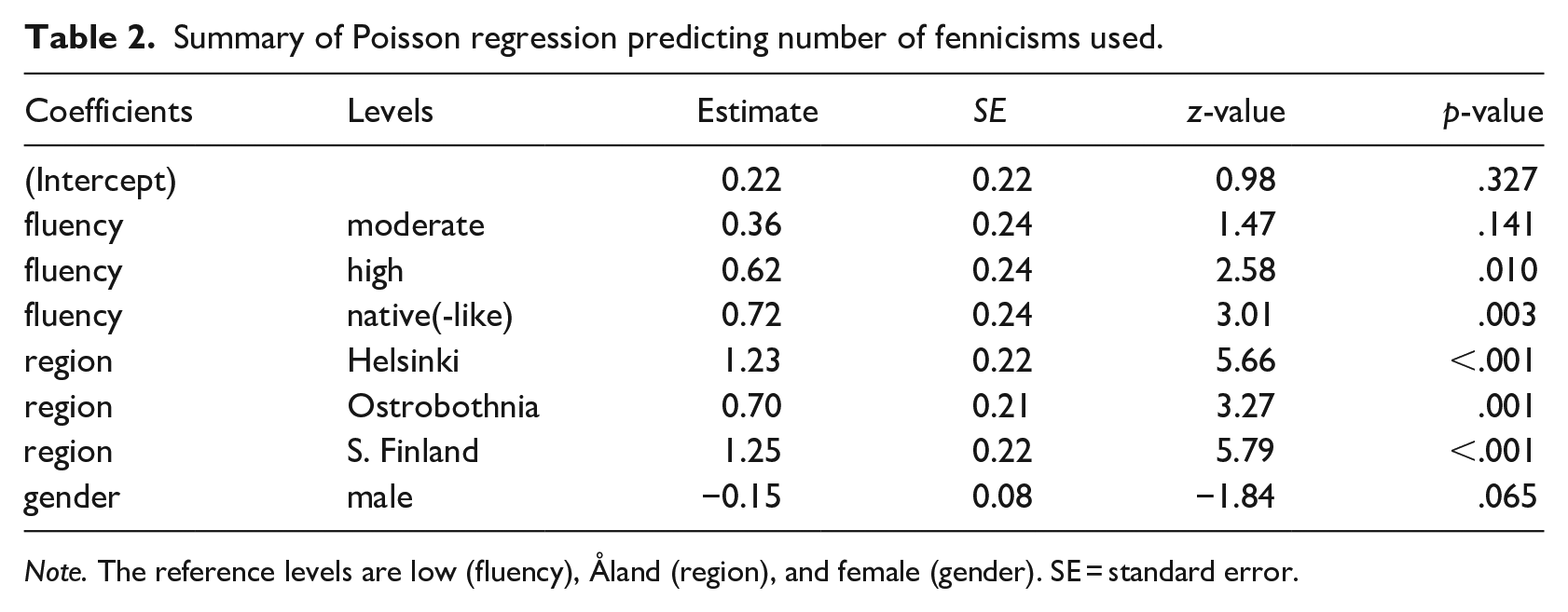
Note. The reference levels are low (fluency), Åland (region), and female (gender). SE = standard error.
The differences in fennicism frequency between the speaker groups in terms of fluency in Finnish are shown in Figure 1. With the exception of individual outliers, the boxplot suggests that participants with low and moderate fluency in Finnish tend to use much fewer Finnish loanwords and calques than participants with high or native-like proficiency. While groups with high and native-like fluency have a median of 7 (5–8.5) and 8 (6–10), respectively, the medians for the low and moderate groups are considerably lower at 1 (1–2) and 3 (2–4.25).
The regional differences are visualised in Figure 2. The boxplot shows that participants from Helsinki and Southern Finland produced the highest number of fennicisms and the widest range: with a maximum of 13, a median of 8 (6–10) and a minimum of 1 for the Helsinki groups, and a maximum count of 13, median of 8 (6.5–9.5) and a minimum of 3 for the Southern Finnish group. In contrast, the maximum value for participants from Åland was 3, with a median of 1.5 (1–2). Similarly, the Ostrobothnian group had a median of 3 (2–5), despite having a maximum value of 9 and two outliers of 10 and 11.
Figure 3, which shows a boxplot in which both groups have the same maximum and minimum, shows female participants having higher values for the median at 6 (3–9) compared to 4 (2–7). This suggests that female participants in the study used fennicisms more frequently than the male participants.
Regression
As the data set consists of categorical predictor variables and discrete count outcome variables, a Poisson regression was considered appropriate to statistically examine the differences between speaker groups. The regression model was fitted with the predictors of Finnish fluency, regional background, and gender identity (male/female) in R (R Core Team, 2020). The predictor of age as well as interaction effects of the predictors was also explored, but the current model was found to be the best fit. The goodness-of-fit was examined using the residual deviance: the residual difference was found to be relatively small and non-significant (p = .655), indicating that the model fits the data sufficiently well. Potential issues of multicollinearity between independent variables for the model were examined using the variance inflation factor (VIF), but no considerable multicollinearity was detected.
Table 2 shows the output of the model summary. We report the coefficients
Fluency in Finnish
For the predictor of Finnish fluency, Table 2 indicates significant differences between the reference level of ‘low’ fluency and ‘high’ (
Summary of pairwise comparisons for the predictor of fluency.
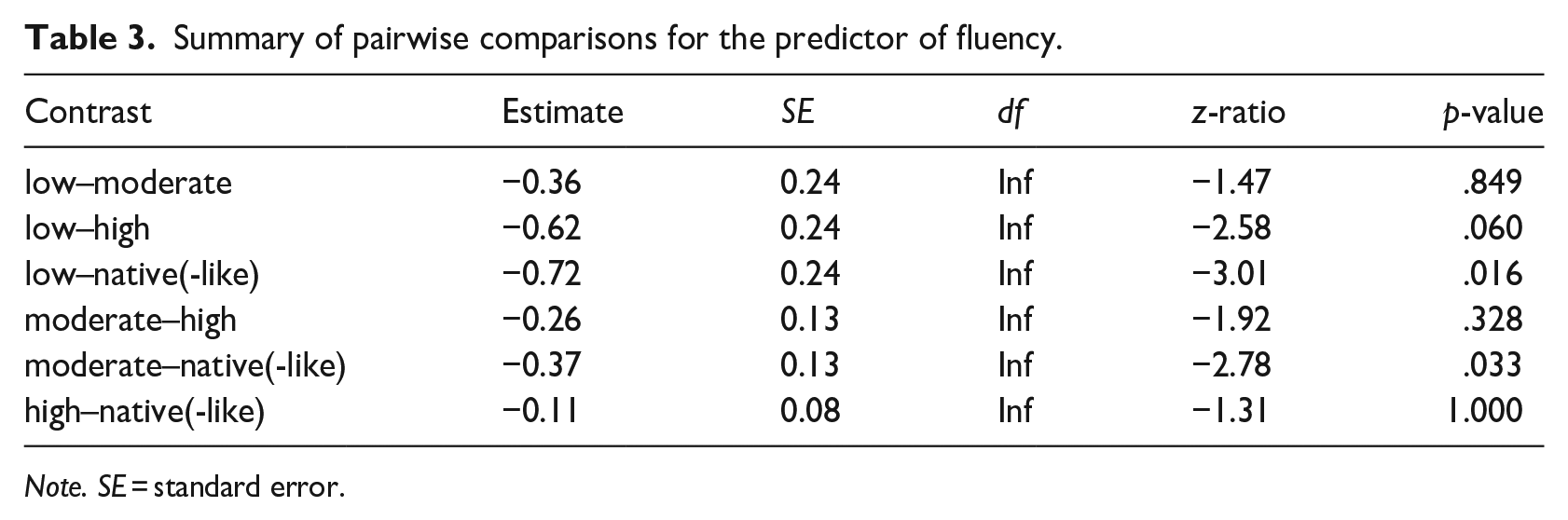
Note. SE = standard error.
As the pairwise comparisons were corrected with the conservative Bonferroni procedure, the results indicated that the low- versus high-fluency difference was near-significant (z = −2.58, p = .060), despite being significant in the regression model. Meanwhile, the comparison between the low and native-like groups remained significant (z = −3.01, p = .016). In addition, the low versus moderate (z = −1.47, p = .849) and moderate versus high (z = −1.92, p = .328) differences were found to be non-significant, while the comparison between the moderate and native-like groups were significant (z = −2.78, p = .033). Overall, the results suggest that speakers who self-identify as having low or moderate proficiency in Finnish are less likely to use fennicisms for everyday objects.
Regional background
The predictor of regional background was found to significantly improve the model, with Table 2 indicating significant differences between participants from Åland and those from Helsinki (
Summary of pairwise comparisons for the predictor of region.
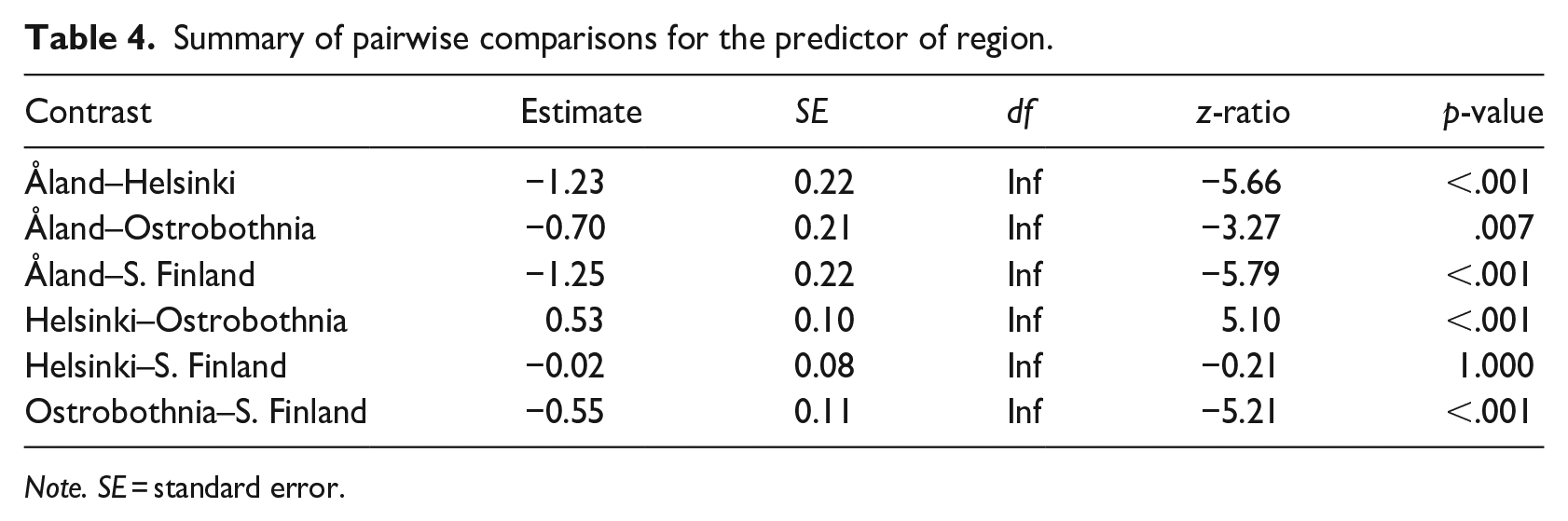
Note. SE = standard error.
Gender
The predictor of gender was found to improve the fit of the model, and the data as demonstrated in Figure 3 suggested that female participants used more fennicisms than their male counterparts. However, the model output for the difference between male and female participants is not significant (
Discussion
The aim of the study was to examine the use of fennicisms among Finland-Swedish individuals, specifically investigating how participants’ regional background and Finnish proficiency relate to fennicism frequency. Because all target words have Standard Swedish equivalents, and multiple people have been found to use these same target words, the fennicisms produced by the participants were presumed to be established Finnish loanwords in the Finland-Swedish mental lexicon, rather than instances of codeswitching. It is also worth noting that the picture-naming task took place after a Finland-Swedish sociolinguistic interview (Strandberg et al., 2021): considering that the interview primed participants to view the picture-naming task as a Swedish-language setting, the fact that participants provided fennicisms up to 72% of the time is striking.
In her study on the use of nominal compounds in Brussels Dutch, Treffers-Daller (2005, p. 502) stated that the studied expressions were so established in the local variety that speakers did not know the Standard Dutch equivalents for them. In contrast, in this study the participants were aware that the fennicisms were not the standard forms; for instance, most participants who used kurabyxor indicated that they knew the word is a non-standard nominal compound including Finnish and Swedish, although not all were aware that the Standard Swedish equivalent is galonbyxor. Similar findings were made by Bergroth (2016) in interviews concerning the use of finlandisms in bilingual Finland-Swedish and Finnish families. In their responses, some parents lamented the use of ‘correct’ Swedish insisted on by their children’s daycare providers, particularly in instances where the parents themselves did not know the standard form (Bergroth, 2016, p. 17). However, despite not always knowing the standard equivalents, the participants in both this and Bergroth’s (2016) study always indicated awareness of the fact that the fennicisms they used were not the Standard Swedish variants. In some cases, participants in this study scoffed at the Standard Swedish forms, finding them silly, stilted, or imprecise. These findings reflect patterns of use identified by Dowling (2011), who found isiXhosa speakers preferring English forms due to considering them more fitting or concise, rather because they fill a lexical gap. In addition, the use of fennicisms in Finland-Swedish can be used to demonstrate a uniquely Finland-Swedish identity, separate from that of Swedish speakers from Sweden (see Bergroth, 2016; Strandberg et al., 2022). In a study on linguistic borrowing by Zulu L1 speakers in South Africa, Ramsay-Brijball (2004) found that while the Zulu-English codeswitching was considered a stigmatised variety, it also expresses a dual linguistic, cultural, and social identity.
The use of fennicisms to demonstrate a uniquely Finland-Swedish or bilingual Finnish and Finland-Swedish identity can be argued to be reflected in the regional variation found in the data. When comparing the four regions, the results indicate that speakers from Åland use hardly any fennicisms at all, and speakers from Ostrobothnia use significantly fewer fennicisms than speakers from Helsinki or Southern Finland. These findings reflect the pattern of distribution of fennicisms identified by Ahlbäck (1971). The fact that speakers from Åland hardly use any fennicisms at all is not unexpected, given how closely associated Swedish monolingualism is with the Ålander identity, how low the status Finnish has in the region, and what strong cultural close ties Ålanders have to Sweden. Interestingly, different approaches to linguistic identity and language practice can also be seen on the Finnish mainland. While participants from both Southern Finland and Helsinki frequently made use of fennicisms in the picture-naming task, speakers from Ostrobothnia used significantly fewer fennicisms. These findings support the literature stating that Swedish- and Finnish-speaking communities remain relatively separate in Ostrobothnia, with Swedish having a stronger foothold than in the south. A study on the language use of Finland-Swedish university students found that while 84% of Ostrobothnian students used mostly or exclusively Swedish on a daily basis, only 60% of Swedish-speaking participants from the south used Swedish as frequently as, or more often than, Finnish (Leinonen & Tandefelt, 2007). Similarly, linguistic exogamy between Finnish and Swedish speakers has been shown to be much less common in Ostrobothnia than in the south of the country (Finnäs, 2012). In Ostrobothnia there is more focus on the separation of the language groups, and the identity of Ostrobothnians is closely tied to the Swedish language, the use of which can even be seen as an act of resistance against the dominant Finnish language and bilingualism among Finland-Swedes from the south (e.g., Aelbrecht, 2017; Klinkmann, 2017). In contrast, in Helsinki and Southern Finland, the Finland-Swedish identity is often intertwined with a bilingual Finnish and Finland-Swedish experience, and Finnish loanwords are more smoothly included not only in the speech of individuals, but also in the mental lexicon of the local community.
The statistical analysis indicated that speakers’ self-assessed fluency in Finnish had an effect on the frequency with which they used fennicisms in the picture-naming task. These findings suggest that fluency in Finnish, whether acquired as a native or second language, predicts the frequency of fennicism use. Although the accuracy of the participants’ self-assessed fluency was not explored through a Finnish proficiency test, previous research has shown that self-ratings are significantly correlated with measured language proficiency (e.g., Marian et al., 2007). We thus presume that the participants’ self-assessed fluency levels are mostly accurate, and our findings suggest that the frequency of fennicism use is correlated with participants’ perceived, if not objective, fluency in Finnish. Some earlier studies have examined correlations between proficiency and various types of codeswitching constituents, with evidence suggesting that more proficient bilinguals tend to produce larger EL constituents (e.g., Backus, 1996; Finlayson et al., 1998). While this article examines the use of pre-determined loanwords that usually appear either as individual utterances (due to the method of elicitation) or embedded in the Swedish matrix language (Myers-Scotton, 1992), future research analysing Finnish and Finland-Swedish hybrid language could examine whether language proficiency can also predict the type of codeswitching constituents that occur in the Finland-Swedish variety.
The model comparison examined the effect of age as a predictor of frequency of fennicism use, but it was not found to improve the model, and thus our study shows no signs of an apparent-time effect. Therefore, although the influence of Finnish on Finland-Swedish is often argued to be increasing (e.g., McRae et al., 1997; Tandefelt, 1996), no evidence of this is found in this study. The statistical analysis also indicated a non-significant effect of gender, despite visual inspection of the data suggesting that female participants used fennicisms more frequently. These findings are in contrast to those of Dowling (2011), who found that female L1 isiXhosa speakers were significantly more likely to provide English responses to the picture-naming task than male participants.
Strandberg et al. (2022) asked their survey participants to provide their own examples of Finnish loanwords, loan translations, and translated phrases used in Finland-Swedish. They, therefore, argued that the study required participants to demonstrate considerable metalinguistic awareness. This problem was avoided in this study using a picture-naming task, thus simply asking participants to spontaneously name items. A limitation, however, is that this method only allowed nouns to be included in the study, thus overlooking other parts-of-speech found to be borrowed from Finnish to Finland-Swedish (see Strandberg et al., 2022). While our paper only examines the frequency of fennicism nouns, future research could explore if part-of-speech category can predict how easily fennicisms are incorporated into the Finland-Swedish mental lexicon.
Conclusion
This study has examined variation in the use of Finnish loanwords and calques by Finland-Swedish individuals. Parallels have been drawn between Finland-Swedes and speakers of isiXhosa and Zulu in South Africa in terms of how linguistic, cultural, as we as social identities can be demonstrated through hybrid language use. Our findings demonstrate that the frequency by which fennicisms are used can be predicted by the regional background of the speaker, as participants from areas where Swedish culture plays an important part and the Finnish language has lower status (i.e., the Åland Islands and Ostrobothnia) use significantly fewer fennicisms than participants from more bilingual regions (i.e., Helsinki and Southern Finland). Self-assessed fluency in Finnish was also found to predict the frequency of fennicism use, with speakers who deemed their fluency as native-like using significantly more fennicisms than those identifying with low or moderate proficiency in Finnish.
Footnotes
Declaration of conflicting interests
The author(s) declared no potential conflicts of interest with respect to the research, authorship, and/or publication of this article.
Funding
The author(s) disclosed receipt of the following financial support for the research, authorship, and/or publication of this article: The fieldwork for this study was funded by The Finnish Cultural Foundation and the Swedish Cultural Foundation in Finland.
