




Abstract
Aims:
This paper seeks to determine the degree to which bilinguals and monolinguals use the semantic information available to them to activate semantically related lexical associates and facilitate processing.
Design:
We conduct a visual word masked priming task with 300 pairs of words that differed in forward strength of association in English-dominant early-acquiring and late bilinguals and monolinguals. We measured the reaction time for participants who completed a semantic judgment.
Data and Analysis:
Reaction times from 34 college-aged bilinguals and 28 monolinguals were analyzed with a series of analyses of variance (ANOVAs). The coefficient of variation (CV), a measure of efficiency, was calculated and used to compare speaker groups.
Conclusions:
Results indicated bilinguals were generally slower than monolinguals and did not display a benefit of additional semantic context on reaction time speed. The increase of semantic information in highly associated word pairs compared to unassociated word pairs did not increase reaction time in bilinguals to the same degree as it did in monolinguals. Comparing CV values indicate that the speaker groups were processing semantic information with approximately equal efficiency, although both groups were processing at different speeds.
Originality:
This study expands on previous research exploring the effect of semantic relations across three word strengths conditions and using visual pairs in a masked priming paradigm using predominantly English-dominant bilinguals.
Significance:
The findings indicate that even early-acquiring bilinguals may not be using meaning-related information to activate semantic associates in the same way as monolinguals. Such differences with word-level processing and activation may contribute to bilinguals’ differences and delays in sentence processing tasks.
Background
The terms “top-down” and “bottom-up” are used to refer to sources of information that a listener uses to comprehend an utterance. Processes that use each source of information are complementary and interact flexibly: this ensures that the listener achieves comprehension effectively (Field, 2004; Tsui & Fullilove, 1998). This study focuses on the use of top-down information for the constituent process of word activation in bilinguals in response to visual stimuli. Specifically, we investigate how bilinguals use semantic information to activate semantically related lexical associates as compared to monolinguals in a masked priming task.
In top-down processing, a listener uses previous information, their experiences and memory, knowledge of the topic of conversation, and other sources of contextual knowledge to facilitate comprehension of the message (Craik, 2007; Field, 2004; Goodman & Goodman, 2014). In this way, a listener’s expectations of what is said drives and reshapes what is perceived in a top-down direction (Kuhlen & Brennan, 2010) before being integrated (Bruner & Postman, 1949). One way that listeners engage top-down sources of information for comprehension is through the lexical activation of words related to those encountered in a sentence, which increases the likelihood that a final word congruent with the sentence meaning becomes activated (Gerrig & McKoon, 1998; Kaczer et al., 2015; Lau et al., 2013; McKoon & Ratcliff, 1992; Neely, 1977). Studies that examined the visual modality found priming effects for semantically related pairs in word recognition tasks (Becker, 1980; Forster & Davis, 1984; Marcel, 1983; Meyer & Schvaneveldt, 1971; Neely, 1977; Sperber et al., 1979). Additional studies found neurophysiological evidence that semantic information facilitates visual word recognition in related word pairs as compared to unrelated word pairs (Brown & Hagoort, 1993; Grainger & Holcomb, 2009; Kutas & Federmeier, 2011).
As a corollary to top-down processing, bottom-up processing includes the use of sensory input as a source of meaning in utterances: in spoken languages, this would be auditory input from a perceived acoustic signal. These sources of information interact during language processing, and this is demonstrated in the auditory modality among monolinguals (Field, 2004; Tsui & Fullilove, 1998). Top-down cognitive factors are crucial for perception (Foo et al., 2007; Lunner & Sundewall-Thorén, 2007) and can compensate for the loss of acoustic signal in suboptimal listening conditions resulting from background noise (Humes, 2007) or presbycusis (Pichora-Fuller, 2008). Similarly, improving the bottom-up signal can result in better word recognition and compensate for some of the inabilities of the top-down system, a flexibility which ensures that the language and perceptual system maintains its efficiency.
Although there is some debate, much of the research generally points to a “bottom-up” dependency in bilinguals in most contexts (Field, 2004; Tsui & Fullilove, 1998). However, Field (2004) describes studies in which L2 processing did use top-down strategies in certain contexts. In Wolff (1987), participants were more inclined to use top-down strategies when the text was more difficult to understand. This conflicts with results that found less-skilled listeners mostly attend to local details in a text than using knowledge-based schemata to comprehend, whereas skilled listeners performed better on questions that required drawing conclusions, synthesizing information, and making inferences (Hildyard & Olson, 1982; Shohamy & Inbar, 1991; Tsui & Fullilove, 1998). Koster (1987) finds that non-native listeners used top-down context to the same degree and sometimes to a greater degree when given enough time for processing (from Field, 2004). In the context of these studies, all three studies conducted by Field (2004) provide evidence of top-down influence when the context was overwhelming and the sentence was highly predictable.
Bradlow and Alexander (2007) suggest that semantic and other top-down contextual information is available to non-native listeners, but it is ineffective or underutilized at critical levels of acoustic impairments. The researchers sought to investigate whether the processing difficulty non-native listeners experience in noise is offset by either semantic (top-down contextual) or acoustic (bottom-up) enhancements or both. In a final word recognition task, native listeners benefited from each enhancement and in combination; however, non-native listeners only improved with both semantic and acoustic enhancements. This suggests that non-native speakers require a greater clarity in the signal in order for the top-down information to be used effectively, rather than an inability to use the top-down information (Bradlow & Alexander, 2007).
Importantly, research has found that the age of second language acquisition may impact a listener’s use of top-down information during L1 processing. Shi and Sánchez (2010) find differential results on a word recognition task with bilingual acquisition that begins after 8 years of age compared to bilingual acquisition before 8 years of age. Sabourin et al. (2014) tested simultaneous (age of acquisition [AOA]: birth), early (AOA: 3–5 years of age), and late bilinguals (AOA: 9–19 years of age) in a within-language and cross-linguistic semantic priming study and found that only simultaneous and early bilinguals showed evidence of L2-to-L1 translation priming effects. Similar results were reported by Perea et al. (2008), which suggests that there is a significant effect of AOA before 5 years of age for developing the bilingual lexicon. Furthermore, Kousaie et al. (2019) posit that early bilinguals with an AOA past 6 years of age do not appear to benefit from contextual information when processing speech. Kousaie et al. (2019) compared processing of high- and low-predictability sentences in simultaneous (AOA: birth) and early (AOA: 3–5 years) in noise and in quiet and found that simultaneous bilinguals can use contextual top-down information to repair impairments of a bottom-up signal better than early bilinguals.
Coulter et al. (2021) examined how bilinguals of different ages of L2 acquisition (simultaneous, early [before age 5], and late acquiring [after age 5]) use semantic context and found that all groups benefited from the addition of semantic in both L1 and L2 processing. However, this differs from the results of Kousaie et al. (2019), which used a similar methodology and found that late bilinguals did not benefit from the addition of semantic context in their L2. Coulter et al. (2021) suggest that these results indicate late bilinguals may not be able to benefit from greater semantic information in less favorable listening conditions. Importantly, both simultaneous and sequential bilinguals appeared to have greater variability in L1 processing accuracy as compared to late bilinguals.
Overall, this evidence suggests that simultaneous and early sequential bilinguals may demonstrate a difference in their ability to use semantic information with greater task difficulty even during L1 processing. As a result, less-proficient listeners may be more likely to require greater bottom-up information during sentence processing than monolinguals. This is exemplified in studies that show reliance on word forms when listening in noise (Field, 2004) and poorer scores on a Speech Perception in Noise (SPIN) test (Mayo et al., 1997; Rogers et al., 2006). In Rogers et al. (2006), early bilinguals and monolinguals were tasked with identifying monosyllabic English words in conditions of quiet, noise, and noise with reverberation. Although both groups had about the same word recognition performance in quiet, the bilinguals had poorer word recognition scores than monolinguals in noise and in noise with reverberation. Similarly, Mayo et al. (1997) found that while early bilingual performance on the SPIN test was equal to monolinguals in quiet, early bilinguals performed more poorly than monolinguals in noise. There is also evidence that early bilinguals have a greater focus on details in a text than on big-picture ideas, the latter of which involves constructing meaning representations over a discourse (Hildyard & Olson, 1982; Shohamy & Inbar, 1991).
Therefore, bottom-up dependence may account for bilinguals’ difference in processing in noise relative to monolinguals. Monolingual listeners can fluctuate the contribution of each source of information: if bilinguals have access to any available top-down sources of information but are still reliant on bottom-up information, we may speculate that there may be a lesser ability to generate top-down context to help in processing or there may be a lesser ability to rapidly integrate that top-down information with what they are perceiving to the same degree as native speakers. In this study, we focus on testing the degree to which bilinguals are generating top-down context during lexical processing to facilitate the activation of associated words. This activation of related words is one underlying process that facilitates larger-scale processing, like sentence comprehension. When encountering words in a sentence, semantic context is generated and used to facilitate over-arching sentence comprehension. Therefore, lexical processing is one sub-component of sentence processing.
Passive resonance
The concept of passive resonance describes how word-level processing facilitates sentence processing. The activation of words that are encountered in a sentence spreads outwards to other semantically related associate words (Gerrig & McKoon, 1998; Myers & O’Brien, 1998). Semantic content that is related to the words in a sentence becomes passively preactivated by association. Therefore, by the time the end of the sentence is reached and the final word is encountered, it has a high likelihood of having been preactivated passively by its associates in the sentence because it is likely to be congruent with other words in the sentence (Lau et al., 2013; Neely, 1977). This contrasts with theories of active lexical prediction in which the meaning representation of the sentence drives an active lexical search for the final word (Myers & O’Brien, 1998). Paczynski and Kuperberg (2012) indicate that there is an interaction between the contextual representation of the sentence and relatedness networks of the words; any “resonance” leads to the facilitation of semantically related upcoming targets (Paczynski & Kuperberg, 2012).
To demonstrate passive resonance, consider the sentence: “She was afraid she would not catch her flight, so she hailed a taxi to get to the (airport).” In this example, the listener theoretically builds a sentence-level meaning representation that evolves as the words in the sentence are encountered. In addition, the listener uses the grammatical constraints of the prior occurring words to constrain what words may come next. Here, “catch” may facilitate the processing of “flight,” and “hailed” may facilitate “taxi.” Under the semantic spreading activation account, processing the words “catch, flight, taxi” and others in the sentence increases the activation of semantically related associates in long-term memory (Collins & Loftus, 1975; Meyer & Schvaneveldt, 1971). As a simplified example, the phrase “hailed a taxi to get to . . .” may result in activation of the word “airport” along with other related words and semantic features. Potentially related words are activated through passive resonance as a listener processes each incoming word. By comparison, active lexical prediction relies on extracting linguistic meaning out of preceding words in order to limit upcoming words to suitable candidates (Becker, 1980); “active” sentential prediction strategies rely on building an evolving meaning representation to predict upcoming words.
Masked priming
To assess bilinguals’ use of top-down information at the word level, we tested the degree to which bilinguals used semantic context available in stimuli to aid in lexical activation. We describe a conceptual replication of the auditory masked priming experiment conducted in Golestani et al. (2009) which isolated the role of the semantic level of speech on processing using masked auditory words with differing degrees of noise (see Crandall & Sherman, 2016). The present study replicates this methodology with a visual masked retroactive priming paradigm using the same stimuli pairs and with some varying methods. If bilingual processing does not effectively use semantic information for sentence processing, this would be evident in a task that is designed to observe the isolated role of semantic information on processing at the lexical level. Prior studies have examined masked priming effects in a visual modality and similarly found facilitation between semantically related pairs than unrelated pairs (Holcomb et al., 2005; Holcomb & Grainger, 2006). This indicates the system has access to a word’s meaning before the word is fully recognized and attests to the presence of top-down semantic context when the visual input is masked (Pexman, 2012; Yap & Balota, 2015).
Golestani et al. (2009) conducted an auditory retroactive masked priming task with 9 native French-English bilinguals who acquired English between 11 and 18 years old and self-reported as having “moderate” English fluency. Their results indicated that target word helped facilitate the backward recognition of a masked prime in their native French only; in the non-native language, Golestani et al. (2009) found that native French speakers hearing degraded words in L2 English had better performance on unrelated trials as compared to related trials. The researchers explain this as semantic interference, where the increased effort of non-native semantic processing leaves fewer cognitive resources to perform the task of recognizing acoustically degraded words. A similar result was found in Moreira and Hamilton (2006) where non-native speakers tasked with choosing the picture whose label rhymed with a target word tended to choose a word that was semantically related to the target rather than one that rhymed with the target (Moreira & Hamilton, 2006). Together these results point to key differences in how bilinguals process their two languages, with the processing of native language words being facilitated by access to semantic information, and the processing of non-native language words being inhibited by the addition of semantic information.
In this study, reaction time (RT) indicates a participant’s ability to activate the linguistic features of words that are related to the stimulus. In bilinguals, overall, we expect longer RTs compared to monolinguals, indicating a slowdown in the activation or use of semantic information to facilitate neighboring words. We expect low association pairs to take longer to process in both speaker groups given that there is less semantic information available to use, but we expect bilinguals to have similar RTs for both high and low association pairs. These results would demonstrate limited access or use of semantic information in bilinguals during lexical processing.
Because individual differences may influence raw RT results, we also analyze our results in terms of processing efficiency (rather than speed) by using a coefficient of variation (CV). The CV is a ratio of RT performance to variation (Phillips et al., 2004; Segalowitz & Hulstijn, 2005; Segalowitz & Segalowitz, 1993) and represents the variability in a participant’s responses. A smaller CV value indicates that the processing engages fewer of the slow and highly variable cognitive operations that slow down processing, such as accessing L1 translation equivalents, processes involved in self-monitoring, error correction, and resolving problems associated with a poor bottom-up input (Phillips et al., 2004). Smaller values are less variable, and this stability is interpreted as reflecting more efficient or automatic processing.
If the proportion of mean RT to variability is the same across groups despite absolute differences, that indicates that participants are completing the given experimental task using processes that have about the same degree of efficiency (Segalowitz, 2008). However, if the proportion of mean RT and variability are different across groups, that indicates that participants are completing the experimental task with cognitive processes that are different in their automaticity and efficiency (Segalowitz, 2008). Differences in CV values would therefore directly indicate bilinguals’ efficiency in word-processing. Bilinguals may be disproportionately slowed down by language-dependent factors such as processes related to self-monitoring, cross-linguistic activation or translation, and error correction. If bilinguals are engaging in less efficient processing than monolinguals during the presented word recognition experiment, this should be reflected in an analysis with CV measures.
Methods
In this study, participants viewed prime-target pairs of visual words that varied in their semantic association to each other and had to identify the obscured prime from a pair of words via a keyboard button press. In order to preserve the effect of semantic context on processing without the effect of auditory processing, the visual modality was used in line with Bernstein et al. (1989). Previous studies showed that bilinguals were more disadvantaged by competing noise in speech perception tasks than monolinguals (Mayo et al., 1997; Rogers et al., 2006).
The study was implemented and distributed to participants online using the PsyToolkit experimental software (Stoet, 2010, 2017). During the study, a fixation cross (i.e., “+”) was shown at the center of the screen at a randomly selected length of time between 150 and 200 ms. Then, a set of 10 hashmarks (i.e., “##########”) was presented for 600 ms before and after the prime word, which was shown for 54 ms and obscured by hashmarks (e.g., “#BIRD#”). This length of time is similar to other masked priming experiments which range between 50 and 55 ms (Balota et al., 2006; Chng et al., 2019). Next, the target word was presented for 600 ms. All participants viewed all 300 stimuli in 3 counterbalanced blocks (99–102 words in each) with stimuli randomized within the blocks.
After a 700 ms delay, two “foil” words were shown on either side of the display screen, one of which was the identical prime word in lower case Arial text (e.g., “bird”) and the other word was a word that was related to the prime (e.g., “feather”). The word that represented the prime word was randomly assigned to the left or right positions counterbalanced across participants. When appearing as a part of the foils, each prime word re-appeared in the left and right positions equally across all participants.
Participants had 5,000 ms to indicate which of the two foil words was the prime word (“A” key to indicate the left foil word and “L” key to indicate the right foil word). RT and accuracy of response were recorded. Trials with outlying RTs that were ±2.5 SDs from the mean RT for each participant were removed from analysis (n = 510). In sum, a total of 3.13% of monolingual responses and 2.52% of bilingual responses were removed from analysis. No participant had more than 19 trials removed from their total 300 trials.
Participants
Participants were recruited via word-of-mouth or from a university course of undergraduate linguistics. Of the total 68 participants who completed the study, data from 6 participants were removed after collection because their rate of correct responses was at or below 50% (i.e., at chance) for each condition. One participant’s data was removed because over 50% of their responses had “timed out” indicating that they had provided no responses. Two bilingual participants’ data were removed because they reported using American sign language and no other second language; the semantic differences of bimodal bilingualism may interfere with the homogeneity of the bilingual subjects in this experiment.
The data were analyzed with the results of the remaining 62 participants. Of this sample, 28 were monolingual and 34 were bilingual. Participants were between 18 and 38 years of age (m = 22.28, SD = 3.84), and 11 participants identified as male, 49 identified as female, 1 identified as non-binary, and 1 provided a null response.
Monolingual participants were between 18 and 27 years of age (m = 21.15, SD = 2.13). All reported that they had no immersive exposure to another language other than English beyond language education courses, self-report their English proficiency as a 6.9 on a scale of 7 (where 7 indicates “perfectly native-like” proficiency), and all report using English exclusively in daily life.
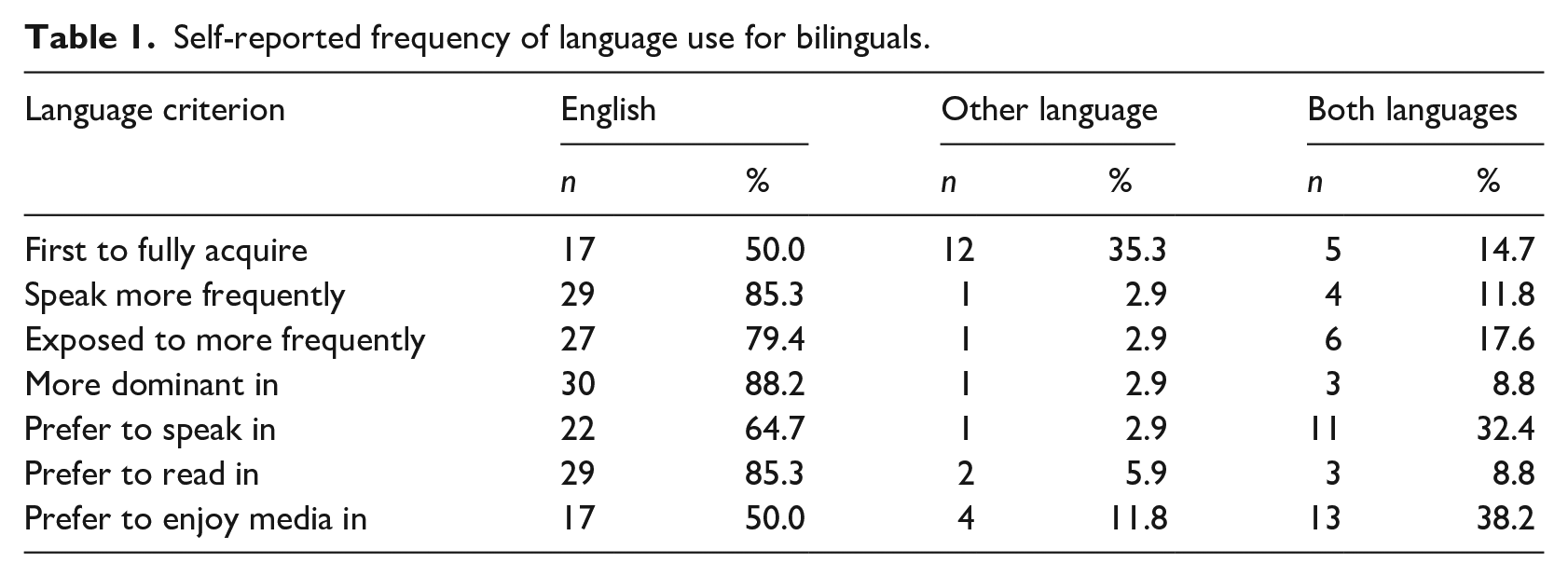
Ages for the bilingual group ranged from 19 to 38 (m = 23.18, SD = 4.63). All bilingual participants reported strong or high proficiency and dominance in English. On average, the bilinguals self-rated their proficiency in English as 6.7 on a scale of 7 with two individuals reporting a proficiency of 4 on the scale, and the rest as a 6 (n = 4) or 7 (n = 27) on the scale (one null response). Most participants were early bilinguals who reported English exposure that began at birth (n = 19) or before 5 years of age (n = 9). The remaining participants reported English exposure that began between 5 and 12 years of age (n = 4) or at or after 18 years of age (n = 2). All participants reported current and regular exposure to English that had not stopped since their time of exposure. The other non-English language varied across bilingual participants and is summarized in Table 1.
Self-reported frequency of language use for bilinguals.
Stimuli
The stimuli were 300 pairs of English words which included 100 pairs of words that had a high forward strength of association and 100 pairs of different words that had a low forward strength of association with each other. In addition, the stimuli included 100 pairs of words that were unassociated with each other. This set was comprised of half the primes from the strongly related word pair list and half of the primes from the weakly related word pair list, each randomly selected and coupled with a completely unrelated target word. The unassociated set of words were screened to ensure they were truly unassociated with each other and randomly paired. Therefore, half the words in each “associated” condition also appeared in the unassociated condition. No words in the unassociated condition were unique to that condition.
Stimuli were 300 word pairs from Golestani et al. (2009), which represent a selection from the University of South Florida Free Association Norms (Nelson et al., 2004). Pairs were strongly related, weakly related, or unrelated representing the free association or forward strength values (Nelson et al., 2004). To replicate the methodology, we used the same stimuli from the list of related stimuli in Golestani et al. (2009) but selected the highest and lowest extremes from the list. The top 100 had a forward strength of between 0.174 and 0.701 and were considered “strongly related” for the purposes of the present study; conversely, weakly related pairs are those for which forward strength is the 100 weakest, or between 0.013 and 0.081. Pairs with a forward strength between 0.081 and 0.174 in the Golestani et al. (2009) list were not used in this study. The lists were consistent in syllable length and word log frequency across each relatedness group (Golestani et al., 2009) and were matched for lexical frequency and the number of syllables across each of the three context lists (strongly related, weakly related, unrelated lists). Foils also matched primes in the number of syllables.
Results
Omnibus differences in RT data
A repeated-measures two-way mixed analysis of variance (ANOVA) was conducted in order to determine whether responses to the conditions of forward strength of association (high association, low association, or no association) were different based on speaker group (bilingual or monolingual). RT values for monolinguals were normally distributed as assessed by Shapiro–Wilk test (p > .05). RTs were not normally distributed for bilinguals as assessed by Shapiro–Wilk test (all association strengths p < .001). This is likely a result of the bilingual responses skewing leftward due to a higher frequency of high RT responses. Figure 1 shows boxplots of the RTs for each condition.
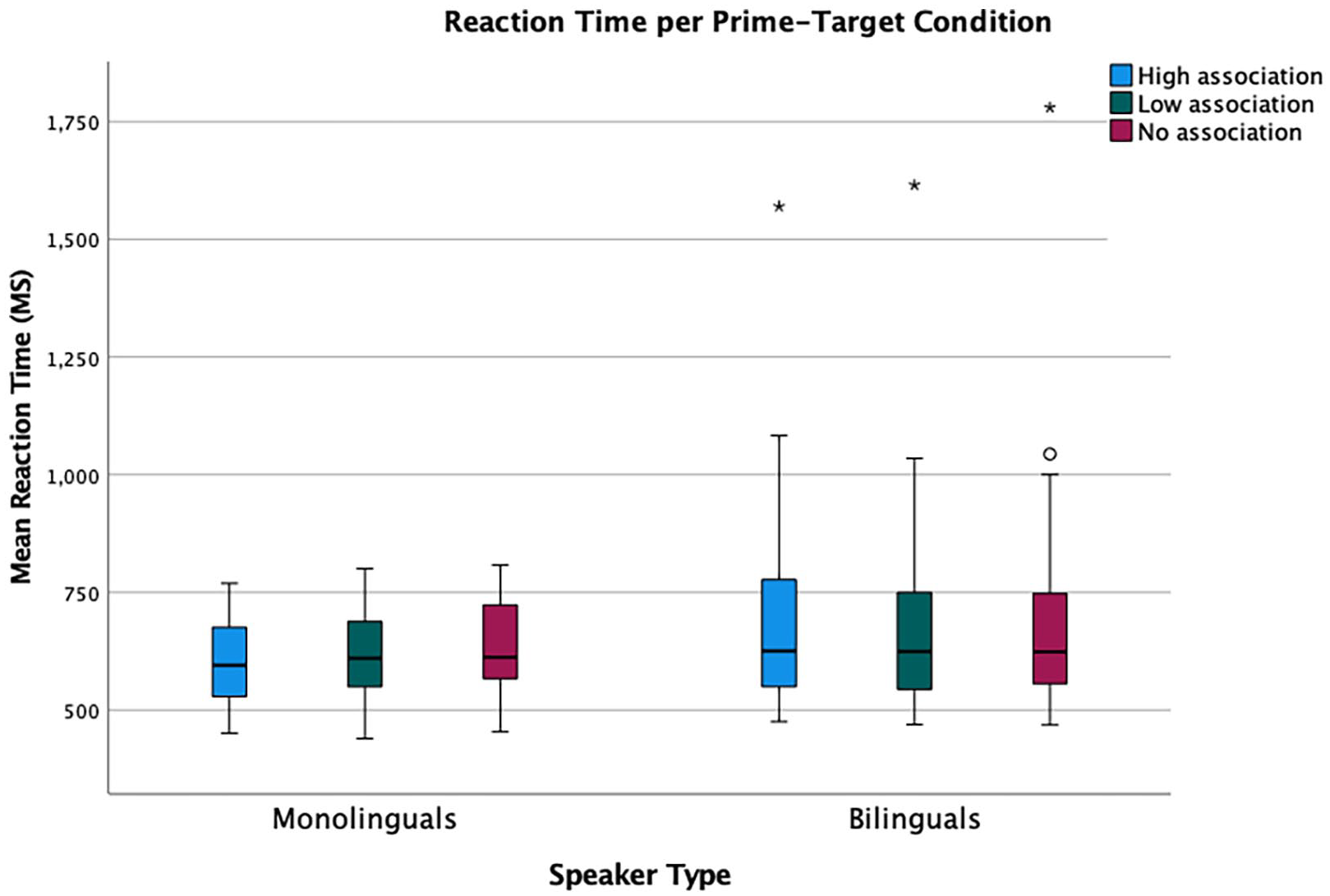
Boxplot of reaction time per condition.
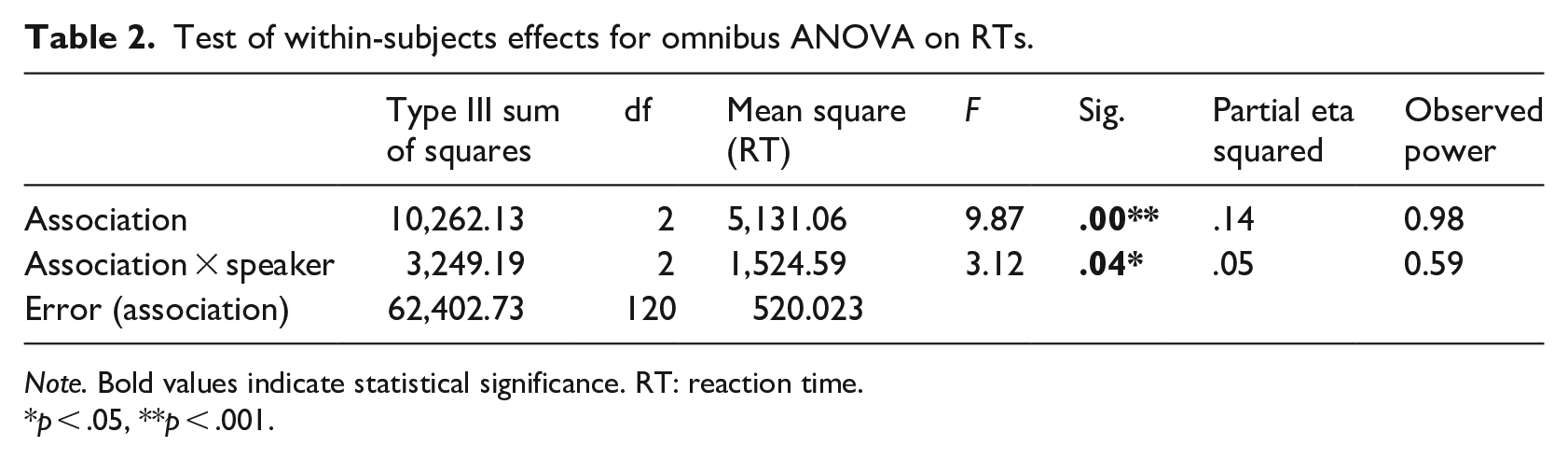
Mauchly’s test of sphericity indicated that the assumption of sphericity was met for the two-way interaction, χ2 = 4.912, p = .086. Figure 2 shows a corresponding profile plot for the two-way ANOVA, and the omnibus ANOVA results are summarized in Table 2.
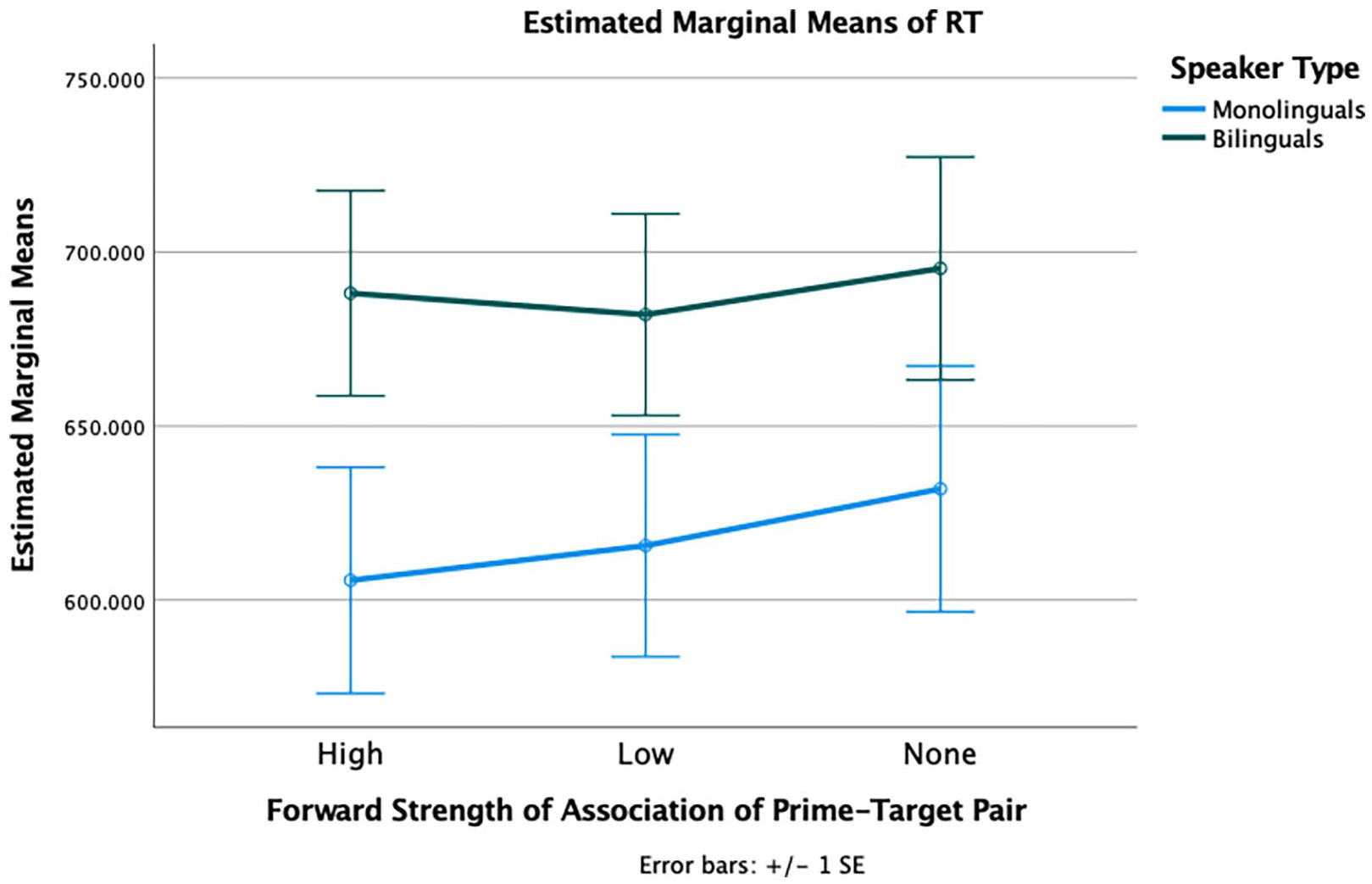
Profile plot for reaction time (RT) two-way ANOVA.
Test of within-subjects effects for omnibus ANOVA on RTs.
Note. Bold values indicate statistical significance. RT: reaction time.
p < .05, **p < .001.
Table 2 shows that there is a statistically significant interaction between the forward strength of association and the speaker type, F(2, 120) = 3.124, p = .04, partial η2 = .059.
Group effects
Simple main effects of group were assessed post hoc with independent samples t-tests comparing both groups for each association strength. A Bonferroni-adjusted p value for multiple comparisons was set at .016. Results indicated that bilinguals had a numerically larger mean RT in all three conditions compared to that of the monolinguals. However, none of these differences was statistically significant: there was no group differences for the high association pairs, t(45.79) = –1.88, p = .07, low association pairs, t(60) = –1.540, p = .13, nor for unassociated pairs, t(44.26) = –1.43, p = .16.
Association effects
Simple main effects of the associations for each group were assessed post hoc with two repeated-measures ANOVA with association strength (high, low, or unassociated) as the independent variable.
We conducted post hoc ANOVAs for each group and found a statistically significant main effect of association in monolinguals, F(2, 54) = 14.94, p < .001, partial η2 = .36. No significant differences in RT emerged between the three association conditions for bilinguals, F(2, 66) = 2.22, p = .12, partial η2 = .06.
Pairwise comparisons
A Bonferroni-adjusted alpha level was set at .016 for all comparisons of the context conditions pairwise for both groups. Pairwise comparisons for the monolingual group revealed that high association pairs had a significantly faster RT compared to unassociated pairs (M = –26.27, SE = 5.29 ms, p < .001). Low association pairs also had a significantly faster RT than unassociated pairs (M = –16.30, SE = 4.47 ms, p = .001). However, high association pairs and low association pairs were not significantly different from each other (p = .046) given the Bonferroni correction.
Analysis of difference scores: effect of semantic context
Following this, we replicated the analyses with difference scores, which were calculated by subtracting the RT of the unassociated condition from each of the two associated conditions. This provides a measure of the effect of semantic association more directly by subtracting out the RT of the unassociated condition for all participants as a baseline.
To determine the effect of semantic association, the High Semantic Context Effect was calculated by finding the differences between the mean RT for high association condition and the mean RT for the unassociated condition for each participant, and a Low Semantic Context Effect was calculated by subtracting the mean RT for low association condition minus the mean RT for the unassociated condition for each participant. These values represent the change in RT speed compared to the unassociated condition. Negative values represent a greater effect of semantic context in reducing the RT speed. Means and standard deviations of these values for all participants are shown in Table 3.
Descriptive statistics of semantic context effects (RTs).
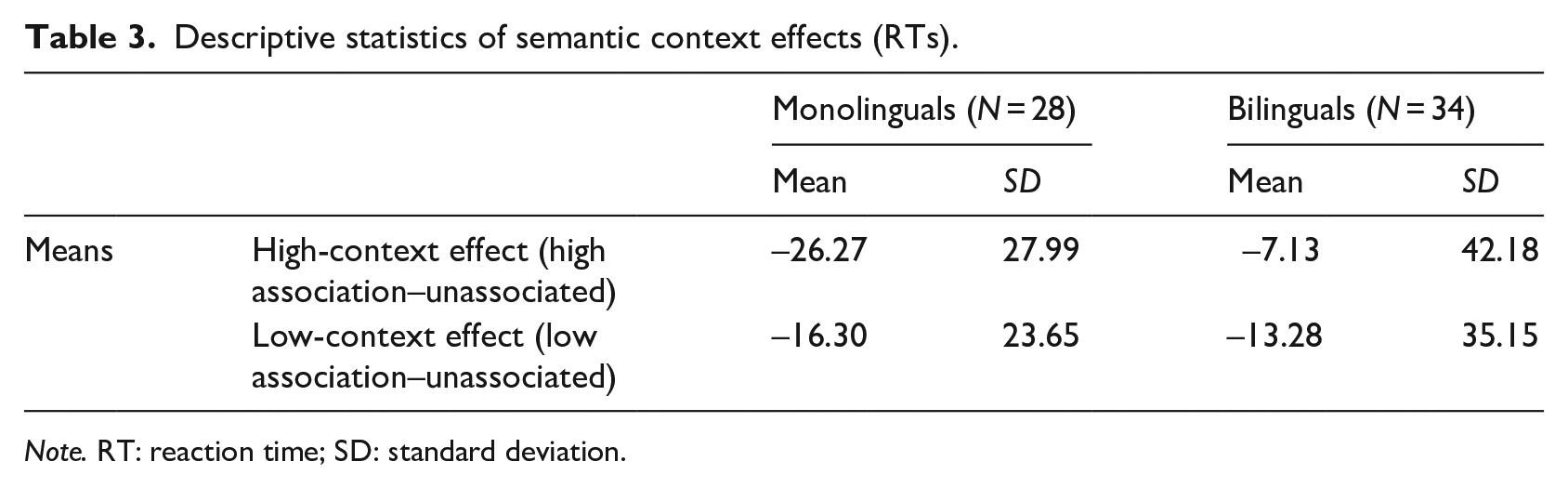
Note. RT: reaction time; SD: standard deviation.
In order to determine whether the decrease in RTs for the high and low contexts was significant, we conducted a one-sample t-test to compare the change in the RT against a test value of zero. The effect of high context was significant for monolinguals, t(27) = –4.966, p < .001, as was the effect of low context for monolinguals, t(27) = –3.646, p = .001. Only the effect of low context was significant for bilinguals, t(33) = –2.203, p = .035. High context did not yield a significant effect, t(33) = –0.986, p = .331.
The mean RTs of the high and low context effects were input into an ANOVA to determine differences between the high and low context effects for each group. The results are shown in the profile plot in Figure 3 and summarized in Table 4.
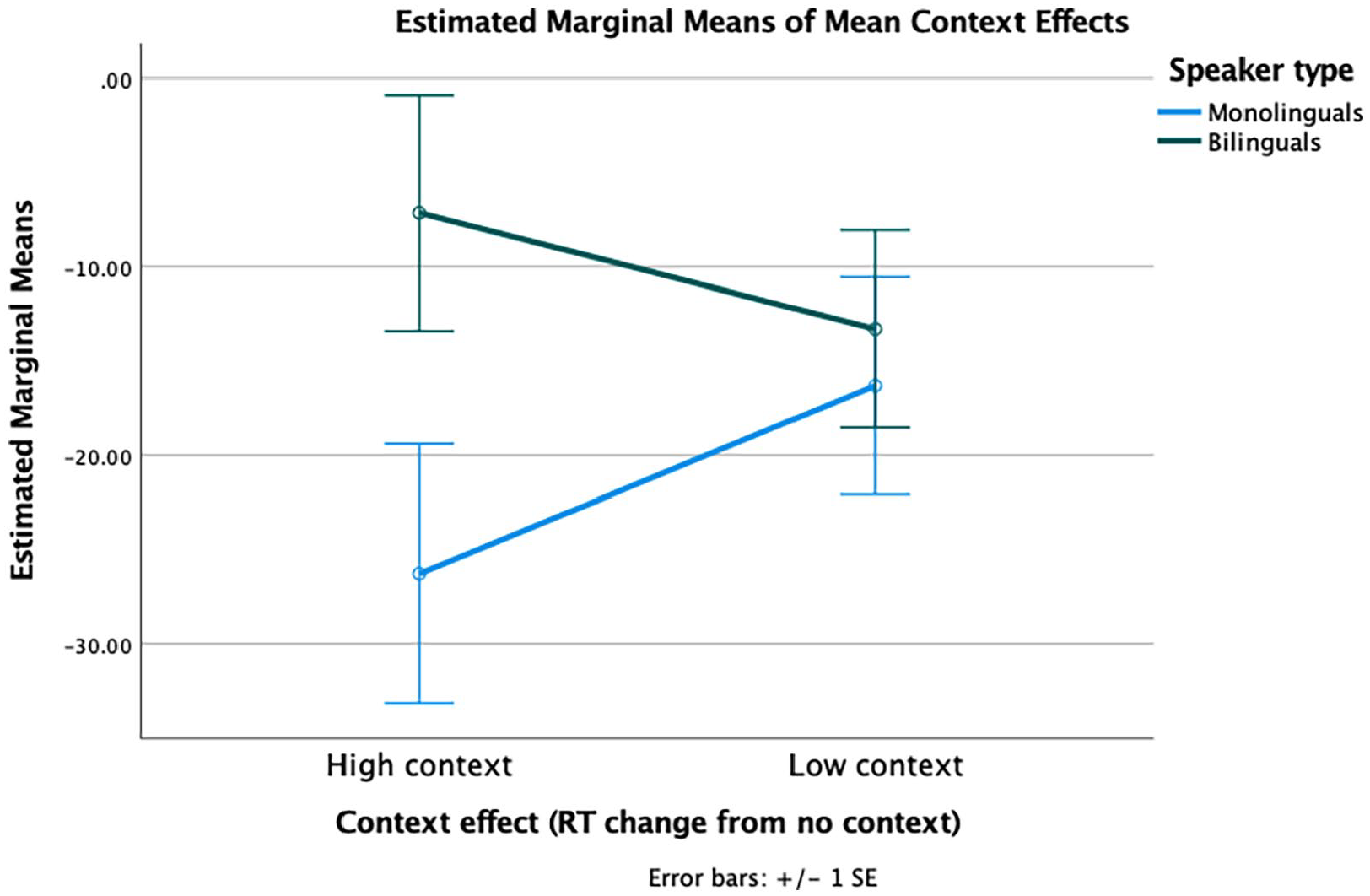
Profile plot for mean context effect reaction time (RT) ANOVA. Plots for the difference values. “High context” condition is the difference between high association pairs and unassociated pairs for each of the speaker groups; “low context” condition shows the difference between the low association and unassociated pairs for each of the speaker groups.
Test of within-subjects effects for ANOVA on context effects (RTs).
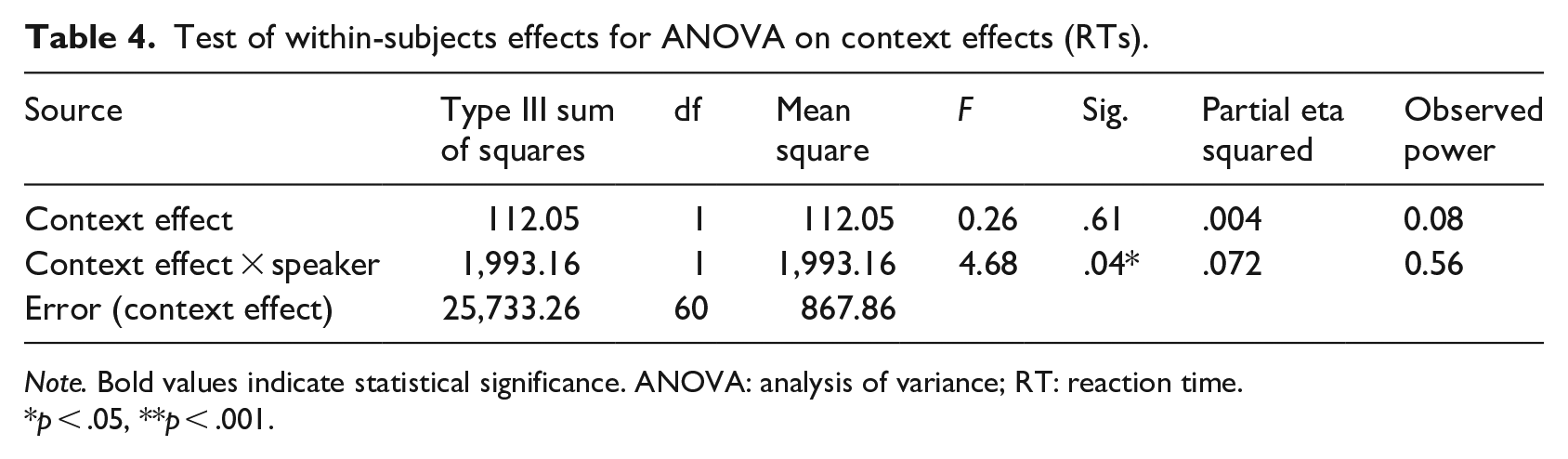
Note. Bold values indicate statistical significance. ANOVA: analysis of variance; RT: reaction time.
p < .05, **p < .001.
There was a statistically significant interaction between the context effect and speaker group, F(1, 60) = 4.68, p = .04, partial η2 = .082. This effect was investigated further within each group with post hoc ANOVAs on the high and low context effects. The result of the one-way ANOVAs for each speaker group indicates that there was a significant difference between context in monolinguals only, F(1,27) = 4.386, p = .046, partial η2 = .14, but no such difference for bilinguals, F(1, 33) = 1.23, p = .28, partial η2 = .04. This indicates that only in monolinguals did a high-context condition generate a significantly faster response effect compared to the effect in the low-context condition. We interpret this as indicating that high-context conditions were significantly more helpful in reducing monolinguals’ speed of processing compared to the low-context conditions. The same effect was not found for bilinguals; in fact, while no significant effect emerged, the trend for bilinguals was that the low-context conditions appeared to be more facilitatory than the high-context conditions in helping to reduce the speed of processing. In other words, not only was the high-context effect smaller in bilinguals than it was in monolinguals, but the high-context effect was smaller than the low-context effect for bilinguals.
Analysis of CV scores: effect of individual variability
Individual difference may account for these RT results, so further analyses were conducted to compare processing efficiency between the groups. To neutralize the effects of variation across participants’ processing RTs, we first analyze the intra-individual variability in response time (CV) values calculated for each subject.
The CV for each subject is a ratio of the standard deviation to mean reaction time (SD/RT) of all a participant’s correct responses and is used as a measure of the efficiency of processing. A repeated-measures two-way mixed ANOVA was conducted to determine whether the CV of participants’ RT responses to conditions of forward strength of association (high association, low association, or no association) were different based on participant speaker status (bilingual group or monolingual group). RT values for monolinguals were normally distributed as assessed by Shapiro–Wilk test (p > .05) but were not normally distributed for bilinguals as assessed by Shapiro–Wilk test (high association: p = .015; low association: p < .001; no association: p = .005). Because the ANOVA is considered resistant to mild violations of normality (Schmider et al., 2010), the ANOVA results are here presented. A boxplot indicated two outliers in the data: this is shown in Figure 4 and the outlying participants are represented by a circle.
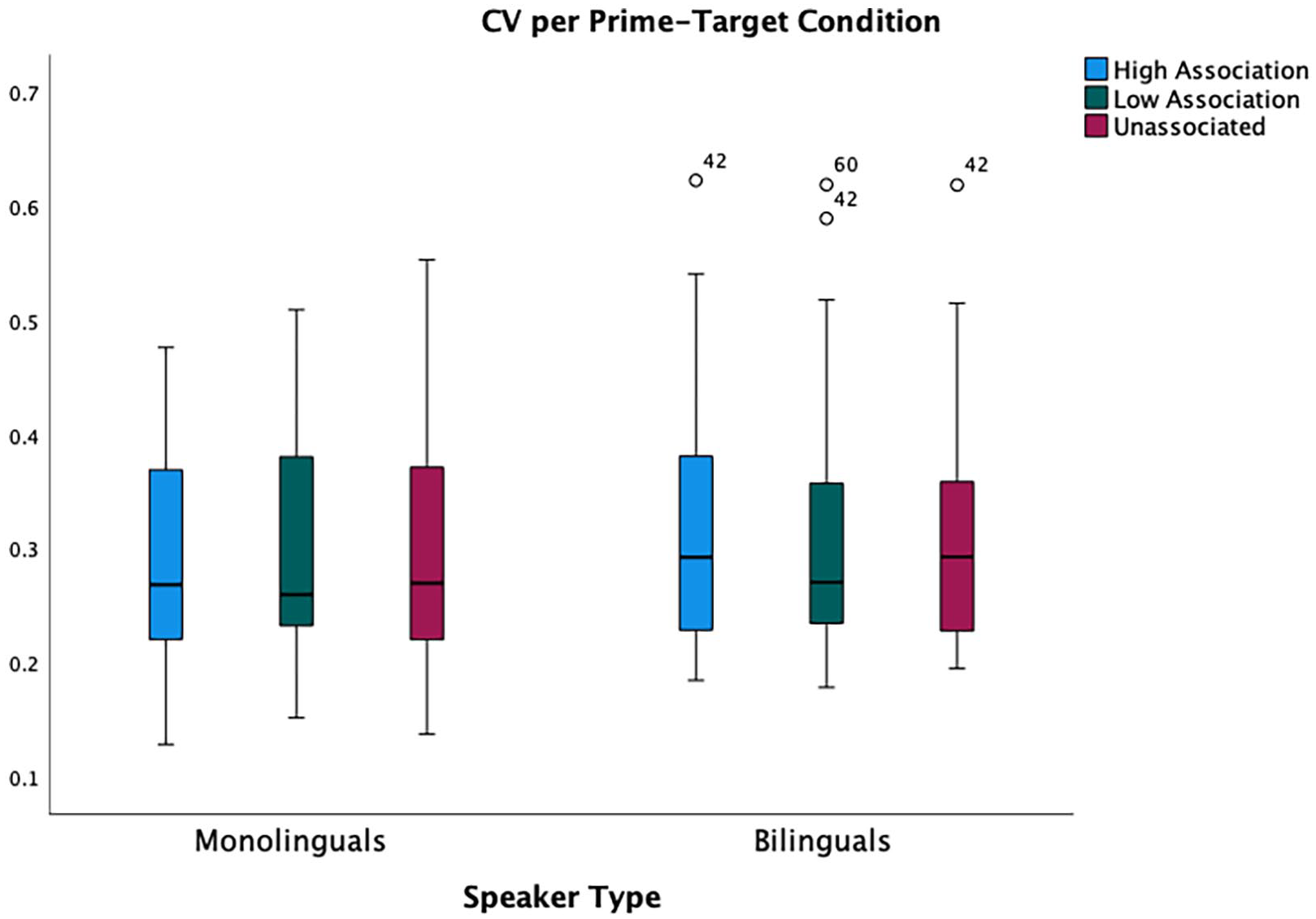
Boxplot of CV per condition.
There was no statistically significant interaction in the CV values of the forward strength of association and the speaker type, F(2, 120) = 1.592, p = .208, partial η2 = .026. Figure 5 shows a corresponding profile plot for the two-way ANOVA and the omnibus ANOVA results are summarized in Table 5.
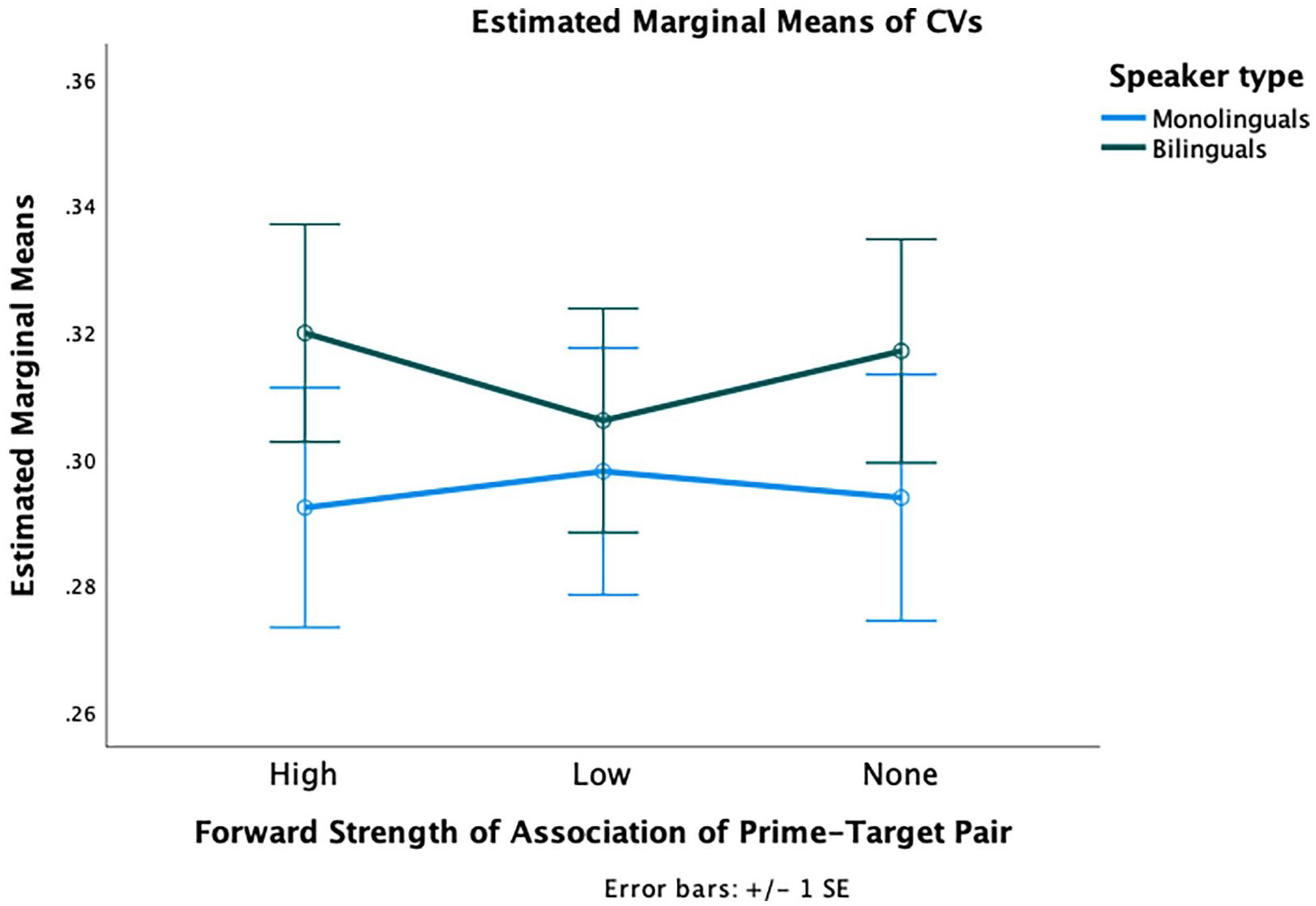
Profile plot for the CV two-way ANOVA.
Test of within-subjects effects for omnibus ANOVA on CVs.
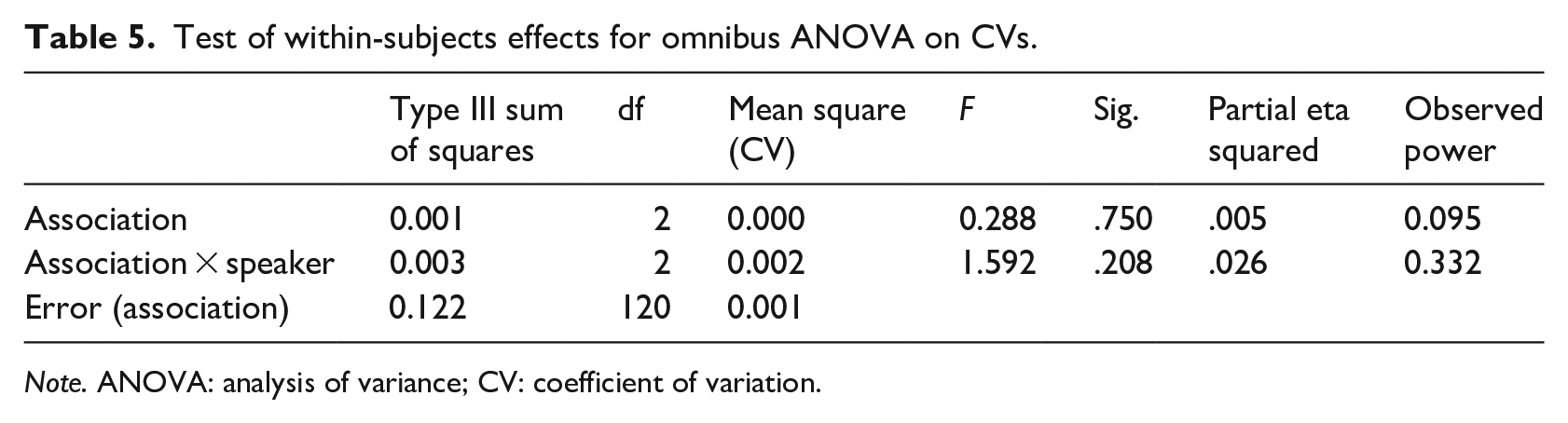
Note. ANOVA: analysis of variance; CV: coefficient of variation.
Discussion
In this study, we aimed to conceptually replicate a study by Golestani et al. (2009) which sought to determine whether bilinguals and monolinguals activate comparable semantic networks in response to incoming words. In line with the cited work, a retroactive masked priming task determined the contribution of semantic information to word recognition in bilinguals (Golestani et al., 2009). We similarly found that the semantic relatedness of a target word helps resolve the identification of a previously presented and perceived (but not yet identified) degraded prime word to different degrees in bilinguals as in monolinguals. In contrast to monolinguals, bilinguals did not show a significant effect of association strength in their RTs, indicating they processed high association, low association, and unassociated pairs not significantly different from each other.
Using the CV values and the difference values, we sought to determine whether the differences found in the monolingual and bilingual RT data were a result of different degrees of processing efficiency by each group or a result of the co-varying individual differences engaged in each of the groups. The repeated-measures two-way mixed ANOVAs revealed no significant interaction effects between the speaker type and the association condition factors for the CV values. Under the interpretation that the CV value is a measure of efficiency, this indicates that monolinguals and bilinguals are processing with the same processing efficiency to complete this task. As a result, we interpret these findings as suggesting that bilinguals, as a group, have concomitant differences that account for the differences in their RTs. This finding is supported in previous literature (Chun & Kaan, 2019; Kaan, 2014).
The monolinguals’ difference scores showed that the high-context effect had a significantly shorter RT than the low-context effect. In bilinguals, the high context resulted in what appears to be a greater RT relative to the low-context conditions. This does not represent a statistically significant difference, but it is notable to mention that the effect trends in the opposite direction of the monolinguals.
One factor that may cause this slowdown in bilinguals is cross-linguistic activation. Activation of non-target words uses time and cognitive effort to conduct and then to suppress that unintended activation, which leaves less resources available for semantic tasks in the language in use. This may be why even early bilinguals demonstrate non-nativelikeness in word processing. This is corroborated in previous research which finds an effect of task difficulty on semantic processing. When using a more favorable signal-to-noise ratio (SNR) compared to Kousaie et al. (2019), Coulter et al. (2021) found that late bilinguals used semantic context to the same degree in both L1 and L2 processing. Kousaie et al. (2019) found opposing results with a less favorable SNR. Coulter et al. (2021) suggest that bilinguals may not benefit from semantic context as much with more difficult listening conditions than used in their study. Therefore, it is possible that the tasks used in Coulter et al. (2021) did not require the recruitment of semantic context to the same degree as in other studies. Similarly, Dijkgraaf et al. (2019) find that bilinguals use sentence-embedded information to predict referents in the L2 with a slower and weaker spread than in the L1; this contrasts directly with the results of a previous study by the same authors, in which bilinguals were found to use semantics to predict referents in L1 equally as in the L2 and equally to monolinguals (Dijkgraaf et al., 2017). In a discussion, the authors cite that this difference in outcome is the result of task-based differences: in Dijkgraaf et al. (2017), the bilingual participants used low-level lexical associations in the sentence to predict final words. With the longer and more syntactically complex sentences used in Dijkgraaf et al. (2019), low-level lexical associations played less of a role and the bilinguals needed to rely on using high-level information for processing (Dijkgraaf et al., 2019). Only when the task required the recruitment of higher-up processes and thereby more cognitive resources did the early bilinguals demonstrate non-nativelikeness (i.e., slower and weaker spread of activation) in processing. In total, this evidence suggests that both early- and late-acquiring bilinguals may not benefit from additional semantic information in stimuli with high language processing demands in the same way as monolinguals. Additional research is needed to investigate the effects of cross-linguistic competition on sentence processing in bilinguals.
We acknowledge that the difference in the variability across the two groups, specifically the greater variability in bilinguals, could be related to the composition of the bilingual group. Importantly, the bilinguals in this study were English speakers who spoke a variety of non-English other languages, and so cross-linguistic semantic differences may have affected these outcomes. Specifically, some of the stimuli may have been cognates in the other language for some participants and not for others. Likewise, differences in word familiarity may have an effect across participants; a person who grew up or lives in a bilingual household may not share the same degree of familiarity with obscure household and food terms as monolinguals, for example, which may contribute to the variability in the results. No exclusionary criteria based on language of use were set in order to generalize findings to a wider bilingual community. Speakers also differed in AOA and were not standardized in their self-reported levels of proficiency. This was done to reflect the typical variations in language history and experience that shape the uniqueness of each bilingual’s experience.
One particular concern is the range of ages of acquisition within the bilingual group. Additional follow-up analyses compared the early-acquiring (English AOA as birth to 5;0) and late-acquiring groups (English AOA after 5;0), but did not reveal differences based on AOA group. Further analyses narrowing English AOA criteria would be a useful contribution to the existing literature regarding AOA effects in the use of semantics. Still, the study showed the group of bilinguals still indicated a significant difference in use of semantics compared to monolinguals. Participants reported high proficiency and frequency of English use; our results therefore specifically describe semantic usage differences across a range of proficient bilinguals from various language backgrounds. Furthermore, our findings coincide with studies that did limit the languages spoken by the bilinguals; similar studies with tasks conducted exclusively in English did not restrict by languages spoken by the participants (Ito et al., 2017).
Finally, there is a possible effect of visual recognition: participants may have had an easier time identifying a degraded prime word from the follow-up pair based on recognizing a similar word length rather than true word identification. Although this was largely unavoidable due to our intent to replicate Golestani et al. (2009) with a visual modality, we intended to attenuate the potential for visual recognition with hashmarks before and after the prime word and the change from upper case to lower case text. This made the length of the word difficult to see and difficult to re-identify in a later part of the task. Still, we consider these effects to not change the findings of this study. Any persistence of this effect would likely affect both groups and all conditions approximately equally since both groups were proficient English speakers. If this effect had been pervasive, it would not result in the effects we demonstrated: our present results are not readily explained by a slower ability to recognize word length in bilinguals compared to monolinguals, nor can they be easily explained by a difference in visual recognition effect based on semantic strength between word pairs.
Conclusion
The impact of semantic information and its use for processing is a relevant and pressing area of current research. In part, the results of this study show that monolinguals may experience a significantly greater benefit of more semantic context compared to conditions of low semantic context. However, bilinguals do not have a significantly greater benefit from more semantic context in the same way.
The findings of this study may also be applicable to sentence processing. Because bilinguals show a difference in their use of semantic information to process word pairs, it stands to reason that a large-scale process such as processing sentences, which also relies on the same mechanisms of semantic spreading activation, reflects this difference. This difference in sentence processing is attested in several studies on word prediction (Grüter et al., 2017; Ito et al., 2017; Martin et al., 2013) and in bilingual sentence processing in noise (Cooke et al., 2008; Mattys et al., 2009; Rogers et al., 2006). The results of this study suggest that the slowdown bilinguals exhibit in sentence processing under cognitive load is indeed fundamentally related to a slowdown at the word level. Specifically, bilinguals do not use semantic information for processes of word-level spreading activation to the same degree as monolinguals; sentence-level processes that rely on lexical associations may be slowed down in bilinguals.
Furthermore, one of the original intentions of this study is to examine how bilinguals may not be using semantic input efficiently, even in the language that many of our participants identified as their dominant language. This is not likely to have major impacts in daily conversation, but it is important to consider that bilingual differences permeate at all levels of bilingualism. Adjustments to facilitate comprehension in educational or clinical settings, for example, may also be useful for bilinguals who are highly proficient speakers and dominant users of one of their first-acquired languages.
Footnotes
Declaration of conflicting interests
The author(s) declared no potential conflicts of interest with respect to the research, authorship, and/or publication of this article.
Funding
The author(s) received no financial support for the research, authorship, and/or publication of this article.
