



Abstract
Aims and Objectives/Purpose/Research Questions:
This study had two specific research goals. First, it investigated the relative importance of meaning and form in bilingual morphological processing of English prefixed and suffixed words. Second, it probed how target language proficiency and morphological type moderated bilingual morphological processing.
Design/Methodology/Approach:
This study implemented the masked morphological priming paradigm that administered three prime types (Transparent, Opaque, and Form) from two morphological types (prefix and suffix) to three Chinese-English bilingual groups (advanced, intermediate, and lower-intermediate). The critical stimuli included the Transparent (e.g., visualize-VISUAL; disagreement-DISAGREE), the Opaque (e.g., vanity-VAN; submission-MISSION), and the Form (e.g., example-EXAM; apparent-PARENT) English words.
Data and Analysis:
A total of 120 Chinese-English bilinguals representing three levels of distinct English competence participated in a masked priming lexical decision experiment. Direct comparisons were made using the linear mixed-effects models on bilingual groups’ priming effects from the Transparent, the Opaque, and the Form conditions of both English prefixed and suffixed words.
Findings/Conclusion:
The results exhibited that compared to suffixed words Chinese-English bilinguals altogether were less sensitive to the internal structure of prefixed words. The results presented that target language proficiency and morphological type moderated bilingual morphological processing, with the advanced Chinese-English bilinguals approximating previous native English speakers in processing English suffixed words.
Originality:
This study compared the priming effects from the Transparent, the Opaque, and the Form conditions of both English prefixed and suffixed words among three Chinese-English bilingual groups with distinct English competence. This study therefore should be the first empirical study that simultaneously evaluates the effects of target language proficiency and morphological type on bilingual morphological processing of prefixed and suffixed words.
Significance/Implications:
The present results indicate that target language proficiency and morphological type interact to impact bilingual morphological processing. Besides, this study provides important methodological and statistical implications for future studies.
Keywords
Introduction
Morphological processing refers to the subconscious mechanism that rapidly breaks down morphologically complex words/MCWs (words with more than one morpheme) into their morphological components (Diependaele et al., 2011; Marslen-Wilson, 2007; Rastle & Davis, 2008). Over the past few decades, much research (e.g., Ciaccio & Clahsen, 2020; Feldman et al., 2009, 2010; Kirkici & Clahsen, 2013; Rastle & Davis, 2008; Rastle et al., 2004; Silva & Clahsen, 2008) has been conducted on how speakers recognize morphological structure in the early stages of morphological processing. An important consensus reached so far is that pre-lexical (before lexical access) decomposition represents a general mechanism for both native (i.e., L1) and nonnative (i.e., bilingual/L2) 1 processing of derived words. However, one frequently explored but still unresolved research topic in morphological processing is whether morphological effects (facilitation from morphological structures) are dissociable from semantic effects (facilitation from semantic association) and orthographic effects (facilitation from orthographic overlap). In other words, it remains to be addressed whether the facilitation elicited by pseudo-morphologically related words (the Opaque words, e.g., corner-CORN) is qualitatively different from that elicited by morphologically related words (the Transparent words, e.g., worker-WORK) and purely orthographically related words (the Form words, e.g., cashew-CASH) 2 . In addition, relatively little effort has been made to address the differences in morphological processing between native and bilingual languages. Previous studies (e.g., Davis & Rastle, 2010; Rastle & Davis, 2008; Rastle et al., 2004) have shown that native speakers produce equally fast responses in both morphologically related words (e.g., worker-WORK) and pseudo-morphologically related words (e.g., corner-CORN), but not in words that are purely orthographically related (e.g., cashew-CASH). In contrast, bilingual speakers have been found to make use of both morphological and semantic relations when dealing with derived words, which is reflected in a greater facilitation of the Transparent words than the Opaque words (e.g., Diependaele et al., 2011; Li et al., 2017). In addition, bilinguals also tend to rely more on orthography for morphological processing, as reflected in the facilitative effects of formal overlap found in bilingual processing.
At the same time, the existing literature also reveals some other contradictory results and gaps. First, some bilingual studies (e.g., Diependaele et al., 2011; Zhang et al., 2017) have supported the independence of morphological effects on semantic and orthographic effects, while other bilingual studies (e.g., Li & Taft, 2019) have supported equivalent facilitative effects across the three types of words. Second, previous studies have primarily focused on processing suffixed words (e.g., worker-WORK) rather than prefixed words (e.g., disagree-AGREE), making it unknown whether morphological type (prefix, suffix) makes a difference in bilingual morphological processing. Third, previous studies have primarily concentrated on native speakers and advanced bilingual speakers, ignoring less proficient bilingual groups. To address these research conflicts and gaps, this study set out to investigate: (1) whether morphological effects were dissociable from semantic and orthographic effects in bilingual morphological processing; (2) to what extent the masked morphological priming effects varied with morphological type (prefix and suffix) and target language proficiency (advanced, intermediate, and lower-intermediate). Methodologically, this study used the masked priming paradigm where the lowercase prime (e.g., worker) was briefly presented in the visual mode (typically as long as 30–60 ms), followed by an uppercase target (e.g., WORK) or an uppercase nonword (e.g., BALFT). In this paradigm, a forward mask (usually in the form of a pattern, e.g., ######) was presented in front of the primes so as to diminish the visibility of the primes and thus avoid participants’ awareness of the primes (Forster & Davis, 1984). Since this study aimed to investigate the early automatic processes for bilinguals’ recognition of English prefixed and suffixed words, the masked priming paradigm should serve the purpose because it should tap into early language processing while reducing participants’ awareness of stimuli and the chance of adopting predictive strategies. The main finding of this study was that bilingual morphological processing was conditional on morphological type (prefix, suffix) and target language proficiency (advanced, intermediate, lower-intermediate), with the advanced Chinese-English bilinguals performing closely to the native English speakers from previous studies in processing English suffixed words.
Literature review
One of the important research topics in MCWs processing concerns the relative importance of meaning and form in masked morphological priming (see Rastle & Davis, 2008 for a review). Three theoretical models have been proposed to elucidate the mechanisms underlying morphological processing (see Diependaele et al., 2009 for a review). First, the supralexical (form-with-meaning/morpho-semantic) model (Feldman et al., 2009. 2010; Feldman & Milin, 2018; Feldman & Soltano, 1999; Giraudo & Grainger, 2000, 2003) posits that the whole-word access is reached before morphological decomposition, indicating that meaning is essential in morphological processing. Second, the sublexical (form-then-meaning/morpho-orthographic) model (Davis & Rastle, 2010; Rastle & Davis, 2008; Rastle et al., 2000, 2004) postulates a compulsory parsing of MCWs into their sublexical components before the whole-word recognition, indicating that meaning is not crucial in morphological processing. Third, the hybrid (morpho-semantic and morpho-orthographic) model (Diependaele et al., 2005, 2009, 2011, 2012; Duñabeitia et al., 2013) proposes that both morpho-semantic and morpho-orthographic pathways are simultaneously available for masked morphological processing, indicating that both meaning and morphological structure are essential in morphological processing. Methodologically, the priming paradigm has been widely adopted to measure the relative importance of morphological structure and semantics in the early stages of morphological processing. The connections between priming effects and the three processing models are not convoluted. If the Transparent condition (worker-WORK) elicits larger priming effects than the Opaque (corner-CORN) and the Form (think-THIN) conditions (while the latter two elicit equivalent priming effects), the whole-word (semantic) access occurs before morphological decomposition, lending support to the supralexical model. By contrast, if the equivalent priming effects elicited by the Transparent and the Opaque conditions are more robust than those elicited by the Form condition, the morphological decomposition is attributable to a mandatory and semantics-independent decomposition process, upholding the sublexical model. Moreover, suppose the Transparent condition produces larger priming effects than the Opaque condition that engenders priming effects larger than the Form condition, the hybrid model is therefore bolstered, as (1) semantic effects are facilitatory, and (2) pseudo-morphological relations generate larger morphological facilitation than purely orthographic overlap (Diependaele et al., 2005). Finally, if indistinguishable priming effects are identified for the Transparent, the Opaque, and the Form conditions (there should be some observable facilitative effects, despite the lack of morphological and semantic effects), the orthographic similarity seems to be the sole reason for activating the morphemic representation. Figure 1 makes illustrations for the three processing models.
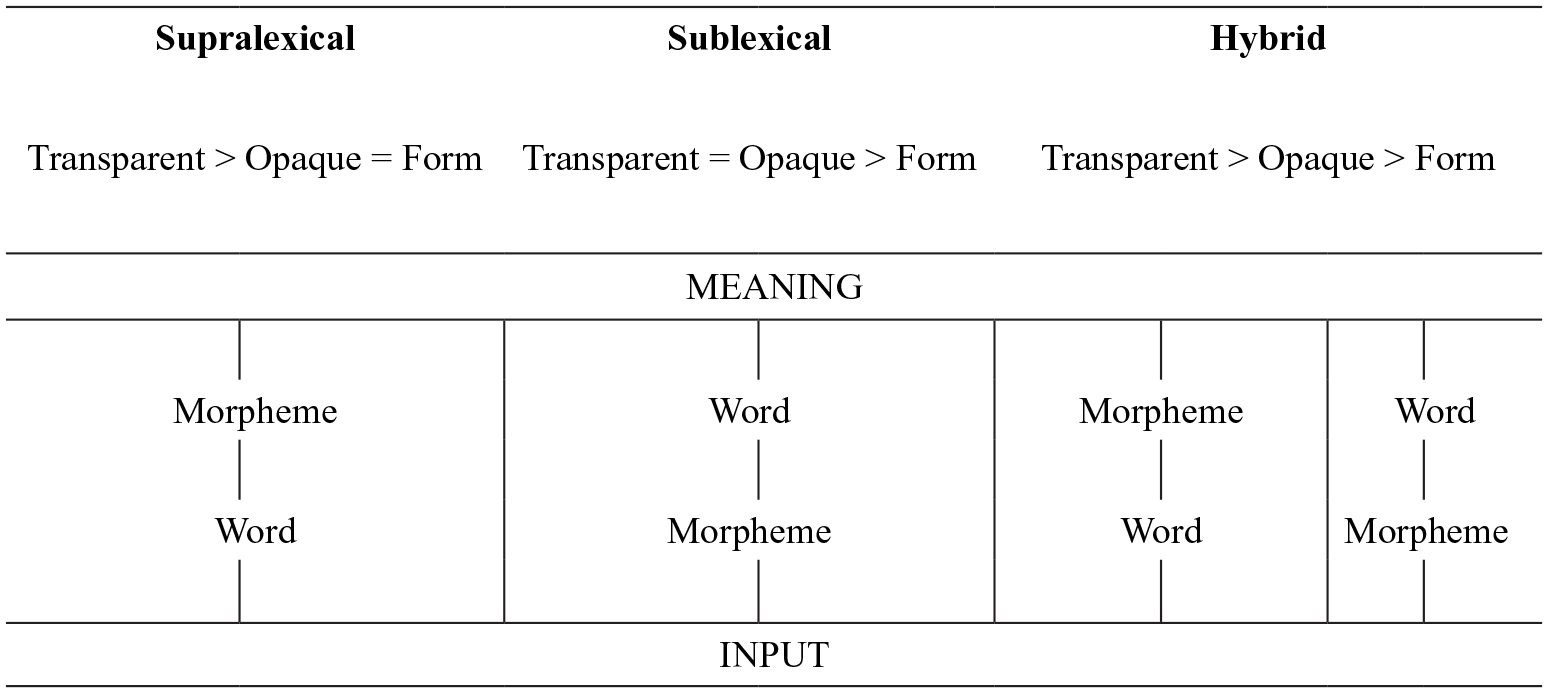
Processing models (adapted from Diependaele et al., 2012).
Over the past decades, studies have predominantly focused on native morphological processing and accumulated supporting evidence for three models (see Amenta & Crepaldi, 2012; Davis & Rastle, 2010; Feldman et al., 2009; Heyer & Kornishova, 2017 for a review). By contrast, fewer studies have researched bilingual morphological processing. Among the studies on bilingual morphological processing, there was a heated debate about whether native and bilingual processing were fundamentally different (whether there were qualitative differences in the underlying mechanisms of morphological processing between the native and bilingual groups) (Clahsen et al., 2010; Silva & Clahsen, 2008). Specifically, some studies (e.g., Diependaele et al., 2011; Li et al., 2017) found minimal native-nonnative differences and provided evidence demonstrating that bilingual speakers were also sensitive to the morphological structure. For example, Li et al. (2017) found that advanced Chinese-English bilinguals could distinguish English suffixed words across the Transparent, the Opaque, and the Form conditions similar to the native English speakers. However, other studies (e.g., Clahsen et al., 2010; Diependaele et al., 2011; Heyer & Clahsen, 2015; Silva & Clahsen, 2008) claimed a distinct native-nonnative difference in morphological processing by offering evidence showing that compared to native speakers, bilingual speakers were less sensitive to the morphological structure and less dependent on the decompositional mechanism which was responsible for breaking down morphologically complex words into morphological components. For example, Diependaele et al. (2011) found bilingual speakers had reduced Transparent priming but larger Form priming than native English speakers, indicating that bilingual processing relies more on orthographic overlap than morpho-semantic information for morphological decomposition. In addition, Heyer and Clahsen (2015) made a direct comparison between native and bilingual processing of English Transparent (darkness-DARK) and Form (example-EXAM) words. This study found that native speakers had morphological priming but no form priming. Instead, bilingual speakers produced priming effects for both prime types 3 . The authors concluded that though morphological effects were found for both groups, bilingual speakers altogether had less morphological sensitivity but counted more on formal overlap for processing MCWs.
As mentioned above, one significant difference between native-nonnative morphological processing is the lack of priming effect in the Form condition. Previous studies (e.g., Diependaele et al., 2009, 2011; Li & Taft, 2019) demonstrated that native speakers had priming effects in the Transparent and the Opaque conditions, but not in the Form condition. Nevertheless, bilingual speakers displayed priming effects for the Transparent, the Opaque, and the Form conditions (e.g., Foote et al., 2020; Heyer & Clahsen, 2015). The lack of priming in the Form condition in native processing may be attributable to the lexical competition that inhibits lexical representation for morphologically simplex words (morphological forms with a single morpheme) (Li & Taft, 2019; Taft & Li, 2020). According to the theory of lexical competition (Grainger & Beyersmann, 2017), when primes (i.e., Transparent, Opaque, and Form primes) are presented, both primes and their embedded targets are concurrently activated. The primes should be more activated than the targets, consequently reducing the chance of observing priming even when targets are presented right after the primes. However, for both Transparent and Opaque primes (e.g., “worker,” “corner”), the presence of affixes such as “-er” will activate the representation of edge-aligned words embedded in the primes (e.g., “WORK,” “CORN”), which consequently generates facilitating effects that override the inhibitory effects of lexical competition. However, such activation does not occur in the Form condition in which the lateral inhibition from the embedding word diminishes the bottom-up activation of the embedded word (Grainger & Beyersmann, 2017). In other words, only targets that bear morphological (e.g., worker-WORK) or pseudo-morphological connections to their primes (e.g., corner-CORN) can keep their lexical representation active, given that lexical competition is still in effect. However, if targets only bear purely formal relations to their primes (e.g., cashew-CASH), their lexical representation will be inhibited in the end. The theory of lexical competition accounts for why native speakers see priming effects in both derived (e.g., worker-WORK) and pseudo-derived words (e.g., corner-CORN), but not in purely form-related words (e.g., cashew-CASH). Nonetheless, priming effects are often identified for the Form condition among bilinguals, suggesting that the lateral inhibition is less effective for bilingual morphological processing (e.g., (Diependaele et al., 2011; Heyer & Clahsen, 2015; Li et al., 2017; Li & Taft, 2019). For example, Li and Taft (2019) found Form priming (e.g., nuclear-CLEAR) only in Chinese-English bilingual speakers but not in native English speakers. Such a native-nonnative asymmetry suggests that orthographic similarity only underlies bilingual morphological recognition.
A thorough literature search has shown that previous studies have primarily focused on suffixed word processing but generally neglected the prefixed words. From the few studies that researched prefixed words, languages with diverse linguistic profiles were covered, including French (e.g., Giraudo & Grainger, 2003), Dutch (e.g., Diependaele et al., 2009), Spanish (e.g., Dominguez et al., 2010), English (e.g., Chateau et al., 2002), and Korean (e.g., Kim et al., 2015). On the whole, previous studies (e.g., Ciaccio & Clahsen, 2020; Li & Taft, 2019) on native processing consistently revealed morphological decomposition for the prefixed words. However, results were inconsistent regarding whether priming effects were comparable between the prefixed and suffixed words. Some studies (e.g., Beyersmann et al., 2016; Beyersmann et al., 2015; Diependaele et al., 2009) displayed that the prefixed and suffixed words had different priming effects, while other studies (e.g., Beauvillain, 1996; Kim et al., 2015) provided counter-examples. Theoretically speaking, stem position should potentially impact the magnitude of priming effects, as the stem in a prefixed word is engaged later, whereas the stem in a suffixed word is detected first. Cutler et al. (1985) have identified two major morphological tendencies across languages by examining cross-linguistic studies of morphology: (1) in terms of linguistic typology, languages generally prefer suffixation to prefixation, which consequently inclines faster psychological processing toward suffixed words; (2) in terms of language processing, stems and affixes are processed separately in serial order, with stems being processed before affixes, as stems take up the salient position in a word. These tendencies further indicate that morphological processing should be serially ordered (first stems and then affixes), and suffixed words should therefore be responded faster than prefixed words when other things are held constant. If this is the case, the prefixed words should yield different magnitudes of priming effects from the suffixed words. Concerning bilingual morphological processing, it can be predicted that bilingual speakers should find it more challenging to process prefixed words than suffixed words, consequently resulting in less priming for prefixed words than suffixed words, as (1) bilingual speakers generally lack sensitivity to the morphological structure of a morphologically complex word (Silva & Clahsen, 2008); (2) bilingual speakers should be even less sensitive to the morphological structure of a prefixed word (cf. Cutler et al., 1985).
Empirically, a thorough search of the literature returned three studies that focused on the bilingual morphological processing of prefixed words (e.g., Ciaccio & Clahsen, 2020; Li et al., 2019; Li & Taft, 2019). For example, Li and Taft (2019) found that bilingual speakers produced equivalent priming effects across the Transparent, the Opaque, and the Form conditions, manifesting bilinguals’ less sensitivity to the morphological structure of prefixed words. To the best of our knowledge, two empirical studies have directly compared prefixed and suffixed derived words for bilingual processing (e.g., Ciaccio & Clahsen, 2020; Li et al., 2019). Ciaccio and Clahsen (2020) compared bilingual speakers’ processing of prefixed and suffixed German words. This study found significant priming effects for both prefixed and suffixed words, but no reliable effect differences between the two sets of words. By contrast, Li et al. (2019) probed whether morphological type (prefix, suffix) affected advanced Chinese-English bilinguals’ recognition of English words. They found that advanced bilingual speakers experienced more difficulties in processing the prefixed words, as reflected by smaller priming effects found for the prefixed words than the suffixed words. Overall, the existing literature lacks enough coverage on the direct comparison in the prefixed and suffixed words. In particular, it remains unclear whether morphological effects should be reduced in the prefixed words for bilingual speakers with different linguistic backgrounds, which creates an academic niche for more inspection.
Moreover, few studies directly investigated to what extent different target language proficiency impacted morphological processing in derived words. To the best of our knowledge, only two published studies (e.g., Foote et al., 2020; Li et al., 2017) compared the processing of derivational morphology between bilingual speakers with different proficiency levels. Li et al. (2017) found advanced bilingual speakers patterned more like native speakers, whereas less proficient bilingual speakers demonstrated less sensitivity to the morphological structure in English derived words. On the contrary, Foote et al. (2020) found that bilingual speakers demonstrated similar patterns to native speakers, regardless of proficiency. Meanwhile, neurocognitive studies also provided evidence for proficiency effects. Liang and Chen (2014) found that target language proficiency exerted a moderating effect on morphological processing, with advanced Chinese-English bilinguals manifesting rule-governed decomposition, whereas less proficient Chinese-English bilinguals counting on the whole-word retrieval. The aforementioned proficiency effect is accountable with the declarative/procedural model (Ullman, 2004). According to this model, less proficient bilinguals rely on the declarative memory that underlies the whole-word storage. On the contrary, advanced bilinguals count on the procedural memory that regulates morphological decomposition (Ullman, 2005). Despite previous neurocognitive inquiries, the current literature still lacks sufficient behavioral studies that cover the extent to which target language proficiency shapes morphological processing.
Last but not least, previous studies primarily focused on European bilinguals (e.g., German-English, Dutch-English), whose native language and target language are typologically alike. On the whole, fewer studies investigated bilinguals whose native language and target language are typologically distinct, such as Chinese-English bilinguals. Empirical evidence showed that advanced Chinese-English bilinguals could decompose English suffixed words into their components, resembling native speakers (Li et al., 2017). One likely reason is that both Chinese and English use suffixation as a productive word-formation process to coin new words. For example, Standard Chinese uses “化” at the end of word bundles to refer to a particular process, such as “现代化” (modernization). In this case, Chinese-English bilinguals may not encounter many difficulties in engaging English suffixed words. On the contrary, prefixed words should pose more considerable difficulties for Chinese-English bilinguals since prefixes are not frequently used in Standard Chinese. In fact, only a few characters can work as prefixes in the initial position of word bundles, such as “小” (small) in “小学” (primary school). Given that Standard Chinese lacks a true equivalent of prefixation in the strict sense, it is logical to assume that Chinese-English bilinguals lack sensitivity to prefixed words and face difficulties in disintegrating English prefixed words into constituents. Such a linguistic dissimilarity provides an additional testing ground to verify to what extent native-nonnative difference influences morphological processing.
In a nutshell, the current literature needs more coverage on how prefixed and suffixed words are processed by bilingual speakers whose native language is typologically different from the target language. Meanwhile, more efforts are needed to find out whether morphological processing varies as a function of morphological type (prefix, suffix) (Ciaccio & Clahsen, 2020) and target language proficiency (advanced, intermediate, lower-intermediate) (Diependaele et al., 2011). This study intends to address these research gaps by investigating the differences in the masked morphological priming of target English prefixed and suffixed derived words. Correspondingly, the present study asks two substantive but related research questions:
Research Question 1 (RQ1). Are the early morphological effects dissociable from semantic and orthographic effects in prefixed and suffixed derived words?
Hypotheses 1 (H1). If semantic effects should play a role, the Transparent condition produces larger priming effects than the Opaque condition
Hypotheses 2 (H2). If semantic effects should not make a difference, both Transparent and Opaque conditions generate equivalent priming effects
Hypotheses 3 (H3). If the morphological structure should facilitate morphological decomposition, the Opaque condition yields more robust priming than the Form condition
Hypotheses 4 (H4). If only orthographic overlap underlies morphological facilitation, equivalent priming effects should be found across the Transparent, the Opaque, and the Form conditions.
Research Question 2 (RQ2). Do the early morphological effects vary as a function of morphological type (prefix, suffix) and target language proficiency (advanced, intermediate, and lower-intermediate)?
Hypotheses: if both morphological type and target language proficiency make a difference, very low proficient bilinguals should not show morphological (or morpho-semantic) priming in any condition, whereas more proficient (intermediate and advanced) bilinguals should show larger morphological priming effects for suffixed words than for prefixed words, as even more proficient bilinguals cannot reach native-like performance and are therefore affected by the word-final position of the stem in prefixed words.
Method
Participants
A total of 120 Chinese-English bilinguals, who were undergraduate students at Sichuan University and represented three different levels of English language proficiency, participated in this study. The participants were classified into three groups based on their English language proficiency, that is, advanced (N = 40), intermediate (N = 40), and lower-intermediate (N = 40). As shown in Table 1, the three groups of participants had comparable mean age, age of acquisition (AOA), and years of learning English (YOL), but differed in their English language proficiency as measured by the College English Test Band 6 (CET 6). The CET 6 is a high-stakes, compulsory, and criterion-referenced English test in the universities on the Mainland of China. Composed of four modules (i.e., listening, reading, reading, and speaking), the CET6 (with a total mark of 710 and a pass mark of 425) examines the English proficiency of undergraduate and postgraduate students in China. For this study, participants were considered “advanced” if they scored between 575 and 625, “intermediate” if they scored between 475 and 525 (e.g., Zhang et al., 2017), and “lower-intermediate” if they scored below 425. Meanwhile, all participants had a normal or corrected-to-normal vision but no behavioral disorders or learning difficulties. All participants received 40 RMB for their participation.
The participants’ demographic information.
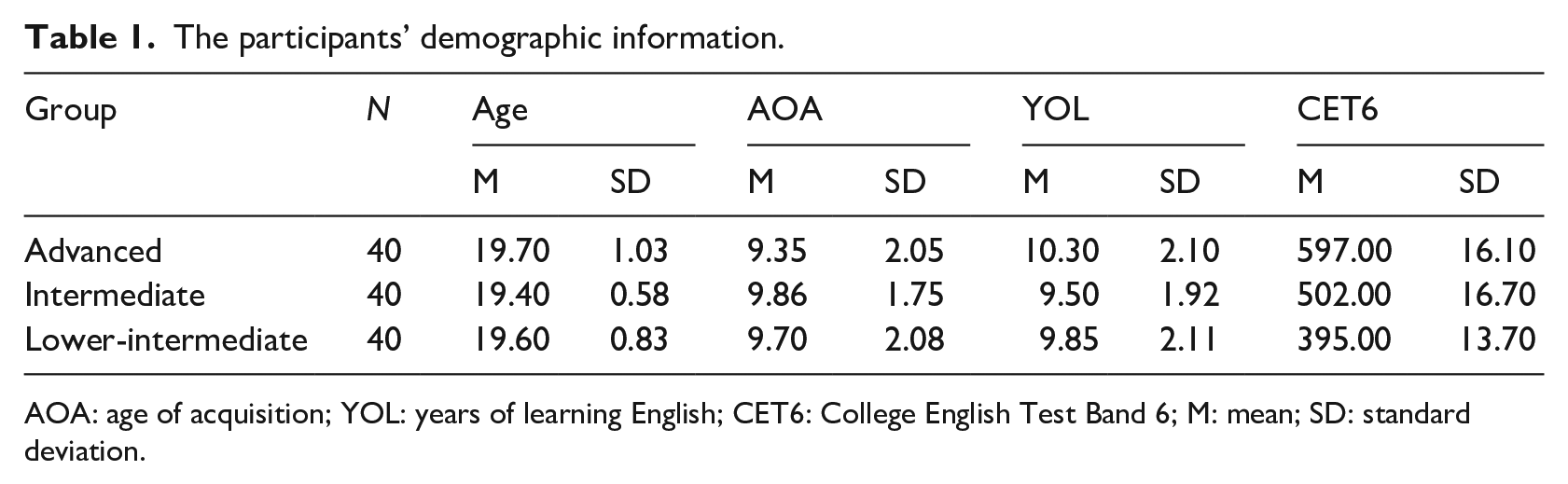
AOA: age of acquisition; YOL: years of learning English; CET6: College English Test Band 6; M: mean; SD: standard deviation.
Materials
There were two sets of experimental items (i.e., prefixed and suffixed English words), with each set consisting of morphologically simplex targets (e.g., “work”) paired with their corresponding morphologically complex primes (e.g., “worker”). Within each set, the primes and targets were further divided into three conditions (in the following examples, the suffixed words were listed before the prefixed words): (1) the Transparent condition in which primes and targets were not only semantically but also morphologically and orthographically related (e.g., visualize-VISUAL and disagreement-DISAGREE); (2) the Opaque condition in which primes and targets were only pseudo-morphologically and orthographically related (e.g., vanity-VAN and submission-MISSION); (3) the Form condition in which primes and targets were only orthographically related (e.g., example-EXAM and apparent-PARENT). The semantic relatedness between the primes and targets was determined by the Latent Semantic Analysis (a natural language processing method for determining the semantic associations between words) (Günther et al., 2015) as per the following criteria: (1) primes from the Transparent condition should have close semantic relatedness to their targets (correlation: 0.1 ⩽ r ⩽ 1.0); (2) primes from the Opaque and the Form conditions should not bear close semantic connections to their targets (correlation: −0.1 < r < 0.1). Meanwhile, an unrelated prime was also selected to serve as the baseline for each target. The unrelated prime stood no semantic, morphological, or orthographic connections to the target. According to the values taken from the English Lexicon Project (Balota et al., 2007), the critical stimuli from the three experimental conditions (i.e., Transparent, Opaque, Form conditions) were matched as closely as possible in terms of the word length, log frequency, degree of familiarity (as measured by independent peers on a 7-point Likert-type scale), and letter overlap (as measured by the Levenshtein distance that refers to the minimum number of edits required to change a word to another word). Last but not least, this study puts efforts into making the targets have phonological overlap with the primes, minimizing the phonological alternations between the prime and the targets. Table 2 (the prefixed words) and Table 3 (the suffixed words) summarized the distributional characteristics for the included primes and targets. The complete set of stimuli can be found in Table S1 in the Supplemental Material. Apart from the critical items, the present study also included 105 nonword targets with the help of the Wuggy software (Keuleers & Brysbaert, 2010) that created nonwords with customized specifications for length, transition frequency, and sub-syllabic segments. Half of the nonword targets were preceded by affixed primes (e.g., volcanic-VAFE and reaction-FIRER), whereas half of them were preceded by non-affixed primes (e.g., satellite-ULTION). The nonword targets served to reduce the strategy effect of participants who would otherwise press the “yes” button after seeing anything.
The stimuli attributes for the prefixed words.
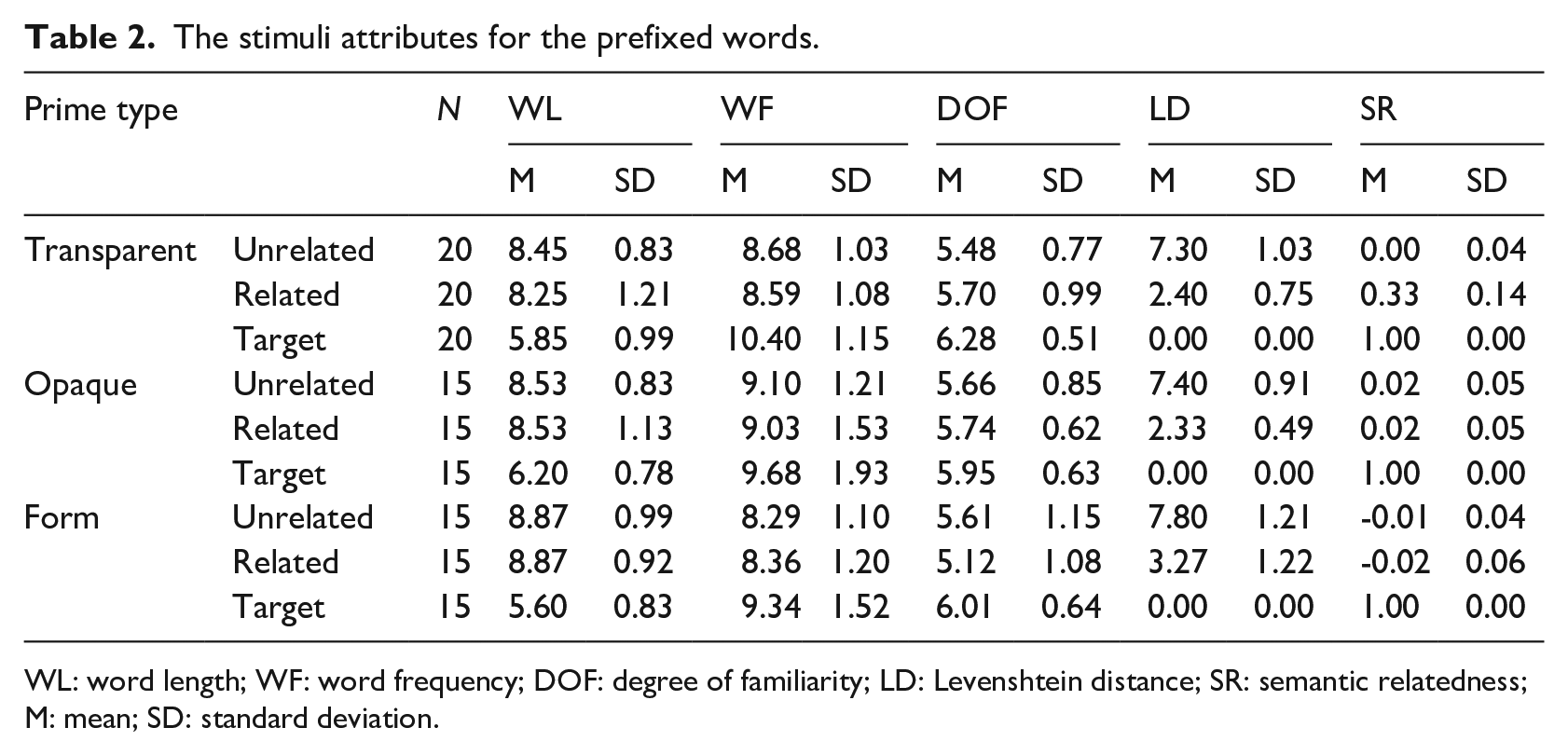
WL: word length; WF: word frequency; DOF: degree of familiarity; LD: Levenshtein distance; SR: semantic relatedness; M: mean; SD: standard deviation.
The stimuli attributes for the suffixed words.
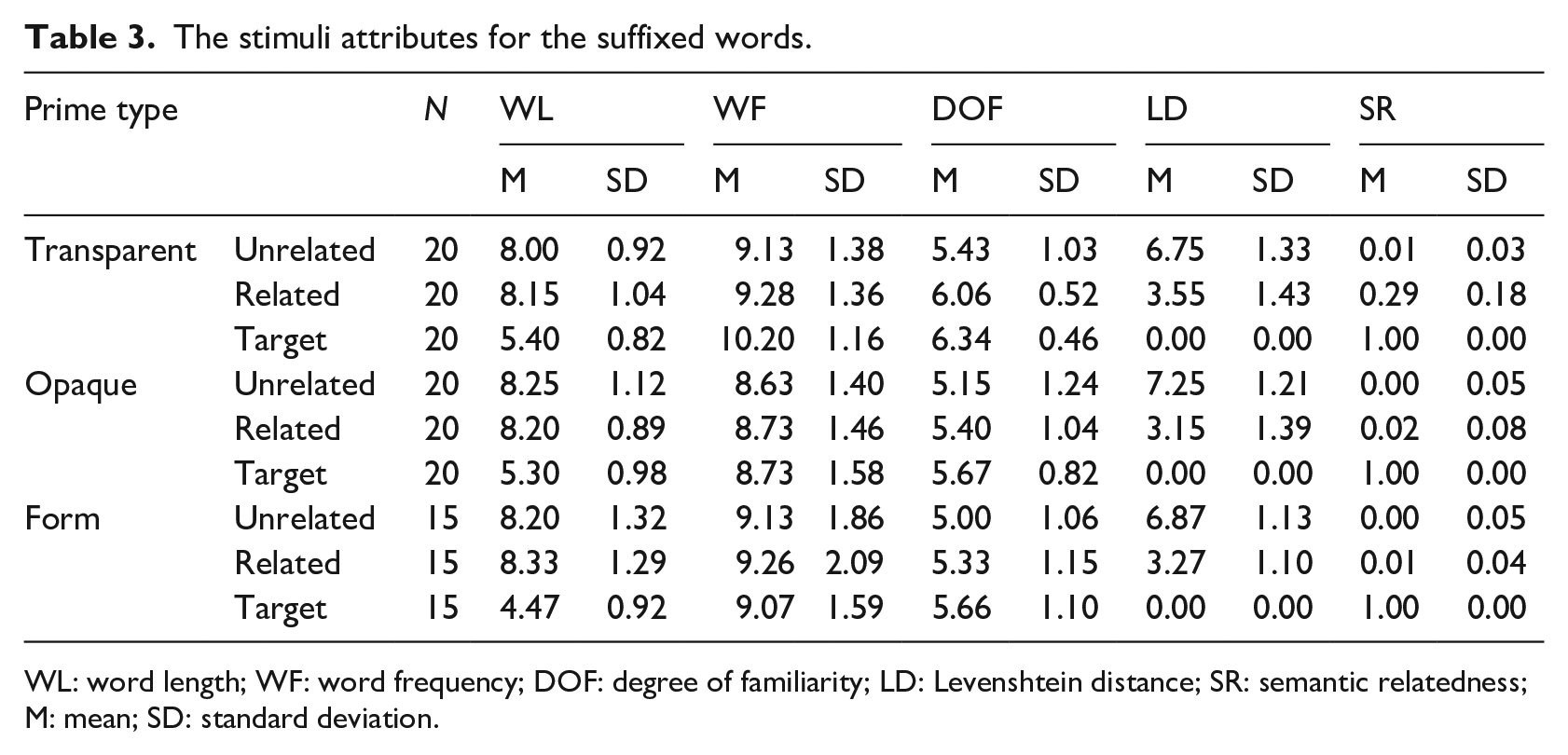
WL: word length; WF: word frequency; DOF: degree of familiarity; LD: Levenshtein distance; SR: semantic relatedness; M: mean; SD: standard deviation.
The prepared stimuli were further counterbalanced with a Latin square design requiring two presentation lists. Half of the words were preceded by the related primes (e.g., vanity-VAN and submission-MISSION), while the unrelated primes preceded the other half (e.g., regular-VAN and paradise-MISSION). Nonwords were also included in the presentation lists. The stimuli within the counterbalanced lists were further pseudo-randomized to avoid items of the same conditions clustered together. Each participant saw only one of the two lists and thus saw each target only once. For example, the Transparent condition in the prefixed words for the present study has a total of 20 targets (as shown in Table 2), thus requiring each participant to see all 20 targets from this condition once (i.e., each participant saw targets that were either paired with the related or unrelated primes, but not both, such that the confounding repetition effects should be avoided).
Procedure
Each experimental trial started off with a forward mask in hash signs “########” (500 ms), followed by a visual prime (50 ms) in lower case (40-pt bold Arial font), then a visual target (2500 ms) in upper case (40-pt bold Arial font). Between two consecutive trials, the inter-trial interval was 1000 ms. The stimuli were electronically presented using E-Prime 3.0 software (Psychology Software Tools, 2016) in a black fixed-width font against a white background on a computer monitor with a 60-Hz refresh rate (with a 16.66 ms refresh cycle). All participants were explicitly required to make decisions on the lexical status of the targets (whether the string of letters was a real word) as quickly and accurately as possible. The participants were also told to attach their fingers to two fixed keys (the left shift key represents “real,” while the right shift key represents “not real”) to eliminate unnecessary behavioral latency. There were ten similar practice items before the actual experiment.
Data analysis
Data preprocessing was conducted before statistical analysis, which included data exclusion, trimming, and transformation. Responses beyond 2500 ms (accounting for 2.2% of the total responses) and incorrect responses (accounting for 3.4% of the total responses) were excluded from the raw data. The remaining data further went through group-wise trimming, with responses outside of ±2.5SDs of group mean RT being removed (accounting for 1.7% of advanced bilingual responses, 1.1% of intermediate bilingual responses, and 2.6% of lower-intermediate bilingual responses). The remaining responses were finally inversely transformed (−1000/RT) to alleviate the degree of positive skewness.
Subsequent to data preprocessing, linear mixed-effects models were adopted to fit the inversely transformed RT using the lmerTest package (Kuznetsova et al., 2017) in the R language (R Core Team, 2018). Both fixed and random effects were included if and only if they significantly improved the model fit (as measured by Akaike information criterion (AIC)). The final model was identified through a backward model selection procedure. For this study, the final model had fixed effects that contained group (advanced, intermediate, and lower-intermediate), morphological type (prefix and suffix), prime type (Transparent, Opaque, and Form), relatedness (related and unrelated), and their two-/three-/four-way interactions. Moreover, the final model also included the mean-centered targets’ word length and degree of familiarity as covariates, as their inclusion reached statistical significance and lowered AIC. Finally, the random effects comprised random intercepts for both participants and items (inclusion of by-subject and by-item random slopes for different factors did not improve the model fits, as measured by AIC). The R code for the final model was Model <-lmer (RT ~ WL + DOF + group*morphological type*prime type*relatedness + (1|Subject) + (1|Item), data = data, REML = FALSE. Last but not least, statistical assumptions were checked to ensure that the follow-up analyses did not fall into the pitfalls of statistical artifacts. Specifically, in addition to the treatment of outliers and positive skewness, no signs indicated potential risks of breaching linearity and homoscedasticity, as shown in the standardized residual plots.
Results
The statistical results (the full model output can be found in Table S2 in the Supplemental Material) showed that the random component (participant group and critical item) accounted for nearly one-third of the within-subjects variance (ICC = 0.3). The fixed effects omnibus test showed statistical significance in the: (1) main effects of targets’ word length, F(1, 104.26) = 20.60, p < .001, targets’ degree of familiarity, F(1, 104.84) = 31.68, p < .001, group, F(2, 119.95) = 38.41, p < .001, morphological type, F(1, 104.51) = 5.18, p = .025), relatedness, F(1, 11,838.77) = 92.82, p < .001; (2) two-way interaction effects of group & prime type, F(4, 11,838.77) = 5.35, p < .001, group & relatedness, F(2, 11,838.79) = 13.57, p < .001, morphological type & relatedness, F(1, 11,838.77) = 6.34, p = .012, prime type & relatedness, F(2, 11,838.73) = 3.02, p = .049; (3) three-way interaction of group & prime type & relatedness, F(4, 11,838.76) = 2.92, p = .02. Subsequently, simple contrasts (for calculating the priming effects) and interaction contrasts (for calculating the difference between priming effects) were performed, respectively, using the glht function from the multcomp package (Hothorn et al., 2008) in the R language to verify the statistic significance of priming effects and the differences of priming effects. Figure 2 (attached in the Supplemental Material) illustrates the simple contrasts and interaction contrasts. The priming effects were calculated by subtracting the related RT from the unrelated RT (i.e., the simple effect of relatedness, indicated by the black rectangles in Figure 2), whereas differences of priming effects were evaluated through comparing the priming effects between (1) Transparent, Opaque, Form conditions (i.e., the prime type effect, indicated by the red dotted line); (2) prefix and suffix (i.e., the morphological type effect, indicated by the blue dotted lines); (3) advanced, intermediate, and lower-intermediate groups (i.e., the group effect, indicated by the yellow dotted lines). In case multiple contrasts were performed, p-values reported were adjusted using the Holm method (Ludbrook, 1998).
The simple effect of relatedness (related and unrelated) revealed significant priming effects (labeled with asterisks) in Tables 4 and 5. For prefixed words processing, significant priming effects were found among the advanced group for the Transparent (t = 4.87, SE = 0.02, p < .001), the Opaque (t = 3.61, SE = 0.03, p < .001), and the Form conditions (t = 3.36, SE = 0.03, p < .001). However, no significant priming effects were identified in either intermediate or lower-intermediate groups (all ps > .05). For suffixed words processing, significant priming effects were seen in the advanced group across the Transparent (t = 8.41, SE = 0.02, p < .001), the Opaque (t = 2.85, SE = 0.02, p = .004), and the Form conditions (t = 2.39, SE = 0.03, p = .017). Similarly, the intermediate group had significant priming effects under the Transparent condition (t = 4.53, SE = 0.02, p < .001), the Opaque condition (t = 3.31, SE = 0.02, p < .001), and the Form condition (t = 2.83, SE = 0.03, p = .005). For the lower-intermediate group, significant priming effect was only identified in the Form condition (t = 2.96, SE = 0.03, p = .003). In summary, the findings demonstrated: (1) morphological type seemed to moderate morphological processing, with suffixed words being prone to elicit priming effects than prefixed words; (2) proficiency seemed to condition priming effects, with advanced Chinese-English bilinguals being inclined to produce widespread priming effects than less proficient bilinguals.
Participants’ performance on prefixed words in each condition.
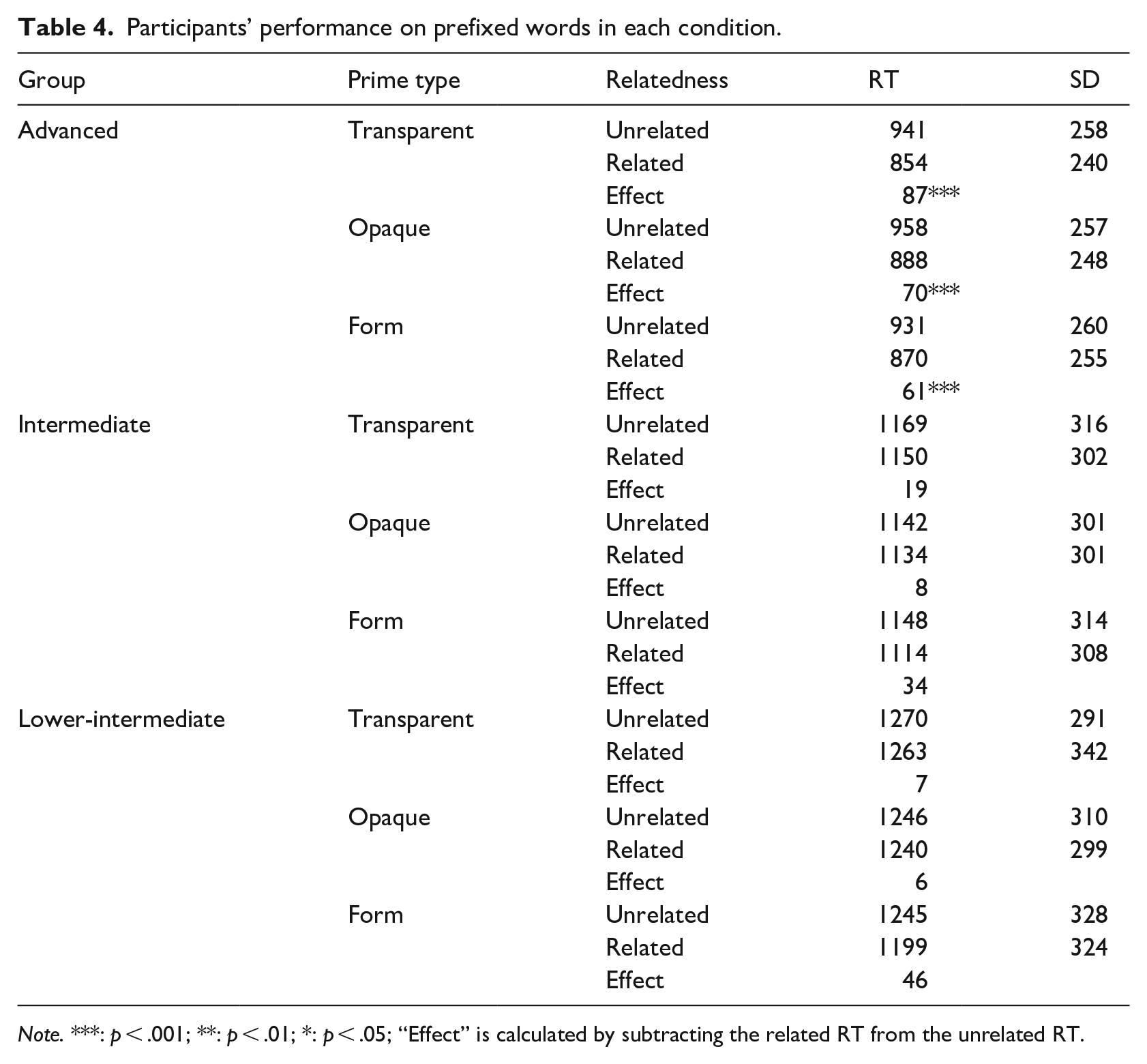
Note. ***: p < .001; **: p < .01; *: p < .05; “Effect” is calculated by subtracting the related RT from the unrelated RT.
Participants’ performance on suffixed words in each condition.
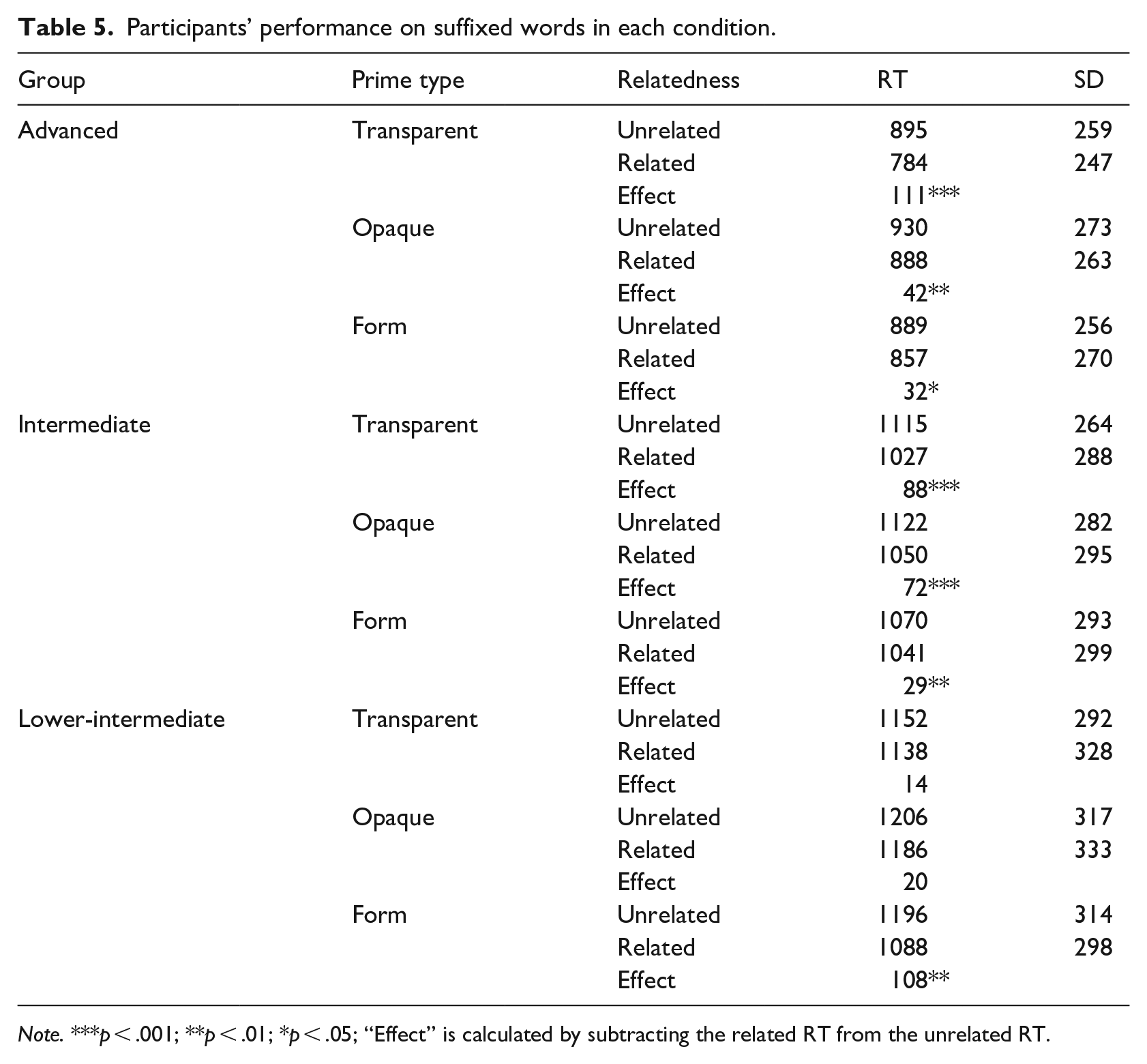
Note. ***p < .001; **p < .01; *p < .05; “Effect” is calculated by subtracting the related RT from the unrelated RT.
For identifying the conditioning effects for prime type, morphological type, and language proficiency/group, interaction contrasts were conducted to assess the magnitudes of priming effects (differences of differences). For the interaction between prime type (Transparent, Opaque, and Form) and relatedness (related and unrelated) (i.e., morphological type * relatedness, assessed for each proficiency group), the results for the prefixed words showed no significant differences in priming effects between the Transparent, the Opaque, and the Form conditions for the advanced, intermediate, and lower-intermediate groups (all ps > 0.05). For the suffixed words, the advanced group showed significant priming effects differences between the Transparent and the Opaque conditions (t = 3.93, SE = 0.03, p < .001), as well as between the Transparent and the Form conditions (t = 3.72, SE = 0.03, p < .001). Somewhat differently, the intermediate group saw stronger priming effects in the Transparent than in the Form conditions (t = 2.63, SE = 0.04, p = .009). In contrast, there were no differences in priming effects between the Transparent, the Opaque, and the Form conditions for the lower-intermediate group (all ps > .05). Apart from the custom contrasts, this study also tested the three-way interaction involving morphological type * prime type * relatedness on the three proficiency groups separately, but only found statistical significance for advanced bilinguals, F(2, 4179.29) = 3.88, p = .021. This result provided extra evidence supporting that proficient bilingual speakers showed semantic effects in the suffixed words, which were dissociable from morpho-orthographic and form priming effects. However, this was not the case for processing the prefixed words.
For the interaction between morphological type (prefix and suffix) and relatedness (related and unrelated) (i.e., group * relatedness, assessed for each prime type), the advanced group had stronger priming effects for the Transparent condition in the suffixed words than the Transparent condition in the prefixed words (t = 2.52, SE = 0.03, p = .012), and a similar pattern was also found in the intermediate group (t = 2.77, SE = 0.03, p = .006). Nevertheless, except for the Opaque condition for the intermediate group, neither the intermediate nor the lower-intermediate groups saw differences between prefixed and suffixed words under the three prime types (all ps > .05). Moreover, the present study had additionally tested the three-way interaction involving group * morphological type * relatedness on three prime types separately and found statistical significance in the Transparent items, F(2, 4444.70) = 3.03, p = .049. This result further supported that not only was transparent priming not distinguishable from morpho-orthographic and form priming in the prefixed words (i.e., the prime type effect), but it was also smaller than priming in the suffixed words for proficient bilingual speakers. Together with the prime type effect, these results collectively suggest that while prefixation-suffixation difference did not matter for low proficient speakers, probably because they were just insensitive to morphological (or morpho-semantic) factors, this started to matter for more proficient speakers.
For the interaction effect between group (advanced, intermediate, and lower-intermediate) and relatedness (related and unrelated) (i.e., prime type * relatedness, assessed for each morphological type), stronger priming effects were found for the advanced group than the intermediate group for the Transparent condition in the prefixed words (t = 2.93, SE = 0.03, p = .003) and the Opaque condition in the prefixed words (t = 2.30, SE = 0.04, p = .021). Similarly, stronger priming effects were found for the advanced group than the lower-intermediate group regarding the Transparent condition in the prefixed words (t = 2.66, SE = 0.03, p = .008) and the Opaque condition in the prefixed words (t = 2.50, SE = 0.04, p = .013). No significant differences were found between the intermediate and lower-intermediate groups for prefixed words (all ps > .05). For the Transparent condition in the suffixed words, the advanced group had stronger priming effects than the intermediate group (t = 2.57, SE = 0.03, p = .010) and the lower-intermediate group (t = 4.82, SE = 0.03, p < .001), while the intermediate group had stronger priming effects than the lower-intermediate group (t = 2.28, SE = 0.03, p = .023). In summary, the main findings from simple and interaction contrasts showed: (1) prime type effect (Transparent, Opaque, and Form) displayed priming effects differences for the advanced and intermediate groups, but not for the lower-intermediate group; (2) morphological type effect (prefix, suffix) revealed priming effects differences between prefixed and suffixed words for the advanced and intermediate groups, but not for the lower-intermediate group; (3) the group effect (advanced, intermediate, lower-intermediate) found priming effects differences between advanced versus intermediate groups, advanced versus lower-intermediate groups, and intermediate versus lower-intermediate groups.
Discussion
This study asked two substantive research questions. The first question concerned whether early morphological effects were dissociable from semantic and orthographic effects. The second research question addressed whether morphological facilitation was conditional on target language proficiency and morphological type. Methodologically, this study implemented the masked morphological priming paradigm that administered three prime types (Transparent, Opaque, and Form) from two morphological types (prefix and suffix) to three Chinese-English bilingual groups (advanced, intermediate, and lower-intermediate).
Consequently, the three Chinese-English bilingual groups demonstrated contrasting behavioral patterns in processing English prefixed and suffixed words, as reflected by in/significance in the priming effects for each condition. Specifically, the advanced group produced priming effects in the three prime types for both prefixed and suffixed words, whereas the intermediate group had priming effects for the three prime types but only in the suffixed words. In contrast, the lower-intermediate group only saw priming effects for the Form condition in the suffixed words. Together with former studies (e.g., Ciaccio & Clahsen, 2020; Diependaele et al., 2009, 2011; Li & Taft, 2019; Li et al., 2017) (Li & Taft, 2019; Li et al., 2017) (Li et al., 2017; Li & Taft, 2019) that examined native English speakers’ processing of prefixed and suffixed words, the present results suggest that bilingual morphological processing is similar to but still different from native morphological processing in the sense that (1) both native and bilingual morphological processing takes advantage of morpho-semantic relations; (2) morpho-orthographic effects only boost native morphological processing; (3) pure formal overlap does not lead to morphological facilitation for native speakers. The formal priming exclusive to current Chinese-English bilinguals (compared to native English speakers from previous studies) might also be attributed to the lack of lexical competition in the bilingual mental lexicon (Grainger & Beyersmann, 2017; Qiao et al., 2009). It is because the lateral inhibition from the Form condition is less effective in suppressing the bottom-up activation from the embedded words (e.g., think-THIN), which in the end leads to form priming in bilingual speakers (Diependaele et al., 2011; Heyer & Clahsen, 2015; Li et al., 2017; Li & Taft, 2019). In addition to the diminished lexical competition, Chinese-English bilinguals have seen priming in all three conditions probably because they focus more on orthographic than morphological overlap (note that all three conditions have prime-target orthographic overlap). Future studies recruiting participants of various linguistic profiles are well invited to make cross-linguistic contributions to this point.
In response to RQ1
Concerning the first research question, the prime type effect (the contrast between prime types) displayed that the advanced group had equivalent priming effects across three prime types for the prefixed words, but produced more significant priming effects in the Transparent condition than in the Opaque condition for the suffixed words. For the two less proficient groups, the intermediate group had larger priming effects in the Transparent condition than in the Form condition for the suffixed words. These findings are similar to what Zhang et al. (2017) had found. In Zhang et al. (2017), intermediate Chinese-English bilinguals applied morphological decomposition to the Transparent and the Opaque items in English. In addition, the lower-intermediate group in this study generated equivalent priming effects across the three prime types for the prefixed words. These findings are also consistent with previous studies on bilingual processing of English prefixed words in English languages (e.g., Li & Taft, 2019). In Li and Taft (2019), advanced Chinese-English bilinguals produced indistinguishable priming effects between three prime types (Transparent, Opaque, and Form). The absence of difference in priming effect for the prefixed words indicates that bilinguals experience obstacles in distinguishing the internal structure of prefixed words. In other words, Chinese-English bilinguals are not able to dissociate the genuinely morphological effects from semantic and orthographic effects in the final-overlapped (prefixed) words. By contrast, the present advanced bilinguals are sensitive to the semantic connections of suffixed words while failing to distinguish between morphological structure and orthographic overlap, as indicated by priming effects differences between the Transparent and the Opaque conditions only. For model affiliation (with reference to the processing models illustrated in Figure 1), the performance of the advanced group (Transparent > Opaque = Form) matches the description of the supralexical model for processing suffixed words, while these advanced bilinguals turn to orthographic cues for processing prefixed words (Transparent = Opaque = Form). Meanwhile, the processing patterns of the intermediate group (Transparent > Form) suggest that the less proficient bilingual group uses more than just orthographic overlap for processing English derived words. Nonetheless, the lower-intermediate group only relies on orthographic overlap for morphological processing. This result closely matches Cutler’s idea (at least in a nonnative language). That is, because bilinguals encounter problems in accessing the lexical content of the stem in word-final position (prefixed words), bilingual speakers have to turn to bare embedded stem extraction mechanisms, resulting in equal priming effects for all prime types. On the contrary, as the lexical/semantic content of the item becomes more available in the word-initial position (suffixed words), morpho-semantic priming is strong than other types of priming. On the whole, the early morphological effects seem to be dissociable from semantic effects for advanced bilinguals (Diependaele et al., 2011; Li et al., 2017; Zhang et al., 2017). However, such a dissociation is also conditioned by morphological type and target language proficiency, as manifested by incongruent processing patterns by less proficient groups or in the prefixed words. A more detailed discussion on the moderating effects of morphological type and proficiency is found in the section below.
In response to RQ2
Morphological type effect
For the second research question, the morphological type effect (the contrast between prefix and suffix) confirms bilinguals’ overall insensitivity to the prefixed words. Specifically, both advanced and intermediate groups had numerically larger priming effects for the Transparent words in the suffixed words than those in the prefixed words. There was no difference in the priming effect between the Opaque and Form conditions in either prefixed or suffixed words, indicating that the positional effect (morphological type) is less effective in the pseudo-derived words and purely form-related words. The present results seem to differ from Ciaccio and Clahsen (2020), which identified no reliable morphological type effect between German derived words, but accord with Li et al. (2019), which found significant differences between English prefixed and suffixed derived words. However, as the current results have been collected from Chinese-English bilinguals whose native language has few/none prefixes (which predicts considerable difficulty in processing prefixed words by Chinese-English bilinguals), the interpretation therefore should not be automatically extended to other bilingual profiles where both native language and target language have prefixes (e.g., Russian-German bilinguals). Since only a few studies have covered the effect of morphological type on bilingual morphological processing, more efforts should be invested into this topic before a definitive conclusion can be reached. In addition, the present findings are partially consistent with previous studies that recruited Chinese-English bilinguals. Li et al. (2017) found that advanced Chinese-English bilinguals generated no form priming in the suffixed words, whereas Li and Taft (2019) showed that advanced Chinese-English bilinguals produced form forming priming in the prefixed words. The observed prefix-suffix discrepancy could be attributable to the processing sequence of prefixed (final overlap) and suffixed (initial overlap) words. That is, the stems are countered first for the suffixed words, allowing for greater opportunity for lexical competition, whereas stems are later seen in the prefixed words, reducing the degree of lexical competition. Meanwhile, the prefix-suffix difference also suggests of Chinese-English bilinguals’ overall lack of sensitivity to prefixation. When it comes to prefixed word processing, the present results were close to Li and Taft (2019) where advanced bilinguals produced equivalent priming effects across the Transparent, the Opaque, and the Form conditions for prefixed words.
However, this study found that when dealing with suffixed words, the current advanced bilinguals produced significant Form priming that is comparable to Opaque priming in magnitude, which was somewhat different from the results of Li et al. (2017) where advanced bilinguals generated significant Opaque priming but no Form priming. One likely reason for this discrepancy might be the actual proficiency differences between the two advanced bilingual groups, even though both groups were of identical proficiency labels. To be specific, the advanced bilinguals from the present study might have comparably lower English proficiency than those from Li et al. (2017), as the present advanced bilinguals had learned English in a classroom setting, whereas those in Li et al. (2017) immersed themselves in an English-speaking context. Besides, a close inspection of the demographic details reveals that although both studies recruited advanced Chinese-English bilinguals with comparable age, age of acquisition, and years of learning English, the two studies were different in their choices of English proficiency measurement. The present study adopted CET6 which is mainly test-oriented, whereas Li et al. (2017) selected IELTS which prepares students for studying and living abroad and thus more reflects one’s genuine English proficiency. In this case, the different results between the present study and Li et al. (2017) might also come from the inconsistent utilization of language tests, as the present “advanced” bilinguals might as well be classified “intermediate” as per Li’s criteria. In fact, past morphological priming studies have been inconsistent in their ways of assessing target language proficiency. Measuring methods include IELTS as a criterion-referenced test (e.g., Silva & Clahsen, 2008), Oxford Placement Test (e.g., Deng et al., 2017), English Vocabulary Test (e.g., Li et al., 2017), and experimenter’s judgment (e.g., Diependaele et al., 2011). Future studies are well recommended to seek unification in the proficiency assessment tools in light of the potential confounding effect of the inconsistent methods for measuring bilinguals’ target language proficiency. In addition, it might be tempting to associate the bilinguals’ native-like performance with their residence in an English-speaking country, as these bilinguals lead more thoroughly bilingual lives, such that the effects of immersion may impact. However, the present study is not able to provide an accurate evaluation on this speculation because the exact lengths of foreign residence are not available in either Li’s or the present studies.
Proficiency effect
The proficiency effect (the contrast between advanced, intermediate, and lower-intermediate groups) revealed that advanced Chinese-English bilinguals were prone to generate larger priming effects than less proficient Chinese-English bilinguals. For the prefixed words, the advanced group had larger priming effects than the intermediate and lower-intermediate groups for both the Transparent and the Opaque conditions. For the suffixed words, the advanced group had larger priming effects than the intermediate and the lower-intermediate groups for the Transparent condition. Taken together, advanced bilinguals obtain stronger sensitivity to the internal structure of derived words than less proficient bilingual speakers. The present study confirmed the moderating effect of target language proficiency found in previous studies (Liang & Chen, 2014), with advanced bilinguals manifesting morphological decomposition but less proficient Chinese-English bilinguals shifting toward lexical retrieval. The advanced bilinguals employ procedural memory, whereas the less proficient groups rely on declarative memory (Ullman, 2004, 2005). The present results also echoed Li et al. (2017) that found a proficiency-related effect in which advanced Chinese-English bilinguals bore a close resemblance to native English speakers. By contrast, in this study, less proficient Chinese-English bilinguals showed less sensitivity to the internal structure of suffixed words. Meanwhile, the present study found that Chinese-English bilinguals overall lacked morphological acumen to decompose the prefixed English words into their constituents, similar to Li and Taft (2019) that recruited advanced Chinese-English bilinguals living a more thorough bilingual life. The present study found empirical evidence for bilingual speakers’ overall reliance on the orthographic overlap for processing prefixed words. By contrast, the supralexical model closely captures the processing of suffixed words by advanced bilinguals, indicating semantic access may come prior to morphological decomposition for advanced bilinguals (morpho-semantic access is available for bilingual morphological processing). Besides, the intermediate group has higher morpho-semantic sensitivity than the lower-intermediate group who depends exclusively on the orthographic overlap for morphological processing. On the whole, morphological effects are dissociable from semantic but not from orthographic effects for bilingual morphological processing. In addition, the independence of semantic effects is governed by the moderating effects of target language proficiency and the closeness of the morphological system between the native language and the target language.
Attentive readers might ask why less proficient groups did not have form priming in the prefixed words as they did in suffixed words, whereas the advanced group saw form priming in both prefixed and suffixed words (in other words, both the intermediate and the lower-intermediate groups failed to show form priming in the prefixed words, while all groups showed form priming in the suffixed words). Based on the literature, the lack of form priming in prefixed words could be attributable to the serial processing hypothesis (Cutler et al., 1985) that states that morphological processing is serially ordered (first stems and then affixes) and prefixed words thus elicit less or no priming effects on the whole. In this regard, it is reasonable to observe no form priming in the prefixed words, including the intermediate and lower-intermediate bilinguals of this study. However, it is still unclear why advanced bilinguals had form priming in the prefixed words, as more proficient bilinguals should be more influenced by lexical competition that inhibits form priming due to lateral inhibition from embedded words (Grainger & Beyersmann, 2017). This study accounts for such a discrepancy by arguing for graded influences between factors. That is, concerning the magnitude of effect, target language proficiency, and morphological type override the bottom-up activation that underlies form priming in bilingual speakers. In other words, form priming from bottom-up activation is less effective in the prefixed words for less proficient bilinguals, consequently rendering (1) the less proficient bilinguals produce no significant form priming in the prefixed words; (2) the more advanced bilinguals yield significant priming in the prefixed words.
In a nutshell, in response to the debate on differences in morphological processing between native and target languages, this study provides indirect evidence, suggesting both similarity (e.g., morpho-semantic priming) and dissimilarity (e.g., form priming) between native and bilingual morphological processing. However, this study also cautions potential moderators, including target language proficiency and morphological type, as (1) advanced bilinguals demonstrated closer behavioral performances to native speakers than other lower-proficient groups in recognizing prefixed and suffixed words; (2) differences concerning native-nonnative performances were found to be narrower in the suffixed words compared to the prefixed words.
Conclusion
This study investigated (1) whether early morphological effects were independent of semantic and orthographic effects in bilingual morphological processing and (2) whether morphological type and target language proficiency potentially moderated the priming effects. In this study, a masked morphological priming lexical decision experiment was conducted to three Chinese-English bilingual groups (advanced, intermediate, and lower-intermediate), and three prime types (Transparent, Opaque, and Form) were investigated for two morphological types (prefixes and suffixes). We found graded priming effects across the three Chinese-English bilingual groups, with the current advanced Chinese-English bilinguals approaching the native English speakers from Li et al. (2017) and Li and Taft (2019). Overall, the current Chinese-English bilinguals had difficulty in parsing the internal structure of English prefixed words compared to English suffixed words. At the same time, bilinguals’ morphological processing depended on morphological type and target language proficiency, and the current advanced Chinese-English bilinguals approximating former native English speakers in processing morphologically complex words. As for the theoretical implications of the present study, the current findings suggest that bilinguals in general make use of non-structural information (semantic information) in dealing with morphologically complex words, suggesting that semantic relatedness is fundamental to bilingual morphological processing, and bilinguals make use of the meanings of their parts to recognize morphologically complex words. These phenomena may be due to the fact that Chinese-English bilinguals receive a lot of practice linking affixes to grammatical functions in English classes, which eventually prompts them to infer the meaning of words from the meaning of stems and affixes. Moreover, the lack of Opaque-Form differences further suggests that bilinguals tend to rely on the surface overlap for processing pseudo-derived and form-related words, indicating that bilinguals have not yet developed morphologically structured representations of the nonnative morphologically complex words.
Supplemental Material
sj-docx-1-ijb-10.1177_13670069221137454 – Supplemental material for The processing of English prefixed and suffixed words by Chinese-English bilinguals
Supplemental material, sj-docx-1-ijb-10.1177_13670069221137454 for The processing of English prefixed and suffixed words by Chinese-English bilinguals by Lei Gu in International Journal of Bilingualism
Footnotes
Declaration of conflicting interests
The author(s) declared no potential conflicts of interest with respect to the research, authorship, and/or publication of this article.
Funding
The author(s) received no financial support for the research, authorship, and/or publication of this article.

Supplemental material
Supplemental material for this article is available online.
Notes
Author biography
References
Supplementary Material
Please find the following supplemental material available below.
For Open Access articles published under a Creative Commons License, all supplemental material carries the same license as the article it is associated with.
For non-Open Access articles published, all supplemental material carries a non-exclusive license, and permission requests for re-use of supplemental material or any part of supplemental material shall be sent directly to the copyright owner as specified in the copyright notice associated with the article.
