



Abstract
Aims and objectives:
This paper first aims to examine how young Gaelic-English bilinguals in immersion education produce aspects of Gaelic phonology. We second consider the extent to which they acquire aspects of a traditional dialect. Third, we investigate how young new speakers outside of a traditional community negotiate place identity and authenticity.
Methodology:
Our methodology first consists of quantitative acoustic and auditory phonetic analysis of word list production data, accompanied by mixed effects regression. Second, we employ qualitative analysis of interview data from the same participants.
Data and analysis:
Data are presented from 22 speakers aged 13–14 in Gaelic Medium Education in Glasgow and 15 speakers aged 13–14 in GME on the Isle of Lewis. For comparison with a traditional dialect, we also include three speakers from Lewis aged 65–80. Our quantitative analysis considers 3,605 tokens in total and the qualitative analysis considers interview data with all speakers.
Conclusions:
Our findings show that young speakers reproduce traditional aspects of Gaelic phonology, though generally to a lesser extent that older speakers. Young new speakers in Glasgow recognise that they do not speak a traditional dialect of the language. They are beginning to create a new authenticity associated with belonging to Glasgow, which represents a new acquisition setting.
Originality:
This study is the first to explore acquisition of dialect and phonology among young new speakers of Gaelic. We explore perceptions of dialect and the implications of not coming from a traditional Gaelic-speaking area for the first time in young people.
Implications:
Revitalisation settings can lead to successful language acquisition but may also contribute to dialect levelling. However, institutional support structures can lead to increased confidence and new place identities emerging in young speakers.
Introduction
In this paper, we consider aspects of linguistic production in young speakers who have become bilingual in English and Scottish Gaelic as a result of language revitalisation policies in Scotland. Our study focuses specifically on young new speakers in urban central Scotland in Glasgow, who are compared with young speakers on the Isle of Lewis, and older traditional speakers from Lewis. In this section, we first introduce the context of Scottish Gaelic and language revitalisation policies of relevance. Second, we consider the factors which may influence production outcomes in young bilingual speakers focusing on the bilingual language setting, and Gaelic as a language undergoing simultaneous obsolescence and revitalisation. We then review recent work which has examined the social identity practices of young revitalisation speakers and how this can influence language production. Finally, we consider the role of place identity in language revitalisation settings and the new challenges this can bring to language revitalisation movements.
Scottish Gaelic
Scottish Gaelic is a Celtic language closely related to Irish. The language is referred to as ‘Gaelic’ [ɡalɪk] by its speakers. According to the last UK Census, conducted in 2011, there are approximately 58,000 speakers in Scotland (1.1% of the Scottish population, Scottish Government [SG], 2015). Gaelic was once spoken across early medieval Scotland and was the language of the Scottish court in the high medieval era. Since this time, however, the number of Gaelic speakers as a proportion of the Scottish population has been in decline (MacKinnon, 1974). Numerically, the densest Gaelic-speaking communities are now in the north-west Highlands and Islands, especially the Outer Hebrides. In the Outer Hebrides, approximately 60% of the population report that they are able to speak Gaelic (SG, 2015).
Since the latter part of the 20th century, Gaelic has been undergoing a programme of revitalisation (Dunmore, 2019). As a significant part of revitalisation measures, school education through the medium of Gaelic is now available across Scotland where there is parental demand. Gaelic medium education (GME) is currently available in 14 out of 32 council areas in Scotland (Education Scotland, 2019), and nearly 6,800 children were being educated in Gaelic in 2018–2019 (Bòrd na Gàidhlig, 2019). A large number of these children are in Highland and Island areas, but an increasing number live in urban central Scotland in Glasgow and Edinburgh.
Lowland Scottish cities have a long history of welcoming Gaelic speakers from the Highlands who emigrated in search of work from at least the 1600s onwards (Withers, 1998). Glasgow in particular, due to its industrial heritage and large number of employment opportunities, has been a natural destination for Gaelic speakers. This immigration continues due to the opportunities provided by language revitalisation. At the same time, people living in lowland Scotland are increasingly aware of the opportunities available through Gaelic medium education and parents see GME as a desirable school setting (O’Hanlon, 2015).
Our paper focuses on adolescent speakers who have come through the GME system into secondary school level. We concentrate on one community in lowland Scotland, Glasgow, and one community in the Outer Hebrides, the Isle of Lewis. In Glasgow, Gaelic is spoken by ~1% of the city’s population (SG, 2015). While numerically speaking Gaelic is well-represented in Lewis (~60% Gaelic-speaking, SG, 2015), numbers of Gaelic speakers are concentrated in the older age brackets (Munro et al., 2011).
In both island and lowland communities, we find a range of young bilinguals. The majority are young people who have acquired Gaelic entirely through the school system, though sometimes parents are engaged in learning Gaelic (for analysis, see Munro et al., 2011; Nance, 2013). These young people are new speakers as defined by, for example, O’Rourke et al. (2015), as they have little input in Gaelic from their parents and little input from peers in the community. Other young people have some Gaelic input from parents in the home and perhaps grandparents in addition. While Gaelic is institutionally well-supported in Glasgow (Glasgow City Council, 2018), it is rarely used outwith Gaelic-designated events (McLeod et al., 2014). Similarly, even in Lewis it is rare for Gaelic to be used outside of the home and Gaelic-designated spaces (Birnie, 2018). As such, a young person in Lewis may experience much of their non-school time in English. Previous work with the young people represented in this study shows that in both locations, the adolescents preferred to use English as a peer group language (Nance, 2015a). We analyse all young speakers as part of a new speaker continuum from some Gaelic home input to little or no home input.
Linguistic outcomes in language revitalisation
In contexts of obsolescence and language revitalisation, the minority language forms part of a bilingual repertoire alongside the societally dominant language. Bilinguals with differing amounts of input at different life stages would usually be expected to show cross-linguistic influence from their dominant or first language, as well as a bidirectional influence from their non-dominant or second language (Amengual, 2017; Cohen, 2016; Flege, 2007). In addition to individual bilingualism factors, the effects of societal language contact spanning centuries may lead to closer convergence between languages (Mayr et al., 2017; Ravindranath, 2015).
Due to the effects of individual bilingualism, language contact, and language minoritisation, minority languages may be subject to rapid and widespread change across the linguistic system, above and beyond what might be expected in a non-minority setting (Dorian, 1981, p. 151). Specifically, we can expect simplification of complex systems and reduction of typologically unusual features (Andersen, 1982; Dressler, 1991). This process is informed by the linguistic context of the bilingual setting (Andersen, 1982; Mougeon & Beniak, 1991) and also the social context of the languages in question (Pearson, 2007). In language revitalisation, young new speakers may take relatively long to acquire all the structures of the target minority language but can achieve complex structures given sufficient input and motivation (Kennard, 2018).
The status of new speakers of minority languages as bilinguals in contact settings may have a large effect on their linguistic productions. However, research also indicates that such speakers also use variation for socio-stylistic purposes. Nance et al. (2016) categorise variationist studies of new speakers into three types: Type 1 studies investigate the extent to which new speakers reproduce the linguistic structures of traditional speakers. For example, Jones (1998) demonstrates how new speakers in Welsh medium education may not produce the traditional morphosyntax of Welsh. Type 2 studies investigate the extent to which new speakers use sociolinguistic variation in comparison to the traditional community, for example, Mougeon et al. (2004) show that new speakers of French do not use the same rates of sociolinguistic variants as traditional speakers such as on or nous as a first person plural pronoun. Type 3 studies investigate how new speakers make use of variation for identity construction. For example, Hornsby (2005) explains that new speakers of Breton actively monitor their use of vocabulary and avoid borrowings from French such as konfitur ‘jam’ from French confiture, preferring neologisms of Breton origin such as koatigell ‘jam’.
Several studies have combined sociolinguistic insight into identity practice with bilingualism methods and theories. For example, Mayr et al. (2017) and Nance (2020) consider the phonetic realisations of young new speakers’ Welsh and Gaelic, respectively. These studies demonstrate that in some contexts, identity factors such as peer group affiliation (in the sense of conducting socially meaningful practices as a group of young people, e.g., Eckert, 2000) can outweigh bilingualism factors such as timing of exposure and quantity of input. Tomé Lourido and Evans (2019) show that new speakers of Galician are influenced by their bilingual background, but still make stylistic choices in salient production features such as unstressed word-final vowels. Similarly, Nance et al. (2016) demonstrate that highly engaged Gaelic new speakers are able to make agentive choices about their use of variation for identity and ideological reasons, and Lantto (2021) shows that Basque new speakers adopt individual strategies towards code-switching and use of dialectal features in the creation of personal styles in their L2.
Place identity in revitalisation settings
Woolard (2008) states that a language’s authority in Western societies is often underpinned by one of two ideological complexes: authenticity and anonymity. Her work describes how majority hegemonic languages such as Spanish in monolingual parts of Spain are characterised by anonymity: they are the unmarked, default code which generally does not belong to a particular ethnic group or location within a nation state. Minority languages, on the other hand, are frequently bound by the ideology of authenticity, which has its roots in the 18th- and 19th-century Romantic ideals. According to authenticity, a speech variety must be grounded in geographical and social territory (Bucholtz, 2003). Woolard (2008, p. 304) states that a speech variety must be very much ‘from somewhere’ in speakers’ consciousness, and thus its meaning is profoundly local. If such social and territorial roots are not discernible, a linguistic variety lacks value in this system.
In the context of Gaelic, the concept of accent and belonging to somewhere is so entrenched that there is a specific word to describe this, blas. Literally, blas means ‘taste’ or ‘accent’, but the Gaelic word also has a meaning linked to localness and traditional dialect pronunciation. All speakers are aware of this and sometimes refer to other speakers as having blas, or not. Those with blas are typically older and grew up speaking a traditional dialect. Those without, may well be competent, fluent speakers, but do not have an accent ‘from somewhere’ (McEwan-Fujita, 2010; McLeod, 2017; Will, 2012, p. 37). Will (2012, p. 40) notes that children in GME are increasingly perceived as lacking blas due to their non-traditional language acquisition route. But, this represents a conundrum: they are the future speakers of the language so should be treated as community insiders, and as children do not typically express the political motivations of adult Gaelic new speaker activists.
The links between value to a linguistic system and geographical roots are particularly pertinent in the context of minority language revitalisation (McLeod & O’Rourke, 2015; O’Rourke & Ramallo, 2013). Specifically, in the Gaelic context, many revitalisation strategies are taking place in lowland Scotland, away from the traditional heartlands of the Highlands and Islands. McLeod and O’Rourke (2015) and Nance et al. (2016) discuss how lowland adult new speakers address the tension of not sounding like they are from an authentic ‘somewhere’. Will (2012, p. 125) suggests that primary GME pupils may lack experience and socialisation with a variety of registers and dialects of Gaelic due to a lack of access to a variety of Gaelic models and the prioritisation of delivering a Gaelic curriculum in a limited amount of time. How do advanced GME pupils negotiate the authenticity of localness in Gaelic based on prior experience and widening awareness of Gaelic’s political status? This question is pertinent in lowland areas where GME exists as a result of language revitalisation, but also in highland areas, where very local varieties are valued and influential (McLeod, 2017), but unlikely to continue as community vernaculars due to language shift and network fragmentation (Lamb, 2011).
Summary and remaining questions
In this paper, we examine the linguistic productions of young new speakers. Specifically, we examine the extent to which they produce the previously described phonological system of Gaelic. We also investigate the extent to which they have acquired local dialect features. This question is investigated among GME pupils through examination of their production of words containing well-known Lewis dialect shibboleths. The results will show the extent to which young people in Lewis are acquiring their local dialect, and also the extent to which young people in Glasgow reproduce a dialect model provided by a large number of their teachers, half of whom were from the Isle of Lewis. The pupils at the schools in Glasgow and in Lewis came from a variety of primary schools so it is not possible to know the exact origins of all their primary teachers. However, Lamb’s (2011) survey showed that in Lewis, 92% of GME primary teachers were from Lewis, and in Mainland primary schools 18% of teachers were from Lewis.
The quantitative analysis is supported by qualitative analysis from interviews with the same speakers about attitudes to dialect and accent. This analysis focuses on the young people from Glasgow where the tension between language revitalisation concerns and an authentically local Gaelic is most salient. Our analysis, therefore, answers the following research questions:
How do bilingual GME pupils in Glasgow and Lewis produce aspects of Gaelic phonology, and what are the implications of this for theories of bilingual speech production and Gaelic revitalisation across Scotland?
How do GME pupils in Glasgow and Lewis produce aspects of Lewis dialect, a significant input variety, and how does this add to our knowledge about input and speech production among bilingual young people?
How is the tension between local identity, peer group identity, and the ideology of authenticity negotiated outwith traditional Gaelic-speaking areas?
Methods
Data are presented here from 22 adolescents in GME in Glasgow, and 15 adolescents in GME in Lewis aged 13–14. In Glasgow, this represented two out of three classes in GME aged 13–14, and in Lewis this sample represented 15 out of 18 pupils in GME aged 13–14.
Each speaker completed a language use questionnaire. For full details and analysis, see Nance (2013). Here, we consider whether the young people spoke Gaelic with one parent or not, as this gives an indication of whether some Gaelic was used in their home. 1 None of the young people spoke Gaelic with both parents. Table 1 shows the numbers of young people who had some Gaelic input and output at home.
Home language background of the young participants.
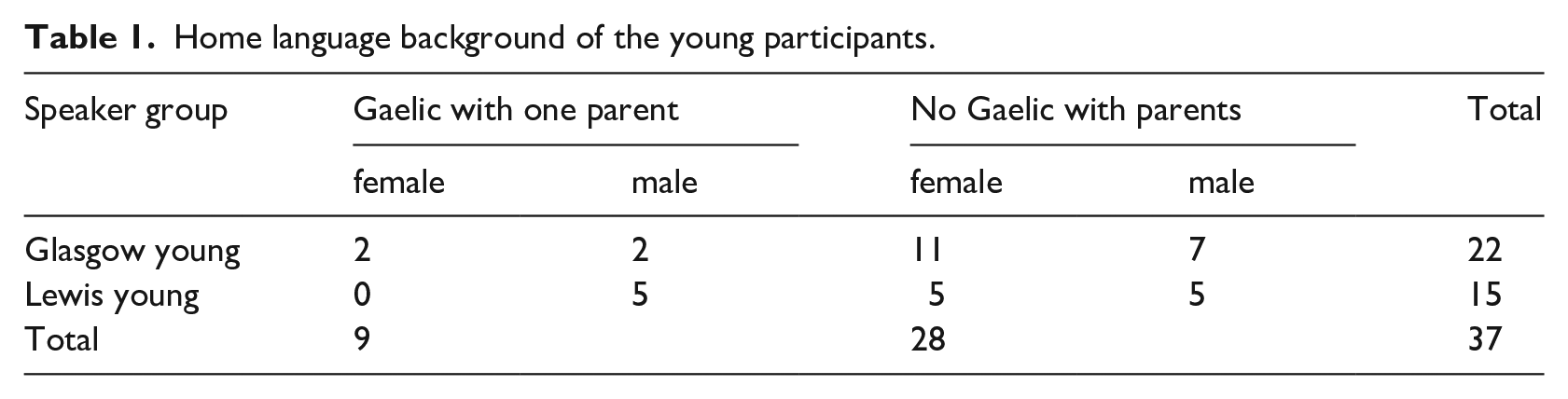
The young participants are compared with three older speakers from Lewis aged 65–80 (all female) to provide comparison with traditional dialect speakers. All the older Lewis speakers reported speaking Gaelic with family and neighbours as well as in social activities.
Each participant completed an individual interview in Gaelic with the first author in a quiet room at their school (younger speakers) or home (older speakers). Participants then read the word list repeating each word twice in random order, and then read a reading passage before completing the language background questionnaire. All participants were recorded using a Beyerdynamic Opus 55 headset microphone, a Rolls Live mixer, and a USB audio interface. The sound files were recorded in Audacity onto a laptop computer at 44100 Hz.
Quantitative analysis
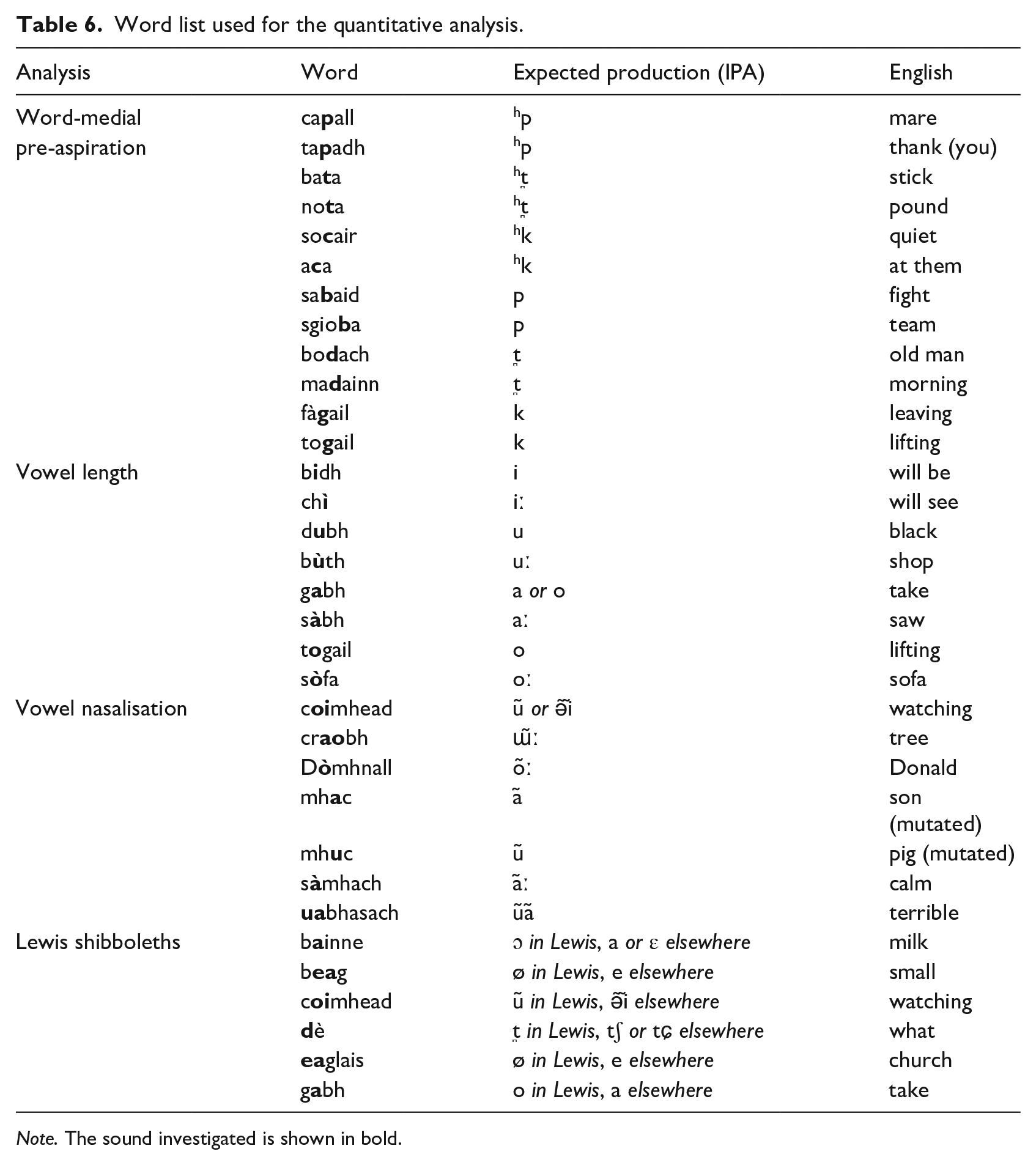
The word list for this analysis can be found in Table 6 in Appendix 1. We here present analysis of four linguistic variables; for further information on Gaelic phonology, see Nance and Ó Maolalaigh (2021). The first three were selected as aspects of Gaelic phonology which are not shared with English. The final variable investigates the extent to which Lewis dialect features are used. The word list data were transcribed in Elan (Sloetjes & Wittenburg, 2008) and then exported to Praat (Boersma & Weenink, 2019) for analysis.
Phonemic pre-aspiration in word-medial aspirated stops
Gaelic has a voiceless aspirated series of stops, which are pre-aspirated in word-medial and word-final position, and a voiceless unaspirated series of stops, for example, boc ‘goat’ /pɔhk/ vs. bog ‘soft’ /pok/ (Nance & Stuart-Smith, 2013). Typically, pre-aspiration is longest in velar and coronal stops and shorter in bilabial stops (Ladefoged et al., 1998).
Voiceless pre-aspiration was labelled from the waveform in Praat (Boersma & Weenink, 2019), along with the entire vowel + pre-aspiration interval. In most Gaelic vowel + pre-aspiration sequences the vowel starts in modal voice with an accompanying periodic waveform, and then changes to breathy voicing, before aperiodic voiceless pre-aspiration (see Nance & Stuart-Smith, 2013). We labelled the voiceless pre-aspiration where there was no remaining periodicity in the waveform until the stop closure. An example of this labelling is shown in Figure 1. We here report on duration of voiceless pre-aspiration as a proportion of the vowel + pre-aspiration interval to normalise for speech rate (see Nance, 2020). This analysis considers 1,097 tokens in total.
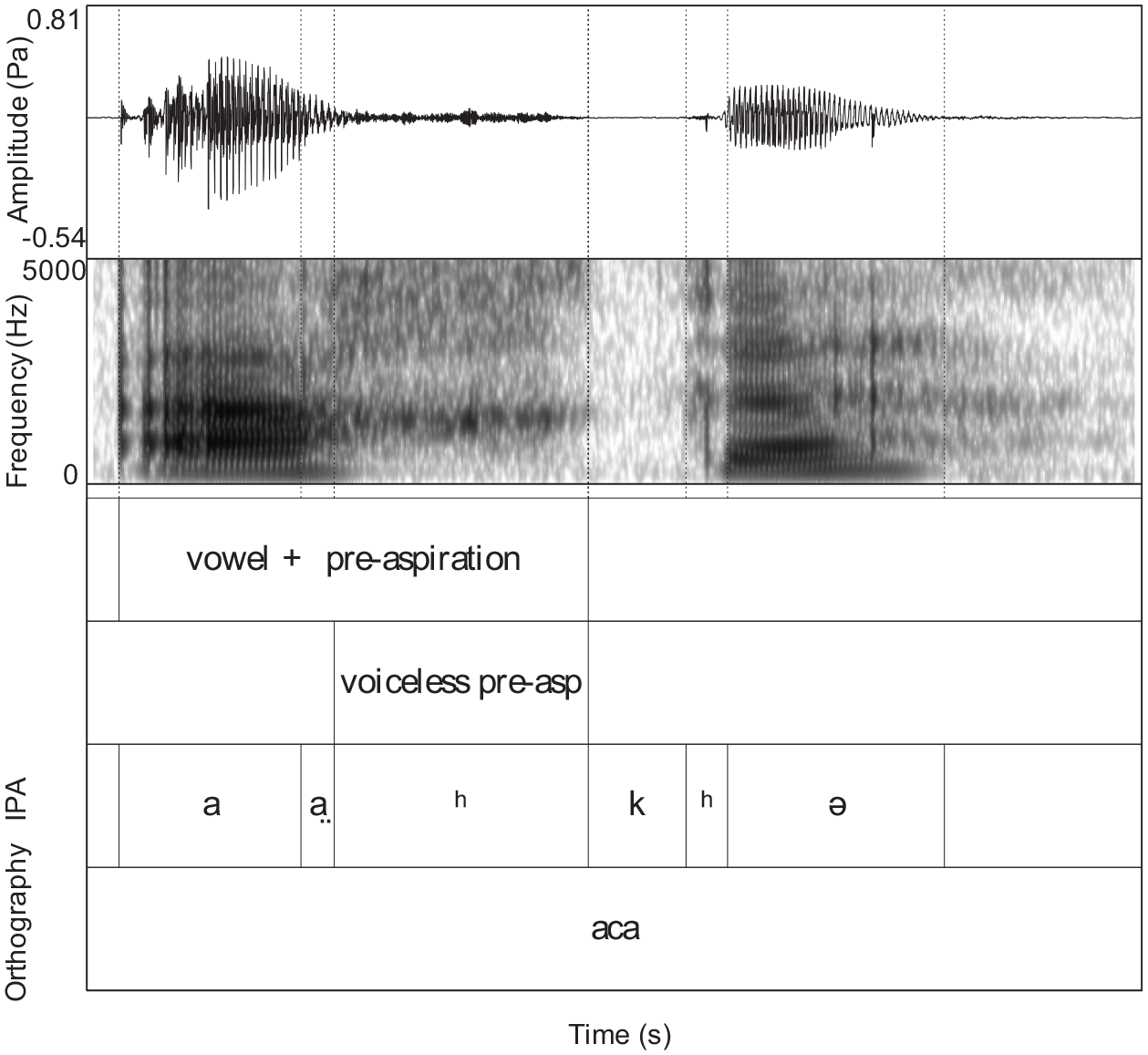
Example spectrogram, waveform, and TextGrid to show the pre-aspiration labelling. The word aca ‘at them’ was produced here by a young female Glasgow speaker.
Phonemic vowel length (long vs. short vowels)
Gaelic vowels are phonemically short or long. Length is generally shown orthographically with a grave accent, for example, teth ‘hot’ /tʃhe/ vs. tè ‘woman’ /tʃhe:/.
Phonemic vowel length was measured by segmenting the duration of the target vowel in Praat (Boersma & Weenink, 2019). Durational measures were then z-scored for each participant to normalise for speech rate. This analysis considers 954 tokens in total.
Phonemic vowel nasalisation
Vowels in Gaelic can be phonemically nasalised but the extent of this is lexically, dialectally, and idiolectally specific (Nance & Ó Maolalaigh, 2021). Our analysis considers words prototypically produced with strong nasal vowels in Lewis dialect.
The extent of vowel nasalisation was determined by auditory analysis. Each target vowel was coded as either oral, nasal, or partially nasal by the second author, and then checked by the first author until agreement was reached. This analysis considers 839 tokens in total.
Well-known Lewis dialect shibboleths
Lexical items were chosen to immediately index Lewis dialect and indicate local pronunciation features. They can be considered stereotypes in the sense of Labov (1972). 2 These words are either unique in their lexical set, or part of a very small lexical set (beag ‘small’, eaglais ‘church’) so are best understood as lexical variables which vary in terms of the vowel/consonant used. For example, bainne ‘milk’ is typically produced as [pɔn̪ʲə] in Lewis, but [pan̪ʲə] or [pɛn̪ʲə] elsewhere (see Table 6 for full details).
The pronunciation of the Lewis shibboleths was determined by auditory analysis. Each word was coded as a stereotypical Lewis pronunciation or supra-regional variant (see Table 6 for details). This analysis considers 715 tokens in total.
Statistical analysis was conducted via mixed effects regression analysis in R (R Core Team, 2020). The first two variables were analysed with linear models, and the second two with logistic models in the lme4 package (Bates et al., 2015). In each case, a model was fitted to the dependent variable under consideration. The independent variables for each model are detailed in the relevant results section. Random intercepts were fitted for speaker and word in each case. Significance testing was conducted by comparing the full model to a model excluding the independent variable under consideration via likelihood ratio tests (Winter 2020, p. 260). To test for the effect of having at least one Gaelic-speaking parent, and the effect of gender among the young speakers, a separate data set was formed made of the data from young speakers only and tested via regression model comparison.
Qualitative analysis
Qualitative analysis focuses on the Glasgow young speakers as the most salient locus of tension between authentic local dialect forms and language revitalisation outcomes. The qualitative data are taken from interviews with the same participants who read the word list. One of the interview questions asked participants if they thought they had an accent in Gaelic, and one asked their opinion on the Lewis dialect. Simple content analysis from the transcripts is presented of the all the cases where young people did not reply Chan eil fios agam ‘I don’t know’ or similar. We therefore discuss overt attitudes to personal accent and dialect variation in Gaelic.
Results
Quantitative analysis
This section presents the results of the four quantitative analyses described above.
Voiceless pre-aspiration
The proportion of voiceless pre-aspiration in word-medial stops is shown in Figure 2.
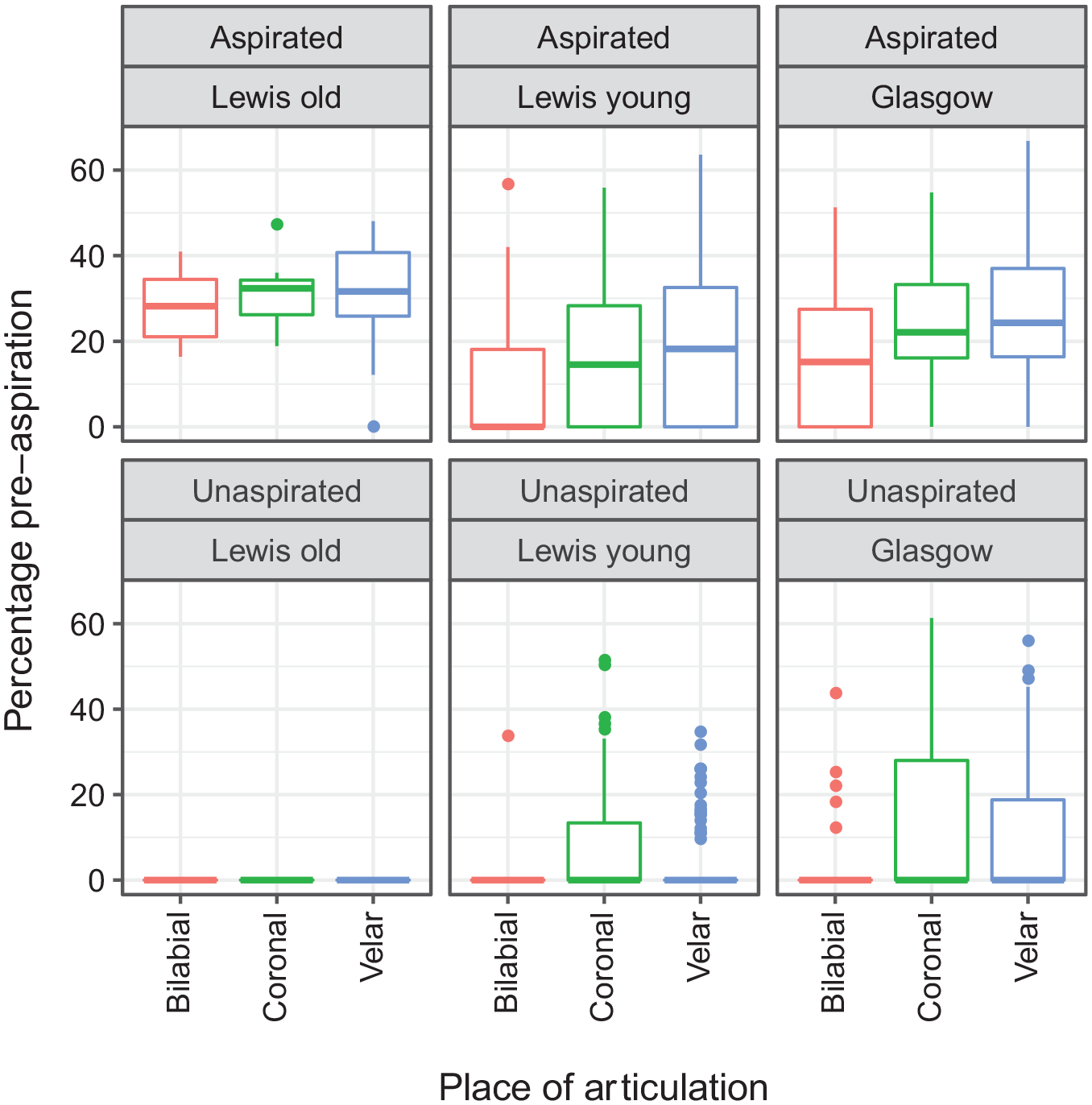
Percentage voiceless pre-aspiration in the vowel + pre-aspiration sequence for each speaker group.
Regression modelling was conducted on proportion pre-aspiration. The full model included stop series (aspirated, unaspirated), place of articulation (bilabial, coronal, velar), speaker group (Lewis older, Lewis younger, Glasgow young), and all possible two-way interactions. Speaker and word were included as random intercepts. The likelihood ratio tests comparing the full model against a model not containing the variable of interest to conduct significance testing (Winter 2020, p. 260) are reported in Table 2.
Model comparisons testing proportion voiceless pre-aspiration.
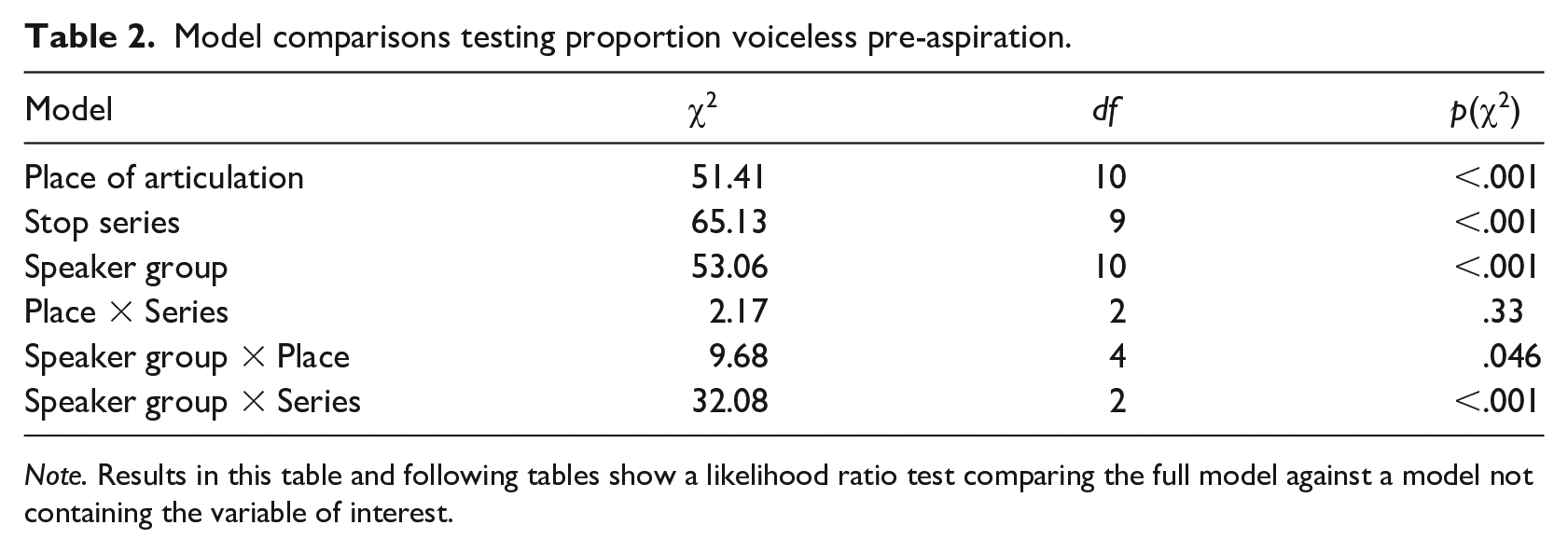
Note. Results in this table and following tables show a likelihood ratio test comparing the full model against a model not containing the variable of interest.
From the detail of Figure 2, the place of articulation finding appears to come from velar stops generally having the most pre-aspiration and bilabial stops the least. This is the case in both aspirated and unaspirated stops (as shown by the non-significant interaction of Place × Series). Aspirated stops clearly have more pre-aspiration than unaspirated stops. To interpret the significant interactions of Group × Place, and Group × Series, model estimates and standard errors are plotted in Figures 3 and 4 using the sjPlot package (Lüdecke, 2020). The interaction estimates show that Lewis younger and Glasgow speakers have substantially less pre-aspiration in bilabial stops, but this is not the case among Lewis older speakers. Also, Figure 4 shows that Lewis older speakers make the clearest distinction between aspirated and unaspirated stop series in terms of pre-aspiration proportion, and Lewis young speakers the least.
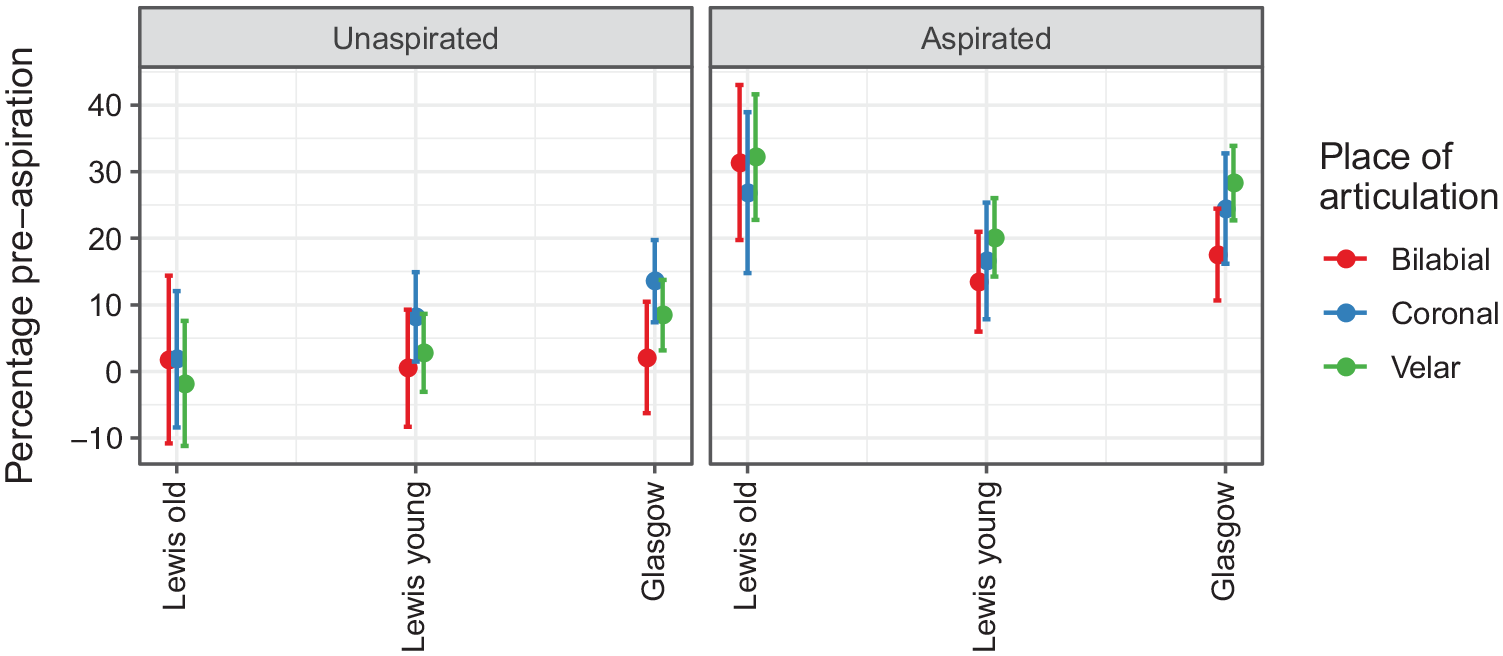
Model estimates of the Group × Place interaction (split according to stop series for most logical interpretation). Error bars show standard error.
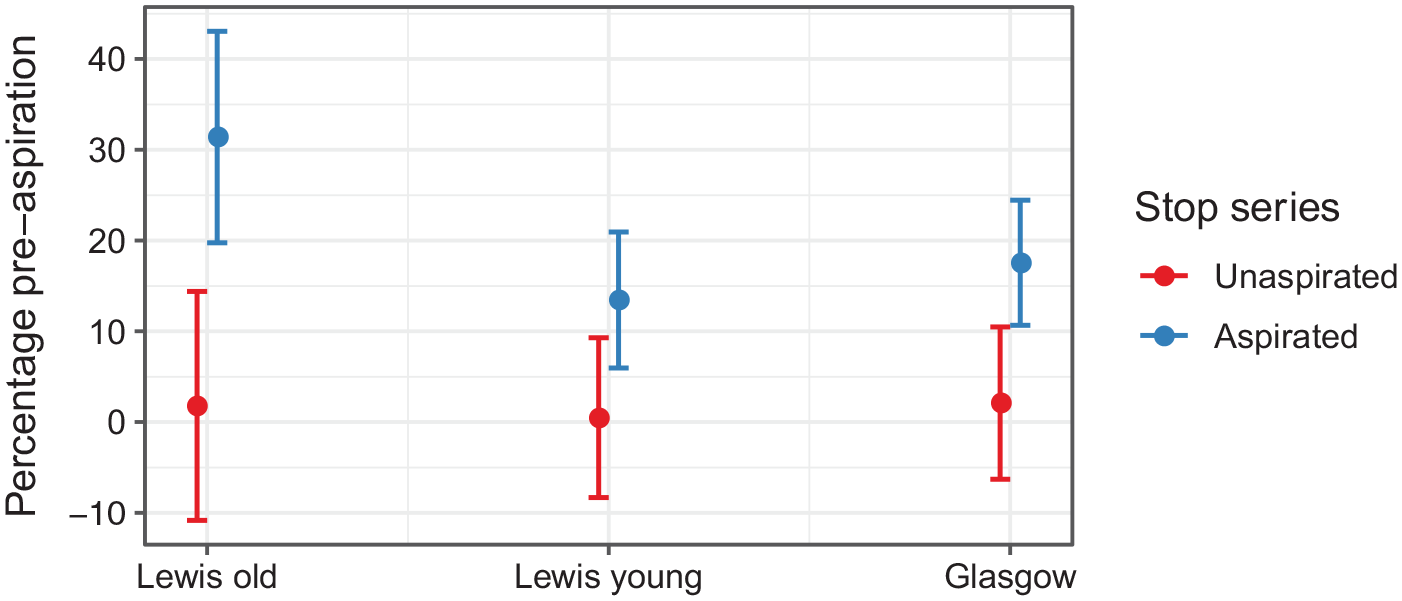
Model estimates of the Group × Series interaction.
Separate modelling was carried out on the young speakers to test the effects of gender and having one Gaelic-speaking parent. The full model included stop series (aspirated, unaspirated), place of articulation (bilabial, coronal, velar), speaker group (Lewis younger, Glasgow young), gender (male, female) and having a Gaelic-speaking parent or not. Two-way interactions between the linguistic factors and social factors were included but not between the social factors, for example, Speaker group × Gaelic-speaking parent, etc., due to low token counts. Word and speaker were included as random intercepts. Significance testing was carried out via model comparison as above and did not yield any significant results.
Vowel length
The vowel duration results are shown in Figure 5.
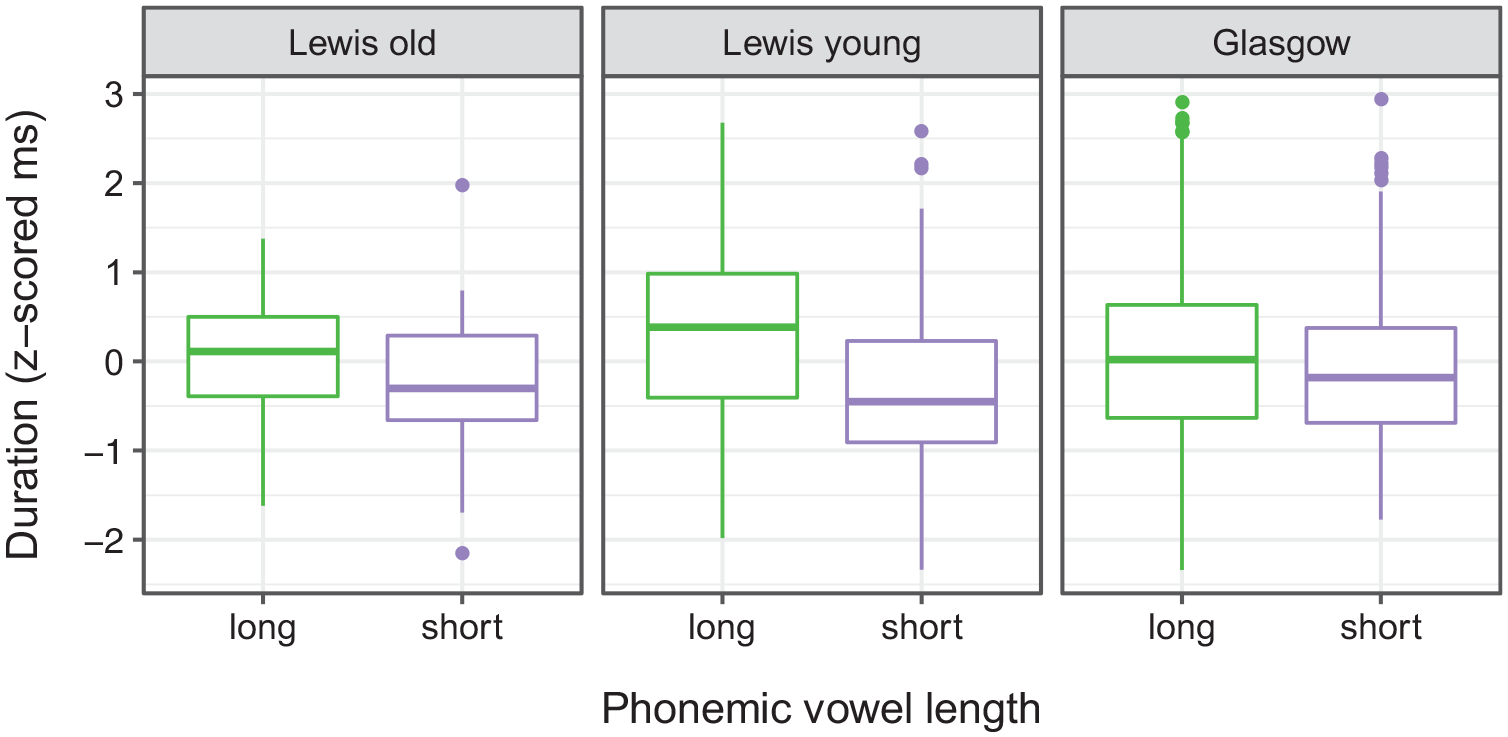
Vowel durations in each speaker group split by phonemic vowel length.
The statistical modelling tested z-scored duration as the dependent variable. The independent variables were phonemic vowel length (long, short), speaker group (Lewis older, Lewis younger, Glasgow), and an interaction of Length × Group. Only speaker was included as a random intercept as the inclusion of word resulted in over fitting of the model. To conduct significance testing, the full model was compared with a model not containing the variable of interest via likelihood ratio testing. The results of these model comparisons are shown in Table 3.
Model comparisons testing vowel duration.
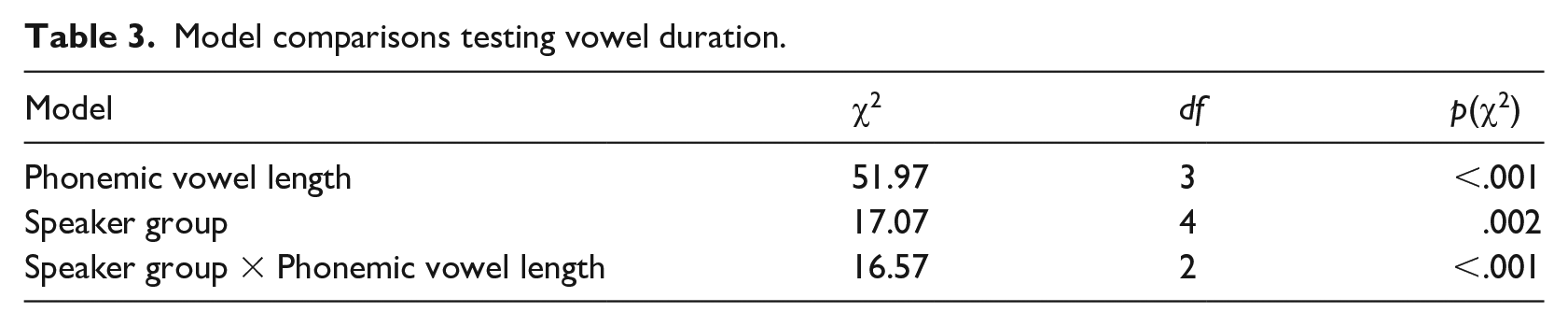
The model comparisons show a significant difference for phonemic vowel length, for speaker group and an interaction of Group × Length. The significant interaction is visualised in Figure 6. The interaction suggests that younger speakers in Lewis make the largest distinction between long and short vowels. The model estimate means are much closer together for young Glasgow speakers, and there is a large standard error in the Lewis older speakers. The Lewis younger speakers, therefore, clearly produce the vowel length distinction, but this is less clear in the Lewis older speakers and Glasgow young speakers.
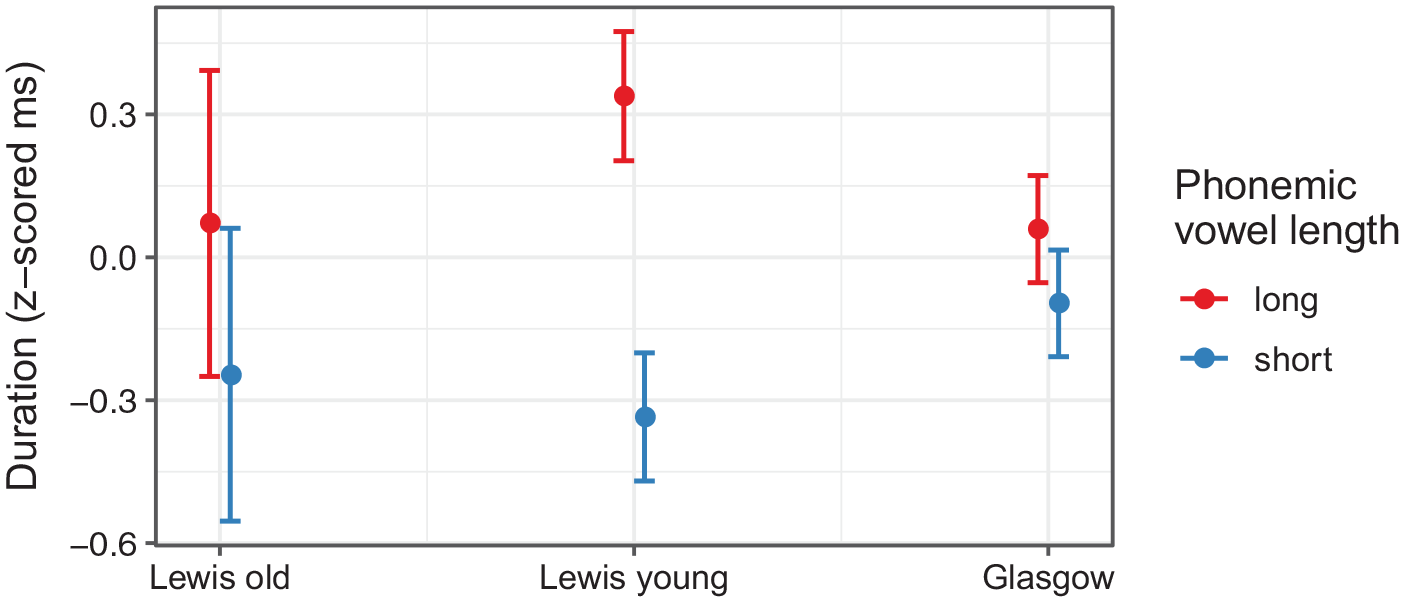
Model estimates visualising the significant interaction of Speaker group × Phonemic vowel length.
Separate modelling was carried out on the young speakers to test the effects of gender and having one Gaelic-speaking parent. The full model included vowel length (long, short), speaker group (Lewis younger, Glasgow young), gender (male, female), and having a Gaelic-speaking parent or not. A two-way interaction between speaker group and vowel length was included but other two-way interactions could not be included due to low token counts. Word was included as random intercepts. Significance testing was carried out via model comparison as above. There was a significant interaction between speaker group and length, with Lewis younger speakers producing a greater difference between length categories mirroring the results above, χ2(1) = 16.22, p < .001. There were no significant differences for gender or having a Gaelic-speaking parent.
Nasal vowels
Vowels were initially coded as nasal, partially nasal, or oral as described above. For the purposes of logistic regression modelling, the coding was collapsed into ‘some nasality’ or ‘no audible nasality’. The results are shown in Figure 7.
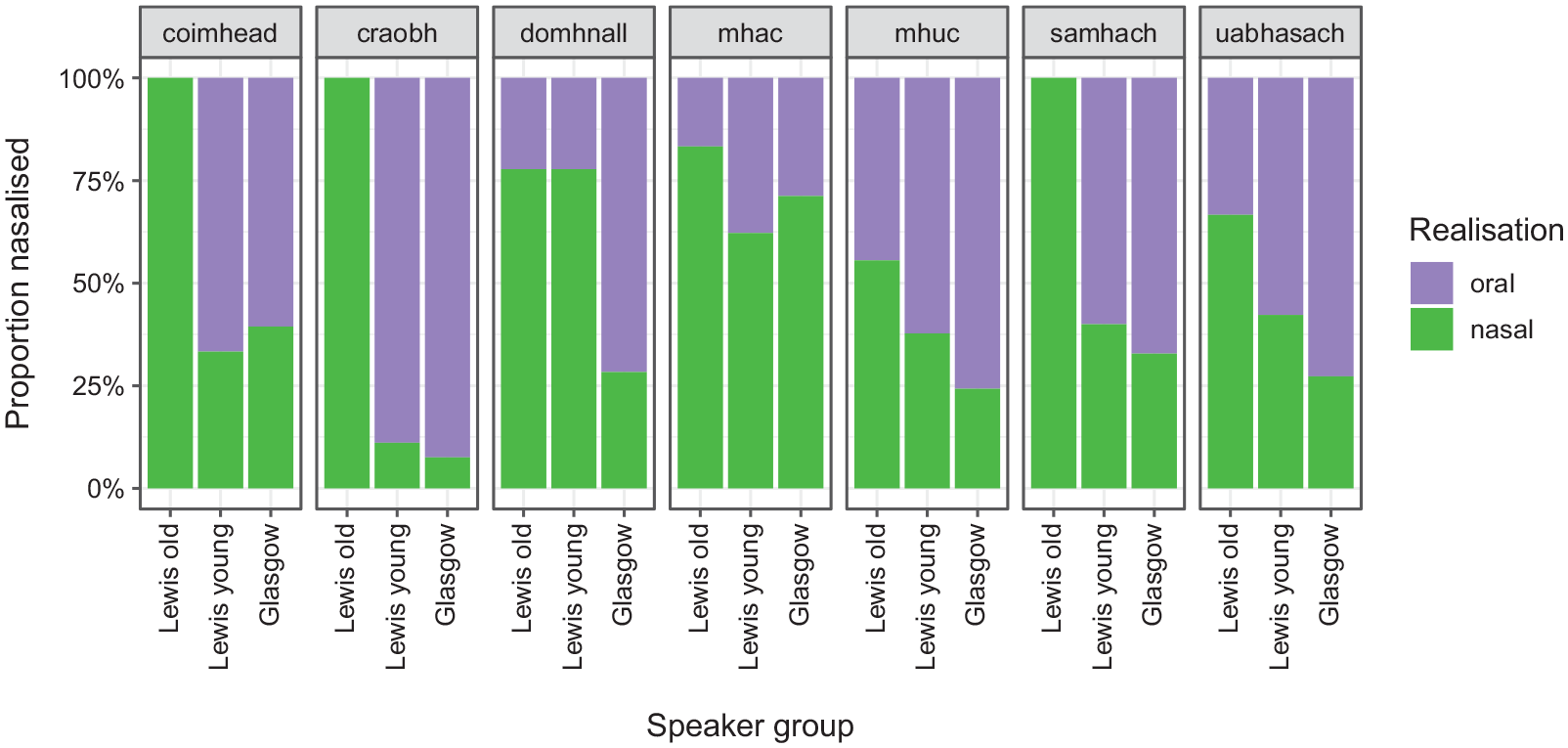
Auditory coding of nasality in each target word.
Presence of nasality was then tested via logistic regression modelling. The model included speaker group as an independent variable and word and speaker as random intercepts. The model comparison comparing the full model against a model not containing speaker group is shown in Table 4. There is a significant effect of speaker group, and visual analysis of Figure 7 shows that older Lewis speakers are producing nasality in 100% of some words, and high rates of nasalisation in others. This is not the case among either group of young speakers.
Model comparison testing presence of nasality.

Separate modelling was carried out on the young speakers to test the effects of gender and having one Gaelic-speaking parent. The full model included speaker group (Lewis younger, Glasgow young), gender (male, female), and having a Gaelic-speaking parent or not. Two-way interactions could not be included due to low token counts. Word and speaker were included as random intercepts. Significance testing was carried out via model comparison as above. There were no significant differences for having a Gaelic-speaking parent, but there was a significant effect of gender with young male speakers more likely to produce nasal vowels, χ2(1) = 5, p = .03. The estimated values from this modelling are shown in Figure 8. The figure shows that young male speakers produce some nasalisation nearly half the time, but young female speakers only produce nasalisation around a third of the time.
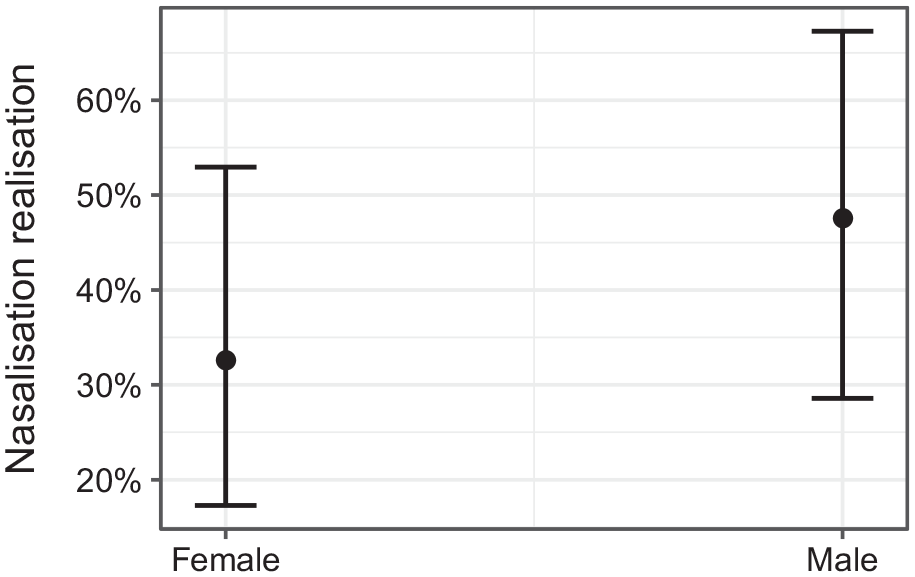
Estimated values for realisation of Nasalisation × Gender in younger speakers.
While we were not able to statistically test two-way interactions due to token counts, it appears that there are gender effects across both locations with males producing more nasal vowels in both cases (Figure 9).
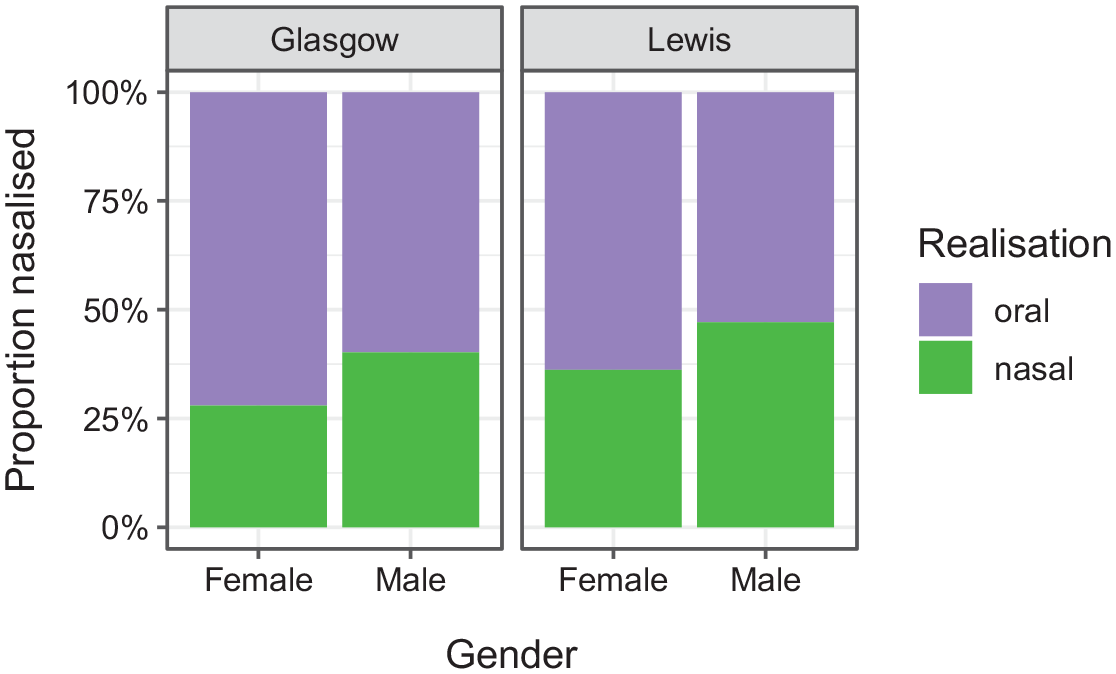
Realisation of nasalisation in young speakers according to location.
Lewis dialect shibboleths
The Lewis dialect shibboleths were auditorily transcribed and then assigned the categories of ‘Lewis pronunciation’ or ‘supra-regional’ for the purposes of logistic regression modelling. These results are shown in Figure 10.
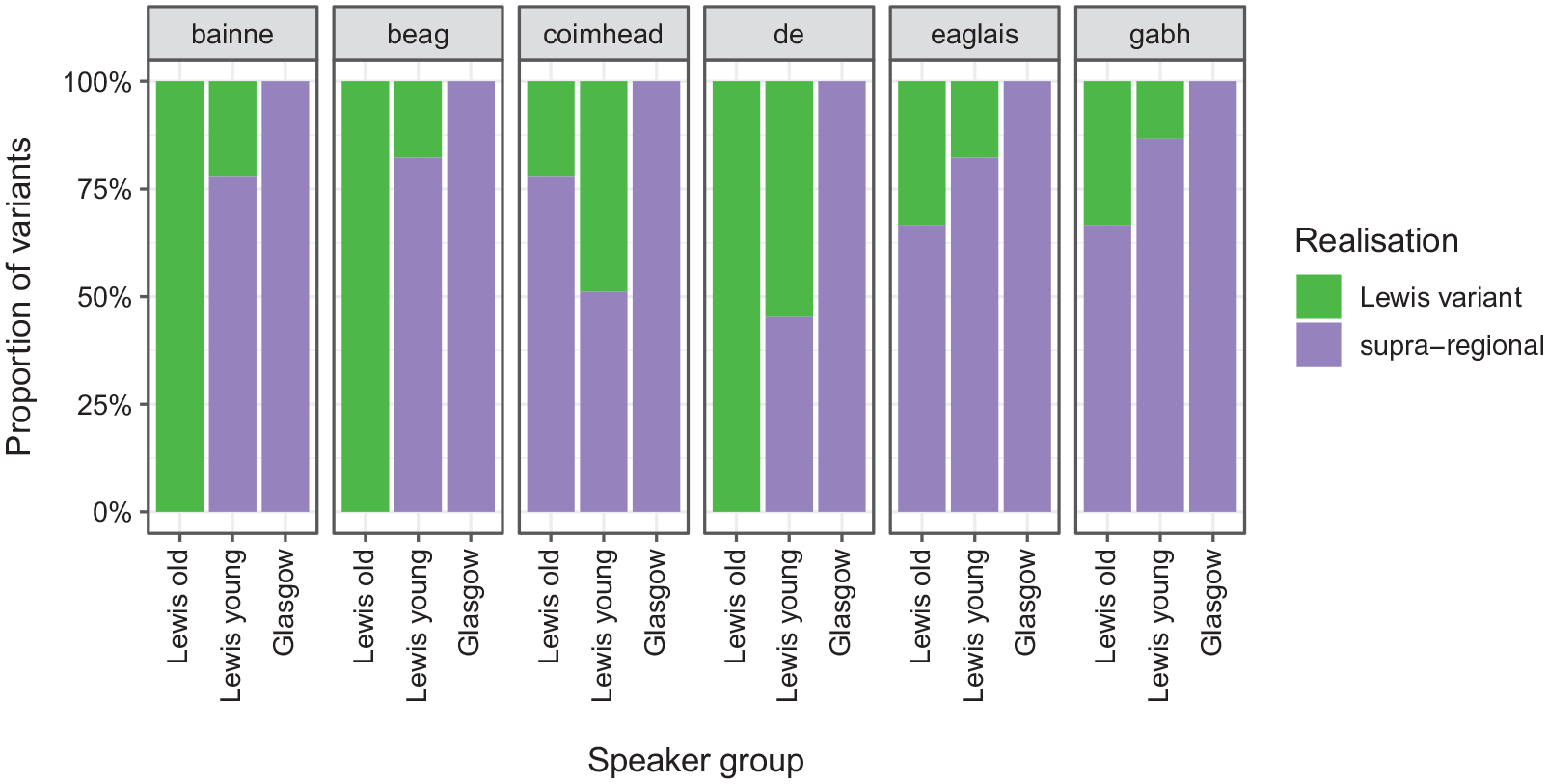
Auditory coding of Lewis dialect stereotypes.
The logistic regression model for the Lewis dialect features included speaker group as an independent variable and word and speaker as random intercepts. The model comparison testing the full model against a model not containing speaker group is shown in Table 5. There is a significant effect of speaker group, and visual analysis of Figure 10 shows that older Lewis speakers are producing the Lewis pronunciation in 100% of half of the words, and high rates in others. This is not the case among either group of young speakers. The Glasgow speakers do not produce Lewis dialect features at all.
Model comparison testing production of Lewis dialect shibboleths.

Separate modelling was carried out on the young speakers to test the effects of gender and having one Gaelic-speaking parent. The full model included speaker group (Lewis younger, Glasgow young), gender (male, female) and having a Gaelic-speaking parent or not as well as random intercepts for word and speaker. Model comparisons yielded no significant results.
Qualitative analysis
The qualitative analysis focuses on the young people in Glasgow as a locus of Gaelic revitalisation in new geographical spaces, and potential perceived lack of an ‘authentic’ local dialect. Each young person was asked about their attitudes to Lewis Gaelic, and whether they themselves thought that they had an accent. In terms of attitudes to Lewis Gaelic specifically, a major input variety of their teachers, the responses below show all the answers given which diverged from answers similar to ‘I don’t know’ or ‘different’.
Tha e quite like strong Gàidhlig. Like pronunciation uabhasach làidir. It’s quite like strong Gaelic. Like strong pronunciation.
Tha e mar like like a granny voice! No tha e well, tha e diofraichte. Like mar really polite. It’s like like a granny voice! No it’s well, it’s different. Like really polite.
Well tha iad gu math slaodach. Well they are quite slow.
Tha mar Leòdhas tha iadsan diofraichte. The best. The right one! Like Lewis they’re a bit different. The best. The right one!
Students were asked about the Lewis dialect specifically as it was the traditional dialect of the majority of their teachers and has substantial exposure in the media. In Extract 1 Tara suggests that Lewis dialect sound ‘strong’, presumably substantially different from her own way of speaking. Extracts 2 and 3 show associations with older speakers referring to the way of speaking in Lewis as a ‘granny voice’ or ‘slow’. Finally, Sophie has very positive associations with the dialect. Sophie’s mother is from Lewis and works in Gaelic language media, so Sophie is very familiar with the dialect and has multiple family connections in Lewis. In this extract, Sophie might be displaying her loyalty to a variety so closely connected to her family.
In terms of their own Gaelic production, Extract 1 suggests that young people consider their Gaelic different to traditional dialects. This is made more specific in Extracts 5 and 6 which show responses to a follow-up question about the pupils’ accents specifically:
Tha mar like na tidsearan tha na accents acasan diofraichte chionns gu bheil iadsan a’ tighinn bho suas bho na h-Eileanan ach mar tha na accents aig mar like na sgoilearan diofraichte chionns gu bheil sinne bho like Glaschu agus àitichean sìos an seo.
Like the teachers they have different accents because they’re from up [there] from the Islands. But like the pupils’ accents they’re like different because we’re from Glasgow and places down here.
Tha mi dìreach a’ smaointinn gu bheil mi a’ bruidhinn mar ann am Beurla ach ann an Gàidhlig. I just think I speak like [I do] in English, but in Gaelic.
Tara shows awareness that her Gaelic is very different to a traditional island dialect. She locates a way of speaking to a specific geography and clearly indicates that it is expected for young people in Glasgow to sound like they are from the city. Vicky also expresses this opinion suggesting that her Glaswegian English accent will be evident when she speaks Gaelic. The relevance of these findings to questions of localness and authenticity are discussed below.
Results summary
To summarise, the quantitative results show differences between older speakers in Lewis, younger speakers in Lewis, and young people in Glasgow. Specifically, older speakers show the longest duration of voiceless pre-aspiration, young Lewis and Glasgow speakers the shortest. Conversely, young Lewis speakers show the greatest distinction in duration between phonemically long and short vowels. Neither group of younger speakers produced a large number of nasalised vowels in comparison to the older Lewis speakers, with young Glasgow speakers producing the least. Young male speakers produced more nasal vowels than young female speakers. Young speakers in Glasgow produced none of the Lewis dialect shibboleths, and young speakers in Lewis produced significantly fewer than older speakers. In terms of the qualitative analysis, young speakers in Glasgow expressed few overt attitudes towards traditional dialects, but when they did it generally appears that Lewis dialect is associated with older people. In terms of their own accent, their overt attitudes suggest that their Gaelic is Glasgow-accented and associated with their geographical location.
Discussion
Production of Gaelic phonology in the context of language revitalisation
In this section, we focus on the results from the first three quantitative analyses of pre-aspiration, vowel length, and nasal vowels. From previous work in minority languages and a range of bilingual speakers (Amengual, 2017; Dorian, 1981; Flege, 2007; Jones, 1998), it might be predicted that the Lewis young speakers would produce output closer to the traditional older speakers due to geographical proximity and greater community input. This appears to be the case in terms of vowel nasalisation where Lewis older speakers produced the most, and Glasgow younger speakers the least. The nasal vowel contrast is, at most, marginally phonemic as described above and in Nance and Ó Maolalaigh (2021). It may well be the case that vowel nasalisation is now acquired on specific lexemes and these have been transmitted via the community in Lewis, but less so in the GME context of Glasgow.
However, the straightforward prediction of most traditional production in Lewis older speakers to least traditional production in Glasgow young people is not the case in the pre-aspiration and vowel length results. Younger speakers in general produce less pre-aspiration than older speakers, mirroring results from Nance and Stuart-Smith (2013). However, all young speakers produced some voiceless pre-aspiration (Figure 2). In terms of phonemic vowel length, Lewis younger speakers produced the greatest durational distinction between long and short vowels of all the speaker groups. As a potential explanation, we suggest that these effects may be due to the context of Gaelic being largely acquired in an educational setting. Both voiceless pre-aspiration and phonemic vowel length contrasts are evident in orthography, unlike vowel nasalisation. It may be the case that in the context of the word list reading task, overtly taught elements of reading may have come to the forefront. These results support the work of, for example, Cutler (2015) who discusses how sequential bilinguals use general learning strategies such as literacy to aid in acquiring their new language, unlike L1 acquisition.
The vowel length results appear to show that older speakers do not make much of a distinction between phonemically long and short vowels. This result should be interpreted with caution: it may be the case that this small snapshot of older speakers’ speech was not large enough to capture differences. It may also be the case that, for older speakers, vowel length is instead realised with vowel quality differences as well as duration (which were not measured here). A final possibility is that for older speakers, vowel length may interact with word- and sentence-level prosody in a way which is not captured here, and previous work has shown that older and younger generations in Lewis do indeed have quite different prosodic systems (Nance, 2015b).
Another notable finding here is the non-significant effect of having a Gaelic-speaking parent in all of the quantitative analyses. We used (at least) one parent with whom Gaelic was used as a proxy for higher amount of Gaelic in the home. While we have only considered a limited number of phonological variables, these results may support recent findings from minority language settings which suggest that in the context of immersion education or systems such as GME, pupils from minority language households may instead begin to sound more like their classmates than their minority language speaking parents (Mayr et al., 2017; Nance, 2020). We suggest that these results may be in keeping with sociolinguistic work on adolescence which suggests that young people engage in social practices which lead them to sound like one another (Kirkham & Moore, 2013). We found one difference for gender among the younger speakers: male young speakers produced significantly more nasal vowels than female speakers. This finding warrants further investigation in future work. Intuitively, we might suggest that vowel nasality is associated with traditional male pursuits such as crofting (small-scale farming) and fishing so may form part of a male style. In the current data set, we do not have data from male older speakers to confirm this, but it would be interesting to investigate further in the future.
Production of traditional dialect features
In this section, we discuss the results of the fourth quantitative analysis looking at the production of Lewis dialect shibboleths. Lewis dialect was chosen as it represented the majority of traditional dialect input for students at the Glasgow school, as well as being the local dialect of young speakers in Lewis. The results from this study suggest that younger speakers in GME settings do not consistently reproduce shibboleths of the Lewis dialect. In the case of Glasgow young speakers, they did not reproduce any Lewis features in the words tested even though they receive dialectal input from teachers. There are two possible sources for this result. First, it is likely to be the case that dialect levelling is happening in the Gaelic context among young speakers due to Gaelic socialisation happening in an institutional setting and semi-formal register (Jones, 1998; Will, 2012). Second, these data were collected from a word list context which may have a tendency to elicit more supra-regional and fewer local forms than other settings (Labov, 1972). The younger speakers may have had more of a tendency to produce supra-regional forms as they were more acquainted with formal use of non-local Gaelic in educational and word list-style settings, compared with the older generation. Indeed, Will (2012, p. 124) notes that primary-aged GME pupils were unfamiliar with non-local dialectal Gaelic and found it hard to understand.
The results of the current study have important implications for language revitalisation. Here and elsewhere (Lamb, 2011; Nance, 2015a), results suggest that exposing pupils to a traditional dialect in a school setting may not result in them reproducing that dialect in their own productions. The welcome increase of Gaelic in ‘High’ contexts (Fishman, 1991) due to revitalisation has resulted in increased exposure to different varieties and increased mobility of speakers. Such an effect is common in non-minority language communities, see for example extensive work on dialect contact such as (Kerswill, 2003; Labov, 2007). As revitalisation programmes progress across the world, dialect levelling is a likely and expected outcome.
Another clear aspect of young people’s speech which is not discussed in detail here is the quantity of code-switching in the extracts presented. We did not find these extracts out of keeping with the rest of the connected speech from the interviews, but, impressionistically, we would say that the quantity of code-switching among younger speakers was somewhat higher than from the older speakers interviewed. Previous work has demonstrated that code-switching is a natural part of fluent Gaelic-English bilingual speech among adults (Dunmore & Smith-Christmas, 2015), so it may be the case that our older participants interpreted the context of a ‘Gaelic interview’ differently to young people and reduced their rate of code-switching for the interview setting. Or, it may be the case that young speakers do code-switch at a higher rate or use code-switching differently. Examining this in detail is beyond the scope of this paper but would be a useful future study.
Place identity and authenticity in revitalisation contexts
While dialect levelling as discussed above has little implications for the authority of a majority language such as English or Spanish in Spain, dialect features may be more important for minority languages (Woolard, 2008). As demonstrated above, new speakers in urban locations do not simply acquire a dialectal model provided by teachers or traditional speakers they encounter. We argue that this tendency is due to two reasons: first, as bilingual speakers it is expected that there is some cross-linguistic influence between the speakers’ two linguistic systems (Flege, 2007). But second, speakers are social agents who use language to portray identity affiliations. Previous work on minority language bilinguals has shown that speakers are able to manipulate linguistic variation in an agentive manner (Nance et al., 2016; Tomé Lourido & Evans, 2019). Considering the identity practices of new speakers is, we argue, crucial to understanding the use of language in context. In taking such a Type 3 approach to variation in new speakers (Nance et al., 2016), we are able to explain why young speakers in Glasgow do not repeat the language input they are exposed to. The qualitative data above suggest that young people, if they have an overt attitude to Lewis Gaelic, associate the dialect with older speakers, that is, a ‘granny voice’. This is clearly not a suitable or relevant model of language use for an urban adolescent and it may be the case that young Glaswegians instead feel a sense of pride in their own Glasgow-influenced pronunciation and avoid dialectal forms with which they do not identify. Also, as noted above, 18 out of 22 young Glasgow speakers did not express an overt attitude to Lewis Gaelic. It might be the case that dialectal Gaelic is an irrelevant factor in their language use and something with which they have no reason to identify.
The ideology of authenticity outlined in Woolard (2008), Bucholtz (2003) and O’Rourke and Ramallo (2013) would suggest that young people in Glasgow have to negotiate a compromise between their lowland selves and Gaelic’s authority of authenticity associated with highland and island areas. However, what we see in these data is either a lack of awareness of their own variety or an acceptance that their variety is Glaswegian. In Extract 5, Tara refers to her accent as ‘diofraichte’ different and ‘bho like Glaschu’ [sic] from like Glasgow. Such attitudes may be present due to the intense involvement of young people at the Glasgow school with Gaelic media. Most of the students in this study had already been interviewed on Gaelic radio and television multiple times and were confident in their language variety and ability to express themselves in media outlets. This implied value given to their language use may have been immensely valuable in promoting confident use of Gaelic. 3 Young speakers in Glasgow (and also in Lewis) do not show production differences according to their home language background. In a purely exposure-oriented model of bilingual production, this finding is unexpected as we would assume that increased exposure to Gaelic would result in more traditional-like productions. Here, instead we find that the homogenising effect of using a language together in a school setting can override home language differences.
These findings from the adolescents presented here have implications for minority language revitalisation strategy. While research such as Woolard (2008) predicts tension and a difficult negotiation of value to a new variety due to a lack of perceived authenticity, this was not necessarily the case among young speakers from Glasgow. The analysis above suggests that the opportunities afforded by revitalisation strategies such as high levels of media exposure to different varieties provides a system for creating new authenticities in new locations. While research among adults suggests that the attitudes expressed here may not yet persist as these young people leave the school setting, the data here show that confidence and new identities can emerge from revitalisation in an appropriate setting. With the current expansion of the GME programme in lowland Scotland, new Gaelic identities and authenticities will continue to become normalised.
Conclusions
This paper considers the linguistic productions of young new speakers and the relevance of these to local place identity and authenticity. We demonstrate that young new speakers do reproduce aspects of Gaelic’s phonology, though generally to a lesser extent than older traditional speakers. We argue that this may be due to the effects of being a bilingual speaker but also Gaelic’s status as a minority endangered language undergoing revitalisation. Production effects are modulated by possible effects of orthography due to the educational context of bilingualism: young speakers demonstrated clear evidence of contrasts which are recognised in orthography (vowel length, pre-aspiration) in comparison to vowel nasalisation which is not reliably shown orthographically. Quantitative analysis shows that young people do not reproduce dialect shibboleths of their local community (for Lewis young speakers) or the dialect to which they are most exposed (for young Glasgow speakers). While previous research suggests that non-traditional varieties may lack authority due to a perceived lack of authenticity, we argue that young new speakers in Glasgow reject traditional dialect models in favour of creating new authenticities in new location for Gaelic.
Our findings have several implications for minority language revitalisation programmes: first, we suggest that the effects of widespread immersion education programmes, increased mobility, and exposure to multiple varieties are welcomed and necessary for revitalisation. However, such effects and programmes can be expected to have implications for local dialects as revitalisation continues. While very local vernaculars may be levelled (Lamb, 2011), Gaelic is expanding to new areas and widespread acquisition of Gaelic in lowland Scotland could lead to new varieties emerging. Second, we argue that the opportunities afforded by language revitalisation, such as extensive experience in the media, have given young people in Glasgow confidence in their own language use and an acceptance that they may sound different, but their variety can still have authority. We suggest that such programmes may be a solution to the conundrum presented in Woolard (2008): new varieties from new speakers can create new authenticities when given sufficient opportunity.
Footnotes
Appendix 1
Word list used for the quantitative analysis.
| Analysis | Word | Expected production (IPA) | English |
|---|---|---|---|
| Word-medial | ca |
hp | mare |
| pre-aspiration | ta |
hp | thank (you) |
| ba |
ht̪ | stick | |
| no |
ht̪ | pound | |
| so |
hk | quiet | |
| a |
hk | at them | |
| sa |
p | fight | |
| sgio |
p | team | |
| bo |
t̪ | old man | |
| ma |
t̪ | morning | |
| fà |
k | leaving | |
| to |
k | lifting | |
| Vowel length | b |
i | will be |
| ch |
iː | will see | |
| d |
u | black | |
| b |
uː | shop | |
| g |
a or o | take | |
| s |
aː | saw | |
| t |
o | lifting | |
| s |
oː | sofa | |
| Vowel nasalisation | c |
ũ or ə̃ĩ | watching |
| cr |
ɯ̃ː | tree | |
| D |
õː | Donald | |
| mh |
ã | son (mutated) | |
| mh |
ũ | pig (mutated) | |
| s |
ãː | calm | |
| ũã | terrible | ||
| Lewis shibboleths | b |
ɔ in Lewis, a or ɛ elsewhere | milk |
| b |
ø in Lewis, e elsewhere | small | |
| c |
ũ in Lewis, ə̃ĩ elsewhere | watching | |
| t̪ in Lewis, tʃ or tɕ elsewhere | what | ||
| ø in Lewis, e elsewhere | church | ||
| g |
o in Lewis, a elsewhere | take |
Note. The sound investigated is shown in bold.
Acknowledgements
Mòran taing Gaelic to the wonderful participants in this research and to the two schools who facilitated data collection. This research was funded by a Lord Kelvin and Adam Smith PhD studentship awarded to the first author, and an undergraduate research internship at the Department of Linguistics and English Language, Lancaster University, completed by the second author. Thank you to the editors of this special issue for their helpful comments and careful reading of the manuscript. Many thanks to the anonymous reviewers for such constructive feedback.
Declaration of conflicting interests
The author(s) declared no potential conflicts of interest with respect to the research, authorship, and/or publication of this article.
Funding
The author(s) received no financial support for the research, authorship, and/or publication of this article.
