




Abstract
Aim and objectives/purpose/research questions:
The aim of this study is to examine the pragmatic function of utterance-level declination as used in conversations in French and Norwegian by 10 migrants from the Democratic Republic of Congo (DRC) living in Norway whose repertoires are highly multilingual.
Design/methodology/approach:
To investigate this contour, we draw on insights from different fields, that is, research on multilingualism, Conversation Analysis (CA), and phonetics/phonology.
Data and analysis:
By an automatic procedure, we examined pitch variations of 400 declarative utterances (200 in Norwegian and 200 in French). The procedure found that 38 of the utterances have declination. These were then analyzed qualitatively with methods from CA in the context of the sequence. The aim of the CA was to assess the pragmatic functions of the contour.
Findings/conclusions:
We found that utterance-level declination is a marked contour, that is, used to make certain utterances prominent in relation to other utterances of the sequence. The contour has the same functions in French and Norwegian for these speakers. Our conclusion is that the contour is a flexible resource of the speakers’ repertoires.
Originality and significance/implications:
This study is a contribution to the scarcely explored area of the prosody-pragmatics interface in speakers with varied linguistic repertoires. Moreover, our approach is emic and inspired by recent trends in the field of multilingualism.
Introduction
One of the main achievements of recent research on multilingualism, often inspired by perspectives from the Global South (Canagarajah, 2012; Pennycook & Makoni, 2019), is that it forces scholars to study multilingual repertoires in their own right (Ag & Jørgensen, 2013; Blommaert, 2010; Blommaert & Backus, 2013; Wei, 2018). This implies placing the fact that speakers in real-world interaction tend to “flexibly combine linguistic features of whatever pedigree” (Jaspers & Madsen, 2019) at the very core of linguistic investigations. Moreover, it entails a shift from an approach in which the researcher categorizes and orders resources (e.g., as belonging to a first, second, or third language) to an approach where speakers’ synchronic deployment of resources for communicative purposes is the object of study.
In this article, we draw on these insights to study the prosody-pragmatics interface in speakers with highly multilingual repertoires. We are concerned with talk-in-interaction as produced by 10 migrants from the Democratic Republic of Congo (DRC) living in Norway, who have learned and used a wide range of languages across the lifespan. All the participants use an intonation contour we refer to as utterance-level declination in some, but not all, declarative utterances in two different one-to-one conversations, in which respectively French and Norwegian are the main languages. Drawing on the methodology from Conversation Analysis (CA; Sidnell & Stivers, 2013) in conjunction with phonological insights and phonetic analysis, we aim at understanding the pragmatic meaning the speakers associate with this contour. We find that it is marked, that is, used in declarative utterances which for various reasons are designed to stand out from the other utterances of the sequence. Moreover, our analysis shows that the contour is translingual, that is, it has similar pragmatic functions whether the language of the conversation is French or Norwegian.
Background
The pragmatic functions of prosody
Prosody, and in particular intonation, has various pragmatic functions in language (Schegloff, 1998), such as marking focus (Hirschberg, 2004), distinguishing between utterance types and speech acts (Hirschberg, 2004), constructing multi-unit turns (Couper-Kuhlen, 2011; Ogden, 2012; Schegloff, 1998), organizing sequences (Couper-Kuhlen, 2011), repairing (Couper-Kuhlen, 2011), communicating stance and alignment (e.g., agreement and disagreement; Nielsen & Morris, 2019; Ogden, 2006), and expressing emotions (Couper-Kuhlen & Selting, 1996; Ogden, 2006). The body of research on the prosody-pragmatics interface is important, but the large majority of studies is based on data from English or discuss general theoretical questions. As regards the pragmatic use of prosody by speakers with multilingual repertoires, there are a few studies. The bulk is conducted within the field of second language acquisition (see Kang & Kermad, 2019 for an overview). Most of these studies find that while expressing themselves in a weaker language, speakers draw on prosodic resources from their dominant language. For instance, speakers of Mexican Spanish use a contour from Mexican Spanish in polar questions in French (Santiago & Delais-Roussarie, 2015) and an East Norwegian contour is used to express finality in both French and English by speakers of East Norwegian (Steien & Lyche, 2016). Moreover, studies of language contact show that prosodic resources from adstrates are frequently found in contact varieties (see Steien & Yakpo, 2020 for a review). Examples are the contours of polar questions in Malay English and Corsican French which originate from Malay (Gut & Pillai, 2014) and Corsican (de Mareüil et al., 2015), respectively. In a recent study, Kozminska (2019) examines the prosody in a migration context, that is, Polish migrants in England. She finds that participants in her study deploy a rare intonation contour of Polish when expressing themselves in English and analyzes the use of this contour as a way to negotiate cosmopolitan identities.
Seen all together, the few studies on the prosody-pragmatics interface concerned with speakers whose repertoires are multilingual indicate that prosodic resources tend to be used flexibly across languages to convey pragmatic meanings.
Previous studies of prosody in Congolese migrants in Norway
Previous studies have shown that the tonal grammars of the speakers in this study are language-specific. When expressing themselves in French, they segment the speech flow in Accentual Phrases (AP; Jun & Fougeron, 2002) which are marked by one, and only one, high tonal target, occurring systematically on the final syllable (/LH*/; Steien & Nimbona, 2018). In Norwegian, their tonal grammar corresponds to the East Norwegian norm: Each AP has one of the two lexical pitch accents (/L*H/ or /H*LH/; Steien & van Dommelen, 2018). However, the phonetic implementation of contours is rather speaker-specific. At the level of the utterance, each speaker operates within a given pitch range and height independently of the language of the interaction (Jensen & Steien, 2017). Moreover, a previous study showed that all the speakers produce a peculiar falling intonation contour across some declarative utterances (Jensen & Steien, 2017) in both French and Norwegian. We refer to this contour as utterance-level declination. The fact that it is optional in both languages and not dependent on utterance type motivated the hypothesis that it is associated with specific pragmatic meanings.
Utterance-level declination
Utterance-level declination is a downtrend, an umbrella term referring to falling intonation contours in parts of or across utterances (Downing & Rialland, 2016b). Downtrends are cross-linguistically common but apply to different domains (phrases or utterances) and might be of different nature. Three types of downtrends are often distinguished, downstep, downdrift, and declination (Connell, 2001; Downing & Rialland, 2016b; Gussenhoven, 2004). Downstep and downdrift result in the interaction of tones; the first phenomenon is the lowering of a H tone due to phonological processes, while the second is the lowering of a H tone following a L tone. Declination, however, is not related to tonal grammar, but is “the gradual, time-dependent downsloping of the fundamental frequency across points that might be expected to be equal” (Gussenhoven, 2004, p. 39).
In the literature on Standard European French and East Norwegian prosody utterance-level declination is not mentioned. Downtrends occur only at the level of the smaller prosodic constituents. Standard European French has downstepped H tones at the right edge of utterance-final APs (D’Imperio & Michelas, 2014; Delais-Roussarie et al., 2015), while East Norwegian has declination in post-focal APs (Fretheim & Nilsen, 1989; Hognestad, 2009; Kristoffersen, 2000). By contrast, downtrends are frequent at the utterance-level (in particular, in declaratives) in several African Bantu languages (Downing & Rialland, 2016a), the language family which comprises the majority of the languages in the linguistic ecologies of the DRC. Utterance-level downtrends have also been attested in some of the languages of the repertoires of the speakers in this study, such as Lingala (Clements, 1979) and Swahili (Maw & Kelly, 1975). Some Afro-European contact varieties, namely French spoken in Burundi (Nimbona & Simon, 2016) and Spanish spoken in Equatorial Guinea (Steien & Yakpo, 2020) also exhibit utterance-level downtrends.
Given the absence of downtrends at the utterance-level in Standard European French and East Norwegian and their presence in Bantu languages, we might hypothesize that the speakers integrated utterance-level declination in their repertoires in the linguistic ecologies of the DRC. At the same time, because of the complexity of these ecologies and of the linguistic biographies of the speakers, tracing it back to a given language would be to overlook sociolinguistic realities. Our approach is synchronic, that is, we treat utterance-level declination as one of the resources of the speakers’ repertoires that they draw on to achieve communicative goals.
Data and methods
This study is part of a larger project on multilingualism among Congolese migrants in Norway (see Steien & van Dommelen, 2018). The data were mainly collected in 2013–2014 and consist of recordings of qualitative interviews designed to elicit the speakers’ linguistic autobiographies (Nekvapil, 2003; Pavlenko, 2007) and of spontaneous conversations in French and Norwegian.
The participants’ linguistic repertoires
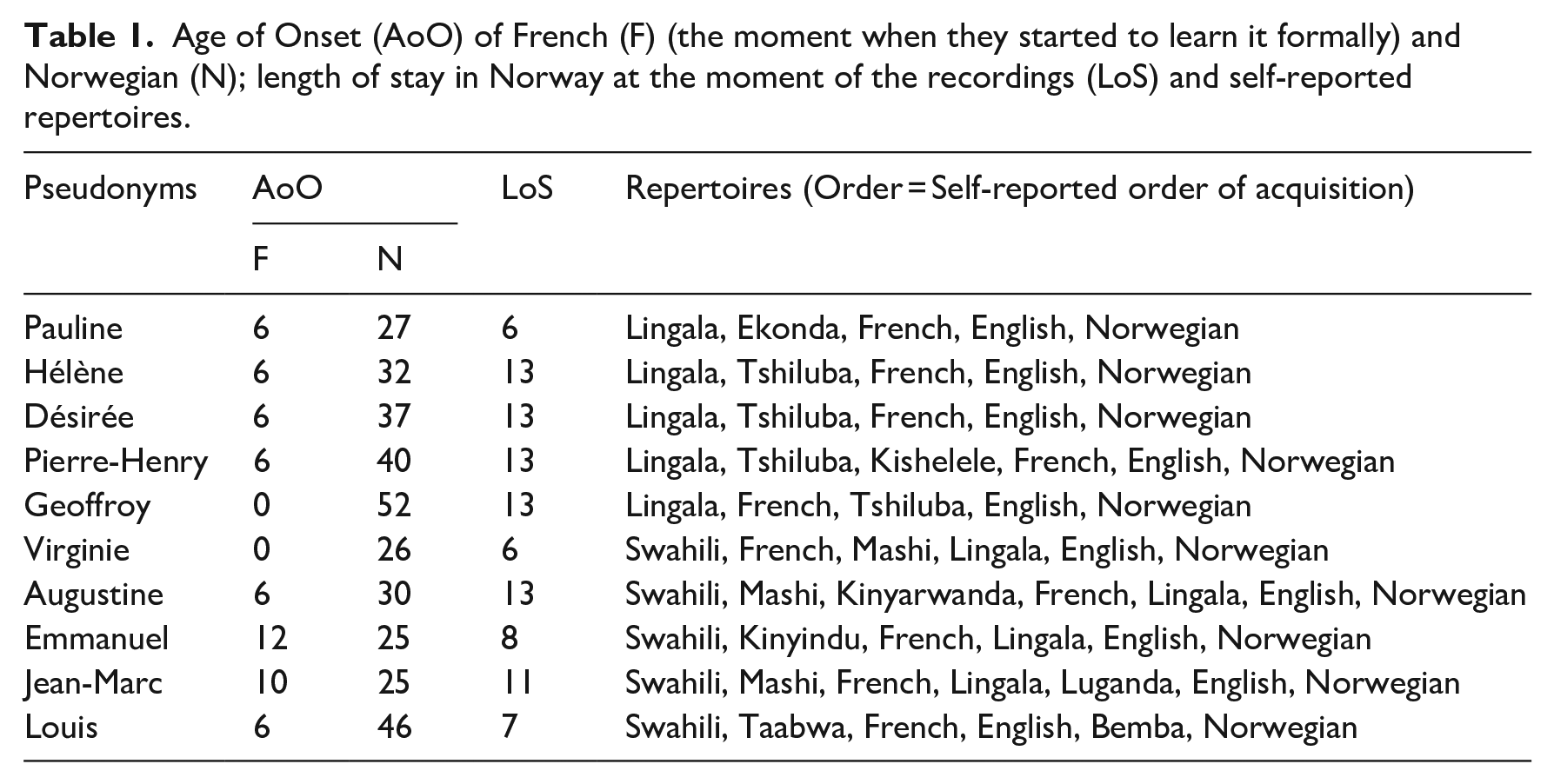
In this study, we focus on 10 participants. Analysis of their narrated linguistic autobiographies enables some generalizations about their linguistic backgrounds: Their first language socialization took place in multilingual ecologies of Congolese cities (Kinshasa, Lubumbashi or Bukavu). From childhood on, they learned Congolese lingua francas such as Lingala or Swahili as well as one or more smaller Congolese languages at the same time as being exposed to myriads of linguistic features of different origins. French, the official language of the DRC, was also present in the ecologies, and in addition, they received tuition solely in French from a certain point of their education. English was a school subject in DRC, but they have rarely used it in interactions outside the context of formal instruction, also after migrating to Norway. Some have lived several places in the DRC or in other African countries and learned language there. All of them migrated to Norway as adults, where they learned East Norwegian through both formal instruction and everyday interactions. Their self-reported linguistic repertoires are given in Table 1.
Age of Onset (AoO) of French (F) (the moment when they started to learn it formally) and Norwegian (N); length of stay in Norway at the moment of the recordings (LoS) and self-reported repertoires.
Data collection and preparation
Each participant was recorded while participating in two one-to-one conversations with different interlocutors (two research assistants). Each conversation was set up to elicit the deployment of only one of the languages, either French or Norwegian. Note that the labels “French” and “Norwegian” mainly refer to vocabulary in our use here as our departure point is that speakers with multilingual repertoires are likely to draw on resources of diverse origin in any context (Jaspers & Madsen, 2019). The French-speaking research assistant, Sandra, grew up in Paris and speaks Standard European French. Her variety of French exhibits phonological differences from the Congolese varieties spoken by the participants, which might have led to mutual linguistic adaptations. We have not studied such adaptations in detail, but as we will see, they do not seem to concern our object of study, that is, the participants’ deployment of utterance-level declination. The other research assistant, Irene, grew up in Eastern Norway and speaks East Norwegian, which was the target norm when the participants first learned Norwegian. As they all live in Eastern Norway, it is also the most frequently spoken variety in their daily environment. In addition, the research assistants and the participants share English, but it is a weaker language for all of them and is not present in the conversations.
To enhance the ecological validity of the data, we chose the location and the topic of the conversations with the aim of creating a relaxed atmosphere. The conversations took place in the participants’ homes, a safe space for them. The research assistants were instructed to ask the participants about their lives in the DRC, differences between the DRC and Norway and their experiences as refugees, and to let the conversations flow naturally once they had found a topic of interest. Each conversation lasted for about half an hour. For the study of prosodic features, we selected 5 minutes of each conversation according to the following two criteria: (1) the acoustic quality of the excerpt and (2) the fluency of the interactions. The excerpts were transcribed orthographically with Praat (Boersma & Weenink, 2018) and segmented into utterances, words, and syllables. The segmentations were aligned with the Praat spectrograms.
For analysis of utterance-level prosody, we segmented the speech flow in utterances taking into account prosodic, syntactic, pragmatic, and practical criteria. The procedure was developed as a heuristic approach to single out utterances which are suitable for such analysis. It consisted of the following five steps: (1) We identified intra-pausal segments, that is, stretches of speech delimited by a pause on each side (Chafe, 1994, pp. 53–70); (2) we examined their syntactic properties and included segments which correspond to an independent clause (i.e., the t-unit, cf. Hunt, 1965) as well as those which are not full t-units but function as complete pragmatic units (e.g., subclauses, infinitive phrases, noun phrases, or preposition phrases); (3) we excluded segments containing more than one t-unit; (4) we excluded segments which were too short for the purpose of analysis of utterance intonation; and (5) we identified utterance types and excluded imperatives and questions.
Based on these criteria, we selected 20 suitable declarative utterances for each language for each speaker, a total of 400 utterances.
Identification of utterances with declination
An automatic procedure was then used to single out utterances with declination. Inspired by Gussenhoven (2004, see above), we developed the procedure based on the following phonetic definition of declination: a monotonically falling tendency of the pitch contour peaks throughout the utterance. The procedure consists of three steps.
First, acoustic measures of pitch were extracted by Praat, using the default setting of 10 milliseconds (ms) as the sampling rate, yielding 100 readings of pitch per second. Hertz values (Hz) for frequency were converted to semitones above 100 Hz.
Second, pitch peaks of each utterance were detected. Since peaks tend to be associated with syllables (Goldsmith, 1976), there is a certain minimum distance between them. Based on the average syllable length in the data (200 ms), two alternative sets of criteria were used to single out peaks. In the first set of criteria, a peak is a point on the contour having a higher pitch than any other contour point within a band of 200 ms on either side. In utterances with a sharply declining contour, however, the falling slope of a previous peak might “overshadow” the following peak by coming closer than 200 ms, even though the peaks themselves are more than 200 ms apart. In the second set of criteria, we therefore narrowed the band to 70 ms on the left-hand side but kept the 200 ms width on the right-hand side. Figure 1(b) and (c) demonstrate diverging results of the two sets of criteria.
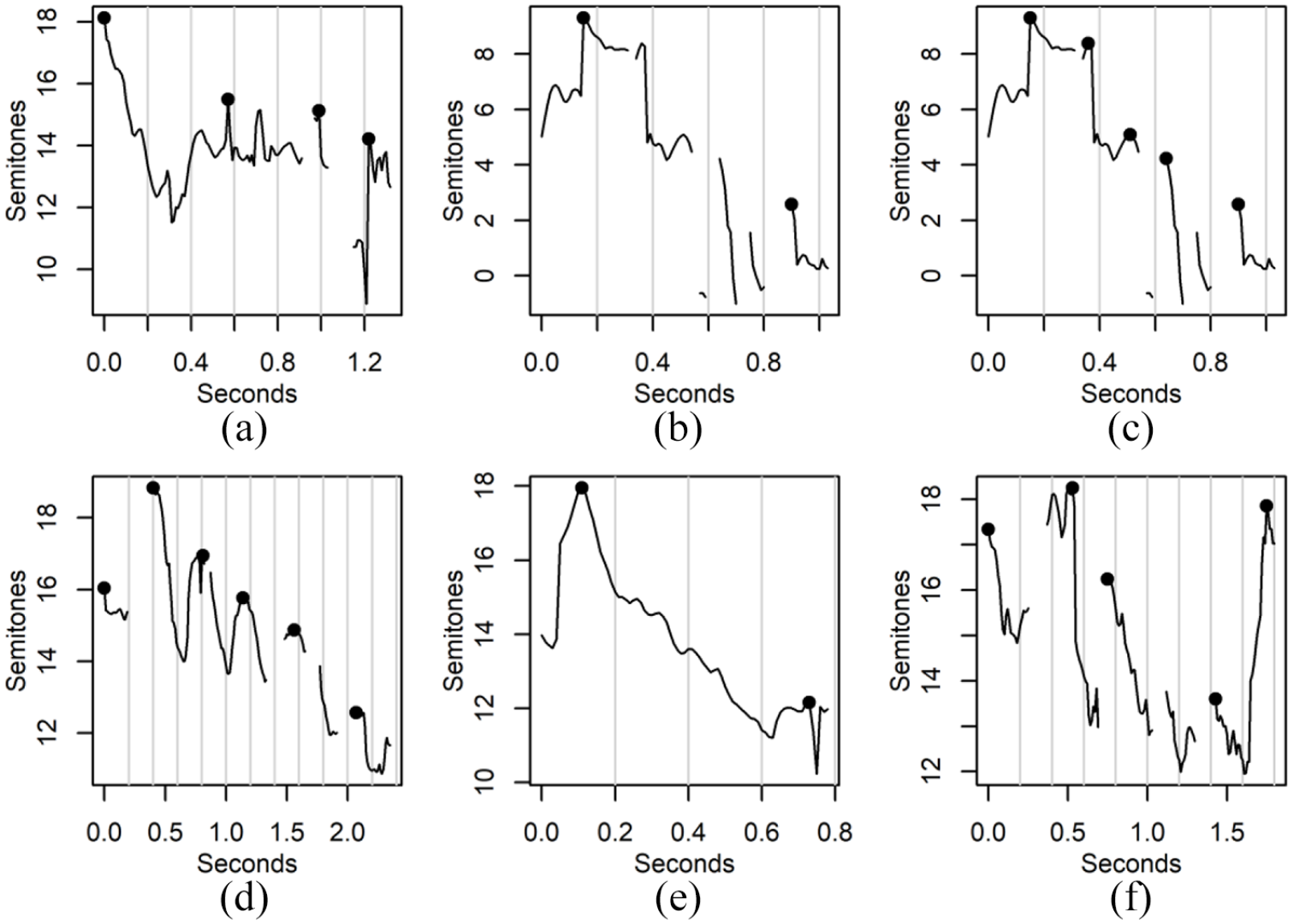
Pitch intonation contours illustrating different features. Real pitch peaks are marked by dots: (a) Declining contour with obvious local fluctuations which are not counted as real contour peaks, (b) contour with only two real peaks picked out by the 200 + 200 ms bandwidth criteria, (c) the same contour with five peaks picked out by the 70 + 200 ms bandwidth criteria and satisfying the criteria for declination, (d) declining contour with leading extrametricality peak, (e) contour with only two real peaks, and (f) contour not satisfying the criteria for utterance declination.
Both these procedures captured some instances of utterance-frontal peaks representing extrametricality and not real contour peaks (see, for instance, Kristoffersen, 2000 for a discussion). To exclude such false peaks from the data, any single leading peaks for which the pitch was lower than the pitch of the following peak were discarded (see example in Figure 1(d)) from the series of peaks.
The procedure hence resulted in two alternative sequences of peaks for each utterance, resulting from either the 200 + 200 ms bandwidth criteria or the 70 + 200 ms bandwidth criteria.
Third, pitch contours with monotonically falling tendencies were identified. If one or both series of peaks for the utterance displayed a monotonically declining tendency, that is, each peak having a higher pitch than the following peak, that utterance was counted as displaying utterance declination. See Figure 1(f) for an example of an utterance without declination and Figure 1(d) for an utterance with declination. Any utterances with fewer than three peaks were excluded from analysis; Figure 1(e) shows a contour displaying a strong falling tendency which was excluded since it includes only two proper peaks.
In all, 38 utterances with declination were identified (23 in French and 15 in Norwegian), and these were analyzed with respect to pragmatic functions. Declination was found in the talk of all the speakers.
Pragmatic analysis
Drawing on CA as a methodology (Sidnell & Stivers, 2013), we analyzed the utterances with declination in their sequential context. Instances of the same action category were included in separate collections, allowing comparative analysis both internally among instances in the collection and externally across collections. Normally in CA, utterances are divided into different types of actions according to the action ascription displayed in the responses to them (Levinson, 2012). However, in this case, there is an important limitation to the application of CA methodology. CA takes an emic perspective, seeking to describe how the interlocutors interpret one another’s utterances. This is conventionally done by analyzing how they respond to the previous turn at talk, and in doing so, display their understanding of it, the so-called next turn proof procedure (Schegloff et al., 1974). Since the recipients had a different linguistic background and thus did not have the specific intonation contour in their repertoire, they could not necessarily draw on a conventional meaning associated with the contour in interpreting the utterance. Thus, the analysis of the recipients’ responses was complemented by an analysis of the features of the utterances themselves in trying to discern a common pragmatic function.
The pragmatic meaning of utterance-level declination
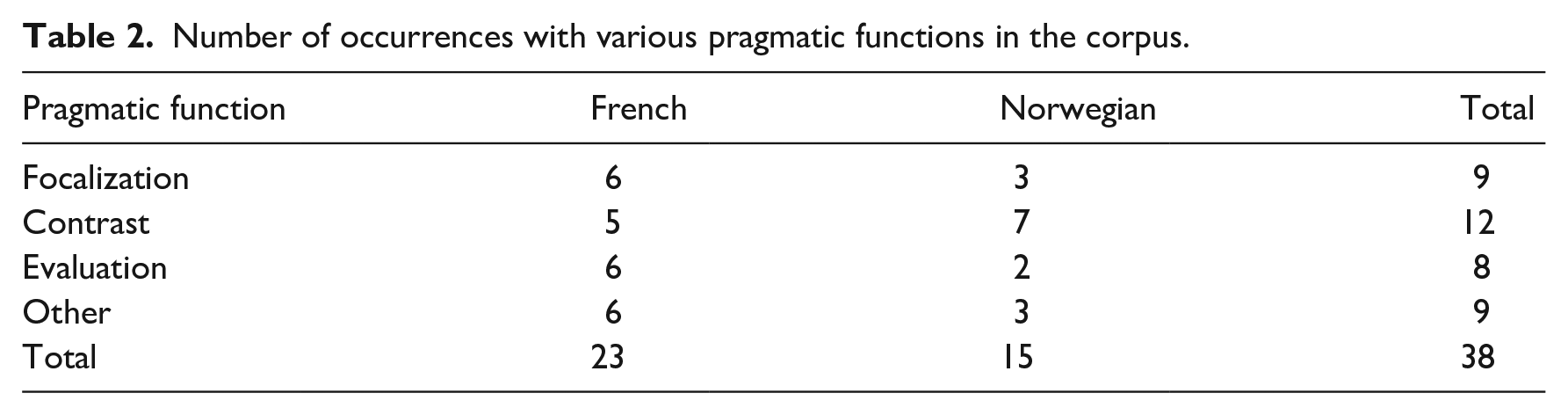
The total of 38 utterances identified constituted complete pragmatic actions and could be analyzed for pragmatic function. The following three pragmatic functions were identified: (1) focalization, (2) contrast, and (3) evaluation. These categories are presented and exemplified in the analysis section below. Nine utterances did not fall into any of these categories and are left unaccounted for. The distribution of the functions in the data is presented in Table 2, showing that all pragmatic functions are present in both languages. Also, all functions are distributed across several individuals in both languages.
Number of occurrences with various pragmatic functions in the corpus.
Focalization
There are nine occurrences of declination used in utterances with an early constituent as the main informational focus. An example is provided in the following extract in Norwegian, where Désirée is telling her migration story to Irene (see Appendix 1 for transcription conventions).
Excerpt 1
Norwegian (original)
English (translation)
The narrative in lines 2–11 is triggered by the mention of the outbreak of war in line 2. In line 9, we find the conclusion of the narrative, an evaluation making explicit the point of the story (Labov & Waletzky, 1967). Hence, the main point of the narrative is not that the war started, but how sudden it was, as we can see by the repeated evaluation in line 11 and the understanding check by Irene in line 12. In line 9, this main point is located in the first constituent of the utterance (the topic position; med en gang “at once”), rather than in the final part (the comment position). The prominence peak of this early constituent seems to engender the declination intonation on the utterance as a whole.
In Excerpt 2, we find a corresponding use in French. Geoffroy has been complaining about the French president, Francois Hollande, and starts comparing him with the Russian president, Vladimir Putin.
Excerpt 2
French (original)
English (translation)
The utterance in lines 3–7 is a substantiation of the claim in lines 1–2. The point Geoffroy is making is that Putin manages to make people dream by seducing them. Thereby, the new and important information conveyed in line 7 is located in the finite verb séduit (“seduces”). This is further manifested in the repetition of this constituent in the subsequent reinforcing repetition (line 9). This word is emphasized by being produced with emphatic stress. Thus, the falling intonation pattern seems to follow from the high pitch realized on this initial constituent.
Contrast
Another environment where declination is commonly found is when one constituent is contrasted with another. This is primarily attested in certain types of repair, where one constituent is substituted by another. The speakers use prosodic means to contrast the new version with the previous one. In Excerpt 3, we see an example of this, as it is manifested in a case of self-repair in French.
Excerpt 3
French (original)
English (translation)
In Excerpt 3, Pauline produces a self-correction, aborting one way of describing the scarcity of vegetables (“only x”) and substituting it with another (“not many x”). The contrasting element in the second construction (pas “not”) is emphasized by increased pitch height, and the rest of the utterance is produced with declination.
In a similar example in Norwegian, a somewhat longer constituent is substituted, namely a full clause. The extract is from a narrative about Hélène’s work experience in Norway.
Excerpt 4
Norwegian (original)
English (translation)
Here, the clause “while I was on sick leave” is repaired and substituted by a more specific time reference “after nine months of sick leave.” The latter reference adds to the evaluative load of the utterance in that it underlines the extreme character of the event. As such, it contributes to marking it as the dramatic peak of the narrative. However, when the interlocutor does not provide any evaluative response (note the pause in line 7), the speaker herself adds an account that explicates the newsworthiness of the event, namely that in Norway, laying off employees who are on sick leave is illegal.
Contrast may also be marked in relation to what the interlocutor has said, as in the Norwegian example in Excerpt 5.
Excerpt 5
Norwegian (original)
English (translation)
In this sequence, Irene initiates repair in line 3 by producing an understanding check. Her candidate understanding is rejected (line 4) and repair is provided (line 6) in the form of a new version of the utterance. This version substitutes the conjunction før (“before”) by når (“when”), and this element is emphasized by high pitch. The rest of the utterance follows a declining pattern.
Evaluation
Finally, declination commonly occurs in assessments, where speakers explicitly or implicitly evaluate some state of affairs. In Excerpt 6, Louis has told about his migration history and ends by stating that he will most probably stay in Norway for the rest of his life.
Excerpt 6
Norwegian (original)
English (translation)
The assessment in line 5 is introduced as a “problem” with the speaker’s plans. In line 6, it is repeated and upgraded from litt (“a bit”) to veldig vanskelig (“very difficult”). In addition, emphatic stress is placed on the reinforcing adverb. The declination intonation in this assessment thus co-occurs with other upgrading devices, indicating that it contributes to the intensity of the speaker’s emotional involvement.
In a corresponding French example in Excerpt 7, Emmanuel is talking about a visit to Paris and the problems of getting around with a baby carriage.
Excerpt 7
French (original)
English (translation)
In this excerpt, he describes challenges of getting around by subway with a baby carriage and concludes the account by an upgraded assessment. The upgrading is achieved by the exclamation “ah” and the adverb vraiment (“really”). The declination starts with a high-pitch peak on the reinforcing adverb, and thus serves to make the evaluative component salient. So once again, declination seems to be yet another means for adding affective intensity to the assessment (Jefferson, 1978).
Summary and limitations
We have seen that declination tends to occur in utterances in which an early constituent is prominent. A main prosodic cue of prominence is increased pitch height, and this engenders a falling contour in the rest of the utterance, resulting in utterance-level declination. Early constituents are prominent for the following three main reasons: (1) they are focalized, (2) they are contrasted with a previous constituent, or (3) they receive emphatic stress in upgrading the emotional stance expressed in an assessment. In sum, the analysis of utterances in their sequential contexts suggests that utterance-level declination is a marked contour, that is, it is deployed by the speakers to make certain utterances stand out from the other utterances in the sequence.
Some limitations of the pragmatic analysis should be mentioned. Some of the instances, that is, 9 of the 38 utterances, are unaccounted for in terms of pragmatic function. We suspect that some of the functions identified are also relevant in the other excerpts but have not included them as long as the excerpt itself does not provide any manifestations of it. For instance, we argue that one function of declination is to add evaluative intensity to an utterance, and this may be used in a range of contexts, but as long as there is no evidence in the excerpt that the participants orient to such an evaluative meaning, we cannot include it in the collection. In addition, there might be weaknesses in the automatic procedure used to detect utterances with declination.
Conclusion
In this article, we have examined talk-in-interaction in French and Norwegian produced by 10 speakers with highly multilingual repertoires. The speakers are migrants from the DRC in Norway who got their first-language socialization in multilingual ecologies and who have continued to acquire new linguistic resources across their lifespan. In both French and Norwegian, they make use of an intonation contour that we refer to as utterance-level declination. Drawing on conversation analysis, we identified some of the pragmatic functions that the speakers seem to associate with this contour, that is, focalization, contrast and evaluation.
In our analysis, we have been inspired by recent research on multilingualism informed by Southern perspectives, enabling the reconceptualization of multilingual repertoires as sets of communicative resources reflecting individual biographies rather than as consisting of separate and more or less fully acquired languages (e.g., Blommaert, 2010; Blommaert & Backus, 2013). From a diachronic perspective, we might suggest that the speakers integrated utterance-level declination in their repertoires in the linguistic ecologies of the DRC as it is present in several Bantu languages, but absent in Standard European French and East Norwegian. However, searching for the origin of the contour and/or discussing its functions in other languages would not necessarily inform us about the speakers’ synchronic deployment of it in the real-world conversations we have examined. Categorizing multilingual speakers’ resources with respect to their origin (as belonging to a first, second, third language, etc.), is in our view an etic endeavor that might fail to treat speakers’ repertoires in their own right, that is, as a set of communicative resources deployed synchronically to make meaning.
Obviously, speakers with multilingual repertoires do not draw on all their resources in all communicative contexts. Vocabulary is, for instance, a candidate for variation according to the repertoire of the interlocutor, which is illustrated by the conversations we have examined in this article. Intonation, however, might be the candidate par excellence for translingual deployment, as utterance-level contours can be flexibly combined with any kind of other linguistic material (vocabulary, syntax, morphology and segmental phonology).
Footnotes
Appendix 1
Declaration of conflicting interests
The author(s) declared no potential conflicts of interest with respect to the research, authorship, and/or publication of this article.
Funding
The author(s) disclosed receipt of the following financial support for the research, authorship, and/or publication of this article: This study was supported by the Research Council of Norway through its Centres of Excellence funding scheme, project number 223265.
