




Abstract
Aims and objectives:
The paper studies Kpelle–Mano bilingualism in the broader context of local multilingual repertoires and assesses symmetry in the patterns of language use.
Methodology:
We combine natural speech sampling with ethnographic observations, interviews, sociolinguistic surveys and elicitation tasks.
Data and analysis:
The data analyzed includes 88 questionnaire responses, targeted elicitation with 21 individuals, as well as corpus collection and ethnographic observations over the course of fieldwork from 2008 onwards.
Findings:
Neither Mano nor Kpelle has an overt prestige value. Marriage patterns and economic activity are symmetrical, and both languages can be in certain cases chosen as a means of interethnic communication. However, bilingualism is typically unreciprocated, and the Mano speak Kpelle more often than the other way round. Contact-induced change is almost exclusively unidirectional, with Kpelle influencing Mano. We suggest relative population size as the main explanatory factor. In contrast, both Mano and Kpelle are in an asymmetric relationship with Maninka, which is frequently used by urban Mano and Kpelle speakers. Even if some Maninka claim to speak Kpelle to a certain extent, they rarely use it in real life.
Originality:
This paper is a report on a previously unstudied multilingual setting. We stress the theoretical and the empirical importance of the patrilect. In addition to its being the defining identity feature, the patrilect is also the main predictor defining the language choice in communication and the volume of the repertoire.
Significance:
We applied long-term participant observation in various social settings to obtain a fine-grained account of the rules governing language choice, which a typical background questionnaire would overlook. We also sampled natural and elicited speech of L1 and L2 speakers of Mano and Kpelle, a method that yields better results than proficiency tests because it captures interference in grammar, which has far-reaching consequences for contacting languages.
Keywords
Introduction
Forest Guinea is a region situated in the south-eastern part of the Republic of Guinea, and both the region as a whole and especially the capital city of Nzérékoré are characterized by a high level of linguistic diversity. The main indigenous languages spoken around Nzérékoré are Kpelle (Southwestern Mande) and Mano (Southern Mande), with an estimated 378,000 Kpelle speakers and 66,000 Mano speakers, according to the 2014 census (Bah & Bangoura, 2017). Nearly 90% of the speakers of both languages reside in Forest Guinea. Other indigenous languages of the region include Kono and Looma (both Southwestern Mande, closely related to Kpelle), Kissi (Atlantic), and different varieties of Manding (Central Mande). Speakers of Manding varieties, that is, Konya and especially Maninka, as well as of Pular (Atlantic), are particularly present in large villages and towns of Forest Guinea, especially Nzérékoré, where they form a large diasporic community. Manding speakers predominate in several professional niches, such as trade, but also administration, healthcare and other government-related spheres. French, the former colonial language, is used in education, administration, and some other domains, and as a lingua franca when the interlocutors are not aware of, or do not speak, each other’s language.
Mano and Kpelle are spoken by ethnolinguistic groups with closely intertwined economic activities, consisting chiefly of subsistence agriculture (rice, cassava), cash crops (coffee, cacao, rubber, oil palms), and other market-sold agricultural products. In contrast with some other groups, especially the Maninka, who engage in transnational trade, both groups are relatively sedentary: exceptions include educated people and also workers in the mining industry. Both groups have similar cultural patterns and widespread intermarriage practices, although linguistic endogamy is equally common in both groups. Neither of the languages is exclusively associated with heightened social prestige. Historically, however, there was a clear asymmetry in the educational domain: since the independence in 1958 and until 1984, school education in Forest Guinea was held in Kpelle (Calvet 1987; Sylla 1997). This resulted in some L1 Mano speakers from older generations having better reading and writing skills in Kpelle than in Mano. This asymmetry is negligeable since today there is very little occasion for Mano and Kpelle speakers to read and write in indigenous languages.
The aim of this paper is to assess this multilingual setting in Guinea with a special focus on the degree of equality between Mano and Kpelle, but also taking into account the role of other languages, including French and especially Maninka. A linguistic map representing the indigenous languages of Guinea, including Mano, Kpelle and Maninka, is provided in Figure 1.
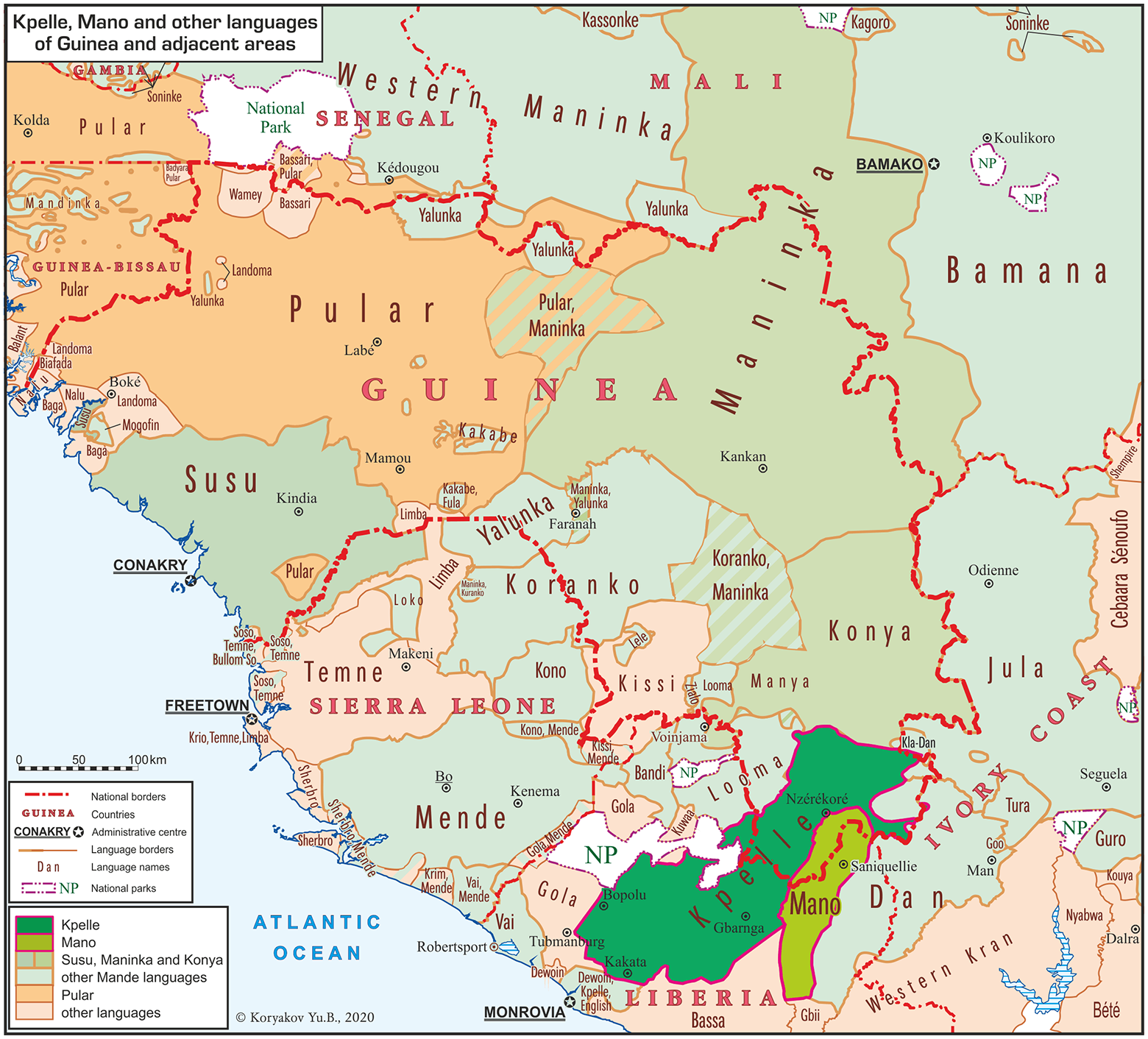
Map of Mano, Kpelle and other languages of Guinea and adjacent areas. Source: Yuriy Koryakov.
Our study makes use of a wide range of methods, including a sociolinguistic survey and interviews. We also applied the method of long-term participant observation in various social settings. The result is a fine-grained account of the principles governing language choice that a typical background questionnaire (e.g. Anderson et al., 2018) would overlook. Finally, to qualitatively assess multilingual proficiency, we sampled the natural and elicited speech of different types of language speakers, including L1 and L2 speakers and bilingual 1 children and adults, a method which yields better results than proficiency tests because it captures interference in grammar and prosody, which has far-reaching consequences for contacting languages.
In the next section, we analyze the overall linguistic situation in Guinea, the lingua francas of the country, and the asymmetry between Mano, Kpelle and Maninka based on the results of our sociolinguistic survey. In the third section, we turn to the case of Mano and Kpelle and discuss the notion of patrilect as a central component of ethnolinguistic identity, but also as a strong predictor of language choice in communication. The fourth section provides a study of actual communicative situations between speakers of Mano and Kpelle as primary languages. Through ethnographic observation, we show how language choice operates in a given context, often resulting in an asymmetric preference of Kpelle over Mano. In the fifth section, we further explore this asymmetry via its linguistic consequences and the asymmetric transfer of Kpelle features to Mano. We provide our conclusions in the final section. 2
Languages of communication in Guinea: A sociolinguistic survey
The Republic of Guinea is divided into four natural regions: Lower, or Maritime, Guinea, Middle Guinea (Fouta Djallon), Higher Guinea and Forest Guinea. The first three regions are dominated by large ethnolinguistic groups: 3 the Susu in Lower Guinea, including Guinea’s capital, Conakry (more than 1,670,000 L1 speakers in Guinea); Pular in Fouta Djallon (3,266,000 speakers; on Fouta Djallon, see Vydrina, this issue); and Maninka in Higher Guinea (more than 2,350,000 speakers; Bah & Bangoura, 2017). Of the four regions, Forest Guinea, and especially its urban centers, most prominently Nzérékoré, is the most ethnolinguistically heterogeneous part of the country, presenting an interesting case for a study of multilingualism. Here, we provide some demographic information about Conakry and Nzérékoré, the two urban centers most relevant for the present study.
Conakry, the capital of the country, has approximately 1,660,000 inhabitants. No census data is available for the city itself, but its population arguably reflects the demographics of the сapital region, where the most prominent ethnolinguistic groups are the Susu (37%), Pular (34%) and Maninka (18.7%) (Bah & Bangoura, 2017, p. 87). The Kpelle and Mano account for just 1.4% and 0.2%, respectively.
The population of Nzérékoré (about 200,000 inhabitants) includes descendants from the Mano- and Kpelle-speaking villages of the area as well as diasporic communities: most prominently the speakers of Manding, that is, the Maninka and Konya, but also the speakers of Pular, Looma, Kissi and Kono. The official census lists Manding as being spoken by approximately a third of the population of the Nzérékoré region, Kpelle by a quarter, and Mano by only 4% (Bah & Bangoura, 2017, p. 87). According to our observations, both Konya and Maninka are spoken more often in the urban areas of Forest Guinea than in the rural areas. In the absence of census data about the city of Nzérékoré itself, we would roughly estimate that Manding speakers account for no less than 40% of the total Nzérékoré population. The census claims that overall, urban speakers of Kpelle are approximately 1.5 times less numerous than rural speakers of the language, and that in the case of Mano, urban speakers are three times less numerous than rural speakers of the language. As a result, we would estimate that the ratio of Mano to Kpelle residents of Nzérékoré is approximately 1 to 9, with the Mano and Kpelle together accounting for approximately 45% of the population of Nzérékoré. The remaining 15% include Pular, Looma and other ethnolinguistic groups.
Most Guineans are multilingual in that they speak their family language(s), the dominant language of the area, and some French. To assess how Guineans choose what language(s) to use in everyday communication in various regions, including Forest Guinea, we devised a sociolinguistic questionnaire.
The questions
The questionnaire was devised in French and contained 13 questions covering the basic sociological parameters of the respondents (age, gender, place of birth, level of education, cities they have lived in, mother’s language, father’s language, 4 proficiency in languages, including the languages they speak fluently and those in which they only know greetings) as well as six open-ended questions about the choice of language(s) used in casual everyday situations (see online appendix 1).
First, we asked our respondents in what language they would address a total stranger in the place of their current residence. Other questions focused on languages used to address a salesperson in a particular trading situation. Trade as a social frame was chosen since it is a universal activity and involves all of the adult population in Guinea. Specific trading situations were included in which we expected the salespersons to belong to a particular ethnolinguistic group, with little variation across the country. Thus, based on our experience and discussions with our consultants, rice with bush meat sauce is typically served by people from Forest Guinea, most likely speakers of Kpelle, Mano or Looma, whereas beef is typically sold by Pular speakers, whose central economic activity is cattle breeding. We wanted to know how subjects adapt their language while communicating with salespersons whose ethnolinguistic profile is expected to be highly predictable. Crucially, the respondents’ answers and their comments generally confirmed our initial predictions regarding the salespersons’ patrilects in particular cases.
Data and sampling
We collected the initial data for the questionnaire through an online survey via Google forms in October 2019 and later in February to March 2020. We received 81 responses via the Google form, but only 62 forms were considered for this study. Nineteen forms were discarded because they had not been filled in correctly or else the subjects did not correspond to our initial requirements, meaning they did not currently reside in Guinea. The Internet sample was strongly biased towards residents of the capital, Conakry; so, an oral survey was also conducted in Nzérékoré, the largest urban center of Forest Guinea, the main region of interest, in January 2020. In Nzérékoré, 26 respondents completed the form. The questionnaire data is presented in online appendix 3.
In sum, we analyzed 62 Internet surveys plus 26 oral surveys, totaling 88 responses. The average age of the Internet survey participants was 29.5 years (median = 29), while the oral survey participants were 32.2 years old on average (median = 29.5). However, it is a standard practice in Guinea to reduce one’s age by 2 to 5 years, so our participants were most likely slightly older in many cases. Most of our respondents had a university degree. The 62 Internet respondents included only five women. The oral poll was slightly more representative, involving nine women and 17 men. We did not find any significant difference between the patterns of multilingualism among men and women in our data. Still, it should be noted that the women in our sample had approximately the same level of education as the men, which is not true for the general population. Hence, there may be more gender-based difference in reality than in our data, especially when it comes to the use of French, the main language of education. Another significant bias of the survey is that it focused on urban populations. The patterns of urban and rural multilingualism and language choice differ, as will be made clearer in the subsequent discussion.
Our survey engaged Guineans using a variety of patrilects (Kpelle, Mano and Maninka as well as Susu, Pular, Jula, Kissi, Konya, Lele, and Looma) and currently residing in 11 urban centers across the country. Table 1 includes data on the two cities of interest, Conakry and Nzérékoré, on all 11 urban centers, and on the crucial ethnolinguistic groups (Kpelle, Mano, Maninka, Pular), providing the total counts for each group in the given urban centers. For a full summary, see online appendix 2.
The sample.
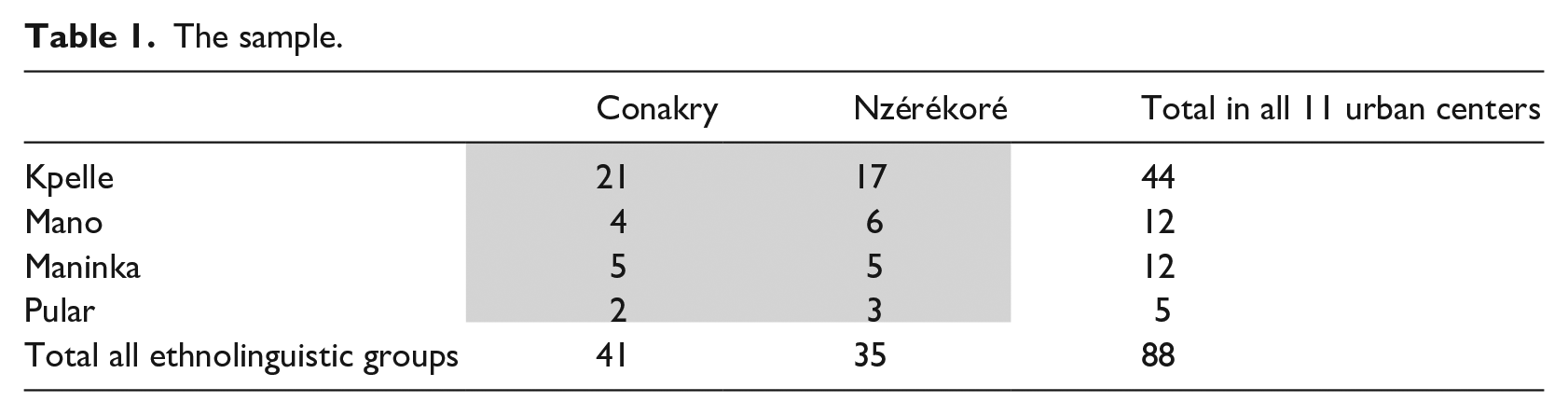
Clearly, our sample of respondents was unbalanced. First, most respondents, 44, mentioned Kpelle as their patrilect. Moreover, as noted above, most of our respondents were educated men living in Conakry and Nzérékoré. Still, we believe that our data is representative enough to reveal some clear trends.
Results
First, different lingua francas emerged in the four regions of Guinea. Of the local languages, Susu clearly dominates as the lingua franca in Lower Guinea, Pular in Middle Guinea and Maninka in Higher Guinea. For example, a Kpelle respondent who grew up in Forest Guinea but now resides in Dalaba (Middle Guinea) reported that he uses Pular in all the communication situations mentioned in our survey. Similarly, Kissi and Mano respondents residing in Higher Guinea (Kankan, Siguiri, Mandiana) reported choosing Maninka in all or most cases. In addition, approximately a third of responses indicated the use of French as a lingua franca in all four regions. The prominence of French could be an artifact of the sample bias of our questionnaire, which included only educated respondents (see also discussion in the section below entitled ‘Code-switching and code-mixing’).
In contrast, data from Forest Guinea reveals the roughly equal prominence of the Maninka, Kpelle and French languages, with Maninka holding the dominant position (see Table 2). A striking example of such dominance was provided by a Looma speaker, who resides in Macenta, a town situated in a region traditionally inhabited by the Looma, but who still chooses Maninka for all cases of communication with strangers. In Nzérékoré, Kpelle speakers generally prefer to use Kpelle or French in their interactions, but they may still use Maninka in the market, while other groups choose Maninka more often, together with French.
The use of languages in Conakry and Nzérékoré.

Table 2 summarizes data from respondents currently residing in Conakry and Nzérékoré. Every subject mentioned at least one language in response to our open-ended questions about language choice in particular situations, most of them pertaining to trade. Table 2 shows how many times residents of Conakry and Nzérékoré mentioned a specific language in their answers, regardless of the specificity of the communication situation. Note that slightly more of the respondents resided in Conakry (41) than in Nzérékoré (35), hence the total number of mentions is slightly higher for Conakry.
Table 2 suggests that Susu and French dominate in everyday social interactions in Conakry, while the data from Nzérékoré reveals more competition between French, Maninka and Kpelle.
Our survey also confirmed that specific social domains are tied to the linguistic repertoires of the interlocutors in each domain. As mentioned above, Pular speakers are highly engaged in the beef trade; therefore, in both Conakry and Nzérékoré Pular may be used by non-native speakers in the context of buying beef. Shea butter is often sold by Maninka speakers because of the origin of the product in Maninka-speaking areas, and hence, Maninka is more likely to be used by non-native speakers when buying shea butter. The languages of Forest Guinea are also associated with a particular economic domain, specifically hunting and restaurant businesses offering bush meat. In both Nzérékoré and Conakry, respondents claimed that they often speak Kpelle or French when ordering rice with bush meat in a restaurant. As some of our respondents noted, French would otherwise be the more appropriate language in a more ‘formal’ restaurant setting. However, a small number of respondents, those with Maninka and Pular as their patrilects, reported that they just opt for their own language in such a situation.
Finally, some important generalizations can be made based on language competence data, which provides crucial evidence in favor of the asymmetric relationship between Mano and Kpelle, as well as between Mano and Kpelle, on the one hand, and Maninka, on the other.
All the Mano respondents residing in Conakry and Nzérékoré claimed that they are fluent in both Kpelle and Maninka. In contrast, out of 21 Kpelle respondents residing in Conakry, only one claimed to be fluent in Mano and four reported knowing Mano greetings; out of 17 Kpelle respondents residing in Nzérékoré, three reported being fluent in Mano, while five stated that they only know greetings. However, all Mano and most Kpelle respondents reported knowing some Maninka, with the proportion of Kpelle respondents fluent in Maninka being slightly higher in Nzérékoré than in Conakry. As for the Maninka speakers, none of them reported knowing any Mano, with the exception of one respondent whose mother was from Forest Guinea (but he did not provide further details). Most Maninka speakers residing in Nzérékoré reported that they can speak some Kpelle, but they never mentioned using Kpelle in the specific communication situations targeted by the questionnaire. Even in the typical Kpelle-associated bush meat domain, some Maninka speakers in Nzérékoré noted that they often use Maninka. This confirms our assistants’ observations that in Nzérékoré, Maninka generally understand some Kpelle but they rarely use it in real life.
To sum up, the survey data and our observations suggest that in urban contexts, indigenous languages in Guinea can be viewed as forming a three-level hierarchy. The highest level consists of the languages dominant over large areas, in this case Susu, Pular and Maninka. The speakers of these languages tend to accommodate themselves less to their interlocutors, who speak languages lower down in the hierarchy. Among native speakers of languages higher up in the hierarchy are those who claim to be (quasi)-monolingual, with a repertoire consisting of the patrilect and limited proficiency in other indigenous languages. Of note, one speaker of Maninka living in the capital of the Maninka-speaking region reported that he speaks only Maninka. 5
The intermediate level includes Kpelle, which is dominant in at least some areas of Forest Guinea, most notably in Nzérékoré. Most respondents who have lived in Forest Guinea claimed to have Kpelle in their repertoire. Yet, it is considered a minority language elsewhere. The asymmetric relationship between the Kpelle speakers and the speakers of Maninka is particularly acute in Nzérékoré, as shown above.
Finally, smaller languages spoken in particular regions, including Mano in Forest Guinea, form the lowest level of the hierarchy. While they are typically learned at home, their speakers claim to be fluent and speak on a daily basis at least some other languages higher up in the hierarchy, such as Kpelle. Mano is not used in communication between strangers in larger cities. 6
The same hierarchy applies in rural contexts, although speakers higher up in the hierarchy seem to show more accommodation in their language choice. For instance, a Maninka contractual worker whom we once met in a monolingual Mano village did speak Mano. Maninka tradeswomen coming to buy palm oil in a Kpelle or a Mano village may opt to speak Maninka regardless of the language of the interlocutors, who, then, have to adapt, or they may occasionally learn local languages.
Unlike the Kpelle and Mano versus Maninka asymmetry based on differences in economic activities and the asymmetry in marriage patterns, the relationship between Kpelle and Mano, to which we now turn, is more complex and multifactorial.
Sociolinguistic situation in the Mano- and Kpelle-speaking areas
Linking language to territory
Both Mano and Kpelle are spoken throughout large parts of Guinea and Liberia, with several hundred thousand persons speaking each language. While the dialects in each language vary noticeably, they remain mutually understandable, with their differences being largely limited to phonetics and phonology and, to a lesser extent, to morphosyntax and lexicon (on the Mano case, see Khachaturyan, 2018; for a study of tone variation in Kpelle dialects, see Konoshenko, 2008). This sets the Mano and Kpelle languages apart from the varieties of Baïnounk spoken in Senegal, as described by Lüpke (2016b), whose ‘sameness’ is more pronounced at the level of language ideologies than supported by scholarly evidence and mutual intelligibility.
The different Mano dialects (or, more accurately, the dialects singled out by native speakers) are not tied to specific villages, but either to clans (Zetterström, 1976; on clan as an important level of group identify, see Khanina, this issue) or to vaguely defined areas (in Liberia). Crucially, with Mano we are not dealing with a case of ‘localist’ language ideology, as in northwestern Cameroon, ‘meaning that practically every village in the region, regardless of scientific classifications, perceives itself as speaking its own language’ (Good, 2012, p. 35). Rather, the Mano language ideology resembles more closely European ‘national language’ ideology and essentialist linguistic identity. Indeed, each Mano variety is tied to a particular territory and group, identified by lineage and cultural practices, including a joking kinship relationship between ethnolinguistic groups and also between different clans within the same ethnolinguistic group. The Kpelle situation is expected to be fairly similar to the Mano situation, except that Kpelle is spoken over a much larger territory by several dozen distinct clans.
Ideology and practice of patrilects
The villages in Forest Guinea are typically ascribed an ethnic status (e.g. a Mano village or a Kpelle village) based on the oral tradition. This applies even to villages with a mixed population. The clan of the patrilineal descendants of the village founder is called, in Mano, sɛ́lɛ́ dàāmìà, literally ‘owners of the land’. Thus, nominal ownership of the land and the identity of the village founder are ascribed to one particular ethnolinguistic group. 7 Individuals, too, trace their ethnolinguistic identity patrilineally and claim to belong to the ethnolinguistic group of their father. Even if the mother and the father have different patrilects, individuals would not qualify as ‘mixed’ and their ethnolinguistic identity would refer only to the patrilect. In many villages, especially those far from the contact zone, the language associated with the village founders is the primary language of communication; hence, many persons in a village may have one primary language and only a limited proficiency in other languages (for a similar observation in Senegal, see Sagna & Bassène, 2016; Sagna & Hantgan, this issue). The way language choice operates in villages in the contact zone requires further investigation (see case 7 below). On a difference between the contact zone and the monolingual zone, see Dobrushina and Moroz (this issue).
In contrast to rural areas, in larger towns with important diasporic communities, especially of Maninka speakers, who are reluctant to learn local languages, the ideology of land ownership is not reflected in practice. Thus, in Nzérékoré, which traditionally has a Kpelle town leader, Kpelle is used in communication with strangers only to a limited extent, competing with Maninka (see above, ‘Languages of communication in Guinea’).
The ideological connection between villages and patrilects is supported by ritual activities. The patrilineal descent of the founder assures key ritual roles, such as that of the initiation master. Ritual activities, such as benedictions, initiations and sacrifices to the ancestors, are performed in the ‘language of the ancestors’. Unlike the situation described by Di Carlo (2018) in northwestern Cameroon, a man will typically not seek spiritual protection in his mother’s village and will benefit from sacrifices, or will undergo initiation, only in his ancestral village – that is, the village of his father – or in a neighboring village speaking the same language.
In addition to ritual activities, land claims in their father’s village constitute a key practical incentive for boys to acquire their patrilect. Even though many young people pursue higher education and hope to find employment in towns, in Guinea such employment is scarce. As a result, even highly educated men rely on agricultural work. In the years following the acquisition of a diploma, or whenever there is a break in employment, they return to their fathers’ villages, so land ownership and integration into the village community, facilitated by a common patrilect, is still important for them.
Women cannot have land claims, so this incentive does not apply to them. While they often become highly educated, they engage mainly in wage labor, agricultural projects, small business or trade. They are rarely fully independent economically and need to seek the support of their male relatives as financial warrantors. Women inherit land only from their deceased husbands and only in the case of civic marriage, with such a restriction being a key indicator of their subordinate economic role. As a rule, a person’s residence is patrilocal, so women move to their husbands’ households and villages. In one known exception, where the reverse pattern applied, the husband obtained employment in his wife’s native village. When women marry a person from a different village, they still typically maintain close ties with their home villages and return there on a regular basis. Women do occupy prominent social roles, such as overseeing a female initiation society. They may be part of the village council, which is, however, always headed by a man.
Language acquisition
Young children typically acquire only the language(s) of the immediate family: the patrilects of their mother and their father, which become their primary languages. Other languages – except perhaps French, to some degree – are not used in the family. Later, children begin to socialize with larger peer groups, so other languages are added to the repertoire, with the children possibly gaining a near-native proficiency in them. One example is our primary language consultant in Mano, whose mother and father are both Mano speakers but who grew up in Nzérékoré, where Kpelle is widespread. As a result of interaction with his peers, he has developed an excellent, but not native, proficiency in Kpelle: the only issue he has is with some complex Kpelle prosodic rules that have no equivalent in Mano, such as downstep.
Child fostering, which often presents a challenge to the acquisition of patrilects in other areas of Africa (Lüpke, 2016b), is widespread in Forest Guinea, but then the children (both boys and girls) are typically fostered in the families of close relatives. While a systematic study of child fostering has not yet been conducted, some preliminary observations show that the typical foster family consists of parents of the father or some other patrilineal relatives, such as the father’s brother or sister. Only in the rare cases where the child is not recognized by the father, or in the case of older children, are they fostered by the family of the mother. Thus, the child’s patrilect is usually spoken in his/her fostering family.
In contrast with the Maninka and Pular, traditionally quite mobile populations with important diasporic communities, relatively few Mano and Kpelle settle outside Forest Guinea permanently. This is due to the strong importance of agricultural labor, which ties the male population to their land. While youth often travel across the country or abroad for studies and for work, they often return to their native villages and towns or to nearby areas, thereby keeping their patrilects alive and transmitting them to their children. One of our Kpelle interlocutors was fostered in Côte d’Ivoire by a family of a Kpelle-speaking female matrilineal relative, and he stayed there for his university studies, but he then returned and settled in Nzérékoré. A Mano interlocutor studied at a university in the Pular-speaking region and searched for employment in Conakry, but he ended up settling in and starting a family in Diécké, not far from his father’s village. His father, in turn, spent many years in Côte d’Ivoire but retired in his home village. Thus, in these cases the individuals retained a native proficiency in their patrilects, Kpelle and Mano, respectively.
Rare are the cases where a person fails to acquire native competence is his patrilect. 8 Unlike in Liberia, where speaking indigenous languages is often discouraged due to a recent history of interethnic violence, in Guinea patrilects (and also matrilects) are usually learned quite well and almost without exception. Thus, unlike what has been reported in other areas, such as in Casamance (Lüpke, 2016b), a language ideology tying ethnolinguistic identity to the patrilect is supported by language acquisition patterns.
Code-switching and code-mixing
Another piece of evidence demonstrating that Mano and Kpelle are conceptualized as distinct codes marking a distinct ethnolinguistic identity comes from the absence of code-mixing between the two languages, except in the cases where such mixing is motivated by a lack of proficiency, as in the case of children or adult L2 speech. In proficient adult speech, we have only rarely found evidence of lexical insertions. One of the speakers whose speech we studied closely grew up in a mixed Mano–Kpelle village, with his mother being Mano speaking and his father Kpelle speaking. He is often criticized, behind his back, for having a Kpelle accent in his Mano speech. According to our observations, the phonological and morphosyntactic properties of his speech are quite close to those of the speech of individuals with Mano as the main language in their repertoire. Yet, he does use some lexical items and calques from Kpelle, which are easily noticed by his Mano interlocutors and interpreted as an emblem of his Kpelleness. Such avoidance, and criticism, of code-mixing between Mano and Kpelle differs from more common code-mixing with other languages that are not associated with salient contrasts in ethnolinguistic identity but rather with other aspects of social identity, for instance being urban or educated. Thus, speakers more frequently use insertions from Susu, the language of the capital, and regularly code-mix with French.
In Mano, French is called kwííwè, the language of kwíí, that is, educated people, and in particular kwíí púlú, ‘white educated people’, namely white Europeans. Code-mixing with French is rather widespread in Guinea, especially when it comes to topics related to some Western economic or religious activities. A telling example comes from a conversation between our Mano language consultant and Mano speakers in Liberia. They were discussing the Catholic Church. The language consultant used a large number of lexical insertions from French to refer to specific religious notions, including the word église, ‘church’ (although a Mano term does exist). He was met with little understanding by his interlocutors, who do not speak any French, but rather English. He quickly adapted some English items, including church. Yet, code-mixing with French is not generalized; it depends on the topic of conversation and its extent varies from speaker to speaker. Our language consultant’s cousin is a lawyer and his nickname is kwíí; whenever he came to visit our consultant, he was the one who code-switched with French most in his Mano speech, meaning that his code-switching pattern reflects his social identity as a Europeanized, educated person (note that his cousin, a veterinary doctor, is no less educated, but adopts a different stance and code-switches much less). On code-switching with a local lingua franca as a rhetorical skill and a reflection of social standing, see Sankoff (1980). In monolingual Mano villages, especially in traditional storytelling, but even in the Catholic register used in the ritual context proper, almost no code-mixing takes place. (On code-mixing with a dominant language and dispreference of code-mixing with other local languages, see Li, this issue; Vydrina, this issue; on code-switching, see Di Carlo et al., this issue).
Ethnographic observations of language choice by Mano and Kpelle speakers
Since 2012, Maria Khachaturyan has been closely engaged in the everyday life of a household headed by our primary consultant on Mano. His parents were both born in a Mano-speaking village. His wife identifies as Kpelle. Both are perfectly competent in each other’s patrilects. While the family lives in Nzérékoré, we have traveled together to the home villages of both heads of the household. In the Mano village, the Mano relatives and their in-laws always speak Mano. Kpelle, the language of the wife’s father, is spoken by default in her family, even when her Mano husband comes for a visit. 9 Thus, in these situations the families’ patrilects, which in both cases are at the same time the languages of the villages, become the main factor in the choice of language.
Communication in bilingual households, such as the one under discussion, as well as in bilingual villages and towns and in settings where speakers of various languages are involved, such as the Catholic Church, is more complex, and language choice is far from trivial. Interacting participants typically have a large repertoire of languages to choose from and tend to choose the language that both of them have best mastered, with other factors playing an additional role in this choice. In what follows, we report on several interactions involving speakers of Mano and Kpelle and explain the resulting language choices. Most of the interaction cases took place in Nzérékoré, a large town and region capital where the Kpelle population outnumbers the Mano population, while cases 5 and 7 took place in villages with a Mano-speaking majority.
Сase 1: Kpelle in the neighborhood
Our Mano language consultant had recently moved to a new neighborhood on the outskirts of Nzérékoré, to a place that is scarcely inhabited and populated predominantly by speakers of Kpelle. He and his immediate Kpelle neighbor regularly pay each other visits. They interact in Kpelle, since the neighbor does not know Mano, while the consultant speaks Kpelle with ease.
Case 2: French as a lingua franca
The same Mano language consultant lives with his younger brother, who at the time of observation was a high school student. The younger brother once brought home his classmate and introduced him to his elder brother. Nothing was known from the start about the classmate’s linguistic identity. At the same time, it is common knowledge that French is the language of education in Guinea at all levels. Thus, high school students, at least in Nzérékoré, gain relatively good oral proficiency in French. The language consultant himself has a university degree. So, the conversation started off in French, the language that the interlocutors knew they surely had in common because of their education level.
Case 3: Speaking Kpelle with strangers
One evening, our Mano language consultant and Maria Khachaturyan were catching a mototaxi in Nzérékoré. It was pitch-black, and the streetlights in town did not add much light. A taxi driver stopped and asked, in French: On va où? (‘where are we going?’). Immediately, without asking any further questions, the language consultant started to give explanations in Kpelle. At home, we discussed this situation. In explaining why he made that choice, he said that speakers of particular languages in Nzérékoré can be identified by their outfit, haircuts, and also their distinctive accent in French. The practice of guesswork based on such contextual clues was confirmed by other Mano and Kpelle interlocutors.
Case 4: Resorting to Kpelle at a Mano–Kpelle wedding
Another opportunity to observe language choice in a bilingual setting occurred at a wedding ceremony between a Mano groom and a Kpelle bride. The ceremony, as is the tradition, took place at the bride’s house, where the groom and his relatives are the guests. It included a key component of ‘buying off’ the bride with presents to her relatives and speeches by the bride’s family. Crucially, the spokesman from the Mano delegation, which consisted of a handful of elderly relatives, spoke almost entirely in Kpelle. He spoke in Mano essentially only once, when the Kpelle in-laws offered the Mano delegation cola nuts, a traditional gift of welcome offered to guests, and the Mano accepted them. The spokesman summarized the interaction as follows: (1) ‘
To this, the delegation responds with ŋ̀ŋ̀, meaning: ‘yes (we agree)’. The spokesman then says, in Mano: (2) ŋwɔ́ yé ‘The issue that brought
In both these examples, the spokesman explicitly addresses his fellow countrymen and women, indexing them with first-person plural pronouns, and contrasts the group to the group of in-laws, who are indexed in the third-person plural. The fact that the opposing party is indexed using the third person, as non-participants in the interaction, is consistent with the choice of the language, Mano, which the Kpelle generally do not understand. It is also consistent with the general pattern, in which communication between the parties is not direct but mediated by the spokesperson.
After that brief interaction, the main ceremonial events followed, and the only language spoken was Kpelle. When we discussed the situation with our Mano language consultant, who was also present at the wedding, he said that Kpelle was spoken because of its convenience, because it is understood by everyone. Traditionally, he said, participants would speak their patrilects and there would be interpreters from both sides.
Case 5: How much Kpelle is really understood by the Mano?
Another case where Kpelle was spoken to a Mano audience was in a Catholic church. The Mano have embraced the Catholic faith much less enthusiastically than the Kpelle. While Mano Catholics constitute a clear religious minority (only about 4% of the Mano population), approximately 32% of the Kpelle are Catholic. 10 Many Kpelle choose to acquire a religious education and become priests. As a result, a Kpelle is ordained into the priesthood almost every year, while there is but one Mano-speaking priest in the area. Thus, Sunday celebrations in Mano villages are usually held without a priest, performed by a Mano-speaking catechist. On the rare occasions when a priest does come, he serves Mass in Kpelle. His sermon is usually translated, but key ritual parts of the discourse, such as the Eucharistic prayer, usually are not translated. During Mass or a Sunday celebration, three excerpts from the Bible are read: one from the prophets, one from the Epistles, and, most important of all, one from the Gospels. It is the priest who usually reads the Gospel, in Kpelle, which is then read in Mano. On one particular Sunday in the Bounouma village the priest read the Gospel in Kpelle, but then the catechist decided not to translate it. A question was then asked about each of the readings, as is usually the case at the beginning of the sermon. When it came to the day’s question about the Gospel, it turned out that the Mano congregation was unable to answer it, so the catechist had to go back and read it in Mano for it to be understood. Thus, while the priest and the catechist presupposed everyone’s passive understanding of Kpelle, in reality the congregation’s competence was much lower.
Case 6: Mano and Kpelle spoken in a bilingual household
The following conversation took place in a household run by a Mano husband and a Kpelle wife. The sister of the Mano head of the family, Evelyne, came to visit and help her sister-in-law prepare the food for the First of January, the day when the New Year is celebrated. The sister is married to a Kpelle man and is helping raise his children, one of whom came, too. She also brought her brother’s daughter who is being fostered by her family. Pola, her sister-in-law and our language consultant’s wife, is a Kpelle speaker. Both women are fully competent in both Mano and Kpelle. Yet, almost the entire conversation was in Mano because it is the language spoken in the household.
There were several exceptions to the rule. In excerpt (3), the conversation between the women (lines 1, 4, 5, 6) takes place in Mano. Yet, when both of them address the visiting children, lines 2 and 3, they do so in Kpelle because it is the language spoken in the household where they are being raised and because it is the language of the father of one of them. Thus, in cases where several languages are available in the repertoire together with several competing patrilects, the choice is made depending on the place of interaction (a Mano household) or the relationship between the interlocutors and the purpose of interaction (instruction given to children in their household’s patrilect). Note that the children have competing patrilects, with one of them having a Mano father and another a Kpelle father; still, the Kpelle language prevails since they are both being raised in a Kpelle household. (See Khanina, this issue, and Morozova & Rusakov, this issue, discussing the choice of language used with children in multilingual families.) The switching from Mano to Kpelle and back is seamless, so the pause between the utterances pronounced in different languages in 3 and 4 (0,1 s) is even briefer than the pause within the turn produced in one language, 5 and 6 (3,5 s).
(in Mano) ‘She will eat it, and then we will also pay for her fish.’
It is not clear at what point children start to be addressed predominantly in their father’s language. When Pola reported in a phone conversation with us the first phrases her youngest child had learned to produce, they were ‘I pooped’ and ‘I fell’ (in Kpelle) and ‘Daddy has arrived’ and ‘Mommy has arrived’ (in Mano). Despite the small size of our sample, and without further details on the participant configuration or the exact context of occurrence, the above example still shows that when a toddler expresses concerns that the mother should address (pooping, falling), she speaks in the mother’s patrilect and likely addresses the mother only. But when the child speaks about matters that concern the entire family, such as the arrival of the mother or the father – and, probably, addressed to everyone in the household – she does so using the patrilect. Older children in the family are addressed by their mother predominantly in Mano, and it remains an interesting question as to when the change in the language spoken between the mother and the child from the mother’s patrilect to the child’s patrilect actually occurs.
In the following excerpt in bold, Cécile, the teenage daughter of Pola, switches again from Mano, the main language of the conversation, to Kpelle, and her aunt Evelyne switches after her as well. The reason they do so is because they are quoting Michel, the son of Evelyne’s Kpelle husband. It is not only because Kpelle is his patrilect that they quote him in this language, but also because he said nasty things about the Mano, and most probably indeed did it in Kpelle. Note that there is no formal means of introducing reported speech: language switching and contextual clues are enough for the interlocutors to understand that Cécile is not speaking for herself but for someone else. On code-switching in reported speech, see Li (this issue).
Case 7: At a weekly market
The main places where the Mano and Kpelle inhabitants of monolingual villages interact are weekly markets. Every village has its own market day, a day when tradesmen and tradeswomen come to sell goods, such as fabrics or small household items, but also to buy seasonal agricultural products, such as rice or red palm oil. On such a market day in Nzao, a Mano village, we followed a tradeswoman who identified herself as Kpelle, but who had been born to a Mano mother and was married to a Mano man, so she was perfectly proficient in both languages. It was not the first time she came to Nzao for trade, so she easily interacted with all her customers and was widely known in the village. We witnessed several of her interactions with the locals.
In one household, her customers explained to her that they had been erroneously informed that she would come on a certain day several days back, and so they had already sold their oil after waiting for her in vain. The entire conversation took place in Mano, likely because it was the language of the household into which she entered as a stranger. In the street, she was addressed by a young man who discussed with her a situation involving her husband’s brother. He did so in Kpelle: although the place of interaction was a Mano village, he was soliciting the attention of a Kpelle person and so, out of respect, spoke to her in her patrilect. Finally, we came to a Mano household where she was able to buy some oil. The female head of the household was a Kpelle speaker, as was known to the tradeswoman from previous interactions with her. Whenever they talked with, or in the presence of, her Mano husband, though, they did so in Mano: for instance, when they discussed the oil’s price or money that he wanted to loan from the buyer. The sellers’ child was also addressed in Mano, her patrilect. Yet when the women talked amongst themselves, discussing the oil’s quality and the amount of processing required – things that did not directly concern the Mano man – they did so in their patrilect, Kpelle.
Case 8: Adaptation in ritual speech
In ritual events, persons are allowed to speak their father’s language when in a different linguistic environment. In practice, however, one adapts to the patrilect of the interlocutors as much as possible. This results in clumsy ritual speech, which is still considered better than foreign ritual speech. Such was the case with a Kpelle brother-in-law of our Mano language consultant. The former is rather proficient in conversational Mano but much less so in ritual genres. He tried to produce a benediction on the occasion of the departure of an important family guest, which was met with much laughter and joy. Such was also the case with a Mano catechist, who attempted to address a benediction in Kpelle to a Kpelle delegation.
Case 9: Speaking when a person from Europe is around
Since our interlocutors assumed that our patrilect was French (the language of educated people, including Europeans), our involvement in a conversational setting surely modifies its linguistic dynamics, but it does so according to the same rules described above. The Kpelle mototaxi driver cited in case 3 could have addressed us in Kpelle, guessing from the Mano language consultant’s outfit that he was a forestier and therefore spoke Kpelle rather than, say, Maninka. One of the reasons that the driver spoke French was likely because a foreign researcher, whose patrilect he assumed to be French, was present. On a different occasion, when we traveled on a motorbike to a marriage in a Kpelle village, the language consultant asked for directions in Kpelle. The interlocutor first started in French, out of respect to the foreign passenger, and then switched to Kpelle out of convenience.
The examples discussed in this section show that language choices in conversation are made based on an assessment of the interlocutors’ repertoire, which is the primary factor. Other factors include the presence of an important overhearer, whose patrilect should be prioritized; the place of interaction, such as a household with a particular language spoken by its male head; the purpose and the topic of conversation, such as instructions and commands given to the children or a toddler’s request for assistance from its mother; the dynamics of the interaction, such as who initiates the conversation and who is the one from whom the information is being solicited or to whom it is being delivered. G. Sankoff reached a similar conclusion about language choice in Buang-speaking areas in Papua New Guinea, with the participant’s linguistic profile being the main predictor of language choice, followed by setting and topic (Sankoff, 1980). On the use of naturalistic speech data combined with rich contextual information, with a careful attention to the dynamics of participation framework, see several papers in this issue, including those by Vydrina, Di Carlo et al., Li, and Morozova and Rusakov.
Prestige or the functional sphere of language use do not seem to play a role in language choice among the Mano and the Kpelle. Even in the Catholic Church, where Kpelle is used disproportionally more widely by priests and church officials (Khachaturyan, 2020), it does not lead to a preference for Kpelle over Mano: the Kpelle speeches are also translated into Mano since a passive understanding of Kpelle by all Mano cannot necessarily be taken for granted (case 5).
In addition to the rules governing language choice, our sociolinguistic survey (above, ‘Languages of communication in Guinea’) and the case studies revealed that in major cities like Nzérékoré, many Mano speak Kpelle, but Kpelle rarely speak Mano, which results in asymmetric bilingualism (cases 1, 3, 4). In their responses to the questionnaire about language choices, discussed in the section describing the survey, most Mano reported that they choose Kpelle, Maninka or French for communication with strangers, whereas Kpelle speakers do not choose Mano. This situation of asymmetry can be explained by the fact that the Kpelle speakers are about six times more numerous than the Mano speakers (and likely even more so in Nzérékoré), which creates an environment where a Mano speaker (a child or an adult) is more likely to encounter a Kpelle speaker and be exposed to this language rather than the other way round. Therefore, the main factor for the Kpelle dominance over Mano in everyday communication is arguably the numerical advantage of Kpelle speakers over Mano speakers. (Dobrushina and Moroz, this issue, make a similar observation that speakers of minority languages have larger repertoires than speakers of languages with a greater speaker population.) In Mano-speaking and bilingual households with a Mano head, as well as in Mano villages (cases 5–8), the situation is different, though, and the preferred language of communication is Mano, even when Kpelle speakers are involved.
We should also add that language choice and competence in bilingual Mano–Kpelle villages remains an open question. Three of our Kpelle interlocutors who grew up in such places, either in mixed or in monolingual Kpelle households, proved to have good to excellent conversational proficiency in Mano. A more detailed study would undoubtedly complement the picture.
Contact effects
In addition to our observations on multilingual communication, our research is based on a collection of samples of spontaneous speech from individuals with different linguistic backgrounds. A collection of texts in Mano and Kpelle spoken as L1 and L2 by children and adults with various levels of proficiency allows us to study variations due to different degrees of interference. We also made use of experimental techniques (picture-based elicitation) with 21 bilinguals and monolinguals.
Our first observation is that, in contrast to what has been predicted by Lüpke (2016a), virtually no code-mixing occurs between Mano and Kpelle in situations of reciprocal bilingualism (see also ‘Code-switching and code-mixing’ above). All cases where Kpelle elements appear in Mano speech can be explained either by a change in footing (Goffman, 1981), such as switching from Mano to Kpelle while reporting an utterance or addressing a new interlocutor (see case 6 above), or by limited proficiency in Mano. Yet, there is abundant evidence of the grammatical impact of Kpelle on Mano, ranging from the influence of Kpelle on Mano in bilingual repertoires to the stable contact-induced changes found even in the speech of Mano monolinguals.
Thus, one domain that proved to be especially prone to contact-induced change and variation in the Mano speech of bilingual individuals turned out to be the expression of reflexivity (Khachaturyan, 2019a). Long-term contact with Kpelle speakers explains the Mano dialectal variation, most prominently at the level of phonology (Khachaturyan, 2018). At the morphosyntactic level, stable effects include agreement patterns (Konoshenko, 2015, pp. 176–177) and the borrowing of inclusory pronouns (Khachaturyan, 2019b). The influence is also quite strong in the lexicon (Khachaturyan, 2020).
In contrast, stable contact influence of Mano on Kpelle has not been documented thus far. Evidence from Kpelle speakers from bilingual villages could shed new light on the question. Indirect influence can be seen only perhaps at the level of the proto-language of the Southern Mande branch influencing the proto-language of the Southwestern Mande branch: for example, reciprocal markers (kíè in Mano, *ki in Southern Mande; kéè in Kpelle). Thus, the influence of Kpelle on Mano is almost exclusively unidirectional, which can be explained by the situation of asymmetry. Yet, such influence does not result in language shift, since, with very rare exceptions, children manage to acquire at least their patrilect, and typically also their matrilect.
Both Mano and Kpelle have undergone contact influence from other languages, most prominently Maninka and French. In contrast with the profound, structural influence of Kpelle on Mano, the influence of Maninka and French on both languages is limited to vocabulary (for more on the lexical influences of Maninka, see Khachaturyan, 2018).
Conclusion
The paper studies patterns of multilingualism in Forest Guinea by focusing on use of the Mano and Kpelle languages, while taking into account other languages in the repertoires of Mano and Kpelle speakers, namely French and especially Maninka. Our study contributes to discussions on (a)symmetry in multilingualism by addressing the notion from various points of view, including studies of language choice in multilingual communication, of simultaneous and sequential second language acquisition, and of stable contact effects, as well as by applying different methods, including a sociolinguistic survey, ethnographic observations, analysis of spontaneously occurring speech and targeted elicitation.
We argue that there is no overt difference in prestige between the Mano and Kpelle languages. Instead, marriage patterns and economic activity are symmetrical, and both languages can be, in certain cases, chosen as a means of communication between speakers of different patrilects. However, bilingualism is often unreciprocated, and the Mano learn to speak, and indeed do speak, Kpelle more often than the other way round. We explain this asymmetry by suggesting relative population size as the main factor, with Kpelle speakers being six times more numerous than Mano speakers. High proficiency in Kpelle among the Mano speakers results in unidirectional contact influence of Kpelle on Mano, but it in no way triggers a language shift, as evidenced by our study of bilingual language acquisition. Mano is carefully preserved as a patrilect and the marker of ethnic identity. Several authors in this issue reach a similar conclusion regarding numerical imbalance as a major factor in language asymmetry: see Khanina (this issue) and Walworth et al. (this issue).
We have also shown that both Mano and Kpelle are in an asymmetric relationship with Maninka, which is frequently part of the repertoire of urban Mano and Kpelle speakers and is used in everyday communication. The reverse does not apply, though: even if some Maninka claim to have certain proficiency in Kpelle, they rarely speak it in real life.
The African multilingual setting presented in this paper differs in its sociolinguistic patterns from some other cases described in the extant literature, including studies of African multilingualisms (Di Carlo, 2018; Lüpke, 2016b). While speakers of Mano and Kpelle are multilingual, the fluid linguistic behavior does not imply a changeable identity (on a similar point, see Sagna & Hantgan, this issue). While Susu is a lingua franca of the Conakry region, and while French remains connected to education and social class identity, the ethnolinguistic identity of Mano and Kpelle speakers remains strongly associated with the use of respective patrilects. In addition to its being the defining ideological feature of ethnolinguistic identity, the patrilect is also the main predictor of language choice in communication and the volume of a person’s repertoire.
The main shortcomings of the paper include a biased sample of respondents in the sociolinguistic questionnaire, which includes mostly well-educated urban dwellers and only a few women. In particular, the level of education may affect the choice of French over local languages. Another shortcoming is a lack of information on mixed villages in the Mano–Kpelle and Kpelle–Maninka contact zones, where the groups in question are equally represented. The absence of a numerical advantage by either group may affect language choice and language competence, especially in the former case. We hope that future research will complement the results of the present paper.
Supplemental Material
sj-docx-1-ijb-10.1177_13670069211023142 – Supplemental material for Assessing (a)symmetry in multilingualism: The case of Mano and Kpelle in Guinea
Supplemental material, sj-docx-1-ijb-10.1177_13670069211023142 for Assessing (a)symmetry in multilingualism: The case of Mano and Kpelle in Guinea by Maria Khachaturyan and Maria Konoshenko in International Journal of Bilingualism
Supplemental Material
sj-docx-2-ijb-10.1177_13670069211023142 – Supplemental material for Assessing (a)symmetry in multilingualism: The case of Mano and Kpelle in Guinea
Supplemental material, sj-docx-2-ijb-10.1177_13670069211023142 for Assessing (a)symmetry in multilingualism: The case of Mano and Kpelle in Guinea by Maria Khachaturyan and Maria Konoshenko in International Journal of Bilingualism
Supplemental Material
sj-docx-3-ijb-10.1177_13670069211023142 – Supplemental material for Assessing (a)symmetry in multilingualism: The case of Mano and Kpelle in Guinea
Supplemental material, sj-docx-3-ijb-10.1177_13670069211023142 for Assessing (a)symmetry in multilingualism: The case of Mano and Kpelle in Guinea by Maria Khachaturyan and Maria Konoshenko in International Journal of Bilingualism
Footnotes
Acknowledgements
The authors would like to thank Francis Phalazar Loua and Ibrahima Sory 2 Condé, who helped us to carry out the sociolinguistic survey in Guinea. We are grateful to Pe Mamy, our Mano host, Pola Kourouma, his wife, and their family members who supported us in the ethnographic research and made us (quite literally) feel at home. We thank Nina Dobrushina, Olesya Khanina and Brigitte Pakendorf for bringing together a fantastic group of scholars and stimulating the exchange of ideas. We also thank Yuriy Koryakov for providing a language map and Erik Heita for proofreading.
Funding
The author(s) disclosed receipt of the following financial support for the research, authorship, and/or publication of this article: We acknowledge the financial support of the Academy of Finland (Grant No. 323403), of the Russian Science Foundation (Grant No. 17-78-20071), of the Kone Foundation (Grant No. 201907156) and of the Helsinki University Humanities Programme.

Supplemental material
Supplemental material for this article is available online.
Notes
Author biographies
References
Supplementary Material
Please find the following supplemental material available below.
For Open Access articles published under a Creative Commons License, all supplemental material carries the same license as the article it is associated with.
For non-Open Access articles published, all supplemental material carries a non-exclusive license, and permission requests for re-use of supplemental material or any part of supplemental material shall be sent directly to the copyright owner as specified in the copyright notice associated with the article.
