



Abstract
Each of the 65 inhabited islands of Vanuatu hosts its own unique linguistic environment in which varying degrees of multilingualism are found. This paper defines various types of small-scale multilingual settings in Vanuatu and explores what sociohistorical factors have led to them. This paper is based on first-hand observations and primary data collected by the authors in four locations in the Pacific Island nation of Vanuatu since 2016: two neighboring villages of Emae Island (Makatu and Tongamea), North Malekula, and on Maewo Island. The assessments of multilingualism in these examples from Vanuatu were qualitative, based on observations of sociolinguistic practices in each of these areas, as well as data from language history and language use surveys carried out in each place. Through defining and comparing the types of multilingualism present in the four case studies, we identify patterns in the social and historical processes that lead to various kinds of multilingualism: (a) interaction of linguistic and sociocultural identities and (b) mobility of both individuals and entire speech communities. The examples described in this paper are used to highlight the diversity of multilingualism found in Vanuatu and to explore how their differing linguistic environments and histories have contributed to their varying degrees of multilingualism. This paper makes an original contribution to knowledge about the small-scale multilingual situations in Vanuatu, offering descriptions of previously undocumented and endangered multilingual environments. Through an examination of the sociocultural motivations for multilingualism, alongside historical migrations of speaker groups and marked sociolinguistic identities, this paper contributes to research on why and how small-scale multilingualism can develop. Furthermore, this paper provides the foundation for future, more rigorous investigations into the small-scale multilingual situations of this highly understudied region.
Keywords
Introduction
The Pacific Island nation of Vanuatu is the most linguistically dense place on earth, with approximately 138 indigenous languages (François et al., 2015) across a population of less than 300,000 (Vanuatu National Statistics Office, 2016). As a result of this intense density, the 65 inhabited islands of Vanuatu exhibit varying degrees of multilingualism and a diversity of multilingual settings. From islands such as Emae that are home to only a few (three) indigenous languages to heavily linguistically populated islands like Malekula (home to over 40 languages), multilingualism is overwhelmingly present in Vanuatu.
Though multilingual societies in the Banks and Torres Islands of far northern Vanuatu have been previously well-described (François, 2012), small-scale multilingualism in Vanuatu is mostly undocumented. This is of great detriment for a global understanding of how multilingualism develops in smaller-scale societies, as the multilingual situations found in Vanuatu are numerous and mostly endangered, where the languages involved are often under threat of being replaced by more dominant languages. Furthermore, these situations are the result of diverse histories of language evolution and language contact and, as such, they can not be presumed to be uniformly defined. Consequently, more description of these various and distinct situations is imperative for understanding the general factors that contribute to different types of small-scale multilingualism. This paper responds to the urgent need for more description by defining four different examples of small-scale multilingual situations in Vanuatu and by exploring the distinctive sociohistorical processes that have led to them.
This paper first presents the overall linguistic situation of Vanuatu, emphasizing the diversity and variation of languages that underlie the array of multilingual situations found in Vanuatu today, as well as both the direct and indirect historical linguistic relationships of the languages observed in the case studies. These four case studies—the neighboring villages of Makatu and Tongamea on Emae Island, North Malekula, and Maewo Island—are then described based on first-hand observations and primary data from language use and history surveys carried out in each place. Subsequently, each study is uniquely defined considering the collective socio-linguistic identities of each respective community, as well as how and to what extent the languages exhibited are used by speakers. Finally, we compare these different types of small-scale multilingualism in order to identify the primary factors that have contributed to the degrees of multilingualism that we describe: (a) interaction of linguistic and sociocultural identities and (b) mobility of both individuals and entire speech communities.
Linguistic situation of Vanuatu
Vanuatu is not only home to incredible linguistic density, but, here, many languages demonstrate significant variation, to the extent where nearly every village community speaks a unique variety of language. These languages are all small languages, with fewer than 10,000 speakers per language, and many are endangered. In fact, as shown in Figure 1, the majority of languages in Vanuatu are spoken by less than 1000 people (François et al., 2015, p. 8). Three dominant, so-called “major” languages, are also spoken in Vanuatu and are the official languages of the country: French, English, and Bislama. These languages, in particular Bislama, the lingua franca of Vanuatu, contribute to increasing language endangerment throughout the country.
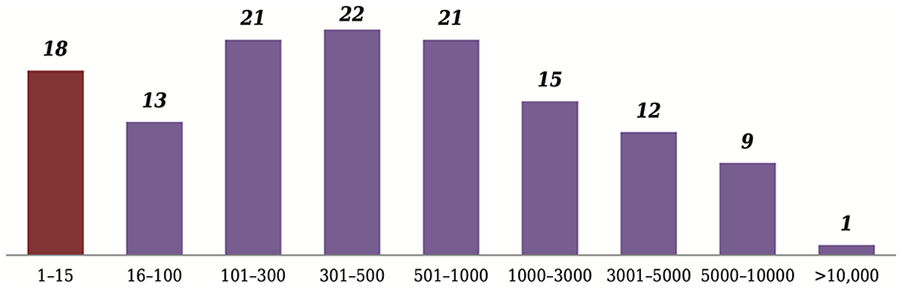
The size of speech communities in Vanuatu (François et al., 2015, p. 8).
Classification of languages
The autochthonous languages of Vanuatu are all members of the Oceanic subgroup of the Austronesian language family. Most are Southern Oceanic languages, a primary subgroup of Oceanic. These languages can be subgrouped into two main groups: North Central Vanuatu and Southern Vanuatu (Clark, 2009; Lynch, 2001). Three Polynesian languages are also present in Vanuatu: Mele-Fila, Futuna-Aniwa, and Fakamae, which will be discussed in the “Emae” and “North Malekula” sections below. These languages are not members of the Southern Oceanic subgroup and are instead known as Polynesian Outlier languages, members of the Polynesian group spoken outside of the geographic region of Polynesia.
Linguistic diversity
The diversification of language in Vanuatu and the high level of movement between groups within Vanuatu and from emigrant populations throughout its history provide the frame for the multilingual situations found there today. François (2012) describes Vanuatu as a region where cultural and linguistic diversity is the norm (p. 86). François et al. (2015) wrote that there is an average of 88 km2 for each of Vanuatu’s 138 languages, making Vanuatu the “densest linguistic landscape in the world” (p. 8). Of course, the distribution of languages is not as straightforward as one language every 88 km2. Islands exhibit different levels of density. Figure 2 presents the distribution of language density across Vanuatu’s islands.
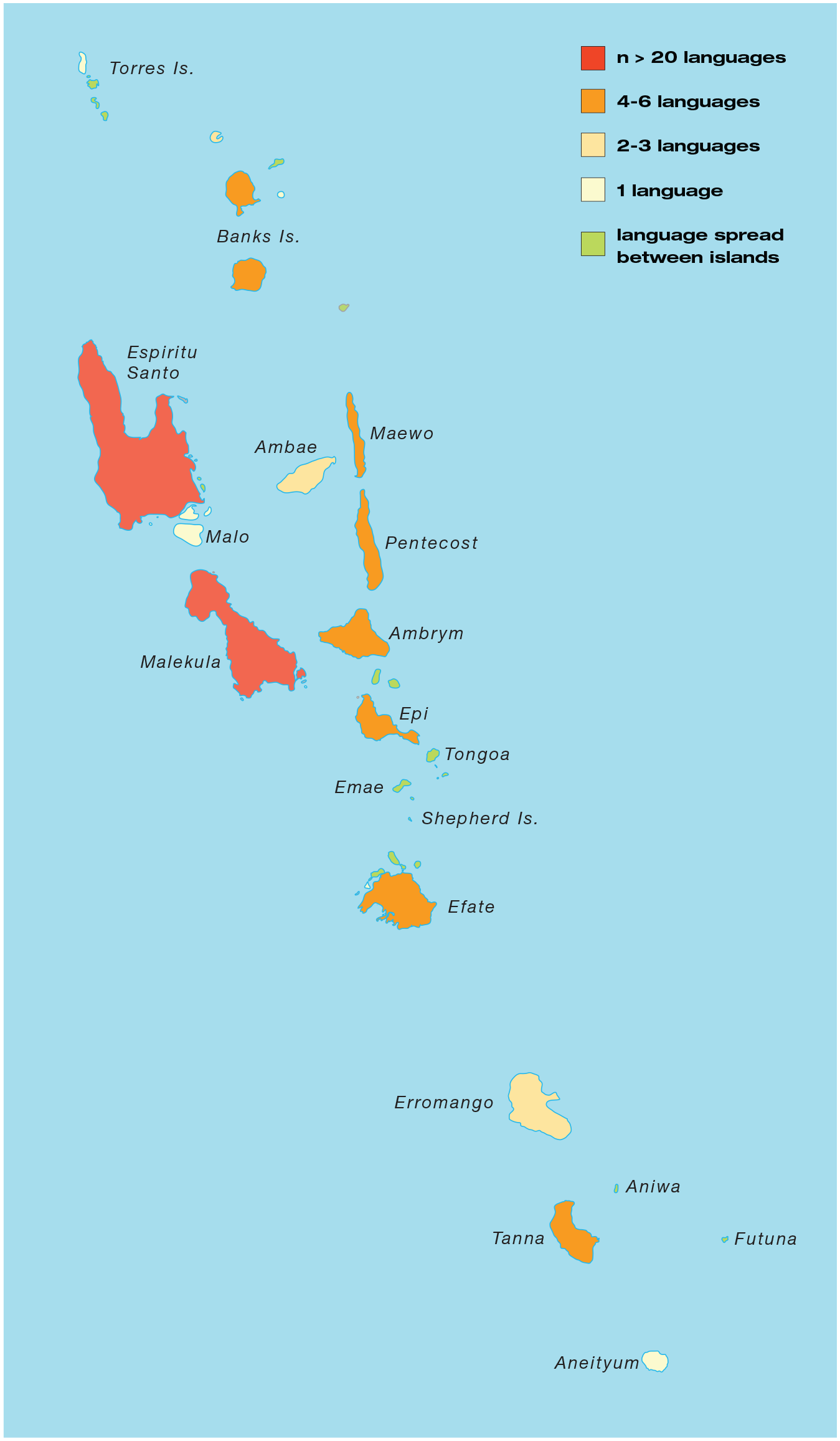
Distribution of language density in Vanuatu.
The reasons for this linguistic density are numerous. According to François (2012), linguistic heterogeneity in Vanuatu can be explained by social bias (pp. 90–95). He wrote: “The emergence of diversity did not merely result from geographical isolation and separate development of languages. A key component in the historical process of cultural and linguistic heterogenization is [an] ideological bias towards the active differentiation among local communities (François, 2012, p. 92)”. Linguistic diversity, according to François (2012), is therefore due to “the exploitation of language in its emblematic function” (p. 94). So, at base, communities in Vanuatu strive for a unique identity, even while they may be culturally cohesive, causing them to linguistically differentiate.
External inputs in Vanuatu’s history are equally responsible for its linguistic diversity. Recent genetic work by Posth et al. (2018) echoes and supports linguistic claims by Blust (2005, 2008) and Donohue and Denham (2008) that waves of migration from New Guinea in Vanuatu’s early settlement period may be responsible for at least some of Vanuatu’s linguistic diversity. Specifically, Posth et al. (2018) argued that several innovative features found in the Oceanic languages of Vanuatu can be attributed to Papuan influence (Blust, 2005, 2008; Donohue & Denham, 2008; Lynch, 1981; Tryon, 1982). In addition to the possible early Papuan influence, a later series of large-scale migrations, within the last 1000 years, from the western area of Polynesia brought in Polynesian languages to Vanuatu. Today, there are clear cultural and linguistic residues of these migrations. These remnants consist of the three Polynesian languages spoken in central and south Vanuatu, as well as significant borrowing from Polynesian languages into the non-Polynesian languages of these regions (see Hermann & Walworth, 2020; Lynch, 1994, 1996, 2001). These migrations and their resulting linguistic interactions certainly contributed to the linguistic diversity in Vanuatu and the linguistic circumstances that are discussed in the following section.
Multiple multilingual situations
The diversity of languages in Vanuatu and the uneven distribution of those languages among the islands has led, unsurprisingly, to a diversity of linguistic situations. Each island exhibits multiple and intersecting linguistic spaces in which varying degrees of multilingualism can be observed, as we will demonstrate in this section. As will additionally be shown through our examples (see ‘Emae Island’, below), even neighboring villages with very similar linguistic contexts can maintain different multilingual situations.
The multitude of distinct multilingual situations in Vanuatu can also be attributed to overlapping networks of exchange and interaction that are at the foundation of Vanuatu’s sociocultural history (Bedford & Spriggs, 2008, 2018; Bonnemaison, 1986; Huffman, 1997; Tryon, 1998), and include: trade and exchange of valued goods (e.g. woven mats, pigs); bride exchange across village and island boundaries and the subsequent maintenance of family contact and alliances across these borders; environmental pressures that forced migration (e.g. volcanic eruptions, tsunamis, landslides); and implicit linguistic exogamy in some areas. The varying degrees of language contact that have resulted from these cultural exchanges have inevitably had an effect on Vanuatu’s linguistic landscape, and the number of languages that one might speak. The multilingualism in Vanuatu is therefore “small-scale”, as defined by Lüpke (2016) as “communicative practices in heteroglossic societies in which multilingual interaction is not governed by domain specialization and hierarchical relationships of the different names languages and lects used in them, but by deeply rooted social practices within a meaningful geographic setting” (p. 35).
In the following sections, we describe four different examples of small-scale multilingualism in Vanuatu. Here, we report our findings from the language use and language histories survey data and present summaries of our first-hand observations. For each situation, sociohistorical information is also considered in order to address possible factors for the type of multilingualism described.
Data collection
Our assessments of multilingualism in these four examples from Vanuatu are based on first-hand observations of linguistic practices in each of these areas, as well as data from language use surveys. Generalizations about the multilingual practices of these particular areas were then made based on these surveys and ethnolinguistic observations.
The language use surveys were carried out primarily with adults, and, with the exception of the more targeted studies in Makatu and Tongamea on Emae Island, those surveyed were over the age of 40. These surveys represent self-reported linguistic repertoires and individuals’ language use and multilingual practices. “First Language” assignment was based on an individual’s response to the question, “what is your native language?”. 1 While answers were uncontroversial, it is important to note that responses correspond to what an individual identified with as their “First Language” and that did not always correspond to the language most used by the individual or the language they reported to be their most fluent. Additional languages (represented in online Appendices 2 and 3 as “Second Language”, “Third Language”, etc.) were not necessarily assessed by the speaker in any particular order. If a person reported to speak more than one language they were asked to assess their fluency, based on the following criteria, and they were asked how they came to know the additional language (i.e. through school, through church, through marriage, through family, etc.). The criteria were presented in Bislama but have been translated here to English for a general audience.
I speak and understand this language as well as I speak my native language.
I am fluent in this language.
I understand and speak this language, but am not fluent.
I understand but do not speak this language.
I know a little of this language, but not much.
These reports included all languages, not just historically autochthonous languages of Vanuatu, and including the dominant languages of the country (Bislama, French, and English). We have not included these in our assessments of the small-scale multilingualism described in this paper, however, and are focused here only on non-dominant local and autochthonous languages. The survey not only investigated the number and use of languages spoken by an individual but also their immediate family members and members of their households.
It is important to note that in two of the cases—Maewo and North Malekula—the surveys were not collected for the specific purpose of investigating multilingualism in Vanuatu, but were collected as a part of general background information of speakers during language surveying in these areas. For this reason, the number of participants per language variety in Maewo and North Malekula was often only one or two participants. Despite the low participant numbers for the surveys, clear patterns about multilingualism emerged through observations of language use and practice in these areas during long-term linguistic fieldwork. However, further larger-scale surveying of each individual speech community in these two areas would be a valuable complement to these preliminary case studies.
Emae
The island of Emae, in central Vanuatu, has a total population of around 750 people (Vanuatu National Statistics Office, 2009). This study focuses on the two villages of Makatu and Tongamea, which share an autochthonous language, Fakamae, a Polynesian Outlier language. These two neighboring villages are the primary locations of the Fakamae speech community today; however, attitudes toward the language differ between the two villages, resulting in different multilingual settings involving the two other non-Polynesian autochthonous Vanuatu languages, Nakanamanga and Namakura, which are also spoken on neighboring islands (Makira (or Makura), Mataso, Tongariki, and Tongoa; Figure 3) and in nearby villages (Nambua, Sangava, Sesake, and Marae; Figure 4).
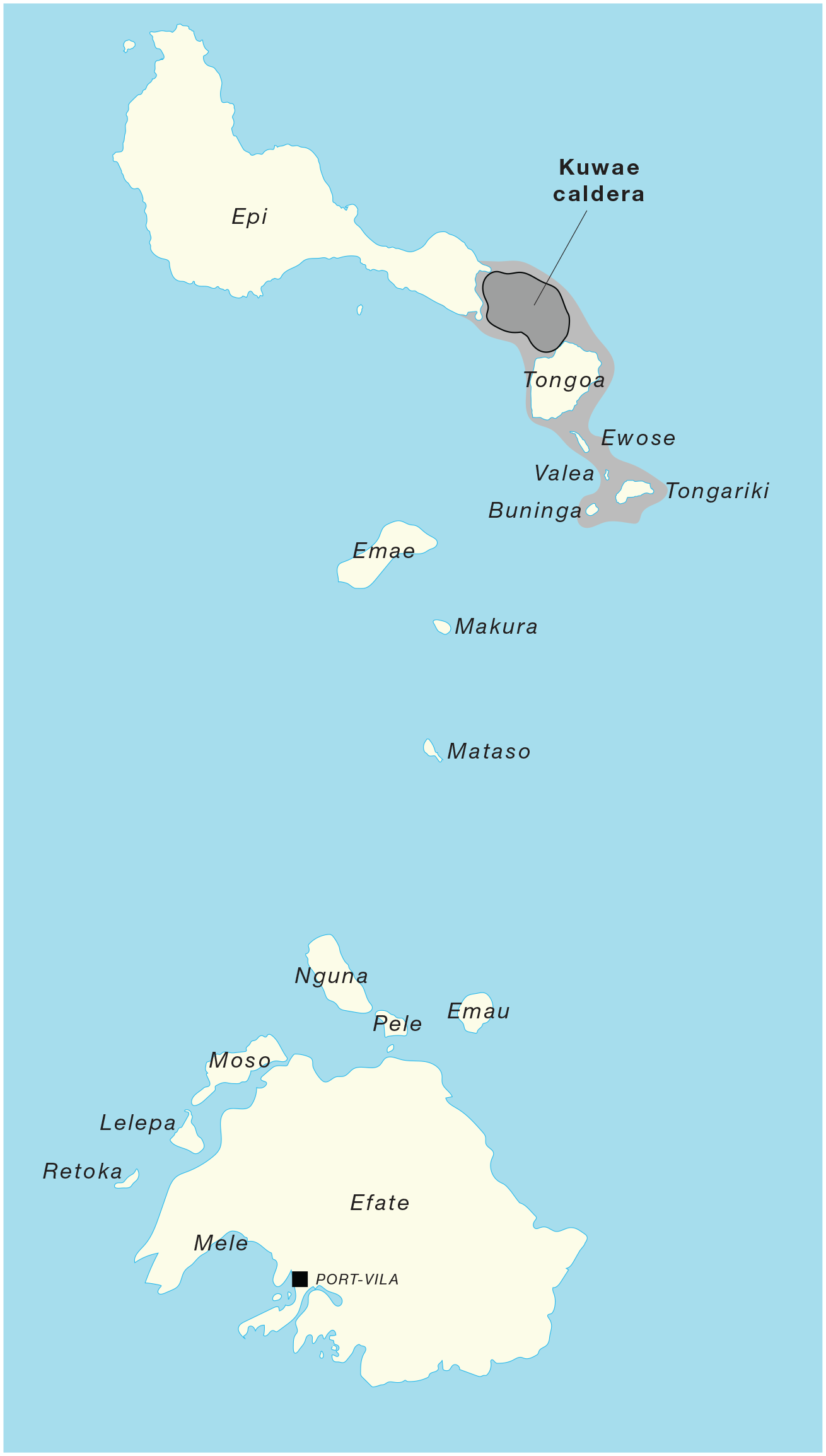
Kuwae Caldera and central Vanuatu.
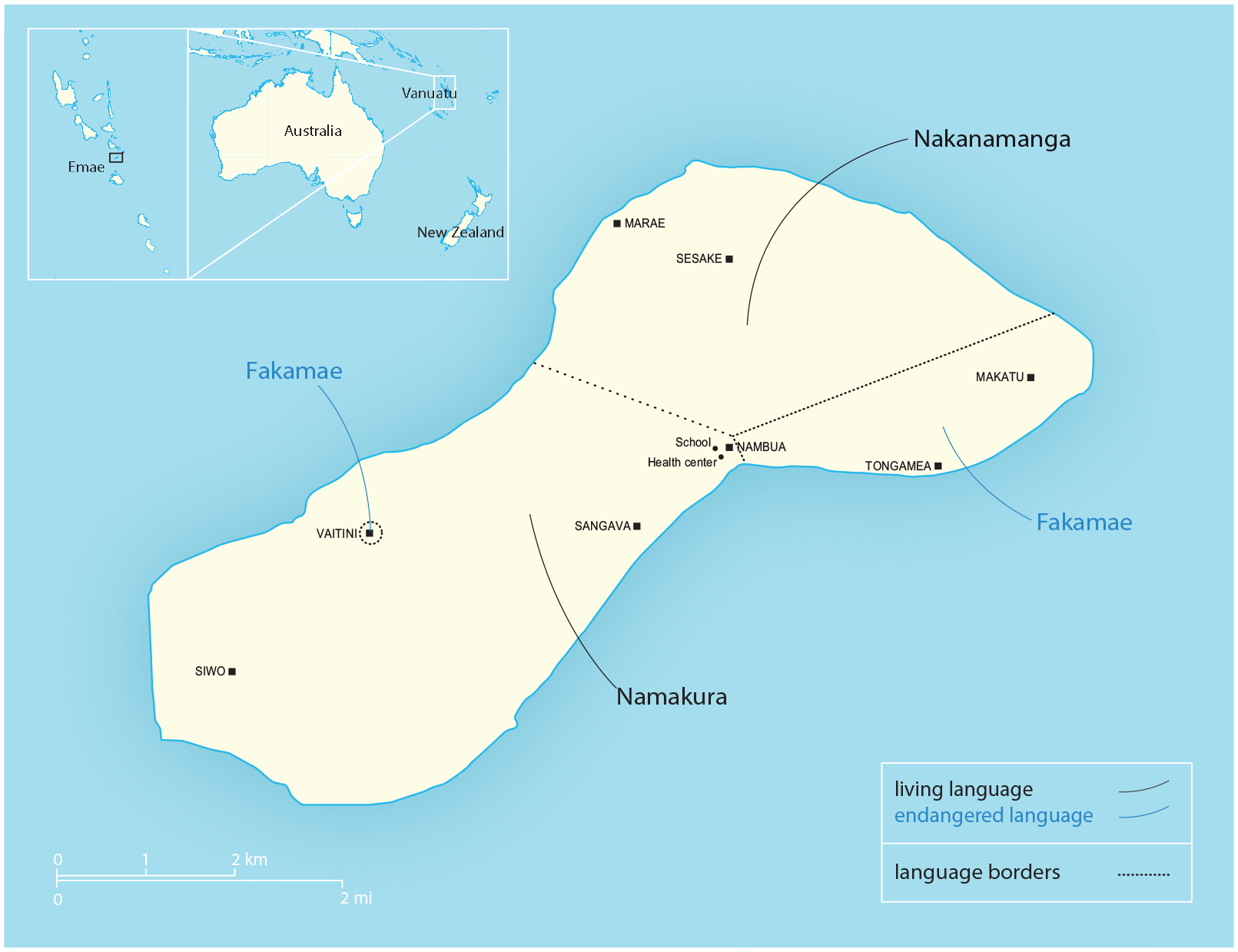
Language distribution on Emae.
The contact situation between these three languages is made up of centuries of interaction between neighboring islands, as well as multiple waves of migration and settlement. The pre-European historical storyline includes two major events in the last millennium that are responsible for the current language situation on Emae. First is the arrival of Polynesian-speaking peoples around 1000 years ago to Emae, which had already been settled by non-Polynesian-speaking peoples well before (Hermann et al., in preparation). Due to a fully oral tradition and no written linguistic records from this time, we have no way of knowing what these languages sounded like, although based on what we can surmise from oral histories, the linguistic history of the region, and the languages spoken on Emae today, we can be sure that the language of the immigrants was Polynesian and we can hypothesize that the language(s) in situ were ancestors of modern Central Vanuatu languages. The second major event, the Kuwae eruption of the mid-15th century, caused two migratory events: mass migration of speaker groups from neighboring islands such as Tongoa, Tongariki, and Epi to Emae (Clark, 1996), and re-colonization of the region by neighboring Efate island chiefs shortly after that eruption (Guiart, 1973). Figure 3 shows the location of the Kuwae Caldera as well as the islands neighboring Emae, in central Vanuatu. Again, we cannot know precisely what these people or chiefs were speaking, but it is certain that they were speaking early versions of the languages spoken today on Emae that are also historically and currently spoken on these neighboring islands: Nakanamanga and Namakura.
In more recent history, language shifts and increased linguistic repertoires are due primarily to intermarriage and close proximity to speakers of different languages. Fakamae was historically spoken throughout most of the eastern part of the island; however, today it is only spoken in three villages: Vaitini, 2 Makatu, and Tongamea. Only in one, Makatu, is it actively maintained by the entire population. The majority of the island speaks Nakanamanga or Namakura, and the school, health center, and airport are located in non-Polynesian speaking villages. Thus, for Fakamae speakers, there is almost daily interaction with these languages. Additionally, both Namakura and Nakanamanga have been continually imported into these villages through marriage. As a result of these languages being subsequently taught to children of such marriages over many generations and the maintained close contact with Namakura- or Nakanamanga-speaking family on neighboring islands, these languages are now more widely spoken on Emae. Both Namakura and Nakanamanga can be defined as “living languages”, in that they are widely used and contrast with Fakamae, which is endangered. The languages of Emae and surrounding islands are mapped in Figures 4 and 5, respectively.
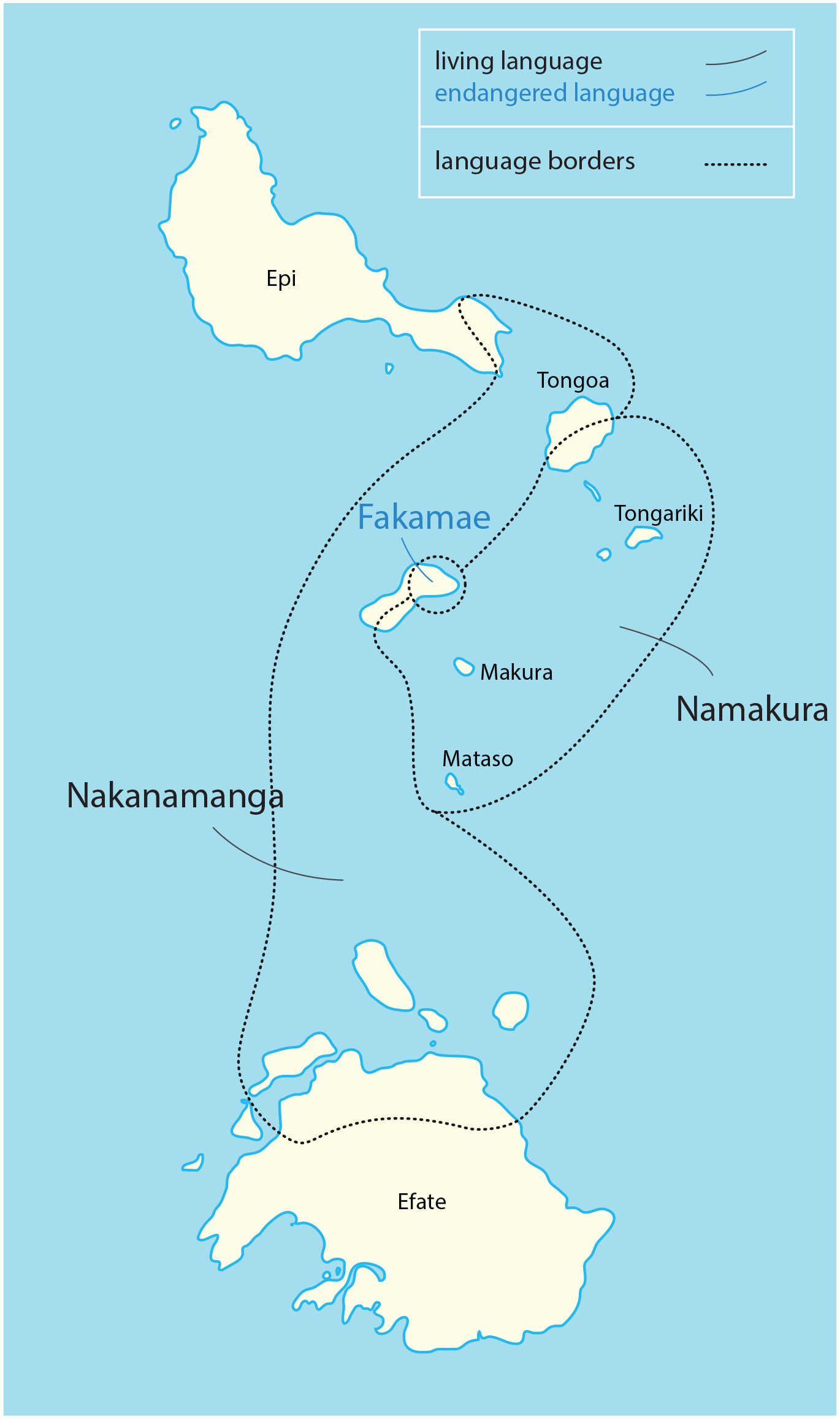
Language distribution in central Vanuatu.
Makatu Village
Makatu has a regular population of approximately 30 to 35 people, children and adults. The authors were able to survey most of the adult members who were currently in the village and willing to participate at the time (15 individuals). All but three adults present in the village during the time of the survey participated. Online Appendix 1 presents a summary of this survey. Participant names have been replaced with numbers, exact ages have been replaced with ranges, and some specific personal history information has been excluded or made to be intentionally ambiguous to protect the identity of participants. This summary of the results includes only reports of non-major languages (i.e. not Bislama, English, or French).
In this survey, we observed that the majority of the Makatu adult population speaks all three local languages. Of those that do not: one is not a permanent resident, living primarily in the capital of Vanuatu, Port Vila, where Bislama is the primary language of use by the majority of the population; one married into the village from a non-neighboring region of Vanuatu; and the four others are under the age of 35, all of whom reported speaking only one other language—Bislama—for communication outside of the village. From this, we can conclude that situations that lead to increased use of Bislama (life in the capital city, no knowledge of local languages, more increased general exposure to Bislama due to younger age) may limit acquisition of additional languages.
What is most significant here is that 100% of those surveyed reported to speak Fakamae, whether or not they are a Makatu-native, a permanent resident, or immigrated to Makatu. This demonstrates what was also observed in speech practices: that people who identify as having historical lineages from Makatu strongly align with their historically Polynesian linguistic identity and that in order to maintain this unique Polynesian identity, they actively maintain and enforce Fakamae use in Makatu, in spite of significant population decline and in the face of encroaching neighboring languages. Paradoxically, due to depopulation, people of Makatu have had to marry outside of the village, and often outside of the language community, to avoid incest. In these cases, those who marry-in are encouraged to learn and speak Fakamae. As demonstrated in the survey summary, 100% of those people who married-in report to speak Fakamae. Furthermore, those who do not reside permanently in the village still report to maintain it as a first language and 100% of people who identify as native-Makatu self-report Fakamae as their first language. Moreover, while community members report being able to speak Nakanamanga and Namakura, they do not do so between each other in the village. While they can speak Nakanamanga and Namakura, and do so in certain social contexts, such as school and interactions with family on neighboring islands and in neighboring villages, they assert their linguistic identity and maintain monolingualism between themselves, within their community.
Tongamea Village
Tongamea is a half-hour walk west of Makatu. Though emigration rates are also high in this village, it has a larger population of about 113 (64 adults). Thirty-seven participants were interviewed in Tongamea. As well as recording participants’ own practices of multilingualism, these people were also asked to give an assessment of the multilingual practices of members of their household, giving a village-wide snapshot of multilingualism. Online Appendix 2 summarizes the results of this survey. It includes data for community members aged 16 years and over. As with Table 1 in Online Appendix 1, participant names have been replaced with numbers and exact ages have been replaced with ranges. This summary excludes the major languages of English and French; however, Bislama is included on the basis that a number of community members are identified as speaking this as a first language. The survey results summarized in Online Appendix 2 are further analyzed in Table 1. This table outlines the first languages of the Tongamea community, and the total numbers of languages used by this community. In this table, dual first languages are assigned one unit each. We see that the majority of the Tongamea community speak the same two local languages: 98.5% use Fakamae, and 95.5% use Namakura. Nakanamanga is also used, though by only 64% of the community.
First language and total speaker numbers in Tongamea, Emae.
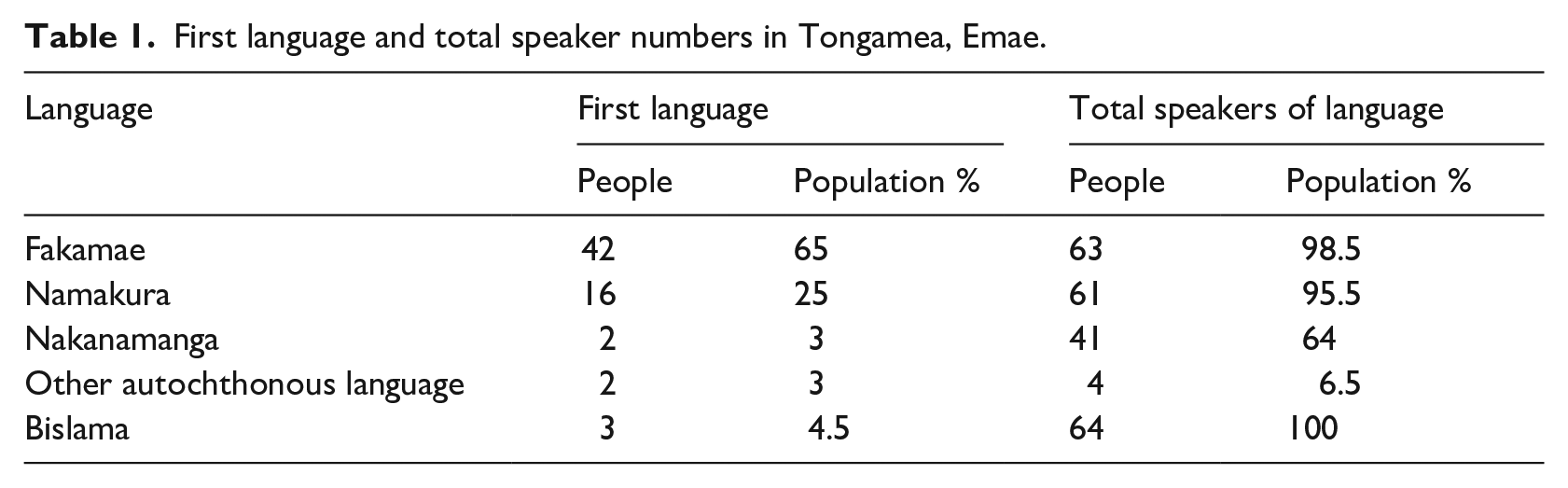
Perhaps the greatest difference between these two villages is that there is a perceived shift in critical mass under way in Tongamea, whereby Namakura is seen to be gaining strength to the disadvantage of Fakamae. While the population of Makatu also appears to grasp such a shift, it is observed to be more prevalent in Tongamea. This perception is partly fueled by community awareness of similar shifts which, according to oral histories, took place among earlier generations in other villages further west of Tongamea. In these instances, what had been Fakamae-speaking areas underwent a shift to Namakura as a result of steady migration from nearby Makira Island over time. Migration to Tongamea from Makira Island and other Namakura-speaking villages (Sangava and Nambua) on Emae is common and remains ongoing for marriage purposes. Many men and women from Namakura-speaking places have moved to Tongamea for marriage, though exogamy is not a current cultural expectation in the village. The same is true for Nakanamanga migrants, though to a much lesser extent. Twenty-five percent of Tongamea adults speak Namakura as their first language, and though all of these people have developed some level of Fakamae knowledge, their presence reflects the growing emblematic role of Namakura, whereby the social and geographical space of Tongamea may in time become redefined as a Namakura area (François, 2012, p. 94).
This situation represents an instance of ‘de facto imbalance’, whereby Namakura is more influential than Fakamae because of a greater number of speakers, though both languages remain equal in social terms (François, 2012, p. 99). This numerical imbalance has led to a situation of asymmetrical multilingualism on the island, whereby Fakamae speakers generally speak Namakura, and to a lesser extent Nakanamanga, while this is usually not reciprocated (see Khachaturyan & Konoshenko, 2021 for a comparable situation of asymmetrical multilingualism in Guinea). While asymmetrical multilingualism impacts the Makatu community in an inter-village context, the impact is greater in Tongamea because of the more significant number of Namakura first language speakers living within the village. This group possesses varying degrees of Fakamae fluency; however, there are enough Tongamea community members with Namakura knowledge—over 95% of adults surveyed – that Fakamae is not essential for intra-village communication, as it is in Makatu. Because of this, Namakura is often spoken by both Fakamae and Namakura first language speakers in a variety of intra-village contexts, both in and outside of the home. It is often used in public settings, and its emblematic role is strengthened by the fact that two of three village chief representatives were born in Makira and are native Namakura speakers, though both have developed productive knowledge in Fakamae.
Many Tongamea community members see a shift from Fakamae to Namakura as inevitable and beyond their control. This perceived shift is viewed negatively: Fakamae is seen as intrinsically linked to the space of Tongamea as a historically “Polynesian” place. At the same time, most people view Namakura in and of itself in positive terms as part of their linguistic repertoire. Namakura is seen as a useful language, also unique to the region, and reflective of strong links to family both in other villages and on Makira Island.
North Malekula
Malekula, with a population of around 23,000 people (Vanuatu National Statistics Office, 2009), is the most linguistically diverse island in Vanuatu with over 40 languages and over 100 varieties of those languages (see Figure 6 and Shimelman et al., 2020, https://vanuatuvoices.clld.org/). In this section, we focus on the northern part of this island (see the shaded areas of Figure 6). The majority of villages in North Malekula are home to approximately 200 to 300 people, based on numbers assessed by the Malampa provincial office (personal communication, 2020).
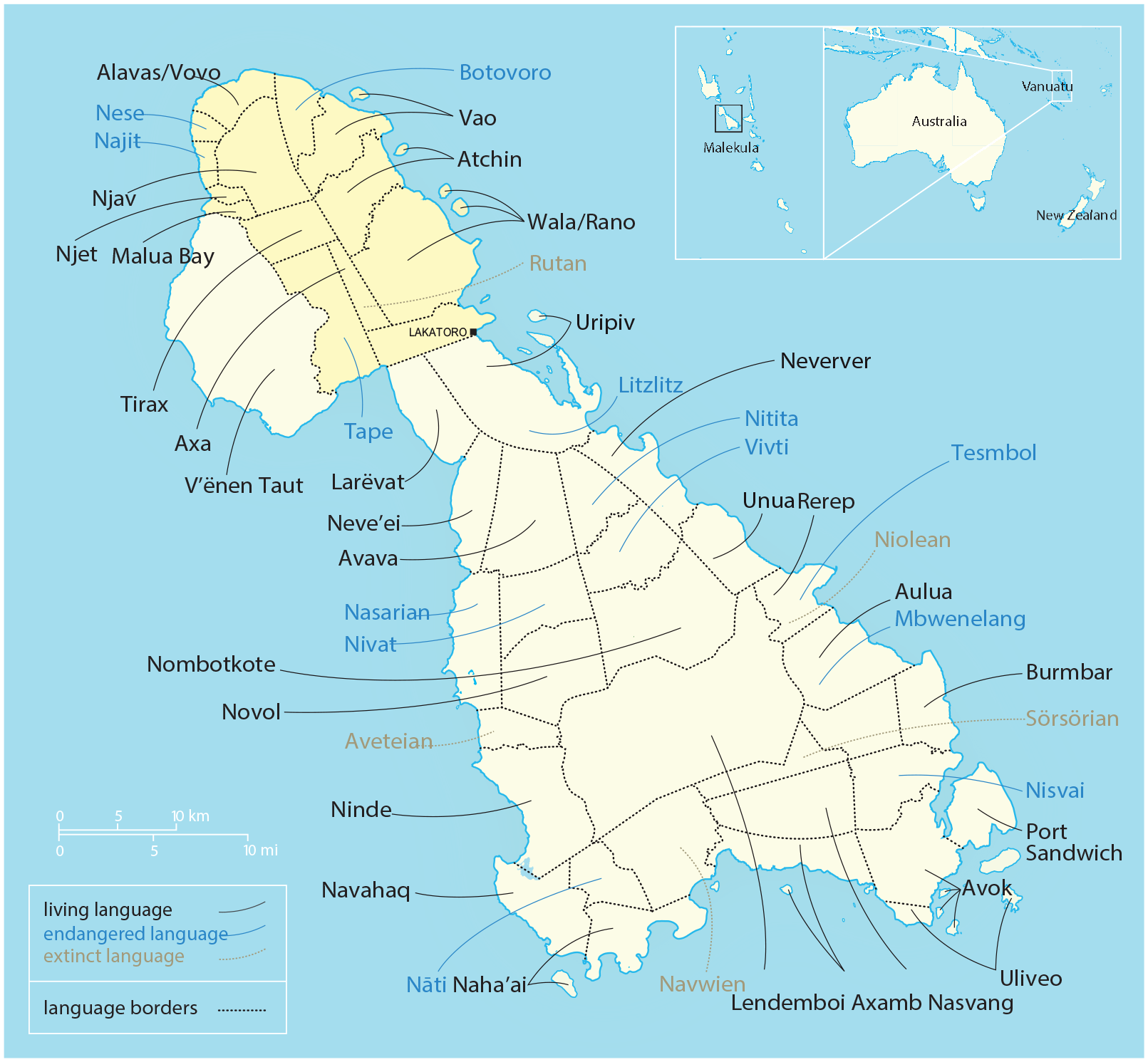
Language distribution on Malekula.
Twenty-four individuals, representing 24 different households, in North Malekula were surveyed. From these surveys and our observations, we found that households in North Malekula maintain up to five local languages. Seventeen participants, or 71% of individuals surveyed, reported speaking three languages or more.
The primary reason for the multilingualism observed in contemporary North Malekula is the mobility of people for marriage and the subsequent maintenance of family relationships across village boundaries. Of the individuals surveyed, 87% cited family ties in other villages as a reason for their multilingualism. In North Malekula, we observed a social rule of exogamous marriage practices, where one must marry outside of one’s immediate village community. Currently, because each village identifies as a unique speech community, marrying outside of one’s community implies marrying outside of one’s language community. While the rules of exogamy here are not explicitly linguistic, the area can nevertheless be considered as practicing linguistic exogamy (similar practices are described by Döhler, 2021). It is worth noting that this implicit linguistic exogamy is not a historical social practice in this region and multilingualism may not have been historically as widespread as it is currently. Elders in the community report that movement outside of one’s community was, in the past, rare during times of tribal conflicts. Grimshaw (1907) wrote in relation to communities in southwest Malekula that “the tribes of the interior have, in many cases, never been down to the coast . . .” (p. 221). This scenario can be applied equally to North Malekula, where inland communities also did not venture far from their designated areas during times of conflict. In the past, practices of exogamy were thus likely to occur only among families of highly ranked men. In these cases, the children of chiefs were often prohibited to marry someone of a lower social status within their own village (Grimshaw, 1907). Grimshaw (1907) further reported that communication between speech communities in Malekula in the late 19th century was also limited due to numerous and differing language varieties (p. 272). This suggests that there were indeed times of little communication between different speech communities in Malekula prior to the missionary period on the island. The advent of Christianity in North Malekula gradually halted conflict, fostering more frequent peaceful contacts between different language communities and common intermarriage. Consequently, today, marriage occurs almost exclusively outside of one’s language community.
As in many other parts of Vanuatu, marriage in North Malekula is predominantly patrilocal, where women generally move from their villages to their husband’s village after marriage. 3 Women are obligated to learn the language of their new place and this becomes the language of the household. Children, as a result, acquire the language of their home community—their father’s language. Often, however, they also learn their mother’s language. According to our observations and language use surveys, in general, the mother still speaks her language at home and there is regular contact and visitation with members of the mother’s family who also speak her language. Family language learning is, however, reciprocal. Not only do children learn the language of their mother in order to be able to communicate with their maternal family members, but often members of the woman’s family come to acquire the language of her new village and her in-laws. This is due to the social obligation that a man’s family has to “host” any of the wife’s immediate relatives whenever they wish. If the visitor spends enough time with the host (as often does occur), then they acquires the language spoken there. Sometimes men also learn their wife’s language; however, it is socially unacceptable for her language to be the primary household language or for the man to use it with any regularity—it is used only to accommodate her relatives.
Further contributing to multilingualism in North Malekula is another kind of mobility: short-term displacement of individuals for the purposes of being nearer to a school or to a church. Of the 24 individuals surveyed, 26% cited moving for education or religion as the reason for acquiring another language. For example, a child whose mother and father are from two different villages may migrate with the family to another village to be near a church or a school and, consequently, the family acquires the language of that area, irrespective of whether they have any relatives in that village. Short term displacement does not only engender the acquisition of the language of an area in which a school or mission is based by an immigrant family. It is a common case in North Malekula that students from a different language area intermingle with other students who speak a totally different language from the one spoken in the area in which the school is located and acquire the language of those other students. In such contact situations, one student from a different language background can acquire the language of another group in a particular socio-communicative setting within a different language area. So, for example, a student speaking the Njaxa language attends a primary school in the Njet speaking area, intermingles with students speaking the Batarxopu language, and acquires their language.
Maewo
Maewo, an island in northern Vanuatu, has a population of approximately 3600 people (Vanuatu National Statistics Office, 2016). Extensive language surveying of the island by the authors in 2018 revealed at least eight autochthonous languages and 19 different language varieties to be spoken there, with a different linguistic variety in nearly every village (see Shimelman et al., 2020, https://vanuatuvoices.clld.org/). Figure 7 shows the rough boundaries of the eight primary autochthonous language varieties of Maewo: Sungwadia, Sungwadaga, Sungwada, Sungwaloge, Sungwadoga, Nalemba, Xalangi, and Sungagage.
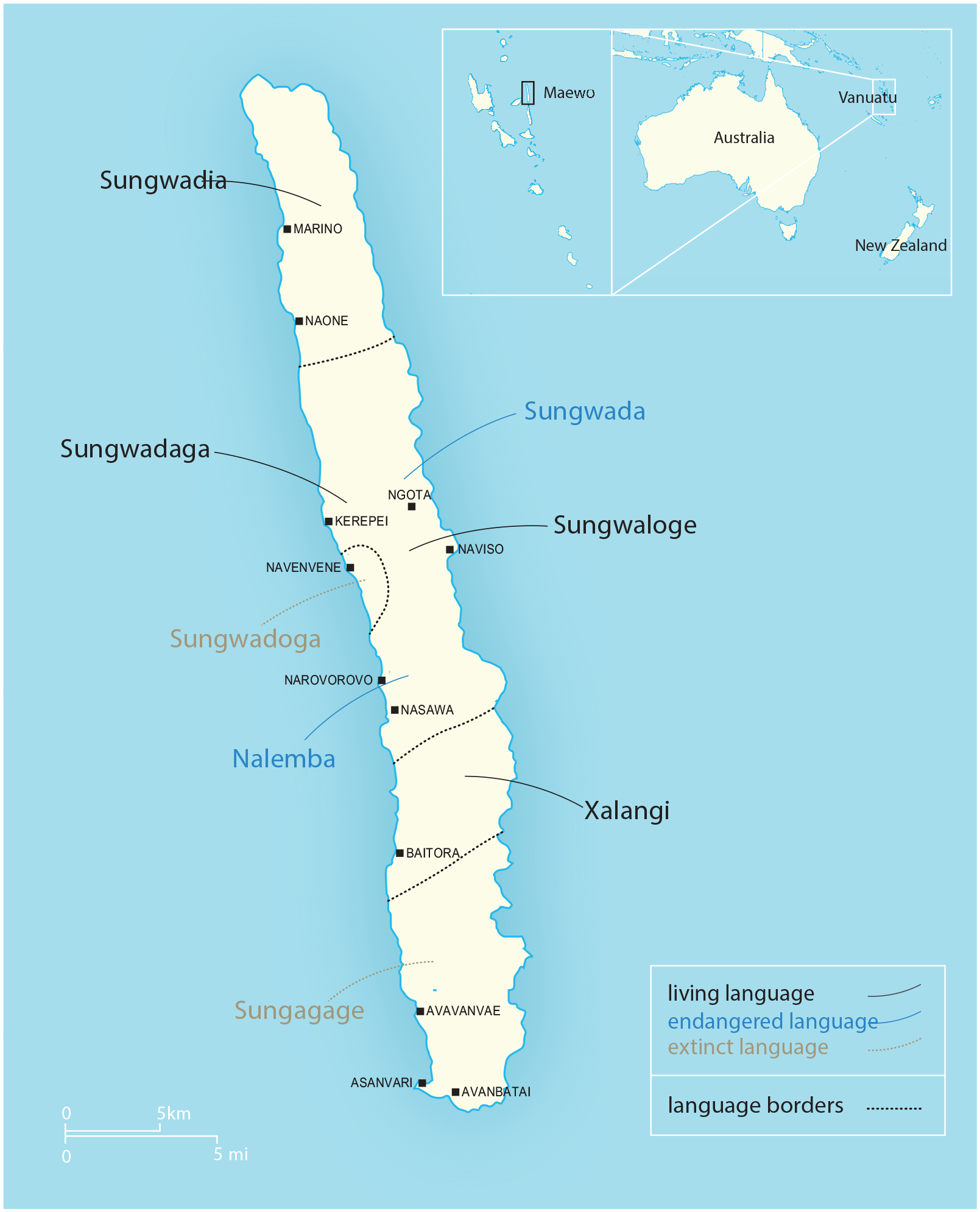
Language distribution on Maewo.
On Maewo, multilingualism is exhibited to a lesser extent than on Malekula, with individuals usually speaking between one and three languages. Of the 29 adults surveyed throughout Maewo, only four individuals reported speaking more than three languages and nearly half (45%, or 13 adults) reported being bilingual. Multilingualism, however, varies across the island. In the northern part of the island, most people provide language similarity as a reason for multilingualism. For example, most people who speak Sungwadia as a first language also speak Sungwadaga (and vice versa) and claim to do so on the basis of their perceived similarity. Elsewhere on the island, this is not the case and multilingualism is usually only a result of a person having moved from a village where a distinct language is spoken. This disjunction between types of multilingualism also has an explanation in an individual’s mobility and their access to neighboring and more distant villages. The entirety of North Maewo is generally accessible all year round; all modern villages are located at low elevations along the coast and movement between them (at least in recent history) is fluid. Populations in the south exhibit substantive degrees of mobility (more so with the arrival of powered watercraft) but to a much lesser degree than in the north. Generally speaking, most people speak the language of their village and only one other language if they moved into their village of residence from a village with a different language variety.
Maewo additionally presents three additional examples of population movement and language shift within the last 70 years, which has impacted language use. Each historical population movement has resulted in different forms of multilingualism. Firstly, in the 1960s, a group of Mwerlap-speaking people from the Banks Islands (about 40 km north of Maewo) came to live in Marino in North Maewo. All of the Mwerlap speakers have acquired the local Sungwadia language irrespective of their gender or clan identity. While the clan systems between Maewo and the Banks Islands differ in their terms, the correspondences with Maewo are known and so aspects of land use and marriage were able to be negotiated through an understanding of the equivalences between the two systems. It is unclear to what extent the Mwerlap language will continue to be spoken in this community and in what social or home contexts. It should be noted that strong influences of Mwerlap language on the communalect of Marino have been described by Henri (2011) predominantly in the lexicon, for example the pronominal systems (p. 158) and negation (p. 397).
A second modern example of population movement and language shift involves the arrival of Raga-speaking people from North Pentecost into southern Maewo sometime prior to 1962 (see Lynch & Crowley, 2001, p. 63). The modern village of Asanvari where the Raga language is found to be spoken was formed in 1963. Unlike in the Marino case, there was not a dominant shift to the local Sungagage language but instead, Raga has become the primary language of the extreme south of Maewo, spoken both in Asanvari and Avanbatai including the smaller villages in between (e.g. Lavui and Avavanvae). Sungagage itself is no longer being spoken as a first language of children and knowledge of the language is only retained among a very select few older individuals. In this case—perhaps due to its superior numbers (estimated at 400 speakers by Lynch & Crowley, 2001, p. 63) and the isolation of southern Maewo—the Raga language has all but replaced the local language variety of Sungagage.
Finally, a third recent historic development was the movement of a community within Maewo. In 1952, Sungwadaga-speaking Ngota village residents left their villages in the interior of the island, to take up residency on the eastern coast, just on the northern side of Naviso. This community of Sungwadaga-speaking residents are nowadays fully competent Sungwaloge speakers. Interestingly, however, many residents self-reported practices of receptive multilingualism in which residents of both communities continue to use their own language in conversation with their linguistic neighbors even though each had verbal proficiency in the other’s language.
We contend that the lower relative occurrence of multilingualism in Maewo also relates to both the presence of and adherence to a matrilineal descent system, in which matrilineal clan membership dictates who one can marry (Hume, 1985), rather than residentially exogamous marriage patterns, like those we observe on Malekula today. Critically, clan membership and linguistic repertoires do not co-vary. This is due to the fact that one clan can be made up of speakers of multiple languages and clan membership does not dictate residence of individuals. Residence is patrilineal and clan membership is matrilineal. In other words, rules of marriage are dictated by clan identity and do not strictly overlap with residency, and one’s linguistic identity corresponds to one’s residence. Clans have rights to parcels of land across the island. Associations between land and clan are not constrained to homogeneous blocks divided according to village groups but instead form something of a mosaic of clan–land relationships that may have multiple languages spoken across them. In this way, who a person marries does not necessarily correspond with the language that they speak or their linguistic identity, as it does in the example we have described for Malekula. Whereas in North Malekula people must marry outside of their village and therefore outside of their speech community, in Maewo, people may end up married to speakers of the same language.
Defining Vanuatu’s multilingual situations
In order to properly compare these situations, we must arrive at some categorization for the type of multilingualism found in each. To do this, we appeal to the types of multilingualism presented by Lüpke (2016): reciprocal multilingualism, receptive multilingualism, and passive multilingualism (p. 64). Because we do not use Lüpke’s scale as a diagnostic tool, but rather a guiding reference, we have chosen to focus only on two of Lüpke’s four parameters for assigning these values: pervasiveness of multilingualism and scope of identities. In this way, we define reciprocal multilingualism as a situation where no monolingualism is practiced and indexical identities are observed; receptive multilingualism is defined as where monolingualism is practiced by some group members and dual identities are observed; and, finally, passive multilingualism is where monolingualism is practiced by most group members and essentialist identities are observed (pp. 63–64).
On Emae, two neighboring villages within the same historical linguistic area have rather similar linguistic settings but exhibit different multilingual situations. In Makatu, people strongly align with their Polynesian linguistic identity, and while they can speak Nakanamanga and Namakura and do so when speaking to Nakanamanga and Namakura speakers who do not reside in their village, they firmly assert their Polynesian linguistic identity and maintain monolingualism within their community. They furthermore expect that others who settle in their community learn and speak Fakamae in order to maintain this village-level monolingualism. In this way, we can argue that multilingual practices in Makatu are passive. The situation of multilingualism in Tongamea can, by contrast, be assessed as more receptive. Dual linguistic identities are observable, whereby Tongamea community members align strongly with their historically Polynesian identity but also possess strong links to Namakura through kin ties. Multilingualism is more pervasive in Tongamea than in Makatu, and we observed that Namakura and Fakamae are regularly spoken by both Fakamae and Namakura first language speakers in Tongamea village. As we can see, the contrast in the scope of identities in these similar linguistic settings has impacted the way multilingualism has manifested. Whereas multilingualism is more covert in Makatu, it is overt and widespread in Tongamea, and both Fakamae and Namakura languages are spoken by community members in a range of pragmatically determined contexts.
In North Malekula, people are very multilingual. They tend to associate with multiple linguistic identities due to their familial connections in multiple villages and their mobility in the region for school and church. These linguistic identities are clearly indexed, and the contexts of place and extended family shape language use. Language learning is mutual and, generally, no single variety of one’s linguistic repertoire appears to take precedence over another. Although language boundaries are marked as villages align with one language variety as the language of the place, fluidity is observed in actual language use and in the reciprocality of language learning in the household and with extended family. North Malekula, as a collective unit, may then be defined as mostly reciprocal.
Finally, in Maewo, we observe multiple multilingual situations. First, there is a general tendency for people to maintain dual social identities—clan and linguistic. However, people tend to maintain a singular linguistic identity; that of their home village. Localized movement of individuals, particularly in the northern parts of the island, has led to acquisition of additional languages and many people report some level of bilingualism. Second, we observed that where large migrant populations reside, dual linguistic identities—the language of the immigrant group and the language of the place—are usually maintained even while language use is reported to be mostly monolingual. In two of these cases, the Ngota population in Naviso village and the Mwerlap migrants in North Maewo, regular language use appears from reports to align with the language identity of the place. However, observations of actual language use (Henri, 2011) suggest that both the local languages and the immigrant languages are used in some capacity by all residents. In South Maewo, residents have acquired the language of the immigrant group, to the extent that the heritage language, Sungagage, is now rarely used and has not been actively intergenerationally transmitted for some time. The community, however, still aligns with Sungagage as the heritage language of the place. As discussed in the ‘Maewo’ section (above) this shift toward the “foreign” language likely relates to the high number of immigrants. In Maewo, then, we often see dual identities and an overall tendency toward some bilingualism. Therefore, in its diverse ways, Maewo may be generally defined as receptive.
Driving forces of multilingualism
Through defining the types of multilingualism present in these case studies according to their degree of multilingualism and the scope of identities, we can furthermore identify patterns in the social and historical processes that have led to the various kinds of multilingualism found. In all of our case studies, we observe the following as the primary factors for small-scale multilingual development:
interaction of linguistic and sociocultural identities;
mobility of individuals and entire speech communities.
Under “interaction of linguistic and sociocultural identities”, we can further specify two types based on the examples from Vanuatu: (a) interaction of linguistic and kinship identities; and (b) alignment of linguistic identities with marked cultural identities. Under “mobility”, we also witness two kinds: (a) mobility of individuals in localized networks due to social factors, such as education and religion; and (b) mass migrations into new speech communities. These factors interact in different ways based on the particular social rules and histories of the respective speech community, and, as a result, lead to varying acquisition of languages in a speaker’s repertoire.
We contend that the interaction of one’s sociocultural identity has direct effects on the extent to which they are multilingual. Focusing first on the interaction of linguistic and kinship identities, we observe in the examples provided above a correspondence between linguistic identity and marriage residence. In North Malekula, marriage is exogamous, whether explicit or implicitly defined. As a result, people generally partner with a speaker of another language variety and are more multilingual. On Maewo, the dual identities of one’s matrilineal clan and one’s local residence do not lead to the same trend, and as a result, people are less multilingual. Second, we observe that when the linguistic identity of a community is directly linked to a specific and marked cultural identity, more monolingualism is practiced even when people report to speak multiple languages. For example, the essentialist cultural identity of the Polynesian-speaking community of Makatu creates for these residents a more passive multilingualism, wherein people act mostly monolingual and where immigrants must learn the local language, even while the population is generally able to communicate in other languages in certain social contexts. This contrasts with Tongamea village, Maewo, and North Malekula, where people generally maintain more than one cultural identity.
We further argue that mobility, in terms of both historical mass migrations and individuals’ local mobility, has notable impacts on the degree to which multilingualism occurs. In all of our examples, the movement of individuals beyond their own villages for social reasons (formal education, church services, healthcare) has clearly prompted some level of acquisition of other local languages. In Malekula, we furthermore see that individuals living outside their home villages for schooling or to be nearer to a specific church results in reports of additional language acquisition not only of the language of the village of the school or church, but also of the languages of classmates and fellow practitioners. In addition to these individual movements, in both Maewo and in Emae, we see that whole community displacements and historical mass migrations have resulted in a tendency to report general monolingualism but to still acquire additional languages into one’s repertoire and, in the cases of Maewo and Tongamea, to maintain more than one linguistic identity.
In sum, when linguistic identity dictates marriage patterns, as demonstrated for North Malekula, more significant multilingualism occurs and is maintained. When linguistic identity is strongly aligned to a distinct or marked cultural identity, as in the village of Makatu, multilingualism tends to be less practiced. As we demonstrate in all of our examples, mobility of individuals results in more multilingualism. However, as we have seen in Makatu village and in some parts of Maewo, the movement of entire speech communities has resulted in less reported multilingualism, even when linguistic repertoires and actual use indicate knowledge or acquisition of other languages.
Conclusions
Given the diversity of multilingual situations found in Vanuatu and their risk of disappearance, it is critical to document and compare them for a better global understanding of what drives various types of small-scale multilingualism. Through such studies of the various contexts in which multilingualism emerges, we can begin to observe factors that drive small-scale multilingualism. In the case studies presented in this paper for Vanuatu, we have analyzed the social and historical processes that have led to various multilingual situations in an attempt to uncover the general causes for small-scale multilingual development. First, we have observed a clear connection between sociolinguistic identity and multilingualism. In Vanuatu, how a community views itself in relation to other communities is often based on the variety of language used in a place. In many parts of Vanuatu, this linguistic identity drives social practices and, as a result, plays an important role in the degree of multilingualism that occurs. Second, we have demonstrated a clear link between kinship and multilingualism. Previous discussions of the role kinship plays in multilingual settings have been generally focused on how exogamy affects what languages people speak and, importantly, the extent of their language inventory (Aikhenvald, 2003; Campbell & Grondona, 2010; François, 2012; Lüpke, 2016; among others). The example from Malekula outlined in this paper also shows that practices of exogamy lead to multilingualism. We furthermore demonstrate that a lack of exogamy, and the role of multiple kin identities, as in the case of Maewo, produces situations of low multilingualism. Third, we observe in Vanuatu that mobility greatly impacts the linguistic landscape. The mobility of individuals for sociocultural factors like school, religion, or marriage facilitates more multilingualism, whereas the movement of entire village populations seems to lead to more marked use of one language.
Furthermore, the examples in Vanuatu demonstrate the vast complexity of small-scale multilingual situations and the importance of addressing the sociohistorical processes that surround multilingualism. Cultural and historical processes that drive small-scale multilingualism are often neglected in linguistic research (Di Carlo et al., 2021; Lüpke, 2016, p. 42); however, it is necessary to describe and investigate the various social conditions that trigger these situations (Di Carlo et al., 2021; Lüpke, 2016, p. 42; Matras, 2009, p. 48; Trudgill, 2011, p. 185). In Vanuatu, for example, we have shown that one’s linguistic repertoire does not simply represent the languages that they speak, but also how a person defines themselves with respect to others, the place where they “belong”, their kin affiliations, and the paths of their ancestors. This multifaceted identity within a linguistic repertoire demonstrates the critical importance of not only examining speech practice and language use, but also investigating individuals’ own assessments of their linguistic repertoires alongside their sociocultural histories, which indeed are the foundation for current linguistic situations.
Supplemental Material
sj-pdf-1-ijb-10.1177_13670069211023132 – Supplemental material for Multilingualism in Vanuatu: Four case studies
Supplemental material, sj-pdf-1-ijb-10.1177_13670069211023132 for Multilingualism in Vanuatu: Four case studies by Mary Walworth, Amy Dewar, Thomas Ennever, Lana Takau and Iveth Rodriguez in International Journal of Bilingualism
Supplemental Material
sj-pdf-2-ijb-10.1177_13670069211023132 – Supplemental material for Multilingualism in Vanuatu: Four case studies
Supplemental material, sj-pdf-2-ijb-10.1177_13670069211023132 for Multilingualism in Vanuatu: Four case studies by Mary Walworth, Amy Dewar, Thomas Ennever, Lana Takau and Iveth Rodriguez in International Journal of Bilingualism
Footnotes
Acknowledgements
We wish to acknowledge our numerous consultants throughout Vanuatu who shared their language and cultural information with us, the Vanuatu Cultural Centre for their permission to carry out our research, and the Vanuatu Cultural Centre Fieldworkers on Emae, Malekula, and Maewo whose invaluable assistance facilitated our research. This article has benefited from the support and contribution of Professor Russell Gray, Director of the Department of Linguistic and Cultural Evolution, Dr. Olesya Khanina as a preliminary reviewer, and two anonymous reviewers.
Declaration of conflicting interests
The author(s) declared no potential conflicts of interest with respect to the research, authorship, and/or publication of this article.
Funding
The author(s) disclosed receipt of the following financial support for the research, authorship, and/or publication of this article: This work was supported by the Max Planck Institute for the Science of Human History Vanuatu Project (Mary Walworth and Lana Takau); Max Planck Institute for the Science of Human History Fieldwork Internship in Vanuatu Institute (Thomas Ennever and Iveth Rodriguez); an Australian Government Research Training Program Scholarship (Amy Dewar); and a Major Documentation Project Grant from the Endangered Languages Documentation Programme, MDP0369, ‘Documentation of Ifira-Mele and Emae, two Polynesian languages of Vanuatu’, Chief Investigator: Dr. Catriona Malau (Amy Dewar).

Supplemental material
Supplemental material for this article is available online.
Notes
Author biographies
References
Supplementary Material
Please find the following supplemental material available below.
For Open Access articles published under a Creative Commons License, all supplemental material carries the same license as the article it is associated with.
For non-Open Access articles published, all supplemental material carries a non-exclusive license, and permission requests for re-use of supplemental material or any part of supplemental material shall be sent directly to the copyright owner as specified in the copyright notice associated with the article.
