



Abstract
Aims and objectives/purpose/research question:
This research probes for language effects on witness memory in bilingual speakers whose languages are typologically distinct, English and Spanish. The key question is whether speakers’ memory for agentive motion events is influenced by first language (L1) or second language (L2) patterns, or both, when the L2 is used for descriptions.
Design/methodology/approach:
Four groups were tested in an event verbalisation and recognition memory task: English monolinguals, Spanish monolinguals, Late L1 English/L2 Spanish bilinguals and late L1 Spanish/L2 English bilinguals. The video stimuli depicted complex motion events (three manners of motion per event) because complex rather than simple events have been shown to elicit language effects.
Data and analysis:
The data for analyses include (a) the number of mentions and the type of detail included in the verbalisation of the manner of motion (the key typological difference) and (b) recognition error rates in the memory task. Recognition errors occurred when the pairs of target videos were deemed the same while in fact they were not.
Findings/conclusions:
Speaking in a L2 that makes it difficult to verbalise a component of an event (manner of motion) can have a negative effect on the memory for that specific component in L2 speakers, while at the same time benefiting memory for some other event features.
Originality:
This work shows, for the first time, negative effects of a L2 on memory for motion events and offers a hitherto elusive explanation and theoretical justification for the reasons when and why we do, or do not, get beneficial effects on memory in bilinguals.
Significance/implications:
The findings contribute to understanding of the effects of late (adult L2) acquisition on cognition. They support predictions of the Complex Adaptive System Principles (CASP) for Bilingualism model, advocating fine-grained typological approaches to lexicalisation of cognitive domains and explicit teaching of typological differences that affect information content.
Keywords
Introduction
One of the most controversial topics in bilingualism is whether it does or does not result in any kind of cognitive advantages over monolingualism. In this paper the focus is on bilingual witness memory, a topic that is rarely discussed in the field. We ask whether speaking more than one language is beneficial for remembering events in a specific cognitive domain, that of motion events. Crucially, the study tests what happens when we are asked to watch, remember and describe events while using our second language (L2). The current research is contextualised within previous experimental findings on language and bilingual witness memory, which has shown that the benefits of bilingualism for memory of events are detected on some occasions (Filipović, 2018, 2020; Koster & Cadierno, 2019), but not on some others (Filipović, 2011).
It will be demonstrated that language typology plays a critical role in explaining the different outcomes of bilingualism, as does the type of bilingualism (balanced versus unbalanced) and the type of communicative situation (reflected in experimental conditions), that is, who the interlocutors are (e.g. other monolinguals or bilinguals) and whether both languages are equally (or near equally) active. The key question we ask is the following: are there any beneficial effects of bilingualism on witness memory, and if yes, what kind of bilingualism is beneficial, early/balanced, late/unbalanced or both? This paper presents new research as well as a critical comparison with previous experimental findings, which together enable us to account for, and predict, when we can expect to detect cognitive benefits of bilingualism for witness memory, and when and why the benefits may not be there. I also show how the current and earlier evidence supports the Complex Adaptive System Principles (CASP) for Bilingualism model by Filipović and Hawkins (2019).
I start by succinctly discussing the previous research from different areas relevant for the current study, including language typology, bilingual memory, bilingual language activation and the CASP for Bilingualism model. I then proceed with the account of the data and methodology used in the present study, followed by a contrastive discussion of the results from this study and the previous studies that used the same or similar experimental materials and that gave us either similar or different outcomes. Finally, the last section summarises the current findings and their theoretical and practical implications, and offers conclusions as well as suggestions for further research.
Theoretical backdrop
Language typology and linguistic relativity
Languages can be classified into different groups based on different criteria. One of the typological classifications is based on semantic criteria and it classifies languages based on how they lexicalise event components in different (universal) cognitive domains (Talmy, 1985, 2000). For example, in the cognitive domain of agentive motion, Spanish and English offer different lexicalisation strategies to their speakers. The preferred pattern in English is the manner component expressed in the verb and the path component expressed out of the verb (e.g. in a preposition), as in “Maya (agent) skipped (manner) into (path) the garden (ground)”. In contrast, the Spanish pattern requires the expression of path in the verb and manner out of the verb, in a non-obligatory constituent such as an adverbial: “Maya entró en el jardín (brincando)” = “Maya entered the garden (skipping)”. Manner verbs can be used in Spanish if there is no change of location, as in “Maya brincaba en el jardín” = “Maya skipped in the garden”. However, most of the motion descriptions in the context of witness reports, and in general language use as well, involve a report on change because communication in general is goal-oriented (Landau & Lakusta, 2012). That is, the information weight is on the change of state (or location), if it occurred, or on the final result or outcome, if known. The notion of change is implicit in motion events because change of location lies in their essence (Filipović, 2007).
If there are multiple paths to express, as in “Maya skipped out of her room, through the corridor and into the garden” or if multiple paths and manners are involved as in “Maya ran out of her room, leapt through the corridor and skipped into the garden”, Spanish speakers would be facing a serious challenge to express this in their language. They would have to use multiple manner gerunds (“running”, “leaping”, “skipping”) per each portion of path, or start a sentence with a manner gerund (e.g. “Skipping, Maya exited…”), but this is not done in that language (Filipović, 2008) because it goes against its rhetorical style and habitual use (Slobin, 1996). Consequently, Spanish speakers tend to remember complex motion events less well than English speakers (Filipović, 2011). Such language effects are more likely to be observed under increased cognitive load, for example, when complex events are used as experimental stimuli (Fausey & Boroditsky, 2011; Filipović, 2011). However, most previous research on motion events and cognition involving monolinguals and/or bilinguals used stimuli with depictions of simple motion events (see Daller et al., 2011; Filipović, 2010; Hohenstein et al., 2006; Malt et al., 2003). Complex event stimuli reflect human everyday experience better because our reality is characterised by complex rather than simple events (see Fausey & Boroditsky, 2011).
Numerous effects of language-specific restrictions and usage habits on motion event verbalisation, event categorisation and memory have been reported in the literature (for an overview, see Slobin, 2006; also Filipović, 2019). Such findings have contributed to the revival of the linguistic relativity debate and coincided with a resurgence of the Sapir–Whorf hypothesis and support of its non-deterministic interpretation. Namely, language-specific effects have been found in a number of different cognitive domains, such as colour (Regier & Kay, 2009; Roberson et al., 2005), objects (Lucy & Gaskins, 2003) and spatial orientation (Levinson, 2003). Some studies insist that it is only under certain specific conditions that language effects on cognition can be observed, for example, if the observed events are also explicitly described (Malt et al., 2003; Trueswell & Papafragou, 2010).
The linguistic relativity debate was significantly influenced by the thinking-for-speaking hypothesis, proposed by Slobin (1987, 1996, 1997, 2003), that captures the interaction of language and thought on numerous occasions – we think for speaking, and also for writing, for translating and for remembering. This means that our conceptualisation is affected by the categories and patterns that we have in our language(s) when language is recruited for an activity, but when language is not required, these effects may not be there. However, it is also important to emphasise that language pervades quite a lot of aspects of our daily life interactions, with the world around us and with other speakers, so it is hard to imagine its influence is ever fully and completely absent, blocked or switched off (although this can be achieved to an extent in experimental circumstances; e.g. Athanasopoulous et al., 2015; Trueswell & Papafragou, 2010).
Bilingual memory
Psycholinguistic research has shown that verbalisation improves memory performance (see Schooler & Engstler-Schooler, 1990, for an overview and a critical discussion), but there is some counter-evidence as well, namely that verbalisation may impair memory. Schooler and Engstler-Schooler (1990, p. 62) argued that “[. . .] verbally biased representation can then interfere with subjects’ ability to make use of their intact visual code”. This is due to the stronger source of information (verbal) becoming dominant over a weaker one (visual). Verbalisation is helpful to the visual memory if it supports it (e.g. providing the word “apple” when viewing an apple). If the verbal information is not helpful (e.g. because it lacks detail about manner of motion), then it is more likely to overshadow the information from the other source, the visual.
It has been known at least since Loftus and Palmer (1974) that language affects witness memory. These authors showed, in a monolingual context, that if we use words like “crash” instead of the less intense “collide” in witness questions about car accidents, witnesses are more likely to develop false memories and claim that they had seen broken glass where in actuality there was none. What is more controversial, however, is that different languages would impact witness memory differently, and this has been shown to be the case by Filipović (2011, 2013), who detected differences in memory outcomes for monolingual speakers of English and Spanish.
Most of the early research in bilingual memory, and memory in general, has been concerned with semantic memory – knowledge about facts including facts related to the two linguistic systems (e.g. lexical and syntactic knowledge; see Altarriba & Mathis, 1997, for a review). Over the last decade studies have begun to examine how the typological language contrasts may play out in bilingual verbalisation and memory of events in different cognitive domains where the two languages present the bilingual with different lexicalisation options. The key question to ask in this context is whether the way bilinguals remember events depends on the language they describe them in, or whether they rely on the patterns of their stronger language. Furthermore, is there a difference in terms of language effect on memory between early/balanced and late/unbalanced bilinguals?
In bilingualism research, studies on memory for motion events have shown conflicting results. In one study by Filipović (2020), English/Spanish (early, balanced) bilinguals were shown to have better memory for caused motion events (e.g. “X dropped Y”) than English monolinguals and equally good memory as Spanish monolinguals. In contrast, early (balanced) bilinguals, together with Spanish monolinguals, had worse memory for agentive motion events (“X staggered into/out of”) than English monolinguals (Filipović, 2011). These conflicting results can be explained if we dig deeper into the realm of typological distinctions within the different domains and if we use a model like CASP for Bilingualism (see the next section for details), which can account for these apparently disparate outcomes.
When it comes to late (unbalanced) bilinguals, research has shown that their linguistic behaviour (and also memory) seems to be mainly affected by their first language (L1) even when speaking a L2 (Filipović, 2018). However, the L2 can also have an effect (see Pavlenko, 2014, for overview). Learning and using a L2 that explicitly draws certain categorial (and conceptual) distinctions that the L1 does not draw can lead to improved memory for these categories (Koster & Cadierno, 2019).
In summary, the question of language-specific effects on cognition seems to be more a question of when and how strong rather than a yes–no dichotomy. Bilingual populations represent a particularly fertile testing ground for some of the most pertinent questions about the interactions of language and cognition. If our languages affect which event components we must express, or habitually prefer to express, and which we cannot express easily, then this difference can sharpen or blur our focus respectively in both language and memory. How then do bilinguals cope with the different demands from their two different languages (of the same or differing proficiency), when witnessing and remembering events?
Bilingual language activation and the CASP for Bilingualism model
One of the reasons it is difficult to properly capture bilingual linguistic behaviour within a single theoretical framework is the malleability of bilingual linguistic behaviour. Bilingual speakers generally adjust their linguistic outputs depending on who their interlocutors are, and they achieve this accommodation with varying success depending on the levels of their proficiency (see Filipović, 2019, for a detailed discussion). We know that bilinguals do it, but we do not quite know how. Grosjean (1992, 1998, 2001) proposed the notion of language mode in order to explain this phenomenon and he defines it as the state of activation of the bilingual’s language and language-processing mechanisms that can be affected by numerous different factors. The level of activation of each of the bilingual’s languages is seen as a continuum ranging from no activation to full activation, based on factors such as the communicative situation, the form and content of the message being listened to, the function of the language act or the participants involved in the exchange and the conventions between them, which might or might not tolerate switching between languages.
It is not clear how the different levels of activation can be confirmed with any certainty – it seems they can only be deduced based on the specifics of a communicative situation. Filipović and Hawkins (2019) observe that bilinguals can be said to be in a bilingual mode but behave very differently based on whom precisely they are addressing. For example, our bilingual speakers are in a fully bilingual mode when they are interpreting, or speaking to two monolinguals in their respective languages at the same time, when speaking formally to a bilingual audience or speaking informally to bilinguals who share the same languages. All of these situations are likely to result in different outputs even though the mode is always bilingual. Furthermore, many studies (e.g. Fabbro, 1999; Hernandez et al., 2000; Paradis, 1997, 2000) indicate that identifying activation levels associated with different languages may not be possible. In addition, an important question has been raised of whether it is the fluctuating language mode that is responsible for variation in bilingual linguistic behaviour or something else; for example, a kind of output monitor that regulates production (see De Groot, 2011, p. 288, for a discussion and see also De Groot, 2011, p. 290, on the circularity of attempts to determine language mode). Green and Abutalebi (2013, pp. 515–516) argue in a similar vein that it is the control processes that adapt to the different demands of different communicative contexts of single language, dual language or dense code-switching. They define single-language contexts as those in which each language is spoken in different environments (e.g. home versus work). Dual-language contexts involve the use of both languages with different speakers, possibly within a single communicative situation but not within an utterance, and dense code-switching occurs when both languages are used within a single utterance, for example, when speaking to another bilingual with the same language combination (Green & Abutalebi, 2013, p. 518). In this study, we are interested in a dual-language condition, when both language systems are active and competing on-line (see the Task and procedure section). This is because we want to establish what happens when the two systems are actively competing on-line when verbalising and remembering events. Different situation demands (e.g. monolingual communication) are likely to affect bilingual outputs differently, as are the relative levels of proficiency in each language (see Filipović, 2019; Filipović & Hawkins, 2019; Grainger & Dijkstra, 1992; Heredia & Altarriba, 2001; Santiago-Rivera & Altarriba, 2002).
It may seem that activation of the other language is redundant if one needs to use only one in a specific communicative situation, but this is precisely what happens (see the next section). Why do bilinguals tend to activate information in both languages at once when they are using only one at a time? The answer is that it is very difficult, or almost impossible, to completely switch off one of the two and it is actually efficient to have co-activation. This is captured by a new model of bilingual language processing, CASP for Bilingualism (Filipović & Hawkins, 2019). This model is based on a set of principles that sometimes collaborate and sometimes compete in bilingual acquisition and use. Filipović and Hawkins (2019) explain that the ensuing outputs of this push–pull relationship among the principles are conditioned by the language typology as well as by internal factors, such as type of bilingualism (e.g. different levels of proficiency), and external factors, such as situation or interlocutor type. For instance, CASP for Bilingualism predicts that bilinguals would aim to Maximise Common Ground and Maximise Efficiency in Communication by having information required by both systems available on-line even when speaking just one. Maximise Common Ground is a CASP principle that comprises what has commonly been labelled in the previous literature as either positive or negative transfer, but here they are treated as products of the same mechanism because both have the same background motivation, that of using something that works in both languages (Dussias, 2001, 2003; Dussias & Sagarra, 2007; Fernandez, 2002; Fernandez et al., 2017); Nicol et al., 2001; Nicoladis, 2002, 2006). The CASP principle of Maximise Efficiency in Communication captures the gist of bilingual efficiency: being multi-language ready and prepared to produce and adjust output in either language at any moment (Filipović, 2014, 2019; see Filipović and Hawkins, 2019, for further details and exemplifications of these and the other CASP for Bilingualism principles).
CASP for Bilingualism helps us explain some interesting aspects of bilingual linguistic behaviour, for example why in the case of caused motion events (Filipović, 2018, 2020) Spanish-English bilinguals add information about intentionality when speaking English (e.g. “The man dropped the bag on purpose/by accident”), even though English does not require it and English monolinguals typically do not do it. Spanish monolingual speakers and bilinguals highly proficient in that language habitually distinguish between intentional and non-intentional causation via the use of two different verbs or the same verb but in different constructions (e.g. Juan rompió el vaso = “John broke the glass” (intentional) versus Se le rompió el vaso a Juan = “John broke the glass” (unintentional)). Interestingly, the non-obligatory information about whether an event was intentional or not is provided by balanced bilinguals in both English and Spanish (Filipović, 2018) and was shown to facilitate memory for the cause in caused motion events. In other words, balanced English/Spanish bilinguals tend to include information on intentionality in both English and Spanish descriptions and remember this detail (intentional versus non-intentional) equally well when using either language. This reflects the previously reported drive in bilinguals to make the same information available in both languages, also found in some other domains (e.g. syntactic attachment Dussias, 2001, 2003; Fernandez, 2002) and agentive (non-transitive) motion descriptions (Hohenstein et al., 2006).
CASP for Bilingualism also explains why in the case of agentive (non-transitive) motion we see that balanced bilinguals in English and Spanish tend use the Spanish motion construction in both their languages (“enter running”), mimicking the use of Spanish monolinguals and in contrast with English monolinguals (who use “run into”; Filipović, 2011; Hohenstein et al., 2006). Again, because of the same principles of Maximise Common Ground and Maximise Efficiency in Communication, the bilinguals opt for the common ground and for being multi-language ready under the dual-language condition. The common ground is the shared pattern that exists in both languages and, in this case, it is the Spanish pattern (“enter running”). As explained earlier, the Spanish pattern makes it harder to include information about the manner of motion in agentive motion events and Spanish-English balanced bilinguals provide less detail in their verbalisations, as do Spanish monolinguals, and both groups have worse memory than the English monolingual speakers (Filipović, 2011).
When bilinguals of unequal proficiency, such as L1 Spanish/L2 English speakers and L1 English/L2 Spanish speakers, describe caused motion events in their respective L2s, the former group provides more explicit detail about intentionality than the latter and remembers information about intentionality better because they habitually distinguish between intentional and non-intentional events in their L1 Spanish. The L1 English/L2 Spanish speakers do not make the relevant intentionality distinctions in their L2 Spanish, probably because they do not draw this distinction habitually in their L1, they seem not to have mastered it in their L2 as it is not explicitly taught and, consequently, they lack awareness about it. So, we can say that both bilingual groups are Maximising Common Ground by using structures that are acceptable in both languages but they are doing it in a different way under the influence of their respective L1s: the L1 English/L2 Spanish speakers are using the same structure for intentional and unintentional meanings, which does not reflect adequate usage in Spanish but is a grammatically acceptable structure in both languages (e.g. Juan rompió el vaso = John broke the glass). L1 Spanish/L2 English are providing more information than required because of their L1 Spanish, which is not habitually done in English, their L2 (e.g. they add adverbs in English under influence of Spanish to distinguish between intentional and non-intentional events). As Filipović (2018) put it, both of these bilingual groups are speaking in their L2 but thinking in their L1. In earlier terminology (e.g. Odlin, 1989), we could say that both groups are exhibiting negative transfer, because they are going against the usage norms in their L2s. However, providing additional information about intentionality in the case of L1 Spanish/L2 English speakers is actually a positive feature – it provides a relevant piece of information about witnessed events (see Filipović, 2019, for a further discussion).
Thus, overall, it seems that balanced bilinguals in Spanish and English and Spanish-dominant (but not English-dominant) bilinguals seem to have an advantage for memory of caused motion events but not for agentive motion events, where native English monolinguals fare better in memory tasks than both balanced bilinguals and Spanish monolinguals. The current study is aimed at finding out how the memory for agentive motion is affected in unbalanced (late) bilingualism, where bilinguals are clearly dominant in either English or Spanish.
Present study: Data, methodology and results
Hypotheses
In line with the thinking-for-speaking hypothesis (Slobin, 1996, 1997, 2006), we can assume that active use of language in event description will affect memory for those events. If L1 habits and patterns persist even when the L2 is explicitly used (as numerous previous studies have shown; see a detailed overview in Pavlenko, 2014), then we could expect that English monolinguals and bilinguals with English as the stronger language would have better recall of the different manners of motion than Spanish monolinguals and L1 Spanish/L2 English bilinguals. In contrast, two alternative hypotheses are also possible. Namely, the bilinguals could be more influenced by their L2 than by their L1 because they were asked to use the L2 to verbalise the stimuli, and this may lead them to re-think for speaking (see Ellis & Cadierno, 2009; Koster & Cadierno, 2019) and also for remembering. In that case, the L1 Spanish/L2 English bilinguals would remember manners of motion better than the L1 English/L2 Spanish bilinguals. Finally, the bilinguals could be doing something that reflects the patterns in both of their languages, a kind of in-between, mixed performance, also noted in the previous literature (see again Pavlenko, 2014). Then we would expect the bilinguals to express more manner detail than Spanish monolinguals but less than English monolinguals, and the recognition memory results should also be inbetween: better than those for the Spanish but worse than those for the English monolingual populations.
Participants
There were 100 participants divided into four groups, 30 monolingual English, 25 monolingual Spanish speakers, 21 L1 English/L2 Spanish bilinguals and 24 L1 Spanish/L2 English bilinguals. All bilinguals were L1-dominant. They all acquired their L2 through schooling, and lived all their lives in their L1 countries (the UK and Spain, respectively). They all spent between 3 and 6 months in the respective L2 countries (mean time spent of 4.7 months at the time of testing), during which time they used both their languages (i.e. the immersion was never fully monolingual). The L1 English/L2 Spanish bilinguals (mean age 20; SD = 0.94) were in their final year of their undergraduate studies at one of three top British universities. They were all students of modern languages, all with Spanish as their L2 and with average grades of upper-second or first-class UK grades in Spanish (equivalent to the C1/C2 levels of proficiency in the CEFR – Common European Frame of Reference). Nine participants had a third language as well but of very low (A2/beginner) proficiency. The L1 Spanish/L2 English bilinguals were all Erasmus exchange students at two UK universities at the time of testing (mean age 21; SD = 0.69) with International English Language Testing System (IELTS) scores of 7 and above (out of maximum 9; 7 being the minimum score for admittance at British universities and also comparable to C1/C2 proficiency levels). Both bilingual groups were using their L1 extensively while staying in the respective L2 countries, although the L1 English group used their second language (Spanish) more on a daily basis (half a day or more) than the L1 Spanish group (who used their second language less than half day). Monolingual Spanish participants (mean age 29; SD = 2.7) were visitors to the UK with only limited travel knowledge of English. Monolingual English speakers were all residents in the UK, with no knowledge of Spanish (mean age 27; SD = 1.7).
Materials
The stimuli were the same as those used in Filipović (2011) with balanced English-Spanish bilinguals, which offers an opportunity to make detailed comparisons of outcomes. The target experimental items are given in Table 1 and the verbs marked in bold in both columns indicate where the difference was between the model and the variant.
Target video stimuli.
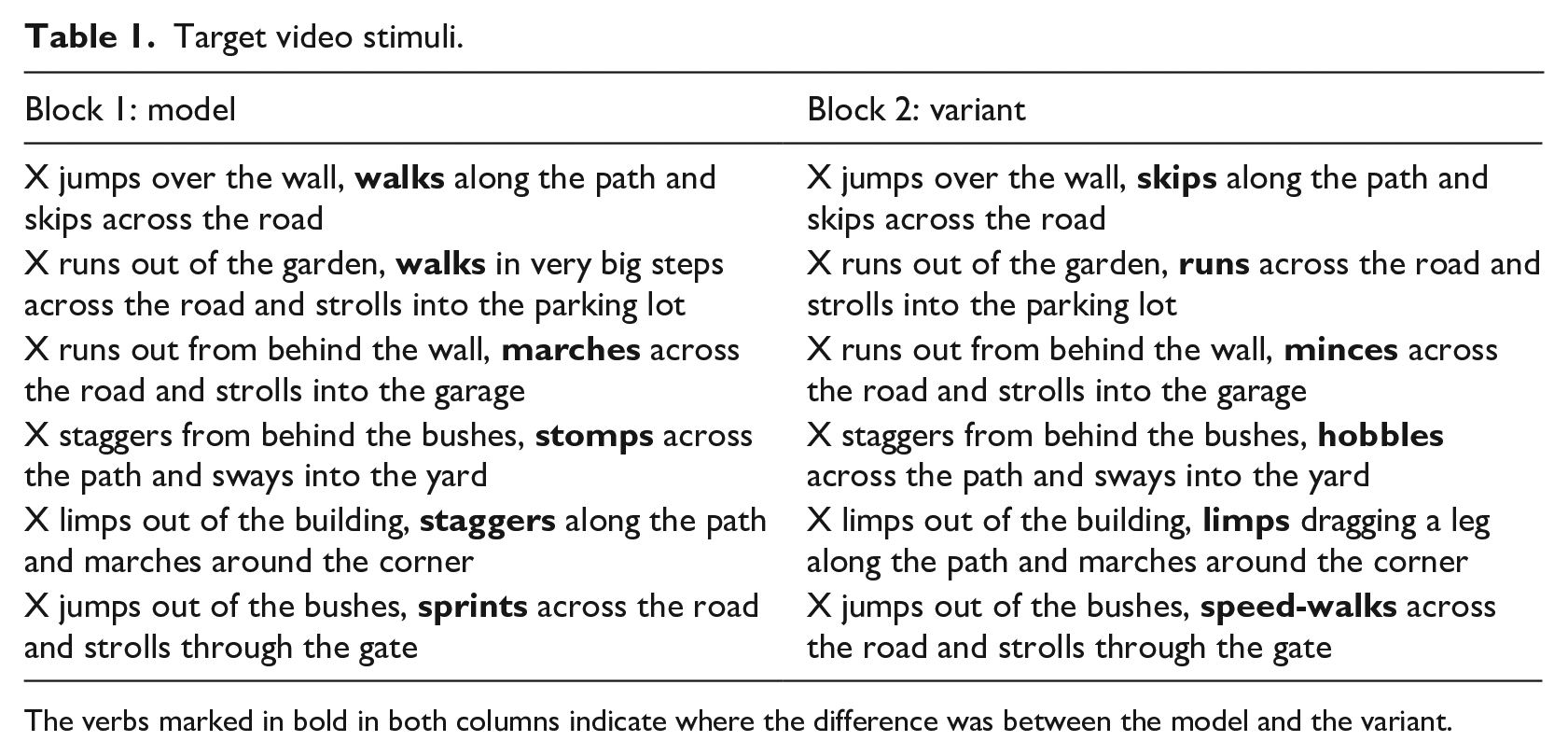
The verbs marked in bold in both columns indicate where the difference was between the model and the variant.
Videos were filmed with a DCR-HC18E Sony digital video camera. The experiment was run on a portable PC laptop using Microsoft Office Power Point presentation. The video clips (14 in total; six targets and eight fillers) lasted approximately 6 seconds each. Each video depicted a different person moving in three different manners per event. Each target item consisted of two video clips: one model and one variant. The model target videos contained three target items each, that is, three manners of motion, for example, limping, staggering and marching. The variant differed in one of the three original manners (e.g. running instead of walking). The fillers depicted non-motion complex activities (that had to be labelled with more than one verb), such as opening a book, leafing through it and then closing it, or putting a number of beads on a string and laying it on the table. Filler variants contained either the same video (no recognition error (RE) expected) or one item changed (RE expected; for example, not closing the book while in the model it was closed in the end or threading four beads instead of only three that were put in the model). Each model and its variant had the same actor, the same surroundings and the same paths, so the only component that was changed was one of the manners of motion. The filler clips were balanced so that half differed from the filler models in the first block and half were the same as the filler models. REs for both target and filler items were counted. An error was marked if a target or filler event in the second block was deemed the same as in the first block when in fact it was not, and vice versa for the fillers only, when an identical filler video was shown in the second block but was not recognised as such.
Task and procedure
All participants were shown two video clips for training, one containing a motion event and the other a non-motion event. They were told that they would be watching videos depicting various indoor and outdoor activities. Importantly, both bilingual groups were kept in a dual-language condition via the experimenter’s questions, which were delivered in the participant’s L1 while being asked after each video to respond to the question “What happened in the video?” in their L2. The only difference in procedure between Filipović (2011) and this study was that there was no condition without verbalisation in this study. This is because the aim of the present study was to ensure that the participants were indeed using their L2 in verbalisation and not staying silent and relying tacitly on their L1.
In the first block the participants saw a randomised mix of target videos and fillers (six targets and eight fillers) and were asked to write down what happened. This was followed by a distractor task of 120 seconds in the form of a 10 × 10 grid of randomised letters, with the participants asked to count as many letters M and N as they could see. The second block contained the same number of videos, again a randomised mix of target videos and fillers (six and eight, respectively). They were asked to describe the event again and put a plus (+) or a minus (–) sign next to it depending on whether they thought they had seen an identical event in the previous block.
There was no monetary or course credit award for the participation in the experiment. All the participants were informed about the ethical guidance underlying this research and told they could withdraw their participation at any point. No personal data other than the relevant meta data, such as age, L2 language proficiency and frequency of use, were accessed or used for the purpose of the analysis. The ethical permission for the data collection was granted to the author by the author’s university ethics board in accordance with its GDPR-compliant ethics policy.
Results
Verbalisation task results
The monolingual groups produced descriptions in line with their typological preferences, as predicted and illustrated in (1) for English and in (2) for Spanish: 1) The man jumped from the bushes, leapt across the road and went into the garden opposite. 2) El hombre salió de un recinto, cruzó la calle y entró The man exit-PST.3SG from an enclosure cross-PST.3SG the street and enter – PST.3SG al jardín de la casa del otro lado. into-the garden of the house of-the other side.
English monolinguals provided manner detail regularly, with the average of 2.4 manner items per verbalised event, while the mean of manner verbalisations per motion event for the Spanish monolinguals was 0.28. Both bilingual groups performed similarly to the Spanish monolingual group, using mainly the Spanish syntactic pattern and with manner item means of 0.73 (L1 Spanish) and 0.69 (L1 English). Most motion event descriptions by Spanish monolinguals and both bilingual groups contained one or no manner items (i.e. manner verbs or adverbials as in examples (3) – “with slow steps” or (5) “slowly”). Importantly, English monolingual speakers used 18 types of manner verbs (e.g. hobble, hop, jump, limp, march, run, skip, stagger, stride, sway, etc.), while the rest of the groups used only three types in monolingual Spanish, L2 Spanish and L2 English verbalisations (“caminar” – walk, “correr” – run and “saltar” – jump).
L1 English/L2 Spanish speakers used the Spanish pattern of path verbs either with no or one item with manner content (gerund or adverb; see example (3)). On very rare occasions there was also the erroneous manner verb + path particle from the L1 English, which is ungrammatical in Spanish (example (4)). Even though more manner information was present in the L1 English bilinguals’ descriptions in L2 Spanish (47%) than in the Spanish monolingual verbalisations (17%), this was nowhere near as frequent as in the monolingual English speakers’ verbalisations, where 98% of motion event descriptions contained at least one item with manner of motion content.
3) Una mujer salió con pasos lentos y atraversó el jardín. A woman exit-PST.3SG with steps slow and cross-PST.3SG the garden. 4) *El hombre saltó y corrió a través della calle y en el jardín. A man jump-PST.3SG and run-PST.3SG across-the street and in the garden.
The L1 Spanish/L2 English bilinguals used the Spanish pattern almost exclusively in their L2 English and they also occasionally provided some information about manner (27%), more often than Spanish monolinguals (17%) but less often when compared to the figures above from the monolingual English and the L1 English/L2 Spanish participants. Examples of bilingual descriptions by L1 Spanish/ L2 English speakers are given in (5) and (6): 5) A woman went out of the building slowly and turned the corner to the right. 6) A man walked out of the garden, went across the road and entered another garden.
Memory task results
A 2 × 2 analysis of variance (ANOVA; group – monolingual versus bilingual × language spoken – English versus Spanish) showed a main effect of language (F = 8.64; df = 1.00; p = .005; SE = 4.6), a main effect of group (F = 4.507; df = 39; p = .001; SE = 4.7) on recognition accuracy (DV) and a significant group/language interaction (F = 15.27; df = 1; p = .008). The post-hoc independent sample t-tests with Bonferroni adjustment for multiple comparisons revealed significant differences between English monolinguals on the one hand and all the other groups on the other, but only for the target items, that is, the videos with motion events. Namely, the performance of L1 English bilinguals and English monolinguals differed significantly (t = −2.69; p = .005; SE = 1.73) and so did the performance of L1 Spanish bilinguals and English monolinguals (t = −9.15; p = .000; SE = 2.10). Similarly, there was a significant difference between the two monolingual groups (t = −3.89; p = .001; SE = 1.25). There was no significant difference between the Spanish monolingual group and the two bilingual populations, or between the two bilingual groups (p > .05). There was also no significant difference in the recognition memory for the filler (non-motion) videos (p > .05). An item reliability alpha coefficient test revealed that there was no specific item that was skewing the results among either target (a = .74) or filler items (a = .84). The mean values for total REs for target items are given in Figure 1.
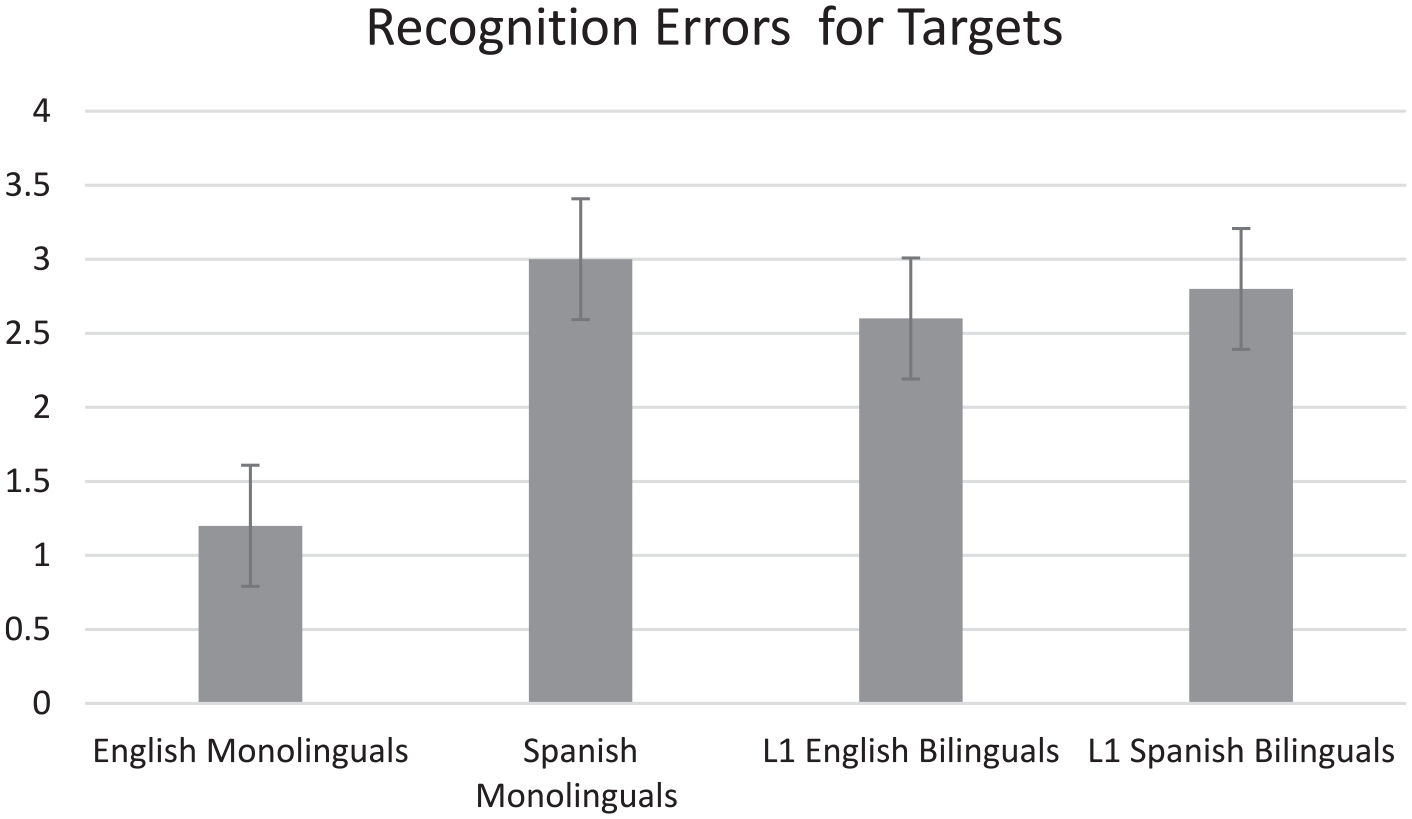
Mean recognition error values for target items. L1: first language.
In summary, the results indicate that the more manner detail there is in the verbalisation (fostered and facilitated by habitual lexicalisation patterns), the more memory focus appears to be on that event component, which results in better recognition memory. The results also suggest that providing none or just one manner item, as Spanish monolinguals and the two bilingual groups do, relying on the Spanish structural and lexical pattern (that is also permissible in English) is not enough to aid recall. In contrast, the pattern that encourages more detailed and frequent expression of manner (in this case the English one) is of aid to memory if it is fully mastered or can be fully resorted to (as done by the English monolinguals). If it is not fully mastered (as in the case of L2 English speakers) or if it cannot be fully accessed (as in the case of L1 English speakers verbalising in L2 Spanish), the benefits are not there. We elaborate on this key point further in the next section.
Discussion
In this study we tested three possibilities of language effect: (a) that a stronger language (L1) in bilinguals may influence verbalisation and memory when using a weaker language (L2); (b) that instead of the L1 it is the L2, the language used for verbalisation, that guides information content in the bilinguals’ descriptions of witnessed events and memory; and (c) that patterns from both the L1 and L2 underlie verbalisation and memory (an in-between performance). Our results seem to provide confirmation for all of three hypotheses, albeit with regard to different aspects (verbalisation versus memory outcomes), which is something that the CASP for Bilingualism model can help us explain.
Firstly, with regard to verbalisation, we see that both bilingual groups are using the Spanish syntactic pattern (also reported by Hohenstein et al., 2006), which is the one that works in both languages. This reflects the CASP principle of Maximise Common Ground (see the section Bilingual language activation and the CASP for Bilingualism model) and resembles what balanced English-Spanish speakers also do with the same experimental stimuli and under the same experimental condition of dual-language activation (Filipović, 2011). We also detected L1 influence and L2 influence in both bilingual groups with regard to the semantic content, so this can be said to reflect an in-between performance. The English pattern of “manner verb + path preposition” is not permissible in Spanish yet it does appear as a result of L1 English influence in L1 English/L2 Spanish bilinguals. The L2 Spanish influence is seen in the reduced manner information in the descriptions of these bilinguals compared to monolingual English speakers. On the other hand, L1 Spanish led the L1 Spanish/L2 English bilinguals to omit information about manner most of the time, while their L2 English influenced them to add manner adverbials and phrases more often than the Spanish monolinguals did (see also Hohenstein et al., 2006). All these outputs are motivated by the drive to Maximise Common Ground and bring the two languages closer together.
When it comes to recognition memory, the results paint a somewhat more uniform picture. English monolingual speakers provided extensive detail about the manners of motion depicted in the video stimuli and consequently remembered better what they had or had not seen in this regard. Spanish monolingual speakers provided almost no manner detail on the whole and their memory for manner was significantly worse than that of their English monolingual counterparts. Interestingly, both bilingual groups performed similarly to the Spanish monolingual group in the memory test, and very differently to the English monolingual group, but for different reasons.
The L1 Spanish/L2 English bilinguals were mainly using their L1 Spanish syntactic pattern because it also works in their L2 English – they were Maximising Common Ground. They also used an occasional English syntactic pattern but they apparently did not have full lexical and structural competence in L2 English. Namely, their repertoire of the English “manner verb + path preposition” constructions was very limited – they produced this pattern only for very common verbs such as “ran out” but not in situations where “limped out” would have been warranted. This probably is not the decisive factor because early/balanced bilinguals, who presumably have a higher lexical and structural competence than late/unbalanced bilinguals and little or no difference in competence between the two languages, show the same behaviour in English under the same experimental circumstances (Filipović, 2011). Thus, we can say that it is Maximising Common Ground that is in operation when both languages are active and when they share a lexicalisation pattern. Similarly, but due to different factors, L1 English/L2 Spanish speakers seem to have been unable to express the diverse manners of motion in their L2 Spanish because (a) Spanish does not lexicalise them or (b) they have not acquired the relevant manner verb because it is a low frequency item and (c) they were distracted by the amount of restructuring that had to be done and did not manage to package all the information under time pressure. Importantly, the participants in the L1 English/L2 Spanish bilingual group correctly used the Spanish pattern of “path-in-the-verb” in most cases (apart from some ungrammatical ones, as illustrated in the example (4) and, consequently, they failed to label, focus on and remember the different manners. In addition, for both bilingual populations adding information about the manner via gerunds or paraphrases seems to be too cumbersome and is not habitually done, which supports the findings in studies about Spanish rhetorical style preferences that accompany the syntactic pattern restrictions in that language (Slobin, 1996).
It is important to note here that agentive and caused motion present bilinguals of the same two languages with different cross-linguistic contrasts and result in different outcomes, as predicted within CASP for Bilingualism. When caused motion events are described, it is Spanish monolinguals, balanced Spanish/English bilinguals and L1 Spanish speakers that have the advantage because Spanish obliges them to draw the key intentionality distinction with existing lexicalisation patterns (intentional subject–verb–object (SVO) versus non-intentional se-constructions). The awareness of that distinction is then created and verbalised in English as a result of bilingual efficiency, as explained before. In contrast, English monolinguals and L1 English/L2 Spanish bilinguals do not have this awareness and fare less well in related memory tasks (Filipović, 2013, 2018, 2019, 2020 for details).
However, in the case of agentive motion events there is a common pattern already in both English and Spanish (namely the Spanish one “enter (running)”) and all types of Spanish/English bilinguals (balanced in Filipović, 2011, and unbalanced in this study) tend to favour it. As a result, they have less information about the manner of motion available as an aid to memory than the English monolinguals, who express manner detail effortlessly and most frequently in the obligatory constituent, the verb. This is why we need to consider the language-specific mapping and patterns of use in each cognitive domain, and be very aware of both proficiency and the level of activation of each language driven by the type of communicative situation (i.e. whether the weaker or the stronger language, or both, are used; see Filipović, 2019, for detailed predictions). We will then be able to predict when, why and who precisely benefits from bilingualism and, most importantly, we can explain why we sometimes see benefits of bilingualism (as in the case of caused motion) and sometimes we do not (as in the case of agentive motion).
Finally, using a multifactor model like CASP for Bilingualism (Filipović & Hawkins, 2019) enables us to make predictions about bilingual outputs under different conditions. For example, if the L1 English/L2 Spanish bilinguals find themselves in a Spanish-speaking environment for a longer period of time and if the use of L1 progressively decreases then we expect the manner modifications to decrease as well, because they are not required or encouraged by the L2 pattern. Conversely, if L1 Spanish/L2 English bilinguals reside in the UK for many years they may preserve their (possibly fossilised and L2-permitted) L1 lexicalisation pattern of using path verbs, while possibly increasing manner modifications as they learn more manner verbs in L2 English. Alternatively, they may gradually move towards the L2 pattern fully and start using manner verbs instead of path verbs if their L2 usage increases significantly and their use of L1 decreases. According to CASP for Bilingualism, all these predictions must be informed by (a) the typological status of the two languages in question (whether there is some, no or full overlap of features between the two), (b) internal factors, such as proficiency (i.e. the respective mastery of each language), and (c) external factors, such as the specific social circumstances of an interaction instance as well as the habitual, everyday usage patterns for each language.
Conclusions
In this paper we saw evidence for language effects on bilingual memory for agentive motion events. Bilinguals with uneven proficiency in English and Spanish were influenced in verbalisation by both their L1 and L2 and they mostly used patterns that are shared in both languages, as predicted by the CASP for Bilingualism principles of Maximise Efficiency in Communication (i.e. being multi-language ready) and Maximise Common Ground (i.e. using words and constructions that work in both languages). Both bilingual populations gave more manner information than Spanish monolinguals (under the influence of English as the L1 or the L2) but less so than English monolinguals because they mainly used the Spanish sentence pattern in both L2 English and L2 Spanish. Consequently, both bilingual groups had a matching performance, even though they came to it from different angles.
In the memory task, the bilinguals performed similarly to the Spanish monolinguals and had more recognition errors than the English monolingual speakers. It is important to reiterate here that balanced bilingualism does not have an advantage over unbalanced bilingualism when it comes to memory for agentive (non-transitive) motion events – balanced English-Spanish bilinguals also followed the (shared) Spanish pattern and remembered information about manner less well than English monolinguals (Filipović, 2011). We also contrasted these results to those obtained in experiments for caused (transitive) motion, where bilingualism, both early and late in some cases, appears to be of advantage (Filipović, 2018, 2020).
In summary, this paper provided an argument in favour of studying finely grained typological distinctions within individual cognitive domains in order to capture when we have and when we do not have benefits of bilingualism for witness memory, and possibly other cognitive tasks where language(s) are summoned for help. In addition, in the spirit of the language awareness framework (Hawkins, 1984), raising explicit awareness about the fundamental lexicalisation and conceptualisation differences is bound to be beneficial to L2 learners because they may not have enough opportunities to work out the relevant features and their “packaging” within lexical and construction units on their own due to limited exposure, especially in a classroom context. Some typological distinctions matter more than others and they should receive more pedagogical attention (as advocated in the Applied Typology Programme; see Filipović, 2017a, 2017b). It would be intriguing to test L2 learners that have or have not been exposed to explicit teaching of important typological contrasts, such as the ones discussed in this study, and see if explicit instruction leads to significant effects in verbalisation and memory. Further research also needs to incorporate more of the different situational factors (e.g. single, dual and code-switching contexts; Green & Abutalebi, 2013): the outcomes may differ for some or all bilingual populations depending on whether they are speaking and listening in just one of their languages during experimentation or both, and which one is weaker or stronger, if they do not have balanced proficiency. This will help us reveal whether and how these external-social factors, in addition to linguistic typological and internal factors such as psycholinguistic profiles of bilinguals, impact bilingual language use and affect bilingual communication and cognition more generally.
Footnotes
Acknowledgements
I am grateful to Bene Bassetti and Jeanette Altarriba for immensely insightful and helpful comments on an early version of this paper, which led to significant improvements. Two additional anonymous peer reviews led to further and important clarifications, for which I am very thankful. Any remaining errors are exclusively mine.
Declaration of conflicting interests
The author(s) declared no potential conflicts of interest with respect to the research, authorship, and/or publication of this article.
Funding
The author(s) received no financial support for the research, authorship and/or publication of this article.
