




Abstract
Aims and objectives:
The aim of this scoping review is to investigate the association between bilingualism in the family and child subjective well-being, by reviewing the literature to identify key themes to date and remaining questions for future research.
Methodology:
Scopus, Web of Knowledge, ERIC, Psych Articles and PsychInfo were searched systematically between September and October 2018, and after title, abstract and full-text screening, 17 of the initial 1433 articles were included in this review.
Data and analysis:
Each study was coded for the discipline from which it emerged, the language combination studied, the measures of well-being and language proficiency it used, the geographical location of the study and the number of participants. Data on the link between bilingualism and well-being was extracted from each study.
Findings and conclusion:
Two main themes were identified: ‘The effect of language proficiency on family relationships’ and ‘The acculturation of parents and children as mediated by language’. Across studies, there was significant heterogeneity in definition of concepts and a diverse range of measures employed. In addition, the studies identified suggest a positive link between minority language maintenance and child well-being, and a positive influence of bilingualism, rather than knowledge of only the home or the majority language. However, the directionality of these relationships will need to be investigated in future research.
Originality:
This is the first scoping review conducted systematically to explore the link between bilingualism in the family and child well-being internationally. It builds on previous work such as a narrative review which examined this association in the European context.
Introduction
A growing body of research in applied and clinical linguistics, family studies, education and psychology has investigated the relationship between language use and family well-being (e.g. De Houwer, 2006, 2015; Lee, 2011; Tseng & Fuligni, 2000; Wang, 2013). A previous narrative review (De Houwer, 2017) summarised findings from studies in the European context and concluded that it is unclear from this body of literature how children’s proficiency in and use of the minority language relate to their well-being. The review did, however, find that parental use of the minority language influenced children’s minority language use and proficiency and hypothesised that the insecurity and distress parents feel when their children’s minority language proficiency does not meet their expectations might have a negative impact on children’s well-being. In this paper we synthesise and consolidate the emerging literature on well-being in bilingual families beyond the European context and across a number of different disciplines, by conducting a scoping review. The review findings may be relevant to a diverse audience including researchers from various disciplines, practitioners who support and advise bilingual families, and bilingual families themselves.
This review focuses on children’s subjective well-being, which in one prominent model of well-being is distinguished from objective well-being (D’Acci, 2011; Dodge et al., 2012; Western & Tomaszewski, 2016). Subjective well-being concerns individuals’ perceived levels of life satisfaction or happiness (Diener & Suh, 1997), while objective well-being relates to factors such as psychological and physical health, security, access to education and employment. Note that although recent decades have seen an increased interest in well-being (Diener et al., 1999; Statham & Chase, 2010), not only as a subject of research but also in the public sphere and in policy making, its definition remains a challenge (Dodge et al., 2012).
This review also concentrates on subjective well-being as opposed to mental health. While the two can be related, there is no clear consensus as to whether they are opposite ends of the same continuum or separate concepts (Huppert, 2014). A recent cohort study, however, suggests that the latter might be the case. Patalay and Fitzsimons (2016) investigated a range of individual, family, social and wider environment factors to determine predictors of mental health and well-being in 12,347 11-year olds in the UK as part of the Millennium Cohort study. They showed that mental health and well-being are only weakly correlated (r = .2) and that different factors predicted each. Mental health is more strongly predicted by health and chronic conditions as well as ethnicity, while the strongest predictors for children’s well-being were their social life and relationships.
This is further supported by Halle et al. (2014), who outline how children’s attachment to their parents and other caregivers, such as teachers, is crucial for their socio-emotional and linguistic development. During family conversations, parents and children communicate their values and their views of the world. It is through dialogue that parents and children share their emotions, discuss problems and voice frustrations. It is also through conversations with their parents (and other key caregivers) that children learn important socio-emotional skills such as how to regulate their emotions (Bernier et al., 2010) and develop their independent problem-solving skills (Landry et al., 2006). Children’s socio-emotional development is in turn related to their overall well-being (Fabes et al., 2006; Thompson & Lagattuta, 2006).
It is therefore unsurprising that good (i.e. more respectful and open) parent-child communication has been linked to a number of positive outcomes in adolescents, such as lower levels of risky behaviour (Guilamo-Ramos et al., 2006; Luk et al., 2010; Rogers et al., 2015), higher levels of academic achievement (Fan, 2001), increased adolescent self-esteem (Levin et al., 2012), lower levels of depressive symptoms (Yu et al., 2006) and higher levels of well-being (Bireda & Pillay, 2018). Recent studies by the OECD, globally, and the Children’s Society in the UK observed a similar link (OECD, 2015; The Children’s Society, 2013, 2018).
Given this association between parent-child communication and child subjective well-being, the question arises of what difference bilingual communication makes. Here we take a broad view of a bilingual communicative environment, including both situations where one or more minority languages are spoken within the family and another majority language spoken in the community and situations where a minority and majority language are spoken in the family 1 . Given the key role identified of parent-child communication, we are interested in families living together with at least one parent, or key caregiver, and a child or young person, but which could also include other important relations such as grandparents, who can play an important role in children’s language development (e.g. Kelly, 2004).
Previous work (De Houwer, 2006, 2015; Little, 2017; Wang, 2013) has highlighted that families in language contact situations face a number of challenges. These can include but are not limited to feelings of exclusion, frustration or lack of communicative involvement due to family members’ different levels of language proficiency (see also Lee, 2011; Vasquez, 1991), culturally different child-rearing beliefs, limited emotional connection due to limited language knowledge, or mismatched parental expectations about children’s desired language competence. These challenges can lead to heightened stress levels in bilingual families and represent barriers to harmonious bilingual development (De Houwer, 2006, 2015), that is, ‘the experience of well-being in a language contact situation involving young children and their families’ (De Houwer, 2015, p. 169). Focusing on early bilingualism, De Houwer (2006) considers the myriad consequences when harmonious bilingual development is not prioritised, including emotional distance from, and even rejection by, certain family members, feelings of insufficiency and exclusion, and ambiguous identity formation. In a review article, Chen et al. (2012) discuss the implications of bilingual parents using different languages with their children for different expressions of emotion and suggest that in many cases a bilingual approach to emotional expression may be most appropriate for the emotional development of the child. They hypothesise that decreased emotionality associated with the majority language may lead to more open discussions of sensitive or contentious topics, compared to those conducted in the parents’ first language. This highlights the close link between language knowledge, choice and emotion in a bilingual context.
Similarly, De Houwer (2015) argues that children’s more or less equal proficiency in both languages and their use of these languages can support the formation of positive relationships and thus harmonious bilingual development. Like Halle et al. (2014), De Houwer also cautions against the extrapolation of findings around monolingual socio-emotional development and highlights the need for interdisciplinarity in research into bilingualism and well-being (De Houwer, 2006, 2015).
There is therefore a clear need to collate the evidence on the relationship between bilingualism in the family and children’s well-being, especially given the potentially significant impact of research in this area for language policies, at a community or national level, and language use in families.
Methods
Procedures
The relationship between bilingualism and family well-being has been investigated in a wide range of disciplines, including psychology, sociology, education, linguistics and family studies. These disciplines often use not only different theoretical approaches, but also quite distinct methodologies. This diversity is a challenge for the synthesis of results that takes place in a systematic review or meta-analysis. Therefore, the approach of a scoping review was deemed more appropriate. The goal of a scoping review is to inform a research agenda for a field in which information has begun to accumulate (Tullock & Ortega, 2017). Instead of offering definitive answers to a specific research question, it aims to map out the key concepts that are available in a field and to describe the main sources and types of evidence available (Arksey & O’Malley, 2005). This allows for a wide range of study designs to be considered.
In conducting the scoping review, we followed the stages described by Arksey and O’Malley (2005): (a) identifying the research question, (b) identifying relevant studies, (c) study selection, (d) charting the data, (e) collating, summarising and reporting the results.
We set the following research question:
What is known from the existing literature about the relationship between bilingualism in the family and child and adolescent subjective well-being?
The following databases were searched between September and October 2018: Scopus, Web of Knowledge, ERIC, Psych Articles and PsychInfo. We decided to limit the timeframe to articles that were published after 1945 to provide a comprehensive overview of the research literature while limiting literature to post-Second World War. The databases were searched using the English search terms provided below. Studies had to include participants aged 0–18, focus on the family setting, and participants had to have been in the country for a minimum of 5 years. We decided on the latter inclusion criterion in order to avoid studies dealing with issues relating to recent migration, such as post-traumatic stress disorder in refugees. While these issues can, undoubtedly, continue beyond an initial 5 years in a country, we thought that this commonly used minimum for ‘settled status’ (e.g. by the UK government) would allow us to focus on families who are more established in the country. Furthermore, all studies needed to include a specific focus on language use or proficiency in order to be included in the review, and child, rather than adult, well-being needed to be studied.
The following search terms were used in all five databases: “subjective wellbeing” OR “subjective well-being” OR wellbeing OR well-being OR welfare OR “life satisfaction” OR “quality of life” AND family OR parent OR mother OR child* OR adolescent OR teen* OR baby OR infant OR toddler OR grandparent OR grandmother OR grandfather AND multiling* OR biling* OR “dual language” OR “minority language” OR “second language” OR migrant OR immigrant OR multiethnic OR multi-ethnic AND “language use” OR “language proficiency” OR “language competence” OR “language knowledge” OR “language attrition”
While the main focus of this review is on subjective well-being, we also included the more general search term ‘well-being’ and the alternative term ‘welfare’ to ensure that articles that did not use the juxtaposition of ‘subjective’ and ‘objective’ well-being were also included. The terms ‘life satisfaction’ and ‘quality of life’ were identified as terms that are commonly used in the literature to describe concepts of well-being. Search terms related to mental health and medical aspects of well-being were not included on the grounds that well-being and mental health are related but distinct concepts (see above). However, due to the close association between mental health and well-being, some studies use scores on tests of mental illness as a proxy for well-being and vice versa (e.g. Maynard et al., 2010). Accordingly, studies using measures of mental health (e.g. scales of depressive symptoms) were included in this review but studies that required participants to have a clinical diagnosis of depression or another mental illness were not.
The search was narrowed down to include terms relating to ‘family’ in order to ensure that only articles dealing with well-being within the family remit were included. Terms that are commonly employed to describe the use of two or more languages were added, along with some relating to ethnicity or migration. Even though they are not synonymous with the use of more than one language, we felt that their inclusion was warranted as this search aimed to cover a wide range of fields and some of these disciplines may use these terms interchangeably.
Finally, we added search terms describing the concepts of language use or proficiency as the aim of the review was to find out how the use of more than one language in the family affected children’s well-being. The term ‘attrition’ was included to ensure that studies which focused on the loss of minority languages rather than their use would also be included.
A total of 1433 articles were found across the five databases and the screening process is detailed in the PRISMA flowchart (Moher et al., 2009) in Figure 1.
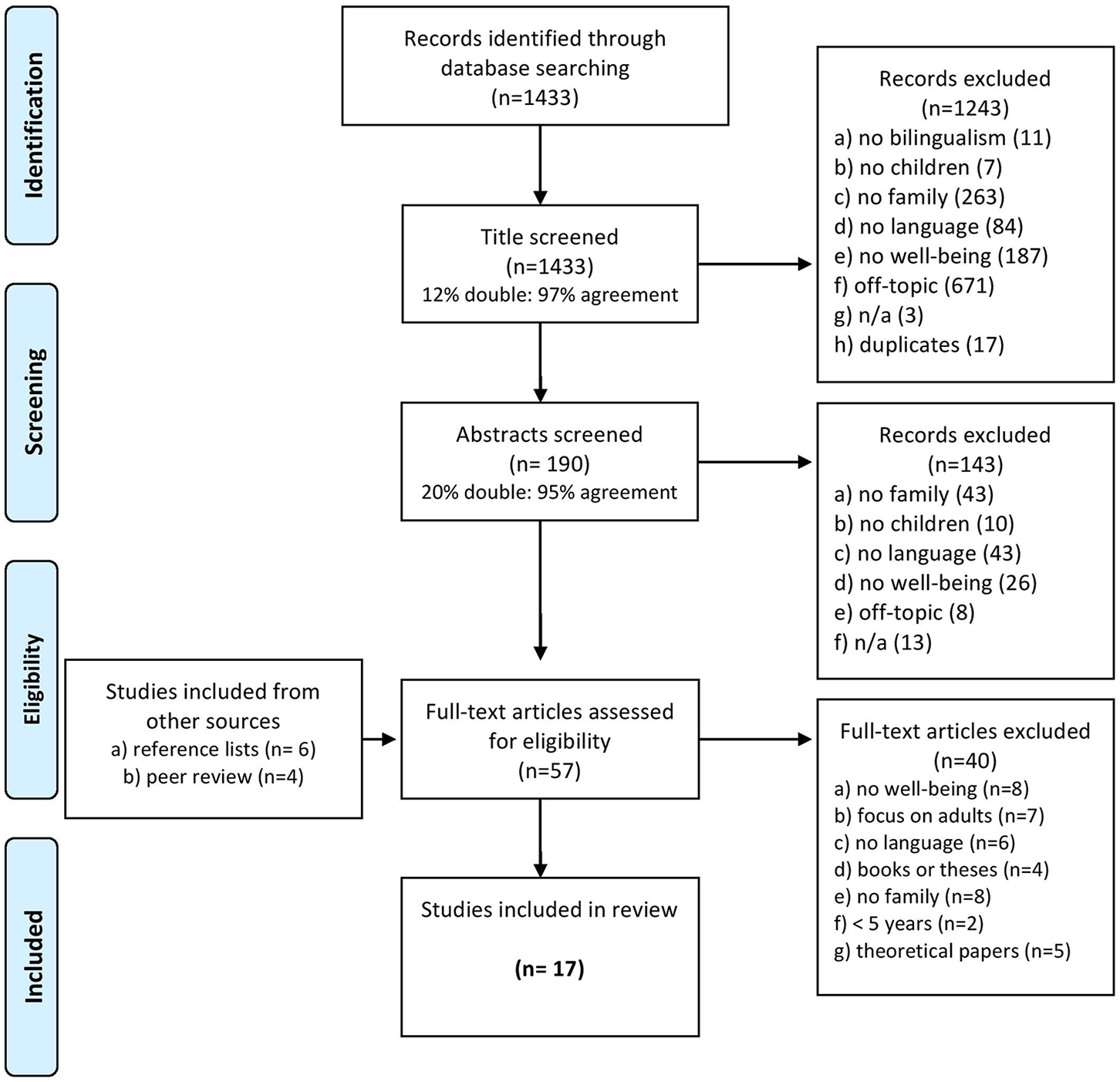
Flowchart of systematic search process.
Title, abstract and full-text screening was carried out by the first two authors of this review. Twelve per cent of titles and 20% of abstracts were double-screened with an agreement of 97% and 95% respectively. Disagreements were resolved through discussions. Where no agreement could be reached, articles were carried over to the next screening phase. A total of 1243 titles were excluded during title screening (reasons for exclusion provided in Figure 1). We considered papers to be ‘off-topic’ if they related to only one of the three main themes (i.e. only well-being, only language, or only multilingualism) or if they were entirely unrelated to the topic of this review. Examples include articles which explored life satisfaction of migrant wives in South Korea, the well-being of recent refugees, or the influence of class composition on pupils’ cognitive development.
A total of 143 articles were removed at abstract screening stage and 57 full texts were screened for eligibility; the reasons for exclusion are provided in Figure 1. Following comments from reviewers on the first version of this paper, four theoretical papers (De Houwer, 2006, 2015; Lee, 2011; Wang, 2013) and one review (Chen et al., 2012) were removed and instead integrated into the introduction of this review to provide context. Another four empirical papers that met our inclusion criteria were added from the reviewers’ suggestions, bringing the total number of articles in this corpus to 17. Of these four additional references, only one had come up in our initial literature search (Weaver & Kim, 2008). We had initially excluded this study at abstract level as we considered it to focus on acculturation more broadly rather than language use more specifically, but following one reviewer’s comments this decision was reversed. To assure that no other articles were missed, the first author re-screened all 1433 titles after the first round of reviews but could not find any further relevant articles in the database.
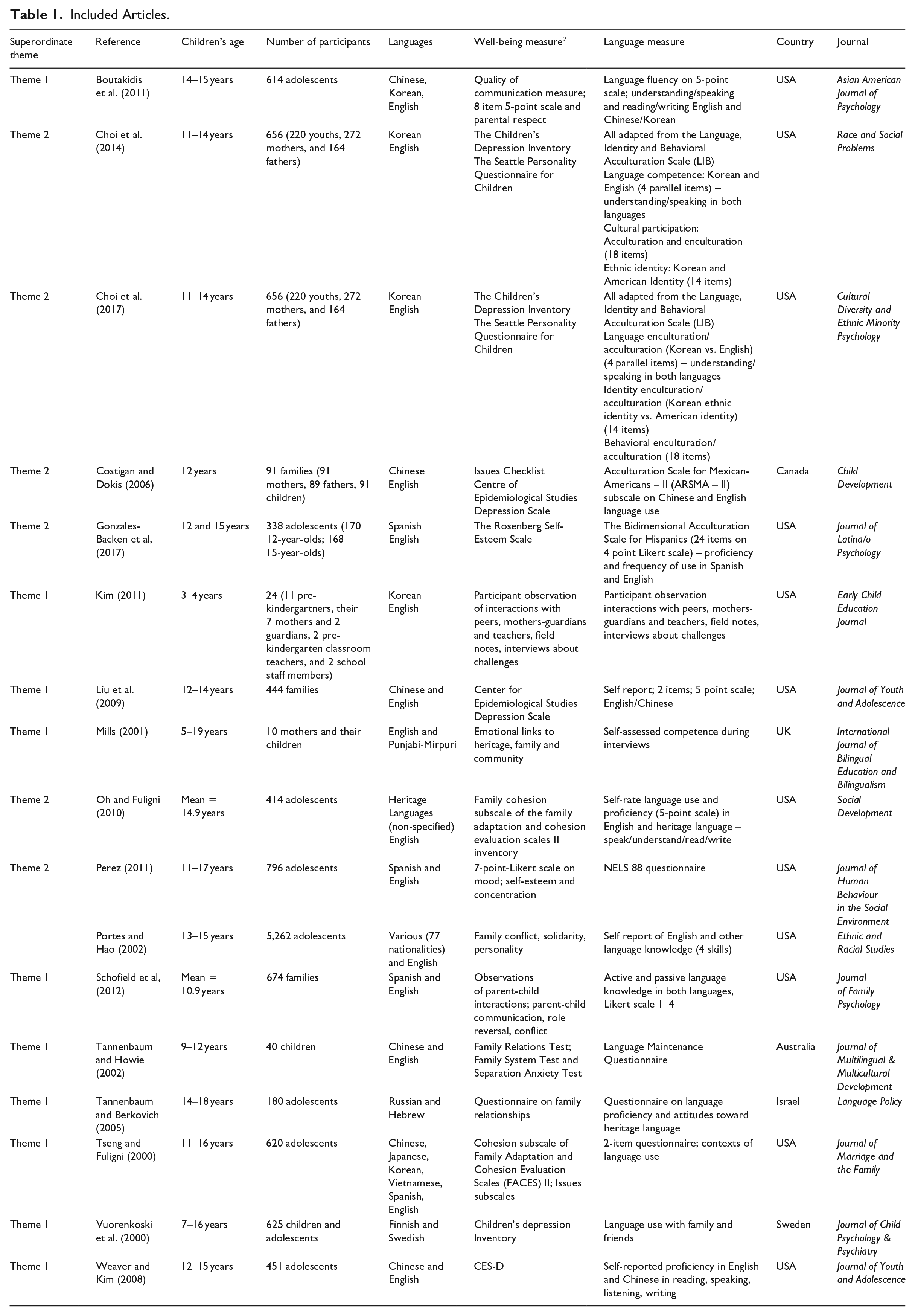
After the final batch of articles was identified, we extracted data on participants and well-being measures and scores as well as language use in the family from all articles. Results are presented in Table 1 and will be discussed in the following section. Then the first two authors of this review re-read all papers and grouped them according to emerging themes. They then compared their results. Two themes emerged as a result of this process: ‘The effect of language proficiency on family relationships’ (Theme 1), and ‘The acculturation of parents and children as mediated by language’ (Theme 2). The boundaries between these themes are, of course, not clear-cut but they do describe the main focus of the studies that are included in each section in terms of their operationalisation of the key concepts. Where the authors disagreed about the inclusion of articles in one group over another, disagreements were resolved through discussions.
Included Articles.
Results
The selected articles are listed in Table 1. Articles were published between 2000 and 2017 in a variety of journals, most frequently in the field of psychology.
Mapping of key concepts
The included articles conceptualised bilingualism and well-being in a number of different ways, which is not surprising, given their disciplinary heterogeneity.
Bilingualism is considered either from the perspective of language proficiency, that is, how well children know, speak, read or write the languages (e.g. Oh & Fuligni, 2010; Weaver & Kim, 2008), or language use, that is, how often, where or for which purposes children use their languages (e.g. Perez, 2011; Tseng & Fuligni, 2000; Vuorenkoski et al., 2000), or sometimes both aspects are considered. Two articles used the term ‘subtractive bilingualism’ (Boutakidis et al., 2011; Tseng & Fuligni, 2000), defining it as when children ‘lose the native language at the same time they acquire English proficiency’ (Tseng & Fuligni, 2000, p. 474); other studies use the term ‘linguistic acculturation’ (Boutakidis et al., 2011; Choi et al., 2017; Perez, 2011) to describe the process by which individuals acquire the language of the majority culture. Vuorenkoski et al. (2000), on the other hand, use the term ‘semilingual’ to describe children who spoke both Swedish and Finnish to their mothers before their re-migration and thus have ‘no true native language’ (p. 262). Portes and Hao (2002) use a related term (‘limited bilinguals’) to describe a group who speak neither the minority nor the majority language well.
Some studies employed a categorisation of bilingualism; for instance, Mills (2001) draws on Romaine’s taxonomy of families’ language use (1995), while Portes and Hao (2002) classified language users into four categories based on their self-reported knowledge of English and other languages: English monolinguals (speak English fluently and have poor or no knowledge of another language), fluent bilinguals (speak English and another language well), foreign monolinguals (speak a minority language well but little to no English), and limited bilinguals (speak neither language well). Vuorenkoski et al. (2000) also grouped participants into five groups according to their language use and cultural identification. The studies then related the level of bilingualism (and biculturalism) to participants’ level of well-being.
Approaches to well-being across included articles can be divided into two categories: (a) the psychological profile of participants, and (b) relational outcomes within the family. The former, the psychological profile of the child, related to individual symptoms, traits and behaviours, such as depressive symptoms (Choi et al., 2017; Gonzales-Backen et al., 2017; Weaver & Kim, 2008) or psychosocial adjustment (Liu et al., 2009; Portes & Hao, 2002). For example, Perez (2011) defines emotional well-being in relation to ‘concentration, mood and self-esteem’ (p. 890). By contrast, the latter, relational outcomes, consider family communication and relationships, and defines well-being in relation to social functioning, for example, respect for parents (Boutakidis et al., 2011). In other words, studies in the first category conceptualised well-being as individual traits or states that were inherent to the child while studies in the second category conceptualised it as a social construct relating to parent-child relationships. ‘Well-being’ itself was actually rarely used as a term, despite the studies’ clear relevance to our research question.
Methodologies
All but two (Kim, 2011; Mills, 2001) studies in this review are quantitative. The studies took place in a wide range of countries, most commonly studying Southeast and East Asian populations in the USA (7 articles). Three articles focused on Spanish-English families in the USA, one on Chinese-English families in Australia, one on Russian-Hebrew families in Israel, one on Swedish-Finnish bilinguals who have re-migrated to Finland, one on British-Pakistani adolescents in the UK, one on Chinese-English families in Canada and the two remaining studies were set in the USA but minority languages were not specified. Children’s age ranged from 3 to 19 years (the 19-year-olds were part of a larger study of 5–19-year-olds). The majority of empirical studies had large sample sizes, of between 40 and 5262 participants. The two qualitative studies in this review are based on 40 (Kim, 2011) and 10 (Mills, 2001) child participants respectively.
Across the studies, a wide range of methods to measure well-being was employed. In six studies a measure of depressive symptoms was used as a proxy for well-being (Choi et al., 2014; 2017; Costigan & Dokis, 2006; Liu et al., 2009; Vuorenkoski et al., 2000; Weaver & Kim, 2008). Note that the two studies by Choi et al. (2014, 2017) are based on the same dataset of the Korean American Families (KAF) project. Six studies measured family cohesion, relations or communication (Boutakidis et al., 2011; Oh & Fuligni, 2010; Portes & Hao, 2002; Schofield et al., 2012; Tannenbaum & Berkovich, 2005; Tannenbaum & Howie, 2002; Tseng & Fuligni, 2000) and two studies measured self-esteem (Gonzales-Backen et al., 2017; Perez, 2011). One qualitative study (Kim, 2011) used observations, field notes, interviews, video- and audio- recordings, copies and artefacts to study well-being. The other qualitative study (Mills, 2001) used interviews. Most studies used standardised or at least readily available measures, while some used bespoke measures designed by the authors – see Table 1.
Measurements of language proficiency were similarly heterogeneous across studies. Six studies used self-report of active and passive language knowledge in both languages (Boutakidis et al., 2011; Choi et al., 2014, 2017; Costigan & Dokis, 2006; Schofield et al., 2012; Weaver & Kim, 2008). Another three studies asked participants to report which language they used in which situation or with which interlocutor (Tannenbaum & Howie, 2002; Tseng & Fuligni, 2000; Vuorenkoski et al., 2000). Two studies (Gonzales-Backen et al., 2017; Oh & Fuligni, 2010) used a combined measure of language proficiency and language use in both languages. Three studies inquired about children’s active language knowledge in both languages (Liu et al., 2009; Mills, 2001; Portes & Hao, 2002) and Perez (2011) used a comprehensive questionnaire inquiring about participants’ language learning history and active and passive language knowledge in both languages. Tannenbaum and Berkovich (2005) inquired about language proficiency in both languages combined with attitudes toward the minority language and, finally, Kim (2011) used recordings, observations and interviews to find out about participants’ language proficiency. All quantitative studies in this review relied on self-assessment tools to assess participants’ language proficiency, and, again, there was a mix of standardised and bespoke measures, with more bespoke measures used than for well-being.
The effect of language proficiency on family relationships
Several studies reported a positive association between adolescents’ minority language proficiency and relationships with parents (Boutakidis et al., 2011; Perez, 2011; Tseng & Fuligni, 2000; Vuorenkoski et al., 2000). In Boutakidis et al.’s (2011) study in the USA, 614 Chinese and Korean adolescents from first- or second-generation immigrant backgrounds completed a survey on measures of family characteristics, language fluency and quality of communication. They found a positive association between adolescents’ fluency in the minority language and reported respect for their parents. Their results suggest that parent-child relationships may be improved by minority language maintenance both for pragmatic reasons (e.g. higher-quality communication) and to foster children’s links with and appreciation for their cultural heritage. In her qualitative study, Mills (2001) interviewed 10 third-generation Asian children in the UK. Despite perceiving themselves to have low proficiency in their minority languages, the children reported a strong desire to maintain them, reasoning that bilingualism was important for communication with family and identity formation.
Vuorenkoski et al. (2000) categorised participants into five groups based on language use 6 years after migration, and found that the two groups who used two languages consistently reported much lower scores for psychosomatic symptoms than those who had undergone significant language shift after re-migration. As a result, the authors promote both ‘balanced bilingualism’ and ‘bicultural identities’ as important factors in well-being for bilingual young people. They describe uneven language proficiency as a potential barrier to either positive communication with parents or assimilation to the new society, both of which could have negative implications for well-being. This finding is echoed in Portes and Hao (2002), who used data from the Children of Immigrants Longitudinal Study (CILS) to explore linguistic adaptation in four groups of children: English monolinguals, fluent bilinguals, foreign monolinguals, and limited bilinguals. The authors found evidence in support of their hypothesis that children who are fluently bilingual have the most positive outcomes when it comes to family relationships and psychosocial adjustment.
Also on this theme, Tannenbaum and Berkovich (2005) found an association between the language maintenance of different generations and harmonious (i.e. positive) family relations. Tseng and Fuligni (2000) also considered the languages spoken by parents and children, concluding that adolescents who spoke their parents’ native language reported higher levels of family cohesion and less emotional distance than those who only spoke the country’s majority language. These findings are in keeping with Weaver and Kim’s (2008) study, which explored the relationship between depressive symptoms and generational differences in cultural orientation. While their study focused primarily on cultural dissonance in Chinese immigrant families, the authors also found that depressive symptoms were highest in parent-child dyads with the greatest linguistic differences, for example, adolescents with higher English proficiency and parents with higher Chinese language proficiency.
Offering an alternative perspective, Tannenbaum and Howie (2002) focus on how family dynamics can affect children’s bilingual development. They used a language maintenance questionnaire and a family relations test to study 40 children growing up in Chinese families in Australia. The authors found that children with more negative perceptions of their families, including emotional relationships, were less likely to use, or to prefer to use, the minority language. Family relationships were to some extent predictive of language use in the home, with more cohesive and egalitarian family environments being more fertile ground for language maintenance. When children perceived their families to be more hierarchical, they were less willing to use their minority language. Tseng and Fuligni (2000) also found the quality of familial relationships to be predictive of changes to language use.
In addition to studies investigating the links between well-being and language proficiency in children, three studies in our review explored the impact of parents’ language proficiency on their child’s well-being. Liu et al. (2009) investigated the extent to which mothers’ and children’s language proficiency in English and Chinese affected youth adjustment to the majority culture. The authors found that fewer depressive symptoms were present among adolescents when their mothers were highly proficient in both Chinese and English. Minority language maintenance was found to be protective against depressive symptoms for adolescents born abroad, but not for those born in the USA, where the study took place. Consistent with the findings from Vuorenkoski et al., Liu et al. (2009) conclude that maintaining both languages and cultures enhances children’s mental well-being.
Schofield et al. (2012) offer yet another, slightly different, perspective in their investigation of parent and child fluency in a common language and its influence on parent-child communication, conflict and role reversal. The main aim of this study was to find out how academic outcome in children was mediated by fluency in a common language between parents and children, and the impact this has on quality of communication. However, their data also included the link between language knowledge and quality of relationships, and they found that fluency in a common language (either Spanish or English) had a positive impact on parent-child communication, conflict and role-reversal.
In sum, in the studies in this first theme the association between bilingualism and child well-being is investigated as the relationship between language proficiency and family relationships. The findings of these studies indicate that minority language maintenance and balanced bilingualism are positively associated with family relationships and child well-being. They suggest that children’s knowledge of their minority language improved family cohesion, led to less emotional stress and was important on a pragmatic level but also improved children’s understanding of their cultural heritage. Furthermore, rather than minority language proficiency alone, balanced proficiency in both the minority and the majority language appear to be important for child well-being as knowledge of both languages allows children to communicate successfully and develop relationships across contexts.
The acculturation of parents and children as mediated by language
Acculturation describes to what extent individuals identify with the majority culture. The concept is relevant in the context of this review because questions about language use and/or proficiency typically form part of acculturation profiles. The studies in this section hypothesised that parent-child relationships and child well-being might be related to the distance between parents’ and children’s acculturation profiles, and thus to their linguistic profiles and preferences.
Perez (2011) observed an interesting distinction between more and less linguistically acculturated young people from Latino backgrounds in the USA. Although primarily interested in the school environment, she also found that adolescents who were less linguistically acculturated (e.g. spoke more Spanish than English) had more positive emotional experiences of interacting with family than of interacting with peers or teachers at school, while the opposite was true for those who were more linguistically acculturated.
Choi et al. (2014) and Choi et al. (2017) took a different approach and analysed how the overlap or mismatch between parental and adolescent acculturation profiles influenced adolescent well-being in the context of Korean Americans. Both studies were based on the same sample. While both studies measured a wide range of factors influencing parental and adolescent acculturation, here we focus on adolescent language competence in English and Korean and its link to well-being. One interesting finding was the positive association between parental cultural socialisation practices for the home culture (e.g. speaking to children about Korean cultural values or sending children to Korean complementary schools) and adolescents’ English language proficiency. In contrast, parental ethnic identity and pride were negatively associated with adolescent mainstream cultural orientation and with English proficiency. Adolescents’ Korean and English language proficiency were both associated with a decrease in depressive symptoms, implying a benefit of maintaining minority language use in combination with acquiring the societal dominant language.
Choi et al. (2017) further studied the link between adolescent acculturation, family processes and adolescent outcomes more explicitly. The findings showed that adolescents’ positive orientation towards the minority culture (i.e. language, identity, behavioural enculturation) may enhance their perception of family relationships. This association appeared to be particularly important for the relationships between adolescents and their fathers, as youth who knew Korean reported that they perceived their fathers as more loving and less restrictive. Furthermore, Korean and English language proficiency predicted fewer youth problems (i.e. depressive symptoms, antisocial behaviour) but not always via family processes. This study thus indicates that the knowledge of the minority language may allow children to interpret parenting behaviour more accurately (i.e. as it was intended and not as it would be interpreted from the perspective of the majority society), contributing to improved parent-child relationships, which in turn are a crucial factor for child well-being.
Examining acculturation differences in immigrant Chinese families in Canada, Costigan and Dokis (2006) found that greater language gaps between mothers and their children were associated with poorer adjustment. The authors cite mothers’ difficulties in discussing emotional issues with their children, in being involved in their children’s education and in engaging in joint activities as primary reasons for this association. In a similar vein, Gonzales-Backen et al. (2017) focused on the link between acculturation on intrapersonal (i.e. ethnic identity), interpersonal (i.e. language use), and familial (i.e. familial ethnic socialisation) self-esteem, depressive symptoms and discrimination. Their study was based on two groups of Mexican-origin girls aged 12 and 15 years (on average) in the USA. The authors identified four cultural profiles. Most participants belonged to the strong-positive cultural profile. The individuals in this group were bilingual in Spanish and English, had high scores on ethnic identity and ethnic familial socialisation and the highest self-esteem scores. This suggests that bilingualism and a positive association with the heritage culture have a positive impact on adolescents’ self-esteem and, in turn, on their well-being.
This is also in line with Oh and Fuligni (2010), who found that the knowledge (but not the actual use) of the minority language predicted the quality of parent-adolescent relationships in their study of Latin American and Asian adolescents in the USA. The authors found that developing minority language proficiency was a more important factor than language choice in the successful adjustment to the host culture of adolescents from immigrant backgrounds. They differentiated between adolescents who knew the minority language and those who used it actively in conversations with their parents and found that it was not so much the active use of the minority language in parent-child conversations that had a positive impact on parent-child relationships but rather children’s minority language knowledge. This stands in contrast with Tseng and Fuligni (2000) who found that children’s minority language use did have an influence on parent-child relationships. Oh and Fuligni (2010) argue that this difference might be due to the fact that Tseng and Fuligni (2000) did not measure minority language proficiency (only minority language use). Positive parent-child relationships might hence be mediated by an understanding of the parental ethnic identity through the acquisition of the minority language more than through the active use of the minority language.
Finally, minority language schools were also found to be a valuable resource not only for language maintenance but as a means of social and emotional support for bilingual families. Kim (2011) explored the perspectives of Korean immigrant mothers on both their children’s integration into the American education system and on Korean minority language schools. Findings indicated that minority language schools served as an important bridge between the community and host societies, and that they improved children’s psychological well-being by providing a space for families to share the cultural differences and the social barriers they faced during the acculturation process.
In sum, studies in this second theme looked at levels of acculturation – which includes language use – and its association with well-being. Their findings suggest that levels of acculturation and enculturation are associated with how comfortable adolescents feel inside and outside the home, and that a gap between parent and child acculturation profiles can negatively impact on their relationships. As language proficiency and use is an important aspect of acculturation profiles, knowledge of the minority language thus appears to be an important mediating factor for the distance between parent and child acculturation profiles. Interestingly, one study in this group (Oh & Fuligni, 2010) found that it was language knowledge more than active use that made a difference in children’s well-being. Further studies will need to disentangle whether it is knowledge alone or active use that are associated with higher levels of child well-being.
Discussion and conclusion
In this section we outline some limitations of the included studies before discussing some limitations inherent to this review and how they could be addressed in future research. Finally, we present some tentative conclusions.
Limitations of research to date
Among the key challenges for studies in this area are, first, measuring both of the key concepts, bilingualism and well-being, and secondly, defining their scope and modelling the interaction.
First, studies used a wide range of measures to assess well-being – ranging from assessments of self-esteem, or feelings of happiness to depressive symptoms – and bilingualism – including language use, language proficiency and combined measures. The studies also differed in terms of the language skills they asked participants to assess. While some studies asked participants to assess their ability across all four language skills, others asked participants to rate their active and passive language knowledge or even just their ability to speak their two languages. This heterogeneity makes it harder to compare across studies, and will present a challenge to systematic and meta-analytic reviews of the topic which seek to synthesise findings across studies.
While the majority of studies used readily available or standardised measures for well-being, language proficiency and use was more often measured with a bespoke design. Further, in many cases language proficiency was measured via self-reporting and even other-reporting (e.g. Costigan & Dokis, 2006; Liu et al., 2009). For example, in Boutakidis et al. (2011) parental language fluency was reported by adolescents rather than the parents themselves, while Oh and Fuligni (2010) did not measure parent language proficiency at all. This shortcoming was acknowledged in some of the studies. For example, Liu et al. (2009) and Tannenbaum and Howie (2002) acknowledged that more comprehensive and objective measures of language use and proficiency would have increased the validity of their studies. While we did not formally conduct a quality assessment as part of this scoping review, it seems clear that better, validated measures of language use and proficiency are needed in future research. For instance, more nuanced questionnaires about language use in different situations, as used by some studies in this review, could be used more widely, and given the recent increase in research on well-being and the consequent refining of questionnaire-based measures (e.g. The Good Childhood Report), future studies have a wealth of robust measures to choose from that measure well-being per se, rather than mental health symptoms. However, along with Tannenbaum & Berkovich (2005), we also call for more qualitative studies in order to gain a more nuanced understanding of how bilingualism and well-being interact, particularly given the subjective and personal nature of familial relationships.
Secondly, the studies included in this review defined ‘well-being’ and ‘bilingualism’ in a variety of ways, and focussed on different elements of their interaction, quite possibly as part of a larger research question. This is, of course, not necessarily a limitation for any one study, but again presents a challenge for drawing them together into a bigger picture. In particular, most studies considered the association between bilingualism and well-being in the family from the direction of bilingualism – what effect does being bilingual have on well-being – but did not consider or test the directionality of this association. It thus remains unclear if better parent-child relationships and well-being positively impact children’s minority language proficiency or the other way around. In all probability, the relationship will be a bidirectional and interactive one, and the explanatory factors complex. Discussions of minority language use and proficiency are intertwined with discussion of other very substantial issues, such as identity, migration and emotion. Future research needs to work towards a complex model of how both linguistic and non-linguistic factors impact the relationship between bilingualism and family cohesion, child-parent relationships and well-being: for example, parents’ own language exposure as infants, reasons for and experience of migration, and family characteristics (e.g. parents’ age, number of children, and role of extended family).
Limitations of this review
We must also acknowledge limitations in this scoping review. These include the fact that all articles included in this review were written in English, due to using English search terms, so we may have missed important findings in this field that are published in other languages. Having previously conducted systematic reviews in the field of clinical linguistics (Uljarević et al., 2016), a relatively smaller field where the use of standardised tests and rigorous testing procedures is more common, we underestimated the range of approaches used to study the current research question. Inclusion and exclusion criteria were substantially more difficult to define and apply in this review and demanded a lot of case-by-case discussion around specific papers. Despite the fact that we followed the double-review protocol to ensure objectivity, it could be argued that the ultimate decision about the inclusion of specific research papers often remained subjective.
The search terms we have employed may also not be exhaustive or precise enough to capture all relevant papers, as indicated by the fact that four additional papers were added after the first round of peer review. This could at least partly be explained by the disciplinary, methodological and terminological heterogeneity and complexity in this field. As pointed out by one reviewer of this paper, the search term ‘resilience’ could also have been included as resilience and well-being are two closely related concepts (Harms et al., 2018), which may have led to the inclusion of further studies.
Furthermore, by only using online search engines for the literature search, this review has potentially missed out important work in the field that is published in books and edited volumes rather than online journals. As one reviewer pointed out, this might also explain why this review did not find much work published in Europe nor a lot of qualitative work as most of this research is published as books or chapters. Future work will need to address this shortcoming by including a wider range of search terms, in more languages and actively searching for literature that is published outside online journals.
Nevertheless, this scoping review is an important step in mapping out this significant area and, we hope, can act as a catalyst for future research on the interaction of bilingual family language use and well-being and complement other reviews emerging in the field.
Future directions
This scoping review revealed a number of key areas where further research is needed. First, geographically, we found that there was a dearth of studies conducted in Europe (although see De Houwer, 2017 and the limitations section above). Similarly, future research in this field should apply existing research designs to other cultures, countries and regions to determine whether factors relating to the effects of bilingualism on well-being are ethnolinguistically specific or more universal. Such comparative studies should take into account the experiences of language maintenance from both the children’s and parents’ perspectives in order to draw out possible points of contention or conflict. Furthermore, as Gonzales-Backen et al. (2017) stress, it will be important to focus on both the majority and minority cultures in order to understand the acculturation process within families.
Secondly, the directionality of the observed association between bilingualism and well-being also warrants further investigation. It is currently unclear if bilingualism leads to higher levels of well-being, or if children with higher levels of well-being are simply more likely to communicate with their parents. A potential way to approach this question would be to incorporate longitudinal research designs so that changes in language use and proficiency, as well as acculturation and adjustment, can be captured over time. The majority of studies in this review focused on adolescents rather than younger children but well-being measures are being developed for children (e.g. The Good Childhood Report), which will enable changes in well-being over the key transition from childhood to adolescence to be captured.
Thirdly, the interaction between bilingualism and well-being should be included in related fields of inquiry. In particular, the fast-growing field of Family Language Policy is concerned with explicit and overt as well as implicit and covert planning by family members around language choice and literacy practices (Curdt-Christiansen, 2018). Its dominant model (Spolsky, 2009) has the three focuses of language ideology (beliefs about languages), language practices (what family members actually do with their languages), and language management (their efforts to maintain languages), each of which could encompass an aspect of well-being. For instance, to what extent are language ideologies shaped by the lived experience of more or less subjective well-being through changing linguistic circumstances? How do practices affect not only a linguistic outcome, whether a language is maintained, but also the well-being of family members? And which management strategies best support family well-being? The rich data collected in Family Language Policy research, both in ethnographic studies and from larger-scale surveys, is ideal ground to better understand the connections between family communication, relationships and well-being.
This kind of future work will allow researchers to begin to develop a more detailed model of the connections between bilingualism in the family and well-being. We will be able to understand which aspects of language proficiency are important: for example, production versus comprehension; spoken or written; and the relative proficiencies of family members. Likewise, which language use choices are important, by whom? For instance, in which contexts inside or outside the home are languages spoken? Is a family language policy enforced or negotiated? We could then identify the mediating factors between bilingualism and well-being, like language attitudes, identity formation, emotional development and cultural differences. Similarly, the ways in which well-being affect language use can be factored in.
Conclusion
The aim of this review was to map out the landscape of research on the association between bilingualism in the family and child well-being, laying out the kind of studies conducted thus far, the methodologies they use, how the key concepts are operationalised, and where further research is needed. Under both themes that emerged – the effect of language proficiency on family relationships, and the acculturation of parents and children as mediated by language – the studies pointed toward a positive relationship between children’s bilingualism and their well-being.
Children’s bilingualism can be linked directly to higher-quality communication with their parents (e.g. Boutakidis et al., 2011). In other words, particularly in cases where parents might not be fluent in the majority language, children’s knowledge of the minority language enables smoother and richer communication between parents and children, which in turn appears to have a positive impact on their relationships. The studies in the second cluster of this review indicated that a larger distance between parents’ and children’s acculturation profiles appears to be associated negatively with parent-children relationships and children’s well-being, and children’s knowledge of the minority language appears to be a possible mediator in this relationship. Furthermore, the positive association between children’s minority language knowledge and parent-child relationships was also observed in studies where parents had relatively high levels of majority language proficiency.
This suggests that children’s proficiency in the minority language might not (only) be a question of necessity but carry importance beyond utilitarian motives as a vessel to transmit cultural beliefs, values, traditions and emotions, a view that is supported, for example, by findings in Mills (2001), and by separate but related research on the interaction between multilingualism and emotions more broadly (e.g. Dewaele, 2013; Pavlenko, 2002, 2005; Wierzbicka, 2004). Pavlenko (2004) showed that language choice is closely related to language dominance in parent-child communication, that is, parents prefer to use the language they are most proficient in and have the strongest emotional ties to when speaking to their children. Pavlenko observed this preference for emotional expression, as well as communication overall. Even bilinguals with a very high proficiency in both their L1 and their L2 have been found to prefer their L1 to express their feelings and communicate with their children (Dewaele, 2011). This suggests that motives for language choice in a bilingual context in general, and in bilingual families in particular, reach beyond the utilitarian and carry strong emotional connotations. This interaction between emotional expression and language could be another explanatory factor for the association between bilingualism and well-being in the family.
The relationship between bilingualism and family cohesion was approached from both directions by studies in the review; just as speaking the minority language improved family relations (Tseng & Fuligni, 2000), closer family relationships meant that the native language was more likely to be used (Tannenbaum & Howie, 2002). This lends further support to the idea that language use in bilingual families is not only driven by utilitarian motives (i.e. the language that all interlocutors know best as the automatic common denominator) but is closely intertwined with interlocutors’ attitudes towards each other as well as the minority and the majority culture. Furthermore, while this review focused on children’s knowledge of the minority language and its link to children’s well-being in the family, it was indeed proficiency in the minority and the majority language that was found to be associated with higher levels of well-being. This suggests that children need their full linguistic repertoire to feel fully comfortable participating in life at home and in the society.
The findings from this review, although tentative, could have important implications for practice in the area of family language policy. Our research with antenatal teachers has shown that parents are often concerned about their children’s majority language development, which is likely to influence their decision-making about minority language use in the home. As this review has shown, children’s knowledge of the majority language is indeed important, not only for their successful functioning in the majority society but also their well-being. However, their knowledge of the minority language also plays an important role. If parents could be made aware about the links between children’s minority language knowledge and their well-being, they might take this knowledge into account when deciding which languages(s) to speak with their children; likewise, practitioners such as health visitors (or others giving professional advice for families) should adopt a holistic approach to helping families navigate family language choices, thinking not only of linguistic outcomes, but also relational ones. On the other hand, those concerned primarily with well-being also need to take into consideration linguistic identity, and in particular bilingual language use.
Footnotes
Acknowledgements
We would like to thank Mirko Uljarević for advice in the early stages of this revew, the librarians at the Clinical School Libraries at the University of Cambridge for their support during litereature searches and the anonymous reviewers who have commented on previous versions of this review.
Author’s note
Lisa-Maria Müller is now affiliated with the Chartered College of Teaching.
Declaration of conflicting interests
The author(s) declared no potential conflicts of interest with respect to the research, authorship, and/or publication of this article.
Funding
The author(s) disclosed receipt of the following financial support for the research, authorship, and/or publication of this article: The idea for this review emerged from a series of stakeholder workshops which were supported by an ESRC Impact Acceleration Account grant entitled “Multilingualism for wellbeing: defining routes to impact among community language learners” (GNAG/064) and the production of this review was supported by a grant from the Cambridge University Language Sciences Incubator Fund entitled “Multilingualism and subjective wellbeing in the family: a systematic review” (U.GN.GNDB.AHAO.ERKZ).
