




Abstract
This article shows how a corpus-linguistic approach to transfer based on Jarvis (2000), Jarvis and Pavlenko (2008) and Mougeon, Nadasdi, and Rehner (2005) can help to disentangle internal and external explanations in language variation and change. The focus of the study is on grammatical collocations (Granger & Paquot, 2008) such as chercher après ‘to search for’ and verb-particle constructions (VPCs) such as recevoir dehors ‘to get out’ in Brussels French. The occurrence of such patterns in Romance varieties is often linked to contact with Germanic varieties, in which VPCs are common. This article discusses the syntactic and semantic properties of both types of constructions and argue they are to be considered as replications of grammatical use patterns (Heine & Kuteva, 2005) from the contact language, the regional variety of Dutch. Proof for covert transfer from Dutch is found through a detailed comparison of the frequency of the patterns in a range of spoken and written corpora.
1. Introduction
This article aims to show, in the first place, that it is possible to disentangle the role of internal and external factors in language change if a corpus-linguistic approach is taken and a comparison is made of the frequency of the phenomena under study in a variety of corpora. Jarvis (2000, p. 246) points out that L1 transfer is too often treated as a ‘you-know-it-when-you-see-it’ phenomenon, and calls for more methodological rigour in the study of transfer, as this may help to resolve the rather unsettling amount of confusion in the field surrounding the role of transfer in L2 acquisition. The second aim of this study is to bring together approaches from different fields to the study of this issue. Researchers in second language acquisition and contact-induced language variation and change both often address the issue of transfer without being aware of either the methods that are being followed or the results that were obtained in each other’s field. It is particularly interesting that researchers from both fields have called for a more rigorous (Jarvis, 2000) or more adequate (Mougeon, Nadasdi, & Rehner, 2005) approach to the study of transfer and have proposed very similar solutions to the issue of what constitutes evidence for this phenomenon (see Table 1). Jarvis and Pavlenko (2008) propose that three kinds of evidence are needed in arguing the case for transfer: intralinguistic homogeneity (to what extent learners with the same L1 behave in a uniform manner when using L2); intergroup heterogeneity (to what extent learners with different L1s perform in a different way in the L2); and crosslinguistic performance congruity (the learners’ use of some L2 feature parallels their use of that feature in L1).
Overview of similarities between approaches to transfer in SLA and contact-induced language variation and change
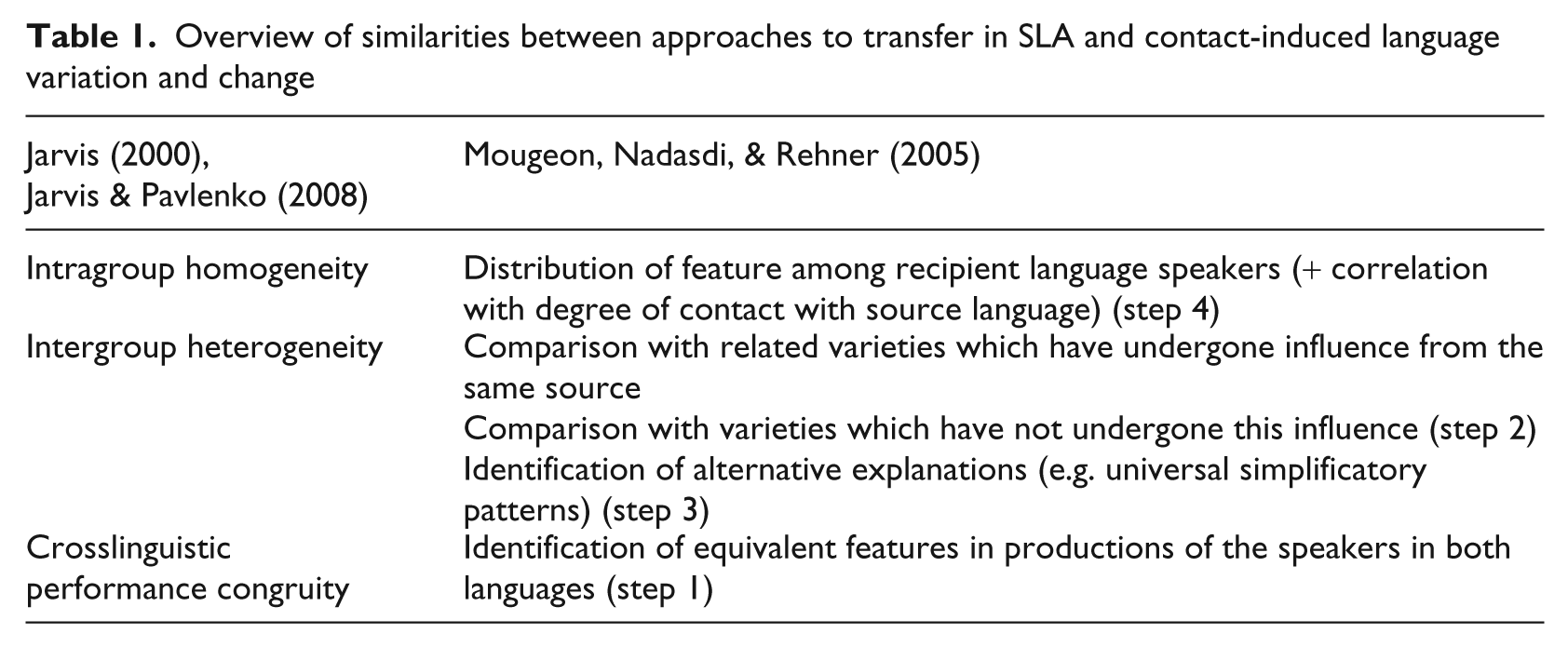
This approach is similar to the steps that researchers in the field of language variation and change recommend taking if one wants to argue that an innovative feature in a contact variety is the result of intersystemic contact (see Table 1). Mougeon et al. (2005) argue that, in step 1, researchers should establish whether there is equivalence between the productions of the speakers in both languages, which corresponds to Jarvis and Pavlenko’s third criterion. In step 2 alternative explanations such as overgeneralization or regularization are explored and in step 3 a comparison with data from other sources is made. These two steps in the process are covered by Jarvis and Pavlenko’s second criterion (intergroup heterogeneity).
In step 4, Mougeon et al. recommend studying whether or not the distribution of an innovation is linearly correlated with the level of contact with the source language. If so, this is an argument in favour of transfer-based explanations, even though the authors point out that this correlation may be much weaker if variants are widely used in the recipient language speech community. Jarvis and Pavlenko (2008) do not discuss this issue in great detail but mention the fact that individual variation in knowledge of or contact with the source language can be a reason for low levels of intragroup homogeneity among recipient language users. This is not likely to be the case if the feature has undergone a process of diffusion (see Mougeon et al., 2005, p. 104).
The approach sketched above is used in this article in the analysis of grammatical
collocations such as regarder après ‘look for’ or chercher
après ‘look for’ in Brussels French, the variety of French spoken in
Brussels.
1
The term
Prior to the discussion about the source of the constructions under study, I aim to clarify whether the second element in the collocations (après ‘after’, (en de)hors de ‘out (of)’ and en bas (de) ‘down’) is a preposition, an adverb or a particle. Talmy (1985) uses the term ‘satellite’ for particles that are part of phrasal verbs in, for example, English, as well as for the separable and inseparable prefixes found in the Germanic languages. With Talmy (1985, p. 102) I assume that prepositions are to be distinguished from satellites, because prepositions disappear when the complement is omitted, but satellites remain in place. As Talmy shows, in I ran out of the house, for example, ran is followed by the satellite out as well as the preposition of, but the satellite out can also appear alone, as in he ran out. He notes that the verb root together with its satellites forms a constituent in its own right, the ‘verb complex’. Other authors use the term verb-particle construction (VPC). As the term ‘particles’ is more widely used than ‘satellites’ among researchers in the field, I prefer to use the former.
The key question I focus on in this article is to what extent the constructions under study are characteristic for this variety of French only or more commonly found in other varieties of French, and whether there is evidence for any influence from Dutch in these constructions. Comparing isolated examples from different periods in the history of French or from different speakers is not helpful, because these provide us only with a confusing range of structures, but not with criteria that can help decide whether internal or external explanations are most plausible. New light can be thrown on the issue if we adopt a corpus-linguistic approach, making a comparison of the frequency of the phenomena in different corpora along the lines of the method proposed by Jarvis (2000), Jarvis and Pavlenko (2008) and Mougeon et al. (2005).
Transfer will be assumed to have played a role in the occurrence of these structures in Brussels French, if the patterns
are widespread among the target group of bilingual speakers in Brussels and not an isolated incident (intragroup homogeneity);
are more frequent in the variety of French used by Dutch–French bilinguals than among varieties of French that are not currently in contact with a Germanic language or are in less direct contact with Dutch, such as varieties of Belgian French from Wallonia (intergroup heterogeneity);
are a common feature in the performance of source language speakers, i.e. Dutch (crosslinguistic performance congruity);
cannot be explained as internal developments;
are found most frequently among speakers with the highest level of contact with the source language, Dutch.
This does not mean that transfer is the only reason: the occurrence of a particular grammatical collocation may well be the result of multiple causation (Thomason & Kaufman, 1988): i.e. transfer and internal causes can contribute together to the emergence or diffusion of a pattern (see also Heine & Kuteva, 2005).
The structure of the article is as follows. First I introduce a number of key concepts of contact-induced change and transfer (section 2). The next section (3) deals with the criteria Jackendoff (2002) uses to distinguish prepositions and particles, and these are subsequently applied to the constructions found in Brussels French, with a view to establish whether they are VPCs or not. In section 4 the focus is on VPCs in Romance–Germanic contact situations. Section 5 presents an overview of the methodology and section 6 focuses on the results of the analyses of different data sets. Section 7 offers a discussion and a conclusion.
2. Contact-induced change, transfer and replication
For the purposes of the present article, contact-induced change is defined as ‘the adoption
of a structural feature into a language as a result of some level of bilingualism in the
history of the relevant speech community’ (Matras & Sakel, 2007, p. 1). Following Grosjean
(this issue), we consider the occurrence of a grammatical collocation to be an example of
The distinction between
As I have argued elsewhere (Treffers-Daller, 1999), the influence of Dutch on Brussels French manifests itself
mainly in the use of reinterpreted and/or restructured French words, and much less in the
importation of Dutch language forms. This is to be expected as the influence from Dutch on
French is the result of a process Thomason and Kaufman (1988, p. 115) call
As Heine and Kuteva (2005, p. 40) have pointed out, when grammatical use patterns are replicated, the new structure in the recipient language is not entirely new in most cases: it often builds on some structure that is present in the source language but constitutes only a minor use pattern. Through the process of replication this minor use pattern then becomes a major use pattern. It is entirely possible that this is also the case in the collocations under study here, and for this reason it is very important to include historical data in the analysis.
3. Distinguishing prepositions and particles
As it is important to establish whether the phenomena under study are prepositions, particles or adverbs, I first review the most important criteria used to differentiate particles and prepositions, and then apply these criteria to the Brussels French data.
Dehé, Jackendoff, McIntyre, and Urban (2002, p. 3) define particles in the following way:
. . . an accented element which is formally (and, often, semantically) related to a
preposition, which does not assign case to a complement and which displays various
syntactic and semantic symptoms of what may informally be called a close
relationship with a verb, but without displaying the phonological unity with
it typical of affixes.
Jackendoff (2002, p. 69) notes that the class of particles is for the most part homophonous with prepositions, but suggests there are clear criteria to distinguish the two. First of all, with intransitive verbs, the particle can serve as the only complement, as in (1), but this is not possible with prepositions such as from, as (2) illustrates. Prepositions can of course be left stranded at the end of the sentence, when the complement has been moved, as in (3):
(1) George grew up. (Jackendoff, 2002, p. 69) (2) *The branch grew from. (3) The tree the branch grew from.
With transitive verbs, the particle can appear on either side of the complement, as in (4a/b), but prepositions can only appear on the left, as (5a/b) illustrate:
(4a) Bill put out the garbage. (Jackendoff, 2002, p. 69) (4b) Bill put the garbage out. (Jackendoff, 2002, p. 69) (5a) The branch grew from the tree. (5b) *The branch grew the tree from.
When they appear on the left of the complement, particles look like prepositions, but several tests show that they are different. Thus, cleft constructions are possible with PPs (6a) but not with particles and their complements (6b). Similarly, wh-movement with pied piping is possible with PPs, as we can see in (7a), but not with particles and their complements (7b):
(6a) It was
(6b) *It was
(7a) From which tree did the branch grow? (7b) *Out which garbage did Bill put?
While the properties of VPCs in the Germanic languages are well known (Booij, 2002, 2010), far less attention has been paid to such constructions in the Romance languages, which are often assumed not to possess VPCs (Dufresne, Dupuis, & Tremblay, 2003, p. 33; Tremblay, 2005, p. 263). In this article I can only summarize a few key syntactic characteristics of the constructions under study here, but more details about the historical development of the distinction between prefixes, prepositions and (adverbial) particles in French can be found in Dufresne et al. (2003), Kopecka (2006) and Marchello-Nizia (2002). I do not deal with the prosodic criteria Dehé et al. (2002) use to distinguish prepositions and particles. As Germanic languages are stress-timed whereas French is a syllable-timed language (Abercrombie, 1967), it is unlikely that the stress patterns associated with particles in the Germanic languages and the Romance languages are the same.
In Brussels French prepositions can be combined with a variety of verbs in ways that are not attested in dictionaries of Standard French, such as the Trésor de la langue française informatisé (http://atilf.atilf.fr/tlf.htm). Baetens Beardsmore (1971, p. 210) notes that verbs which are transitive in metropolitan French are sometimes accompanied by prepositions, as in chercher après ‘to look for’, and that prepositions are also used as adverbs more often in Brussels French than in French as spoken in France. 3 In this present study the focus is on collocations of verbs with après ‘after’, en bas (de) ‘down’ and (en) (de)hors (de) ‘out of’, which are often argued to be transferred from Dutch (e.g. Baetens Beardsmore, 1971), because VPCs are very common in Germanic languages. The Dutch translation equivalents zoeken naar ‘to look for’ and naar beneden vallen or neervallen ‘to fall down’ from my Brussels French corpus are often seen as sources for the Brussels French constructions in (8a/b) and (9a/b). These examples show that après and en bas can be used in different ways. In (8a) preposition après is followed by a complement, but in (8b) there is no overt complement:
(8a) Il
‘He is still looking for his little frog.’ (8b) Mais le chien
‘But the dog runs after (them) and makes them fall.’
In (9a) en bas de can be seen as a compound preposition (Jones, 1996) or if one uses Talmy’s (1985) framework, as a sequence of the satellite (particle) en bas ‘down’ and the preposition de ‘of’. In (9b) it is an adverbial phrase which does not take a complement:
(9a) Son chien il
‘His dog he falls down from the window.’ (9b) En une fois il ne sait plus se tenir et il
‘All of a sudden he cannot hold on anymore and he falls down.’
Examples (10a) and (10b) are clearly different from each other in that dehors is part of a compound preposition in (10a), 4 but an adverb in (10b). In Dutch there is a wide range of verbs with separable prefixes such as uit-vallen ‘to fall out’ (Booij, 2002, 2010), which could have formed the model for the occurrence of tomber en dehors in (10a):
(10a) Le gamin lui il
‘The boy, he falls out of the tree.’ (10b) Il
‘He goes out and calls the frog.’
The first question that needs to be answered is whether or not the structures under study here constitute examples of verb-particle constructions. The results of the tests proposed by Jackendoff (2002) show that most constructions under study here are not VPCs, because they allow for clefting and wh-movement with pied piping (11–13). This indicates that in these constructions après, (en de) hors (de) and en bas de are best seen as prepositions or adverbs, and not as particles:
(11a) C’est
‘It is after his frog that the boy is searching.’ (11b) ‘After which frog is the boy searching?’ (12a) C’est
‘It is out of the house that the boy went.’ (12b) ‘Out of which house did the boy go?’ (13a) C’est
‘It is down the window that he fell.’ (13b) ‘Out of which window did he fall?’
The Brussels French constructions differ in this respect from the Canadian ones mentioned by Chevalier and Long (2005), of which (14a) is an example. As we can see in (14b/c) shutter off does not allow for clefting or pied piping:
(14a) J’ai
‘I shut the light off.’ (14b) *C’est
It is off the light that I shut ‘I shut the light off.’ (14c) * Off which light did I shut? ‘Which light did I shut off?’
Although we have just seen that en bas it is not a particle, it is interesting that it can be placed on either side of its complement, as (9a), repeated here as (15a), and (15b) show: 5
(15a) Son chien il
‘His dog he falls down from the window.’ (15b) Le chien
‘The dog already falls down from the window.’
By contrast, we find après only to the left of its complement, as can be seen in (16), unless the complement has been moved or replaced with a pronoun, as in (17). In examples such as (17) après is a stranded preposition because the dative clitic lui ‘him’ is the complement of après:
(16) *Le garçon cherche la grenouille
The boy looks the frog for ‘The boy looks for the frog.’ (17) Les abeilles lui
The bees him run after ‘The bees run after him.’
If dehors is used in combination with sortir ‘to go out’ (see 18), it only appears to the left. In combinations with other verbs, such as recevoir ‘to get’, it can appear on the right as well (see below for a discussion of example 20):
(18) *Le garçon est sorti de la maison
The boy is left of the house out ‘The boy left the house.’
There are, however, also other combinations with après, dehors and en bas which are clearly different from the ones discussed so far. Baetens Beardsmore (1971) notes that en bas can be combined with a range of verbs, such as payer en bas ‘to pay off’, secouer en bas ‘to shake off’ and couper en bas ‘to cut off’. Collocations with dehors include chercher dehors ‘search out, take out’ and couper dehors ‘to cut out’. While on the surface en bas in (19) resembles a preposition, it cannot be moved to the front in a cleft construction (19a), nor is pied piping of the PP allowed (19b). Thus, according to Jackendoff’s (2002) criteria, en bas is a particle in this construction. Together with the verb secouer ‘to shake’ it forms the VPC secouer en bas ‘to shake off’ in (19):
(19) Secoue un peu la crasse
Shake a bit the dirt off on the scraper ‘Shake the dirt off the scraper.’ (19a) *C’est la crasse
It is the dirt down that you shake ‘It is the dirt that you shake off.’ (19b) *Quelle crasse
Which dirt off did you shake ‘Which dirt did you shake off?’
For the same reasons, dehors in (20) is a particle, and it forms a VPC with recevoir ‘to get’. As (20a/b) demonstrate, clefting and pied piping are not possible with this construction:
(20) Je ne sais pas
‘I cannot get the (fuel) cap out.’ (20a) *C’est le bouchon
It is the fuel cap out that I got ‘It is the fuel cap that I got out.’ (20b) *Quel bouchon
Which cap out did I get ‘Which cap did I get out?’
It is possible to separate après from the verb, as in (21), where two PPs, dans le bois ‘in the forest’ and avec son chien ‘with his dog’, appear between the verb chercher and the preposition après:
(21) Il va même
‘He even goes looking in the forest with his dog for his frog.’
While the issue cannot be explored in much detail here, the word order in (21) is not common in metropolitan French. In French from France adjuncts such as dans le bois ‘in the forest’ and avec son chien ‘with his dog’ normally follow the direct object sa grenouille ‘his frog’ or a prepositional phrase which is closely linked to the verb, such as après sa grenouille ‘after his frog’ (Judge & Healey, 1985, p. 403; see also Magnus, 2007, for further details on the contrasts between Dutch and French word order). Therefore speakers of metropolitan French would probably prefer the word order given in (21a):
(21a) Il va même
‘He even goes looking for his frog in the forest with his dog.’
It is possible that the word order in (21) is influenced by Brussels Dutch, which allows for the insertion of several adjuncts before the preposition which forms a collocation with the verb. The word orders in (21b) and (21c) are both possible in Dutch:
(21b) Hij
‘He even looks in the forest with his dog for the frog.’ (21c) Hij
‘He even looks with his dog in the forest for the frog.’
A few words also need to be said about the semantics of the constructions. The collocations form lexicalized patterns, i.e. a particular meaning is found to be in regular association with this construction. The meanings of Brussels French collocations such as payer en bas ‘to pay off’ (Baetens Beardsmore, 1971, p. 262) or recevoir dehors ‘to get out’ (De Vriendt, 2004, p. 34) are not very transparent to speakers unfamiliar with this variety of French and can often only be understood by those familiar with the Dutch translation equivalents.
The addition of après (whether used as a preposition or as an adverb) to courir in (21) changes the meaning of the verb from ‘run’ to ‘pursue/chase’ and crier après means ‘to call (for)’, which is different from crier ‘to cry’. In both cases, there is a more formal equivalent for these verbs, namely poursuivre ‘pursue/chase’ and appeler ‘to call (for)’. The addition of après also changes the subcategorization frame of the verb so that it can be used in combination with an object (courir après quelqu’un/quelque chose ‘to run after someone/something’; crier après quelqu’un/quelque chose ‘to call for someone/something’).
The addition of en bas (de) to the path verb tomber as in (20a/b) appears to be redundant, but as one reviewer has pointed out, the expression en bas adds a precision to the meaning of the verb: it can be functional in some contexts, as for example descendre en bas can be used to refer to going down to the ground floor as opposed to going down to the first floor of a building.
4. Verb-particle constructions in Romance–Germanic contact situations
While verb-particle constructions are commonly found in Germanic languages, there is some evidence for their existence in Romance languages too. Iacobini and Masini (2006, p. 169) show that VPCs such as andare dentro ‘to go in’ (which are used alongside the synthetic synonym entrar ‘to enter’) are very popular in Italian, in particular in informal speech. The popularity of VPCs may be due to the fact that more meanings can be expressed with the VPCs than with the synthetic forms: there are no synthetic alternatives, for example, for andare appresso/dietro ‘to go behind’ and andare lontano ‘to go far’ (Iacobini & Masini, 2006, p. 168). In addition, many of the prefixes found in alternative, synthetic constructions are no longer productive. The authors strongly argue against what they call ‘the Germanic Hypothesis’ and claim this is a language-internal development; although it appears to be the case that the phenomenon is particularly popular in dialects in the North. Iacobini and Masini admit that in Alpine dialects the phenomenon may have been ‘strengthened by contact with modern German’ (p. 165) but insist it is a language-internal development. Unfortunately, the authors do not provide any quantitative evidence for their case, even though a detailed comparison of different corpora could provide further evidence in favour (or against) this claim. The development itself is interesting because the VPCs represent a departure from the perspective of the typology proposed by Talmy (1985, 2000) and Slobin (2004), according to which Romance languages belong to the verb-framed category, in that path is expressed in the verb, whereas Germanic languages tend to be satellite-framed, in that path is expressed in a satellite that is linked to the verb. In Italian VPCs path is expressed in a satellite. As Beavers, Levin, and Tham (2010) have pointed out, in most languages, including English, both satellite-framed and verb-framed patterns are available, although one is often used more widely than the other.
Kramer (1981, p. 130) notes that fixed combinations of verbs with locative adverbs are very frequent in a range of Romance varieties that are close to the Germanic/Romance language border. Kramer and other researchers, including Gsell (1982), Jaberg (1939), Meyer-Lübke (1899, §482) and Rohlfs (1983) assume that language contact with Germanic languages explains the frequency of these constructions in Romance varieties, but unfortunately they do not provide quantitative evidence to corroborate this claim. Dufresne et al. (2003, p. 34) and Vincent (1999) dispute the Germanic origin of these constructions, and claim that both prefixation and particles are of Indo-European origin. In Old French aspectual or locative prefixes were highly productive, but this is no longer the case in modern French (Dufresne et al., 2003; Foulet, 1946; Kopecka, 2006). Particles such as sus ‘up’ or jus ‘down’ could be used to modify the meaning of a verb in Old French, but structures such as descendre jus/aval ‘descend downwards’ and monter sus/amont ‘climb upwards’ have disappeared as well. According to Foulet (1946, p. 60) it is in particular in redundant constructions such as the two last examples that contact with Germanic varieties can be assumed, which is interesting if one believes with Trudgill (2004) that increased redundancy can be one of the effects of long-term bilingualism. However, as we have seen in section 3, the grammatical collocations under study here are not always or not entirely redundant (e.g. tomber en bas).
In modern French, just like in Italian, verbal prefixes which originate in Latin or Greek can encode path: in ac-courir ‘to run to’ and s’é-couler ‘to flow out’, for example, the prefix adds the notion of path to the verb root (Kopecka, 2006, p. 89), but these forms are lexicalized and in many cases not very transparent. It is also possible to use a deictic verb such as aller in combination with a preposition such as hors ‘out’ as in elle va hors de la maison ‘she goes out of the house’ or in combination with an adverb such as dehors ‘out’, as in elle va (en/au) dehors ‘she goes out(side)’, but the path verb sortir ‘to leave’, as in elle sort (de la maison) ‘she leaves (the house)’ is used much more frequently for these purposes. A quick search on the French webcorpus of Sketchengine (over 126 million words) shows that combinations of aller + dehors get only 43 hits, but sortir gets 39,590 hits. 6 This confirms the results of Hickmann (2006, p. 296), who found that French adults prefer to encode path in the verb and French children learn the typical ways of expressing motion very quickly from the age of three onwards. French children rarely use satellites to express path although there are some differences between adults and children with particular items (Hickmann & Hendriks, 2006, p. 122). British learners of French as a second language, on the other hand, regularly make use of deictic verbs combined with prepositions or path satellites as a means to express motion, possibly because they transfer L1 patterns into French, or because these constructions are somehow perceived to be simpler or more transparent than path verbs. Schlyter (1984) and Harley and King (1989) were the first to show that learners with a Swedish or an Anglophone background overuse venir ‘to come’ and aller ‘to go’ in comparison with native speakers of French who prefer to use verbs which conflate motion and path, such as sortir ‘go out’ or entrer ‘go in’. Similar overuses of deictic motion verbs were found among British learners of French (Treffers-Daller & Tidball, in prep.).
Less is known about contact-induced change in grammatical collocations among bilinguals who use a verb-framed and a satellite-framed language. The studies of the particle back in different varieties of Canadian French are particularly relevant in this context. King (2000, 2008) found that in different varieties of Canadian French the English particle back can be used with French verbs (including but not limited to verbs of motion) to produce structures such as venir back ‘return’. Some cases are redundant in that the prefix re- is combined with the English particle, as in revenir back ‘to come back’. In some varieties of French as spoken in Canada back can also be prefixed to the verb as (22):
(22) Il m’a
‘He hit me back.’
In addition, back can also express meanings it does not have in the source language, as in (23) where it expresses the notion of ‘again’:
(23) Je vous dirai pas
‘I won’t tell you again.’
These two possibilities, which do not occur in English, illustrate the process of nativization of borrowings (Mougeon, Brent, Bélanger, & Cicocki, 1980). According to Mougeon (personal communication) the differences in the usage of back in Canadian French are linked to differences in normative pressures. In communities with prolonged contact with English and low normative pressure, more advanced usages of back are found. In Ontario French, where normative pressures are relatively high, donner back ‘give back’ is possible (see Canale, Mougeon, Bélanger, & Main, 1977) but back donner is not and the use of back to mean ‘again’ is unattested. In Quebec French, on the other hand, where contact with English is weaker, and normative pressures higher than in Ontario French, back has not entered the morphosyntax of French, nor have de retour or en arrière adopted the meaning ‘back’ (see also Thomason & Kaufman, 1988, for the influence of intensity of contact on the outcome of language contact).
Chevalier and Long (2005) show that the importation of particles is not limited to back: six other English-origin particles can be used in French as spoken by adolescent speakers of the southeast of Canada, namely: out, up, off, on, in and around. In the Acadian French variety, which is often referred to as Chiac, verb-particle constructions most often consist of an English verb and an English particle, as in (14a), which was discussed in section 3, but combinations with French verbs are also attested: aller on ‘to go on’, (re)garder around ‘to look around’, mettre on ‘to put on’ and sortir out ‘to go out’.
The differences between the Canadian data and the Brussels data are clear. In the Canadian
examples English language material is imported into French, and they can thus be seen as
examples of
According to Tremblay (2005, p. 263), in some varieties of French (for example Quebec French) grammatical collocations can be found which consist of a French verb and a French preposition/adverb, such as monter en haut ‘to go up’, descendre en bas ‘to go down’, se lever debout ‘to get up’, mettre bas ‘to put down’ and jeter bas ‘to throw down’. Interestingly, some of the prepositions mentioned here are redundant, and the constructions resemble those found in Brussels French and those mentioned by Gsell (1982), Jaberg (1939) and Kramer (1981). These authors only give examples of combinations of Romance particles with Romance verbs (pattern replication) along the Romance/Germanic language border, but do not bring up any cases of the importation of Germanic particles (matter replication) into the Romance languages. In most of the contact situations under study the Romance language is the dominant variety, which may explain why the results are similar to what we find in Brussels, but different from those in Canada, where matter replication is found too, at least in some varieties. Normative pressures may well play a role too in the frequency with which matter and pattern replication is found in the other bilingual communities, but this is beyond the scope of the current article.
5. Method
The data studied here come from a variety of sources. In order to maximize the comparability of the data across groups of informants, a story telling task was used to elicit semi-spontaneous data. The frog story Frog where are you? (Mayer, 1969) was chosen for this purpose, because it forms a good source of information for the description of motion, and many collocations under study here involve motion verbs. The story has also been used by a wide range of researchers in the field of L1 and L2 acquisition. The data from Dutch–French bilinguals (N = 25) were collected in 2006 in Anderlecht, one of the 19 municipalities of the Brussels Region, situated in the southwest of the agglomeration. Among these informants, 16 can be classified as balanced bilinguals and nine as Dutch-dominant (Treffers-Daller, in press). The informants’ mean age is 62, they had lived all or most of their life in the Brussels Region, and belong to the so-called traditional bilinguals (Janssens, 2001, p. 92): they speak the two languages of the Brussels Region, that is (the regional varieties of) French and Dutch. 8 The informants from Anderlecht also told another frog story (Frog goes to dinner) in the local variety of Dutch, Brussels Dutch, which made it possible to compare the bilinguals’ use of some collocations in both languages. The same story could not be used for elicitation in both languages, as this might have triggered unwanted translation effects.
The Brussels data are compared with frog stories from native speakers of French from Paris (N = 27, mean age 21), collected in the same year, and with frog stories from 18-year-old Flemish L2 learners of French from the city of Aalst in Flanders (N = 25), who had had six years of French tuition in secondary school prior to data collection. The data were collected and transcribed in CHAT by Laurence Mettewie and Alex Housen, and they are available from the FLLOC database (http://www.flloc.soton.ac.uk/). The other data sets were also formatted in CHAT and all data were analysed with CLAN (MacWhinney, 2000).
The frog story data are compared with a variety of databases from written and oral sources. Historical data were obtained from Frantext (http://www.frantext.fr/). Beeching’s corpus of spoken French (http://www.uwe.ac.uk/hlss/llas/iclru/index.shtml) of about 155,000 words as well as the Sketchengine database (http://www.sketchengine.co.uk/) of 126,850,281 words were used as the sources of information on spontaneous spoken and written data from varieties of French that are less likely to have undergone influence from Germanic varieties. These two sources are also used to check whether the frequency of the structures under study in the narratives from Paris is comparable to that in French data from other spoken and written sources, as a low frequency of these structures in the Paris control corpus could be accidental. Finally, a subset of data from Namur and Liège from the Chalons subcorpus of the VALIBEL database (http://www.uclouvain.be/valibel.html) formed the key source on Belgian varieties of French outside Brussels. This subcorpus contains 472,018 words. Finally, I have used the Corpus Gesproken Nederlands (Corpus Spoken Dutch) of about 9,000,000 words (http://www.inl.nl/nl/corpora/corpus-gesproken-nederlands-(cgn)) for the occurrence of the Dutch translation equivalents of the structures under study (e.g. naar beneden vallen and neervallen ‘to fall down’).
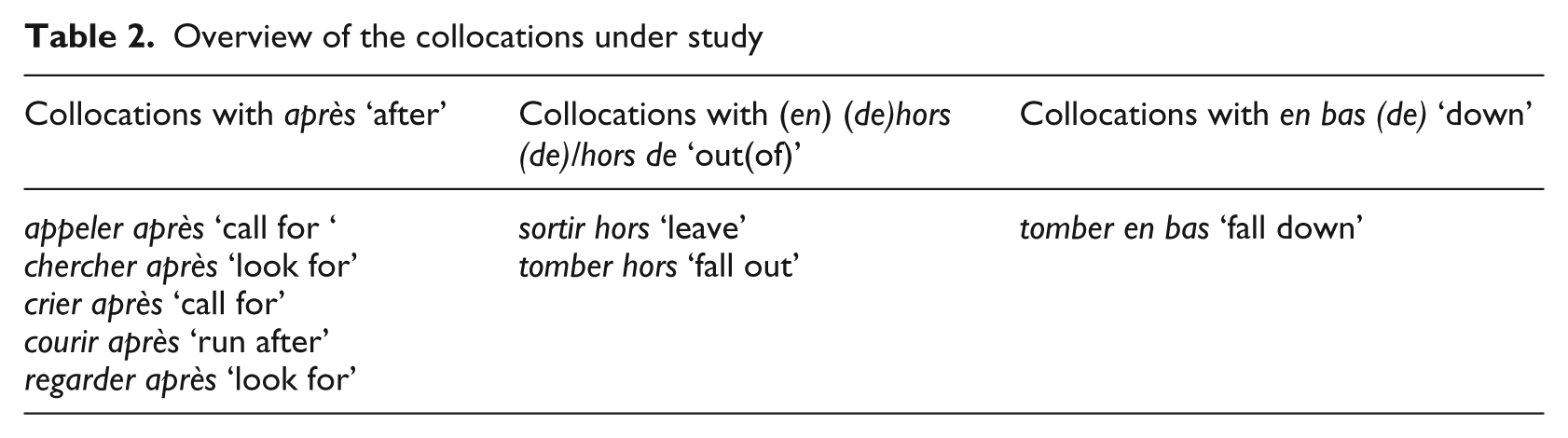
From the prepositions/adverbs whose use is discussed in Baetens Beardsmore (1971), I selected those which occurred more than once in the frog stories from Brussels (see Table 2). 9 Two of these constructions (courir après ‘run after’ and crier après ‘call for’) are attested in the Petit Robert and the dictionary of the Trésor de la langue française informatisé 10 (TLFI) but they were not used at all by the speakers of metropolitan French who told the frog stories. In order to find out to what extent their usage differs in Brussels French and metropolitan French, courir après and crier après were kept in the analysis. In all cases, I carefully checked whether the examples found were indeed the intended collocations and not, for example, verbs followed by temporal adjuncts such as après deux heures ‘after two hours’ or constructions such as those in where regarder après does not mean ‘to seek’ but literally ‘look behind’: thus it does not form a collocation with the verb, but represent a directional adjunct which does not change the meaning of the verb. In (24), the object of the search is not the tree but the frog: thus the little boy is not looking for the tree but behind the tree. Cases such as these were excluded from the calculations:
Overview of the collocations under study
(24) Et il va
‘And he goes looking behind the tree.’
The search strings were formulated in such a way that all the different inflected forms of
the verb were included in the searches in all corpora. As other words can sometimes occur
between the two parts of grammatical collocations, as in Ils cherchent
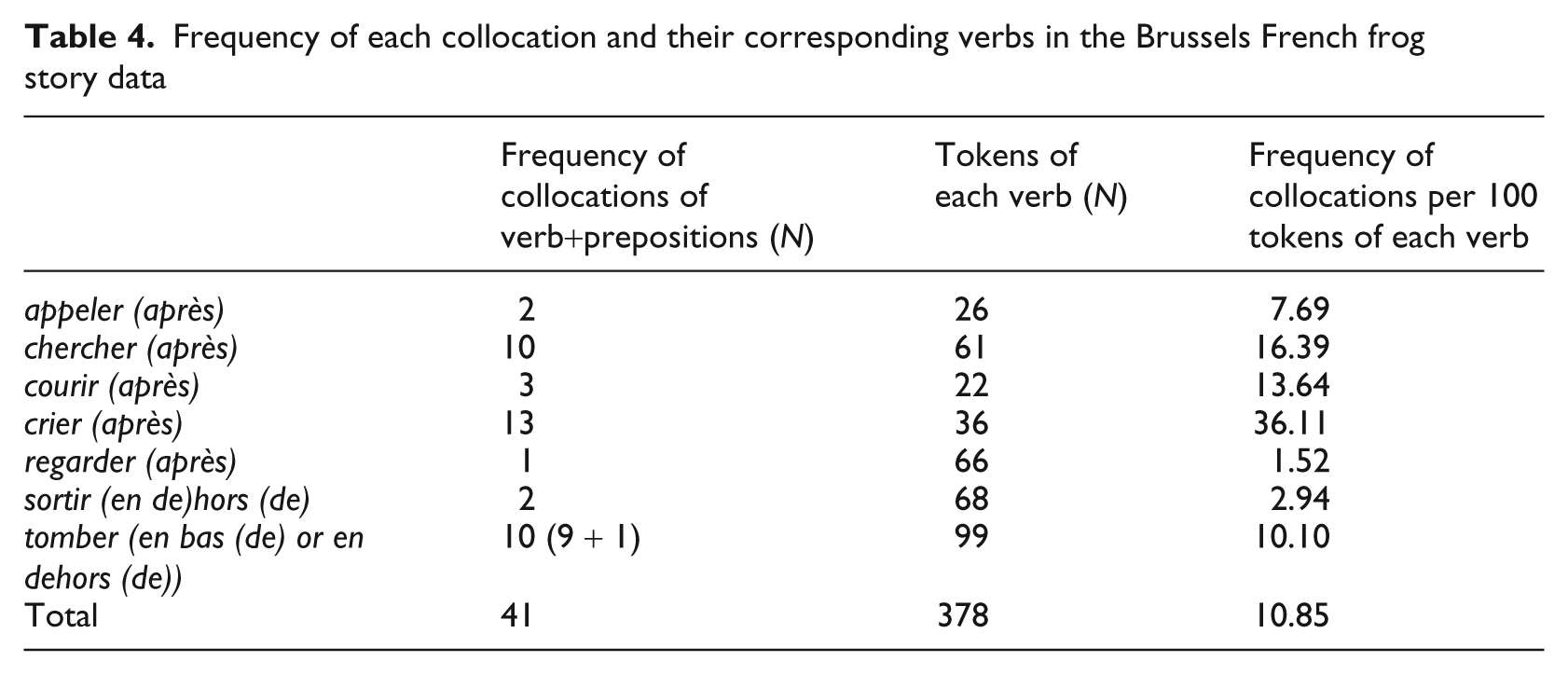
As it was important to find out not only how many times informants used the different collocations, but also how many times informants could have used a collocation but preferred a bare verb (for example chercher instead of chercher après), I also counted in all transcripts how frequently the different verbs were used without the prepositions/adverbs under study. Subsequently I calculated the relative frequency of the collocations for each informant in relation to the total number of tokens of the same verb. In those cases where more than 100 tokens of a particular structure were found, only the first 100 were scrutinized to establish whether they were the intended collocations, and not tokens of temporal PPs or other structures that needed to be excluded. 11 If needed, further context was obtained to determine the function of the preposition/adverb in a particular example. The total number of collocations per 100 tokens for all verbs under study was then calculated as follows: the total number of collocations in the Brussels frog story set (41) was divided by the total number of verbs (378). The outcome was multiplied by 100, which leads to a result of 10.85 (see Table 4).
6. Results
6.1 Intragroup homogeneity and degree of contact with Dutch
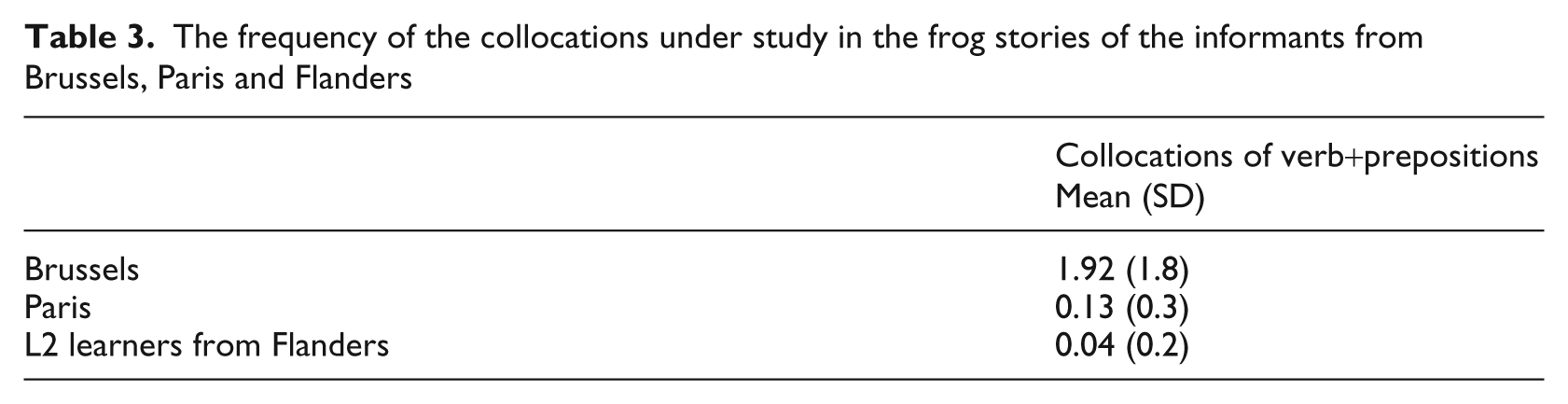
The collocations are widely used by the bilinguals from Brussels, as 19 of the 25 informants in this group use these structures, whereas only two of the 27 informants from Paris and only one of the 25 informants from Flanders use the collocations under study. The constructions are indeed very rare among the latter two groups, but much more frequent among the group from Brussels (see also Table 3). The standard deviations reported in Table 3 are somewhat higher in the Brussels group than among the two other groups, which indicates there is more variation within the Brussels group than within the two other groups.
The frequency of the collocations under study in the frog stories of the informants from Brussels, Paris and Flanders
In order to find out whether degree of contact with Dutch could explain the frequency of usage of the collocations, I operationalized degree of contact with the source language (Dutch) by dividing the group into those who attended a Dutch-speaking primary school (15 informants) and those who went to a French-speaking primary school (6 informants). The remaining four informants claimed that both languages were used in class or did not provide any information regarding the languages spoken at school, so these informants were excluded from this analysis. The frequency with which the informants in the bilingual group use the collocations may indeed be related to the languages spoken in school, as among those who went to a Dutch-speaking school the relative frequency of the collocations is 12.9, whereas among those who attended French-speaking schools the relative frequency is 6.6. The differences are not significant, but represent a trend (t = 1.39; d.f. = 19, p = .092 (one-tailed)), which indicates that, if further data could be collected, this factor (i.e. the language of schooling) would probably turn out to be a predictor of the use of the collocations under study.
6.2 Intergroup heterogeneity
In this section I compare the data from Brussels French with data from related varieties which have or have not undergone influence from a Germanic variety. In the first part a comparison is made between the frog stories from Brussels, Flanders and Paris; in the second part the Brussels data are compared with evidence from a large corpus of spontaneous French that has not been influenced by Germanic varieties. Then in section 6.3 alternative explanations based on internal developments are explored.
6.2.1 A comparison between the frog stories of the three groups
Table 3 gives the mean frequency of the collocations per group and demonstrates that the collocations are far more frequent among the bilingual group from Brussels than among the two other groups, and these differences are significant (ANOVA, F(2,72) = 24.39, p < .001). A post-hoc analysis reveals that the Brussels group is significantly different from the two other groups, but the differences between the Paris group and the group from Flanders are not large enough to become significant. 12
A more detailed picture of the frequency of different constructions can be found in Table 4. Three of the collocations, chercher après, crier après and tomber en bas, are relatively frequent in the Brussels corpus. All others occur fewer than 10 times. A calculation of the relative frequency of all collocations (i.e. frequency per 100 tokens of the verb) shows that they occur on average 10.85 times per 100 tokens. In the L2 learner corpus and the Paris corpus almost no collocations are found: 13 there is only one token of tomber en dehors in the learners’ corpus and the informants from Paris produce one token each of tomber en bas and tomber hors de.
Frequency of each collocation and their corresponding verbs in the Brussels French frog story data
As two reviewers point out, speakers could also have opted to use the slightly more formal, synthetic alternative, namely poursuivre ‘to chase (after)’ instead of courir après, and appeler ‘to call’ instead of crier après. 14 As it turns out, all groups do indeed use poursuivre, but it is clearly favourite among the Paris group (26); it is least used by the Flemish L2 learners (2), and the Brussels group occupies the middle position with nine tokens. The Brusselers use crier après (16), but they also use appeler frequently (25). The Paris group and the learner group do not use crier après but instead use appeler 52 and 22 times respectively. This analysis reinforces the conclusions drawn on the basis of Table 3, namely that the option to use a collocation is most often chosen among the Brussels informants. For the other collocations there are no obvious alternatives except using the verb without the preposition/adverb.
6.2.2 Comparison with data from Belgian French and Canadian French
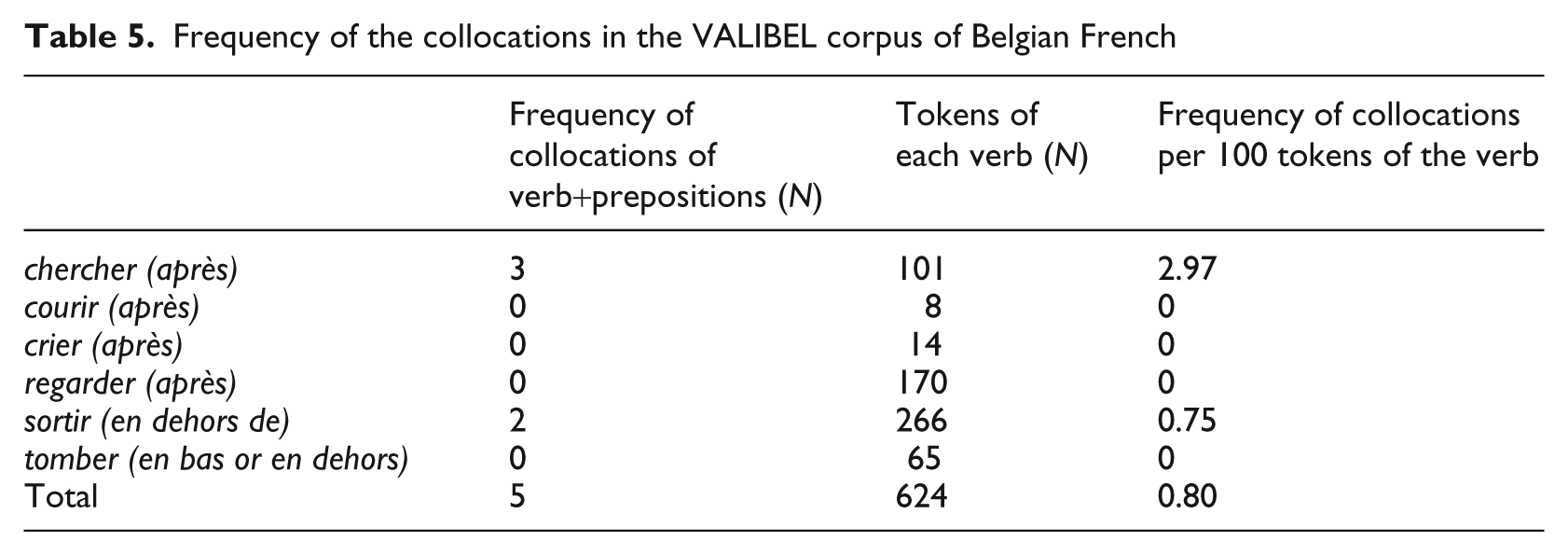
In this section the focus is on the frequency of the patterns in a corpus of Belgian French from Wallonia, which forms part of the VALIBEL corpus. As explained in section 1, I assume the collocations will be less frequent in these varieties, because the speakers are less influenced by Dutch and thus transfer from this language is less likely. The results in Table 5 show that only two of the collocations under study were found in the VALIBEL corpus: chercher après and sortir en dehors, and they occur 10 times less often than in Brussels French: 15 only 0.8 times in 100 tokens of the verbs. It will be interesting to compare these results with French data from France, as even less influence from Germanic varieties is expected there. This is dealt with in section 6.3.
Frequency of the collocations in the VALIBEL corpus of Belgian French
The constructions found are very similar to those found in Brussels. In (25a) we find chercher used with the adverb après and in (25b) the same verb is followed by a prepositional phrase headed by après:
(25a) La petite soeur
‘The little sister looked for (it = the big monster).’ (25b) Je dois
‘I have to look for my words.’
In (26) the speaker use sortir with a prepositional adjunct in en dehors de:
(26) On ne
‘We never go out outside Ciney.’
A brief comparison with data from Mougeon and Beniak’s (1991) corpus of Ontario French is interesting at this point, as two of the verbs under study here, regarder and chercher, occur with adverbs or prepositions in Ontario French too. The preposition used by French Canadians is pour, the translation equivalent of English for, as shown in (27) and (28), and not après ‘after’, which is the translation equivalent of Dutch na/naar/achter:
(27) Inspector Clouseau il
‘Inspector Clouseau he was looking for a man.’ (28) Mais là je vas
‘But you know I am going to look for a job.’
Thus, in Brussels French, Belgian French and Ontario French a preposition is added to these verbs, but the choice of the preposition differs in these varieties as it based on the translation equivalent in the contact language. In Brussels French and in the VALIBEL corpus, regarder pour and chercher pour are not attested, and no mention is made of regarder après or chercher après in Ontario French. After completing a detailed comparison of the use of these verbs in a variety of data from speakers, Mougeon and colleagues conclude that the source of the innovations in Ontario French is likely to be English, because degree of contact with the source language English explains the frequency of occurrence of these forms (Mougeon et al., 2005). As we have seen in section 6.1, there is not yet enough evidence to draw conclusions about this issue for Brussels French. Mougeon et al. (2005, p. 108) also note that the use of the verb regarder with the preposition pour, which together encode the meaning ‘to seek’ (a calque from ‘to look for’), represents a more in-depth form of contact-induced change than the use of chercher pour because the former entails not only the insertion of pour, but also the substitution of regarder for chercher, whereas the latter only involves the addition of a preposition.
In (29) the regarder après can be translated as ‘to look for’ or ‘to seek’ but not as ‘to look at’: this would only be possible if the frog were in the jar, which is not the case in the picture. Thus, in this case the verb regarder has probably indeed assumed the meaning of chercher, but this transfer of meaning cannot be explained as contact-induced, because the Brussels Dutch translation equivalent zien or bezien ‘to look at’ does not mean ‘to seek’: 16
(29) Le petit garçon regarde le chien, qui
‘The little boy watches the dog, who looks into the jar for the frog for the
frog.’
This example is also interesting because the speaker corrects herself, in that she first uses pour and then après, which clearly demonstrates the difference between Canadian and Brussels French.
Studies of L2 acquisition provide important information about the link between learners’ L1 and the use of these two collocations in French. According to Desmet, Klein, and Lamiroy (2004, p. 113) Dutch learners of French often add the preposition après after chercher, whereas Anglophone learners often add pour to this verb (Holmes, 1977, cited in Lumsden, 1999, p. 132). Learners of French with Dutch and Anglophone backgrounds thus make different errors in their uses of the verb chercher, and these errors are linked to their L1.
Finally, Mougeon (personal communication) notes that courir après occurs 16 times in the Ontario French corpus of 1 million words, and the more formal equivalent poursuivre occurs 12 times. Further evidence regarding the role of language contact in the occurrence of this form and the other collocations can be obtained through the analysis of data that have not been influenced by a Germanic language, which is done in the next section.
6.3 Alternative explanations: evidence for internal developments?
In this section we first look at two corpora from modern French: Beeching’s corpus of spoken French from France and the Sketchengine corpus (section 6.3.1) and then we look at the historical development of these collocations in data from five centuries in the Frantext corpus (section 6.3.2).
6.3.1 The collocations in modern French
There is some evidence that these collocations occur in varieties of French that have not been influenced by Germanic varieties. In his study of popular French, Bauche (1920, p. 148) notes that prepositions can be placed at the end of a sentence, with or without complement, ‘un peu à la façon de la particule séparable allemande’ as in (30), which corresponds to the structures found in Brussels:
(30) Je lui ai
I him ran after ‘I ran after him.’
Gadet (2007) does not mention après, but notes that the use of sans ‘without’ and dessus ‘on’ as prépositions orphelines or stranded prepositions, as in (31) and (32), is not limited to Belgian French. She therefore doubts that language contact is to be invoked in explaining the occurrence of such prepositions:
(31) Elle a un nounours qu’elle peut pas dormir
‘She has a teddybear that she cannot sleep without.’ (32) Il passe son temps à me copier
He spends his time to me copying on ‘He continuously copies me.’
Interestingly, Bauche (1920, p. 149) also mentions the use of après with ‘some other verbs’, namely monter après un mur ‘to climb onto a wall’, demander après qn ‘to ask for someone’, chercher après qn ‘to look for someone’ and attendre après qn ou qc ‘to wait for someone or something’. These collocations are still found at the end of the 20th century. In his study of colloquial French, Ball (2000, p. 122) mentions that stranding of the preposition is possible with for example crier après ‘to shout at’, aboyer après ‘to bark at’, attendre après ‘to wait for’ and demander après ‘to ask for someone’ and notes that the last two usages are colloquial.
According to Baetens Beardsmore (1971), these verbs are used in this way in Brussels French too, but there is a wider range of verbs that can be used with après or pour in Brussels French, namely, for example, voir après ‘to look after’, sentir après ‘to feel for’, goûter après ‘to taste after/like’, parier pour ‘to bet on’, soigner pour ‘to take care of’. For many of these verbs translation equivalents exist in Dutch, which is why transfer from Dutch is often assumed to be the source of these constructions in Brussels French.
It is not possible, however, to decide whether transfer from Dutch plays a role in these structures if one considers isolated examples only. It is information regarding the frequency of these collocations in different speech communities that can shed new light on the issue, as in bilingual communities some variants may be used more frequently than in others because they correspond to variants found in the contact language. If this can be shown to be the case in Brussels, this will provide evidence for covert transfer (Mougeon et al., 2005).
Therefore I now compare the frequency of collocations in the frog story data from Brussels with their frequency in corpora of spontaneous metropolitan French. First of all I searched the collocations in Beeching’s corpus of French as spoken in France (155,000 words) and then in the French corpus of Sketchengine (126,850,281 words). 17 A frequency analysis of these collocations in popular French could also have provided highly interesting information, but to the best of my knowledge, such a corpus is not currently available. In Beeching’s corpus only one collocation with après was found, namely courir après, shown in (33). 18 As we have seen already, this is one of the two collocations which are also attested in the Trésor de la langue française informatisé (TLFI):
(33) Je peux pas
‘I cannot run after (him/her).’
The prepositional phrase après ça in (34) is not linked to the verb chercher, but to the following clause il se disait ‘he said to himself’, although there are no pauses between the verb chercher and après ça or between the PP and the following clause. The PP does not refer to an object the speaker is looking for, but refers to an earlier event. Thus, après ça is a temporal PP and not part of a collocation with chercher (Beeching, personal communication). None of the other collocations were found in this corpus:
(34) Alors il cherchait après ça il se disait si je me mets, je vais me
jeter dans un virage avec ma mobylette. (corpus Beeching, speaker B, line
664) ‘Then he searched, after that he said to himself, if I put myself, I will throw
myself off my motorbike in a bend in the road.’
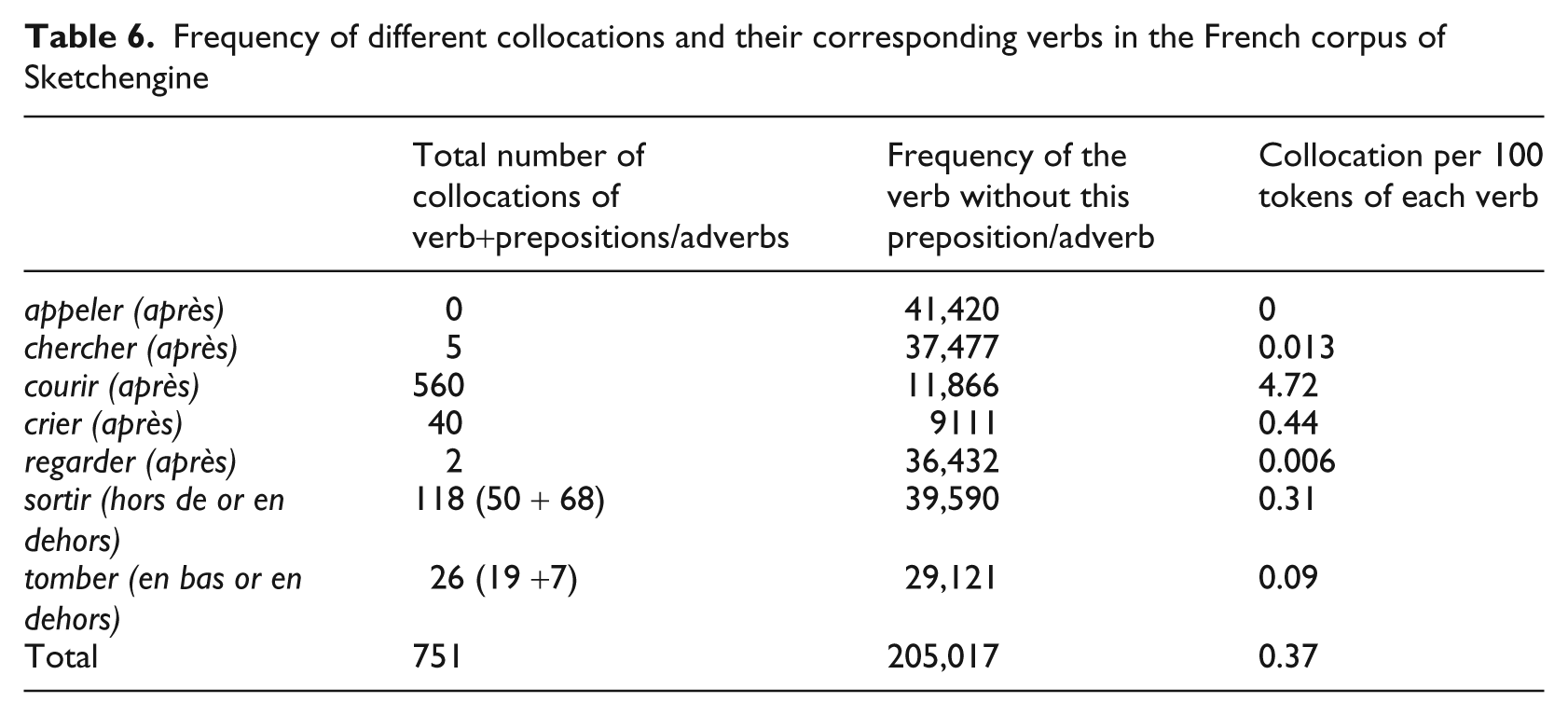
The results from Sketchengine confirm the findings based on Beeching’s corpus: the collocations under study are very rare in modern spontaneous French. Table 6 presents the frequency of each of the collocations in the Sketchengine corpus, as well as the frequency of the same verbs without the preposition/adverb, and the relative frequency of the collocations, that is their frequency per 100 tokens of each verb. These results show that among the collocations studied here courir après is the most frequent one in this corpus, but the other collocations do not occur more than once in 100 tokens of the verb. On average, the collocations under study occur only 0.37 times per 100 verbs in the Sketchengine corpus, which is less than in the Belgian French corpus (0.8) and much less than in the Brussels French frog story corpus (10.85).
Frequency of different collocations and their corresponding verbs in the French corpus of Sketchengine
Although the analysis of the data from Beeching’s corpus and the Sketchengine corpus clearly shows that the collocations under study are rare in modern spoken French, it is of course possible that they were more frequent in previous centuries. Thus, the constructions in Brussels French could be archaisms which have survived in this variety. As is well known, regional varieties of French, including those spoken in Belgium and Canada, are often marked by archaisms (Francard & Latin, 1995), but to my knowledge the structures mentioned here have not thus far been considered to fall in this category. Therefore I have scrutinized historical data from the previous five centuries to find out whether the collocations under study here were more frequent in the past. Of course comparing oral data with written data is problematic, but for obvious reasons, we can only get access to written historical data.
6.3.2 Historical development of the patterns
The results in Figure 1 show that the collocations were indeed used in the previous centuries, and there is a gradual decline in their use from the 16th century onwards. Only the development of courir après differs from the other collocations in that it becomes more frequent in the 18th century, after which the decline sets in. It is still relatively frequent in the 20th century in comparison with the other collocations. There are no examples at all of appeler après, and very few of regarder après or chercher après. 19 As the number of collocations does not exceed 3.5 per 100 tokens of each verb, it is clear they are not very frequent in any of the centuries studied here, and there is a clear downwards trend in their use, which is even clearer in Figure 2, which represents the averages for all forms. The decline presented here stands in marked contrast to the development in Italian, where such collocations are increasingly common (see section 4).
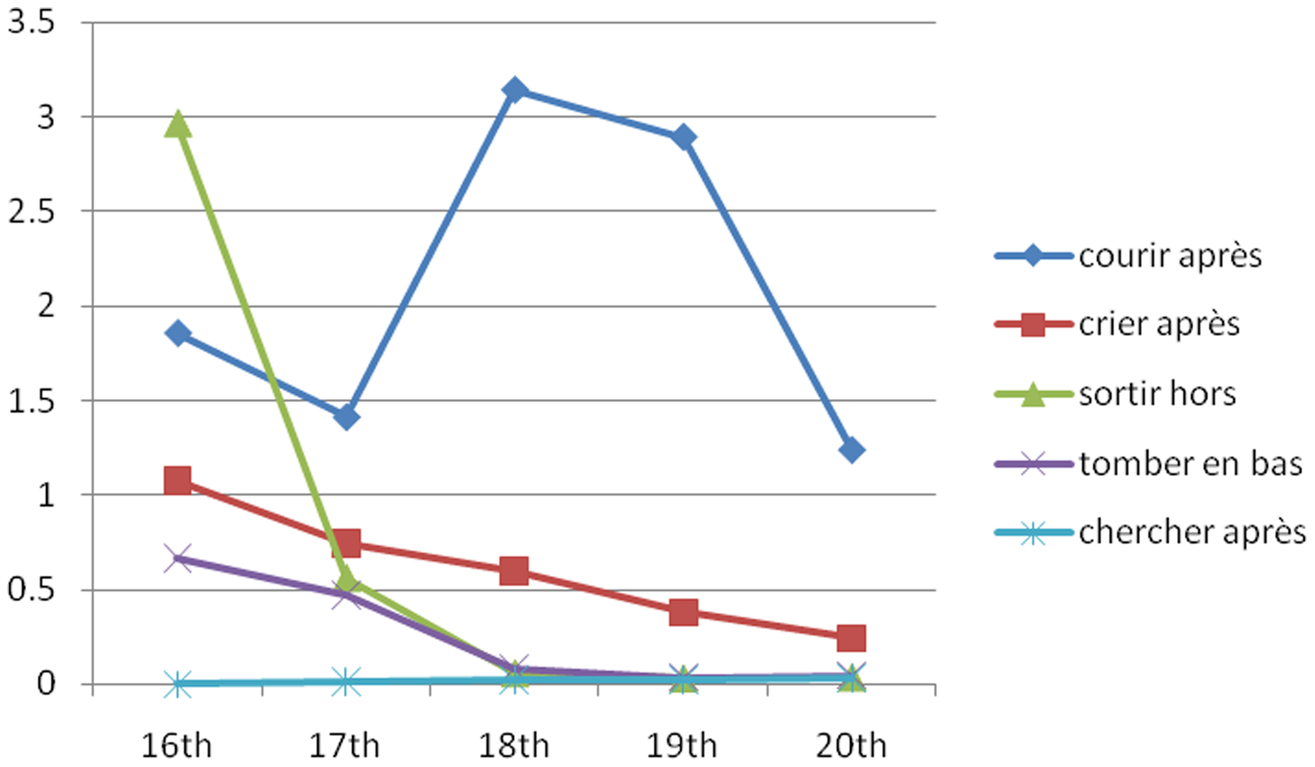
Frequency of the collocations per 100 tokens of each verb from the 16th to the 20th century (based on Frantext)
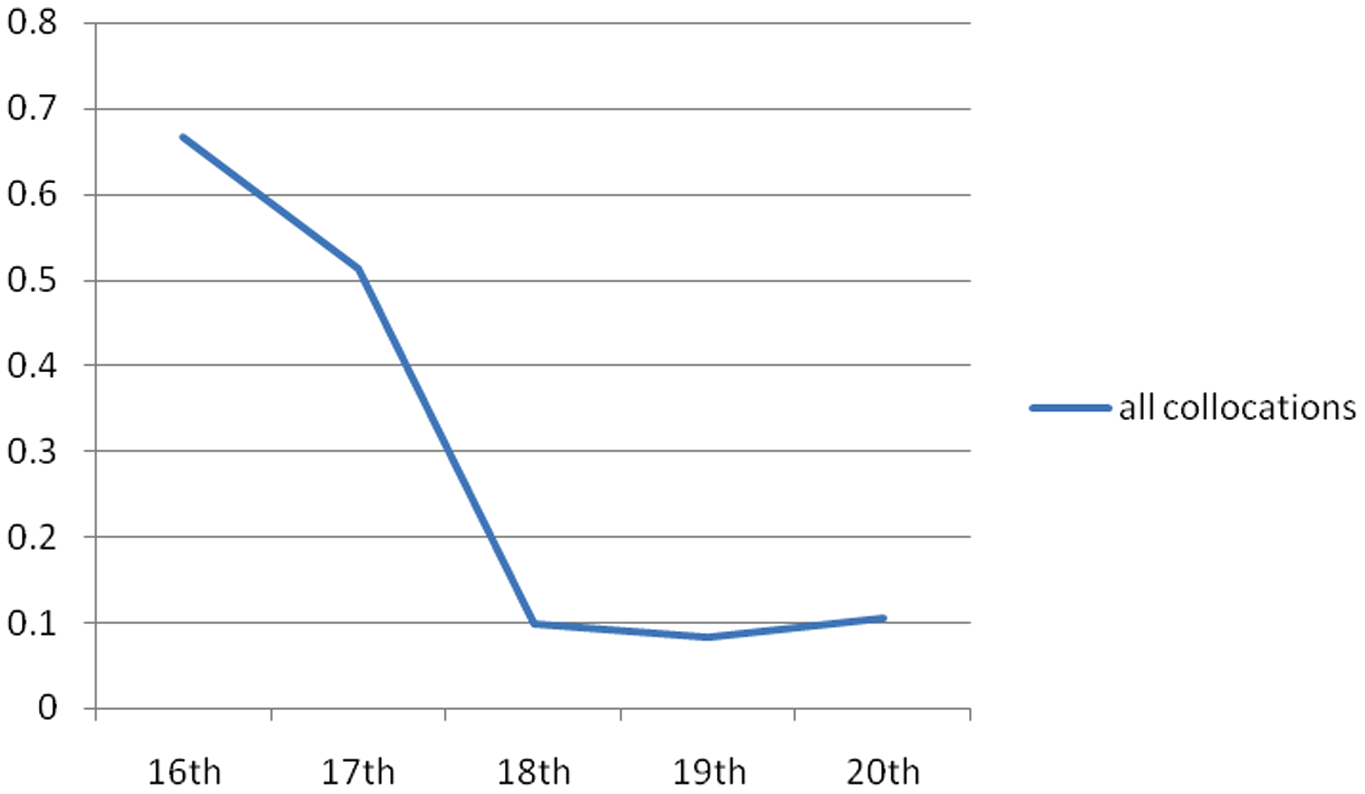
Average frequency of five collocations from the 16th to the 20th century (per 100 tokens of the verbs)
In the 16th century we find examples of courir après, crier après, sortir (de)hors and tomber en bas/à bas, and they are illustrated in (35) to (38):
(35) Mais Gargantua
‘But Gargantua ran after (him = Gallimassue) and grabbed him by the collar.’ (36) J’ay une coustume de
‘I have the habit of shouting at night at my birds.’ (37) … et qu’on les voulloit faire
‘And that they wanted to make them leave the room.’ (38) Quand elles (= les étoiles)
esclairent et qu’elles
‘When the stars light up and they fall down, to earth.’
In (39) we see the earliest example of regarder après, as found among 6698 tokens of the verb regarder in the 17th-century subcorpus of Frantext, which consists of 21 million words. It is the only time we find this collocation in this century. In this scene, Alidor warns his friend Cléandre that the woman they are both in love with, Angélique, may discover that they have exchanged roles. As she might scream when she discovers she has been deceived, Cléandre is told to watch out for her cries:
(39) ‘Watch out for her cries if you want to be the master.’
The earliest example of chercher après is found in the 17th-century corpus too (see 40). There are 7219 tokens of chercher in this corpus, but only one of these is a collocation with après:
(40) Et c’étoit vraisemblablement la disposition de ceux qui
‘And it was probably the mood of those who were looking for Lazarus, seeking to
kill him.’
The historical data clearly show that the collocations studied here were used from the 16th century onwards, even though they are extremely rare, especially in the more recent past, and never exceed 1 in 100 tokens of the verb. Although this means that there is at least some evidence that the collocations in Brussels French can be explained as archaisms, they are much more frequent in Brussels French, where we find 10.85 collocations per 100 verbs, than in the historical data from the previous five centuries. It is therefore clear that historical explanations on their own are not sufficient to explain the high frequency of the collocations in Brussels French.
6.4 Crosslinguistic performance congruity
In this section I explore the existence of crosslinguistic performance congruity in Dutch and French as spoken by bilinguals in Brussels. In other words, we want to know whether there are similarities between the bilinguals’ use of collocations in the recipient language (French) and their use of collocations in the source language (Dutch). While a detailed comparison of L1 and L2 performance of the same speakers is not possible at this point, as the speakers told different frog stories in the two languages, to avoid unwanted translation effects, Dutch collocations such as zoeken naar/achter ‘to look for’, as in (41), and roepen naar ‘to call for’, as in (42), which are translation equivalents of the Brussels French collocations chercher après and crier après are attested in the data:
(41) en de schildpadde die zit
And the tortoise it sits behind that frog on the looking ‘And the tortoise is looking for the frog.’ (42) En hij
‘And he calls for the restaurant owner.’
The southern Dutch translation equivalent of courir après, achter X lopen ‘run after X aan’, 21 as in (43) was also found in the data:
(43) Ik
‘I walk after that gentleman and I take back my frog.’
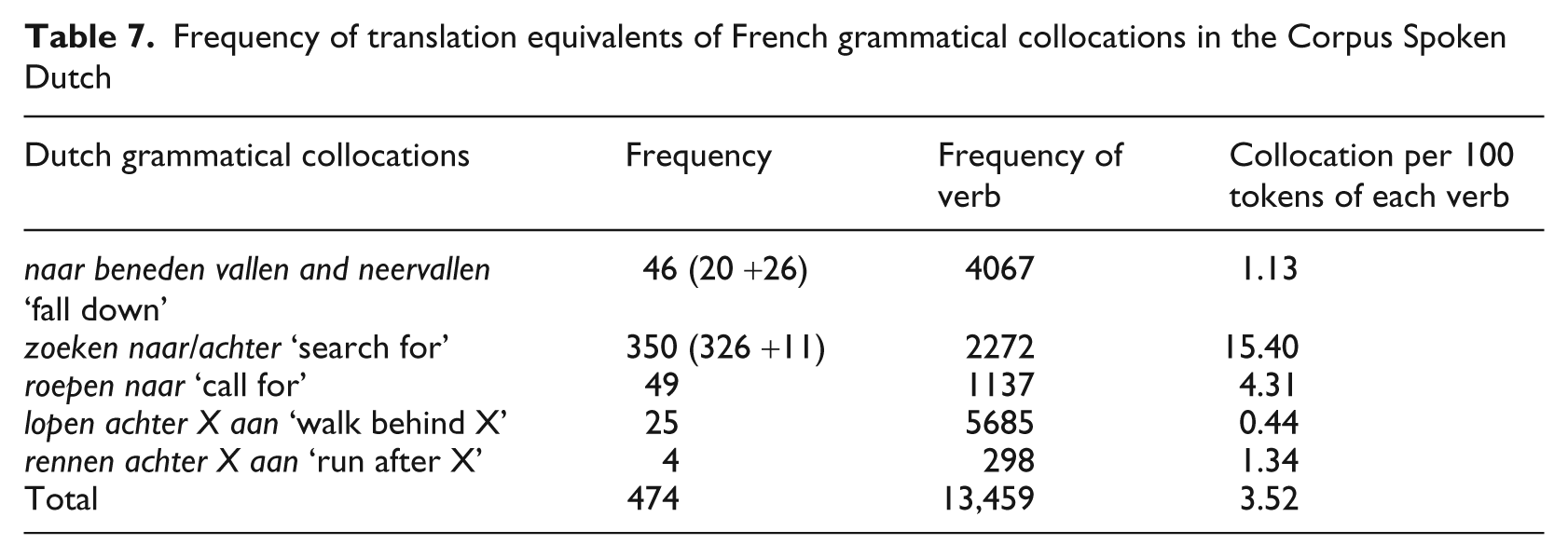
In the Dutch frog story corpus there were no tokens of the Dutch translation equivalent of tomber en bas, possibly because the story Frog goes to dinner did not provide the right context for this collocation to be used. A search in the Corpus Spoken Dutch demonstrates, however, that naar beneden vallen and neervallen (which both mean ‘fall down’) are common expressions in Dutch. The translation equivalents of the other structures under study are all frequent in this corpus too (see Table 7). In some cases, different translation equivalents were possible, as for example courir après can be translated into Dutch as achter X aanrennen ‘to run after X’ or achter X aanlopen ‘to walk after X’, and there is a wide range of translation equivalents for sortir dehors. 22 The different options were all searched in the Dutch corpus. For the purposes of the current article it is, however, important to note that the use of the preposition naar (or achter) is not obligatory with roepen ‘to call’ or zoeken ‘to search’: the verbs can be used with a direct object or a prepositional phrase, as in (naar) iemand/iets zoeken ‘to search (for) someone/something’ and (naar) iemand/iets roepen ‘to call (for) someone/something’. 23 As Table 7 demonstrates, in Dutch the collocations occur 3.5 times per 100 tokens of each verb. Comparing the frequency of the collocations in Dutch to those in French is, however, problematic, because the translation equivalents of the verbs are unlikely to occur with the same frequency in different languages. However, the fact that these translation equivalents exist and are relatively frequent in spoken Dutch provides additional support for the assumption that the collocations in Brussels French have become a major use pattern under the influence of Dutch.
Frequency of translation equivalents of French grammatical collocations in the Corpus Spoken Dutch
A final, highly interesting illustration of the influence of Dutch in the production of a French collocation can be found in (44), where the speaker uses a hybrid collocation consisting of a combination of the French verb chercher with the Dutch preposition naar ‘after’:
(44) Il cherche il cherche, il
‘He looks, he looks, he looks for in a hole.’
A possible explanation for this hybrid collocation can be sought in the speaker’s language dominance profile. From an analysis of this speaker’s vocabulary (Treffers-Daller, in press) we know that he is clearly Dutch-dominant in that he obtained a score above the median for Dutch and a score below the median for French on the D measure of vocabulary richness (Malvern, Richards, Chipere, & Durán, 2004). It is fascinating to see the speaker’s dominant language being activated exactly at the moment of the production of the collocation. It is probably the dual activation of the two languages which results in him producing a hybrid construction. In this particular case, it seems to me that we are dealing with a dynamic phenomenon which is linked to processing, i.e. interference in Grosjean’s terminology, while in the other examples which are found among a wide variety of speakers, the collocations reflect permanent traces of Dutch on French, and are thus best seen as examples of transfer.
7. Discussion and conclusion
While transfer has been studied extensively over the past few decades and insights into the role of transfer in SLA and in studies of language variation and change have increased considerably, there is still a great deal of confusion about the nature of transfer and how it is best investigated. The aim of this article was to provide evidence regarding the claim that Brussels French grammatical collocations which consist of a verb with a preposition or an adverb chercher après ‘to look for’ are the result of transfer from Brussels Dutch, following the methodology proposed by Jarvis (2000), Jarvis and Pavlenko (2008) and Mougeon et al. (2005) for identifying transfer. Collocations and verb-particle constructions have been studied widely in the Germanic languages as well as in Italian, but less attention has been paid to their occurrence in French, in which verb-particle constructions are assumed to be much less common. It has been known for a long time, however, that a range of grammatical collocations and some verb-particle constructions can be found in Brussels French and other Romance varieties along the linguistic frontier (Baetens Beardsmore, 1971; Kramer, 1981), although evidence for the claim that their use is related to transfer from Dutch or German varieties was never provided.
After a brief review of the key concepts of contact-induced change, transfer and replication, the most important syntactic and semantic properties of the collocations in Brussels French were presented. With the help of Jackendoff’s tests to distinguish particles and prepositions, it was established that most of the constructions with après, (en de)hors (de) and en bas (de) that occur in the Brussels French data set under study are not particles, because they fail Jackendoff’s movement tests. For this reason, it would be incorrect to consider the constructions in which they are used as verb-particle constructions, and the term ‘grammatical collocations’ (Granger & Paquot, 2008) was chosen instead. A few examples from Baetens Beardsmore (1971) and one example from De Vriendt (2004) could, however, be considered as VPCs. The Brussels French patterns were shown to differ clearly from Canadian French constructions such as shutter off ‘to shut off’. In the Canadian contact situation English language material has been imported into French, whereas in Brussels French only a pattern has been replicated, but no language material has been transferred into French. It is likely that differences in social pressure and intensity of contact (Thomason & Kaufman, 1988, p. 46) between the contact languages are responsible for the dissimilar outcomes of language contact in these two language communities. French is the dominant language in Brussels, whereas it is the non-dominant language in many Canadian communities. In particular in those Canadian communities where pressure from English is strong, advanced forms of language contact such as the importation of VPCs from English are found. In Brussels, where French is much less under pressure from the contact language, no VPCs are imported from Dutch, but some VPC patterns are replicated.
In the results section, the focus was on providing the three kinds of evidence needed if one wants to argue a feature is contact-induced: intragroup homogeneity (uniformity of behaviour of bilinguals in Brussels with respect to the patterns under study); intergroup homogeneity (differences between the Brussels group and other groups which are or are not in contact with the same source language); and crosslinguistic performance congruity (similarities in the structures produced by bilinguals in their two languages).
The first set of evidence that was investigated consisted of frog stories collected among bilinguals in Brussels. The results revealed that 19 out of 25 informants in this group use these collocations, which demonstrates that the phenomenon is not an isolated incidence and the group behaves in a relatively uniform manner with respect to this feature. In addition, there was a trend for speakers who had been to Dutch schools to produce these collocations more frequently than those who had been to French schools, so that contact with Dutch is probably a factor that can to some extent explain the frequency of occurrence of the phenomenon.
A comparison between the French frog stories from Brussels and those produced by a control group from Paris and a control group of L2 learners of French from Flanders confirmed that there are significant differences between the Brusselers and the other two groups in their use of these collocations. In Brussels, collocations were found on average 10.85 times out of 100 tokens of each verb, while in Paris there were virtually no examples of these constructions. While this in itself would have been enough to demonstrate intergroup heterogeneity, further evidence from other French corpora (spoken data from Wallonia and France, written data from literary sources and from internet sources) was sought to establish whether the absence of these collocations in the data from the control groups was accidental. The VALIBEL corpus of Belgian French contained examples of chercher après and sortir en dehors, but their frequency was much lower than in the Brussels French frog stories (0.8 per 100 tokens). Beeching’s corpus of modern spoken French and the Sketchengine corpus contained even fewer examples of these constructions (0.34 per 100 tokens). The fact that the frequency of the collocations was equally low in such a wide variety of data is remarkable, and strengthens the validity of the analyses presented here.
Alternative internal explanations, in particular the possibility that the patterns in Brussels French are archaisms, were also explored. The analysis of collocations in historical data from the 16th century onwards revealed that most of the collocations under study do occur in historical data, with the exception of appeler après ‘to call for’, which was not found in any of the other sources. The collocations are, however, extremely infrequent in the historical data or the 20th-century Frantext corpus, while they are much more frequent in Brussels French. Little evidence was found for qualitative differences between the use of collocations in Brussels French and other varieties, except for some Dutch influence on the word order of a number of constructions. Although it is likely that normative pressures have played a role in the demise of these patterns, it is unlikely that internal factors are sufficient to explain these contrasts; an additional, external factor is likely to have played a role.
The most plausible explanation for the facts is that knowledge and use of Dutch has led to an increase in the use of collocations by bilinguals in Brussels, in other words that the structures are the result of covert transfer (Mougeon et al., 2005) or pattern replication (Matras & Sakel, 2004) from Dutch. In Heine and Kuteva’s (2005) framework the structures can be seen as replications of a grammatical use pattern which existed as a minor use pattern in French and which has become a major use pattern in Brussels French under the influence of Dutch.
A number of facts discussed in this article point to influence from Dutch as the key factor that can explain the high frequency of the collocations in Brussels French. First of all, there is a trend for bilinguals who went to Dutch schools to produce more of these collocations; second, an analysis of Dutch frog stories produced by the same bilinguals from Brussels confirmed that the speakers use many Dutch patterns that are translation equivalents of the French collocations, such as zoeken naar ‘to look for’ and roepen naar ‘to call for’. A quantitative analysis of the translation equivalents in the Corpus Spoken Dutch revealed that these are indeed common in spoken Dutch. Third, for one informant from the bilingual group it could be shown that Dutch was activated during language production, because he produced a hybrid collocation which consisted of the French verb chercher and the Dutch preposition naar. Fourth, it is well known that Dutch learners of French often produce the form chercher après (Desmet et al., 2004), while Anglophone learners of French use the forms chercher pour or regarder pour (Mougeon et al., 2005). The most likely explanation for the differences is that they are the result of transfer or pattern replication (Heine & Kuteva, 2005; Matras & Sakel, 2004) from the students’ first language.
The current article clearly shows that the rigorous methodology to study transfer proposed by Jarvis (2000), Jarvis and Pavlenko (2008) and Mougeon et al. (2005) can help disentangle the role of internal and external factors in language variation and change. The differences in the frequency of the phenomenon across a range of corpora provided the key evidence for the role of transfer from Dutch in the use of these collocations in Brussels French. It would be very interesting to see this approach applied to studies of VPCs in Italian and other languages spoken along the Romance/Germanic language border. Further studies of the frequency of these structures in popular French would also be extremely useful, as it appears that some of the structures under study here do occur in popular French. In addition, it would be relevant to study the frequency of these collocations in the speech of monolingual French speakers from Brussels, as this would give us further information about the diffusion of the phenomenon across the speech community of French speakers in Belgium. Factors such as social class and register may also play an interesting role here. These issues will need to be addressed in further studies of this fascinating phenomenon.
Footnotes
Acknowledgements
I gratefully acknowledge financial support received from the School of Humanities, Languages and Social Sciences at UWE Bristol for a term’s leave, which made it possible to collect and analyse the data. I am very grateful to Kate Beeching for making her corpus of modern spoken French available and for help in analysing examples from this corpus, and to Michel Francard and his team for giving me access to the VALIBEL database. I am also indebted to Kate Beeching, Geert Booij, Richard Coates, Raymond Mougeon, Sera de Vriendt and one anonymous reviewer for their detailed comments on earlier versions of the article. All remaining errors are mine.