




Abstract
Malawi has a permissive legal framework which permits admissibility of forced confessions, a subject that is under-researched in African literature. Civil society organisations have regularly reported to various United Nations committees that the use of excessive force and torture to obtain evidence in the Malawi criminal justice system is endemic and relied upon by prosecutors and judges in criminal cases despite inherent unreliability. The prison system continues to suffer from lengthy remand detention, severe congestion and poor conditions. We present a socio-legal assessment of the legal, human rights and procedural concerns regarding the admissibility of forced confessions in Malawi. Prohibition of torture and cruel, inhuman or degrading treatment or punishment is provided in the 1994 Constitution of Malawi. Section 176 of the 1967 Criminal Procedure and Evidence Code (CP&EC), however, allows forced confessions as admissible evidence, contradicting constitutional and human rights protections. Our assessment illustrates how colonial-era legal frameworks continue to undermine fundamental human rights and administration of justice in Malawi. Constitutional advocacy, legislative reform of the CP&EC, oversight mechanisms and resourcing of law enforcement training on the Méndez Principles on effective interviewing and interrogation is warranted.
Keywords
Introduction
The latest Afrobarometer survey has reported on widespread and systemic police corruption, misconduct and use of excessive force across Africa (Krönke et al., 2024). The Special Rapporteur on Prisons, Conditions of Detention and Policing in Africa has also voiced her concern and urges state parties to ‘refrain from excessive use of force and subsequent violations of the human rights of individuals and take appropriate measures to put an end to such acts of abuse of authority by the Police and other Security Forces against civilians’ (African Commission on Human and People's Rights, 2023a). Vulnerable groups exposed to police exploitation and violence include the poor, women and girls, juveniles and members of the LGBTQI community (Aborisade and Obileye, 2017; Aborisade and Oni, 2020; Atilola et al., 2020; Scheibe et al., 2016).
Over one million people are detained in prisons in Africa, with high rates of pre-trial detention and poverty-related offences causing several congestion levels (in some African countries over 200 per cent capacity), resource scarcity and poor conditions (Muntingh, 2020; Penal Reform International, 2024a). Twenty African countries continue to report that over 50 per cent of the prison population are held on remand (Penal Reform International, 2024a). This is largely due to high rates of vagrancy, nuisance and other poverty-related offences, lengthy pre-trial durations and weak functioning criminal justice systems (African Commission on Human and People's Rights, 2023a; Muntingh, 2020; Van Hout, 2023).
Despite various United Nations and regional norms and standards, due process rights remain complicated in the many post-colonial, post-dictatorial and/or transitional African states, many of whom continue to operate anachronistic laws which offend Constitutional provisions, and clash with accepted international and regional human rights frameworks (Alemika, 2003). There is very little data that is available with regard to the extent that law enforcement within the African context relies on forced confessions, their admissibility in court and their impact on prison overcrowding. Literature on the practice and admissibility of forced confessions in African justice systems is concentrated in Botswana, Ghana, Nigeria and South Africa. The tenuous nature of participation of accused persons in criminal proceedings is observed by legal scholars in these countries, particularly due to the absence of clear-cut (rights-based) rules to guide law enforcement interrogators (Atilola et al., 2020; Onoja, 2017; Quansah, 1997; Tufuor, 2022).
We present a socio-legal assessment of the legal, human rights and procedural concerns regarding the practice and admissibility of forced confessions as evidence in the Malawi criminal justice system. Malawi is classified as a least developed country by the Organisation for Economic Co-operation and Development (2022). Diverse sources of information (academic and grey literature, jurisprudence, media reporting) were scrutinised. First, the various international and African regional protections and rights assurance mechanisms respecting the rights to those deprived of their liberty were scrutinised (not limited to prohibition of torture and discrimination, and including due process rights). Second, we present context with regard to the Bill of Rights, the Malawi prison system and relevant inspectorate and human rights reporting on prison conditions and access to justice of persons deprived of their liberty. Third, we present the conflicting situation regarding due process rights assurances and the Malawi's Criminal Procedure and Evidence Code (CP&EC) s. 176, which allows forced confessions as admissible evidence, contradicting constitutional and human rights protections.
International and African human rights frameworks: Deprivation of liberty and the prohibition of torture and other cruel, inhuman or degrading treatment or punishment
Article 15 of the Convention against Torture and Other Cruel, Inhuman or Degrading Treatment or Punishment (UN CAT) expressly prohibits the use of evidence tainted by torture, unless it is to be used against the person charged with committing torture (United Nations, 1984). In General Comment No 2, this international safeguard was extended to include ill-treatment (United Nations Committee Against Torture, 2008). The United Nations Human Rights Committee affirms the right to silence at the pre-trial stage, particularly during police interrogations. It has also noted that the imposition of the death penalty after violation of fair trial and due process guarantees under Article 14 of the International Covenant on Civil and Political Rights (ICCPR) would render the sentence arbitrary in nature, constituting a violation of the right to life (United Nations, 1966a). This includes a lack of access to effective legal representation and the use of forced confessions. Forced confessions are generally, on a prima facie basis, inadmissible by the courts in most countries (‘the exclusionary rule’) (Hasel and Kassin, 2012).
The African Charter on Human and People's Rights (Organisation of African Unity, 1981) expressly prohibits torture and enshrines due process rights. The right to freedom from torture is protected under Article 5 of the African Charter and is classified as a non-derogable right. Whilst the Charter does not specifically provide for prisoners’ rights, the African Commission on Human and Peoples’ Rights’ (2003, 2023a) underscores the obligation of the state to protect the rights of all persons who are deprived of their liberty, due to their reliance on the state. The Commission has held that rights under the Charter cannot be limited due to war, emergencies or other special circumstances. The Commission maintains that even if the Charter’s prohibition on derogation contradicts international norms, certain rights—such as the right to freedom from torture and cruel, inhuman and degrading treatment—are absolute and cannot be restricted under any conditions (Article 19 v Eritrea, s. 98).
The African Court of Human and People's Rights, like the Commission, applies and interprets the Charter. In the 2004 case of Democratic Republic of Congo v Burundi, Rwanda and Uganda, 1 the Commission examined torture provisions in international humanitarian law. In 1998, in International Pen and Others (on behalf of Ken Saro-Wiwa Jr) v Nigeria, 2 the Commission affirmed that Article 5 prohibits not only torture but also cruel, inhuman or degrading treatment. This prohibition includes actions causing serious physical or psychological suffering, as well as those that humiliate an individual or compel them to act against their will or conscience. Additionally, the Commission regards human dignity as an inherent and fundamental right, accessible to all individuals without discrimination, regardless of mental or physical ability. The African Court on Human and People's Rights has not yet been asked to comment on forced confessions, but it has discussed the right to silence.
The 1996 Kampala Declaration affirms the rights of people deprived of their liberty and commensurate with human dignity (Penal Reform International, 1996). Building on this, the 2002 Ouagadougou Declaration and Plan of Action on Accelerating Prisons and Penal Reforms in Africa advocates for reducing prison populations through the application of the rule of law, effective prison administration and the successful reintegration of prisoners into society (Muntingh, 2020). Subsequent pan-African initiatives further strengthened these protections. The 2003 Principles and Guidelines on the Rights to a Fair Trial and Legal Assistance in Africa and the 2004 Lilongwe Declaration on Accessing Legal Aid in the Criminal Justice System in Africa promote the right to fair trial and access to justice. The Robben Island Guidelines seek to prevent and eradicate torture and other ill-treatment in Africa (African Commission on Human and People's Rights, 2008). The 2014 Luanda Guidelines on the Conditions of Arrest, Police Custody and Pre-Trial Detention in Africa introduced a rights-based approach to pre-trial detention, reinforcing due process guarantees, including the right to silence (African Commission on Human and People's Rights, 2016). The most recent development within the broader regional effort to articulate standards regarding rule of law and access to justice are the 2017 Principles on the Decriminalisation of Petty Offences in Africa (Muntingh, 2020). Collectively they aim to enable, encourage and support criminal justice reform, particularly to address weak criminal justice systems, and the consequent impact on prison congestion and stretched human and financial resources.
Fundamental human rights protections in Malawi: Prohibition of torture and cruel, inhuman or degrading treatment or punishment, the right to human dignity and deprivation of liberty
Malawi has ratified the ICCPR (United Nations, 1966a) and the International Covenant on Economic, Social and Cultural Rights (ICESCR) (United Nations, 1966b). It accepts individual complaints procedures under the Optional Protocol to the ICCPR (United Nations, 1966c). It has not ratified the Optional Protocol to the ICESCR (United Nations, 2009). Whilst Malawi ratified the UN CAT (United Nations, 1984) in 1996, it has not ratified the CAT-Optional Protocol (United Nations, 2003) and does not accept individual complaints procedures under the CAT, Article 22. Malawi accepts the inquiry procedure under the Article 20 of the CAT. Malawi is a State party to the African Charter on Human and People's Rights (OAU, 1981) and is bound by the provisions of the Charter as well as decisions of the African Court on Human and Peoples Rights and the African Commission on Human and Peoples Rights resolutions.
Malawi is a dualist state requiring an act of parliament to give effect to international law, with the majority of fundamental human rights transposed nationally by the Malawi Constitution. Chirwa (2011) emphasises the importance of international law as an ‘interpretative aid’ and a ‘source of law’ when interpreting the Bill of Rights. This is especially crucial regarding human rights litigation (Gumboh, 2012). The fundamental rights of people who are deprived of their liberty are enshrined in international instruments that are binding for Malawi under s. 211(2) of its national Constitution.
Malawi has a constitutionally entrenched Bill of Rights, with a comprehensive catalogue of economic, social, cultural, civil and political rights directly enforceable by the courts (Chirwa, 2011). The Bill of Rights also ensures that individuals are treated fairly and justly, and includes strong provisions on equality, non-discrimination and human dignity. Section 43 of the Constitution provides for the right to administrative justice and it creates a new constitutional basis for judicial review based on lawfulness, procedural fairness, the giving of reasons and justifiability (Chirwa, 2011).
Regarding non-derogable rights outlined in s. 44(1), Chirwa (2011) notes that in this Bill of Rights the prohibition of torture and cruel, inhuman or degrading treatment or punishment is inextricably connected to the right to human dignity. Chirwa (2011) underscores the centrality of human dignity in the Bill of Rights, as the ‘new blueprint of administrative justice’, illustrating a procedural shift away from treating people in contact with the criminal justice system with contempt, and revised approaches to punishment, stating accurately that; ‘a person must…be treated with respect during investigations, trial, sentencing, appeal or parole procedures’. Prohibition of torture and cruel, inhuman or degrading treatment or punishment is provided in the Constitution, with s. 19(3) stating: ‘No person shall be subject to torture of any kind or to cruel, inhuman or degrading treatment or punishment.’ Section 45 prohibits state derogation from torture or any other form of cruel, inhuman and degrading treatment or punishment.
Realities on the ground: Weak criminal justice systems and harsh detention conditions
Malawi's criminal justice system remains weak, ill-resourced and lacks forensic capacity, often leading to unreliable investigations and forceful interrogation techniques (Malawi 24, 2022a; Van Hout et al., 2023a). Although every person has the constitutional right to representation (s. 42(2)(f)(v)), high proportions of people in conflict with the law in Malawi are from lower socio-economic backgrounds with little access to legal representation (African Commission on Human and People's Rights, 2023b; Centre for Human Rights Education, Advice and Assistance, 2021, 2022; Van Hout et al., 2022, 2023a).
The Malawian prison system of 30 facilities with a capacity of 7000 continues to operate substantially over capacity (236 per cent as at June 2024) (World Prison Brief, 2024). The 2023 Malawi Prison Audit highlighted that whilst the remand rate (17.6 per cent) is among the lowest in Africa, prisons are not used primarily as a measure of last resort (Centre for Human Rights Education, Advice and Assistance, 2023; Penal Reform International, 2024b). The 2023 audit also reported that almost all persons arrested were held too long in police stations with no legal assistance. One-third of all prisoners, both remand and sentences in Malawi are detained for crimes of dishonesty (theft, handling, personation) (Penal Reform International, 2024b). It is unknown how many are incarcerated as the product of forced confessions.
Despite constitutional protections, the 2023 Malawi Prison Audit identified concerning lapses and derogation of due process rights within the criminal justice system. These gaps centre on reports of arrest without investigation; use of torture by officials to extract confessions; lack of access to legal representation; partially completed investigations; various forms of arbitrary detention (pre-trial, remand and post sentence) including for long durations (years in some cases); and detention in congested, harsh and life-threatening prison conditions (African Commission on Human and People's Rights, 2023a; Centre for Human Rights Education, Advice and Assistance, Southern Africa Litigation Centre, Irish Rule of Law International, Reprieve, 2021: 2023; Malawi Inspectorate of Prisons, 2019, 2021, 2023; Office of the United Nations High Commissioner for Human Rights, 2022; Penal Reform International, 2024b; United States Department of State, 2023; Van Hout et al., 2023a, 2024).
The groundbreaking Gable Masangano v Attorney General judgment 3 could be viewed as a useful platform for the development of socio-economic rights jurisprudence in Malawi (Kapindu, 2013). In this judgment in 2009, the claim was that the conditions of his and his fellow prisoners’ imprisonment violated the Republic of Malawi Constitution and the Prison Regulations of the Prisons Act (‘Prison Regulations’) by subjecting them to torture and cruel and inhuman and degrading treatment (inadequate nutrition, clothing, bedding, space, access to the outside, access to medical care, harassment of prison staff); that the prison authorities had failed to meet the minimum constitutional and statutory obligations placed on them with regard to prison conditions. The court held that overcrowding in prisons amounts to inhuman and degrading treatment and was therefore unconstitutional. The court also required the state to take positive steps in allocating sufficient resources for the realisation of socio-economic rights for persons deprived of their liberty (Kapindu, 2013).
In reality, little has changed for the better regarding arbitrary detention and poor prison conditions. Concerns around congestion, circulation of infectious disease, food insecurity, malnutrition and related deaths in custody continue to be submitted to government and to various United Nations Committees, without substantial change within the criminal justice system (Centre for Human Rights Education, Advice and Assistance, Irish Rule of Law International, Reprieve, The World Coalition Against the Death Penalty, 2023; United States Department of State, 2023; Van Hout et al., 2023b, 2024). The status quo is exacerbated by the fact that the Prisons Act enacted in 1956 was not amended to reflect the new Bill of Rights (Chitsulo, 2024). In 2003, calls to align the Prison Act to the Bill of Rights and international human rights standards commenced, resulting in a Special Law Commission tasked with conducting a comprehensive review of the Act and developing the new Prison Bill of 2025 (Southern African Litigation Centre, 2025).
Balancing due process rights and protections: Prohibition of torture, cruel, inhuman and degrading treatment and the admissibility of ‘materially true’ forced confessions
The Constitution of Malawi protects the right to a fair trial. Of key importance is Article 42(2)(c) which provides for the right ‘not to be compelled to make a confession…which could be used in evidence against him or her’. Article 42(2)(f)(iii) further reinforces this by providing for the right to silence at 42(2)(f)(iii) and the right against self-incrimination at 42(2)(f)(iv). Whilst Article 42 is not identified as non-derogable under s. 45 of the Constitution, s. 45 mandates that a right can only be derogated from in a state of emergency.
Despite these constitutional assurances, s. 176 of the 1967 Criminal Procedure and Evidence Code (CP&EC) allows forced confessions as admissible evidence, and the Supreme Court of Malawi has stated that s. 176 does not to contravene the Constitution. A confession is deemed admissible in court, even if it was obtained through coercion or force, with the only criteria for admissibility being that it was made by the accused and it is ‘materially true’.
Section 176 CP&EC states: (1) Evidence of a confession by the accused shall, if otherwise relevant and admissible, be admitted by the court notwithstanding any objection to such admission upon any one or more of the following grounds (however expressed) that such confession was not made by the accused or, if made by him, was not freely and voluntarily made and without his having been unduly influenced thereto. (2) No confession made by any person shall be admissible as evidence against any other person except to such extent as that other person may adopt it as his own. (3) Evidence of a confession admitted under subsection (1) may be taken into account by a court, or jury, as the case may be, if such court or jury is satisfied beyond reasonable doubt that the confession was made by the accused and that its contents are materially true. If it is not so satisfied, the court or the jury shall give no weight whatsoever to such evidence. It shall be the duty of the judge in summing up the case specifically to direct the jury as to the weight to be given to any such confession. (4) Nothing in this section except subsection (2) shall apply to any confession made by an accused at his trial or in the course of any preliminary inquiry relating thereto.
The case law regarding s. 176 can often be inconsistent and contradictory, as observed below. Whether a confession is ‘materially true’ has largely been interpreted by Malawian courts as meaning that it indicates and yields corroborating evidence. In the 1971 High Court case of Chiphaka v Republic the court noted as follows: …treatment, intimidation, inducement and the like go not to admissibility but to weight and if any allegation of any of these factors is proved it is difficult to conceive of any reasonable court accepting a confession to be materially true in the absence of pointers of such cogency as virtually to amount to corroboration as that term is understood in law.
4
In 1997, in Republic v Chinthiti, 5 whilst the High Court concluded that s. 176 CP&EC violated the constitutional right not to self-incriminate (s. 42(2)(c)), it did not consider admission of involuntary confession evidence with regard to the absolute prohibition of torture, cruel, inhuman and degrading treatment. Justice Nyirenda in this case ruled s. 176 to be unconstitutional and invalid, but this approach was not upheld by subsequent judgments.
The case of Palitu and Others v Republic tried to advance an approach whereby if coercion was indeed found to have been used to elicit a confession, then no weight should be attached to it at all. Section 176 provides for the confession to come in and leaves it for the judge of fact to decide what weight should be attached to a confession. As I pointed out in Republic vs Chizumila, the judge should advise the jury to attach no weight whatsoever to a statement obtained by force. The reason I gave is a weak one: the weight to be attached to such a statement is negligible. It is a good reason but a weak one. There is a stronger reason. Under section 44 (1), this right [Section 19(3) of the constitutional] is non-derogable. Laws or practices cannot restrict or limit it. A rule allowing use of evidence obtained by torture is unconstitutional, unreasonable, does not comply with international human rights standards and is not necessary in an open democratic society. Section 176 of the Criminal Procedure and Evidence Code only lays a rule and procedure for letting in such evidence. The judge must direct the jury on the weight to attach to the confession. The judge must, because of sections 19 (3) and 44 (1) of the Constitution, direct the jury to attach no weight whatsoever to statements obtained through torture. In my judgment the court cannot and should not even direct the jury on pointers. The statement must be given no weight at all.
6
Although the Judge in Palitu and Others v Republic purported to advance a human rights-based approach, he upheld the constitutionality of s. 176 and described a method of circumventing the prohibition of forced confessions in the Constitution by noting that ‘no weight should be attached’ to any confession taken forcibly. He also disagreed with the idea of ‘a trial within a trial’ noting that juries should be present for arguments on admissibility. A reasonable conclusion could therefore be drawn that, although the judge referenced international human rights law and obligations to a much greater extent than other judgments, the court was still keen not to discount torture-tainted confession evidence entirely.
In the 2001 Supreme Court judgment of Thomson Fulaye Bokhobokho and Another v The Republic 7 the Court ruled that a forced confession is admissible and can indeed be given weight providing there is corroborating evidence to support that the confession is ‘materially true’ (see also R v Soko and Another; Republic v Mseyama and Others). 8 In Republic v Humphrey Elia & Another in the High Court follows the approach of Thomson Fulaye Bokhobokho. It referred to s. 176 CP&EC and recognised that ‘…In other jurisdictions, a confession must be made voluntarily and freely for it to be admissible. That seems not to be the position in this country though with our current s. 42(2)(c) of our Republican Constitution one would have expected the position to be like in those other jurisdictions.’ 9 The court referred to Chiphaka v Republic (and also the cases of Nyasulu and Others v Rep and Maonga v Republic), 10 both of which confirmed the case of Chiphaka v Republic; and confirmed that all that is needed for the admissibility of evidence is that it was made by the accused person, and that the contents were ‘materially true’. The courts in all three cases noted that if the court was not satisfied that the confession was deemed to be ‘materially true’, then no weight at all should be given to it, but were notably silent on the use of coercion. Consequently these cases affirm that, unlike the judgment of Palitu and Others v Republic, weight can indeed be given to a confession regardless of whether coercion was used.
Consequently evidence obtained through torture and ill-treatment is frequently relied upon by prosecutors and judges in criminal cases in Malawi despite its violation of international human rights law, and inherent unreliability (African Commission on Human and People's Rights, 2023a; Centre for Human Rights Education, Advice and Assistance, Southern Africa Litigation Centre, Irish Rule of Law International, Reprieve, 2021; Office of the United Nations High Commissioner for Human Rights, 2022; United States Department of State, 2023; Van Hout et al., 2023a). Civil society organisations such as the Centre for Human Rights Education, Advice and Assistance, Irish Rule of Law International and Reprieve routinely submit to United Nations Committees that in practice, it is infrequent that courts in Malawi actually demand the corroborating evidence to prove that the confession is ‘materially true’, and rely on it solely to convict accused persons (e.g. Centre for Human Rights Education, Advice and Assistance, Irish Rule of Law International, Reprieve, The World Coalition Against the Death Penalty, 2023; Centre for Human Rights Education, Advice and Assistance, Southern Africa Litigation Centre, Irish Rule of Law International, Reprieve, 2021). For example, in all cases of individuals sentenced to the death penalty since 2019, torture-tainted evidence was admitted and relied upon unsafe ‘confessional statements’ obtained by law enforcement through threats, coercion and extreme physical violence (Centre for Human Rights Education, Advice and Assistance, Southern Africa Litigation Centre, Irish Rule of Law International, Reprieve, 2021).
In 2021 a Supreme Court ruling potentially marks an important point of departure regarding illegally and unconstitutionally obtained evidence, including forced confessions. In R v Chanthunya, 11 the trial court recognised the transgressions by law enforcement but noted that in circumstances where there was sufficient collaborative evidence to convict the accused, s. 3 CP&EC applied (‘the principle of substantial justice should be done without undue regard for technicality shall at all times be adhered to’) and could be used to cure any illegality. In his Supreme Court challenge, the appellant argued that s. 3 only related to technical errors rather than substantive errors, and the trial court could not therefore use it to cure these substantive transgressions, regardless of any other evidence. In its decision, the Supreme Court pronounced that Malawi is now in ‘the era of Constitutional superiority…where all laws and acts must pass constitutional muster or risk being declared illegal and therefore null and void.’ The Court also noted that ‘it is now obligatory that all laws, human rights and constitutional freedoms are, except to the extent to which they are lawfully limited, fully respected by all branches of government namely the Executive, the Judiciary and the Legislature.’ Though s. 176 CP&EC was not at issue in this Supreme Court case and so it would be considered obiter, it is highly persuasive. The court noted that it must ‘depart from that position’ with the position being that s. 42(2)(c) (the right not be compelled to make a confession or admission which could be used against him or her) had no effect on the legality and therefore the admission of evidence.
The occasional compensation of victims of torture, despite both Supreme and High Court defence of the constitutionality of s. 176 CP&EC further fuels ambiguity (see the 2021 case of Dickson Magombo v the Attorney General, 12 which assessed damages for torture whilst in police custody). Various positive measures taken to address rights violations by law enforcement include the amendment of the Police Act to establish the Independent Complaints Commission (ICC) with powers to investigate cases of torture or deaths in police custody (Office of the United Nations High Commissioner for Human Rights, 2022). Prosecutions of police officers or state representatives, however, rarely take place. In the highly publicised case of Buleya Lule, who was tortured using electrocution and died because of his injuries (Malawi 24, 2021; Malawi Human Rights Commission, 2019), 13 police officers, including the Commissioner of Police for the Central Region, were arrested and charged in 2020 (Malawi 24, 2022b). At the time of writing, the prosecution has not progressed beyond this to date.
Conclusion
This socio-legal assessment regarding admissibility of forced confessionary evidence is the first regarding the situation and processes at play in Malawi and contributes to the growing socio-legal interest in forced confessions in the African legal landscape (Aborisade and Obileye, 2017; Aborisade and Oni, 2020; Ajayi, 2014; Arisukwu et al., 2021; Onoja, 2017; Quansah, 1997; Tufuor, 2022). It illuminates the equivocal nature of the Malawi legal landscape where legacy laws from colonial and dictatorial regimes continue to undermine constitutional and human rights protections and administration of justice in Malawi.
The jurisprudence in Malawi is very similar to other African jurisdictions, most criminal justice systems within the region grapple with contradictions and ambiguities regarding the admissibility of forced confessions and the right to silence. In Nigeria, despite the Constitution guaranteeing the right to silence, admissibility of confessions is determined by the Judges Rules and Evidence Act 2011, which does not explicitly link the Constitution's right to silence to the admission of confessions (Onoja, 2014). There is judicial ambivalence as to whether products of interrogation can be used in evidence in court, and where the challenge of a confessional statement is alleged to be obtained by coercion, the court embarks on a separate trial to determine the voluntariness of the statement in question (‘trial within a trial’) (Ladapo, 2011). Similarly in Ghana the voluntariness of confessions is challenging to both assess and affirm within the inherently coercive custodial environment (Tufuor, 2022). In Rwanda the burden of proof lies on the prosecution proving that the accused has not been tortured or ill-treated; including by expressly stating that confessions obtained by mental, as well as physical, torture are inadmissible in any proceedings, and by ensuring that the burden is on the State to prove that such statements were provided voluntarily (Nshimiyimana, 2018). In Tanzania there are similar legal complexities regarding use of force during interrogation and admissibility of forced ‘but true’ confessions (Hussain and Satyanarayan, 2016).
Malawi has various international law commitments against the use of torture or cruel, inhuman and degrading treatment or punishment under the ICCPR, CAT and the African Charter on Human and Peoples’ Rights. The UN Human Rights Committee affirms the application of the right to silence at the pre-trial stage, particularly during police interrogations. Abusive practices by law enforcement arising from the misconception that ‘torture works’ and leading to forced confessions contributes to wrongful convictions, gross miscarriages of justice and the incarceration of the innocent (Méndez, 2021). When they amount to torture, cruel, inhuman or degrading treatment or punishment (other forms of ill-treatment), they are absolutely prohibited by international law (Méndez, 2021). For example, the European Court of Human Rights has reiterated ‘that no legal system based upon the rule of law can countenance the admission of evidence obtained through torture because the trial process is a cornerstone of the rule of law and it is irreparably damaged by the use of torture’. 13
Continued adoption of s. 176 CP&EC to admit involuntarily obtained confession evidence violates fundamental human rights, by allowing evidence elicited by torture or cruel, inhuman and degrading treatment, and by violating basic due process rights (right to silence and the right against self-incrimination), and results in the consequent imprisonment of the innocent. It plays a substantial role in contributing to severe congestion in already ill-resourced over-capacity prisons, and compromises all efforts to employ various decongestion measures, and ensure safe and adequate standards of detention.
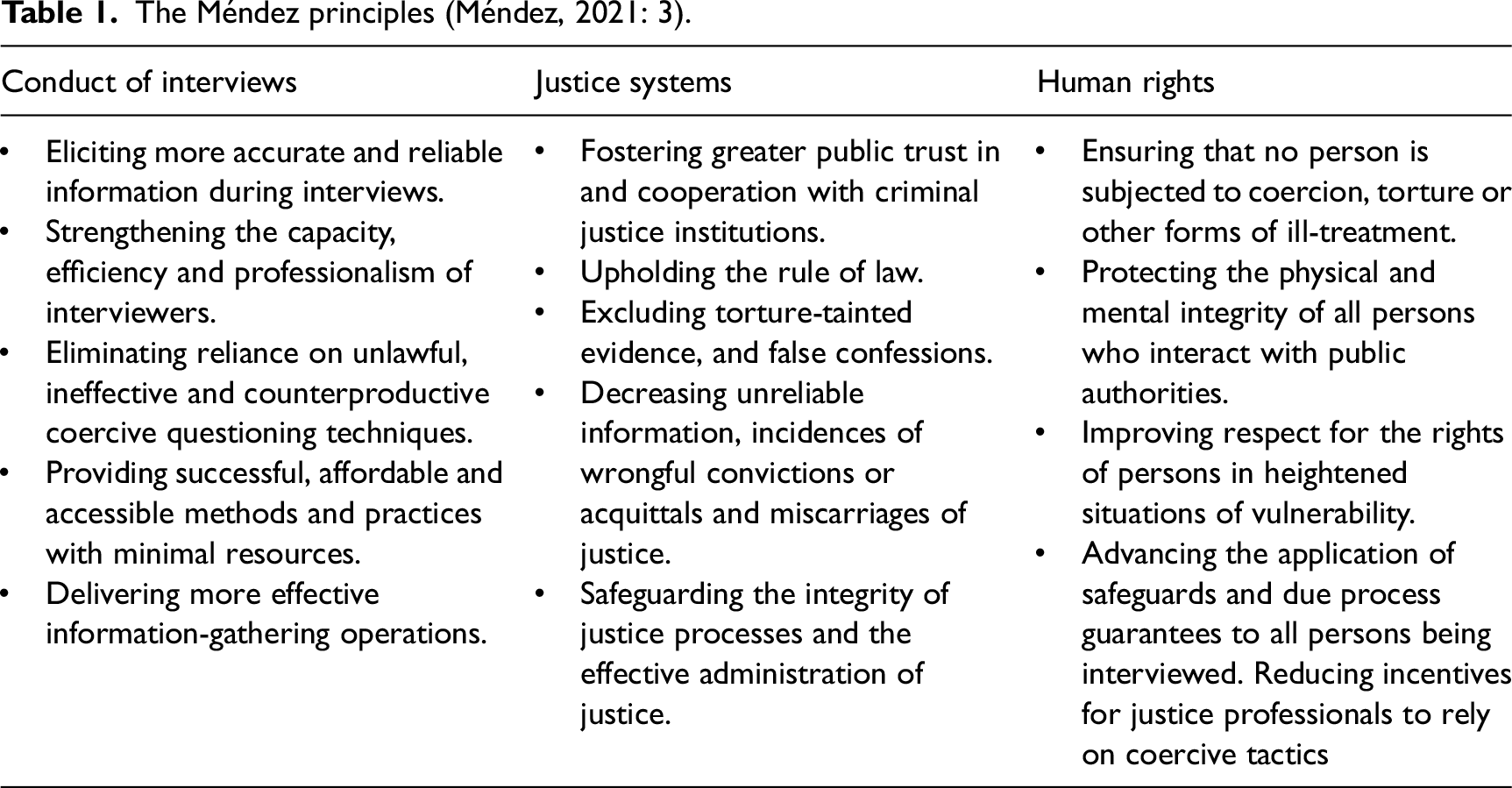
The Malawi Police Service (MPS) must embed the Méndez Principles on effective interviewing and interrogation (Méndez, 2021) into their training curriculum and cascade them to professional practice. The Méndez Principles were adopted under the auspices of the United Nations, and provide an ethical and scientifically based model of ethical interrogation by replacing coercive interrogations with rapport-based, non-coercive methods for interviewing. They improve the results of investigations, fully respect human rights and enhance trust in the State. See Table 1.
The Méndez principles (Méndez, 2021: 3).
On the basis of R v Chanthunya, a case could be brought to the Constitutional Section of the High Court to directly challenge s. 176 CP&EC on the basis of the manifold ways it conflicts with the constitution and the international human rights of obligations of Malawi. Civil society organisations in Malawi have been working hard to engage with stakeholders on this critical issue. Stakeholders such as the Legal Aid Board, police and magistrates have been brought together to discuss and interrogate international human rights law, including the right to be free from torture and the constitutional obligation against forced confessions, and to consider the Méndez Principles on effective interviewing. Efforts to engage the relevant Ministries also need to be undertaken, as, aside from strategic litigation, a Private Member’s Bill could be introduced to amend s. 176 of the CP&EC, if broad consensus was reached amongst stakeholders as to its tenability.
Ratification of the CAT-Optional Protocol is warranted. Oversight mechanisms preventing human rights abuses are crucial in all criminal justice settings in Malawi, not limited to police custody, remand detention facilities and prisons. It is critical that the Malawi Human Rights Commission, the ICC and the Inspectorate of Prisons are sufficiently resourced and operate independently of the Malawi Police Force and Malawi Prison Service. Independent inspections and further research is warranted to monitor and document the extent to which due process rights are upheld and the administration of justice in Malawi. Detailed investigation of the experiences of people who are deprived of their liberty, including those on remand, often for long periods of time, is recommended. The focus of the Special Rapporteur and United Nations Treaty Body missions and academic research activity should include detail on access to legal representation and lived experience of detention, including in police holding cells, and the extent to which fundamental rights are respected in the Malawi criminal justice system. They must also include detailed monitoring of the extent to which forced confessions continue to be admissible in the Malawi courts.
Footnotes
Acknowledgments
This Policy and Practice Note is dedicated to James Douglas, Director of Irish Rule of Law International, who was part of the author team and sadly passed away during development of this work. Go Raibh Suaimhneas Síoraí Air.
Declaration of conflicting interests
The authors declared no potential conflicts of interest with respect to the research, authorship, and/or publication of this article.
Funding
The authors received no financial support for the research, authorship, and/or publication of this article.
