




Abstract
The paper presents an analysis of the effect of lifelong learning courses helping the observed beginning teachers overcome difficulties in the initial years after completing undergraduate training. Data, analysed using a grounded theory method, were obtained through in-depth semi-structured interviews with 11 beginning biology teachers with 1 to 5 years of experience. There is an apparent disconnect between what novice teachers named as failures (and what they need to improve on) and what kind of continuing education courses they actually take. The data analysed revealed the reasons for this discrepancy: (1) beginning teachers fail to identify the causes of their teaching problems; (2) An induction teacher or a similarly attuned colleague can help to name the problem and identify its causes; however, beginning teachers lack an induction teacher (often only formally appointed); (3) the lack of support from the school can be compensated to some extent by in-service training courses – however, beginning biology teachers sought out courses oriented towards knowledge or practical skills acquisition; only when they came across a course that provided a space for reflection and sharing experiences with other (beginning) teachers did they better cope with the “reality shock” – they discovered that teaching failures do not happen only to them and they are not “thrown into the water” alone. While in-service training courses are valuable for beginning teachers, it is essential that they are not only oriented towards knowledge or the acquisition of practical skills, but that they provide a space for sharing experiences and for joint reflection on situations arising from school reality.
Keywords
Introduction
Lifelong learning is a kind of unwritten duty of every teacher. In Czechia, the obligation of continuing education for teachers is enacted, however, in a rather vague way: teachers have the obligation of continuing their education during the period of their pedagogical activity to renew, maintain, and supplement their qualifications (Act No. 563/2004 Coll., 2016). There is a lack of any clearer anchoring and no definition of more detailed forms or links to professional standards or career regulations (Act No. 563/2004 Coll., 2016; https://www.zakonyprolidi.cz/cs/2004-563). This is similar in Italy and Finland (European Education and Culture Executive Agency [EACEA], 2019). As a result, beginning teachers (BTs) are not obligated by law to undertake specific further training. Thus, they are referred to courses provided by accredited organisations. These may include universities and colleges, but in Czechia these institutions do not offer specialised courses for BTs. By contrast, in most countries in Europe, support for BTs includes some kind of additional professional programme (further education) provided by universities, etc. (EACEA, 2019). There, teachers can develop competencies but also reflect on practical experience (EACEA, 2019). In Germany and the UK (especially Scotland), there are specific programmes for BTs, and in Hungary, Lithuania, Latvia, Poland, and Austria, further training is required for career progression or salary increases (EACEA, 2019).
This study reveals the importance of in-service training courses in the adaptation period of BTs in the Czech context. It can also be an inspiration for other countries that have developed a system of courses similar to Czechia (e.g. Italy and Finland).
Theoretical Background
Needs of Beginning Teachers
BTs are thrown into the fire on the first day of school (Howe, 2006), when they enter the educational system with complete responsibility (Šimoník, 1994; Voss & Kunter, 2020). Their first months and years of practice (in European countries, the starting period ranges from 4 to 36 months; EACEA, 2019) are marked by receiving a professional jolt from the daily operation of the school – known as a “reality shock” (Šimoník, 1994; Veenman, 1984). BTs first focus on themselves (they mainly want to survive), and only then do they start to focus on the pedagogical situation, and finally they orient themselves towards the pupils (Fuller, 1969; Janík et al., 2017). BTs in the “survival” phase are not able to use their skills acquired during their studies. This period is associated with a high level of stress (Harmsen et al., 2018) and a rollercoaster ride of emotions (Lindqvist et al., 2023). BTs also show a lower level (66%) of teaching competence than advanced teachers who have been teaching for more than 20 years (Van de Grift, 2010). Thus, negative feelings in BTs could revail over positive feelings during this period (Lindqvist et al., 2023; Vítečková, 2018).
Johnson et al. (2014) identified the main areas causing problems: lack of knowledge from pre-service training; idealistic motivations for teaching colliding with reality; insufficient quality of induction and support; personal factors; loss of motivation and enthusiasm when confronted with established structures in the school; and lack of effective support for BTs from leadership (Johnson et al., 2014).
A 2018 study in Czechia identified the following problems as the main ones for BTs: discipline (shouting and forgetfulness) and motivation of pupils, problems with the administration, problems with (one’s own) authority, fear of class (home-room) meetings, and problems with timing of lessons (Vítečková, 2018). Unsurprisingly, novice teachers perceive the greatest problems in their work in areas where they also feel underprepared from their university studies (Hanušová et al., 2017; Rajsiglová & Přibylová, 2020).
BTs in Czechia also perceive difficulties in integrating into a collective (Vítečková, 2018). Colleagues are a contradictory factor in the newly discovered reality – they are both a form of help and support, but they also evoke a sense of threat. At the same time, teachers who are still identifying with their role may find odd certain common characteristics among their colleagues and hope that they will not acquire them themselves (Juklová, 2013).
The sense of not having mastered the commencement of their professional lives and negative feelings in BTs can have adverse consequences on their teaching and students. This ultimately increases stress, which in the long run can lead to leaving the profession altogether (Hanušová et al., 2017; Harmsen et al., 2018; Lindqvist et al., 2023).
Through a comparative analysis of the drop-out rates of BTs, researchers Píšová and Hanušová (2016) show that BT drop-out can be observed to a high degree (20%–50%) in the USA, the UK, and Australia, in addition to Czechia. By contrast, Japan, South Korea, Finland, and Taiwan have low (1%–7%) drop-out rates. The problem is, as the authors further suggest based on their analyses, that teachers who graduated with excellent academic results are more likely to leave the field of education (Píšová & Hanušová, 2016).
From the Czech context, research by Šimoník in 1994 showed that 25% of BTs were considering a change of profession (Šimoník, 1994). The research project “Do they want to stay or leave?” later showed that only 65% of the novice teachers surveyed declared their intention to stay in their current school (Hanušová et al., 2017). Research conducted by the National Institute for Further Education (the NIDV, now the National Institute of Education) in 2018, showed that 79.9% of the BTs surveyed had the intention to stay at their current school (Juhaňák et al., 2018). Thus, in the long term, there is a relatively high (20%–35%) percentage of BTs in Czechia who want to leave their current school or education as a whole.
To prevent these departures from occurring, it is essential to be sensitive to the needs of BTs and to focus on the causes of negative feelings among BTs as described by Johnson et al. (2014).
School Support in the Teacher’s Adaptation Period
The approach of BTs to teaching and their motivation to stay in teaching are fundamentally influenced by the school environment and the support they receive from colleagues (Hanušová et al., 2017; Howe, 2006; Paula & Grīnfelde, 2018; Thomas et al., 2019; Warsame & Valles, 2018). BTs feel more comfortable and thrive more when they are offered professional support from multiple colleagues. Support in the early years of practice is crucial for new teachers, especially for personal growth, and developing resilience strategies and teaching skills (Gratacós et al., 2023; Helms-Lorenz et al., 2016; Ingersoll & Strong, 2011). If the school does not offer comprehensive support, novice teachers do not develop to their full potential and stagnate, and this too can lead to attrition (Helms-Lorenz et al., 2016).
A safe school environment and having supportive colleagues are essential (Hanušová et al., 2017; Howe, 2006; Thomas et al., 2019; Warsame & Valles, 2018). However, support needs to be comprehensive and long-lasting (more than 1 year) – from classroom visits, to help with lesson planning, to mentoring (Helms-Lorenz et al., 2016; Shanks et al., 2022; Voss & Kunter, 2020). Formative feedback is also important (Voss & Kunter, 2020). Howe (2006) uses the metaphor of a chemical reaction requiring specific ingredients. An experienced and specially trained mentor is like a catalyst (accelerator) of the reaction, who helps the novice teacher effectively adapt. Howe (2006) also stresses that BTs need mainly assistance and not assessment during this period. A study from Israel shows that different types of mentoring (individual and group mentoring and mentoring networks) facilitate the substantive personal, professional, and social growth of STEM teachers, with individual mentoring contributing the most to all three growth dimensions (Akiri & Dori, 2022). Good examples of the practice of induction can be found in Germany and studies from this context show that thanks to this kind of support, German teachers experience a milder “reality shock” and overcome it effectively without frequent lapses into burnout territory (Voss & Kunter, 2020).
These findings suggest that the key role in the adaptation period is played by the induction teacher, who should be a particularly experienced mentor (Shanks et al., 2022), a guide who helps the BT to mature and become independent. Mentoring can be defined as: An intentional long-term process of ongoing individual support provided to a teacher or student teacher by a more experienced colleague to facilitate their professional learning processes and guide them towards self-management. Mentoring for new teachers is not only aimed at professional growth but also focuses on personal development (Spilková & Zavadilová, 2021). Certainly, the process of mentoring should not only focus on integration into the organisation and the running of the school (Hagger et al., 2011; Janík et al., 2017).
When setting up the conditions and processes in the adaptation period, it is important to keep in mind that the goal is not only to help the novice teacher “survive” the first year of practice but also to cope with current problems (Feiman-Nemser, 2001). Its importance lies in the fact that it allows to expand the competencies established in pre-service education towards the practical performance of the profession – that is, to provide conditions suitable for growth (Janík et al., 2017).
A Look at the Adaptation Period in Czechia
The situation with induction in Czechia in the European context was investigated by the TALIS survey in 2018, according to which it was found that informal induction activities are significantly more prevalent in Czechia than formally structured programmes (Boudová et al., 2020). The availability of informal activities in school is reported by 82% of Czech principals (EU average 71%), while for formal induction programmes it is 35% (EU average 55%). From the perspective of teachers, 52% of teachers participated in informal induction activities, while only 40% of teachers participated in formal activities, and 43% of teachers did not participate in any induction activities. Thus, principals’ and novice teachers’ perspectives on programme delivery differ (significantly; Boudová et al., 2020).
A more detailed view of induction in Czech schools was provided by a survey conducted in 2017 and 2018 (Juhaňák et al., 2018). The results showed that in 60.7% of cases, BTs reported that the school where they work has no induction plan and their induction is not guided by any plan. Overall, just under 80% of BTs reported that they were officially assigned an induction teacher (Juhaňák et al., 2018). However, in more than half of the cases (56.3%), BTs reported that the induction teacher was more likely to wait for them to be active. Furthermore, a relatively significant number of novice teachers (27.4%) reported that the induction teacher did not sufficiently check their work, and then in 17.3% of cases, novice teachers stated that they would appreciate more feedback (Juhaňák et al., 2018). Novice teachers said they most often needed help from the induction teacher with topics that novice teachers struggle with and which they felt unprepared for from their university studies (Juhaňák et al., 2018; Vítečková, 2018).
These results suggest that the non-regulation of the induction process leads to significant differences in induction among schools and in the contribution of the induction teacher. Support for BTs was enacted in Czechia on 1 January 2024. How the changes will take effect in reality remains unanswered.
Further Education for Beginning Teachers in Czechia
Janík et al. (2017) emphasise that collaboration and learning from an experienced teacher, as well as intergenerational and peer learning, that is, multiple resource support, is essential for the development of a novice teacher. It is noted that support should be embedded in different contexts (school context, the wider professional community, etc.; Janík et al., 2017). The focus on supporting BTs should not just be on embedding them in a given, particular school, but in the profession as a whole – gaining perspective on the specificities of the school (Feiman-Nemser, 2001; Janík et al., 2017). In the Czech context, Vítečková structures the sources of positive influence on the novice teacher’s adaptation to the profession as follows: (1) quality university studies, (2) quality school management open to feedback, (3) systematic collegial support including the induction teacher, and (4) further teacher education (Vítečková, 2018). Thus, she points out that the support and climate of the school play a key role in the adaptation period, the growth of the novice teacher, and the development of the competencies acquired in pre-service education. Other environments outside of the school where teachers can enrich their education are also important (Vítečková, 2018).
In most countries in Europe, in addition to mentoring and induction, the adaptation process includes other professional programmes (further education) provided by, for example, universities, etc. There teachers can develop competencies, but also reflect on practical experience (EACEA, 2019). The continuing education needs of BTs were already addressed in 2002 by Havlik in his questionnaire on the readiness and needs of BTs. Those teachers stated that they would most appreciate help with mastering new teaching methods (96%) and deepening their problem-solving skills (95%; Havlík, 2002). According to a 2018 study, BTs are generally interested in further training (Juhaňák et al., 2018). They would need to develop, in a practical way, their methodological and didactic skills and their ability to deal with difficult, stressful situations (Vítečková, 2018), as well as have help with school documentation, disciplinary problems, communication with parents, pupil assessment, and working with pupils with special educational needs (Juhaňák et al., 2018). So again, unsurprisingly, these are areas that novice teachers have difficulty with, that they turn to induction teachers for, and that they do not feel prepared for from their pre-service training. Interestingly, according to Vítečková, BTs do not perceive the need to improve their interpersonal skills (cooperation, assertiveness; Vítečková, 2018).
Research Section
Research Questions and Methods
Our aim was to go one step further in understanding the needs of BTs than existing studies go. Therefore, we asked the question: What are the needs of beginning (science) teachers for their further education? In other words, to find out whether continuing education courses have the potential to help novice teachers manage the early stages of their practice. And further, to find out what kind of help and support in getting started these BTs would appreciate.
Given the focus on the area of needs and support that the studied teachers had, we opted for qualitative research. This allowed us to delve into the depth of these teachers’ feelings and needs. After the first transcribed interviews, a theory began to form that needed to be further tested, and we decided to use the grounded theory method.
Data Collection
From the possible methods of data collection applied in qualitative pedagogical research, we chose the method of in-depth interview, specifically its semi-structured variant. Thanks to this type of interview, it is possible to obtain answers from multiple respondents on the same topic, but at the same time, there is some freedom left when analysing individual and specific situations or topics (Švaříček & Šeďová, 2014). This allows us to get a closer understanding of the needs of BTs.
To obtain answers to the main research question, we divided the semi-structured interview into three main parts:
In the first icebreaking part, we focussed on obtaining basic information about the respondents, the school they work at and their teaching backgrounds. Furthermore, we were interested in their motivations to become teachers.
In the second part, we focussed on mapping how BTs feel about their current practice at school. We explored what aspects of teaching novice teachers thrive in, where they have reservations, and what aspects they find more challenging. We asked about the benefits of their university studies. In this section, we also looked at their relationships with colleagues and management. We asked where they seek help with their teaching problems.
The last section was devoted to the continuing education of teaching staff. We investigated whether a system of further education exists in their schools, what courses the respondents have taken or want to take, and on what criteria they choose a certain course.
The questions were carefully worded so that they were open-ended, and encouraged a comprehensive response (Švaříček & Šeďová, 2014). This allowed respondents to give complex answers. After the first interview, the wording of some questions was slightly modified and were also added new questions relevant to the research.
Some of the interviews were conducted in person, with audio recording, however, some interviews had to be conducted online, with audio-visual recording, due to the then ongoing COVID-19 pandemic.
The research sample was drawn up in a graded design. At the beginning, the following criteria were set for the selection of respondents:
- teaching at the lower secondary stage of elementary education or at a secondary school
- teaching for less than 5 years
- teaching science subjects – biology, chemistry, physics, geography, etc.
Since authors of the research have a background in science, teachers of science subjects were selected for this research. First, were approached four novice science teachers authors knew from wider community. However, all four respondents had graduated from Charles University and were teaching in Prague. Therefore, authors decided to use the power of social media and addressed more teachers who met the requirements in various Facebook groups, with the addition of the criteria of studying or completing a teaching qualification elsewhere than Charles University. Thus, the next respondent was a graduate of Masaryk University in Brno.
At this stage of the research, the respondents’ answers began to repeat and further interviews did not bring much new information. For this reason, authors decided to triangulate the data collection methods by holding a focus group with three novice teachers. Such triangulation is important to broaden the context and add consistency to the data (Švaříček & Šeďová, 2014). In individual interviews, the authors got to know each teacher in detail, which no longer allows for a focus group interview. However, in the focus group the teachers could complement each other, develop their ideas and perspectives on some situations, could compare their schools, etc. But it must be acknowledged that the focus group participants shared less about what they were not doing well in the classroom.
After five individual interviews, a theory began to take shape. The analysis of the focus group interviews refined the emerging theory, and based on this, a need arose to add a novice teacher with active support in their school to the set of respondents. Therefore, authors searched for additional respondents on social media. From the possible candidates, those whose email communication revealed that the support at their school was only formal were excluded. This resulted in two respondents being interviewed. Finally, was decided to add one more respondent to the sample, for whom a change in school leadership played a large role in her adaptation to the school.
All of the interviews were conducted between December 2019 and December 2022 (Table 1).
Overview of Research Respondents.
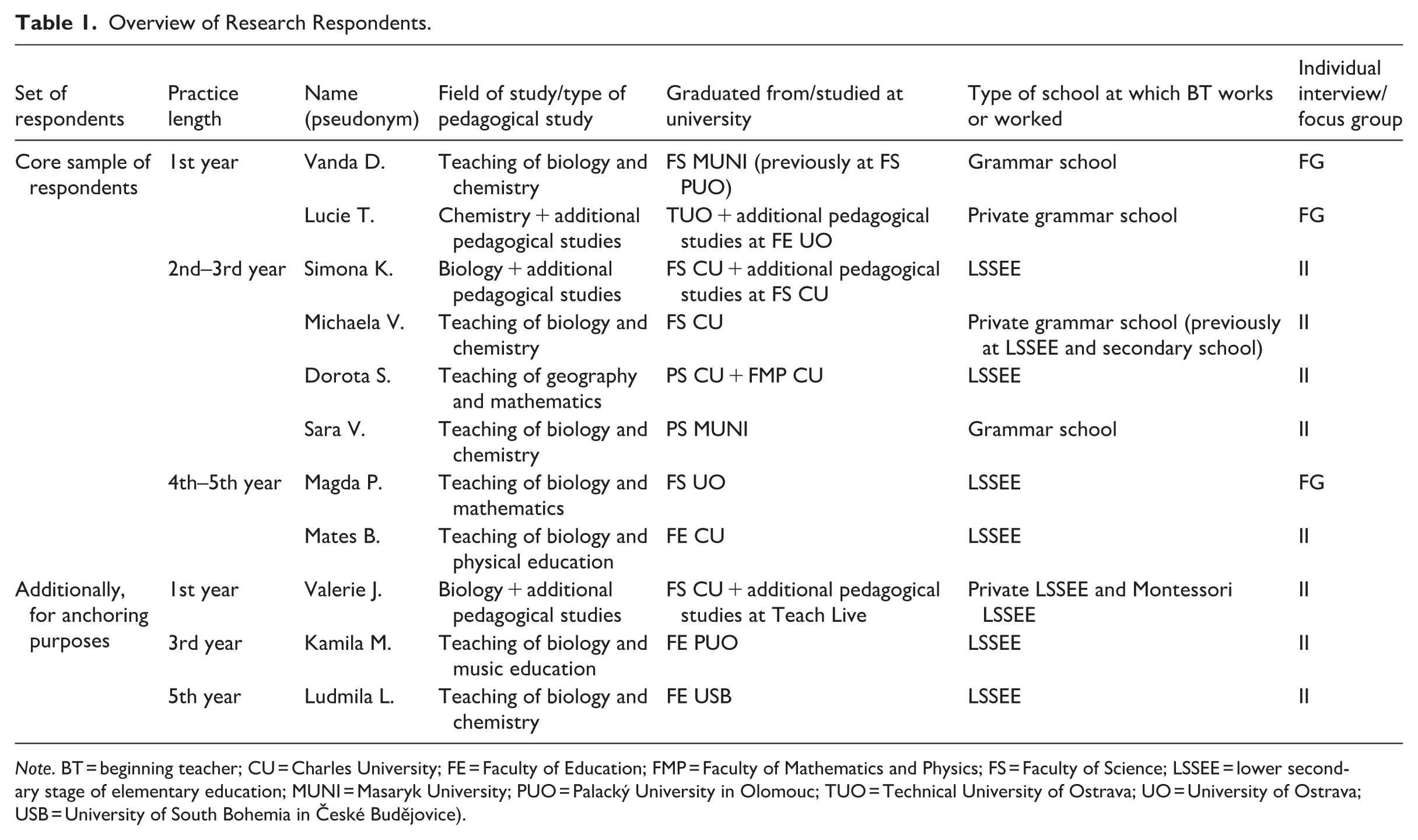
Note. BT = beginning teacher; CU = Charles University; FE = Faculty of Education; FMP = Faculty of Mathematics and Physics; FS = Faculty of Science; LSSEE = lower secondary stage of elementary education; MUNI = Masaryk University; PUO = Palacký University in Olomouc; TUO = Technical University of Ostrava; UO = University of Ostrava; USB = University of South Bohemia in České Budějovice).
Grounded Theory Method
The data obtained from the interview transcripts were analysed using the procedures and techniques of the grounded theory method. The data was subjected to what is known as “open coding,” in which respondents’ statements are divided into parts carrying certain messages or information. These parts are then labelled with a kind of tag or code that briefly summarises their message (e.g. come when you need to, teaching is an obvious first choice).
Axial coding followed, the codes from the open coding were grouped into categories (e.g. school climate), that is, groups from the same themes or domains.
The obtained categories were correlated with each other. At this stage, the basic skeleton of the story gradually began to take shape. The categories were further assembled into a paradigmatic model according to Strauss and Corbinová (1999), which arranges the categories in a sequence and defines their meaning. The model consists of the following parts: causal conditions, phenomenon, context, intervening conditions, action and interaction strategies, and consequences.
The results were then selectively coded and integrated, and the basic skeleton of the story was elaborated into an analytic narrative by identifying the phenomenon, the central category (reality shock) around which the other categories cluster. Next, the central category was related to the other categories (such as motivation to teach, the benefits of university studies) and then related the categories to each other at the level of their properties (describing the regularities and recurring relationships that the category has with the other categories). In doing so, it was formulated the basic analytic story and created a causal model (see Figure 1), that is, a complementary paradigmatic model (see Figure 2), and the base of the theory.
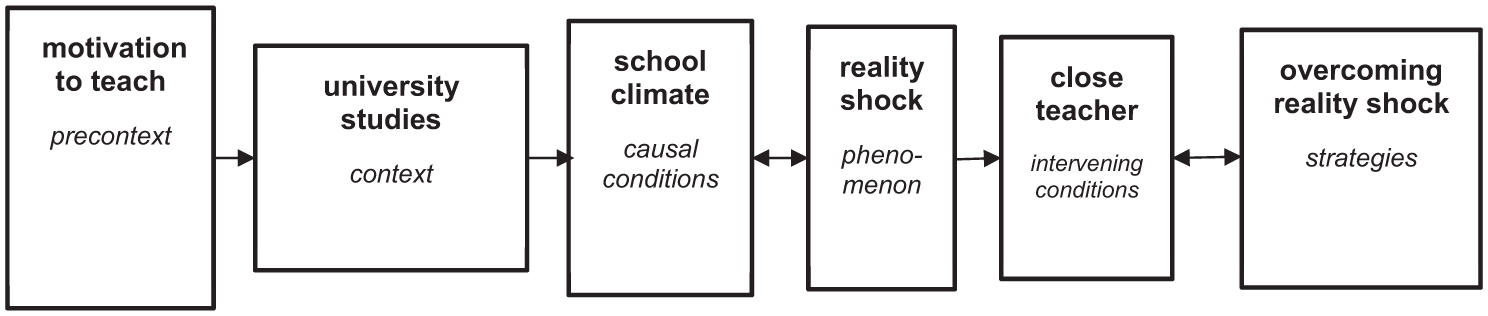
A proposed paradigmatic model of reality shock among BTs.
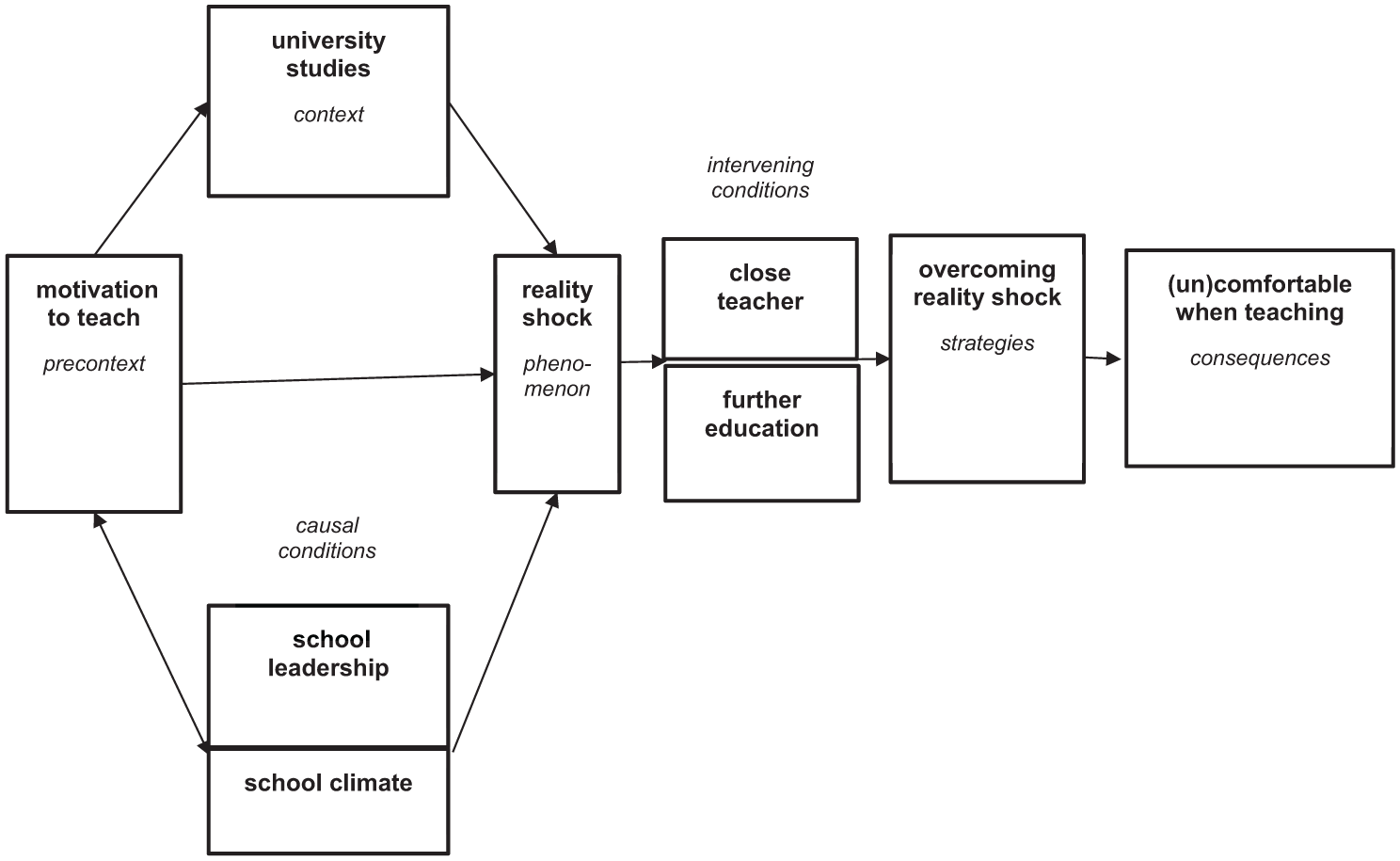
Causal model.
The final stage of the whole process was then to back-anchor the theory, where the causal model and the relationships between categories and their properties needed to be further studied on the analysed data. In this phase, we additionally supplemented the data obtained by the last three individual interviews.
Results
It should be noted at the outset that throughout this chapter the term BT is used as the equivalent of beginning science teacher (which was the focus of the research).
Paradigmatic Model
During the interviews, it became clear that BTs most wanted to talk about what they were or were not doing well in their schools and why. In doing so, they often reported that their encounters with school realities are largely influenced by (in)sufficiencies in their university studies and the climate of the school. In the literature, the term “reality shock” is used to describe this phenomenon – the encounter with school reality and the resulting (un)success of pre-service teachers (e.g. Rajsiglová & Přibylová, 2020; Šimoník, 1994; Voss & Kunter, 2020).
In the analysis of all of the interviews, it became clear that the intensity of reality shock is significantly influenced not only by the contribution of university studies and the school climate, but also by the respondents’ motivations for becoming a teacher (why they started studying teaching, if they worked with young people before or during their studies, etc.). The role of the school management also emerged as important, as it shapes the school climate and is strongly perceived by the BTs. For all respondents, we also noted the key role of “someone close, ideally from a teaching background, with whom the BT can reflect their experiences.” These people can be found in a variety of places – at the school where the teacher is working, at the institution providing university studies, in the family, or in continuing education courses. Thus, based on the first analyses, a first paradigmatic model was created which depicts the situation just described (Figure 1).
Basic Analytical Story and Causal Model
Causal Model
The intensity of reality shock is influenced by both the strength of motivation to teach and the contribution of university studies. However, the climate of the school, which is shaped by its leadership, is absolutely crucial. If the BTs have someone to share and reflect their reality shock with (ideally the induction teacher, usually, e.g. similarly attuned colleagues, university classmates, university lecturers) they effectively process the events, phenomena and situations that happen to them during the educational process. As a result, they overcome reality shock, acquire teaching competence, grow, and feel comfortable when teaching. Some novice teachers seek help from family, friends, or other non-teachers, and are thus effectively on their own to cope with reality shock – they are unable to process the multitude of stimuli effectively, do not grow into the role, and do not overcome reality shock. It turns out that in such a situation, where they lack support from like-minded teachers (including leadership), in-service training provides teachers with a crucial space to mitigate reality shock and fulfil their needs. If teachers do not find a close mentor, they are not satisfied in the teacher’s role and cannot “grow.” A summary is provided by the second picture of the causal model.
Discussion
The beginning science teachers in this research are significantly affected by the clash with school reality – that is, reality shock (Šimoník, 1994; Veenman, 1984) when entering the profession as has been documented in several other studies (Hanušová et al., 2017; Harmsen et al., 2018; Howe, 2016; Rajsiglová & Přibylová, 2020; Šimoník, 1994; Vítečková, 2018; and others). What they do and do not do well in their teaching (reality shock) is largely influenced by their university studies (Gratacós et al., 2023; Hanušová et al., 2017; Harmsen et al., 2018; Howe, 2006; Rajsiglová & Přibylová, 2020; and others). The pre-service teachers surveyed in their university studies value courses related to practice, courses taught by practising teachers, and courses that link multiple components of preparation – for example, a seminar reflecting on the experience of teaching practice in the school. This is in line with the research findings of Rajsiglová and Přibylová (2020), who describe the need for interdisciplinary and transdisciplinary integration of the various components of preparation (didactics, subject matter expertise, pedagogical-psychological preparation, and teaching practice) to manage the early years of school-based practice successfully.
The degree of the BTs’ reality shock also depends on the timing of their entry into school practice and their motivations for teaching. If they have previously worked with children and have strong motivation, or entered school practice during their university studies, their reality shock is more likely to take the form of a clash with the setting of functioning in a particular school (similar to Juklová, 2013; Rajsiglová & Přibylová, 2020). Juklová (2013) names highly motivated and experienced novice teachers as empathetic educators.
However, the climate of the school, which is shaped by the school leadership, and the acceptance by colleagues, has a crucial influence on the integration of the new teacher (similarly shown by Howe, 2006; Paula & Grīnfelde, 2018; Thomas et al., 2019; Warsame & Valles, 2018; in Czechia Hanušová et al., 2017 and others). Indeed, novice science teachers seek help with their setbacks or problems from their colleagues at school. If a comprehensive adaptation process is set up at the school (the novice teacher is just assigned a mentor or an adequate induction teacher by the school management, regular meetings with the management and other teachers are set up, etc.), the novice teacher feels supported, feels comfortable at the school, and copes more effectively with reality shock (similarly shown by Howe, 2006; Shanks et al., 2022; Thomas et al., 2019; Voss & Kunter, 2020). However, most of the research respondents encountered school leadership that was not proactive. Thus, activity is usually left mainly to the novice teacher. Colleagues are generally accepting of BTs, however, the key to overcoming their reality shock is whether there are colleagues who hold the same values or are close in age with whom they feel trust. This phenomenon is described by Juklová (2013), who points out that colleagues are a form of help and support but can create a sense of threat as well in the novice teacher. This is confirmed by Dorota S. – she still sees her colleagues as authority figures and she is afraid of being judged and evaluated. Interestingly, low support from the school can also lead to even greater feelings in pre-service teachers of being underprepared (Hesson, 2016; Rajsiglová & Přibylová, 2020).
BTs who do not find support directly at school seek it elsewhere and outside of the school. The key is to find a “close teacher,” a catalyst to help them process reality shock (Howe, 2016). Someone with whom the BT can effectively process the events and situations that happen to them during the educational process. This can be a classmate from their university studies, a college professor, a teacher in the family, and others. These BTs are then happy in the teaching role but not in the school and think about leaving the school. Some BTs, however, seek help from family, friends, or other “non-teachers” and so are effectively on their own to cope with reality shock and are unable to process the multitude of stimuli effectively, do not grow into the role, and do not overcome reality shock. These BTs are not even happy in the profession itself and consider moving on.
An important element in overcoming reality shock is the continuing education of teaching staff (Howe, 2016). Havlík’s (2002) survey showed that novice teachers in Czechia would most appreciate training courses aimed at deepening their problem-solving skills (95%) and learning new teaching methods (96%). This was confirmed by Vítečková’s (2018) research, according to which novice teachers would need further training to develop methodological and didactic skills and the ability to deal with difficult, stressful situations.
However, according to the findings of presented research, BTs usually seek training courses in areas in which they feel prepared from their pre-service training (e.g. courses to expand their subject matter expertise) or feel confident in teaching (e.g. courses to add new methods or deepen their mastery of existing methods). There is an apparent discrepancy between what teachers name as areas that they are failing and in need of improvement in and what courses they actually take. This discrepancy was also observed in the respondents’ statements. The reason for this discrepancy seems to be the fact that BTs cannot identify the causes of their teaching problems and therefore do not know which courses could help them with their problems. It is with the naming of the problem in question and the identification of its causes that an induction teacher or a similarly attuned colleague should help the teacher. If teachers lack such a mentor in the school, it is logical that they are not able to identify the problem and are on their own to overcome the shock. Crucially, our research has shown that novice teachers who do not find support at school end up valuing the fact that they were able to share their problems with others on training courses. In doing so, they find other teachers with whom they can share what they are not doing well and reflect on it. In this respect, training courses are a place where the causes of difficulties can be addressed. This is in line with Janík et al. (2017), who point to the need for multi-source support for BTs, as well as its embedding in various contexts (the contexts of different schools, the wider professional community, etc.). This is also supported by a study from Sweden which shows that it is necessary to develop more collaborative and collegial forms of further education (Karlberg & Bezzina, 2022). Courses therefore play an important role in the growth of the BT, which is even more significant if the respondent lacks a related colleague at the school.
The data and the theory derived suggest that both interdisciplinarily-linked university studies and a valued, like-minded colleague, ideally an induction teacher, are needed to integrate the novice science teacher smoothly into the school climate, grow, and effectively process the phenomena associated with reality shock. A strong motivation to teach is a factor accelerating the integration and overcoming of school reality shock. If one of these conditions is absent or inadequate, overcoming the reality shock will not be effective and the BT will not feel comfortable at school or in the role of teacher. This is in line with Vítečková (2018), who states that the process of a BT’s adaptation to the profession is positively influenced by (1) quality university studies, (2) quality school management open to feedback, (3) systematic collegial support including the induction teacher, and (4) continuing teacher education.
However, in contrast to Vítečková’s (2018) conclusion, the results presented here show that in-service courses are not only important for novice teachers to gain specific knowledge, but mainly to enable them to share their problems and meet other (novice) teachers. Such courses are crucial for those who do not have adequate, collegial support at their school, but they will also help other novice teachers in gaining perspectives and contexts from different schools (Janík et al., 2017; Karlberg & Bezzina, 2022). It would therefore be useful to have courses that provide both knowledge (what novice teachers are looking for) and also a safe space for reflection on teaching (Akiri & Dori, 2022), and further education outside the school. Courses will provide new perspectives for all BTs and, in addition, may save teachers without school support and enable them to become happy teachers who will develop their competencies and grow in the profession.
Conclusion and Educational Implications
This research was oriented towards novice science teachers, however, when compared with Czech and foreign research, the results show general trends that are also observed by authors who do not focus exclusively on science teachers. The results of the research show: (1) an initiating approach of the school management and collegial support is absolutely crucial for mastering a teacher’s start in schools; and (2) formative TARGETED feedback directed from the induction teacher to the newcomer is crucial.
A lack of support from the school can be compensated to some extent by continuing education courses that provide this help to the novice teacher. Beginning teachers generally want further training, ideally in the form of practical or information-oriented workshops and seminars. Although the novice teachers observed seek out courses on areas of teaching in which they feel confident, at the end of the courses they point out that they find it very valuable to meet other novice teachers, as this helps them to see that teaching failures do not occur only to them. It seems appropriate that courses should not only be oriented towards the acquisition of knowledge or the acquisition of practical skills, but that they should also provide a space for sharing experiences with other (novice) teachers and for joint reflection.
Science fields need a great deal of subject specialisation in university studies; as do subjects such as history or Czech language and literature. It can therefore be assumed that the results of this study will also apply to beginning teachers of other content-intensive subjects. On the other hand, university studies for teachers of foreign languages or primary pedagogy generally have a different approach. We see this as a limitation of the research, however one that offers scope for further exploration of those groups of beginning teachers.
Supplemental Material
sj-docx-1-imp-10.1177_13654802251407358 – Supplemental material for Further Education as Help to Saturate the Needs of Beginning Teachers
Supplemental material, sj-docx-1-imp-10.1177_13654802251407358 for Further Education as Help to Saturate the Needs of Beginning Teachers by Jana Fryzelková and Ina Rajsiglová in Improving Schools
Footnotes

Funding
The authors disclosed receipt of the following financial support for the research, authorship, and/or publication of this article: The publication was financially supported by the project of the Ministry of Education, Youth and Sports: Institutional Support for Long-term Development of Research Organizations - Cooperatio HUM/“ General Education and Pedagogy ” - Charles University, Faculty of Education (2023).
Declaration of conflicting interests
The authors declared no potential conflicts of interest with respect to the research, authorship, and/or publication of this article.
Supplemental material
Supplemental material for this article is available online.
References
Supplementary Material
Please find the following supplemental material available below.
For Open Access articles published under a Creative Commons License, all supplemental material carries the same license as the article it is associated with.
For non-Open Access articles published, all supplemental material carries a non-exclusive license, and permission requests for re-use of supplemental material or any part of supplemental material shall be sent directly to the copyright owner as specified in the copyright notice associated with the article.
