



Abstract
This study explores professional social support models in schools in Finland and Estonia. The study sheds light on how Finnish and Estonian minority language schools have organised social support in the frame of their professional development for beginning teachers. Using a structural framework for understanding social support at all systemic levels in the learning environment, we used qualitative case studies to analyse how social support for beginning teachers is integrated in everyday practices. We conducted 20 semi-structured interviews with school principals, practice supervisors and teachers at 6 schools (3 in each country). The findings show that there were differences in whether the social support was based on individual needs and systematised school-based implementation involving recognised leadership. The differences reflect variations in the level of maturity of the social support system of beginning teachers. The findings were interpreted through a systems approach and adopted to a cross-national context. This resulted in a proposal for a multi-level social support model underlining systematic support mechanisms for professional development with a social dimension.
Introduction
Beginning teachers bring to their school communities the latest research-based knowledge on teaching and learning, and enthusiasm. However, beginning teachers also face challenges, some of these pertaining to who they are as teachers, that is, their teacher identity (Kelchterman & Ballet, 2002), high levels of work pressure and feelings of stress (Tikkanen et al., 2021; Tynjälä & Heikkinen, 2011), depression (Gavish & Friedman, 2010), thoughts of resigning (Heikonen et al., 2017), dissatisfaction with school leadership (Harju & Niemi, 2020) or other professional challenges, such as communicating with parents (Fantilli & Mcdougall Rogers, 2009) or handling conflicts and diversity among their pupils (Harju & Niemi, 2018; Larrivee, 2012). Research shows that beginning teachers need substantial multi-professional support in their first few years to experiment and develop their professional skills in safe and non-threatening environments (Aspfors & Bondas, 2013; Burke et al., 2013; Eteläpelto et al., 2015; Meristo, 2016; Paniagua & Sánchez-Martí, 2018). It is also known that the first 5 years are the most critical for beginning teachers with regards to the prospects of their staying in the profession (Baker-Doyle, 2011; Lunde Fredriksen, 2020; Thomas et al., 2018).
Induction programmes are a means of supporting beginning teachers during their first teaching year.
Research has highlighted the importance of the social dimension, and of beginning teachers’ collegial and social dimension of the teaching profession (Baker-Doyle, 2011; Meristo & Eisenschmidt, 2014). Often, beginning teachers consider their mentor to be the main and perhaps only collegial contact (Löfström & Eisenschmidt, 2009). Yet there are signs that mentors may not pay enough attention to promoting collegiality, or the school culture is not supportive of new teachers (Poom-Valickis, 2014). Research shows that there is a need to develop the ecosystem for mentoring in Finland (Heikkinen et al., 2020; Tynjälä et al., 2019). However, even if a support mechanism for new teachers exists, there is a need for its systematic implementation and for raising awareness about it at several levels and contexts for instance at the organisational level, at the policy level and in Finnish teacher education institutions (Harju & Niemi, 2024). Despite that there is solid evidence recognising the individual support needed for teachers during their induction, formal and systematic support models, and national-wide guidelines for induction programs for beginning teachers are not in place in Finland (Harju & Niemi, 2024). It is recognised on a European policy level that induction programs are the weakest part of Finnish teacher in-service training for professional development (European Commission/EACEA/Eurydice, 2021; Harju & Niemi, 2024). In turn, a challenge in the Estonian context has been to instil a sense of leadership of the professional learning community (Oppi & Eisenschmidt, 2022; Oppi et al., 2020). While the challenges are different in the two countries, they both boil down to issues with supporting professional development with a social dimension.
This study contributes to the body of knowledge on how social support is implemented for beginning teachers (also referred to as newly qualified teachers, novice teachers and new teachers in the ‘early career teachers’ literature, e.g., Fransson & Gustafsson, 2008). This early career stage spans the first few years of work, often up to 5 years (Olsen et al., 2020). The first year of work, often referred to as the induction year (Eisenschmidt, 2006), may involve formal or informal activities for beginning teachers (Teaching and Learning International Survey [TALIS], 2018). Induction activities may include structured programmes on individual or group levels such as systematic supervision by the school principal, for example, individual job orientation (see Harju & Niemi, 2024), formal mentoring by an experienced teacher (Berkovich & Eyal, 2018; Eteläpelto et al., 2015; Hudson, 2012) or peer-group mentoring (see Tynjälä et al., 2019). Research on the beginning teachers’ need for support during the first years as teachers reveals the need for support on the individual level (Harju & Niemi, 2018, Heikkinen et al., 2020; Tynjälä et al., 2019). The induction activities can also entail separate informal activities with the aim to support beginning teachers (TALIS, 2018), such as support groups in social media (Lee & Mehta, 2015). The aim of this study is to identify models of social support for beginning teachers in two minority-language school contexts in two countries, namely, Finland and Estonia. On average (OECD countries), approximately one in five beginning teachers are assigned a mentor. While Estonia aligns with this average, in Finland only 1 in 10 beginning teachers are assigned a mentor (TALIS, 2018). Irrespective of country, most beginning teachers do not receive mentoring, which suggests that in neither of these countries are the means of providing social support for beginning teachers fully exploited. By focusing on minority language schools, we wish to shed light on an aspect of social support, which at least to some extent, may be culturally provisioned, yet often less researched than the majority context.
Social Support for Beginning Teachers
Social support is rooted in institutional structures and practices, and manifested through practice supervision, mentoring and school leadership (Väisänen et al., 2016). Social support consists of the social resources (Cobb, 1976; House, 1981) perceived to be available by the learning environment in the Communities of Practice (Lave & Wenger, 1991). Prior research has highlighted beginning teachers’ perceptions of social support as crucial for starting a career in teaching (Meristo et al., 2013). Research shows that experiences of belonging to a community enhance early career teachers’ job satisfaction (Meristo, 2016; März & Kelchtermans, 2020). Social support results in self-efficacy and a positive perception of the development of professional identity (Meristo et al., 2013). Receiving social support also builds up the development of important psychosocial strategies such as coping with stress better and in that way strengthen the feeling of wellbeing (Väisänen et al., 2016). Prior research highlights the importance of school leaders in early career teachers’ socialisation into the school environment, and their wish to stay in the teaching profession (Aspfors & Bondas, 2013; Berkovich & Eyal, 2018; Harju & Niemi, 2020) and mentoring (Hobson et al., 2009; Löfström & Eisenschmidt, 2009). Yet, research has also identified undeveloped potential in mentoring practices (Hobson et al., 2009; Olsen et al., 2020; Tynjälä et al., 2019).
Social support can be viewed in light of support sources, support types (later these are described as support forms according to the initial model by Pyhältö, 2018), support fit, and support dynamics (initially developed by Pyhältö, 2018 and adapted to school context by Väisänen, 2019; see also Cornér et al., 2018; Figure 1).
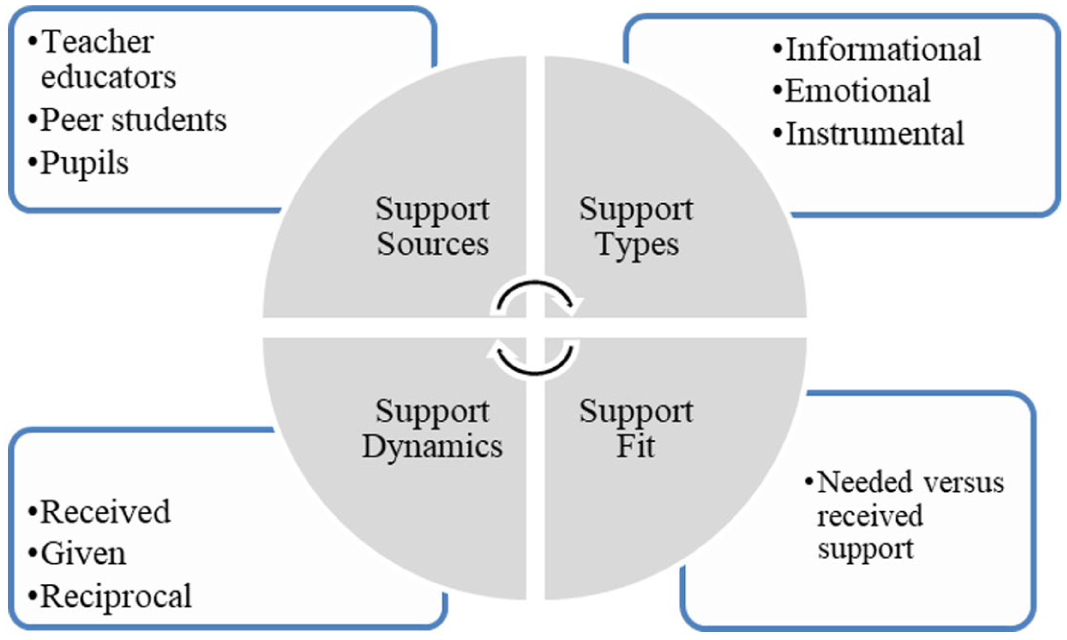
The social support system in teacher education (Väisänen, 2019, adapted from Pyhältö, 2018).
The school environment hosts a variety of relationships involving school principals, teachers, mentors, other professionals working at the school, parents and pupils (Eisenschmidt et al., 2021; März & Kelchtermans, 2020; Rautanen, 2020). The parties of these relationships constitute sources of social support.
Three types or forms of social support have been distinguished (Cobb, 1976; see also Pyhältö, 2018). Informational support refers to intellectual information such as advice, guidance, feedback and affirmation that teacher students/new teachers receive in order to develop their strengths. Instrumental support refers to more practical and tangible support such as having an acceptable amount of time for the study process/the work, having sufficient funding and a workspace. Emotional support consists of empathy, trust, encouragement, listening, supporting self-esteem, and the sense of belonging to a network of the community of practice.
The support fit referring to a match or mismatch between the support that is needed and that which is received is a central component in understanding socially embedded early teacher career experience. The crucial dimension may not always be the quantity of support, but the recognition and development of beginning teachers’ different support needs during their initial years in the teaching profession (Aspfors & Bondas, 2013; Korte & Simonsen, 2018). Furthermore, in terms of support dynamics, beginning teachers are not only recipients of social support, but their role in the school community must be seen as a reciprocal one in which they contribute to the professional community in valuable ways (Schaefer et al., 2012). Also, reciprocity involving the mutual actions between colleagues and other actors in the school community is one of the more important aspects for beginning teachers (Aspfors & Bondas, 2013). The support must be holistic and multilevel involving, and extend beyond classroom activities (Harju & Niemi, 2020; März & Kelchtermans, 2020).
For this study we adopted a systems approach (see also Pyhältö, 2018) with a focus on societal, organisational, individual levels and inter-individual forms of support. The societal level comprises the municipality, teacher unions and higher education institutions partnering with schools. The organisational level for beginning teachers consists of activities taking place at the school level, such as interactions between the school leadership and the teacher collegium. The individual level involves relationships between beginning teachers and individuals in their closest environment, including their mentor, pupils and parents. The societal, organisational, and individual levels constitute a structure for framing social support for beginning teachers.
Considering the challenges to develop an ecosystem for mentoring in Finland (Harju & Niemi, 2024; Heikkinen et al., 2020) and to instil a sense of leadership of the professional learning community in Estonia (Oppi & Eisenschmidt, 2022; Oppi et al., 2020), the aim of our research was to identify how social support for beginning teachers is understood and implemented in schools in the two countries. We identify roles and responsibilities in providing the support, forms of support and the organisation of the support. By doing this, we identify the models of social support and analyse them in relation to their national context. At the same time, we have identified commonalities and differences and proposed good practices for the development of social support for new teachers. We posed our research question as follows: How is beginning teachers’ social support in terms of forms, sources, fit and dynamics manifested in schools in Estonia and Finland, and at what systemic levels does support emerge?
Context
Estonia
In Estonia, to become a qualified teacher, a master’s degree in the educational field is compulsory. The status of the teaching profession has been low for decades and has resulted in alarming teacher shortage (Pedaste et al., 2019; Tire, 2020). Although nearly half of the beginning teachers do not have the required qualifications, most are nevertheless enrolled in for a master’s degree in teaching (Selliov & Vaher, 2018). Most beginning teachers follow the 3 + 2 route at a university. Elementary school teacher education (grades 1–6) consists of a 5-year programme and subject teacher education (grades 7–9 and upper secondary school) follows a 3 + 2 route, in which students’ study in a 3-year bachelor’s degree programme in a subject, and a master’s degree in education in a 2-year programme. The average age of beginning teachers is over 30 and reflects the non-linear career of beginning teachers (Kolde & Meristo, 2020). Today, about 13% of schools in Estonia are Russian-medium schools including approximately 25% children living in Estonia (Estonian Ministry of Education and Research, n.d.). Russian-medium schools in Estonia can be heterogeneous: most have joined the language immersion programme, which has regional characteristics. There are also schools at which some subjects are taught in Estonian, but which do not follow the language-immersion policy, and there are schools at which the only medium of instruction is Russian. One of the support mechanisms that Russian-medium schools need is the skill of creating social cohesion inside school communities. Russian-medium schools in Estonia have been studied from the perspective of students’ language acquisition and language immersion (Golubeva, 2018), educational and school level policies (Põder et al., 2017), and PISA results (OECD, 2019; Tire, 2021; Täht et al., 2018). The latter indicates that there is sometimes a lack of a strong learning environment in Russian-medium schools in Estonia, which negatively affects students’ academic outcomes and may have negative implications for the teacher community. Estonia follows a comprehensive school system designed to cater for all students regardless of their social and linguistic background. However, delivering inclusive education, especially in multicultural classrooms, poses challenges.
Finland
Teacher education is a popular study choice in Finland (Toom & Husu, 2021). To become a teacher in Finland, master’s level teacher education is required (Toom & Husu, 2021). As in Estonia, elementary school teacher education (grades 1–6) consists of a 5-year integrated programme. Subject teacher education (grades 7–9 and upper secondary school) follows a route, which consists of a master’s degree in a subject, in which 60 European Credit Transfer Standard (ECTS) credits educational studies are included. The official language status in Finland guarantees that Swedish language speakers have the same language-related rights as the Finnish language speakers (Vincze & Harwood, 2015), as both Finnish and Swedish are official languages in Finland. In practice, approximately 6% of the population speak Swedish as their first language. Schools follow the same national core curriculum for basic education irrespective of the language of instruction. Further, the Finnish core curriculum, which came into effect in 2016, supports socially just education incorporating diversity and multicultural perspectives (Zilliacus et al., 2017). One of the future national development themes in The New Comprehensive School Programme, by the Finnish government in the past 2 years has been to develop community and collaborative culture in schools (Finnish Government, 2021). While the research on social support in schools with Swedish as the medium of instruction in Finland is scarce, there is evidence of tensions between the enjoyment of being a caring elementary teacher and exhaustion induced by the new role as a teacher experienced by beginning teachers (Aspfors & Bondas, 2013).
Method
We used a multiple case study approach for this study. It enables an analysis of the participants’ experiences in multiple bounded systems (cases) at the organisational level (here school) and the psycho-social level (here individual and collective; see Cohen et al., 2007; Creswell & Poth, 2018; Robson, 2002; Yin, 2003). The cases examined are in Estonia and Finland, and three schools were included in both countries to allow for more variation within each case.
Participants
The Estonian Case
We reached out to three municipal schools collaborating with a teacher education programme. All the principals agreed to take part in the study. At the conclusion of each interview, the interviewer requested that the principal identify a staff member involved in student teachers’ school practice and a beginning teacher, who could then be approached for an interview. In each of these three schools, three individual interviews were carried out, involving nine informants. For seven participants the first language, L1, was Russian and for two it was Estonian. Firstly, the participants included three school principals (two women, one man) with leadership experience ranging from 1 to 20 years. Their educational background included master’s degrees in teaching L2 Estonian, arts and natural sciences. In addition, two principals had an additional master’s degree in educational leadership and L2 Estonian. Secondly, we interviewed three vice principals (all women) with experience in their current position ranging from 4 to 11 years and all with an L2 Estonian teaching qualification. All had more than 10 years of experience in teaching and continued teaching despite their administrative duties. Thirdly, the participants included three beginning teachers (two women, one man), all working as first-year teachers. Their master’s degrees were in teaching L2 Estonian, subject teaching, and teaching adult learners. In the Estonian school the vice-principal is responsible for organising and managing school practice. Appointing a mentor to a beginning teacher can be a joint decision by the school leadership (i.e. principal, vice principal, heads of subject fields, coordinator of teaching students with learning disabilities) or solely by the vice principal, depending on the particular school’s common practice.
The Finnish Case
We contacted five municipality schools partnering with a teacher education programme. Three principals consented to participate in an interview. At the end of the interview, the interviewer asked the principal to name three individuals in the school involved in the facilitation of student teachers’ teaching practice, who may be contacted for an interview. In the three schools, a total of eleven interviews were carried out. The participants were all women whose first language, L1, was Swedish. First, two principals and one vice principal with substantial leadership experience of at least 15 years and with a master’s degree and a qualification as school principal were interviewed. Second, three practice coordinators and four supervising teachers, were interviewed. All had been in their current position for >5 years. Their educational background included master’s degrees. All were acting teachers with at least 10 years of teaching experiences. One first year beginning teacher was interviewed. In sum, about half of all the informants in Finland and Estonia were principals or vice principals with long experience of school leadership duties. The leadership experience varied from 1 year to over 30 years, but most of the informants had extensive experience of leading a school. Also, the practice coordinators and acting supervising teachers had lengthy teacher experience. Hence, the informants were recruited as they were known to be in key roles or have insight into the support of beginning teachers in the school.
Data Collection
Twenty structured interviews were carried out. The data were collected in May to June 2021 with an interview instrument designed by the researchers. The interview instrument was translated from Swedish to Estonian and English. The interviews consisted of 18 main questions. Background questions and the core themes in the interview instrument were developed together by all three authors of this study. The first author had the main responsibility for the overall design of the interview instrument and for the Swedish and English language versions. The second author had the responsibility for the Estonian translation of the interview instrument. The questions relevant for our purposes drew on the theoretical model for the social support system in teacher education (Väisänen, 2019 adapted from Pyhältö, 2018). The themes Support sources and Support forms and Collegial support in the school community explicitly addressed the school’s organisation of social support for beginning teachers how Finnish and Estonian schools have organised social support in the frame of their professional development for beginning teachers. Some examples of the questions asked were, “What kind of support and who offers support for beginning teachers” and “Would you like to explain how everyday work is organised in your school?” The systemic location of the social support for beginning teachers in the school community emerged in the interview’s responses about the implementation of social support. Further, background questions on their title, work history, range of leadership/teaching experience, current number of pupils in the school, current number of teachers in the school and the number of newly recruited teachers per year were included. Interviews lasted between 45 and 60 min. The data collection started with interviews with the principals who, at the end of the interviews, were asked to suggest employees in the school with roles vital to the social support of beginning teachers. Three researchers conducted the interviews simultaneously in Finland and in Estonia. In the Estonian case, all the interviews were carried out in Estonian, in the Finnish case, in Swedish. The interviews were recorded with permission and transcribed verbatim.
Data Analysis
We applied qualitative theory-driven thematic analysis (Table 1). According to the theoretical model (Cornér et al., 2018; Pyhältö, 2018; Väisänen, 2019), support sources, support forms, support fit and support dynamics were identified. We have illustrated these by providing data excerpts. The theoretical support model was complemented by the levels of individual, organisational and societal levels. We applied the themes within the four components of the theoretical model (Figure 1) to the extent they were relevant. After that, we took a more inductive approach during which we were open to other themes emerging in the data but not present in the theoretical model. This phase was necessary as the initial model had been created with another context (doctoral education) in mind (Pyhältö, 2018). While the model had been applied to a school context (Väisänen, 2019) we anticipated that further applying the model in other contexts could introduce novel themes or perspectives. Indeed, such themes included school leadership, school community, mentoring and community leadership within the component ‘sources of social support’. Regarding support fit, we identified adjusted and personalised support as additional themes.
Examples of Data Excerpts.
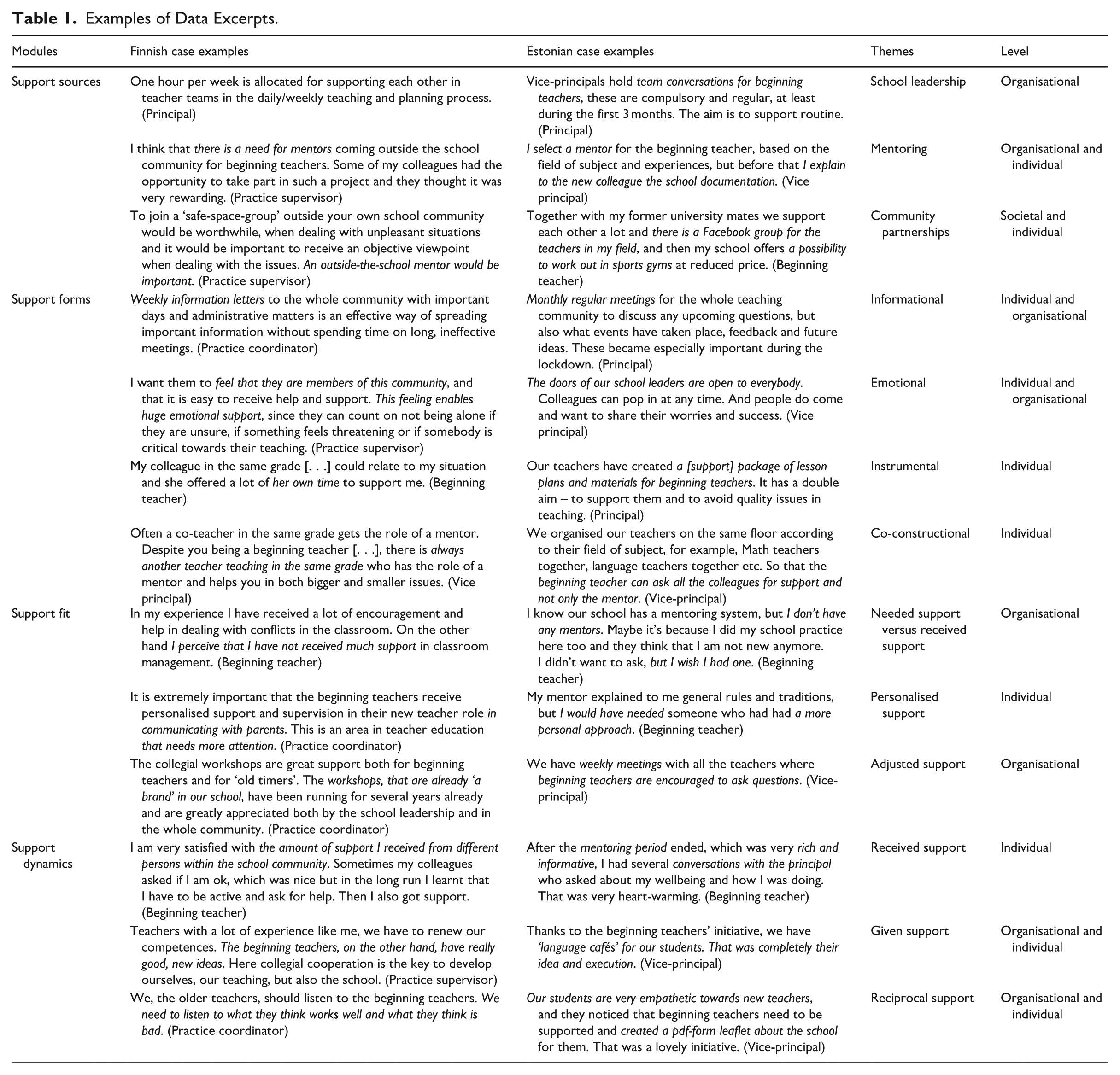
Text segments relevant considering the social support model (Figure 1) were identified and themed appropriately. A text segment was identified as an extraction from the interviewee’s texts describing one coherent thought in relation to support sources, support forms, support fit, and support dynamics and an elaboration of these. The text segments referring to explicit thoughts created the idea of something that the respondent perceived as important and directly learnt in relation to the school context and described it as such. The initial analysis was undertaken independently by two authors. The third author, knowledgeable in both Swedish and Estonian, reviewed the analyses which enabled constant cross-checking and comparison during the analysis process (Korstjens & Moser, 2018). The reliability was strengthened by consensus in data interpretation (Creswell & Poth, 2018). Consensus was reached through on-going discussions about the analysis.
Research Ethics
With the research, we respected the fundamental principles of research integrity in European Finnish and Estonian contexts, (The European Code of Conduct in Research Integrity, ALLEA, 2017; Finnish Advisory Board on Research Integrity, 2012). In Finland and in Estonia, an ethics review is not required for anonymous no-risk research involving healthy volunteer adults (see Finnish National Board on Research Integrity, 2019). Research permission for a study to be carried out in schools was obtained from the three municipalities in Finland in which the data collection took place. In the Estonian case, the permission for the study in schools was given by the school principals. Participation in the study was voluntary and based on informed consent. No incentives were offered. The data were anonymised to protect the participants’ identities. Protecting the identities of research participants was a priority in this study. The participants represent language minorities in Finland and in Estonia and therefore they could be identifiable from information such as the name of the school. As we recruited participants partly through the school principals, we identified the need to be careful about not disclosing whether we had interviewed the individuals suggested by the principal. While the recruitment procedure involved such ethical considerations, we found it necessary for identifying individuals with relevant knowledge and experience, considering our focus on beginning teachers’ social support.
Results
Social Support and the Implementation of It in Estonian and Finnish Schools
We identified all support dimensions, that is, support sources, support forms, support fit and support dynamics in the data. In addition, we also identified themes within the support dimensions brought out by the specific contexts in which we carried out the research. All themes applied to both the Estonian and the Finnish contexts.
Support Sources and Support Forms
The results showed that social support from the school leadership as a source of support was underlined by the participants. The participants emphasised that the roles and responsibilities in providing social support must be clear but also identified that there was a variety of expectations attached to perceived roles and responsibilities. The principals themselves mentioned that they work with an ‘open door’ policy emphasising to the beginning teachers that they are available for them also after the office time. This meant that the beginning teachers were welcome to contact the principals also outside school hours. In providing this opportunity for support, the leaders hoped to signal availability and emotional support. One principal shared her thoughts as follows: I want to emphasise the feeling that they are not alone, that they are a part of a collegium. They receive support and they can come into my office whenever they want. This creates a feeling of belonging to a community. . . I see this as a good form of emotional support, so that they feel that they are not alone if they feel unsure or if they encounter a threatening situation or they feel questioned for their behaviour or their way of teaching. (A school principal from Finland)
Other support sources were the whole school community, mentors and other professionals such as school counsellors and school health nurses. The Finnish interviewees emphasised the availability of formalised social support that beginning teachers receive from their teacher colleagues in teacher teams. The daily work in planning and teaching in all the Finnish case schools was organised in teacher teams focused on specific age groups. In these teams, experienced and beginning teachers worked together. One mentor-teacher was appointed in the teacher team with the special task of helping and supporting the beginning teachers in the team. This way of organising support in smaller teams with a clear structure was underlined as the most important way of supporting new teachers to cope in their job. One participant described the responsibility as follows: When you arrive as a new teacher to our school, for example to grade 2, then you are a part of the grade 1 to 2 team. In that case you have your own teacher mentor in that same team. This means that the new teacher has an appointed colleague that they can contact and ask for help whenever they need a piece of advice. (Practice coordinator, Finland)
Providing the support of (formally) appointed mentors emerged as a future developmental target for providing extended social support sources. In both the Finnish and Estonian schools, this was expressed by several participants, as some schools offered this source of support, but other schools did not seem to offer this opportunity of supporting beginning teachers during their induction year. A beginning teacher described how the situation as a new teacher could be like if a mentor had not been appointed: I can honestly say that not much help was actually offered, that I had to search a lot myself and think logically about how the system could work. I felt that there was a great need for such a mentor. (Estonian beginning teacher)
Social media groups were mentioned as an important source of social support, since communicating in other groups allows beginning teachers to be in contact with former peers from teacher education. This suggests that social media in these peer groups is a safe place to discuss and receive a different, less formal kind of social support for daily school activities.
The participants reported receiving informational, instrumental, emotional and co-constructional forms of support, but they also identified development needs. One principal identified providing constructive feedback as a development target. This also involves showing appreciation to beginning teachers who may struggle with experiences of insufficiency and failure to meet expectations. The principal described this as follows: We should offer more positive feedback on a personal level and show them [beginning teachers] more appreciation when they have done something good. I think that we count on the teams they work in, since we know that the small teams provide a positive response. But I think we need to take this more into account and incorporate more constructive and concrete positive feedback in our support system. (A school principal from Finland)
The results indicate further that much work to enhance social support for beginning teachers is done at the individual and organisational levels. However, improvements are needed at the organisational level, and social support for beginning teachers requires attention and enablers at the structural and policy levels.
Support Fit and Support Dynamics
The results showed that the support needed and received did not always match, meaning that the support provided to the beginning teachers was not available or the support was not adequate in terms of the beginning teachers support needs. New themes identified within support fit were personalised and adjusted support. The results showed that the support offered was not always aligned with the beginning teacher’s expectations, situation, and level of knowledge. One participant illustrated beginning teachers’ need for personalised, everyday support with the right timing and immediacy, as the following quotation shows: I see a difference between the so-called planned supervisory or mentor sessions and the beginning teachers’ need for ad hoc support and help in different matters. For example, when messages should be written to parents or the beginning teachers have received troublesome messages from parents, these matters cannot be scheduled into the future. The beginning teachers need personalised support every day, they need support on the individual level here and now. The challenges the beginning teachers meet must be solved immediately when they occur. (Finnish practice coordinator)
The results indicated further the need for adjusted support from the school community and the policies, both formal and informal. The respondents indicated that mismatched support regarding adjusted support may occur when the new teacher lacks awareness of how the teachers have agreed on modes of communication with parents, for example. The beginning teachers need support from the school community and more advanced teachers about the shared policies of the school, for example regarding the school and parent cooperation. One beginning teacher shared their worries: I had no clue about the school policy regarding when to give feedback to parents on Wilma [electronic communication system], nor how often the other teachers give written feedback to parents. Am I supposed to write to them [the parents] as a group or should I contact them individually? I did not know anything about what the school community had agreed upon and I would have needed a lot of support in this matter to find the right balance in both quantity and quality. (Finnish beginning teacher)
The results showed that the participants want to develop and find new practices for support fit, both personalised and adjusted, as a central component of a socially embedded beginning teacher career experience. Furthermore, the results showed that the roles of the various actors for support actions varied. The roles varied between actions for giving support, for receiving support or for reciprocal support. Beginning teachers do not see themselves as always being only on the receiving side. Instead, the results indicate that they offered their ideas on how to enhance teaching and teaching methods. They bring new knowledge to the school community, and they are also often eager to develop collegiality and the whole school community. This is shared by one participant as follows: Beginning teachers come with new approaches. They are sometimes modest about sharing their ideas and need encouragement, but more experienced teachers often welcome their beginning colleagues’ initiatives. (A school principal from Estonia)
The results showed that the beginning teachers actively seek social support when it is needed, they gradually find their role in the school community and offer their support to others outside the classroom. Reciprocal influences of social support were identified, and the participants reported that beginning teachers also contribute holistically to the school community and that they have a positive impact on both an individual and an organisational level.
The results on the kinds of support and how it is provided to beginning teachers in Estonian and Finnish schools revealed the identification of all support dimensions; support sources, support forms, support fit and support dynamics. Several themes that complement each other within the support dimensions were found, and also multilevel implementation of social support was detected in both the Finnish and Estonian school communities. Table 1 illustrates Estonian and Finnish data excerpts in relation to the dimensions of support sources, support forms, support fit and support dynamics and organisational level.
Discussion
Summary
We explored social support for beginning teachers in Finland and Estonia and related the social support components to the individual, the organisational and the societal level. The theoretical underpinning and the construction of the research question was anchored in the Model of Social Support (Cornér et al., 2018; Pyhältö, 2018, Väisänen, 2019) and, further, interpreted through a systems approach and adopted to a cross-national context. By focusing on the implementation of the various dimensions of support sources, support forms, support fit and support dynamics on organisational levels in the context of beginning teachers, this study aimed to extend the literature on school development and the teaching profession by focusing on beginning teachers. The study contributes to the existing research literature on the concept of social support by developing the theoretical social support model, since this study shed light and brought forward new knowledge on the various needs of multi-level social support in beginning teachers’ new profession in school. Our results corroborate earlier research suggesting that social support is significant to beginning teachers in the induction period of their career as new teachers (Baker-Doyle, 2011; Lunde Fredriksen, 2020; Thomas et al, 2018).
Our research shows that considerable work is done to support beginning teachers on the individual and organisational level. The two cases highlight the role of school culture as a defining feature in social support. The results corroborate those of previous research (see Aspfors & Bondas, 2013; Burke et al., 2013; Eteläpelto et al., 2015; Meristo, 2016; Paniagua & Sánchez-Martí, 2018; Struyven & Vanthournout, 2014). However, there are differences regarding the two national contexts in whether the social support is based on individual needs or systemic school-based implementation of the support involving the school leadership. These differences reflect variation in the level of maturity of the social support system for beginning teachers. Maturity of the implemented social support system in the local school contexts meant more organization around support practices for beginning teachers’ day-to-day planning and teaching. This could be identified in the representation of teacher teams in the Finnish case schools where beginning and experienced teachers (mentors) worked closely together as a team planning the activities for a given age group. In the Estonian context, the organisation of blended teacher teams (involving seasoned and beginning teachers) could be regarded as a good practice for the development of a stronger learning community for all but being especially beneficial for beginning teachers.
Implementation of the Social Support Model in the Schools
The results show further that good practices were identified related to various dimensions of social support for beginning teachers. The components of the initial Social Support Model were identified, in both the Estonian and the Finnish data. In addition, subordinate themes to the dimension of support sources were found in relation to roles and responsibilities. The results reveal the importance of school leadership, an appointed mentor and overall social support from the whole school community for beginning teachers. These findings correspond with previous research indicating that teachers in the beginning of their work career need multi-professional support in the (Berkovich & Eyal, 2018; Eteläpelto et al., 2015; März & Kelchtermans, 2020). However, sometimes beginning teachers might not recognise all support available to them in their daily work and therefore it is important that social support is pinpointed as a resource. The results in this study also reveal good practices in relation to support dynamics and the dimension of reciprocity. The results corroborate earlier research (Cornér et al., 2024) when underlining the importance of recognising beginning teachers’ willingness to contribute and suggest ideas for new teaching methods or approaches. Such contributions could involve introducing new perspectives on societal values, for example, implementation of best practices for social justice into the school culture and to bring new research-based knowledge to the organizational level (see Cornér et al., 2024). The results corroborate prior results according to which there is a need to consider the role of mentoring in education policy in both Finland and Estonia (see Harju & Niemi, 2024; Tynjälä et al., 2019). Mentoring and similar forms of individual support may encourage beginning teachers to explore their professional roles in a safe environment, like that experienced in medical training (Paniagua & Sánchez-Martí, 2018).
A Socially Embedded Support System in Schools
A closer scrutiny of support for beginning teachers’ shows that it can be located at all systemic levels, namely individual, organisational and societal levels. Support sources, such as school leadership and school community can be located mainly at the organisational level, while mentoring can often be located at the individual level. Social media is an important support source for beginning teachers and is located as a support source at the societal level and at the individual level. Different forms of social support are connected to the individual level or both to individual and organisational levels. The results indicate that much work to enhance social support for beginning teachers takes place at the individual and organisational levels. However, we identified a need to develop support on an organisational level, as well as at a societal level. Enablers of social support, such as structures and policies, must be in place for organisations to implement support effectively. However, no national induction program is stipulated in Finland. There are continuous policy-level discussions about the need to promote mentoring and systematic induction programs to new teachers (see e.g. Ministry of Education and Culture, 2016). Despite the ongoing discussions, support structures left at an individual level risk that support becomes ad hoc and the responsibility of mainly those who are willing to take on such roles. In turn, this may lead to beginning teachers being in unequal positions in terms of the support available to them.
The research-based theoretical model earlier developed in doctoral education (Pyhältö, 2018) and teacher education (Väisänen, 2019) was here applied in the school context across two countries. The systemic approach enables identification of the need for social support in the school culture (Figure 2). The multi-level application of the social support model allows identification of location, and consequently a more effective provision of social support for beginning teachers.
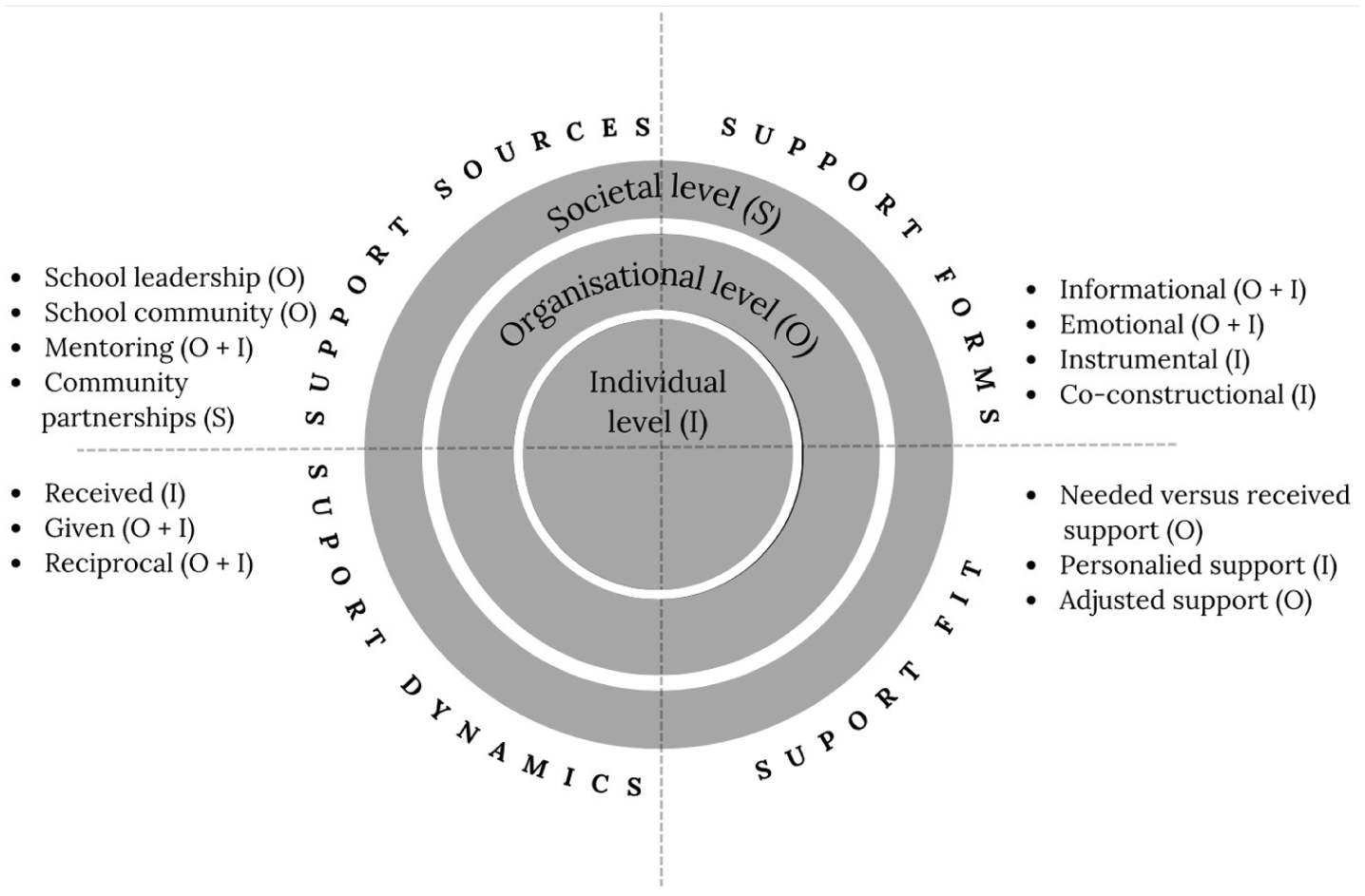
The multi-level social support system in school community context.
Based on the results, schools in the target countries and possibly beyond, may benefit from development of a model for social support for beginning teachers with a systemic approach. Investing in teacher professional development at the organisational level, that is, developing the whole school community may have positive influences on the individual level, such as promoting a pupil’s wellbeing at school as well as a beginning teacher’s learning and occupational wellbeing resulting in reduced rates of turnover (see Heikonen et al., 2017; Tikkanen et al., 2021). While our research design did not capture influences across systemic levels, we find this an important avenue for further research on the provision of beginning teachers’ social support.
The results show that beginning teachers receive multi-level support for their professional development in various forms and from various sources. To systematically implement a research-based model for social support and, in parallel, support the beginning teacher’s professional development schools may need incentives. Depending on the context, municipalities and national agencies for education may play a crucial role. An essential aspect could be to develop national structures for coordinated support for all beginning teachers in the two national contexts. Both Finland and Estonia are lacking a support system for beginning teachers on a macro level. The benefit with a concerted effort is that teacher education institutions do not need to initiate the creation of a system anew, but can build on existing good practices already implemented, and collaborate in the creation of implementation guidelines. In addition, universities offering teacher education programmes may benefit from further collaboration with municipalities in the development of research-based induction programs for beginning teachers. As well as an operational model for social support in schools, which includes an emphasis of school leadership, the results suggest a stronger role of mentoring practices to be included in policies for teacher education in the two countries. It is also important to develop support for the beginning teachers that match the needs of the local schools/municipalities and the specific learning environments and the demographical background they are embedded in. These suggestions for development actions on the societal level would provide more opportunities for beginning teachers to receive social support and may ultimately serve to strengthen professional development and occupational wellbeing. Although these actions require more economical resources, from a long-term perspective, they would represent important actions towards a sustainable teacher profession and school culture. A sustainable school culture leans on beginning teachers’ feelings of integration and wellbeing during their induction period. To address the suggestion for specific arguments for the multilevel implementation, we have concluded the study with insights into these core results and related them to the broader field of the study.
Methodological Reflections
By collecting interview data from several schools in two distinct national contexts we may have avoided some of the problems of single-school and single-nation studies, in which the results may reflect only a specific school or nation and their specific characteristics. We were able to identify the same dimensions in both countries in our data, which suggests that support sources, forms, fit, and dynamics identified in this study have relevance beyond a single-school or national contexts. However, the results are not generalisable, and this has not been our intention in this study. The research targeted two minority-language contexts, but language identity was not evident in the descriptions of social support suggesting that the maturity level of the school culture plays a greater role in the shaping of social support. However, this interpretation warrants further research.
Conclusion
This study contributes to a wider audience with novel aspects of beginning teacher induction. Firstly, the study focuses on language minority schools in a cross-cultural European context. The comparison of Estonian and Finnish social support practices in language minority settings revealed commonalities and differences to which we have suggested good practices for organised social support in the frame of professional development for beginning teachers. Secondly, the study provides an example of how a systemic approach of a research-based socially-embedded support model in education contributes to insights on organizing roles, responsibilities, and different kinds of support forms in providing social support for beginning teachers. Thirdly, this study contributes to recent research with a theoretical refining of a multi-level application of the social support model. The refined model acknowledges the identification of location of social support practices for beginning teachers in schools.
Footnotes
Acknowledgements
We would like to thank Laura Kiuru for assisting in the data collection process and Ellinor Elmvik for technical assistance with figures. We appreciate the reviewers’ useful comments in developing the manuscript.

Funding
The authors disclosed receipt of the following financial support for the research, authorship, and/or publication of this article: The research was part of a research project which has been financed by the Swedish Cultural Foundation Finland (158418).
Declaration of conflicting interests
The authors declared no potential conflicts of interest with respect to the research, authorship, and/or publication of this article.