




Abstract
An unfortunate but well-established international trend exists of high attrition amongst beginning teachers. Many schools in rural areas experience challenges with retention, isolation, increased teacher responsibilities, and poor resourcing. Despite these challenges there are some indicators that rural places have the potential to effectively support beginning teachers. This study in the Australian state of Victoria used a strength-based lens to examine the impact of rural contexts on 40 beginning teachers’ experiences working in rural Catholic schools. Analysis of focus group data revealed some paired advantages and challenges for these beginning teachers. Participants reported that their rural schools provided collegial, supportive environments for new teachers, but also tended to poorly resource induction and mentoring. Rural communities were welcoming and supportive of a positive work-life style, while also associated with a loss of privacy. Rural contexts supported participating beginning teachers to better understand and engage with their students. However, participants associated rural contexts with difficulties in engaging students academically. Rural schools can build on these advantages and work to mitigate the associated challenges to improve beginning teachers’ experience and retention.
Introduction
Teacher shortages experienced internationally (Ingersoll et al., 2018; Nguyen et al., 2024) have sharpened attention on the experiences of beginning teachers with the proportion of teachers leaving the profession within 5 years of graduating reported as between 20% and 50% (Dorman & Dyson, 2014; Lang & Brown, 2020; Sass et al., 2011). Attrition rates for beginning teachers in rural schools are typically worse than those in metropolitan schools (Cuervo, 2016; White, 2019), however there is minimal published research examining the experiences of beginning teachers in rural settings (Rhinesmith et al., 2023). The little there is tends to take a deficit view, focussing on issues associated with rural community isolation and low socio-economic status, with a paucity of literature exploring the potential benefits of commencing a teaching career in a rural school. This study contributes to redressing this literature gap, reporting on analysis of focus group data examining both the challenges and opportunities experienced by early career teachers working in rural Catholic schools in Victoria, Australia.
Recruitment and retention issues now being experienced across all geographic areas have long been confronted in many rural and regional areas (Cuervo, 2016). Despite these long-standing issues in rural education, little attention has been given to the experiences of beginning teachers in rural settings, including factors that contribute to them leaving or staying in these schools. Arguably, high attrition of beginning teachers in rural schools can be attributed to the challenges facing all rural teachers. Compared to metropolitan schools, rural schools are typically more isolated, have less access to teacher professional development (Barrett et al., 2015), are more poorly resourced (Afzal Tajik et al., 2022; Pei & Yang, 2019), and serve more disadvantaged communities (Kilpatrick et al., 2019; Li et al., 2023). Composite classes of multiple age groups are more common in rural schools (Cornish, 2021), requiring teachers to address a wider range of learning needs and breadth of curriculum. Teachers in rural schools tend to be more visible to their communities, and community scrutiny can bring additional pressure (Miller & Graham, 2015). There are challenges known to particularly impact beginning teachers. Research has found that beginning teachers at rural schools are more frequently asked to teach subjects outside their area of expertise (Weldon, 2016), and to take on leadership roles than their metropolitan counterparts (Miller & Graham, 2015).
A focus on these challenges can foster a deficit view of beginning teaching in rural areas compared to metropolitan areas (Blackmore et al., 2024). It is less common for a strengths orientation to be adopted where the resources and opportunities available in a rural space are acknowledged. However, there are growing numbers advocating for a strengths approach to exploring challenges faced by many rural schools (e.g. Green & Reid, 2021; Walker-Gibbs et al., 2018). In this study we respond to this call, examining both the challenges and opportunities encountered by beginning teachers in rural Victorian Catholic schools that could be attributed to the particular rural places that each teacher worked in. In this study we adopt a broad definition of rural to include all places other than major cities, as is common in rural education research (Roberts et al., 2024). The understanding of rural used in this study and the associated conceptual framework is further explored in the Context and Conceptual Framework section.
Background
Beginning teachers’ experiences are impacted by many factors, independent of location. Heavy workload, teaching outside their qualifications, poor support from leadership, job insecurity, and salary levels contribute to negative experiences and teacher attrition (Amitai & Van Houtte, 2022; Australian Institute for Teaching and School Leadership [AITSL], 2016; Creagh et al., 2025; Du Plessis et al., 2019; Howes & Goodman-Delahunty, 2015; Mason & Matas, 2015). Inclusive and diverse classroom settings are particularly difficult for novice teachers (Miles et al., 2019). However, supportive school cultures can shape a positive experience for beginning teachers (Kutsyuruba et al., 2022; Trevethan, 2018). Support from colleagues and school leaders is crucial in helping new teachers to navigate challenges and develop a sense of belonging and purpose (Buchanan et al., 2013; García et al., 2022; Powell, 2021). Supportive relationships with school leaders and mentors, as well as a positive school culture, are important factors in improving retention and resilience (Crosswell et al., 2018). In fact, practical considerations, such as income, job security, and work-life balance, factor lower in new teachers’ priorities than personal fulfillment and support received in the early years of teaching (Buchanan et al., 2013; García et al., 2022; Howes & Goodman-Delahunty, 2015). Of relevance to this study, there is a dearth of research explicitly focussing on beginning teachers’ experiences in Catholic Schools, a situation that seems not to have changed since Scheopner (2010) noted it their review paper 15 years ago. The little that does exist suggest that Catholic teachers’ experiences are largely impacted in similar ways to those described here (Scheopner, 2010; Tamir, 2013), though there is some suggestion that Catholic school teachers are more satisfied with the level of support they experience (Scheopner, 2010).
Although all beginning teachers encounter challenges as they commence in the profession, new teachers in rural schools can encounter additional hurdles. Research suggests beginning teachers in rural schools are more likely to be asked to teach outside their areas of expertise (Du Plessis et al., 2019; Sharplin, 2014). There tends to be less access to mentoring for beginning teachers due to lower numbers of experienced teachers in rural schools (Jenkins et al., 2015). The relative scarcity of experienced teachers in rural schools can lead to beginning teachers being asked to take on leadership responsibilities, in addition to their teaching (Cornish, 2015; Rhinesmith et al., 2023). While a potentially positive professional opportunity, fulfilling these roles can reduce the time and energy beginning teachers have to develop their classroom practice (Graham et al., 2015). The smaller size of rural communities can result in new teachers feeling that they are constantly under observation and scrutiny (Miller & Graham, 2015), impacting their capacity to develop professionally as they experience an overwhelming level of accountability for their actions within and beyond the school (Cuervo, 2016). Further, when beginning teachers relocate to take up positions in rural schools, potential isolation from family and friendship networks can impact morale (Cuervo, 2016; White, 2019) and the new teacher faces the challenge of transitioning into a new community (Dorman & Dyson, 2014).
There is some limited research into the advantages of teaching in rural schools, though very little of this examines beginning teaching. Smaller class sizes in rural schools can allow teachers to spend a greater proportion of class time on learning activities rather than classroom management and administration (Cuervo, 2016; Ho & Tsai, 2023; Tran et al., 2020). Small rural school communities can facilitate positive teacher-student relationships that support teachers to better meet students’ learning needs (Gallo, 2020; Miller & Graham, 2015). Teachers in rural schools are viewed as having higher autonomy and receiving stronger support from colleagues and school leaders (Gallo, 2020; Ho & Tsai, 2023; Seelig & McCabe, 2021; Tran et al., 2020). Schools are often central to rural communities, and their teachers can be held in relatively high esteem (Seelig & McCabe, 2021; Tran et al., 2020). Rural communities, despite the scrutiny noted above, are perceived to support positive, safe, affordable, and family friendly lifestyles for teachers (Crumb et al., 2023; Jenkins et al., 2015; Tran et al., 2020).
It is important to note, that these advantages, nor the challenges noted earlier, cannot be generalized across rural schools (Noone & Miller, 2015). While rural schools and communities may share general characteristics such as a small size and relative isolation, each rural place is unique and associated challenges and advantages are specific to that place (Noone & Miller, 2015).
Context and Conceptual Framework
This article draws data from a study of early career teachers working in rural Catholic schools in Victoria, Australia. The areas in which the schools are located are highly varied in terms of industries, environments, and demographics, however they are all classified as rural using two classifications commonly used in Australia, the Rural, Remote and Metropolitan Area (RRMA) classification (Australian Government, 2021), and the Australian Statistical Geography Standard (ASGS) remoteness structure (Australian Bureau of Statistics [ABS], 2016). The RRMA classifies cities with populations of greater than 100 000 as metropolitan and classifies rural and remote areas using a combination of distance to urban centers and relative density (Australian Institute of Health and Welfare, 2004). All schools in this study were in areas classified as rural according to the RRMA, either large rural centers (25,000–100,000), small rural centers (10,000–24,999), or other rural areas (less than 10,000; see Table 1). The ASGS remoteness structure defines five classes of remoteness: major cities, inner regional, outer regional, remote, and very remote, with classes determined using road distances from service centers (ABS, 2016). Though the structure does not explicitly use the term rural, it is commonly used in Australian rural research and policy where all classes other than major cities are bundled together as “rural” (Roberts et al., 2024). The rural schools where the participants in this study worked would all be classified as inner or outer regional using the ASGS remoteness structure. By employing both these commonly used Australian descriptions of rural, this study uses definitional reliance to establish rural definition triangulation (Grant et al., 2024).
Participants by School Setting and Rural Population Size.
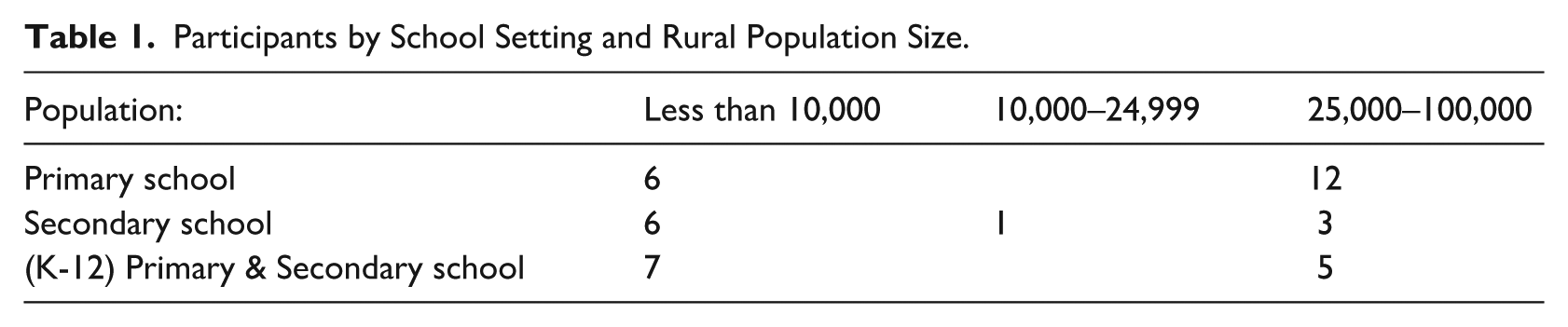
Adopting statistics-based definitions of rural risks creating an artificial and simplistic urban/rural binary, which in turn can encourage deficit thinking (Roberts et al., 2024). To remedy this, we use Walker-Gibbs et al.’s (2015) Pedagogy of the Rural as a conceptual framework to examine how the various rural places shaped the experiences of the beginning teachers in this study. The Pedagogy of the Rural challenges binary thinking and stereotypical notions of rurality, such as being small, isolated, and dependent on agriculture – noting these characteristics apply to only some rural places. The framework highlights that rural areas vary by place – the geographic location – and by space – the traditions and experiences of the associated rural communities (Walker-Gibbs et al., 2018). The framework draws on Reid et al.’s (2010) notion of rural social space, where rural areas can be described according to their unique environment, industries, and peoples, to illustrate the rich diversity of rural areas, and the potential for these communities to morph and change. Some participants in this study worked in small schools in isolated alpine Anglo-European communities dependent on dairy farming and hydropower, or in regional areas with strong First Nations communities and large manufacturing and health industries, or in abattoir towns close to feedlots and highways with large migrant work forces, or in ex-tobacco growing regions now reinvented as wine producing tourist destinations. The Pedagogy of the Rural dismantles the urban/rural binary and the notion of a single rural identity, encouraging the recognition of various rural identities and the opportunities (and challenges) associated with each (Walker-Gibbs et al., 2015).
The Pedagogy of the Rural positions size, and its associations with resourcing and opportunities, as another way of understanding a rural place and how it differs from other rural places (Walker-Gibbs et al., 2018). The participants in this study were from communities of diverse size, though all were relatively small compared to major cities. Walker-Gibbs et al. (2015) argue that rural community size impacts teacher identities. In rural places schools and teachers tend to form close relationships with the wider community, and they play significant roles in the community. The closeness of these relationships makes it easier to establish one’s identity in a rural place. Identities are developed through social interactions. As members of rural communities share a social space, they know each teacher: their roles and status in both the school and the wider community. Interactions between the teacher and members of the community are influenced by this knowledge, making it easier for a teacher to understand their position, thus shaping their identity. Size, and its associated resourcing, also impacts teacher practice (Walker-Gibbs et al., 2015). Experiences with rural space interact with teachers’ conceptions and knowledge of rurality, ultimately impacting each teacher’s interactions with students, colleagues, and the wider community. Ultimately, the Pedagogy of the Rural requires consideration of what the rural brings to each teacher’s experience, not what teachers bring to rural spaces (Walker-Gibbs et al., 2018).
The Pedagogy of the Rural informed our data collection, analysis and reporting. Beginning teachers were prompted to reflect upon how their rural context impacted their early career experiences. The data were analyzed relative to the context and size of participants’ schools and communities. Finally, our findings and discussion sought to demonstrate the impact of rural context on beginning teachers, illustrating how size is important but also how the distinctive characteristics of each context created unique participant experiences.
Method
This study employed focus groups to collect data about the experience of beginning teachers employed in rural Catholic schools across central and northern Victoria, Australia.
Participants
Focus groups were comprised of a convenience sample (Golzar et al., 2022) of early career teachers attending a 2-day beginning teacher conference for Catholic schools. Conference attendees were invited to participate in focus groups just prior to the conference dinner. Participation in focus groups was optional and all participants were provided with a participant information form and provided written consent. The 40 consenting participants had been employed as teachers for between 10 weeks and 2 years, with 18 employed in a primary school, 10 employed in a secondary school, and 12 employed in a K-12 school (see Table 2). Twenty-nine participants identified as having come from a regional/rural background, and four from a metropolitan background, and seven participants did not identify their background. Of the 29 who identified as having come from a regional/rural background, 19 were working in schools that were a 30-min drive or less from where they grew up.
Participants by School Setting and School Student Enrollments.
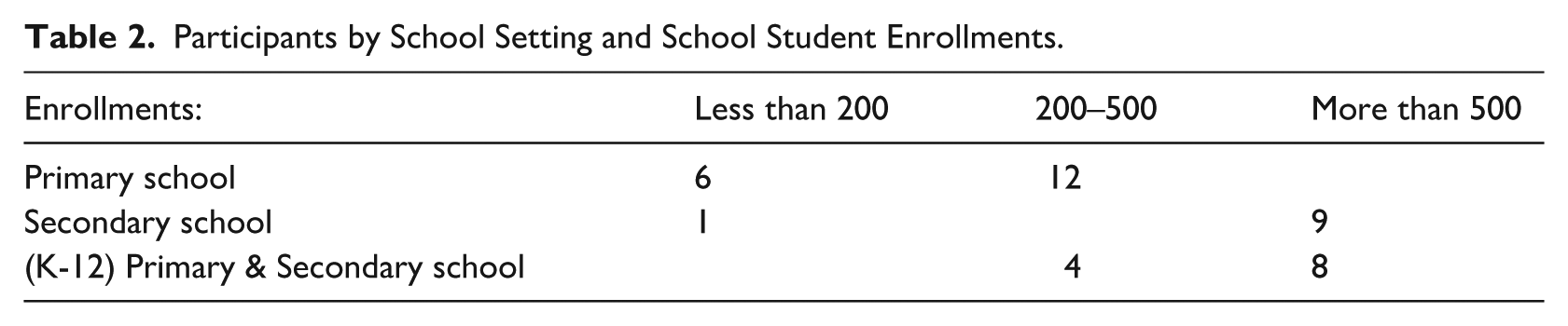
Data Collection
Data were collected from five focus groups of eight participants each. Participants self-allocated themselves to groups by joining one of the five focus group tables. Participants were asked to avoid joining a focus group with another employee at their school. Semi-structured focus group scripts, 30 to 40 min in length, asked participants to discuss the good things and challenges associated with beginning a teaching career in a rural-regional school, and what advice they would give to schools and school systems to better support beginning teachers in rural-regional schools (see Appendix 1).
Focus groups were audio-recorded, then transcribed, with participants given pseudonyms based on their focus group and the sequence of their first contribution to discussion (e.g. FGE3 participated in focus group “E” – the fifth group – and was the third participant to speak).
Data Analysis
The data were analyzed thematically (Wilkinson, 2011), with a focus on how rural context had impacted the experiences of participants. Both focus group interactions and individual participant contributions were regarded as units of data, with primacy given to interactions in the identification of key themes (Braun & Wilkinson, 2005). Data were initially grouped into descriptive codes by the second author, where a code included examples of contributions that were similar across focus groups. These codes were then reviewed and confirmed by the other members of the research team. Codes were then grouped together as themes by the first author. These themes were then reviewed and discussed with the other members of the research team to reach a consensus on the themes present in the data. Three themes were agreed upon: the impact of rural contexts on the work-place support experienced by beginning teachers; the impact of rural contexts on beginning teachers’ developing work-life style; and the impact of rural contexts on beginning teachers’ practice. We use the term “work-life style” to capture how the participants described the ways they integrated their work and non-work experiences.
Results
Thematic analysis of focus group discussions identified three broad themes associated with the way that beginning teachers’ rural contexts impacted their early career experiences. This section explores each theme, providing illustrations from focus group data and discussing how the findings contribute to knowledge of beginning teachers’ experiences in rural schools. When dialog between participants is presented, the participant is identified at the beginning of their contribution to the interaction. Where an individual statement is offered as evidence, participants are identified at the end of the quote.
The Impact of Rural Contexts on the Work-Place Support Experienced by Beginning Teachers
A common theme across the focus groups was that participants believed rural schools were more supportive schools in which to commence a career, for example, the following discussion from one focus group:
FGB1: . . . you can get a good mix of teachers in a small school that really blends in really well together and you can all support each other.
FGB4: Or to be vulnerable in. Like to be able to say, “Oh, I do not get this” and you know that they don’t think you’re an idiot because they’ve known you in a previous life.
FGB2: I’m pretty similar to [FGB1]. So yeah, obviously, you do know some people obviously that work at the same school. And it’s also really good for me obviously as a grad. . .
. . .
FGB5: But also with that, having a smaller staff, it’s very personable. I think if I had trouble with something, I know that I could easily ask any teacher that is on staff because you see them every day, you see them in the staff room. . . It’s a smaller community and yeah it’s just, you find those relationships connecting a lot quicker with everybody because of that reason I think.
Aligning with one of the tenets of the Pedagogy of the Rural, that size matters (Walker-Gibbs et al., 2015), participants in this study typically attributed the supportive atmosphere they experienced in rural schools to the relatively small population of these schools. As suggested in this exchange, a smaller staff allows new teachers to more quickly know the other members of staff, which ultimately helps to develop an initial sense of trust that supports assistance seeking.
The small size of rural schools was also felt to afford rare and beneficial access to school leaders, as illustrated in this brief exchange:
FGB5: the access is a lot harder as well. The school’s bigger, it’s physically bigger, and there’s a bigger [staff] so there’s just more people that the higher up people have to take care of.
FGB7: I agree with that. Again, from a small school, you go up and knock on the principal’s door and just ask him about something or question something, whereas in a larger school you go to your year four leader, then middle leader, then vice principal, then principal. So, there’s that those tiers of people you need to communicate.
Small rural school size, however, did not translate into more supportive environments for all beginning teachers. In some cases, the small size meant that strong personalities or the absence of a support person had impacts that might not be experienced in a larger school, as illustrated by this comment:
[The principal] would be like, “I’m here for you”, but he wasn’t actually there. . . There’s only two staff in the whole school that you actually see. You have to get on with each other. She was very lovely, but very bold and boisterous, and it was her way or the highway. It was hard being okay. I was very accommodating. (FGD6)
Small school size left other beginning teachers professionally isolated when they were the only new teacher or the only teacher of their particular discipline. One teacher commented, “I’m the only one teaching a few of the subjects that I teach. I don’t really know what I’m doing for a lot of it. I’m grappling with that.” (FGA3). Another said, “At the school I’m at there [are] no other grads this year. I don’t have anyone else to ask. I’ve got grads, you know, from last year, but no one kind of going through it with me. I kind of find that a bit hard.” (FGC2)
It is worth noting that not all participants in the focus groups were working in small schools. One participant working at a large school said, “I don’t have anything specifically about, necessarily anything good about being at a rural school or I don’t really see much of a difference I guess.” (FGB3). This provides another illustration of how size matters when considering the Pedagogy of the Rural (Walker-Gibbs et al., 2015), especially how school size differences can impact the experiences of teachers, regardless of their rurality.
While school size was the most common explanation offered by participants for the supportive environment experienced in their rural schools, one focus group postulated that the ability to offer support to new teachers was in rural and regional schools’ own interests, given that they typically encounter recruitment difficulties, as shown in this brief exchange:
FGA2: So, my friend who is a graduate, and she is in Melbourne, it’s very much . . . throw you under the bus, let’s not help each other because this is my job. . .and she can’t go to people for help. . .Whereas I know any of the schools in my area I went to and said, “I need some help.” And they’re like, “Yeah, what do you need help with? How are we going to deal with this?” They get around you and it’s, well, if you fail, it’s not good for the kids. It’s not good for anyone here, whereas in Melbourne-
FGA3: Well, it behoves you as system wide in a place where there’s a staff shortage to do your best to keep the staff. So why wouldn’t you?
. . .
FGA1: They want you to feel welcome because they want you to stay.
Most participants reported that their schools had been supportive as they commenced their teaching career. However, the practical assistance and mentoring afforded them was felt to be limited at some rural and regional schools. Sometimes this was attributed to low recruitment rates in smaller schools and an associated lack of systems in place to properly support beginning teachers, as illustrated by these two examples from separate focus groups:
I’m the only new teacher at the school. Everyone else has been there for four or five years or has been there for a really long time. We didn’t do a lot of [induction], because. . . everyone already knows what they’re doing, and everyone already knows how to do things. (FGD1) My school may have not had a first-year student for a long time, like a graduate student and perhaps mentoring program, hasn’t really been utilized. (FGE3)
Further, staffing shortages experienced by rural schools resulted in many participants not receiving the time-release and mentoring support initially promised to them as beginning teachers. For example, one participant commented, “When I started at the school, I was told there were three hours a week. Plus, I’d get two extra days during term. I haven’t had any.” (FGE7)
These comments suggest that some rural schools can struggle to resource programs to support beginning teachers more generally, either by providing scaffolded induction or by providing time to work with mentors.
Once more, it is important to note that size matters (Walker-Gibbs et al., 2015) – teachers in larger schools felt they were at no disadvantage relative to their metropolitan counterparts, as illustrated by this comment: “I don’t think we’re missing out on anything in terms of resources and what have you where we are in [regional centre], because anything we would want to do in Melbourne, I think we’d be comfortably doing in [regional centre].” (FGB5)
The Impact of Rural Contexts on Beginning Teachers’ Developing Work-Life Style
A theme across the focus group discussions was the impact of living and working in rural areas on the beginning teachers’ work-life style, from how they were able to interact with the local community through to their commute to and from school.
It was common for the participants to describe their community as welcoming, and for some teachers new to the area this was described as particularly valuable, as illustrated by these examples from separate focus groups:
I would say that the main differences from having placements in . . . city schools, whereas coming here. . . the community have been a lot more welcome and opening . . . there’s just so much community spirit. . . they ask you to be involved in the community. It’s been fantastic. (FGA1) I’ve moved up recently from Melbourne and I find that just everyone’s been really welcoming and there’s just a much greater sense of community up here. . . (FGC2)
However, other comments suggested that integrating into a new rural community took real effort for some beginning teachers:
I’m not from rural, regional and coming here, I knew nothing, nobody, anything. So, I would say adaption and getting used to the town and getting used to the community and willingly being a part of that by involving myself in various activities. You’ve got to branch out. (FGA1)
Many participants observed that joining a small and inclusive community was frequently accompanied by a loss of privacy. One participant commented, “You’re not anonymous that when you step outside the door, you don’t get to go to another suburb where you’re not going to run into kids.” (FGB4). Another participant gave this example: “You go to footy and netball and then you go to the pub and then the next time Monday. Oh, I saw you drinking miss. . .You have no privacy.”(FGE2)
While many participants spoke of the strong sense of community they experienced in their smaller rural communities, they also highlighted associated difficulties this brought in maintaining professional relationships, as illustrated in this focus group exchange:
FGA6: Being in a small community. So, parents are trying to. . .add you on social media and trying to like cross that boundary into like separating your work life from the community as well, because there’s certain boundaries, obviously that you can’t really. . .
FGA8: That’s a very good point. I could teach at the school my children are at and I know the parents quite well. And you know, last night I took one of the kids I teach to gymnastics. I’m like, am I crossing a line here? . . .
FGA6: Yeah. It’s hard because you’re so close in the community. It’s such a small little town and. . .you don’t want to do anything wrong. . . it’s challenging finding that balance sometimes.
FGA4:. . .and even just going to the local supermarket. I can’t do my shopping in under an hour because I see everybody. . .
While the tension between the affordances and challenges associated with developing a work-life style in rural areas was a common topic of conversation across the groups, a more pragmatic consideration was also mentioned by many participants – their relatively easy commute to work in their particular rural areas:
I find the commute to school is an easy commute as opposed to if you lived in the city. So, I think that can be a nice part of day. (FGA4)
An easy commute was positioned by some participants as benefiting both professional and social life, as described by this participant:
I do know some people who travel upwards of an hour to get to school in the city. That’s a lot of time that I really get to have at home. And for example, at school. So, I have that extra time, and especially at school I can stay back longer and just hang around for a bit and chat and just work on what I need to do. (FGB2)
The Impact of Rural Contexts on Beginning Teachers’ Practice
The Pedagogy of the Rural experienced by the beginning teachers in this study impacted their ability to both engage students, and to plan for, and support, their learning.
Participants believed that the rural context enabled them to quickly establish rapport with their students and families. It was common for this to be attributed to relatively small school size, for example:
We have quite a small school. And knowing when you go out on yard duty, that you can specifically call the name of each child because some, like I remember my first term last year when I was [at a large school], kids would run away and you can’t even get them to come back because you don’t know what their name is. But now like every time, it’s just nice knowing every time a child walks past, you can say, “Good morning so and so” to every single child. (FGB5)
Participants offered other explanations for how the rural context contributes to developing relationships with students, as illustrated in this focus group discussion:
FGE2: I know a lot of them and that helps settle in and the support that you get from those people because you can go to them quite easily.
FGE1: I agree, it makes the connections a lot easier and the relationships a lot quicker to form. I feel like you can question them about how their sport went on the weekend or might have been an event that happens at it’s a bit of a community thing. So, you have. . . common ground with the kids and I think it makes the relationships a lot easier to form.
FGE5: I think it’s easier to understand the demographic that you’re working with because obviously being from [town name]. Small town, well reasonably small. Growing up there, you understand where the kids are coming from and things like that.
The first two speakers suggested that they drew on community connections beyond school to develop productive relationships with their students. The final speaker suggests that a shared experience of small communities has helped them to better understand their students.
However, some participants suggested that the small communities resulted in them not being informed about important information about their students:
FGA1: If there’s something going on at home with a student or something like that, a lot of the teachers will know. . .because they’re from the town, it’s so small. And. . .it’s like, “Oh, that’s that thing” . . . and I’m like, “I have no idea what you’re talking about. . .”
FGA3: I am being constantly surprised by things that people have either forgotten to tell me or have just been doing for so long that they’ve forgotten that they’re not common knowledge and you don’t automatically know it.
This exchange suggests that the close relationships between teachers at small rural schools and community results in assumed shared knowledge. When beginning teachers don’t have access to that knowledge they feel at a disadvantage.
While many participants felt the rural context supported engaging with students on a personal level, they suggested it imposed some difficulties engaging some students academically, as illustrated in this focus group discussion:
FGE2: They’re just very reluctant to try because they’re like, “What’s the use?” Because they’re like “Well, I’ve got a job on the farm at home with dad.” And I don’t mind, but yeah, that’s probably an issue.
FGE3: And it could also be because in Melbourne there’s so many universities that nearby.
FGE7: And also, I think it’s to do with the family background. If mum and dad – generalize – they haven’t finished school, then they’re going to, that’s going to generation. Whereas if you’ve got a parent come from Melbourne or they have parents that been to the university, both parents been to university. Then there’s more push for them . . .
The participants in this exchange were grappling with stereotypes and deficit assumptions of rurality that the Pedagogy of the Rural challenges (Walker-Gibbs et al., 2015). Comments like, “I don’t mind, but yeah, that’s probably an issue” (FGE2) and “beautiful kids, but yeah, farmer” (FGE1) indicate a tension experienced by these beginning teachers between not judging rural employment pathways as lesser, and the desire for better academic engagement from their students.
Participants’ comments also suggest their rural context impacted their ability to plan and support learning. For some, the small staff size enhanced collaborative planning that shared expertise and workload, as illustrated by FGA2:
I didn’t expect quite so much support and teamwork in our planning . . .. We all really work together really well . . . You would have so much to do, but the way we do it’s so shared and you might work with someone who has a skill that you don’t, to develop that.
For others, the small staff size exacerbated workload, as illustrated by FGA3:
The challenge with small staff is that everyone is overloaded – I’m doing more than I should be doing. It’s crazy. There’s more being put on me than I can possibly cope with some days I feel, but everyone else is similarly overloaded. So, there is no real time . . . let’s collaborate. Let’s write this unit together. When? Like eight o’clock on Friday night should we do that? It’s absurd.
Considered together, these comments suggest staff size impacts beginning teachers in different ways, a large staff risks anonymity, but a small staff can limit collaboration opportunities and generates additional informal burdens, such as taking sole responsibility for unit planning.
Discussion
This study used focus groups to explore both the experiences of beginning teachers in rural Victorian Catholic schools that could be attributed to the rural contexts. The findings highlight paired advantages and challenges that beginning teachers may experience transitioning into the profession in a rural school associated with school size and community size, as illustrated in Figure 1 which offers a simplified graphical summary of the findings.
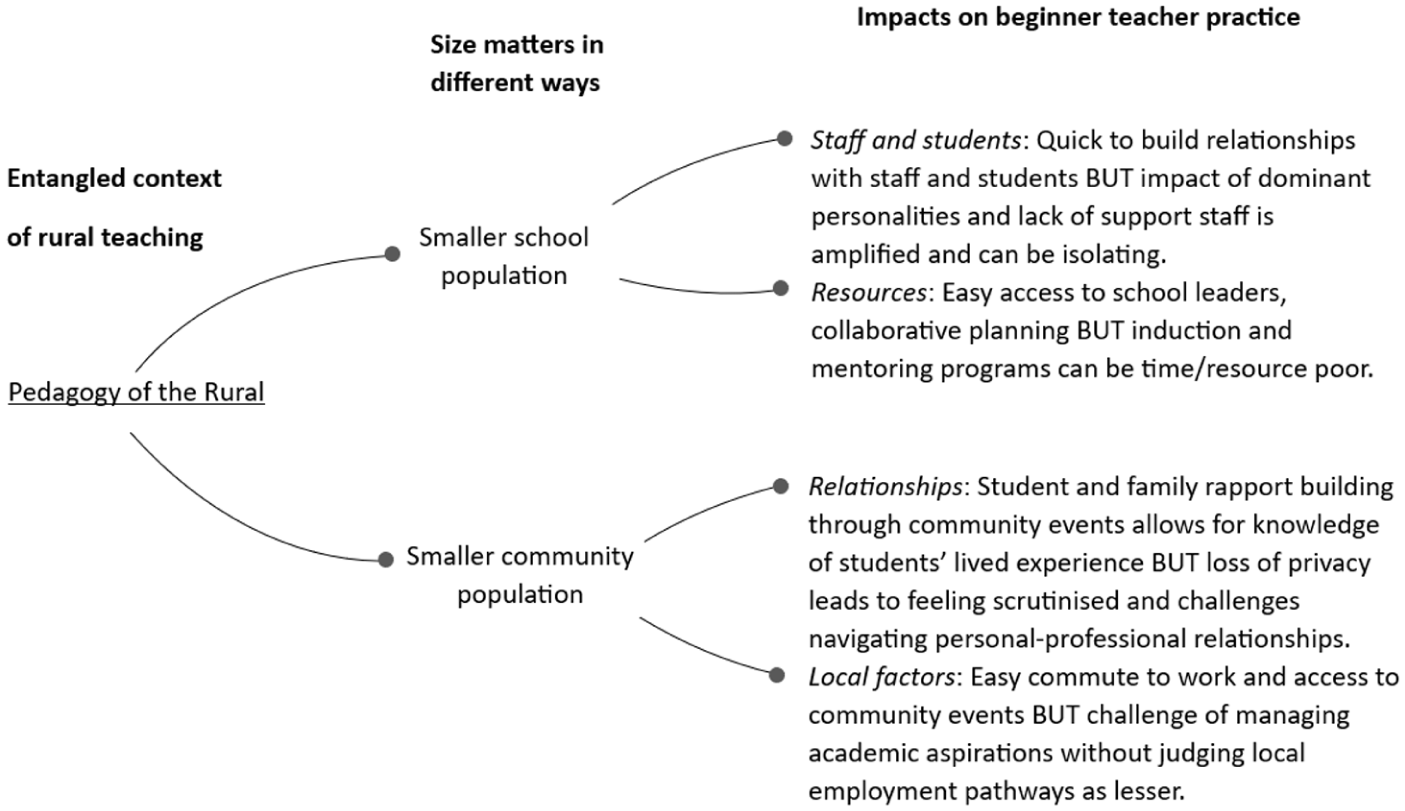
Influences of school and community size on pedagogy of the rural for beginning teachers.
Participants reported that smaller size of rural schools tended to result in more collegial, supportive environments for new teachers, but this small size was also associated with under-resourced induction and mentoring. These findings show that these beginning teachers experiences were similar to rural teachers more generally who report high teacher satisfaction with their supportive school communities (Gallo, 2020; Ho & Tsai, 2023; Jenkins et al., 2015; Seelig & McCabe, 2021; Tran et al., 2020). However, this study also builds on this understanding by suggesting that the smaller size of rural schools is a key factor facilitating access to this support, with participants highlighting how this contributes to easy relationship building and frequent incidental interactions. Participants also often associated small school size with rural school leaders’ availability, suggesting a potential key strength of beginning teaching in a rural area not prominent in the literature. While the support of school leaders is known to help beginning teachers generally (Buchanan et al., 2013; Powell, 2021) and ultimately contribute to improving teacher resilience and retention (Crosswell et al., 2018) there is little previous research exploring this impact in rural areas. Some participants suggested a desire to improve recruitment and retention as an ulterior motive for colleagues and leaders in rural schools to be supportive, aligning with previous research (Cuervo & Acquaro, 2018; Downey, 2021). While participants frequently associated rural schools with strong support, they also suggested that rural schools can struggle to resource programs to support beginning teachers more generally, either by providing scaffolded induction or by providing time to work with mentors. This extends on previous research that identified difficulties sourcing mentors for beginning teachers in rural schools (Jenkins et al., 2015), showing that even when mentors are available, processes and opportunities for mentoring to occur can be limited in rural schools.
Participants viewed their rural communities as welcoming and supportive of a positive work-life style, while also associated with a loss of privacy. This tension between the supportive nature of rural communities and the pressures associated with the community scrutiny is described in research literature (e.g. Cuervo, 2016; Miller & Graham, 2015; Tran et al., 2020). This study builds on these findings, particularly illustrating that it is not just the community scrutiny that beginning teachers find challenging, but also the complex task of negotiating professional and personal relationships in a rural community. One benefit touted by participants in this study that has not been highlighted in previous research in rural education was the benefits of their short commute, allowing additional time for both their professional and personal lives. This relatively simple affordance was understandably significant in the minds of participants given it can provide some relief to the overwhelming experience of commencing a career in teaching (Mayer et al., 2017). However, it should be noted that transport issues, including a lack of public transport, can also be experienced as a disadvantage for rural teachers (Ho & Tsai, 2023).
While participants suggested rural contexts supported beginning teachers to better understand and engage with their students, it was associated with difficulties in engaging students academically. These findings align with, and extend upon, earlier research that has found that smaller rural communities facilitate positive student-teacher relationships to form (Gallo, 2020; Miller & Graham, 2015). The participants in this study suggested how their rural communities facilitate relationships, suggesting the size and contained nature of each rural community means that it becomes feasible for beginning teachers to understand the contexts of their students, and that by engaging with the same communities beginning teachers are better able to relate to their students. While relationships were viewed to enhance learning in this study, participants discussed how the lower academic aspirations of some of their students impacted negatively. They proffered explanations that are well represented in the research including: limited familial academic experience; limited access to tertiary education pathways; and access to employment opportunities that do not require tertiary qualifications (Rosvall et al., 2018). Finally, participants in this study also suggested the informal workload and lack of collaborative opportunities in some small schools further impeded beginning teachers’ ability to meet students’ learning needs. This extends on the extant research literature that points to the challenges associated with additional formal leadership and responsibility placed upon beginning rural teachers (Cornish, 2015).
This study highlights various opportunities for future research. Each participant’s rural context was different and thus the impact of the rural on each participant’s experience was unique – no assumptions can be made about the experience of a new teacher in any particular rural place. Further, this study uses data collected early in the second term of the school year, so it reflects beginning teachers’ experiences after only a short time in the profession. Future research that charts the experiences of beginning teachers across the first several years of teaching would help better understand the factors that contribute to attrition and retention in rural schools. Further, participants were drawn from those able to access and be released from teaching to attend a 2-day conference. We are aware that some of the more remote schools in the region did not send anyone to the conference. Collecting data through focus groups also meant that the specific context of individual teachers could not be included in analysis. Future research at school sites may be more effective at capturing the voices of a more representative sample of beginning teachers. Only four participants in this study were originally from metropolitan areas, and more than half were working in areas near where they grew up. While not atypical of staff profiles in rural areas, this does mean that this study offers limited insight into the experience of beginning teachers wrestling the dual challenge of transitioning into the profession and moving from the city into a rural locale. Finally, our findings point to two potentially valuable lines of inquiry under-explored in the research literature: the experience of beginning teachers in rural Catholic schools versus non-Catholic schools, and the impact of contemporary teacher workload and work intensification (Creagh et al., 2025) on the experience of beginning rural teachers.
Conclusion
This study contributes to the limited literature exploring beginning teachers’ experiences in rural schools. Further, by viewing these experiences through a lens informed by the Pedagogy of the Rural, it subverts the deficit views that dominate discussions about rural education, making visible the opportunities and challenges beginning teachers have as they commence their careers in rural schools. In doing this the study highlights the affordances of rural spaces that rural schools can leverage to improve the experiences of beginning teachers.
Recommendations
The study suggests some recommendations useful for policy makers and schools hoping to improve new teacher recruitment and retention in rural schools. Beginning teaching in rural schools can have advantages that should be promoted associated with collegial support, productive teacher-student relationships, and positive work-life styles. Rural school leaders should work to exploit the potential advantages of size and community to ease teacher transition into the profession. At the same time, work should be done to mitigate challenges associated with transitioning to teaching in rural schools. Policy makes should consider ways to strengthen resourcing to support induction and mentoring of beginning teachers, including providing guaranteed time for this work. School leaders should explore ways to support stronger communication and consultation with new teachers.
Footnotes
Appendix 1 – Focus Group Protocol

Ethical Considerations
Research ethics approval was obtained by the Human Research Ethics Committee, La Trobe University. The procedures used in this study adhere to the tenets of the Declaration of Helsinki.
Author Contributions
Steve Murphy: Conceptualization, Methodology, Investigation, Formal analysis, Writing – original draft. Aime Sacrez: Conceptualization, Methodology, Data curation, Formal analysis, Writing – review & editing. Rebecca Miles-Keogh: Conceptualization, Methodology, Investigation, Writing – review & editing. Stefan Schutt: Funding acquisition, Conceptualization, Methodology, Writing – review & editing. Adam Staples: Funding acquisition, Conceptualization, Methodology, Investigation. Andrea O’Connor: Methodology, Investigation, Writing – review & editing. Bernadette Walker-Gibbs: Supervision, Validation, Writing – review & editing.
Funding
The authors disclosed receipt of the following financial support for the research, authorship, and/or publication of this article: This research was supported by the Catholic Education Sandhurst (CES) Ltd. Though one author is employed by CES Ltd., the financial support was granted prior to, and independent of, this author’s involvement in this research. Data collection occurred during a CES Ltd. early career teacher conference. Beyond this CES Ltd. played no role in the study design, data analysis, report writing, or the decision to submit this article for publication.
Declaration of Conflicting Interests
The authors declared no potential conflicts of interest with respect to the research, authorship, and/or publication of this article.