




Abstract
Inter-school collaboration is widely promoted as a catalyst for system improvement. However, the collaborative turn is rarely accompanied by detailed consideration of the contextual conditions that support or inhibit joint work of mutual benefit. The purpose of this research is to enhance understanding of the dynamics of inter-school collaboration. An ecological approach to professional agency is used to explore the relational dynamics of collaboration within a mandated school network. The analysis draws on in-depth interviews with 23 school leaders who participated in the introduction of a cluster-based model of school improvement in Wales. The findings draw attention to the iterative nature of trust building as school leaders manage endemic tensions between institutional self-interest and collective responsibility. The study signals a need for further research on multi-relational accountabilities if moves towards collaborative governance are to be sustained.
Introduction
There is international convergence on the desirability of lateral school clusters or networks as an instrument of de-centralised school reform (European Commission, 2017; OECD, 2019). For more than a decade, academic and policy literature has positioned inter-school collaboration as a catalyst for system improvement, a means to address place-based inequities, and an alternative to hierarchical, target-driven reform. Local lateral collaboration is deemed to be more responsive to context with greater potential for system improvement than single school innovation (Ainscow, 2016; Mifsud, 2015; Muijs, 2015). The appeal of inter-school collaboration is evident in education reform strategies across diverse geo-political contexts (Harris & Jones, 2020). Deep engagement in purposeful networks is associated with a ‘collaborative advantage’ (Huxham & Vangen, 2005, p. 3) or ‘partnership dividend’ (Kendall et al., 2005, p. 85). Mutually beneficial ‘co-opetition’ between providers is thought to ameliorate the harsher effects of market governance and competition-based approaches to service improvement in the public sector (Muijs & Rumyantseva, 2014, p. 4). In education, these ideas resonate with calls to address the limits of ‘prescribed professionalism’ controlled by government (Evans, 2008, p. 29). Horizontal forms of professional accountability are purported to extend the resources available to support school improvement beyond top-down competitive comparison, target setting and auditing. As a consequence, hybrid systems have emerged that retain high levels of central regulation alongside an espoused commitment to increased lateral capacity and professional agency (Chapman, 2019a; Priestley et al., 2016). However, hybridity should not be equated with symmetry of power or influence. This article problematises attempts to localise school improvement through school-to-school collaboration within systems of hierarchical accountability. The case study addresses a knowledge gap in providing qualitative insights into the contextual conditions that support or inhibit joint work between school leaders engaged in a mandated collaboration initiative.
Policy discourse around collaboration is typically normative, aspirational or celebratory, rather than robustly evidence-informed. Empirical research has not kept pace with policy development. Baharav and Newman (2019) note, ‘the literature is thin in describing the infrastructure and conditions that promote successful collaboration among professionals within and across institutions’ (p. 241). There have been calls for ‘more conceptual and terminological clarity’ in critical appraisal of school-to-school collaboration (P. W. Armstrong et al., 2021, p. 319). While the concept of collaboration is ubiquitous in improvement literature, definitions are imprecise and seldom differentiate between determinants, processes and outcomes. In the early years of the 21st century, Gajda (2004, p. 66) warned collaboration might become ‘an overused catchall to signify just about any type of inter-organizational relationship’. Organisational descriptors encompass alliances, coalitions, learning collaboratives, clusters, consortia, families, federations, zones, professional learning networks and professional learning communities (de Lima, 2010; Poortman et al., 2022). Amid a proliferation of practices over two decades insufficient attention to contextualised aims and situatedness has obscured important differences and restricted possibilities for policy learning.
How school-to-school collaboration is translated and enacted in diverse forms of local/regional experimentation is seldom acknowledged or compared. Education settings located in specific contexts collaborate for different purposes with diverse success measures, over variable periods of time, with contrasting levels of resource and intensity of participation (P. Armstrong, 2015). School networks vary markedly in size, organisational form and mode of governance. Partnerships can be elective, incentivised or mandated; peer-led or externally orchestrated; intentionally temporary, loose and informal or underpinned by a formal legal structure (Poortman et al., 2022). Collaborations range from two schools in a single locality to large-scale geographically dispersed networks connected via online technology. School-to-school alliances stretch from cooperation (the sharing of information and mutual support between schools), to coordination (agreement on common tasks and compatible goals), to collaboration (the formation of integrated strategies to achieve a collective purpose; P. W. Armstrong et al., 2021; Muijs & Rumyantseva, 2014). Collaboration can be empowering and transformational (Coleman, 1988; Putnam, 2000), or reinforce negative social capital, within-group solidarity and social hierarchies (Sennett, 2013). Chapman (2019b, p. 7) articulates a ‘dark side of collaboration’ characterised by ‘passive buy-in’, self-serving ‘fabricated cooperation’ and ‘collusion’. Hargreaves (2019) cautions collaborative efforts can be ‘misused or misdirected’ (p. 604). Connecting individuals and teams across organisational, sectoral and professional boundaries is an insufficient basis for enhanced practice. Simply bringing people together does not assure joint work for mutual benefit. The concepts of ‘contrived collegiality’ (Hargreaves, 2019, p. 609) and ‘cordial hypocrisy’ (Solomon & Flores, 2001, p. 13) capture dysfunctional aspects of time limited inauthentic collaboration. Even in contexts conducive to innovation, sustaining and deepening network activity beyond pioneers involved in the start-up stage can be challenging (P. W. Armstrong & Ainscow, 2018).
Aim and Research Questions
This qualitative study was undertaken to provide insight into the processes and conditions that foster or inhibit collaboration between school leaders engaged in a mandated partnership initiative. It does this by examining collaborative relations across a regional school network convened by a middle-tier third party. The network design blends elements of espoused co-construction, incentivised participation and externally defined outcomes measures. This form of hybrid alliance is an amalgam of lateral leader agency (local-level leader to leader joint work), central channelling of contracted resource (meso-level funding and coordination) and external public accountability (national level performance measures). The study directs attention to the cooperative and competitive dimensions of collaboration as experienced by school leaders as they engaged in the first year of a mandated school cluster scheme in southeast Wales. Attention is afforded to cluster composition, school positionality, processes of engagement, resourcing and leader sense-making. This is significant because a better understanding of the contextual conditions and tensions underlying collaborative practices between leaders may support more sustainable and richer forms of collaborative activity and outcomes.
The following research questions are addressed: What conditions promote collective responsibility and mutual benefit in school-to-school collaboration? What is the role of trust in supporting inter-school collaboration? To satisfy the research questions, transcript data from an earlier process evaluation of the introduction of a cluster model of school improvement in Wales (Hulme et al., 2018) were re-analysed using collaboration, agency and trust as ‘sensitising concepts’ (Blumer, 1986). It is not the intention of this ‘instrumental case study’ (Stake, 1995, p. 3) to evaluate the effectiveness of the interventions or outcomes of the scheme, but to explore the dynamics of collaboration between school leaders as a trust-related exchange.
Conceptual Framework
The conceptual framework that supports this study identifies trust and agency as key elements within the collaboration process.
Collaborative Process
Collaboration is approached here as a dynamic, interactive and evolutionary process. Studies of collaboration often depict ‘pro-social/neutral relationships’ and rarely attend to the possibility of challenging professional relationships (Daly et al., 2015, p. 2). Collaboration is simply depicted as ‘collective co-work among groups of stakeholders who share with and learn from one another’ (To & Ko, 2016, p. 1605). However, collaboration is an inherently micro-political process shaped by antecedent organisational conditions and internal motivational factors including ‘network intentionality’ that is, ‘beliefs about the value of social networks or motivations for forming them’ and ‘leadership efficacy’ (Y.-H. Liou et al., 2025, p. 4). Partners forging new alliances may have divergent motives, varied expectations, uneven access to resources and multiple cross-cutting ties. Participants may vary in how far their experience of collaboration generates a sense of belonging, mutual advantage, shared knowledge and commitment to common purpose, which is particularly pertinent in externally directly or mandated collaboration (Sullivan et al., 2024). Collaborative activity between school leaders can support knowledge mobilisation or retrenchment. Collaboration is multidimensional. Practices of collaboration involve embodied knowledge (tacit and verbal knowledge, know-how), inscribed knowledge (stable, communicable via texts and tools) and enacted knowledge (transient, generated in action; Freeman & Sturdy, 2015). School leaders bring embodied and inscribed knowledge to local collaboration as resources for action, but the resulting enactment is an outcome of interpretive and collective activity.
Ecological Agency
Like collaboration, professional agency is under-theorised in policy discourse and often used to denote positive capacity. Cross-institutional collaboration is accomplished in and through practice located in particular cultural and institutional settings (Biesta & Tedder, 2007). Interaction takes place in time-space contexts. Policy direction to collaborate interacts with multiple – sometimes contradictory – policies, and sediments upon layers of previous ways of working. Where education reform positions school leaders as agents of change, care should be taken to consider how change processes are to be facilitated and the social contexts in which the proposed change is to be enacted (Roberts & King, 2021). Advancing an ecological approach, Priestley et al. (2012) interpret agency as ‘space for manoeuvre’ that is, ‘personal capacity to act, combined with the contingencies of the environment within which such action occurs’ (p. 196). The differential distribution of social, cultural and material resources across individuals and groups frames possibilities for action. Quality and depth of collaboration is influenced by the capacity of participants, institutional characteristics and culture, the size, scale and governance of the collaboration and the affordances of the external policy environment (Ball et al., 2012; Díaz-Gibson et al., 2017). Approaching school-to-school collaboration from this perspective draws attention to the horizontal and vertical relationships between parties, and the role of norms and trust in shaping how far and in what ways, collaboration develops within extant systems of educational accountability.
Trust
Given the attention afforded to the importance of collaboration it is perhaps surprising that little research has been conducted on trust in inter-organisational change in education settings (Andersson & Liljenberg, 2020). Schleicher (2021) maintains, ‘We know still little about how trust is developed in education and sustained over time, or how it can be restored if broken’ (p. xii). Much research on trust in school settings has focused on the role of the school leader as ‘trust broker’ in leader-follower relations within schools (Bryk & Schneider, 2002; Kutsyuruba et al., 2016; Robinson, 2010; Tschannen-Moran & Hoy, 2000) rather than trust between networked leaders, or as a requirement of system governance (Ehren & Baxter, 2021). Addressing this lacuna is important because the strength and quality of relational ties between leaders is a likely contributor to prospects for local/regional innovation and system improvement.
In their exposition of trust theory, Rousseau et al. (1998, p. 393) approach trust as a ‘meso concept, integrating micro-level psychological processes and group dynamics with macro-level institutional arrangements’. As a relational resource, trust is socially constructed, dynamic and contingent. Trust develops, fails to develop or regresses through the interaction of trustors and trustees. As Kutsyuruba et al. (2016) note, ‘the dynamics of trust are expressed through changes in scale and intensity over the course of time and relationships, as expectations are either fulfilled or disappointed and as the nature of the interdependence between people changes’ (p. 345). For Tschannen-Moran (2014, p. 18) trust acts as a ‘glue’ and ‘lubricant’: binding relationships and easing partnership development. Willingness to be vulnerable (trust-as-attitude) is a core facet of trust (Daly & Chrispeels, 2008). Trustees risk collaborative interaction where the trustor is deemed to possess ‘benevolence, competence, integrity, openness, reliableness, and respect’ (Daly, 2009, p. 175). The deliberative nature of trust formation is articulated in relational and calculative trust (Fink, 2016; Rousseau et al., 1998). Relational trust develops through repeated social exchanges over time. In contrast, calculative trust is more restricted and circumscribed to specific exchanges and continual monitoring of short-term risks and outcomes. Relational trust cannot be imposed but must be nurtured. Whether trust progresses or regresses depends on the perceived trustworthiness of parties within social exchange.
Background: National and Regional Policy Context
This article explores school-to-school collaboration as a form of trust-related exchange following the launch of a formal cluster initiative in Wales, UK. In 2014, the Welsh Government invited the Organisation for Economic Co-operation and Development (OECD) to conduct a review of the quality and equity of the Welsh school system. Improving Schools in Wales (OECD, 2014) identified a number of strengths and challenges: a comprehensive school system with below-OECD average student performance; an inclusive school system that needed to better address students’ learning needs; positive school climate with varying workforce quality; and evaluation and assessment systems that lacked synergy between arrangements. The report recommended the development of a Welsh strategy for school-to-school collaboration, led from the middle (regional consortia and local authorities) and integrated with other continuous professional development strategies. Subsequently, Qualified for Life (Welsh Government [WG], 2014) set out the strategic objective of building a system of self-improving schools in which resources, activities, responsibilities and accountabilities shift from the centre to schools, so that schools have the time, money and people in place to support collaborative improvement with other schools. The Welsh model is premised on an education community that works cooperatively. The 22 local authorities in Wales work closely with four regional consortia established in 2012 (North Wales, South-West and Mid Wales, Central South Wales and South East Wales) to provide school improvement services (OECD, 2017). It is within this context that in 2017/18 the regional consortium for South East Wales initiated a cluster-based model of school improvement.
The Education Achievement Service (EAS) of South East Wales is the regional school improvement consortium formed by the five local authorities of Blaenau Gwent, Caerphilly, Monmouthshire, Newport and Torfaen. In 2022, the EAS supported 237 maintained schools with over 73,000 pupils, 19% of all school age pupils in Wales (Education Achievement Service [EAS], 2022). In 2018/19, there were 35 school clusters across the five Local Authorities. Clusters addressed three regional priorities: improving leadership, teaching and learning to raise outcomes in literacy/Welsh /English and numeracy/mathematics; accelerating improvement for those eligible for Free School Meals and more able learners; and, improving regional capacity to implement a self-improving system. Cluster Improvement Plans were generated locally and reviewed by the Headteacher Strategy Group and Local Authority Director. Each cluster, irrespective of size and sector, was awarded £20,000 per annum to support cluster activity. Progress was reported in cluster self-evaluation ‘FADE’ reports (that addressed the
Method, Sources and Analysis
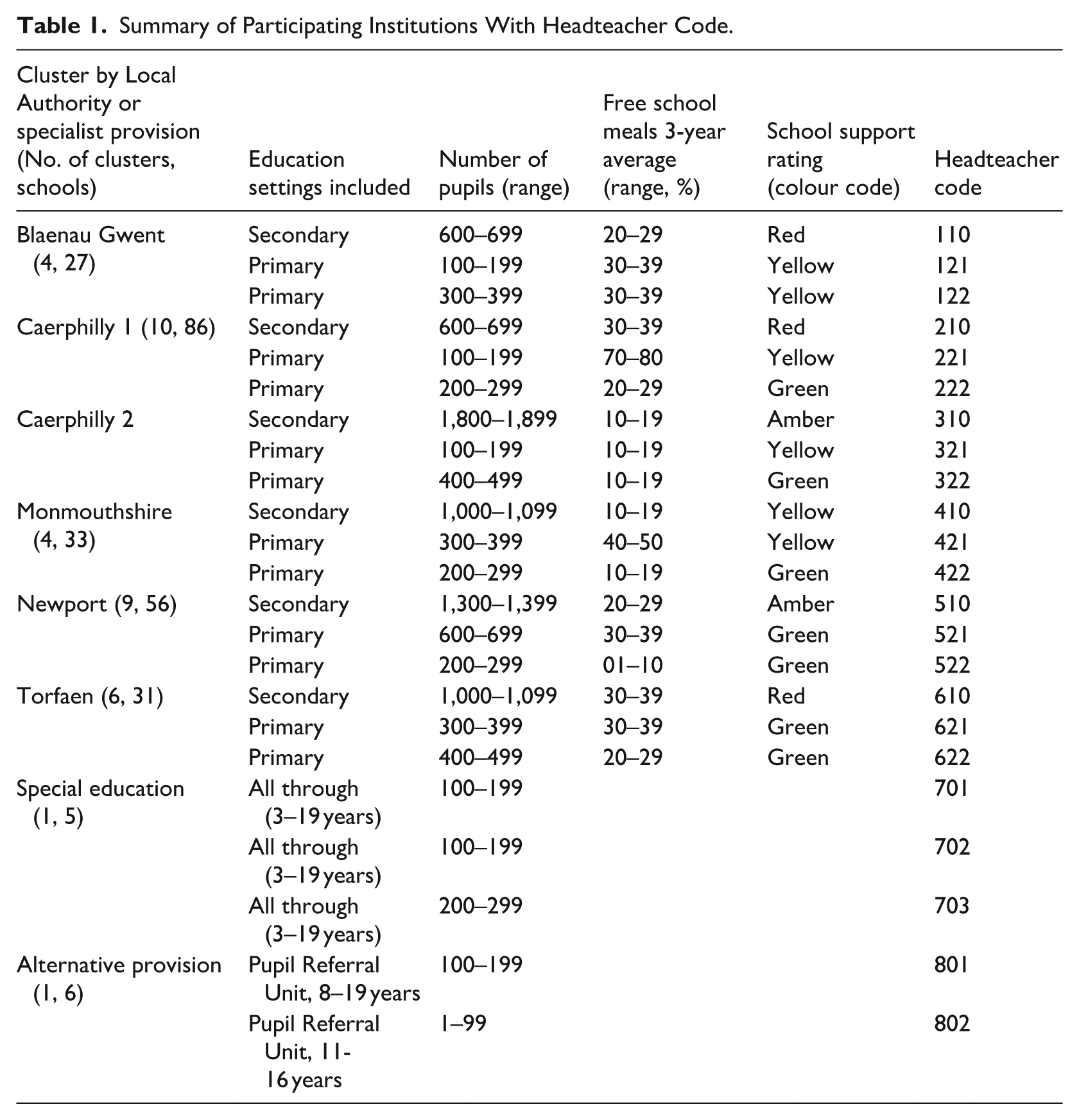
The study draws on qualitative data from interviews with 23 school leaders (12 primary and 6 secondary schools, 3 special schools and 2 Pupil Referral Units) involved in school cluster activity in south east Wales between 2017/18 and 2018/19. A sampling frame of the target population was constructed using school-level data shared securely by the regional consortium. A diverse and proportionate sample was generated using the following selection criteria (Patton, 2002): geographical spread – local authority, urban/town, village/rural; cluster size – number of schools in the cluster; school type & size – primary, secondary, special school, Pupil Referral Unit (PRU), Welsh medium; pupil demographics – measured by percentage of pupils eligible for free schools meals, ethnic diversity (including additional language learners) and catchment area description; change focus – identified in Cluster Improvement Plans; network links – school involvement in other networks for example, the Learning Networks and Pioneer Schools Programme; and school performance profile – measured by pupil outcomes in national assessments and evaluations by the school inspectorate, Estyn, and the regional consortium. Where clusters included primary and secondary schools, two primaries were selected based on contrasting characteristics in regard to eligibility for Free School Meals (national average 17%), performance rating (attainment) and size. As a result of this process, and following ethical approval from by the Research Ethics Committee within Manchester Metropolitan University, 27 school leaders were approached via workplace email to participate in interviews that sought to elicit their perspective on and experience of cluster-based collaboration. Twenty-three leaders in eight clusters located across the five local authorities agreed to take part (Table 1). Semi-structured telephone interviews of up to 60 min duration explored four stage-related themes: agreeing the focus for improvement; collaboration processes and activities; assessing and reporting progress; impact and sustainability.
Summary of Participating Institutions With Headteacher Code.
Interviews were transcribed verbatim and analysed using NVivo. The analysis strategy combined both deductive and inductive approaches to coding (Saldaña, 2016). Drawing on trust theory and an ecological approach to leader agency, transcripts were coded focusing on trust-related exchanges and the interrelationship of collaborative processes with the context of enactment. Attention was afforded to trust-as-attitude (disposition) and trust-as-choice (behaviour). Following Priestley et al. (2012), temporal-relational dimensions of agency were explored in terms of ‘past experiences and projective aspirations, as well as the possibilities of the present’ (p. 197). Comparisons were conducted within each cluster, across school clusters and by stage (pupil age range) and phase/sector (primary, secondary, special and Pupil Referral Unit). To preserve anonymity, findings are reported thematically. A numerical code and sector descriptor are used to show the range speakers.
Limitations and Delimitations
The primary method is self-report, supplemented by documentary sources that is, school documents and cluster records. The analysis is restricted to the perspectives of school leaders that is, the headteacher or school principal, and not teacher leaders, the wider school staff, cluster Advisors or officials within the regional consortium. The inclusion of multiple perspectives would enhance understandings of collaboration across boundaries, but the object of this study is school leaders’ lateral collaboration in a cluster scheme. It is important to note the context in which self-report was used that is, within a commissioned process evaluation of the introduction of the cluster scheme. Interviewees perceptions of the purpose of the research may influence both response rate and responses (Kvale & Brinkmann, 2015). Participants were reminded of the limits of anonymity and risks of ‘deductive disclosure’ (Pascale et al., 2022) within a bounded participant pool. While acknowledging that qualitative interviews are constructed interactions, individual semi-structured interviews were an appropriate method for generating insights into leaders’ experiences and understandings during a period of mandated change. Telephone interviews permitted timely access to leaders across multiple geographic locations. While acknowledging lack of access to visual, nonverbal cues and body language, physical separation of remote interviews can foster a sense of ease and privacy that may increase disclosure (Vogl, 2020; Weller, 2017). The commissioned study did not support longitudinal engagement and therefore the data generated is restricted to the first year of cluster development.
Findings
This research is intended to enhance understanding of the contextual conditions and relational dynamics that influence inter-school collaboration. The findings are organised in three interrelated themes pertaining to structural, relational and material factors that promote or inhibit collective responsibility and mutual benefit in inter-school collaboration. These are exemplified in terms of: (1) the influence of cluster composition (antecedents); (2) the relational dynamics of devolved decision making; and (3) resource seeking and sharing. Collectively, the findings address the micro-politics of collaboration and the influence of context on deliberative trust.
Cluster Composition
School leaders within the six mainstream clusters had a history of local collegial interaction ranging from four to 15 years. Many were recognised within their local authority as a ‘cluster’ or ‘family’ of schools that cooperated informally on pastoral matters and transition arrangements. Cluster funding gave these schools an opportunity to consolidate or extend projects in areas of mutual concern. Examples included support for More Able and Talented students, pursuing Rights Respecting Schools status, cross-phase work in science and the development of entrepreneurial skills. However, while these schools often had a history of elective collaboration, they were not free to choose which schools to work with in the cluster scheme. Some questioned the rationale for matching and a lack of flexibility to move between clusters. For example, one headteacher described being, ‘locked into a cluster because it’s convenient for the regional consortium’ (702). Not all clusters were accepted as a good fit. Urban schools that were geographically close were noted to serve quite different populations. A minority of schools expressed concern about their capacity to respond to multiple initiatives not of their choosing.
So many additional projects are pushed in our direction, we feel the pressure. On occasion, we do feel that the decision isn’t ours, and we have to run with a lot of things that come down to us. (Primary headteacher, 321)
Two non-geographic clusters – Pupil Referral Units and special schools – were established as the outcome of active lobbying from the respective sectors. The achievement of designated cluster status was described as a ‘breakthrough’ (PRU leader, 801) and an assertion of professional jurisdiction. For example, one leader commented, ‘We haven’t got Advisers within our local authorities who have the expertise to challenge us. So, we created this peer group’ (Special school, 701). Pupil Referral Units were initially added to local mainstream school clusters but not allocated funding or given a particular role in cluster plans. For these groups, the cluster initiative consolidated in-group bonding.
In heterogeneous clusters, sharing data and the high profile afforded to formal rankings evoked uncomfortable collaboration. Building collective responsibility entailed critical interrogation of performance data across institutional boundaries. The regional consortium supplied school-level progress data over 3 years colour coded red (‘limited’), yellow (‘satisfactory’), amber (‘strong’) or green (‘very good’) to reflect the national categorisation system for school support in Wales at that time. Clusters were encouraged to use this data as a starting point for deliberation.
Initially, there was a bit of resistance. Some of the test data didn’t reflect well on pupils at the beginning of the Year 7. We couldn’t just brush that under the carpet or say, ‘Well, we won’t share that’. Some [schools] were fine, others weren’t. So, there’s been some tricky conversations. (Secondary headteacher, 610)
It is unsurprising that expressions of shared leadership and reciprocal relations were more common among schools with the same support rating. Schools with higher support needs were sensitive to expectations of comparable progress within delineated periods. Some leaders drew on performance ratings to reproduce hierarchical relations within the cluster. The position of schools within the cluster was influenced by prior perceptions that demanded active re-negotiation to adjust expectations.
The school had been a red category, the highest level of possible support with unfortunate inspection outcomes. So, this school didn’t have a lot to bring to the table. From a power position, the cluster was relatively unbalanced. It was a situation where they were helping, rather than a collaboration of mutual benefit. (Special School, 702) It’s sometimes difficult for me to find schools to work with that have a similar context to my own. I have to help people understand that I have different challenges when creating a cluster plan. I need to make sure changes have a good impact on what’s happening in my school, too. Sometimes I have to fight to get that idea across. (Primary headteacher, 421)
Devolved Decision-Making
Cluster composition and school positionality (history, matching and standing) influenced the terrain for problem definition, goal setting and devolved decision making. Leaders within clusters included experienced, acting and recently appointed headteachers of schools of varied size and support rating. Leaders brokered external expectations and negotiated from different positions of influence (positional power and personal persuasiveness). A range of conventional evidence was used to identify shared priorities and agree common indicators of progress for example, Cognitive Abilities Test data and teacher assessment data. In this way, leaders sought to align external agenda and local priorities, to make space for valued activities not driven by performance data. In cluster meetings, leaders ‘battled it out around the table’ (Head of Welsh-medium primary school, 321) to establish collective priorities. Most leaders felt able to exercise a degree of control over the improvement focus and cluster operation. Through repeated deliberation over time, the limitations of ‘raw’ (de-contextualised) data was acknowledged.
Raw data doesn’t actually give you a good picture of what’s going on inside the school. It just gives you lots of questions and direction. Two of our schools host a Special Needs Resource Base. We needed to go and pick a little bit more into the data and then we made our decisions from there. (Primary headteacher, 122)
Where priorities were regarded as mismatched, this was a source of tension. The new cluster formation did not displace residual perceptions of asymmetric influence between phases. For example, a secondary school leader questioned whether concern with literacy skills was shared as a priority by (higher performing) cluster primaries. Three headteachers of primary schools in two clusters suggested that the secondary school assumed a dominant role in cluster governance, insisting on the secondary school name as the title for the cluster. The self-appointed lead role assumed by some secondary headteachers created resentment, which damaged legitimacy and commitment levels among members.
The secondary school should come to meetings with an open mind. They have already made their decisions before sitting around the table. As primary schools, we make decisions together [whereas] the secondary school makes decisions over the primary schools. (Primary headteacher, 321) A couple of people got together, wrote the plan and then implemented it. That feels like you are just trying to complete a task, rather than think strategically. Relationship building is key: ensuring you’ve all got that shared vision. You have to invest the time in order to get the best value. (Primary headteacher, 421)
Decision making was described as ‘consensual’ and based on a model of ‘shared governance’ in three of the six mainstream clusters (121, 122, 221, 410). Two of the eight clusters agreed to rotate the chair position year-on-year (321, 621).
Resource Seeking and Sharing
Collaboration necessarily entails achieving a balance between collective benefit and institutional self-interest. At a time of budgetary pressure, the opportunity costs of participation received sustained attention. Tensions emerged over the equitable distribution of funds within clusters. Funding was typically allocated according to school-level responsibilities (i.e. contribution to cluster activities), pupil headcount (size of school) or staff release needs. Small primaries often felt short changed while secondary heads complained the majority of the funding was allocated to the larger number of primaries in the clusters. Within the PRU cluster, funding was routed to the only PRU that was also a registered school and could therefore carry over funding from one period to the next.
We’re all different schools of different sizes so there can be a feeling of inequality. We’ve got a village school in our cluster and some very large schools. It’s trying to give equity in terms of access to the funding and how it impacts across the schools. That can sometimes be a challenge. (Primary headteacher, 421)
Schools often used their core budget to advance cluster work and claimed funds retrospectively from the regional consortium. Tensions arose when funds were not distributed to cluster-level and cluster members in a timely manner. Leaders expressed difficulty in forward planning when managing multiple income streams from diverse sources. Cluster priorities could not be fulfilled without seeking supplementary funds, which was particularly challenging in smaller settings. One leader described, ‘looking for grants here, there and everywhere to be able to put in place the cluster work that we’d like’ (Primary headteacher, 522).
The economic cost of release time for teachers, and potential learning loss through teacher absence, were identified as significant barriers to sustained inter-school collaboration. Cluster curriculum work was often completed in twilight meetings, adding to teacher workload. The opportunity cost of releasing teachers from classes was more acute in the secondary and Welsh medium sectors, where the pool of qualified supply teachers was limited.
The secondary has some really good teachers but their supply pool is poor. They don’t want to see a dip while those teachers are out. (Primary headteacher, 422)
The time and cost of convening meetings to work on reporting was regarded as excessive in relation grant income (701). Reporting protocols were not peer-led and were generally regarded to contribute to the intensification of leaders’ work. Eight school leaders expressed concern about the frequency, volume and multiple formats deployed in progress monitoring. The reporting process was deemed ‘extra paperwork’ (510, 310), a ‘paper exercise’ (802), ‘not a good use of leaders’ time’ (701). One headteacher argued that ‘constant scrutiny’ by an external body was inconsistent with the ethos of lateral collaboration (522).
I don’t see the impact of a Challenge Adviser continually monitoring what I’m doing or the EAS or local authority. It’s power you can see through that. (Primary school leader, 522)
There was consensus that the FADE tool did not support developmental purposes: ‘it becomes a thing you do after the learning, rather than as part of it’ (702). The purpose was regarded as ‘verification’ (701, 703) and the process ‘burdensome’ (410). Schools in Wales are pursuing several major policy initiatives concurrently (a new school curriculum, national school improvement strategy and professional standards for teachers) while juggling grant income from multiple funding streams. One primary headteacher noted, ‘there’s lots of drums all demanding things all the time’ (610).
How many masters do I have? I have the regional consortia, the local authority, Estyn, my governing body. My non-core income for last year was £320 thousand. Over £300 thousand I receive in grants of some kind, all of which I have to evaluate and fill in forms for. It’s not easy to plan financially (Secondary headteacher, 410) We have plans for plans. Our cluster plan feeds into our school’s development plan and if you are a school that’s graded as red or amber, you’ll have a support plan as well. The cluster plan should feed into your school development plan and not feel separate from it. (Primary headteacher, 421)
Discussion
This study explored the conditions needed to promote collective responsibility and mutual benefit through school-to-school collaboration and the role of trust in supporting inter-school collaboration. The analysis was conducted to deepen understanding of the relational dynamics of school-to-school collaboration and the significance of the context of enactment. The findings challenge romanticised or naïve notions of collaboration premised on assumptions of mutuality and equality. Tensions are inevitable. The relative success of inter-institutional collaborations such as the cluster model will be influenced by how far partners interpret tensions as limiting or productive. A relational perspective permits insight into the ‘space to manoeuvre’ (Priestley et al., 2012, p. 196) within contractual obligations, and the structures and processes through which collaborative leadership is enacted. If local and lateral ways of working are to support more ‘democratic’ forms of professionalism, dialogue around difference is to be encouraged (Biesta, 2017; Zeichner, 2020).
This small-scale qualitative study illustrates how mandated collaboration does not erase tensions between phases/sectors and asks more of ‘boundary spanners’ charged with working across institutional/sectoral demarcations. Hierarchical systems tend to erode a sense of mutuality and without careful scaffolding lateral networks can re-create the hierarchical relations they are assumed to disrupt. Schools enter into cluster arrangements on different footings. Using the partnership metaphor of marriage, school partnerships can be ‘love matches’, ‘marriages of convenience’ or ‘shotgun weddings’ orchestrated by others. From a linked ecologies perspective, Abbott (2005) reminds us that invitations to collaborate ‘perpetually create potentialities for gains and losses of jurisdiction’ as participants ‘seizing openings’ as they arise (p. 247). In this example, special education and alternative provision interest groups used the cluster opportunity to assert professional jurisdiction and territory control. For these groups, the cluster initiative contributed to in-group bonding but weakened the between-group bridging function of network collaboration. Where a hub and spoke model was used to create primary-secondary clusters, network centrality was awarded to the secondary school. This unintendedly damaged prospects for more collegial inter-local governance. In some cases, school leaders felt compelled to participate but ill-placed to cope with the volume of initiatives in play concurrently. Participation across multiple initiatives enfolded leaders into forms of contractualism through which they were positioned as economic agents. This is constitutive in the extent to which it frames new relationships between schools and regulatory mediating agencies. This matters because the durability and quality of relational ties will be affected by the circumstances of their formation.
On entry to a cluster, the relative standing of partners was to some extent pre-determined by the pervasive influence of external metrics. The degree of reciprocity (potential mutual benefit) was apportioned according to local assessment of what contributors ‘brought to the table’. Projective investment in collaboration was assessed by past performance inscribed in school-level attainment measures. Rankings translated into bargaining power in nascent inter-school relationships. In moving from cooperation towards collaboration (Chapman, 2019a), the level of reciprocity between the single site and cluster needs to remain open to social negotiation and adjustment to avoid the stymying effects of residual competition or the disabling impact of being positioned not as a contributor but as a dependent receiver of ‘help’. Potentiality should not be ascribed on entry or fixed in early encounters but evolve over time with repeated interaction and richer reflection. Some clusters made space to explore contextualised interpretations of data when identifying common purpose. Interaction here typified a trust relation of benevolence, integrity and respect (Daly, 2009). In these cases, an exploration of relatedness avoided retrenchment through deficit-based othering. The goal was group learning through an iterative process, not convincing or settling by ‘battling it out around the table’ at start-up.
Moreover, it cannot be assumed that the apparent ‘consensus’ recorded in formal planning documents is multi-voiced and balanced. Authentic collaboration through dialogue is elusive and can be unsettling as leaders challenge one another and jostle for influence. Wider participation may not support more democratic deliberation. In this example negotiation over the cluster plan also entailed vetoing (rejecting others’ ideas), agenda setting, defensive moves to resist encroachment (turf wars), and the management of outliers (eliding division through impression management). This was evident in reports of leaders’ attempts to manipulate agenda, control the purse strings or to permit or withhold participation by school staff. Accounts of ‘battling’, ‘fighting’ and ‘agenda setting’ suggest mistrust and power plays. Some leaders elected not to return to the fray to avoid disrupting the goodwill of others, but silence is also a form of agency (Parpart & Parashar, 2019). What is wilfully not spoken in cluster meetings or recorded in cluster documentation is nonetheless impactful on the collective dynamic. Rather than transformation, low-trust routinised participation that is inauthentic can yield ‘collaborative inertia’ (Huxham & Vangen, 2005, p. 59). If collaborative agreements are not open to re-working, declining trust may become evident in absence from meetings, progressive disengagement, collapse of collaborative work or pragmatic compliance to secure funding.
Allocation of finite public funds rightly requires accountability from recipients. Uncontrolled experimentation would be foolhardy, especially in fields that bear upon the wellbeing and future prospects of children and young people. However, hybrid systems that blend central regulation with an intention to enhance professional agency demand a recalibration of conventional approaches to accountability in school systems. Collaboration practice has not been matched by the concurrent development of multi-relational accountabilities. Bryson et al. (2015) note how collaborative arrangements demand structural and processual ‘ambidexterity’ (p. 653) among those charged with managing endemic tension between self-interest and collective interest, autonomy and interdependence, lateral and hierarchical relations. While ambitious, the cluster model was built on a legacy of linear problem-solving approaches in educational administration. Alongside the new language of co-construction, this hybrid model retained elements of low-trust performance management. Attempts to blend hierarchical and local lateral control risk grafting on additional accountability demands in an increasingly complex context. Bolt-on collaboration as ‘policy palimpsest’ (Carter, 2012) is unlikely to disrupt entrenched practice or provide robust support for durable innovation. In such contexts the collaborative turn – however optimistic and well-intended – becomes another form of what Allen et al. (2021) term ‘shadow boxing with real problems’ (p. 142). While attention is turning to the collaborative competence of networked relational leaders (see Beswick & Clarke, 2018; Brown & Flood, 2020; Díaz-Gibson et al., 2017; Leithwood, 2019; Y. H. Liou & Daly, 2023), successful collaboration is not simply a matter of leaders’ collaborative capacity. Policy makers need to attend closely to the cultural and structural domains that frame school-to-school collaboration.
The case for collaboration remains strong. Most of the schools made progress towards outcomes specified in the cluster plan. At the mid-point of the first year, the regional consortium judged four of the 35 clusters to be making ‘limited’ progress (11%), 22 ‘satisfactory’ progress (63%) and 9 ‘strong’ progress (26%). On conclusion of the first year, only one cluster was judged to have made ‘limited’ progress overall (3%), 8 ‘satisfactory’ progress (23%) and 26 ‘strong’ progress (74%). In becoming ‘ambidextrous’, school leaders worked with traditional performance indicators and sought to insert new indicators into deliberation on what mattered most locally.
Conclusion
By focusing closely on how the principle of collaboration was enacted within a mandated cluster initiative, the findings of this research draw attention to the significance of context. Possibilities for collaboration were influenced by the composition of clusters of schools with different histories, different status or standing in public performance ratings, at different stages in their development journey and different localised needs for example, student population, staffing profile, budgetary position. This study shows little evidence of professional self-government among the sample of leaders required to engage in formal collaboration. Leader collaboration was strongly framed by external agenda set by regulatory bodies and monitored by the regional school improvement consortia. Moreover, leaders were largely silent on how the cluster scheme supported distributed leadership within their schools, much less between schools in the same cluster. Collaboration opportunities/requirements remained at the level of headship and were exercised in terms of managing the initiative. Lessons from this case study indicate that time is needed to build a project of joint work that is co-owned, revisited and open to negotiation. Such time for relationship building is not often appreciated within the timeline of mediating agencies. Decision makers impatient for change should not underestimate the impact of initiative ‘overload’ and multiple layers of reform on prospects for leader engagement in terms of attitudes and capacity.
Future research would usefully extend beyond the turbulent beginnings of the start-up phase to explore how collaborative arrangements play out over time and evolve beyond initial incentives. Deeper insights would be produced by site-based studies that include observation of meetings that go beyond textual self-report (what is said in self-report interviews or written in project records), to consider the meaning of absence, silence and omission and how leaders use their contributions. There is a need for further independent research that takes a relational-ecological perspective to the formation and on-going development of school-to-school collaboration networks. Such enquiry would help to mitigate the limits of ex post facto or retrofitted evaluation. Research designs informed by a relational ecological perspective might better address the how (activity) and here questions (locality) and advance a critical approach to claims that ‘collaboration’ equates with enhanced ‘professional agency’. This would enable learning to move from assessment of the delivery of short-term outcomes to how agentic leaders negotiate the many challenges of collaborative governance (Waardenburg et al., 2020). Of critical importance here is exploration of new ways of approaching multi-relational accountability that might better support a transition from low-trust bureaucratic accountability towards ‘new public leadership’ (Brookes, 2024). In addressing persistent and widening educational inequities in the aftermath of the pandemic, the contextual conditions conducive to successful inter-organisational collaboration merit further attention.
Footnotes

Funding
The author disclosed receipt of the following financial support for the research, authorship, and/or publication of this article: This research draws on an evaluation funded by the Education and Achievement Service of South East Wales.
Declaration of Conflicting Interests
The author declared no potential conflicts of interest with respect to the research, authorship, and/or publication of this article.