




Abstract
Chess is widely available in schools globally due to its perceived academic benefits. Many policy makers, educators and parents advocate for its inclusion as a co- or extra-curriculum activity. Stakeholders’ beliefs that chess in schools contributes to education improvement is apparent in the positive advocacy and growth of chess as part of education systems. The literature suggests numerous and diverse benefits, but studies that seek to provide a holistic perspective of the nature and extent of these benefits are scarce. Previous studies have mostly focussed on the impact of learning to play chess in relation to standardised literacy and numeracy test scores with researchers questioning whether this is a viable line of enquiry. As such, this paper adopts a stakeholder theory perspective where perception studies are particularly helpful when confronted by seemingly ambiguous or ‘tricky’ issues such as that of attributing educational benefits to chess. Indeed, education research recognises the importance of understanding stakeholder perceptions in all educational improvement initiatives. A survey of 315 stakeholders was conducted to investigate stakeholder perceptions as they relate to the educational benefits of chess in primary schools in Australia. A factor analysis reveals clusters of educational benefits attributed by stakeholders to learning to play chess in schools. The clustered benefits were (a) social and learning skills, (b) creativity and life skills and (c) thinking skills. From the results, a typology is presented that aims to prioritise possible lines of enquiry for future research associated with ‘chess in schools’.
Introduction
Much has been reported in terms of the benefits of playing chess in schools. While progress has been made in terms of research focussed on the association between playing chess and its effect on learners’ standardised test scores, much less is known about other educational benefits of playing chess in schools and the forms that they take. These are important considerations given the investment in chess at schools and the improvement of extra curriculum activities that enhance educational outcomes.
Even with more recent clarity dispelling the notion that learning to play chess leads to higher test scores, chess continues to grow and expand across education systems worldwide. Clearly there is a belief held by stakeholders, policy developers and decision makers that chess in schools remains a good idea and has valuable educational benefits that justify, often significant, investment. What are the perceived educational benefits that continue to convince educational decision makers to include chess in schools and can they be classified in terms of ‘types’?
Chess is played by hundreds of millions of people worldwide and is actively promoted in schools in many countries. 1 This popularity is sustained by the belief that learning to play chess has educational, social and cognitive developmental benefits. In particular, researchers continue to demonstrate that playing chess in schools improves academic performance (Rosholm et al., 2017) cognitive abilities, problem-solving capacity and socioaffective development (Aciego et al., 2012). The extant literature further acknowledges that chess has become popular amongst children, irrespective of gender, various disabilities, learning difficulties, economic status, ethnicity, sporting performance or other traditionally divisive characteristics and is actively promoted by large governmental agencies such as the European Parliament (2012).
Indeed, stakeholders’ beliefs that chess in schools contributes to education improvement is apparent in the positive advocacy and growth of chess as part of education systems. There appears to be a persistent belief among stakeholders including teachers, principals, administrators and decision makers and the learners themselves that chess-based learning is holistic and has a positive impact on learner development (Chitiyo et al., 2021, 2023).
The seminal work on stakeholders by Freeman and Reed (1983) concludes that understanding stakeholders’ perceptions through studies can provide valuable insights for effective decision making, policy development and investment. They argue that stakeholders, including leaders, employees, customers and communities, have legitimate interests and that their perceptions and expectations should be taken into account in decision making and policy development. This has given rise to the field of ‘perception studies’ and stakeholder theory (Phillips, 2003). Perception studies have flourished and have been applied across public policy and decision-making domains. Perception studies are particularly helpful when confronted by seemingly ambiguous or ‘tricky’ issues such as the difficulty attributing improved standardised test scores to learning to play chess. They have typically been applied to problems in areas such as health (Green & Aarons, 2011), community development (Byrd et al., 2009), and education (e.g. Odhiambo & Hii, 2012; Oke & Fernandes, 2020; Scott, 2007). Indeed Guskey (2007) notes the importance of understanding stakeholder perceptions in all educational improvement initiatives.
It is not adequate to explain the rationale of including chess in schools in terms of generally having educational benefits. We argue that not only is it important to understand what the general perceptions are, but probably more importantly, what types of perceived educational benefits inform decision making associated with the inclusion of chess in schools. The reason this is important lies in the recognition that educational decision makers increasingly are called upon to align the perceived benefits described by education policy, curricula and pedagogical considerations with the allocation of resources. To illustrate the point, if education policy is focussed on numeracy and literacy enhancement in primary schools, the lack of conclusive evidence linking these to playing chess would mean that education decision makers are unlikely to invest in chess in their schools as a curricular activity.
The reports from the literature on the educational benefits of playing chess are broad, diverse and evasive. It can be challenging to know where to look for quality research on the educational benefits of chess. It is certainly not a prominent line of enquiry in the education fields of research. Some exceptions can be found but by and large, educational leaders and decision makers seemingly rely on perceived benefits of including chess in their schools. This may be due to traditionally held beliefs, strong cultural affiliations and educational benefits advocated by chess in schools stakeholders including learners, parents, teachers and administrators.
Most discoverable studies have included a focus on the effect of learning to play chess on children’s literacy and numeracy scores. Apart from this focus (standardised academic performance), the literature on the educational benefits of chess appears to lack cohesion. This is apparent from a number of recent literature reviews (Arraez Infantes, 2019; Blanch, 2022; Brito, 2021; Expósito Barrios, 2017; Ortiz-Pulido et al., 2019; Sala & Gobet, 2016).
Where there is some cohesion in chess research such as investigating the association between standardised test scoring and playing chess, there is ongoing disagreement. Despite Sala and Gobet’s (2017 and 2017b) and Sala et al’s (2019) conclusion that chess cannot be definitively associated with an increase in standardised test scores, research efforts continue this line of enquiry illustrating a stubborn belief that there is an association (e.g. Poston & Vandenkieboom, 2019; Rosholm et al., 2017) Therefore, even in an area of concentrated focus such as chess’ association with standardised test scores it appears that stakeholder perceptions continue to perpetuate a belief advocating for chess in schools.
Following the assertion that stakeholder perceptions in education are valuable indicators for future research (Odhiambo & Hii, 2012) this paper frames stakeholder perceptions as necessary to guide future research into chess and its educational benefits towards improvement of schools. A central premise of this paper is that by knowing what stakeholder perceptions of the educational benefits of chess in schools are, we can understand the origins of these beliefs in order to inform a more cohesive approach to its scholarship. This is especially important within the context of the broad and disparate nature of research on educational benefits of playing chess in schools. Knowing stakeholder perceptions will also help understand why chess in schools continues to grow internationally and enjoy the governmental and institutional support it has.
Reported Benefits of Chess
Despite the reputation of chess as a ‘smart’ game, the extant literature has yielded mixed findings regarding the educational benefits of learning to play chess (Islam et al., 2021; Jerrim et al., 2016; Poston & Vandenkieboom, 2019; Rosholm et al., 2017). Despite this, there is a perception by stakeholders, defined in this instance as school principals, teachers and parents, that learning to play chess has numerous educational benefits. This is evidenced in the case of Australia, by the explosion of ‘chess in schools’ programmes since 2000.
There have been several disparate studies over many years relating to the educational benefits of chess (see, e.g. Horgan & Morgan, 1990; Martinez, 2012; Sala et al., 2015). Critics assert that the research needs to be more cohesive, less dispersed and more rigorous to be convincing (Jerrim et al., 2016; Sala & Gobet, 2016). Further research is especially important in justifying the provision of chess in schools. Cohesive lines of enquiry aligned with types of educational benefits of chess in schools are needed.
Research in the Field of Children Learning Chess in Schools
Specific studies investigating the educational benefits for children have frequently associated the benefits of learning to play chess with curriculum learning outcomes. These range from improved creative thinking skills (Amelkina & Petrulytė, 2009; Ferguson, 1986; Sigirtmac, 2012, 2016), standardised tests (Gaudreau, 1992; Liptrap, 1998; Martinez, 2012; Poston & Vandenkieboom, 2019), and maths scores (Boruch & Romano, 2011; Rosholm et al., 2017; Sala et al., 2015). Other studies, apart from looking at maths or literacy skills, also examine problem solving and heuristics (Trinchero & Sala, 2016), risk aversion, patience, creativity, attention and focus (Islam et al., 2021), student behaviour and self-esteem (Yap, 2006), and problem solving and comprehension (Gaudreau, 1992).
Further, metacognition has been examined in several studies (Kazemi et al., 2012; Meloni & Fanari, 2019; Sala et al., 2016). Most of the studies examined in the literature are concerned with ‘thinking skills’ (McGregor, 2007; Moseley et al., 2005). Apart from a few notable studies, this research is criticised for lacking methodological rigour and definitional clarity (Jerrim et al., 2016; Sala & Gobet, 2017a).
Overall, there have been significantly more studies involving numeracy than literacy (literature reviews by Blanch, 2022; Nicotera & Stuit, 2014; Sala & Gobet, 2016).
The overarching intention of these studies presumes to inform decision-making and education policy. An example of this can be found in the Declaration of the European Parliament on the introduction of ‘Chess in School’ of the European Union (European Parliament, 2012, np). The declaration includes the assertion;
whereas chess is an accessible game for children from every social group and can help social cohesion and contribute to policy objectives such as social integration, combating discrimination, reducing crime rates and even the fight against various addictions; . . . [and] whereas whatever the age of the child, chess can improve children’s concentration, patience and persistence and can develop the sense of creativity, intuition, memory, and analytic and decision-making skills; whereas chess also teaches determination, motivation and sportsmanship.. . . Calls on the Commission to take into consideration the results of any studies on the effects of this programme on children’s development.
Despite such prominent support and its reference to generic social and educational benefits, it is unclear how these disparate and broad benefits are grouped. A fully informed understanding necessarily includes what stakeholder perceptions are of the educational benefits which, (a) may inform such decision making and (b) could guide further studies to provide a defensible evidence-base for school improvement educational policies.
The main purpose of this study is to provide a preliminary indication of types of educational benefits as perceived by stakeholders. Building on previous studies and addressing the need for more research into stakeholder’s perceptions, this paper’s focus is to present the relevant findings of a study in Australia. As such, the study sought to determine what educational benefits are perceived by stakeholders as associated with chess in the education of primary school children. The paper provides initial empirical evidence for a typology of educational benefits as derived from the literature and from surveying stakeholders. This is intended to not only allow for a better understanding of educational decisions related to chess in schools but also seeks to inform more cohesive lines of enquiry for future research.
Methodology
The study was exploratory. A pragmatism paradigm guided the research design. Pragmatism suggests that mixed methods research, including qualitative and quantitative data sources, should be used. According to Creswell (2013), ‘pragmatism recognises the importance of the empirical breadth that can be achieved by employing quantitative data methods along with revealing a greater depth of meaning using qualitative methods’. As such, the study sought to confirm whether previous findings in the literature regarding educational benefits are aligned with stakeholder (parent/educator) perceptions. Further, it sought to discover whether stakeholder perceptions include other benefits not reported or qualify reported benefits based on the rarely reported voice of parents and educators.
A key premise of the study as reported above was that the degree of alignment between research on actual learner benefits and those perceived by key stakeholders is critical in informing ‘chess in schools’ decision-making. It was deemed important for this study to identify the extent of stakeholder agreement of perceived educational benefits reported in the extant literature, explore whether there was an underlying structure of the data and include deeper insights as they relate to the participant responses.
The study administered an online survey whose questions included both 5-point Likert scale questions and open-ended questions for qualitative responses. The questions were derived from identified benefits emerging from the literature. The range of questions were also expanded to include non-academic reports of benefits such as that in the European Parliament (2012) report.
The survey was distributed, primarily by an emailed link, to school principals and chess coordinators, via Education Queensland publicly-available lists of emails of every school in Queensland. Schools were asked to distribute the invitation and link to parents. The survey collected both quantitative and qualitative data concurrently. This was especially useful as it enables the triangulation of the results. Ethical clearance for the study was approved by the relevant university Human Research Ethics Committee.
Participants
A purposive convenient sampling method was adopted. In defining the criteria for sampling, stakeholders were generally defined as ‘those at a primary school level interested in the possible educational benefits of chess’. The sample population (stakeholders) included school principals, other school leaders, teachers and parents. The population parameters included primary school communities in Queensland and northern New South Wales in Australia. Approximately 150 school communities responded to the invitation to participate. These included participants from schools offering chess as a co-curricular or extra-curricular activity and those without a school chess programme.
Survey
The questionnaire consisted of 38 questions. Twenty-five, five-point Likert scale questions relating to different perceived educational benefits of chess as reported in the extant literature were included. Four demographic questions to ensure that responses met the sampling criteria and nine questions associated with cost and in-school programme types were included. Every Likert-type question also had a ‘comments’ field to allow stakeholders to share their experiences and any further insights. The questions did not attempt to capture the full range of thinking skills reported in the literature. Rather, from a brief literature review, the questions included the most commonly reported educational benefits associated with chess.
Data Analysis
Quantitative Data
The quantitative data downloaded from the online survey software were cleaned, screened and checked for normal distribution of data. Normality of data was tested using statistical tests for detecting Skewness and Kurtosis. One response was deleted due to missing values. The study’s analysis techniques included descriptive statistical analysis (including frequency statistics) and exploratory factor analysis (EFA) to determine the underlying structure (if any) of the data.
Qualitative Data
Anonymous qualitative comments were coded manually and grouped according to their related question item. Some comments did not directly apply to any of the Likert scale questions and were deleted. The qualitative analysis used thematic analysis (Clarke & Braun, 2017) to identify emerging themes.
By obtaining quantitative and qualitative data concurrently, it was possible to (a) gain deeper meaning related to the quantitative responses and (b) achieve data triangulation.
Results
Quantitative: Demographics
There were 315 valid responses (n = 315) to the survey. The number of respondents that indicated that there was no chess programme in their school amounted to 21% of the sample. By comparison 67% of the sample respondents did indicate an affiliation with a school that had a chess programme. The balance (12%) did not indicate whether there was an affiliation. As such, an element of self-selection was present in the data. Of the participants, 172 were associated with state schools and 81 with private or faith-based schools. The remainder did not indicate an affiliation.
Quantitative: Frequency Analysis
A frequency analysis was conducted as part of the descriptive statistical analysis, which included calculations of mean, standard deviation, Skewness and Kurtosis. These illustrate the percentage of responses associated with the answers to each Likert scale question. Respondents were not required to answer every question. Table 1 presents the results of the frequency analysis of questions relating to educational benefits.
Survey of Stakeholders: Frequencies.
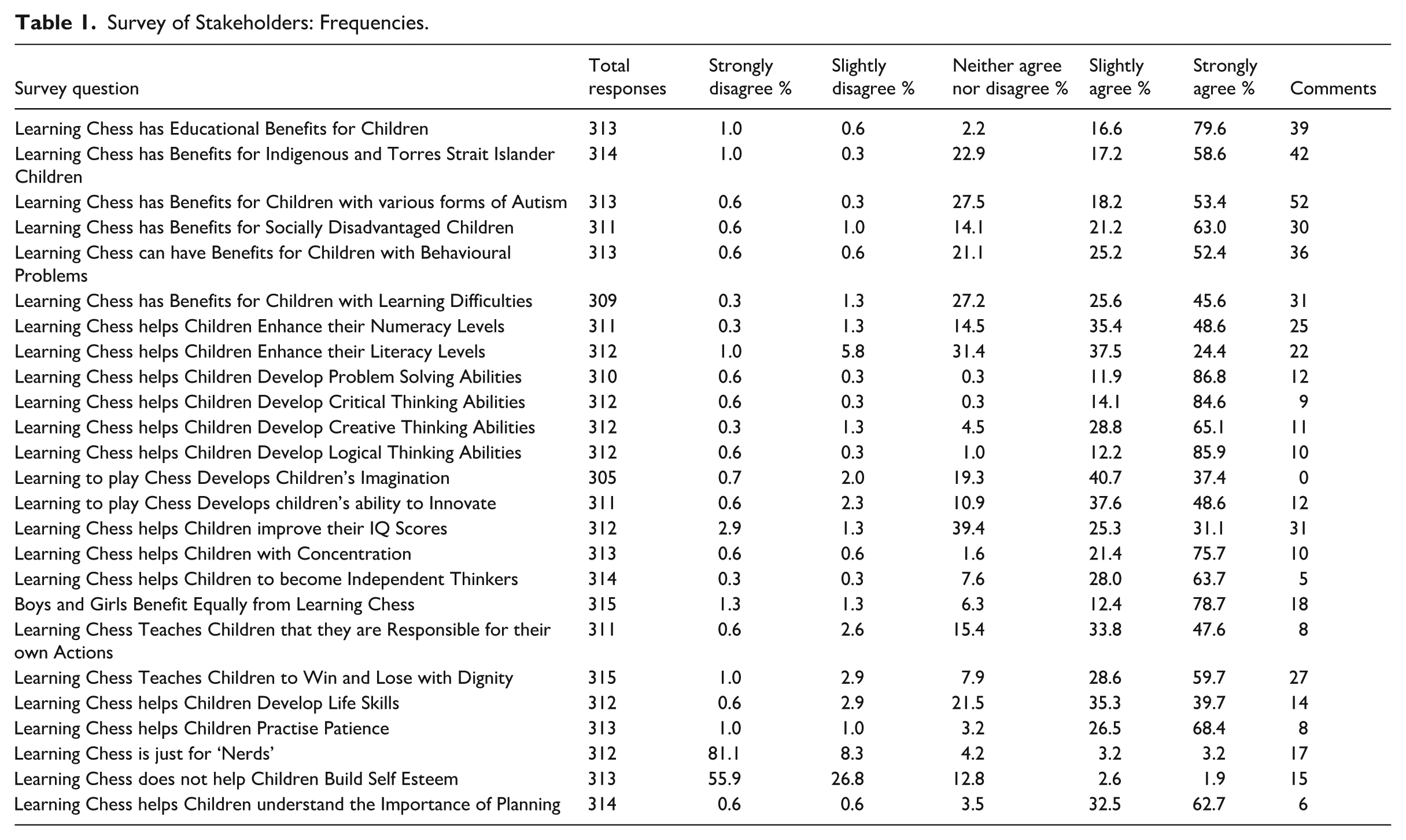
It is notable that 96.15% of the respondents (n = 313) agreed (16.6%) or strongly agreed (79.6%) that learning chess has educational benefits for children. This indicates an overwhelming belief of stakeholders including those affiliated with non-chess playing schools, that learning to play chess has educational benefits for children.
Of note from Table 1 is that over 70% of responders believe that chess has educational benefits for marginalised groups or those facing learning challenges. Indeed, 84.2% believe that socially disadvantaged children gain educational benefits from learning to play chess.
A significant proportion of all stakeholder groups in the study believe that there are many key thinking skill benefits associated with children playing chess in primary schools. Of note was that over 95% of respondents gave a positive response (agree or strongly agree) to questions relating to the benefits of problem solving, logical thinking, critical thinking and planning abilities.
In contrast to the high levels of agreement associated with the other educational benefits included in the questions, only 62% agreed that chess helps children with their literacy levels and 56.4% of respondents believe that learning chess helps with IQ scores.
More than 80% of respondents believe that chess helps children build self-esteem, win and lose with dignity and take responsibility for their actions while 91.1% of respondents perceive that boys and girls benefit equally from learning chess. In inter-school tournament chess, the culture of shaking hands before and after each game, of winning and losing with good grace and learning to accept that losing is an excellent learning experience, is highly valued by teachers and parents.
Quantitative: Exploratory Factor Analysis (EFA)
The primary objective of EFA is to define the underlying factorial structure associated with the question items in order to reduce the number of dimensions (Hair et al., 2019). EFAs seek to analyse interrelationships among a large number of variables and to explain these variables in terms of their common underlying factors. EFA was useful to the study as it would indicate groupings of items relevant to perceived educational benefits of learning to play chess in primary schools and thus point towards the types and parameters of benefits.
The method of extraction used for the EFA analysis was the maximum likelihood (ML) method due to the chi-square statistic (model fit of the data) that it can generate. The multivariate normality of the data obtained during the data screening process met the assumption required for ML. Eigenvalues greater than 1 (Hair et al., 2019) and scree plots were used to determine the number of extracted factors. A varimax rotation method was adopted due to the assumed orthogonal differences between item groupings (Cunningham, 2008) as they relate to different types of benefits.
The EFA using SPSS software and the ML extraction method extracted three factors (Table 2). The Kaiser-Meyer-Olkin (KMO) measure of sampling adequacy was 0.924, with 16 items explaining 61.99% of the variance. Item loadings ranged from 0.432 to 0.862. As an exploratory study, loadings below 0.6 are justified. The goodness of fit test indicated a Chi-square of 153.661 and statistical significance (p = .000), indicating construct validity. Hence the data fit the model well.
Exploratory Factor Analysis Rotated Factor Matrix: Educational Benefits of Learning to Play Chess.
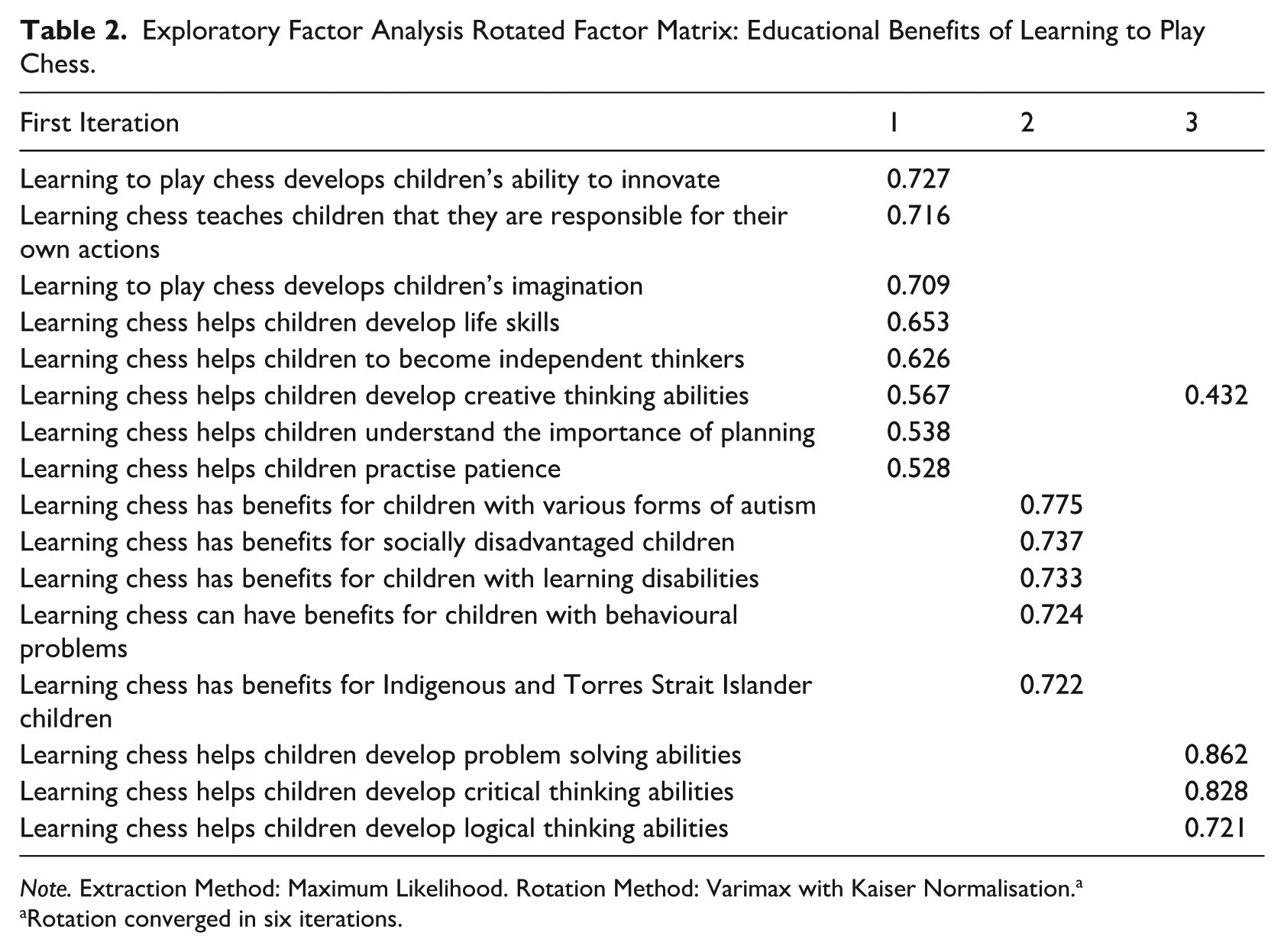
Note. Extraction Method: Maximum Likelihood. Rotation Method: Varimax with Kaiser Normalisation. a
Rotation converged in six iterations.
The EFA (ML) converged after six iterations into three factors. Factor 1 explained 23.93%, Factor 2 explained 20.577% and Factor 3 explained 17.48% of the total variance (total variance explained 61.99%). This is satisfactory in exploratory social science studies (Hair et al., 2019). Item loadings were generally high (>0.7). Based on the item communalities clustered in each factor, the following descriptions were attributed to each factor describing the perceived benefits: Factor 1 (Creativity and Life Skills), Factor 2 (Disadvantaged and Children with Learning Challenges) and Factor 3 (Problem-Solving, Logical and Critical Thinking).
Discussion: Quantitative Results
The EFA converged into three factors. These clusters of items relate to:
(i) benefits associated with creativity and life skills, including the ability to innovate, use imagination, understand the importance of planning, practise patience, become an independent thinker and take responsibility for one’s own actions
(ii) benefits for Indigenous and Torres Strait Islander children, those with various forms of autism, socially disadvantaged children, those with learning difficulties and those with behavioural problems (
(iii) benefits for children’s thinking skills, specifically problem solving, critical and logical thinking abilities
Benefits associated with children’s creative thinking abilities had factor loadings across both the Creativity and Life Skills and Problem-Solving and Critical Thinking factors. This suggests that the benefit of ‘creativity’ associated with learning to play chess is perceived to contribute to both life skills and thinking skills, as indicated in the literature (Wurdinger & Rudolph, 2009). Learning to play chess was associated by stakeholders with the benefits of developing problem-solving, critical and logical thinking abilities. This finding is not surprising, as chess players use these skills, particularly problem-solving, when considering every move in a chess game.
Consistent with the conclusions of Sala and Gobet’s (2016) study, improvements to children’s literacy and numeracy scores and IQ due to learning to play chess did not have statistically significant factor loadings and failed to converge with the three-factor solution. While the general community may associate chess with smarter children, or being just for smart children, those closer to the game or with an intimate knowledge of chess (teachers, principals and parents) appear to discern the educational benefits as being distinct from notions of higher IQ, literacy and numeracy. They suggest that chess has many benefits for children that may not be apparent in mainstream education’s standardised measures. The conclusion relating to numeracy should be treated cautiously as 83.9% of responders believe that learning chess helps children enhance their numeracy scores. Studies investigating the link between learning to play chess and numeracy scores have had mixed results.
Those with a more direct and deeper understanding of chess believe that children benefit by developing a range of life skills, which are generally regarded as useful both in and out of school. Abilities such as innovation, imagination, planning, patience, independent thinking and taking responsibility for one’s own actions are generally valued in society and may become apparent when learning to play chess.
According to the EFA, a cluster of items related to benefits to the ‘Disadvantaged and Children with Learning Challenges’ are suggested. This factor of the solution includes those with autism, learning difficulties, behavioural problems and social disadvantages especially in Indigenous and Torres Strait Islander communities. This confirms a recent study that included 135 countries responding to a joint survey conducted by FIDE (world chess federation) and ECU (European Chess Union) in 2021. It found that approximately 25 million children worldwide participate in school chess programmes including 10 million in India and 5 million in China. This information suggests that due to its low cost and easy accessibility, chess is well suited to low socio-economic or marginalised groups. The results also tend to support the European Union (European Parliament, 2012, np) declaration that chess is accessible for children from every social group, improves social cohesion, improves social integration and combats discrimination.
Qualitative: Results and Thematic Analysis
The analysis of qualitative data, based on comments given in the survey, provided greater depth to understanding the quantitative results. In total, there were 834 comments provided by respondents and there was general, positive unity between parents and teachers. None of the comments suggested any additional educational benefits other than those initially included in this study as derived from the literature. A thematic analysis allowed themes to emerge related to the survey questions (Clarke & Braun, 2017).
Theme 1: Benefits Associated with Children From Disadvantaged Groups, and Those with Various Disabilities or Learning Difficulties
The positive comments from teachers and parents highlighted the perceived advantages children with various difficulties gained when they learned to play chess. In getting to know and like chess, benefits are not limited to academic learning. Comments suggest that self-esteem and making new friends are critically important to these students. In their paper The Justification for Inclusive Education in Australia, Boyle and Anderson (In Press) quote Mitchell and Sutherland (2020, p. 209), who ‘found that students from disadvantaged or minority groups gain academically from being in an inclusive environment’. The results further reflect the benefits enunciated by the European Parliament (2012) in that it is perceived by stakeholders as typical for disadvantaged students or those with learning difficulties to thrive in a chess group. They also quote Dewey (1916) who, more than a hundred years ago, described the best way to develop a strong society was to educate students in social groups made up of individuals from many diverse backgrounds with many different interests, where the interaction between these individuals was full and free.
The following comments from four teachers and one parent describe real-life experiences related to chess and children with learning difficulties and behavioural problems.
As support teacher for Special Education & Learning Difficulties, I can attest to the specific benefits of chess for . . . ASD [students] participating. They respond especially well to the individual challenges; the stable routines & most importantly to the rule governed nature of the game. My son was becoming disengaged and behind socially, he is ASD high-functioning, ADHD and ODD. Since starting classes he has become a full-time student and is managing social situations a lot better than before. Chess has pushed him to think in different ways from forward planning to analysing outcomes of various moves he may choose, he has gained confidence in himself and in his decisions, chess causes no anxiety for him when he is playing. I have had lots of success teaching kids with autism at a School Special Ed Unit in Queensland (actual school deleted). They love it and it really calms them down. I am inspired by this diverse group who can be (over) excitable and need behavioural management. I'm finding that the individual challenge/desire to win is settling for many. One Y1 student was particularly noticeable in his chess skill development. This student still has literacy learning difficulties, however is now showing above grade maths ability.
Some research has been conducted in this field, for example, Blasco-Fontecilla et al. (2016) and Mohammad Nour ElDaou and El-Shamieh (2015), but more is warranted, especially as comments indicate that the possible benefits for this group of students is a growing issue.
Theme 2: Problem-Solving, Critical and Logical Thinking Skills
A key observation in this study shows that maths and literacy achievements may be over-emphasised in the extant literature related to studying the educational benefits of chess. This could be due to an attempt to associate the benefits of learning to play chess with standardised outcomes of educational systems due to the emphasis placed on these outcomes. However, stakeholders in this sample closely associate learning to play chess with improvements in problem-solving, critical and logical thinking skills. In their paper ‘21st century skills for senior curriculum’, the Queensland Curriculum and Assessment Authority (QCAA, 2024) put critical thinking joint top of their list of 21st century skills, with a sub-list of analytical thinking, problem-solving, decision-making, reasoning, reflecting and evaluating and intellectual flexibility. These are all skills used by chess players, at varying levels of ability, in almost every game (Gardiner, 2019, p. 25). Related comments include:
Chess is one of the best ways I know that teaches students the importance of problem solving. Every move in chess is solving a problem so this would have to enhance this skill. I know that Chess is a valuable conduit to learning logical thinking skills and critical thinking skills and this leads to stronger academic performances. It may be a coincidence, but it is rare - in my experience - to find an academically weak chess student. Analysis of mistakes is an incredible component of chess. Chess is a form of logic to a great extent and will be good training for other endeavours.
Theme 3: Creativity
From the stakeholders’ responses they believe that creativity, logic and imagination are closely associated and transferable to other task domains. Creative thinking was joint top of the QCAA, 2024 list of 21st century skills, with innovation top of the sub-list.
Chess playing certainly encourages innovation - coming up with plans to win! My oldest son, a chess player from a young age, has become a national manager working in a very large company. He wants innovative thinkers in particular - one of the questions on his job application is whether the candidate plays chess. Students of chess are given a permanent starting point, however everything they do from there is an opportunity to be creative with how they develop their knowledge and skills. Visualisation and imagination especially.
Chess is a complex game that takes many years to fully understand, if ever. In the early stages of learning the game, players are either taught various themes or work it out for themselves, thus stimulating their creative thinking. Indeed, visualising future board positions is a critical skill that plays a large part in defining the game. Further, the visualisation can only be made real through logically ‘playing virtual moves’ to arrive at the visualised status of the board. At times, the visualised position of the board changes through the opponents’ moves, stimulating the need to develop alternative plans creatively.
Theme 4: Growth Mindset
Mindset theory (Dweck, 1999), derived from achievement goal theory (Elliott & Dweck, 1988), is defined as the ‘responses to challenges or setbacks [and that] mindsets should be associated with achievement particularly among people who are facing challenges’ (Yeager & Dweck, 2020). The qualitative responses frequently identified a range of perceived benefits related to what can be termed mindsets for students learning chess leading to, but not limited to; politeness, behaviour, patience, persistence, having fun, confidence, building friendships and emotional development. These are interlinked and associated with the learner’s response to preparation, expected conduct, challenge, loss, playing etiquette and conclusion of playing chess games. As such, it appears that stakeholders associate playing chess with a growth mindset paradigm being ‘the belief that personal characteristics, such as intellectual abilities, can be developed’ and lead to mindsets that develop out of adversity including positive beliefs and behaviours (Yeager & Dweck, 2020).
This is one of the few games where students shake hands before and after the game. Our students learnt in chess there are only winners and learners. Based on our family experience - chess was attractive primarily due to its social nature. Our kids wanted to go because others were going to chess. It has improved our children’s sportsmanship and is very good at enforcing acceptable behaviour . . . we’re sure chess supported their learning - especially problem solving, patience, persistence and being able to visualise cause and effect. None were high chess achievers but all of them had fun. Chess is one of the first extra-curricular activities my son has shown an interest in. I have noticed an improvement in his confidence in the short time he has been attending chess classes. Chess has been a wonderful part of my children’s childhood and development. In fact I think playing chess is the main reason my son actually made it through school in one piece. The social benefits are huge . . . It helps in all aspects of their development and education. Chess is a great activity for all children to be involved in. It is one of a number of activities that schools can offer that assist in the academic, social and emotional development of children. I believe my son has benefited from learning and playing chess. He plays physical sports and chess has given him an opportunity to increase his mental activity also.
Assimilation of Results and Typology of Educational Benefits
A key feature of the methodology is that qualitative and quantitative data were collected concurrently, addressing the same phenomenon, namely, stakeholder perceptions of the educational benefits of learning to play chess in primary schools. Collecting quantitative and qualitative data concurrently allowed the researchers to triangulate the data and assimilate the results of both the qualitative and quantitative analysis simultaneously. This enabled the detection of disagreement, commonalities and supplementary information that enhances the validity of the findings.
Of particular importance is the observation that stakeholders do not ascribe the educational benefits of literacy and numeracy to the same degree as (i) the other educational benefits and (ii) that which is represented by the number of studies focussing on these in the literature. It appears that due to literacy and numeracy being key performance indicators of primary education, the research focus has been on these with mixed results. The stakeholder perceptions appear to confirm that the primary educational benefits are the ‘softer’, harder to measure, cognitive, creative and social skills associated with chess.
The EFA results conclude that there are three clusters or types of perceived educational benefits of learning to play chess; (i) benefits addressing Social and Learning Difficulties, (ii) Creativity and Life Skills and (iii) Thinking Skills. The qualitative thematic analysis identified four emergent themes associated with perceived educational benefits of learning to play; (i) Benefits for children with various disabilities or learning difficulties, (ii) enhanced problem-solving, critical and logical thinking skills, (iii) enhanced creativity, (iv) development of life skills. With the purpose of this paper to develop more focussed lines of enquiry in chess research, the study proposes a typology of educational benefits of playing chess, as presented in Figure 1 below. The typology is developed based on the underlying factorial structure derived from the EFA (in order to facilitate future studies that have similar questions/data) but adds greater depth in each ‘type’ of benefit as derived from the qualitative results. It is worth noting that the typology extends to playing chess as opposed to being limited to ‘learning to play’.
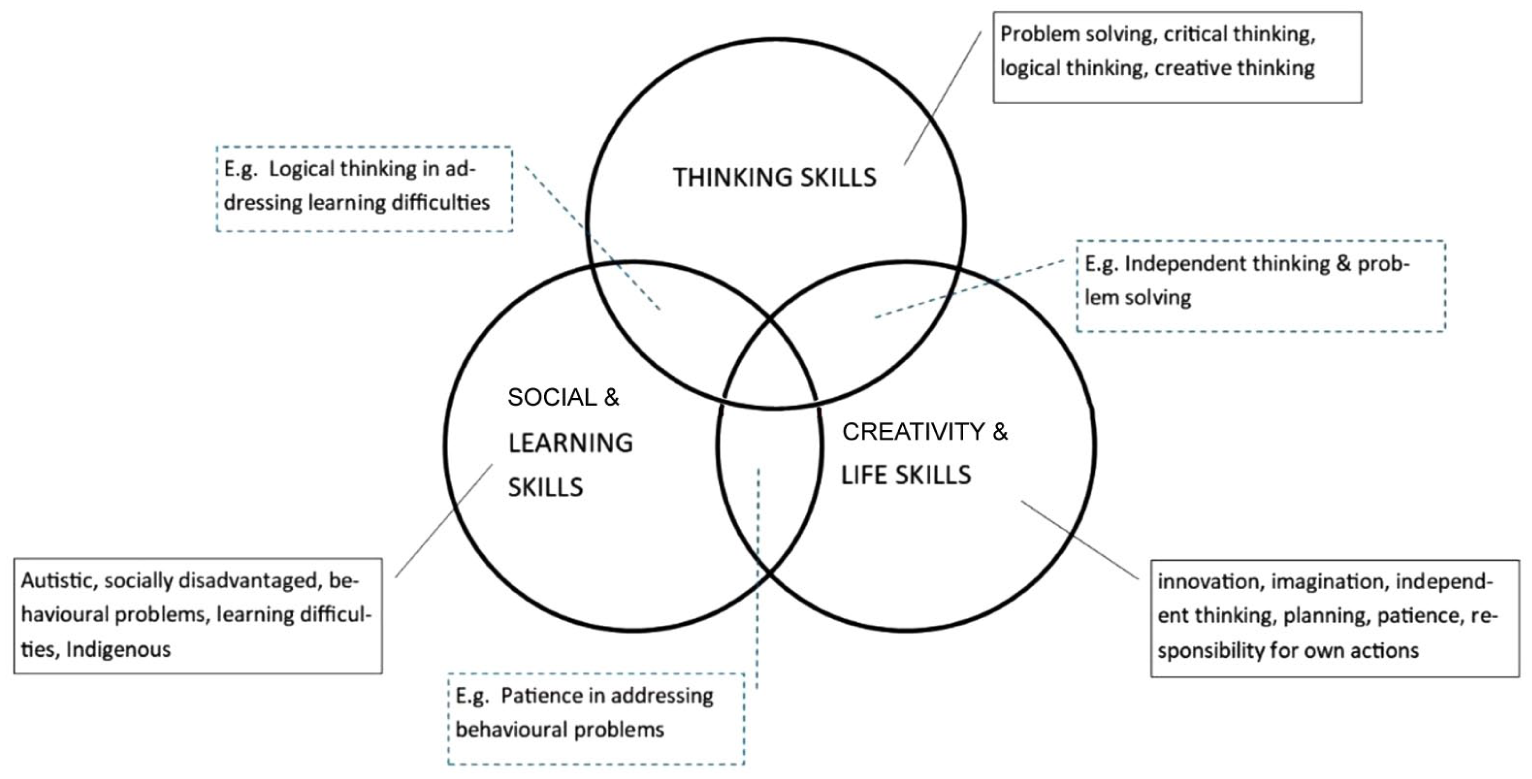
Proposed typology of educational benefits associated with learning to play chess. The typology includes thinking skills, creativity and life skills and benefits for those with social and learning difficulties.
Conclusion
The findings of the study provide triangulated quantitative and qualitative evidence that learning to play chess is associated by stakeholders with educational benefits for children as reported in the literature. However, the results suggest that stakeholders do not associate the benefits of literacy and to a lesser extent numeracy, with playing chess compared to other cognitive, social and creativity benefits. This would suggest that future research should shift from a dominant focus on literacy and numeracy scores to those represented in the typology. Based on this, the foci of future studies may draw on cognitive behaviour theories, learning theory and psychological theories such as mindset theory.
The sample adequately represents the population of interest in terms of the qualifying criteria used to determine ‘stakeholders’. However, it is only representative of the context within which the sample was collected, the associated education system and the chess in schools programme of the Queensland education system. While it is likely that other education systems will yield similar results, this cannot be inferred.
The study sample is made up of parents and educators. While it was not within the scope of the study, further analysis and future studies should focus on these groups separately as the ‘stakeholder perceptions’ line of enquiry develops.
The limitations of the study include its preliminary nature and sampling parameters. The sample size was good, however the sampling was not randomised and therefore could not control for self-selection. The paper’s findings do not claim to be generalisable to the population (stakeholders of primary schools) although it is proposed that similar findings would be evident in other Australian communities. Further studies are required in other jurisdictions to confirm or otherwise, the results of the study.
The study identified three key areas which stakeholders believe have the most advantages for children; (a) helping those with various social or learning difficulties, (b) contributing to the development of creativity and life skills and (c) assisting in cognitive development associated with problem-solving, critical and logical thinking skills. The EFA analysis provided insight that creativity clustered with life skills, problem-solving, critical and logical thinking. A small number of studies have shown promising results in increasing creativity among very young children who learn to play chess (e.g. Sigirtmac, 2016).
What is surprising is that very little quantitative research involving schoolchildren has been conducted into the relationship between the three typographical areas identified by the study, their elements and learning to play chess. Instead, most research has focussed on whether learning to play chess leads to improved standardised test scores (especially numeracy, and to some extent literacy, outcomes of education).
There is increasing recognition that general capabilities, or 21st century skills as they are often called, are essential early learning outcomes. There is a growing consensus that these skills must be cultivated to help learners succeed in modern society and that embedding them within existing education systems should be a priority (Roseth Valerio et al., 2016; Scoular et al., 2020). To this end, further research is warranted into confirming or otherwise the results of this study, extending similar studies to other contexts and focussing on lines of enquiry that investigate the educational benefits of a particular type. The study also reveals a distinction between educational benefits attributed to learning to play chess, and practising and competing in chess which should inform future studies. Further, future studies may also seek to note the relatively low scores as they relate to standardised test scores of literacy, IQ and to a lesser degree, numeracy, and heed the advice provided by Sala and Gobet (2016) that further studies in this regard are no longer warranted.
Footnotes
Acknowledgements
N/A.

Ethics Approval
N/A.
Funding
The authors received no financial support for the research, authorship, and/or publication of this article.
Declaration of Conflicting Interests
The authors declared the following potential conflicts of interest with respect to the research, authorship, and/or publication of this article: The author of this study, Graeme Gardiner and his wife Wendy Gardiner founded Gardiner Chess in 2002. Upon their retirement in December 2015 they sold their business to their two senior staff members, Andrew Fitzpatrick and Justine Jule. They still own the business as of October 2025. Gardiner Chess kindly emailed their database with a copy of the author’s survey of stakeholders, one of several ways used to contact stakeholders. Apart from this, Graeme Gardiner has done occasional paid work supervising students from Somerset College at inter-school chess competitions conducted by Gardiner Chess and voluntary coaching at Somerset College. This has diminished to almost zero in the latter years of this study. Gardiner Chess kindly allowed the author to keep his Gardiner Chess email address, which is one of three email addresses used by the researcher.