




Abstract
In the west, truth is being eroded by post-modernist ideas such as alternative facts. Once truth is no longer valued it is a short route through nationalistic populism to fascism. To combat this we need to establish the idea of ‘veritocracy’ as a form of government. A veritocracy is a democracy in which truth is so highly valued that promising to tell the truth will become a central feature of politicians’ election manifestos feeding back the idea of veritocracy deeper into national culture. A proper understanding of the nature of science can support the idea of veritocracy. This proper understanding will not repeat the mythology of post-World War II philosophy and history of science, but will begin with the much more socially cognisant revolution in our understanding of science that began in the 1960s and 1970s. Nevertheless, a ‘wave three’ of science studies will justify science, not as a certainty-maker for policy, but as the way to bet in developing the best understanding of the observable world. The key is that science depends on moral truth in its attempts to develop correspondence truth. Science, like the law, should be a ‘check and balance’ in pluralist democracies and an object lesson in how to pursue truth in decision-making.
The ideal subject of totalitarian rule is not the convinced Nazi or the convinced Communist, but people for whom the distinction between fact and fiction (i.e., the reality of experience) and the distinction between true and false (i.e., the standards of thought) no longer exist.
For there to be communication using language, and therefore any kind of human society, the default assumption must be that people intend to tell the truth most of the time. If one has no idea whether someone intends to tell the truth, what they say, and its opposite, are equivalent and therefore meaningless; that destroys communication. Note that if you know a speaker is lying, it is possible to extract quite a lot of meaning from what is said: communication collapses entirely only where the distinction between truth and lies disappears. This is the realm of ‘alternative facts’ and ‘post-truth’, not the realm of liars. President Nixon had a great respect for truth and that is what made him such a determined, and for a time, successful, liar. President Putin's aim is to confuse his audience to the extent that his utterances no longer fit the category of truth or lies. Trump and his cohorts seem to be influenced by Putin's approach rather than Nixon's.
As a sociologist of science, my ambition along with some of my colleagues has been to counter the erosion of truth in western societies by changing the culture. Because culture and language are intimately related, and because we have no financial, or direct political power, we hope to do this by changing the language. We want to introduce a new term into western political discourse that will revive the respect for truth: the term is ‘veritocracy’. 1 A veritocracy is a democracy in which truth is a central political value. If that term were to gain currency and respect, we think it would help to safeguard truth. Of course, it will not be one word alone that makes the difference, but a new word will encourage a new network of discourse and debate, and networks of words carry moral and practical consequences with them. 2 We are going to start building this network by suggesting that the idea of veritocracy is intimately related to the role of science in democracy and we will try to show how to use this to the advantage of truth. But science and truth have to be properly understood.
Three waves of science studies
In the early 1970s, I was one of the pioneers of the sociology of scientific knowledge. In 2002, I was the co-author of a much cited and somewhat controversial paper that partitioned the evolution of science studies into two ‘waves’ and proposed a third wave initially to be focused on the analysis of expertise. Sociology of scientific knowledge is the foundation of wave two. 3 Although the content of the 2002 paper is well known among both adherents and critics in the science studies community, now more often referred to as the science, technology and society (STS) community, it seems sensible to reprise the three-wave schema because it is a framework for the argument presented here. The current argument is intended as a further contribution to the third wave. 4
Wave one
The first wave in the study of science reached its apogee in the years following World War II and was underpinned by the philosophy of science. It reached towards what Karl Popper (1959) would call The Logic of Scientific Discovery. 5 The crucial feature of the first wave was to explain how it could be that science was the only kind of knowledge-making that stood above society and its influence. Science escaped from the dizzying implications of the sociology of knowledge, which holds that everything we think we know emerges from the circumstances of our early socialisation and subsequent upbringing and which varies palpably from society to society. Science, however, seemed to stand above both society and societies, generating universal knowledge from within a shared culture that transcends and cuts across national and local cultures. In those days, history of science confirmed the logic of scientific discovery in its redescriptions of classic scientific discoveries and breakthroughs, whereas sociology of science, under the leadership of Robert Merton, explained the norms of science that described and enabled its transcendence. These norms acquired the acronym CUDOS, standing for: Communism (common ownership of scientific discoveries); Universalism (which means that anyone's scientific claims should be examined irrespective of race, gender, creed or other personal characteristics); Disinterestedness (which means scientific claims should be evaluated without reference to one's personal preferences); and Organised Scepticism (which means that claims should be subject to criticism and debate). 6 Among thinkers about science there have always been those pointing to aspects of science's provisionality and uncertainty but if one wants to try to capture the spirit of the age, wave one of science studies, bolstered by the success of radar and the promise of atomic power, was what was driving most analysts of science and science media personalities in the years following World War II, and still drives much of science's presentation to the public.
Wave two
The 1970s saw a new approach to the analysis of science that affected sociology of science, history of science and philosophy of science, along with anthropology and ethnography of science. It gave rise to a unified subject initially called ‘science studies’. The new approach was based on detailed observations of science in practice rather than retrospective analyses of science's successes or on theoretical analyses of its logical structure. Science studies expanded greatly from 1970 onwards. The inspiration might well have been Thomas Kuhn's book, The Structure of Scientific Revolutions (1962), though Wittgenstein's later philosophy provided the detailed philosophical perspective for many of the early analysts and, as is often the case when revolutions are proclaimed, many earlier precursors can be found. 7
To a student of sociology like myself, immersed in that tradition, playing Popper off against Lakatos (1970), the new idea that the history of science was characterised by paradigm revolutions, thus exhibiting its own cultural ruptures and incommensurable schisms, and having its own sociology, was a break with the past. In my particular case, it was easy to grasp because chance had led me to be deeply immersed in Winch's (1958) exposition of Wittgenstein's notion of form of life, with its combination of practice and language, and the notion of paradigm was simply a form of life applied to science. But one can see how revolutionary it was for those who had not been so exposed. Indeed, it gave rise to great resistance from some scientists and especially certain philosophers, who wanted to go back to wave one's understanding of science and embarked on what became known as the ‘science wars’. 8 For example, an early ‘science warrior’, Israel Scheffler (1967), described science a la Kuhn as ‘mob psychology’, though the reception among scientists of the amusing but philosophically shallow ‘Sokal hoax’ was perhaps, a better example. 9
Wave two grows and gives rise to democratisation, which aligns with populism
By the early 1970s, and through that decade, wave two of science studies developed and grew, giving rise to its own paradigm revolution within science studies. Wave one still gripped the powerful academic institutions, but one could see it crumbling and by the end of the decade there could be no doubt where things were going in spite of the vicious reaction from scientific and, particularly, philosophical conservatives. Field studies of science in action flourished and in my own work I was lucky enough to ‘discover’, or stumble across, the experimenter's regress (Collins, 1985) – it certainly felt like a eureka moment in the way the ‘discovery’ cut through the standard scientific claim that scientists could always tell what was true and what was false through experimental replications. Anthropologists entered the fray, while the work of historians could now be put to new uses, showing that the myth-like accounts of the crown jewels of science, re-told over and over again in the science textbooks, painted over the disputes of the time. Historical analyses now often showed that those disputes looked very like what goes on in contemporaneous studies of the ‘social construction’ of scientific knowledge. 10
Wave two's dominance increased, and as strong interest emerged in showing that now that science no longer stood above society but was part of society, it was no longer universalistic but came complete with social influences. This led to the claim that science not only did not, but should not, stand outside democratic politics. The old debates about the relationship between science and democracy going back to Dewey and Lippmann were revisited and interpreted accordingly, with Dewey being seen by many as the hero and Lippmann the undemocratic villain.
11
Science was now all too easy to see as being controlled by an elite with unjustifiable power, based not on election to office, but chosen through the procedures of closed-door societies belonging to the esoteric world of fellow professionals. The new way of looking at the world was symbolised by the invention of the term ‘lay experts’, intimating that ordinary peoples’ views about scientific matters had as much right to be heard as the views of professional experts because the experts were no longer immune from the social influences and self-interest that affect the rest of us. Thus, Sheila Jasanoff (2003, pp. 397–398), emerging as the most successful of those championing the democratisation of science, wrote: [T]he presumption in democratic societies is that all decisions should be as far as possible public; it is the exceptions that require justification. … expertise is constituted within institutions, and powerful institutions can perpetuate unjust and unfounded ways of looking at the world unless they are continually put before the gaze of laypersons who will declare when the emperor has no clothes.
The practical meaning of this kind of claim was made clear in democratisers’ support for the revolt against the deployment of the measles, mumps and rubella (MMR) vaccine. The revolt had been triggered by Andrew Wakefield's notorious article in The Lancet (Wakefield et al., 1998), which could be interpreted as indicating that the MMR vaccine could cause autism. Many parents, experiencing the agony of seeing their child exhibiting the symptoms of autism shortly after administration of MMR vaccine, and supported by newspapers with an eye for a ‘balanced’ story, were sure that the temporal relationship was a causal relationship in spite of epidemiological studies of populations showing no relationship.
Another democratiser was Brian Wynne (1989). Work like his gave rise to the term ‘lay expert’ consequent on his study of Cumbrian sheep farmers. 12 This widely cited study showed that the sheep farmers had knowledge of sheep ecology that should have been used in scientists’ analysis of post-Chernobyl sheep farming in the Cumbrian fells. The point is, however, that the farmers were not ‘lay experts’; they were an elite body of experience-based experts. Wynne, championing the much more general lay expert idea, formed a powerful alliance with Jasanoff and sided with the parents in the MMR controversy. Both Jasanoff and Wynne were judicious in their printed statements and this remains so in their contemporary view of the anti-vaccine position that is found well represented among the public. However, their anti-MMR view was clear in their various live conference presentations although they have not defined their position in respect of Covid vaccination nor explained why or whether it differs; why should the public's view of Covid treatments not be taken into account just as they wanted it taken into account at the time of MMR?
These events were part of what triggered Collins and Evans to write their 2002, paper analysing the history of science studies as comprising two waves, with a third wave needed. The remark by Jasanoff quoted above is found in an intemperate response to that paper, claiming, among other things, that it was an attempt to go back to technocracy; Wynne was also an author of such a response. 13 Like the science warriors, they preferred (and prefer), not to address the problems of their position – particularly the problem of extension. The problem of extension follows from the extent to which science has to be an elite enterprise. The alternative poses the problem: should the right of holding a scientific opinion be extended to the general population so that science merges with democracy? 14 Jasanoff and Wynne preferred to ignore this problem and instead address the popular sympathy for anything that smacks of so-called ‘democracy’ when opposed to elitism without looking at the other side of the equation and its uneasy consequences for the meaning of science in its role of advisor to policymakers.
The rise of populism has increased the importance of this debate still further. In the current context, it is easy to see that if we want to maintain a system of checks and balances in western democracies that can control the actions of populist governments, then at least some of those checks and balances must have power born out of their technical expertise and this means they must be elites. The unpopularity of science strikes a chord with conspiracy theorists and anti-vax groups, and these might well support the sentiments expressed by Jasanoff. But the idea that there is an inevitable conflict between elite experts and democracy is easily seen to be false by considering the way things work in respect of the law. For example, in the UK, when Prime Minister Boris Johnson wanted to prorogue parliament so as to push through Brexit without parliamentary opposition, elite judges prevented him by invoking the illegality of the move. Indicatively, a Brexit-supporting, right-wing newspaper, the Daily Mail, dedicated a front page to a photograph of the principal judges with the caption ‘enemies of the people’ (4 November, 2016). In the United States, of course, the rule of law seems in danger because of the influence of the people, via the elected president, on Supreme Court appointments. But both the Daily Mail and the evolution of the Supreme Court align with the democratisers’ sentiments whether they intend it or not.
Wave three
Setting aside the democratisation movement, which is aligning itself with the abandonment of the checks and balances that could resist populist dictatorships, inadvertently we must presume, wave three addressed the problem of how to justify science in the light of wave two. The ‘science warriors’ simply attacked wave two, wanting a return to wave one. Wave three accepts the findings of wave two – indeed, as explained, wave two's initiators included some of the proposers of wave three – but wave three does not accept the consequences as interpreted by some of the democratisers. Instead, it tries to address the difficult problem of how to maintain the central role of science in western societies, crucial to democratic politics, without going backwards in our understanding of science. Wave three accepts the analysis of wave two but not the advertised political implications.
The first and least controversial move was away from analysis of the construction of truth and towards the analysis of expertise in general and scientific expertise in particular. A number of new and seemingly enduring concepts were developed based on the idea that expertise was a matter of socialisation into an expert community, which could be of any scale from nation to small groups of specialists or hobbyists, all overlapping and embedded within one another, what we have called the ‘fractal model of society’ (Collins et al., 2020). Other new ideas that arose out of the emphasis on analysing expertise included the concept of interactional expertise, granting a new power to the acquisition of the specialist language of an expert group in the absence of the ability to execute the practical skills, and its distinction from, but complex relationship with, contributory expertise – the execution of specialist skilful practices. This distinction made it possible to make sense of the division of labour in specialist domains. Another new idea was that of ubiquitous expertise, which is the genuine expertise of lay persons acquired as they become fluent members of their native society. The term ‘lay expertise’ arising from Wynne's analysis of the sheep farmers, should have been ‘experience-based expertise’; ‘lay expertise’ confounds the expertise of small specialist, but scientifically unqualified groups, such as the Cumbrian sheep farmers, with what the public at large could know. Ubiquitous expertise, such as natural language speaking and an understanding of the behaviours and taken-for-granted moral code of a society – the proper separation of those on a sidewalk is a standard example of ubiquitous cultural expertise – is expertise proper, but belongs to entire native groups who are not elites within their own societies, but who possess expertise that members of other societies may not. 15
Science truth and democratic politics in wave three of science studies
Truth and its complications
Wave three of science studies is now moving on from the analysis of expertise to consider the political role of science and especially its relationship to truth in society. It is argued here that a proper understanding of the nature of science and its relationship to truth, shows how science can form a foundation for a veritocracy. One has to be careful with the idea of truth because it has (at least) two common meanings: ‘correspondence truth’ and ‘moral truth’. 16 Correspondence truth means ‘corresponding to reality’; moral truth is the aspiration to tell the truth irrespective of whether correspondence truth is achieved. To take an example from science, when physicists claimed that energy and mass were conserved, they were not lying, they were aspiring to tell the truth; it has turned out that they were sometimes wrong about the correspondence truth, but not wrong about their truth-telling intentions. 17
Science involves both kinds of truth. Science's end is to uncover the truth in the sense of correspondence to reality, but scientists know that to get there it is important not to lie or deceive in reporting the implications of their theories or the outcome of their experiments. So, the institution of science practises moral truth in the quest to reach correspondence truth. 18 Of course, there are individual scientists who are corrupt, but the institution of science would not work as science – a route to correspondence truth – if it was typified by corruption. Science works, even when it is failing to find correspondence truth, because moral truth is so robust as a concept and as a practice within the institution of science.
So important are both kinds of truth to scientists that they guard the boundaries of their professional interactions so as to allow in only those with the appropriate moral and specialist socialisation. They do their work in ‘core-sets’, which are small social groups. As in all communication, trusting the wrong people can be costly but in science it can lead to an indefinitely large waste of money and effort pursuing the wrong technology, to the discrediting of the whole institution of science, and to the demise of science as a check and balance on the power of governments. 19
Trust is everywhere in science. Here are two examples from the field of gravitational wave detection. First an example of personal trust: for many years Russian scientists claimed to have measured very good quality factors in sapphire crystals, but no one outside Russia could repeat the measurements. The quality factor, or ‘Q’, of a crystal is the length of time it will ring (like a bell) if set into vibration and a high Q would be important for the mirrors in the next generation of gravitational wave detectors. In 1999, a scientist, pseudonym, ‘Checkov’ travelled to Glasgow to show other scientists how to repeat the Russian measurements but after a couple of weeks of effort with his help they were unable to accomplish it. Every indication was that the claim had always been incorrect. But Checkov left such a good impression of sincerity and conscientiousness that the Glasgow scientists, instead of declaring that they had uncovered a mistake or a fraud, continued to try. Eventually they achieved the desired result. In that case, a subtle display of personal integrity led to persistent effort at replication and eventually to the international acceptance of a scientific claim. 20
Moving to a more general level of analysis, as Duhem (1908) pointed out, every scientific claim rests on a network of assumptions that remain stable only as long as scientists agree not to question them. In 2016, shortly after the announcement of the first detection of a gravitational wave, Barry Barish, one-time director of the project and soon to win a Nobel Prize, was invited to present the details of the discovery at a meeting of CERN scientists. A member of the audience remarked, correctly, that the whole story of the discovery depended on the assumption that gravitational waves travelled at the speed of light – something that had never been directly demonstrated. Another member of audience riposted that if questioning assumptions of this generality was allowed, they would soon ‘undiscover’ the Higgs Boson. 21
Experimenter's regress, taken-for-granted assumptions, the fringe and conspiracy theories
Science is a skilful activity but many of the skills comprise tacit abilities that cannot be explained. In disputed areas, this leads to the ‘experimenter's regress’, which states that unless you already know what the outcome of an experiment is supposed to be you cannot know whether that experiment has been carried out successfully and therefore you cannot know why an experiment has failed to reproduce a result. You do not know whether a negative result is a negative replication or an experimental failure. This means that replication cannot be used as a straightforward test for disputed claims, and arguments about such things may turn into a search for proxies for competence and integrity on the part of the scientists; such proxies include personal trust and institutional affiliation. 22 This makes it easy to understand the continued existence of ‘fringe science’ among the body of qualified scientists, and easy to understand the existence of conspiracy theories among those more distant from the expert community: these are both maintained through willingness to question the background assumptions and the relations of trust that support the orthodox claims. Because the persons who are disputing orthodox claims are found further from the mainstream, they are willing to question more and more radical assumptions. Fringe scientists from inside the community may question, for example, esoteric but unobservable features of relativity theory, or the properties of sapphire crystals that they have never been in a position to measure themselves. Similarly, anti-vaxxers from outside the biomedical community may question the veracity of the drug companies or the effect of viruses on human health (Figure 1). 23
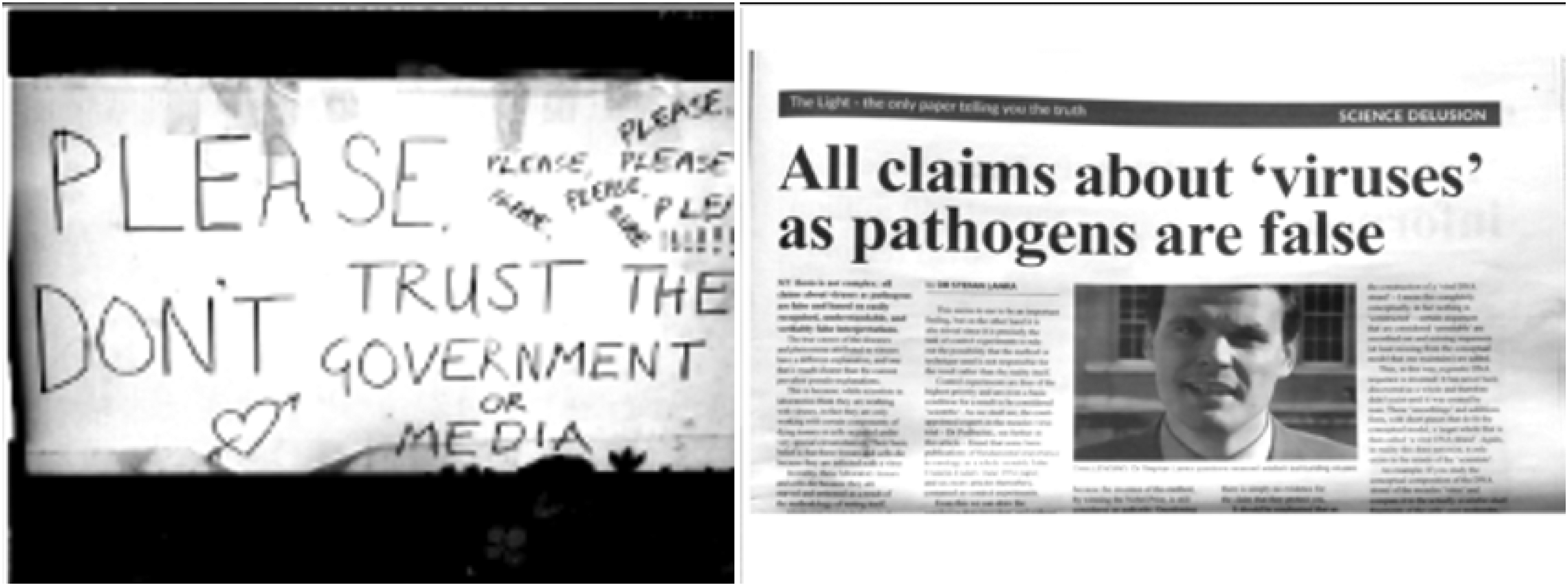
Anti-vax appeals in a shop window (photograph by author, 2020).
None of this is difficult to understand in terms of the ‘logic’ of the situation because all groups of science consumers, including scientists themselves who have continually to ‘consume’ science that they have not carried out directly, depend on hearsay for their knowledge of science. You, dear reader, almost certainly have no direct evidence of the esoteric features of relativity theory or of the veracity of the claims of drug companies: you simply believe what you have been socialised into believing. Even if you are a biomedical scientist or practitioner, you almost certainly have no evidence of the effect of viruses of human health beyond hearsay, because even reading scientific papers provides little more than hearsay and even experiments have to be interpreted. You just interpret what you see in terms of that hearsay, including how the community has decided how to interpret experiments. So, it is almost certainly the case that the difference between the views expressed in the shop window, as shown in Figure 1, and your views are largely a matter of which assumptions and which institutions you have chosen to trust.
This is an important point because it also draws attention to the cure for the malaise in the presentation of scientific knowledge and supposed scientific knowledge encouraged by social media and the like: the cure must be public trust in the institution of science, not individuals’ trust in particular scientists and certainly not an individual citizen's ability to make esoteric technical judgements – we do not have access to indicators of individual scientists’ trustworthiness or the ability to make such technical judgements unless we are lucky enough to be the equivalent of members of the group who hosted the scientist from Russia who came over to demonstrate the right way to measure the Q of sapphire (and failed). Otherwise, we have to deal at the level of institutions. The fringe scientists and conspiracy theorists just choose to trust and distrust different sets of institutions from the rest of us.
Crown jewels, trust and policymaking
What has to be worked out is how to get people to trust the institution of science without the full-scale socialisation into an academic elite that causes you and me to trust those institutions. One difficulty is what has to be trusted in most policymaking scenarios is an institution that is not delivering a perfect kind of truth but is still resolving internal disagreements. The speed of politics is faster than the speed of scientific truth formation that gives rise to the iconic ‘crown jewels’ of scientific discovery. Policy science is nearly always science in the making, whereas our image of scientific truth formation is itself formed by retrospective accounting. Consider one of the crown jewels of science: the 1887 Michelson–Morley (MM) experiment which revealed that the speed of light was a constant. The way this experiment is described in physics textbooks is as ingenious and convincing. The experimental result was published in 1887 and is said to have been conclusive enough to have caused concern among the physics community by the time the measurements were completed. The results gave rise to a troubling anomaly, which was not resolved until Einstein came up with his 1905 paper that showed why the speed of light in space should be a constant.
The standard account of the MM experiment is a useful resource for teaching physics and also appears in the popular literature. Thus, Steven Hawking in his A Brief History of Time (a popular book found on the bookshelves of many households, even if, like the Latin Bible, no one understands it) writes: In 1887 Albert Michelson and Edward Morley carried out a very careful experiment at the Case School for Applied Science in Cleveland. They compared the speed of light in the direction of the Earth's motion with that at right angles to the Earth's motion. To their surprise, they found they were exactly the same! (Hawking, 1988, p. 20)
But more detailed historical reconstruction tells a different story (Collins & Pinch, 1993/1998). The MM experiment was meant to work as an Earth speedometer, to indicate the speed of the Earth as it passed through the aether in different directions, by measuring the apparent changes in light speed. But no such changes could be measured so the experiment was abandoned as a failure before it was completed in the way required to demonstrate constancy of the speed of light. A series of improved experiments of the same type were then carried out in various places, the most elaborate being conducted in the 1930s. This one did find a small difference in light speed according to direction of earthly travel. All these experiments were subject to the experimenter's regress until relativity became firmly established. It has been said that no really satisfactory MM-type experiment that found constancy was conducted until around the 1950s even though consensus about the constancy of the speed of light was established much earlier by other means.
Although the retrospective account might be useful for teaching physics, it is misleading as a representation of science for science policy. Science for policy is nearly always in the formative stage or is of a type that cannot produce exact answers. Science for policy is much more uncertain and invites questions about the special interests of those who produce it and whether it should be carried out by diverse groups who represent the different interests found among the public. If the answer to the latter question is yes, then ‘the problem of extension’ must be solved.
Consensus in respect of the theory of relativity resolved the experimenter's regress. Exactly when that consensus was reached is hard to say although it was decades after 1887. Any MM-type experiments that were done after the consensus had formed and found anything other than constancy for the speed of light are counted, in virtue of that fact, as incompetently performed. But reading back all the way to 1887 reinforces the public image of the MM experiment and of science in general as a producer of crown jewels with exact outcomes, and sets up the conditions for disillusion and criticism of science as a producer of policy advice. 24
The uncertainty of science at the policy frontier does not present a problem because, assuming they are honest about the advice they are being given and the way they have assessed it, we want elected politicians, not scientists, to make the final policy decisions. Room for manoeuvre in the science is perfectly acceptable. Indeed, we want politicians to make the decisions even when the science is pretty certain, so long as they explain why they are going against established scientific wisdom if that is what they choose to do. To have the scientists making the policy decisions would be ‘technocracy’.
What politicians should be doing is leaving scientists to do their best to settle their disagreements in the political time frame, but within their tightly guarded competence networks, listening to what they say, making an assessment (aided by social scientists as suggested in Collins and Evans, 2017), about how strong the scientific consensus is, and then making clear just how the science has fed into their political choices. But for that to work, politicians and ordinary citizens have to agree that the institution of science is sufficiently trustworthy to leave at least that much of the input to policy – the advice on matters of science – to the institution of science.
Science has to play the same kind of role in society as the law, an institution that everyone agrees requires professional elites with enough respect to interpret the rule of law even when it means saying ‘no’ to politicians. Science has to be accepted as being an elite institution too, one that may not have the final policy word in the way the law has the final policy word, but one which has the respect to be taken seriously enough to merit public explanation on those occasions when it does clearly contradict politicians’ conclusions. Politicians can override science in such circumstances, but in a veritocracy they would be obligated to explain why they are doing it and that means they have to be honest about the science.
But why should we trust the less-than-completely certain conclusions produced by the institution of science when put to work in the time frame of policymaking any more than we trust any other institution? The answer goes all the way back to trust and truth. Science is an institution that aims to discover correspondence truth and when it is on its way to discovering it is wedded to moral truth because it knows from logic and experience that there is no hope of finding correspondence truth unless the discoverers cleave to moral truth. That being the case, we need to ask only one question: when we want our politicians to take advice in respect of the observable world, what kind of institution do we want it to be given by? The obvious answer to the question does not deliver scientific certainty but it shows the way to bet – go for the institution where honesty is integral to its activities.
There are, of course, a long list of related features that make science the most suitable institution for delivering advice about the observable world but all these rest on the aspiration to find correspondence truth via moral truth. These include:
Science aspires to know what it is talking about through observation and experiment. Science aspires to be clear in its claims so that it can be subject to meaningful criticism by peers. Science restricts the locus of legitimate interpretation and criticism of its claims so that critics are producers of the relevant specialist knowledge or close to the producers. Science adopts procedures to ensure disinterestedness: the intention to corroborate, to replicate, to be subject to falsification, to do double-blind trials and statistical tests and so on, are all associated with the values of correspondence and moral truth even if they do not work as mechanically as was once believed. Science's methodological and social values align with universalistic truth in all its senses. Science guards the boundaries of knowledge-making, valuing the face-to-face and resisting the internet.
Alternative truths: How can we regain respect for science?
The list of alternative facts put into circulation by the Trumpists includes the claim that his inaugural crowd was bigger than Obama's, the claim about the efficacy of alternative Covid cures and the futility of masks and lockdowns in controlling the Covid pandemic, the non-reality of anthropogenic climate change, and the claim that Trump won the 2020 election, but it was stolen by the Democrats.
The second, third and fourth of these depend on evidence to which we, the public, have little direct access. The only way we can decide whether alternative cures work, and masks do not, is through our assessment of the institutions and individuals issuing the claims. We do, however, have some slightly better access to the value of lockdowns via international comparisons of death rates (which no one seems to be questioning). Recent extreme climate events are providing some strong indications about climate change, even though we will not be completely certain until it is too late to do anything about it. What we know about the 2020 US election comes from the mass media at best. But the first claim, about the inaugural crowd, is extraordinary in its boldness because there were photographs showing it was false and, surprisingly, they do not appear to have been doctored by allies of Trump. Kellyanne Conway, when she announced that the Trumpists’ account of the size of the crowd was an ‘alternative fact’ was, it seems, ‘going for broke’: from the outset of the Trump presidency the public was to be educated into the idea that Trump's statements about what you could see in a photograph were the facts, not what you as an individual could see in a photograph. What Trump and his cohorts said was, henceforward, to be the new source of truth of every kind. But, for most of the public it appears it did not work: the large crowd story does not seem to have gained traction. Furthermore, the public when faced with reported death rates from Covid in different countries seem to have understood that the United States handled the pandemic badly and that ignoring medical advice for the sake of political sloganising was not the best way to run a country. Perhaps reports from Bolsanoro's similarly ineffective approach in Brazil bolstered their views of what was happening the United States. It is not hard to find commentators who believe that Trump's handling of the pandemic turned the election against him in 2020. The idea that climate change caused by humans is real is also gaining traction, perhaps because of the increase in extreme weather events. As for the 2020 election being stolen, the United States appears divided, with Republicans being all too ready to believe it. But Republicans are not everyone and Trump has made it politically dangerous for Republican politicians not to align their public statements with his on this issue whether they really believe them or not. Nevertheless, the more people say the election was stolen, the more the credibility of that alternative fact grows, accelerating the erosion of truth in general. Looking at these four examples and relying on our (my) ubiquitous expertise as a citizen of ‘the west’, it does not seem as though the idea of alternative facts has yet become a dominant theme among more than certain sectors of the American public, although another Trump, or Trumpist, election victory in 2024 may turn the tide of truth, leaving us beached on the mud.
Changing the language
As powerless academics, our best means for changing culture is changing the language. A natural language is not just a set of symbols for communication, it embodies moral and practical understanding. Hence, we want to introduce the neologism, ‘veritocracy’ and encourage the associated language to become entrenched in academic and popular discourse.
What is a veritocracy? It is a democracy in which the idea of the value of truth has become so entrenched in the general culture that those mounting political campaigns would find it attractive to voters to include a promise to tell the truth; the value of truth would become still more attractive as it becomes reinforced by the positive feedback of campaign affirmations. Honesty among politicians will grow to become a component in what economists call the ‘utility functions’ of ordinary citizens because honesty will, once more, be a formative component of the language. When we learn a native language, we learn a moral code along with it and people learning the term ‘veritocracy’ and its associated network of terms will be learning that the citizens of veritocratic countries value honesty above many other things they might desire.
Veritocracy is a neologism because there was no need for such a term in decades past. In the childhoods of the oldest among us, it was known that palpably dishonest politicians would not attract votes, and it was known that politicians caught lying in the course of parliamentary business would resign. But the antics of Trump and Johnson and their cronies have made it clear that this this is no longer taken for granted in the west. It is true that Johnson was forced out by his parliamentary opponents after one lie too many, but that was only after he had told far more lies than most British people believed a prime minister could survive. And even after he left, the strongest candidate to be his successor was one of his closest allies who had refused to take part in the revolt against him or criticise his attack on truth, someone who one might have thought would be automatically disqualified from the leadership. 25 In the United States, Trump continues to deploy the lie about the election result to win nomination for himself and his favoured candidates.
In a veritocracy, none of this could happen. It is not an impossible idea: we have seen veritocrats in the past. Jimmy Carter's campaign theme promised: ‘a government as good and as honest and as decent and as competent and as compassionate and as filled with love as are the American people,’ … he [would] restore the trust of the people in their government. (Krukones, 1985, p. 137)
And the current leader of the opposition in the United Kingdom, the Labour Party's, Kier Starmer, reacting to the lies of Johnson, has recently promised: ‘what you will always get from me is someone who believes honesty and integrity matter’. 26 So, words that connote a veritocracy have already seen once or twice as potentially attractive in US and UK politics. Admittedly, the Carter example goes back a long way, but it did help to get him elected.
Audiences for the argument
Who are the audiences we are targeting for the argument about veritocracy? Inevitably, our first audience must be fellow academics, in particular, philosophers and sociologists, with a focus on sociologists of scientific knowledge. The popularity in the STS community of the democratisation of science idea, irrespective of its alignment with populism, is worrisome. 27 We have to convince this community to modify the never-changing programme of critique of the procedures and outcomes of science; they also need to work out what is good about science and how to say what is good about it. The interpretation of the critique of science as leading to the ‘democratisation’ of science, as an institution, conferring epistemological rights to ‘lay experts’, is a populist programme in the absence of worked out limits. There are no ‘lay experts’; when it comes to the technical content of science – science is essentially an elite activity (like the law) even though lay persons may well collect data or donate their computers’ downtime to the analysis of esoteric problems. This is not to say that there are not experience-based experts in certain domains who can provide valuable input to scientific research, but they should be seen as part of the technical elite with their input evaluated for each specific case, as with all contributors to a technical domain. 28 The STS community must solve ‘the problem of extension’: in so far as those outside the scientific community have rights to contribute to the content of science, how far do those rights extend and where are the boundaries drawn? If that question is not answered, then science collapses into politics.
The argument about the special nature of the institution of science – its end being to discover correspondence truth by operating with moral truth – is directed at the STS community, the philosophical community and the political community. The peculiar nature of the institution of science makes it uniquely suited to be the provider of advice about the observable world even in times when the science itself is uncertain. This is the political argument of the third wave of science studies. It replaces the discovery that science is not as separated from society as we once believed, more obviously in the case of sciences related to policymaking, with the argument that the recognition of the moral value of the aspiration to tell the truth is as universally recognisable as anything is, and is the crucial feature of science even when it falls partially back into the mundane world. The solution to the newfound imperfection of many of science's correspondence truths is not to reduce science to politics, making science as imperfect as politics, but to recognise its special moral value as an institution and to resist rather than celebrate the erosion of science's traditional values.
The general public, we hope and believe, is still open to persuasion that science is the best way to approach questions of policy in respect of the observable world. The esoteric argument about the centrality of truth to science as an institution has had discernible outcomes in the handling of the Covid pandemic and growing fears about climate change. It does seem that many of the general public have concluded over the past few years that diminishing the input of experts into these problems for the sake of immediate political or financial gratification does not lead to the best long-term solutions for them or their societies.
Our hope is that a combination of these arguments and these interpretations of what has been observed will bring science back into public esteem, make it attractive for politicians to endorse honesty and integrity, and create a series of positive feedback loops that will change culture in a direction that prevents the erosion of truth in the west. Honest journalists will be a crucial contributor to cultural change and one of our audiences will have to be the press and broadcast journalists. Perhaps civic education has a role to play too. It certainly has a role to play in explaining how government works in democracies. That role should include a deeper understanding of the way science and government can interact and why science as an institution is worthy of respect as an advisor to governments. Social media erodes truth. To understand why, it is necessary to understand the way that social media penetrates the boundaries of professional elites and the readiness with which powerful media voices can disguise themselves as experts. 29 There is no tension between technical experts and democracy – on the contrary, trusted technical experts are needed to check and balance political power. In a veritocracy, these things would be part of the taken-for-granted understanding of citizens.
Conclusion
I have laid out an argument for and path towards veritocracy as a corrective to the erosion of truth in civil society. The first step was to recognise that correspondence truth was usually a long-term business, whereas the involvement of science with government was a matter of the short term when scientific conclusions had not yet gelled, at least the boundaries of the scientific decision-making community could be recognised in the short term. Expertise was recognisable in the short term before correspondence truth had been established. This argument led to a new sociological understanding of expertise, which seems to have been fruitful. Subsequently, the third wave of science studies has addressed itself not only to the recognition of scientific expertise, but also to the justification of science in the short term, when it cannot be justified by the demonstrable superiority of its findings. Here the main line of argument reverts from correspondence truth to moral truth.
The key point in recent third wave work, at least that associated with the current author and his colleagues, is that even if science can no longer be guaranteed to stand above the melee of social influences, its aspirations as an institution are transcendental, because in aiming at universal correspondence truth they rest, and can be felt to rest, on moral truth, which is a universally recognisable idea. It has to be universally recognisable or there would be no communication and no societies and because there are societies it must be recognisable in all of them. After this comes the simple question: if you want advice about how the observable world is likely to affect the future should you inquire of an institution that has discovered the importance of moral truth and is wedded to the quest for correspondence truth, or should you inquire of some other kind of institution with different aspirations? That is the justification of short-term science as the prime institution for providing such advice. It does not follow that the advice will always be right, but it does seem the way to bet. It does not follow that the advice will leave no room for political choice because the advice will not always be right. It does not even follow that the odds will be short enough to make the political choice an easy one. And it does not follow that even if the odds are as short as they can be, a democratic government must be bound by them. It does follow that a government that is interested in being truthful – a veritocracy – should explain the advice and should explain how its choices relate to both the substance and the certainty of the advice.
Footnotes
Declaration of conflicting interests
The author declared no potential conflicts of interest with respect to the research, authorship, and/or publication of this article.
Funding
The author received no financial support for the research, authorship, and/or publication of this article.
