




Abstract
The use of direct popular votes such as plebiscites, referendums, and postal surveys to determine the right of same-sex couples to marry have proliferated in recent years, particularly across the Global North. By including the public in the decision-making process, serious debates have been fermented about the morality of lesbian, gay, bisexual, transgender, and queer (LGBTQ+) rights. Based on a scoping review of the available English language literature, this paper maps the key findings from 24 peer reviewed studies to offer a cross-national analysis of conflating and diversionary discourses used by pro- and anti-SSM advocates. This paper finds that despite ostensibly being about LGBTQ + sexual rights, these debates commonly conflate SSM with other unsubstantiated ‘threats’, categorised here as operating across the global, national, and individual levels. The findings suggest that SSM debates consistently conflated the issue with international human rights discourses, alongside notions of ‘race’, gender, family, and reproduction as a strategy to garner public opinion. This study reveals a complex network of discourses where the rights of LGBTQ + people are continuously harnessed for political agendas extending beyond the specific efforts to legislate SSM. This paper concludes with the limitations of this review and possible directions for future research.
Introduction
Across a wide range of countries, various methods have been employed to implement laws allowing same-sex couples to marry. Thirty-one countries have legalised same-sex marriage (SSM), predominantly across the Global North. Of these countries, 22 have legalised SSM following direct popular votes 1 via referendums, postal surveys, and plebiscites (Human Rights Campaign, 2022). The methods used to achieve SSM have different degrees of public engagement. For example, while legislation is traditionally developed through parliamentary processes and informed by courts and precedent (Human Rights Campaign, 2022), around the world politicians are increasingly including the broader public in the decision-making process regarding the question of SSM. In doing so, direct popular votes examine public opinions on SSM, often sparking debates on the morality rather than the legality of lesbian, gay, bisexual, transgender and queer (LGBTQ+) rights (Dreher, 2017).
This article examines how SSM debates preceding public votes are frequently imbued with moral panics, which conflate SSM with other contentious issues as a destabilising tactic. This article draws upon Cohen’s (2002) definition of moral panic, occurring when a “condition, episode, person or group of people emerges to become defined as a threat to societal values and interests” (p. 1). In the context of SSM debates, both pro- and anti-SSM groups often use sensationalist discourses that frame their opponent as a risk to their values and goals through the use of heteronationalism and homonationalism (Turner et al., 2018). Thus, SSM is an important institution for analysing ‘othering’ discourses that construct and shape national identity.
Analysing 24 peer reviewed academic articles on public discourses in pro- and anti-SSM debates, the findings reveal how conflating tactics operate at different levels—global, national, and individual. Through the multi-level analysis, I argue that SSM debates are not isolated discussions but exist in a complex system that shape, construct, and uphold social norms. The media, politicians, and activists continuously harness LGBTQ + people and other minority groups for political agendas extending beyond the specific efforts of SSM. Whether one supports or opposes SSM, the hetero- and homo-nationalist discourses ‘other’ LGBTQ + people and the Global ‘South’ alike, significantly shaping the boundaries of global, national, and individual identity.
Whilst there is an artificiality in discussing these levels as distinct, this framework sought to address the diverse scale of conflating discourses used in SSM debates. Given that previous research analysing SSM discourses has primarily had a domestic focus (for instance, see Turner et al., 2018), this scoping review consolidates the English-language literature from diverse locations. To examine the political discourses used in SSM debates, the article first sets out the literature regarding the intersection of discourses, sexuality and nationalism before describing the scoping review methods, a discussion of the key findings and directions for future research.
SSM background
Across the globe, SSM debates have been characterised by two distinct objectives, with countries using direct popular votes to either include or exclude same-sex couples to the institution of marriage. (Figure 1). This binary echoes reductive divisions between the Global ‘North’ and ‘South’
2
in debates about sexual politics, where the former’s supposedly inclusionary stance on LGBTQ + rights broadly are used as a benchmark for evaluating social progress as a whole. In response to growing acceptance of SSM, governments from the Global North and international human rights organisations use sexual rights as the referent for categorising nations as ‘good’ or ‘bad’ and, by extension, the ‘North’ and ‘South’ (Sabsay, 2012). Likewise, SSM is used as a moniker for “the liberal regime of modern citizenship” (Richardson, 2017: p. 212). As a result, the Global North can be seen to use their supposedly progressive position on SSM as a proxy for human right observance (Svensson et al., 2024), and to group all countries opposing SSM as “the bad other” of the ‘South’ (Sabsay, 2012: p. 611). The strategic use of SSM by governments, activists, and international actors highlights the importance of understanding the specific machinations and framings employed in SSM debates. Consequently, the subsequent section unpacks the literature pertaining to discourses, power, and nationalism in the context of sexual politics. SSM public votes across the globe. *The shaded are countries where SSM is illegal as of April 2024.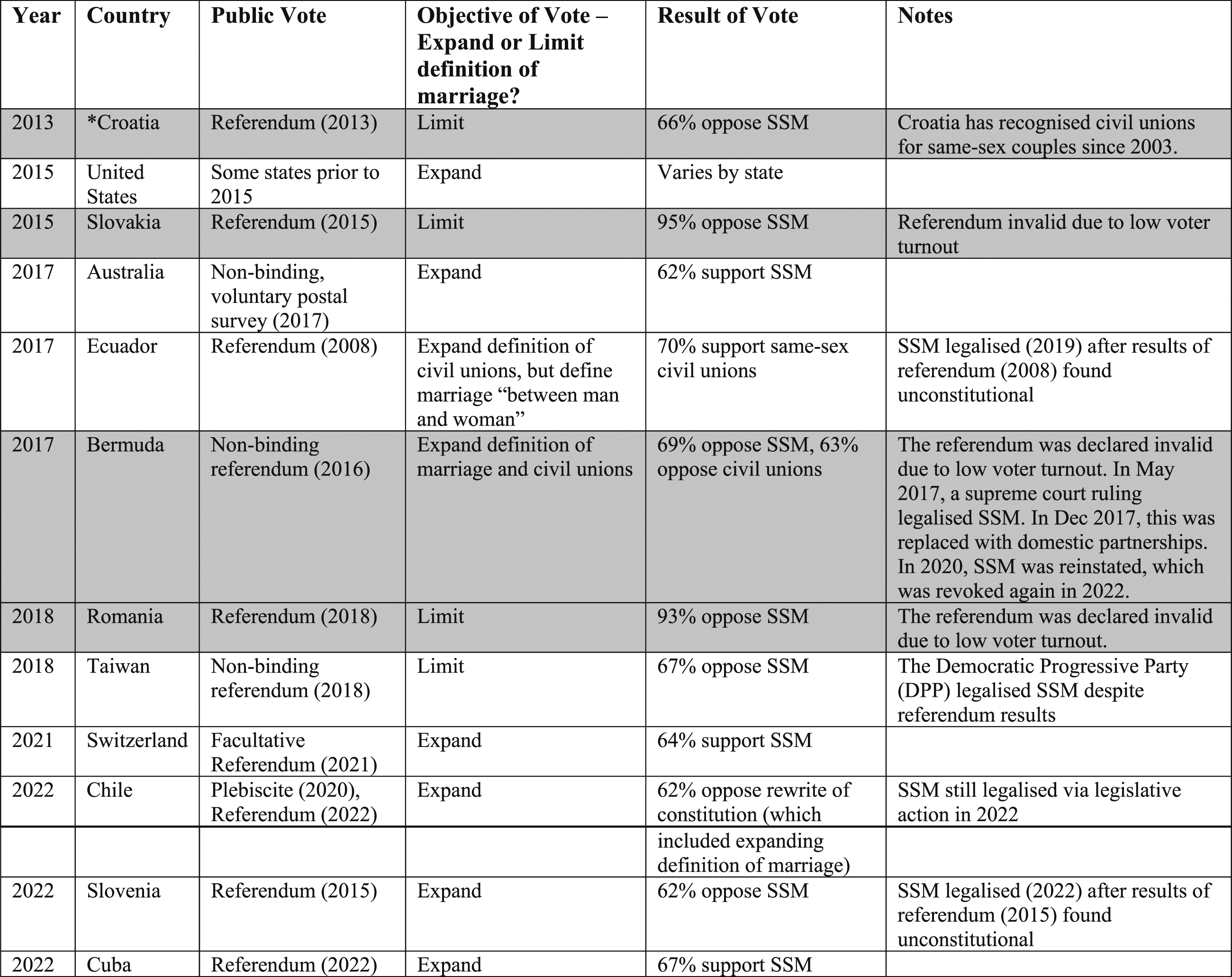
Literature review
Discourses and power
This paper draws on Foucault’s (1972) work that conceptualises discourses as comprising diverse forms of communication, including written texts, spoken words, visual representations, practices and rituals. According to Foucault (1972: p. 49), discourses not only represent reality but actively construct and shape it, functioning as both signs and practices that mould the objects they discuss. Given the power inherent in communication, discourses are crucial to SSM and broader LGBTQ + politics, where the politicisation of gender/sexuality exerts significance influence in the formation of national identity and belonging (Richardson, 2017).
To construct the boundaries of national inclusion, states and popular discourses use ‘othering’ practices categorised by “a few negative and stereotypical characteristics” which are maintained by “physical and symbolic markers of who is part of the nation and who is not” (Slootmaeckers, 2019: p. 243). The definition of the ‘other’ “is at least as important as the question [of] who is included, if not more so” (Slootmaeckers, 2019: p. 243), indicating the objectification of those who do not belong in constructing a nations identity. In Australia for example, the positioning of indigenous and LGBTQ + individuals as ‘others’ through exclusionary discourses, have reified white heterosexual norms (Nicholas, 2020). This instance from Australia underscores the mechanisms that shape broader narratives of national identity and belonging, where the normalised ‘subject’ relies on the marginalisation of minority groups. Using a similar lens, SSM is an important institution for analysing the ‘othering’ discourses that serve as a tool for constructing national identity, which will be outlined in the next section.
Critical perspectives on sexual politics and nationalism
Popular discourses and academic literature suggest that the Global ‘South’ is characterised by LGBTQ + exclusion, while the ‘North’ sets the benchmark for sexual rights; both positions are represented by forms of nationalism: heteronationalism and homonationalism.
While the two “are often discussed as contradictory phenomena” (Slootmaeckers, 2019: p. 256), this binary has been challenged, as both are a form of nationalist ‘othering’, albeit directed at different ‘others’ (Slootmaeckers, 2019). Specifically, heteronationalism, defined by exclusionary discourses and practices targeted at LGBTQ + people, assumes that SSM disregards cultural, religious and racialised differences (Svensson et al., 2024).
While heteronationalism presents itself as a conservative defence of traditional values against perceived Western decadence, a contrasting phenomenon has emerged primarily in the Global North, where homonationalist discourses are employed for alternative political objectives. Puar’s (2007) homonationalism explores the way that the moral panic of terrorism post 9/11 coincided with SSM demands, reconfiguring citizenship of the Global North to include LGBTQ + people at the expense of “racialized terrorist look-alikes” (p. 52), especially Sikhs, Muslims, and Arabs. By articulating immigrants and ethnically diverse individuals as a threat to LGBTQ + progress, such as SSM, this conflation rationalises increased xenophobia and tightened border controls directed at migrants (Puar, 2007; Richardson, 2017). Thus, immigrants are positioned by politicians and the media as a threat to the nation’s efforts towards SSM (Slootmaeckers, 2019).
Building on ‘homonationalism’, Rahman (2014) cautions against objectifying the ‘South’ as victims of exclusionary discourses emanating from the ‘North’. Instead, they suggest a more nuanced analysis can be achieved through the ‘triangulation’ of otherwise one-sided narratives of nationalism and sexuality. Using the term ‘homocolonialism’, they note a conundrum wherein Muslim resistance to LGBTQ + politics is equally intwined with ‘Northern’ supremacy in that anti-LGBTQ + rhetoric acknowledges queerness as something uniquely belonging to the Global North. They note: Resistance to queer rights may be constructed as resistance to neocolonialist impositions, but this premise relies on the acceptance of sexual diversity as the vanguard of Western modernity, leading us back to the original prioritization of Western exceptionalism. Given this process, can we conclude anything else other than Muslim homophobia ultimately reinforces Western exceptionalism? (Rahman, 2014: p. 280)
Utilising ‘homocolonialism’ within the specific context of SSM, countries that oppose SSM reify the ‘North’ as “exemplary markers” (Rahman, 2014: p. 275, emphasis in original) of modernity, leaving the perceived supremacy of ‘Northern’ nations intact through the ‘South’s’ very resistance.
Thus, in both the ‘North’ and the ‘South’, state policies on SSM become representative of a heterogenous group (Slootmaeckers, 2019), where individuals within a state are reduced to their countries stance on SSM. The existing literature on SSM and nationalism predominantly has a domestic focus. Thus, this paper will consolidate the literature to interrogate the diversionary discourses used in SSM public votes across the globe, focusing on pro- and anti-SSM advocates.
Methods
Given the lack of literature that analyses SSM discourses globally, a scoping review was conducted to cross-nationally synthesise findings of available domestic research. According to Arksey and O’Malley (2002: p. 30), scoping reviews are particularly useful for surveying literature in terms of the characteristics of the primary research. Similar to systematic literature reviews, scoping reviews use rigorous and transparent search methods (Pham et al., 2014) but focus on mapping existing literature rather than analysing the quality of studies. This paper adopts Arksey and O’Malley’s (2002: p. 22) scoping review framework. The stages include 1) identifying the research question, 2) identifying relevant studies, 3) studying the selection, 4) charting the data and 5) collating, summarising and reporting the results. The guiding research question was: how do diversionary discourses and political tactics intersect cross-nationally in the context of direct popular votes for SSM?
In December 2023, the online databases ProQuest (Social Science Database/Sociology Database/ProQuest Central), EBSCOhost (Academic Search Complete/SOCINDEX/LGBTQ + Source) and Scopus were employed to search for current literature in this field of study. The following search terms were utilised: AB (Discourse* OR “discourse analys*” OR content* OR language* OR linguist*) and AB (Plebiscite OR referendum OR “postal-survey*” OR “postal survey*”) and “same-sex marriage*” OR “same sex marriage*” OR “gay marriage*” OR “marriage equalit*”. Only peer-reviewed journals and English language chapters were considered. Given the focus on cross-national linguistic techniques used in SSM direct popular votes, no limit was placed on country of origin. (Figure 2). Prisma diagram: Identification of studies via databases.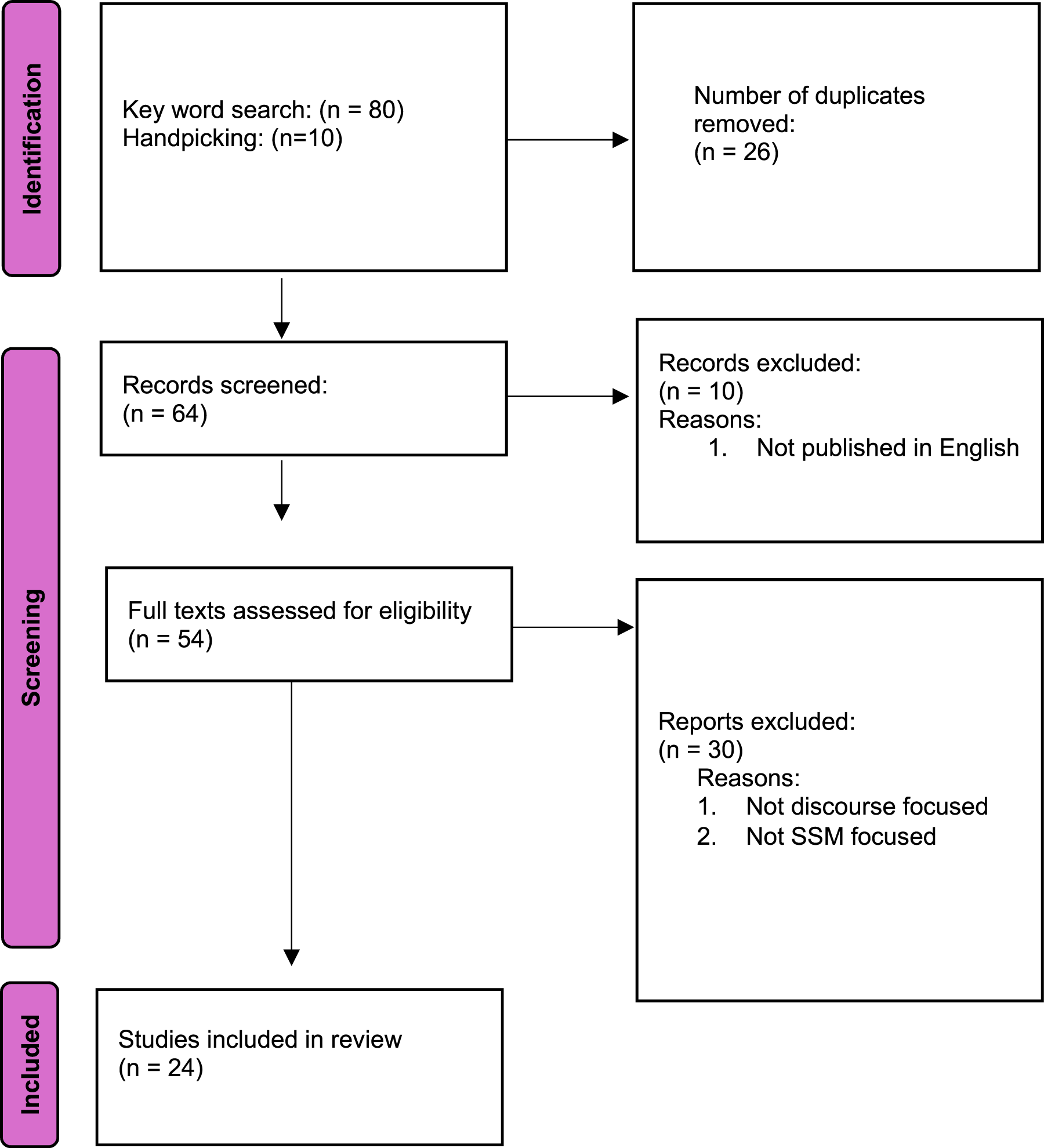
The search terms yielded 54 articles after duplicates were removed. No limit was placed on the year of publication, though all studies were published between 2007 and 2022. Abstracts were screened using inclusion and exclusion criteria. Non-English or non-SSM discourse articles were excluded. Application of these criteria and addition of relevant articles found through handpicking (n = 7) resulted in 24 articles for analysis. As per Arksey and O’Malley (2002: p. 27), an Excel spreadsheet recorded relevant information, including citation, journal, discipline, methods, geographical location and key findings (see Appendix A).
Of the 24 studies included (see Appendix A), 12 focused on countries where direct popular votes aimed to restrict LGBTQ + rights: Slovakia (4), Romania (3), Taiwan (2), Croatia (2), and Bermuda (1). The remaining 12 studies investigated countries where direct popular votes were conducted to potentially expand marriage definitions: Ireland (5), USA (3), Australia (3), and Ecuador (1) (Figure 3). Summary of studies included in this review (for detailed overview see Appendix A). *The data and methods used in the studies apart of this review were extremely diverse (see Appendix A). Yet, many of the actual data and methods used were similar despite different terminology used by authors. As such, this table has summarised the data and methods into comparable terms while appendix A uses the exact terminology used in each paper.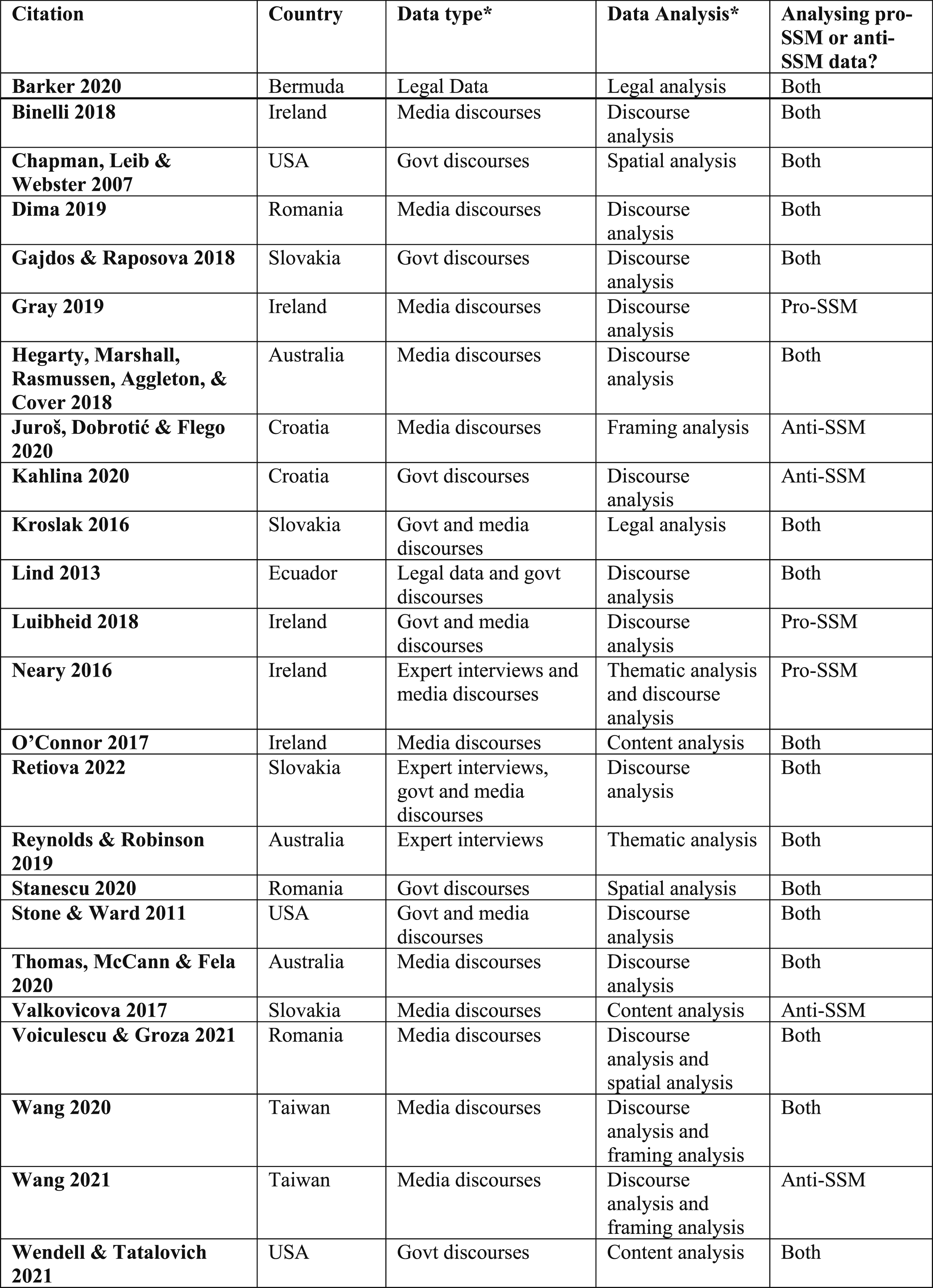
For the data-charting process, scholars recommend an iterative approach where data extraction is continuously updated (Arksey & O’Malley, 2002). This scoping review utilised first, second and third-order interpretations to distinguish and organise the data (Jovanovski and Cook, 2019). First-order interpretations involve synthesising data that researchers analysed, looking at the SSM discourses examined in each study. Second-order interpretations are the researchers’ evaluations based on first-order interpretations. Using Endnote and Excel, the 24 studies were inductively coded in line with the first- and second-order interpretations, that being the SSM discourses analysed and the researchers’ interpretations, respectively.
The third-order interpretations merge the first two, aiming to create a new interpretation of the data. The findings section contextualises the first and second-order interpretations within a sociological framework (i.e. third-order interpretations). The forthcoming results are presented across three levels of sociological analysis: macro, meso and micro levels (Johnson, 2008: p. 459). The macro level refers to international trends, the meso level represents the state within domestic borders, and the micro level refers to individual actors within the state. The analysis enhances our “awareness of how the different levels of the social world are interrelated” (Johnson, 2008: p. 9). The articles are then analysed in relation to discourses, providing insight into how language reflects and constructs reality, and how these ‘levels' intersect.
Findings
Following a rigorous data-charting process, a total of eight political tactics pertinent to SSM discourses were identified. The political tactics identified from the studies were then positioned within one of the three levels of analysis, illustrating the different ways that SSM is debated using problematic techniques. At the macro (i.e. global) level, SSM was conflated with human rights discourses and migration issues for advocates to position their respective states within the global community, based on the assumption that one party speaks for a whole country. At the meso (i.e. national) level, political tactics used by advocates on both sides of the debate included grouping racial minorities as uniformly conservative to gain votes and introducing debates about the unforeseen ramifications on the gender binary. At the micro (i.e. individual) level, pro- and anti-SSM advocates utilised the debate to reify heteronormative definitions of family and reproduction.
Macro – constructing a global identity
On the international level, SSM discourses serve as a critical lens through which pro- and anti-SSM advocates within countries navigate broader human rights narratives and position themselves and their respective countries strategically within the global community. These discourses positioned entire countries against each other, and were conflated with issues around religion, child trafficking, and asylum/migration. Both pro- and anti-SSM advocates framed countries opposing their stance on SSM as the ‘other’, further exacerbating tensions on a global level. Thus, this section outlines some of the ways that SSM debates intersect with national identity formation and international relations.
Navigating international human rights
Within the corpus of data, countries using public votes for SSM aimed either to restrict or expand LGBTQ + rights. Those aiming to restrict rights sought to tighten adoption laws, redefine the family constitutionally, and limit sex education, as exemplified by Slovakia, Romania, Taiwan, Croatia, and Bermuda. Other countries (Ireland, USA, Australia, and Ecuador) were aiming to expand the legal definition of marriage to include same-sex unions. Yet, from both corpuses of data, SSM was conflated with broader human rights discourses, with groups within the nation using the debates to position themselves within the global community: [Slovakia will] send a clear message to Europe that family and a relationship between a woman and a man are the basis of the European civilisation. (Alliance for Family [Slovakian Org], as cited in Valkovičova, 2017: p. 103) the African countries are against same-sex marriage and the Western countries are for it. (Furbert [Bermudian MP], as cited in Barker, 2020: p. 167) a negative result in the [SSM] referendum might affect the international status and reputation of our country. (Spelman [Irish SSM advocate], as cited in Gray, 2019: p. 641) Ireland has etched out a new global identity. (Hahessy [Irish reporter], as cited in Binelli, 2018: p. 305) The Republic guarantees religious and civil liberty, equal rights and equal opportunities to all its citizens […] cheering all the children of the nation equally. (Irish ‘yes' campaign, as cited in Binelli, 2018: p. 305)
Likewise, an advertisement curated by Australian Marriage Equality (AME) in the SSM plebiscite of 2017, analysed by Thomas et al. (2020), utilised imagery of the Australian Flag, the white nuclear family, and language that emphasises LGBTQ + people as “Australian citizens”. Thomas et al. (2020: p. 488) argue that these “approaches reify the legitimacy of the western nation-state and its claim to represent progress and modernity”.
Using a similar tactic for opposing aims, the ‘Coalition for Family’ (CfF) categorised Romanian citizenship as limited to heterosexual Christians (Dima, 2019). Dima (2019) suggests that anti-SSM groups positioned Romanian citizens as responsible for opposing SSM and its associated ‘threats’, that were supposedly being imported from the US. The pressure from anti-SSM advocates for citizens to embrace religious morals was evident in first-order data excerpts from various locations: This is why we have to oppose the homosexual propaganda by any means: In the US, Christian patrons are fined with enormous amounts of money if they refuse to satisfy homosexuals’ caprices!!! (CfF [Romanian Org], as cited in Dima, 2019: p. 200) Romania needs a change to preserve its traditions and values because we have declared ourselves a Christian people. (CfF [Romanian Org], as cited in Voiculescu and Groza, 2021: p. 682) On the day of the referendum… you [the clergy] should invite the believers to attend, and to cast their voice ‘FOR' so that they can contribute to the preservation of the precious gift of marriage and the values that are essential for the well-being of our Church and the Croatian Homeland. (Croation Cardinal of the Catholic Church, as cited in Juroš et al., 2020: p. 1541)
Valkovičova (2017: p. 88) argues that the Slovak referendum positioned Slovakia as ‘pure’ and Europe as ‘depraved’. According to Valkovičova (2017: p. 107), Western Europe is perceived by Central and Eastern European (CEE) countries as a collapsed civilisation. Furthermore, Barker (2020: p. 167) contends that opponents of SSM in Bermuda employed a discourse that contrasted ‘European’ values with those of the Caribbean and African regions, claiming that the latter oppose homosexuality. This juxtaposition not only implies a divide between ‘North’ and ‘South’, but also perpetuates a form of homocolonialism (Rahman, 2014), wherein European values are considered incongruent with Bermudian identity, perpetuating a concerning cycle reminiscent of historical cultural imposition. By presenting European values as antithetical to the Caribbean and African values, this discourse echoes colonial-era tactics of branding certain cultures and practices as ‘other' or inferior. Replicating historical patterns of cultural imposition reiterates the idea that non- ‘Northern’ values are inherently inferior, perpetuating a power dynamic that extends beyond mere opposition to SSM.
International movements and asylum seekers
International mobility was identified as another prominent diversionary discourse used by pro- and anti-SSM groups, available in first-order interpretations from the studies. Several conservative non-governmental organisations affiliated with the Romanian CfF suggested that same-sex couples in the Global North were to blame for the country’s child trafficking problem (Voiculescu and Groza, 2021). Namely, the Romanian Social Democratic Party, as cited in Voiculescu and Groza (2021: p. 682), proclaimed that international adoption by LGBTQ + couples posed risks to ‘passive’ children, telling citizens to “defend your children, they can be taken by two gay men”. In Croatia, the referendum pamphlet organised by the conservative group ‘On Behalf of the Family' (OBF) (as cited in Kahlina, 2020: p. 229) explicitly states their main goal is to “protect children from being adopted by same-sex couples”. Similarly, a Slovakian anti-SSM advocate (as cited in Rétiová, 2022: p. 319) stated that: if we look at statistics – the family situation, its functionality, marriage stability or, for instance, reproductive function are worsening in society. For example, few children are born, and it is a problem.
The adoption and reproductive rhetoric employed here implies that legalising SSM poses some sort of threat to the global population for which LGBTQ + people are responsible.
On the topic of transnational mobility, Luibhéid’s (2018) and Gray’s (2019) analysis of the homonationalist discourses used in the Irish SSM referendum demonstrate how LGBTQ + individuals were framed within political discourses as victims of immigrants who supposedly embody anti-LGBTQ + rhetoric. For example, Luibhéid (2018) notes that while Ireland’s SSM referendum was unfolding, so too was the Mediterranean crisis which saw an exponentially increased demand for host countries to house refugees. Despite the immigration crisis, strict asylum policies in Ireland and around Europe meant few safe and legal migration channels were available (Luibhéid, 2018). Whilst this sequence of events was unfolding, the study reports that popular newspapers were publishing stories portraying already hosted migrants and asylum seekers as universally conservative and a threat to marriage equality (Luibhéid, 2018: p. 420).
As Gray (2019) reported, simultaneous to anti-refugee discourses was a multitude of digital campaigns, namely ‘We’re Coming Back’ and ‘#HomeToVote’, encouraging recent Irish emigrants to return home to cast their vote in the SSM referendum. Luibhéid (2018: p. 415) notes a concerning paradigm in their analysis, wherein the opportunity to vote in the Irish SSM referendum was not only legal, but was safe, in contrast to the many asylum seekers who died in their migration process throughout the Mediterranean crisis. Furthermore, Gray’s (2019: p. 643) analysis of Irish emigrant social media campaigns highlight how citizens of the Global North were free to embrace “flexible movement at both ends of the global labour market” by leaving and returning as they wished. In sum, the persistent use of homonationalist tactics seek to include LGBTQ + people as part of the state at the expense of racially diverse individuals and immigrants who are cast into the role of the unaccepting ‘other’.
The findings in this ‘macro’ section show the way in which SSM debates were often conflated with broader human rights narratives, as a purposeful way for pro- and anti-SSM groups within the nation to position their respective nations on the international stage. Specifically, the groups framed the ‘opposition’ as a ‘risk’ to their values. The next section unpacks dynamics of the nation-building process surrounding SSM when confined to national borders.
Meso – construction of the nation
At the national level, political strategies discrediting SSM drew on both hetero- and homo-nationalist discourses by grouping racial minorities as uniformly intolerant to LGBTQ + perspectives, while also discussing the unforeseen implications for traditional gender roles.
In response, SSM advocates took a normative approach by employing the ‘just like you’ argument, reflecting homonationalist impulse to prioritise assimilation. As such, the following section will examine the conflation of ‘race’ and gender with SSM at the national level, treating each issue separately.
Racial/ethnicity politics
Studies from the US (Chapman et al., 2007; Stone and Ward, 2011), Bermuda (Barker, 2020) and Australia (Hegarty et al., 2018; Thomas et al., 2020) emphasise the way that ‘race’ was used as a tactic to support or oppose SSM. In the US, Stone and Ward (2011) found that anti-LGBTQ + groups relied heavily on racial discourses, though they contend that both sides of the SSM debate were racialised. One such example of the utilisation of ‘race’ by the US pro-SSM movement was its framing as a civil rights issue: [passing the SSM ban] is the same thing as when legislatures put Jim Crow laws and codified them in their law books. You’re saying that people because of their status are not allowed to have the same rights as us. (Orrock [Atlanta representative], as cited in Chapman et al., 2007: p. 38)
Stone and Ward (2011) posit that SSM advocates wittingly drew parallels to racial discrimination and Jim Crow laws as an attempt to appropriate the minority label. Pro-SSM activists’ appropriation of the minority label frames the rights of LGBTQ + people and African Americans comparably, assuming that the two groups are oppressed in the same manner.
Throughout the corpus of data, the conflation of SSM with ‘race’ was more striking in anti-SSM campaigns. In Australia, at the time of the SSM plebiscite, a right-wing group based in Sydney called ‘The Party for Freedom’ rallied against SSM (Hegarty et al., 2018). The anti-SSM group drew on a “offensive and racist parody of the ‘Black Lives Matter’ movement in the USA” (Hegarty et al., 2018: p. 412), choosing the phrase ‘Straight Lives Matter’ as their primary slogan. Similar conflation of SSM and ‘race’ was witnessed in data excerpts from other locations. For example: you just can’t equate sexual orientation to racial discrimination… You can make a choice of who you want in your bedroom, but you can’t choose your skin colour. (Williams [Georgia House of Representatives], as cited in Chapman et al., 2007: p. 38) This [SSM] will not keep them from doing what they want to do as far as voting, as far as going to school or as far as where they eat. . . . I’m black because that’s the way I was born, and I can’t change it. I don’t know what made them gay. (National Black Justice Coalition, as cited in Chapman et al., 2007: p. 38) [Gay rights] will make it harder for Blacks to get jobs in Pittsburgh (because) there will be a well-organized and affluent special interest group ahead of them. (Data excerpt, as cited in Stone and Ward, 2011: p. 612) We know the majority of Europeans support this type of action [SSM]. I am not from Europe. I am not European. And this country is predominantly black. (Mr Burgess [Bermudian Politician], as cited in Barker, 2020: p. 167)
Both within the Georgia SSM referendum (Chapman et al., 2007: p. 38) and other US-based referendums analysed in a study by Stone and Ward (2011: p. 614), pervasive notions of ‘choice’ employed by anti-SSM activists intended to highlight SSM as politically insignificant and maximise support from African American voters. Further, Stone and Ward (2011: p. 605) contend that white, religiously motivated anti-SSM campaigns relied on African American figures to legitimise and secularise their agenda.
In the Croatian Marriage Referendum of 2013, led by the conservative group OBF (Kahlina, 2020), the conflation of SSM and ethnicity 3 highlights the diverse socio-political landscapes influencing SSM debates. For instance, while the debate in the US draws parallels to historical civil rights struggles, in Croatia, the discourse surrounding SSM is more intricately tied to the concept of ethnicity within the framework of ethno-nationalism (Kahlina, 2020). This important differentiation underscores the importance of historical and contextual factors in shaping the discourse surrounding minority, and specifically LGBTQ + rights within different cultural and national contexts.
Gender norms
This section outlines the way that anti-SSM advocates used gender to substantiate political stances on the issue. Throughout the corpus of data included in the studies, gender, children and education became enmeshed in SSM debates, all of which were intricately linked. Anti-SSM advocates used the so-called ‘radical gender ideology’ (Nicholas, 2020) 4 to highlight SSM as a threat to children. The notion of ‘the child at risk’ permeated much of the data corpus, with unforeseen ramifications to the gender binary being a discursive feature in anti-SSM campaigns (see Barker, 2020; Binelli, 2018; Gajdoš and Rapošová, 2018; Juroš et al., 2020; Kroslak, 2016; O'Connor, 2017; Rétiová, 2022; Stănescu, 2020; Thomas et al., 2020; Voiculescu and Groza, 2021; Wang, 2021). For instance, Thomas et al. (2020) found that the Australian Christian Lobby (ACL) used ‘slippery slope’ fallacies related to the gender binary to highlight children as endangered by LGBTQ + ideologies in its campaign against SSM. Specifically, the ACL focused on the prospect of children as ‘cross dressers’: “school told my son he could wear a dress next year if he felt like it” (ACL, as cited in Thomas et al., 2020: p. 481). Likewise, the anti-SSM Coalition for Marriage, as cited in Thomas et al. (2020: p. 480), conflated SSM with the possibility of a ‘radical gender ideology’, contending that “more and more kids will be taught their gender is fluid and not based on biology”.
Many studies correspondingly reported on anti-SSM advocates' strategy to frame education systems as the vehicle for hastening the alleged radical gender ideology (Juroš et al., 2020; Kroslak, 2016; Rétiová, 2022; Wang, 2021; Wendell and Tatalovich, 2021). For instance, threatened by increased LGBTQ + representation in everyday life, anti-SSM activists in the US argued that schools should not teach children that SSM is acceptable (Wendell and Tatalovich, 2021: p. 174). In Taiwan, gender and sexuality discourses were, according to Wang (2021: p. 301), mutually inclusive, rising “to prominence like the flip side of a coin”. At the time of the Taiwan SSM referendum in 2018, anti-SSM and anti-GEE (gender equity education) campaigns gained momentum (Wang, 2021). Advanced by the conservative group ‘Coalition for the Happiness of Our Next Generation’ (CHONG), anti-LGBTQ + discourses framed children as passive victims of SSM and GEE, at risk of radical (and queer) possibilities in the context of education. e.g., CHONG, as cited in Wang (2021: p, 310), expressed concern that “inappropriate materials” pertaining to SSM and GEE would introduce “identity confusion, affecting children’s physical and mental development”. Likewise, simultaneous to Croatia’s, 2013 marriage referendum, conservative activists and the Catholic Church were campaigning against calls to widen the scope of sex education, on the grounds that homosexual propaganda would permeate schools (Juroš et al., 2020).
A similar strategy occurred in Slovakia. For example, on a publicly broadcasted radio show, Greek-Catholic priest Rastislav Bako (as cited in Kroslak, 2016: p. 158) asks: Have you heard of what our health care service has done at an elementary school in Košice? a course on venereal diseases, where ninth-graders were supposed to demonstrate sexual positions between a man and a woman, a man and a man as well as between a woman and a woman in pairs. This encouraged immoral life without the consent of parents.
The effect of conflating SSM with the imagination of a radical gender ideology hastened by SSM was twofold. Firstly, the diversionary tactic depicted SSM as a threat to traditional understandings of gender, consequently reinforcing the gender binary. Secondly, characterising the spectre of gender fluidity as dangerous objectified children as victims of SSM through mechanisms unnamed and unknown.
These findings suggest that SSM discourses drawn from first-order interpretations were conflated with ‘race’, ethnicity and gender to legitimise political agendas. Namely, historically marginalised racial minorities were leveraged as a tool for pro- and anti-SSM advocates to articulate arguments across a multitude of countries. Further, SSM was framed by anti-SSM activists as a risk to children and their gender identity, which would be inculcated through education systems. The following section discusses the conflating tactics at the individual level.
Micro – the individual effects
At the individual level, both pro- and anti-SSM activists utilised heteronormative definitions of family and reproduction for political agendas related to SSM. Firstly, anti-SSM activists challenged the inability of same-sex couples to reproduce by drawing on heteronationalism, wherein nationalist ideologies align with heterosexuality as the perceived normative standard. In contrast, pro-SSM activists reified conjugal relationship frameworks as fundamentally natural to appeal to heterosexual communities. This stabilising tactic, akin to homonationalism, leverages LGBTQ + rights to project a progressive and tolerant national identity.
Reproductive rights
Within the corpus of data examined in studies from Ireland (Binelli, 2018), Australia (Reynolds and Robinson, 2019), Romania (Dima, 2019), Croatia (Juroš et al., 2020), Ecuador (Lind, 2013) and Slovakia (Gajdoš and Rapošová, 2018; Valkovičova, 2017), there was a punitive focus on reproduction to highlight political positions on SSM. For instance, the Romanian CfF, as cited in Dima (2019, p. 200), condemned SSM advocates on the basis that LGBT + couples cannot reproduce: “other forms of social cohabitation, family alternatives, are aggressively promoted: … single-parent households, and homosexuality”. Further, assisted reproductive technologies (ART) were framed as being ethically compromised as a tool to oppose SSM. these practices [surrogacy] necessarily and deliberately cut the natural ties between a child and his or her biological parent. (Data excerpt [Ireland], as cited in O'Connor, 2017: p. 502) There is no bond equal to the innate natural instincts of a mother and father. (Data excerpt [Ireland], as cited in O'Connor, 2017: p. 502) kids brought up by biological parents do better in life. (Data excerpt [Ireland], as cited in O'Connor, 2017: p. 502)
In contrast, again, according to O'Connor (2017), pro-SSM activists neutralised, rather than challenged, the homophobic discourses by contending that “children will continue to be raised by their natural parents. There won’t be a baby-boom among gay couples” (Twitter post, as cited in O'Connor 2017: p. 502).
Heteronormative intimacies
Many studies included in this review show that anti-SSM campaigns in diverse locations relied on the narrow definition of family that excludes SSM as a tactic to oppose legislative changes (Barker, 2020; Chapman et al., 2007; Dima, 2019; Gajdoš and Rapošová, 2018; Juroš et al., 2020; Kahlina, 2020; Kroslak, 2016; Lind, 2013; O'Connor, 2017; Rétiová, 2022; Reynolds and Robinson, 2019; Valkovičova, 2017; Voiculescu and Groza, 2021; Wang, 2020; Wendell and Tatalovich, 2021). For instance, while Ecuador’s constitutional referendum of 2008 was unfolding, assembly members (as cited in Lind, 2013: p. 136), based on the understanding of family as exclusive to heterosexual two-parent households, conflated SSM with the possibility of the “degradation of the family”. The privileging of conjugal relationship frameworks was not isolated to Ecuador. For example: We cannot let judges in Boston, or officials in San Francisco, define marriage for the people of Georgia. This ban will build a defense around the institution of marriage, and it is needed to protect the family structure that has existed for 6,000 years. (Bill Hembree [Georgia House of Representatives], as cited in Chapman et al., 2007: p. 35): The SDP's [Socijaldemokratska partija - Socialist Democratic Party] agenda is to downplay the system of values of the Croatian people, to disparage marriage as a life-unit between a woman and a man, to disparage family ... (HDZ [Croatian Democratic Union] as cited in Juroš et al., 2020: p. 1541)
Anti-SSM advocates responded to SSM by considering heterosexual family structures as paramount to a functioning society (Gajdoš and Rapošová, 2018; Lind, 2013; Rétiová, 2022; Wang, 2021; Wendell and Tatalovich, 2021). According to researchers from Slovakia (Valkovičova, 2017: p. 104), heterosexual families are viewed as self-reliant and functional, resulting in an illusion that LGBTQ + families rely on social security systems and pose a threat to national economic development. One such example of anti-SSM advocates highlighting heterosexual families as economically sustainable is a data excerpt, as cited in Dima (2019: p. 200): Our goal is to have as many families in Romania as possible, marked by longevity, as numerous as possible, providing their members with a favorable economic, social, protective and psychosocial environment, and for the Romanian nation, providing continuity, demographic, economic, social and cultural development.
Similarly, anti-SSM advocates in Slovakia argued that LGBTQ + people “do not adhere to any principles; they would tell whatever is convenient for them as the right ideologues and recipients of financial grants” (News article, as cited in Rétiová, 2022: p. 326). The rhetoric that LGBTQ + people are financially opportunistic aligns with other trends observed in this scoping review, where opponents of SSM portray LGBTQ + people as child abductors and a threat to global peace (Kahlina, 2020; Rétiová, 2022; Voiculescu and Groza, 2021).
Pro-SSM activists used a similar normalising tactic, wherein there was a general demand amongst SSM advocates for access to heteronormative models of love and commitment: we’re the same as everybody else. . . we’ve got the tuxes all lined up. . . So, it just, I suppose it brings lesbian and gay sexuality in from the cold. . . we are people who have, in many ways, the same concerns as everybody else. (Irish Participant, as cited in Neary, 2016: p. 770) CP [Civil Partnership] helps to shift the perception of gay and lesbian people… from being about sex to being about love and commitment and shared lives and romance. (Irish Participant, as cited in Neary, 2016: p. 772) All we want to do is have a family… have the same rights as normal straight people. We’re also normal. (Australian Participant, as cited in Reynolds and Robinson, 2019: p. 282)
Likewise, according to Thomas et al. (2020), pro-SSM activists in Australia reified heterosexual families as fundamentally normal. Using imagery of the (heterosexual) nuclear family in the pro-SSM campaign was a purposive tactic by the organisation ‘GetUp!’ to neutralise the fear-provoking tactics employed by the conservative ACL (Thomas et al., 2020: p. 481). Indeed, the authors found that imagery of the nuclear family was more prominent in pro-SSM advertisements than anti-SSM material, indicating the heteronormative future that marriage equality yields.
Furthermore, language choices such as ‘equal love’ in Australia (Reynolds and Robinson, 2019) and ‘say yes to love’ in Ireland (Neary, 2016) privilege heteronormative models of commitment. Likewise, Irish pro-SSM campaigns were fronted by lesbian women and children based on the stereotype that gay men are “hypersexual” (Neary, 2016: p. 772); this strategic choice seemed to reify heteronormative systems of love and care. Ultimately, pro- and anti-SSM activists used similar conflating tactics that relied on normative (i.e. biological) definitions of reproduction and family. The only difference, however, was activists’ specific posture on the normalisation of LGBTQ + intimacies.
Limitations and future research
It must be noted that this scoping review does have some limitations. Firstly, I have presented three overarching tensions within the debates on SSM, all of which conflate SSM with unsubstantiated threats. While I have presented these debates as independent to distinguish similarities and differences of SSM from a cross-national perspective, in practice, these discourses and their purposes are intricately linked. However, using Johnson’s (2008: p. 459) three-tier framework was useful given that the studies typically isolate findings to one ‘level’ and one location.
Second, researchers from the Global South are more likely to publish in languages other than English. This limited access to data from countries such as Slovenia, which held referendums on expanding same-sex partnership rights in 2012 and legalising SSM in 2015, both of which failed, but has since legalised SSM in 2022 (Kuhar and Zobec, 2017; Manno et al., 2021). For future researchers with access to funding, it would be beneficial to use translation software or transnational research teams to allow for the inclusion of a broader dataset, including if the focus of inquiry transcended SSM to interrogate other public debates on sexual politics.
Finally, the fluid and evolving nature of SSM implies that more research opportunities will inevitably emerge, especially regarding topics like direct popular votes and other forms of public debate involving SSM and LGBTQ + rights. The example of Bermuda, where SSM rights were revoked, serves as a reminder that legal rights can be subject to ongoing public debate and scrutiny.
Conclusion
The diverse body of literature surveyed in this scoping review has ultimately highlighted a similarity in SSM direct popular votes internationally. Regardless of the specific cultural or political context, the possible changes wrought by SSM is often imbued with moral panic and conflated with other contentious issues as a tactic to reaffirm political positions and influence public opinion. Using the multiple levels of analysis unveils a network of SSM discourses, wherein LGBTQ + individuals are consistently utilised for political purposes, often transcending the immediate scope of SSM initiatives.
In the first-order interpretations from the studies, some nations prioritise the preservation of traditional values, while others objectified LGBTQ + individuals as victims of anti-gay rhetoric from the Global South, a tactic often linked to rationalise stricter border control. The symbiotic relationship between these two prevailing discourses indicates a complex interdependence that reinforces Global North’s unique relationship with queerness and the regions positioning as superior to its supposed opponent.
At the national level, anti-SSM advocates diverted the focus of the SSM debates by portraying racial minorities as uniformly intolerant to SSM and positioned the gender binary and children alike as susceptible to a ‘radical gender ideology’ in education systems, which would be hastened by SSM. Additional uncorroborated arguments were introduced at the individual level, suggesting that the two-parent heterosexual family structure is under threat from both SSM and reproductive technologies. Pro-SSM advocates responded to ‘race’, gender, and family debates by reifying normative understandings of said issues, relying on palatable political regimes ultimately highlighting the incapacity for society to diverge from already established norms. Regardless of one’s position on SSM, the conflating hetero- and homo-nationalist discourses significantly shape the boundaries of global, national, and individual identity and belonging.
This scoping review has made an essential contribution by consolidating the literature on discourses preceding SSM public votes to provide a transnational contextualisation. Ultimately, the findings indicate a need for future policy debates both within and beyond the specific efforts to legalise SSM to refrain from conflating the lives of marginalised groups with contentious issues and moral panic. Rather than formulating policies and legal judgements based on morally driven arguments and biased stereotypes, a stronger emphasis should be placed on leveraging existing research. This approach could lead to more informed decisions that prioritise minority groups, unburdened by unfounded assumptions or political expediency.
Footnotes
Acknowledgements
I would like to thank my supervisors, Dr Sal Clark and Professor Kay Cook, for their feedback, comments, and suggestions on this article. Thank you to the two anonymous peer reviewers for their extremely helpful comments on an earlier version of this paper.
Declaration of conflicting interests
The author declared no potential conflicts of interest with respect to the research, authorship, and publication of this article.
Funding
The author received no financial support for the research, authorship, and publication of this article.
