




Abstract
This paper charts how, in interviewing across generations of assigned female at birth (AFAB) queers in ‘Australia’ about their experiences of lateral violence in LGBTQ+ communities, we found dominant narratives of joy, solidarity and empathy across differences, generations and intersections that demonstrate the ongoing world-making inherent to queer communities. We chart the future-oriented, more utopian themes that came out, in particular around queer (as opposed to LGB) communities and the positive ethics and politics that emerge from and are forged in them.
Keywords
Introduction
We hear a great deal about conflicts in and about queer communities. The validity of queerness itself is contested in many societies such as the settler colony now known as ‘Australia’ 1 where there are substantial push backs against queer affirming laws and policies (Nicholas, 2019). The expansion of terminology and identifiers such as non-binary and non-monosexual identifiers like pansexual are mocked both outside and within LGBTQ+ communities (O’Sullivan, 2021a). Lateral violence – the perpetuation of bias and violence against other members of one’s own group due to wider dissatisfaction or anger – has understandably become an important focus for community publications and academic research (Tran et al., 2023). As in many other parts of the world, discourses circulate in ‘Australia’ about polarized pro-trans/gender diverse and anti-trans sentiment among lesbians and other queer folk (Nicholas and Clark, 2023). Sometimes this is articulated as a generational divide, with gender diversity framed as a phenomenon of younger generations and of older queer generations more committed to binary gender and sexuality categories and hostile to expansion (Paulick, 2009). However, given this context, it seems vital to us to record and analyse the positive and joyful aspects of these things: of queerness itself, of expanding identifiers and language and of finding community. We approach this article with the premise that ‘accentuating joy offers nuance to understandings of the lived experiences of marginalized people that has been absent from much of sociological scholarship’ (Shuster and Westbrook, 2022: 1).
We were motivated to interview across generations of assigned female at birth (AFAB) queer people living in ‘Australia’ to bring nuance to discussions of lateral violence and to understand the realities of AFAB queer life beyond some of the narratives of divides across identity and political lines that circulate. We thus designed this project to elicit narratives of two generations of AFAB queer people’s perceptions of shifts in gender and sexuality identities and experiences of lateral violence within the queer community.
Contrary to the narratives of conflicts we thought would dominate our data, we found that, while most participants at least knew about these divides, especially around ‘TERF’ (trans exclusionary radical feminist) discourse and tensions between older lesbians and younger non-binary folk, most placed themselves outside of these divisions. Indeed, in asking participants about their experiences of lateral violence in LGBTQ+ communities, we also found spontaneous narratives of joy, solidarity and empathy across differences and intersections. These narratives are an important geographically specific contribution to literature on queer joy that charts the joy experienced as a result of queerness, not despite it. Most participants identified with the term ‘queer’ in some capacity in terms of identity and community, but we also observed a substantial capacity to sit with both/and, with some people finding joy in identifying as non-binary dykes, queer lesbians and lesbians who were not women, as well as finding community across multiple aspects and configurations of identity. Indeed, we found their desire to move beyond identity-based divides, their ethical dedication to freedom and inclusivity and their political dedication to empathy, coalition and solidarity to most closely resemble the principles of queer theory, and the queer ethics that were articulated from this. Ultimately, we argue that for queer people, a refusal to capitulate to the conflict and attempt to foster alternative ways of being demonstrates that ‘joy is resistance’ (Lu and Knight Steele, 2019: 824).
Literature review: Queer theory, queer ethics and Queer joy
Before outlining our methods, we will discuss the literature on queer theory and in particular the positive, reconstructive trajectory of queer ethics which resonated with our participants’ accounts and that we consider to sit well alongside the idea of queer joy. In particular, we chart the nuanced engagements with queer theory that reduce it to neither identity/non-identity nor positive/negative.
Queer theory is often thought, or argued to be, purely critique and a negative positionality of ‘queering’ the norm. However, there has always been a reconstructive ethos in this theoretical project. Indeed, the impetus to critique is motivated by the desire that things be otherwise, and there is a rich trajectory of work that considers the ethical and political elements and possibilities of queer theory (see Nicholas, 2014a for an overview). The foundations of queer theory are crucially anti-normativity: the idea of ‘queering’ or deconstructing the norm and in particular heteronormativity (De Lauretis, 1991; Warner, 1991). Coming from a radically anti-essentialist perspective, queer theory was/is critical of identity politics and the exclusionary outcomes of them. That is, as Judith Butler (not a self-identified ‘queer theorist’ but influential on the field) articulates in their germinal Gender Trouble, those drawing on identity politics need to acknowledge the ‘constitutive powers of their own representational claims’ (Butler, 2007 [1990]: 6). Butler refers to the limits of using ‘woman’ as the basis of feminism in this work, and the way that it reifies binary gender, the underpinning cause of gender inequality, in the process. Others, such as Warner (1991) and Sedgwick (1990), have critiqued gay and lesbian identity politics for their heteronormative, assimilationist aims and outcomes.
Queer theory is most often critiqued on the grounds that it is unable to articulate a positive ethic or politic, that it is limited to be a position of critique. Indeed, some queer theorists have argued that this is its power (Halberstam, 2011). However, it has also long been argued that the ‘oppositional nature of queer theory is a moral impulse, a positive value’ (Nicholas, 2014a: 7). For some, ‘the antisocial force of (queer) sex is fundamental to the world-making inventiveness that queer bonds also name’ (Weiner and Young, 2011: 226). Queerness has long motivated prefigurative community, sexuality and identity practices, that is attempts – often joyful – to experiment with things that may be otherwise to, and better than, the hierarchical and exclusionary norms it critiques. Indeed, ‘joy fuels activism against oppression by energizing people and offering alternate possibilities for what life can be like as a member of marginalized group’ (Westbrook and Shuster, 2023:17). For example, in attempting to articulate the notion of ‘queer joy’, a participant in Greteman, Morris and Weststrate’s intergenerational queer knowledge sharing project articulated a similar ethos that is reductive to neither the positive or negative: ‘Acknowledging both the joyful bits, as well as the difficult bits, felt most salient’ (Greteman et al., 2021: 412). In addressing transgender joy, Westbrook & Schuster define this joy, as that of queer joy, black joy and disabled joy, as ‘experiencing and speaking about the joy of being a member of a marginalized group’ (Westbrook and Schuster, 2023: 17). However, the concept of black joy, from which queer joy is significantly influenced, is able to acknowledge that ‘for Black folks, joy and pain live together’ (Lu & Knight Steele [citing Cornel West] 2019: 823). Black thinkers and theorists have long conceptualized of ‘joy as a mode of resistance’ (Lu and Knight Steele, 2019: 824). For Brittany Packnett ‘Joy is resistance. Oppression doesn’t have room for your happiness. You resist it when you find joy anyhow’ (in Lu and Knight Steele, 2019: 823). Similarly for Indigenous people, the notion of queer joy is key towards self-determination and resistance in realizing a more just future (Lezard et al., 2023) where the sovereign right to have presence celebrates that ‘our bodies are seen for our Indigeneity and our queerness’ (Sullivan, 2023: 293). Indigenous queer joy ‘is a remarkably useful, radically resurgent affect, which, if granted the attention and nurturing that it deserves, can continue to facilitate more collective, utopian ways of life’ (Ashcroft, 2022:105). With this in mind, can the positive, reconstructive and joyful aspects of queerness not still be conceptualized as political and ethical, as resistance?
Another critique is that the term and idea of ‘queer’ has been taken up and used in reductionist ways. Indeed, Cover notes that in ‘Australia’, queer is often used as an identity label, especially by AFAB younger people (Cover, 2018, 2019). For some thinkers, this is at odds with the core of queer theory itself. Giffney, for example, argued that ‘those who employ queer theory for anything other than the location of non-heteronormative – yet nongay or lesbian – identities risk charges of misappropriation, misuse, misunderstanding’ (Giffney, 2004: 73). For some, ‘queer’ has congealed into a norm or even an identity rather than a theory of position, and this is sometimes posited as a generational divide (Vaccaro, 2009). Indeed, Gen Y has been accused of a ‘hyper-identity politics’ (Downing, 2018) that supposedly omits the possibility of structural analysis of gender and sexuality norms. However, for Butler, the uptake of queer as identity did not necessarily diminish its critical power. It just called for regular self-critique: …a critique of the queer subject will be central to queer politics to the extent that it constitutes a self-critical dimension within activism, a persistent reminder to take the time to consider the exclusionary force of one of activism’s most treasured contemporary premises [identity] (Butler, 1993: 227).
Finally, a critique that must be taken seriously is the extent to which queerness in practice is limited in its capacity or attention to challenge intersectional oppressions, that is the extent to which the ordinary critique of heteronormativity is extended to other normativities that produce hierarchy. This has long been questioned in terms of queer’s race and class politics (Smith, 2010; Gambino, 2020; O’Sullivan, 2021b). A key question we considered in this paper, alongside its capacity to provoke joy for these specific participants, is whether queer, like all identity-based movements (even those based on an oppositional identity) is destined to collapse into normativity, hierarchy and partiality?
Methods
Participant demographics. Pseudonyms, age, gender identity, sexuality and ethnicity of participants.
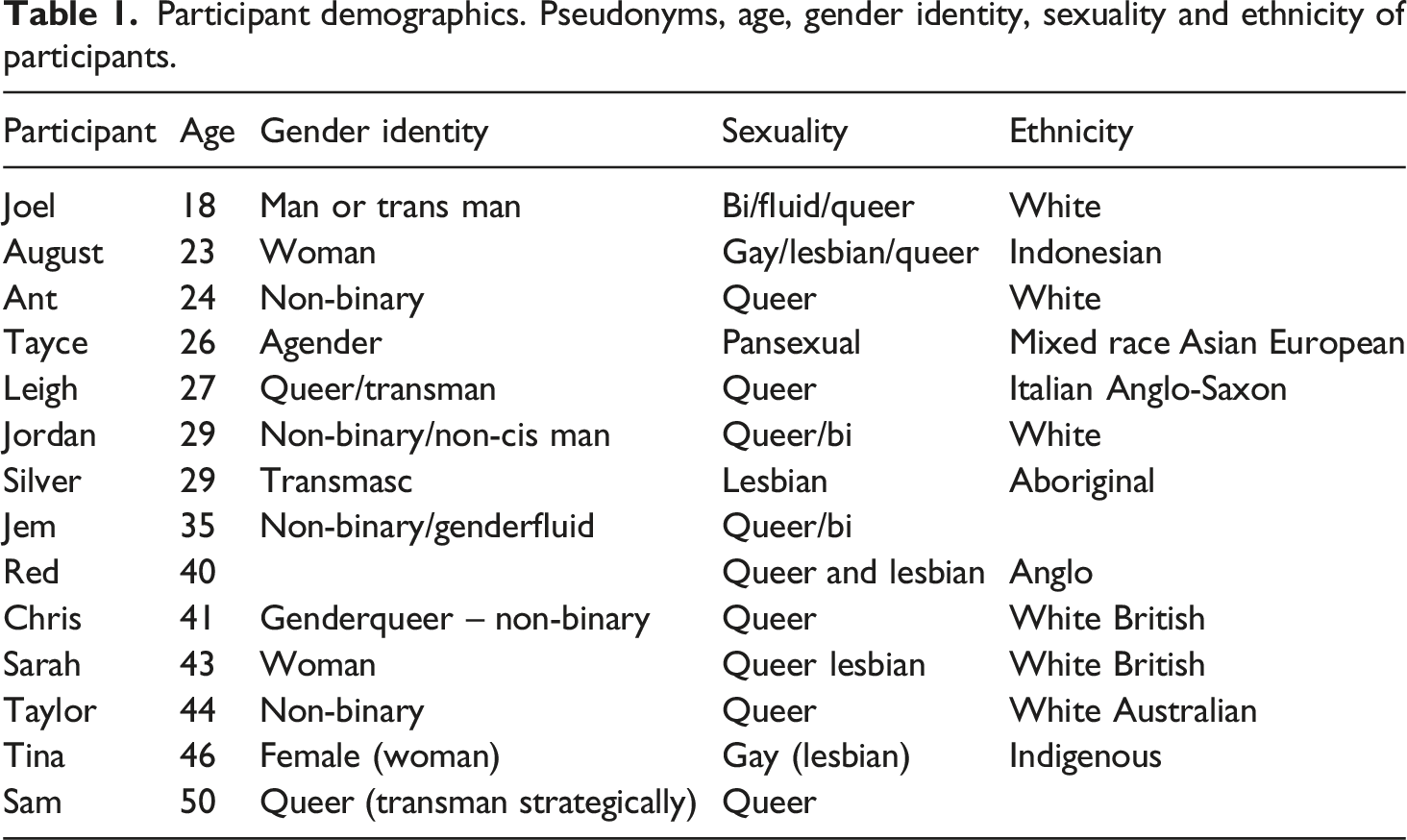
Prior to the interview, participants were asked to watch an episode of the television show ‘Vida’ as a prompt. This episode was chosen because it is one of the few pieces of popular culture that illustrates some tensions across AFAB queer generations and different identities at a lesbian bar that we felt could elicit valuable responses about identity and community. No Australian equivalent is available, but the episode resonated for many participants. Participants were first asked (optional) demographic questions – including their age, ethnicity/cultural background, sexuality and gender identity. Questions about the episode of ‘Vida’ were then asked, including their thoughts on the queer representation on the show and its display of LGBTQ+ intergenerational conflict. Participants who chose not to view the episode were still included and asked the same questions with only specific questions pertaining to the episode omitted. Participants were then asked about their identity and that of their friends, their opinions on different identities and communities under the queer umbrella, such as non-binary, queer and lesbian, their perspectives on womanhood, the term ‘cisgender’ and experiences of or thoughts on lateral violence. The data was uploaded to NVivo and coded by three team members using thematic analysis. A surprisingly consistent and dominant theme was the joy that queerness and different queer communities bring participants. While we also identified many themes about lateral violence, in this paper in particular we make an epistemological decision to focus on the positive, solution-focused aspects of the data in our analysis, from the premise that accentuating the joyful aspects of marginalized people’s experiences is an ethical imperative of sociology to counter what Shuster and Westbrook (2022) call the ‘joy deficit’ of the discipline.
After outlining the joy that the anti-normativity and openness of ‘queer’ offered our participants, we outline that this often unproblematically co-existed with the comfort or enablement, and indeed joy, of (albeit proliferating) sexual and gender identities. This somewhat challenges the concerns of those critics who charge queer theory with a collapse into essentialist, individualist identity politics. Indeed, we found that most participants maintained an idea of fluidity and openness in their understandings of identity. Additionally, most participants had experienced and or called for solidarity and coalition among ‘queer’ people, women and others. However, as per some critiques above, while many did articulate a structural analysis of oppressions, this was often limited to gender and sexuality and less often extended to race and other axes of oppression, especially by white participants.
Findings
‘Fuck yes!’: Queer joy
There was a great deal of positive affective language when participants were asked about identity and community in our interviews, despite an ostensible over-arching topic of lateral violence. This was especially so for those who considered themselves part of ‘queer’ communities, which was almost all participants. Indeed, our youngest participant, Joel articulated a definition of ‘queer’ community that was near ubiquitous in our sample: ‘the community that I’ve kind of surrounded myself with has been just generally the queer community, so it’s kind of a mix, just like, gender and sexuality and all sorts of different people’ (Joel, 18) and, in reflecting on experiences of lateral violence, he said ‘I haven’t seen that as much in the real life, like, spaces I’ve gone to with the groups of people. But it’s in the online spaces a lot more, I think I’ve seen’ (Joel, 18). So, while he has ‘felt kind of unwelcome in some like, quote unquote, like, just like gay bars or gay spaces sort of things cos it was like, I’m not 100% this or that’, the queer community is, for him, ‘a place where kind of anyone, I feel like it doesn’t really matter about what labels, it’s just like about being inclusive… it’s just more like the prerequisite that you know you’re gonna be, like, respected’. A key theme in definitions of queer (as distinct from gay communities) was inclusiveness and diversity as well as care and respect.
When asked about the qualities of the queer community they are part of, as well as this inclusiveness, Tayce articulated that ‘joy and, like, care are pretty strong qualities in the queer community. Like, I think, umm, being able to share joy and care for each other’ (Tayce 26). For Taylor, ‘I think the word queer has the branding of liberation to it and sexual freedom and joyfulness’ (Taylor, 44). Sam, likewise, articulated that connecting with non-cis people and the community aspect of non-normative gender and sexuality (‘non, not binary and not cisgendered’) community is ‘delightful’: …the upside of being very visibly trans is that... you're very visibly connecting with other people who live in the same... non, not binary, not cisgendered space. And so you automatically have some level of camaraderie and companionship with them because you're in the same shit, umm, to a greater or lesser extent. Umm, and it's not always shitful, it is mostly delightful. (Sam, 50)
This (delightful) way of conceptualizing identity or community is much more in line with Giffney’s ideal of queer theory as ‘the location of non-heteronormative – yet nongay or lesbian – identities’ (Giffney, 2004: 73). This was not restricted to offline space. Across generations, participants had found ways of understanding themselves, others and queerness online, in ways similar to those of the ‘identity curation’ afforded to young people in online spaces found by Hanckel et al. (2019): I think like finding that sense of community not just in physical spaces has been really, like, a wonderful thing. One of the wonderful things about the Internet. Like, yea, having a sense of like, um… like validation that doesn’t necessarily need to come from being around other people. (Jem, 35)
On the topic of validation, this comradery and community was highly affirming and validating for most participants. It is well established that ‘cultural resources’ or what Greteman et al. (2021) describe as ‘interpretive resources’ are crucial for ‘learning to recognize social norms and developing alternatives to them’ (409), that is for ‘queering’ norm. They are also essential for queer people in ‘making sense of their [own] social experiences’ (Fricker in Greteman et al., 2021: 409). This idea is in line with the queer theory ethic of deconstruction in tandem with world-making. Indeed, for Jem (35) ‘the best, like, and most affirming thing that’s happen to me is to find this queer friend circle’.
In particular among our sample of AFAB participants, non-binary and queer were both seen as identities that allow for greater self-expression than previously available (or known) identities and that are enabling and flexible. Some of our older participants came to find these later in life, and many after trying other more fixed, binary or essentialized sexual or gender identities. For example, Taylor, like some of our other participants, came to both non-binary and queer after identifying as a lesbian for some time and stated that: one of the things about being non-binary is that, I feel like it allows me to embrace liminal spaces of all kinds. But this is the longest I've stayed in an identity that I enjoyed. I like the, I like the word queer, actually. (Taylor, 44)
As a younger participant coming of age with far greater access to cultural/interpretive resources, having access to online and offline cultural resources (and being in a large city) meant that Leigh was able to come to understand sexuality as fluid and feel comfortable moving and changing: … being a young queer in the City, with the Internet, meant that I could, like, flux between pansexuality and bisexuality and know the differences. Umm, and, and, sort of, you know, move around this community and talk to people. (Leigh, 27)
Jem (35) found both queer and non-binary/genderfluid to be pivotal in understanding their identity: ‘reacting to the word queer … finding, like, that language, for me has really helped me to, like… I think, find my own identity’ (Jem 35). Once again invoking the emotional impact of this, Jem goes on to describe ‘watching Courtney Act’s Australian Story [documentary episode about “Australian” genderfluid drag queen], and she was talking about being genderfluid and … I was like crying at the end… so I’ve like, come to talk about myself as, like, non-binary, like genderfluid’. (Jem 35)
Leigh expresses gratitude for the online spaces and the proliferation of discourses about sexuality that were available to them because of that, especially when comparing this to their cousin’s experience of growing up as a gay man in the 1980s. They said they feel grateful to be part of: the generation that grew up with the Internet and having like constant… like, ways to reach, like, different communities and like, talk about things that make you comfortable and uncomfortable, and having people, sort of, find you and, and… sort of… their want to, like, work out, and like, come up with language to sort of express yourself is… like, it’s very helpful. (Leigh, 27)
This demonstrates how, for our participants, cultural resources of queer provided ‘concepts that do justice to their expanding sense of selves and contribute to expanding conversations around genders and sexualities. … each of which provide “queers,” embodied in diverse ways, with interpretive tools to describe and understand the self and the world’ (Greteman et al., 2021: 411).
‘It’ll exist spectacularly’: Queer ethics
As well as individual affirmation from on/offline spaces, many participants articulated that they observed or learnt in queer culture(s) an ethic of openness to and care for others. This took the form of both considering identity itself as open-ended, as well as respectful and caring interpersonal relations. Nicholas (2014a) has described these aspects – open-endedness and positive regard for others – as core to a queer ethic, sharing much in common with feminist ethics of reciprocity. When asked where they prefer to socialize and what spaces they felt best in, Jem responded: [‘Australian’ queer party is] a really radical space to kind of like party in because it’s like… yea, everyone is really like, cautious with each other. Everyone is kind to each other. People make space for other people. Like, it’s such a nice... space to go and like it’s very, like, liberating to go. (Jem, 35)
Indeed many participants articulated this as a queer ideal. For example, for Taylor, ‘my first principle is always gentleness. And to sit with, oh this is impacting me and I’m feeling really bad, what are my choices now?’ (Taylor 44). Chris, having discussed lateral violence, then articulated what a better future may be that combines the affirmation of individual identity with an ethic of reciprocity with and openness to others: how we can create spaces where people are able, not just to, are able to recognise that, yes, we want everyone to have their own identity, we want people to feel as comfortable as possible. But hopefully, within that comfort comes a compassion and recognition of… how one impacts on other people. (Chris, 41)
Echoing this openness, a through-line in our interviews was that queerness was, despite having some norms, such as hypersexuality (Taylor 44) able to maintain an openness and fluidity such that it may evolve and become increasingly more inclusive and expansive. Despite literature that has found older LGBTQ+ people to be more rigid in their identities and more committed to essentialist binaries, some of our oldest participants articulated openness to the future most vehemently. For example, Sam is hopeful about changes in understandings of sex assigned at birth: overtime maybe there’ll be more labels than there are now, about the intersex community and the trans community. I do hope that at some point in the future, the intersex community will... not need to be lobbying to stop unnecessary medical surgeries on children under the age of 18. That we will get to a point where we have a new word for that intersex community, um, that they choose for themselves, but which reflects that they have not been abused by the medical system. That would be a lovely thing for me to live long enough to see, and so I hope that there’s a new label for the intersex community that is more joyful and positive, delightful. And we can imagine what it might be now, because it doesn't exist now. But that, I hope that it will exist soon, and it'll exist spectacularly. (Sam, 50)
Likewise, they are keen for more inclusive and positive terminology for all non-hetero non-cis people: ‘it’d be lovely if we could have a, a positive word that describes all those of us that aren’t… whatever. Umm… where the label isn’t describing not blah, blah. But is describing, is, all of these lovely things’ (Sam, 50). Leigh (27) appreciated that identity terminology is expanding and said, ‘we should have more words. Words are nice … I think it’s nice that there are, like, more kids being open to… and just exploring, like, gender identity with more words’. Likewise, contrary to some research which finds that older queer people are alienated or hostile to emerging identities, Taylor (44) finds inspiration and joy in new identities and languages, stating: ‘this exciting thing is happening on Instagram right now, right, where so many young people are identifying non-binary dyke … Fucking thrilling’. In expanding on this, and considering possible resistance to this expansive identity, they developed a whole new language and cake-based analogy for queer ethics that is more powerful than any academic explanation: …there will be a stack of non-binary people who are like, you can't have everything. You can't be in the lesbian community and be the non-binary, that’s not a thing. But why not? You know, we should have all the cakes. We should. All the cakes, and then more cakes next week, but a different cake. There’s an abundance of cake. (Taylor, 44)
Indeed, in one of the few texts dedicated to developing a queer ethics, Nicholas (2014a) in their Queer Post Gender Ethics, described a core tenet of queer ethics as proliferation and open-endedness, which they argue is a key way to protect against the closure and thus exclusion of foundationally identity-based values and ethics. In our interviews, this ethic of openness and fluidity transcended generation. Indeed, there was joy in seeing other generations expand ideas of gender and sexuality. Jem (35) said that ‘seeing like older people who are coming out and talking about being like non-binary and um like, talking about being trans, talking about being, um, like any kind of like queer identity, um, is, yea, really… really really nice to see’ (Jem, 35). And Taylor (44) that ‘young people are not fixed beings. And we as, in this elderqueer space, we need to make space for that. And affirm that moving around-ness’. Further, in discussing conversations with cisgender queer women of their age about the possible fluidity of gender, Taylor, 44, expressed once again the excitement of how new generations come up with new ways of understanding, and it is still fluid and open: I think it's complicated but, umm... I'm here for it, you know. I'm just excited every time because I just feel like... yea. In a way, I, I quite like the people who are not men. The way that we just are like, fuck you, we’re gonna do everything differently than everybody ever did. And every generation, it’s like, we’re just gonna do that, but different, again. I’m like, this looks so exciting. (Taylor, 44)
This is quite contrary to findings from other studies such as the intergenerational study by IGLYO (Paulick, 2009) which found older LGBTQIA+ people often find younger generations to be individualistic and identity obsessed, with what Downing (2018) would call ‘hyper-identify politics’. Indeed, contrary to Greteman et al. (2021: 410) who found a ‘lack of contact across LGBTQ+ generations, beyond one-time events or fleeting encounters, that could provide complicated yet healing conversations that grapple with legacies of oppression’, we heard heartening stories of the queer community. Our youngest participant Joel (18) summarized this beautifully: ‘I’ve probably learnt every, kind of, every, all of my like, important life skills from, like, older queer people’.
‘I am so happy for you, this is amazing’: Both/And and belonging in differences
This openness, combined with the ideal of care and inclusiveness, can often be seen in participant narratives through an ideal, ethic or politic of what we have elsewhere called a ‘belonging in difference(s)’ (Nicholas, 2014b). One of the motivations for this project was to interrogate the extent to which the highly polemical narratives that play out online and in the media that pit ‘feminists’ against proponents of gender self-identification reflected on-the-ground reality of queer women assigned female at birth of all identities. We found a dominant theme to be that, while most participants celebrated the proliferation of sexualities and genders in queerness, then, for many there is still unity and still political affiliations with more fixed, essentialist and binary identities. This was associated not with conflict or impasse, but with enabling and the joy of these identities alongside queerness. A strong example of this that recurred across several participants was that for them queerness and lesbianism were able to happily co-exist and both provide joy. This may reflect our small sample and/or a skew in our recruitment (as we used the language of ‘participants who are either cisgender women or assigned female at birth people of any gender identity’ in our recruitment material) but only one participant identified as binary in both gender and sexuality (as a gay woman). Most participants, however, were able to separate their own identities and preferences for fluidity and expansiveness from the joy that more fixed or binary identities may have for others: … [at women-centred club night] we had like this like little baby gay come up to us. She’s like this is my first gay night. We’re like oh that’s exciting. She’s like, I’ve just come out as a raging lesbian.[laughs] I was like, I am so happy for you, this is amazing. (Jem, 35)
Further, this ethic of openness to others meant that most participants were critical of attempts to police the identity of others. For example, our youngest participant Joel who had found such diversity and inclusiveness in an explicitly queer community made the important distinction between self-identity and imposing that outwards: I think the whole argument a lot of people have is kind of saying, well this is how I identify and I don’t want the way you identify to, like, affect how other people view, you know, my identity. But it’s like, well, it’s not changing how you identify and it’s not, you know changing the way you describe yourself, so it shouldn’t really affect that. (Joel, 18)
Indeed, many participants articulated complex and co-existing or fluid ways of identifying. There is Taylor (44) above who found the use of non-binary dyke ‘fucking thrilling’ and Silver who identified as lesbian but not woman, and sometimes strategically as transmasculine and stated they find a joy in woman-centred masculinity and butchness: I’ve also seen and met people who exercise masculinity in different ways. And, umm, now I kind of think from more of like, uhh, queer perspective rather than from a gendered perspective. Umm, I start to see butchess as this exercise of masculinity that’s specifically for women. Umm, and not for women in the sense that, like, I’m exercising it for myself, I’m actually exercising it for other women. And there’s like this enjoyment of butchness which is like… uhh, yea, that’s like, I get to enjoy butchness because it’s for other women. (Silver, 29)
Likewise, Red (40) identifies as both queer and lesbian and states that, while they know gender is social not natural, there is a joy in being happy with women: I think sometimes, I do like to, uhh, emphasise the fact that, like, women can just be happy with other women and that, actually that’s a joyous thing. And I think lesbian implies, you know, women and women. Umm, and that for some people then, that becomes too exclusionary because... gender is seen as a much more fluid thing. But I think in the kind of, the reality of the social existence of gender, that having that says you can be happy being a woman, woman and just being with woman, umm, is good. (Red, 40)
More commonly, then, our participants mostly identified with queer, but also found meaning and solidarity in a range of other identities. As Taylor said above, for them, there is something about being not-men, which was also echoed by Red’s positive framing of AFAB masculinity as woman-oriented. Silver perhaps summarizes this ethico-political position best: I still really strongly align myself with lesbianism, even though I don’t necessarily identify as a woman. Umm, but I still, if I could describe it, I would say probably for me, like, I align myself with lesbianism because it’s about loving women politically. And that’s regardless of whether they’re cisgender or transgender. (Silver, 29)
The idea of ‘loving women politically’ encapsulates an important aspect of the ethical impulse of many of our participants: while queerness was about personal affirmation, interpersonal care and feeling belonging in community, it was also about the wider political context. Participants demonstrated a capacity to have empathy for the ‘generalised other’ in instances of political conflict, and an analysis of the shared structural underpinnings of marginalized people, best understood as solidarity or coalitional politics.
‘It’s coming from the same place, right?’ Queer politics, solidarity and coalition
For Gambino (2020: n.p), a shortcoming of queer theory’s political potential is that ‘queer theorists tend to figure sexually marginalized subjects as exemplary democratic agents’, but that many sexually marginalized folk fail to extend their politics out to other axes of oppression. That is, being queer does not always catalyse a wider radical anti-oppression politics. Indeed, homonormativity and its impact on other marginalized people is now well charted (Duggan, 2002; Puar, 2007). Among our participants, while there was an acknowledgement that not all sexually and minoritized people inherently have a solidarity for other marginalizations, there was a desire to move beyond individual identity as a solution to queer marginality and to understand structural underpinnings that are shared between different subordinated groups. However, for many participants (perhaps because of the nature of our questions that focused on generation, feminism and lesbianism) this was often limited to gender and sexuality.
For example, many of the narratives demonstrated that a specifically queer framework had fostered an empathy and solidarity in most participants that in turn underpinned an empathy for perpetrators when participants did observe lateral violence. Some participants were acutely aware of the ‘epistemic injustice’ of a lack of cultural resources, where ‘a gap in collective interpretive resources puts someone at an unfair disadvantage when it comes to making sense of their social experiences’ (Fricker, 2007 in Greteman et al., 2021: 409). Having outlined the way that cultural resources were so enabling for them, many participants then articulated that they consider much hostility to come from fear, lack of knowledge or a challenge of ontological stability: …that’s very much what violence is, is the, you know, unbearable senses of… you know, a transgression of what is… is something that fundamentally calls into question one’s sense of self and how one is in the world and how one can exist in the world, or one’s understanding of that. (Chris, 41)
Likewise, having expressed the affirmation and joy that the openness and fluidity of queer offers them, Jem (35) also expressed an understanding of people for whom this felt threatening and for whom ‘having solid identities have been like super important, and like being tied to a certain identity was, you know, a point of survival as well’. This reflection on the use of identity for survival helped Jordan (29) reflect on some of the hostility they have seen from older queer people, acknowledging that ‘older people, have been through quite the ringer when it comes to, like, being hurt and, umm, you know, judged on their sexuality’. As a result, they suggest that what is required is better understanding and communication between generations and their contexts, a theme that other participants touched on. Leigh (27) stated that they are keen for intergenerational sharing and knowledge exchange, reflecting that ‘‘underneath… TERF, like, active TERFs, you’ve got people that are just, you know… scared and honestly think that, you know, trans people in the bathroom is a problem’ (Leigh, 27).
This desire for mutual understanding and dialogue is a natural evolution from the ideal of respecting and being open to differences that was such a theme of the ethics of our participants. This idea echoes some classic theoretical and political articulations of coalition or alliance politics such as that of Cathy Cohen (1997) and Zein Murib’s more recent (2018) ideal of alliance politics. This is developed from an Indigenous perspective that is not about homogeny but, instead, about learning about each others’ ‘unique and overlapping struggles’: the form of alliance politics that I put forward here rethinks coalition as something that can be achieved through a movement focused on creating spaces where education and language about the group-specific experiences of oppression are developed to facilitate an understanding among members of their unique and overlapping struggles. In other words, the form of alliance politics that I outline here does not require groups coming together into an undifferentiated group unified under one name, but rather envisions coalition as a series of actions people take in order to develop a shared understanding of the stakes entailed in political struggle. (Murib, 208: 175)
While some theorists have argued that ‘Where intersectional theorists promote coalition-building between differently marginalized subjects, queer theorists tend to figure sexually marginalized subjects as exemplary democratic agents’ (Gambino, 2020: n.p.), there is some indication that our participants are able to do both. This with the caveat that the discussions of race, ability and class were albeit uncommon. However, the data does indicate a desire to think about structural causes of oppressions. For example, many participants articulated an analysis of overlapping sources of oppression for groups that have sometimes come to be at odds, such as trans folks and TERFs. Perhaps uncoincidentally, Silver (29) is Indigenous and articulated a depth of understanding about feminist anti-trans sentiment as follows: I think it comes from a place of… pain from misogyny. Umm, I think that a lot of... people who have… experienced misogyny and sexism or… I feel it’s coming from the same place, right? So like, umm, if somebody is having some issues with, like, somebody moving between genders or, umm, however you want to describe their journey, affirming their gender. Umm… it’s coming from a place of, like… it’s coming from a place of, like, how men treat everybody else, I think. Umm, so then, there is like that tension there, because of… because of that legacy. It’s really about the pain from that legacy (Silver, 29)
This again echoes Taylors’ and other participants’ articulations above that there is a solidarity in being non-men, and in uniting around the experience of not being the dominant group: I think the radical lesbian TERF, if you want to call it that position, comes from a place of like, we’ve experienced horrendous oppression as women at the hands of men largely. And trans people say we’ve experienced horrendous oppression and trauma at the hands of cis people and, umm, mainstream services and whatever. And lesbians could say the same thing. It’s not, so, okay, let’s... figure out who and what structures and systems are causing all of this trauma. Cos it’s not us. It’s not each other. (Red, 40)
Finally, we will finish with the words of our youngest participant who calls for ‘lifting up the community’: I just think the community should stick together because there’s enough external, like, hatred … I’ve never really got it and I’ve always tried to distance myself from that sort of drama cos I’m like, it’s a waste of time and I would rather, like, put my energy into actually, like, kind of lift up the queer community and see what’s affecting and what’s happening and, you know, issues that are happening externally so I can try and raise awareness for that. (Joel, 18)
Conclusion
Despite a focus on lateral violence in LGBTQ+ communities in our interview questions, among our sample of ‘Australian’ AFAB people, we found narratives of joy, community, belonging and understanding. This was often associated with explicitly queer identity or queer community. Further, despite concerns that ‘queer’ has long since lost its radical or political edge, our participants described queer spaces and identities as ‘radical’, freeing and enabling, described the ethical practices they had learnt from them and presented sophisticated structural analyses of marginalization and subordination. Informed by the background context of consistent invalidation from wider society, struggles and conflicts over identity categories within queer communities and oppositional narratives in contemporary feminism, we asked participants about their own identities and their opinions on other identities. What we found was an overwhelming joy in self-identifying and an empathy and desire for understanding with others. Contrary to many mainstream narratives of ‘the left’, queer people or feminists in crises of internal conflict, we found hopeful narratives that attested to the ongoing world-making potential of ‘queer’ as an idea and of joy as resistance. In particular, we found a desire for cross generational understanding and propose that future research and community interventions in ‘Australia’ could, like those undertaken elsewhere (see: Morris et al., 2022), focus on the complex narratives of joy across generations that could be a vital resource to this end.
Footnotes
Declaration of conflicting interests
The author(s) declared no potential conflicts of interest with respect to the research, authorship, and/or publication of this article.
Funding
The author(s) disclosed receipt of the following financial support for the research, authorship, and/or publication of this article: This work was supported by the Western Sydney University.
