




Abstract
This paper is a small scale feminist enquiry into the experiences of seven queer Kenyan women using Instagram to assert and navigate queer agency. The ways the existence of queer women in Kenya is subject to erasure, epistemically, symbolically and materially, is explored and highlighted how this can render queer women ‘unimagined’ in the now ‘democratic’ Kenyan regime. Queer women in Kenya are now reconfiguring social media spaces such as Instagram to push back on erasure and assert their existence. Drawing upon postcolonial feminism, this study shows that spaces like Instagram are locations where these women are making themselves ‘visible’ and ‘reimagined’.
Introduction
For queer individuals, social media is a landscape that has contributed to a drastic change in queer world-making (Yên, 2016). Here, the specific experiences of Kenyan queer women 1 are illuminated using Instagram as an alternative space to assert and navigate queer agency in the now ‘democratic’ Kenya that remains patriarchal, cisnormative and heterosexist.
Queer Kenyan women have been erased on multiple levels following their social location and sexual identity (Bailey and Trudy, 2018). As affirmed by Hale and Ojeda (2018), the patriarchy makes a separatist appeal on queer women. In Kenya’s case, this appeal manifests in three main ways: epistemologically where the existence of these women is erased from history; symbolically through institutions and systems that render these women unimagined in the heteronormative regime and via material violence meted through violent acts such as rape, forced marriages and murder.
Despite these oppressive conditions, it has been observed that social media has contributed to the changing of the landscape that previously defined queer individuals’ experiences of self-presentation, wellbeing and social interaction. Specifically, for queer African women, McLean and Mugo (2015) discuss the idea of a ‘feminist digital space’ through which queer women’s rights can be protected and within which dialogue to fight invisibility and exclusion can be shaped in a safe space before being extended into the society.
This study moves beyond how queer persons utilize this space to navigate queer agency, instead investigating the specific experiences of these queer individuals and how their experiences online differ from what they experience offline. This is especially relevant in Africa for three reasons. Firstly, studies on queer identity are currently gaining momentum with interest groups putting increased pressure on African states to become more accepting of queer individuals. Secondly, the discourse on sexuality in Africa still remains predominantly shaped by western identity politics necessitating a more postcolonial framework in understanding African queering (Harper, 2005; Munro, 2012; Nyanzi 2014). Third is the persistence of the assumption that the experiences of queer African women are subsumable under those of men (Curriera and Migraine-Georgea, 2016). This is despite studies showing to the contrary that there exists a variation in behaviours and sexual practices between individuals of different genders and sexual orientations (Choi et al., 2016).
This current study hopes to illustrate the unique experiences of African queer women who are asserting agency online. We argue queer women’s use of Instagram opens a platform for them to resist and destabilise existing power structures using the representation of their own bodies and voices. Whilst mainstream platforms, such as Instagram, might not always offer full autonomy, it provides more than other media forms in an age of technocapitalism.
Queer women in Africa
In the wake of growing scholarship on queer identities on the African continent, both activists and scholars have immersed themselves in archival and anthropological research geared towards uncovering the existence of precolonial same-sex relationships and gender ‘transgressive’ practices (Macharia, 2015; Rao, 2020). However, Mailula (2018) observes that while the last three decades have been marked by an increase in the scholarship surrounding queer existence on the continent (Blessol, 2013; Luft, 2016; Morgan and Wieringa, 2005), the scholarship has been laden with androcentrism, further contributing to the epistemicide and erasure of queer women’s existence in African societies (Mama, 1996; Oyewumi, 1998). The continued scant analysis and research on queer women on the continent confirms Amory’s (1997) assertion that anthropological research is profoundly gendered.
In addition, the failure of Western queer theory to recognize the diversity in African women’s queer identities contributes further to the erasure and misrepresentation of these identities (see Clarke, 2013). Research carried out by Kendall (1999) aimed at ‘finding’ African ‘lesbians’, uncovered that while same-sex eroticism did exist within African communities, the linguistic expressions and nature associated with such relationships were dissimilar to the ones in the ‘West’ as they had anticipated. Their findings of female same-sex eroticism among Basotho women showed that these women engaged in lifelong friendships that sometimes involved sexual aspects that did not affect their marriages to men. Another study by Gay (1986) in Lesotho revealed that in secondary schools, young girls developed close sexual relationships called ‘mummy-baby’ that served to provide emotional support before marriage. As such, we can see how the universalization of western ‘queer’ conceptualizations is problematic as a framework to make legible queer sexualities in Africa. Further, these findings illuminate the erosive power within a scholarship that retells history from the angle of those in power; mainly cisgendered heterosexual white men.
Here we use postcolonial feminism to centre the voices of these women by recognizing them as individuals that possess agency and an ability to make choices. Postcolonial theory derives its critical focus from the imbalances of power between domination and subordination for third world women, providing a lens through which we can study the experiences of queer Kenyan women. As argued by Preciado and Scherer (2009: 160), postcolonial theories provide answers to ‘the impossibility of the subaltern individual to articulate their own position’, which in essence is the main aim of this study.
A postcolonial feminism for examining postcolonial queering
Taking a lead from Bertolt (2018), contemporary African societies cannot be understood outside of the colonial context. The decision to explore the experiences of queer Kenyan women from a postcolonial feminist framework is therefore also informed by the role sexual and gender hierarchies played (and continue to play) in colonial state building. Meghani and Saeed (2019) argue that colonial projects framed colonies as sexually permissive societies that were simultaneously in need of control. As such, colonization is complicit in the denial of sexual and gender freedoms in the colonies (and post colonies). Further, as argued by Eppercht (2008), that while colonialists continued to exert control over African bodies, colonial anthropologists and ethnologists developed epistemological accounts of a heteropatriarchal Africa. The erasure of queer practices has gravely contributed in the rendering of queer African relationships as unimaginable while giving rise to western queer imperialism. In line with this, some scholars have argued that utilizing queer western frameworks to analyse African contexts is futile (see Matua, 2006). A postcolonial feminist framework here is useful in providing a historically and contextually aware point of departure in analysing the experiences of queer women in a former British colony. The recognition of the ways in which the colonial enterprise has shaped contemporary sexuality and gender systems in Kenya challenges the vantage point of an inherently homophobic Kenya.
Admittedly, postcolonial feminism has not lent itself to the study of the doubly colonised (queer women) in the Kenyan context. By using the term ‘queer’ while referring to the individuals that this study is about, it is recognised herein that the term is heavily influenced by western queer theory making its migration into an African context such as Kenya uneasy. However, as Tamale (2014) puts it, there is some sense in utilizing existing theoretical bases as a departure point, this is perhaps more useful than engaging in the ‘enterprise of reinventing the wheel’. Against this backdrop, ‘queer’ in this study is used as an identifier for individuals that traverse gender and sexual identities. As further explained in the methodology, the collaborators of this research all self-identified with the label ‘queer’.
Queer women in Kenya
The legacy of colonization permeates contemporary Kenya through upholding laws that criminalize same-sex activities between male persons. The evident lack of acknowledgement of the existence of queer ‘females’ contrasts the strong stance on ‘gross indecency’ between males. Msibi (2009) explains that the failure of postcolonies to acknowledge queer women is the result of attempts to reproduce the colonial ideal of masculinity, leading to the violent policing of men seen as not taking their masculinity ‘seriously’. Queer women are unimagined under the constitution of Kenya: Figure 1.
The mass media has increasingly become the touch point through which individuals make meanings (Harrison, 2016; Seif, 2017), therefore the omission and trivialization of certain people groups creates an illusion of non-existence. This aligns with Bourdieu and Whiteside (1990) who argue that denying visibility (and visualisation) of particular individuals in society renders them un-representable and thus erased and marginalised. 2
While digital media may allow more space for queer individuals to renegotiate visibility in the Kenyan context, mainstream media to some extent still relies on what Mwangi (2014) refers to as gatekeepers to facilitate the countering of anti-queer animus. In line with this, Khalil et al. (2018), affirm that while space is socially constructed and multiple in nature, it does not mean it is entirely flexible and negotiable. Rather, as Lefebvre (1984) argues, power relations operate within spaces through the domination of particular ideologies that affect how particular individuals perceive themselves, interact with each other and with space. As such, while the digital space can be credited with opening new possibilities such as increased visibility of queer persons, the resulting experiences and effects of these possibilities depend largely on the hegemony that dictates those digital spaces (Johnson and Boylorn, 2015). This lack of presentation and highly regularized landscape provides a context for this study to explore how the affordances (see Gibson, 1977) on the social media landscape may be challenging this oppression.
Social media and the queer(ing) experiences
Scholars from different disciplines have investigated the impact and role of social media usage (Golan et al., 2019). In order to better understand the way that social media impacts agency and the formation of queer identity, one must first understand and define what exactly is social media, its functionalities and the implications of these functionalities to an individual’s identity.
Wolf et al. (2018) maintain that because most studies focus on exploring one particular application, for example, Facebook (Brown and Vaughn, 2011; Gilbert and Karahalios, 2009; Waters et al., 2009); Twitter (Brannen, 2010; Delery and Roumpi, 2017; Ross et al., 2015); Reddit (Ferris and Duguay, 2020) there exists a lack of clear way on how social media should be defined. Bluteau (2023) maintains the art of creating images that fit to the aesthetic of a particular network is ‘fetishistic and nuanced’. Scholars such as Kietzmann et al. (2011), recognizing the insufficiency in attempting to define social media in an all-encompassing way, suggest identifying social media by a set of functionalities or ‘building blocks’: Figure 2. Excerpt of Kenyan Penal Code, 2006. Building blocks of Social Media (Kietzmann et al., 2011).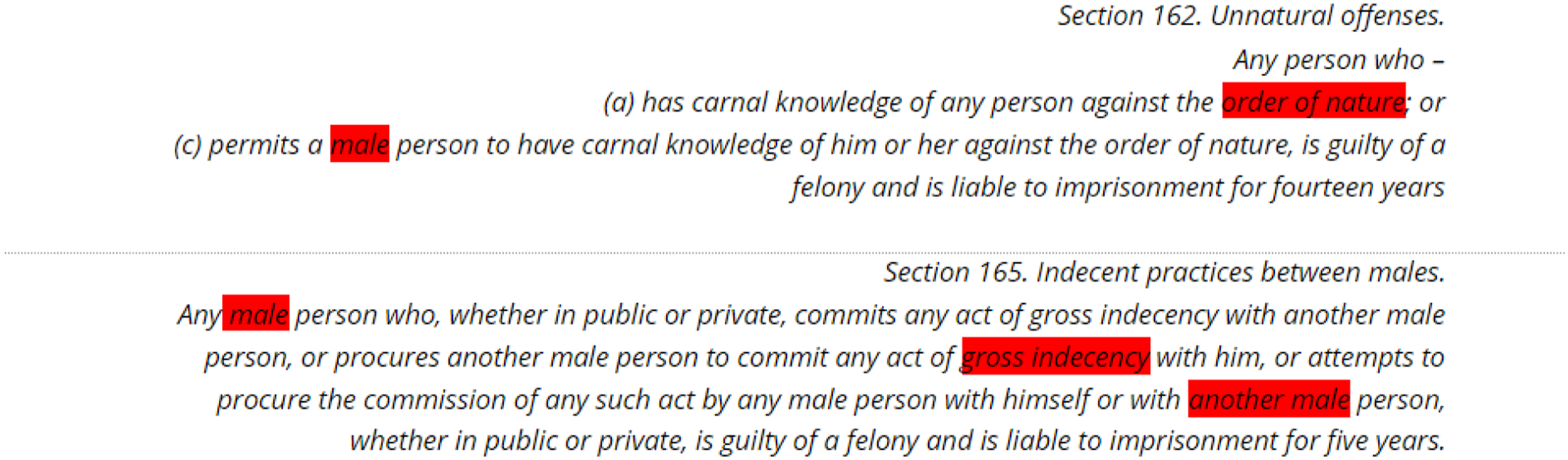
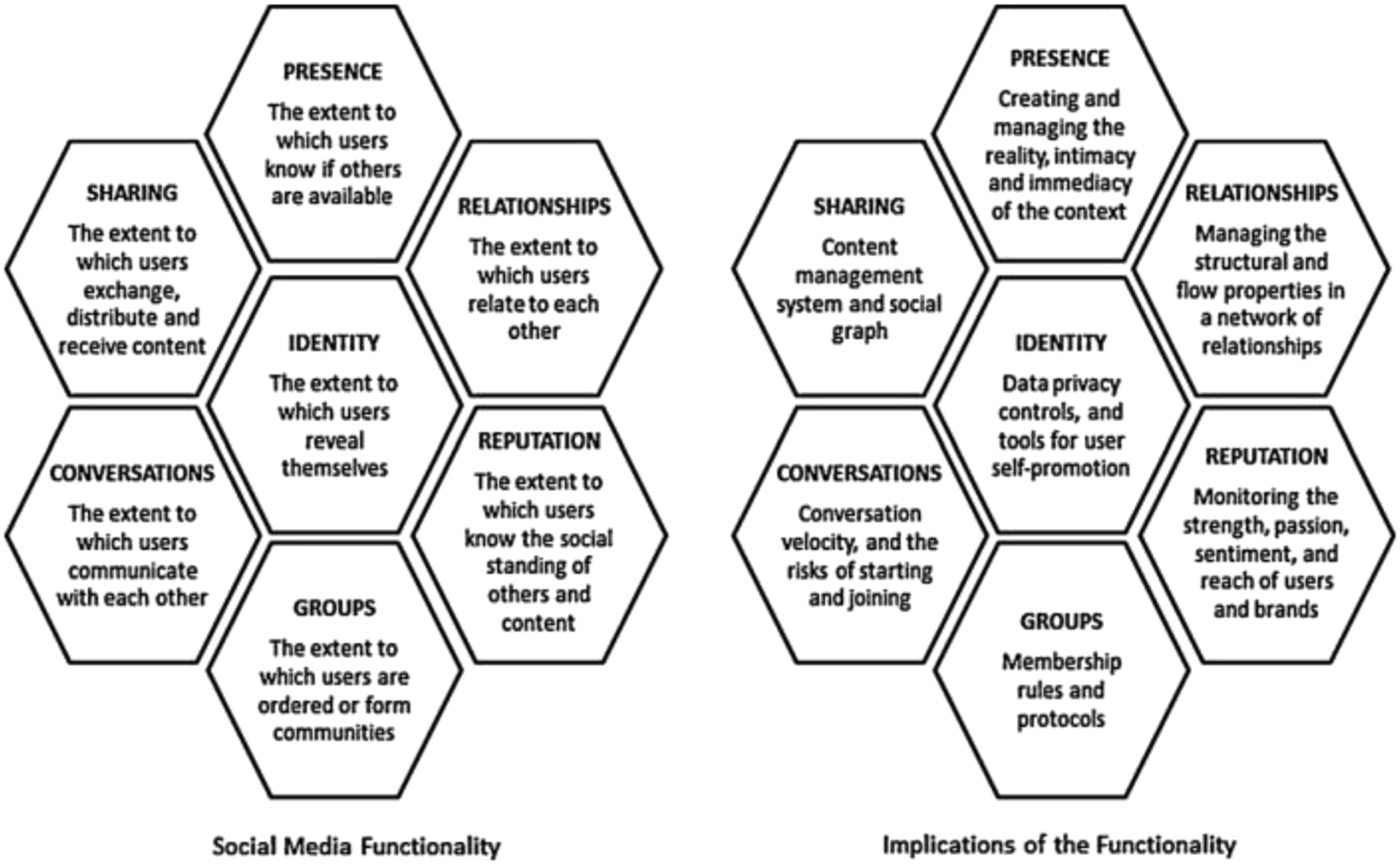
McLean and Mugo (2015: 97) maintain online spaces, such as social media which facilitate micro-blogging, serve as essential ‘counter publics’ from which new and alternative discursive positions can be injected into public spaces. Shaw (2012: 382) highlights that these spaces are ‘counter’ because they deviate from the requirements for inclusion in the dominant cultural public. One such space is HOLAAAfrica (McLean and Mugo, 2015) whose main purpose is to provide a digital space for queer African women to share their stories and experiences.
The widespread adoption of social media has significantly contributed to a shift in the socio-cultural terrain that previously defined queer identity and its development (Mustanski et al., 2014; Triggs et al., 2019). Within this field of study, findings on the experiences of queer persons using social media in ‘queer-world-making’ embody two different directions. Some of these studies have shown that even in predominantly heteronormative societies, social media has opened up possibilities for queer people to engage community and identity exploration (Craig and McInroy, 2014), learn queer culture, resist subversion and communicate empowerment (Boyd, 2014; Craig and McInroy, 2014; Mowlabocus, 2010; Pullen, 2014). Others have associated the use of social media with increased risk of homophobia for queer persons (Mburu, 2016; Mwangi, 2014).
While investigating the ways people present themselves online, understanding how they perceive and construct their identity in relation to others in their social setting is important. However, research exploring ‘context collapse’ (the flow of people, norms and information from one context into the confines of another ‘separate’ context) indicates that the complexity of online sociability has made it increasingly difficult to separate online audiences from each other (Boyd, 2014; Marwick and Boyd, 2014). Navigating audiences that are both multiple and invisible has become a part of the social world, following proliferation in the use of social media. As such, scholars (Ellison et al., 2007; Triggs et al., 2019) have argued that the coexistence of ‘multiple publics’ enabled by social media makes it difficult for the users to distinctly manage the content to be shared between different audiences. This is significant to research surrounding queer persons use of social media as the inability to distinguish audiences heightens the risk of identification of queer persons who would rather remain anonymous or have a clearly segregated and distinct audience. While studying queer use of Facebook, Duguay (2017) reports that queer participants living in heteronormative societies are forced to constantly render tailored ‘performance’ and distinguish their audiences in order to prevent unintentional context collapse which could expose them to social and physical harm.
Methods
Queer African women sexualities have largely been shaped by silence and secrecy (Currier and Migraine-George, 2016) with the experiences of Kenyan women remaining unnamed, invisible and underground (Mwangi, 2014). In line with the emancipatory agenda of this study, enabling queer Kenyan women’s voice to shape the narrative of their experience without censorship or filtering was of central focus. In order to do this, the research design at every stage was conscious to centre the voices of the participants who we have also called collaborators because of their significant role in the process. Horner (2016) defines co-constructive research to be research that encourages equal partnership between the researcher and participants in the process of knowledge creation. As such, rather than taking the traditional role of the ‘participant’, the interviewees in this study were viewed as collaborators; taking into account that the interpretation of their experiences and the language through which they (re)created these accounts is a valuable source of data. Mclean and Mugo (2015) also probes us to think about who gets to tell the stories of queer African women. She affirms that by adopting universalising narratives of queering, ones often written from a Western perspective, the experiences of queer African women are usually erased. As such by committing to ‘hearing’ the collaborators’ voices, the research design was keen to take into account the diversity of experiences of the different women.
To effectively implement this, the invitation email sent to the collaborators proposed questions with an open invitation to remove or add questions as needed. As postulated by Cohen (2007), one advantage of interviews is that they allow the researcher a valuable chance to understand the ‘negotiations of meanings’ as understood by the participants within their context. Additionally, regarding feminist research techniques, Reinharz and Davidman (1992) note that semi-structured interviews provide a more nuanced perspective on the research subject. This is because it allows the researcher access to the participants’ thoughts, memories and ideas in their own words. That is specifically useful in this research seeing that queer women’s experiences and voices have largely been silenced and rendered invisible. The interviews were carried out in a mixture of both English and Swahili as they were the common languages shared between the participants and researcher.
Why Instagram?
The decision to use Instagram as the primary platform is informed by multiple factors. First, following Cox and McLean (2013), the features, and formats of digital media technologies are important as they shape how users interact on the platforms. Of interest was the ways that queer women fight back erasure by visually constructing their existence by inserting pictures of themselves through the landscape of Instagram. However, the research process revealed that Instagram had more affordances such as hashtags, the user profile, filters, comments, privacy settings, follow buttons were being repurposed by queer women to make statements about their queerness, build community, discover their identity and create safe spaces where they can comfortably express themselves.
The second factor that influenced the choice to use Instagram was studies that have examined the experiences of queer individuals online have so far mostly focused on queer-specific platforms (Duguay, 2017). This research was, however, interested in platforms used by ‘mainstream’ populations (Duguay, 2017), that is, Instagram. The study anticipated examining the experiences of queer women in a landscape that was mainly cisnormative and heteronormative (Caldiera et al., 2020). Additionally, previous research indicates that Instagram’s affordances tend to favour the reproduction of dominant gender ideologies (Tiidenberg, 2015) but there is very little evidence supporting this in the context of the global south. By focussing on Instagram, this research seeks to understand, the extent to which Instagram serves as a space for these women to exercise their agency in a predominantly heterosexual context or if it rather reinforces and reproduces existing forms of oppression. Evidence from this research could help to inform the reconfiguration of Instagram as a tool to support agency and resistance by queer women whilst also recognising algorithmic nature of such a platform which dictates visibility (Cotter, 2019).
Finally, given Instagram’s extensive regulations and terms of use on what is acceptable or not when it comes to images and videos shared or hashtags used amongst other content, this study hoped to investigate the experiences of queer women reconfiguring affordances on this landscape to exercise their queer agency. As affirmed by McHugh (2013), recent literature positions non-state actors, such as Instagram as the ‘new governors’ in the digital age and the terms of use provided by these platforms as ‘constitutions’ that govern what is acceptable. The use of photographs as ‘cues for resistance’ (Salley, 2012) was also significant in this platform. Indeed Salley (2012) argues that photographs are not simply representations for individuals to recognize themselves, rather they bear the potential to be ‘documents tied to regimes of truth’. Following this assertion, we can question the ways that sharing of photographs on social media can provide a means for the silenced and unspeakable to enter representation.
Collaborators
Table showing their self-identification, age and visibility as described by participants.
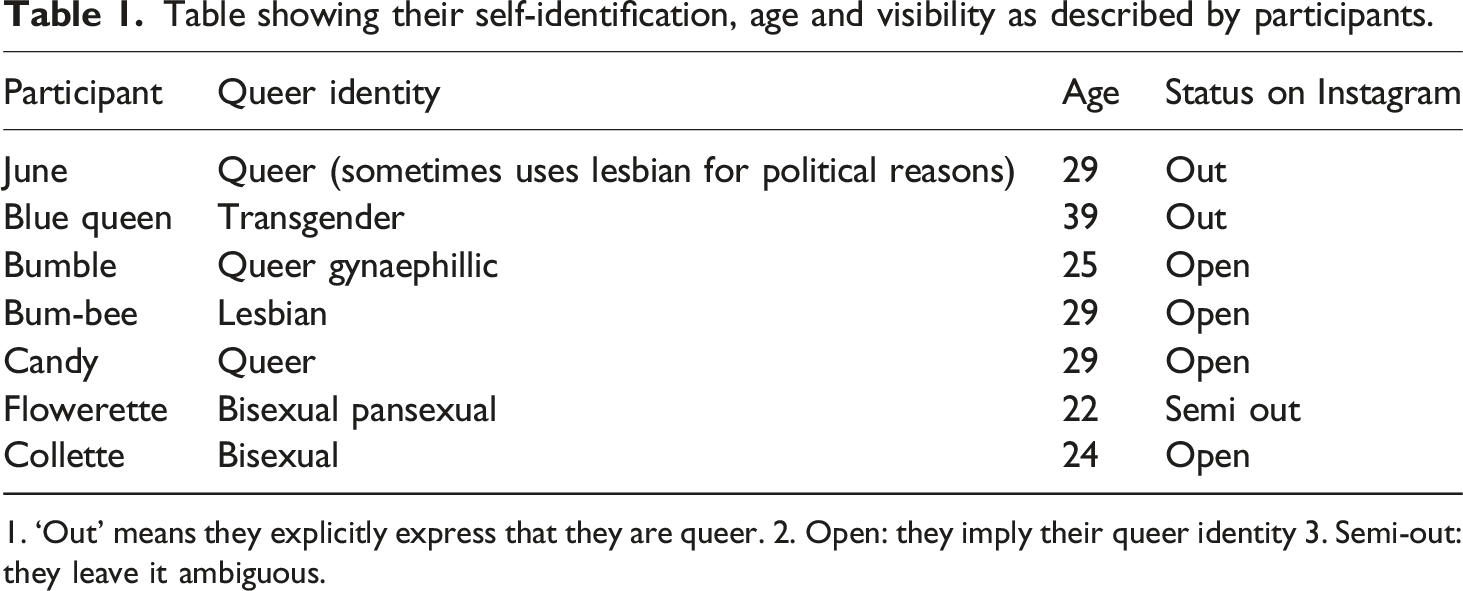
1. ‘Out’ means they explicitly express that they are queer. 2. Open: they imply their queer identity 3. Semi-out: they leave it ambiguous.
Following COVID-19 restrictions limiting movement during the time of the study, all interviews were done via Zoom. Using the video functionality allowed for an almost similar face to face interaction (Lune and Berg, 2017). The interviews were transcribed, printed out and analysed thematically.
Reflexivity and positionality
The authors of this paper all identify as cisgender and heterosexual women. Two are black African and one white European. As Reissman et al. (1993) puts it, sharing the same gender with the participants does not automatically neutralise power relations or create rapport. Similarly, despite the personal commitment of this study to ensure collaboration and power neutralisation, many other elements of our identities shape the outcomes of this research. Law (2004) points out the information given by participants does not speak for itself; rather, it relies on the interpretation of the researcher(s).
Findings
Self-presentation and fighting erasure
One of the ways that these queer women navigate agency on Instagram was through self-presentation. The participants shared their interpretations of presenting themselves online:
The thing was looking for people like us...Kenyan queer women who were older and not finding any..and you panic because people always say that
(Bum-bee, 29)
A similar sentiment was shared by June who speaks about her Instagram as her legacy and journey: If I died today, I want to leave a legacy. If you look closely at my page I post a lot of personal stories and for every photo, there’s an experience I was looking to share with people ...and it’s necessary that we give names and faces to the experiences of queer women. I think a big part of why it’s hard for us to be heard is
(June, 29)
The queer women’s self-presentation on Instagram takes place along the frames of consciously fighting erasure and marginalization. As such, some of the participants in this study perceived Instagram as a space to assert their existence through photo sharing. The assertions provided are supported by Salley (2012) and Thomas’s (2010) analysis of Zanele Muholi’s work on the ways visual cues in South Africa are being used to embody the resistance of black queer women by providing visuals that not only act as testimonies for queer existence but as tools to deconstruct the ‘gaze’. Queer women’s visual self-presentation serves as a means to subvert disciplining power. By inserting visual mediums via Instagram, these women reconfigure the app into a site for harnessing social power and politically disrupting space to assert agency and existence.
An observation from two of the participants’ experiences on self-presentation was the ways that mainstream media had an effect on how people respond to their content.
‘The one annoying thing I get a lot from sharing my pictures online is people who come to my comments to spew very sexual things. I think some shows like Orange Is the New Black on Netflix have made people really sexualize queer women..you tell people you are bisexual the next thing they are sending messages to ask you if you are down for a threesome!! It's plain annoying ..so I am forced to really evaluate what I am posting’
(Flowerette, 22)
‘I used to share stuff on my sexuality online before ...but it always warranted weird sexual suggestions from people and it was creepy. With time I’ve grown out of it and stopped sharing as much queer content...I do not want to be sexualised’
(Collette, 24)
Here we can observe that mainstream media largely shapes the way people perceive and understand matters of gender and sexuality (Mehraj et al., 2014). While social media spaces allow more room for gender and sexual minorities to insert their own narratives (because those spaces are composed of media-consuming members of society) these platforms are becoming spaces where these media-enforced stereotypes are reproduced (Antunovic and Hardin, 2013). The findings reinforce previous studies by Randazzo et al. (2015) and Johnson and Boylorn (2015) that found mainstream media’s limited and stereotyped representation of queer women served to further sexualize the ‘gaze’. Further, Flowerette’s experience points to the unique sexual objectification of bisexual women illustrated by (Brewster and Moradi, 2010) who state that cultural depiction of hypersexualized bisexuality predominant in mainstream media and pornography shapes the day-to-day experiences of bisexual women. Generally, what these findings illustrate here is that while Instagram can be used as a space to navigate agency through self-presentation and symbolic insertion, the strategies put in place by queer women are sometimes products of/or subject to normative pressures even on social media as seen in both Flowerette’s and Collette’s narratives.
The paradox of (in) visibility
The findings also illustrated that while Instagram was more flexible in creating a space for the queer women to articulate their identity and self-present through photos (and other affordances), not all the queer women were keen on attaining visibility. As previously highlighted, Collette (24) did not mention that she was explicitly queer because the assertion of her identity online warranted uncomfortable sexual suggestions. Bumble and Bum-bee shared almost similar sentiments while describing their experiences as being openly queer online:
‘I think as soon as you bring homosexuality on the table..people stop everything and focus on your sexuality ...they assume that there’s a way Lesbians are supposed to think..especially the way they are amazed by our intelligence..(laughs ruefully) someone once said to me .. - ’Shit! I didn’t think Lesbians could think like that!’ - and so when you check my Instagram its not all rainbows and stuff..that doesn’t mean I am living in denial...It means I am acknowledging my sexuality is just a small part of it’
(Bum-bee, 29)
‘I do not believe in coming out. That’s such a weird space where everyone expects you to talk about your sexuality all the time ...coming out is for you ..someone once sent me an inbox asking about my sexuality. They asked if I was a lesbian and I asked them why? They responded with ‘I just wanted to know’ and I asked her if she had a yeast infection ..when she said no...the only thing I told her was “Get the hell out of my vagina and do not come back!!’
(Bumble, 25)
‘The older I grow..the more I realize that your life is not for everyone to consume.I am usually out there with my queerness but not as much as I was when I was younger. Now I have a career and I do not want my queer identity to be the first thing people see about me’
(Candy, 29)
The shared experience here between Candy, Bumble and Bum-bee illustrates their not wanting to create a singular identity as only queer individuals. As seen on Bum-bee’s Instagram profile Figure 3, she intentionally draws attention to other aspects of her life – ‘Spoken Word Artist. Activist. Feminist’. Alimohamed’s (2010) work on the ways that marginalized Pacific Islander queer women were redefining queer politics illustrated similar conclusions with participants not wanting to ‘come out’ since they felt that by announcing their queer identity, they risked erasing other aspects of their lives. In a sense, therefore, experiences of agency for some of the women in the study deviated from ‘the quest for visibility’ that was assumed would be empowering. For them, asserting agency to some extent stemmed from being able to navigate Instagram aware of their queer identity without necessarily constantly asserting it for other individuals. Further, these findings challenge the assumption that structures of power (the majority) solely possess the power to render visible or invisible. Rather, as highlighted in these experiences, queer women navigating Instagram possess the influence to negotiate visibility and invisibility to suit their needs. These findings bolster the idea pushed by postcolonial feminism highlighting that women in different contexts are best aware of the conditions surrounding their intersecting oppressions and are best positioned to curate the blueprint for their liberation. In this regard, Mansoor (2016) asserts that those in the margin assert agency by actively creating alternative meanings for what empowerment looks like. In which case, the ‘centre’ is no longer an absolute for which everyone strives for, making its ‘hierarchical placement’ flimsy. Instagram Profile belonging to Bum-bee.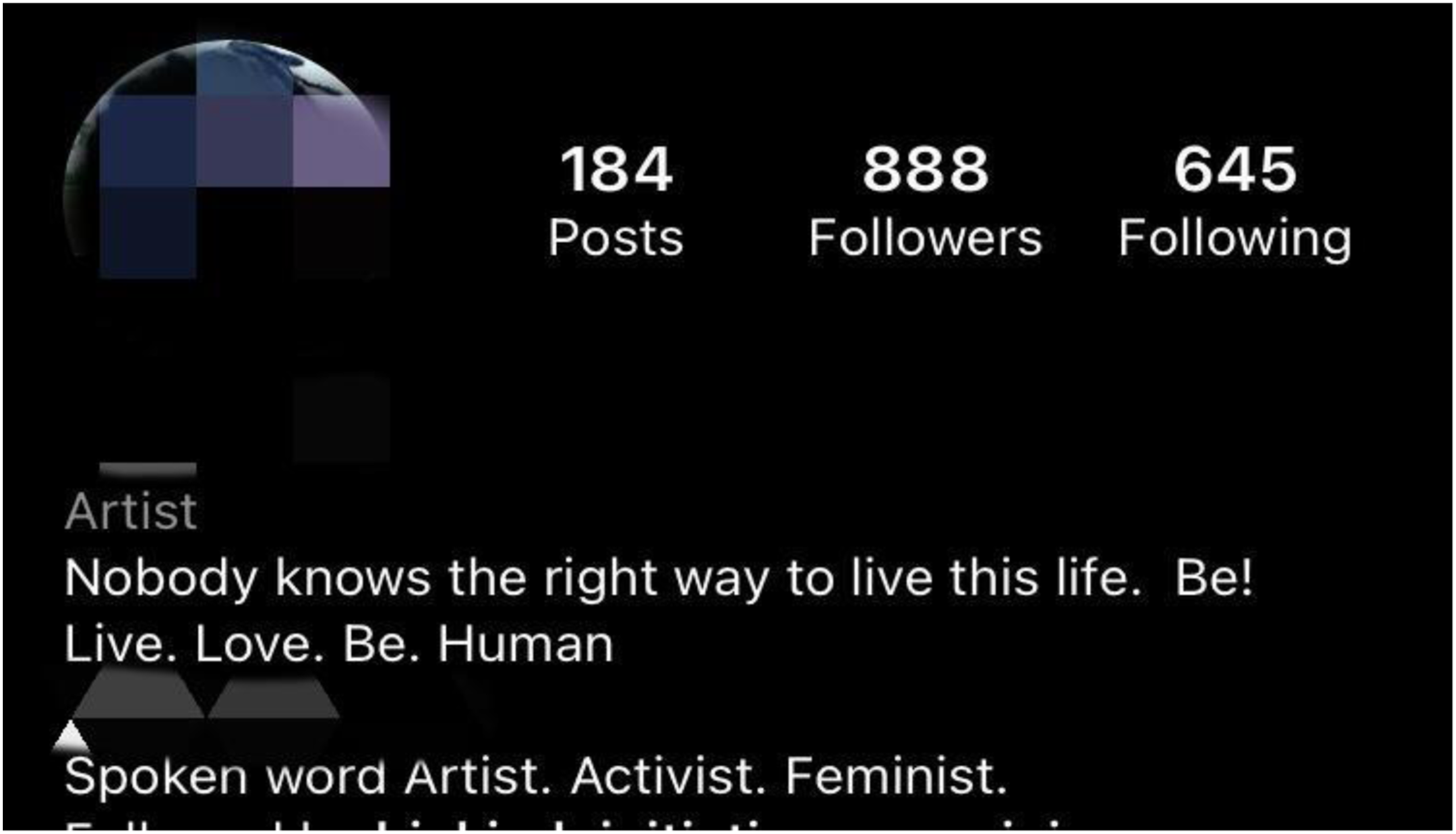
Conversely, June highlights her struggle pertaining visibility as one surrounding being told that she was too ‘out’ seeing that her Instagram page was largely rainbow-themed as a display of what she deems ‘queer pride’.
‘People..especially heterosexuals usually say to me..“why must you be so out and in our faces with your queerness..we do not go out there telling everyone we are straight”...what they do not realize is, that is their privilege..to not have to remind the world that they matter too’
The participants attached varying meanings to their experiences following the feedback they received online and the resultant influence on the strategies they employed to negotiate their (in)visibility. On the one hand, some participants were wary of creating a single online identity that paints them as only queer, and on the other hand, participants felt the need to use their Instagram page as space to predominantly assert their existence as queer bodies. This is notable in Flowerette’s (22) discussion where she draws a parallel between being queer offline and online in Kenya.
‘ I think as a queer person in Kenya you do not get to show who you truly are..on Instagram I am super real and I get to share my queer identity .. but as I told you, I have not come out to my family... my parents have seen my socials..my photos ..the ones with rainbow paint... and it was a big deal ..but I just told them I know what I am doing .’
Flowerette describes being the ‘real’ her online. However, she also states that she is not out to her family despite her parents having seen her posts online and making a ‘big deal’ of them. From her response, it is evident that while she considers what she posts online as her way of being ‘out’ and ‘real’, she interprets having not explicitly mentioned her queerness to them as not being ‘out’ to them. All the responses on (in)visibility reveal that there exists a dynamic that is more complex than the dichotomy of being in/out online. Participants’ interpretations of exposing queer identity were varied and present an interesting dynamic to the idea put forth by Saxey (2008) on ‘coming out’ as the site through which queer individuals construct authenticity. For these queer women, identity exposure online happens on their own terms. As exemplified in the analysis, the participants of these study utilized varied performative strategies such as the power of language (as seen on Bum-bee’s profile) or the symbolic association of the pride flag (as utilized by June and Flowerette) to construct ‘authenticity’ as queer individuals in the ways they best felt comfortable with.
Queer identity validation
Garnetts and D’ Augelli (1994), state that there exists a psychological correlation between identity validation and empowerment for queer individuals. The interviews with the queer women highlighted their experiences with using Instagram to find validation for their identities. Blue Queen (39), discusses finding ‘similar individuals’ online as empowering since it allowed her to ‘stabilize’ a key part of her identity. Another similar sentiment came from June and Flowerette who both discuss finding validation and confidence online:
‘I’d speak of LGBTQ rights from time to time, but I would always speak about it from a third-person perspective when people would ask me why I post queer activism content so much ...I was always ready with “Kwani they do not have rights’’ (points away from herself) I used to really highlight “they” just to make sure I was clearly not one of them...but eventually I got tired of denying myself… I knew there wasn’t anything wrong with me. So this one time my sisters asked me about my queer activism and I came out’
(June, 29)
‘100%...I think Instagram has helped me come to terms with my identity. I used to feel so weird about how I identified...growing up in church and being told that something was wrong with people like me ...I did not want to disappoint my parents ..but Instagram is like this other alternate space that makes you feel normal and accepted..’
(Flowerette, 22)
‘I come from a very religious home...I’m a P.K (laughs) -Pastor’s Kid. I used to feel so stuck and wrong… finding watu kama mimi (People like me) was life-changing. I do not talk to my real family as much since coming out ..but I have folk I can count on’
(Candy, 29)
The above assertions reveal various experiences that stem from utilizing Instagram to navigate queer agency. First, they highlight the ways in which queer women are able to find likeness, acceptance, comfort and ultimately identity validation in online spaces. These findings align with previous studies that show social media facilitates a space for self-exploration and acceptance for sexual and gender identity (Craig and McInroy, 2014; Duguay, 2017). While the aforementioned studies focus on the process of finding self-validation in countries where queer identities are legalized (Canada, United Kingdom, Belgium, respectively) and accepted to some extent, the findings from this study deviate from a context that doubly marginalizes queer women through the criminalization of their identities and cursory recognition. In which case, finding a space to validate their identities can be understood through Castell (1997) who draws a relationship between power and identities. He affirms that because identities are peoples’ source of experience and meaning, the capacity of a social actor to validate their own identity can be empowering. Drawing parallels between the findings of this study and the idea of empowerment online, it can be construed that, queer Kenyan women are able to have empowering experiences by finding likeness online. What came through here was the role of religion and family in producing different oppressions that shape their perceptions of their queer identity. Institutions such as the family and the church (in the case of these women) serve as sites for control in the ways that bodies make sense of their social-cultural positions and identities. This relates to the idea pushed forward by postcolonial feminism on the multiplicities and specificities that shape identities of different women (Guy-Sheftall, 2003; Kiguwa, 2019).
Erasing ‘femmes’
While this was not a sentiment shared by all participants, it was interesting to observe that some participants expressed the invisibility that came with being ‘femme’ (presenting traditionally feminine traits) online as a queer woman;
‘As a queer woman, when you express yourself as feminine, people really second guess your queerness..that is unless you are all rainbows and constantly asserting your identity as a queer woman’
(Flowerette, 22)
‘I used to identify as a lesbian..but now if you check my profile you see ‘queer woman’ that is because the more I grow the more I realise I do not fit into the societal definition of lesbian ..people assume that lesbian women must look and dress in a boyish way...and I have to keep correcting the labels people give me’
(Candy, 29)
The participants describe feeling a sense of invisibility predicated on societal constructions of the way queer women present themselves in the Kenyan context. The sentiments they share depict a homogenization of queer women under one category – ‘lesbians’ – and the idea that only women presenting masculine traits were truly ‘queer’. These findings resonate with those provided by a previous study on queer women in Kenya (Dearham, 2013) where the participants reported that the queer identity category the public associated to all queer women was ‘lesbian’. We can observe here that the ‘femme’ queer women, being undistinguishable performatively from heterosexual women, can be ‘de-lesbianized’ while the ‘butch’ based off their overtly ‘masculine’ attributes are more recognizable as ‘lesbians’. Seeing that the earlier study by Dearham (2013) focused on the public sphere, a notable aspect here is the replication of the same stereotypes online. Further, despite the agency afforded online for the participants to challenge these stereotypes and assert more diverse labels, other online users utilize these women’s self-presentation (dress codes, physical appearance and pride flags) as a means to evaluate their queerness which is usually limited to either lesbian or not.
The findings above also illustrate how the tensions between the performance of gender and its normative socialization can complicate queer identity. It is apparent that even in online spaces, the ways that ‘lesbianhood’ is imagined in Kenya propagates the erasure of some queer women’s identity. Even more critically, these findings highlight the question of ‘What categories of womanhood are visible under the patriarchy?’ Hoskin (2020) discusses the idea of femininity as a tool for subordination through which ‘femme’ expressing queer women are erased while trans women are denied authenticity into the category of ‘woman’. In a sense then, it is possible that while postcolonial feminism addresses the issue of agency as regards cisgendered women, it falls short in highlighting how trans-women navigate oppressive locations. As such, a more inclusive feminist theorization that accommodates this category of women in postcolonial regimes is needed.
Conclusions
First, this study found that the varied affordances of Instagram situate the photo-sharing app as a site from which these queer women contest erasure or their ‘unimagining’ through self-presentation and the amplification of personal narratives. On the surface, queer Kenyan women’s use of Instagram might be perceived as insignificant, however, their experiences have shown that their participation on the app embodies both conscious and unconscious forms of resistance that destabilizes power within dominant publics. These findings, just like those of other previous research, illustrate that there is an opportunity for the reconfiguration of new media for groups previously marginalised to challenge privilege and navigate oppressive structures. As seen in this study, not only are queer Kenyan women able to assert themselves and their narratives, the app functions as a site for sustained resistance where these queer women are politicising their own bodies and voices.
Second, despite the agency afforded online, the experiences of the queer Kenyan women using Instagram reflect that as space, Instagram contributes to the replication of dominant attitudes since a majority of users that interact with the content shared by these women subscribe to cisnormative, heteronormative and patriarchal attitudes. In a sense, therefore, while using Instagram increases the choice making capacity of the queer women online, their participation could enhance minority stress in some ways. A good instance where this was shown in the findings is the sexualization of queer women presenting themselves online. The question begs to be asked, ‘Are all spaces that make audible the voice of the subaltern suitable counter publics?’ This study has shown that while the experiences of queer women using Instagram might not always have agentic outcomes, online spaces provide them with a choice that is not always available in other spheres. However, this research has probed thinking about the ways that access to sites such as Instagram might serve to further displace the feminist agenda. One, seeing that in Kenya there exists disparities in terms of technology availability, queer women in rural areas are denied access to such spaces further propagating inequality. Two, while the idea of agency in this study focused on the individualized notion provided by Kabeer (2005), there’s a sense of agency that is robbed from individuals participating in apps such as Instagram that are controlled by technocapitalism. In this regard, Fotopoulou (2016: 13) discusses this paradox of feminist discourse online that challenges disciplinary power while the tools of their political project are digital capitalism.
Footnotes
Declaration of conflicting interests
The author(s) declared no potential conflicts of interest with respect to the research, authorship, and/or publication of this article.
Funding
The author(s) received no financial support for the research, authorship, and/or publication of this article.
