




Abstract
This empirical phenomenological study examines women’s sexual identity work in menopause. It shows that women’s self-understandings are at stake and take shape through a negotiation of dis/connectedness from/to others in sexual activities. Four negotiations are distinguished: (1) lessening with the other, (2) self-familiarizing (3) experimenting with others, and (4) giving oneself to the other. Herein, sexual identity work is revealed to be a precarious practice. In making sense of oneself, often through new sexual activities, women balance the tightrope of dis/connecting with others and norms, while facing the possibility that they may lose themselves and others in the process.
We were just sitting there, on the couch, no [sexual] tension, none. [But now, we do] swinging and bondage: so amazing! […] It’s so different from everything I did [before]. It’s challenging, you really have to open yourself up […]. [But] you [also] need to maintain your boundaries very strictly. “What do I like, what not?” [Because of] all those new things, I get to know myself again. […] It seems as if I become different … or more and more myself. (Beth)
Introduction
Since Beth is in menopausal transition, her body, life, and social roles have undergone significant changes. Her libido decreased, her vagina became dryer, and the body fat that gathered around her waist made her feel less attractive. At the same time, her children moved out, and she had more time alone with her partner. “We were just sitting there, on the couch, no [sexual] tension, none,” she recalls. In the midst of these changes, she tried new sexual avenues—not only for renewed sexual pleasure but also “to get to know [her]self again.” Beth’s above-cited words show that her body and life changes in menopause encouraged her to do what may be called “sexual identity work”: making sense of herself within and through sexual activities. It is through swinging (or partner swapping) and bondage that Beth, as she says, “becomes different … or more and more myself.” By analyzing this account and those of other women and adopting the basic assumption that self-understandings are shaped within and through the things we do (see Merleau-Ponty, 1962; Mol, 2002), this paper explores the meaning of sexual identity work in menopause.
Various theorists in the social sciences and philosophy have acknowledged the pivotal role of sexuality in identity construction. Studies typically focus on how sexual practices and experiences shape gendered and sexual self-understandings such as being queer, woman, man, non-binary, or gay, bi-sexual, heterosexual, pan-sexual, and a-sexual (Daniluk, 2003; De Beauvoir, 1997; Galupo et al., 2018; Gamson and Moon, 2004; Heinämaa, 2003; Person, 1980; Schudson and Van Anders, 2019). While this may be true, sexuality arguably constructs self-understandings beyond these identities or roles. It co-shapes what it means to be a “me” in a lived context in general (Butler, 2022; Merleau-Ponty, 1962; Taylor, 2016). That is, sexual experiences co-constitute the roles we take on in daily life and the meaning we ascribe to these roles (Taylor, 2016). They co-shape the ways in which we position ourselves within one’s past, present, and future (Heinämaa, 2011; Steinbock, 2006). They influence and shape whether and how we inhabit our bodies as our own (Käll, 2009), or ascribe “worth” to ourselves (Bortolan, 2018; Daniluk, 2003; Ratcliffe, 2005). They even shape what it means to be human to begin with (Levinas, 1981).
While many—perhaps even all—people do sexual identity work, it seems to come more to the forefront and acquire more urgency for those whose bodies, psyches, or lives are undergoing change. Studies have shown, for example, that becoming ill or old(er), having surgery, or going through other major life events such as child birth and divorce require new ways of relating to and making sense of oneself, including within and through sexuality (Dickel, 2022; Hogan, 1997; Leunissen et al., 2016; Parker and Yau, 2012; Riessman, 2003; Santos and Santos, 2018; Shildrick, 2009). In this kind of research, however, a ubiquitous change has hitherto largely been taken for granted: menopause. 1 Half of the world’s population goes through this transition sooner or later, and for many, the change not only means that one stops menstruating and becomes infertile; it may also imply a plethora of other changes such as hot flashes, a dry(er) vagina, decreased libido, insomnia, altered orgasms, different social roles, mood swings, and/or bodily in/sensitivity (Santoro et al., 2021). Given these possible alterations in menopause, this papers offers an analysis of women’s sexual identity work in menopause. 2
In doing so, the study accounts for the pivotal dimension of relationality in sexuality. In the literature, sexuality is often perceived—and rightly so—as an intimately personal experience in the sense that my attractions, feelings, and sensations are, first and foremost, my own (Aanstoos, 2012). However, sexuality—like perhaps all aspects of life—is arguably also a fundamentally relational phenomenon (De Beauvoir, 1997; Irvine, 2005; Merleau-Ponty, 1962; Ussher et al., 2015; Winterich, 2003). In sexuality, after all, there are always others present. These others may be imagined, for example, in erotic fantasies, but they may also be flesh-and-blood others when it concerns, like in Beth’s case, encounters with bed partners. In expanding on this relational dimension of sexuality, this paper focuses on the preliminary question of what relationality means for menopausal women in their sexual identity work.
In this respect, Beth points to what relationality in sexual identity work potentially means. “You really have to open yourself up,” she says. At the same time, her felt urgency to “maintain very strict boundaries” suggests that she does not only mean openness and connectedness to others. For her, bondage and partner swapping entail a negotiation between proximation and distance, connectedness and disconnectedness, familiarity and strangeness, or autonomy and dependence between oneself and others (Merleau-Ponty, 1962; Taylor, 2016). It is also within and through this negotiation that Beth may make sense of herself, something that she alludes to when she says that “[because of] all those new things, I get to know myself again.”
By analyzing sexual identity work in menopause, this paper draws on these relational negotiations of dis/connectedness and examines their extent and diversity. To this end, the paper offers an interpretative phenomenological empirical analysis of how 11 women in menopause practice their sexuality (Smith, 2009; Van Manen, 2016). Through this analysis, four ways of relational negotiations in these women’s sexual identity work are distinguished: (1) lessening with the other, (2) self-familiarizing, (3) experimenting with others, and (4) giving oneself to the other. The interpretations and discussions of these empirical results are based on philosophical–phenomenological insights about sexuality, identity, and relationality.
Phenomenology of sexuality
In using philosophical phenomenology as a heuristic tool, this paper critically appraises research in sex therapy, psychology, and medicine. These disciplinary fields have contributed to important and ground-breaking insights about the functionality and experience of sexuality in general and also during menopause (see, e.g., Astbury-Ward, 2003; Caruso et al., 2016; Ussher et al., 2015). However, studies within these disciplines typically review sexuality as a somatic or psychological problem; as such, they tend to treat sex as a phenomenon explicable through universally shared biological mechanisms within the isolated body—through hormones, “drives,” or other cognitive and somatic processes. One may think, for example, about research that states that a progressive decline of “sex hormones” or “sex steroids” largely determines the ways in which menopausal women experience their libido (Nappi et al., 2014) or studies that hold that many sexual disorders in menopause are caused by cardiovascular conditions, diabetes, or musculoskeletal disorders (Cipriani and Simon, 2022; Nazarpour et al., 2021).
In response to both the universalizing/mechanistic and individualizing tendencies in sex research, this paper turns to the phenomenology of sexuality. In doing so, it reclaims an appreciation for sexuality as taking shape in and through contingent, socio-cultural contexts and as meaningful for people beyond its pathology (Aanstoos, 2012; Irvine, 2005; Ussher et al., 2015; Winterich, 2003). Phenomenology foregrounds the ways in which people make sense of themselves and the world through their experiences, practices, and sexual activities (De Beauvoir, 1997; Levinas, 1981; Merleau-Ponty, 1962). Even more, in his seminal work Phenomenology of Perception, the philosopher Maurice Merleau-Ponty (1962) argues that sexuality should be understood as an (almost) ever-present sense-making practice. In writing that “sexuality [is] co-extensive with existence” (170), he holds that sexuality, like an inescapable smell or atmosphere, is a modality of existence through which we inhabit our lifeworld as well as ourselves. Thus, sexuality may be everywhere at any time—in the supermarket, in our beds, in our dreams, in doing the dishes, in nose-picking—and, thus, functions as a horizon over and against which we co-construct our self-understandings.
In asking how people make sense of themselves within and through their sexual practices, phenomenology sees the sexual self not as an isolated entity but first and foremost as the result of a complex set of relations with the environment and others. After all, the sense we have of anything, including of ourselves within and through sexuality, is only made possible on the basis of a pre-given world that we are always already involved in (Merleau-Ponty, 1962; Taylor, 2016). As such, sexual identity work reflects our encounters with (more or less concrete) others as well as with historized, socio-cultural aspects such as norms about beauty, relationships, sexual practices, age, class, and gender (Bartky, 1990; De Graeve, 2019; Harding, 1996; Read, 2013; Ussher et al., 2015; Wilkins and Miller, 2017; Winterich, 2003). In this regard, Merleau-Ponty writes that sexuality is not a natural phenomenon but a “historical idea” (1962: 170). Sexuality is a place wherein historized, socio-cultural structures are taken up and realized in intersubjective encounters. In examining sexuality in menopause as a sense-making practice of the self, therefore, we have to attend to both of these relational—intersubjective and cultural—contexts.
Here, it is important to note, as did Beth at the beginning of this paper, that relationality in sexual identity work entails both connectedness to and disconnectedness from others. We are only able to relate to another when we have some dependence on or connection to that other. At the same time, we can only relate to that other if there is a distinction, disconnectedness, or difference between the self and other—if there are (at least) two (somewhat) autonomous subjects or entities (de Boer et al., 2019; Taylor, 2016). Otherwise, the self would collide with the other, and there would be no ground for a relation. Relationality, including in sexual identity work, may therefore be understood as a negotiation of proximation and distance, connectedness and disconnectedness, familiarity and difference, autonomy and dependence between the self and other.
Phenomenology further teaches us that this negotiation of dis/connectedness plays out within and through various (interrelated) aspects of our lives, specifically through our temporal and embodied existence. We are, first and foremost, able to and always have to relate to others by virtue of our embodied being in the world. Merleau-Ponty (1962) writes that this arises from the “metaphysical structure of my body, which is both an object for others and a subject for myself” (167). Thus, through our inevitable embodied existence, we experience and affect—we see, touch, smell, taste, hear, and physically position ourselves over and against—other bodies, and other bodies experience and affect us through their sensory positioning (Merleau-Ponty, 1962). Such embodied relationality, then, may be lived in various ambiguous ways. For example, in being physically close to others, we may not only experience connectedness but also a repulsion for the (smell of the) other. Furthermore, in touching another (and being touched), we may not only become sensorially familiar with the other body; it also encompasses a sense of estrangement and differentiation, in that, we are never able to know how the other experiences our touch or is affected by it (Zeiler, 2014).
Importantly, these embodied relational aspects are inherently temporal and constantly subject to change, and so too is our sexual identity work. Our lived closeness to or distance from others is never isolated from our past and future—from our memories, hopes, and wishes (Boerde et al., 2015; Steinbock, 2006). With every touch, whisper, remembered event, or hoped-for future, our relationships change as well as our sense of self. Therefore, rather than mistaking our relational identity for something static or fixed, it is always a becoming. Sexual identity work, in this sense, is ultimately work in progress.
In revealing and examining sexuality as an inherently relational practice wherein one becomes oneself, philosophical phenomenologists typically do not empirically explore different ways of doing sexual identity work in a relational—intersubjective and cultural—space. Their theoretical examinations, however, may help us describe and understand how sexual identity work in menopause takes shape and what is at stake in doing such work. In this paper, therefore, we will deploy philosophical phenomenological insights as a tool to interpret these women’s accounts of sexuality.
Researching sexual identity work in menopause
Participants
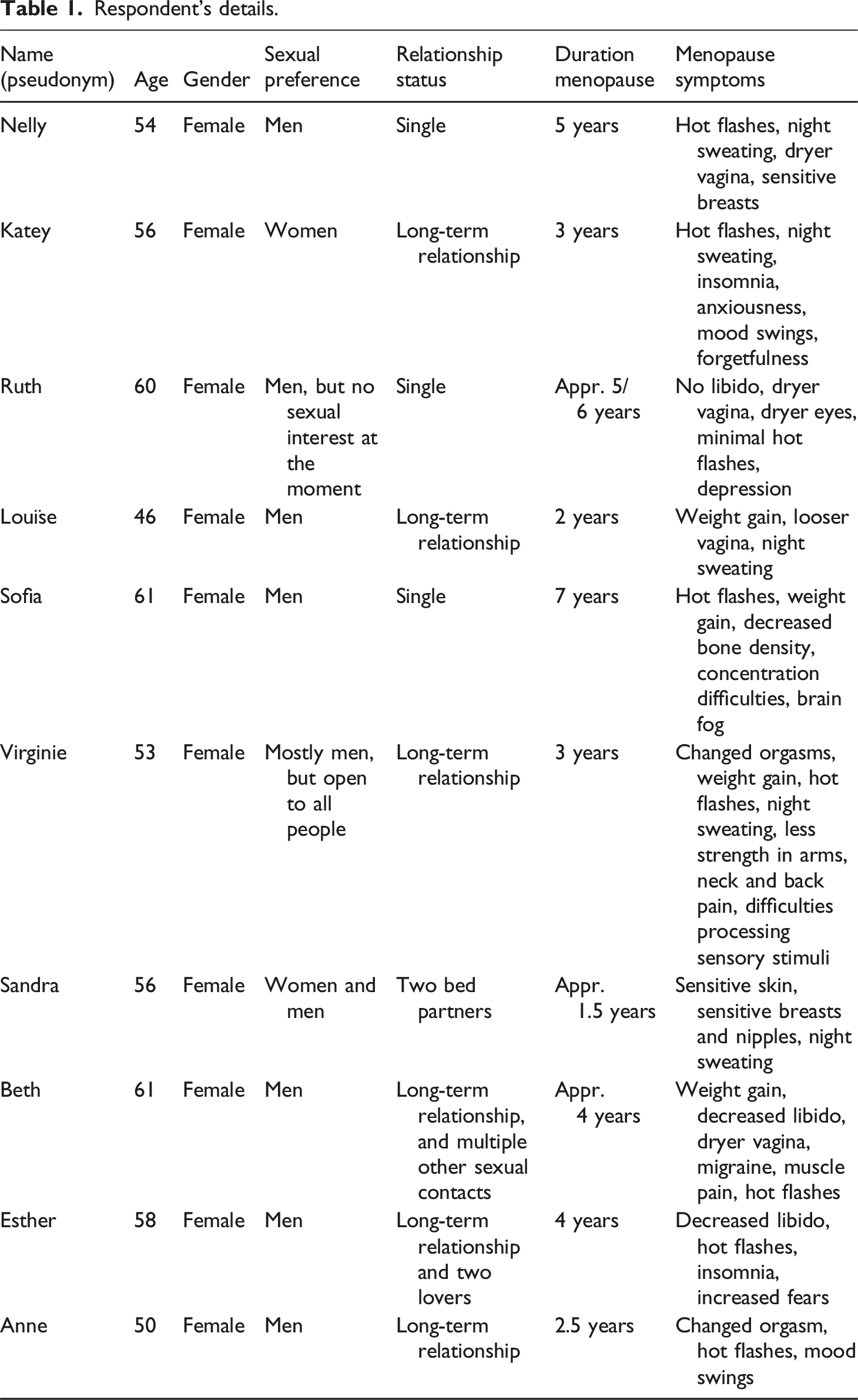
Respondent’s details.
Recruitment
After obtaining ethical approval from the university ethical board (insert dossier nr.), women were recruited through an advertisement on social media platforms dedicated to menopause. The 33 women who responded to the advertisement were invited to fill in a questionnaire with information about their age, gender, sexual preference (women, men, queer, none, etc.), relationship status (if applicable), duration of their menopausal transition, and menopausal experiences. Out of the 25 women who filled in the questionnaire, 15 were invited for an interview, and 11 interviews were included in the analysis. 3 These women were selected in order to create a diverse sample in terms of the aspects addressed in the questionnaire. This means that women who did not (only) sexually preferred men and who were not in a long-term relationship were purposefully selected. It was also made sure that the invited women ranged in age, the duration of their menopausal transition and the severity and kinds of menopausal symptoms. Such purposeful sampling into small, diverse samples is commensurate with a qualitative phenomenological study design that yields rich and rigorous interpretive descriptions about the experiences and practices under investigation (Sandelowski, 1995).
Analysis
In the analysis phase, the anonymized transcriptions of the audio-taped interviews were read and re-read. The data were then analyzed and interpreted through an interpretative phenomenological research method (Smith, 2009). First, open descriptive codes to interview excerpts were attributed that related relationality and sexual identity work on a general level. Examples of these codes are: “less intimacy with partner,” “acquiring new sexual practices by oneself,” and “getting to know one’s body.” In the process of reading, coding and re-reading (always coded) interviews, the interviews were recoded. Through this recoding process, more specific codes involving intersections of relationality and sexual identity work were drawn out. Examples of these codes are: “(re-)familiarization with oneself: masturbation” and “connection with partner: trying new sexual practices together.” Based on these final codes, more general storylines or themes involving relational negotiations of dis/connectedness in these women’s sexual identity work were identified: (1) lessening with the other, (2) self-familiarizing, (3) experimenting with others, and (4) giving oneself to the other. Within and through describing and interpreting these four ways of relational sexual identity work, this paper shows, first, how the principle of dis/connectedness between the self and other may take on different ratios (i.e., proportion of connectedness to disconnectedness) and types (i.e., proximity/distance, familiarity/estrangement, etc.) within various kinds of sexual activities (bondage, partner swapping, etc.) and, second, the repercussions of these various relational negotiations regarding sexual practices on how women come to understand and make sense of themselves. More concretely, the results of this paper are organized so that the spectrum of relating to others in one’s sexual identity work becomes clear: from physically distancing from the other and feeling estranged from the other (see: “Lessening with the other”) to distancing from the other and turning to the self in order to proximate and connect with the other, again or anew (see: “self-familiarization”) to mainly connecting, and familiarizing with the other (see: “experimenting with others”) to (almost) becoming the other in their relational sexual practices (see: “giving oneself to the other”).
Results: Four ways of sexual identity work in menopause
Lessening with the other
Many of the women narrated that their changing bodily and psychic experiences in menopause drastically influenced their sexual relations and experiences. Changes such as a dryer vagina, more sensitive skin, overly sensitive nipples and breasts, depression, anxiety, sleep deprivation, mood swings, and hot flashes seemed to decrease their experienced libido and/or propel less- or even unpleasant sexual encounters. For these women, the frequency of their sexual practices with others typically diminished. They reported that they did not want “to be in pain that much” (Nelly) or that they did not “see the purpose of it all anymore” (Esther). In this lessening of sexual encounters, however, not only was the avoidance of unpleasant sexual experiences potentially at stake but also these women’s identities, which was the case for Katey. In her interview, she recounted the last time she had sex with her partner, more than 6 months ago: I began to sweat all over; I was so, so hot, I thought I would burst. […] I couldn’t think, and she kept touching me and I shouted: “stay away, give me space! Don’t touch me.” […] I panicked; I couldn’t stand it. […] Only when she was not near me anymore, I could come to myself, I could regain myself again. […] So as long as I have this [makes sweating gesture], there is no this [makes touching gesture]. (Katey)
Katey’s account suggests a sense of alienation from herself in the unpleasant sexual contact with her partner. In recounting how she handled her panic while experiencing severe hot flashes during sexual contact, she seemed to adhere to a split self, a self “othered” from one’s self: “I could come to myself, I could re-establish myself” [author’s emphasis]. Such a split selfhood reflects a basic experiential structure that we all have as human beings: not only are other bodies given to us as objects but our own (subject-) bodies as well. After all, as bodies, we are touching and being touched, or seeing and being seen, and as such, we are given to ourselves as both object and subject (Merleau-Ponty, 1962). However, despite the fact that split selves, in this sense, are commonplace, it seems that, for Katey, it took on an overly intense form. That is, if we put the emphasis on different words in Katey’s narration, we can see her need to move to and collide (more) with her othered self again. Here, physically distancing herself from her partner seems to be a prerequisite in doing so: “only when she was not near me anymore, I could come to myself, I could regain myself again” [author’s emphasis]. As such, it seems that Katey lessened her sexual contact not simply to avoid sexual displeasure but also because she did not want to relive the experience of an intense doubling of her selves in that unpleasant experience.
For some women, not only is their identity at stake in lessening unpleasant sexual encounters but also in reducing interactions that are non-pleasurable, which was the case for Ruth, who currently refrains from sexual contact: [My] libido is gone. The thought of it [having sex] gives me nothing. […] Being intimate is not something that you need to do for satisfying the other. […] You never have to sacrifice yourself—I think. […] You have to do it for yourself, and only yourself. (Ruth)
In narrating that her sexual interactions should only be in service of satisfying her own pleasures, Ruth’s account can simply be interpreted as a selfish hedonist understanding of sexuality. However, by specifically accounting that sexual contact in service of pleasuring the other entails sacrificing oneself, Ruth seems to point out that her hedonism may be more than unadulterated selfishness: it may be a way to maintain and verify herself as a self. Here, the understanding of hedonism by the philosopher Emmanuel Levinas is instructive. For him, hedonism is the ability to enjoy enjoyment for itself and not for something outside of that enjoyment—which speaks to our primordial way of dwelling in the world (Levinas, 1981; Staehler and Kozin, 2021). It is, in other words, a particular human feature to be able to enjoy without a particular purpose. This can apply to eating and tasting—Levinas’ famous example—which “does not have existence as its goal, but food” (Levinas, 1981: 134) as well as sexuality. Just like tasting is the very meaning of eating, being pleasured is the very meaning of sex. Therefore, when sexual interactions are not enjoyable (anymore) and only derive their purpose, as in Ruth’s case, from pleasuring others, one may not be able to live and confirm their all-too-humanness. In this sense, we may understand how Ruth’s non-pleasurable sexual interactions may dissuade her sexual contact as it would help her maintain sight of what it means to be a human or at least avoid the risk of sacrificing her sense of self as a human being.
Self-familiarizing
As a consequence of bodily changes that may occur during menopause, women do not only lessen their sexual contact with others; they also frequently try to find altered and new ways of having sexual contact with others. In doing so, some women first try to re-/familiarize themselves with their bodies and their sexual preferences on their own before sexually re-/relating to the other. Here, many of the women referred to changes in their orgasms as a bodily change that encouraged them to get reacquainted with their bodies again. They often did so in implicit and euphemistic ways, saying that there is “no [sexual] tension (Beth) or “that the dryness [of the vagina] did not help”(Nelly). In Virginie’s interview, she was quite explicit about her orgasms: It’s like a little sneeze. […] I don’t know myself like that. […] They [her orgasms] are horrible [because] I want to give myself, [and] him [her partner] the pleasure of an, ehm… nice ending. (Virginie)
In aiming to alter or perhaps even regain her (level of) orgasming, she recently enrolled in a so-called “orgasm course” with a sexual therapist. She explained why she wanted to do this course on her own: I cannot use him there; it’s important that I figure out on my own what my needs are. […] I need to put myself first. […] I don’t have those care hormones anymore, also not in bed. (Virginie)
What stood out in Virginie’s account was her explanation to take an orgasm course, in which she referred to “care hormones.” Her phrasings may be understood in the light that women, especially in heterosexual love relationships, are persistently regarded (and regard themselves) as having to take care of and even be subservient to their partners. By extension, their sexual relationships are also perceived (ideally) as being in service of the (orgasmic, erotic) needs of the male counterpart (Sanchez et al., 2012). Virginie’s choice to take the orgasm course by herself can be regarded as breaking with these dominant heteronormative sex roles, and so, she may have felt that she needed to take a firm stance against this prevailing norm. Repeating her rationale—as she does—may have been one way of doing so, and using a biological substantiation in her explanation may have been another. Thus, in saying that, as a menopausal woman, she does not “have those care hormones anymore, also not in bed,” she seemed to naturalize her choice of “putting myself first.” This kind of hormonal imaginary, after all, may be interpreted as a way to argue that there is a biologically deterministic mechanism in place that makes her want to turn to her own sexual needs (more) (see Harding, 1996).
Note, however, that in explicitly turning to her own sexual needs, Virginie still seemed to try to sexually re-relate to her partner: Because I will know myself better [through the orgasm course], I can give him space to get to know me better since I know what I want [and I] am not that pre-occupied with myself anymore. (Virginie)
Her solo orgasm course, in this sense, was in anticipation of welcoming an altered relation with her partner. This turn to herself so that she could re-relate to her partner, however, was not without risks as the distance between her and her partner could become unbridgeable. As she recounted: I am afraid to discover [in the orgasm course] that we did not do it [having sex] right all these years. That we… that our relationship was rubbish. […] What if I want another man? (Virginie)
Here, Virginie’s words reflect an interesting play of temporalities. In taking the orgasm course, she fearfully anticipates a possible unsurmountable distance. This future possibility originates in a possible future evaluation of her past sexual experiences in light of what she will learn in the orgasm course. Arguably, however, Virginie does not only fearfully entertain the possibility that her current evaluation of her sexual relationship is misguided; by not wholeheartedly relying on her current evaluation of her past sexual experiences—and thereby fearing the loss of her partner in the future—she alludes to a present experience of distance between her and her partner, an experience of distance wherein a future unsurmountable distance is considered by her as a possibility to begin with.
Furthermore, besides the fact that women, such as Virginie, talk about bodily changes that directly invoke a need to become (more) familiar with themselves, many of the women also talked about how their bodily changes affected their sense of being sexually un/attractive (see also: Ussher et al., 2015), which, in turn, invoked a need for self-familiarization. These women stated that they knew or suspected that their bodily changes (e.g., their weight gain (Sofia and Louïse), sweating (Nelly), “sagging breasts” (Ruth), or “looser vagina” (Louïse)) made them less attractive to others. However, instead of modifying their bodies to meet the (assumed) sexual standards of others, they seemed to begin by meditating on what they understood as sexually attractive about themselves. Louïse’s account is telling: My sense of feeling attractive apparently also very much resides in how he [her partner] looks at me and touches me. That is just different now. […] My sensuality does not matter that much to him anymore. […] And I need to find out what still matters, not so much for him, but for me. […] What is that [sensuality/attractiveness] for me? That is an important question. […] I think that if I value myself, that good things will happen. [That] he finds me attractive again as well. If I radiate that [her feeling of being attractive], others will feel that too. (Louïse)
In this quote, Louïse does not explicate what her understanding of self-attractiveness is or how she will try to find it. What she does make clear is that her (to be found) feelings of being attractive would condition whether others will also find her sexually attractive. In attributing such preponderance to self-attractiveness, she seems to allude to the idea that this experience—just like, for example, self-esteem—is not just an episodic self-evaluation that arises quickly and lasts momentarily. For her, self-attractiveness seems to pertain to a pervasive background experience of self-worth, to what she calls “valu[ing] myself”. Self-attractiveness, in this sense, cannot be absent (entirely) as we always have a more or less implicit account of our worth or value. Given that self-attractiveness may be understood as such an existential mode of being-in-the-world, it may significantly impact our attitudes and behaviors as well as those of others (Ratcliffe, 2005). Here, the meaning of Louïse’s “radiating” self-attractiveness seems to become apparent: as an existential disposition, her sense of being (un)attractive may spill over into how she approaches others, something that may (positively or negatively) also influence the ways in which others evaluate her attractiveness (Bortolan, 2018).
Experimenting with others
Whereas the women in the above two sections showed a tendency to distance and disconnect from others in their sexual identity work, at least at first and/or to some extent, some women mainly connected with others in doing so. This was the case for Sandra as she experimented sexually with her two bed partners in order to get reacquainted with her changed body again. During her menopausal transition, her skin grew very sensitive, something that now made touching different, sometimes unpleasant. She then deliberately and enduringly experimented with especially one of her bed partners in order to figure out what she liked and disliked during sex: What helped in the end was that we did it [had sex] more often; we tried a little more. […] She touched me; sometimes I said, “no, no, not there.” Then there [touching gesture]: “no, slowly!” until we reached a point where we could say “yes, now, yes.” (Sandra)
In this quote, Sandra repeatedly used the first person plural: “we did it,” “we tried a little” [author’s emphasis]. In doing so, it turns out that her touching experimentations were a thoroughly collaborative effort wherein bodily proximations were alternated with moments of distancing. Thus, while proximation in the form of touching seemed to be key, it was in this bodily proximation that Sandra occasionally provided feedback when her bed partner came too close too soon or touched her in the wrong places. Such attract and (sometimes) repel movements eventually seemed to result in a deep connection between her and her bed partner, up to a point where she rehearsed their shared voice of sexual reacquaintance and contentment: “we could say ‘yes, now yes’.”
Two other interviewees also seemed to experiment with others in their sexual identity work. One was Beth, whose account was the opening of this article. During menopause, which was a drastic body and life changing event for her, she started experimenting with bondage and partner swapping. In her interview she seemed to point out that these practices require both a welcoming attitude and an explicit differentiation to others. And it is within and through keeping this balance that she seemed to be able to make sense of herself again: to “I get to know myself again.”
Esther also seemed to get to know herself in a renewed way by experimenting with others. Like Beth, she also experienced decreased libido, but instead of sexually experimenting with her partner, she tried out new things with two secret lovers. In her sexual encounters, she discovered that “it [her libido] was not gone at all.” She contemplated why she was experiencing sexual desires with her lovers but not with her long-term partner: I could try out new things […] say weird stuff I would never say to my husband. […] Perhaps it is because I could be someone else with them, not that prude, but naughty, sexy. (Esther)
In Esther’s account, it seems clear that making sense of and getting reacquainted with oneself is not only entangled with what one does (with, in this case, experimental activities: “try out new things”; “say weird stuff”) but also with having a certain relationship with designated roles or identities that allow for certain activities to be pursuable to begin with (“to be someone else”).
What is interesting in both Beth’s and Esther’s accounts is that they explicitly diverted from certain dominant norms about what is accepted sexuality. It could be argued that Beth practiced non-normative sexuality by engaging in bondage and partner swapping (Carlström, 2019). Similarly, by having secret lovers, Esther seemed to defy, at least to some extent, the traditional norm of monogamy and exclusivity in love relationships (De Graeve, 2019). Even more, it seems that connecting to others within and through these non-normative forms of sexuality allowed these women to make (better) sense of themselves.
One could argue, then, that an interesting negotiation between connection and disconnection is taking shape in these women’s sexual identity work. For them, intersubjective connections seemed important, as well as a sense of dissociation from shared norms about sexuality—at least to a certain extent.
Giving oneself to the other
Central in the above-recounted descriptions of the women’s sexual identity work were their rather deliberate strategies of dis/connecting from (the) other(s) in order to re/construct their identity—to experiment with others, lessen with others, or pursue activities to get to know oneself. In this sense, these women’s accounts arguably echoed a commonsensical understanding of what work, at least in part, may entail: to purposefully act (Budd, 2011). However, one of the interviewees seemed to divert her sexual practice from this understanding of work. Anne’s sexual identity work did not consist of strategies, at least not conscious or deliberate ones. Like Sandra, Beth, and Esther, her self-understanding was co-constructed while connecting with her sexual partner. Anne described that 2 years into her menopausal transition, her orgasms changed dramatically: It [her new orgasm] was just there, so ehm… intense. […] Before I came only occasionally, and always because of well, stimulation with the fingers. […] When he is in me now, I can do it. […] I could just do it; I did not have to do anything. It was a surprise for me too. […] You can understand [that] I’m totally into it [having sex]. I can give myself completely. (Anne)
What Anne described is that she was now able to reach an orgasm more easily and more intensely, not only while stimulating her clitoris but also during penetrative sex. She emphasized that this change was not the result of (explicit) effort on her part: she “did not have to do anything.” Her new orgasming, in this sense, was not only a surprise in the English meaning of the word (i.e., something unexpected, amazing) but also in its French meaning: it is something that is given to her as a gift.
Whereas many bodily changes during menopause can be understood as given to—and not enacted or actively pursued by—a person, Anne’s given orgasms are interesting, in that, they may be interpreted as part of an enacted succession of gifts that give her a new sense of self (see Mauss, 2002). According to Anne, because of her new way of orgasming, she could be more engrossed in sexual activities: “I’m totally into it.” She then relayed something significant: “I give myself completely.” Granted, this narration can be understood as just another way of saying that “she’s totally into sex,” but it can also be interpreted in a more literal sense: that in being given a new kind of orgasm, she is able to give something in return: herself. This latter interpretation seems to be underscored when, later in the interview, she returned to the meaning of her new ability to orgasm: It may sound stupid, but it’s then, it’s just like those castle novels, but I just feel so, so connected to him then—really one. (Anne)
What Anne seems to allude to here is that in being given a new kind of orgasm, she quite literally gives herself to the sexual activity, to her sexual partner, through which she seems to experience a deep connection with the other, even being merged with the other: “I just feel one.”
With Anne’s story, we do not only seem to arrive at the fringes of what sexual identity work means but also at, or perhaps even beyond, the limits of what it means to relate to the other. Thus, Anne’s deep connection with her partner and her accompanying self-understanding as “feeling one” with her partner is not (only) the result of deliberate activities or strategies; it also seems to be the outcome of a gift that was given to her (i.e., her new orgasming) and upon which she acted by giving another gift (i.e., herself in sexual encounters). Paradoxically, then, the gift of orgasming, also known as cumming, and the eventual deep connection and unified self-understanding may lead Anne to refrain from actually relating to her partner. After all, in relating to an “other,” one has to connect to and differentiate themselves from that other (de Boer et al., 2019). Anne, in orgasming or cumming and being “so, so connected to him,” she feels that she becomes one self. In other words, and by referencing the title of this article, Anne “becummes” one self in relating to her partner. Through such a fusing experience, differentiating from the other becomes difficult and perhaps even impossible, at least in the orgasmic moment. In these deep connective moments, Anne is, technically speaking, not relating to her partner but, rather, seems to be her partner.
Discussion: The precarious practice of sexual identity work in menopause
The women in this study showed that their sexuality in menopause goes back to what it means to be a woman, even a human. In this life- and body-changing phase, women may feel particular urgency to relate and make sense of themselves and their bodies (again), something that may be done within and through sexuality (Butler, 2022; Merleau-Ponty, 1962; Taylor, 2016). Although these women’s accounts underscore Merleau-Ponty’s (1962) argument that sexuality is “co-extensive with existence” (170), this does not mean that it is given at once or that it comes naturally. Thus, identity construction within and through sexuality typically requires work (Budd, 2011); that is, giving meaning to oneself within and through sexuality entails various (more or less) deliberate and often new activities in order to make sense of oneself: from enrolling in an orgasm course to taking on secret lovers, doing bondage, partner swapping, and explicitly practicing abstinence to finding one’s sense of self-attractiveness and enacting on one’s new-given ability to orgasm.
By drawing on phenomenological theories, this paper examined the meaning of these sexual identity works in menopause and probed the question of the ways in which menopausal women’s identities are at stake and take shape within and through these activities (Aanstoos, 2012; De Beauvoir, 1997; Irvine, 2005; Levinas, 1981; Winterich, 2003). Such identity work is revealed as thoroughly relational, meaning that the effort to make sense of oneself in these sexual activities is taking shape within and through negotiating one’s dis/connectedness from/to others (see de Boer et al., 2019; Merleau-Ponty, 1962; Zeiler, 2014). The women negotiated their dis/connectedness from/to sexual partners: long-term, secret, or occasional partners as well as individuals or couples. We also came across negotiations of dis/connectedness from/to people who may not have been part of sexual encounters as such but who nevertheless co-shaped these women’s sexual identity work. Here, one may think of sexual therapists that teach orgasming, explicitly kept-at-bay or absent others as well as children who move out of the house and, by doing so, reshape relationships between long-term partners.
In the analysis of the accounts of the women’s sexuality, four kinds of relational negotiations of dis/connectedness in sexual identity work were identified. Herein, a spectrum of distinctive modes and levels of dis/connectedness between selves and others were outlined—modes and levels through which women may maintain or re/create self-understandings. We saw that in the midst of un- or non-pleasant bodily changes, some menopausal women may predominantly disconnect to others and lessen their sexual encounters. While this seems to function as a precondition to maintain or regain their sense of self, the risk of losing oneself seems to loom in the background. Moreover, in response to the bodily changes brought on by menopause and the affective responses to these changes, many women explicitly connected with others in finding altered and new ways of having sexual contact. Some of them, however, did not turn directly to others and first sought to re-/familiarize themselves with their changed orgasmic and un/attractive bodies on their own—something that may be accompanied by the felt risk of losing the other in doing so. However, other women turned directly to others in their attempt at becoming reacquainted with their changed bodies and selves, that is, through sexual experimentation with others—in bondage, partner swapping, and acting naughty with secret lovers. While such experimentations entailed bodily proximations and felt familiarizations to oneself and others, they also seemed to entail safe-guarding one’s sense of distinctiveness and autonomy from others. Finally, we saw that, for one woman, her new-given orgasmic change gave her the ability to give herself fully in the sexual encounter and to the other, even to the point of becoming one self with the other and risking the ability to relate to the other to begin with.
Noteworthy, in these intersubjective negotiations of dis/connectedness, these women also revealed that their sexual identity work was thoroughly embedded in a larger cultural and normative context (Aanstoos, 2012; De Beauvoir, 1997; Irvine, 2005; Ussher et al., 2015; Winterich, 2003). The kinds of activities they pursued and how they pursued them in relation to others were, as we saw, co-shaped by certain oppressive and liberating norms about (self-)attractiveness, non-/normative sexuality, and non-/traditional gender roles. Even more, these women’s felt urgency to do sexual identity work to begin with may have been thoroughly shaped by prevailing (oppressive) norms about sexuality and gender. Think, for example, about how Virginie’s need to enroll in an orgasm course by herself may have been influenced by the sexist norm that heterosexual relationships still often center around the orgasmic needs of males. In this sense, sexual identity work cannot only be understood as instigated by bodily and psychic changes in menopause but also by (oppressive) normative structures about gender and sexuality. Therefore, more than merely disclosing that identity construction in sexuality requires various kinds of (more or less) deliberate and often new activities (e.g., bondage, enrolling in orgasm courses, etc.), these women showed that by pursuing these activities, they engaged in quite delicate balancing acts of dis/connectedness between themselves and others as well as opposing and engaging with certain cultural and normative structures.
Given this conclusion, we arguably understand sexual identity work in menopause as a particularly precarious practice. To begin with, in sexuality in menopause, women’s identities are at stake. And by shaping their identities through sexual practices, these women may lay bare their changed, often inhibiting and non-normative, and sometimes capable bodies and psyches. In their sexual identity work, moreover, they often tried new sexual avenues, which may have been liberating and identity constructive but may also have left them anxious about their future (with others) or troubled about their present (selves). Within such bodily exposures and trying out firsts, then, these women engaged in delicate balancing acts between their selves, others, and norms wherein the stakes were particularly high. Relational negotiations between the selves and others could be done in (more or less) harmony and with desirable results, but some negotiations were less pleasant and may even have involved the (felt) risk of losing oneself and others in the process. And in pursuing certain kinds of sexual identity work, even pursuing sexual identity work to begin with, women take a stance against powerful oppressive normative structures. In this sense, we see that sexuality is so much more than a constitutive modality of existence (Merleau-Ponty, 1962): it requires various kinds of (more or less) deliberate activities and laying bare one’s changed bodies and psyches (Budd, 2011; Mol, 2002). Doing such sexual identity work entails balancing a tightrope of dis/connectedness between selves and others and working with and against (oppressive and liberating) normative structures—all the while facing the possibilities that one’s effort may pay off and help make (some) sense of oneself, or not, and that one may even lose oneself in the process.
A widely shared understanding of the meaning and significance of sexual identity work may positively impact the clinical practice of guiding menopausal women in their sexual concerns and the treatment of these women’s sexual discomforts and pains. While sex therapy and medicine has offered us invaluable insights into women’s sexual dysfunctions (see: Cipriani and Simon, 2022; Nazarpour et al., 2021), the phenomenon of “sexual identity work” specifically draws attention to that such dysfunctions are not only functional somatic or individual psychological problems, but that they take shape and may be resolved within and through (more or less deliberate) activities within a socio-cultural context, and that these activities may have extensive existential repercussions. Informing women about the significance and promise of doing sexual identity work in menopause in order to navigate, deal with and possibly resolve their sexual pains, discomforts and dysfunctions may thus be a good step in improving women’s sexual care. Such an informational approach may entail introducing women to a range of possible—distancing, experimental, self-familiarization, and connection—activities. But in order to do justice to that sexual identity work takes shape and becomes significant within and through these women’s contingent socio-cultural settings, such guiding moments should be repeated throughout the treatment process, thereby helping to ensure that women’s specific sexual identity work (still or again) align with their needs, wishes and desires within these always changing contexts. Second, while this paper shows that sexual identity work not only entails promises of betterment, but that it is also always risky—even on an existential level—and may even incorporate gift-like (and as such, possibly unconditional) qualities, this informational approach should not create the illusion that doing the work will always pay off. That is, guiding women in their sexual identity work also entails the important work of trying to manage women’s outlook on their futures—that is, co-shaping and fostering the awareness that in wanting, hoping, wishing that through their dis/connective activities with others and themselves that these women may make their sexual lives less painful, even more fulfilling and meaningful, but that sexual identity work cannot ensure or enforce this future to materialize, and may even bring on new discomforts, pains and dysfunctions. Informing and guiding women in doing sexual identity work, in other words, entails helping them to balance the tightrope of individual needs and their contextual, relational co-constitution, and of embracing this work’s promise of a better future that may never become a present.
Footnotes
Declaration of conflicting interests
The author(s) declared no potential conflicts of interest with respect to the research, authorship, and/or publication of this article.
Funding
The author(s) disclosed receipt of the following financial support for the research, authorship, and/or publication of this article: This work was supported by the Nederlandse Organisatie voor Wetenschappelijk Onderzoek (NWO VENI 201F.003; Marjolein de Boer).
