




Abstract
The aim of this article is to reconsider ‘pornification’ as a universal concept to describe the mediatized process of proliferation of pornographic images in cultural spaces. Based on a textual and discursive analysis of newspaper clippings from the 1990s, autobiographical books and semi-structured interviews with Hungarian porn industry participants, this article explores the local factors that made Hungary an ideal place for the international porn industry to expand production after 1989. This article contributes to the growing body of literature in Porn Studies, which emphasizes the importance of the industrial nature and global inequalities in porn production. We examine the local discourses that justified the ‘porn boom’ as a sign of westernization and the country’s catching-up to the West and present the key factors in the capitalist reintegration process that led to the expansion of the Hungarian porn industry.
Introduction
In the early 1990s, numerous East European feminist activists and scholars warned that the proliferation of pornographic materials and sexualized images of naked female bodies in public, as a visible marker of the birth of a new gender regime, inevitably accompanied the neoliberal political and economic restructurings of the region (Adamik, 1991; Petrova, 1993; Todorova, 1993; Havelková, 1993; Drakulić, 1993; Dolby, 1995; Hauser et al., 1993; Gal and Kligman, 2000). Relatively soon, it became apparent that Hungary achieved a unique and remarkable position in the international porn industry 1 . The country was one of the smallest but infrastructurally one of the most developed countries in the region, with the most liberal economic policies among the Eastern European countries. As this article will demonstrate, these factors contributed to the country becoming referred to as one of the new ‘porn capitals’ (Slade, 1997). It is not just an anecdote or an urban legend that Hungary plays a critical role in the international porn industry. Hungary and Budapest, in particular, are often cited as one of the European ‘porn capitals’ not only in studies of the international porn industry (Milter Szoverfy and Slade, 2005; Sarikakis and Shaukat, 2008) but also in popular culture studies (Dolby, 1995), media studies (Imre, 2003) and even in tourism studies (Smith and Puczkó, 2010) and urban studies (Hubbard, 2012). Nevertheless, there are other reasons that make us claim that Hungary’s role in the international porn industry is remarkable. Hungary is consistently ranked among the top three countries in the world for porn performers 2 per capita 3 , alongside the Czech Republic and the US.
Sexualized images of women and pornography proliferated in Hungary after the regime change. Similar processes occurred in other post-socialist countries in the region, which is widely documented (Gal and Kligman, 2000: 111; Petrova, 1993: 27; Todorova, 1993: 36; Havelková, 1993: 62; Heitlinger, 1993: 103; Sokolová, 2014). However, as we will demonstrate, Hungary showed a new and eager demand for the expanding international porn industry. Moreover, it proved to be a perfect location of supply in terms of infrastructure for porn production (Milter Szoverfy and Slade, 2005) and a surplus of cheap performers.
Studies on the development of the porn industry are usually limited to the examination of specific countries and tend to focus on the Western context (see, for example, Tarrant [2016] on the history of the porn industry in the US; Voss (2012) on researching porn industry in North America or Smith (2005) on the marketization of pornography in Britain). Relatively few historical analyses have examined the international nature of trade in pornographic materials in the past and focused on the role of colonial inequalities in the production and distribution of pornographic materials. Surprisingly, even studies that describe the international flow of pornography emphasize the circulative and decentralized nature of the global pornography trade and conclude that the concepts of core and periphery are unable to grasp the fluid and flexible relation between the locations of trade in the past (Stoops, 2018).
In the last few decades, as the global economy and market fundamentalism have expanded and crystallized the unequal economic relations between different parts of the world, the porn trade has developed into a whole industry. Few studies have addressed the international nature of the modern porn industry. To date, studies on the international concepts of the porn industry have focused on the unequal relations between the so-called ‘global North’ and the ‘global South’ in production and representation (Jacobs et al., 2020). At the same time, the liminal position of the ‘global East’ (Müller, 2020) remained under-discussed and undertheorized despite its leading role in the porn industry.
In the epistemologically Western-oriented literature on pornography, theoretical approaches that examine the effects of pornography from a cultural point of view have become dominant in recent decades. The effects of pornography on mainstream culture have become increasingly visible, the sexualization of people and situations is omnipresent (Attwood, 2011). One of the most influential frameworks to emerge in the late 1990s, focussing on the impact of pornography on culture both in academia and popular culture, is pornification (Boyle, 2017). Pornification refers to the proliferation and the normalization of pornographic images through which pornography becomes part of the mainstream culture (Paasonen et al., 2007). Pornification is dominantly theorized as a cultural process which, resulting in that porn and pornographic imagery are becoming normalized part of popular culture, and affects local policies and regulations of porn and shapes ideas about human relationships, sexuality, and intimacy as well (Attwood, 2009; Goldfarb, 2015; Paul, 2005: 11; Paasonen et al., 2015).
Furthermore, it is accompanied by the perception that porn and pornographic imaginary flood into every life sphere (Smith, 2010). Existing critiques of the term suggest, the concept of pornification is too broad (Smith, 2010) and unable to grasp pornography as a systemic notion; therefore, it limits the possibility of feminist critiques (Boyle, 2017). Culture-based approaches to the phenomenon of pornography dominantly result in the lack of studies aimed at understanding the economics of porn production and the logic of the porn industry. Consequently, the study on porn production remains marginal in theoretical frameworks which approach the phenomenon purely from a cultural perspective (Paasonen et al., 2007; Smith, 2010).
Political-economical context
Contrary to popular belief, before 1989, Eastern European countries were not completely isolated from Western markets and investors. The process of reintegration of the Eastern European region into the world economy had already begun in the 1970s (Gerőcs and Pinkasz, 2018). The ‘long downturn’ in the world economy in the 1970s (Brenner, 2006) had led to a much more competitive, ‘negative-sum’ world trade situation (Arrighi, 1994), which had impacted Eastern Europe. By the early 1970s, the semi-peripheral countries, characterized by dependent development models, had almost simultaneously exhausted their internal resources and became increasingly and unmanageably dependent on capital and technology from the Western core. Thus, the regime change in the Eastern European former state-socialist countries was triggered by the structural transformation of the international division of labour and the gradual spread and expansion of private property and capital investment. (Böröcz, 1992, 1999, 2012; Gagyi 2016; Gerőcs and Pinkasz, 2017). Hungary signed a declaration of accession to the IMF and the World Bank in 1982 and pursued one of the most liberal economic policies in the Eastern bloc. The country removed the barriers for Western investors to becoming partners in Hungarian companies almost two decades before 1989. This was rather advantageous for the country later in the early 1990s when the whole region started to compete for foreign direct investment. The reintegration process intensified beginning in 1989, on the one hand, due to the change in the geopolitical situation (weakening and later the collapse of the Soviet bloc). On the other hand, Western European countries' efforts to increase European integration included expanding and deepening the international political, and more importantly, economic relations with Southern and Eastern European countries. At the same time, as a reaction to the crisis of the 1970s, firms in industrial states, in the absence of domestic demand that would absorb goods, started to produce much more for the world market. Consequently, they began to outsource less capital-intensive economic activities to countries where labour was cheaper, thus creating global value chains (Feenstra, 1998; Gereffi et al., 2005). By the 1980s, companies in Western and Northern European core countries needed new markets and cheap labour to compete more aggressively in the global market. Thus, the regime change in Hungary and the subsequent accelerated reintegration into the capitalist world system were primarily based on cheap labour and capital investment. In accordance with the basic principles of capitalization, namely constantly seeking new markets and new sources for production (Leyshon and Thrift, 2007), the international porn industry utilized the region’s extreme dependency on foreign capital.
Hungary could be considered, beyond economically, the most liberal country in the region regarding sexual politics. It had a relatively liberal sexual regime before 1989: abortion became legal in 1956, homosexuality was decriminalized in 1961 and sex education in schools started in the early 1970s (Takács, 2015). This provided a legitimate context for the intensification of sexualized representations of female bodies in public. For example, images of half-naked female bodies have been allowed to be used in commercials since 1972 (Vörös, 2015). Hypersexualized representations of women were also indispensable in popular satiric comics (Magó-Maghiar, 2010) and some television programs, too, and reached millions every week. Therefore, female nudity, the commercial usage of female bodies to increase arousal, was not an exception, rather a norm in the late 1980s in socialist Hungary.
During the period of the regime change, women’s employment opportunities significantly decreased, female poverty increased (Watson, 1993; Czibere and Molnár, 2017; Fodor and Nagy, 2014). Masses were pushed out of the labour market. The economic transformation hit hardest those who had been doing industrial work, had lower levels of education and had virtually no resources to mobilize in order to mitigate their material and existential losses associated with the regime change (Kovács and Váradi, 2000; Szalai, 2000). Therefore, there was a vast and desperate supply of cheap female workforce that the international porn industry could easily exploit.
The term ‘westernization’ encompasses the cultural process of the facilitation of the adoption of Western values, the uncritical admiration of anything that originated from Western countries and setting the West as a reference point (Bar-Haím, 1988). The rejoining of the Eastern European region into the capitalist world system in 1989, as Giovanni Arrighi (1990) put it, was influenced by the illusion of catching up. The liberal political elite and its allied capital fraction proclaimed that with the program of free market and democracy, the country could catch up quickly to ‘the West’ and achieve the level of prosperity and social security that characterizes the countries of Northern and Western Europe (Gagyi, 2016; Melegh, 2006). At the level of symbolic geopolitical relations and identity formation, it also functioned as moral geopolitics (Böröcz, 2006), as lagging behind ‘the West’ appeared as a moral, character-based, or cultural disadvantage. Thus, westernization as a form of developmental idealism not only identifies ‘the appropriate goals of development’ (such as economic growth, progress in education, gender equality and civilization) but also assigns the proper tools (moral, behavioural, etc.) for achieving these targets and aims (Thornton et al., 2015). The notion that public discourses around sexuality at the time and shortly after the fall of the Iron Curtain served to westernize local culture and legitimize some of the socioeconomic changes in the Eastern European region (Janion, 2020), including the intensification of the practice of commodifying female bodies (Ibroscheva, 2013), is rather under-discussed in the literature. This article aims to close this knowledge gap by focussing on a significant period of the Hungarian porn industry’s history, the second half of the 1980s and the long 1990s. Furthermore, we demonstrate how the integration into the international porn industry was framed as a form of westernization, and as such, legitimized the proliferation of pornographic materials in public.
We argue that the presence and the proliferation of pornography in public discourses, especially those of the local representatives of the porn industry and some liberal intellectuals, were understood and legitimized as a natural element of the process of westernization and as a sign of the emergence of liberal democracy. Therefore, by following in the footsteps of previous analysis being critical about applying Western-based concepts to studying the topic of sexuality in ‘the East’ of Europe (Navickaité, 2013; Janion, 2020), this analysis aims to refine the concept of pornification as a western-based term. Also, we argue that the concept of pornification is rather limited and requires critical rethinking and contextualization to grasp the ‘porn boom’ in Eastern Europe after the fall of the Iron Curtain.
We divide the rest of this article into three main sections and end with the conclusion. First, after a brief presentation of the methodology and a short description of the sources of the research materials, we will present the discursive mechanisms and frames that served to normalize the proliferation of pornographic materials and justify pornification through arguments that utilized the contemporary mainstream norms of westernization. Then we will provide an overview of the different working mechanisms of the porn industry through which western capital flooded into Hungary and linked the different local participants to global actors in the industry. Finally, in the discussion part, we will reflect upon the validity of the concept of pornification that originated in Western academia and to what extent it is an applicable concept to theorize and grasp the history of the porn industry in Eastern Europe. Finally, in addition to our closing thoughts, we include the extension of the concept to make it eligible for studying non-Western contexts.
Methodology
We applied data source triangulation, a frequently used technique in qualitative research, to ensure the validity of our investigation (Denzin, 1978). We relied on the critical textual analysis of three different historical research material sources: relevant interviews and newspaper clippings from the 1990s; biographies of porn directors and porn performers (two of famous and award-winning porn performers and one of the most well-known Hungarian porn directors, all of whom were in their heyday in the 1990s); and a tabloid report style two-volume-collection about the Hungarian porn industry. 4 Additionally, between September 2020 and March 2021, we conducted seven semi-structured interviews with two Hungarian porn directors, two porn magazine publishers, a former editor-in-chief of the Hungarian edition of an international erotic magazine, a tabloid journalist who frequently reported on events of the Hungarian porn scene, and a former conservative politician who led a campaign against pornography. On the subject of the intertwining of the mainstream film industry and photography with porn production, we conducted two email interviews, one with a former representative of the film industry and one with a photographer.
In this research, we intentionally focused on and approached participants with strong ties to the business and production side of the industry for two reasons. First, as studies on the international porn industry had already highlighted, producers, managers, as well as the agents of porn performers are often neglected and undervalued in research on porn, and more focus is directed on the individual performers and their experience (Voss, 2012). Second, producers, directors and managers played a crucial and active role in shaping the nature of the international porn industry in the 1980s and the 1990s (Coopersmith, 1998): they had increasing economic and symbolical power over production, distribution and financial resources in the industry. Therefore, while this research has the limitation of lacking the first-hand perspective of performers on the industry, the examination nevertheless relies on testimonies by those in the most influential positions in the local context, players who had remarkable power in shaping collaborations between the Hungarian and international porn scene.
It is essential to consider the fact that relying, in part, on interviews with the most influential participants in the field means that our initial perspective and knowledge of the industry is taken from the views of the influential players of the field. As customary in qualitative research based on interviews, we treated these as subjective self-presentations and narrations of historical events. By applying data source triangulation (Denzin, 1978) and by critically examining both the historical research materials and the interviews, and by continually cross-checking our findings with published research, we were able to remain self-reflexive about our findings and minimize the potential of the results being corrupted by the power position of the interviewees.
The majority of the historical research materials were derived from daily and weekly newspaper and magazine excerpts published between 1985 and 1999. We selected the material from the Hungarian Arcanum Digitheca, the most significant Hungarian digital periodical database. Keywords like the Hungarian equivalents of ‘porn,’ ‘pornography,’ ‘pornographic’ were used in the search engine. Out of the initial 3,000 hits, finally, 188 articles were selected as relevant sources. 5 These articles were drawn from nearly 30 different newspapers or magazines, covering a wide range of local and country-wide daily or weekly political newspapers, tabloids, magazines. The articles were composed of four different topics with a relatively equal share. One group of the articles consisted of status reports on the porn industry. Another group was composed of interviews with porn directors, producers, or porn performers from that time. A third group contained reports on public events related to the porn industry (new release, new openings and expo). Finally, in parallel with these, quite a few articles, mainly op-ed pieces, discussed the flood of porn materials in public.
The newspaper clippings, along with the semi-structured interviews and biographical and report books were segmented and thematically coded with MAXQDA 2018 software with the application of 138 final codes based on our research questions.
It is important to emphasize that researching autobiographies (see Adamson and Johansson, 2021) and historical newspaper and tabloid clippings (see Bates, 2016) pose methodological challenges for researchers: the reliability of factual information is questionable, and the sensationalized tone might aim to boost the self-image, rather than to provide a realistic representation of past events. Therefore, we decided to interview a former journalist who frequently reported on public porn events to clarify whether any of the previous representations were distorted or exaggerated and confirm whether the articles' descriptions of the porn industry fit his current evaluation. Furthermore, we also interviewed one of the authors of the autobiographies, who is a producer and director. We posed concrete questions about his first-hand experiences of the porn industry of the time. This method of asking direct questions, using different sources from different times and origins, and cross-checking the facts enhanced both the validity and reliability of our research and helped us to check whether people with different perspectives on the industry were describing the events in similar ways.
Pornification as Westernization: associations between pornography and ‘the West’
After the shift from state socialism to a market economy in Hungary, the public sphere was dominated by the belief that the economic and political transition would lead to economic growth. Economic growth was taken as a prerequisite of catching up with Western European countries, both in economic and cultural terms (Böröcz, 2012; Melegh, 2006). Suddenly, many Western products became widely available, and by consuming these previously banned goods, people could express their political values, exercise their freedom and demonstrate their wealth (Dombos, 2008; Ettenson, 1993; Fehérváry, 2002). The ‘West’ became associated with an imagined, idealized world, often symbolized by products that had been forbidden or difficult to obtain during state-socialism: for example, McDonald’s fast food, Levi’s jeans, or Hungarian artists adopting English-sounding stage names (Dombos, 2008).
Officially there was no pornography in Hungary during the state socialist decades, and pornographic materials were theoretically unavailable. Beginning around the second half of the 1970s, however, pornographic images, magazines, and later – with the spread of video players – videotapes were among the most popular Western contraband (Hammer, 2002). Therefore, pornography itself and possessing or watching porn in state socialist Hungary had an immediate connotation of living the admired Western lifestyle. The association between pornography and Western parts of the world was reinforced in other ways. One of the earliest celebrities in the Hungarian popular culture was Ilona Staller, stage-named Cicciolina, a Hungarian-born porn performer who became well-known in Italy in the late 1970s and 1980s. Her figure in the Hungarian media was constructed as one of Hungary’s most popular export ‘products’ and a subject of fame in a Western country, an ambiguous subject of national pride. The fact that she was able to gain popularity through porn movies in Italy, which was considered a wealthier Western country than Hungary, served as a basis for a peculiar success story. In 1973, she had her own radio talk show in Italy; in the 1970s, she appeared in several Hungarian and Italian films. Her photos appeared in Playboy publications in several countries, including the USA. She also became a member of parliament in Italy in the 1980s, and her biography was published in 1992 (see Satanosso, 1992) (Scherer, 2004). First, this public success story contributed to normalizing porn as a means for prosperity, especially for women, and second, to link Hungarian female nudity to Western porn production. There is no doubt that Staller was a pioneer and paved the way for Hungarian women who ended up in Italy as porn performers. In addition, later, she capitalized on her Italian connections. In the early 1980s, Staller herself co-founded an Italian-Hungarian model agency with Riccardo Schicchi, an Italian photographer and porn director, and recruited erotic and porn performers for Italian porn movies in Hungary (Gózon, 1994: 33). Later in the early 1990s, Staller was followed by other Hungarian women who became popular porn performers in Italy, like Éva Henger (later wife and business partner of Schicchi) or Anita Skultéty (stage named as Anita Rinaldi).
Imitating the Western, even Hollywood-styled film industry with its star cult was an inherent part of the Hungarian porn industry in the 1990s. Therefore, it was not surprising that porn performers mainly had English or French stage names that helped the international porn industry sell the porn movies in which they performed. In the local context, having a Western stage name increased the performers’ status by linking it to the cultures considered more developed. Besides, it still provided some privacy for the performers, who could hide their real names behind the stage names and became famous as Michelle Wild, Maya Gold, Monique Covet, to name a few. The international success of the Hungarian porn industry was presented in the mainstream media through the news about nominations of porn movies and porn performers to the annual AVN awards 6 , often referred to as the ‘Porn Oscar Award’ in the Hungarian media. In the research materials, several excerpts and clippings reported about the nominations and presentations of porn directors and performers, which usually included the number of awards and nominations. Like the original Academy Award, the international ‘Porn Oscar’ was used as a professional benchmark, an international quality marker, that helped the normalization of pornography and facilitated national pride.
The first half of the 1990s witnessed an intensive debate about the public presence of pornography in Hungary. The ‘porn boom’ was visible both in the urban streets and mainstream media (Adamik, 1991; Arpad, 1994). Opponents of porn originated in two otherwise opposing directions: on the one hand, conservative and Christian groups, on the other hand, humanist liberals, accompanied by some feminists (Bollobás, 2006). Apart from the representatives of the porn industry, like porn directors or porn performers, other remarkable groups directly favoured or campaigned for pornography at that time. A relatively strong discourse from a liberal perspective sought to legitimize pornography in Hungary as an indicator of the country’s linear historical development. The legitimizing discourses had a threefold structure. The discourse of economic justification framed pornography as a business, the discourse of sexual freedom justification argued that free access to pornography is an inalienable fundamental human right, while the discourse of liberal democracy justification claimed that the presence of pornography is an unquestionable indicator of the fact that Hungary became a liberal democracy. As we will demonstrate, these discourses were not just intertwined but mutually reinforced and legitimized each other.
The discourse of economic justification argued that pornography is a prosperous industry that produces profit and economic utility. Therefore, it should be treated as an industry like any other in the economy. This argument is similar to others in the academic literature claiming that the logic of the porn industry does not differ significantly from the mechanism of other profit-oriented creative sectors (McKee, 2016). Examples of similarities may include exposure to digitalization, working conditions in the industry (Berg, 2014), as well as inequalities in salaries. However, the economic justification narrative did not raise any concern about the principles the porn industry relies upon and their consequences on human relations. Instead, it reflected the mainstream ideology of market fundamentalism at that time, echoing that everything, including intimacy, pleasure and sexuality, was marketable and ready to be sold (Somers, 2008). ‘Let’s acknowledge that this is as much a business as any other. A damn good business. Small investment, huge profit. You just have to do it right’ (Anonymous, 1989: 44). The commodification of sexuality and intimacy was described as an inevitable characteristic of the new era, and the working mechanism of the industry was presented as the rational logic of production. The following excerpt, in which the director of the Hungarian edition of an Austrian porn magazine describes the principles of the sex market, illustrates this: ‘Today, sex is business that builds on the most natural human desires. Porn magazines and videos take advantage of this and make desire and the satisfaction of the desire a “product”’ (Verebics and Kovács, 1995: 9). Presenting the sex industry, including the porn industry, as a profitable business served to neutralize its presence and to allow the organic development of the new capitalist era.
The discourse of sexual freedom justification argued that sexuality and sexual freedom are part of human rights. Since human rights are inalienable elements of democracy, democratic transformations necessarily and inevitably result in sexual freedom that embraces different forms of pornography. Therefore, the presence of porn indicates complete freedom and the possibility of practicing human rights and freedom of expression, which is refreshing after 35 years of communist dictatorship. Even the harshest opponents of pornography used this frame, as demonstrated by the following excerpt of an op-ed piece in a Catholic weekly: As a sign of our Europeanness, spirit-damaging publications proliferated in the subways, at street vendors, and also on the shelves of bookstores. It is not my prudery that drives my protest, and I am not even claiming that these books and booklets should be burnt at the stake. If someone needs them, let them have access. it belongs to their human rights. (Anonymous, 1990: 2)
The quotation directly links the country’s European catching-up to immorality and sex products. Representatives of the porn industry utilized the sexual freedom discourse to argue that no restrictions can be allowed on any forms of sexuality and sexual products, pornographic ones included. ‘If we are headed towards democratization, then let the Hungarian people decide for themselves if they need this [porn] or not. Because if we have democracy, let there be in sexuality, too’ (Vörös, 1990: 26). This discourse brings us to the leading group of legitimizing narratives, claiming that the presence of pornography in a country can be taken as an indicator of the existence of liberal democracy. This discourse directly linked the political and economic restructurings to the presence of pornography. In this framing, pornography that was strictly banned during the anti-democratic socialist era indicates that the Hungarian society catches up to the West, more precisely to ‘Europe’. Consequently, opponents to pornography protest because they are not there yet in terms of maturity and liberal thinking. For example, as a sexual psychologist notes in a newspaper interview: – Don’t we need to fear for morals because of the appearance of sex and porn literature? – Just the opposite, we should worry about the sex magazines because of the lack of comprehension by Hungarian society. (Erőss, 1990: 19)
Therefore, even some experts legitimized and supported the argument that the commodification of sexuality is an explicit marker of social modernization. Pornography as a political indicator of freedom and democracy was represented directly in the porn products, too: magazine titles like Sexy Lady – Independent Democratic Sexy Magazine or Lesbi Girls – Independent Democratic Lesbian Magazine clearly mirrored the slogans of the time and used these keywords (independent, democratic) to link hardcore pornography to progressivism and development.
Representatives of the Hungarian porn industry embraced the idea that Hungary needs to catch up to Europe regarding sexuality, sexual culture by mass education and eradicating harmful prudery. In August 1991, publishers of the most widely circulated magazines accompanied by the most important local porn movie production companies established the European Movement for Civilized Sexuality. On the one hand, this organization aimed to be an umbrella organization for participants in the sex industry, protecting and representing the industry’s interest. On the other hand, it sought to establish a ‘European-level sexual culture’ (ÖKM, 1991) in the country. In the same year, one of their first actions was issuing a statement protesting the decision of the municipality of Budapest that ordered the removal of sex and porn magazines from the windows of the street kiosks, a step that ran against the porn industry’s interest. They argued for a solution of wrapping up the magazines in blurred foils or hiding the covers behind plastic on the newspaper stands, ‘just like they do it in Europe’ (Vörös, 1990: 26). Western practices and values related to sexuality served as a reference point, and representatives of the porn and erotic industry argued for adopting these Western values. As the first editor-in-chief of the Hungarian edition of Playboy put it apropos of launching the magazine in the country for the first time: ‘I think that what is valuable there [in the US] and useful for us here, should be adopted, and we need to add our own Hungarian emphases’ (Futász and Vértessy, 1989: 28).
Westernization as capitalization
As Hungary reintegrated into the world economy, porn industry capital broke into the country with great fervour. In the Eastern European region, the availability of impoverished, cheap workers, who had become unemployed due to the economic transition and could become female porn performers, was combined with an almost complete lack of regulation. 7 Hungary’s relative proximity to Western Europe compared to other countries in the region made it particularly attractive in the fierce market competition for the porn industry. In addition, the availability of cheap labour, low-cost and regionally high-quality technical equipment, infrastructure and professionals for pornography production significantly improved the country’s competitive advantage. Finally, more relaxed regulation of sexuality and pornography resulting from economic reintegration beginning in the 1970s, coupled with the peaceful regime change and the absence of ethnic struggles, made Hungary an ideal place for Western investment. 8
As for porn magazines, the Hungarian soft- and hardcore porn magazine market opened up relatively soon after 1989. Since magazine publishing required a rather small amount of capital to invest, the proportion of Hungarian investors exceeded the international publishers. The advantage of the local publishers proved to be short-lived. Figure 1 shows the ‘porn boom’ with the peak in 1991 and 1992 on the magazine market. While in 1991, nine times more Hungarian porn magazines were published than foreign ones, in 1992, the ratio turned to its inverse. It is difficult to tell if Hungarian magazines were more vulnerable or the internationally funded ones were more successful. Regardless of their origin, many magazines wound up after one or two issues. However, this practice was part of the business strategy for many. For years after the change of regime, the state-owned Hungarian Post, which was responsible for distributing newspapers to the subscribers and the kiosks, held on to its existing practice. First, it purchased all the copies from the publishers, and then the following week or month, it returned the leftover copies to the publishers, who were supposed to buy back the remaining copies. Of course, many companies took advantage of this and vanished into the air immediately. The Post had no other choice but to absorb the loss. (Excerpt from an interview conducted by the authors with the former head of the Hungarian edition of a Western porn magazine) The number of new (first-time published) soft- and hardcore porn magazines published by Hungarian or international publishers in Hungary between 1985 and 1999.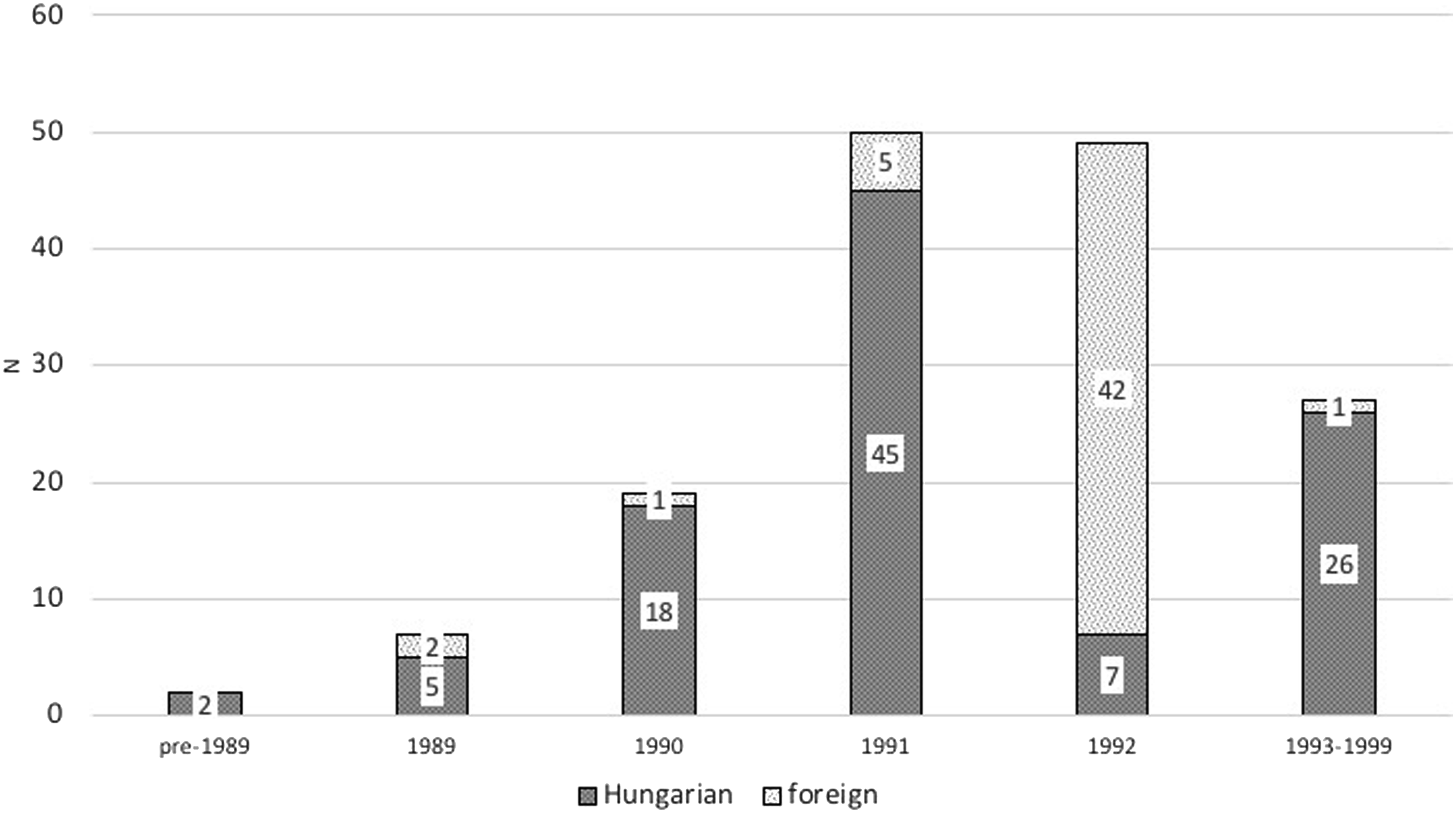
With a relatively rarely spoken language, the Hungarian market was very tiny for both the Hungarian and the international publishers. The number of sold copies was secondary to the returns from advertisements limited to sex-related products or other branches of the sex industry. Consequently, the porn magazine market formulated an isolated bubble separated from the mainstream press and publishers. This isolation, however, resulted in the interdependence of the otherwise competitors and forced them to collaborate.
Until the mid-1990s, the magazine market’s dominant product was ÖKM (Österreich Kontakt Magazin), which operated from the Austrian capital, but few Hungarian magazines could have also been successful. The conditions of the time and the industry’s capital requirement are illustrated by the fact that the founder of one of the most successful Hungarian magazines published the magazine’s first issue using the money set aside for renovations of an apartment building where he worked as a caretaker. 9 Initially, he and the editors of another magazine used photos cut out from Western porn magazines. However, a Dutch company found out and gave them an ultimatum: either start obtaining the photos legally or be reported to the authorities. From then on, the Dutch company provided the photos to both magazines.
At the time of the regime change, many Hungarian porn magazines were formed by taking advantage of the anomic situation and the opportunity of stealing from the state through the post office. The Austrian ÖKM took on the role of the market leader. Then in 1992, foreign capital tried to break into the country through many channels with little success. From 1993, the Austrian ÖKM remained the market leader. A few of the established Hungarian magazines achieved some degree of success, but the number of copies sold declined. Then, by the turn of the millennium, the magazine industry almost entirely disappeared.
Gianfranco Romagnoli (1994: 27), a famous Italian porn director and later performer active in Hungary, said regarding porn films: ‘In Hungary, one can find the latest Japanese and American technology. However, monthly wages are scandalously low. Hungarian youths are not shy; after all, sex is a source of living for them. That’s how they bring home the bacon.’ In Italy, pornography was banned, but it could be shown in cinemas and later on cable channels (Romagnoli, 1994). The movies had to be made somewhere. In the case of other countries, it was simply cheaper to shoot films in Hungary. As Romagnoli further explains: – Why did you start a porn company in Hungary? Why not at home in Italy? – […] Italian law prohibits pornography. You can watch it, but you cannot make it. In contrast, you can make a movie in Hungary but watch it only at home on video, not in a cinema. (Romagnoli, 1994: 34)
In the same 1994 interview, the renowned Italian porn producer explained that he was not a supporter of the Hungarian Socialist Party, which ultimately won the Hungarian elections. He believed that their expected left-wing policy would make Hungary’s accession to the European Community (EC) more difficult. 10 This would be problematic because of the increasingly strict rules regulating non-EC citizens' employment in Italy. 11 Moreover, this quote highlights that the increasingly restrictive migration policy of the EC and its member states in the first half of the 1990s intensified the outsourcing of pornography to the semi-periphery. It is also clear from the quote that the country’s accession to the EC as soon as possible would have been a clear production advantage for producers. The accession facilitated the flow of the labour force, as it did later in the case of prostitution after 2004 (Katona, 2020).
As discussed above, the country was also an attractive destination for the porn industry capital due to cheap technical labour, equipment and venues. The studio of Mafilm, the Hungarian state non-profit film producer limited company, for example, served as a venue for photography and filming. The top employees of Hungarian Television worked on filming porn and did so at a very high level. A whole small industry was built to serve the influx of sex filmmakers. I know a colleague who housed them in his home. He organized everything for them, the actors, the venues, the camera, the staff, even breakfast, so it seemed the most practical solution to offer the guest room as temporary housing. The director practically just had to get off the plane, and he could get to work. (Kovács, 2015: 28)
Recruitment agencies for porn magazines and porn films soon appeared in Hungary. These agencies were able to start operating relatively quickly, in a smooth and somewhat standardized way: Most girls are seduced by ads looking for ‘female photo models’ or ‘nude models for premium pay.’ A modeling agency with well-established relationships with plenty of newspapers and magazines usually posts the ads, which ensures that the applicant’s image will be featured in the columns of a paper sooner or later. A few girls per day arrive at the agency where their photos are taken, then they undress and fill out a standard questionnaire after the photoshoot. The data collection is accompanied by a couple of questions in which their interviewers ask about what the applicant lady might be willing to do: girl on girl, a girl with boy, anal, threesome, and so on. Well, where such inquiries are made, filmmakers and directors tend to show up to select new girls for upcoming productions. (Gold, 2005: 14)
Agents received a commission from the wages of the recruited women after each shoot.
12
Agencies and agents tried to persuade actors to do pornography by pointing out the excellent earning potential and exceptional travel opportunities. They highlighted the porn actresses who have been successful (Gold, 2005: 106). Several of our interviewees highlighted that for women in porn, money was one of the reasons to get involved. The interviews also indicated that many came from a distinctly low-income family environment, and the porn world was an escape from poverty for them. Julianna Bodor, who became known as Julia Taylor, a porn performer in the 1990s and 2000s, and another performer, using the pseudonym ‘Mazsi,’ talked about their childhood in a tabloid book about the Hungarian porn industry: I grew up in a very small village and lived there until I was fourteen. My father worked in agriculture; my mother worked on a dairy farm. (…) My childhood was difficult, but I survived. My parents were very poor. (Bodor, 2004: 142) I was born in a small village in Somogy. (…) In a poor family in the countryside, the children had to do their share of work. They had to work to be able to afford such things as a school bag, books, and clothes for September. At the age of six, I was already weeding and hoeing in the cooperative vegetable garden. (‘Mazsi’, 2004: 249–250)
An important element of another well-known porn performer of that time, Mariann Aranyi’s (stage named as Maya Gold) self-representation, is that she comes from an impoverished family. Her mother could not support her on her dairy factory salary as a child, so she had to do physical work in addition to going to school. She went to Budapest in response to a newspaper ad (Gold, 2005). She described her childhood through the following images: We were very poor (…). I coveted simple things like talking dolls or the latest sports bikes. Because of necessity, I had to put up with wearing other people’s outgrown and discarded clothes because everything was about saving money. (…) we raised pigs at home, as my mother could not support the family on her dairy factory salary. (…) We fought poverty by trying to be self-sufficient, by producing everything ourselves. (Gold, 2005: 23–24)
It is not the subject of this analysis to examine the role of (self-)narrative in why actors connect themselves and their involvement in pornography with or explain these through their childhood’s financial and other difficulties. However, the producers confirmed the fact that poverty is a motivation for young people to enter the porn industry: ‘I had to realize that I had to make a porn movie here. Hungarian girls have little money, few good job opportunities, so they would do anything for money. I feel sorry for them’ (Romagnoli, 1994: 35).
A more critical article in Népszabadság, one of the leading Hungarian newspapers of the era, quoting the famous French daily Liberation (Nadler and Richard, 1995), also mentions that the influx of Hungarian women into the porn industry can be linked to the economic change associated with the change of regime. According to Liberation, it is not the flexible spirit that is the cause of everything [the over-representation of Hungarian women in the porn industry], but it is simply economic hopelessness. During the economic transition, many girls see no other way out for themselves than the porn industry. (Anonymous, 1995)
Some of the performer interviewees described the mundane financial vulnerability that pushed them toward pornography: ‘[e]ver since I started filming, my life has changed radically. I don’t have to think five times about buying something that I like in the shop window. This is why most girls decide to enter filming. They are sick of poverty’ (Anonymous, 1996).
As a result, the country served as a production site for the Scandinavian, American, German and Italian porn industries. For example, almost a quarter of the porn films made in Europe were produced in and around Budapest until the mid-2000s (Milter Szoverfy and Slade, 2005: 173) through the Swedish Private Media and the American Elegant Angel/Evil Angel companies, using mostly Hungarian actors. This could mean hundreds of films a year. As the reviewer of the 1992 American porn film Hungarian Anal Rhapsody (Beau, 1996) puts it in an online review: ‘This tape gets an extra half-point for an exotic location … but with the number of “Budapest” titles appearing these days, the old city is getting to be familiar’ (AVN, nd). Indeed, emphasizing the uniqueness of a post-socialist country as an exotic location full of lust, and constructing Budapest and Hungary as special brands on the international porn scene, were frequent selling techniques that could be seen as nation branding (Gudjonsson, 2005; Fan, 2006) through the sex industry. Recognizing the demand from Western distributors, local producers quickly exploited the market niche, presenting Hungarian women as exotic, formerly unavailable female bodies from behind the Iron Curtain, and in order to shape their specificity on the porn market, rapidly became specialized in anal sex scenes (Slade, 1997). 13
As of 1995, only 18 films had been made with Hungarian capital (Barna, 1995), while the number of films made with foreign capital was estimated to be several times higher, illustrating the dominance of foreign capital in the Hungarian porn film industry.
Hungarian entrepreneurs were able to make a steady profit in the dubbing and Hungarian-language distribution sectors. The practice of redubbing films provides a good indication of the relationship between domestic and foreign capital. The official original soundtrack of the films made in Hungary with Hungarian actors was dubbed in English, German, or Italian, targeting the film’s primary market. Then, the films made initially with Hungarian actors had to be dubbed into Hungarian for distribution in Hungary. When I bought the rights to a film, I got the copies in Italian or German. If they did a lousy job abroad, it was still possible to read from the actors’ lips, ‘Mi a fenét mondjak még? [What the hell else should I say?]’ In the absence of other possibilities, we had to dub the films shot initially in Hungarian to Hungarian again so that Hungarian viewers could enjoy them. (Kovács, 2015: 36)
Conclusion
Our paper aimed to highlight the importance of focussing on the historical and economic underlying factors of porn production throughout the Hungarian ‘porn boom’ of the long 1990s. The Western-oriented literature typically discusses pornography purely from a cultural perspective, without problematizing the global economic factors that had shaped the context. One of the most influential theoretical frameworks is the idea of pornification, which claims that pornography spreads in a pre-defined public and media sphere. We have attempted to demonstrate the limitation of this idea in the case of the development of the Hungarian porn industry in the 1990s. In this case, pornification serves as a justifying and legitimizing discourse that shifts the explanatory focus from the complex economic and social factors behind Hungary’s capitalist reintegration to the cultural and moral codes of westernization through the porn industry. Moreover, the surface process of pornification resulted from deeper political-economic processes. We have, therefore, emphasized the geopolitical and the international aspects of the labour relations of the Hungarian porn boom and highlighted the severe limitations and even distortions of the concept of pornification in grasping the historical development of the porn industry in Eastern Europe in general and in Hungary in particular.
First, we showed how pornification was connected to the discourses of westernization and moral geopolitics. We argued that, in a sense, participants in the porn industry instrumentalized the discourse of ‘catching up’ to the West. In parallel with this, either supporters or conservative opponents, local intellectuals saw the proliferation of porn as a marker of ‘catching up’ to the West. Hungarian organizers of the porn industry deliberately built a Western-like star cult around some Hungarian porn actresses and deliberately stigmatized opinions critical of porn as post-socialist prudence and backwardness. Meanwhile, others in the Hungarian public argued that pornification could be justified by Western values such as economic and sexual freedom and liberal democracy because respect for these values would help the country be part of Europe again after more than three decades of communism and restrictive dictatorship.
Second, we showed that beyond the pornification-Westernization discourse was a complex geopolitical process, which made Hungary a desirable target for becoming the capital of the porn industry and which enabled the Hungarian ‘porn boom’. This process did not lead, in reality, to the westernization of the country but rather to the strengthening of geopolitical dependence, of which the porn industry was just one example. The ‘porn boom’ was mainly built on a lack of regulation and a combination of cheap but good quality infrastructure and cheap labour. Nevertheless, the possibility of fraud also played a role, increasing during the anomic period of the regime change. After a short period of profiting considerably because of their embeddedness in international production chains, Hungarian producers, directors and other non-performers gradually became more and more dependent on international capital, just as in other industries after the regime change. However, it is crucial to emphasize that one can observe a remarkable stratification of the participants in the Hungarian porn industry in terms of vulnerability, agency and bargaining position. Producers, directors and agents benefitted significantly from their international collaboration and Western capital. Only a tiny minority of the performers were able to enjoy a star-like lifestyle for a while, exit the industry altogether, or move over to the other side of the camera and become directors or producers themselves. At the same time, those local representatives of the industry who were in a more influential position benefited more from the flood-like inflow of international capital that arrived in the region. Pornification cannot highlight these internal differences and tends to homogenize the perspectives of different participants.
Therefore, we claim that a purely cultural-based concept such as pornification cannot explain the rise of the porn industry in the country, since Hungary’s the semi-peripheral, post-socialist economic position was determinant in the development of the porn industry. Our analysis demonstrated the complex relationship between capitalism, pornification, and the working mechanisms of pornography as a production industry. By drawing this conclusion, we join those Eastern European researchers who recently highlighted that the analysis of political and other meanings of a local phenomenon, in this case, the expansion of the porn industry in Hungary, requires rigorous contextualization and a systemic revision of the concepts serving as analytical categories. We demonstrated that pornification, understood merely as a cultural phenomenon, is not simply unable to grasp the events in the 1990s in Hungary comprehensively, but without contextualization and placing into the economic framework; it indeed distorts the process of knowledge production about the porn industry on the semi-periphery.
Footnotes
Declaration of conflicting interests
The author(s) declared no potential conflicts of interest with respect to the research, authorship, and/or publication of this article.
Funding
The author(s) disclosed receipt of the following financial support for the research, authorship, and/or publication of this article: This work was supported by the New National Excellence Program of the Ministry of Human Capacities, Hungary (Ú NKP-20-3).
