



Abstract
In gender and sexuality studies, heterosexual sex has often been portrayed in terms of inequality and injustice; however, there has been scant discussion of what social conditions may cultivate a democratic and egalitarian culture that sustains sexual autonomy. Developed from Nussbaum’s capabilities approach, I propose the erotic capabilities approach to assess and promote entitlement to erotic choices and erotic freedoms in everyday practice. I argue that erotic capabilities should consist of the following: (1) freedom from sexual coercion and deprivation; (2) democratized sexual knowledge; (3) sexual health options; (4) inclusive space for diversified erotic expressions; (5) erotic affiliation and negotiation; and (6) diversified erotic aspirations, fulfilments and experimentations. Drawing on a 29-month ethnography of a sex party club in Hong Kong, I demonstrate how the erotic capabilities approach can be used in a meso-level analysis to evaluate a sexual space or community which, while situated in the overarching patriarchal ideology, may or may not offer a reflexive space for its participants to define their erotic selves. As this study formulates sexuality as a vehicle of empowerment that can and should be cultivated and actualized, it illuminates the possibility to imagine and create agentic and pleasurable opportunities for people in different social locations under the patriarchy we still live in.
Introduction
This paper offers a critical framework to evaluate what and how social conditions give rise to possibilities of equitable, enjoyable and empowering sex in the lived experiences of heterosexuality. In critical studies of gender and sexuality, heterosexual sex has been readily and routinely described as ‘unpleasant and inequitable’ (Beasley et al., 2015: 688). In research on human sexuality, there is a pathologizing inclination that indicates ‘implicit biases against the very act of sex itself’ (Jonason and Balzarini, 2016: 13). As Angela Jones (2019) observes, despite a recent proliferation of feminist and queer analyses about pleasure, women’s sexuality in most positivist research is still discursively represented as ‘unagentic and constrained by antiquated gender norms’ (2019: 658). While the unagentic portrayals of contemporary patriarchy are largely accurate, they leave us with little space to imagine, articulate and create alternatives of heterosexual sex.
Heterosexuality is neither a homogenous monolith, nor the equivalence of heterosexism (Beasley et al., 2015). We must consider how heterosexualities are dynamic and shaped in diverse social processes. Jennifer Nash (2017) urges feminist scholars to move beyond the familiar good/bad debates of sexual representations and develop new strategies to describe and analyse them. I propose the erotic capabilities approach to address the social conditions that constitute and transform sexual agency and sexual subjectivities. To cast the erotic as a capability rather than as pleasure or satisfaction is to underscore the transformative power of the erotic (Lorde, 1984). Sex is recast as not merely biological or psychological gratification but instead a resource that nourishes self-worth, self-discovery and deep connection with others. The erotic becomes a vehicle for empowerment; it is not a luxury but a basic freedom central to a flourishing life.
I open with a review of feminist critiques and reconstructions of ‘pleasure’, ‘satisfaction’ and ‘consent’, and introduce how, by synthesizing Martha Nussbaum’s (2011) central capabilities, the erotic capabilities approach promotes justice and interrogates agency in erotic interactions. Then, I draw on my 29-month ethnography of a heterosexual sex party club in Hong Kong to demonstrate how the erotic capabilities approach can be adopted in a meso-level analysis to evaluate the transformative process of sexual agency in a liminal (Turner, 1979) sexual space under the conditions of patriarchy. I argue that erotic capabilities should consist of the following: (1) freedom from sexual coercion and deprivation; (2) democratized sexual knowledge; (3) sexual health options; (4) inclusive space for diversified erotic expressions; (5) erotic affiliation and negotiation; and (6) diversified erotic aspirations, fulfilments and experimentations. Ultimately, I seek to problematize the binary of agency/structure or good/bad sex and proffer an approach to unravelling the complexity of the erotic power of individuals within the structural violence of societies.
From pleasure, satisfaction, consent to erotic capabilities
Pleasure is not a mere physiological response but a social experience that shapes social action, reflects our identities and intersects with multiple systems of inequality (Jones, 2020). Studies on hookup culture have identified how gender (Armstrong et al., 2012; Piemonte et al., 2019) and class (Hamilton and Armstrong, 2009) inequitably structure young adults’ experiences of pleasure and intimacy. Studies of heterosexual sex have also revealed a gendered double standard in which women are more likely to be derogated for pursuing casual sexual pleasure (Crawford and Popp, 2003; Kreager and Staff, 2009; Sagebin Bordini and Sperb, 2013). In The Tragedy of Heterosexuality (2020), Jane Ward explains that while straight culture is plagued by a misogyny paradox, a heterosexual-repair industry in North America has romanticized and remarketed misogyny as heteroerotic. Meanwhile, religion remains powerful in shaping the contemporary narrative of sexuality. Although evangelicals increasingly celebrated pleasure for married and heterosexual Christians, the logic of godly sex still defines homosexuality, pornography and premarital sex as sinful (Burke, 2016). Insofar as scholars of sexualization (e.g. Attwood, 2006; Gill and Orgad, 2018) and racialized pornography (e.g. Cruz, 2016; Miller-Young, 2014; Nash, 2014) illustrate how the discursive construction of pleasure reflects systemic sexism, racism and classism, they urge us to eschew polarized debates and to relocate pleasure and agency in daily negotiations.
Meanwhile, although research on ‘sexual satisfaction’ has burgeoned since the 1990s, the concept is interrogated for its propensity to implicit bias and overlooked injustice. Sara McClelland (2010) argues that as people’s sense of entitlement can affect their perception of satisfaction (672), a woman may report sexual satisfaction due to her low expectations, preconditioned by ‘the influences of sexism, heterosexism and sexual stigma’ (670). In other words, sexual satisfaction can be understood as an adaptive preference (Nussbaum, 2011, 2015) that women and other deprived groups have been socialized to accept. It illustrates how the wider social context conditions a person’s perception.
Hence, we must look beyond individuals’ experiences to understand the constructs of sexual agency and empowerment (Bay-Cheng, 2015; Gavey, 2012). Feminists have explained that the ethic of consent is insufficient in addressing the scope of bad sex. There are myriad reasons why women do not say no and even say yes to sex that is unwanted or unpleasant (Chu, 2019; Traister, 2015; Ward, 2020). West (2020) labels the harm caused by the consent routinely given to undesired and unwelcomed sex a ‘hedonic dysphoria’ and argues against an over-reliance on consent to demarcate acceptable and unacceptable sex. As Joseph Fischel (2019) points out, as consent focuses on the sexual interactions of two or more people in the immediate present, it ‘restrictively narrows the spatial and temporal parameters of discussion’ (18). We need a more comprehensive approach to tackle not only nonconsensual but also various forms of harmful sex.
This study proposes an intimate justice framework to discuss enabling conditions for people to enjoy self-definition in sexual life. Feminist scholars call attention to the notion of justice in understanding practices of sex and intimacy. McClelland’s (2010) feminist framework of intimate justice aims to guide sexual satisfaction research, as it addresses how sociopolitical inequalities affect ‘how individuals imagine, behave and evaluate their intimate lives’ (2010: 672). Ho and Hu (2016) develop the concept of intimate injustice in relation to intersectionality and the interplay of inequality between the macro-political and micro-political. While Shatema Threadcraft’s (2016) discussion focuses on the intergenerational oppression of Black women, she brings in Nussbaum’s capabilities approach to rethink the implications of ‘historic white opportunity hoarding’ (142) and emphasizes that securing Black bodily integrity and their ability to form strong emotional attachments is as important as addressing racialized economic and political disadvantages.
Focussing on basic justice, Nussbaum’s capabilities approach (2000, 2002, 2011) evaluates people’s entitlement to both meaningful choices and substantial freedoms to empower them for ‘self-definition’ (18). It emphasizes providing opportunities to nurture and actualize people’s potentials in different aspects, including cognitive, emotive and creative development, as well as social, economic and political participation (2011: 33–34). Nussbaum considers basic justice not as the overall or average well-being of society, but as ‘the opportunities available to each person’ (2011: 18). Nussbaum goes only so far in addressing sexual entitlement through her discussion about guarding bodily integrity and ensuring freedom from sexual violence and the freedom to enjoy sexual satisfaction and reproductive rights. Nevertheless, as her analysis of ‘Lawrentian objectification’ (Nussbaum, 1995) suggests, the denial of a person’s erotic potentiality is plausibly a form of dehumanization. We must pay more attention to what justice in desires is.
Audre Lorde (1984) famously asserts that the erotic is ‘a considered source of power and information within our lives’ (53), which arises not from the actions taken, but from ‘know[ing] the extent to which we are capable of feeling that sense of satisfaction and completion’ (54). Erotic power is essentially a capability which can be developed through cultivation and realized through individuals’ freedom to make autonomous erotic choices. As such, I find Nussbaum’s capabilities approach instrumental as a theoretical foundation to extend the conceptualization of intimate justice.
Disability and sexuality scholars have turned to Nussbaum’s account of social justice to reconceptualize sexual autonomy for individuals with different abilities. Kulick and Rydström (2015) are critical of disability discourses that ‘too exclusively foreground agency, empowerment and ability’ (269). They draw upon the capabilities approach and contend that a society is fundamentally unjust if it denies the sexual needs of people with disabilities. In their discussion of disabilities and sexual consent, Fischel and O’Connell (2019) reconstruct sexual autonomy as ‘the capability to co-determine sexual relations’ (140). By adopting Nussbaum’s capabilities approach, they put forward a relational approach to sexual agency that ‘inquire[s] about the laws, institutions and social and educative practices that cultivate or diminish sexual autonomy’ (149).
These authors have inspired the rethinking of sexual justice. While they centre on people with different abilities and address how reforms in law, social policy and education may promote a democratic sexual culture (Fischel and O’Connell, 2019; Kulick and Rydström, 2015), this article draws on the ethnography of a sex party club to examine how a bottom-up, non-institutional organization of alternative sexual spaces may foster or undermine the cultivation and actualization of erotic capabilities. Nussbaum (2015) frames the capabilities approach as providing conditions for choice for citizens in modern democracies. She explains how the approach can be implemented in national and international efforts, but there is little discussion of whether and how the private sector or civil society can create or suppress the cultivation of capabilities. This study purposefully adapts the capabilities approach to apply a meso-level analysis of a sex party club for two reasons.
First, while it is understandable that Nussbaum refrains from applying the capabilities approach to non-democratic states, her work can inspire people in these states to consider what they can do to pursue democracy and self-determination in different aspects of life. In Hong Kong, where political autonomy erodes in recent years, it is important to consider what people can do at a grassroots level to cultivate freedom, including erotic freedom, even if the government fails to deliver or actively limits. No project of justice could be complete without the state’s commitment to respect its citizens as equal; still, there are things that people can do to expand the conditions of individuation.
Second, this study highlights how different erotic worlds, even within the same sovereignty, may present contrasting conditions to develop or undermine people’s erotic capabilities. Drawing on Bourdieu’s field theory and Goffman’s dramaturgical analysis, Adam Isiah Green (2008, 2011) delineates how the social organization of desires, desirability and sexual practices varies across sexual fields. The sex party club in this study is also a sexual field; it consists of a specific sexual stratification and shapes its participants’ desires and sexual repertoires. Informed by the sexual fields theory, the following analysis considers how elements of both macro and micro configure the field sociality of sex parties. Unique to the erotic capabilities approach is the focus on social and material conditions that let participants cultivate and actualize their erotic capabilities in some ways, while oppressing and obstructing them in others.
Central to Nussbaum’s approach is capability rather than functioning (2001, 2011). It acknowledges the plurality of values and honours different lifestyles. In this extension of the capabilities approach in the erotic sphere, I adopt Fischel and McKinney’s (2020) revision of Nussbaum’s approach, which replaces dignity with Cornell’s (1995) theory of individuation as its basis, as it reconciles the contradiction between choice and non-humiliation in sexual and reproductive justice. Instead of subscribing to a substantive theory of equality, Cornell frames freedom as a chance for people to take on the struggle to define their free personhood. Insofar as she assumes that people are not born free, a ‘protection of minimum conditions of individuation’ (5) is necessary for the free personhood to flourish.
Accordingly, intimate justice requires symbolic and material conditions that support the cultivation of erotic capabilities to enable people’s imagination and expression of their ideal selves. Rather than celebrating specific values or lifestyles, the ultimate concern of the erotic capabilities approach is whether and how a society can create or undermine opportunities for people to determine their erotic selves. A just society should accommodate not only the needs of sexually active people but also those of the asexual in finding emotional fulfilment in non-sexual relationships (see Carroll, 2020).
Methods and setting
In this ethnography, I take a blended approach (Hallett and Barber, 2014; Hine, 2017) to investigate online and offline experiences of sex partying. Between April 2016 and August 2018, I carried out participant observation in Marvel-Sex Club, 1 a heterosexual sex party club in Hong Kong. Apart from parties and sexual technique classes hosted in hotel suites, residential apartments and local or overseas villas, I also participated in hiking, dinners and Halloween masquerades, as well as virtual interactions on the club’s online forum. The virtual communications of Marvel-Sex Club’s members included sex party anecdotes, erotic selfies, diet and workout tips, as well as around-the-clock flirts and chats in chatrooms.
As I had been a member for more than two years prior to fieldwork, I was familiar with its rules, customs and existing members. My membership allowed me to ‘acquire “understanding in use”’ (Adler and Adler, 1987: 82). Meanwhile, the partygoers mostly welcomed my study and were open to sharing their intimate stories with me. During the 29-month fieldwork, I shifted back and forth in the hyphen-spaces of insiderness-outsiderness (Cunliffe and Karunanayake, 2013; Fine, 1994). I began as an active member and volunteer of the club and leaned toward an observer role during the interview phase. When conflicts between the organizer and more than a dozen participants became acute in the last seven months of the fieldwork, my relationships with them also became more complex. To manage my varied and equivocal relationships with the participants, I drew on Tillmann-Healy’s ‘friendship as method’ (2003), a feminist and queer methodology, to guide my inquiry through dialogical relationships with them (Owton and Allen-Collinson, 2014) as a compassionate companion (Behar, 1996). I also adopted the principles of protagonist-driven ethnography (Cobb and Hoang, 2015) to focus on theorizing participants’ experiences.
In addition to informal interviews during participant observation, I conducted twenty-two in-depth interviews with current or former members, who were Hong Kong residents aged 18 years old or above. 2 The interviewees were thirteen men and nine women, aged 18 to early 50s. All of them considered themselves heterosexual or mostly heterosexual, except for one who identified herself as bisexual. All interviewees were ethnic Chinese. Apart from two who studied abroad, and two who migrated from mainland China before adulthood, all were born and educated in Hong Kong.
Like other sex party clubs in Hong Kong, Marvel-Sex Club was not corporate-run. It was founded and organized by a middle-aged man. The members respectfully called him Dai-lo, which translates as ‘big brother’. The nickname reflected his patriarchal role in the club and his paternalistic style. He established a comprehensive list of rules based on the principles of safer sex, confidentiality, harmony and non-commercial and non-romantic interactions among members. He oversaw rules enforcement for all members. Members had to go through a screening process that included STD tests, a written test about the rules, and an in-person or phone interview. No membership fee was required, but members paid the entrance fees for each party they registered.
The club had a ‘score’ system and a hierarchical membership. Those found breaking rules had their scores deducted or membership suspended, while those recognized as role models moved up in the hierarchy. The higher-ranked members enjoyed discounted party fees and prerogatives, such as hosting chatrooms on the club’s forum. Below, I discuss how the paternalistic organization of sex partying, situated in the overarching patriarchy of Hong Kong, created liminal social conditions that let participants cultivate and actualize their erotic capabilities in some ways, while oppressing and obstructing them in others.
Freedom from sexual coercion and deprivation
Marvel-Sex Club was created to be a risk-averse space, with rules, discipline, hierarchy and a paternalistic structure. In this section, I focus on its regulations around confidentiality and membership composition to analyse how an alternative sexual field with corresponding sexual/erotic capital (Green, 2008, 2011; Martin and George, 2006) was constructed in sex partying, and how it opened up erotic opportunities for heterosexual adults of different ages, classes and abilities to different extents. Consent is not the only principle that guards against sexual coercion. This section addresses how the specific structure of desires of the club enabled and disabled erotic opportunities for different people. A more focused analysis of consent in sexual encounters is presented in the section ‘Erotic affiliation and negotiation'.
Two-thirds of the interviewees indicated confidentiality as their top reason for joining Marvel-Sex Club. To become a member, people had to sign up with a username and a profile picture that were not associated with any of their other identities. In addition to banning any exchange of personal contacts among members, the club regulated what could be said on the forum and at the parties to prevent members’ accidental revelation of personal information. There was a detailed list of rules to protect the confidentiality of the parties. For instance, participants needed to cover the camera lenses on their phones with tape and put them in a locked box. Even outside the club, members’ interactions were limited. They needed to act like strangers and report to Dai-lo should they run into each other. These rules were meant to protect members from stigma by rigid partitioning of their daily identities and sex partygoer identities.
An unintended consequence of pseudonymity is a partial suspension of social hierarchy. First, class differences were obscured as members could not mention anything about where they lived, worked, or studied. Second, by banning exchanges of both material benefits and romantic attachments, members’ interactions were rendered purely erotic. As such, the conversion of social or economic capital into erotic capital, which is common in commercial or marital sexual interactions, was minimized. At parties, women were not under pressure to fake orgasms or perform sexual acts they were not interested in. Rather, they were encouraged to select partners who could bring them gratification. As there were usually slightly more men than women at parties, men who wanted to be desirable were motivated to learn how to please women. The relative gender symmetry in pleasure acquisition was reflected in the practice of oral sex. My interviewees who also had sex outside the club agreed that while reciprocity of oral sex was a norm in sex parties, it was not common in casual sex or committed relationships. In fact, most interviewees said that women enjoyed more privilege than men and were pampered at Marvel-Sex Club.
The effect of pseudonymity on restructuring sexual stratification in sex partying was not without limits. For instance, though Marvel-Sex Club welcomed adults of all ages and ethnicities, most frequenters were Cantonese-speaking men in their 30s–40s and women in their 20s–30s. Although Dai-lo recalled a young woman member with cerebral palsy and another two with impaired hearing, throughout the club’s decade-long history no other visible disability had been observed. In fact, the blurring of socioeconomic backgrounds amplified the importance of physical attractiveness in the parties’ sexual status order. Bald men were not usually admitted as members. The club’s preference for conventionally attractive bodies was also reflected in the provision of discounts for members with ‘profession-standard’ physiques, such as police, firefighters, fitness trainers, or dance instructors.
In many ways, the structure of desire (Green, 2008, 2011) in Marvel-Sex Club was similar to many other heterosexual sites in Hong Kong. However, its structure was distinctive in two ways. First, in comparison to hookups, mastery of sexual techniques was considered a critical erotic capital in sex partying. Unlike many casual sex encounters in which people have no prior knowledge about how their partners perform in sex, there were abundant resources at Marvel-Sex Club for members to learn about each other’s sexual preferences and performances. For instance, if a member enjoyed their interaction with a particular playmate, they could compliment and gift points to that person. Consequently, members who initially possessed less erotic capital (e.g. physically unattractive by conventional standards) could improve their desirability by learning to give pleasure to their partners. Men were more likely to benefit from this, as women tended to prioritize playmates’ ability to deliver enjoyable erotic experiences over their appearance.
Second, although people who were less conventionally attractive struggled to have sex in parties, the rules of maintaining harmony prevented them from being insulted. This was particularly cherished by women. Kar-po was a rare obese member of Marvel-Sex Club. Though she had little luck getting sex at parties, she remained an active member for almost two years: Here, I enjoy a certain level of respect. Even if somebody does not like or want [you], they will not and cannot attack you verbally. It is not the case outside the club. No regulation; people can say whatever they want, and they can be really malicious... If my sexual needs are not fully satisfied here, it’s okay, I can satisfy myself. But the feeling of respect can only be given by others, and I think that’s what really matters (Kar-po, 25, informal interview).
While sexual stratification based on conventional attractiveness persisted in Marvel-Sex Club, Kar-po’s experiences reflect how the club’s maintenance of harmony also created a less misogynistic environment for its members to explore their sexuality: In terms of sex, here, I can do all things that I don’t do or say normally. A simple example is that normally in Hong Kong, I dare not go out wearing tank top, or sleeveless, or deep V… The way Hongkongers look at you is quite annoying. (Kar-po)
For curvy women in Hong Kong, even wearing a tank top in public demands courage, as judgemental glances are unavoidable. These glances policed Kar-po’s body in daily life. Relatively, the club offered a tolerating space for women of all sizes to express themselves sexually, without fear of judgement.
Democratized sexual knowledge
As previously discussed, sex partygoers were motivated and encouraged to learn how to give their partners pleasure. However, sexual techniques classes organized every year at Marvel-Sex Club only targeted men as learners. It reflects a persisting culture of patronizing masculinity in the club, although these classes also stressed women’s entitlement to pleasure and subverted the dominant penile-centric sexual script: Learn how to have sex from lesbians. Learn how to arouse your partner without penetration. Stop worshipping the penis and it will help you to improve greatly (Dai-lo, Foreplay Class for Men, fieldnotes).
In these classes, men were constantly reminded to be attentive to women’s emotional experiences rather than their physiological responses. In this discourse of sexual knowledge, the ultimate aim of heterosexual sex is not coital, male orgasm, or even female orgasm, but interpersonal connection and erotic fulfilment. While there was no equivalent class for women, the club afforded them a space to exchange their sexual knowledge and experiences with each other. On the forum and in parties, women often shared how to please themselves (e.g. masturbation tips, sex toys reviews) and their partners (e.g. oral sex techniques).
In Hong Kong, sexuality education has never been mandatory in schools, and the latest sexuality education guidelines were published by the government in 1997 (Cheng, 2018). Marvel-Sex Club afforded a space for its members to have some alternative education. When a reporter from a local newspaper came to a party to interview the members, the interview was momentarily turned into a sex education class: Hulk: Eliza [another member] said she did not know where the clitoris is before joining the club. Reporter: Clitoris? Hulk: Didn’t you pay attention in school? Reporter & Eliza: It’s not taught… Hulk: Alright, do you know where the labia majora is? Labia minora? Have you heard of it before? … Reporter: Can you draw and show me? Hulk: Actually, though I’m not young, I only came to know these things after joining the club. How should I tell you… (starts drawing) So this is the labia majora, inside them are two smaller labia minora, and this thing that connects them is the clitoris. … Hulk: That’s why I said since I came here, I have found a whole new world. I can’t imagine how ordinary people out there could acquire this knowledge and experience. I think it’s a pity. I mean, sex is something truly enjoyable… Of course, Mr. Holier-than-thou would say that it doesn’t matter if you are unaware of the joy; ignorance is bliss. You will live happily ever after if you’re ignorant; but this is obviously not what we believe in.
This conversation reflects the sexual knowledge illiteracy of the city. The reporter, a woman in her early 20s, and the partygoers, a man in his 50s and a woman in her late 20s, were not taught about vulvas outside of sex parties. Of course, knowledge sharing in sex parties cannot and should not replace sexuality education, especially as the knowledge shared in the parties is mostly pleasure oriented. Nonetheless, rephrasing Hulk, breaking away from ignorance about sex is a crucial step toward cultivating erotic capabilities.
Sexual health options
To become a member of Marvel-Sex Club, it was a requirement to pass STD tests for HIV, syphilis, chlamydia, gonorrhoea, herpes 2 and hepatitis B antigens/antibodies. Members had to retake these tests biannually to extend their membership. Women also needed to take a pap test annually. At parties, participants had their genitals inspected by Dai-lo or a volunteer invigilator (usually a senior member) before sex. If questionable conditions were found, the member would be restricted from certain or all sexual acts at that event.
There were detailed rules regarding condom use, which was compulsory for vaginal and anal penetration, whether by penis, finger, or sex toy. Unprotected penetrative sex was inexcusable, even by consent. The club’s forum recorded several incidents of unprotected sex and how Dai-lo punished those involved. Protection was not obligatory for oral sex, however, and was rarely observed in practice.
Safer sex practices were compulsory for members. This would appear to contradict the vision of the capabilities approach, as we should endorse health capabilities rather than health itself. However, when we consider Marvel-Sex Club as one of many sex-seeking channels available to heterosexual adults in Hong Kong, the club presented itself as a safer option for people pursuing non-monogamous sex.
That said, the sanitized space constructed in Marvel-Sex Club was by no means impregnable. As members tended to be credulous under Dai-lo’s supervision, many were unaware of his own violations. Three young women disclosed in interviews that they had had sex with Dai-lo without condoms. Others accused Dai-lo of allowing certain women to join the parties before they had passed the STD tests, and I witnessed a couple of newcomers attending the parties in the same way. In some cases, as recalled by interviewees, Dai-lo even asked newcomers to hide the fact that they had not taken the STD tests or, worse, failed an item.
The paternalistic nature of the club paradoxically undid the haven it attempted to make. As Marvel-Sex Club was run by Dai-lo single-handedly, there was a lack of transparency and accountability: Why do the members still support him? Or why did we support him? It’s because he was the only one who fed us information. What we knew was partial, thus we tended to think his decisions were reasonable… What we need to do is to return the power to the people. Let information flow among people. Unveil the information and let them know the truth, so they can make their own judgements (Mike, man, early 20s, interview).
While the members became more aware of Dai-lo’s violation, more than a dozen purposefully broke confidentiality rules and connected with each other outside the club. After discussion with several members, I also wrote on the club’s forum to share the anonymized information that concerned all members’ sexual health and safety. The members’ responses were mixed: while some were disappointed and left the club, others still found Marvel-Sex Club to be safer than other similar spaces. Indeed, the erotic capabilities approach does not concern what sexual health choices people make for themselves; only whether these choices are informed and voluntary.
Inclusive space for diversified erotic expressions
The sex parties opened up a space that was neither public nor private for members to explore and express their non-monogamous desires. Here, I identify Marvel-Sex Club as a queer counterpublic (Fraser, 1990; Warner, 2002) that supplied a reimagination of erotic relations from the dominant discourse of sexual ethics and entailed the creation of a queer space and time (Halberstam, 2005). In other words, while their spaces were mostly heterosexual, they were queer, as defined against the normal (Warner, 1993). First, within the online and offline spaces of Marvel-Sex Club, members were no longer in the closet. Many – though not all – erotic expressions censored in both the public and private spheres became permissible here. Almost all interviewees described presentations of different selves (Goffman, 1959) in parties and in everyday settings: I wear a suit for camouflage. But when I come here, why camouflage? Why should I seal myself in? What for? (Tesla, man, 26, interview). In most circles of friends outside, I don’t talk anything sexual. My defence mechanism makes me blush automatically, even though I am lustful. So, my friends think I can’t stand sexual talks. In the club, I can get a dirty joke in a split second. But there’re times outside that when everyone was laughing at a dirty joke, I took a long time to get what it’s about (Aurora, woman, 18, interview). When I’m here, as everyone is a ‘friendly stranger,’ it doesn’t matter if I make some mistakes or special requests. I can go as far as I want as you don’t know who I am, and I don’t know who you are. Conversely, with my other half, I still need to see her every day. Will I leave a thorn in her heart [if I make a mistake or request]? (Hulk, man, 51, fieldnotes).
These quotations demonstrate how sex partying opened up space for its participants to become someone they could not be in other spaces. Whether a conscious camouflage (Tesla) or subconscious defence mechanism (Aurora), whether a business or social occasion (Tesla), among friends (Aurora), or within a marriage (Hulk), partygoers had to censor their expression of desires as part of their front work in daily life. Even though the partygoer-self was hardly a ‘truer self’ of the participants, especially under the paternalistic surveillance of the club, it was a self that they wished to actualize in the liminal space of sex partying. Within the club, they could share their thoughts and emotions with people congenial to them.
Second, despite being semi-underground, Marvel-Sex Club was not a secluded community. In particular, its online forum sought to ‘address to indefinite strangers’ (Warner, 2002: 86). From the list of rules written by Dai-lo to the thousands of sex party anecdotes shared by various members, a new genre of sexual stories (Plummer, 2002) emerged and reached potential partygoers. This was also one of the reasons why many partygoers, such as Chi-wah, persisted in writing anecdotes: If anyone is interested and has the courage to read our forum, and if they read what I wrote and feel assured, then … no matter if my writings have reached a few dozens or a few hundred people, I feel fine as I’ve contributed to others (Chi-wah, man, 34, interview).
These anecdotes were not confined to the club’s forum. From time to time, Dai-lo shared anecdotes written by first-timers on other mainstream forums to promote the club. Together with the online discourse produced by similar sex party clubs in Hong Kong, an alternative queer culture was developing in the city.
In addition to the online discourse, the club’s media exposure was part of its world-making project. In interviews with reporters, radio or television hosts, Dai-lo and other partygoers often emphasized that they were not ‘sex-crazed or perverted’ but ‘ordinary people who were honest with their desires.’ Likewise, they rejected the label of ‘orgy club’ (zaap-gaau wui) for its negative and indiscriminative connotations but positioned Marvel-Sex Club’s parties as ‘safe sex parties’. They adopted a rhetoric that suggested there were multiple forms of sex partying, and their version was normal and honest rather than deviant and unprincipled. Their publicizing efforts strategically redefined sexual normalcy was and, to a certain extent, contributed to creating a more diversified sexual culture in Hong Kong.
Needless to say, the rhetoric of normalcy can hardly be wholly queer or subversive. Like the neoliberal discourse of sameness (Richardson, 2005) and homonormativity (Duggan, 2002), the emphasis on normalcy barely challenged dominant assumptions of sexual norms and values. While the narrative of sanitized sex partying might be more palatable to the general public, it reinforced an ‘apolitical’ neoliberal discourse by favouring disciplined sexual practices and pushing more edgework queer sexual practices and communities further into stigma.
Erotic affiliation and negotiation
The organization of sex partying brought forth not only some extradyadic sexual relations but also a community of congenial erotic interests in which people had opportunities to share, befriend, mentor, learn from and care for each other. In the absence of a conflict of interest, partygoers were more likely to be honest with each other in the negotiation of mutual erotic accomplishments. Here, I take up the issue of consent to show how the interplay of East Asian culture (macro), the rules of the club (meso), and participants’ interactions (micro) conditioned and transformed people’s agency in erotic negotiation.
Marvel-Sex Club provided some basic instructions on the communication of consent, yet their execution was not unproblematic. The English word ‘no’ was an absolute signal to halt any ongoing physical contact. The word is distinctive as the members mostly communicated in Cantonese, while all, including the occasional non-Cantonese-speaking participants, were fully aware of what ‘no’ means. Members needed to have their playmates’ consent before performing any ‘atypical’ sexual activity, such as anal sex and BDSM. As such, a hybrid principle of implied consent and affirmative consent was observed: most ‘typical’ sex between two or more people did not require verbal confirmation of consent, though consent could be withdrawn anytime.
The problem with these seemingly fair and simple rules was that they did not consider the wider cultural context that hampered partygoers’ ability to express consent. This was particularly true for women. This may be because women in Hong Kong are mostly socialized to be ashamed of active sexual pursuits. Yves, Aurora and Tinkerbell admitted that they did not know how to say no. Beatrice even said she would rather be slightly coerced than take the initiative. Common in these women’s narratives was the phrase ‘I don’t know how’. Although they were aware of their right to make their own sexual choices, their capabilities to initiate, accept, or decline a sexual advance was not developed before they joined the club. In parties, they often evaded unwanted sex by avoiding eye contact or making excuses. Still, these tactics did not always work, and these women recalled unwanted experiences.
Failure to convey consent was more common among, but not exclusive to women. Several men also mentioned unpleasant experiences of being pressured into sex. For instance, Cactus expressed his frustration on the forum that several men and women had teased him in an event, and his resistance was not taken seriously, but misread as enjoyment.
Despite the limitations of its consent regulation, the sex party club had also become a training ground for both men and women for communicating consent. Richard remarked on how he learned to say no through partying: At first I didn’t really know how to reject others, but then I know [I can] say no. … It took half a year to learn [how to say no], it’s like … when a person keeps doing things you dislike again and again, the only thing I can do is to say no (Richard, man, 28, interview).
In a culture in which rejection is often interpreted as rudeness, it is difficult for women and even men to communicate consent. Despite the regulations around consent in Marvel-Sex Club, it took time for partygoers like Richard to re-socialize and assert themselves in sexual encounters. These examples remind us again of the complexity of consent, and how sociocultural dynamics can influence a person to consent to unwelcomed and unpleasant sex. We must look beyond consent and examine the social conditions that allow or prevent equitable negotiation for sex that is wanted and potentially pleasurable 3 .
Diversified erotic aspirations, fulfilments and experimentations
I feel that the club has opened up another world inside me. The movie Inside Out says everyone has different islands. I feel that a new island is formed inside me. Slutty Island? (laugh) Whatever. I mean, my worldview and values are, boom, suddenly changed (Aurora).
In Pixar’s Inside Out (2015), the Personality Islands are created from a person’s core memories and constitute that person’s sense of self. The islands that appear in the movie represent relationships, beliefs, passions and experiences that are important to shaping the protagonist’s understanding of who she is. By borrowing the metaphor of Personality Islands, Aurora implied that her experience of sex partying was crucial to her self-definition. She not only recognized the partygoer as her alternate ego, but also that it was an indispensable personality that impacted her values and worldviews.
So what if erotic capabilities are cultivated and actualized? Aurora’s account suggested the significant role of the erotic in her life. She was not the only partygoer who spoke of the impact of sex partying. To many of them, sex partying was not just about sensual gratification, but also about growth, self-discovery, horizon widening and empowerment. In her first write-up, Janice described how the new sensual experience renewed her self-understanding as a woman: I suspected that I was sexually unresponsive and that’s why my sexual life with my other half was unsatisfying... Perhaps I’ve fewer sensory cells there… but only 10 seconds and I may overthrow the assumption that I was born with defects. … Then I found out an astonishing truth: Actually, I can moan. And actually, in a spontaneous way. Actually, I am a true woman (Janice, woman, forum post).
Before acquiring the first-hand experience of pleasure, Janice could only rely on mainstream discourses to explain her sexual dissatisfaction in marriage, which led her to self-doubt – blaming it on her so-called physical defect and not seeing herself as a true woman. As she also wrote, for years before she joined the club, she was troubled by questions like, ‘Is satisfaction really a thing for women?’ and ‘Are you too demanding?’ The new embodied experience thus became her new knowledge to contest these sexist questions and narratives.
Aurora’s and Janice’s stories also illuminate that sex partying was empowering not because it allowed sexual access, but because it encouraged individuated rewriting of the self. Though this empirical analysis focuses on sex partying, the erotic capabilities approach promotes various erotic self-definitions, including voluntary celibacy for asexual and racialized groups that are traditionally hypersexualized.
Although these narratives of growth were common in Marvel-Sex Club, needless to say, not every partygoer felt the same impact. Some people, like Fork, deemed sex parties to be ‘just an additional circle to have fun’. Oppa said his participation made him less happy. There could be multiple reasons leading to better or worse sex partying experiences for each person. On the one hand, as revealed in this article, paternalistic sex partying did not constitute an ideal environment for cultivating and actualizing erotic capabilities. For instance, Oppa went on to explain his unhappiness, as he was stressed out by the surveillance of ‘many prefects’ in the club, which meant he could not make any mistakes.
On the other hand, as the erotic capabilities approach suggests that erotic flourishing hinges on social conditions, the macro, structural forces beyond the sex partying space, intertwined with personal history and perception, also affected how people made sense of their sex partying experiences. Like other sexual subcultures, such as BDSM communities, while the narrative of self-empowerment was common among the participants, such a narrative relies on the privilege to ‘sidestep or remake oppressive social norms’ (Weiss, 2011: 170) in an asocial and ahistorical space of the community.
Discussion: The intimate justice framework of erotic capabilities
The empirical analysis of sex partying exemplifies how a subcultural group may open up opportunities for erotic flourishing alongside its specific forms of oppression and exploitation. The erotic capabilities approach offers an evaluative framework for examining the potential and constraints of a social setting in nurturing sexual autonomy. It does not consider sex as a discrete, additional capability, but one that intersects multiple categories of capabilities. After all, sex is not only corporeal, but also cognitive, emotional, sensational, creative, relational and manifested as a form of public participation or expression. Accordingly, I prefer calling it an ‘erotic’ rather than a ‘sexual’ capability to emphasize the multifacetedness of sex.
The erotic capabilities and the corresponding central capabilities
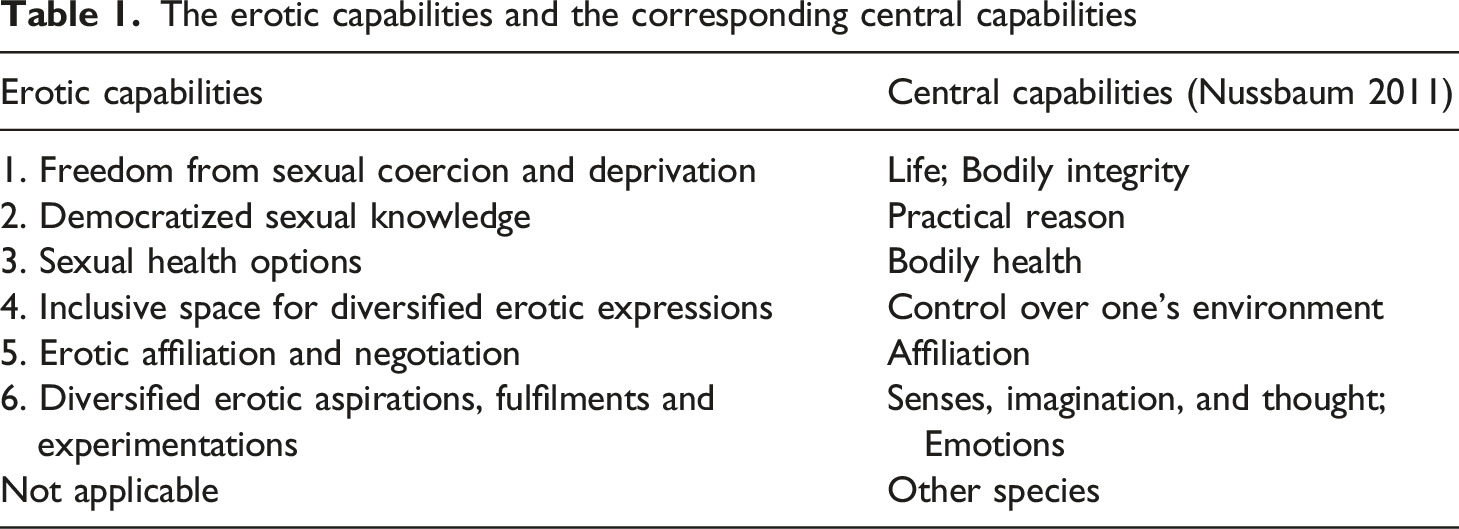
Freedom from sexual coercion and deprivation: The meanings of ‘sexual coercion’ are twofold here. First, in addition to the common understanding of sexual coercion as an interpersonal act of using physical, verbal, or emotional violence or trickery to obtain sex (i.e. neglecting or trespassing consent in sexual interactions), ideological and institutional forces, such as patriarchy, heterosexism, cisgenderism, ageism and ableism, should also be understood as antecedents to sexual coercion. Besides regulating the act of perpetration, we should also be concerned with whether people in vulnerable positions are empowered to recognize and exercise their freedom to reject unwelcome sexual advances. Second, just as Vance (1984) calls to address the tension between pleasure and danger, an autonomous sexual life is free not only from sexual violence, but also from deprivation. In the presence of sexism and sexual stigma, repressive coercion may emerge in the name of love or through the purity myth and by discrimination against people who are not cisgender, heterosexual, or conventionally attractive. As critical disabilities scholars remind us, we should not only focus on protecting vulnerable people from sexual violence but also consider how to enhance their sexual autonomy and access (Fischel and O’Connell, 2019; Kulick and Rydström, 2015).
Democratized sexual knowledge: Education plays a vital role in the capabilities approach. It is essential to develop the ‘internal capabilities’ (Nussbaum, 2011), which are prerequisites for individuals to actualize their potentials following their own choices. Besides arguing for equal and inclusive sexuality education for every member of society, I also want to stress the importance of democratizing the production of sexual knowledge. If sexual knowledge is constructed on the dominant discourse of sexism and heterosexism, passing on such oppressive sexual knowledge will not promote justice and equality, but rather, will substantiate the entrenched gender divisions in erotic functioning. A critical sexuality education should aim not at ‘reducing rates of adolescent pregnancies, disease and sexual activity’ (Fields, 2008: 36), but at ‘promoting agentic sexuality’ (Barcelos, 2020: 153). Democratized production of sexual knowledge implies the process of co-constructing sexual language and meanings and allowing the participation and representation of different sexualities (including asexuality). The objective is not to guide a ‘correct’ way to do sexuality, but to promote ‘thick desire’ (Fine and McClelland, 2006) and proffer informed choices for people in different social locations to determine their erotic lives.
Sexual health options: If education signifies the provision of discursive resources to people, these resources are necessary material support for people to maintain sexual health. This includes affordable and accessible protective devices and vaccinations, as well as safe and legal abortion options. As Nussbaum reminds us, we should endorse health capabilities rather than health itself in order to honour ‘the person’s lifestyle choices’ (2011: 26); thus, most sexual health resources should be presented as options rather than as obligations imposed on everyone.
Inclusive space for diversified erotic expressions: Although sex and intimacy are often thought to be private matters, their expressions are everywhere in the public sphere. From heterosexual couples holding hands on the street and posting their romantic selfies on social media to mainstream movies that depict white, rich, young, slender, or muscular people as attractive, each society approves or despises different kinds of erotic expressions in public spaces. An inclusive space should respect the plurality of erotic expressions. While it is recognized that the standard of what is (un)acceptable in everyday spaces – physical or virtual, discursive or material – should be negotiable depending on the cultural and religious contexts, respect for equality and diversity should remain the crux of the inclusive environment.
Erotic affiliation and negotiation: First, this refers to the freedom to engage with others in various forms of consensual erotic interactions. These interactions are not necessarily sexual, as they can include friendship, organization and community with those of similar erotic interests. Second, it embraces fair and honest negotiation in erotic relationships. No one should be shamed or feel ashamed to express their desires or pursuit of pleasures, nor should anyone be under deception or under pressure to be deceptive about their erotic affiliations. An open and equal discussion among erotic partners will facilitate mutual accomplishments of erotic satisfaction.
Diversified erotic aspirations, fulfilments, and experimentations: Corresponding to Nussbaum’s concept of functioning, erotic aspirations, fulfilments and experimentations can be considered the ‘active realization’ (2011: 25) of erotic capabilities. A fair share of freedom, knowledge, resources, space and affiliation is the foundation of justice in the development of erotic capabilities, which allows people in different social locations to explore and define their erotic selves.
Overall, the erotic capabilities approach lays out the structural conditions that are essential in allocating ‘a threshold amount’ (Nussbaum 2011:36) of erotic capabilities to each person in the community. In other words, it shifts the focus of sexual autonomy from individual agency to the social and relational forces that determine erotic functioning. In reality, the distribution of erotic capabilities is almost always uneven. Thus, certain subcultural groups may suspend, resist, or reconfigure sexual norms to offer a liminal distribution of erotic capabilities for their members.
Conclusion
I think there is a Pandora’s box in every woman’s body. It is a stigmatized box that the whole world has warned us to guard but not to open at our will. Yet, if the box is not opened, how will we ever know that there is, within us, a sky? How about if we rewrite the story of Pandora? How about if we say what drives her to open the box is not curiosity, but the courage to reveal the unknown? (Mandala, woman, forum post).
In her first write-up in Marvel-Sex Club, Mandala described sexuality as Pandora’s box, which society stigmatized and forbade women to explore. She also believed that sexuality was a wealth of potential. To clear the way for more women to utilize this wealth within their bodies, we need to rewrite the myth of Pandora, or, more broadly, the heterosexist and puritanical culture of society. As the erotic capabilities approach formulates, people’s opportunities to define their erotic selves hinge on unwriting these conditions.
This article proposes rethinking sexuality as a form of capabilities. The erotic capabilities approach acknowledges that in a society of justice, people are entitled to opportunities to cultivate and actualize their sexual autonomy. It also underscores the necessity of considering how structural and material conditions impact the development of erotic capabilities in different contexts and social locations. It is a critical framework that illuminates a path that moves beyond the dichotomized debates of agency/structure or good/bad sex, while addressing the interplay of macro-level policies and culture, meso-level organization and micro-level interactions in shaping different aspects of erotic empowerment.
Accordingly, the intimate justice framework of erotic capabilities advances feminist and critical articulations of sex positivity in two ways. First, it reinstates that sexual access does not equate to sexual liberation (Fahs, 2014; Traister, 2015). The erotic capabilities approach respects people’s highly variable renditions of sexual freedom and demands that a just society provide opportunities for people to accomplish these renditions. Therefore, second, rather than seeing sex positivity as a project of personal emancipation through capitalistic consumption (Glick, 2000), this approach requires a social transformation – from social policy and organizational culture to interpersonal interactions – to promote equity and democracy in the erotic sphere. After all, it is not about what choices an individual makes, but what choices they can make in this world.
Footnotes
Declaration of conflicting interests
The author(s) declared no potential conflicts of interest with respect to the research, authorship, and/or publication of this article.
Funding
The author(s) received no financial support for the research, authorship, and/or publication of this article.
