




Abstract
In this article, I outline findings from a photo-elicitation study of a bisexual community event in the United Kingdom. Participants describe the event as taking place in ‘a separate world’, a ‘portable bubble’ reached by a symbolic journey away from the everyday, within which they can recognise themselves as present-tense bisexual subjects. These framings support a theorisation of BiCon as a heterotopic place-event where the paradox of bisexual subjectivity can be temporarily resolved. Applying the concept of heterotopia to BiCon 2008 allows us to account for the relationship between the ‘magical space’ of BiCon and the spaces of the non-BiCon world. Further, by theorising BiCon 2008 as a place-event (Pink, 2012), we can begin to account for the ways in which the space is produced intersubjectively, through the movements and practices of its constituents.
This article is intended as a contribution to the scarce literature on bisexual-centred spaces. It focuses on participants’ experiences of BiCon, an annual UK convention for bisexuals and their allies. In common with other work since the spatial turn in the social sciences, it understands spaces as socially produced not only in topographical terms but also via time and motion – that is, as events as well as locations (Massey, 2005; Pink, 2012) – and therefore as situated within multiple and contested power relations (Hetherington, 1997; Murdoch, 2006). Its main contribution is its theorisation of this bisexual space as a heterotopia (Foucault, 1986) – a space characterised by its difference from the social world surrounding it.
Participants in this study define the carnivalesque space of BiCon against an everyday world in which bisexual subjectivities are temporally and spatially displaced. In the first section of the article, I set this sense of displacement in its historical and theoretical context, before going on to describe some of the ways in which activists and academics have sought to establish material and discursive space for bisexuality. Having briefly reviewed the relevant scholarly literature on bisexual spaces, I introduce BiCon as the focus of the present study and outline my methodological approach. In my analysis, I show how my participants’ position BiCon as a ‘magical place’ outside of ordinary reality, where utopian desires for a differently ordered world can be expressed, and yet which remains enmeshed within the power relationships of the wider social world. These framings, I argue, support a theorisation of BiCon as a heterotopic place-event, and allow us to account for both the relationship between BiCon and the ‘distant’ everyday world, and for participants’ descriptions of moving into, through, and out of an intersubjectively constituted BiCon ‘bubble’ within which present-tense bisexual subjectivities can be recognised and validated.
Locating the ‘displaced’ bisexual subject
The scholarly literature on bisexuality is replete with explanations of how the socio-political utility of binary, essentialist accounts of sexuality led to the cultural erasure of bisexuality (Angelides, 2001; Gurevich et al., 2009; Monro et al., 2017; Rodríguez-Rust, 2000; Yoshino, 2000). In brief, the idea that heterosexuality and homosexuality were innate and orthogonal both allowed heterosexuals to distance themselves from homosexuality, and provided lesbian and gay rights campaigners with a powerful basis on which to make claims to equality and citizenship. This shared investment resulted in what Yoshino (2000) has called an ‘epistemic contract of bisexual erasure’, an implicit agreement that bisexuality had no ‘place’ in sexual politics beyond its conceptually necessary status as ‘the fence’ between gay and straight (Hemmings, 2002; Pramaggiore, 1996).
This epistemic minimisation of bisexuality was achieved discursively, by relegating bisexuality to either the ancient past (as a feature of polymorphous pre-history) or to the distant future (as a characteristic of a utopian future ‘beyond labels’), while quickly discrediting any claims to present-tense bisexual subjectivity (Angelides, 2001; Garber, 1995; Petford, 2003). Thus, bisexual subjects must be constantly conjured up in popular culture (‘Female celebrities kiss!’/‘Athlete comes out as bi!’), only to be immediately exorcised (‘But they were only doing it for attention!’/‘He is actually gay!’) – a vanishing act which seems to confirm that they were, after all, ‘just going through a phase’ (Alarie and Gaudet, 2013; Ault, 1996a; Deschamps, 2008; Eisner, 2013; Fahs, 2009; Hartman, 2013). The epistemic bisexual subject – everywhere and nowhere (Petford, 2003), anytime but now (Angelides, 2001; Garber, 1995) – thus flickers in and out of focus, never fully materialising in the present tense.
These accounts of bisexual subjects as tragically, perennially displaced are seductive, but as Bell (1994) argues in a widely cited chapter (Binnie and Valentine, 1999; Brown and Knopp, 2003; Maliepaard, 2015a; Storr, 2013b), they are sometimes deployed in ways that contribute to the bi erasure that they rail against, for example, by positioning social spaces as ‘belonging’ to their most visible/dominant inhabitants. Coding public spaces as ‘straight’, and LGBT+ scene spaces as ‘gay’, for instance, obscures the reality that every day, present-tense bisexual subjects inhabit all the same spaces and moments as everyone else.
That said, however, these accounts are compelling because they provide an explanation for both society’s discomfiture with bisexuality, and for the emergence and pervasiveness of negative stereotypes of bisexual people. They also account for the deeply felt sense of displacement and isolation experienced by many bi individuals (Flanders, 2016; Lambevski, 2005). Further, a substantial body of empirical research demonstrates that bisexual erasure has profound implications for bisexual people’s subjectivity and well-being – studies repeatedly make explicit links between bisexuality’s ambiguous epistemic positioning, negative stereotypes about bisexual people and bisexual-specific micro-aggressions experienced by individuals. These have in turn been linked to high rates of depression, anxiety, self-harm and suicidality among bisexual people (Barker et al., 2008, 2012; Bostwick and Hequembourg, 2014; Jorm et al., 2002; King and McKeown, 2003; Rankin et al., 2015).
Furthermore, it is evident that bisexuality’s discursive displacement is reflected in a lack of bisexual-specific material spaces, and that there are few spaces where bisexuality is the default or dominant identity (Formby, 2017; Hemmings, 2002; Maliepaard, 2015b; Monro, 2015). Because bi community organising is less formally structured, less resourced and lacking in infrastructure when compared to lesbian and (especially) gay men’s communities (Barker et al., 2012; Formby, 2017; Monro, 2015), bisexual spaces are almost always temporary, taking place in borrowed venues – a bi support group meeting in a pub or village hall, a bi night in a gay club and a convention on a university campus (see, e.g. Bi Community News, 2019a; The Bisexual Index, 2015), and therefore lack the visibility and stability of, for example, commercial gay venues (Maliepaard, 2015b).
Making space for bisexuality
Unsurprisingly, the establishment of bi-affirmative spaces has been a key focus of bisexual activism (Hemmings, 2002; Klesse, 2013; Monro, 2015; Rose et al., 1996) since the late 1960s. Bisexual academics and activists have made strenuous efforts to carve out both conceptual and material space for bisexuality – both as a constituency within the LGBT+ community and as an identity vis-à-vis the wider world. The academy has been one site of this struggle – the scholarly literature on sexuality is now replete with bisexual epistemologies, focused on establishing bisexuality as a theoretical standpoint (Eadie, 1993; Storr, 2013a; Yoshino, 2000), while a large body of empirical literature on bisexual identity details the discursive strategies that bi people deploy to make bisexuality culturally intelligible in a gay/straight world (Ault, 1996b; Hartman, 2013; Hayfield et al., 2018; Voss et al., 2014). Meanwhile, in everyday life, huge amounts of activist energy have been devoted to bisexual community-building – the establishment and maintenance of spaces (material and virtual, separate and shared) in which bisexuals can experience inclusion and validation.
One strand of this space-making work has focused on gaining recognition and acceptance of bi people’s place within the shared spaces of LGBT+ community, commerce, campaigning and carnival (Bertilsdotter Rosqvist and Arnberg, 2015; Browne and Bakshi, 2013; Formby, 2017; Voss et al., 2014) These ‘sexually shared’ spaces, such as clubs and organisations and Prides and saunas (Bertilsdotter Rosqvist and Arnberg, 2015), have often been the focus of empirical studies by sexual geographers, who have documented their ambivalent relationship with commercialism, and the territorial tensions that arise within them (see e.g. Hemmings, 2002; Maliepaard, 2015b; McLean, 2008). Most of this work, however, mentions bisexuality only in passing, and typically with reference to its contested nature, pointing out for example that while bisexual people have always contributed to and been stakeholders in LGBT+ spaces, they have often experienced marginalisation and/or outright hostility as a result of biphobia from lesbian and gay people (Barker et al., 2012; Browne and Bakshi, 2013; Formby, 2017; Harrad, 2016; Monro, 2015).
A second focus of bisexual space-making work has been the establishment of what I will refer to as bi-centred spaces, 1 by which I mean discursive, virtual and material spaces that centre bisexual identity. These include a burgeoning activist and academic literature (Eisner, 2013; Harrad, 2016; Hemmings, 2002; Storr, 2013a); a wide range of social media communities and online magazines and event listings (Bi Community News; The Bisexual Index; Biscuit), as well as an ever-growing range of material spaces. In the United Kingdom, these latter spaces currently include a well-established annual convention (BiCon, currently in its 35th year), and a large number of regional groups and events. 2 The first dedicated Bi Pride parade took place in London in September 2019. 3
Bi-centred spaces like these have arisen in response to the epistemic struggle playing out not just in academic and activist literature but in the lives of bisexual people. Like other spaces that centre a particular marginalised group (see, e.g. Lewis et al., 2015), they offer their constituents the opportunity to experience the ontological security (Giddens, 1991; Skey, 2010) of being the ‘default’ identity within a space. Such spaces are enormously significant to scholars of sexuality seeking to understand how bisexual subjectivities are negotiated, enacted and experienced, and how power relations operate within, through and between these spaces (Who is included? Who is excluded? What role do bi-centred spaces play in wider LGBT+ politics?). However, with the important exception of Hemmings’ (2002) landmark book Bisexual Spaces, and a few more recent studies (Bowes-Catton, 2015; Maliepaard, 2015b, 2017a; Voss et al., 2014), these bi-centred spaces have received far less empirical or theoretical attention than shared LGBT+ spaces (Bell, 1994; Bell et al., 1994; Binnie and Valentine, 1999; Browne et al., 2007; Formby, 2017). Research into the character and constitution of such spaces, the subjectivities they make possible and the power relations within and between them are therefore vital to a scholarly understanding of bisexual identity and politics.
Exploring bisexual subjects and spaces
Any discussion of empirical work on bisexual spaces and the subjectivities they make possible necessarily begins with Clare Hemmings’ (1997, 1998, 2002) work, particularly her landmark 2002 book Bisexual Spaces. Situated within a cultural/queer geographic tradition which has long focused on issues of spatiality and marginalisation (see, e.g. Bell and Valentine, 1995; Binnie and Valentine, 1999; Browne et al., 2007), and on the ways in which spaces are socially produced (Murdoch, 2006), Hemmings’ book examined how bi subjectivities were produced in ‘sexually shared’ (Bertilsdotter Rosqvist and Arnberg, 2015) women’s social space in Northampton Massachusetts, and the ‘sexually separate’ environment of the 1990 National Bisexual Conference in San Francisco. As Maliepaard (2015b) observes, Hemmings’ work, like other sexual geographies of the time, focuses on the sexual coding of space based on the visible presence of people of a particular sexuality (Bell and Valentine, 1995; Binnie, 1995; Ghaziani, 2014) but it also draws on and contributes significantly to another area of scholarship – that of bisexual epistemology.
This body of work, abundant since the late 1990s (Chedgzoy, 1997; Däumer, 1992; Eadie, 1993; Hemmings, 1998), in many ways anticipated later sexual geographies by accounting for bisexuality, and bisexual subjects, in terms not only of spatiality but also of other modalities of experience, notably time and motion. Whitney (2001), for example, describes bisexuality as a revolving door, while Eadie (1993: 149) describes it as ‘shaky ground’. Such descriptions capture both the constraining effect of the sexual dichotomy (in Whitney’s example, the inside and outside of the building, in Eadie’s, the ground and what lies beneath), and the ways in which the productive tension between these polarities engenders movement (the revolution of the door, the shaking of the ground). Similarly, Hemmings’ (1997) conceptualisation of the bisexual as ‘double agent’ demonstrates how the bisexual subject can be understood as constituted by its perpetual motion between the poles of the binary. In these accounts, bisexuality is similarly constrained (by polarities) and fluid (in its current-like movement between them). These theorisations position the bisexual subject as marginal, liminal and central all at once – as a narrative rather than an identity (Garber, 1995) – and account for its cultural unintelligibility in a social context in which the validity of an identity is established in terms of fixity, visibility and consistency over time (Hartman, 2013).
This emphasis on temporality and movement in the production of spaces and subjectivities is echoed in the ‘turn to the spatial’ across the social sciences as a whole (Hetherington, 1997; Murdoch, 2006), a move towards understanding spaces as sites for the cultural construction of identities and the negotiation of belonging (Formby, 2017: 5). While continuing to see topographical space as significant, this tradition of work, informed by the cultural turn in geography (Anderson and Harrison, 2012; Massey, 2005) and anthropology (Ingold, 2011; Ingold and Vergunst, 2008; Pink, 2012) and drawing on French cultural theory (Foucault, 1980; Lefébvre, 1991) and classical social anthropology (Douglas, 1984; Durkheim, 1971), stresses the importance of understanding space not simply in terms of location, but as socially produced/productive via a number of material, discursive and sensorial modalities, and therefore situated within multiple and contested power relations (Hetherington, 1997; Murdoch, 2006). To understand a space, we must therefore attend not just to the space itself but also to the whole range of modalities through which it is constituted.
Importantly, these modalities include temporality, meaning that spaces need to be understood as events as well as locations. Like the perpetually moving bisexual subject described above, spatio-temporal events (Massey, 2005) or place-events (Pink, 2012) are not static, but always-already in the process of ‘becoming’ – they are constantly shifting localised intensities, produced by the dynamic interweaving of the social, material and sensory with practices, movements and discourses (Pink, 2012).
A similar approach to theorising bisexual spatiality is taken by the Dutch sexual geographer Maliepaard, who draws on more than representational geographies and Schatzki’s theory of practice (Crouch, 2003; Lorimer, 2005; Schatzki, 2005) to position everyday bisexual spaces as ‘temporal–spatial stabilisations of social and sexual practices’ or ‘spaces with a bisexual appearance’ (Maliepaard, 2015c, 2017b, 2020). While Maliepaard investigates how bisexuals in the The Netherlands negotiate bisexuality in the mundane spaces of the everyday, the focus of this article is on the co-production of bisexual space and subjectivity in a setting that participants describe as far from mundane – the spectacular space of BiCon, a UK bisexual convention.
As I will outline below, participant accounts of BiCon support a theorisation of this particular bi-centred place-event as heterotopic in nature –that is, characterised both by its difference from and proximity to the social world surrounding it.
Heterotopias
The concept of heterotopia has its origins in the medical term heterotopic to refer to something out of place, missing or additional within the body, such as a dislocation, amputation or tumour (Hetherington 1997: 42). Foucault applied this concept to spaces within the social world that were organised differently from the surrounding areas, such as psychiatric hospitals and prisons (Foucault, 1986, 1989; Hook and Vrdoljak, 2002). Since Foucault’s death, the concept of heterotopia has been taken up and developed by cultural and social geographers, and applied to the study of spaces as diverse as gated communities (Hook and Vrdoljak, 2002), libraries (Lees, 1997), museums and the spaces of mental health care (McGrath and Paula Reavey, 2013), all of which are defined in terms of their difference from rest of the social world. However, heterotopias are more than simply counter-hegemonic, marginal spaces. Far from being sealed off from the mundane world, they are ‘spaces of traffic’ (Hetherington, 1997) – their relationship with the surrounding social world is one of ‘mutual co-construction’ (Hook and Vdroljak, 2002). Hook and Vdroljak, for example, describe how sales brochures for South African gated communities position them as safe havens from a dangerous outside world, while in contrast, McGrath and Reavey’s mental health service users find that their positioning as stigmatised, ‘risky’ subjects within healthcare spaces increases their sense of marginalisation in the spaces of everyday life. Defined against the world outside, heterotopias are characterised by both division and connection, by distance and proximity, marginality and centrality (Hetherington, 1997). Whether as refuges, as disciplinary spaces or as spaces from within which to gather resources for political action (Lees, 1997), heterotopias, like other spaces, remain enmeshed within a complex network of power relations. Nevertheless, they are unsettling spaces because they provide places in which alternate social orders can be established or experimented with.
Bi spaces as heterotopic place-events
Although Hemmings does not use the term, her (2002) analysis of the 1990 National Bisexual Conference (NBC) in the US lends support to a theorisation of bi community spaces as heterotopic place-events. Hemmings describes the NBC as discursively constituted in terms of its difference from the rest of the social world, and in particular against its immediate geographical context, the gay and lesbian districts of San Francisco.
Organisers worked hard to ensure that the space was organised differently from the surrounding world – the NBC was envisaged as an inherently diverse space without constituents or exclusions, where ‘all participants could see themselves represented and catered to’ (Hemmings, 2002: 170), and this was reflected in the large amount of effort put into making the event accessible for all by, for example, requesting that attendees avoid wearing fragrance in order to accommodate those with chemical sensitivities.
Nevertheless, Hemmings shows how, like the heterotopias described above, the 1990 NBC remained firmly located within the power relations of the ‘outside’ world it defined itself against. Despite its outward commitment to diversity, its centring of white, middle-class concerns meant that the conference was ultimately a site for the reproduction of dominant social relations. It dealt with racial and classed subjectivities in the same way that the wider social order dealt with bisexual ones – that is, by deferring them to an idealised utopian future (Hemmings, 2002: 170).
Re-framing the 1990s NBC as a heterotopic place-event thus allows us to account for both the utopic aspirations of the event, and its complicity with the wider social order. Like the bisexual subjects it sought to welcome ‘home’, the NBC was a space characterised by both marginality and centrality. It was a space to which certain (white, middle-class) bi subjects could bring all of themselves, where they could enjoy being, for once, centred (Formby, 2017; Hemmings, 2002; Maliepaard, 2015b; Monro, 2015), but where others felt less welcome.
Below, I draw on data from a study of a UK bisexual convention to argue that this space, too, can be conceptualised as a heterotopic place-event – a space within which the paradox of bi subjectivity can, for some bi subjects, be temporarily resolved.
Firstly, I outline the significance of BiCon in UK bisexual politics and explain why I selected this particular bisexual space as the focus of my study.
BiCon
BiCon, established in 1984, is significant because it is the biggest and longest-standing bisexual-focused event in the United Kingdom (BiCon Continuity, 2019b; Lano, 1996) – a focal point in the annual calendar of many UK bisexuals. Sustained by a relatively small community of volunteers and, more recently, a steering committee (BiCon Continuity, 2019c) the event, an annual long weekend of workshops, socialising, political strategizing and partying, reliably attracts 250–350 people from all over the United Kingdom as well as abroad (Barker et al., 2008, 2012; Eisner, 2013; The Bisexual Index, 2015).
BiCon was also selected as the focus of this study because it is an important nexus of intra-community power relations, and an incubator for other identity-focused bisexual spaces. For example, many of the 20 or so bi social and support groups in cities around the United Kingdom and Ireland have strong links to BiCon, with some emerging directly out of community-building workshops at BiCon itself. Events such as BiFest and BiTastic (1-day mini-conventions aimed at people new to the bi scene), BiCabaret and club night Biche are also run by long-term BiCon attendees (Bi Community News, 2019b).
While research evidence suggests that practice-based/sexually shared spaces attract participants from a range of social, class and ethnic groupings, BiCon, like many ‘identity-focused’ or ‘sexually separate’ LGBT+ spaces, is overwhelmingly white and middle-class (Bertilsdotter Rosqvist and Arnberg, 2015; Formby, 2017; Monro, 2010). Convention organisers and attendees have made strenuous efforts to remove barriers to attendance in the last decade, for example, providing discounted entry or free entry for some groups, organising ‘safer spaces’ for these groups within the event and most recently setting up anti-racism and anti-ableism working groups (BiCon Continuity, 2019a). Nevertheless, the convention emerged from, and has been structured by, white middle-class values and expectations, and as such remains a space that BAME and/or working-class people in particular report experiencing as less welcoming than do their white and/or middle-class counterparts (Applebee, 2015, 2016; Eisner, 2013; Formby, 2017; Monro, 2015).
BiCon also serves as a hub for outward-facing activism. Key groups and individuals associated with the community around BiCon, such as Bi Community News, The Bisexual Index, BiUK, Bis Of Colour and BiCon Continuity Limited, wield significant influence in wider United Kingdom and international LGBTQI+ politics, often being invited to speak to the media on bisexual issues (BBC Newsbeat, 2019) or to contribute to government policy discussions in the United Kingdom and abroad (Barker, 2016; Morgan, 2010; Walters, 2016). Some have achieved national recognition for their work, appearing on lists of prominent LGBT influencers (see, e.g. Diva Magazine, 2019; Stonewall, 2016; The Independent, 2015) or receiving national awards and honours (see, e.g. Bi Community News, 2016; National Diversity Awards, 2019). Given the relative privilege of many prominent bisexual community advocates (including myself), these power relations warrant, and have received, critical examination (Applebee, 2015, 2016; Eisner, 2013; Monro, 2015).
The studies
Fieldwork was conducted at and around BiCon 2008, 4 which took place on a university campus in Leicester (BiCon 2008 Team, 2008a).
The data presented here were produced in the course of a photo-elicitation study, in which a volunteer sample of 11 BiCon attendees were asked to take photographs, and keep notes about key moments in their experiences of BiCon 2008, and a week in their everyday lives. Participants were broadly representative of BiCon 2008 attendees in that most identified as bisexual, white, female and middle-class. Most had at least one degree and more than half identified as having one or more disabilities or chronic health conditions – in these ways, too, they were representative of attendees as a whole (Barker et al., 2008, 2012; Bowes-Catton, 2015). Following the event, I conducted individual interviews with participants between September and December that year. During these interviews, participants were asked to draw sketch maps of the BiCon space as they remembered it, and to explain which spaces had been the most significant to them. They were then invited to review the photographs they had taken, sorting them into groups or categories. We then talked through the photographs, and I asked participants to describe the moments at which the photographs were taken. Interviews lasted between 90 min and 4 h, with the number of photographs discussed ranging from 12 to 80. The transcripts were analysed using an adapted form of hermeneutic phenomenological analysis based on Langdridge’s (2007) approach, and also influenced by Ahmed’s (2006) work on queer phenomenology. 5
In common with other photo-elicitation studies (Del Busso and Reavey, 2013; Harper, 2002), I did not conduct analysis of the visual artefacts produced during fieldwork. As I have explained elsewhere, I theorised that using visual artefact production as part of the fieldwork process might facilitate participants to give a more experiential, material account of bisexual subjectivity than conventional discourse analytic studies had succeeded in eliciting (Bowes-Catton et al., 2011). Therefore, it was the recordings of the workshops and interviews, rather than the visual artefacts produced, which formed the focus of my analysis, and on the basis of which I have drawn the conclusions presented below. 6
Analysis
‘This magical place’
Narratives of transportation to a place outside ‘the world’ are a common framing in social scientific accounts of subcultural spaces. Queer geographers in particular often describe LGBT+ spaces as characterised both by a carnivalesque festivity and a sense of homecoming (Formby, 2017; Hodkinson, 2002; Howe, 2001; Monro, 2015; Rooke, 2007; Voss et al., 2014). Such framings were evident in the accounts of almost all my participants, who positioned BiCon as a highly significant annual event, which they experienced as both temporally and spatially distinct from their everyday lives.
Below, for example, Kathryn contrasts the ‘holiday’ of BiCon with the more tentatively demarcated space of her local bi group in both spatial and temporal terms:
Extract 1: Kathryn (emphasis mine)
This [local bi group] is a bit more tentative than BiCon, it's very much a gathering in the outside world rather than having our own space, erm, it's not like it's a huge amount of bi space in my life but I know it's huge compared with what a lot of people have. It is a bit like BiCon. It's more everyday, it's more, you know, BiCon’s a holiday, it's a festival, it's really hard work sometimes it's not, it's a special point in the year, and this is just a bit of everyday life that happens to have coalesced around being bi.
Like many participants, Kathryn positions BiCon as in dialectic relationship with everyday life in a way that recalls Bakhtin’s carnival or Lefébvre’s la fête, such that the carnivalesque ‘holiday' of BiCon stands in contrast to the constraints of the ‘civilized' everyday (Bakhtin, 1984; Danow, 2004; Lefébvre, 2008). This contrast is underlined by the ways in which, despite my efforts to structure interviews in such a way as to frustrate participants' impulse to narrativise their experiences, most participants’ accounts follow a conventional linear arc, in which the central drama of the event itself is framed, and often almost eclipsed, by accounts of the experience of travelling to, arriving at and leaving the BiCon space.
Movement through liminal spaces such as trains and stations is central to these narratives of arrival and departure in ways that are reminiscent of Saturnalian literary forms such as Shakespeare’s festive comedies, in which characters move between poles of restraint and release, often undertaking symbolic journeys through liminal spaces such as forests, in order to reach a place where the rules and conventions of everyday life are suspended (Barber, 1959; McLelland, 2011). During these symbolic journeys, many participants describe undergoing a process of dis-orientation from the norms of everyday life, and of re-orientation towards the differently ordered space of BiCon.
In the extract below, for example, Eddie describes this process in both material and intersubjective terms:
Extract 2: Eddie
Cool. Right. That [photo] was [taken] on the train […] And I took that picture because, erm, I was starting to feel excited and BiCon-y. And I’d just tripped over a bloke on the way to the buffet and he said ‘Sorry mate’ and there was this pause and he did that double-take thing, and I thought [delighted tone] ‘you've got my gender wrong!’ and then he went ‘oh sorry’ and I was like ‘yep!’ And, and that was just a really nice entrée for the weekend. So I was feeling a bit bubbly and a bit, and a bit um, disconnected ‘cos it, I like trains, just those, little, liminal space things. And also cos you can’t stand up straight in them and so I was sort of falling over in the corridors. And, um, and the woman at the buffet was very nice and sort of friendly. And I was thinking ‘yes, I will be in BiCon in a bit and I can- not assume- but there will not be this sort of like ‘is this person flirting with me’, I’ll be thinking like ‘yes, they, they may well be flirting with me’, I don’t have to make any assumption about them, being mistaken, and therefore they’re probably not flirting with me. Um, so yeah, it felt like, it was kind of an exciting space and I was on the way somewhere cool. And [my friend] was working on [a workshop for BiCon] too, so it felt like we had kind of colonized that bit of train and turned it into a kind of little Hogwarts Express going to Leicester.
For Eddie, then, both the physical experience of being on a moving train, and their interactions with fellow passengers, act as prompts to disconnect from their everyday assumptions, and to re-orient themselves towards the imagined space of BiCon. Firstly, being mis-gendered by the man they bump into serves as ‘a really nice entrée' for a weekend in a space where a variety of expressions of gender are explicitly welcome (BiCon 2008 Team, 2008b). In mis-gendering Eddie, the man on the train unknowingly validates their genderqueer subjectivity – a validation whose continuance at BiCon Eddie happily anticipates. Secondly, the friendliness of the buffet car staff member prompts Eddie to consciously set aside their usual working assumptions about the non-flirtatious nature of friendly interactions, and to remind themselves that in BiCon space, someone who’s being friendly ‘may well be flirting with me'.
Travelling with a friend who’s preparing a workshop, Eddie feels that they have jointly ‘colonized that bit of the train and turned it into a kind of little Hogwarts Express'. Eddie’s use of the term ‘Hogwarts Express' here is telling. In the Harry Potter universe, the Hogwarts Express is the train which carries pupils of Hogwarts School from the mundane reality of King’s Cross station to the secret, magical world of witchcraft and wizardry, which is at once distant from, and adjacent to, the everyday world. Once aboard the train, passengers shed their everyday clothes and don robes, emerging at the end of their journey into the magical space of ‘the wizarding world’ (Rowling, 1997). For pupils at Hogwarts, as for Eddie and their friend, the train acts as a space for disconnection from the everyday world and re-orientation towards another world, full of queer possibilities.
This sense of a transformative journey to a magical space is also present in Singular’s description of her train journey to BiCon. When asked to draw a sketch map of BiCon, she includes the train in her drawing, and describes it as one of the places in which she felt most relaxed. Like Eddie, Singular describes the train as a route to a ‘magical place' – ‘a somewhat separate world':
Extract 3: Singular
I like this photo…erm, cos I like the, the speeding train going by- I don’t know how I managed to take a picture of myself like that, and it’s a bit dark but I really like the movement, sort of erm. I wrote at the time but I didn’t finish one, but I just got [reads from notes] ‘trains bring me’, oh- ‘they speed me to long-distance kisses’ just the whole thing of going to this magical place. […] ‘Romance and luxury, I can speed through the country untouched by my everyday life’, erm this reminded me ‘BiCon a somewhat separate world’- oh yeah, sometimes it can feel a bit sort of separate and I’m somewhat untouched by everything else around and I’m sort of speeding through it all in my nice sort of air-conditioned carriage.
Singular’s description of the train/BiCon as a space where she remains present in the world, yet ‘untouched’ by it thanks to her ‘air-conditioned carriage’, echoes phenomenological accounts of bodily ease in the world as marked by a lack of abrasion between self and world (Ahmed, 2006).
Our ‘at-home-ness' in a given space, Ahmed argues, is a result of having become oriented within it, such that we move smoothly through it as body-subjects, with a reduced awareness of the boundaries between our bodies and the material world. When we are dis-oriented, we are acutely aware of these boundaries – we experience our bodies as discrete objects that ‘come up against’ the world as we squeeze into uncomfortable chairs or knock our knees on low tables (Ahmed, 2006: 11).
This theme is also present in Singular’s account of waiting for the train to Leicester earlier that day.
Extract 4: Singular
Yeah, well the first two, oh the first three are erm [a central London] station. Erm, erm, yeah, I’m a bit nervous about missing the train, but also, erm, I really liked the plaque (Figure 1) ‘beyond the throb of the engines is the throbbing heart of all’. This is the same train station that I go to erm, (gestures) erm, my partner’s, one, and then, yeah so it gives always a lovely sort of feeling of, this is my station where I get away to bi loveliness. A photograph of a circular grey plaque placed in a granite floor. The plaque reads ‘Beyond the throb of the engines is the throbbing heart of all’. H: aww S: and yeah, I just thought, that just was part of BiCon, being there. And also just the space, and the nice airiness, the freedom, it kind of just reinforced being free, being able to be self-determined. So yeah, that’s why I took these three. H: So freeness and o- Can you put yourself back in the moment of being in the station and tell me about how it actually felt? S: Oh, exciting. H: Exciting? S: Yeah, really exciting, and like this was a real holiday, it didn’t feel at all like it was going to be 3 days, it was like, yeah, just fantastic, feeling excited and really longing to, to get there. H: Yeah. And -that kind of openness, is that about the station, or about…? S: Well I’m usually reasonably open, I’m, I said before I’m out at work, which is great, and I try not to sort of like squash bits of meself nowadays, though I know I did very much in the past, but erm I just think I could just re-emphasise, I could just sort of breathe out and there was just all this space and I didn’t have to squash meself in or double life there or and it just felt freeing and liberating.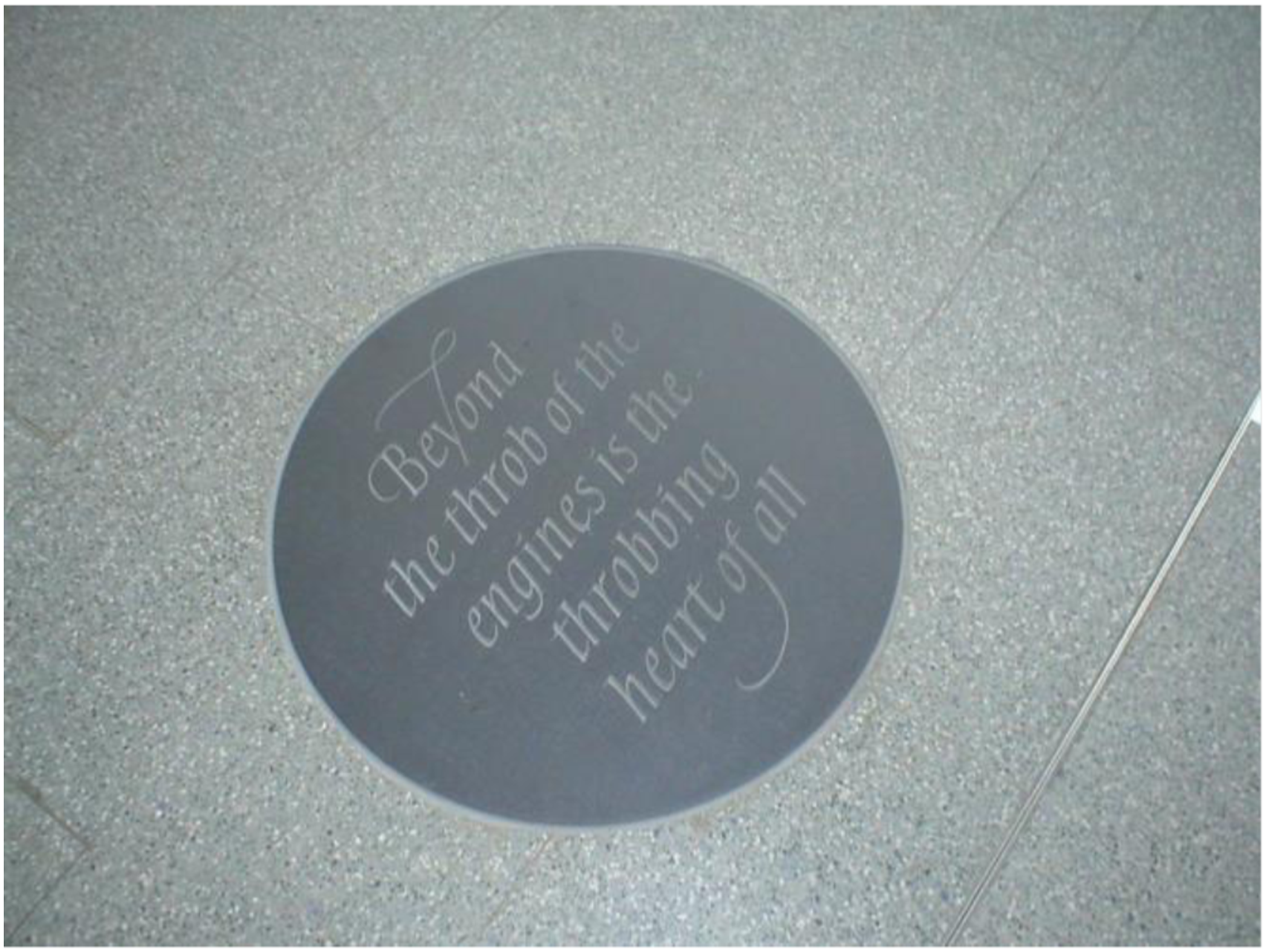
In this extract, Singular locates herself in relation to three points of reference: the station itself, her everyday life, and the ‘bi loveliness' to which the station serves as a departure point. Singular locates this ‘bi loveliness' as something to ‘get away to’, placing it firmly outside the confines of her everyday life. Clearly, the spaces of everyday life ‘touch’ Singular – rather than ‘speeding through…untouched’, her everyday life is a space where she has to make an effort not to ‘squash bits of meself' – her various marginalisations, bi subjectivity included, chafe against the world. In contrast, the station is somewhere that she feels able to ‘just sort of breathe out' – to expand bodily into the ample space, to move from ‘squashed in’ body-object to ‘liberated’ body-subject, at ease in the world (Ahmed, 2006).
‘BiCon moments’
The above accounts of participants’ experiences of travelling to BiCon support a theorisation of BiCon 2008 as a heterotopic space, constituted in relation to other sites by its different social ordering. One aspect of this different ordering is the validation of non-binary gender and sexual subjectivities, which allows attendees to experience themselves as present-tense bisexual subjects, for once in the right place and time.
However, as Hetherington (1997), following Foucault (1986), argues, heterotopic spaces are not simply ‘elsewhere’; they are spaces in which utopian desires for a differently ordered world can be explored and expressed. Below, I outline how these utopian desires are expressed temporally, in participants’ descriptions of ‘BiCon moments’.
‘BiCon happening’
One of the most striking features of Kathryn’s account of BiCon 2008 is the distinction she makes between places and moments where BiCon is ‘happening’ or ‘not happening’. During our interview, struck by this, I encouraged Kathryn to point out instances of ‘BiCon happening’. Kathryn’s description of these moments inspired me to look at other participants’ descriptions of moments that were in some way ‘particularly BiCon’, and I discuss some of these here.
As will be seen below, these moments occurred both within the bounds of the official BiCon site, and outside it. One characteristic of these ‘BiCon moments’ was that they were shared experiences taking place in groups, and in communal areas of the BiCon site such as the grassy area, bar, or dance floor, or in public spaces in the vicinity of the campus such as the local supermarket or the university botanical gardens. Another characteristic of these shared moments was that, whether they took place on or off-campus, participants clearly positioned themselves as within BiCon space. Thirdly, these experiences took the form of an encounter with ‘the outside world’ that served to reinforce the heterotopic nature of the BiCon space. In short, ‘BiCon-ness’ was often most clearly felt as a shared experience of contrast with ‘the outside world’.
For example, here is an excerpt from Kathryn’s description of an unexpected fire alarm on Friday night:
Extract 5: Kathryn
Kathryn: This is when the fire alarm went off […] so [my friends] brought their food outside and we were on the grass, […] I was kind of hanging out when they were eating and I’ve got my knitting there […] so this is hanging out during a fire alarm. […] H: Yes, is that a picture of BiCon happening? K: Yes, BiCon happening is eating in a group, outside, during the fire alarm is very much BiCon happening. But it's quite, you get that kind of spirit of: yeah we're going to make BiCon happen even though the fire alarm's going off and everyone's fed up, it hasn't stopped but it's getting a bit chilly now and… […] Because you sort of pull together […] there's something about the kind of “us against the world”-ness that the adversity adds to BiCon, although it would be really nice to have BiCon without the adversity.
In this extract, Kathryn describes this (and a fire alarm at a previous BiCon) as uniting the attendees in a shared experience of adversity. A striking feature of this account of ‘BiCon happening’ is the sense of a shared orientation towards ‘the world’, which is defined against the ‘us’ of BiCon attendees. ‘The world’, embodied in the mundanities of fire regulations, makes itself felt inside the BiCon space, but for Kathryn, this intrusion galvanises participants into defiant action (‘we’re going to make BiCon happen even though the fire alarm’s going’) in a way that adds something to her experience of the event. It is as ‘the world’ threatens to disrupt BiCon that the ‘happening-ness’ of BiCon is most keenly felt.
The portable ‘bubble’
A different kind of ‘BiCon moment’ is produced during group forays off-campus and into the ‘outside world’. Several participants describe a sense of the BiCon space as an intersubjectively constituted ‘portable bubble’, from within which groups of attendees could make trips off-campus without feeling as if they had ‘left BiCon space’.
Below, for example, Kathryn describes a section of her sketch map of the venue, recalling how she and a friend ‘took the BiCon space’ with them on a trip to the supermarket.
Extract 3.13
Helen: What does that say? Kathryn: Asda and the pharmacy. K: Because that was the only place that I went out of the space, and I took the BiCon space and… H: You took it with you? K: Sort of, I went, I went with [friend] and we were being very BiCon and we got asked if we worked in a nursery because we were wearing brightly coloured clothes and had name badges and… H: That’s cool, what do you mean being very BiCon? K: We were talking about stuff and not just doing everyday getting on with people, we were having actual conversations with content and meaning. H: With each other or…? K: With each other, I don’t exactly know how, but we were being very BiCon it wasn’t like, it was, just because together we looked like we, we probably looked like we worked in a nursery even in our regular clothes but it felt like we had this bubble of BiCon around us and talking was different but, being together was different and we were going to get food for the teddy bears’ picnic so we were thinking about it, finding food for a large group of people and being, making BiCon-ness happen and what would you do if x or y or z happened during the picnic and I feel more, I would feel very, much more shy in a new place if I hadn’t been in BiCon space but I’d also, I’d probably doing my hiding thing very much more, if I wasn’t, but I did feel we had a bubble of BiCon.
In this extract, rather than being positioned ‘against’ the world, their shared orientation towards BiCon allows them to move through the world in a ‘bubble’ (similar to the way that Singular, in Extract 3, ‘[sped] through the country untouched by [her] everyday life[…] in [her] nice sort of air-conditioned carriage’.) The surface tension of the ‘bubble’ creates a ‘protected’ space within which Kathryn feels less shy, and less inclined to ‘[do] my hiding thing’ than she usually would in an unfamiliar space. Although they are outside the physical space of the event, Kathryn and her friend continue to orient towards it as they shop for the picnic and plan how to ‘[make] BiCon-ness happen’ there.
Conclusion
Theorising BiCon 2008 as a heterotopic place-event allows us to account for the ways in which the ‘magical space’ of the event was intersubjectively produced both through the movements and practices of its constituents, and in relationship to the close-yet-distant spaces of the non-BiCon world, whose proximity provided the most ‘BiCon’ moments of all.
The result of this production was a space in which participants described being able to temporarily resolve the paradox of bi subjectivity, and to appear as present-tense bisexual subjects both within and outside the topographical space of the event itself. In the 12 years since this fieldwork was conducted, the advent of smartphones has contributed to a partial virtualisation of the space, which in some ways has extended the ‘BiCon bubble’ further beyond the physical space of the event (as it has become possible to ‘join in’ via livestream, or to follow events via social media), as well as within it (attendees can be physically present in one part of the site, but closely following events in others, and move between spaces accordingly). This virtualisation of the space warrants further study, particularly in the light of the COVID-19 pandemic, which has forced the first-ever cancellation of the physical convention, meaning that 2020s event will take place entirely online. How far a ‘virtual BiCon’ will facilitate the intersubjective construction and validation of present-tense bi subjectivities remains to be seen.
Like the 1990 NBC (Hemmings, 2002), BiCon 2008 was also heterotopic in that it remained enmeshed within the power relations of the wider social structure. Despite strenuous efforts on the part of organisers to make the event as inclusive as possible, my predominantly white, middle-class participants often described the ‘outside world’ against which the event was defined as populated by classed and racialised imagined Others (Applebee, 2016; Applebee and Bowes-Catton, 2016; Bowes-Catton, 2016; Eisner, 2013). The consequences of this for working-class attendees and those of colour, particularly those with multiple experiences of marginalisation, deserve to be examined at length, and will be discussed in forthcoming work (Bowes-Catton, in prep). This work is particularly urgent in light of the increased social acceptability of overt prejudice and the sharp rise in hate crime that followed the UK’s 2016 referendum on EU membership (Flatley, 2019). If, as Jones (2019: 1088) seems to suggest, the 2013 introduction of the Marriage (Same-Sex Couples) Act turns out to have been the high-water mark of LGBT acceptance in the United Kingdom, then future BiCon attendees, particularly the most marginalised, will need ‘this magical place’ more than ever.
Footnotes
Acknowledgements
This research was conducted as part of my doctoral research at The Open University, UK. I would like to thank my supervisors, Dr Meg-John Barker, Prof Paula Reavey, and Prof Gillian Rose, for their unswerving support of this project. I am also grateful for the helpful comments on an earlier draft of this paper, provided by members of the Open University’s Social Psychology Research Group, and to the anonymous reviewers of this paper for their helpful and constructive feedback. Above all, I remain indebted to my participants, to the organisers of BiCon 2008, and to the wider BiCon community, for their support and participation.
Declaration of conflicting interests
The author(s) declared no potential conflicts of interest with respect to the research, authorship, and/or publication of this article.
Funding
The author(s) received no financial support for the research, authorship, and/or publication of this article.
