




Abstract
This article questions the progressive potential of media depictions of male strip shows. I examine two overriding discourses within media representations, comparing these to the experiences of male dancers and female customers gleaned through ethnographic fieldwork in two strip venues. Namely, the media’s portrayal of the masculinity of male strippers as ‘fragile’; together with the construction of dancers as ‘fantasy’ subjects who know ‘what women want’. The article interrogates these constructions in relation to a critique of women’s opportunities to exercise an erotic ‘gaze’; the operation of racist and classist discourses of consuming ‘difference’ and Othering customers; and male dancers’ attempts to construct a viable sense of workplace self in the light of negative constructions of sexual labour.
Introduction
Drawing upon a critical discourse analysis of film and print media within the UK and USA, which is comparatively analysed alongside ethnographic fieldwork conducted within two male strip venues in the UK, I seek to ascertain what is missing, troubling or potentially progressive about media depictions of male strip shows. The title of this article is deliberately playful – borrowing the name of the famous 1997 film to question whether male strip shows represent women achieving ‘the full package’, so to speak, in terms of gender and sexual equality. I examine the ‘performativity’ of gender (Butler, 2004), to ascertain which meanings are brought into being through both media portrayals and people’s experiences within strip venues. Some scholars have suggested that male striptease represents a form of ‘equal time for women’ in heterosexual relations (Peterson and Dressel, 1982: 185). This article questions this notion. Two overriding discourses were identified within media depictions of male strip shows, namely: the portrayal of the masculinity of male strippers as being ‘fragile’ or even ‘failed’; together with the construction of male dancers as ‘fantasy’ subjects who know ‘what women want’, with the implication that they know this better than women themselves. The article interrogates these constructions in relation to a critique of women’s opportunities to exercise an erotic ‘gaze’; the operation of racist and classist discourses of consuming ‘difference’ and Othering women customers; and male dancers’ attempts to construct a viable sense of workplace self in the face of negative constructions of sexual labour. Theorising from a feminist poststructuralist perspective, I argue that while there are progressive moments, media representations, and very often male strip shows themselves, perpetuate a one-dimensional view of women’s sexuality, replicate traditional social hierarchies and leave little room to explore women’s multiple identifications with erotic performances.
Situating male strip shows
There are approximately three companies providing male strip shows for women within the UK. Globally, my estimations suggest that there are around 18 companies offering ‘non-conventional’ erotic dance in the USA, 9 companies in Canada, and 14 companies in Australia.1 This is of course much smaller than estimates of around 250+ ‘strip clubs’ where women dance for men in the UK (Sanders and Hardy, 2014: 23). Yet these figures need to be carefully considered, for as Sanders and Hardy (2014: 23) note, they may not include venues that have closed, particularly in the light of contemporary contestation surrounding licensing.
There are some notable differences in the conventions of strip shows internationally. Many UK male strip shows are held within nightclubs rather than strip venues specifically. Tipping conventions also differ. It is customary in the USA for women to tip dancers. There are ‘tipping stations’ in clubs in Chicago where women go to tip, and it is assumed that if a woman takes a ‘ringside seat’ that she will be the highest tipper (Liepe-Levinson, 2002: 151, 153). In the UK, the women I interviewed did not consider it customary to tip, with one woman commenting that she considered it ‘unladylike’. The furniture was also not set up in a way that suggested tipping was mandatory.
There have been notable representations of male striptease in film (for instance, Magic Mike, 2012; Magic Mike XXL, 2015; The Full Monty, 1997; Chocolate City, 2015; A Night in Heaven, 1983), all of which are analysed within this article. Male striptease has also been featured in many newspaper articles, where it is very often the case that a female journalist recounts her experiences of visiting a show. Yet, relatively little academic attention has been paid to male striptease (exceptions include Liepe-Levinson, 2002 Pilcher, 2011, 2017; Scull, 2013; Smith, 2002; Tewksbury, 1993). There is currently no research directly comparing media depictions of male striptease with the lived experiences of dancers and customers – the key aim of this article. This lack of research is somewhat surprising considering that a survey some years ago proposed that one in five women in the UK who have been on a ‘hen’ party have visited a male strip show (Mintel Reports, 2003).
The media does not have an overly positive track record with regards to portrayals of sexual labour. Scholars have identified the harm that language utilised within the media can enact in constructing female sex workers as ‘Others’ and objects of ‘disgust’ (O’Neill and Campbell, 2006: 38). Moreover, Colosi (2010: 72) argues that the portrayal of lapdancing as a ‘risky’ occupation in media reports is a discourse that ‘prospective dancers, before spending time in the stripping industry might internalise’. Further, Sanders et al. (2015: 86) note the absence of female lapdancers’ voices in UK media reports, and a lack of coverage of the impact that changing licensing legislation might engender for dancers. Despite these analyses, we currently have little insight into how male strippers are portrayed in media accounts and how dancers navigate such depictions.
Research suggests that while conventional gendered meanings position the naked female body as vulnerable, the nudity of the male stripper demonstrates ‘male power, expertise and control’ (Tewksbury, 1993: 173). Scull (2013) argues that male stripping is ‘masculinised’ through dancers’ adoption of a powerful, and sometimes ‘aggressive’, sexual role in interactions with women customers. Research with women customers suggests that alcohol consumption may encourage women to act in a loud, ‘sexually aggressive’ manner (Peterson and Dressel, 1982). Importantly, Smith (2002: 83) argues that the male strip show represents a key space where women can ‘show themselves as actively desiring’.
This article advances this literature in two key ways – by uncovering how discourses surrounding male striptease circulate media portrayals, and through exploring their impact on the lived experiences of male dancers and female customers. In doing so, the article indicates the wider impact of media discourses, examining how discourses create new knowledge in the operation of power (Foucault, 1980). Specifically, I highlight how problematic binary constructions of male and female sexuality are circulated; how gendered, classed and racialised power relations are reproduced; and the strategies dancers adopt to mediate stigmatising constructions of men performing sexual labour.
Methodology
Much feminist research, and research surrounding erotic dance, has been ethnographic because ethnography privileges people’s own views of their experience, and is attentive to the researcher’s role in the production and analysis of data (Skeggs, 1997). I conducted ethnographic research at two male strip shows held within nightclubs in cities in the UK.1 Both venues opened early to host the shows and then opened later to the public. At ‘Cheeky’s’3 I carried out 20 hours of participant observation over five evenings across three months in 2008. I also conducted 10 informal interviews and 17 email interviews with women customers and interviewed one male dancer. I visited the second venue; ‘LoveLads’, on designated Saturday evenings that management gave me permission to attend across four months in 2010. I conducted face-to-face interviews with five male dancers, held a brief interview with a drag queen host, and interviewed 14 women customers via email. In LoveLads I was required by management to sit on a stool on an upper balcony while watching the show, which meant that I could not interact with women customers until afterwards. This did, however, enable me to build a better rapport with male dancers than I was able to at Cheeky’s, as their dressing room was nearby and dancers would often pass by and speak with me.
Participants were selected opportunistically on fieldwork visits, and also through snowball sampling where customers recommended people I could speak with. Some women preferred to be interviewed via email, due to the sensitivity of the topic or as many lived far away. I also sampled participants in LoveLads via a public social media page. Whilst this was effectively ‘cold calling’, it was a successful recruitment strategy, likely because I gave a detailed explanation of the study’s aims and ethical protocol in initial messages. Customers at Cheeky’s were aged between 18 and 40 and all identified as white. Their occupations included managers, students, teaching, support work, telesales and hairdressing. Customers at LoveLads were aged between 18 and 50 and their occupations included students, secretarial work, counselling, beautician, recruitment, civil service. The majority of these participants identified as white, and four participants did not state their ethnicity. Socio-demographic data about the dancers have been omitted to preserve anonymity as there were only a few dancers within each venue.
Interviews with dancers were conducted in nightclubs where loud music was playing which made talking somewhat difficult, and sometimes I could not fully hear the participant. However, this had a key benefit – dancers repeated responses, and they often offered a fuller explanation in their second response. Full conversations were picked up by the dictaphone. As environments where no one wrote on paper, visibly taking fieldnotes would have disrupted the ‘flow’ and positioned me as an outsider. I took notes on my mobile telephone, in a notebook in the toilets, and extended these notes when returning home. The ethnographic data were thematically analysed.
For the media comparison, film and print media were selected as these are the most prominent mediums through which male striptease is portrayed. I utilised Google search and IMDB to locate films broadcast in English that featured male striptease as the dominant narrative. This resulted in the selection of five films. As The Full Monty has been greatly analysed in academic accounts with regards to class politics, my analysis focused largely upon representations of gender and sexuality. News articles were selected using the Nexis database and Google news searches, using the search terms ‘male stripper’ and ‘strip show’, from anytime until 25 October 2016. I limited the search to articles written in English within Europe and the USA, and to articles which were about the context of a show (for example, including quotations from dancers, or recounting a journalist’s attendance). These parameters produced 29 articles for analysis. The films span the years from 1983 to 2015. Media reports span from 1981 to 2016, and are mainly clustered between 2012 and 2015.
Critical discourse analysis was the most apt means for analysing the media data and comparing the information with the ethnographic fieldwork, as language is crucial in generating meaning. Language is not neutral, it reiterates existing meanings, produces new ones, and incites ways for people to be regulated (Foucault, 1980). Critical discourse analysis is attentive to ‘how specific identities, practices, knowledges or meanings are produced by describing something in just that way over another way’ (Rapley, 2007: 7). My analysis considered why dancers or customers might be portrayed in a specific way within a media account – what the function of that construction is serving, and how a different framing of these subjects could result in an entirely different meaning. I also thought carefully about the multiple potential ways that language and images can be read, highlighting where meanings may be more complex than a singular interpretation of what is ‘going on’. In comparing media and ‘real life’ examples from strip shows, I am not suggesting that ‘real life’ accounts are more ‘authentic’ or ‘truthful’ than media depictions, as all meanings are contextually specific and made within interactions. Meanings are also temporal, and the ethnographic data are products of their time. The ethnographic data are thus not generalizable to all striptease participants. In a Foucauldian sense, I am teasing out the ‘mechanics’ through which certain discourses become dominant, and how strip venue participants navigate such discourses.
‘Fragile’ masculinity
An overriding media discourse is the presentation of male dancers’ masculinity as ‘fragile’. This on first glance could be considered progressive, in demonstrating that ‘hegemonic masculinity’ (Connell, 1995) is an ideal rather than something attainable. It suggests that masculinity is not fixed, but rather its meaning is changeable and can be ‘undone’ in Butler’s (2004) sense. However, male dancers are constructed as embodying a fragile masculinity owing to class-based prejudices evident within media constructions, which intersect with stigmatising conceptions of sex work. Moreover, my ethnographic fieldwork suggests that male dancers adopt three key strategies to mediate the effects of this discourse on their performances and sense of self. Such strategies involve (1) performing ‘bodywork’ to deflect notions of them being ‘fragile’ and/or ‘weak’; (2) constructing their workplace ‘self’ through Othering men in other sex-related occupations; (3) projecting their anxieties onto the bodies of women customers.
A key mechanism of the fragility construction is casting stripping as a ‘last resort’. Men are presented as being at a particular ‘crisis’ point in their lives, having fallen on hard times. The classic representation of this is in The Full Monty, where we see a group of working-class men grossly affected by the closure of steel mills in Sheffield. The men ‘turn’ to stripping to make ends meet. Similarly, in Chocolate City Michael’s family are having money problems, and he enters stripping after a man approaches him in a toilet with a business card for a ‘money making opportunity’. In Magic Mike ‘The Kid’ enters stripping because his college education did not work out, while Mike’s business designing custom furniture is not taking off.
Even stripping as a ‘last resort’ ultimately does not ‘solve’ the men’s problems. In Magic Mike XXL in one scene the dancers sit round a campfire, listening to ‘Big Dick Richie’ come up with ideas for ‘new’ show routines. He is animated and excited but is shouted down by the others who say that his ideas have been performed before. This plays into a construction that Butsch (2003) identifies in relation to TV sitcoms, in which the working-class male character is represented as somewhat of a joke, as incompetent. Butsch (2003: 101) argues that this man, embodied through characters such as ‘Homer Simpson’, is ‘typically well-intentioned, even lovable, but no one to respect or emulate’ – he is presented ultimately as an unintelligent ‘buffoon’. This resonates with Big Dick Richie’s ideas being ridiculed, which is also a mocking of his intelligence, and feeds in to the middle-class construction that the working class are responsible for their own fate, thus ignoring structural conditions shaping social class positionality.
Similarly, The Sunday Times (Spicer, 2012) presents intelligence as antithetical to male dancers: ‘Molloy is a stripper with an intelligence and honesty rare for this funny little corner of showbiz’. Dancer ‘Anthony’, cited in a newspaper, picks up on this stereotype: ‘There is a persona attached to male strippers that they’re not smart,’ admits Anthony. ‘But I have a college degree, one of the lads is a biochemist and another is a forensic scientist’. (Irish Independent, 2015)
A key mechanism that men utilise to ward off negative constructions of their masculinity is through bodywork to display a ‘built’ body. A body’s nudity implies its vulnerability, and male nakedness ‘may also reveal the inadequacies of the body’ (Dyer, 2002: 263). Thus, the ‘built body’, with its ‘hard and contoured’ appearance, literally acts as a form of ‘armour’ to maintain the man’s image as invulnerable (Dyer, 2002: 265). In Magic Mike XXL we see dancers consuming ‘protein shakes’ to aid their ‘built’ physiques, and in Magic Mike the men dress in heavily masculinised occupational costumes, including builders, cowboys, ‘Tarzan’, soldiers, sailors, boxers and firefighters. Similarly, in LoveLads the men dressed as firefighters, sailors, soldiers, builders and police officers. Many of these occupational roles are ones which provide a rescue service or involve danger and risk (such as performing with fire). The costumes therefore construct the dancers as ‘heroes’, there to rescue women customers, thus upholding the ‘active’ male hero and ‘passive’ female victim binary. Further, there is an emphasis on the display – or promise of the display – of the erect penis. In Magic Mike we see Mike, dressed as a construction worker, performing with a large wooden pole between his legs. Similarly in Cheeky’s, dancers hid their genitalia behind a piece of material before flicking it in front of the audience. As Addleston (1999) argues, ‘using the phallus’ has been a strategy employed to ‘validate marginalized masculinities’.
Cinematic portrayals further construct masculine fragility in racialised terms. In film, we often witness white male dancers being showered in dollar bills, triumphantly walking back to the dressing room with money tucked into their underwear. Yet, Chocolate City, where the dancers are black men, is the only film that depicts dancers themselves collecting the dollar bills up off the stage after their act. It gives the impression that the men in Chocolate City are more dependent upon this money, that they desperately need it, through their picking up of every last dollar off the floor. Indeed, researchers have documented how racism impacts the divergences of earnings in striptease. Brooks (2010b) notes that ‘Black and dark-skinned Latin women gained less returns for their erotic services’ while working as dancers at ‘White clubs’. It is possible that Chocolate City is alerting the viewer to racist hierarchies, which operate within stripping through this tipping scene.
Dancers may seek to construct a viable sense of self through comparing themselves against other men in sex-related occupations. For example, dancer Reeves in a news article says: … my dad has a Phd. We were a well-read family. I was thinking of studying English or politics at university … I’m brighter than the other Chippendales, which is why it was so limiting for me as an artist. (cited in Kelly, 1993, Daily Mail).
Negativity concerning the male stripping role may also be deflected onto the bodies of women customers. Both venues sought to create an atmosphere of the shows as spaces where women could transcend normative gender roles. In doing so, the hosting figures exhibited what McRobbie (2004) has termed the ‘double entanglement’ of anti-feminist and feminist ideas in ways of performing, or in this case eliciting, ‘new’ postfeminist sensibilities. At the same time as women customers are encouraged to ‘let loose’, the entertainment is laced with sexist and classist statements. On one occasion Greg, a manager at LoveLads, played a ‘warm-up game’, telling the audience that ‘I’m gunna do to you what I first do to a girl when I meet them – split them in half’. In another show, a drag queen host mocked a woman’s clothing, saying: ‘it looks like you’ve got that down Primark love’, thus reinforcing class as being linked to subtle aesthetic (supposedly ‘innate’) taste. The audience are encouraged to ‘laugh along’ with this offensive language.
This deflection of attention away from dancers’ bodies is an aspect of the women customers’ experiences that is rarely portrayed in film. A rare glimpse into how women may be ridiculed can be seen in Magic Mike. In one scene a dancer lifts a woman up and makes a gesture to emphasise that he has hurt his back, implying that she is too heavy to lift, then promptly leaves the stage. The woman is left on stage humiliated. Print media constructions are even more overt in their invoking of fattist and classist language regarding women customers: The light in the Mecca Bingo club is flat and harsh, the decor a grotesque pink and purple. It’s Saturday night on an industrial estate in Luton and inside many of the ladies are large to very large, drinking pints or lurid alcopops. It’s a sitting target for mocking disdain. (Spicer, 2012, The Sunday Times) [H]e’s hired by the sorts of working-class women who probably aren’t getting lathered up over 50 Shades of soft porn on the Kindle – he says only middle-class people ever ask him to keep his pants on. (Spicer, 2012, The Sunday Times)
A similar distinction is made in the Observer Magazine, through a male performer’s subtle intermingling of class- and gender-based anxiety with more overtly fattist language: The group from hell. Women on alcohol. Not being rude, but some women can be physically demanding. You ever tried picking up some 10-ton tessie when she’s passed out on the stage? (Shaw, 2005: 10)
The opprobrium of women in this manner is further problematic considering that strip shows actively encourage women to consume alcohol. As dancer Todd from LoveLads explains ‘as they get drunk, they get a bit louder like they’re letting their guard down’. Alcohol consumption is encouraged from the moment that women enter the show. Customers receive a ‘free cocktail’ and are encouraged to purchase alcoholic drinks in set ‘drink and toilet breaks’ announced by the club’s host. Similarly, drinks in Cheeky’s were cheap, only becoming more expensive when the club opened to the public, suggesting that they actively encourage drinking to stimulate a certain atmosphere as much as to increase revenue. It is therefore even more pernicious that alcohol consumption is held against women customers.
‘Men know what women want’
It is perhaps somewhat ironic that the second overriding discourse apparent in media representations is that ‘men know what women want’. Particularly in film, male dancers are constructed as the ultimate ‘fantasy’ subjects who know better than a woman herself what she ‘really wants’. Early in Magic Mike we see Dallas encouraging The Kid to get into character: … you are fulfilling every woman’s fantasies … you are the husband that they never had, you are that dreamboat guy that never came along, you are that one night stand that free fling of a fuck that they get to have with you on stage tonight. (Dallas) … these girls have to deal with men in their lives who every day, they don’t listen to them. They don’t ask them what they want … We’re like, we’re like healers or something.
This discourse is most prominent in a scene at a petrol/gas station in Magic Mike XXL, in which Big Dick Richie is encouraged by his peers to interact with a stern-looking female cashier, and to ‘go in there right now and put a smile on her face’ (Mike). As the Backstreet Boys’ ‘I Want It That Way’ starts to play, Big Dick Richie enters the shop, doing everything he can to capture her attention – he bursts open a packet of crisps, dances suggestively up against a drinks cabinet, thrusts with a water bottle (figure 1), pours the water over himself before taking his top off. He then performs press-ups on the floor, which the woman peers over the counter to see, before he delivers his finale – asking her ‘How much for the Cheetos and the water?’ The cashier’s face breaks into a smile, much to the delighted cheers of the dancers who are watching outside.
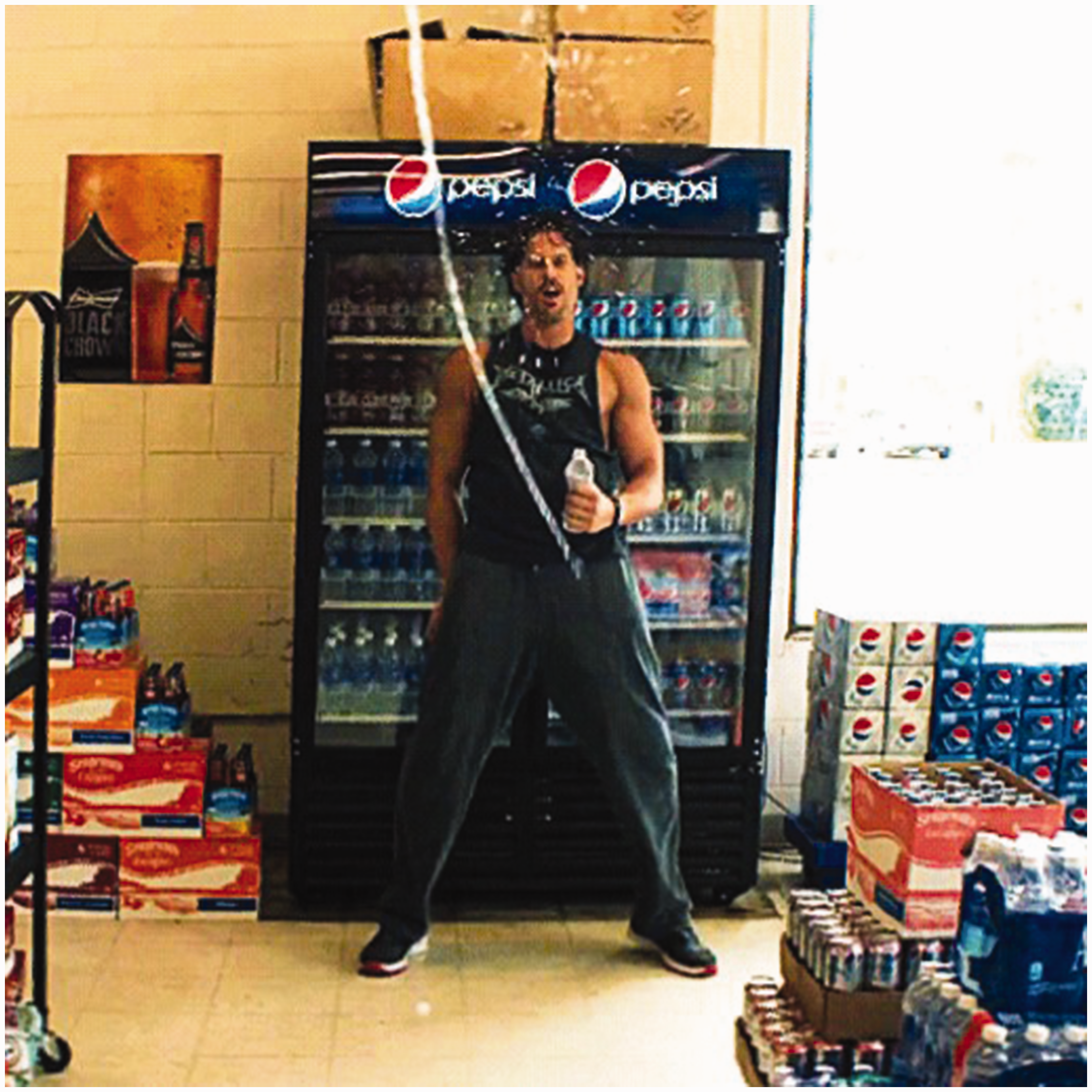
Big Dick Richie in the petrol/gas station.Magic Mike XXL, Warner Bros. Pictures, USA, 2015.
While his achievement of the smile from the cashier is presented as him knowing what even the ‘sternest’ of women want, feminists have long documented that men’s quest to ‘get a smile’ from women is a form of harassment – a woman not smiling at a man is portrayed as her not having a sense of humour, which implies that it is the woman herself at fault. His spraying of the water as a prop to signify the power of the phallus to command the woman’s attention is also interesting. As Bordo (1999: 43) argues, rather than being portrayed purely as a source of sexual pleasure, phallic imagery is deployed to denote a sense of masculine ‘achievement’. Further, Addelston (1999: 350) suggests that ‘when gender roles are no longer so clearly defined, it is left to sexual markers to bifurcate and establish identity’, thus it is no surprise that ‘we are seeing the rise of cultural depictions’ of the penis ‘to prove masculinity, specifically by the people who are the least able to claim masculine status’. Big Dick Richie is therefore not only asserting that he knows what women want but utilising phallic imagery to potentially deflect the discourse of masculinity as fragile.
A similar discourse surrounding men allegedly knowing ‘what women want’ permeates ‘real life’ strip shows. As Smith (2002: 76) notes, The Chippendales claim to have created a ‘woman’s fantasy land’ based on ‘men being open about pleasing and entertaining women’. For some women in Cheeky’s, the show did provide space for them to articulate their desires. After she had been taken onstage by a dancer one woman said she ‘was in heaven’, and that he ‘looked like Richard Gere, he was my fantasy man’. Similarly, in LoveLads, customer Vanessa said that she ‘loved the show … highlight – male nudity!’ One woman also commented after watching a male dancer squirt cream on his chest that ‘I just wanted to lick it off him, mmm’.
As Butler (2004: 28) argues, ‘fantasy is part of the articulation of the possible; it moves us beyond what is merely actual and present into a realm of possibility’. To the extent that women can utilise the shows to articulate their own fantasies, the strip show could represent a space in which women can act outside the parameters of normative femininity. Maher in The Times (2012) suggests that Magic Mike is ‘a movie that’s about objectifying men for women’. Some academic accounts agree, with Perfetti-Oates (2015: 24) suggesting that Magic Mike ‘reverses the argument Mulvey makes about the male gaze in “Visual Pleasure,” since the film clearly signifies the presence of the heterosexual female gaze’. I would not suggest, however, that the male strip show represents a straightforward ‘reversal’ of gendered conventions of ‘gazing’.
The very notion of ‘what women want’ is one-dimensional, reverting, somewhat ironically given that women are watching erotic entertainment, to a view of women’s sexuality as contained or as ‘naturally’ sexually passive. Male dancers at LoveLads see themselves as ‘knowing’ what women want:4 Girls want to see … the journey, it’s a little bit more than getting your clothes off, our show is about taking them on a journey rather than full wack straight away … girls don’t like that. (Craig) … that’s what women want, they wanna see a little bit of nakedness but they’re also shy and a little bit reserved and they don’t want the whole kind of thing, they don’t want it too full on. (Todd)
We see here that women are perceived to be ‘shy’, not able to articulate their desires, and ultimately different in their expressions of sexual desire than men. There also has to be a justification for them viewing erotic entertainment, it cannot simply be about ‘sex’ per se, but they are seen as needing a ‘journey’ or something gentler. Similarly, other areas of women’s sexual exploration have traditionally had to be justified through their activities being couched in ‘domesticity’ (Juffer, 1998: 81), or there has to be a sense of romance ‘and the justification of love before sexual activity’ (Smith, 2007: 202). The overriding message is that while women do not know what they want, the male dancers do, and thus dancers are able to position themselves as the ultimate fulfillers of female fantasies. Moreover, these narratives from dancers also serve a further function. They work to separate the male dancers’ labour from that of women strippers through disassociating their performances from ‘sexual’ labour, with all its connotations with ‘dirty work’ (Tyler, 2011: 1477), and shift them into the genre of a comedic performance.
There is a difference between these narratives in which women are presented as sexually ‘shy’ but interested in ‘fantasies’, and with some print media which presents women as completely devoid of desire. Shaw claims in the Observer Magazine (2005) that women customers are ‘not out to be sexually aroused’. Similarly, Gold sets a binary distinction between women’s and men’s sexuality in writing about her attendance at a strip show. In The Guardian (2009) she claims that ‘[w]omen watch men strip for fun. Men watch women for darker reasons’ and that ‘[f]or women, it has nothing to do with sex’. Continuing this blanket assumption, she says: ‘There is not a single woman here who actually wants to have sex with a Chippendale’. Her narrative essentialises women, and does not recognise women’s multiple potential identifications with strip performances.
In contrast, in my fieldwork women were certainly interested in viewing erotic entertainment. Yet they criticised the narrow parameters of ‘fantasy’ that were presented to them, particularly how the shows were structured to regulate and limit their experiences. Women in both venues mentioned the lack of ‘private dancing’ in private rooms, as is customary when men watch female striptease. In LoveLads, private dancing was not available to women, and they were required to sit during the show. At Cheeky’s women could stand around the edge of the dancefloor (which operated as a ‘stage’) and engage in touching interactions with dancers, but there were no ‘back stage’ rooms for them to experience one-to-one dances. Customers in both venues considered that being able to engage in a private dance would enhance their erotic enjoyment. Regarding LoveLads, Wendy said that ‘it’s just not private enough, if you fancy a man and you think he likes you then there’s too many people there to compete with and nowhere you can be alone’.
One way that women could potentially enjoy a more intimate experience at the shows could be through the medium of touch. For instance, in Magic Mike XXL, we see the men visit a private strip ‘house’ in which women have more intimate interactions with dancers (albeit still in view of other customers). In LoveLads, it was only after a show that a customer could ‘hug’ a dancer during a period of the evening dedicated to ‘photograph’ opportunities. While more touching interactions occurred in Cheeky’s, 11 participants felt that some of the touch was uninvited and aggressive. In Cheeky’s dancers would select a woman from the audience, and hold her ‘in place’ on the stage, while the man’s genitalia was thrust into or hovered over her face. One participant said that she ‘felt uncomfortable having a strange man have his stuff almost in my face!’ and another said that she found a dancer ‘very commanding’ and that he was ‘quite firm’ so ‘it didn’t come across as particularly sexy’. Moreover, language used in cinematic depictions can also be aggressive. In Magic Mike, Mike asks The Kid ‘So how pregnant did you get that girl’s mouth?’ and in another scene, says of a customer: ‘look at what she’s wearing tonight, she came here to be bothered’.
Another aspect, little covered in cinematic portrayals, is women’s vocalisation of their distaste at the embodiment of the ‘fantasy’ figures who are presented to them. Two women from Cheeky’s commented that they found dancers’ genitalia to be ‘too big’ and ‘scarily huge’. Similarly, in LoveLads I witnessed women shouting rude remarks at a dancer while he was onstage, screaming ‘you’re fat’ and ‘yuck’. On the one hand, women are clearly disavowing the ‘gazing’ conventions that have been set out for them by the parameters of the show through their vocalising of their displeasure. Yet, some of these remarks still delineate quite narrow parameters for the male body, reifying the toned and muscular body as the most desired.
The women’s experiences bring into question the pervading discourse that ‘men know what women want’. Yet this discourse is questionable in another sense, with regard to how the media constructs ideas about ‘race’ within the ‘fantasy’ that is being sold. The strip show is already a space that is constructed as liminal, as transcending experiences that women might have in their ‘ordinary’ lives. Yet in media narratives this extends to invoking racist fantasies surrounding the consumption of racial difference. Media narratives construct encounters for women with black men as ‘more exciting, more intense, and more threatening. The lure is the combination of pleasure and danger’ (hooks, 1992: 26). The very fact that the perceived racial characteristics of non-white male dancers are commented upon within both cinematic and print media, while whiteness is often left as the unspoken norm, equates non-whiteness with difference. For instance, ‘Big Dick Richie’ is described by Mike as a ‘fucking Greek God’ in Magic Mike XXL; The Sun (Phipps, 2007) speaks of a dancer as ‘dark, mysterious Zami’, and a dancer is described as a ‘Latin sensation’ (Griffin, 2015). Further, in Magic Mike XXL there is an exchange centring upon selling different racial fantasies to women: ‘We’ve still got … one person of colour’ and ‘One snowy white Ken doll for all those good little Christian women’. While this is a representation, as an industry that operates largely through ‘ideas of customer taste and preference’, Brooks (2010a: 99) argues that if a customer does not view a particular dancer as desirable, it is constructed as ‘the objective result of consumer taste … not structural anti-Black racism operating within the psyche of the customer or club management’.
Racism pervades media constructions of striptease through the invoking of racist constructions of black men as hypersexualised. The Full Monty includes a scene where a black male, referred to as ‘The Horse’, auditions for the troupe. Speculation is made as to whether he has a ‘big wanger’. In another scene, Dave asks his wife if she has ever ‘been out with a black bloke’, commenting that ‘it’s true then what they say about black men they’ve got good bodies’. In my fieldwork, racist stereotypes surrounding black men were invoked, such as a night in Cheeky’s where the host told the (primarily white) audience that ‘you’re gunna see some big black cock tonight’. Such stereotyping, as Hall (1997: 257) argues, ‘reduces, essentializes, naturalizes and fixes ‘difference’’. Furthermore, Hall (1997) argues that stereotypes involve fantasy – something we have already seen is crucial to the male strip show – as they focus as much upon the ‘imagined’ or fantasised as what is perceived as ‘real’. In the examples given earlier, the fantasy is, as hooks phrases it, of somebody ‘[g]etting a bit of the Other’. As hooks (1992: 23) argues, black people are constructed as ‘more worldly, sensual, and sexual because they [a]re different’. Engaging in a sexual encounter with a black male is thus constructed as ‘a movement out into a world of difference that would transform’ (hooks, 1992: 24).
This ‘difference’ construction within media also extends to racialised metaphors of food consumption. For example, The Sun (Patterson, 2012) contains the headline ‘MAAN BREAD OR POPPABUM; Curry house puts male strippers on menu’, claiming women will consume a ‘bit of beefcake after their baltis’. Similarly in Magic Mike XXL, Tito performs a routine as the ‘candy king’, who invites women into his ‘candy shop’. This confirms hooks’ (1992: 366) argument that ‘[w]ithin commodity culture, ethnicity becomes spice, seasoning that can liven up the dull dish that is mainstream white culture’. The men are presented as ‘flavours’ to be tasted by women customers.
Owens and Beistle (2006) have analysed the racialised food metaphor in relation to personal dating advertisements. Discussing how ‘chocolate’, ‘vanilla’, ‘cream’ and ‘dark coffee’ enter dating discourses, they suggest this represents a ‘discursive eating of the black body’ (Owens and Beistle, 2006: 201). They highlight the paradox that through such metaphors the black body is presented as both ‘alluring’ but also a ‘gluttonous sin’ (Owens and Beistle, 2006: 201). If we think about this in relation to the titling of Chocolate City, and the stage name of Michael as ‘Sexy Chocolate’, we can think about how chocolate is popularly construed as something we are supposed to have in moderation, it is seen as ‘bad’ for us through the argument that it might bring about fatness, which is socially constructed as an undesirable embodiment, particularly for women. By ‘consuming’ black male embodiment, women viewers are thus dabbling in something that they are supposed to consume only as a ‘guilty pleasure’.
Yet the title could suggest that we need to read elements of the film in a different vein. As Templeton (2015: 330) points out, ‘[t]he term ‘Chocolate City’ refers not only to a city with a black majority population, but also thriving black business and leadership’. The film begins with the host saying: ‘you’ve seen the Magic Mike way, and now we’re gunna add a little chocolate’, which arguably portrays the ‘adding’ of chocolate as something better. Further, Miller-Young’s (2014: 5) work exploring black women’s experiences as porn performers, proposes the possibility of racialised ideas surrounding ‘sugar’ as having the potential for a dual meaning, particularly where women may ‘reappropriate’ language on their own terms. Miller-Young (2014: 6) argues that women may use the ‘seductive power of brown sugar’, to defy historical racist connotations of black women embodying a ‘raw’ sexuality, turning these stereotypes on their heads ‘to intervene in representation, to assert their varied sexual subjectivities, and to make a living’. While it is not clear from Chocolate City whether the food metaphor fully reverses problematic stereotypes, as the film does not explore this narrative in enough depth, Miller-Young’s work at least suggests the possibility of a potential rereading of the title and the film’s intentions.
Conclusion
Whilst media depictions of male striptease, and the shows themselves, are about the micro interactions between male dancers and women customers, this analysis indicates that the discourses constructed within both mediums work to reproduce much wider problematic assumptions surrounding gender, class and ‘race’. Sexist ideas are reproduced about the ‘essential’ nature of female sexuality as one-dimensional. We are presented with the notion that ‘men know what women want’, but hear little of women’s experiences. Yet ethnographic research with women customers indicates their frustration with how their opportunities to watch the shows are heavily regulated. Further, despite the nuances in dancers’ experiences of stripping, together with their sometimes very successful careers, male dancers are overwhelmingly presented in media depictions as ‘fragile’ in their masculinity, due to their purported lack of intelligence, inability to ‘hold down’ other forms of employment, and of sexual labour being cast as something that is only ‘turned to’ in ‘hard times’.
In a further classed construction, women’s attendance at male strip shows is posited as largely the pastime of working-class women. This is simply untrue. Within both LoveLads and Cheeky’s the women came from a wide range of class backgrounds; the cost of attending the LoveLads show was very expensive (£35–£45 per ticket);5 and some of the customers had attended the show on multiple occasions. Moreover, the shows invoke classist humour to incite laughter at women customers who are deemed ‘excessive’ and not to be exhibiting feminine respectability, which indicates that women’s viewing of erotic entertainment is trivialised, demeaned and not taken seriously.
There is also a wider connection with the findings in this article and broader thinking about sexual labour. Much of the problem here is that stripping, and indeed sex work more broadly, is not viewed as a legitimate form of work, either in much of the dominant media or within people’s everyday imaginaries. Yet ‘[s]tripping work requires multiple forms of labour’ (Sanders and Hardy, 2014: 135). As I have argued previously, stripping is a form of work that entails an exceptional degree of aesthetic labour, emotional labour and body work (Pilcher, 2017), and is a far cry from media depictions of it as a role performed by the seemingly ‘unintelligent’ or unskilled. While male dancers may resist the power of these discourses, as their work is not deemed legitimate, their only avenue to do so is through a number of problematic strategies. Namely, they attempt to claim legitimacy by projecting negativity associated with their role onto women customers’ bodies, or engage in Othering practices in relation to other men who work in sex-related occupations. Therefore, while male strip shows, and portrayals of male striptease in film and print media, create potential spaces to open up a discussion of what erotic entertainment for women audiences could potentially ‘be’, this article argues that in their current manifestation they perpetuate a one-dimensional view of women’s sexuality, replicate traditional social hierarchies, and leave little room to explore women’s multiple identifications with erotic performances.
Footnotes
Acknowledgements
Thank you to those who gave their time to participate in this study.
Funding
The author(s) disclosed receipt of the following financial support for the research, authorship, and/or publication of this article: Thank you to the Economic and Social Research Council for funding the ethnographic component of this research [grant number ES/F024126/1].
