




Abstract
We propose the concept of algorithmic heteronormativity to describe the ways in which dating apps’ digital architectures are informed by and perpetuate normative sexual ideologies. Situating our intervention within digital affordance theories and grounding our analysis in walkthroughs of several popular dating apps’ (e.g., Tinder, Bumble, and Hinge) interfaces, promotional materials, and ancillary media, we identify four normative sexual ideologies—gendered desire, hetero and homonormativity, mononormativity, and shame—that manifest in specific features, including gender choice, compatibility surveys, and private chat. This work builds on earlier digital culture theorizing by explicitly articulating the reciprocal and gradational linkages between existing moral codes, digital infrastructures, and individual behaviors, which in the contemporary context work jointly to narrow the horizon of intimate possibility.
“The moral law is in our hearts, but it is also in our apparatuses.”
–(Latour, 2002, p. 253)
Introduction
In early 2019, the dating app company Hinge updated its tagline from “The Dating App Made for Dating” to “Designed to Be Deleted” (Carman, 2019). Both taglines are worded to suggest that Hinge, unlike other dating apps, is designed to get users dates that will become serious, long-term, monogamous relationships as opposed to simple casual sex and other ostensibly suboptimal intimate arrangements. This messaging implicitly casts its competitors in the dating app market as fostering comparatively superficial connections, hence inferior. This marketing campaign is a coded attack against Hinge’s largest competitor, Tinder. Tinder, not necessarily designed to form lasting connections, was designed using swipe logic to gamify the dating experience, and thus to keep users on the app for as long as possible (Ferris and Duguay, 2019). Further, as Haber (2019) has noted, Tinder mainstreamed queer cultures of promiscuous sociability and cruising for heterosexual audiences. And though Grindr was the first app to enter the scene and “appified” promiscuity, Tinder commodified it for the heterosexual market (Ahlm, 2017). Hinge, in turn, stakes its claim on being digital promiscuity’s antithesis, promising a return to normative patterns of relationality centered around monogamy.
In this paper, we argue that Hinge and Tinder’s dueling visions of the relational ideal are not as irreconcilable as they might appear; rather, we argue that underlying the discursive imaginations of myriad dating apps’ features and affordances are normative sexual ideologies that discourage a range of non-monogamous sexual behaviors regardless of whether the app is “for dates” or “for hook-ups.” In this way, we aim to theorize the conceptual link between app affordances and sexual ideologies. We ask: How do normative sexual ideologies manifest in app design, and how do these design features influence user behavior?
To address this question, we triangulate theories of sexual normativity and affordance theory with walkthroughs (Light et al., 2018) of multiple dating apps’ interfaces, promotional materials, and ancillary media (e.g., terms of service documents and social media posts). Dating apps refer to smartphone software that allow users to access a pool of profiles that are ordered based on physical proximity (Miles, 2018). The myriad current dating apps come in two major interface types: (1) a matrix-based landing page or “cascade” where users are displayed en masse in an egocentric grid (Brubaker et al., 2016) and (2) an algorithmically-ordered “card stack” of full-screen profiles which must be traversed in sequence, such as via the now-iconic “swipe” gesture (Ward, 2017). Some apps advertise themselves as catering to specific groups of people, such as queer men (Grindr, SCRUFF, and Jack’d), queer women (Lex and HER), and Muslims (Salams), whereas others are presented as universal apps that are open to everyone (Tinder, Bumble, and Hinge) (Regan, 2021).
Apps were selected purposefully through a combination of typical case and deviant case sampling (Etikan et al., 2016). We focus primarily on several of the most popular apps in the North American context that are marketed to the general mobile device-using public (based on total number of users in 2021; Curry, 2022), including Tinder, Bumble, Hinge, and OkCupid, so as to capture the most pervasive sexual discourses that impact large swathes of online dating participants. In addition, however, we examine several nonheterosexual-targeted apps, including Grindr, SCRUFF, and Lex, to see how, if at all, the dominant sexual ideology is contested.
In the first section, we situate our intervention within theories of heteronormativity and digital affordances. Rather than focusing on defining and enumerating dating apps’ affordances, we are interested in explicating further the relationships between technological features, social structures, and individual behaviors. Building on the work of Evans et al. (2017) and Davis and Chouinard (2016), we argue that studies of digital culture need to more explicitly articulate the roles of normative structures and ideologies in the development of app features, how said features influence user behaviors, and how the perceptions of these features and uses “stem from the sociotechnical, political, cultural, and economic arrangements in which users are embedded” (Duguay 2018: 128). In this way, we echo Noble’s (2018) investigation on how search engine algorithms perpetuate racism to advocate for a deeper consideration of how digital media and app culture only offer a narrow view of permissible sexual behaviors. In the second part, we discuss the four key normative sexual ideologies that are perpetuated by dating app features and influence user behavior: gendered desire, hetero and homonormativity, mononormativity, and shame. In the third part, we apply our theorizing to various apps and discuss how these ideologies manifest in three specific features: gender choice, compatibility surveys, and the chat feature. By way of conclusion, we theorize ways for dating app infrastructures to adapt and include more nonnormative affordances.
Situated theories
Algorithmic Heteronormativity
Our central argument is that dating app architectures are informed by and recapitulate a normalizing sexual ideology we refer to as algorithmic heteronormativity. Algorithmic heteronormativity describes digital infrastructures, features, and affordances that encourage heteronormative sexual behaviors and devalue queer sexual behaviors and expressions. This concept builds on the work of Safiya Noble (2018), who theorized algorithmic oppression as “algorithmically driven data failures that are specific to people of color and women” within digital corporate environments (p. 4). For Noble, algorithmic oppression “reflects a corporate logic of either willful neglect or a profit imperative that makes money from racism and sexism” (p. 5). Grounded specifically in a Black feminist perspective, we aim to extend Noble’s work by considering how other intersectional axes of oppression and privilege—in this case, sexuality—manifest within digital infrastructures. Algorithmic heteronormativity speaks to instances where digital platforms have failed queer and sexual minority communities by perpetuating social structures that privilege heterosexual monogamy as a key organizer of interpersonal relationships online.
Before proceeding, it is important to articulate clearly the theoretical terrain of our conceptualization of heteronormativity and how it influences our theorizing. Given its longevity as a theoretical term within queer and sexuality studies (Warner, 1991) as well as its broader dissemination into popular, academic, and activist discourses, heteronormativity describes a broad range of social arrangements within neoliberal capitalism that privilege heterosexual sociality over queer and sexual minority sociality. When it intersects with the particular algorithmic affordances of digital culture, there are three key features of heteronormativity that have forbearance on the field of dating and hook-up apps: the reproductive imperative, monogamy, and sexual shame.
As Ruberg and Ruelos (2020), Bivens (2017), and others have argued, digital platforms overdetermine and oversimplify the roles of gender identity in constructing online personas and profiles. This overdetermination of gender, we argue, is the key structure through which apps manifest heteronormativity’s reproductive imperative: that is to say, that the only acceptable object of desire is one that will produce a child. Heteronormativity, which produces heterosexual monogamy as the apex of sexual relations, organizes societies around the primacy of heterosexuality, with the ultimate goal of reproduction (Edelman, 2004).
Building off the insights of heteronormativity, scholars of non-monogamous sexualities have discussed “mononormativity” as the idea that societies privilege monogamous, dyadic couples as the primary mode of sexuality (Emens, 2004; Schippers, 2016). To the extent that the idealized relational configuration under heteronormativity is as much a question of partner number as gender (namely, one different-gender partner at a time), heteronormativity legitimates and is legitimated by monogamy (Allen and Mendez, 2018). Despite Tinder’s reputation for being an app that privileges hook-ups over dates, we want to suggest, like Hinge, it operates largely from a mononormative position insofar as its features discourage non-monogamous and polygamous relationalities.
Another central feature of heteronormativity is the cover of shame over discourses of sexual intimacy. As Foucault (1990), Tomkins (1995), and others have noted, there are significant prohibitions on sex that stem from relations of shame. While much theorizing on shame has focused on its queer experience, we think it particularly generative to theorize it as constitutive of heteronormativity as such and not just one of its psychological outcomes. In Foucault’s (1990) formulation, affective registers such as shame are why the “incitement to discourse” about nonnormative forms of sexuality does not necessarily entail liberation from power and its functionaries, and indeed, in some cases, is a more thoroughgoing form of discipline than repression—because to speak it into existence and cast it as an object of scorn mobilizes the populace in their own mutual policing. For to implant notions of perversion, deviance, and dysfunction in particular sex acts, talk of sex must multiply as a precondition. As “other Victorians” we are wont to speak verbosely about sex, but it is a nervous speaking marked by shame, which constructs certain sex acts as more or less acceptable than others.
Heteronormativity renews itself by making certain sexual behaviors shameful, producing what Rubin (1984) has described as the “charmed circle” of acceptable sexual behaviors. Sex is good when it reproduces a child. Sex is good when it is monogamous. Sex that is neither of these things is produced as shameful within the affordances and features of dating and hook-up apps. A growing literature points to a stigma attached to (queer) sexual promiscuity and by extension use of dating apps that are reputed to facilitate it—a shame which individuals attempt to disavow by presenting themselves “respectably” online or rendering themselves anonymous (Ahlm, 2017; Blackwell et al., 2015; Birnholtz, 2018). This shame in looking for casual sex is tied intimately with the shame of sex itself. As Tomkins (1995) theorizes in discussing the relationship between shame and looking: “whatever taboos there may be on intimacy as such are immediately enforced on interocular exchange, just as they are enforced on sexuality” (p. 144). The shame and stigma surrounding sexual behavior is linked to the shame of looking and being looked at, hence why many dating app users, and queer users especially, seek to minimize their digital footprint (Ahlm, 2017; Birnholtz et al., 2014).
App companies seem to know that this association between sex and shame negatively affects their business. Tinder, for example, has spent considerable resources distancing themselves from their initial branding as a hook-up app. Instead, they have attempted to rebrand as a relationship and social connection app, since the “association between Tinder and hooking up poses a threat to the company’s bottom line because discourses that link casual sex to immorality, promiscuity, and danger affect Tinder’s uptake” (Duguay 2018: 127). Shame thus operates across the dating app market—from design, to marketing, to use.
Affordances, features, and user behavior
Within the field of dating and hook-up apps, algorithmic heteronormativity manifests in various features and affordances. Affordance theories seek to describe the structurally situated relationships between subjects, objects, and behaviors within systems. Much of this theory emerges from Gibson’s (1979, p. 179) foundational theorizing: “The affordances of the environment are what it offers the animal, what it provides or furnishes, either for good or ill. […] These affordances have to be measured relative to the animal.” For Hutchby (2001, p. 444) “Affordances are functional and relational aspects, which frame, while not determining, the possibilities for agentic action in relation to an object.” Within studies of digital media and app culture, affordance theories are used to describe the relationships between users and their technologies to account for the range of actions made available to users by digital objects. Because of the conceptual imprecision of some of this initial theorization, and confusion over what counts as an affordance in digital contexts, recent work on digital affordances aims to “set forth threshold criteria for establishing what an affordance is, and what it is not” (Davis and Chouinard, 2016: p. 242). A popular distinction is made between features, affordances, and outcomes/behaviors within digital contexts, with features defined as “what users can do with a technology” (Markus and Silver, 2008: 612), and outcomes as behaviors “connected to the goals of the actor” (Evans et al., 2017: 40). Affordances are the relational link between these two components, “as they emerge in the mutuality between those using technologies, the material features of those technologies, and the situated nature of use” (Evans et al., 2017: p. 36). In this view, social media cross-linking would be an example of a feature, anonymity an affordance, and community building an outcome.
Importantly, affordances do not simply either afford or not afford, but rather afford in degrees. Davis and Chouinard (2016, p. 242) delineate these gradations “into a suite of interrelated mechanisms […] artifacts request, demand, allow, encourage, discourage, and refuse.” These mechanisms are interrelated insofar as “what an artifact requests of a user, it can also encourage; when it demands one thing, it refuses anything else” (p. 243). This conceptualization provides an understanding that behaviors on dating apps are afforded through degrees; some behaviors are encouraged, others requested, and some outright refused. For example, a dating app may demand that the user input a gender marker, and may refuse them from using the app until they have provided that information. An app may request a user use their real name by linking their profile with their Facebook account, or it may encourage the use of pseudonyms by allowing users to manually input their own name. These mechanisms are not discrete: “The boundaries between mechanisms are porous and interrelated, with easy slippage from one category to the next” (p. 244).
Affordances are also contextual: “What an artifact requests of one user it may demand of another; what the artifact refuses in one moment, it may later allow” (Davis and Chouinard, 2016: p. 245). This means we must ask the question: afforded for whom? To what extent a technology makes certain lines of action possible depends on the multifarious capacities of the user themselves: whether they “perceive” the feature(s) in question, are “dexterous” enough to use it, and have the “cultural and institutional legitimacy” to use it (Davis and Chouinard, 2016: p. 245–6). For our purposes, this third criterion—of cultural and institutional legitimacy—is the most compelling given our interest in thinking through how dating apps legitimize some sexual behaviors and delegitimize others. There is growing recognition that social values and norms are programmed into software (Balsamo, 2011) and that programming choices have “world building capacities” (Bivens and Hoque, 2018; Haraway, 2016). By understanding affordances as existing within structurally situated relationships, we are seeking to provide a framework for determining to what extent affordances are produced by these structures. What follows is a discussion on how algorithmic heteronormativity legitimizes particular affordances and manifests within the features of the apps themselves. Our aim is to encourage app scholars to name and theorize more concretely how various socio-cultural frameworks inform the features, affordances, and behaviors on and off apps.
“Who are you interested in?“: Foregrounding gendered desire
One constitutive element of heteronormativity that is evidenced through the affordances of dating apps is gendered desire. During initial profile setup on several of the most popular apps for “general audiences,” that is, those not explicitly targeted toward any specific demographic group or interest, including Tinder, Bumble, and Hinge, one of the first questions users are asked, usually after their first name and date of birth, is their gender identity. Soon thereafter they are posed some variation of the question “Who are you interested in?” which is almost always framed in gendered terms (see Figure 1). Users can sometimes change these settings later, but a gender and partner gender sexuality must be specified at all times in order to access basic functions like matching and messaging. This design decision warrants scrutiny, given leading research on the phenomenology of sexual orientation maintains there is no a priori reason why sexual orientation is defined singularly or even primarily by a partner’s gender as opposed to other parameters like partner number, type of sexual activity, or intensity (Van Anders, 2015). It has thus been reasoned that gender’s designation as one of, if not the most central organizing principle of desire and sexuality, is a social accomplishment and historically contingent fact (Schudson et al., 2018). Moreover, queer theorists and activists have long argued that heteronormativity’s intelligibility is contingent on elevating a gendered logic within cultural formations of sexuality; were gender to lose its preeminence, so would heterosexuality in due course (Butler, 1990; Young, 1992). We submit the ideology of gendered desire, which is part and parcel to heteronormativity, is reflected in and perpetuated by dating apps’ digital architectures. It is neither arbitrary nor necessary to force users to identify their gender and partner gender sexuality and sort them foremostly along this axis while relegating other criteria like type of relationship sought, hobbies, and values to the status of optional filters; rather, it is a willful choice on the part of design constituencies among nigh-infinite alternatives that arise out of discourse and with discursive consequences. Indeed, as work by Bivens (2017), Ruberg and Ruelos (2020), and MacLeod and McArthur (2019) shows the ability to select one’s gender is a significant feature of nearly all social media platforms, including dating apps. It is also central to how the apps are able to quantify their users. Tinder, Bumble, and Hinge (L to R) features that ask users to select who they are interested in as of March 2022.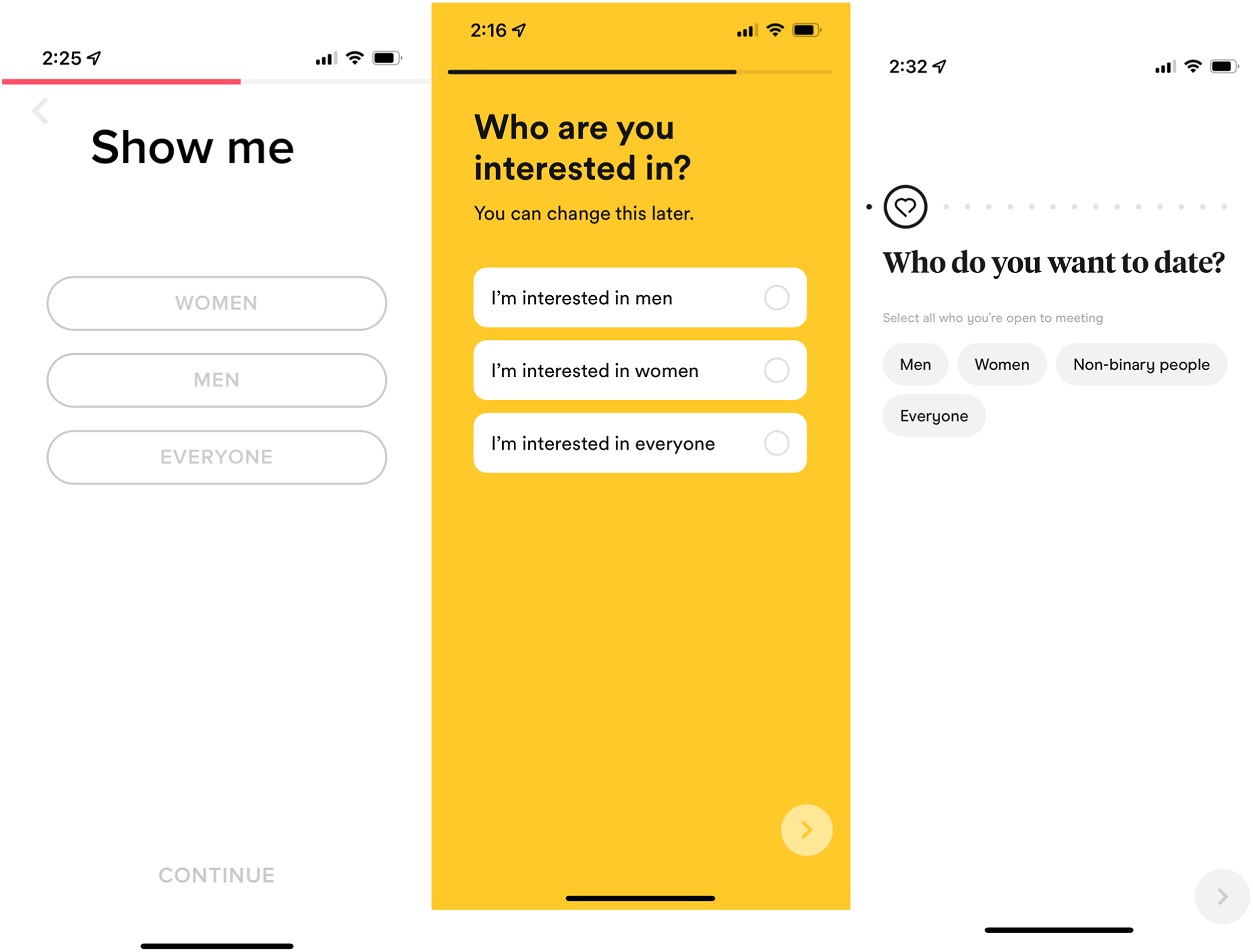
The cruel optimism of compatibility surveys: hetero and homonormativity
Dating app features also promote certain relational configurations and images of happiness and “the good life” that reinforce hetero and homonormativities (social and political formations within sexual minority communities that advance heteronormative institutions and mores, e.g., conspicuous consumption, monogamy, marriage, domesticity, and reproduction; Duggan, 2003) This is perhaps most visible on apps, like Hinge and OkCupid, that ask users to fill out detailed profiles. Indeed, the detailed profile itself is a feature that affords hetero and homonormativity as they narrow the scope of potential matches in the name of finding long-term matches that can reproduce and consume together. This goal is quite explicit in marketing materials: “we’re dedicated to helping people find love and happiness through meaningful connections” (OkCupid, 2022); “Go on your
What about children? What’s your hometown? Where do you work? Where did you go to school? What’s the highest level [of education] you’ve attained? What are your religious beliefs? Do you drink? Hinge’s compatibility questionnaire as of March 2022.
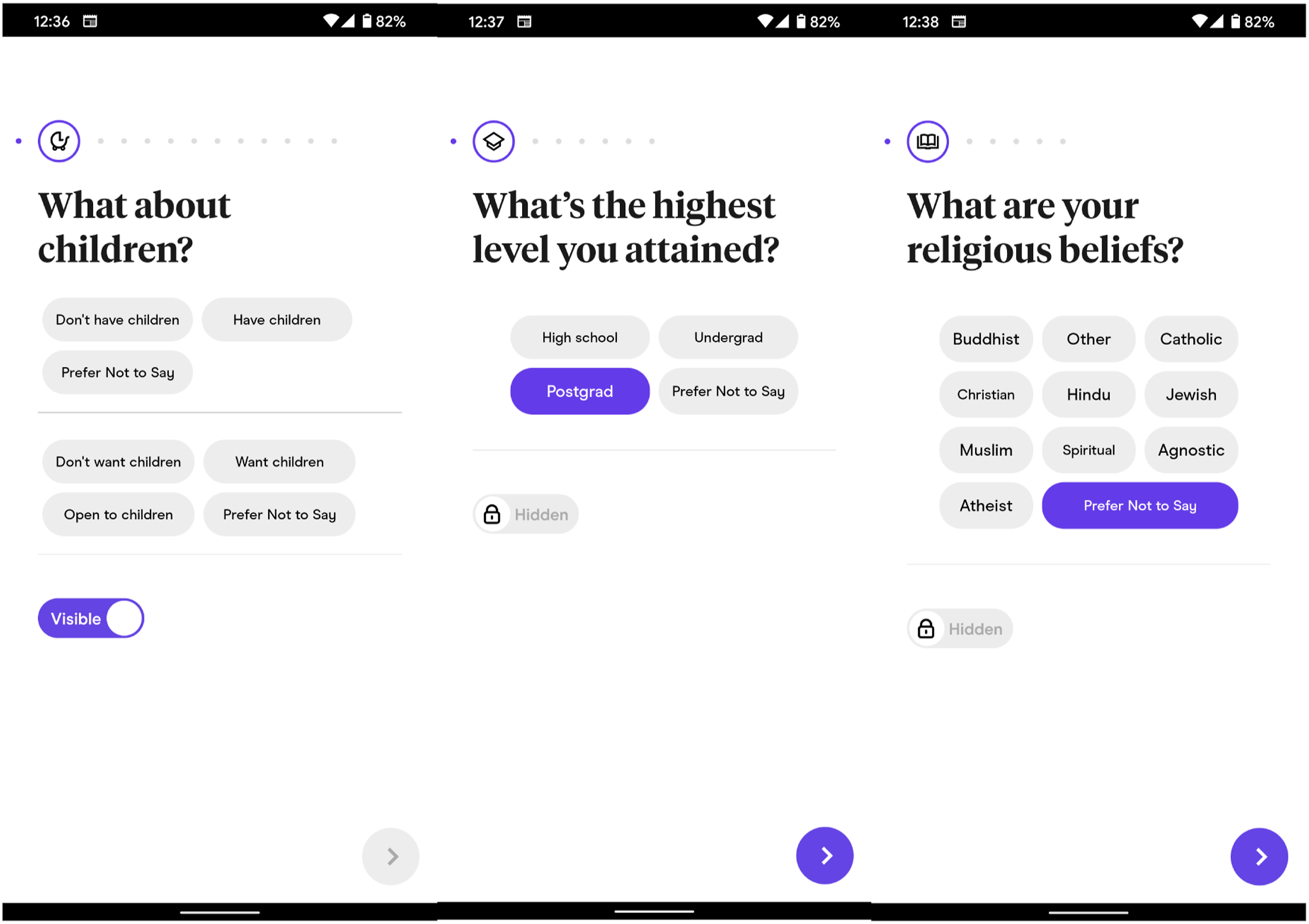
Once the user’s initial profile is set up, users can answer additional questions about a range of matters from political views to drug use. The ordering of this questionnaire reveals much about what Hinge’s developers conceive as the ideal relational form. The fact that the first question asked after demographic data relates to children (if the user has children, but also if the user would like to have children at some point) underscore’s Hinge’s assumption that children and the reproductive imperative are key metrics through which to measure the success or failure of potential relationships—for heterosexuals and nonheterosexuals alike, as the question order does not change based on whether the user indicates wanting to see people of the same or different gender. Such normative framing does not provide for the possibility that the user may not be able to have children (for biological, social, or economic reasons), not want children, or that children are an unimportant factor in considering a relationship.
By placing the child first (quite literally) and developing complex and detailed mechanisms for users to enumerate exactly who they are and what they are looking for in a person (‘s lifestyle), dating apps construct relational “success” in heteronormative terms—long-term, monogamous, reproductive, consumptive—to the exclusion of alternative socio-sexual configurations, like “publics of privates”: loose networks of concurrent casual sex partners that simultaneously generate erotic, practical, and affective bonds (Race, 2015).
Furthermore, by promising a hetero and homonormative vision of happiness that may ultimately be unrealizable, dating apps effect a “cruel optimism,” which Berlant (2011, p. 1) argues “exists when something you desire is actually an obstacle to your flourishing.” A Pew Research survey found that 39% of online dating users have been in a committed relationship or married someone they met on a dating app, meaning that for over one in two, the tacit promise of online dating has not materialized. This is evidently a source of frustration, as a whole 42% of online daters report a somewhat or very negative experience (Anderson et al., 2020). This contradiction between the outcomes that dating apps promote and what users actually experience may be a result and reflection of their engagement-centered profit structure, which generates perverse incentives to keep people using the apps for as long and frequently as possible to maximize user data harvesting, subscription revenues, and ad exposure (Wilken et al., 2019). Rather than disenchant people to the heteronormative ideal, there is reason to think digitally mediated deferral might actually reinforce its cultural hegemony. Similar to how the unattainability of hegemonic masculinity is central to its reproduction (Kaufman, 1999), heteronormativity preserves its mystique and nostalgia by virtue of being difficult, if not impossible, to embody in its entirety or at all times.
Mononormativity and one-on-one chat
As alluded to earlier, another central element of heteronormativity that informs and is reproduced by dating apps’ technological assemblage is mononormativity. This is perhaps best exemplified in Tinder, Bumble, and Hinge’s chat features, which structure interaction between users in ways that specifically promote monogamous relationality. Chats afford only one-to-one interactions between two users who have already “matched” with one another, with no ability to bring a third party or more into the exchange. The lack of a group chat feature, in contrast to many other popular social networking and messaging apps like Instagram, WhatsApp, and Facebook Messenger, is striking and underscores that within intimate relationships specifically the dyad remains the ascendant social unit. This limits users’ freedom to pursue polyamorous relationships and/or group sex scenarios within the interface of the app, forcing inefficient and even unsanctioned workarounds, like merging discrete chats in an external app or sharing one profile as a couple. The latter practice is often discouraged or prohibited: “By using the service, you agree that you will not: […] use another member’s account, share an account with another member, or maintain more than one account” (Tinder, 2021).
The features of private chat further produce a sort of monogamy without sex, evacuating prospective intimate connections of their erotic content. Tinder, Bumble, and Hinge not only restrict the use of sexually explicit photos in profile creation but also variably disable the sending of personal multimedia (e.g., photo, audio, and video) within private messaging, confining non-textual expression to emojis and gifs. Moreover, Tinder issues a prompt when it detects the user inputting sexually explicit or offensive language as an intended deterrent (see Figure 3). While such features are designed to protect users from harassment and image-based sexual abuse, they have the secondary effect of stifling consensual sexually explicit text messages and other consensual sexual activity on the apps. The upshot is that intimacy is further entrenched within a heteronormative ethic of pre-marital chastity, instrumentality, and reproduction. How designers navigate the tensions between sexual violence mitigation and sexual permissibility represents an important avenue for future research. Tinder’s chat feature, devoid of multimedia sharing capabilities, also issues prompts when it detects users inputting sexually explicit or offensive language.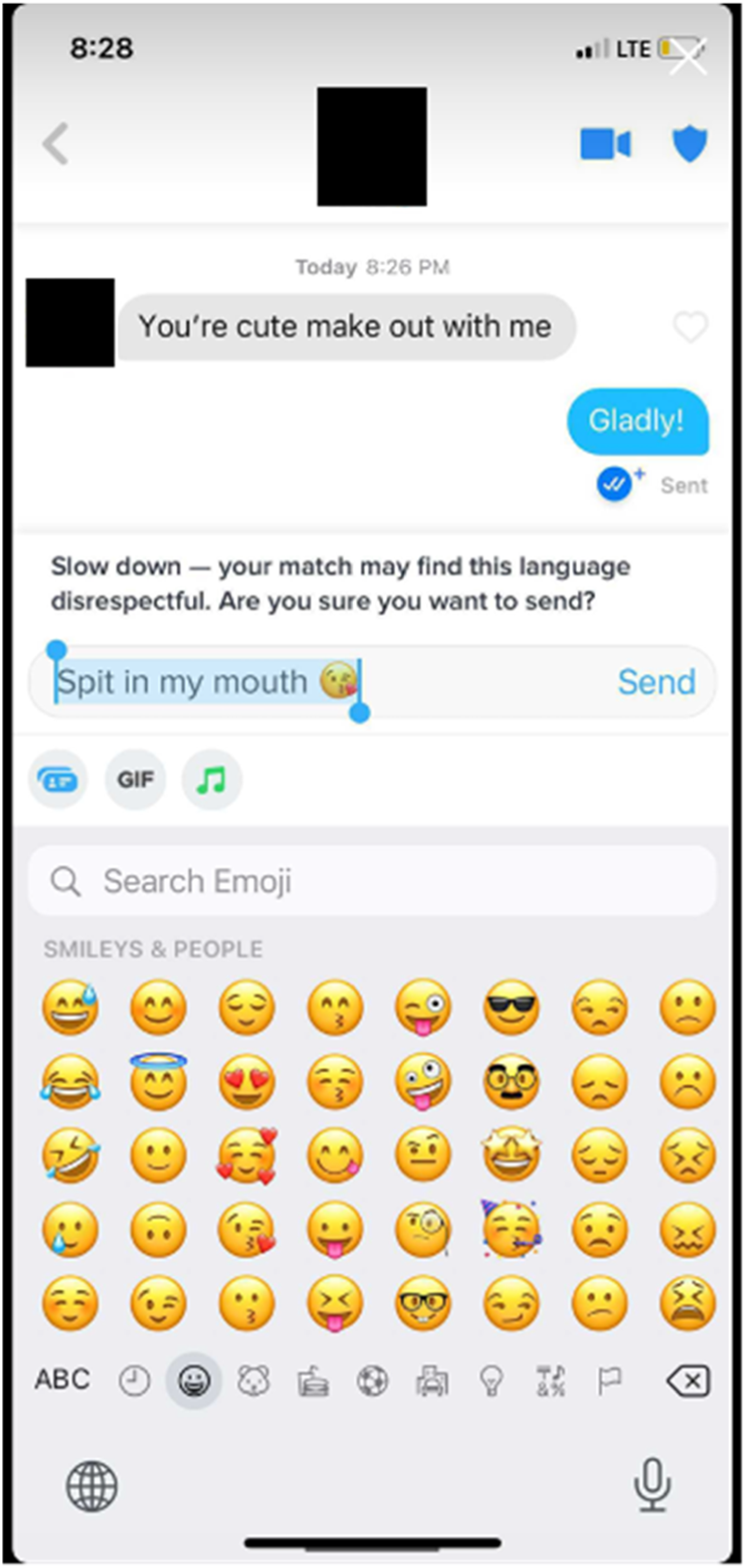
Undoing shame, undoing power
Although myriad actions by dating apps’ design constituencies bolster the link between shame and (queer) sexual promiscuity, including but not limited to downplaying the possibility of diffuse erotic interchange, there nevertheless exists within these digitally mediated networks of interaction the potential for collective undoing of shame, and by extension the heteronormative power structure it buttresses. The shared experience of shame—of being shamed by power—becomes the basis from which to build solidarity and community. As Dunn (2019: 373) puts it: “the performance of a shameful act can be reconsidered as a way to affirm others who have already been shamed in the past. Put differently: choosing to do something shameful can constitute a social bridge between oneself and another previously shamed person or community.” The path to the undoing of shame and the normative ideologies that it supports is made clearer by viewing shame as a form of interest that is constitutive of communities. Here Sedgwick and Frank’s reading of Tomkins is particularly instructive: If, as Tomkins describes it, the lowering of the eyelids, the lowering of the eyes, the hanging of the head is the attitude of shame, it may also be that of reading – reading maps, magazines, novels, comics, and heavy volumes of psychology, if not billboards and traffic signs.[…] yet this reading posture registers as extroversion at least as much as introversion, as public as it does private: all a reader need do to transform this ‘inner life’ experience to an audible performance is to begin reading aloud. (Sedgwick and Frank, 1995: p 20).
In other words, shame’s individual experience is simultaneously the basis for mutual identification, commiseration, and organization. The shamed may form a collective and with greater strength in numbers challenge and resist their shaming.
In the age of digital communication technology, this “reading aloud”—articulating private experiences as social issues and building alliances to realize alternative futures—can be accomplished by scrolling, swiping, and texting. Moreover, the point Sedgwick and Frank are making (as is Tomkins) in remarking on the shared posture between shame and reading is not that reading is inherently shameful, but that shame is coextensive with interest. As Probyn (2005) notes: “Shame is the body’s way of registering interest, even when you didn’t know you were interested or were unaware of the depth of your desire for connection” (pg 28). Shame is experienced when this interest is interrupted, when someone makes us aware of our behavior. There is only shame about sex because we are interested in sex. Hence, insofar as dating apps represent an inchoate “community of interest” (Rheingold, 1993), that interest being intimacy in its manifold forms, they are uniquely positioned to serve as sites of organized resistance against shame tied to intimacy.
However, these communities of intimates are still very much in their nascency, to the extent that they exist at all. In their current state, most dating apps are more reminiscent of an “anonymous, self-serving public” (Miles, 2017: p. 1601) than a community; users are atomized, largely self-motivated, and feel minimal closeness and commitment to one another. This is likely due in no small part to the dyadic conversation structure, which impedes any kind of group deliberation whereby subaltern discourses that challenge heteronormative shame might be negotiated. Indeed, it has elsewhere been argued in the context of sexual violence prevention that dating apps’ pairwise interaction style prevents robust community from forming, requiring activist and mutual support activities to be outsourced to third party platforms like Reddit (Masden & Edwards, 2015).
To undo shame, and to undo power, apps need to provide the space to allow users to be interested in ways that not are not circumscribed by heteronormativity. To some degree this space is already provided on numerous queer dating apps. Lex, SCRUFF, and Grindr do not require users to identify the gender of their object of desire upon sign up, allowing for more fluidity of sexual desire. Similarly, these apps allow more freedom of expression in profile creation, and do not guide users to answer a predetermined set of questions like Hinge or Bumble. And while almost all apps limit chat to one-on-one interactions, Grindr is unique in offering a group chat feature, which is implied to be useful in setting up group sex.
Of course, just because these apps have these features does not mean they are immune to the normative structures that frame the affordances and features of their heterosexual peers Tinder, Bumble, and Hinge. Like Tinder before it, Grindr has recently been attempting to rehabilitate its image as a hook-up app by pushing a #MetOnGrindr viral marketing campaign that promotes the long-term relationships made on the app. The direction these app cultures will take in the future—either towards or away from prevailing sexual norms—is uncertain and will be decided in the struggle between different and opposing social, economic, political, and technological forces (Callon, 1987). As with most historical developments, the outcome will likely be located somewhere between pure reaction and pure transformation. Perhaps then, much in the same way as affordances, the relationships between power, pleasure, and sexuality should be considered to operate in gradations. Normative ideologies do not simply afford/constrain sexual behavior: depending on the context, sexual behaviors are sometimes discouraged, requested, encouraged—a far wider range of possibilities than simply request/deny, afford/constrain. Power, pleasure, sexuality, and affordances: these frameworks “rhyme” insofar as they all offer theories of qualitative difference and gradation instead. The key task of scholarship in dating app culture, then, should be plotting out these rhyming schemes.
Conclusion: toward an intersectional theory of affordances
In this article, we introduced the concept of algorithmic heteronormativity to describe the ways in which dating apps’ digital architectures are informed by and perpetuate normative sexual ideologies. Through walkthroughs of several popular “general use” apps (Tinder, Bumble, Hinge, and OkCupid) and more niche, nonheterosexual-targeted apps (Grindr, SCRUFF, and Lex), we identified four constitutive elements of heteronormativity that manifest through particular features and affordances: gendered desire, hetero and homo normativity, mononormativity, and shame. In so doing, we have clarified a heretofore undertheorized aspect of affordance theory: namely, the ways social structures interact with affordances and features, and how this affects user behavior and outcomes. We have shown that similarly to how affordances operate through gradations—affordances do not simply afford/constrain, but offer a complex set of interrelated mechanisms—so too do the structures that influence how particular features and affordances are taken up by users. Mononormativity and heteronormativity, for example, cannot be simply added or removed to apps by adding or removing features. Depending on how these features interact with other features and the context of their use, the interaction between social structure, feature, and affordance can place different demands on the user. By offering group chat, for example, Grindr encourages group sex, and thus encourages non-monogamous behaviors. Further, Hinge, by offering users the choice to indicate a variety of preferences around children—but not requiring that users answer the question, nor answer the question in a way that affirms their desire to want children—encourages users to seek out long-term, monogamous, hetero/homonormative relationships, but does not demand it. Nevertheless, the net effect of the reciprocal and gradational linkages between existing moral codes, digital infrastructures, and individual behaviors in the contemporary context is the narrowing of the horizon of intimate possibility.
This begs the question of what role, if any, these technologies might play in deconstructing heteronormativity. The most obvious takeaway from the complex interrelations that have been established in our analysis between social structure, technology, and user behavior is that creating a milieu in which a diversity of sexual desires, identities, and practices can flourish is not as simple as tweaking the existing technological assemblage—removing or modifying affordances that encourage/demand heteronormativity or discourage/refuse nonnormative (queer) sexuality. Such an assumption is animated by the erroneous belief that technology, operating autonomously and according to its own inherent logics, unilaterally influences societies and sets the course of history. This so-called technological determinism has largely been eschewed for a social constructionist perspective that maintains the design, development, adoption, and use of any technological artifact is inextricably tied up with the social groups concerned with the artifact and the meanings they give to it (Pinch and Bijker, 1987). According to this view, the current array of features on dating apps reflects existing norms, values, and priorities. To some extent the reason why features like algorithmic gender sorting and dyadic interaction have stabilized is because they were preceded by a social context of gendered desire and mononormativity—these ideologies prevailed during dating apps’ development. In other words, such features exist in part because significant portions of the population reflexively or otherwise want them. This poses problems for companies looking to make progressive changes to their product, as they risk alienating current and potential users and undermining profits. For evidence of this we need look no further than the backlash to Grindr’s group chat function, which a cursory survey of public tweets and Reddit comments—many of which deploy homophobic tropes of depravity and disease transmission—suggests was not insignificant (see Figure 4). Hence, progressive social and technological change must go hand in hand, lest the latter be rejected or worked around. This is not to suggest that technologies play a negligible role, however, the extensive interpenetration of the social and digital spheres in the modern era means that, more than ever before, qualitative or quantitative changes to one imply changes to the other Public tweets and Reddit comments regarding Grindr group chat.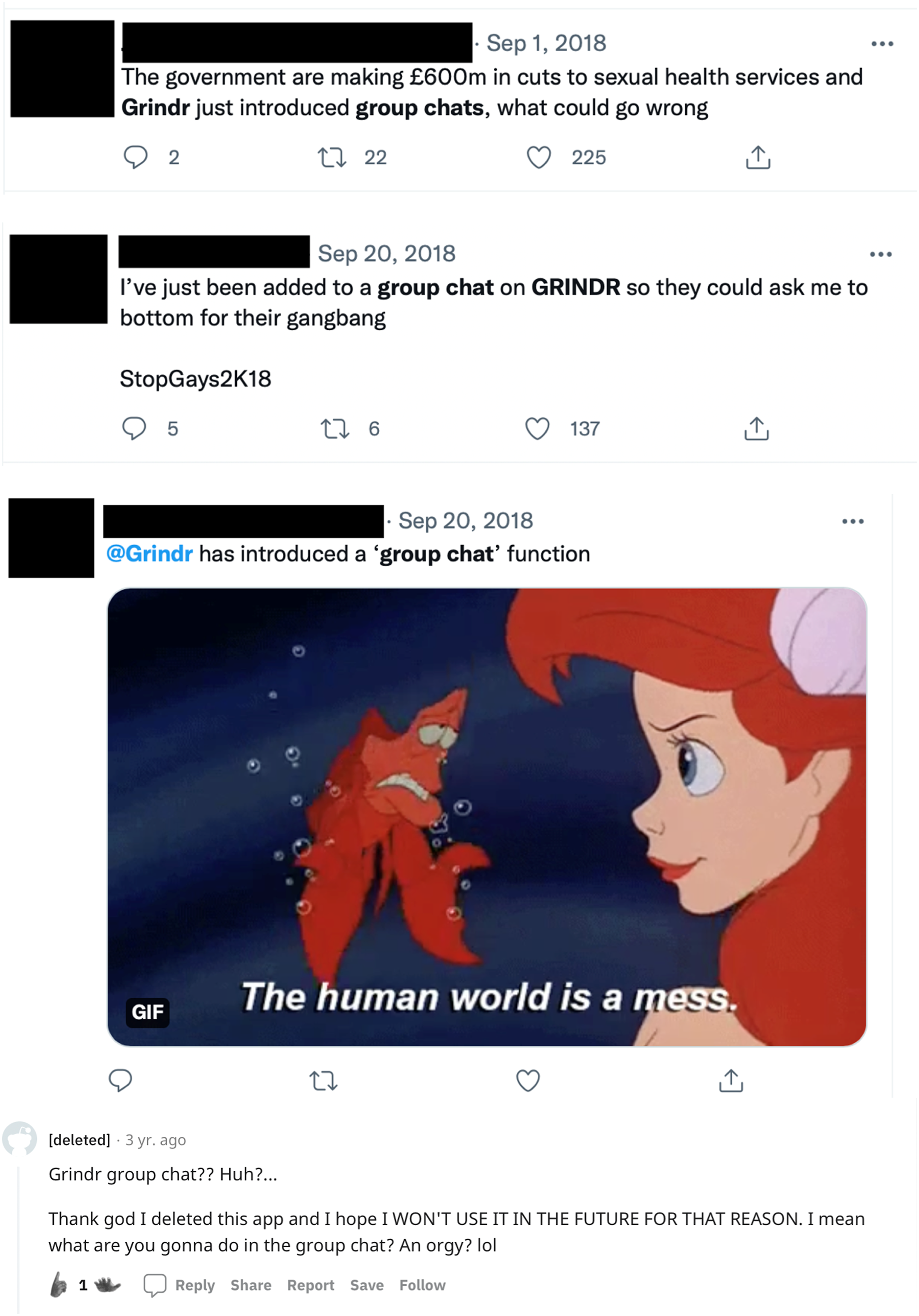
In advocating for this constructionist technological perspective in understanding normative sexual structures, we also hope that scholars of other intersectional issues—like race, gender, ability, and so on—find utility in this framework. While this paper has focused on questions of sexual behaviors, and naming some of the structures that variably demand, encourage, discourage, and refuse sexual behaviors, we encourage scholars to consider structures from an intersectional approach (e.g., Collins and Bilge, 2016) and think about how structures of sexism, racism, colonialism, transphobia, ableism, among others, inform the features and affordances of dating apps. For as much as users are central to reproducing colonial, racist, transphobic, and ableist logics, apps have a role in making such reproduction possible. The ways racism manifests in an app’s features and affordances will change depending on the affordances and features the app provides for gender, for sexuality, for ability, and so on. We focus on a single axis here—in this case, sexuality—because in the case of dating apps, sex and sexuality are the key organizing feature of user interaction on the apps. We encourage future studies to problematize and make intersectional our theorizing. The stakes of such intersectional theorizing are clear: by naming the intersectional structures that interact with features, affordances, and behaviors, scholars can pay more attention to how dating apps are both complicit in the production of normative power and can be mobilized toward its undoing.
Footnotes
Declaration of conflicting interests
The author(s) declared no potential conflicts of interest with respect to the research, authorship, and/or publication of this article.
Funding
The author(s) received no financial support for the research, authorship, and/or publication of this article.
