



Abstract
The use of human enhancement drugs (HED), which include prescription drugs and other substances used for reasons beyond their intended medical use, has been the subject of considerable interest since the late 2000s. However, there is a lack of research exploring how working conditions and organisational norms may significantly contribute to an individual’s decision to use substances for enhancement or performance purposes. Building on the concept of pharmaceuticalisation to examine the case of enhancement drugs use in the financial industry, this article highlights how the social context, particularly the workplace, can be central to analysing the causes and modalities of substance use for performance or enhancement purposes. This study therefore approaches the financial sector as a site where such processes may be observed in particularly acute forms. Through a qualitative analysis of an online forum, this study explores the experiences, motivations, opinions and beliefs about such substance use in the financial industry. The findings suggest that substance use is openly discussed in the forum and that difficult working conditions appear to contribute to shaping the modalities of such use. Stress and long working hours were the most reported problems associated with substance use. The study also shows that, far from being neutral, medicines and in particular HED themselves play a key social and normative role in the process of accepting these extreme working conditions. The narratives about the use of performance-enhancing substances created and disseminated within the community studied contribute to the idea that the micromanagement of the worker’s bodies is ultimately the main tool available to adapt to their working conditions.
Keywords
Introduction and background
The use of “human enhancement drugs” (HED), which encompasses prescription drugs and other substances that are consumed for reasons beyond their intended medical use to enhance various physical or cognitive abilities, 1 have been the subject of considerable interest since the late 2000s. A substantial body of scientific research has been conducted on these issues with college students as the primary focus (Benson et al., 2015; Coveney et al., 2011; Forlini, 2022; Robitaille and Collin, 2016). It is also the subject of a growing body of literature in various work settings, including medicine (Franke et al., 2013; Rubin-Kahana et al., 2020), finance (Dietz et al., 2016), academia (Sahakian and Morein-Zamir, 2007; Sattler et al., 2013; Wiegel et al., 2016), classical music (Fishbein et al., 1988; Kenny et al., 2014) as well as among artistic circles (Nwadigwe, 2008; Winick, 1959) and truck drivers (Davey et al., 2007; Leyton et al., 2012). However, while substance use in general has been studied in certain industries, and while some of these studies have considered the role of social factors such as occupational stress, there is a lack of research exploring how users’ work experiences and environments may influence their decision to use HED.
This article focuses on the financial sector and mainly on the profession of financial analyst. To date, very little research has examined the use of enhancing drugs in the financial sector (Dietz et al., 2016), and none has focused on the articulation between working conditions and the use of HED.
Building on the concept of pharmaceuticalisation to examine the case of enhancement drugs use in the financial industry, this article will highlight how the social context, particularly the workplace, can be central to analysing the causes and modalities of substance use for performance or enhancement purposes. This paper draws on a qualitative analysis of one of the largest online forums for employees in the financial industry. Research using online forums has proven fruitful when the behaviours being studied are associated with social stigma, as anonymity allows users to speak freely while maintaining their privacy (Kozinets, 2019). More specifically, this study explores how working conditions in the industry, as discussed by employees, contribute to the shaping of substance use practices and beliefs and social norms about them. In turn, this study questions the role that HED play in the process of accepting extreme working conditions.
This article is structured in five main sections. We begin by drawing on the concept of pharmaceuticalisation to establish the theoretical framework for analysing the use of enhancement drugs in the workplace from a sociological perspective. We then outline the methodological approach underpinning this study, detailing the principles of netnography and the procedures used to analyse online discussion forums. The three sections that follow present the findings of our analysis. First, we show that the use of human enhancement drugs in the financial sector is embedded within the context of extreme working conditions, and more specifically as part of a broader process through which such conditions are normalised, rendering the worker’s body increasingly framed as deficient or even pathological. Second, we examine how pharmaceuticals, by shifting the boundaries between the natural and the artificial, open up new forms of technologies of the self among financial professionals, who seek to extend the limits of their bodies through pharmacological means. Finally, we show that the use of HED gives rise, within online forums, to a profound process of identity negotiation situated between deviance and conformity, centred on the question of what it means to be a “true” financial analyst.
The use of enhancement drugs at work: A theoretical framework
Research on the use of HED has traditionally been framed through public health and bioethical concerns, particularly those relating to the misuse or diversion of prescription medicines (Nicholson et al., 2015; Outram and Stewart, 2013). These debates have often centred on questions of cheating, deviance from medical or institutional norms and the risks of dependency or addiction. Parallel work has emphasised the potential harms associated with using pharmaceuticals for performance-related purposes, highlighting cardiovascular, psychological and behavioural risks for workers exposed to demanding conditions. Much of this literature, however, adopts an individualising perspective, linking enhancement practices to pre-existing psychiatric conditions—such as depression, ADHD, or substance dependence—rather than situating them within their wider social, cultural, or organisational contexts (Maier et al., 2015; Peterkin et al., 2011; Poulin, 2007; Rubin-Kahana et al., 2020).
Yet, as enhancement practices become increasingly normalised and socially tolerated, a purely biomedical or behavioural framing proves insufficient. Sociological research on cognitive enhancement drugs—often termed smart drugs, pharmaceutical cognitive enhancers or human enhancement drugs—examines how these substances reconfigure norms of productivity, self-optimisation and health in contemporary societies. Early sociological engagement highlighted that concepts such as medicalisation (Conrad, 2007) and biomedicalisation (Clarke et al., 2010) illuminate some aspects of enhancement, but risk overstating clinical authority when enhancement practices are increasingly detached from formal diagnosis and therapeutic intent (Coveney et al., 2011). Coveney et al. (2011) suggest that pharmaceuticalisation offers a more precise analytical lens through which to examine how substances such as modafinil, methylphenidate and amphetamine-type stimulants migrate from therapeutic into broader socio-economic domains, where they function as tools for managing the intensification of academic, professional, and social demands (Coveney et al., 2011).
Indeed, research on pharmaceuticalisation has deepened sociological understandings of how medicines increasingly acquire new roles in social life, shaping identities, norms, and expectations of self-management (Abraham, 2025; Bell and Figert, 2015; Gabe et al., 2015; Gabe and Martin, 2023). Williams et al. (2011) propose a set of dimensions—problem redefinition in pharmaceutical terms, changing governance, mediation, identity formation around drugs, expanding non-medical markets and “health futures” that shape present action—through which pharmaceutical intervention becomes normalised. Abraham’s analysis complements this by emphasising the political economy and institutional drivers of pharmaceutical expansion as key forces shaping when and how pharmaceuticals move beyond treatment and into optimisation (Abraham, 2010). According to this literature, the rising use of enhancement drugs is the expression of broader economic and cultural logics—logics that valorise optimisation, resilience, and the disciplined management of one’s capacities.
A further theoretical development is to conceptualise pharmaceuticals not only as biochemical inputs, but also as political and social actors. Through their agency, they participate in the shaping of subjectivities, affecting both bodily experiences and social interactions. In this perspective, the notion of “living drugs” proposed by Fraser et al. (2009) highlights the manner in which drugs become intertwined with social practices and meanings. This concept asserts that drugs function through and beyond the body, thereby influencing everyday behaviour and the realm of experiences. From this standpoint, the utilisation of HED in the workplace can be interpreted not solely as a reaction to arduous labour conditions, but also as a conduit through which such conditions are engendered, reinforced, and experienced.
In this regard, Collin (2016) offers an important extension by conceptualising how drugs restructure both individual experiences (as living drugs) and broader social orders (political economy, changing governance and institutional drivers of pharmaceutical expansion). Collin suggests conceptualising pharmaceuticalisation as a triadic and iterative process comprising medicalisation, molecularisation and biosocialisation (Collin, 2016).
Classic analyses of medicalisation, from Zola to Conrad, have demonstrated how an increasing number of human experiences are being redefined as medical issues. This process of redrawing the boundaries between what is considered normal and pathological remains central to understanding contemporary health cultures (Conrad, 1975, 2007; Zola, 1972). Building on this, scholarship on molecularisation—particularly Rose’s work—shows how molecular biology and genetics relocate health governance to biochemical processes, contributing to the emergence of a “somatic self” and new regimes of individualised biological management (Rose, 2007). Complementing these developments, the concept of biosocialisation, originally advanced throught the concept of biosociality (1996), highlights how emerging biotechnologies and the formation of online communities generate new forms of collective identity and belonging structured around shared biological traits, as illustrated in studies on genomic citizenship (Gibbon and Novas, 2008).
Building on these three processes, Collin’s framework highlights how pharmaceuticals operate as transformative “dispositifs” that reshape perspectives on health, nature, and identity by generating new forms of social plasticity (Collin, 2016). Through their materiality, flexibility of use, pharmaceuticals continually reposition key polarities. These polarities include those between normal and pathological states, as defined by the process of medicalisation; the natural and the artificial through the process of molecularisation; and between conformity and resistance to social norms through the process of biosocialisation. These shifting boundaries contribute to far-reaching transformations in the sociocultural landscape, as pharmaceuticals “colonise” the life course and become deeply embedded in contemporary social experience. In this study, we draw upon these three interconnected sociological processes, which help illuminate the shifting role of pharmaceuticals in contemporary societies.
However, the establishment of a comprehensive theoretical framework for the examination of HED utilisation in contemporary societies, particularly within the context of the workplace, calls for an additional dimension. Research on pharmaceuticalisation has indeed highlighted the connections between enhancement practices and the broader economic and cultural dynamics of contemporary capitalism (Ballantyne, 2021; Davies, 2017; Rosa, 2010). The values associated with the “new spirit of capitalism,” as described by Boltanski and Chiapello (2011), provide a valuable backdrop for understanding the growing appeal of so-called “smart drugs” and, more broadly, of psychoactive drugs that Chatwin and Alexander (2025) term “virtuous drugs” in the neoliberal context.
In contexts marked by heightened competition, diminished social safety nets and escalating expectations of productivity and excellence, the use of HED is increasingly framed as a viable means of meeting the demands of professional or academic performance (Bloomfield and Dale, 2015; Le Dévédec, 2020; Mann, 2021).
Bloomfield and Dale (2015) show in particular how prescription drugs and other substances enable workers to adjust to intensified labour conditions by acting directly on their physical and cognitive capacities. In this sense, pharmaceuticals serve to extend bodily limits and align workers with environments characterised by rising workloads, long hours, and sustained effort. The productivity gains attributed to HED use may, in turn, contribute to the normalisation of “extreme work,” fostering a new category of “extreme workers” who internalise norms of continuous optimisation and self-surpassing.
Despite the conceptual links drawn between pharmaceuticalisation, boundary shifts and neoliberal productivity norms, empirical evidence concerning the use of HED in the workplace remains relatively limited, with a few notable exceptions (Ballantyne, 2021; Crespin, 2017; Lopes et al., 2024). Further investigation is therefore needed to understand how these dynamics take shape in practice: how workplace conditions, organisational cultures, and performance expectations become articulated through substance use; how these practices are justified; and how individuals experience them in their daily working lives.
The financial sector offers a particularly fertile terrain for such inquiry. Highly competitive and deeply embedded in the neoliberal economy, it stands as an emblematic field within the global market and reflects some of the most advanced transformations in contemporary work organisation, including flexibilisation and the intensification of labour (Michel, 2014). The coexistence of hyper-competition, expectations of continuous productivity and a 24/7 work culture provides a compelling context in which to examine the use of HED in professional settings (Okat and Vasudevan, 2023). This study therefore approaches the financial sector as a site where such processes may be observed in particularly acute forms. The concept of pharmaceuticalisation has been proven to facilitate comprehension of the proliferation of HED usage. It also encapsulates a more extensive socio-technical process in which pharmaceuticals enable transitions in pivotal boundaries governing health, performance and identity.
Methods
Study design and digital fieldwork
Given the stigmatised and often concealed nature of substance use in professional settings, we adopted a netnographic approach to explore discussions about human enhancement drugs within the finance sector. Netnography offers a systematic framework for analysing naturally occurring online interactions and is particularly suited to sensitive topics where anonymity supports candid disclosure (Addeo et al., 2020; Caliandro, 2018; Kozinets, 2019). In financial occupations characterised by strong international mobility and standardised professional norms, online forums provide access to shared occupational cultures that extend beyond specific workplaces or national contexts.
Site identification and thread sampling strategy
Data collection unfolded in two stages. First, Google and Bing search engines were used to identify occupational online forums frequented by finance professionals using combinations of keywords such as “finance + foru,” “banking + foru,” and “private equity + foru.” In order to evaluate the relevance and richness of each potential site’s criteria for selecting digital fields were applied. These criteria include the volume of interaction, thematic coherence and sustained activity (Kozinets, 2019).
An exploratory review confirmed that the forum we selected was the most suitable terrain. Active for over 15 years, the site hosts more than 365,000 registered members, over 236,000 discussion threads, and an average of 3800 new threads per month. Its longevity and scale make it a particularly valuable site for examining culturally shared representations of work, performance and coping practices in the financial industry. A targeted internal search was then conducted using terms referring to prescription stimulants, illicit substances and enhancement strategies: vyvanse, adderall, concerta, ritalin, amphetamine, methylphenidate, provigil, cocaine, modafinil, supplements, nootropics.
Threads older than 10 years at the time of data collection were excluded to ensure relevance to contemporary working conditions and drug practices. Two criteria guided the selection of the remaining threads: (1) the presence of discussions addressing both working conditions and substance use; and (2) substantive exchanges on the practice, motives or effects of substance use, beyond brief mentions. Utilising this strategy, 59 discussion threads were identified, amounting to a total of 3111 individual posts. Of these, 949 were deemed to be analytically relevant (see Table 1 below).
Frequency of codes pertaining to selected posts (n = 949). a
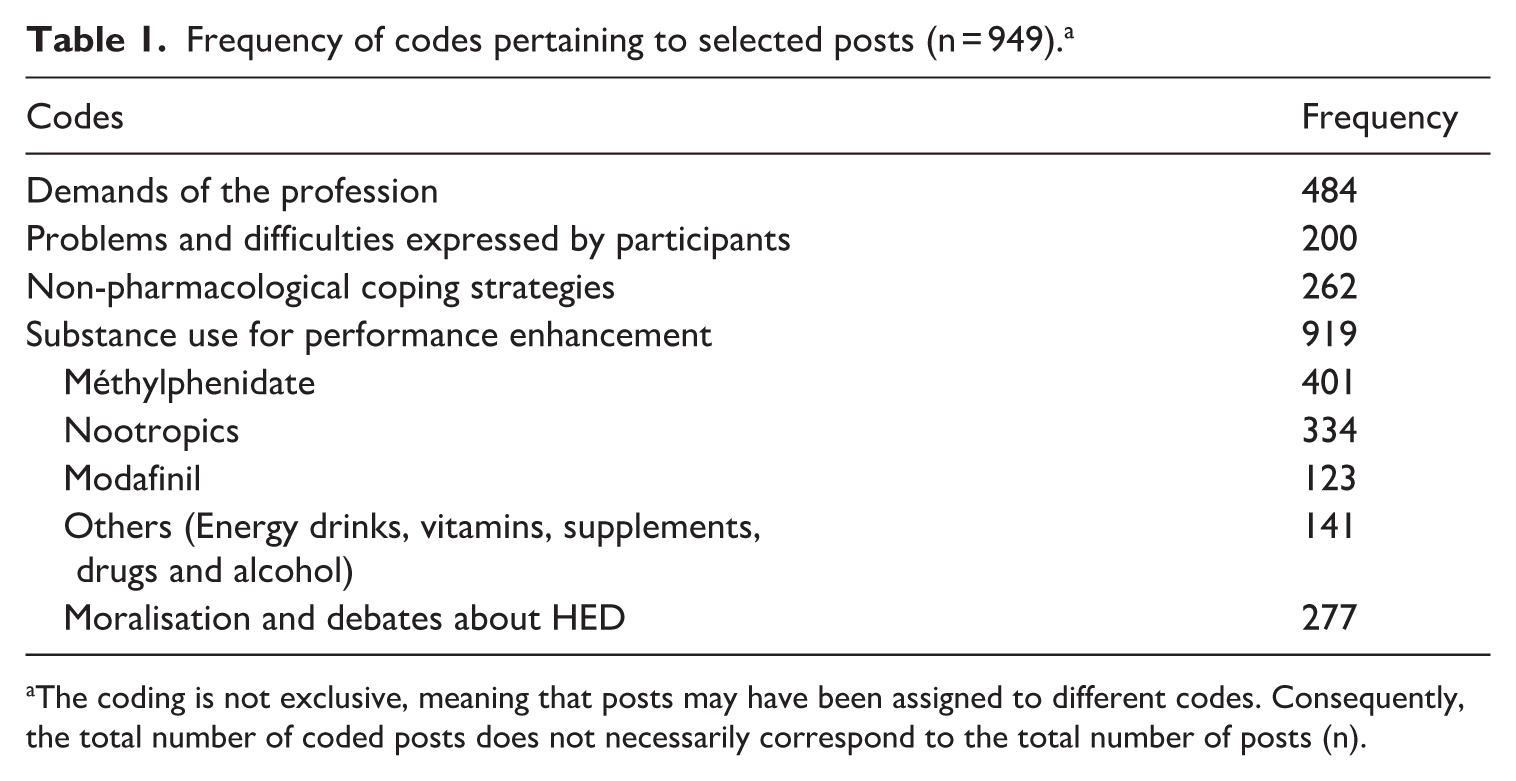
The coding is not exclusive, meaning that posts may have been assigned to different codes. Consequently, the total number of coded posts does not necessarily correspond to the total number of posts (n).
Ethical considerations and anonymisation strategy
The study was approved by the Research Ethics Committee of the corresponding author’s institution and deemed minimal-risk. However, although the forum is publicly accessible, users may not anticipate that their contributions could be identified, reproduced or traced across platforms. For this reason, and consistent with international guidance for internet-mediated research (British Psychological Association, 2021; Franzke et al., 2020), strict measures were applied to minimise reidentification risks.
All usernames were removed, and potentially identifying contextual details were omitted. Direct quotations were included only when they posed minimal risk; otherwise, posts were reworded or paraphrased using a multi-layered anonymisation strategy that combined lexical, structural, and semantic transformation while preserving the analytical meaning of the original contribution. 2 No interaction with forum members was undertaken, and all data collection respected the site’s terms of use.
Data analysis
To examine how HED use is embedded in occupational norms and experiences of performance, we conducted a reflexive thematic analysis (Braun et al., 2019). The initial phase involved detailed coding of the 949 posts identified as analytically relevant (see Table 1). Codes were organised into four overarching dimensions reflecting recurring patterns in the data: (1) Demands of the profession (skill expectations; organisational constraints; personal commitment and accomplishment; relationship to success and failure); (2) Problems and difficulties expressed by participants; (3) Non-pharmacological coping strategies (e.g. lifestyle changes, physical or psychological techniques for stress and productivity management); (4) Substance use for performance enhancement (main categories of substances, motives, expected effects, and debates surrounding HED use).
This structure enabled us to situate accounts of drug use within a broader ecology of workplace demands and self-management practices. Following an iterative process of comparison and interpretation, three higher-order themes—each capturing a patterned, shared meaning across the dataset (Braun et al., 2019)—were developed and organised along the main dimensions of the theoretical framework by combining evolving polarities and boundary shifts (Collin, 2016) and dynamics of work intensification (Bloomfield and Dale, 2015; Le Dévédec, 2020). The three themes are: (1) Between therapy and productivity: normalising extreme working conditions; (2) Becoming extreme workers; (3) (Re)Defining what constitutes a “real” or legitimate analyst.
Together, these themes provide a comprehensive understanding of how finance professionals narrate the pressures of their occupational environment and the place of enhancement practices within it.
Between therapy and productivity: Normalising extreme working conditions
The idealisation of the financial sector, regarded as the primary site of talent aggregation, positions the financial analyst as a role model in the professional landscape, demonstrating the capacity to confront and surmount any challenge. However, the participative style of management that characterise the industry, while insisting on autonomy and freedom to choose one’s own schedule and tasks, clashes with the reality of cultural norms of performance and self-sacrifice (Ho, 2009; Michel, 2014). The sector is indeed characterised by stringent working standards that exert considerable pressure on employees, pushing their physical and mental capacities to their limits.
As will be demonstrated in this section, a recurrent theme in the online forum under study is that analysts report feelings of inadequacy and inability in the face of their extreme working conditions. A common perception among them is that failure to meet the demands of their work is indicative of personal deficiency or pathology. This, in turn, contributes to the normalisation and acceptance of their extreme working conditions. Thus, the first polarity that HED has the potential to affect is by shifting the border between what is considered normal and pathological and the distinction between therapeutic interventions and productive activities. This mirrors the shift that characterises the process of medicalisation. The phenomenon can be conceptualised as a particular manifestation of social norming, a process whereby extreme working conditions are fostered and accepted.
The extreme long hour culture (all-nighters)
The financial industry is characterised by demanding working schedules that are perceived as abusive, particularly in the context of “sweat shops” and banks, which have a reputation for exploiting younger workers. Employees in the investment banking jobs in large financial institutions generally start as analysts for 2 or 3 years before getting their MBA and coming back as associates, and then being promoted to more prestigious positions like vice president, director and managing director.
As described by forum users, analysts and associates engage in market analysis with the objective of providing insights to senior employees, who in turn develop strategies for optimising client valuation. Their work consists mainly of carrying out asset value analyses and preparing internal or client presentation documents. In order to allow for the possibility of changes in the markets, it is necessary for them to be present from the moment the markets open in the morning until they close at night. However, the closing of the markets is often only the beginning of the analysts’ work, as they must integrate new information into their models, which may come from the market, their superiors or new customer needs. Therefore, it is not uncommon for them to stay at work until midnight.
Moreover, many forum users mention that there is constant uncertainty about the number of hours they will be required to work. Often, a request from a manager, a critical piece of information that was not anticipated, or a tight deadline related to a major deal or client presentation forces employees to stay in the office all night and work through the next day on no sleep. Long hours are often seen as incompatible with adequate performance. Many forum users complain about the loss of skills late into the evening and the low productivity of these late hours. Analysts refer to it as «all-nighters», a hallmark of the industry, according to the excerpts.
Much of the hours you spend in the office during the day might be wasted just surfing the net and proofing some associate work, it’s the urgent out of nowhere project that messes up your night. From sunset to sunrise, I plugged away in Excel doing work that could have been avoided if people had just thought ahead instead of changing their mind at the last minute. The sun was rising when I sent out the updated analysis. All I got in return for my hard work was, “Thx, I’ll look at this later today.” . . . I almost quit on the spot.
The work environment is also often described by forum users as particularly stressful, not only because of the uncertainty and deadlines, but also because of the psychological violence that is commonplace.
When you’ve been getting crushed for weeks and barely sleeping 4-hours a night, and can feel your eyelids dropping, all you can think about is going home and crawling into your warm, comfortable bed to sleep, but if you don’t get this work done tonight then your boss will scream at you. You’ll definitely get a crap performance rating. You might even get fired. My associate would scream and curse so loudly that we occasionally got complaints from the company on the floor below us (I wish I was joking). This associate called me every name in the book, regularly told me that I was a POS (piece of sh. . .), and trashed me (and every analyst) to the MD (managing director) on a regular basis.
The ability of financial analysts to perform at a high level is contingent upon their capacity to endure lengthy working hours and engage with tasks that are often tedious and repetitive.
The face-time implicit rule
Additionally, the performance to be delivered constitutes the presentation of a certain form of display. It is not solely a matter of being productive, but also of appearing to be so. Several forum users have submitted commentary regarding the pressure to which employees are subjected to be physically present at the workplace, and also to have their presence and activities observed by their colleagues and superiors.
One term used to describe this requirement is “face-time,” which refers to physical presence in the workplace and visible adherence to standards of availability and performance. This is particularly prevalent in “sweat shops.” The requirement is further intensified by the fact that a significant proportion of financial analysts’ salaries is attributable to bonuses, which depends very much on the subjective impression of superiors.
Thus, many forum users report that they must look completely unaffected after an all-nighter. Taking a nap is then seen as a dangerous admission of personal weakness rather than an effective contribution to company productivity. According to this culture, the employee must also demonstrate not only that work is being done, but that work is taking precedence over all other activities.
Therefore, the analyst must demonstrate to the employer that he is fully available and that he is giving the company as much time as possible. For example, it’s not seen as acceptable for an employee to leave work before the supervisor. This obligation forces employees to constantly show visible signs of their activity, even though this may be detrimental to productivity.
However cool your boss is, if you leave before him, he’ll question it. Regardless of your work product.
Furthermore, employees are expected to demonstrate a high degree of flexibility regarding their working hours. This implies that schedules are frequently not predetermined and known in advance. It is anticipated that employees will relinquish any scheduled activities (such as physical training or holidays with family members) to accommodate the demands of new tasks.
You work for them for 3 weeks straight typically till 3 or 4 in the morning and now it’s really starting to get down to the wire and they want to submit a bid the week after Christmas which means that you are likely not going to get a chance to get home [. . .] It’s just “Hey you’re going to need to step it up and get this done, if that means you live here, then you live here. . . make it work. I am joining a bank where there are no protected Saturdays, and the group is a well-known sweatshop. Kinda worried about it tbh (to be honest).
In this culture of ‘face-time’, the visibility of sacrifice and adherence to productivity standards are perceived as the primary means of gaining the respect of superiors. This is further reinforced by the prevalence of open-plan office layouts, which facilitate constant visibility and monitoring. Analysts must adhere to these expectations to ensure their survival and avoid downgrades and penalties, despite their actual performance: I can think of one analyst in particular who was really top tier in terms of ability and was actually fine with doing changes and small tasks, but just would not come in over the weekend if work was not requested Friday morning. He got the bottom bucket (meaning he did not receive a high bonus).
This extreme working environment gives rise to a variety of problems. According to forum participants, it leads to fatigue and long-term stress. Users report physical repercussions such as weight gain or loss, high blood pressure and low energy levels. They also report psychological consequences such as demoralisation, addiction problems, depression and burnout.
The inevitable lack of sleep, the unpredictability of deadlines and working hours, the need to always be available and the constant stress this generates are all factors that render success in this field only attainable for a select few. The study’s findings demonstrate that the predominant sentiment among forum users is one of inadequacy, stemming from their perception that they lack competence if they are unable to meet these requirements. This perception serves to normalise and promote acceptance of such extreme working conditions.
Becoming an extreme worker: The extensions of body limits through HED
The capacity to adapt is of paramount importance for achieving long-term survival in this industry, as stated by forum users. As we will see, the preferred methods of coping with such challenging working conditions are optimising and rationalising one’s lifestyle and resorting to drugs for non-medical purposes. Therefore, the second polarity that HED disrupts is by shifting the border between the natural and the artificial, as encapsulated by the concept of molecularisation.
The process of molecularisation of society has been mobilised by several authors to illustrate the impact of molecular biology on the portrayal of human life as a molecular entity that can be modified in accordance with medical and social aspirations of transcending the boundaries of the human body (Clarke et al., 2010; Rose, 2007).
The phenomenon of HED is indeed part of this trend, whereby the physical (natural) limits of the body (and brain) are extended by relying on chemical (artificial) supports. Confronted with such inhospitable working environments, individuals resort to the utilisation of HED to cope with the challenges they face. The employment of these practices, encompassing the adoption of extreme behaviour such as working without sleep and maintaining wakeful focus in the face of fatigue, becomes the prevailing norm. Therefore, the argument can be made that HED play a role in the process of employees becoming extreme workers (Bloomfield and Dale, 2015).
The body project
Some forum members believe that they will naturally develop the ability to work on little sleep, a view supported by the fact that analyst positions in investment banking are typically held for a maximum of 2 years. Most of them, however, believe that this can only be achieved by doubling the career project with a self-transformation project, a “body project.” From this perspective, adapting to the analyst’s lifestyle does not mean working better, but enduring more and longer.
I envy most people’s horsepower. I have a lot of energy and interest in my job, but I can’t ever say I have the stamina of an investment banker. They are at another level.
To reach this goal, forum members are discussing various solutions. These include productivity tools such as the use of the Pomodoro method, the elimination of distractions in the work environment, the management of stress through breaks and naps and more. They emphasise the importance of fitness and nutrition and share mental tips to motivate themselves.
The first (sleep) is beyond my control, but I can control what I eat, and exercise is generally in my control as well [. . .]. Living a somewhat healthy lifestyle in terms of diet/exercise will do wonders for you when the rest of your body is getting killed (stress/no sleep). This has helped me power through the stress and the generally crappy lifestyle. What morons we’ve all been — working 100+ hours a week, popping those mean nasty pills, pumping our bodies full of unnatural stimulants, when what we REALLY should do for maximum performance is to leave the office early to make sure we’re getting our 7-8 hours of beauty sleep.
However, the solutions proposed to facilitate adaptation—that is, work on oneself leading to a healthier body—are often made impossible by the very long hours to which employees are trying to adapt. So, to accomplish their self-transformation project, many forum members advocate the use of various substances.
I work out 5-6 days a week and I tell you that it does NOT give you the superhuman powers that Ritalin / Adderall does — it’s not even comparable no matter what research is presented. Sure, these things help an overall healthy balance of life, but they don’t replace the advantages that ‘pills’ provide for me.
The use of HED allows analysts to adapt to working conditions without which the optimal transformation of their bodies is insufficient, if not impossible. Many users stress the need to include them in individual “recipes” in order to adapt and succeed.
I found the only way to maintain a social life, have a girlfriend, get top marks, network and run a full-time business is to minimize sleep to 2-3 hours about 5 days a week, and 2 all-nighters. And the only real way to do this is “chemical aid.” Hey, if you’re reading this, it’s probably because you’re taking stimulants to stay awake and get your work done, right? When you’ve been working with Excel all day and your brain is fried, it seems like the only option that works.*
Stimulants are by far the most common type of substance cited as a solution to work-related problems (see Table 1). However, modafinil, a medication to control narcolepsy is also commonly used by forum members. As a non-amphetamine central nervous system stimulant, it is presented as useful for staying alert and productive for long periods of time, including during all-nighters.
Modafinil helped me grind through my sweatshop years in a boutique whose “culture” mandated so much facetime that we would need to spend a minimum of 80-90 hours/week.
Users like the fact that it has fewer side effects than other stimulants, especially the lack of a high.
It seems to have virtually none of the short-term side effects associated with caffeine and stimulants in general–including no crash, which makes all-nighters more productive and sustainable. There was plenty of coffee and modafinil as well, to get me up in the morning and keep me up throughout the day. I know lots of other bankers who use modafinil, both at work and after work.
Psychedelics and nootropics 3 are the other two main categories of substances discussed for their potential to improve work performance. Opinions on microdosing are fairly positive, with many people sharing their feel-good experiences and others expressing interest in the solution.
I took low doses of acid for two months. It was good. I waited three or four days to notice the effects of microdosing. I was more creative, I felt good, and boring things didn’t bother me anymore. I also understood people better. I take microdoses of psilocybin in the evening and then go for a long walk. I feel a pleasant physical effect and my mind is very clear, which allows me to work creatively on the big ideas and topics that are on my mind.*
With regard to nootropics, forum members cite a number of reasons for using them to enhance work performance. These include mood enhancement, stress reduction, improved social performance and cognitive enhancement. When their effects are discussed, the focus is on the action of the substances on the brain, for instance on the dopaminergic system, neurogenesis, neuroplasticity or the sympathetic system. Comments show that users tend to be very knowledgeable about the substances they use.
Ginkgo increases blood flow to the brain and in turn helps you stay alert–it also triggers the release of certain neurotransmitters in areas of the brain [. . .] You might want to try some supplements in the racetam class if you really want to improve your focus without buying illegal drugs.
However, it is widely believed by forum users that the effects of these substances vary greatly from one individual to the next. Nootropics are not presented as ready-made solutions. Understanding the overall effects on oneself is therefore a gradual process of trial-and-error discovery. Users stress the need to experiment to find the best combination of nootropics for an individual’s situation and view their use as an exciting experience of self-discovery and self-improvement.
My first and most important piece of advice would be to do extensive research on the nootropics you find interesting, particularly those that antagonize / protagonize chemicals in your brain [. . .] Additionally, don’t just stack up all at once - incorporate them individually and really reflect on whether or not you believe it has benefited you and, more importantly, adversely affected you. There are many products available: modafinil, kratom, GABA. . . You need to do your own research and try what works for you. These products are great for those who like to experiment and are interested in biohacking.*
In addition to curiosity and interest in self-experimentation, the exchange of information and discussion about the effects of different substances on the body and especially on the brain contribute to the normalisation of drug use among forum members.
Adaptation and depolitisation
The narratives concerning the utilisation of HED contribute to the notion that the worker’s body ultimately serves as the primary instrument for functioning with their working conditions. In fact, the social and historical justifications for such extreme working conditions are never questioned.
It’s too bad, because if you take away the hours, you get to do some pretty interesting work with talented people. But unfortunately late-nights are part of the deal with these jobs. And if you can’t survive late nights at the office, you’re going to burnout and either quit or get fired within a few years. Tough, but true.
These demands are perceived as “normal” by the majority of forum users and are regarded as an inherent aspect of the profession. The solutions proposed are always individual, and the few suggestions for negotiating working conditions are met with derision by other analysts. Through the use of HED, the body is thus pushed to its limits and subject to increasingly sophisticated forms of micro-management and technologies of the self, with the objective of enhancing productivity and enabling resistance to challenging conditions without any outward sign of discomfort or distress. This phenomenon of micro-management is in line with the neoliberal paradigm, which emphasises the concepts of self-discipline and self-entrepreneurship (Foucault, 2004; Rose, 1990).
In the context of the analyst’s work, the notion that the worker’s body is ultimately the primary instrument available for modifying their working conditions is of particular significance. The legitimisation and promotion of the imperative for individuals to adapt to their environment by acting on their bodies, rather than the other way around, is thus facilitated by using HED. This phenomenon can be likened to the depoliticisation process previously described by I. Zola, who asserted that : “[. . .] the labels health and illness are remarkable ‘depoliticizers’ of an issue. By locating the source and the treatment of problems in an individual, other levels of intervention are effectively closed” (Zola, 1972: 500).
Between deviance and conformity: Redefining what is a “true financial analyst”
The third polarity that is remodelled by the use of HED involves the redefinition of the boundaries between deviance and conformity, and between inclusion and exclusion. The process of biosocialisation has the potential to facilitate the formation of virtual communities through the sharing of experiences via social networks (Rabinow, 1996). These communities may, in turn, give rise to new social norms and patterns of substance use that may become commonplace. This suggests that there is an emerging shift in the prevailing standards or social expectations. In other words, the line between what is regarded as deviant behaviour, such as cheating or the misuse of medication for performance-enhancing purposes, and what is considered to be in accordance with social norms is moving.
Indeed, contemporary sociological approaches to substance use increasingly challenge binary distinctions between conformity and deviance by emphasising the situated, relational and moral dimensions of consumption (Dertadian, 2023; Otero and Collin, 2016). In his ethnography of opioid use, Dertadian (2019) develops the concept of a “fine line” that highlights the instability of moral boundaries that separate legitimate relief from stigmatised pleasure, showing how such boundaries are produced through institutional discourses, emotional experiences and socio-economic pressures. In parallel, Otero and Collin’s analysis of “insiders” develops the concept of socially acceptable deviance whereby users engage in practices that technically transgress formal norms (medical, legal, moral) yet remain socially legitimated because they adhere to tacit rules embedded within specific social worlds. These forms of regulated transgression depend on users’ ability to maintain respectability, perform social roles and align their practices with the expectations of their milieu.
Discussions among forum users indicate the emergence of a norm among financial analysts, whereby adherence to standards of hyper-productivity and performance is accompanied by an acceptance of the methods and strategies necessary to maintain these standards and expectations.
The moral debate
The trivialisation of HED as a tool, as well as the portrayal of it as both useful and even benign substances, constitutes a recurrent theme in the discourse of forum members. HED are frequently regarded as a mere instrument, comparable to coffee, which enables individuals to secure their position in the workplace.
However, there is evidence of a moral debate among forum participants. Among them, some express moral opposition or health concerns, or both: In the industry, everyone knows that many people frequently use ADHD medications, such as Adderall/Vyvanse, Ritalin, etc. (with or without a prescription) to stay awake for more than 12 hours. In the short term, this is certainly less harmful than using cocaine or 3-4 energy drinks a day (and also much more effective), but it assumes that you are taking these drugs regularly, as prescribed by a doctor. But for many people, working more than 80 hours a week means that life is anything but regular. This can lead to long-term drug abuse, leaving them empty and on the verge of burnout.* [. . .] you should really learn how to power through long and stressful hours without pills.[. . .] But if you don’t learn to do it while you’re younger, you’ll always fall back to popping provigil or whatever the new drug is. It just can’t be good for your body to take what is essentially a stimulant for the long term.
The moral opposition typically manifests as condemnation of the practice as “cheating,” with further comparisons being drawn with sports doping. Nevertheless, numerous alternative commentaries repudiate and condemn this ethical opposition.
Honestly, I think this is a dumb argument, if you followed most of the people’s reasoning who are against Aderall usage then coffee would also be banned. It articially allows you to study longer. Does that mean caffeine should be banned? What about red bull? Its a slippery slope. Aderall isn’t cheating because you still need to learn the material. Cheating, imo (in my opinion), is when you either know the answers before a test or bring information into a test that other people don’t have. Adderall is one of the most fair advantages you can get. Compare it to other advantages: some people are born smarter, to richer parents, more charismatic, etc. Those are unfair advantages, they’re random and you have no control over them. But Adderall? Everyone is given the same option with the same consequences, so I don’t see how that’s unfair.
Notwithstanding the moral debates provoked among analysts by the utilisation of HED, the definition of what constitutes a “true financial analyst,” a person belonging to this select profession, appears to emerge from the posts by forum users. In order to avoid being judged as unworthy of inclusion in the profession, analysts must demonstrate not only the capacity to tolerate extreme working conditions whilst consistently meeting elevated performance standards, but also the willingness to adapt, which can mean to employ all available means and tools to achieve their objectives.
Defining what is a true analyst
Forum members who oppose the use of substances to enhance performance demonstrate a high level of criticism towards those who use them. For opponents, resorting to HED is indicative of an absence of willpower, and demonstrates that users are ultimately ill-suited to the financial world.
You know there are people who have guts, who are intelligent, and who have the professional ethics needed to produce without needing to take pills, but you can’t handle it. I’ll tell you something: you’re weak. *
In doing so, they suggest that being a genuine analyst, belonging to this chosen profession, means having the capacity to meet the extreme expectations of productivity without chemical assistance. Using psychostimulants is associated with failing to adapt on their own to the specific working conditions of the setting.
However, some are defending the legitimacy of using HED on the basis of the same arguments as their opponents about the failing to adapt to working conditions. In their view, they are legitimate professionals, perfectly suited to their roles, as long as they make use of all the resources available to them in order to be successful. Since failure is associated with an inability to adapt to extreme environmental conditions, the use of HED represents a legitimate means of self-fulfilment: These are ambitious individuals that aren’t satisfied with being average–they want to be the best. They are willing to invest in themselves and do whatever it takes to succeed. Universities don’t tell you everything. What you learn doesn’t matter. What matters is getting good grades so you can find a good job. Does Goldman Sachs care about your knowledge of ethics? No. Cheating in school is preparing you for the real world. In this world, what matters are results.* [. . .] you’re viewing this as a ‘game’ and that Adderall gives the ‘players’ an unfair advantage (. . .) because they are using it outside the ‘rules’. But this isn’t a game, this is your life. Companies aren’t trying to award a ‘win’ to the ‘best players’, that’s not their goal. They want people who know what they’re talking about and can do the job–people that take Adderall fit the bill.
Consequently, the willingness to utilise any available resources to enhance one’s performance does not contradict this ideal; rather, it constitutes one of its fundamental principles and aligns with the definition of a genuine financial analyst.
Overall, HED use can be read as a form of adaptation that is deeply normative rather than marginal. Otero and Collin’s figure of the “insider” crystallises this: the enhancement user is not necessarily an “outsider” transgressing workplace norms, but may instead be a highly socialised, rule-oriented actor who uses HED to better inhabit competitive expectations—an instance of conformist deviance in which compliance and transgression are folded together (Otero and Collin, 2016). As also shown by Chatwin and Alexander (2025), drug use appears and tends to be constructed as “virtuous” when engaged in by “good neoliberal citizens” as part of the rational pursuit of personal happiness or, more specifically in the context of financial analysts, the pursuit of productivity and performance. Such analyses are particularly useful for interrogating how responsibility is redistributed—away from organisations and towards self-management—while still producing moral ambiguities around legitimacy, fairness and the boundaries of acceptable performance.
Taken together, these perspectives invite a shift from viewing deviance as an inherent property of substances or behaviours towards understanding it as a negotiated position shaped by moral economies, social contexts and the practical work of users. They offer a conceptual lens especially suited to analysing enhancement drug use in professional settings, where norms of performance, discretion and self-regulation are continuously negotiated.
Conclusion
This study demonstrates that pharmaceuticals, and HED in particular, are far from neutral: they play a key social and normative role in the acceptance of extreme working conditions. Beyond their material effects, these substances foster an adaptive relationship with oneself and the world, helping to legitimise and non-reflexively reconcile such conditions. Sociological analysis of HED use is therefore crucial, as work contexts are central to understanding how pharmaceuticals are employed to enhance and optimise performance. The finance sector offers a paradigmatic example: lengthy working hours are a fundamental aspect of the industry’s operational culture, with employees expected to remain fully available throughout their tenure (Ho, 2009). Regulatory challenges further characterise this sector, with non-compliance to established norms shaping its operational landscape (McGillivary and Fung, 2013). Faced with these extreme demands, more conservative solutions—such as relaxation exercises or lifestyle adjustments—are often deemed insufficient. Users report the need to resort to substances that allow them to push back their physical and cognitive limits in order to cope. The neoliberal environment and societal norms are key factors in both the use of these substances and their normalisation and trivialisation.
Through the lens of pharmaceuticalisation, this study has shown how HED use in finance reconfigures three forms of polarity. HED function as dispositifs that reshape the boundaries between the normal and the pathological (medicalisation), the artificial and the natural (molecularisation), and deviance and conformity to social norms (biosocialisation). Extreme workplace conditions are perceived as natural and unquestionable, rendering analysts’ capacities and bodies deficient, while simultaneously prompting bodily adaptation and self-management. HED contribute to the normalisation of extreme working conditions and foster the emergence of “extreme workers”—individuals who chemically extend their limits to conform to a performance-centred environment. By blurring the boundaries of deviance and conformity, and between inclusion and exclusion, they also provoke debates over what constitutes a “true financial analyst.” These dynamics indicate that HED use should not be seen as individual deviance, but as a reflection of a societal model that demands further scrutiny, particularly as such practices become normalised and legitimised (Dertadian, 2023; Otero and Collin, 2016).
Ultimately, HED use can be understood as a key vector in the decline of collective social perspectives in the workplace, occurring alongside the weakening of trade unions and the erosion of social frameworks for labour conditions. The social and historical justifications for extreme working conditions in finance remain largely unquestioned. This trend reflects broader developments in contemporary societies, where individualism places the burden of improvement solely on the individual. It is thus unsurprising that the increasing availability of pharmaceuticals positions them as a favoured solution—not only for marginalised or “deviant” subcultures, but for ordinary individuals seeking to meet the demands of their work or achieve personal goals (Bloomfield and Dale, 2015).
Footnotes
Acknowledgements
The authors would like to thank Anouck Freliger for providing valuable comments and discussions on previous versions of this article.

Ethical considerations
The authors declare that they have obtained ethics approval from the Clinical Research Ethics Committee (CERC) of the University of Montreal (Reference: Certificate #CERC-21-013-D).
Funding
The authors disclosed receipt of the following financial support for the research, authorship, and/or publication of this article: This study was funded by the Social Sciences and Humanities Research Council (SSHRC), Canada. Grant number: 435-2020-0854.
Declaration of conflicting interests
The authors declared no potential conflicts of interest with respect to the research, authorship, and/or publication of this article.