




Abstract
This article analyses the meaning and conditions of penal moderation, conceptualizing it as a spectrum between non-punitiveness and a public penal philosophy. It explores two examples of Italian penal policy—the decarceration provisions of 2010–2015, and the Stati Generali sull’Esecuzione Penale and 2017 Orlando Law—elaborating upon them to enrich the theoretical debate on penal parsimony and its relationship to democratic politics. The article explores the implications of ‘democratic disfigurements’ for penal moderation, explaining how they can stimulate short-term forms of non-punitiveness but militate against moderation as a public philosophy. It also discusses whether the ascendancy of these ‘democratic disfigurements’ signals an impoverishment of contemporary western politics that casts doubt on the possibility of a ‘better politics of crime’ in the absence of ‘better politics’.
Keywords
Introduction
By exploring the meanings and conditions of ‘penal moderation’ I ask what a ‘better politics of punishment’ (Loader and Sparks, 2010) looks like and how likely it is given the current impoverished state of western politics. Drawing from my work on punishment and politics, and on Italian penality, I offer a working conceptualization of penal moderation that builds on debates initiated in Theoretical Criminology (Bosworth, 2010) spurred by the reversal in punitive trends experienced by some western nations in the early aftermath of the global financial crisis. I define penal moderation as a spectrum, with non-punitiveness at one end and a public penal philosophy at the other. This definition extends to jurisprudence and citizens’ understanding and practices but, in this article, I focus on criminal justice legislation. I offer an account of moderation in Italian penal policy between 2010 and 2018, identifying two key examples of moderation: the decarceration provisions of 2010–2015, and the Stati Generali sull’Esecuzione Penale, which represent non-punitiveness and public penal philosophy, respectively. I use these examples to ask about the conditions of penal moderation: not just ‘what is penal moderation?’ but also ‘how can we sustain it?’. Answering from the perspective of punishment and politics scholarship, I offer an evaluation of penal moderation in times of ‘crisis’, expanding upon analyses that have linked punishment and political ideologies, particularly ‘thin’ political ideologies (Loader and Sparks, 2017) or ‘democratic disfigurements’ (Urbinati, 2014).
My approach integrates political sociology of punishment and political philosophy, in an interdisciplinary move that follows Loader's ‘morphological’ approach (2020: 1183), investigating ideologies’ claims on state–citizen relations, and how they play out in the penal realm. I conduct this investigation first in the abstract, and then for Italy with its social and cultural specificities, and local articulations of contemporary ideologies and punishment. My argument is that thin ideologies can at best serve the interest of penal moderation as non-punitiveness but cannot guarantee its long-term survival. Given their internal logic, the ideologies militate against moderation as a public penal philosophy, in its substance and in its form as public philosophy. To the extent that democratic disfigurements are taking hold across western polities, the political scenario does not bode well for penal reform.
The article is organized as follows: the first section explains the need to re-engage with definitions of penal moderation. It presents my working conceptualization of penal moderation and addresses comparative difficulties in articulating the concept. Having explained the time frame of my investigation, and characterized contemporary Italian penality, the second section discusses forms of penal moderation in Italy between 2010 and 2018. The section investigates the proximate links between Italian politics and penal policymaking, a discussion that feeds the theoretical analysis of the last two sections, on the connection between democratic disfigurements and penal moderation. The article concludes by discussing the possibility of penal moderation, and a better politics of punishment, in the absence of a better politics.
Penal moderation: Aims, definitions, definitional difficulties
Like many punishment and society scholars, I have sought to understand the conditions for the rise of, and resistance to, punitiveness in Western European democracies. Punitiveness, put simply, refers to an excess use of state coercion (Loader, 2010: 357) primarily, though not exclusively, expressed through increased reliance on incarceration. It is a problematic state of affairs insofar as, in its ‘excess’, it represents an abuse of the state's ultimate power (to ‘encase’ the detainee; Barker, 2009) particularly where punitiveness has been linked to the demise of state sovereignty (Garland, 2001), the dissolution of our ‘dialogic communities’ (Ramsay, 2014) and the needs of contemporary western capitalism (De Giorgi, 2006; Wacquant, 2009). Though punitiveness can take multiple forms (Carvalho et al., 2020), my focus is state punishment: specifically, the state's willingness to use, forgo or reverse, its power to imprison—a tangible manifestation of its coercive capacity. Concerns about ‘punitiveness’ are magnified given punishment's unequal distribution: as border criminology 1 has clearly demonstrated, in continental Europe non-EU and accession-state migrants are ‘preferred’ recipients of harsh state sanctions, even in nations that have resisted the pull of punishment (Barker, 2012; Lacey, 2008). Punitiveness, then, is worth investigating (and resisting) because of its high human cost, and because it is an indicator of a broader democratic malaise.
Note how I framed my inquiry: we study punitiveness and resistance to punitiveness, or, in Loader's (2008: 408) words, ‘refusals, resistances, and indifferences’. I use this framing deliberately because it showcases one of the intellectual limitations of punishment and society scholarship: in its concern with punitiveness, it has been less than systematic in its attempts to define and investigate punitiveness’ counterpart (Loader, 2010: 358). 2 If your concern is punitiveness and its human cost, then non-punitiveness is not a bad thing: it is, prima facie, better than the opposite.
However, non-punitiveness as the absence of punitiveness can be problematic if your hope is a long-term reduction of state punishment, and a parsimonious use of state coercion, with democratic rooting. Here, we are talking of something more than non-punitiveness, we are talking of penal moderation. The follow-up question is, of course, ‘what is penal moderation?’. I offer a working conceptualization of penal moderation, developed in my theoretical work on the political sociology of punishment in Western Europe and a comparative analysis of contemporary Italian penality. Insights from Italy can nuance our understanding of what we see, and might want to see, as alternatives to ‘punitiveness’. My analysis thus contributes to the pursuit of a ‘better politics of punishment’ (Loader and Sparks, 2010), asking what penal moderation is, but also how we can get it, and how we can keep it.
Penal moderation is best understood as a spectrum. On one end, we place non-punitiveness: in a simplistic articulation, if a policy is not punitive, it is moderate. This side of the spectrum privileges outcomes, such as decreasing incarceration rates; moderation so conceived is a defensive concept. On the other end, we place moderation as a ‘public philosophy of punishment’. Here good outcomes are not sufficient, we also want good intentions: this form of moderation is an aspirational concept. This is where I place Loader's (2010: 351) definition of penal moderation, characterized by ‘restraint, parsimony, and dignity’ in punishment. Loader (2010: 351) also stresses that moderation is a public philosophy: a story about why and whom, and how and how much, ‘we’ punish that connects with, and re-articulates, sentiments that have some purchase within […] society. [It] seeks to foster debate about the choices ‘we’ make in response to crime.
The expression ‘penal moderation’ does not necessarily travel across contexts. Loader (2010: 358; Melossi, 2001) is clear about the cultural ‘embeddedness’ of his concept in England and Wales (Loader, 2010: 351–352). A direct Italian translation of penal moderation (‘moderazione penale’) does not fully work as it has no obvious meaning in debates on Italian punishment. However, I work with a theoretical framework constructed from scholarship that, where it discusses Europe, has de facto treated England and Wales as the ‘centre’ of our debate, and all other contexts as the ‘periphery’ or as ‘deviations’ from the European Anglosphere (glossing over the internal diversity of both ‘centre’ and ‘periphery’; Sozzo, 2023: 663). To speak to and within this field (even critically), some careful linguistic licence is necessary, not least to avoid reifying the ‘periphery’ by insisting only on bespoke concepts, which limit the capacity of different contexts to learn from each other (Sozzo, 2023: 661) and allow the native anglophone scholar to unthinkingly assume their own centrality. This exercise ‘de-centres’ our intellectual frameworks (Dal Santo and Sozzo, 2023), inductively feeding our theoretical concepts (Brangan, 2020: 606; Sozzo, 2023: 670) from a wider variety of cases than just the ‘core’ ones. Potentially it is also of value to ‘central’ polities, whose capacity to identify their existing forms of penal moderation (Loader, 2008: 406) may have been lost to lamentations of their dystopian penality. This myopia may now require ‘central’ polities, like England and Wales, to consider themselves in the mirror that ‘peripheral’ polities, like Italy, hold up to their penality.
That said, I believe the substantive core of the term ‘penal moderation’ is applicable beyond England and Wales and is intelligible in relation to Italian punishment. Questions of parsimony, dignity and restraint in the use of state coercion—‘a minimum necessary penal system’ (Loader, 2010: 354) with a possible Italian counterpart in Baratta’s (1986) ‘minimal criminal law’ 3 —do travel. What also travels, is the idea that penal policy can be coherent, and can be the outcome of considered collective debate. Likewise, the more defensive notion of non-punitiveness makes sense in a context like the Italian one where clemency provisions and decarceration have often been used to reduce carceral hyperinflation. The next section illustrates two forms of penal moderation by looking at examples from Italy between 2010 and 2018: one instance of moderation as non-punitiveness and one of moderation as penal public philosophy. Simultaneously, the section inductively ‘feeds’ my broader theoretical definition of penal moderation.
Seeking penal moderation in Italy: Pragmatism and principles
The scope of the investigation: Time and actors
My focus is on the period 2010–2018, roughly from the Eurozone crisis to the 2018 Italian general election, one characterized by a flurry of penal policymaking, both punitive and moderate. The forms of moderation witnessed during this time have received little attention (as an exception see Colombo et al., 2014), particularly in their aspirational form, despite the fact that they were explicitly designed to initiate an overhaul of Italian penal execution. These years are also marked by the ascendancy of political forces characterized, totally or partially, by one or more of Urbinati's (2014) ‘democratic disfigurements’—populism, episteme and plebiscitarianism—the penal implications of which are a subject of this article. Moreover, the period saw changes in Italian institutions and political practices that disrupted the ‘volatile political equilibrium’, which had heretofore characterized Italian politics (Gallo, 2019: 156). The era is therefore suited to an investigation of penal moderation, its articulations and its relationship to political (ideational, institutional) change. My analysis stops just after the general election of 2018 and does not directly consider the political coalitions in power since that date.
The background: Italian dual penality
For context, I summarize contemporary Italian penality from 1970 to 2019 as a dual penality, meaning that Italy is both punitive and moderate (Gallo, 2015). The co-existence and alternation of punitiveness and moderation is visible if we look at our usual proxy, imprisonment rates, which have experienced a background increase in Italy since 1970, particularly marked in the 1990s and then again in the late 2000s (Figure 1). 4 Overall, Italian prison rates are ‘middling’ within continental Europe (Mosconi, 2014: 69; Pavarini, 2014: 49, 73). However, they present numerous recurring ‘dips’, determined by amnesties and pardons and, once clemency provisions fell out of political favour in the 1990s, by other forms of decarceration (see below). Therefore, if it is true that there has been an increasing reliance on imprisonment in Italy since 1970, there has also been intermittent political will to reverse imprisonment through various deflationary measures.
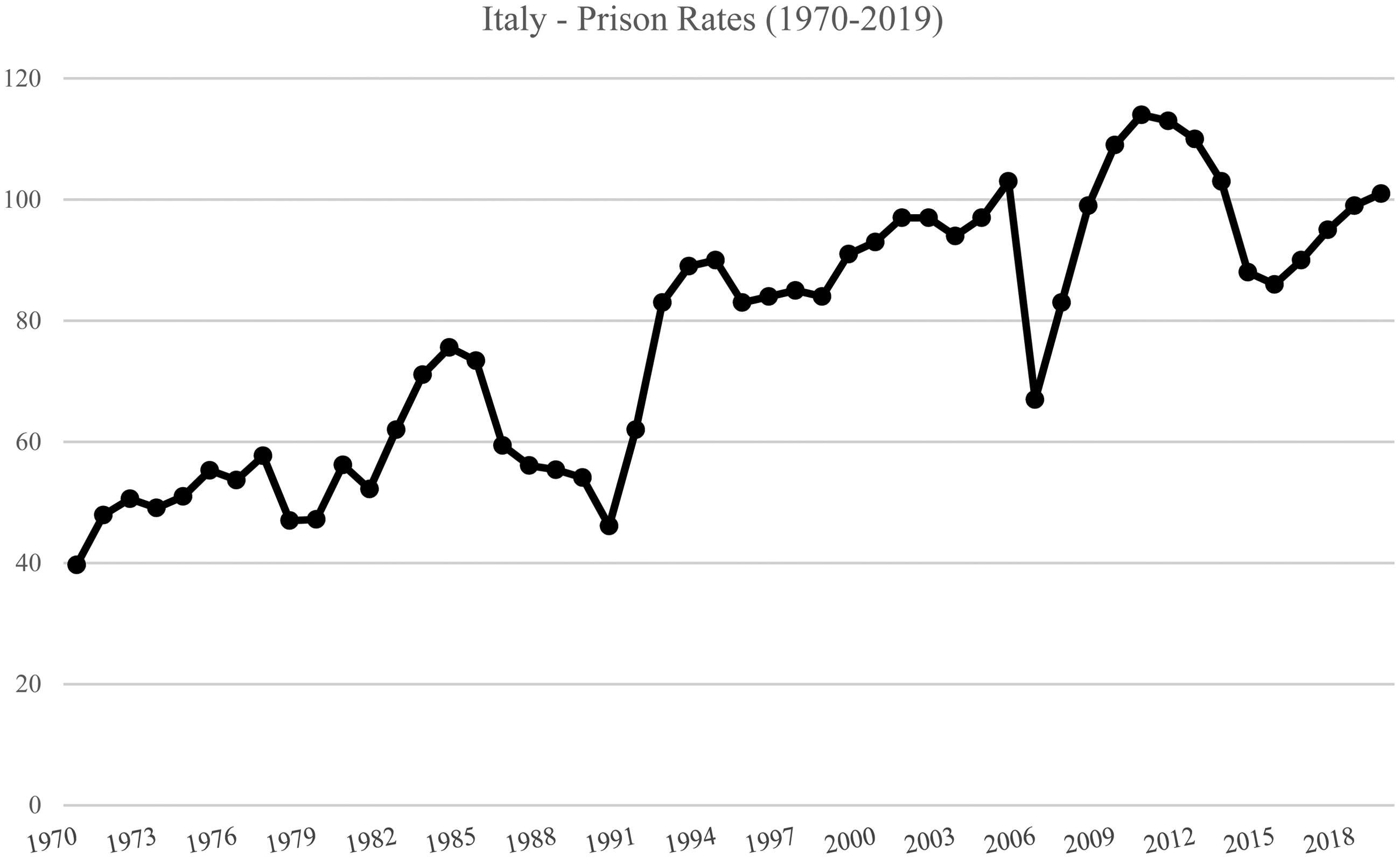
Italian prison rates 1970–2019 (per 100,000). Source: Author's calculations on ISTAT and DAP data.
Italy's penal dualism tracks the nation's history and is aptly represented by the tension between Constitutional penal principles, the Prison Reforms intended to give them effect (1986; 1975), and the emergency provisions designed to respond to internal political terrorism and organized crime. According to article 27(3) of the Italian Constitution, punishment must ‘tend to the re-education of the offender’. The 1986 Prison Reform Act—the Gozzini Law (l. 663/1986)—was ideally designed to give effect to article 27(3). It aimed to do so through the principle of the individualization of punishment, tailored to the individual detainees’ needs and profile to truly re-educate them. The reality in Italy is more mottled (Ruggiero, 1998): a story of rehabilitative aspirations with mixed outcomes. This is where emergency provisions play a part. Laws passed to strengthen the state's hand against the violent challenges it faced from internal political terrorism (1970s and 1980s) and organized crime (1980s and 1990s) allowed for the suspension of (intramural) re-educative treatment for offenders belonging to terrorist/mafia organizations, precluding their access to non-custodial alternatives, which become a bargaining chip held by the state to obtain co-operation from offenders who had manifested loyalties to alternative political authorities, and lack of allegiance to the Republic and its laws (Pavarini, 2014).
This approach in effect makes re-education ‘conditional’, a practice that persisted even as Italy's emergencies subsided (La Greca, 2005). The Berlusconi governments of 2001 to 2009, 5 for example, implemented policies designed to exclude entire categories of offenders from more favourable penal treatment. Pre-trial remand was mandated for repeat offenders 6 and for defendants tried for a defined range of offences, rather than being a discretionary judicial choice. Here the Berlusconi governments generalized, to ‘ordinary offences’, treatment that was originally designed to address the risk posed by suspected terrorists or organized criminals, with their criminological specificity (Corda, 2016: 142). The list of offences to which this unfavourable treatment was extended during Berlusconi's era was indeed serious, including murder, serious sexual offences and drug trafficking (2009). However, none of these offences displayed the features that justified a presumption of adequacy of custody and that were specific to ‘associative’ crimes: political bonds or bonds of belief that manifested alternative normative allegiances, or rootedness to a particular, supportive local context (stz 331/2011, 2011: 3).
The aftermath of Berlusconi's tenure prompted despairing accounts of Italian convergence to full-blown US-style punitiveness (Corda, 2016). Incarceration and overcrowding rates give some credence to this despair: imprisonment went from a rate of 93 per 100,000 in 2000 to 112 in 2010—Italy's highest incarceration rate since 1970 7 —and from 2000 onwards occupancy rates in prison exceeded 120 detainees per 100 available places, peaking in 2010 with 151 detainees per 100 available places (ISTAT, 2015). Yet the Italian story remains more ambiguous than simple convergence towards punitiveness. We see, for example, instances of resistance in the Italian Constitutional Court, undoing some of the Berlusconi-era policies, including the absolute presumption of pre-trial remand in custody for serious offences. We also see exogenous pressures exerted onto Italy, prompting half a decade (2010–2015) of decarceration. Overall, the nation still displays penal dualism, though its penality has recently been marked by greater volatility and a shrinking time-lag between the ascendancy of punitive and of moderate intentions. This partly reflects the rapid succession of Italian political executives between 2010 and 2019, 8 and partly reflects political practices such as confidence votes, becoming more prominent in recent years. Within Italian dual penality what forms of moderation can we find and where are they situated on my spectrum?
Decarceration: Pragmatism, principles, and purse
Beginning in 2010, a series of measures were introduced—by both centre-left and centre-right governments—designed to achieve decarceration and fast. This included two so-called ‘svuotacarceri’ or prison ‘clear-outs’ (Colombo et al., 2014). These laws (2010a, 2014b) ‘boosted systems of early release and administration of […] sentences outside prison’ (Corda, 2016: 121; Gallo, 2019: 160), for example by mandating house arrest for short sentences, 9 and enhancing the use of electronic tagging rather than remand in custody. Attempts were also made to ‘[curb] over-reliance on pre-trial detention’ (Corda, 2016: 121): in 2014 the government 10 modified the Italian penal procedural code, so that judges could not remand a defendant to prison if they evaluated the latter would be awarded a suspended sentence or would receive a prison sentence not exceeding three years (l. 117/2014, 2014a).
The combined effect of these provisions was a visible drop in incarceration and overcrowding levels, with a steady decline in Italian prison rates: from a high of 112 in 2010, to 110 in 2012, to 88 in 2014 (World Prison Brief (WPB) falling further to 86 in 2015 (Torrente, 2016). The rate of pre-trial/remand prisoners fell from 49 in 2010 to 29 in 2015; from 44% to 34% of the total prison population (WPB). The overcrowding rate also decreased from its peak of 151% in 2010 to 105% in 2015 (Scandurra, 2017: 3). Moreover, the decrease in imprisonment affected both nationals and foreigners, by contrast to the decades-old trend whereby the Italian prison population ‘has been made up of fewer and fewer Italians and more foreign nationals’ (Colombo et al., 2014: 189), with high levels of migrant over-representation in Italian prisons (Melossi, 2015).
The causes of such policies are various exogenous pressures, and the impetus for decarceration was determined by Italy's international obligations, though its articulation was inevitably ‘local’. Before 2013 the pressures can be linked to the Eurozone crisis, with fiscal austerity stimulating a pragmatic form of moderation (Gallo, 2019: 159), akin to Loader's (2010: 354) parsimony ‘with a Treasury mindset’, driven by the expensive nature of incarceration at a time of budgetary constraints. The interaction between principles and purse is more obvious still in relation to decarceration provisions initiated after 2013 when, in Torreggiani v Italy (2013), the European Court of Human Rights (ECtHR) condemned Italy for its levels of overcrowding, judged to violate detainees’ Article 3 rights against torture and inhuman or degrading treatment. This was not the first time that the ECtHR had chastised Italian prison over-crowding; it was the first time that it threatened damages if Italy failed to make good on its obligations. This threat provided the Italian legislature with the impetus to keep going with decarceration. Here we find parallels with Aviram's (2015) notion of ‘humonetarianism’, where ‘humanitarian’ concerns, based in human rights obligations, mask monetary concerns, based in the cost of imprisonment at times of resource scarcity.
This period is one of penal moderation, manifested as a reduced reliance on imprisonment, and situated closer to the ‘defensive’ end of my spectrum. Here we have the importance of outcomes: a reduction in the prison population. However, as Slade et al. (2023: 5) point out, outcomes alone may be deceptive. In Italy, it is not just outcomes that make this period one of moderation: this is willed moderation with a match between aims and effects of the provisions, namely reducing incarceration rates and overcrowding within a short lapse of time—be it for economic reasons, for reasons of international reputation, for constitutional limitations or all of the above. Yet we are still some distance from Loader's ‘public penal philosophy’. The penal moderation embodied in the 2010–2015 decarceration provisions is qualified. For one, it was temporary in both inception and outcomes. These were ‘emergency’ measures, passed using legal decrees (art. 77 Costituzione) some of which cited ‘the extraordinary necessity’ of passing measures that complied with the Torreggiani judgment (l. 117/2014, preamble, my translation). Within certain of the provisions (l. 99/2010, article 1), we also find an admission that the measures were meant to be stopgaps, awaiting structural reforms that would offer longer-term solutions to the recurring problems of Italian penality. Their effect was also temporary: imprisonment rates crept upwards to 90 in 2016 and 99 in 2018 (WPB), with a knock-on effect on overcrowding, back up to 119% in 2018 (Antigone, 2018). In practical terms this was the result of time-limits, placed on decarceration provisions, which were allowed to elapse and were not renewed once ECtHR pressure slackened.
This does not mean that the decarceration provision represents a failure of moderation: the measures were designed to be temporary and were meant to tide Italy over while structural reforms were put in place. More damning is that such structural reforms, while attempted, did not materialize. The moderation of the 2010–2015 decarceration provisions is best understood as pragmatic: a short-term, practical and immediate solution to a pressing problem. Italy is no stranger to this type of moderation: amnesties and pardons are instances of pragmatic penal problem-solving, offering safety valves in a system beset by a historical over-reliance on criminal law (Maiello, 1997: 940). Pragmatism also relates to the monetary concerns that jump-started the decarceration provisions. However, it is reductive to interpret them as cynical, or solely motivated by ‘purse’: opting for short-term decarceration is a long-standing feature of Italian penal history, revived but not birthed by external fiscal and legal constraints. We should also not assume that pragmatism equates to bad faith. It may, in fact, be the expression of a desire to restrain the use of the state's coercive power, relying on safety-valves at system-breaking-points, in a context where the only option is a piecemeal approach. This is a broader feature of Italian politics, where fragmentation, institutional permeability and a reluctant and chaotic interdependence between actors produce a volatile equilibrium that relies on short-term solutions to systemic blockages (Gallo, 2019: 156). In relation to decarceration, monetary concerns facilitated, rather than simply side-lined, principled concerns for a more restrained use of state coercion.
Principle is also invoked in the uses of, and public explanations for, decarceration with reference to the European Convention on Human Rights (ECHR) (article 3) and article 27(3) of the Italian Constitution, and an emphasis on the dignity of the offender. Torrente (2016: 5, my translation) identifies the Torreggiani judgment, and the political will to decarceration demonstrated in this half-decade, as having created a ‘change in rhetoric’ around incarceration, emphasizing ‘the need to restore the [Italian prison system] to legality’. According to Torrente (2016: 9, my translation), this had the result of affecting the actions of those involved in administering penality on the ground—‘police, tribunals, prison administration’—where discretionary decision making started to be informed by a logic of decarceration.
In this form of moderation, pragmatism and principle mingle, though pragmatism has the upper hand: outcomes matter, but intentions are not irrelevant. If we are concerned with the human costs of incarceration, and advocate its measured and much restrained use, this form of moderation is no bad thing. But it falls closer to non-punitiveness than to a penal public philosophy, and this makes it less desirable than moderation as a public philosophy, primarily because of its origin in, and susceptibility to, political contingency. The decarceration provisions of 2010–2015 responded to a political need, one that encompassed fiscal necessity and, after Torreggiani, the need to show that Italy was acting to reform its prison system and rescue its international reputation. This type of decarceration, by short-term expedient measures, tends to be short-lived (Gallo, 2019: 159; Torrente, 2016: 10). Italian incarceration rates strongly suggest that this is precisely what happened, and that the decarceration provisions were ultimately unable to interrupt Italy's penal oscillations. Moderation as public penal philosophy should, by contrast, be able to withstand the ebb and flow of politics: if it is a collective reflection, with democratic legitimacy, it may survive partisan politics, without needing to isolate questions of punishment from public influence (Lacey, 2008: 192; Loader, 2006: 582, 2010: 361). This is an empirical and context-specific question, and it may be that ultimately an investigation in this direction will throw us back onto Reiner's (2009) lament for the demise of social democracy and social democratic criminology. However, I argue that there is still a case to be made for the greater resilience of moderation as a public philosophy (aspirational end of the spectrum), rooted in collective deliberation, rather than moderation as pragmatic non-punitiveness (defensive end of the spectrum), born of urgency.
There is another—interlinked—reason why this type of penal moderation is less desirable: defensive moderation can militate against a more articulate form of penal moderation. In a more benign sense, if it is practised too often it may disincentivize complex forms of rehabilitation, which are more expensive, harder to implement and whose outcomes are harder to measure. Scandurra (2014: 15) has indeed warned of a qualitative deterioration of non-custodial punishment, with a shift away from re-education towards simple population reduction.
In a less benign sense, if decarceration is practised too often, becoming a recurring emergency, then it can also be misconstrued by the public as leniency. This is not just about the deteriorating quality of rehabilitation. Leniency—rather than parsimony or restraint—suggests that due punishment is not being delivered, because of a discretionary, even arbitrary, sovereign decision. Repeat uses of emergency provisions and rhetoric heighten the sense of arbitrariness. The result could be Loader's (2010: 354) ‘red-rag-to-a-bull’: a reason to discredit arguments in favour of a restrained use of punishment, particularly incarceration, and plump for law-and-order fervour. We see instances of this dynamic in Italian parliamentary debates where representatives of the League—right-wing, xenophobic and nationalist—argued against prison reform on the grounds that it meant ‘open prisons, more hidden clemency, more “prison clear-outs”’, which the League promised to reverse by locking up serious offenders and ‘throwing away thes key’. 11
The Stati Generali sull’Esecuzione Penale and the Orlando Law: Public philosophy in the (not quite) making
Attempts at a more considered approach are nevertheless visible in recent Italian penality. In 2015, Justice Minister Andrea Orlando, a member of the centre-left Democratic Party, initiated the Stati Generali per l’Esecuzione Penale. The initiative brought together stakeholders from a variety of sectors interested in prison reform, including prison administration professionals, academics and activists, to reflect on executing punishment in a manner that avoided an excess use of prison, and respected offenders’ dignity. The Stati Generali fed into a proposed bill authored by Orlando that came before the Italian Parliament in 2017 as the Orlando Law (2015).
According to Orlando, the Stati Generali were intended to lead to a ‘redefinition of punishment and a better carceral physiognomy, more dignified for those who work within prison and for detainees’, as per article 27(3) of the Italian Constitution. In an ambitious, holistic vision, they were designed to involve ‘the whole of Italian society’ in a debate on punishment and its implications ‘for collective security and for the possibility of social reintegration of those who have erred’ (Orlando, 2015, my translation). This debate was essential if a reflexive approach to state punishment was to remain more than an elite aspiration and become socially accepted and democratically legitimate. The project was supposed to involve public opinion through online consultation on the materials published by the Stati Generali, ideally magnified by media coverage of the initiative (Ruotolo, 2017).
In its design, this political initiative has the trappings of a public penal philosophy in the making, one that emphasizes parsimony, restraint and dignity. Though still partially pragmatic, because prompted by the Torreggiani judgment, the initiative is also a self-reflexive effort to move beyond emergency management, to a principled, constitutionally inspired reform of punishment.
The policy report summarizing the Stati Generali's reflections (Giostra et al., 2017) offers a fascinating and detailed vision of one future. It raises questions about the initiative's significance and legacy for Italian penality, the nature of moderation and the relationship between penal intentions and penal outcomes. Giostra et al. (2017: 7, my translation) note how genuine prison reform requires Italy's ‘social culture of punishment’ to change. Absent this change, reforms will not take root or will be distorted by short-term imperatives. What needs to be broken is the logical fallacy that takes elites and public alike from fear directly to imprisonment: crime is identified as the source of social fears, imprisonment is identified as the solution to crime, and incarceration rates balloon. Decarceration provisions can interrupt but not reverse this fallacious logic.
What, then, did the Stati Generali propose? Their emphasis, articulated across several axes, was on an increased use of non-custodial alternatives: for example, the suggestion that all custodial alternatives be made available to offenders who receive a custodial sentence of four years or fewer. The Stati further suggested reducing the cases for which non-custodial penalties are automatically barred (Giostra et al, 2017: 71–72), for example where offenders are detained for organized crime offences, terrorism and subversive association (art 4-bis o.p.; art 58-ter o.p.). Typically, non-custodial alternatives are restored where offenders collaborate with the state against their co-affiliates, thus demonstrating renewed allegiance to the Italian Republic (Gallo, 2015: 607). By contrast, under the proposed schema, alternatives were to be allowed even if the offender refused to collaborate. If the offender could show they had no persisting ties with organized crime, terrorist associations or subversive associations, then their refusal would be considered a relative rather than absolute presumption of dangerousness, thus open to rebuttal (Giostra et al., 2017: 72).
The latter suggestions are interesting because they aim to tackle long-standing sources of Italy's punitive potential (Gallo, 2015: 605), namely the conditioning effect that emergency provisions have had on Italian penality (their ‘policy effect’; Garland, 2017: 23). They are also interesting because they manifest an effort to re-conceptualize custodial alternatives, seen as valuable for their independent re-educative potential and their capacity to incentivize ‘restoration of social co-existence […]’, ‘[repair] conflict and [rebuild] the relational harmony damaged by offending’ (Giostra et al., 2017: 65). This means more custodial alternatives, but also better custodial alternatives, to obviate reliance on simple decarceration, and return the offender to ‘place’ (‘territorio’): the geographical, political and social location to which the offender belonged when they offended, and still belong to despite offending. In the Stati's holistic vision ‘place’ implies location and infrastructure, but also those resources (social connections, work, education) that allow offenders to ‘rebuild belonging’ (Giostra et al., 2017: 65, my translation).
The suggestions advanced by the Stati Generali were designed to inform the government's reform of the Italian prison system. The 2017 Orlando Law delegated reform to the government, after which ministerial commissions were set up to formulate the legislative decrees for reform. The final version of the decrees (A.G. 17, 2018a) was assigned to the Commissioni Giustizia—‘Justice Commissions’ (of Chamber and Senate)—for approval or rejection in 2018. Looking at A.G. 17 ‘some of the [Stati's] proposals were resized, when not put aside altogether’ (Dolcini, 2018: 175, my translation), as principled aspirations were diluted the closer they got to legislative formulation. For example, the recommendation that presumptions in favour of custody be abandoned was heavily circumscribed (Della Bella, 2017); offenders detained under article 4-bis o.p. who refused to collaborate with authorities would still be barred from accessing penitentiary benefits or conditional freedom. However, the Orlando Law redefined the remit of these preclusions: ‘focusing more clearly on membership offences’ such as organized crime membership (‘associazione mafiosa’), with some single-author offences removed from article 4-bis o.p. (Dolcini, 2018: 176).
This example gives some idea of the general trend of the passage from Stati Generali to governmental document: constrained reform (Dolcini, 2018: 179). Public consultation also fell flat, reflecting the media's ‘entrenched indifference to issues of penal execution’ (Ruotolo, 2017, my translation). Penal reformers and academic commentators critiqued the excessively generic nature of the defining principles that informed the Orlando Law, implying good intentions but sufficient flexibility for the reform to amount to little more. Moreover, the law's clause of ‘financial invariance’ (art. 26, 2017) meant that no additional budget was allocated to the reform of custodial alternatives, thereby severely limiting its transformative capacity (Della Bella, 2017). Here the ‘treasury mindset’ actively militates against holistic penal moderation, even as it incentivizes pragmatic moderation.
In the end, even the diluted aspirations of the Orlando Law and A.G. 17 fell through. This can be attributed to several factors. First, the composite nature of the governing coalitions under which the Orlando Law was formulated: not all members were enthusiastic about reforming penal execution. Second, the composite nature of the law itself, where its much broader agenda (including, for example, sentence hikes for property offences) made for lengthy parliamentary debate. Debate was further delayed by the third factor: the Constitutional referendum spearheaded by Prime Minister Matteo Renzi that displaced other legislative projects (Giostra, 2018: 119). Institutional delay meant that the legislative process came to a head in the overlap between two governments. In 2018, Italy held general elections leading to the so-called ‘Yellow–Green’ government, a coalition between Five Star Movement (yellow) and the League (green). Distant on many points, both parties were united in their vocal anti-political rhetoric and avowed desire to undo the penal reforms attempted by their predecessors ('Contratto per il Governo del Cambiamento', 2018b: 23). Their new Justice Commissions thus rejected A.G. 17, renouncing any attempts at extending non-custodial alternatives and reducing the use of imprisonment.
So, if the decarceration provisions offered moderate outcomes with mottled intentions, the Stati Generali and the Orlando Law offered good intentions with no perceptible outcomes insofar as the reform never had the chance to affect the Italian penal system. However, the experience remains significant for an investigation of penal moderation and its pre-conditions. The Stati Generali produced ideational tools available in future to anyone wishing to articulate penal moderation as parsimony, restraint and dignity, and to enshrine these concepts in durable policies. This was one of the aims pursued by Giostra and his commission (Giostra et al., 2017: 7) and it may not have been a far-fetched one: the League-M5S government lasted only one year, and Italian penal policy was then entrusted to Marta Cartabia, Justice Minister, and former President of the Italian Constitutional Court. The so-called Cartabia Law (d.l. 150/2022) came into effect in December 2022 and may yet have systemic effects in Italy's persistently dual penality. European pressures linked to the Recovery and Resilience Facility, which partly informed the reform, may also stand in the face of changing Italian executives including Giorgia Meloni's current ‘hard-right’ government (Giuffrida, 2023).
Moreover, the experience of the Stati Generali illustrates the persisting consciousness, among political and judicial elites, of the progressive principle enshrined in the Constitution and in the 1986 Prison Law. That said, it was exogenous pressures that provided the moment for this consciousness to re-emerge, and at this time of particular political volatility, attempts at moderation ‘as public philosophy’ are highly vulnerable to political contingency (Duff, 2010: 298). The contemporary political scenario in Italy actively militates against penal moderation as public philosophy, because it is increasingly characterized by untrammelled volatility, magnified by the influence of populism, technocracy and plebiscitarianism: three ideologies allergic to the type of long-term, long-view, slow politics of negotiation that a public philosophy requires. The following sections reflect upon the implications of these ideologies for penality, punitive and moderate.
Punishment and political ideologies: Democratic disfigurements and punitiveness
While this article is about penal moderation, it is also about the dynamic relationship (Gallo, 2015: 599) between penality and politics understood as political institutions (Barker, 2009; Lacey, 2008) and political ideologies (Loader and Sparks, 2017). Here, I draw upon arguments (Gallo et al., 2020: 272) on the penal implications of Urbinati's (2014) three ‘democratic disfigurements’—populism, episteme (or technocracy) and plebiscitarianism—and their capacity to engender punitiveness at the institutional level, and in terms of civic pedagogy (Gallo et al., 2020: 286–293).
The source of political authority in populism and episteme is ‘truth’—the will of the ‘one true people’ for populism and the knowledge of experts in episteme—and in plebiscitarianism it is ‘faith’—in the (spectacle of) leadership (Gallo et al., 2020: 275–277; Urbinati, 2014). This makes these ideologies unable to include, within institutional procedures, ‘the partisan conflict that is an inevitable feature of contemporary social and political life’ (Gallo et al., 2020: 275). Moreover, as Bickerton and Invernizzi Accetti (2017: 188) note, ideologies such as populism and technocracy take aim at parliamentary democracy and its twin tenets: ‘the mediation of political conflicts through the institution of political parties’ and the importance of ‘parliamentary deliberation and electoral competition’ in the revisable formulation of ‘the common good’ that informs ‘public policy’. It is therefore no surprise that political forces populated by ‘democratic disfigurements’, would push for disintermediated institutional forms and practices. The ideologies also ‘teach’ citizens that conflict is pathological, and that conflict-bearers are ‘total enemies’ (Urbinati, 2019: 102), engendering a civic pedagogy of adversarialism (Gallo et al., 2020: 288) or of enmity.
With their agenda for a politics premised on disintermediation and lone-wolf decisionism, the disfigurements threaten to break down the institutional buffers associated with a more moderate approach to punishment (Lacey, 2008; Lijphart, 2012). They produce a civic pedagogy that can only respond to conflict with excision and to total enemies with annihilation. They teach that the only possible response to crime—understood as conflict writ large—is to call in the punitive majesty of the state, even if this ruptures the interpersonal bonds already threatened by conflict. Similarly, the only possible response to conflict-bearers, those who trespass against us with their offending, is retribution, with state coercion a readily available means of effecting it. There is no space for negotiating, seeking consensus, understanding conflict as a physiological feature of our complex societies, understanding error as human and seeing human interaction as worth salvaging despite error and conflict, or what Lacey and Pickard (2015) call associational value. Given the ascendancy of democratic disfigurements across European nations, this ideological scenario does not bode well for punishment. What does it spell for moderation?
Contemporary ideologies and penal moderation: The need for (less) speed
This section brings together my reflections on the link between penal moderation and ‘thin’ ideologies/democratic disfigurements. These ideologies can be traced, in various combinations, across the four Italian executives of 2011 and 2018, most vividly represented by Mario Monti and his government of self-avowed technocrats (November 2011–April 2013), and by Matteo Renzi, Prime Minister between 2014 and 2016, a political figure who embodied elements of all three ‘disfigurements’. The technocratic government and the successive grand coalitions are sandwiched between political forces characterized as populist and plebiscitarian, with Berlusconi and allies on the far side, and populist, plebiscitarian and technocratic, with the Yellow–Green government on the more proximate side.
Recall that these ideologies work to excise conflict from social and political life, for example by pushing for majoritarian institutions and streamlined procedures (Gallo et al., 2020). Similarly, conflict-bearers are seen as expressing pathology and—in the Manichean worldview pushed by ideologies based on ‘truth’ and ‘faith’—cannot be partners, much less allies. They are at best adversaries and at worst enemies. What are the implications of this logic, and its institutional manifestations, for penal moderation? As the Italian case suggests, a politics of disintermediation can actually serve the interest of penal moderation as non-punitiveness. If your aim is decarceration, it may be advanced by majoritarian institutions and streamlined political processes that jump layers of political mediation. This kind of politics offers limited resistance to decisive political action, including action to reduce incarceration rates, rates of pre-trial remand, and overcrowding rates. Disintermediation is indeed part of the story of Italian decarceration between 2010 and 2015: many of the deflationary provisions started out as legal decrees, that is, forms of emergency law, and even the Orlando Law was passed using a confidence vote.
However, disintermediated politics produces fragile forms of moderation because it offers little protection against political volatility, particularly when contemporary party politics are unstable. Following political change, the same streamlined, fast-paced processes can just as easily be used to fast-track law-and-order policies. This is what occurred with Italian defensive penal moderation, tethered to temporary measures that were not renewed, and felled by the arrival of a coalition committed to ‘certainty of punishment’ articulated as vengeful retributivism with incarceration at its core. More broadly, a politics of disintermediation, allergic to ‘parliamentary deliberation and electoral competition’ (Bickerton and Invernizzi Accetti, 2017: 188), undercuts the institutional terrain required for the formulation of penal moderation as public philosophy: it militates against aspirational moderation even as it may incentivize defensive moderation.
Disintermediated politics cannot host the type of collective debate that Loader posits because it is lacking the institutional forms, processes and timescales necessary for a polity to develop a ‘story about why and whom, and how and how much, “we” punish’ (Loader, 2010: 351). Moreover, a disintermediated politics undercuts the ideational terrain necessary for the formulation of public philosophy. The rhetoric accompanying disintermediated politics diminishes the importance of political debate because debate stands in the way of decisive political action. In the words of the PM Renzi: ‘parliamentary discussion can be a stimulus … but it cannot upset the [aims] we have given ourselves’ (Cazzullo, 2014).
In its extreme version, this narrative—not exclusive to Italy (see French and German parallels: Gallo et al., 2020: 284)—articulates political debate as a futile obstacle to averting impending catastrophe, thus weakening the political authority of politics as a collective endeavour (White, 2015: 585). Matters are not improved by the fact that disintermediated politics has been associated with emergency, specifically the ‘emergency politics’ of the Eurozone crisis (Gallo et al., 2020: 285). The rhetoric of heightened emergency has in fact become ever more central to Italian, and indeed Western European politics: the economic emergency, the refugee crisis, the pandemic. This narrative is likely to be exalted by the fact that Europe is said to be living in times of ‘permacrisis’ (Zuleeg et al., 2021) in which ‘one challenge’ is ‘seamlessly followed by the next’ and the environment ‘radically and regularly changes’ with ‘high levels of uncertainty, fragility and unpredictability’ that require decisions ‘to be taken swiftly and often only on the basis of partial evidence’.
Even less reassuring are the implications of the pedagogy of adversarialism/enmity, which is common to all three democratic disfigurements. The pedagogy:
provides citizens ‘with templates for conflict resolution […] centred round adversarialism and an all-or-nothing [solution]’ (Gallo et al., 2020: 289); educates citizens ‘to a short-term, rancorous […] retaliatory approach to interpersonal conflict’ (Gallo et al., 2020: 289); is inimical to political dialogue, teaching citizens to see conflict-bearers as ‘total enemies’. ‘Enemies’ we can ‘relate to’ and ‘strike compromise with’ even though we may ‘be in conflict’ with them (Urbinati, 2019: 102); total enemies must be neutralized.
There is little in this civic lesson that suggests the value of minimizing resort ‘to penal measures in general and prisons in particular’, or capable of ‘[reinforcing] the notion that guarantees of basic human rights can and should apply within penal settings’(Loader, 2010: 355). Penal parsimony and care for offenders are difficult sells at the best of times; they are a much harder sell when political ideologies, institutions and processes instil a civic pedagogy that reinforces a pathologizing, deterministic view of crime and deviance. In Italy, this view is first represented, and then reified, by the differential distribution of punitiveness and moderation, which is particularly marked across the national/migrant divide. Migrants have been over-incarcerated since the 1990s (Melossi, 2015); they are also the ever available ‘invading enemy’ that populates cross-party rhetoric, and penal policy ranging from imprisonment to the punitive deployment of administrative detention, to criminal law reforms such as the League's attempts to make homeowner self-defence ‘always legitimate’ (l. 36/2019) that pitched Italian defenders of the home against ‘burgling foreigners’.
How, in such a civically depleted scenario, could citizens see the importance of reducing reliance on state coercion, or of protecting the dignity of offenders? If the citizenry is conceived in dualistic terms what space is there for punishment that addresses offenders as though they were ‘still members of the polity’? (Duff, 2010: 302). In societies permeated by a pedagogy of enmity the question posed by Duff—‘not what kinds of punishment “we” should impose on “them”, but what kinds of punishment we should impose on ourselves and our fellow citizens’– does not make sense. Neither does the endeavour of ‘[seeking] modes of punishment that [repair] offenders’ civic relationship with their fellow citizens’ (2010: 302, emphasis added). The very fact of conflict signals we were never in the presence of a true—fellow—citizen, for civic standing in our disfigured democracies is always conditional on homogeneity (Gallo et al., 2020: 288).
Conclusion
In this article, I have elaborated upon the notion of penal moderation, addressing its meanings, and its conditions of existence in the current political moment. I provided a conceptualization of penal moderation as a spectrum going from penal-moderation-as-non-punitiveness to penal-moderation-as-public-philosophy, along which different instances of penal policy can be situated. Drawing upon developments within Italian penality (2010–2018), I offered illustrations of moderation-as-non-punitiveness and moderation-as-public-philosophy. This provided a basis for further discussion on the relationship between political ideologies, particularly Urbinati's (2014) ‘democratic disfigurements’, and penal moderation. By an internal logic that pushes for a disintermediated politics and a civic pedagogy of enmity, these disfigurements can at best stimulate short-term moderation-as-non-punitiveness, such as fast-pace decarceration measures with limited lease of life. However, they weaken the long-term viability of non-punitive measures and undercut the institutional and ideational terrain for penal moderation as a public philosophy.
These conclusions raise questions on the possibility of penal moderation and on how we can instil an approach to punishment that is democratically legitimate, premised on a parsimonious use of state coercion, and respectful of offenders, even as it reasserts the polity's core norms. This, I understand to be a ‘better politics of punishment’ (Loader and Sparks, 2010). Loader and Sparks (2017) do an admirably optimistic job of analysing populism and technocracy in this light, identifying what lessons a penal democrat might learn from them: for example, from technocracy, we take the need for penal policy to have an evidence base, and from populism, we take the need for penal policy to talk, rather than pander, to citizens’ concerns. We might also derive optimism from the fact that Europe may have experienced what Brandariz (2022: 354) calls ‘the crisis of the cultural and legal conditions of the punitive turn’. This means that crime and punishment have ceased being primary public concerns 12 and punitive penal measures have lost political currency. Brandariz (2022: 355) links this change to a decline in crime rates in Europe (particularly lethal violence) that, together with financial concerns, may have laid the groundwork for changes in ‘penal discourses and practices’, thus explaining consistently declining imprisonment rates across many European jurisdictions.
These arguments need to be verified empirically but if we accept Brandariz's scenario as plausible, we may need to temper our optimism where democratic disfigurements advance. These disfigurements stimulate volatility and divisiveness: in a fertile institutional set up (as Italy undoubtedly is) and at the right historical moment (as ‘permacrisis’ may turn out to be) volatility and divisiveness can act as fuel for a re-flaring of punitive sentiment. 13 Additionally, as Brandariz (2022: 355–357) acknowledges, the fact that we may have moved away from ‘punitive law enforcement’ to ‘punitive enforcement of migration’ suggests that we may have simply displaced rather than addressed our collective need to ‘other’ and to ‘control’. The implication is that, absent more structural change, financial imperatives may remain the only buffer against a resurgence of punitiveness. Thus, we would do well to identify the value in this form of moderation, normative-second-best though it might be.
Moreover, democratic disfigurements are ill-suited to debating complex issues. Populism and technocracy dualize and depoliticize debate, as issues become matters of unassailable common sense or unassailable expertise. This is a particular risk where the issue at hand is emotive and complex (Invernizzi Accetti, 2021), as crime and punishment are (Loader, 2006: 582–583). Should their political appeal experience a revival within a disfigured political scenario, we might find that the institutional and ideational degradation of our politics has made the road to penal-moderation-as-public-philosophy difficult indeed. The problem here lies in politics as much as in penality, and we are faced with the question of how to sustain a more democratic penality where the political system suffers from democratic crisis. This is not a call to despair: if anything, it is a call to political activism.
Footnotes
Acknowledgements
My thanks to José Angel Brandariz Garcia, Nicola Lacey, Dario Melossi, Francesca Menichelli, Johanna Nickels, and Waltraud Schelkle for their invaluable comments on earlier drafts of this article. Thanks to Sean Deel and Emily Barritt for their comments and essential editorial help. I am grateful to the anonymous reviewers for their rigorous feedback. Versions of this article were presented at the 21st ESC Conference, the 2022 Lisbon LSA conference, the Law School Research Seminar at KCL, the Department of Legal Studies Research Seminar at Bocconi University, and the Law Department Criminal Justice Research Seminar at LSE. My thanks to all discussants for their engagement. All responsibility for the contents of this article, and any errors it may contain, is my own.
Declaration of conflicting interests
The author declared no potential conflicts of interest with respect to the research, authorship and/or publication of this article.
Funding
The author received no financial support for the research, authorship and/or publication of this article.

Notes
Author biography
Zelia Gallo is a Senior Lecturer in Criminal Law and Criminology at KCL School of Law. She researches politics, political economy and punishment in contemporary western democracies, with a focus on Italy. Dr Gallo also studies the criminalization of immigration as a key component of contemporary penality and has researched the relationship between punishment and serious violence.