




Abstract
The externalisation of European border controls in North Africa is represented and justified by European leaders as the antithesis to the business model of human smuggling and human trafficking. Rather than being in an antithetical relationship, I argue that the European Union is in a symbiotic relationship with criminal groups exploiting the (im)mobility of migrants for profit. My analysis is informed by 37 interviews with African migrants, organ brokers, migration brokers and humanitarian organisations. Their experiences reveal how the convergence of crime and immigration controls along the Central Mediterranean route has led to the development of criminal synergies between different illegal markets, i.e. human smuggling and illicit organ removal.
Keywords
Introduction
Nuredin Wehabrebi Atta was arrested by the Italian police in 2014 and given protective custody in return for information on the activities of key members of a criminal network that smuggled people, arms and drugs from Libya to Europe, via Sicily. He collaborated with police after 366 people died in a shipwreck off the coast of Lampedusa on 3 October 2013 (Campana, 2018; Nelson, 2014). In his testimony, obtained from the Office of the Liaison Magistrate in Catania, Atta described his role facilitating smuggling operations in Libya. He explained how different smuggling groups were working together in Libya, Egypt and Tunisia, sharing information (e.g. travel routes) and resources (e.g. arms). Migrants, he explained, are collected in the Kufrah region of Libya in towns bordering Sudan. They are transported by microbus to Tripoli before departing from the North Libyan coast. Atta was responsible for collecting and depositing cash payments to the smugglers in advance of any scheduled departures. Migrants, he claimed, who were unable to pay smuggling fees were transferred to organ ‘traffickers’ in Egypt to sell their organs: Sometimes the migrants do not have money to pay for the trip they made over land… I was told by Ermais and Abdul [names have been changed] and some of the survivors that these persons who cannot pay are handed over to Egyptians for their organs, which are sold in Egypt for around $15,000. Sometimes they are even killed.
Building upon these reports, this article explores the relationship between border security, human smuggling and the organ trade in North Africa. In doing so, it explicates the symbiotic relationship between European Union (EU) migration polices and criminal groups who simultaneously profit from the im(mobility) of migrants as destitute recipients of aid (Coddington et al., 2020); sources of unfree labour (Bales and Mayblin, 2018); and bodies to be traded (Columb, 2020). My analysis is informed by interviews with Sudanese (North and South) and Eritrean migrants in Cairo, Egypt, Khartoum, Sudan and London, England (2014–2023) who sold a kidney to cover smuggling-related costs. Challenging the often-assumed dichotomy between criminal networks and state apparatuses, their experiences reveal how migrant detainability and deportability in the North African context has stimulated criminal synergies and produced new ways to commodify migrant bodies, including for the purposes of organ removal. The intertwining of crime and immigration controls along the Central Mediterranean route has disrupted migrant support networks (Dadusc and Mudu, 2022; Zhang et al., 2018). This disruption has, inadvertently, created spaces of convergence where criminal synergies between different illegal markets, i.e. human smuggling, and the organ trade, have developed. In Libya, the reduction of irregular crossings has led to a shift in informal market relations, away from economic activities primarily centred around the smuggling industry towards economic opportunities presented by the incarceration of migrants (e.g. extortion, ransom, forced labour and illicit organ removal). In Egypt, refugees and displaced persons who are denied state protection are being targeted by organ brokers working with smugglers along migrant routes into and out of North Africa.
The focus of my analysis is very much exploratory and should not be taken as representative of all migrant journeys to and from North Africa and Europe. The narratives that I present do, however, provide unique insight into the process of cross-border networking between criminal groups and the key bridging role played by intermediaries working at the intersections of criminal activities (Kleemans and Van De Bunt 2008; Kleemans and De Poot, 2008). The findings also shed light on the social organisation of organ trading networks, which despite recent studies remains a relatively under-researched crime (Ambagtsheer and Bugter, 2023; Columb and Moniruzzaman, 2024; Scheper-Hughes, 2000; Yousaf and Purkayastha, 2015). In doing so, this article reflects on the processes of criminalisation that leave people who are living in transit vulnerable to exploitation in various ways (Dauvergne, 2008; DeGenova, 2002). My findings suggest that there is overlap between different illicit goods and services that constitute ‘markets of dispossession’(see Achilli and Sanchez, 2021) or what I refer to as the ‘extra-legal service industry’ catering to and for people living in transit ( Columb, 2020). However, these connections are better understood as synergies, mediated by criminal ‘fixers’ working within and between different groups, as opposed to a full market convergence by a dominant criminal organisation. These criminal synergies, I argue, have developed in symbiosis with EU-mandated crime and immigration controls.
Methodology
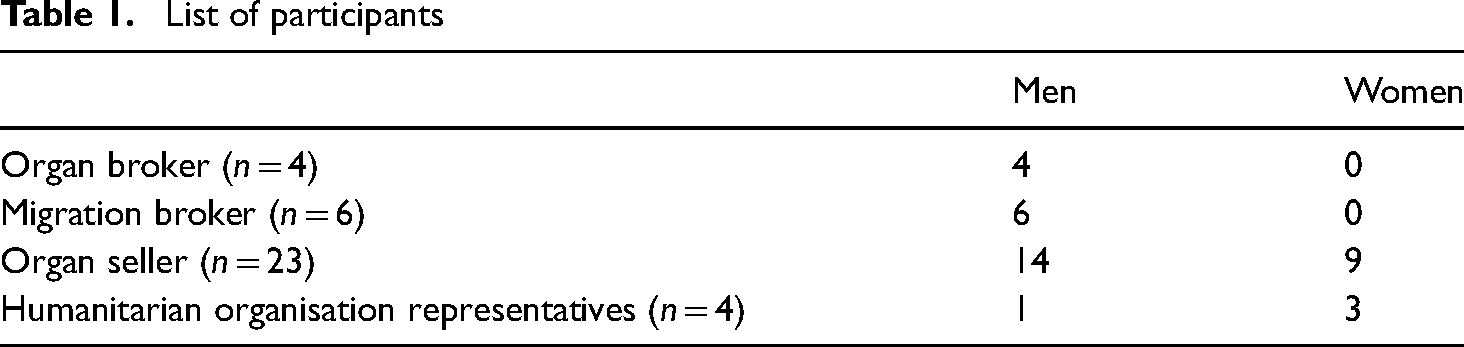
The analysis in this article is grounded in and developed from the perspectives of people who sold or brokered the sale of organs to facilitate human smuggling between November 2017 and March 2023. I explore the nature and possible causes of this relationship using ethnographic and qualitative research methods. Interviews with organ sellers (23) were arranged via a process of snowball sampling, primarily with African migrants who sold a kidney to cover smuggling-related costs, in Egypt, Sudan and England. This ‘chain referral’ method uses initial contacts to generate contexts and encounters that allow for an analysis of the different activities, actors and relations that constitute illicit networks (Goodman, 1961). The use of referrals also helps to build trust and identify otherwise hard to reach populations (Polsky, 1967). Participants from Sudan, South Sudan and Eritrea were between 19 and 33 years of age. Further interviews were arranged with migration brokers (six) and organ brokers (four), following periods of observation. Observations took place in urban spaces (i.e. informal street markets and coffee shops) where brokers were known to organise their activities. Interviews with Eritrean and Sudanese refugees (from Darfur) in Khartoum, Sudan took place before conflict broke out between opposing military forces in April 2023. Interviews were also carried out in London, UK, with people who had sold a kidney when transiting through Egypt. These interviews were arranged through existing contacts from Egypt and Sudan who connected me to participants in London, via their diaspora networks. Four interviews were completed in Catania, Italy, with representatives from humanitarian organisations operating rescue vessels on the Mediterranean. This was to ascertain whether migrants entering Europe, via Italy, from Libya and Egypt had been identified as having had a kidney or other body part removed. Table 1 shows the total sample by gender.
List of participants
As with most qualitative and ethnographic research, the observations and findings that I present reflect a level of affective bias. I formed a strong bond with many of the people that I spoke with. The ability and opportunity to engage and interact with people on a personal level was, however, fundamental to developing contacts and creating opportunities to speak with other participants. Interviews were open-ended and conversational. This approach helped build rapport and avoid the type of repeated questioning, associated with more formal structured interviews, which could prove emotionally triggering for participants. Interviews with people who sold a kidney took place at their homes, in cafés or at tea stalls, depending on where they were most comfortable. Interviews with brokers were conducted in public spaces to minimise the potential for conflict, should something go wrong. For example, it is possible that a certain question or line of enquiry could elicit an adverse response, particularly if the conduct in question was of a sensitive or criminal nature, presenting a risk of harm to the researcher. Follow-up interviews were arranged where possible, to allow participants to think over different aspects of their experience that may have been withheld or simply forgotten during the initial interview. Some participants could speak English, but most interviews were conducted in Arabic with the assistance of an interpreter. Interviews were audio recorded on an iPhone with the consent of participants and were transcribed anonymously. The audio recordings were transferred to an encrypted external hard-drive and uploaded to a password protected Jisc account after each interview. To ensure the anonymity of participants, the original audio files were deleted. No identifiable information (e.g. names, contact details) was recorded. Pseudonyms are used throughout the article.
Criminal synergies
Crime convergence refers to the confluence of different criminal activities, at a particular place and time, with respect to targets, tactics, offences and offenders, most often in response to regulatory changes (Felson, 2017; Guerette and Aziani, 2022). Although media accounts, policy reports and scholarly works tend to focus on the convergence of illicit markets by powerful criminal groups diversifying and expanding their criminal portfolio (see for example, Mandel, 2011; Naim, 2010; OECD, 2016), there has been much less attention as to how policy convergence can stimulate criminal activities (Andreas, 2021). The policy convergence of crime and immigration controls along the Central Mediterranean route is one of the key features of the EU Agenda on Migration (Stumpf, 2006). The securitisation of borders is premised on the notion that disrupting criminal networks will prevent irregular migration and ultimately save lives (European Commission, 2015). Hence, the business of securing borders is represented and justified as the antithesis to the criminal business of human smuggling and human trafficking. Rather than being in an antithetical relationship, I argue that the EU is in a symbiotic relationship with criminal groups exploiting the (im)mobility of migrants for profit. This symbiotic relationship has led to the development of criminal synergies between different illegal markets profiteering from the legal and social precarity of people living in transit.
According to Passas (2003) symbiotic relationships between legal and illegal actors can occur in different ways. For example, outsourcing or delegating specialised services to third parties for reasons of convenience, efficiency and plausible deniability. This type of relationship can occur on a one-off or a continuous basis. Funding is another type of symbiotic relationship that occurs when a legitimate organisation (e.g. a state) knowingly or unknowingly finances criminal activities (Passas, 2003). The above relationships can be ‘collaborative’ or ‘reciprocal’ in which the aims and purposes are longstanding and mutually beneficial. Alternatively, symbiotic relationships can be premised on unequal power relations, or what Passas refers to as co-optation, in which one party uses its relative power over the other to achieve its end goals. These different types of symbiotic relationships can be characterised by systemic synergy, where because of existing structural factors both legal and illegal actors co-exist in a manner that encourages their own goals and objectives. It is not, presumably, the goal of the EU to support the illicit markets that have developed around people whose movement has been restricted by border controls. The containment and subsequent exploitation of migrants does, however, accord with the general objective of the EU's migration deterrence policies to restrict the mobility of migrants to designated geographic spaces outside Europe (Aas and Gundhus 2015; Andrijasevic, 2010; Bialasiewicz, 2012; Zaiotti, 2016). In the North African context, the ‘systemic synergy’ between the EU and its African partners to fund, outsource and co-opt crime and immigration controls along the Central Mediterranean route has stimulated criminal synergies between state and non-state actors, commodifying migrant bodies for personal gain. Selling a kidney represents a new phase in the commodification of migrant bodies rooted in dehumanising social and legal practices that make people profitable in their exclusion.
European funding, outsourcing and co-optation of migration management has made people valuable in their exclusion from political membership, work and rights (Coddington et al., 2020). For example, in 2017, Libya received €90 million under the European Trust Fund for Africa (EUTF) to support the creation of a ‘protection space’ for migrants and refugees. This involved the construction of detention centres, re-labelled as ‘safe spaces’, to contain migrants, asylum seekers and refugees who had been returned from Europe (European Commission, 2017). It also included funding for surveillance equipment (e.g. helicopters, patrol ships) and military training – provided by private companies – for the Libyan Coastguard. This was despite an acknowledgement of ‘the appalling situation the migrants stranded in Libya face’ (European Commission, 2017: 1). More recently, in Egypt, the European Commission announced that €80 million would be allocated, in 2022 and 2023, to curb irregular migration [into Europe] at its land and sea borders with Libya and Sudan. An additional €200 million for migration management was announced as part of an EU–Egypt strategic partnership in March 2024 (European Parliament, 2024). Support from the EU has strengthened Egypt's policing and surveillance capacities by providing training and funding for its security forces operating under the National Coordinating Committee for Combating and Preventing Illegal Migration (NCCPIM). It has also provided the Egyptian government with political legitimacy at a time when its oppressive state apparatus has come under scrutiny for perpetrating human rights abuses (Human Rights Watch, 2023).
Egypt's Law No. 82/2016 ‘Combatting Illegal Migration and Migrant Smuggling’ was established in furtherance of Strategic Objective 5 of the Operational framework for the North Africa Window of the EUTF to ‘reduce the enablers of and mitigate vulnerabilities arising from irregular migration’ (European Commission, 2017). The law, drafted by the NCCPIM, effectively expands the remit of the Law of Trafficking in Persons (Law 64/2010) to account for all types of irregular migration, conflating two separate issues to advance a singular law enforcement objective. A key provision of the law is that it does not criminalise irregular migrants. In practice, however, migrants attempting to depart Egypt are regularly arrested on grounds of illegal entry (to Egypt) or for attempting to exit the country by irregular means (Egypt Today, 2020). Border cooperation with Sudan has led to the arrest, refoulement and the death of migrants (seeking asylum) crossing into Egypt (Human Rights Watch, 2023). Meanwhile, proactive deterrence and containment measures in Libya have contributed to the commodification and subsequent exploitation of refugees detained for profit by dissident militia groups (Kuschminder and Triandafyllidou, 2020).
The deterrence logic that underscores the European Agenda on Migration produces high revenues for the beneficiaries of state sponsored border management regimes, (e.g. law enforcement agencies, non-governmental organisations, international organisations, state officials) (Andersson, 2014). At the same time, the bifurcated purpose of crime and immigration controls to protect sovereign borders and exclude unwanted populations (migrants) is creating sub-spheres of criminal influence outside state control (see Interpol, 2021). The coercive power of state policies enables state and non-state actors to exploit the inability of migrant populations to maintain a livelihood for profit (Achilli and Sanchez, 2021; Aliverti, 2023; Gaibazzi, 2017; Hudson, 2014). It has also increased the dependency that migrant workers, asylum seekers and refugees have on intermediaries who facilitate smuggling and/or provide other services (e.g. temporary accommodation, counterfeiting services, currency exchange and money transfers) along migrant routes (Achilli and Sanchez, 2021). Increased demand for smuggling services, due (in part) to the closure of legal pathways for migration, has led to a rise in fees from a high of USD $1500 in 2014 to USD $10,000 in 2023 (according to interview participants). One consequence is that access to asylum is being determined by migrants’ ability to pay exorbitant fees to smugglers. Another is that client-migrants unable to pay smuggling fees are being referred to organ brokers for kidney sale.
To sell a kidney
Jemal, a young Eritrean man in his early 20s, was smuggled into Sudan – in February 2018 – after escaping indefinite military service in Eritrea. He travelled from Kassala to Khartoum where he found temporary employment washing cars on busy street intersections. ‘I could barely survive doing this,’ he said. ‘I had some friends from Eritrea who let me stay with them, but this was only a temporary thing.’ Like many other young Eritreans who make the journey to Sudan, Jemal was reluctant to register with the United Nations High Commissioner for Refugees (UNHCR) in Khartoum because of concerns over corruption and unfairness in the system (Hayden, 2018). Instead, he sought out the services of a samsar (a migration broker) to arrange his transport to Cairo and to connect him with smugglers transporting people to Italy. Samisira are well known to migrant communities and can be found in cafés and restaurants, generally in areas of Khartoum/Omdurman with large immigrant populations, (e.g. Al Daim, Gabra and Al Sahafa). Jemal was introduced to a Sudanese man who claimed to work for an agency assisting migrant workers in Egypt. ‘There are [unregulated] recruitment agencies that can help you find work or connect you with someone who can take you [to Europe] by sea’, Jemal said. The broker advised Jemal to sell a kidney in Cairo. Jemal, he claimed, would receive over $8000 and save someone's life in the process. This money would ensure that Jemal could pay for safe passage on a more reliable cargo vessel, costing between $3500 and $6000 [in 2018], to cross the Mediterranean into Italy. ‘There's not a lot of work in Cairo’, Jemal explained. ‘I did not want to register with the UN. I know this will not improve my situation. My plan was to go to Libya and then Italy. But I did not have the money for this. So, I know what I am going to do. I am going to sell my kidney. It is the only way to help myself.’ The surgery took place in a medical facility outside Cairo. ‘They took me for blood tests and a few days later I was at a hospital near Alexandria. All I remember after that was waking up and feeling pain on my side.’ After the surgery, Jemal was taken to an apartment to convalesce. He received $5000, a few thousand short of what he was promised and what was needed to complete his journey to Europe. When Jemal reported the incident to the police, he was informed that it was a criminal offence to sell a kidney. Instead of receiving assistance he was asked for his identification documents. Unable to produce them, he was threatened with arrest and/or deportation.
Jemal’s experience highlights how migrant workers and asylum seekers face a double criminalisation. Under existing international (Art 4a COE, 2015) and domestic legislation (Egyptian Law No 5/2010), someone who sells a kidney for economic reasons can be held liable for a criminal offence unless they are recognised as a victim of criminal abuse. Similarly, ‘economic migrants’ who are denied asylum because they are not considered ‘people of concern’ are categorised as illegal Dauvergne, 2008; DeGenova, 2002). This double criminalisation excludes migrant workers and asylum seekers from receiving support, where available, and occludes the structural factors that position them in exploitative relations to begin with (Aas, 2011; Agustin, 2008; Bernstein, 2010; Calavita, 1998). The selective acrimony of ambiguous legislation obfuscates criminal activity further, invalidating claims of abuse in the context of ‘illegal’ migration. We keep hearing about all this money to help refugees, but can you tell me where it is? There is no support in Egypt for people like me [refugees] … People are afraid to go to the police. We are accused of being smugglers. If you sell a kidney, you can be arrested also. We are the easy ones [victims]. (Sudanese refugee, Cairo 2020) The conditions at refugee camps are worse than any prisons. This is why people do these things [sell a kidney]. I know how risky this is [human smuggling]. But what choice do I have? There is nothing for me here [Khartoum]. I have tried [to cross the Mediterranean] before and I will try again because if I do nothing then I am already dead. I’m waiting now to save more money. There is a guy at Libya market who brings people to Cairo to sell their organs. I am giving this serious consideration. (Eritrean refugee, Khartoum 2023) I tried many times to go by sea [cross the Mediterranean Sea] but every time I was arrested. I had to pay for my release. So, after this I had to sell my kidney – I owed too much money. (Eritrean refugee, Cairo 2020)
Rather than deterring criminal behaviour, the imposition of border controls along the Central Mediterranean route has stimulated criminal synergies and increased the influence that criminal actors have over ‘illegal’ populations. Disillusioned with the UNHCR resettlement process, migrants turn to samsara (migration brokers) for assistance relocating to another country. Their exclusion from state protection is a determining factor in their exploitation, compelling them to take risks that they would otherwise avoid: travelling along unknown routes patrolled by armed militias, risking death at sea under the threat of detention and/or deportation, selling a kidney.
Gatekeeping asylum
Ibrahim, one of the migration brokers in my sample, claimed asylum in Egypt after defecting from the Sudanese Presidential Guard in 2011. ‘People come to me to organise their transport and to make the payment’, he explained. ‘I confirm the payment, and then I bring people from Cairo to Alexandria. They stay in warehouses, on chicken farms, and wait there until the time is ready to go to sea.’ In the criminological literature, there are several examples of persons who occupy a central position in one or more criminal networks (Bruinsma and Bernasco, 2004; Fijnaut, 1998). These criminal ‘fixers’ have the ability to bring different people into contact with each other, facilitating cross-border networking and fostering new criminal collaborative links (Farah, 2013; Kleemans and De Poot, 2008 ). Ibrahim claimed that both active and former military personnel in Sudan, Egypt and Libya, are involved in smuggling illicit goods and services. They work primarily as fixers – intermediaries who position themselves as a bridge between groups, transferring and gatekeeping valuable information from one group to another. In 2016, the Sudanese government deployed the Rapid Support Forces (RSF) at the Libyan border to prevent irregular migration and human trafficking as part of the Khartoum Process, an EUTF project to manage migration flows (European Commission, 2016; European Council 2016; European Parliament, 2024). According to Ibrahim, some of the most successful fixers, including members of the RSF, used their military training and knowledge of the borders to establish themselves as prominent players in the smuggling industry.
During his time in the military, Ibrahim acquired detailed knowledge of travel routes, checkpoints and security personnel. He used his social contacts and logistical knowledge to enter the smuggling market as a third-party facilitator. His primary role was to organise transport between Cairo and Alexandria and to connect people with smugglers (known as muharbin in Arabic) crossing the Mediterranean to Italy from different departure points in Egypt and Libya. He also acted as a point of liaison between smuggling groups operating from Khartoum (Sudan), Addis Ababa (Ethiopia) and Cairo (Egypt). ‘More people are coming to Egypt now’ he said. ‘Because it is not safe like before to go direct to Libya. Refugees are coming to work and then to make the crossing.’ Ibrahim explained how smugglers had responded to tighter border controls limiting the number of irregular crossings taking place by increasing their fees. He described a two-tiered smuggling market where client-migrants were offered different ‘service options’ depending on their ability to pay: People can pay less than the asking price ($3500) but if you do this, you’re like a third-class passenger. These ones [people] can end up in detention centres where they will only be released if they agree to work or sell their bodies for sex. This is why I recommend to people to sell a kidney before they travel.
In general, the heightened risk of kidnapping and/or arrest in Libya served as a pretext for kidney sale. Smugglers benefited from this arrangement because it enabled them to charge higher prices for their services and/or to secure a large deposit in advance of the journey. Hakim, a young Sudanese man, aged 24, explained how he worked with smuggling groups in Khartoum, Sudan, to recruit kidney sellers: I receive the organ sellers from recruiters in Khartoum. They have their own resources in Sudan and then I bring them to the [organ] brokers [in Egypt] who are in direct contact with the hospitals. Some of these people go to Libya. Others try and make it [cross the Mediterranean] from Egypt but this is more expensive.
For client-migrants who cannot afford to pay for smuggling fees the ‘offer’ to sell a kidney is presented as a gateway to asylum. Yet, only one participant, interviewed in Cairo 2018 and subsequently in London 2021, made the journey to Europe successfully. Omar travelled from Khartoum to Cairo and sold his kidney for $6000. ‘I did not know I was going to do this, but after I arrived, I realised how difficult things were. People told me that Libya is more dangerous than before, and you need money to pay for your release if you are kidnapped. I just want to live a normal life, and this is the price that I had to pay.’ After the operation, Omar was introduced to an Eritrean man who organised his transport from Damietta to Tripoli. Omar was detained at a military compound in Bani Walid for five weeks before boarding a boat to Italy. When he arrived in Italy, he was taken to a reception centre. He left during the night in a private car before the Italian authorities could arrange for his registration and review his application for asylum. ‘No one wants to stay in Italy. I have family in the UK. I called them when I was in Milan, and they sent me money with Western Union.’ Omar entered England from Calais in France in February 2020, using the money he received from his family to cross the English Channel. He claimed to know several people in the UK and other European countries (Sweden, Netherlands, Italy and France) who sold a kidney in Egypt to pay for passage overseas. However, representatives from humanitarian organisations (MSF, SOS Mediterranean) operating rescue vessels on the Mediterranean, interviewed in Catania and Milan, were unable to confirm reports of illicit organ removal among stranded migrants and refugees. According to Omar, ‘there is zero chance’ rescued migrants will tell a crew member that they have sold a kidney. ‘You don’t want to stand out. This way you will eventually be sent back [to Egypt] again’, he explained. More reliable smugglers, he claimed, who charge upward of $5000 per crossing take passengers directly to the Italian coast where private cars are waiting to transport them to a safe house (see Albahari, 2018). This may explain why there are relatively few reports of illicit organ removal from asylum seekers in Europe. Another possible explanation is that kidney sale is most often a consequence of failed journeys rather than a means to a successful one.
Exploiting (im)mobility
Border reinforcement and law enforcement crackdowns have not only failed to prevent the arrival of irregular migrants in Europe; they have disrupted important support networks for people living in transit, leaving them exposed to exploitative practices by state and non-state actors. Smuggling laws, for example, are often used to criminalise migrants as well as those who assist them for no financial gain (Sanchez, 2014). Contrary to the ‘business model of human smuggling’ that informs EU migration policy, not all migrant journeys are profit-orientated criminal endeavours characterised by abuse and violence. The people who facilitate or organise irregular journeys often do so at significant personal risk (Achilli, 2018). Intermediaries, many of whom are refugees themselves, have adapted to difficult living conditions by facilitating access to goods and services for a growing population of people socially excluded and legally marginalised by crime and immigration controls (Achilli and Sanchez, 2021). At the same time, the information asymmetry that samisira wield can be used for exploitative purposes. In this way, the coercive force of enforcement measures is reproduced in interpersonal relations.
The resilience of smuggling networks in Libya, and to a lesser extent Egypt, is a clear indication of the ineffectiveness of the EU's current approach to migration management. After the fall of the Gaddafi regime, Libya emerged as a hub for different smuggling routes (see Hüsken, 2017; Lacher, 2020). With funding from European governments, the Libyan Coastguard scaled up efforts to interdict and seize migrant vessels attempting to cross into Italian waters (European Commission, 2017). This (temporarily) led to a reduction in the number of irregular departures from Libya to Italy. It also coincided with reports of violence and exploitation in Libyan detention centres (Reitano and Shaw, 2017). Several armed groups who had been providing protection for smuggling activities have reassessed their position in response to international attention and financial support for counter-smuggling measures (Micallef, 2019). This has led some groups to transition into de facto law enforcers working in cooperation with the UN backed Government of National Accord (GNA). Militias and tribal groups, such as the Rada Special Deterrence Force and the al-Wadi Battalion in Tripoli, that were key players in Libya's smuggling economy have been sub-contracted by the GNA to manage detention centres under the banner of the Libyan Department for Combating Illegal Migration (Mannocchi, 2017). Other groups working beyond and against the remit of the GNA have monopolised illicit trade, of which human smuggling is a key component (Kuschminder and Triandafyllidou, 2020). The decline in (human) smuggling activity has, however, led to the diversification and convergence of offences (e.g. arms trafficking; drug trafficking, illicit organ removal) (Interpol, 2021; GITOC, 2019). The policy convergence of crime and immigration controls along the Central Mediterranean route and the subsequent convergence of mixed migration flows in major cities, like Khartoum, Tripoli and Cairo, have presented state and non-state actors with an opportunity to exploit the (im)mobility of migrants in different ways. In a move broadly emblematic of the position taken by militias in Tripoli, tribal groups such as the Turaeg and the Toubou in the south-eastern region of the country have taken control of detention centres, transforming them into prisons where arrested migrants have been forced into bonded labour, prostitution and extortion for ransom in exchange for their freedom (Belloni, 2016).
Four participants who were detained in Libya were threatened with organ removal if they did not cooperate with their captors and request ransom money from family members in exchange for their release. Amir, a refugee from Eritrea, was arrested shortly after disembarking from the Libyan coast enroute to Italy. ‘Some smugglers are okay, but you don’t know who is waiting for you. When one group takes you across the border, you are handed over to another group. They can hold you in a warehouse for months. I waited for nearly four months and then I was arrested two hours into sea.’ Amir returned to Cairo after he was released from a detention centre near Tripoli. Like most people that I interviewed, he was critical of the UNHCR. ‘The UNHCR does not do what it is supposed to do. Where is all the help that we have be promised. It is not an easy choice to sell a kidney. Let me tell you, I lost everything and after that I sold my kidney – I needed to support myself.’
Another participant, Solomon, an asylum seeker from Eritrea, claimed that his kidney was removed in a medical facility close to the Libyan detention centre where he was held. ‘When the smugglers stopped talking, we knew that we were being kidnapped’, Solomon explained. ‘You hear stories like this, but you hope that you will not be one of the unlucky ones.’ The samsar, he claimed, was with the RSF. Solomon was taken to a military compound and asked to pay a ransom of $8000 or donate his kidney in exchange for his freedom. Money, he explained, is sent directly to a broker in Sudan – the captors get a message when the money is received. Solomon reached out to his family in Eritrea, but they could not afford to pay the ransom. His only option was to ‘donate’ his kidney. Solomon was taken to a clinic close to the compound where he was detained. ‘The medical team were from Turkey’, he said. ‘I could hear them speaking. It was Turkish, I’m sure. They did health checks, blood and urine, blood pressure. Then I went to sleep [general anaesthetic] and my kidney was removed.’ Solomon was discharged from the clinic without any medical follow-up or aftercare. He was given a plastic bag with painkillers past their date of expiration and transported to Tripoli where he was released. Solomon's family contacted relatives in Djibouti and the UK to raise money to pay a Libyan family who had agreed to take Solomon to Cairo. Although the accounts of Solomon and others mentioned in this article are by no means conclusive evidence that illicit organ removal is being performed on captive migrants in Libya, they also indicate that recruitment for organ removal is not particularly difficult, despite the introduction of prohibitionary measures. The connection with Turkish surgeons does, however, merit further investigation to determine the nature and extent of this relationship, assuming there is any. A criminal investigation conducted in 2017 by Israeli prosecutors revealed links between Turkish doctors performing transplants on foreign patients at medical facilities in Sri Lanka, Kosovo and Thailand with weak or no legislation regarding illicit organ removal. It is possible that a similar modus operandi is beginning to emerge in Libya. It is also possible that prison guards threatened detainees with organ removal to encourage them to cooperate with their demands. The threat of organ removal is also a powerful cautionary tale that could serve to deter people from crossing into Libyan territory. In Solomon's case, this threat was realised.
Discussion and conclusion
The EU's counter-smuggling strategy in North Africa has contributed to an ongoing process of social and cultural disinvestment in refugee populations. EU–Africa cooperation has led to the indiscriminate arrest and proactive refoulment of people seeking refuge, sending migrants on remote and dangerous trajectories where they are exposed to a higher level of risk and/or death (Andersson, 2014; Mainwaring and Brigden, 2016). Funding for deterrence and containment policies has been increased at the expense of an already defunct resettlement scheme. At the same time migrants circumnavigate transnational borders, they must contend with low wages, unemployment and poverty at various stages of their journey. This structured precarity inhibits the development of strong social ties, because people are separated, family bonds are disrupted and remittances are linked to ever more precarious labour arrangements. Over time, this strategy of deterrence through indifference has eroded the ability of people living in transit to organise and find ways to support themselves. In the process, social relations have become linked to and determined by an extractive system of exchange and exploitation mediated by profit-orientated state and non-state actors, to the extent that asylum has become a commodity in and of itself, to be bought and sold according to local market dynamics. The sale of kidneys represents another phase in the commodification of migrant bodies produced by a punitive system of control that generates value from the exclusion of disenfranchised others.
In contrast to media and intergovernmental reports, there was no evidence to suggest that smuggling networks have expanded their criminal portfolio to include illicit organ removal. Rather, the convergence of offenders was facilitated by criminal fixers who formed key links between different groups and facilitated mutually beneficial arrangements. This pattern of economic exchange developed in symbiosis with securitisation and containment strategies funded and outsourced by the European Union. EU–Africa agreements (European Commission, 2017) to manage mixed migration flows emphasise a commitment to refugee welfare and support. In practice, EU allocated funds have been used to reinforce a narrow crime control agenda that overlooks the social and economic arrangements that underpin irregular migration (Achilli, 2018). Millions of euros have been spent on training programmes and law enforcement initiatives to support and develop law enforcement operations with a view to disrupting criminal networks who are said to be responsible for endangering migrant lives (Andersson, 2014; Bachiller Lopéz, 2023). Joint operations between European and African governments have led to several arrests of suspected people smugglers and traffickers. Yet, despite the constant rhetoric of ‘disrupting the business model of human smuggling’, most arrests include recruiters, drivers or other migrants criminalised for assisting people seeking refuge (Carrera et al., 2018). The imprisonment of low-level smugglers, such as Atta (discussed in the Introduction), is unlikely to reduce the estimated ‘billions in dollars’ of profits generated by the human smuggling industry (Interpol, 2021). Rather the erosion of trust and the general perception of unfairness that punitive migration polices engender has undermined an already fragile relationship between state agencies and refugees (Dadusc and Mudu, 2022; Zhang et al., 2018).
In the absence of legal pathways to migration, people living in transit seek out the assistance of guides and facilitators to help them navigate transnational borders (Sanchez, 2017). Their well-being is largely reliant on the strength of their social ties and their access to informal networks of support. The affective relations between migrants and smugglers become more strained as migrants cross borders and traverse dangerous terrains where they rely on profit-orientated facilitators, often with links to criminal groups involved in different activities (e.g. illicit organ removal) and corrupt officials for their safety. As informal ties weaken, the dynamic changes from a relationship based primarily on solidarity and mutual trust to a transactional agreement subject to (unfair) terms of exchange. In the North African context, the disruption to migrant support networks caused by securitisation regimes has increased demand for the services of intermediaries who gatekeep access to extra-legal services, (e.g. human smuggling), for a fee. In contrast to reports suggesting that migrants sell kidneys to reach Europe, most participants sold a kidney after they were arrested, detained or diverted back to a (EU) designated safe country of origin (e.g. Egypt). Despite promises of assistance from various support agencies responsible for implementing migration management and development projects, most notably under the EUTF, they found themselves in significant debt after expending all their resources to reach the Mediterranean coast. Participants opted to travel to Egypt to earn money and/or to avoid crossing into the south-eastern border between Libya and Sudan where there have been reports of kidnapping and extortion (GITOC, 2019; Lacher, 2020). They were solicited for their kidneys during the Egyptian stage of their journey as a means of paying extortionate smuggling fees and/or debts accrued after several failed attempts to claim asylum outside Africa.
The activities of criminal fixers and the groups that they work with can and do lead to exploitation and violence against migrants. However, the criminal abuse that people living in transit are exposed to is not related to the activities of criminal actors alone. The findings from this study suggest that the co-dependencies and criminal synergies that have developed between criminal groups involved in human smuggling and illicit organ removal are instead linked to the policy convergence of crime and immigration controls along the Central Mediterranean route. The ‘systemic synergy’ between public and private interests to control, and in the process profit from, the movement of unwanted populations has made migrants valuable in their exclusion (Coddington et al., 2020). Economically motivated agreements to outsource, fund and co-opt crimmigration controls in North Africa have created conditions of confinement and insecurity that push people with no alternatives into transactional relationships with state and non-state actors who profit from their immobility. Caught between intersecting interests to secure borders and to exploit immobility, migrants are compelled to compromise on asymmetrical trade-offs to secure relative safety. It is at this precarious interface, that kidney exchange has become another commodity to be bought and sold in the business of securing borders.
The symbiotic relationship between misguided polices and criminal markets requires disruption. Rather than trying to disrupt the business model of human smuggling, policymakers would do well to identify and reduce the scope of punitive measures that render people subject to the will of others. Re-distributing a fraction of the millions already spent on border enforcement into job creation, public services and welfare assistance inclusive of migrant workers and refugees would help reduce demand for illicit goods and services and create viable alternatives for people whose livelihoods are tied to illicit activities (see for example, Al-Arabi, 2018). Human smuggling and/or illicit organ removal is unlikely to be eradicated anytime soon, but the ensuing exploitation is not an inevitability. Prioritising investment into impoverished communities, creating safe and legal pathways for migration and developing equitable health services accessible to asylum seekers and refugees would go a long way in reducing the commercial incentive for smuggling and/or organ markets. Most participants who sold a kidney did so in an attempt to take control of their own destinies rather than being caught up in a migration system designed to limit their mobility. No one should be in position where selling a kidney is a gateway to asylum.
Footnotes
Declaration of conflicting interests
The author declared no potential conflicts of interest with respect to the research, authorship, and/or publication of this article.
Funding
The author disclosed receipt of the following financial support for the research, authorship, and/or publication of this article: This work was supported by the British Academy and The Leverhulme Trust (grant number SRG20\201496).
