




Abstract
Although various state and non-state agencies are central to criminal justice, our understandings of criminal justice's past remain dominated by histories of public police and modern prisons. Inspired by Braithwaite's call to reconnect genealogies of criminal justice and business regulation, this article presents an original historical study of the Excise as a criminal justice agency. It illustrates that criminal justice has historically involved a shifting ensemble of regulatory actors whose remits and functions have converged, diverged or been transferred over time. Importantly, this perspective illuminates the usually hidden offending of more privileged or powerful social actors, adding a significant historical dimension to wider efforts to rebalance criminology away from ‘crimes of the streets’ and towards ‘crimes of the suites’.
Introduction
At 6 a.m. on Wednesday 19 October 1831, two officers knocked on the door of a house on Waterloo Road, London (The Times, 21 October 1831). Officer Happell and his colleague had been informed that a suspect was using these premises for illicit distillation. The door was not opened, but a woman answered them from a window. She claimed that the person they sought did not live at this address but, a few minutes later, he duly appeared at the window. The suspect denied that alcoholic spirits were being produced in the house. The door was eventually opened, and the officers commenced a search of the premises. In a kitchen, they discovered crucial evidence: a still for making spirits, along with molasses wash and a few gallons of liquor. The officers took the suspect into custody and two days later he appeared at Union Hall Police Court charged with knowingly aiding and assisting in the illegal manufacture of spirits. Whether readers are familiar with crime and justice in the 1830s or not, few will be surprised to hear that law enforcement operations of this sort were occurring at this time. What may surprise readers, however, is the fact that Happell and his colleague were not police officers. The two men who received intelligence, entered the house on Waterloo Road, performed a search and arrested the suspect were, in fact, excise officers. They formed part of a law enforcement agency which, despite being almost entirely omitted from existing histories of policing and criminal justice, played a major role in combatting crime across Britain from the 17th century onwards.
Raids on suspected illicit distilleries were just one operation that the Excise routinely conducted against illegalities within the trade in alcoholic drinks. Although this article concentrates on the drinks trade, the Excise also worked to combat tax evasion, fraud and related criminal offences within many other industries that traded in taxed commodities for long periods of history, including tobacco, tea, coffee and soap. The purpose of this article is to reintroduce this long and rich history of excise tax enforcement into the history of crime and criminal justice. These things are usually dealt with separately; histories of policing focus overwhelmingly on the history of the institutions we now call ‘police’ and histories of punishment concentrate disproportionately on prisons. The law enforcement activities of other agencies, no matter how extensive or relevant to criminal justice, are generally ignored. These shortcomings leave a sizeable gap in historical knowledge. Furthermore, they contribute implicitly to the reproduction of many of mainstream criminology's well-known biases, including the tendency to foreground ‘crimes of the streets’, downplay ‘crimes of the suites’ and reinforce a particular conception of ‘the criminal’ as a lower class person committing direct, interpersonal violence or property offences (Braithwaite, 2003; Sutherland, 1940).
This article presents a historical study of the Excise as a criminal justice agency. It reports findings from a specific project on illicit alcohol in England and Wales across the long 19th century (c.1789–1914) and reflects on their meaning for criminology today. The article draws on extensive archival research involving, in particular, tax records held at The (UK) National Archives and reports of court proceedings accessed through digital archives (e.g., Old Bailey Online, British Library Newspapers). It takes specific inspiration from John Braithwaite's (2003) article in Theoretical Criminology, which argued that genealogies of criminal justice must be reconnected to genealogies of wider regulatory agencies, including those tasked with overseeing various spheres of business. The article fills a particular gap in the literature relating to the law enforcement functions of the Excise in modern history. But, more importantly, it aims to further recent scholarly advances that have challenged the manner in which police, prisons and other formal criminal justice institutions are privileged within contemporary analyses of social responses to crime. If this orthodoxy of analytical attention can be disrupted, then some of the fundamental biases of contemporary criminology, relating specifically to what is crime, who are criminals and who should deal with them, can be creatively unsettled. The goal here is partly the pursuit of a criminology that more accurately reflects the breadth and nuances of criminal justice in the past. Importantly, the article is also intended to help produce a criminology that is less encumbered by entrenched biases and so better equipped for making sense of the present as well as shaping how crime is understood and responded to in the future.
Criminal justice history and tax history
Braithwaite's lucid call for the reconnection of genealogies of criminal justice and other regulatory projects was made within an illuminating critique of David Garland's The Culture of Control (2001). Braithwaite argued that Garland's study, and the wider Foucauldian tradition of genealogical research in which it sits, is constrained by its particular historical purview. Scholarly work in this tradition traces ‘how contemporary practices and institutions emerged out of specific struggles, conflicts, alliances, and exercises of power, many of which are nowadays forgotten’ (Garland, 2014: 372). As such, genealogical research can be ‘powerfully critical and revealing’ (Garland, 2014: 379) in how it problematises many taken-for-granted aspects of contemporary societies and reveals their specific origins in contingent historical happenings. The difficulties with this strategy stem from how it concentrates on certain genealogical branches and overlooks connections to others. Braithwaite (2003) argues that many of the aspects of contemporary penality that are taken as novel in The Culture of Control and attributed to the rise of neo-liberal governmentalities – actuarialism, public/private partnerships and more – have actually been transferred into criminal justice from the sphere of business regulation. But the rather anachronistic tendency of genealogical accounts to isolate contemporary institutions or practices and trace them backwards in time effectively ‘saws off’ other branches, meaning that important interconnections between branches such as criminal justice and business regulation can be overlooked (see also Knepper and Scicluna, 2010).
The history of punishment more widely has been critiqued for sharing this orientation towards the institutions that comprise formal penality today. Taking aim at Michel Foucault, Michael Ignatieff and others, Mary Bosworth (2000) has emphasised that many histories of punishment are preoccupied with the rise of the modern prison in the 19th century and ignore the deeper and more diverse roots of prison as a penal sanction within older institutions – including, crucially, women's prisons – that were operated along a mixture of religious, therapeutic and welfarist lines. Churchill (2014) similarly documented an overriding historiographical concern for a narrow set of state penal apparatus in the 1800s that skews scholarly attention away from the larger array of actors and practices that have comprised punishment across historical time, including workplace discipline (Godfrey and Cox, 2013) and informal community justice (see King, 2000: 17–46). Both accounts show that punishment is not the sole preserve of formal criminal justice institutions and, in all likelihood, never has been. Taking a wider view, Braithwaite (2003) stresses the breadth of regulatory institutions involved in responding to bad behaviour and illegalities, highlighting the importance of a variety of state-based actors and practices, such as those involved in intellectual property disputes or the use of certain forms of licensing to suppress organised crime.
Police history is similarly marked by a prevailing interest in the institutions that bear the name ‘police’ today and the ‘year zeroes’ in which they were established (Gutiérrez and Neocleous, 2023). In England and Wales, this has led many studies to foreground 19th century reforms, particularly statutes passed between 1829 and 1856, which established the Metropolitan Police and other ‘new police’ forces that remain recognisable today (Emsley, 1996; Steedman, 1984). Revisionist historians have downplayed the importance of these moments of institutional genesis and pointed out that, in actuality, the ‘new police’ were not as distinct from the ‘old police’ – an umbrella term encompassing parish constables, watchmen and private detectives – as was once supposed (see Bland, 2022). In a posthumously published book, Clive Emsley (2021) addressed this point and examined how, although its history tends to be told through the history of public police institutions, policing has actually been performed by a range of judicial, municipal and quasi-military authorities across the long sweep of history (also Churchill, 2014, 2017; Reiner, 2000; Shearing, 1989). These varied agencies conducted tasks we would nowadays associate with police, including arresting suspects who had been summoned to court, as well as fulfilling other duties relating to traffic flow, the cleanliness of streets and much more (Emsley, 2021). Other scholars have connected the varied functions of the ‘old police’ to the idea of policing itself, which, as well as its narrower meaning relating to crime control, has long been connected to a wider mission of ordering communal life (Dodsworth, 2008; Gutiérrez and Neocleous, 2023; Winstanley, 1990). These broader intellectual and operational roots of modern policing are now well-known to police historians, although the field itself has been slow to adapt its analytical foci to account for them (see Churchill, 2014, 2017).
In addition to presenting a rather blinkered view of the past, neglecting the interplay between different forms of regulation through time reinforces some questionable tenets of contemporary thinking. In particular, it lends credence to the idea, implicit within criminology's ‘fetishism’ of police (Reiner, 2000: 1) and prisons as objects of study, that public policing and formal criminal punishment are fundamental – perhaps even inevitable or necessary – components of how societies respond to crime and deviance. There have been advances in recent years as some criminologists have adopted a wide lens view of policing and punishment by examining how punitive penal practices have spread into the work of other government actors, such as border control agencies (Franko, 2020), or investigating quasi-formal penal processes administered by armed, non-state organisations (Dudai, 2022). Prominent accounts of security (Zedner, 2003), private government (Shearing, 2006) and plural policing (Loader, 2000) have also drawn attention to how social responses to crime in contemporary society routinely encompass the actions of individuals, communities, businesses and voluntary groups. Much of this literature acknowledges or examines relevant historical continuities or antecedents, particularly those made visible by the ‘mixed economies’ of crime control that existed in other historical eras (Churchill, 2017; Zedner, 2006). These studies direct criminological thinking away from a rigid concentration on police, prisons or other components of a narrowly defined criminal justice system. Instead, they demonstrate the wisdom of Zedner's view that criminal justice is less a system and more ‘a series of institutional constellations’ (2010: 73) that exists because of the interactions of plural, disparate actors seeking to control crime in some manner, while simultaneously pursuing additional objectives.
Importantly, analysis that takes a wider view of the institutional constellations at the heart of criminal justice has the potential to bring new groups of offenders under the criminological gaze. Braithwaite (2003) argues that Garland's treatment of penal institutions as the locus of punishment means that The Culture of Control is effectively a history of the punishment of the poor. It foregrounds the people processed by penal institutions and thus reinforces the idea that this constituency, as defined by their class, ethnicity and other variables, are the main crime problem that societies must grapple with. Vic Gattrell (1990) once observed that many historical researchers effectively do the same by diverting their attention from lawbreaking in all its many forms and concentrating instead only on the things labelled as crimes by the criminal justice institutions of the period they are studying. As a result, they are left ‘at the mercy of the prejudices and constraints which determine how the law selects some targets and ignores others’ (Gattrell, 1990: 244). If police officers believe that criminality is more likely to be found within poor communities – which they generally did in Victorian Britain – their ability to direct their disciplinary attention towards these communities effectively wills this prejudice into empirical being, ensuring it will be manifest in arrest statistics, court records and so on (Gattrell, 1990; also Bland, 2022; Davis, 1989b; King, 2000). Braithwaite (2003) evokes Edwin Sutherland's (1940) famous critique of social science's preoccupation with the crimes of the lower classes and demand for more research on what he famously termed ‘white collar crime’, or lawbreaking perpetrated by those from other classes.
Since Sutherland made this point in 1940, criminological literatures on crimes of the powerful, corporate crime and middle class crime have emerged (see Karstedt, 2016; Nelken, 2012). Yet recurrent complaints about the marginality of these literatures within criminology as a subject area (Whyte and Wiegratz, 2016) indicate that Sutherland's clarion call has yet to be fully answered. Relatedly, there remains a shortage of historical research on white collar crime (Locker and Godfrey, 2006) and financial crime (Wilson, 2017; see also Wilson, 2014), which, among other things, makes it difficult for researchers to historically contextualise contemporary studies of these phenomena. Consequently, the analytical gaze of criminology has not shifted decisively away from the ‘usual suspects’ (see Hendry, 2022), those socially disadvantaged people most likely to be arrested, charged and convicted of criminal offences. Indeed, despite a few exceptions (Patriarca and da Silva Lopes, 2023), even studies that have looked beyond public police and prisons in recent years mostly reproduce this focus. The voluntary and private agencies involved in ‘plural policing’ tend to concentrate again on traditional ‘crimes of the streets’ (anti-social behaviour, public disorder, burglary, etc.) (Boels and Verhage, 2016; Crawford, 2011) and the frequently disadvantaged people associated with them (e.g. lower social classes, or young people in public spaces). The crimes of individuals and groups with more social status or political power are typically dealt with through different means (Sutherland, 1940). Braithwaite's (2003) specific contribution here is to argue that the generally downward-looking social gaze of criminology might be altered through sustained efforts to explore the role that wider regulatory agencies – either state or quasi-state – have played in responding to crime and other illegalities through historical time, either in conjunction with or independent of the formal criminal justice system. It is this agenda which leads to the article's focus on commodity taxes and the Excise.
At present, the Excise and other tax authorities are almost entirely absent from historical research on crime and social responses to crime. 1 The history of excise taxes features extensively within tax history, but this field is largely economic or financial in orientation and mostly concerned with the fiscal–military matter of how states raised the capital needed to pay for military actions (Brewer, 1988). Excise taxes are among the best examples of fiscal–military taxes; pioneered in the Netherlands, they were first introduced in England and Wales in 1643 and their use was strongly connected to military expenditure until at least the 1800s (Coffman, 2013; also Yeomans, 2018). Their administration, moreover, is widely characterised as ‘modern’, a forerunner of the sort of disinterested, bureaucratic governance often taken as characteristic of modernity (see Vernon, 2014). But the associated role of the Excise – the agency tasked with collecting excise taxes – in dealing with criminality in certain industries and markets attracts little attention. Ashworth's book Customs and Excise (2003) is something of an exception. Although not guided by a specific interest in criminal justice or policing, it covers the everyday work of Excise employees alongside more historiographically orthodox fiscal–military matters. Taking things further, Ziegler's (2018) research on Customs in the 18th century deliberately pivots away from fiscal–military concerns, arguing that riding officers, cruiser captains and other Customs officials working in coastal areas were as much concerned with policing as they were with revenue. These officers, Ziegler shows, ‘were part of a culture of vigilance that was less about money and more about authority and control over coastal communities’ (2018: 77). Ziegler has, therefore, taken effective steps to begin bridging the gap between tax history and police history.
This article is a direct response to Braithwaite's call for more research on the diverse agencies that have responded to crime and illegality across the centuries. It is shaped additionally by Zedner's institutional constellation conception of criminal justice. Building on Ziegler's existing work on Customs, it examines the law enforcement practices of the Excise, as a large, powerful and distinctly modern government agency.
The Excise and criminal justice
Excise taxes were introduced in England and Wales in 1643 to help Parliament pay for the ongoing Civil War. Although customs duties were already applied to the importation of certain goods, excise taxes were levied at varying rates on the domestic production and trade of numerous commodities, including beer, wine, cider and spirits. The ordinance that created excise taxes further legislated for the creation of an Office of Excise in London, to be overseen by eight commissioners, and local offices in each county to be staffed by excise officers (Firth and Rait, 1911). These structures were housed within the Board of Excise from 1683 and subsequently moved several times, including to the Inland Revenue in 1848 and HM Customs and Excise in 1909. Local excise offices were tasked with registering makers, sellers and commercial buyers of all excisable goods in their areas and the makers (brewers, distillers, etc.) were required to regularly report their manufacturing output and pay the resulting taxes that were due. To ensure these taxes were paid, excise officers were given significant law enforcement powers of precisely the sort that we now associate with policing. These included the power to enter and search premises, to seize goods and equipment, and to arrest and imprison those who did not comply with the new rules (Firth and Rait, 1911). It was not unusual for excise officers to be armed when carrying out their duties. They sometimes carried pistols or other weapons, especially when confronting gangs of smugglers (Old Bailey Online, 9 December 1772).
The collection of some excise duties was ‘farmed’ for a period between the 1650s and 1680s (performed by private individuals on behalf of the state) (Coffman, 2013). Otherwise, it is evident that the Excise has consistently possessed and exercised these police powers to collect taxes (Ashworth, 2003; especially 94–130). In terms of its organisation, it operated at a national scale from the start and answered directly to central government – specifically, to the Treasury. The Excise was a hierarchical organisation staffed by trained professionals who were paid a salary and, from the 1690s, could pay into a pension fund (Ashworth, 2003: 117–130). In addition, its officers were moved around the country regularly to stop them building up the sort of local connections which might encourage corruption (Ashworth, 2003: 117–130). Customs has been organised on similar lines for much of its history too. Ziegler argues that the professional basis of Customs, as well as its interest in combatting (some forms of) crime, makes it a forerunner of the ‘new police’ forces set up in the 19th century. If this is true of Customs, then it is certainly true of the Excise also. When added to their extensive police powers, the professional basis of the Excise from the 17th century onward reinforces attempts by revisionist historians and others to challenge the distinction of ‘old’ and ‘new’ police and de-centre 19th century, ‘year zero’ moments of institutional creation in the history of modern policing.
As well as using police powers to support tax collection, the Excise frequently used the courts to punish or otherwise sanction those who violated the law. Under a 1672 statute, the Commissioners of the Excise could sit as a summary court in London and try defendants for tax offences. In some instances, the Excise Court – as it was known – dealt with complaints or decided whether to alter a penalty imposed on individuals who had already been convicted by a magistrates’ court (The Times, 16 February 1832; also HM Government, 1836). But, especially in cases of adulteration, it often functioned independently of other courts, dispensing verdicts and deciding upon penalties (The Times, 8 April 1830). The Excise Court sat regularly in the first half of the 19th century and, in 1832 alone, heard 473 cases (HM Government, 1836). More widely, the Excise quite routinely acted as a prosecutor across the country throughout the 1800s. It employed solicitors to pursue convictions in summary courts against those who had breached tax or licensing laws, typically for offences including adulteration, smuggling or illicit distillation. These solicitors were aided by excise officers who, almost uniformly across all cases, provided evidence to support the prosecution. In serious cases – often those in which smugglers violently resisted enforcement operations – the Excise would be involved in trials at higher criminal courts. In other instances, they proceeded against individuals in civil courts, such as the Court of Exchequer. This could occur if a tax bill was unpaid or if there was a dispute over the sums due (The Times, 3 September 1864), although the precise reasons why a civil court was used are not always clear. Whatever their exact response, the Excise was very active in seeking to punish or otherwise sanction those who did not comply with their legal obligations around tax and wider business activities.
The Excise was therefore equipped with a range of police and judicial powers across the 18th and 19th centuries. The responsibility of Customs towards the management of national borders meant it mostly operated in certain geographical areas, especially coastal communities. The Excise, by contrast, collected taxes and enforced the law with regards to the domestic trade in any taxed commodity, hence it was geographically bounded only by the limits of British territory and took a large swath of economic activity as its operational domain. It is important to stress the size of the drinks industry in this period. As Fahey (1980) reports, 17 of Britain's 47 largest companies in 1905 were breweries and 1 was a distillery. Indeed, London brewery Watney, Combe and Reid had the second highest valuation of any company at this point in time (Fahey, 1980). The fact that taxes were often applied to constituent ingredients of alcoholic drinks also meant that the Excise worked to police additional industries, such as hop cultivation and malt production. Furthermore, levies were applied to tobacco in the 19th century as well as a range of other commodities for periods of time, including tea, soap, paper, starch and bricks. The Excise was, therefore, equipped and expected to function as the main law enforcement agency within several large and lucrative sectors of the British economy.
Excise and criminal justice
Law enforcement operations
Much of the Excise's work entailed the sort of bureaucratic labour that might be expected of a tax collection agency. Although its administration changed somewhat, the organisation maintained a ‘permits and surveys’ system for inspecting and monitoring certain industries across this period. Producers, dealers and retailers of excised goods were generally required to register or obtain an excise licence to legally operate, and were always obliged to submit to regular, often unannounced surveys in which revenue officials would inspect their premises and accounts. They had to keep books detailing what they were producing, buying or selling and were required to obtain permits before moving taxable goods between premises. In the 1830s, excise officers made an account of the stock held by dealers in excised goods every 28 days (HM Government, 1836). Maltsters were surveyed several times each week, sometimes every day (Ashworth, 2003: 209–234). Brewers, in the mid-1800s, could expect unannounced inspections at least every two weeks and at any time of day or night (House of Commons, 1855). A checking officer would inspect the brewer's entry books and their supervisor could make further checks on these at any time (House of Commons, 1855). The precise administration of this system varied over the period but, to illustrate its scale, an 1836 estimate calculated that its maintenance resulted in 800,000 entry books being kept, 1.7 million permits being issued and 15 million excise surveys being conducted each year for the beer, wine, tea and tobacco industries alone (HM Government, 1836: 20). This vast system was operated to help ensure that all due taxes were collected, but it was also intended to help identify and prevent criminality. Frequent, unannounced surveys of stock, entry books and commercial or industrial premises were meant to prevent illegalities by acting as a deterrent against non-compliance with tax laws.
The Excise also conducted investigative operations when relevant illegalities were known or suspected. In contrast to the bureaucratic labour involved with surveys and permits, these operations could be extremely violent, especially when directed against smugglers. Customs, the Royal Navy and the Coastguard were the principal agencies who tried to stop smuggled goods being landed on the British coast. Once they were ashore, excise officers – often alongside the military – were frequently involved in efforts to seize illegal cargoes and arrest smugglers. These efforts did result in violence in the 1700s and early 1800s, because smuggling gangs could be large, organised and armed. Injuries were common in such encounters and deaths were not infrequent (The Times, 27 July 1808).
The Excise's other reactive, law enforcement activities were less violent. These included several, typical forms of policing operation. The first encompasses the sort of raids on suspected illicit distilleries described in the Introduction. On receiving information about a specific location, the investigating party would proceed to the address before gaining entry and searching the premises. If illegal spirits or distillation equipment were discovered, they would be seized and people present at the address could be arrested. Peaking at 551 in 1850, the number of raids upon illicit alcohol stills often numbered in the hundreds in a given calendar year (Figure 1) and, based on newspaper reports, were overwhelmingly concentrated in towns and cities. With a very high conviction rate, those charged could expect to be convicted at a summary trial and most of those convicted served short prison sentences (Figure 1). It is notable that, although sometimes conducted solely by tax authorities, raids on suspected illicit distilleries were often joint operations that saw police constables accompany excise officers. 2
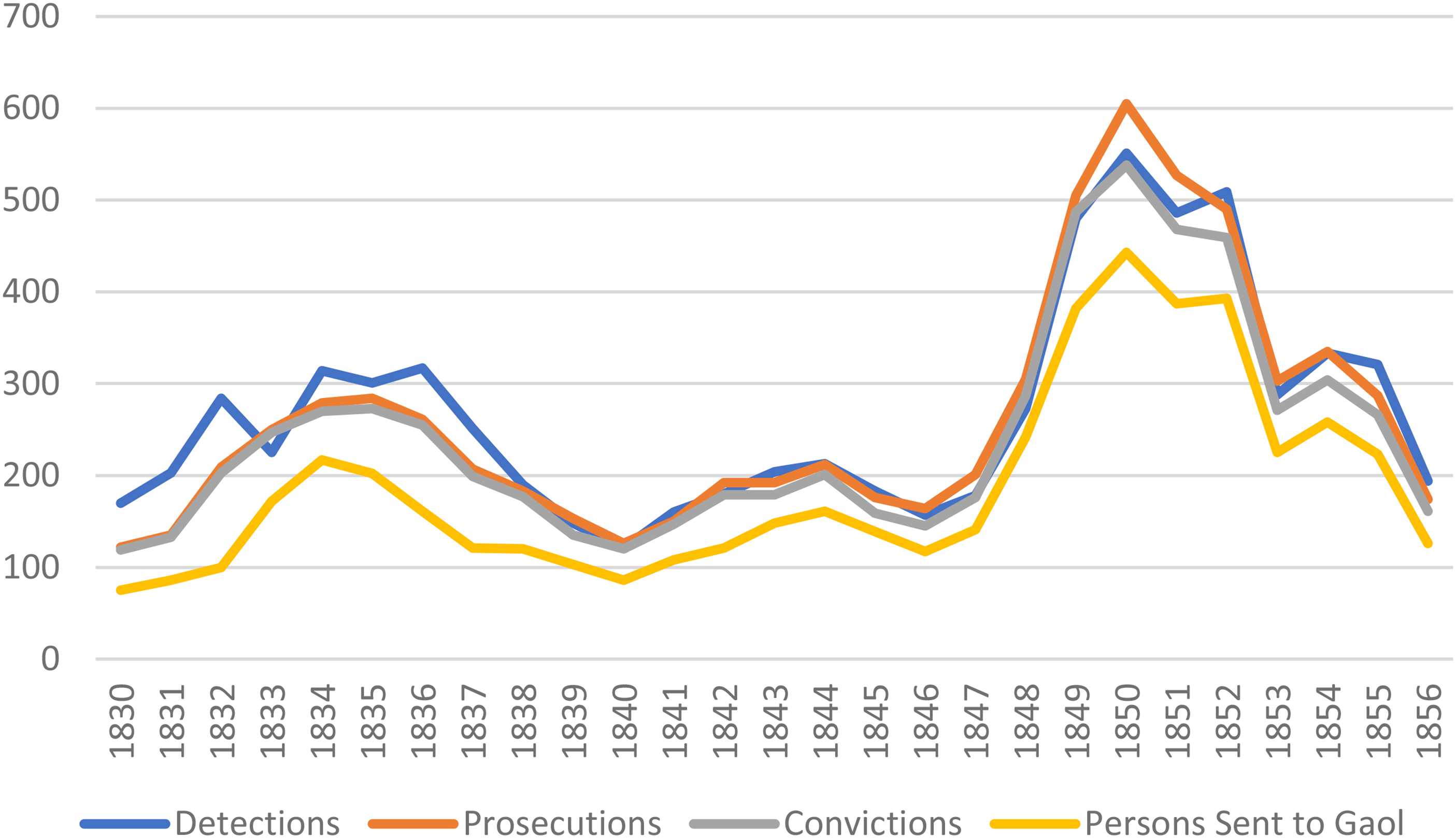
Illicit distillation 1830–1856 (data from CUST 44 Series).
The second type of reactive policing operation pertains to adulteration, which became an increasing governmental concern across the 1800s (Burnett, 1989). Adulteration often consisted of the addition of water and flavourings to drinks (e.g. sugar, salt, coriander, caramel) but, in other instances, more harmful ingredients were added, including lead to wine and cocculus indicus to beer. Excise officers initially relied on taste, smell and the presence of suspicious ingredients on the premises to detect adulteration during routine or reactive inspections. As technology improved, they were able to use specialised equipment (e.g. hydrometers) (Ashworth, 2001) and were increasingly able to take samples of products to send away for chemical analysis. Private laboratories provided this analysis for a time and expert testimony from prominent scientists, including Michael Faraday, was heard in court (The Times, 5 April 1830). From the 1840s, tax authorities developed their own laboratories and specialised staff to test samples of commodities for adulteration. By 1855, 60–70 trained analytical chemists were employed nationwide by the Board of Inland Revenue (which contained the Excise) and 14 more were studying at University College London with a view to becoming excise analysts (House of Commons, 1855). In the same decade, the Inland Revenue created a specialised detective force specifically tasked with conducting unannounced inspections of pubs, breweries and other premises where adulteration was suspected to be occurring (House of Commons, 1855). A prosecution was likely to be initiated if adulteration was detected.
Another reactive police operation routinely conducted by the Excise concerns the suppression of the unlicensed sale of beer, spirits and wine. The number of people prosecuted for unlicensed sale often numbered in the thousands in a single year (Figure 2) and the Excise played a crucial role in gathering evidence and obtaining convictions. Notably, newspapers reported an apparent spate of cases concerning ‘bogus clubs’ roughly between the 1890s and the beginning of the First World War. These clubs were purported to be private members’ clubs, which were not required to obtain a magistrate's licence for sale of alcoholic drinks in England and Wales until 1921 but were constrained by other rules, including the stipulation that they could only sell drinks to club members (Cherrington, 2013). Both revenue and police officers visited clubs covertly – and separately – to check whether the law was being upheld. They would seek to gain entry and buy drinks or other goods without being in possession of a membership. The Inland Revenue or the Treasury tended to conduct any resulting prosecution and the evidence provided by these covert visits was pivotal.
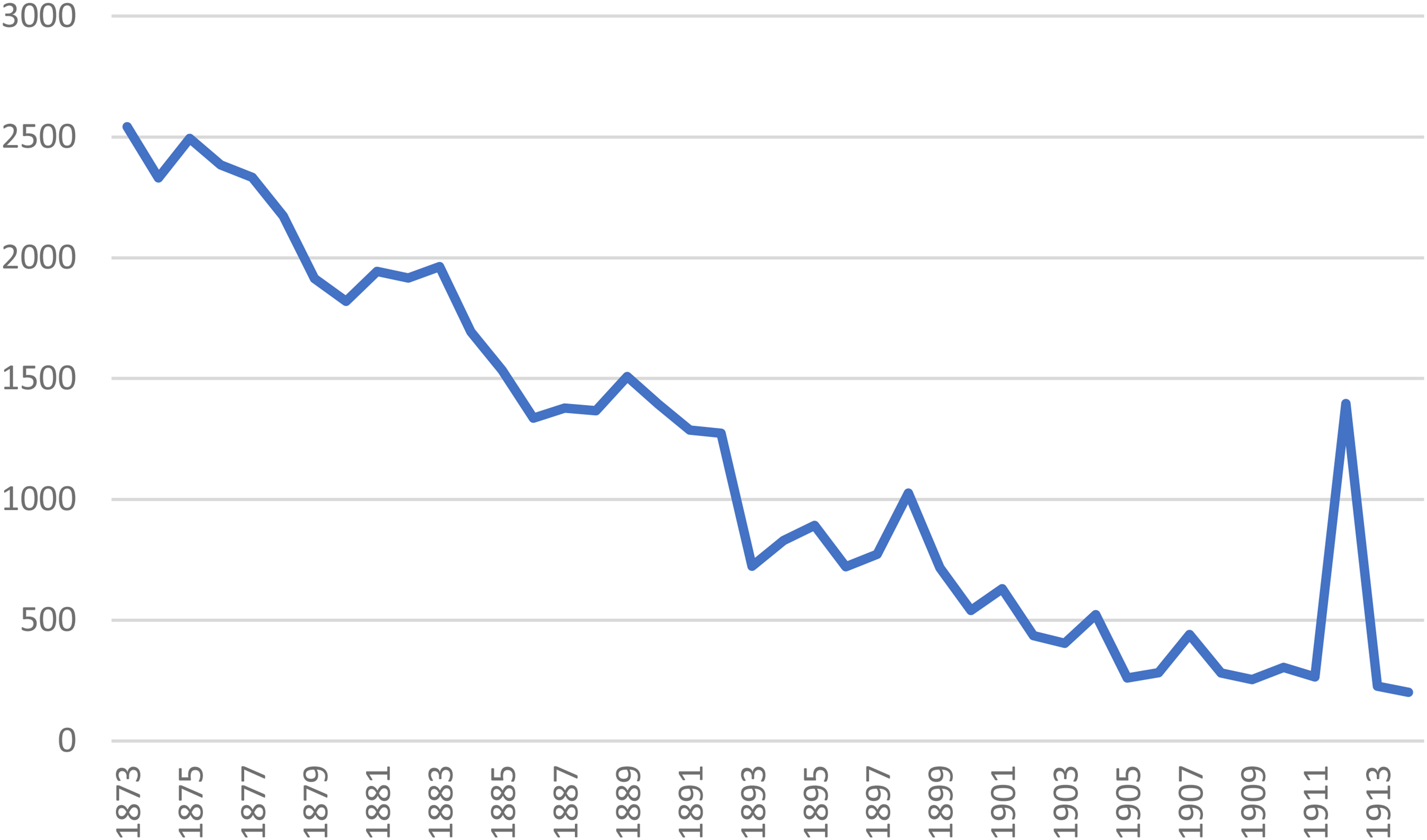
Persons tried for unlicensed sale of drink (data from Parliamentary Papers, ‘judicial statistics’).
The Excise therefore routinely performed law enforcement work as well as collecting taxes. It maintained a vast bureaucratic system of permits and surveys that functioned to support tax collection and prevent criminality. It routinely undertook reactive operations, mobilising a repertoire of coercive, investigative and surveillance powers against illegal practices within markets for alcoholic drinks. Hence, it both possessed and exercised extensive police powers across the long 19th century, functioning as an autonomous criminal justice agency as well as a partner organisation that often worked cooperatively with police forces and other state agencies.
Unusual suspects
Part of the reason the English ‘new police’ concentrated so extensively on lower class criminality in the 1800s is because of their overriding interest in public space, which was disproportionately used by poor or working class people who had limited access to private property or other non-public areas (Bland, 2022; Davis, 1989a, 1989b). 3 The Excise, however, were equipped and required to police economic activities that mostly occurred on private property, including manufacturing and commercial premises. Policing these spaces brought the Excise into contact with a more socio-economically diverse mixture of suspects and offenders.
This was not true for all of their policing operations. Smuggling sometimes involved wealthy or politically influential figures in this era, but social historians have emphasised its roots in lower class communities (Rule, 1979; Winslow, 1977). Illicit distillation, moreover, was largely practiced by poor or working class people, mostly men but often women too, who were keen to find extra money (Yeomans, 2023). Newspaper reports occasionally noted that those prosecuted for illicit distillation were unemployed and often assigned them a manual or unskilled occupation. Occasional attempts to use poverty as a defence or mitigation further evidence this point (Leeds Mercury, 13 November 1847). Moreover, although small fines were the standard penalty for illicit distillation, 77% of those convicted between 1830 and 1856 ended up serving short prison sentences instead as they would not or could not pay (Figure 1).
The situation with unlicensed selling is more complex and the social class of those prosecuted is not always clear from the source material. Two things do stand out. First, unlicensed alcohol selling was, in the late 1800s and early 1900s, frequently blamed on ethnic minorities or migrant communities. Italians and Swedes are among the groups who feature in newspaper reports on ‘bogus clubs’ in this era (The Times, 13 May 1909; The Times, 16 January 1913). At the prosecution of Louis Lorentzen for licensing offences committed at the Scandia Club, the magistrate decried ‘the many difficulties to which these foreigners put them’ (The Times, 16 January 1913). Second, the accused sometimes leveraged considerable social capital. Notably, when Curtis Bennett, Louis Elken and Morris Cohen were prosecuted for running a bogus club, they could count on local newsagent Solomon Marks to give evidence in their defence, as well as barrister and Member of Parliament Sir Rigby Swift KC to conduct their defence (The Times, 6 January 1912). It is not clear whether these men could be considered wealthy – although Elken was described by The Times as a land and estate agent – but they could evidently draw upon support from business owners and politicians when they needed it. Although a disproportionate concern for the behaviour of ethnic minorities is regularly observed within law enforcement past and present, the prosecution of well-connected individuals reveals that the Excise also dealt with some rather unusual suspects when policing unlicensed alcohol sales.
This practice becomes more visible when adulteration is considered, because the vast majority of those prosecuted for adulteration were men working in the licensed trade. The chemist Frederick Accum noted this in his 1820 exposé of adulteration, complaining it was ‘pursued by men, who, from the magnitude and apparent respectability of their concerns, would be the least obnoxious to public suspicion’ (Accum, 1820: 2). Accum (1820) notes court proceedings against wholesale brewers and retail dealers, and it is evident that licensed distillers (HM Government, 1836: 29) and maltsters (Leeds Mercury, 6 August 1828) were also prosecuted for adulteration. But it was publicans, found to be selling adulterated drinks or caught in possession of ingredients to be used for adulteration, that made up the bulk of those prosecuted. In March 1830, for example, Charles Wright was convicted of adulterating beer after excise officers found salt, water, sugar, treacle and iron sulphate in the cellar of his London pub, the White Swan. Wright protested that he had acquired these ingredients to cure a leg of pork but the Excise Court was not persuaded and fined him £100 (The Times, 6 March 1830). The enforcement of laws against adulteration thus meant tax authorities prosecuted significant numbers of traders running small to fairly large businesses. Publicans were not uniformly wealthy but, because they were employed and licensed, were in a different socio-economic position to the many illicit distillers prosecuted at the same time. Publicans did occasionally cite financial hardship as a reason for adulterating their drinks, but the courts gave such disclosures short shrift. When a tavern-keeper called George Hunter complained to the Excise Court on receiving a £20 fine for the possession of ingredients for adulteration, the three presiding commissioners replied flatly ‘you are very well off’ (The Times, 17 December 1836). 4
Finally, it must be stressed that identifying the more diverse socio-economic backgrounds of the offenders processed by the Excise does not point towards some hitherto unknown parity in how the law was enforced in the long 19th century. Adulteration was typically treated as a criminal matter but when licensed traders committed other alcohol-related offences, for example selling smuggled spirits, they were often processed more as civil matters of unpaid fees or debts – usually by the Court of the Exchequer. 5 Similarly, in 1844, the Court of the Exchequer fined John and Robert Phillips £600 after brandy, a hydrometer and distillation equipment were found in outbuildings on their farm (The Times, 5 February 1844) while, in the same year, the criminal courts imprisoned 161 people for illicit distillation. In 1825, the Court of the Exchequer sought to send ‘a warning to the respectable farmers of the country’ (The Times, 1 December 1825) by trying another farmer, Mr Borough, for his involvement in smuggling, but, at the same time, the criminal courts were punishing gangs of smugglers with transportation. The line between civil and criminal spheres was admittedly rather blurred in the 18th and early 19th centuries (King, 2000), but it is not difficult to find further instances where middle class or ‘respectable’ persons appear to have been dealt with leniently. 6 Indeed, in the case described in the Introduction, the fact that the suspect arrested by Officer Happell was a ‘solicitor of respectability’ (The Times, 21 October 1831) weighed in his favour. He claimed he was only visiting the house in question to see the woman lodging there and knew nothing of the illegal still. Despite the Excise receiving information that implicated him directly, the magistrate displayed a rare concern for the defendant's well-being and postponed the hearing to give him ‘an opportunity of leaving that office with his character cleared from the stigma’ of the charge (The Times, 21 October 1831). There is no record of a further court appearance and, presumably with the same concern for the apparently respectable man's well-being, The Times did not disclose the defendant's name. So, while the actions of the Excise evidently contributed to the policing of crimes committed by the middle class, there remains abundant evidence of class bias within criminal justice and law enforcement.
Shrinking roles, diverging branches
By now it should be clear that, for much of its history, the Excise was a highly significant agency within the institutional constellation of criminal justice. Working alone or jointly with the police, military and other state officers, it acted to suppress illegal alcohol enterprises and combat criminality within licit markets, bringing thousands of cases to the criminal and civil courts in the process. But, as has already been alluded to, the manner in which the Excise performed its crime control functions changed from the mid-19th century onwards. There were two main dimensions to this change.
First, the work of the Excise was partly altered because of changes in illicit alcohol enterprises. The sort of large-scale, organised smuggling that had been central to some coastal communities in earlier eras had almost completely disappeared from England and Wales by the 1840s. Moreover, all indications suggest that the decline in illicit distillation prosecutions from the 1850s onwards (Figure 1) reflects a genuine, significant decrease in its occurrence (see Yeomans, 2023). From 1875 to 1914, the number of illicit distillation detections per year rarely reached double figures. This meant that, as the long 19th century wore on, the enforcement activities of the Excise narrowed and became proportionately more concerned with economic illegalities perpetrated by businessmen, property owners or other middle class offenders. The abolition of several excise duties, including hops duty in 1862 and malt duty in 1880, also reduced the number of production processes that the Excise policed. The Excise therefore became concerned with a more specific set of criminal offences occurring within a shrinking pool of industries.
Second, successive pieces of legislation effectively lessened the role of the Excise in responding to the main forms of criminality that remained within their operational remit. Steedman (1984) describes how, whereas they had long been active against unlicensed alcohol selling, reforms in the 1860s and 1870s increased the police's ability to enter licensed premises and develop regular processes for inspecting drinking houses in their jurisdictions. The Excise continued to monitor suspect premises into the 20th century and tax authorities conducted all relevant prosecutions, but there are increasing newspaper reports of police forces detecting instances of unlicensed alcohol sale without operational support from excise officers (The Times, 12 October 1881). Policing adulteration, meanwhile, was almost exclusively conducted by the Excise until the Sale of Food and Drugs Act 1875. This Act gave police officers, Inspectors of Weights and Measures, inspectors of nuisance and medical officers of health the power to take samples of goods to check for adulteration. Rather than relying on the Inland Revenue's laboratory, it also required local authorities to appoint a public analyst to test samples for adulteration (see French and Phillips, 2000). Inspectors of Weights and Measures subsequently detected instances of adulteration in the late 1800s (North Wales Chronicle, 9 September 1899) and the police were also increasingly active in this domain. In 1893, for instance, a spate of prosecutions for whisky adulteration in the Wrexham area resulted from the actions of one police officer, Deputy Chief Constable Vaughan, who acquired samples from multiple pubs (Wrexham Weekly Advertiser, 22 July 1893 and 29 July 1893). The law enforcement terrain that had once been the principal preserve of tax authorities was, by the early 1900s, occupied by multiple regulatory bodies.
If criminal justice is understood as a constellation, then the Excise's star was distinctly faded by the early 20th century. The Board of Excise Court heard its last case in 1852 and was formally abolished as a magistrates’ court in the 1890s. Tellingly, the content of the Inland Revenue's annual reports also shifted in this period, with significantly less space and prominence afforded to discussion and data on illegalities by the 1880s and more given over to purely fiscal matters. 7 The Excise was thus redefined as a primarily fiscal institution, with its tax collection duties placed front and centre while its criminal justice functions were relegated to the background. Of course, the Excise did not cease to be a criminal justice agency. Today, it is subsumed within His Majesty's Revenue and Customs (HMRC), which continues to exercise certain police powers against tax fraud and evasion. HMRC's investigative units can search premises and arrest suspects (HMRC, 2021a) and their investigations of tax fraud and evasion result in hundreds of convictions per year. However, HMRC's strong preference is to resolve illegalities using civil procedures (HMRC, 2021b). A mosaic of other agencies, with overlapping remits and varying law enforcement powers, now work to police the other economic illegalities once targeted by the Excise. Licensing and illicit distillation are largely the preserve of the public police. The UK Border Force routinely act against smuggling and the National Crime Agency can become involved. Adulteration is dealt with as a consumer protection matter by Trading Standards (which evolved from the Inspectorate of Weights and Measures) or as a food safety issue by the Food Standards Agency.
Conclusion
This article has explored a forgotten past – spanning much of the modern era – in which the Excise occupied a prominent position within the institutional constellation of criminal justice in England and Wales. It has reintroduced the history of tax enforcement to the genealogy of criminal justice, revealing how the Excise, police and other agencies have, at different points in time, shared joint operations, occupied overlapping remits and transferred or inherited regulatory domains from each other as their roles have diverged. Furthermore, it has become apparent that the Excise's specific concern for illegalities within large sectors of the British economy meant that – through civil and criminal means – it routinely dealt with property owners, businessmen and other licensed traders. The article has thus shone a light on the criminality of the middling classes, illuminating how men of some financial means and social standing – seemingly motivated by greed not genuine material need – regularly engaged in fraud or other illegal business practices. Just as Braithwaite (2003) envisaged, reconnecting the genealogies of criminal justice and wider regulatory agencies has helped to broaden the criminological gaze beyond the typically lower class persons processed by the criminal justice system.
These findings provide useful – and rare – historical context which should help to locate contemporary studies of white collar or middle class crime within a longer temporal purview. Importantly, there are wider implications for criminology. Nicole Rafter (2010), drawing on Eviatar Zerubavel (2003), has argued that criminology's sense of the past is crucial to how we understand the identity of our subject area and seek to ‘do criminology’. If we continue to understand criminal justice's past as constituted by the activities of public police actors and the development of current penal institutions, then there is little reason to rethink the police and prison fetishism of contemporary criminology. If, on the other hand, we can accept that criminal justice's past encompasses the interconnected genealogies of tax authorities and other regulatory bodies, then perhaps the present identity of criminology can be redefined as an enterprise that requires the analysis of the constellation of institutional actors that constitute society's response to crime at any point in historical time. Few – if any – criminologists would deny the importance of studying middle class crime or crimes of the powerful but, as noted earlier, such studies remain marginal within our subject area. A wide lens view of criminal justice's past could, to extend Rafter's reasoning, provide the impetus needed to push this scholarship more firmly into the mainstream.
Redirecting criminology's generally downward socio-economic gaze towards a more equitable concentration on crime and deviance committed by people of various social classes is an ambitious objective. Further research is clearly needed to achieve it. Three specific implications for further research can be identified here. First, more historical research on the constellation of actors involved in criminal justice is needed. Encouragingly, there is a growing corpus of recent or ongoing studies that examine the broader variety of state and non-state actors that have played large roles in responding to crime across modern history, including banks and financial institutions (Keech, 2022), postal services (Dickinson, 2022), military authorities (Griffiths, 2016), welfare institutions (Watkins, 2023) and the private security industry (Churchill et al., 2020). But other regulatory bodies, including health authorities or weights and measures inspectorates, could be explored further. Second, more studies of tax authorities as criminal justice agencies are required. There is space for more historical criminology on the collection of taxes in England and Wales (especially direct taxes) as well as considerable scope for research on the linkages between criminal justice and tax enforcement in other countries. Finally, it is important that further research on criminal justice's past is sensitive to how the genealogies of different law enforcement or regulatory branches have connected, disconnected or otherwise interacted through historical time. The shrinking criminal justice role of the Excise in the late 1800s and the increasing powers of police and other agencies has evidenced the existence of dynamic, evolving interplays between different organisational remits and functions. Further historical studies that foreground the interactions between the heterogenous agencies that collectively constitute society's response to crime will further expand the scope of criminology to uncover and understand offending by middle classes and social elites.
Footnotes
Acknowledgements
This work was funded by The Leverhulme Trust (grant number: RF-2021-249). Thank you to Tereza Radomirova for her assistance in compiling the quantitative data. Thanks to David Churchill for feedback on an earlier draft. For other support, thanks also to Mark Roodhouse, Kim Stevenson, Tu Tran and Sarah Wilson.
Declaration of conflicting interests
The author declared no potential conflicts of interest with respect to the research, authorship, and/or publication of this article.
Funding
The author disclosed receipt of the following financial support for the research, authorship, and/or publication of this article: This work was supported by the Leverhulme Trust, (grant number RF-2021-249).

Notes
Author biography
Henry Yeomans is Professor of Criminology at the University of Leeds.