




Abstract
Theories of desistance assert agency is a prerequisite to the process; agency which can be enabled or curtailed by social structures. We present data from six community hub sites that hosted probation services in the UK in 2019. While our analysis identifies agency enabling institutional and relational structures across the different hub governance sub-types in our sample, these were clearest in hubs run in the community by the community. This article contributes a triad of core enabling social structures that operate at the intersection between agency and structure in the desistance process. The significance of our findings is that the ownership question is key to the expedition of enabling social structures.
Keywords
Introduction
In 2006, Maruna posed the question: ‘Who owns re-integration?’ using Christie’s (1977) ‘conflicts as property’ perspective. Maruna (2006: 24) argues that, if viewed as ‘property’, the ownership of re-integration has been ‘given over’ to the formal criminal justice sector rather than being ‘located with its rightful owners—victims, offenders and communities’. Based on the data analysis presented in this article, we apply the same ownership question to the desistance process. Responding to the call to the discipline to ‘expand its collective imagination’ (Paternoster et al., 2015: 225) our analysis illuminates how the ‘process of desistance, and the people who support it, extend beyond penal practices and practitioners’ (Weaver, 2013: 193; see also Farrall, 2005; Farrall et al., 2010; McNeill et al., 2012).
Understanding the agency–desistance connection is described as the ‘missing link’ in desistance research (Laub and Sampson, 2003: 141; see also Carlsson, 2016). This is important as agency is considered by some as the most important predictor of successful desistance (LeBel et al., 2008; Liem and Richardson, 2014; Maruna, 2004). We conceptualize agency in the desistance process as being as much an institutional and relational structural concept as an individual phenomenon (see Burkitt, 2016; Farrall, 2005; Weaver, 2012).
In this article we examine the link between agency and desistance in the context of community hubs. Community hubs are spaces in which a range of agencies are co-located to provide support services (Dominey, 2018). Community hubs operate with different governance models. Six governance sub-types are categorized by the third party status of the organization providing the premises and defined as: community hub; hybrid hub; specialist hub; pop-up hub; co-location; and reporting centre (Gardner, 2016: 1). The nature of these sub-type governance structures ranges from: an independent community hub, for example, Community Voluntary Sector (CVS)-run premises providing space for probation appointments as a small part of a much wider existing generic local community support offer; to a reporting centre—although technically not a hub, the main premises are still provided by a third party, usually a police station or prison visitors’ centre (Gardner, 2016). The remaining four sub-types range by the extent to which probation-run premises are used to host external agencies or vice versa.
This article begins by defining social structures and agency and considers how these concepts are currently conceptualized as interacting in the desistance literature. Our inductive data analysis is presented and the resulting triad detailed. The key implications of linking enabling social structures to the ownership question are detailed in the concluding sections. This article’s contribution is threefold: extending understandings of institutional and relational structures that are agency enabling; providing a triad of core constituents of enabling social structures; and advocating for the addition of the ownership question to the growing recommendation that desistance interventions are informal (McNeill, 2012; McNeill et al., 2012).
Considering agency and structure in desistance
Conceptually complex and historically contested, contemporary definitions of social structure generally acknowledge at least two distinct types of structures exist (Lopez and Scott, 2000). These are: institutional structures—defined largely in organizational terms as embodying cultural or normative expectations of behaviour; and relational structures, defined as the nature and quality of relational arrangements as patterns of interconnection and interdependence among agents (Lopez and Scott, 2000: 3–4). Desistance scholars have routinely focused on the socio-structural impacts at the individual level of family, employment and disconnection from criminal networks; however, recently more meso- and macro-level policy changes have also received attention (Farrall et al., 2010). Individual agency is defined as the capacity of an individual to act independently, make choices and exert influence over their own life (Hitlin and Elder, 2007).
Early desistance theoretical frameworks offered contrasting conceptualizations of agency vs. structural desistance actualizing mechanisms, prioritizing either internal or external triggers (e.g. Giordano et al., 2002; Sampson and Laub, 2003). Since then, however, the relationship between structure and agency in relation to desistance has been explored in more detail. Desistance scholars have drawn on the work of a range of social theorists who have attempted to bridge the agency– structure divide; largely however these frameworks have focused on the individual. For example, Vaughan (2007) builds on Archer’s (1995) realist social theory to highlight the individual’s negotiation between subjective concerns and structural opportunities and desistance. These are supposedly realized through an internal reassessment conversation (Vaughan, 2007: 390). While attempting to compensate for the constraints in accounting for change in both Bourdieu’s (1977, 1990) and Giddens’ (1984) models, Farrall et al. (2010: 553) highlight Mouzelis’ (2008) useful distinction between ‘formal institutional arrangements’ and more informal ‘figurational’ (relational) structures. Nevertheless, with regards to the subsequent discussion’s relevance to desistance, these analyses prioritize the individual desistors’ interpretation and navigation of the structural opportunities and impediments they face. This involves the individual ‘situating’ themselves differently towards structures than they have done previously (Farrall et al., 2010: 552–553).
By way of contrast, but still grounded at an individual agency level, King (2013c: 323) extends the relational sociological perspective of Emirbayer and Mische (1998) to argue the transformative potential of agency and structure interaction depends on the configuration of both institutional and relational structures. These mechanisms are argued to be defined by the ‘quality of engagement between the actor and their structural context’ (King, 2013c: 323). The implication is that, should an individual’s social context limit opportunities for projective agency (imaging possibilities of future self) and practical-evaluative agency (realistic assessment of goal realization), their future outcomes are likely to be a repetition of past actions (iterative agency), as ‘new or alternative forms of social action appear to be unobtainable’ (King, 2013c: 329). However, utilizing Donati’s (2011) relational morphogenetic society thesis, Weaver (2016) rejects the preoccupation with the structure and agency debate, asserting it is the social relation which is the key unit of analysis to understanding the changes required to facilitate desistance.
Notwithstanding these significant developments, albeit from a difference stance, affective, developmental and psychoanalytical frameworks have also been applied by desistance scholars to reinforce the pertinence of relational structures in agency actualization. Mutual recognition in desistance is well established (Maruna, 2012); however Gadd’s (2006) work highlights this recognition can be realized in an individual’s everyday relational encounters, despite apparent power imbalances. Farrall’s (2005) application of existentialism demonstrates one participant’s agency interacting with relational social structures supporting her desistance efforts. Gadd and Farrall’s (2004: 131) interpretive psychosocial approach further highlights individual change as depending on ‘attachments to, certain social configurations . . . and on the corroborating experiences of recognition and empowerment’. While highlighting that multiple forms of selfhood complicate explicit accounts of desistance, Laws (2020) also identifies feelings of acceptance as an interactive bridge overriding previously experienced structural barriers. These findings mirror the acknowledgement of the complex role of emotions in the desistance process, with specific regard to ‘the feelings experienced by a wider social network of people’ (Farrall and Calverley, 2006: 129; see also Farrall, 2005; Hunter and Farrall, 2018). Collectively, this body of work emphasizes relationships as the key to agency actualization for those who may have limited access to enabling institutional, and relational structures; particularly for those ‘in situations of extreme disadvantage’ (Hunter and Farrall, 2018: 293).
It is therefore well established that desistance from crime involves an interaction between agency and the socio-structural context (Farrall and Bowling, 1999; Farrall and Calverley, 2006; Farrall et al., 2011). As demonstrated throughout this section however, theoretically and methodologically, accounts have focused largely on how individual agency is utilized to reflect and act upon given socio-structural opportunities to aid desistance. Further, while the actual and practical configuration of agency and structural interaction remains uncertain (King, 2013a; Weaver, 2016). With particular regard to our ownership question, it would seem it is individuals who remain theorized as being largely responsible for negotiating both structure and agency in their own desistance process. Thus far, it would appear that the ‘structure–agency coupling . . . generally fails to illuminate how structures shape decisions’ (Weaver, 2012: 397). Ultimately, this literature can be said to have largely overlooked explaining how institutional and relational social structures ‘may be enabling’ (Farrall et al., 2010: 547), inadvertently buttressing existing power relations (Barry, 2016; Nugent and Barnes, 2013) by unintentionally conceptualizing structural constraints as personal shortcomings (Healy, 2013). Our data analysis speaks directly to these omissions.
Method, sample and data analysis
The data presented here are drawn from a research project designed to identify the potential role of community hubs to help deliver probation services to support desistance in England and Wales. The research was commissioned by HMI Probation and undertaken by the authors in 2019. The research design was approached from a desistance perspective, utilizing McNeill et al.’s (2012: 2) eight principles of desistance-focused practice to establish the ways in which practice in community hubs could be described as supporting them.
The fieldwork was conducted in a sample of six community hubs representing each of Gardner’s (2016) hub governance sub-types. Data were generated in two primary ways: interviews with hub workers, responsible officers, strategic managers and service users; and observational data collection concentrated on the environment and layout of the hub, with a focus on identifying the interactional possibilities facilitated by the spaces encountered. Semi-structured interview schedules (SSIs) were specifically developed around seven areas to identify: (1) background of hub attendance; (2) the extent of hub resources; (3) users’/workers’ experience of the hub; (4) diversity and environmental issues; (5) facilitators, barriers and good practice; (6) impacts on relationships with responsible officers; (7) individual evaluations of the service (and de-brief material). The SSI was adapted slightly to be relevant for each interview sub-group experience. Across the six sites, the research team conducted interviews with: 33 probation, Community Rehabilitation Company (CRC) and wider hub staff; 37 current or previous probation service users; and seven regional strategic lead staff. The service user sample consisted of 21 male and 16 female respondents, with ages ranging between 23 and 63 years old, with 67% (n = 25) aged between 20 and 40 years old and 33% (n = 12) between 40 and 70 years old at the time of the interview. The majority, 86% (32) self-identified as British or white British and the remaining 14% (n = 5) identified as Welsh (n = 3), Black British (n = 1) and Black Caribbean (n = 1). With respect to sentencing profile, 40% (n = 15) identified this as being their first community sentence, 49% (n = 18) identified as this not being their first community sentence, while 11% (n = 4) did not supply this information. From within this breakdown, 24% (n = 9) identified as having been released into probation from a custodial sentence within the last two years. All interviews were recorded and transcribed.
Observational data collection was undertaken over each of the three day-long site visits. An observational template was designed to ensure consistency, based on generating data regarding how the hubs function on a day-to-day basis. Rather than interviews, which shed light on what people say they do, observations allow the researcher to observe activity first-hand. Thus, the observation template sought to collect data to address a set of research sub-questions: (1) How do people use the physical environment provided in the hub? (2) How does the environment enable or inhibit desistance-informed practice? (3) Does—and if so how does—the hub meet the needs of a full range of service users? The observational template contained five sections prompting the recording of observations on the: (1) physical location of the hub; (2) external hub building; (3) physical space inside, how it is utilized and by whom; (4) open notes page for photographs/scanned leaflets; and (5) a social capital building data collection ladder. The social capital building ladder was adapted from a social capital building model (Albertson and Hall, 2019), prompting recording of data regarding the extent to which the space and activities facilitated social capital building opportunities, classified from 1 to 6 as follows: Opportunities to: (1) visit the hub outside of probation appointments; (2) participate in hub awareness-raising activities; (3) participate in hub-based social events and group tasks; (4) engage in reciprocative and generative activities; (5) participate in wider local community events; and (6) participate in formal civic, governance or decision-influencing settings. These data were transcribed, stored and analysed alongside the interview data.
This original dataset was analysed with the eight principles of desistance-focused practice deployed as sensitizing concepts. In order to ensure inter-rater reliability, the research team exchanged transcript sub-groups. The findings were written up into a report for HMI Probation (Phillips et al., 2020b) and a separate academic article highlighting principles of good practice (Phillips et al., 2020a). In the course of the analysis and writing process it became clear that, as institutional and relational structures, hubs were particularly well placed to affect structural impediments to desistance at the nexus of community, society and the individual.
A theoretical framework identifying enabling social structures
Across the literature, successful desistance trajectories are largely presented as being conditional on the capacity of an individual’s agency to develop pre-existing or create new resources (Bottoms and Shapland, 2011; Farrall et al., 2010; Giordano et al., 2002; Hunter and Farrall, 2015; Maruna, 2001; Paternoster and Bushway, 2009). Nonetheless, little is known about how people on probation ‘marshal their personal resources to help them embark on meaningful and productive lives’ (Healy, 2013: 557). Many probationers begin this process with disproportionally depleted choices arising from and contributing to a lack of access to enabling social structures (Farrall et al., 2010; Paternoster et al., 2015). These issues emphasize ‘unreconciled discrepancies between core theoretical accounts of desistance’ (Paternoster et al., 2015: 210) and particularly the social structures that could support the process. Hence our understanding of the potential of institutional and relational structures to advance agency–desistance progression requirements is curtailed. In response, we began formulating our alternative approach to identifying enabling social structures and establishing the conditions from which these can be said to interact positively with individual agency with regard to supporting desistance trajectories.
Our approach to analysing the existing data was therefore designed to address a different, but specific research question: what institutional and relational structures can be identified as impacting on probation service users’ agency actualization? We applied an interpretative inductive approach to the raw data in order to derive relevant themes (Thomas, 2006). This was a recursive process (Neeley and Dumas, 2016) and after several shared readings we began to identify the key structural mechanisms both explicitly and implicitly referred to as facilitating the agency and engagement of probation service users (Braun and Clarke, 2006; Elo et al., 2014). From our inductive analysis, three core components were identified as structural mechanisms supporting service user agency. These are the provision of: sustainable resources service users could elect to access; a friendly, welcoming space in which they were received as members of the community first and foremost, in which a range of activity choices were made available to them; and a resource that was open to the whole community. We then revisited existing desistance theories to identify what are the key mechanisms involved in the agency–desistance actualization process, for a deductive comparison against our inducted data analysis findings (Bradley et al., 2007). Across the desistance theoretical frameworks, we similarly deduced the process as largely: an extended process; involving some form of severance from previously stigmatized identities; and requiring some form of engagement in alternative pro-social relational structures. The results sections below are structured around these three components which we term: temporal facilitation; spatial facilitation; and relational facilitation (see full triad in Figure 1). Pseudonyms are used hereafter to ensure respondent anonymity.
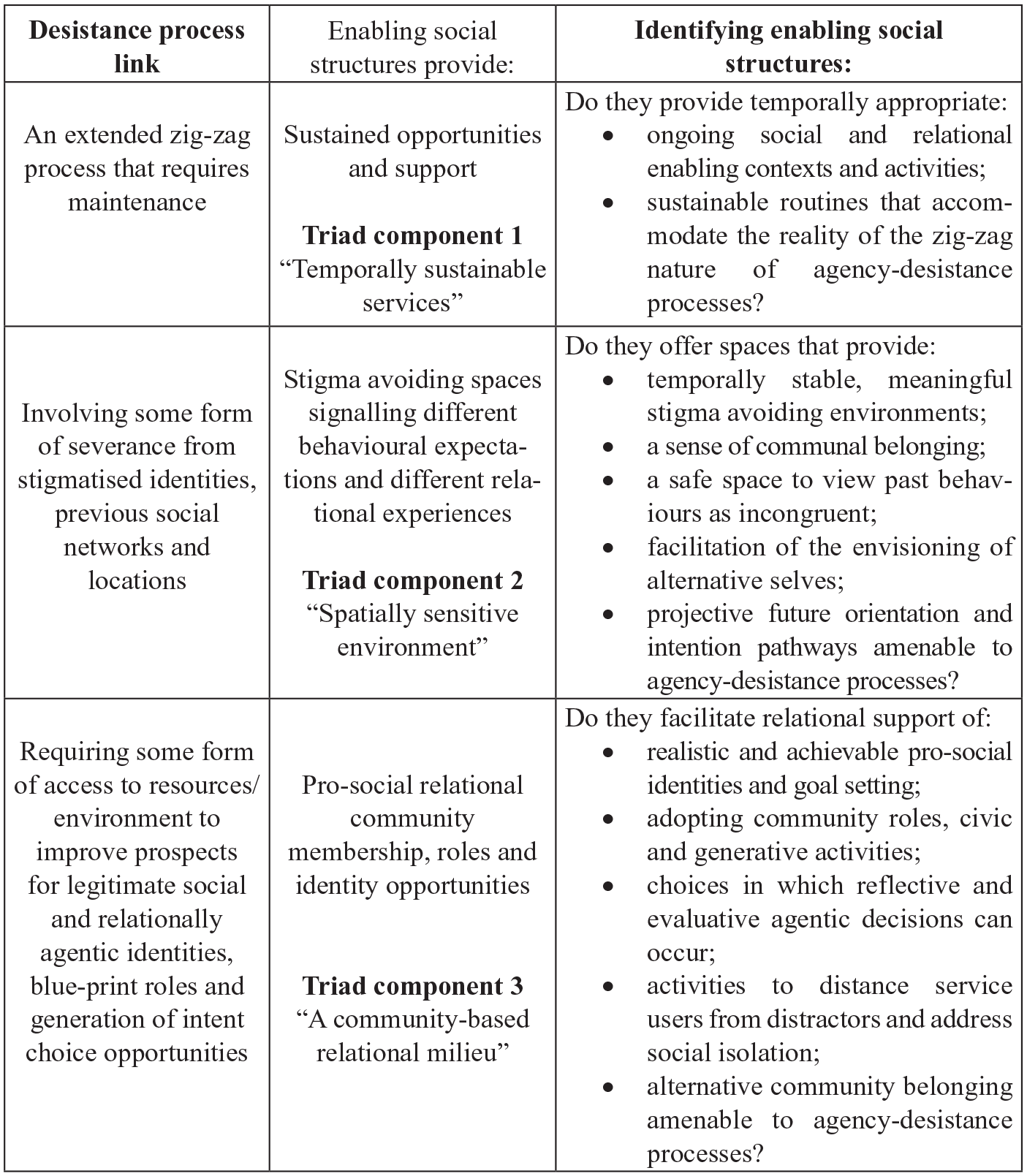
Triad of core components of enabling social structures.
Findings triad component 1: Temporally sustainable support services
Sustained agency–desistance activation opportunities
Agency actualization is described as the first key step into desistance trajectories, be that as ‘up front work’ (Paternoster and Bushway, 2009: 1152) or ‘agentic moves’ (Giordano et al., 2002: 992). It would therefore appear that the well-established empirical observation of a ‘temporal zig zag nature’ (Farrall et al., 2010: 560; see also Phillips, 2017) of desistance trajectories does not fit with the ownership of the desistance process residing with institutional structures whose interventions are time limited (Farrall et al., 2010).
The majority of our respondents had experience of traditional probation office appointments previous to their accessing the hub. Their reflections on this experience could be described as ‘faltering on a pendulum of ambivalence’ (Burnett, 2013: 169). For example, the first three months of Gina’s probation appointments occurred in a formal institutional environment, where ‘surviving’ the waiting room experience was her main priority. Gina’s agency can be seen to have been impeded by this experience. Not engaging agency was her survival strategy; once adopted this strategy persisted when she was taken from the waiting room into her 1:1 probation appointment:
The staff were behind glass . . . always banging on it and shouting . . . it was an intimidating environment . . . I would be just trying not to make eye-contact . . . that carried on even when I was in the appointments. you’ve got to speak to them like if you go to a bank . . . Then they’ve got to buzz each other in. I’m like ‘hmm, no’.
Many of our respondents reported these formal institutional and relational structures resulting in what has been described as weak or delayed agency actualization (Healy and O’Donnell, 2008). However, the enabling informal institutional and relational structures in the community hub context were reported as meaningfully affecting their sense of agency:
but what it’s led to [attending the hub] . . . it enables me to turn my life back around to better than it was before, so it’s been a kind of an opportunity. Everything about this [hub] is perfect. The staff are so welcoming . . . you wouldn’t think it was probation.
Individual agency was also identified as being stimulated when probationers were presented with a range of ‘more externally faced’ (Burnett, 2013: 169) opportunities from which they could elect to attend (or otherwise) at the hub outside of their probation appointments:
there’s loads offered here. It empowers people to perhaps realize that they can do things . . . that they can use other skills, they can find out what they’re good at. The main thing for me is getting out and about, not sat at home doing nothing, keeping myself occupied and active. With this it gives me a purpose.
As with Goodwin’s (2020) desistors, our service users reported benefitting from the extended period of time to allow agency–desistance processes to manifest offered by the community hub model:
if they know where everything is and where they can go for support, particularly if their order finishes then they’ve already forged links with different agencies in the community. It’s meeting their needs and meeting them where they are.
And how are you feeling now your probation has come to an end?
It’s a bit strange . . . a bit sad, but the door [to the hub] is always open if I need anything. I like the social feel. It’s just kind of coming and being here was what I enjoy the most.
Our findings thus add to an increasing body of evidence that the agency–desistance process is neither simple nor linear, underlining that standard institutional and relational structures of criminal justice interventions lack temporal dimensionality. This further implies traditional provision may be insufficient for those who do not realize agency during criminal justice’s ‘bundles of temporal and spatialised activities’ (May and Thrift, 2001, cited in Hunter and Farrall, 2015: 950). Traditional provision thus (inadvertently) places constraints on what can be achieved, highlighting a direct tension with more desistance informed temporal concerns (Farrall et al., 2010; Maguire and Raynor, 2006). In short, enabling social structures can provide temporal routines that are more amenable to the zig-zag trajectories of desistance theory frameworks. Enabling institutional and relational structures can therefore disrupt the criminal justice system’s desistance-incongruent disciplines of time and concomitant ownership of the means of the agency–desistance process. The data presented here contribute to the understanding of temporal restraints on agency–desistance processes and provide insights into how to address these.
Findings triad component 2: Spatially sensitive environments
Stigma avoiding spaces signalling different behavioural expectations and relational experiences
Across theories of desistance, spatial, situational and environmental issues are identified as highlighting the potential of experiencing different ‘places’ as safe spaces where service users can be enabled to: see their past behaviours as incongruent (Giordano, et al., 2002; Rocque, 2015); experience a crystallization of discontent and recalculate a new world view (Maruna, 2001; Paternoster and Bushway, 2009); form relationships with pro-social others and distance themselves from distractors (Paternoster and Bushway, 2009); access different routines and networks (Bottoms, 2014; Farrall et al., 2011, 2014); and recognize ‘place’ rather as ‘space’, that is, as a location where opportunities to realize different, but achievable future selves can be formulated (King, 2013a, 2103b). Distinguishing between the types of spaces in and through which meanings are generated overtly situates agency–desistance processes through service users deriving ‘a sense of belonging (or exclusion)’ (Hunter and Farrall, 2015: 948).
In our data, these factors were primarily typified by descriptions of the different behavioural and relational expectations set up by the institutional and relational structures of a formal probation office being described as ‘places’, in direct contrast to experiences of community hub sites being described as ‘spaces’ (see Hunter and Farrall, 2015). Service users accessing the hub indicated they felt respected, valued and confident: ‘I have never seen anybody kicking off . . . I’ve never felt intimidated by anybody in here’ (Adrian, Probation service user). The benefits of this space management ethos are explicitly identified by staff:
If you invite someone in to a space and they are respected and valued and welcomed, the psychology would suggest that they will behave differently and they will be responsive to that. I do think that’s because they feel safe here. The whole ethos . . . is about breaking down the barriers . . . so that it’s not us and them . . . and projecting that . . . everyone that comes here is a visitor, not a service user or client.
This impacted on probationers’ relational expectations of more open, informal and equal relationships which enhanced retention and engagement behaviour:
I think if they weren’t . . . I probably wouldn’t be so trusting . . . I’d probably be a bit more, ‘oh, I don’t want to talk to you about my business’. It’s not an atmosphere that you could come in and think, ‘Oh God, I’m back here again, I don’t want to do this’.
This spatially sensitive approach set up different expectations of behaviour for service users, accommodating a more distinctly restorative interaction which could be described as a threshold into liminal rites of transition (Turner, 1969; Van Gennep, 1960 [1908]):
you’ve been stood at the glass screen trying to get someone to hear . . . already wound up like a blooming spring . . . then to a room where it looks like you are an axe wielding maniac . . . It’s almost a self-fulfilled prophecy. [Whereas in the hub] there’s a very different approach that changes the whole dynamics. We don’t have a security team; we have a welcome team.
The stigma associated with an offending identity is described as invisible punishment (Travis, 2002). Opportunities for people on probation to access different institutional and relational structured spaces where stigma is avoided are limited (Jamieson et al., 1999; Skeggs, 2004). Our findings indicate that social structures directly addressing stigma enhance motivation to attend formal appointments: ‘It’s not a big sign outside saying “probation” basically’ (Rory, Probation service user). Such social structures operate to disassociate attendees from an offending identity:
[Usually] when you come in to probation it’s so embarrassing, because of what you’ve done. You’re walking around with your head down. I don’t feel such a stigma coming here as I did going to the probation [office].
The data presented here are from the three of the six hubs in our sample that offered mixed provision, the other three delivered to probation service users only. These data demonstrate the potential of enabling social structures to provide meaningful places where stigma is minimized and behavioural expectations are strengths-based (Albertson, 2015; Albertson et al., 2015). This illustrates the benefits of spaces avoiding identifying probationers with the ‘behaviours we would rather they left behind’ (McNeill and Maruna, 2007: 235). The data presented here contribute to understanding the spatial impact on the agency–desistance actualization process and provide insights into how to reflect these issues in delivery setting planning.
Findings triad component 3: A community-based relational milieu
Pro-social relational community membership, roles and identity opportunities
Decisions—for example, to desist—must be contextualized by the availability of the institutional and relational structural resources required to realize these decisions, as the circumstances in which people make decisions ‘may not enable them to live up to these decisions’ (Farrall and Bowling, 1999: 260). Social reinforcement of, and recognition of, attempts to desist are identified as ‘critical features’ often missing in probationers’ lives (Giordano, 2016: 22). Desistance can be a painfully socially isolating experience (Farrall et al., 2010; Nugent and Schinkel, 2016) as access to building social capital (Putnam, 2000) opportunities are often limited. Yet, the actual social structural mechanisms by which these issues can be addressed remain unclear in terms of any realistic proposals to link service users into wider relational contexts.
The benefits of addressing social isolation and access to informal pro-social capital building contexts are key findings of this study. Probationers were linked into pro-social capital building opportunities via their interaction with the wider community. This is demonstrated in the following interviewer/respondent exchange:
These activities, are they for people on probation or people not on probation?
Probation service user: A mix
How did that feel?
It didn’t make me feel any different to themselves really. I mean they don’t pre-judge you or nothing like that. [I] made really good friends. From here I’ve been able to—it’s broadened my support network . . . I can reach out to people and talk to them if I have a problem.
These links were identified as occurring to a greater degree in hubs where membership is not restricted to probation service users only. Of the hub governance sub-types (Gardner, 2016), this mixed delivery ethos existed in half of the hubs, but was more explicitly championed by the independent CVS-run and hybrid hubs. Reciprocally beneficial relationships were reported for members of both the probation and non-probation community hub; members of both groups can often suffer from social isolation. For our probation service user participants, these relationships provided motivation, hope and reassurance:
[We have] some women who have never been anywhere near the criminal justice system, but they’re quite isolated . . . what’s lovely about that is that some of the younger, particularly more chaotic women [on probation orders], they absolutely love having those women in the group because it’s like an older, female . . . mum type. I feel so low but then when I come here I’m thinking I’m not on my own . . . you see other normal [non-offending] people and you hear them talking and you’re thinking well, it’s not just me.
Being able to choose between two or more realistic possibilities is a key feature of agency. The multi-agency institutional structure of the hubs enables a large range of activities in which people on probation can choose to get involved or otherwise. This includes drama groups; craft workshops; creative writing clubs; walking groups; and allotment gardening groups. Such activities also provide opportunities to build social capital alongside reducing social isolation:
you’re going to like make friends and bond with people, like to have the support network of friends and stuff. there is always different things going on in here every day. They have trips where they go and do stuff out and about.
Because the hubs institutional and relational structures operate to connect people with few existing resources into these activities, probation service users felt they were being provided with the opportunity to garner realistic everyday relational encounters within their community (see Gadd, 2006):
you’ve got people buying in to it and a sense of belonging—you can’t buy those things can you? You can’t buy a relationship. You can’t buy trust. You can’t buy all the things that you get from being visible in the community and just dropping in and becoming familiar with people. Relationships are key to it all.
The hubs provided opportunities for people on probation to engage in civic and generative roles via leading volunteer and service user groups representing their hub community:
We have a service user-led group . . . it’s led by an ex-service user that used to come here. I do voluntary work . . . we’re building beds and growing vegetables and anyone can access . . . It’s to keep myself busy . . . gives me something to do and something to get up for. I did the Away-Day so I went and talked to lots of people . . . about my experience.
The data presented here contribute to understanding the interaction between institutional and relational structure and agency with regard to enabling probationers to realize their desistance aspirations. This section demonstrates the potential of enabling structures to provide probation service users with realistic choices that are of value to them.
Overall, these three empirical component findings extend our current understanding of the links between agency and structurally facilitated dimensions of: temporality; meaningful utilization of space; and realistic links into local community membership. Thus, we highlight that theoretical frameworks focusing on individual agency activation lack consideration of the institutional and relational structures that can support the agency–desistance process. In other words, these frameworks cannot adequately account for the interdependency of the processes which have been presented here, resulting from the observed interplay of agentic and structural factors experienced by our respondents.
A triad of core components of agency–desistance enabling social structures
Our triad, presented in Figure 1, evolved out of an analysis of qualitative data as an inductively generated framework of agency actualization ‘consistent with the theory of crime and desistance’ (Paternoster, 2017: 353). This led to the induction of key social structural features which lend themselves to the integration of agency and both institutional and relational social structures. Our triad illustrates enabling social structures which provide access to sustained, anti-stigmatizing spaces and contact with pro-social relational resources, as illustrated in Figure 1.
Significantly, while each of our triad of components were evident throughout the community hub governance sub-types in the sample, they were most clearly identified in those sites located towards the independent community hub category (Gardner, 2016). The implication of this question of ownership is discussed further in the next section.
Discussion
The wider literature advocates that desistance-informed interventions be directed at the communal, social and personal contexts in which people on probation are located (Farrall, 2002; King, 2013a, 2013b; McCulloch, 2005). Despite this, there have been few examples proffered regarding alternative ways in which formal to informal social structures can effectively be realized, let alone how to ensure ownership of the desistance process remains ‘with its rightful owners—victims, offenders and communities’ (Maruna, 2006: 24). Our desistance enabling social structure triad is grounded in desistance theory frameworks and developed around our key premise; that the provision of enabling institutional and relational structures in the communities within which people on probation reside will increase the prospect of agency being realized.
Our findings demonstrate the potential for the structural facilitation of different institutional and relational experiences that are more consistent with spatial, situational and stigma-avoidant theoretical frameworks. This contrasts with the maintenance of a system prioritizing formal institutional demands over the agency–desistance needs of its service users. These findings highlight how traditionally structured criminal justice reporting and reception behaviour expectations operate, in effect if not in intent, to reinforce and extend stigma. This constitutes a significant development to the integration of agency and structure in the desistance process. The results presented here are induced from primary data and motivate theoretical frameworks of desistance specifically incorporating structures that are enabling of desistance alongside issues of appropriate ownership. The findings of our study are in line with the increasing acknowledgement that ‘the process of change exists before, behind and beyond the intervention’ (McNeill et al., 2012: 13).
The potential for enabling social structures providing spaces that dissociate probationers with their offending past is illustrated by our findings. The data underline the meaning implicit in certain places to those engaged in the criminal justice system; these inherent meanings can underpin (or undermine) efforts to desist (Hunter and Farrall, 2015). Hubs, for example, do not quarantine probationers into places and activities clearly identified as being delivered to a stigmatized group.
Our findings also highlight the potential of facilitating connections into agency–desistance supporting opportunities in the wider informal institutional and relational structural context, by illustrating the benefits of enabling opportunities for the formation of an identity through participating in a new practice or community (Albertson et al., 2015; Wenger, 1998). Our study illustrates the benefits of a community delivery model example which enables social structures that develop and support naturally occurring community processes (Farrall, 2004). This point is aligned with the argument that the desistance process is not—indeed, cannot be—owned by professionals, but that informal enabling social structures have a role in facilitating spaces where ‘citizens, not professionals’ are ‘the primary agents’ (Maruna, 2006: 28).
Conclusion
Ultimately, the contribution of this article is that it informs innovative informal and parsimonious intervention designs, underpinned by the acknowledgement that: ‘instead of agency resting on the reflexive monitoring of action or the reflexive deliberation on structurally defined choices, agency emerges from our emotional relatedness to others as social relations unfold across time and space’ (Burkitt, 2016: 322). Our triad identifies enabling institutional and relational structures which are consistent with desistance theoretical frameworks. The relevance of the ownership question was realized as a salient feature in our study. Enabling institutional and relational structures were identified as increasing the further away one moves from the criminal justice ownership sub-types along the ownership/management range of community hub sub-types, from those being run by criminal justice agencies to those operated by the CVS (Gardner, 2016).
This observation can be explained by the application of the ‘conflicts as property’ perspective (Christie, 1977), which leads us back to this article’s opening question: who owns desistance?
The conflicts as property perspective, seminal to the restorative justice movement, informs a critique of formal criminal justice owned procedures as institutional and relational structures distant from ordinary people’s informal lives; resulting in victims, offenders and communities being ‘denied rights to full participation’ (Christie, 1977: 3). Christie (1977: 5) asserts that, where ownership is located within official justice institutional and architectural spaces two types of formal segmentation occur: ‘spatial and caste’. These categories describe a separation between formal and informal spaces and also people groups. Space-wise, segmentation is said to occur in terms of physical location and the architectural design in a formal setting. People-group-wise, segmentation is said to occur between formal experts and informal supporters, networks and communities, who are excluded from these institutional and relational structures (Christie, 1977).
Our study highlights that hub services delivered ‘for the community, in the community and by the community’ are temporally more appropriate as sustainable informal spaces. Furthermore, informal relations are important to probationers, whereas formal spaces and relations have ‘limited relevance’ (Christie, 1977: 5; McNeill, 2012; McNeill et al., 2012). If viewed from this ‘conflicts as property’ perspective, our triad highlights how informal enabling social structures can be realized appropriately within the communities in which probationers reside. Thus, our triad echoes Maruna’s (2006: 28–31) list of the principles of restorative re-entry in the context of desistance.
The acknowledgement of the ‘conflicts as property’ (Christie, 1977) perspective means less intrusive models of criminal justice intervention may be realized (see, for example, McNeill, 2018) as parsimony in the design and delivery of probation services are considered. This would involve sharing some of the control formal criminal justice structures hold over the timing, location and range of services it supports (Albertson et al., 2015: Phillips et al., 2020a; Weaver, 2012). Informed by these findings, we suggest that commissioning criminal justice services adopt a meso-broker role for probation services into agency–desistance opportunities (Dowden and Andrews, 2004; Nugent and Schinkel, 2016) as a strategy towards supporting informal institutional and relational structures that are meaningful to probationers. Our study identifies communally owned institutional and relational structures that are enabling in the sense that they assist in making the agency–desistance process less like ‘an endurance test’ (Nugent and Schinkel, 2016: 580) and more like a realistically grounded supported intervention for probationers.
Footnotes
Acknowledgements
The authors would like to thank Sarah Goodwin, Jamie Grace and Kevin Albertson for comments on earlier drafts. Particular thanks must go to the journal’s anonymous reviewers whose comments and proposed revisions resulted in a much stronger article.
Funding
The author(s) disclosed receipt of the following financial support for the research, authorship and/or publication of this article: the authors disclose receipt of the following financial support for the original HMI Probation research project, entitled: ‘Identifying the potential role of community hubs to help deliver probation services and support desistance’, which was undertaken by the authors in 2019. No financial support was received for the writing of this article.
