




Abstract
This study aimed to examine how structural ableism affects autistic learners by collecting first-person perspectives of current and former autistic students about how their school experiences shaped their ability to self-advocate. In addition, the study aimed to further highlight autistic perspectives by incorporating a community-participatory research design, which consisted of a primarily autistic research team. Participants consisted of 19 autistic adolescents and adults who represented a wide array of intersectional sociodemographic identities. Participants were engaged in a 90-min semi-structured interview to discuss their school experiences. Interviews were analyzed qualitatively and inductively through a critical constructivist approach to grounded theory. Data analysis highlighted many structural barriers to autistic self-advocacy for our participants. These barriers were described within six distinct domains which emerged as themes in our analysis: erasure, conformity, isolation, oppression, hidden expectations, and authority. This qualitative, community-participatory research study exposes the degree to which systems-level ableism exists within US K–12 systems. Specifically, our participants emphasized ableism that went beyond the individual or interpersonal level. We conclude with a series of recommendations on how to combat these manifestations of ableism in schools.
Lay summary
The goal of this study was to ask current and former autistic students about their school experiences and self-advocacy. Self-advocacy means being able to ask for what you need and to make your own choices. Nineteen autistic students were interviewed about self-advocacy at school. These autistic students told the research team that schools often made it hard for them to self-advocate. They also told the research team that schools were ableist, meaning that they did not respect the rights of disabled people. This study is important because it shows ways in which schools do not support autistic people and recommends ways for schools to treat autistic people better. This study is also important because the research team was mostly autistic. The expertise of autistic researchers on our team helped us create research that highlights autistic people’s voices.
Keywords
Introduction
According to the Universal Declaration for Human Rights, “Education shall be directed to the full development of the human personality and to the strengthening of respect for human rights and fundamental freedoms” (United Nations (UN), 1948). Unfortunately, historic ableism within US K–12 school systems has prevented autistic students from realizing their full potential (Baglieri & Lalvani, 2019; DeMatthews, 2019; Parekh, 2023). According to the US National Council on Disability (NCD, 2018), the US K–12 education system, which typically serves children from ages 5 to 18, does not successfully meet the needs of their disabled students. This failure to meet disabled students’ needs has led to educational disparities between disabled and nondisabled students, such that disabled students are more often segregated from their classmates, less likely to graduate high school, and less likely to pursue higher education than their nondisabled peers (Brown et al., 2021; NCD, 2018).
While these educational disparities have been documented across students with a variety of disabilities, autistic students specifically experience additional unmet needs at school. For example, autistic students endure higher levels of social exclusion, peer victimization, sensory challenges with the school environment, and stress than their nonautistic peers (Feldman et al., 2022; Goodall, 2018; Horgan et al., 2023; NCD, 2018; Rowley et al., 2012). In addition, many autistic students express dissatisfaction toward their K–12 educational experiences and the degree to which their classrooms prepare them for adult life (Brede et al., 2017; Parsons, 2014; Williams et al., 2019). Sources of dissatisfaction include lack of representation of autism in school curricula and lack of acceptance among peers (Boshoff et al., 2024; Brede et al., 2017; Mueller, 2021). These negative effects have lasting implications for autistic students, as significant positive correlations have been found between the quality of autistic adults’ prior experiences at school and their later life satisfaction (Parsons, 2014).
Research has only recently begun to document ableism in school systems by incorporating first-person perspectives of autistic students (Newson et al., 2024). Thus, this relatively small body of existing research does not reflect the multidimensionality of autism experiences. Current research that documents first-person narratives of autistic individuals’ school experiences vastly underrepresents autistic students of color, autistic students who do not identify as cisgender male, and autistic students with other historically marginalized identities (Newson et al., 2024; Zanuttini, 2023). In addition, very little research has focused on autistic students’ experiences of self-advocacy, even though autistic students are less likely to engage in self-advocacy at school than other disabled students (Santhanam & Wilson, 2023).
In this study, we aim to examine how structural ableism affects autistic learners by collecting first-person perspectives of current and former autistic students around how their K–12 school experiences shaped their ability to self-advocate. This aim was accomplished through a community-participatory, neurodivergent-led research team implementing an inductive, qualitative research design. In the following sections, we will further contextualize our study within the existing literature by discussing the ways in which autistic voices have historically been excluded from discussions related to research and policy and emphasizing the importance of fostering self-advocacy among autistic youth, particularly in K–12 school settings.
Autistic underrepresentation
Autistic voices continue to be left out of conversations that directly impact educational research and reform (Horgan et al., 2023; Newson et al., 2024). Recent literature reflects a call to action involving autistic perspectives in decisions about education, as autistic people are on the receiving end of these practices (Holmes, 2022). Autistic testimony provides critical insight into understanding the larger autistic community, offering lived experiences and making practical suggestions toward inclusive practices.
The absence of autistic perspectives in education research reflects a larger context in which autistic perspectives have historically been left out of autism research more broadly (Dinishak & Akhtar, 2023; Milton, 2014). Autistic advocacy groups call for autistic researchers to be adequately represented and for participatory research designs that facilitate autistic leadership (Fletcher-Watson et al., 2019; Keating, 2021; Nicolaidis et al., 2019; Pukki et al., 2022). However, much of autism research still does not include autistic researchers and does not adequately meet autistic people’s needs (Dinishak & Akhtar, 2023; Pellicano et al., 2014).
This widespread exclusion of autistic perspectives within research stems from attitudes that have historically undervalued autistic expertise. Although autistic individuals have been identified in the literature as autism experts, their expertise has often been devalued relative to nonautistic academics (Gillespie-Lynch et al., 2017; Milton, 2014). Moreover, the first-person perspectives of autistic youth as research participants reporting on their own experiences have been especially absent (Newson et al., 2024). Our participatory research model, which puts autistic voices at the forefront of our research design both as researchers and as participants, aims to tap into the expertise of autistic lived experience in the context of the US education system.
Autistic self-advocacy
To our knowledge, no research to date specifically examines autistic individuals’ first-person perspectives about self-advocacy during their K–12 school experiences. Self-advocacy has been broadly defined in the literature as knowledge of oneself, knowledge of one’s rights, the ability to communicate one’s needs, and the ability to initiate and/or lead change (Schena et al., 2023; Test et al., 2005). Self-advocacy can manifest in a variety of forms across individuals and is a critical means by which disabled people request and obtain the necessary accommodations and resources to which they are entitled (Autistic Self Advocacy Network (ASAN), 2021; Schena et al., 2023). Self-advocacy is often emphasized within autistic advocacy groups to counteract ableist narratives that autistic individuals are unable to be autonomous and/or make decisions for themselves (Test et al., 2005). Thus, the importance of self-advocacy has historically been intertwined with disability advocacy and the neurodiversity movement (ASAN, 2021; Leadbitter et al., 2021; Longhurst, 1994; Williams & Shoultz, 1984).
We specifically emphasize self-advocacy in this study because self-advocacy skills are associated with a wide variety of positive outcomes among autistic and nonautistic individuals. Interventions that directly target these skills have noted positive relationships among self-advocacy skills, empowerment, and autonomy (Rankin et al., 2024; Schena et al., 2023). Similarly, self-advocacy has been noted as an important contributor to mental health and a tool in psychosocial interventions (Stylianos & Kehyayan, 2012). For example, increased self-advocacy skills predicted reduced hopelessness and psychiatric symptoms in a therapeutic setting with participants experiencing various mental health problems (Pickett et al., 2010).
Within school settings, self-advocacy skills may contribute to students’ success in the classroom and beyond. For example, stronger self-advocacy skills have been associated with higher school retention and classroom engagement among students (Doren & Kang, 2015; Roberts et al., 2016). Similarly, disabled adults with greater self-advocacy skills are more likely to succeed in postsecondary education and employment settings (Roberts et al., 2016; Santhanam & Bellon-Harn, 2022). For these reasons, it is important to evaluate the extent to which autistic students feel comfortable self-advocating in school settings.
The current study
This study is novel for many reasons. It is the first study to date that specifically examines first-person narratives of autistic adults and adolescents about their experiences of self-advocacy in K–12 school settings. In addition, this study prioritizes the inclusion of autistic perspectives from historically marginalized communities, which further differentiates it from other studies that document first-person perspectives of autistic students. Furthermore, this is the first study to our knowledge that integrates the perspectives of both current students and adults looking back retroactively on their school experiences. Finally, the community-participatory nature of our design, in which our research team was primarily composed of autistic researchers, distinguishes this study from many other autism research studies, which often do not include autistic individuals among their collaborators.
Methods
Research design overview
To amplify autistic lived experience as authentically as possible, we implemented a modified grounded theory research design using a constructivist-social justice approach and a community-participatory framework (Charmaz, 2014, 2017; Levitt, 2015, 2021; Nicolaidis et al., 2011). Grounded theory was chosen for its emphasis on inductive theory generation, which aligns with our goal to construct new meaning about US K–12 schooling based in autistic students’ collective experiences (Glaser & Strauss, 1967; Hood, 2007). To highlight the multiplicity of autistic lived experience, we elected to draw from constructivist grounded theory, which posits that reality consists of multiple perspectives, rather than classic grounded theory, which more so emphasizes one objective and universal truth (Charmaz, 2014, 2017; O’Connor et al., 2018). Furthermore, our choice to describe our approach as constructivist-social justice was inspired by Levitt, who defined this approach as a form of grounded theory rooted in critical consciousness and social transformation (Levitt, 2015). In sum, a constructivist-social justice approach to grounded theory aligns with our aim to outline systemic forces that uphold systems of oppression, namely, ableism, by centering the experiences of autistic people, who hold complex and often marginalized intersecting identities.
The community-participatory nature of our study is rooted in the fact that our core research team was primarily composed of autistic and neurodivergent investigators. In addition, most team members came from backgrounds with professional expertise outside of psychology research. To combat the historic marginalization of autistic voices in autism research, one or more autistic co-investigators were involved in all stages of the research process, including developing and refining our research question, composing interview questions, transcribing interview data, analyzing data, and writing and disseminating findings. Thus, the research focus and guiding questions reflected priorities identified jointly by the team. In addition, the results and interpretation reflect analysis by all members.
Core research team/reflexivity
Consistent with community-participatory research practices, the core research team consisted of two neurodivergent researchers in clinical psychology and four autistic co-investigators with expertise in disability advocacy, higher education, and early childhood education, alongside other professional and lived experiences. In alignment with constructivist grounded theory, which prioritizes researcher reflexivity such that researchers as well as participants are active contributors toward study findings, the core research team engaged in frequent discussions about positionality, accessibility, lived experience, and bias (Charmaz, 2014, 2017). Reflexivity discussions allowed the research team to conceptualize the ways in which the data, as well as researchers’ experiences, were located within larger social and cultural contexts (Charmaz, 2017; Levitt, 2015).
To ensure meaningful and accessible participation for all team members, we adapted elements of Nicolaidis et al.’s (2011, 2019) recommendations on fostering successful community–participatory research collaborations with autistic researchers. These efforts included collaborating in various formats, such as large team meetings, informal small-group meetings, individual check-ins, and written exchanges. In large team meetings, agendas were provided in advance and comprehensive notes were taken. These meetings served as a platform to discuss project progress and milestones, share reflections and lived experiences, and discuss action items. Small-group meetings, individual check-ins, and written exchanges supplemented larger meetings and enabled further processing, reflection, and clarification.
Study participants
Nineteen autistic adolescents and adults participated in this study. Participants were recruited through local autism advocacy groups, autism support organizations, social media groups for autistic adults, and word of mouth. People who met eligibility criteria (ages 15 and older; based in the United States; attended K–12 schooling in the United States; self-identified as being autistic or having a diagnosis of autism or historically equivalent diagnosis such as Asperger’s) were provided with the consent form (and assent form, for those younger than 18 years). Participants were selected via theoretical sampling to represent a variety of sociodemographic identities and autism experiences (communication preferences, autism identities, age of diagnosis, etc.) (Charmaz, 2014; Hood, 2007).
Participants were 22 years of age on average (range: 16–43 years) and were diagnosed at 12.5 years of age on average (range: 2–35 years). Roughly half (47%) identified as people of color. Regarding gender, 32% identified as female, 37% identified as male, and 32% identified outside of the gender binary. Most reported communicating with spoken language only (95%), and one endorsed using an Augmentative and Alternative Communication (AAC) device (5%). More comprehensive demographics of study participants are presented in Table 1.
Participant demographics.
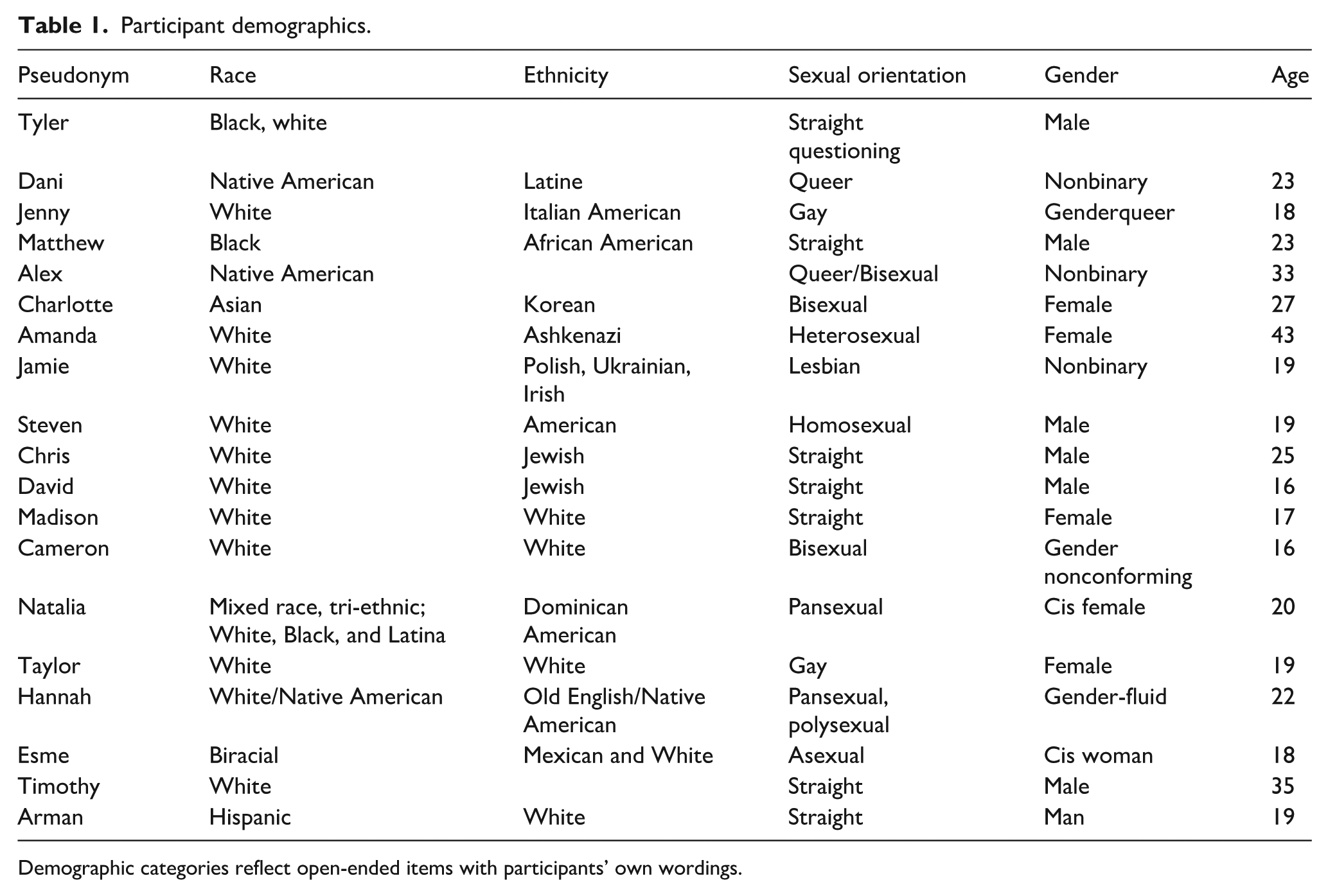
Demographic categories reflect open-ended items with participants’ own wordings.
Procedure
Participants completed one semi-structured interview approximately 90 min in length. Participants were given the option to complete the interview in whatever modality felt most comfortable to them, including in-person, in-person with a loved one present, online via video call, and online via direct message.
Data analysis
Interviews were analyzed iteratively through the following process rooted in constructivist grounded theory (Charmaz, 2014, 2017; Levitt, 2021; Rennie, 2000). First, interview transcripts were coded line-by-line via open coding (Charmaz, 2014; Holton, 2007). This open coding process resulted in the generation of meaning units, defined by Rennie as summary statements that correspond to one section of text reflecting a single unit of meaning pertaining to the research question (Rennie, 2000). Examples of meaning units from this study include “teachers did not believe participant’s report of being physically harmed by other students until the participant came into class with crutches” and “teachers became irritated when the participant frequently asked questions, although the participant genuinely didn’t understand the instructions.”
Next, meaning units were juxtaposed via constant comparison to group meaning units into preliminary categories that reflected patterns in the data (Charmaz, 2014; Glaser & Strauss, 1967). These initial categories underwent a similar comparative analysis, which led to the generation of higher-order categories. These higher-order categories were then examined in relation to each other and in relation to their subcategories through axial coding, which ultimately culminated into a single hierarchy of categories (Walker & Myrick, 2006).
Following the first 10 interviews, as new interview transcripts and their meaning units were added, they were integrated into the existing hierarchy. This addition of new interview data required the team to iteratively edit our hierarchy by restructuring, expanding, and/or adding categories. Saturation, which is defined as the point in data collection when adding new data does not contribute any new meaning to the existing hierarchy, was achieved at 19 participants (Charmaz, 2014). We specifically defined saturation for the purpose of this study as the point in which a novel interview transcript had no meaning units that yielded any new lower- or higher-order categories or suggested any new modifications to any existing category. This point of saturation signaled the conclusion of data collection and analysis.
Data trustworthiness
The research team took the following steps to promote the trustworthiness and credibility of our findings. First, each interview concluded with two credibility questions to ensure that participants’ experiences were captured wholly (“Do you have anything else that you would like to add about your school experiences that we didn’t get to?” and “Do you have any feedback for me about the interview or about our study?”). Second, researchers engaged in memo writing and reflexive journaling to grapple with their impressions and reactions elicited from transcripts and to engage in reflexivity about the findings in relation to their own positionalities. Third, the research team regularly engaged in peer debriefing with clinical psychology researchers not involved in the analyses to share reactions to transcripts in a collective space and discuss reflections drawing from clinical, professional, and lived experiences. Team meetings among members of the core research team were also conducted to ensure consensus about category decisions. Finally, we obtained feedback from a subset of participants (n = 4) in response to a member-checking survey out of the nine contacted (permission to follow-up was only sought and obtained from the latter nine participants). For each theme, participants rated their agreement with the following statements: “I think this theme represents my school experiences well” and “I think this theme is important.” Ratings were quantified on a 5-point scale (1 = not at all, 3 = in the middle, 5 = very much). Although they had been involved in analyses, three autistic co-investigators on our core research team also submitted feedback ratings on this statement: “I think this theme is important.”
Results
This study examines first-person perspectives of current autistic students and autistic adults about how their K–12 experiences impacted their ability to self-advocate. Data analysis yielded a hierarchy that consisted of one core theme and six main categories. To provide further depth of meaning, each of the six main categories was divided into two to three subcategories. Categories and their respective subcategories are presented in Figure 1 and are discussed below with quotes that represent participants’ lived experiences. Quotes were selected to best represent our findings, to reflect passages that were voted on by autistic co-investigators, and to represent as many participants as possible (n = 14). Names attributed to participants during this section are pseudonyms given to uphold participant confidentiality.
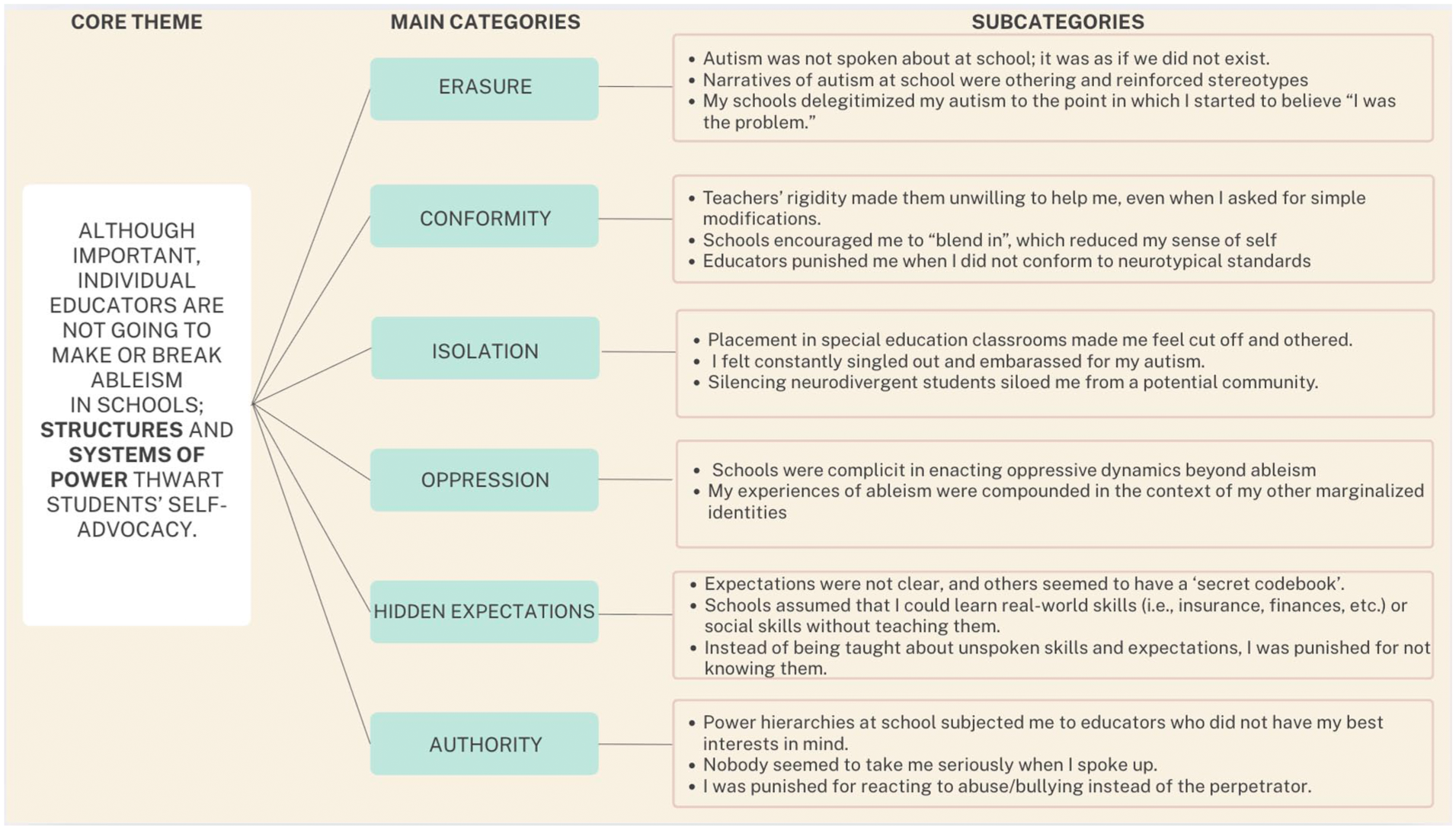
Hierarchy consisting of core theme, main categories, and subcategories.
An important element of our methodological process was to analyze data flexibly and cocreate meaning inductively. Originally, our team had expected to examine autistic adults’ reflections upon the conditions that best led to self-advocacy during their school experiences. However, shortly into analysis, it became clear that participants were telling us that US K–12 school systems are not conducive to self-advocacy at a fundamental, structural level. These sentiments were further echoed within our feedback check ratings, which are presented in Table 2. Thus, our data analysis yielded a core theme that centers structural barriers over individual barriers to self-advocacy.
Participant and consultant feedback ratings.
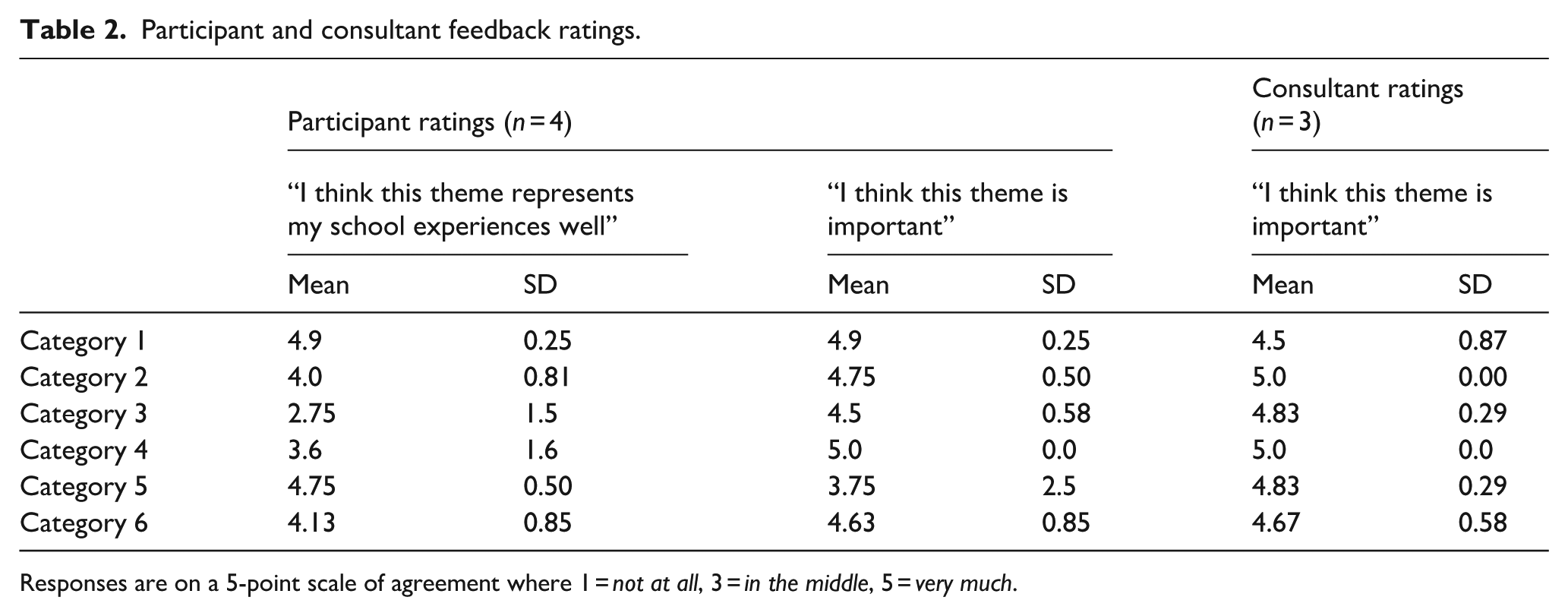
Responses are on a 5-point scale of agreement where 1 = not at all, 3 = in the middle, 5 = very much.
Core theme: although important, individual educators are not going to make or break ableism in schools; structures and systems of power thwart students’ self-advocacy
All participants recounted how systemic ableism was baked into the foundation of US K–12 school systems. Participants described structural ableism within six distinct domains, which are represented by our six main categories: erasure, conformity, isolation, oppression, hidden expectations, and authority. Participants reported that barriers to self-advocacy were most significant at levels beyond the individual. Even with good intent, individual educators could not deconstruct these barriers due to the higher-level manifestations of ableism. The sections below provide more detail about each of our six main categories and their respective subcategories.
Category 1. Erasure
In this category, participants described how schools perpetuated autistic erasure. This category was endorsed by 17 participants and is divided into three subcategories. These subcategories expand upon this larger category by discussing how students received few opportunities to learn about autism in school, experienced stereotyped narratives about autism, and often learned to view their own autistic traits negatively.
Subcategory 1.1. Autism was not spoken about at school; it was as if we did not exist
Eleven participants shared that autism was rarely acknowledged during their K–12 school experiences. Participants noted that they did not realize this silence until later in life when they had more knowledge about their own autistic selves. Alex, a nonbinary adult in their 30s, stated, “I guess I’m realizing that sort of the poverty of education about autistic people in school” Similarly, Amanda, a woman in her 40s, reflected, “I don’t remember [autism] being talked about at all . . . Like I don’t think it was stigmatized. I don’t think it was there. I think it was absent.” Upon reflecting about the lack of discourse about autism in schools, participants expressed that they did not have the tools or knowledge about their autistic selves required to understand their own needs. Participants described that having knowledge about autism, which often came later in life for many of them, was critical for their self-advocacy.
Subcategory 1.2. Narratives of autism at school were othering and reinforced stereotypes
Eleven participants expressed that autistic erasure also manifested as unidimensional conceptualizations of autism, presenting autistic people as weak, voiceless, and even threatening. Matthew, a young man in his 20s, noted, “the way they talk about autism [in school] is like, um, some deadly disease, which once you are diagnosed you can never be anybody in the future.” Matthew’s experience mirrored that of many others, who received narratives that framed autism as harmful and even damning. Dani, a young adult in their 20s, described how even teachers with good intentions spread alienating messaging: “when teachers tried to be publicly supportive [of autism], it often turned into a ‘treat your peers with kindness even if they are weird’ lesson, which othered me even more.” To combat stereotypical discourse, participants called upon schools to teach about autism in ways that highlighted the complexity of the autistic experience.
Subcategory 1.3. My schools delegitimized my autism to the point in which I started to believe “I was the problem.”
Thirteen participants described how invalidating experiences at school perpetuated erasure, such that students questioned the validity of their own experiences; participants described that this type of erasure led them to experience internalized ableism and blame themselves for their negative experiences. In reflecting about their K–12 teachers and classmates, Jamie, a nonbinary college student, noted, “I don’t think that they would consider me disabled because they saw me as just bad. And like, you know, they thought it was like a personal failing.” Like Matthew and Dani in the section above, Jamie was exposed to deficit-based messaging about autism without receiving counternarratives about autistic strengths and advocacy. Because Jamie and many other participants lacked the knowledge to contextualize their experiences as ableism, they internalized their autistic traits as a personal failing and felt disempowered to self-advocate.
In sum, participants described that schools perpetuated autistic erasure by failing to discuss autism in school, upholding autism stereotypes, and fostering internalized ableism among autistic students. Participants explained that autistic erasure prevented them from learning about themselves and their needs, which hindered their ability to self-advocate.
Category 2. Conformity
In this category, participants described how schools enforced conformity. This category was endorsed by all 19 participants and is divided into three subcategories. Subcategories expand upon this category by exemplifying how school staff refused to adjust educational practices based on students’ needs, how classroom culture discouraged expressions of difference, and how punishment was used to impose neurotypical behavioral standards onto neurodivergent students.
Subcategory 2.1. Teachers’ rigidity made them unwilling to help me, even when I asked for simple modifications
Eleven participants described school staff’s inflexibility and refusal to make small adjustments for the sake of students’ well-being. Participants noted that this rigidity seemed arbitrary and that the modifications requested posed little to no extra work on personnel. They often reflected that educators refused to provide flexibility even in the face of student distress. For example, Jenny, a genderqueer college student, shared the following: “I would be coming back from sobbing in the bathroom or something, and then [my teacher] would be like ‘oh, you spent too long in the bathroom, I’m going to have to mark you absent for class today.’” Frequent negative responses by K–12 school personnel made Jenny feel helpless and discouraged from speaking up for their needs. This sentiment was shared among others, who reflected that greater flexibility from educators would have helped them to self-advocate. Many participants who went on to college explained how modifications provided by their undergraduate institutions contributed markedly toward their academic success. These participants expressed sadness that they had gone so long in K–12 without adequate supports due to educators’ inflexibility.
Subcategory 2.2. Schools encouraged me to try to “blend in,” which reduced my sense of self
Fifteen participants commented on the ways in which their school rejected expressions of difference and coerced students into trying to fit in with peers. Taylor, a 19-year-old woman, commented on the degree to which schools seemingly forced a “one size fits all” approach onto their students: “[schools are] trying to shove a square peg into a round hole . . . the solution isn’t to shave off these corners of the square and force into this round hole. The solution [should be] to find the square hole.” Taylor’s reflection was echoed by other participants, who noted that these dismissals of difference were ineffective. Rather than help them integrate into the classroom environment, participants described how these experiences were painful and taught them to reject the parts of themselves that were different. In contrast, participants emphasized that educators who did value individuality were quite rare but very impactful. For example, Amanda explained that the teachers who did honor her differences “saved my life.”
Subcategory 2.3. Educators punished me when I did not conform to neurotypical standards
Fourteen participants further elaborated upon schools’ rejections of difference by describing how discipline was leveraged as a tool to regulate students’ behavior such that they adhered to neurotypical standards. Alex noted how even experiences of individuality that demonstrated academic skill were discouraged:
when you’re a kid, you don’t know that people are gonna, like, look down on you for reading ahead in the textbook, and like, you think that would make the teacher happy, and that sort of thing was always really frowned upon both by my peers and by my teachers.
Even positive behavior was punished when it did not conform to the majority, so students feared consequences that accompanied speaking up for themselves.
Overall, participants described how schools enforced conformity by refusing to be flexible on behalf of students’ needs, discouraging expressions of individuality, and punishing those who acted differently from their peers. Consequently, participants felt fearful to express themselves and their individual needs, which negatively impacted their self-advocacy.
Category 3. Isolation
In this category, participants described how school systems intentionally isolated autistic students. This category was endorsed by 16 participants and is divided into three subcategories. Subcategories expand upon this category by describing how schools cultivated physical isolation, perpetuated social isolation, and failed to foster community among autistic students.
Subcategory 3.1. Placement in special education classrooms made me feel cut off and othered
Six participants described physical experiences of separation from other students, which hindered their ability to feel part of their classroom communities. Charlotte, a graduate student in her 20s, reflected upon her K–12 experiences with special education and noted, “it definitely took hours of my time away from normal classes . . . it was pretty evident that it was like ‘oh, special education . . . we don’t fit in with most of the students.’” While Charlotte spoke about experiences leaving her classroom to participate in special education programming, David, a current high school student, reflected upon how he was also separated from his peers within the classroom:
teachers would be like, “you can only work alone on this because you are not going to do well in the group, just work alone with your aide on it.” . . . basically they’re saying that you are not good with people, you need to be controlled doing this.
Both Charlotte and David, among other participants, illustrated how physical isolation placed a barrier between them and others, thus reducing opportunities for self-advocacy and increasing alienation.
Subcategory 3.2. I felt constantly singled out and embarrassed for my autism
Thirteen students described social experiences of isolation, in which they were singled out and even ridiculed in front of others. Some noted that they were uniquely picked out from their peers in public settings by educators. For example, Jamie described an instance in which a teacher commented,
“okay class, guess who in this class wrote two pages for an answer that required one sentence? You guessed it . . .” And like, everybody would laugh. And I think that she thought that it was a funny thing . . . until I finally broke down crying in the middle of class.
Jamie reflected that this teacher’s joke, even if well-intentioned, made them uncomfortable. This sentiment was echoed by others, whose experiences of being singled out were upsetting and isolating. Participants reflected further by explaining how instances in which educators singled out autistic students modeled to peers that it was acceptable for them to do the same.
Subcategory 3.3. Silencing neurodivergent students siloed me from a potential community
Ten participants discussed the importance of social relationships in school and how experiences of isolation deprived them from the healing nature of community. Participants emphasized that isolation threatened their ability to make friends and experience companionship. In describing friendships with other neurodivergent students, Amanda reminisced, “my friends celebrated the whole weird, quirky me . . . so I was celebrated. And I celebrated them in turn.” By having a community that celebrated difference, Amanda reported feeling empowered to stand up for herself and express her needs. While some participants expressed similar feelings stemming from autistic community-building, many others lamented being unable to form this community during K–12 schooling due to experiences of isolation. For example, Jamie reflected, “I didn’t really have an example of somebody who was like me . . . so I always felt like I was broken.”
In sum, participants described how K–12 schools isolated them through physical and social exclusion while failing to encourage community-building among autistic students. Participants explained that these experiences kept them quiet so that they would not be further isolated from others, contributing to reduced identity exploration and thwarted self-advocacy.
Category 4. Oppression
In this category, participants described how they were affected by systems of oppression in school. This fourth category was endorsed by 11 participants and is divided into two subcategories. These subcategories provide further meaning to this category by discussing how schools failed to support students of marginalized backgrounds and how participants’ negative experiences in school were compounded by experiences of marginalization for other identities.
Subcategory 4.1. Schools were complicit in enacting oppressive dynamics beyond ableism
Six participants discussed how school systems implemented various forms of structural oppression, such as racism, sexism, and ableism. Participants described that students of privileged identities were treated much better than students of marginalized identities and that schools made no meaningful effort to acknowledge inequities. Jenny, who reflected upon the intersections of their genderqueer and disabled identities, described how their school was unwilling to support students of marginalized backgrounds: “we’ve had racist allegations for years, like we had to hire a diversity and equity inclusion board person, and then they were fired because the outrage of the parents was so severe.” Jenny’s sentiments were echoed by others, particularly among participants with other marginalized identities. By not making an effort to cultivate an inclusive environment, schools sent clear messages to autistic students that they were not interested in changes that would benefit the marginalized.
Subcategory 4.2. My experiences of ableism were compounded in the context of my other marginalized identities
Eight participants described how their other marginalized identities interacted with their autistic identities to yield multifaceted, compounded experiences of discrimination. Jamie described experiences of bullying in school by reflecting on “an intersection between my sexuality and my autism” and “between being fat and being autistic.” Jamie noted, “if you’re autistic but you’re like, really beautiful then it might be like ‘oh, she’s just quirky,’ but when you’re seen as fat and ugly . . . then it’s like, you know, unacceptable.” Tyler, a young man in his 20s who identified as Black and white, reflected upon trying to counteract forces of oppression:
I did a . . . program that was like a law enforcement explorer program. And part of that was actually in its own secret way to protect myself, because as a disabled person of color, I knew that the police often negatively react, and they can sometimes take life before your time.
In addition to Jamie and Tyler, other participants reflected upon the ways in which their autism intersected with their gender, race, ethnicity, body size, sexual orientation, citizenship status, and religion, among other identities.
Overall, participants explained how schools enacted oppression in a variety of forms, which impacted autistic students’ experiences in the context of their intersectional marginalized identities. Although many students were aware of the impacts of this discrimination, they noted feeling hopeless and consequently disempowered to self-advocate.
Category 5. Hidden expectations
In this category, participants described how they were expected to adhere to hidden expectations. This category was endorsed by fifteen participants and is divided into three subcategories. Subcategories describe how participants felt confused about how their classmates understood school staff’s expectations, wished that schools were more proactive about teaching real-world skills, and feared punishment for not adopting this “hidden curriculum” naturally.
Subcategory 5.1. Expectations were not clear, and others seemed to have a “secret codebook.”
Thirteen participants described feeling confused about unspoken expectations at school, although their peers seemed to have little trouble with them. Amanda noted, “I just felt, like, confused and behind and how does everyone else . . . like, know the things? I don’t know. And did they get a special manual?” To cope with feeling “confused” and “behind,” many participants reported seeking out educators for clarifications. Esme, a current high school student, recalled,
I would get a bad grade on an assignment because [my teacher] was never specific about how she wanted the assignments to be done . . . I would be like “okay, so why is my grade this way because I want to know so I can improve for the next time?” She never helped me.
Similar to Esme, many other participants experienced difficulties obtaining information about classroom expectations and often reported being dismissed and ignored when asking for assistance.
Subcategory 5.2. Schools assumed that I could learn real-world skills (i.e. insurance, finances, etc.) or social skills without teaching them
Eight participants described that another facet of their school’s hidden curriculum was a missing curriculum consisting of real-world skills that students would need to support themselves outside of the classroom. They expressed surprise and disappointment that they did not receive education on these skills. In reflecting upon their college experience, which required many skills related to independent living, Jenny described how an autistic friend of theirs would have benefited from more practical skills instruction in high school:
they didn’t receive any guidance on how to get a license, how to get an ID how to get like insurance . . . if they had the knowledge that the school system is supposed to build in you . . . they would have been able to go out into the world and figure things out like that with more ease.
Subcategory 5.3. Instead of being taught about unspoken skills and expectations, I was punished for not knowing them
Seven participants discussed how their lack of knowledge about this hidden curriculum was not met with compassion but instead with punishment. Specifically, participants noted that their misunderstandings were often met with frustration and dismissed and/or perceived as ingenuine. For example, Alex described an instance in which they had no knowledge of why they were being punished: “all of a sudden, I’m being screamed at for like, insubordination . . . or having an attitude, or, you know, using a tone or something like that . . . and it’s like, I honestly have no clue what you’re talking about.” In these moments, Alex and other participants described receiving no explanation or redirection. Because disciplinary action felt unpredictable, students feared for others’ reactions when they spoke up about what they did not understand.
In sum, participants described how schools upheld hidden expectations by failing to give clear instructions about unspoken rules, assuming that students possessed certain skills without teaching them, and punishing students for not following expectations. Participants explained how schools’ failure to provide instruction, even when students asked for help, discouraged them from self-advocating.
Category 6. Authority
In this category, participants described how schools leveraged authority to thwart students’ self-advocacy. This category was endorsed by 16 participants and is divided into three subcategories. These three subcategories discuss how participants’ agency was stifled by power hierarchies within schools, how participants were often not believed when advocating for themselves, and how participants were punished for speaking up when being mistreated.
Subcategory 6.1. Power hierarchies at school subjected me to educators who did not have my best interests in mind
Fifteen participants reflected on power hierarchies in the classroom. When describing his current high school, David expressed that his teachers “wanted to control us” and attributed disciplinary action to upholding power structures. Tyler described how even school staff who were meant to be advocates sometimes exerted power at the expense of autistic students:
There was a psychologist at my high school and she ran this separate program for those of us who have a variety of disabilities . . . and she was kind of like talking down to us . . . she was actually in my IEP evaluation one year, and my opinion was not solicited during the entire processes . . . I felt that I was boxed in, in a way and told that you don’t have any choice in the matter. You don’t have any say.
David and Tyler’s testimonies, in conjunction with others’ perspectives, illustrate how power hierarchies robbed autistic students of the opportunity to speak for themselves in school settings.
Subcategory 6.2. Nobody seemed to take me seriously when I spoke up
Eight participants described feeling dismissed when speaking up for themselves. Many felt disregarded by their educators as exemplified by Dani in the following statement: “I have a very black and white sense of justice and not being treated as an equal stakeholder in my education was hard for me.” Hannah, a gender-fluid high school student, described similar experiences: “there’s a consistent pattern of people not believing me when I say something’s not right or I can’t do something . . . there’s kind of a long history there.” Experiences of invalidation, such as those described by Dani and Hannah, contributed to participants’ feelings of helplessness and lack of trust toward adults in power, causing them to stay silent in the future. Some went on to describe how this helplessness followed them into adulthood, leading them to struggle to speak out against future experiences of abuse and victimization.
Subcategory 6.3. I was punished for reacting to abuse/bullying instead of the perpetrator
Six participants described that instances of self-advocacy were often met with victim-blaming, in which autistic students were punished for identifying bullies. Cameron, a gender nonconforming high school student, recalled a painful anecdote:
I remember in like 8th grade and stuff the principal, the vice principal, the guidance counselor, and the gym teacher all said to me, it was a meeting with them because I was getting physically beaten up almost on a daily basis. They said, “well it’s your fault because you are too vulnerable and I was like ‘I am sorry what now?’”
Timothy, an autistic man in his 30s, stated a chillingly obvious, yet unfollowed recommendation, to school staff, “I think it should be the people who tease who get punished and have to change their behavior, not the people who get teased.”
Overall, participants described how schools leveraged authority by enforcing power hierarchies, ignoring students who spoke up for themselves, and engaging in victim-blaming. Because participants were often targeted for speaking out against authority, they were hesitant to self-advocate in the future.
Discussion
This study sought to qualitatively explore autistic individuals’ perspectives about their self-advocacy in US K–12 school settings by using a constructivist, social justice–informed approach to grounded theory and a community-participatory research design. This study contributes to an important yet relatively new body of literature that highlights autistic individuals’ first-person perspectives about their school experiences. This study is novel in that it is the first to our knowledge that specifically examines current and former autistic students’ perspectives on the construct of self-advocacy during their K–12 school experiences. In addition, our theoretical sampling method, which prioritized intersectionality, addresses gaps posed by similar studies that have highlighted the need for research to amplify the perspectives of autistic students who hold historically marginalized identities (Newson et al., 2024; Zanuttini, 2023). Finally, the community-participatory nature of our study, which consisted of a primarily autistic research team, contributed important professional and lived perspectives to our data analysis and interpretation.
As a whole, our participants described feeling dissatisfied with their K–12 school experiences and having trouble self-advocating at school. Our findings, in which participants expressed that their needs were largely unmet, replicated similar studies that identified significant dissatisfaction among autistic individuals with their school experiences (Brede et al., 2017; Parsons, 2014; Williams et al., 2019). In addition, the fact that our participants experienced difficulty self-advocating aligns with other findings that autistic students are less likely to self-advocate than nonautistic students at school (Santhanam & Wilson, 2023).
Overall, participants’ testimonials yielded a core theme that described structural ableism as their most significant barrier to self-advocacy. In other words, participants expressed that their difficulties self-advocating were not due to individual skills deficits but instead due to larger manifestations of ableism within school systems. This finding provides important context for school-based interventions, many of which have begun to directly target and teach self-advocacy skills to autistic students (Schena et al., 2023; Zuber & Webber, 2019). Although it is important to equip autistic students with the skills needed to self-advocate, teaching individual self-advocacy skills without addressing structural factors and acknowledging the effects of ableism may potentially limit the outcomes and/or efficacy of these initiatives.
Thus, rather than only placing the individual responsibility onto autistic students to build self-advocacy skills, our findings provide opportunities for schools to implement educational reform to promote autistic self-advocacy. In other words, this study highlights the need for schools to adjust their own policies that uphold structural ableism. These barriers to success described by our participants align with similar challenges described by educators themselves. In recent studies, teachers have cited several structural challenges to supporting their autistic students at school, including lack of administrative support, training opportunities, and overall resources (Haspel & Lauderdale-Littin, 2020; Oliver-Kerrigan et al., 2023). Therefore, our findings suggest that autistic perspectives play a critical role in addressing and dismantling ableist educational practices that impede both students’ and educators’ success.
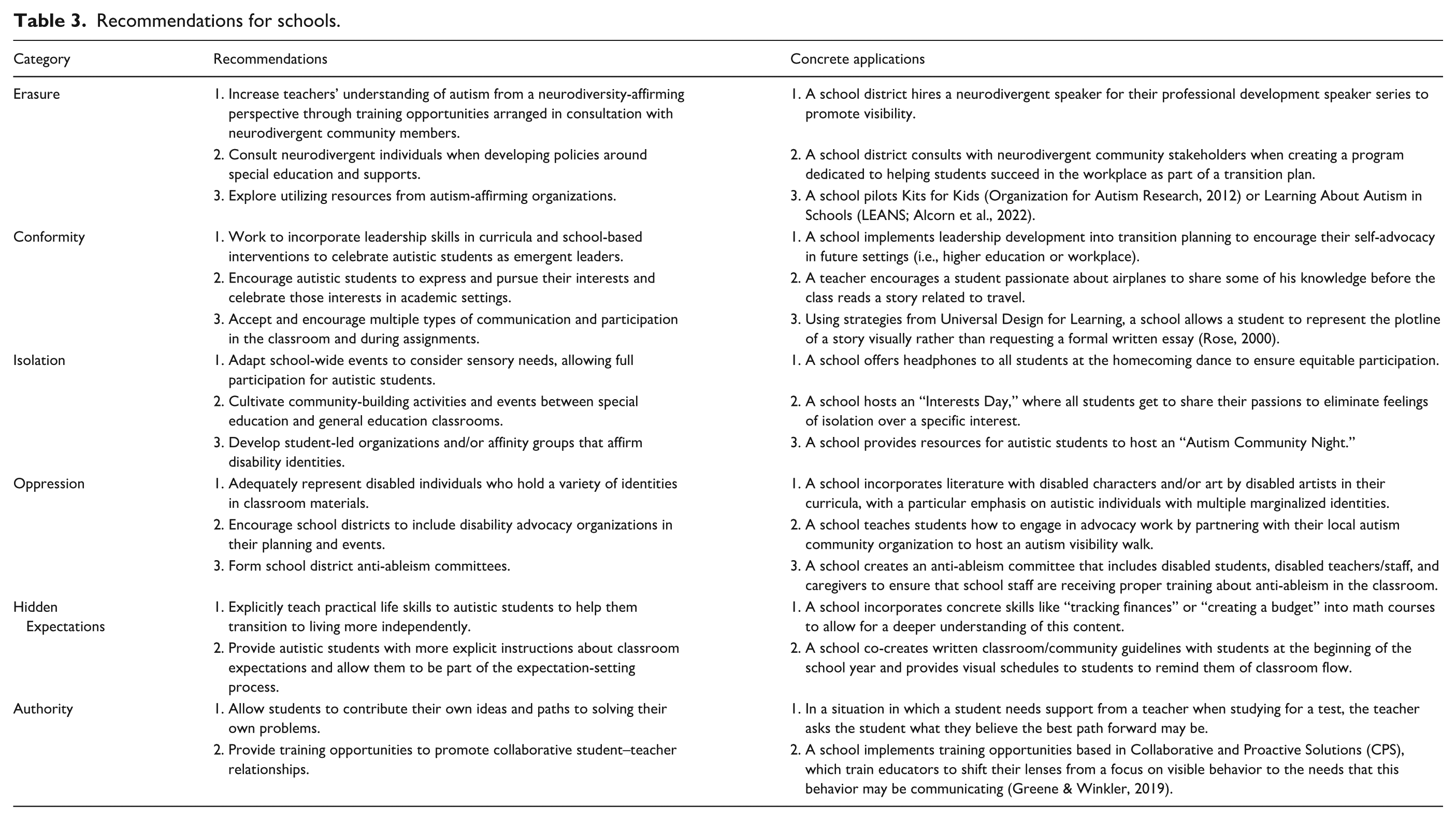
In sum, participant data suggested that schools thwart self-advocacy by cultivating negative school experiences that fall into six categories: erasure, conformity, isolation, oppression, hidden expectations, and authority. Based on these six categories, direct recommendations for teachers and policymakers are presented in Table 3. These recommendations were generated by our core research team, drawing upon the various professional and lived experiences of the team members. Table 3 presents recommendations that map onto each of our six main categories, as well as concrete ways in which these recommendations may be applied in practice.
Recommendations for schools.
Study limitations
Despite the strengths offered by the intentionality of our research design and our neurodivergent-led research team, our study has notable limitations. For example, due to the qualitative nature of our study, our participant sample is relatively small. Thus, although we attempted to prioritize intersectionality through theoretical sampling, there are many identity groups that we were unable to include. Notably, our sample did not include perspectives of autistic people with a known intellectual disability, nor did it include autistic individuals who use AAC devices as their primary form of communication (although at least one of our participants reported using AAC). Therefore, our sample more strongly represents the perspectives of speaking autistic individuals without an intellectual disability. In addition, our findings do not represent the full range of school settings that autistic students experience. Most participants reported attending public schools and few reported other settings, such as private schools, therapeutic day schools, and home schooling.
Future directions
Future research should incorporate and validate the perspectives of autistic individuals with various lived experiences about their school experiences, including autistic individuals who are primarily nonspeaking and/or have a known intellectual disability. In addition, it may be beneficial for future studies to explore our categories and/or recommendations in greater detail, using mixed quantitative and qualitative methods. Future work may also benefit from gathering the perspectives of educational professionals as it relates to these themes. Finally, very few studies solicit the perspectives of neurodivergent educators themselves, who carry expertise both within the field of education and with their lived experiences. Future research would benefit from exploring neurodivergent educators’ expertise more deeply. For instance, researchers can tap into these educators’ expertise by including neurodivergent educators as co-investigators. Given their own lived experiences, neurodivergent educators may have insights about how to improve representation and visibility of autism in schools to facilitate neuroinclusive education practices. In addition, neurodivergent educators may form particularly meaningful student–teacher relationships with neurodivergent students by sharing stories from their own school experiences, reflecting upon strategies and successes from their adult lives, and exhibiting greater empathy due to a shared neurodivergent identity.
Conclusion
The findings of our study bring autistic students’ experiences of marginalization to light during their time in school. Notably, autistic students collectively reported structural ableism that was embedded into the context of their school experiences and served as a barrier toward their self-advocacy. Specifically, our participants described harmful experiences rooted in six main categories: erasure, conformity, isolation, oppression, hidden expectations, and authority. Our community-participatory, neurodivergent-led research team presents these findings to make recommendations for future research and policy, to exemplify the critical need for the inclusion of autistic individuals in the development and refinement of educational policy, and to highlight structural barriers to self-advocacy within US K–12 school settings.
Footnotes
Acknowledgements
We would like to sincerely thank all of our participants who generously shared their experiences, perspectives, and insights with us. We also would like to thank Shay Phillips, Alyssa Christopher, Min Yang, and Kohrissa Joseph for contributions to this manuscript.

Ethical considerations
Study activities were approved by the University of Massachusetts Boston’s Institution Review Board.
Informed consent
Participants were given the option to complete written or oral informed consent procedures according to their preference. To preserve confidentiality of our participants, data cannot be shared.
Author Contributions
Funding
The authors disclosed receipt of the following financial support for the research, authorship, and/or publication of this article: This research was supported by a Public Service Grant, a Proposal Development Grant, and a College of Liberal Arts Dean’s Research Grant from the University of Massachusetts Boston awarded to A.E.
Declaration of conflicting interests
The authors declared no potential conflicts of interest with respect to the research, authorship, and/or publication of this article.