




Abstract
Autistic people face touch-related challenges, yet the factors influencing these difficulties are not well understood. We developed a novel instrument to capture social touch experiences of autistic adults, along with both social and individual factors that influence them. Using a body-painting task and questionnaires, we demonstrated that the perception of touch interactions varies based on social contexts and neurotypes. Autistic adults, on average, prefer touch less, but the type of relationship influences the perceived comfort and meaningfulness of touch similarly in both groups. Regarding the appropriateness, erogeneity, and pleasantness of social touch, the autistic group showed different touch perceptions in professional and friendly scenarios compared to the non-autistic group, whereas touch in intimate scenarios was perceived similarly. Sensory responsivity, touch predictability, social confidence, and touch-related anxiety affect social touch to a greater extent than the non-autistic group. Despite these marked differences in perception, the autistic adults, on average, engage in social touch as frequently as non-autistic adults, and their satisfaction with touch is comparable. Our findings suggest that supporting autistic people would involve understanding their preferences and the contextual factors that contribute to their sense of comfort, rather than excluding them from touch interactions.
Lay abstract
Autistic people find certain types of touch, particularly light or unexpected touch, uncomfortable or overwhelming. The reasons for this are not fully understood. To address this, we asked both autistic and non-autistic adults how they feel about being touched in different situations and on different parts of the body. We also asked how much they enjoy touch and how they feel about being touched by people in various relationships, such as a partner, parent, or friend. Finally, we looked at how individual traits affect their experience of touch. We found that the autistic group engaged in social touch just as often as the non-autistic group and reported similar overall satisfaction. In intimate contexts, such as with a romantic partner, both groups perceived touch similarly. Both groups agreed that touch from a partner or child is the most meaningful and comfortable compared to other relationship types. Despite some similarities, autistic adults, on average, still reported enjoying social touch less overall and experiencing more touch-related challenges in romantic relationships. They also placed less importance on touch for bonding. Moreover, the autistic group rated touch as less appropriate, less pleasant, or less intimate than the non-autistic group in professional (like physiotherapy) or friendly (like a dance class) situations. While social interaction difficulties influence how both groups experience touch, other factors seem to play a stronger role for the autistic group, such as how predictable the touch is, whether they experience sensory challenges, and how socially confident they feel or how anxious about touch they are. Rather than assuming autistic people dislike touch, it is important to recognise that they may have different preferences, and that certain situations make touch feel more comfortable and enjoyable. Respecting these preferences can help make social touch more positive and meaningful, potentially improving relationship quality with autistic people.
Introduction
Social touch is critical for social affiliation, emotional bonding and relational quality in the neurotypical population (Jakubiak & Feeney, 2019; Wu, 2020). Touch serves as the earliest form of communication between caregivers and infants, preceding the onset of verbal interactions (Hertenstein, 2002). However, this may not generalise to neurodivergent individuals, for whom social touch can hold different meanings or elicit varied responses (Keizer et al., 2022; Smirni et al., 2019). Autistic individuals often show distinct experiences of social touch across lifespan (Henderson, 2022), from reduced cuddliness and tactile defensiveness in infancy (Baranek et al., 1997; Clifford et al., 2013) to heightened discomfort in later life (Kaiser et al., 2016; Lee Masson et al., 2019; Penton et al., 2023). However, some social touch experiences are reported as enjoyable, such as firm pressure (MacLennan et al., 2022).
Differences in sensory processing may contribute to social touch experience. Autistic individuals react emotionally and respond behaviourally to sensory input, such as touch, in different ways compared to neurotypicals (Crane et al., 2009; Tomchek & Dunn, 2007). In line with the recently developed sensory taxonomy (He et al., 2023), the present study uses the term sensory responsivity, which denotes an individual’s behavioural responses to sensory input that is enjoyable or discomforting. However, this work also spans affective reactions to sensory input, referred to as affective reactivity in the taxonomy, but henceforth, we use the term ‘responsivity’ for coherence. Individuals may be hyperresponsive, experiencing sensory input as intense or overwhelming, and/or hyporresponsive, not attenuating or being slow to attend to sensory input (Miller et al., 2007). Autistic people may also seek out sensory input, characterised by fascination, fixation and/or repeated engagement (Miller et al., 2007). Individual sensory profiles can be highly complex across modalities and can vary across time and context (MacLennan et al., 2022).
Unexpected touch can evoke both positive or negative reactions among neurotypical adults (Sailer et al., 2024). Autistic individuals tend to perceive it more consistently negatively (MacLennan et al., 2022). This may relate to a preference for sameness, such as routine and repetition, to regulate sensory input (Lidstone et al., 2014). Predictability can be facilitated through clear communication to bridge differences in social information processing and communication style (Constantino et al., 2003; Milton, 2016). Without such alignment, social touch may lead to misunderstanding between autistic individuals and others (Henderson, 2022; Lee Masson, 2025). In addition, anxiety is highly prevalent among autistic individuals, and those with sensory hyperresponsivity often experience anxiety related to fears of physical injury (MacLennan et al., 2020), further complicating social touch experiences.
Within the neurotypical population, contextual factors, such as the nature of the relationship and the specific body areas involved, influence how touch is perceived (Suvilehto et al., 2023). In the context of autism, previous work used a body-painting task in which participants rated hypothetical touches on different body regions according to various feelings. Autistic adults, on average, rated touches in intimate and friendly contexts as less erogenous, pleasant, and appropriate than non-autistic adults, and these diminished ratings were linked to social touch avoidance (Mello et al., 2024, 2025).
Erogenicity, pleasantness, and appropriateness capture complementary social–affective dimensions of touch (Fusaro et al., 2021; Mello et al., 2022). Examining them offers a multidimensional framework for understanding social touch in autism. Perceived erogenicity differs between autistic and neurotypical groups, with reduced erogenicity in autism moderated by sensory hyperresponsivity (Sala et al., 2024). Reduced pleasantness of touch has been consistently reported by autistic people (Fukuoka et al., 2025; Jönsson et al., 2015; Lee Masson et al., 2019; Mello et al., 2025; Miguel et al., 2017). Relationship context further shapes touch norms. Romantic partners permit distinct forms of touch (Sala et al., 2024; Suvilehto et al., 2015; Wu, 2020; Xu et al., 2023), whereas professional settings (e.g. professional massage, medical examination, airport body check) typically impose stricter or hierarchical boundaries (Sekerdej et al., 2018; Suvilehto et al., 2023). These dimensions are interconnected and relate to emotional closeness, with greater intimacy allowing more permissive touch (Debrot et al., 2024; Mello et al., 2025; Suvilehto et al., 2019).
No previous study has simultaneously examined perceived erogeneity, pleasantness, appropriateness, comfort, and meaningfulness of touch across various social contexts, alongside factors including sensory responsivity, social interaction difficulties, social confidence, touch-related anxiety, predictability of touch, and frequency and satisfaction with daily social touch. Moreover, while the Social Touch Questionnaire (STQ) (Wilhelm et al., 2018) assesses attitudes towards social touch with high reliability and validity (Vieira et al., 2016), it is not specifically designed to capture touch experiences relevant to autistic individuals. To address the multifaceted nature of social touch experiences in autism, we developed the Autistic Social Touch Experience (ASTE) questionnaire. Developed in consultation with autistic advisers, the ASTE explores various aspects of autistic social touch, focusing on the factors reviewed earlier. The study adopts a multi-method approach through a body-painting task, the novel ASTE questionnaire, and the well-validated STQ, seeking to provide a comprehensive understanding of how autistic adults perceive and experience touch, along with a range of individual and contextual factors that may impact this process. Understanding these factors is crucial for developing more inclusive environments where autistic people’s touch preferences are acknowledged and respected. The findings of this study are intended to inform tailored interventions, improve communication, and enhance the overall understanding of touch-related needs in various settings. Based on the literature discussed earlier, we predict that autistic people, on average, would find touch to be less pleasant, less erogenous, and less appropriate. Factors such as sensory responsivity and social interaction difficulties are expected to negatively influence their touch experiences. We also hypothesise that they would engage in social touch less.
Methods
Participants
We recruited 77 participants aged 18 years or older through the Durham University SONA system, the MQ mental health research platform (https://www.mqmentalhealth.org/), private and public social media platforms, and posted flyers in various locations. To ensure data integrity, we screened all responses and excluded entries showing excessive repetition or other signs of inauthenticity. The inclusion of open-ended questions provided a robust basis for these checks. Of the 77 participants, we excluded three for not meeting inclusion criteria or providing poor-quality responses. We included one participant in the questionnaire analysis but excluded them from the body-painting task due to their misunderstanding of the task, as reported by the participant. The final analysis included 31 autistic adults (13 self-identified and 18 diagnosed). We adopted an identity-based rather than diagnostic approach, consistent with recent literature emphasising the validity and importance of self-identification within autistic communities (Ardeleanu et al., 2025). Forty-three non-autistic adults with no autistic first-degree relatives were included. This exclusion criterion is based on the shared genetic variance observed among first-degree relatives. The two groups differed regarding ethnicity (more Asians in the non-autistic group, p-value = 0.02) and other co-occurring conditions (higher proportion of autistic individuals had other co-occurring conditions, p-value < 0.001) but were similar in age, sex, gender, sexual orientation, education levels, and employment status. Table S1 in Supplementary Materials (SM) shows detailed information on participants’ demographics. A detailed power analysis regarding sample size is provided in SM. The study was approved by the psychology ethics committee of Durham University (PSYCH-2024-0071-252). All participants provided informed consent to participate. Compensation was offered via a prize draw, with 10 prizes awarded at random among the participants.
Participatory methods and positionality
The study was conducted by a neurodiverse team with two of the authors identifying as neurodivergent. In addition, we consulted four autistic advisors, recruited via the Centre for Neurodiversity and Development Autism Database. After receiving study information via an email, they expressed interest in contributing and participated in two 1-hour insight session meetings conducted on Microsoft Teams, with additional time allocated for the preparation and review of the documents. Compensation offered in alignment with National Institute for Health and Care Research guidance (a total compensation of £125). Their input was integral to several aspects of the study. They reviewed and helped refine the design and wording of the ASTE questionnaire, ensured accessibility and clarity, and aided in interpreting the results in light of autistic lived experience. This reflects the choice-points model (Vaughn & Jacquez, 2020), where involving stakeholders in design and interpretation strengthens validity, mitigates researcher bias, and ensures findings are anchored in lived experience. More details are provided in SM.
Materials and procedure
We created the online study using jsPsych (version 6.1.0; Leeuw et al., 2023) and hosted on Pavlovia (https://pavlovia.org/). This online study consisted of a body-painting task, a questionnaire on the autistic experience of social touch (see the ASTE in SM), and the STQ (Wilhelm et al., 2001)
Body-painting task: Building on the approach of Mello et al. (2024), we investigated the intensity of three feelings (appropriateness, erogeneity and pleasantness) associated with touch on different body parts across three social scenarios (intimate, professional and friendly context). The intimate scenario depicted touch with a partner driven by mutual attraction, the friendly scenario depicted touch with a dance coursemate in a social, non-romantic setting, and the professional scenario depicted touch with a physiotherapist during a therapeutic massage. These scenarios portray how touch varies based on the relationship dynamics and purpose. After reading each scenario (see Supplementary Table S2 for details), participants painted the front and back of body silhouettes using colours to reflect their emotional responses to touch (Figure 1). Participants completed nine body-painting trials arranged in a 3 (emotion) × 3 (scenario) design, followed by three trials in which they rated whether each touch scenario reflected an intimate, professional or friendly relationship on a 5-point scale. These additional trials were included to confirm whether our scenarios matched participants’ perceptions of the intended relationship types (e.g. that the ‘romantic’ scenario was indeed perceived as romantic). The task was implemented using the jsPsych body typology task plugin (https://github.com/justinsulik/jspsych_plugins/blob/master/jspsych-paint-d3.js).
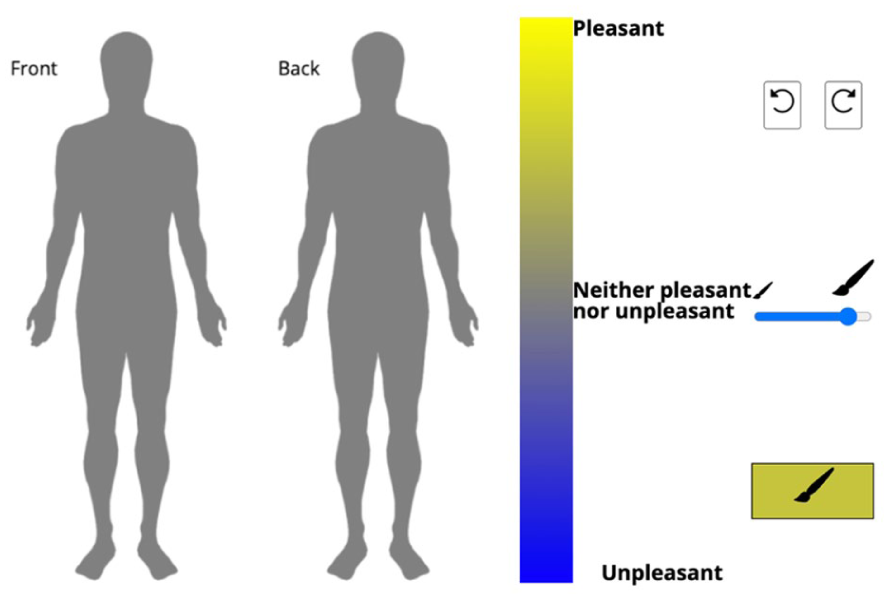
An example trial from the online body-painting task.
ASTE: The questionnaire, developed in consultation with autistic advisors, investigates various aspects of social touch experience among autistic people through closed-ended and open-ended questions. The closed-ended questions were organised into three sections. The first section assessed how relationships influence the comfort and meaningfulness of social touch (e.g. ‘How comfortable do you feel receiving social touch from a romantic partner?’). The second section examined the effects of sensory responsivity, social interaction difficulties, unpredictability, social confidence, and touch-related anxiety on social touch experiences (e.g. ‘My sensory experience holds me back from engaging in social touch’). The final section assessed satisfaction with physical contact, preferences for giving versus receiving touch, and the frequency of engaging in social touch (e.g. ‘I am satisfied with the amount of physical contact I have in my interpersonal relationships’). Closed-ended questions used a 5-point Likert-type scale, from 1 (e.g. Strongly disagree) to 5 (e.g. Strongly agree). Responses to open-ended questions were not analysed in this study and will be presented in future work focused on qualitative methods.
STQ: The STQ is a standardised questionnaire for assessing attitudes towards social touch. It consists of 20 questions using a 5-point Likert-type scale (e.g. ‘I generally like it when people express their affection towards me physically’). We reverse-coded half of the items, so higher STQ scores indicate more positive attitudes towards social touch.
Data pre-processing and statistical analysis
We used body-painting to explore how social contexts and body parts affect social touch perception across neurotypes. The data were pre-processed in Python (version 3.10.13) and analysed in RStudio (R Core Team, version 2024.04.2 + 764). Pre-processing and statistical analysis are identical to that of Mello and colleagues (2024). The brief summary is provided here, and details can be found in SM. We conducted three generalised linear mixed models (GLMMs) to analyse ratings of appropriateness, erogeneity and pleasantness. Each model included neurotype (autistic, non-autistic), body parts (e.g. face, chest, hands), scenarios (friendly, intimate, professional) and sex (male, female) as fixed effects, with participants as a random effect. The small number of non-binary participants (autistic: n = 4; non-autistic: n = 1) limited statistical power when gender is used. We recognise that reducing gender diversity to a binary categorisation, and analysis focused on sex, is problematic. Accordingly, sex-related findings should be interpreted with caution.
Followed by the GLMMs, we measured the goodness-of-fit of the model (performance package in R) and conducted a mixed-model repeated-measures analysis of variance (ANOVA) with the car package (ANOVA function, Type II Wald chi-square tests) to evaluate the significance of the effects of the independent variables (neurotype, sex, scenario, and body parts) and their interactions on the GLMM fit outcome. For the significant ANOVA results, as a post hoc analysis, we conducted pair-wise comparisons using Tukey’s HSD correction.
To examine both between- and within-participant factors that may influence social touch experiences, the ASTE and STQ data were analysed with a mixed-model ANOVA and Welch t-tests. For significant ANOVA results, Welch post hoc tests were conducted for comparing the two groups, and Tukey’s HSD test for pair-wise comparisons for ratings differences. Although our primary hypotheses focused on group differences, we conducted additional exploratory pair-wise correlational analyses using Spearman’s rank correlation to examine potential associations between variables. The False Discovery Rate (FDR) correction method was applied to handle the multiple comparisons.
Results
Body-painting task
We focus on reporting the results related to the main effects of neurotype or any interactions involving it. Participants generally agreed that each scenario depicted the chosen social setting, with average scores around 4 (‘Agree’) for all three scenarios (see Supplementary Table S3).
Appropriateness: The GLMM with appropriateness ratings as the outcome had goodness-of-fit of R2marginal = 0.71. This indicated that neurotype, sex, scenario, body parts and their interactions accounted for 71% of the appropriateness ratings. The main effects were significant for body part (X2(13) = 861.48, p < 0.001) and scenario (X2(2) = 679.63, p < 0.001), but not for neurotype (X2(1) = 2.2, p = 0.14) or sex (X2(1) = 1.79, p = 0.18). Touching the arms, back, face, hands, head and shoulder is perceived as appropriate, whereas touching the belly, chest, groin and bottom (a taboo zone shown in blue, Figure 2) is perceived as inappropriate, based on one-sample t-tests against the neutral midpoint (0.5). Participants from both neurotype groups perceived touch in the professional scenario as the most appropriate, followed by intimate scenario, with touch in friendly scenario perceived as inappropriate (Supplementary Table S4). We found a significant two-way interaction between neurotype and scenario (X2(2) = 11.03, p = 0.004), and the Tukey’s HSD post hoc analysis revealed that autistic adults, on average, rated touch as less appropriate in a friendly scenario than non-autistic adults (z-ratio = −2.6, p_fdr = 0.01). The other scenarios showed a similar trend that did not reach significance.
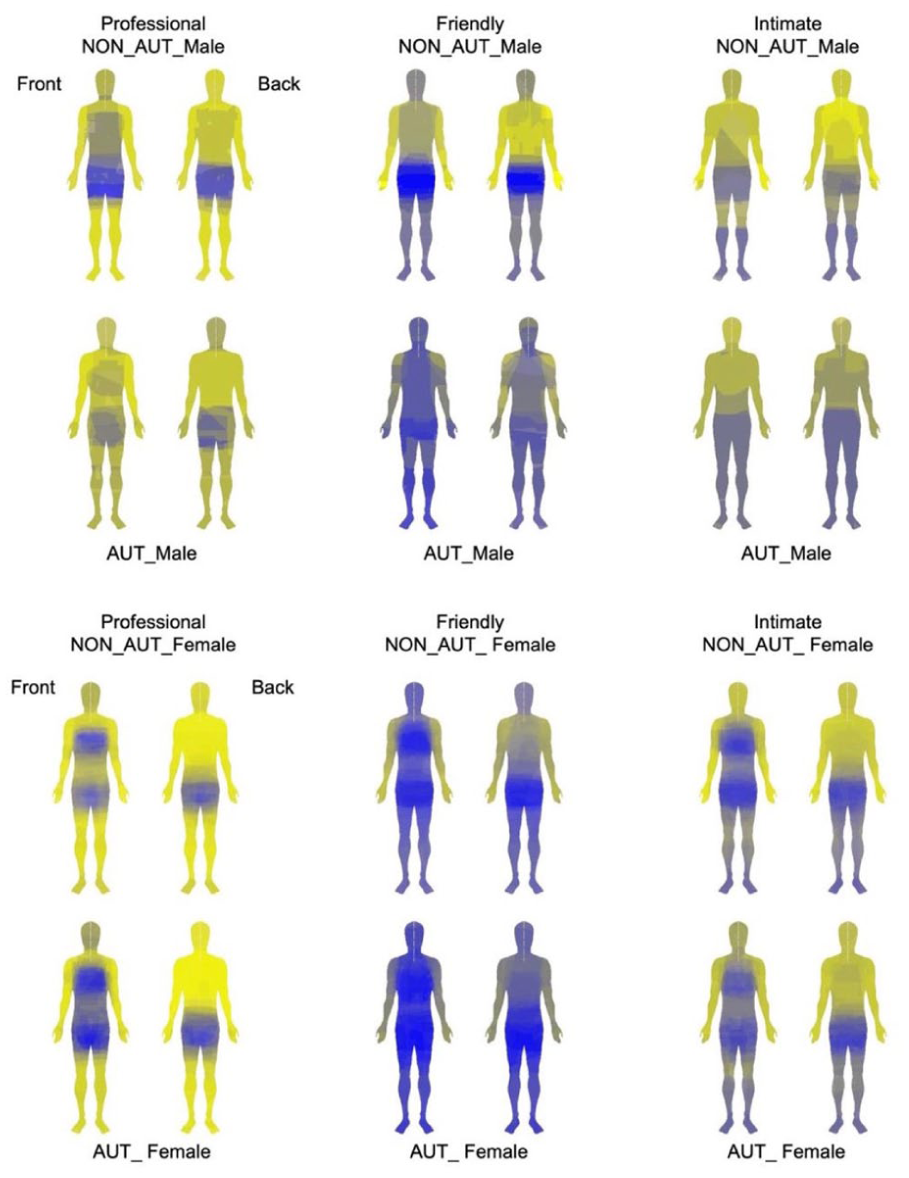
Appropriateness ratings from the body painting by scenario, neurotype, and sex.
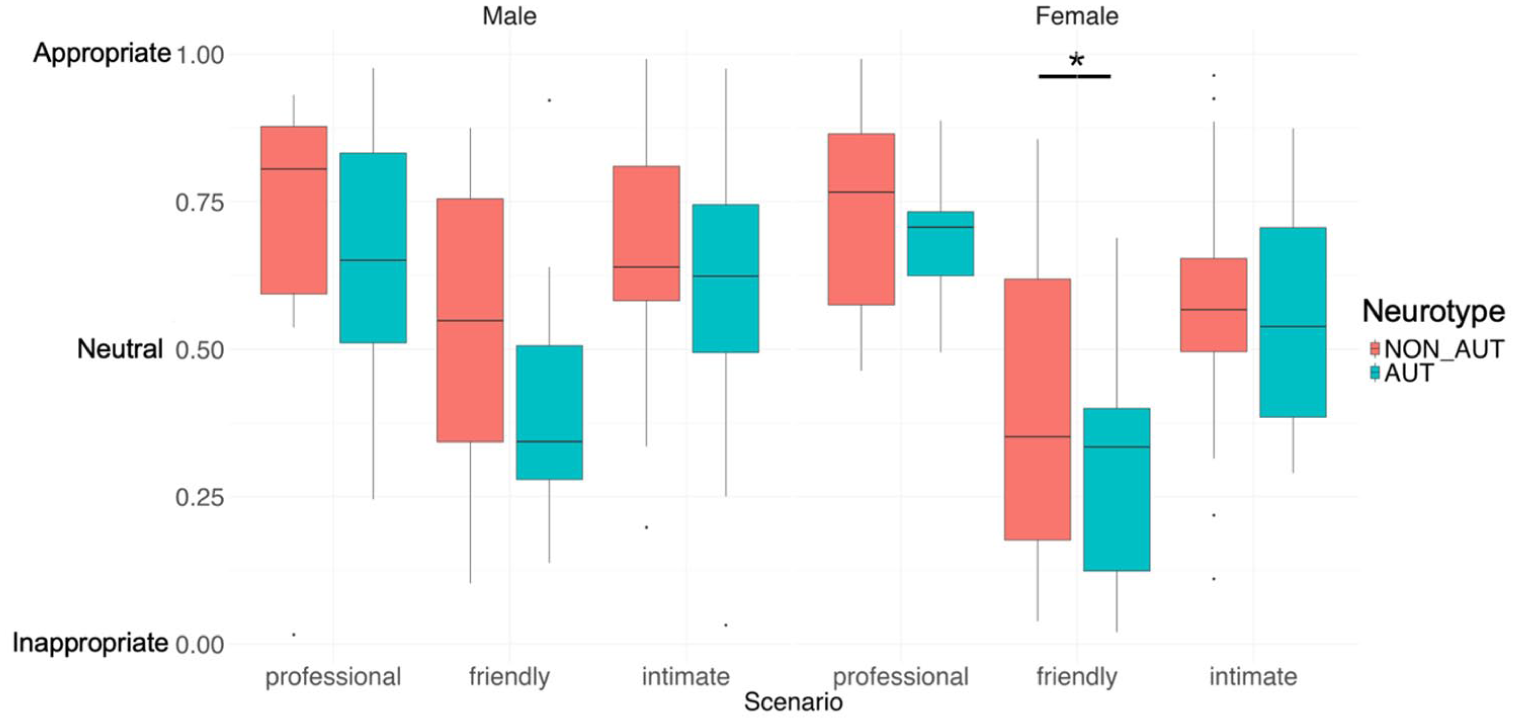
Appropriateness ratings by scenario, neurotype, and sex.
We found a significant three-way interaction between neurotype, scenario and sex (X2(2) = 7.35, p = 0.03). The Tukey’s HSD post hoc analysis showed that non-autistic female, on average, rated touch as less appropriate than non-autistic males in a friendly scenario (z-ratio = −2.71, p_fdr = 0.007). No significant sex or neurotype differences were found in the professional or intimate scenarios (Supplementary Tables S5–S6).
Erogeneity: Neurotype, sex, scenario, body parts, and their interactions account for 56% of the erogeneity ratings. The main effects were significant for body part (X2(13) = 192.84, p < 0.001) and scenario (X2(2) = 884.19, p < 0.001), but not for neurotype (X2(1) = 0.07, p = 0.79) or sex (X2(1) = 0.97, p = 0.33). Only touching groin and bottom is perceived as neutral (although perceived as erogenous in intimate scenario), whereas touching the rest of the body parts is perceived as non-erogenous, based on one-sample t-tests against the neutral midpoint (0.5) (most body parts are painted in blue, Figure 4).
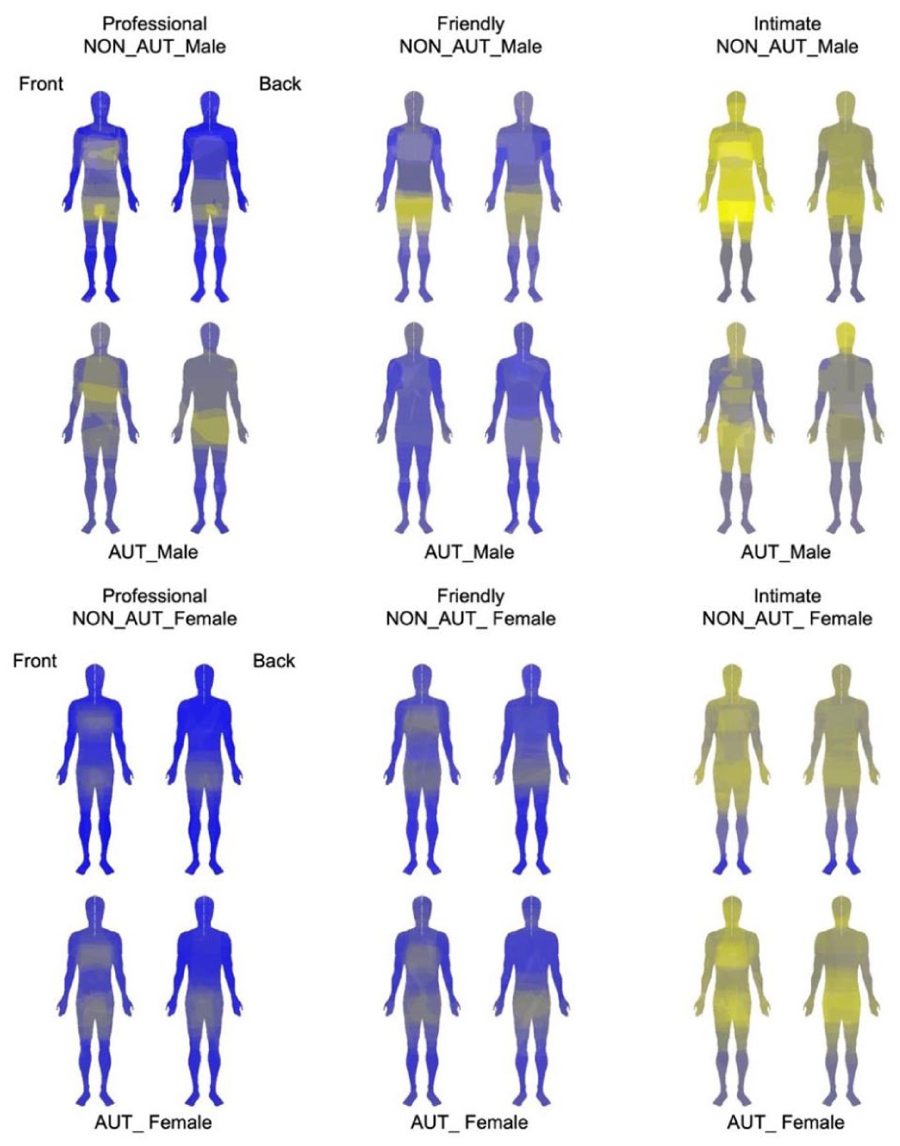
Erogeneity ratings from the body-painting by scenario, neurotype and sex.
Participants from both groups perceived touch in intimate scenario the most erogenous, but touch in friendly scenario and professional scenario as non-erogenous (Supplementary Table S7). A significant two-way interaction between neurotype and scenario (X2(2) = 18.10, p < 0.001) led to the post hoc analysis. The autistic group rated professional touch less non-erogenous than the non-autistic group (z-ratio = 2.12, p_fdr < 0.03). The opposite trend was observed, but the results were not significant in other scenarios. A significant three-way interaction between neurotype, scenario, and sex (X2(2) = 31.59, p < 0.001) showed that this difference was driven by the autistic male group who rated professional touch more erogenous than non-autistic males (z-ratio = 2.01, p_fdr = 0.045) (Figure 5). We did not observe sex differences within the same neurotype (Supplementary Table S8) or neurotype differences in females across the three scenarios (Supplementary Table S9).
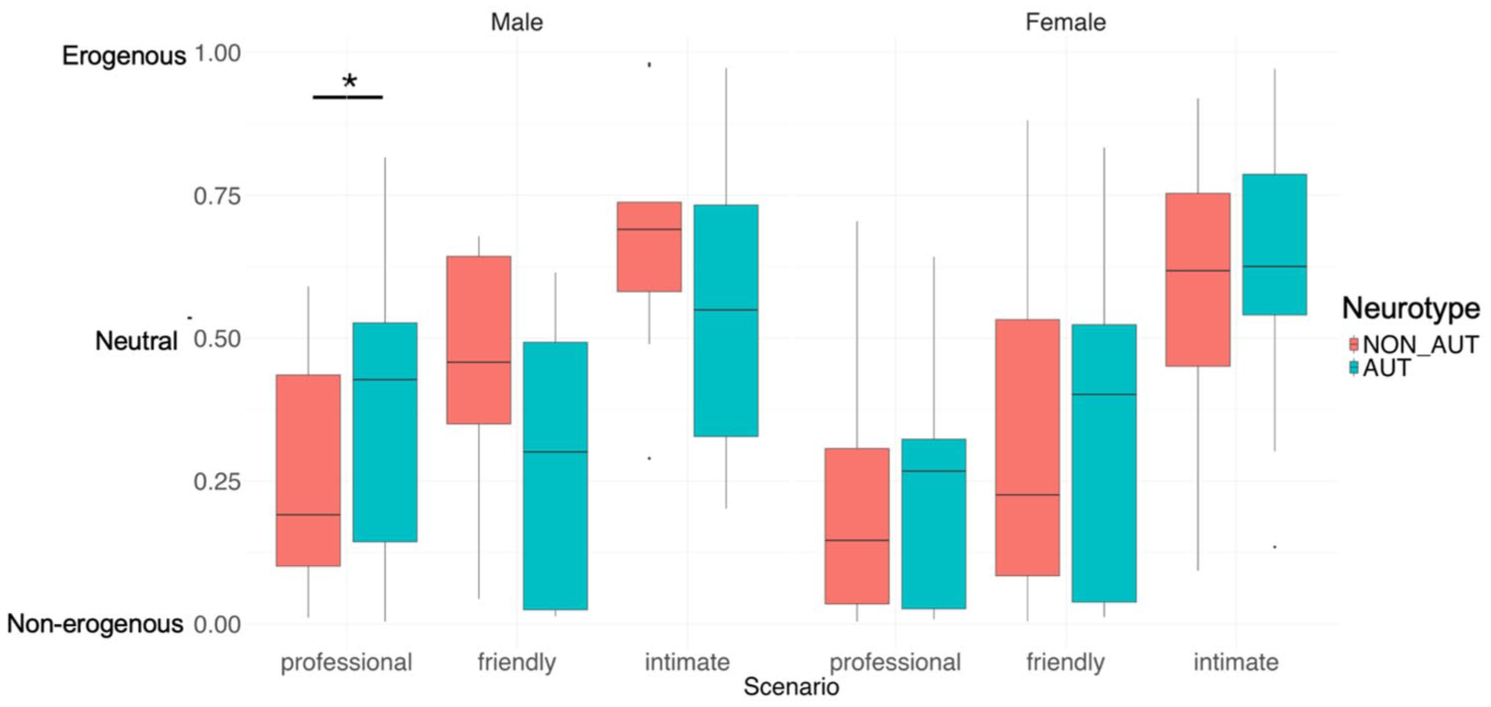
Erogeneity ratings by scenario, neurotype and sex.
Pleasantness: Neurotype, sex, scenario, body parts and their interactions account for 56% of the pleasantness ratings. The main effects were significant for body part (X2(13) = 543.39, p < 0.001) and scenario (X2(2) = 523.58, p < 0.001), but not for neurotype (X2(1) = 3.18, p = 0.07) or sex (X2(1) = 0.15, p = 0.70). Touching the arms, back, hands, head and shoulder is perceived as pleasant, whereas touching the belly, chest, feet, groin and bottom (mostly a taboo zone shown in blue, Figure 6) is perceived as unpleasant, based on one-sample t-tests against the neutral midpoint (0.5). Participants from both neurotype groups perceived touch in the intimate scenario as most pleasant, followed by the professional scenario, and touch in the friendly scenario as unpleasant (Supplementary Table S10). Following a significant two-way interaction between neurotype and scenario (X2(2) = 11.13, p = 0.004), post hoc analysis revealed the autistic group rated touch as less pleasant in a professional scenario than the non-autistic group (z-ratio = −2.30, p_fdr = 0.02). The other scenarios showed a similar trend that did not reach significance.
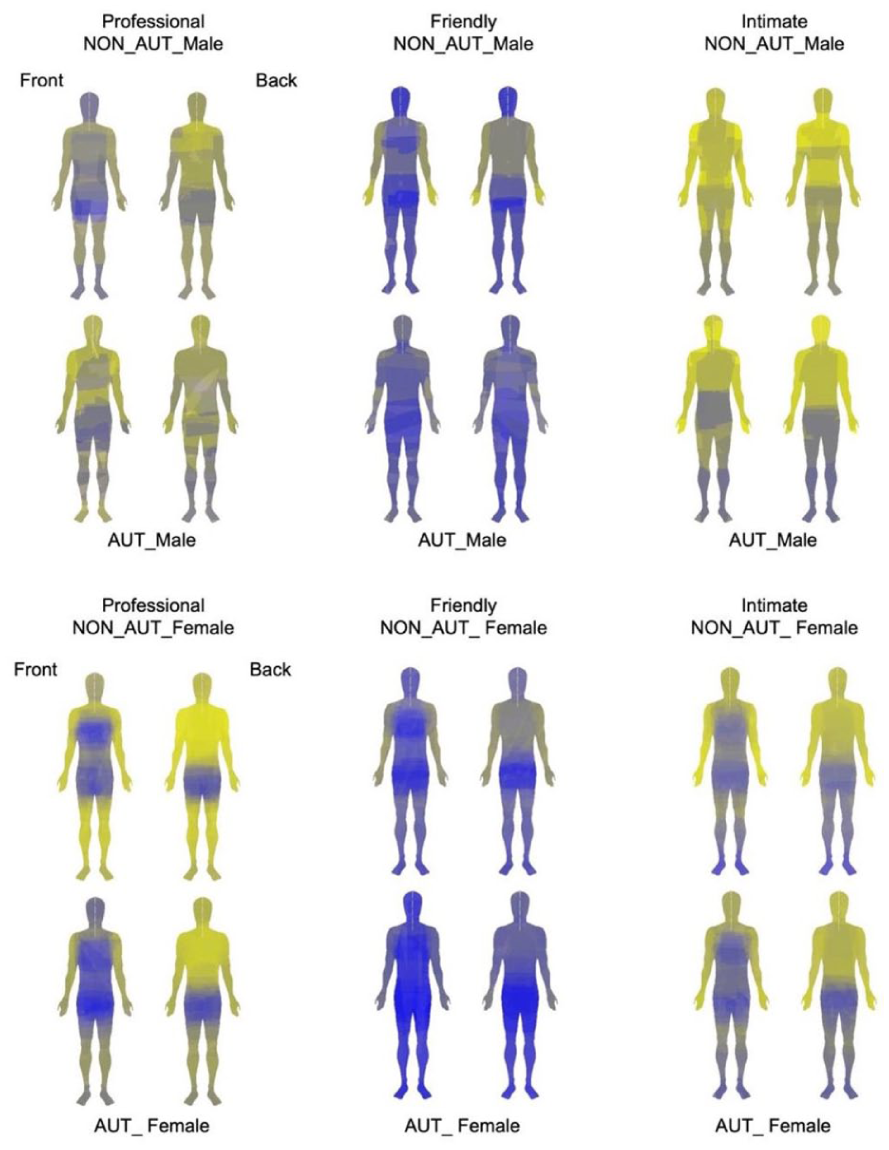
Pleasantness ratings from the body-painting by scenario, neurotype, and sex.
We found a significant three-way interaction between neurotype, scenario and sex (X2(2) = 12.29, p = 0.002). Autistic females, on average, found touch as less pleasant than non-autistic females in both friendly (z-ratio = −2.08, p_fdr = 0.04) and professional scenarios (z-ratio = −2.46, p_fdr = 0.01) (Figure 7). No sex differences within the same neurotype (Supplementary Table S11) or neurotype difference in male across three scenarios were found (Supplementary Table S12).
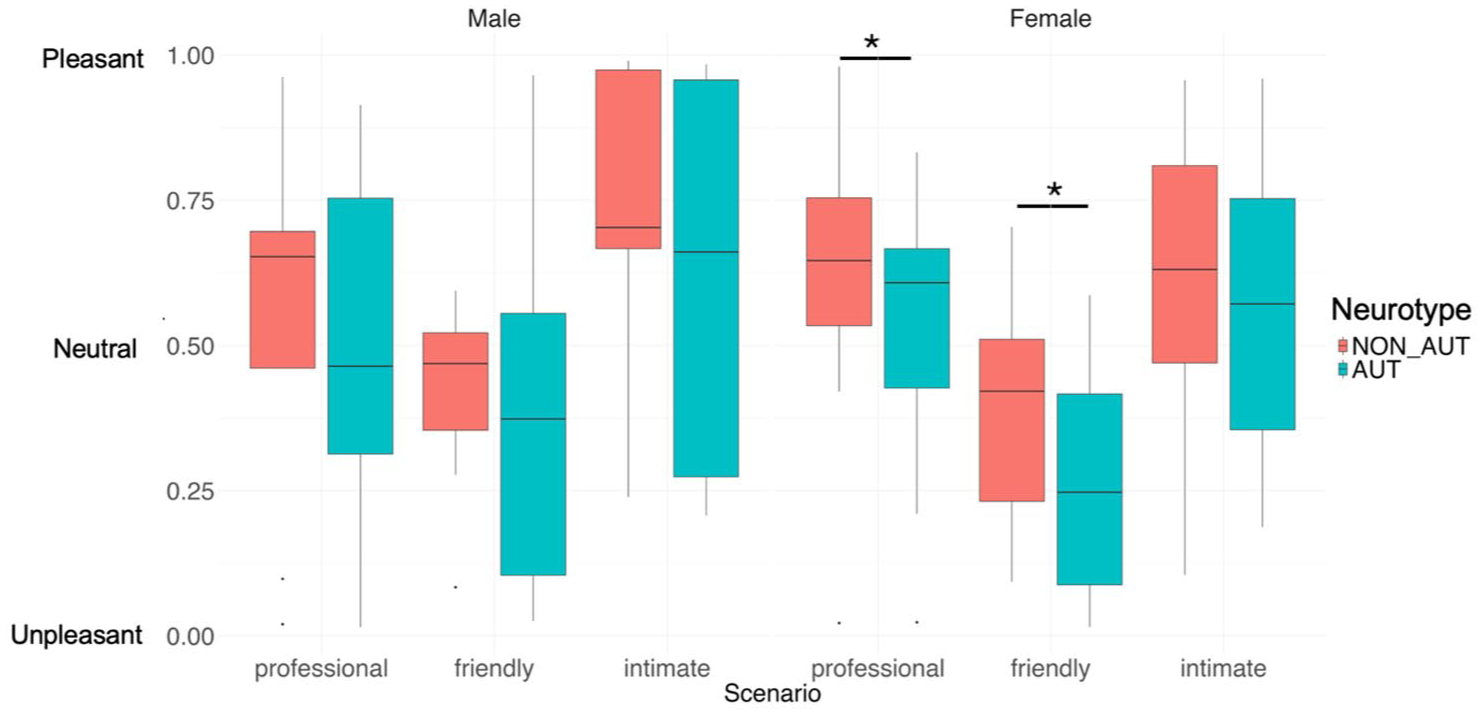
Pleasantness ratings by scenario, neurotype, and sex.
The overall results from the body-painting task suggests that autistic individuals, on average, perceive touch in professional and friendly scenarios differently, while touch in the context of intimate relationships is similar to that of non-autistic adults. Although touch perception is predominantly explained by sex and social context, neurotype moderates these effects as shown in the three-way interaction results in all ratings.
Autistic social touch experience
The total score of the ASTE was higher in the autistic group with a statistically significant difference in neurotype (t(63) = 5.57, p < 0.001), reflecting a more negative perception and experience of social touch. We conducted a detailed statistical analysis on the items related to our research question: the comfort and meaning, factors negatively affecting social touch, and actual touch experience.
Comfort and meaningfulness: ANOVA results revealed significant main effects of neurotype (F(1,371) = 29.44, p < 0.001 for comfort; F(1,371) = 10.31, p = 0.001 for meaningfulness) and relationship type (F(5,371) = 24.71, p < 0.001 for comfort; F(5,371) = 35.35, p < 0.001 for meaningfulness). There was no significant interaction effect between neurotype and relationship type in both ratings (F(5,371) = 0.35, p = 0.88 for comfort; F(5,371) = 0.55, p = 0.74 for meaningfulness). Concerning neurotype differences, post hoc analysis revealed that the autistic group rated touch significantly less comfortable (t(315) = −4.64, p < 0.001) and less meaningful (t(334) = −2.64, p = 0.009) than the non-autistic group.
Tukey’s HSD tests indicated that, across groups, participants rated touch with an acquaintance as less comfortable (all p_fdr values < 0.04) and less meaningful (all p_fdr values < 0.001, except for a father, where no rating difference was found) than other relationship types. Conversely, participants rated touch with a partner as more comfortable and more meaningful than with others (all p_fdr values < 0.001), except for children, where the ratings were similarly high for both. The means, standard deviations, and t-statistics are detailed in multiple tables within the SM (Supplementary Tables S13–S16).
Both groups gave similar ratings on its importance for maintaining emotional bonds, with scores around neutral (M = 2.77, SD = 1.12 for autistic; M = 3.33, SD = 1.13 for non-autistic) (p_fdr = 0.06). However, autistic adults (M = 3.54, SD = 1.07) more often reported that social touch had created difficulties in their romantic relationships (M = 2.50, SD = 1.06), (t(58) = 3.94, p_fdr < 0.001). Overall, the first section of ASTE results indicates that perceptions of social touch vary by relationship type in both groups similarly. However, autistic adults generally experience touch more negatively, which creates additional challenges in romantic contexts.
Sensory responsivity, social interaction difficulties, unpredictability, touch-related anxiety, and confidence: First, we averaged responses from three questions on sensory responsivity, with higher scores indicating greater sensory response differences. The autistic group (M = 3.33, SD = 0.68) reported sensory responsivity compared to non-autistics (M = 2.33, SD = 0.72) (t(67) = 6.15, p_fdr < 0.001). We asked the impact of sensory responsivity on social touch interactions to participants with a sensory responsivity score above 3 (occasionally experiencing sensory processing differences). We averaged the responses of two questions, with one of them reverse-coded, so that higher scores indicated a greater negative impact. The autistic group (M = 3.68, SD = 0.93) reported a significantly greater negative impact of responsivity on social touch interaction than non-autistics (M = 2.70, SD = 0.87) (t(58) = 4.23, p_fdr < 0.001). Sensory processing differences were greater in the autistic group, and it had a more negative impact on their social touch experiences.
Second, the autistic group (M = 3.87, SD = 1.02) reported greater social interaction difficulties than non-autistics (M = 2.63, SD = 1.11) (t(68) = 4.97, p < 0.001). But out of those who experience social interaction difficulties, its impact on social touch was similar between neurotypes (M = 3.67, SD = 0.86 for autistic, M = 3.32, SD = 0.92 for non-autistic adults, t(37) = 1.33, p_fdr = 0.22). Unpredictability had a more substantial negative effect in the autistic group (M = 3.71, SD = 0.86) than in non-autistics (M = 2.74, SD = 1.16) (t(72) = 4.11, p_fdr < 0.001). Similarly, touch-related anxiety had a greater negative impact on social touch in the autistic group (M = 3.81, SD = 1.19) than non-autistics (M = 2.84, SD = 1.29) (t(68) = 3.33, p_fdr = 0.002). The autistic group (M = 2.81, SD = 1.25) reported significantly less confidence in their ability to interpret others’ intentions in social touch interaction than non-autistics (M = 3.81, SD = 0.85) (t(50) = −3.88, p_fdr < 0.001). The results from the second section of ASTE indicate that social interaction difficulties may similarly impact social touch experiences across neurotypes, but sensory responsivity, touch-related anxiety and confidence may have a greater impact on social touch interactions for the autistic group.
Touch satisfaction, frequency and preference: We averaged the responses from three questions measuring touch satisfaction (amount and type of social touch, wanting more/less touch), with higher scores indicating higher satisfaction. There was no difference in touch satisfaction (M = 3.27, SD = 0.94 for autistic, M = 3.45, SD = 0.71 for non-autistic, p_fdr = 0.37) and the frequency of social touch interactions (M = 2.84, SD = 1.21 for autistic, M = 3.40, SD = 1.07 for non-autistic, p_fdr = 0.06) between neurotypes. A score of 3 indicates engaging in social touch interactions a few times a week. Regarding preferences for giving versus receiving social touch, the Chi-square test revealed that there is no significant difference between neurotypes (p_fdr = 0.22). Of the total, 54.84% of autistic and 74.42% of non-autistic adults reported having no specific preference. The results from the third section of ASTE suggest that the overall profile of social touch interaction may be similar between the two neurotypes, despite the earlier identified neurotype differences.
Social touch questionnaire
Welch t-test revealed that the autistic group had a significantly lower STQ scores (M = 49.6, SD = 10.7) than the non-autistic group (M = 60.70, SD = 10.7) (t(65) = −4.4, p < 0.001), indicating a more negative attitude towards social touch.
Pair-wise correlation between variables
We used Spearman’s rank correlation coefficient to examine the relationships between variables from the body-painting, ASTE, and STQ (Supplementary Table S17). The STQ scores were significantly linked to all other variables, and the STQ scores strongly correlated with the total ASTE scores (r = −0.76, p_fdr < 0.001). Individuals who had positive attitude towards social touch found touch more comfortable (r = 0.75, p_fdr < 0.001) and meaningful (r = 0.65, p_fdr < 0.001), and considered it more appropriate in a friendly scenario (r = 0.30, p_fdr = 0.04), and more pleasant in both friendly (r = 0.39, p_fdr = 0.004) and professional scenarios (r = 0.36, p_fdr = 0.008). In contrast, those who had more negative attitude towards social touch reported that their touch interactions were more negatively affected by sensory responsivity (r = −0.67, p_fdr < 0.001), social interaction difficulties (r = −0.49, p_fdr < 0.001), unpredictable nature of touch (r = −0.63, p_fdr < 0.001), and anxiety (r = −0.42, p_fdr = 0.001). Figure 8 illustrates the pair-wise correlation between variables.
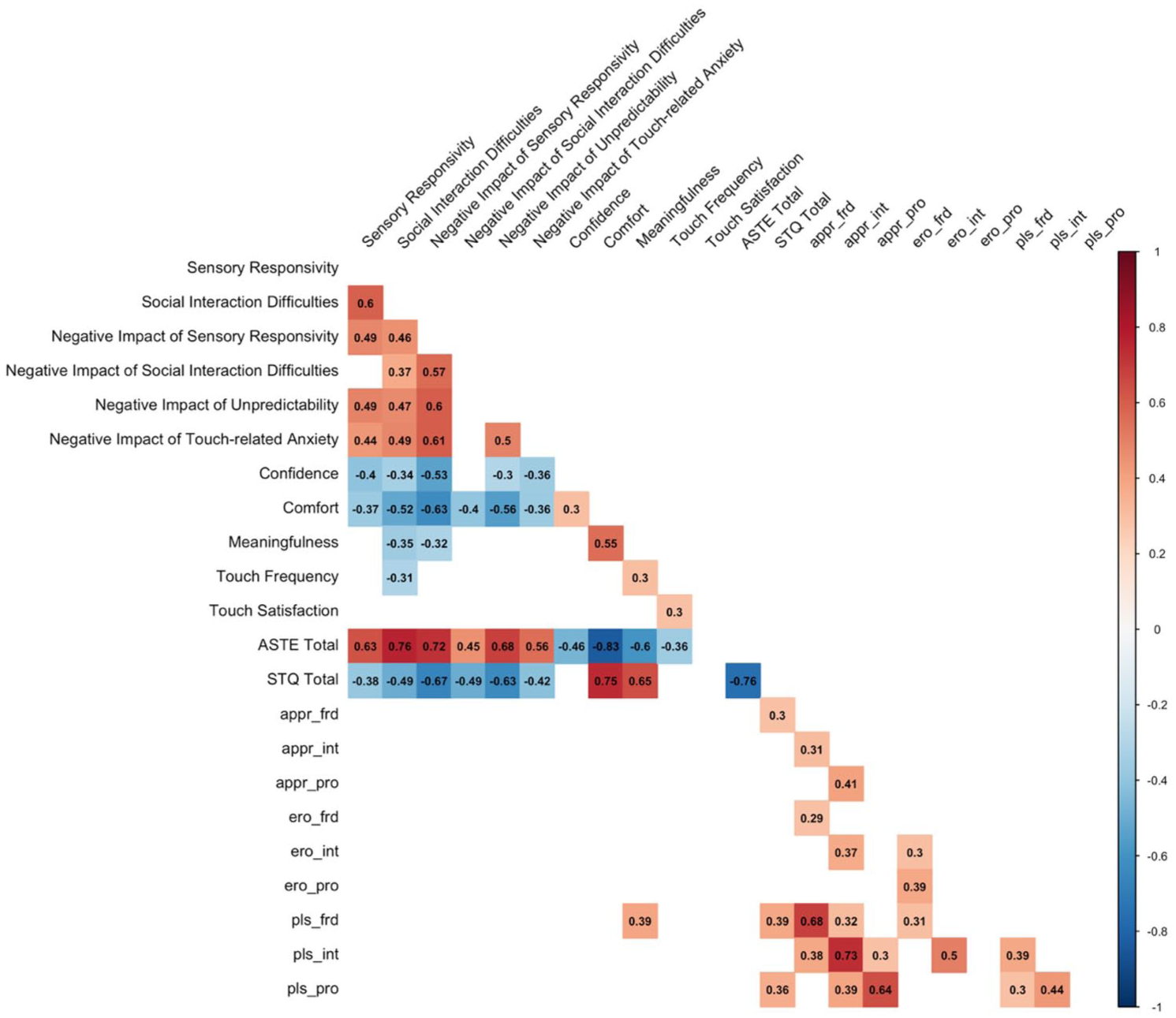
Pair-wise correlation.
Discussion
The current multi-method, quantitative study is the first to examine the social touch experiences of autistic adults in comparison to non-autistic adults, using body-painting, a standardised scale to measure attitudes towards social touch, and a newly developed scale designed to capture the social touch experiences of autistic individuals. A novel aspect of this study is the ASTE scale, which was created with feedback from autistic advisors and includes individual traits relevant to autism, such as sensory processing differences.
Hypotheses around the body-painting task were only partially supported, with minimal differences observed between groups. Both groups rated the appropriateness, erogeneity, and pleasantness of touch differently depending on social contexts and body parts. As hypothesised, however, ASTE and STQ revealed that autistic adults, on average, had more negative attitudes towards and experiences of touch, influenced by heightened sensory response differences, touch unpredictability, touch-related anxiety and reduced social confidence. The current study is the first to explore these factors comprehensively, revealing how these factors more negatively affect social touch experience in autism. Finally, contrary to our prediction, the autistic group engaged in touch as frequently as the non-autistic groups. Importantly, the total scores of the ASTE are strongly correlated with the well-validated STQ scores, suggesting that the ASTE effectively measures what is assessed by the STQ while also considering individual traits relevant for autistic individuals in general. Despite its strong correlation with the standard measure and its in-depth exploration of social touch, the length of the ASTE may limit ease of use. We therefore recognise the need for full psychometric evaluation with a larger sample size, including factor analysis and dimensionality reduction. This may shorten the questionnaire and facilitate its use in future research.
The perceived appropriateness, erogeneity and pleasantness of touch vary based on neurotypes and social contexts
Regardless of neurotype, participants rated touch as most appropriate in professional scenario, less appropriate in intimate scenario, and least appropriate in friendly scenario. The effect of social context on touch interactions has been well documented. Touch that aligns with social expectations, as is often the case for interactions in professional settings, such as physiotherapy, is viewed more positively and perceived as appropriate (Kelly et al., 2018; Saarinen et al., 2021; Suvilehto et al., 2023). Our research used a scenario in which touch during physiotherapy represented professional touch. This context may be generalizable to other professional settings involving touch, such as medical examinations or visits to a hairdresser. The group difference emerged only in the friendly scenario, where autistic participants rated touch as less appropriate, aligning with prior findings (Mello et al., 2024). Finally, we found that a more positive attitude towards social touch is associated with greater perceived appropriateness of touch in friendly scenarios. Our finding suggests that regardless of neurotype those who evaluate social touch more positively may perceive physical contact as a natural part of social interactions, which could contribute to a greater perceived appropriateness.
Regarding erogeneity, touch in intimate scenario was the only context perceived as erogenous in both neurotypes. There was no overall group difference, but autistic males, on average, perceived touch in professional scenarios as closer to neutral, while non-autistic adults and autistic females, on average, rated it as non-erogenous. The literature in this area is limited and presents mixed findings. Some suggest that sensory discomfort during social touch in intimate contexts may reduce the enjoyment of touch for autistic (Beato et al., 2024). Other research shows that autistic adults enjoy intimate touch when it is clearly communicated and aligned with their sensory preferences (Pearson & Hodgetts, 2024). However, in the study by Mello et al. (2024), autistic adults, on average, perceived touch in friendly and intimate contexts as less erogenous than non-autistics. One explanation of this difference is that the hypothetical scenario involving individuals who had met a few times in a social setting may not have evoked strong erogenous feelings in the UK sample regardless of neurotypes.
In the present study, both neurotypes found touch in intimate scenario more pleasant than friendly scenario. This finding aligns with work that has previously only shown this in neurotypical populations (Brkljačić et al., 2017; Krahé et al., 2024; Sorokowska et al., 2021). However, autistic people, on average, perceived social touch in friendly settings as unpleasant (Mello et al., 2024). We also showed that autistic females, on average, rated touch as less pleasant in friendly and professional scenarios than non-autistic females, while no group difference was found in males, possibly due to the small autistic male sample. We extended these findings by correlating pleasantness ratings with other factors. Individuals who perceived social touch as more meaningful in relationships also rated touch in friendly scenarios as more pleasant, while those with a more negative attitude towards touch rated touch in both friendly and professional scenarios as less pleasant. The autistic group rated professional touch as appropriate yet less pleasant, suggesting an awareness of social norms and expectations surrounding professional touch, despite experiencing discomfort. Alternatively, although such touch may be perceived as technically appropriate, individuals may still avoid engaging in it if it is not experienced as pleasant.
Finally, unlike previous work (Mello et al., 2024), no interactions between body part and neurotype were found across the three social contexts and rating dimensions, suggesting that the two neurotypes did not differ in their perception of touch across body areas. Overall, the results from the body-painting task indicate that autistic adults, on average, perceive touch in professional scenarios as more neutral on the erogenous scale but less pleasant, and in friendly scenarios as less appropriate and less pleasant, whereas touch in intimate contexts was perceived similar to that of non-autistic individuals. Therefore, for autistic individuals, touch may be reserved for those with whom they share close relationships, whereas for non-autistic individuals, the use of touch may be broader.
Autistic adults show more negative attitudes towards social touch, along with a more negative perception and experience of touch, which are largely influenced by individual factors
Based on STQ and ASTE scores, autistic individuals, on average, have more negative attitudes towards social touch, perceive touch as less comfortable and less meaningful, and face more touch-related challenges in romantic relationships than non-autistic individuals. These findings are in line with previous work showing social touch differences experienced by autistic individuals (Clifford et al., 2013; Daly et al., 2022; Lee Masson et al., 2019; Penton et al., 2023). A novel aspect of the current study is that it reveals how multiple factors impact social touch experiences in autistic adults in general. Overall, current findings highlight that social touch differences in autism may be better understood through factors that extend beyond the pathologizing lens of social impairment.
Autistic individuals often have sensory processing differences and heightened sensory responsivity related to discomfort and avoidance (Horder et al., 2014; MacLennan et al., 2022; Mello et al., 2025; Ujiie & Takahashi, 2022). Previous work has also suggested that greater social interaction difficulties is experienced due to challenges with social awareness and communication (Black et al., 2023; Constantino et al., 2003). However, in our study, while sensory processing differences had a greater negative impact on social touch experiences, social interaction difficulties impacted the social touch experience in both neurotypes similarly, suggesting that sensory responsivity may be a key factor in how autistic individuals experience social touch. Our results highlight the importance of understanding the interplay between sensory responsivity and social interaction in autism as social challenges experienced by autistic individuals may result from the interaction between sensory and social domains. This notion is supported by neuroscientific evidence showing that divergent development of the sensory cortices impacts social responsiveness in autistic infants (Hazlett et al., 2017). Although the present study examined overall sensory responsivity, future work could further investigate autistic experiences of social touch in relation to hyperresponsivity, hyporesponsivity and seeking to gain a deeper understanding of social touch related to the differential profiles.
The unpredictable nature of touch and high levels of anxiety more negatively influence the social touch experience in the autistic group. The strong preference for predictability to maintain routines and reduce uncertainty are well documented in autism research (Bird et al., 2024; Rodgers et al., 2012; Wigham et al., 2015). The experience of social anxiety during social events, including social touch interaction, has also been observed in this group (Black et al., 2023; Mello et al., 2025; Wilhelm et al., 2001). The pair-wise correlation analysis revealed that these two factors were linked to sensory responsivity, suggesting that making touch more predictable through better communication and mutual consent may help autistic individuals reduce the anxiety associated with intolerance of uncertainty (Lidstone et al., 2014; MacLennan et al., 2020).
Regarding social factors, touch with close others is perceived as comfortable and meaningful in neurotypical population, while autistic individuals particularly value physical intimacy with significant others (Barahmand et al., 2023; Sala et al., 2023; Schirmer et al., 2023). We showed similar patterns across neurotypes in how social factors influence touch, with no differences in frequency or satisfaction. While autistic people may engage in touch despite discomfort, some may do so not out of preference but as a form of masking or fawning to avoid rejection or harm, especially in unsafe relationships (Pearson et al., 2023). This highlights the importance of viewing touch within a wider social and relational context, beyond individual traits.
Limitations and future direction
This study has several limitations regarding the sample, methods, and generalisability. Although we observed a significant interaction between neurotypes and social contexts in body-painting task, we found no interaction between body parts, neurotypes, and sex reported by Mello et al. (2024b). This discrepancy may reflect our imbalanced sample, which included more females and a higher proportion of non-autistic participants. Sex-related findings should be interpreted with caution given the small number of male participants. However, the greater representation of autistic females offers valuable insights, as most prior studies have predominantly focused on autistic males. Sex differences can influence touch perception (de Giambattista et al., 2021; Kumazaki et al., 2015; Lai et al., 2011; Osório et al., 2021), but only examining sex assigned at birth and not gender identity is problematic; therefore, future work could recruit more balanced samples to more inclusively examine biological sex and gender.
Most of our participants were largely based in the UK, which may affect cultural diversity. Cultural differences in touch have been reported within Western countries and around the globe (Schirmer et al., 2023; Ujiie & Takahashi, 2022). The present study cannot address the interaction between neurotype and ethnicity given that Asian participants were unevenly distributed, with more in the non-autistic than the autistic group. Future research should include more culturally diverse participants to explore how cultural norms shape social touch experiences.
Future work may examine social touch experiences among trauma-exposed and chronic-pain cohorts, which are prevalent in autism (Rumball et al., 2021) and often show altered sensory/tactile perception (Kass-Iliyya et al., 2017; Nees et al., 2019; Yochman & Pat-Horenczyk, 2019). Given the high rates of anxiety in autism (Hollocks et al., 2019), incorporating validated measures of generalised anxiety would help disentangle the effects of broader anxiety from touch-specific anxiety on social touch experience.
Finally, future work may consider developing more accessible and intuitive paradigms to better capture the social touch experiences of autistic people with a wide range of support needs. Although the body-painting task may be more intuitive, the accompanying scenarios and questionnaires currently rely heavily on reading and writing, which may not reflect the preferred or most effective communication styles for some autistic individuals. Adapting these methods could help ensure more inclusive participation and representation across the spectrum.
Conclusion
This study is the first to systematically examine how individual and contextual factors influence social touch perception in autistic adults using a neurodiversity-informed lens. While both autistic and non-autistic adults were similarly influenced by context and body region in their perception of social touch, autistic adults reported more negative attitudes overall, with their experiences more strongly shaped by sensory responsivity, social interaction difficulties, reduced confidence, touch-related anxiety, and unpredictability of touch. Despite these differences, autistic adults engage in social touch just as frequently and report comparable levels of satisfaction in general, highlighting the importance of recognising individual preferences rather than assuming avoidance.
The development of the ASTE scale contributes to the field by offering an autism-informed measure that addresses a key gap in capturing the nuances of social touch experiences. This work challenges traditional deficit-based interpretations by centring lived experience and context as critical to understanding social touch. In doing so, the current study not only generates novel insights but also lays the groundwork for more inclusive, personalised approaches to social interaction, clinical support, and societal understanding.
Supplemental Material
sj-docx-1-aut-10.1177_13623613251403906 – Supplemental material for Autistic adults prefer social touch less but engage just as much: The impact of social context, relationship type, sensory responsivity, and psychological factors
Supplemental material, sj-docx-1-aut-10.1177_13623613251403906 for Autistic adults prefer social touch less but engage just as much: The impact of social context, relationship type, sensory responsivity, and psychological factors by Macy Tsz Wing Li, Manuel Mello, Keren MacLennan and Haemy Lee Masson in Autism
Footnotes
Acknowledgements
The authors thank Dr. Amy Pearson for her feedback on the manuscript, Dora Sadler for her support in participatory research, and Dr. Justin Sulik for developing and making the body-painting task publicly available.

Ethical Considerations
This study was approved by the Psychology Ethics Committee of Durham University (Ethics Code: PSYCH-2024-0071-252) on 2 February 2024. This research was conducted ethically in accordance with the World Medical Association Declaration of Helsinki.
Consent to Participate
All participants provided consent to participate online prior to enrolment in the study.
Author contributions
Funding
The authors received no financial support for the research, authorship, and/or publication of this article.
Declaration of conflicting interests
The authors declared no potential conflicts of interest with respect to the research, authorship, and/or publication of this article.
Data availability statement
Supplemental material
Supplemental material for this article is available online.
References
Supplementary Material
Please find the following supplemental material available below.
For Open Access articles published under a Creative Commons License, all supplemental material carries the same license as the article it is associated with.
For non-Open Access articles published, all supplemental material carries a non-exclusive license, and permission requests for re-use of supplemental material or any part of supplemental material shall be sent directly to the copyright owner as specified in the copyright notice associated with the article.
