




Abstract
While the link between autism and gender dysphoria has received increasing attention, the phenomenon of gender dysphoria co-occurring with autism remains unclear owing to the lack of autistic transgender perspectives. Therefore, we explored the gender dysphoria experiences of 15 Japanese autistic transgender adults, obtaining two key findings. First, their gender dysphoria experiences were diverse; some were related to gender incongruence, whereas others were not. The latter were characterized by resistance to the societal gender norms themselves, sensory disgust related to autistic sensory sensitivities, uncertainty regarding the gender norms of the social majority, and the autistic burden of living in a gendered society. Second, by examining the participants’ life stories of being autistic in society, we found that most of them not only accumulate distress over gender norms (i.e. gender dysphoria) but pervasive social norms as well, which we termed pervasive social dysphoria. In other words, most participants experienced gender dysphoria as a subset of pervasive social dysphoria. These findings indicate that future research and practice need to further affirm the internal perspectives, such as by investigating which among the diverse gender dysphoria experiences co-occur with autism or a link between autism and pervasive social dysphoria, and by providing support for both gender dysphoria and pervasive social dysphoria in practice.
Lay abstract
Studies have suggested that autistic people are more likely to experience gender dysphoria, which refers to the gender-related distress emerging from personal factors and gender norms that some transgender people experience. Transgender people are diverse; some experience gender incongruence (i.e. an incompatibility between a person’s gender identity and that expected of them based on their birth-assigned gender), whereas others do not. Therefore, the association of autistic transgender people’s gender dysphoria with gender incongruence varies, and the literature has overlooked such diversity. Interviews with 15 Japanese autistic transgender adults revealed diverse gender dysphoria experiences independent of gender incongruence, such as resistance to the societal gender norms themselves, physical dysphoria caused by the imposition of gender, sensory disgust related to autistic sensory sensitivities, uncertainty about the gender norms of the social majority, and the autistic burden of living in a gendered society. Moreover, we found that most participants had not only accumulated distress over gender norms (i.e. gender dysphoria) but also over pervasive social norms, termed Pervasive Social Dysphoria. Our findings suggests that future co-occurrence research and practice must affirm these internal perspectives more, such as by providing support for both gender dysphoria and Pervasive Social Dysphoria, as autistic transgender people may experience gender dysphoria as a subset of Pervasive Social Dysphoria.
There is growing evidence of a link between autism and gender dysphoria (GD). Since the late 1990s, several case reports of this co-occurrence have been published worldwide (Tateno et al., 2008; Williams et al., 1996), raising the question of a possible link between autism and GD experiences. For instance, de Vries et al. (2010) found a 7.8% prevalence of autism spectrum disorder (ASD; American Psychiatric Association [APA], 2013) in children and adolescents referred to gender services—almost eight times higher than the global prevalence (Lai et al., 2019). Since de Vries et al.’s (2010) report, several prevalence studies have emerged, suggesting a link (e.g. Hisle-Gorman et al., 2019). However, other researchers have highlighted the uncertainty regarding which gender experiences co-occur with autism (e.g. Turban & van Schalkwyk, 2018). This is attributable to the lack of autistic transgender perspectives in the field, as co-occurrence studies are only beginning to address the 21st century’s evolution of perspectives around autism and GD.
Evolution of perspectives: from disorder to diversity, external to internal
Both autism and GD have been pathologized from an external perspective, while not understanding internalized experiences. The characteristics differentiating autistic people from non-autistic have been pathologized as a disorder (ASD; APA, 2013). However, as neurodiversity—the diversity of the human mind—is increasingly accepted through the efforts of the autistic community and advocates, autism is now considered one variation of a myriad of minds, and autistic people are considered different, not inferior (e.g. Singer, 2017). Therefore, we define autism as a lifetime neurodevelopmental condition that affects the way people interact with the world. Autistic people exhibit differences in social communication, social interaction, and sensory sensitivities. They also show restricted and repetitive interests and behaviors (RRBI), which may give them comfort while posing disadvantages (e.g. Cage et al., 2018).
Similarly, regarding GD, people’s diverse gender experiences that do not align with social and cultural expectations attributed to their birth-assigned gender have been pathologized from an external perspective (i.e. gender identity disorder (GID); APA, 1980). However, the self-advocacy of transgender people (i.e. people whose gender identities or gender expressions or both are not what is typically expected for the gender to which they were assigned at birth; Coleman et al., 2022) have led to their gender identity being de-pathologized. The Diagnostic and Statistical Manual of Mental Disorders, 5th edition (DSM-5; APA, 2013) replaced GID that was found in previous editions with GD, acknowledging the distress experienced by some transgender people due to their gender incongruence, defined as the incompatibility between a person’s gender identity and the gender expected of them based on their birth assignment.
However, transgender perspectives are not fully reflected in current research and practice. Recently, Japanese transgender people have raised objections to the definition of transgender that assumes gender incongruence: As our very existence has proven, some transgender people do not align with the golden rule that assumes gender incongruence. One example is transgender people, such as us, who have no gender identity. However, how those with no gender identity can be termed “trans” gender is a highly complex and intricate issue that is rarely discussed (Satsuki & Shuji, 2023, p. 94; translated by the authors).
It is gradually being understood in Japan that although some transgender people have an alternative gender identity to their birth-assigned gender and transition accordingly, others may have transitioned without an alternative gender identity as a result of their search for a means of survival (Shuji & Takai, 2023; see Supplementary Appendix C for Japanese transgender history). Thus, we define transgender and GD in terms of gender norms, without assuming gender incongruence: Society has gender norms that require a person to (1) live as a man or woman and (2) behave as a man or woman would, based on the gender assigned at their birth, regardless of their circumstances and desires (Moriyama, 2017, p. 49). Transgender people are distressed by the first (and second) requirement and, in response, move away (transition) from their birth-assigned gender, irrespective of whether they experience gender incongruence (Shuji & Takai, 2023, p. 37). GD is the gender-related distress experienced by some transgender people (see gender terminology and abbreviations in Supplementary Appendices A and B). The other reason for adopting these definitions was their alignment to our findings in this study.
Conceptualizations of autism and GD have rapidly transitioned from disorder to diversity, affirming the internal perspectives of autistic and transgender people in recent times. However, in co-occurrence research, these internal perspectives have been largely overlooked.
Limitations of existing studies on the co-occurrence of autism and GD
Prevalence studies
Since 2010, several prevalence studies have investigated the incidence of autism in transgender populations. Kallitsounaki and Williams (2023) conducted a meta-analysis and concluded that the possibility of there being no association between autism and GD is negligible. However, they cautioned that it is unclear which gender experiences are significantly associated with autism, as these studies combined heterogeneous transgender experiences from a researcher’s perspective, overlooking the diversity from internal perspectives.
Similarly, studies investigating the incidence of GD in autistic populations have overlooked autistic people’s perspectives. For example, several studies have asked caregivers about their child’s gender incongruence, using a single item (i.e. wishes to be of opposite sex) from the Child Behavior Checklist (CBCL), and reported that caregivers of autistic children are more likely to identify gender incongruence in their children than controls (e.g. Strang et al., 2014). Turban and van Schalkwyk (2018) questioned the reasoning behind considering a child as experiencing gender incongruence based on caregiver responses to a single item that is not specific to the assessment of GD. These critiques led to counterarguments (e.g. van der Miesen et al., 2018), which expressed concern that stressing on the clarification of the phenomenon of GD co-occurring with autism could lead to denying autistic people’s GD in clinical practice. Although their concerns were pertinent given that, historically, GD in autistic people has been denied, it is necessary to understand the phenomenon identified from an external perspective—the caregiver’s—from the perspective of the autistic person, from an affirmative point of view.
Qualitative studies
Compared to the numerous quantitative prevalence studies, qualitative studies on autistic transgender people’s internal perspectives are few (Strang et al., 2018). In addition, existing qualitative studies focused on those who experience gender incongruence, limiting the understanding of autistic transgender people’s diverse GD experiences that may not be associated with gender incongruence. Nevertheless, these studies offer important insights. Two qualitative studies from the United Kingdom suggest that, from the perspective of autistic transgender people, GD may be a subset of the wider conflicts they face as an autistic person in society. Coleman-Smith et al. (2020) interviewed 10 autistic adults with a formal diagnosis of GD and found that, even after gender congruence increased, autistic participants continued to feel “different” because of being autistic in society. Similarly, Cooper et al. (2022) interviewed 21 autistic adults with GD and found that their conflict was not only related to their gender but extended to their wider sense of the self, which relates to being autistic in society. However, this view has not been explored, as the current literature assumes a specific link between GD and autism.
Research questions
From reviewing the co-occurrence literature, the general lack of autistic transgender people’s perspectives is evident. This raises two issues: (1) The diverse experiences of GD that co-occur with autism are not well understood. (2) The possibility that the phenomenon co-occurring with autism may not be exclusively GD when considered from an internal perspective is unexplored (e.g. GD may be a subset of a wider conflict they face as an autistic person in society). Therefore, two research questions were formulated and addressed through in-depth interviews with 15 Japanese autistic transgender adults. First, we sought to understand their lived experiences of diverse forms of GD that may not involve gender incongruence (RQ1). Second, we sought to understand how the phenomenon co-occurring with autism is conceptualized from an internal perspective and whether it spans beyond GD (RQ 2). We addressed RQ 2 by examining the positioning of GD experience within the participants’ life stories of being autistic in society. We explore life stories because by focusing specifically on GD experiences according to the researcher’s framework, there is a risk of overlooking the wider experiences of autistic transgender people.
Method
Research design
This study adopted a qualitative research design, employing interpretive phenomenological analysis (IPA; Smith et al., 2022), for three reasons. First, the phenomenological approach of IPA was best suited to understand the lived reality of autistic transgender people’s GD in their own terms. Second, IPA’s emphasis on researchers’ reflexivity from the hermeneutic tradition is useful for reflecting researchers’ preconceptions to capture diverse GD experiences, including those that do not conform to the hegemonic discourse of GD that assumes gender incongruence. Third, the idiographic approach of IPA aligns with our aim of examining the diverse experience of GD while focusing on the individual.
The methods and materials for this study were approved by the University of Tokyo’s Research Ethics Committee (22-232). Procedures were conducted in Japanese, following which the themes and representative quotes were translated into English by the bilingual first author and reviewed by two bilingual individuals and an English proofreading service.
Reflexivity statement
The first author is a clinical psychologist with experience in supporting autistic people, including facilitating a peer-support group for autistic transgender people. The second author is a university professor with extensive experience in supervising qualitative research. To manage the researchers’ perspective, the first author, who collected and analyzed the data, maintained a reflexive journal, received regular supervision from the second author, and attended qualitative analysis training. Furthermore, 14 participants provided feedback on the findings in member check interviews.
Participants
Study participants comprised 15 Japanese adults aged 20–49 years (mean ± SD: 31.3 ± 10.2), who are formally diagnosed with ASD and identify as transgender with GD, as defined in this article. Of them, 3 were assigned female at birth (AFAB) and 12 were assigned male at birth (AMAB). All were born and raised in Japan, except one participant who lived intermittently in another country until high school. ASD diagnosis was confirmed in 14 participants using the Autism Diagnostic Observation Schedule-2 (ADOS-2; Lord et al., 2012). One participant could not participate in the ADOS-2 and member check interview owing to difficulty visiting the site; however, their eligibility was confirmed by their primary psychiatrist. Although two participants scored as “non-spectrum” on the ADOS-2, we included them based on their formal diagnoses, which were confirmed by an official report; moreover, ADOS-2 is only one component of a full diagnostic assessment for ASD (Lord et al., 2012). All participants identified as transgender with GD as defined in this article; 11 had received support from gender-informed professionals before, including 6 participants who had a diagnosis of GD according to DSM-5, which requires gender incongruence. The four other participants, who had never sought support from gender-informed professionals, were included to ensure a range of autistic experiences of GD that may not involve gender incongruence. Table 1 summarizes the participants’ demographics.
Participants’ demographic information.

SD = standard deviation, GD = gender dysphoria, ADOS-2 = Autism Diagnostic Observation Schedule-2, DSM-5 = Diagnostic and Statistical Manual of Mental Disorders (5th ed.).
Four participants had not sought help from gender services.
ASD diagnosis was confirmed for 14 participants through the ADOS-2 (Lord et al., 2012), administered by research-reliable personnel.
One participant was not administered ADOS-2 due to difficulty in visiting the site.
Participant recruitment
Recruitment process
Participants were recruited from two hospitals and one clinic specializing in neurodevelopmental disorders across all ages (n = 7), a hospital department and a clinic specializing in gender care for all ages (n = 6), a community group for autistic transgender people (n = 1), and a community group for transgender people (n = 1). All recruitment locations were in urban areas in the eastern and western parts of Japan.
Data collection
Participants were invited to speak with a researcher either in-person or online before their interviews to provide informed consent (i.e. verbal and written). To obtain a comprehensive understanding of their lived experiences, we interviewed participants over two to three sessions (total interview time of 203–396 minutes, with an average of 273 minutes) between April 2021 and March 2022. In addition, member check interviews (lasting 79–145 minutes, with an average of 111 minutes) were conducted with 14 participants in January 2023. The interviews were either face-to-face (n = 10), online (n = 3), or both (n = 2). All interviews were audio recorded. Participants were presented with a ¥3000 shopping voucher for each session.
Interview schedule
Semi-structured interviews were conducted by the first author. The interview schedule included the following topics: (1) GD experiences in their life, (2) their life story of being autistic in society, (3) intersectional experience of being transgender and autistic, and (4) support needed (see Supplementary Appendix D for the full interview schedule). Topics (1), (3), and (4) examined the diverse GD experiences of autistic transgender people to address RQ1. Topic (2) explored how autistic transgender people position their GD experiences within their overall life stories to address RQ2. In the member check interviews, participants reviewed the findings and confirmed the consistency with their experiences.
Analysis
All interviews were transcribed verbatim, imported into MAXQDA 2022 qualitative data analysis software (VERBI GmbH, 2021), and analyzed using IPA (Smith et al., 2022). First, an idiographic analysis was conducted on each individual transcript. Transcripts were read repeatedly, and exploratory notes were taken. Working primarily with these exploratory notes, the data were reduced to the level of emergent themes, called experiential statements, which refer directly to the participants’ experiences and their associated meaning, and also to the analysts’ interpretation. Patterns of similarity and differences across experiential statements were identified and grouped as Personal Experiential Themes (PETs).
From this idiographic analysis, we found that although all participants were distressed with being forced to live as their assigned gender at birth, not everyone had an alternative gender identity (see Supplementary Appendix E for all participants’ gender identification). They had different perspectives on their GD experiences, with only eight explaining their GD experiences in association with gender incongruence. Based on their experience of gender identity, participants were divided into three groups: (1) autistic transgender group with gender incongruence; (2) autistic transgender group without gender identity; and (3) autistic transgender questioning group (see Figure 1).
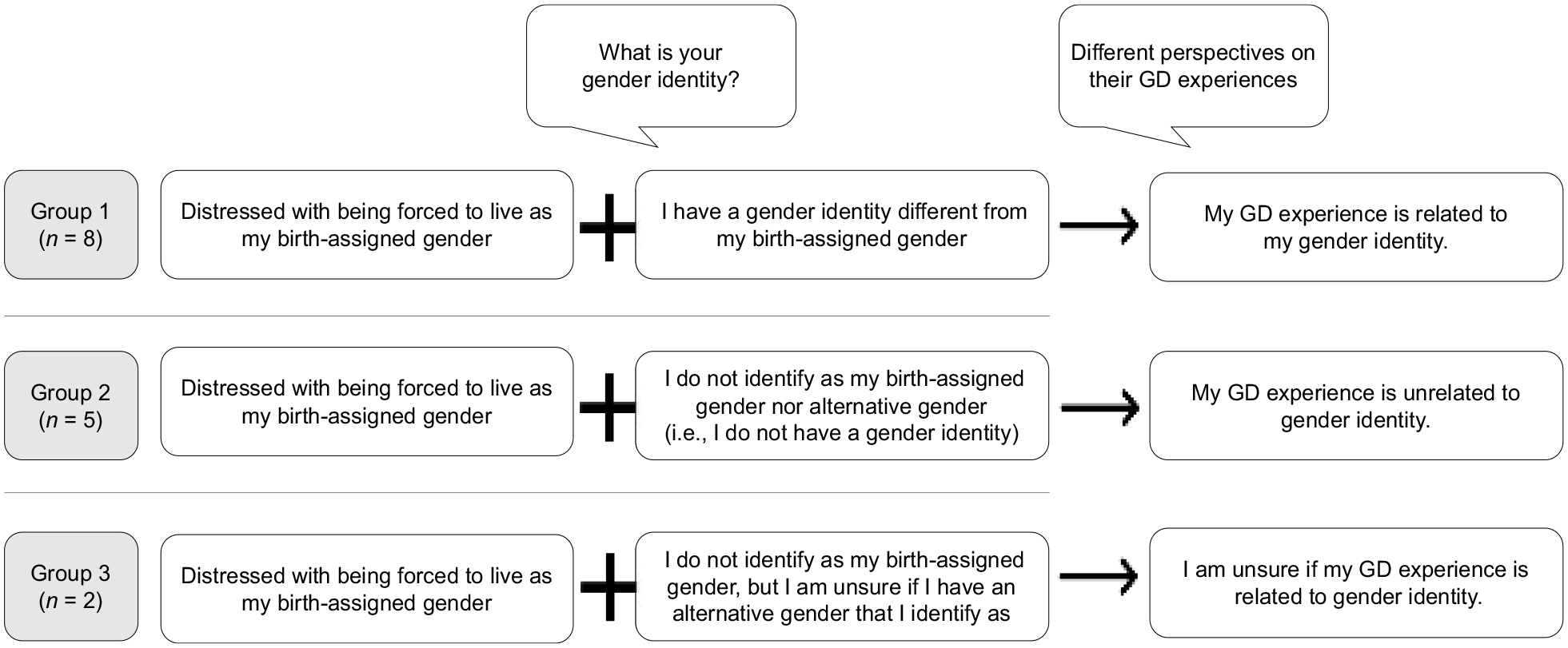
Three groups of participants.
Since participants had different perspectives on their GD experiences, we used a multi-perspectival IPA design—an applied IPA methodology that aims for a more complex and systematic understanding of phenomena by exploring multiple perspectives (Larkin et al., 2019). We looked for the shared and unique features within each of the three groups across the PETs generated for each participant in the idiographic analysis and created a set of Group Experiential Themes (GETs). Once each group had been analyzed, we used a similar process to identify overarching themes across the three groups and specific themes for each group. Thus, we generated four superordinate GETs, of which two contained unique subordinate GETs for each group (superordinate-GETs 1 & 2), and the other two were shared between the groups (superordinate-GET 3 & 4). In addition, we generated one superordinate GET for their life story of being autistic in society (superordinate-GET 5; see Figure 2).
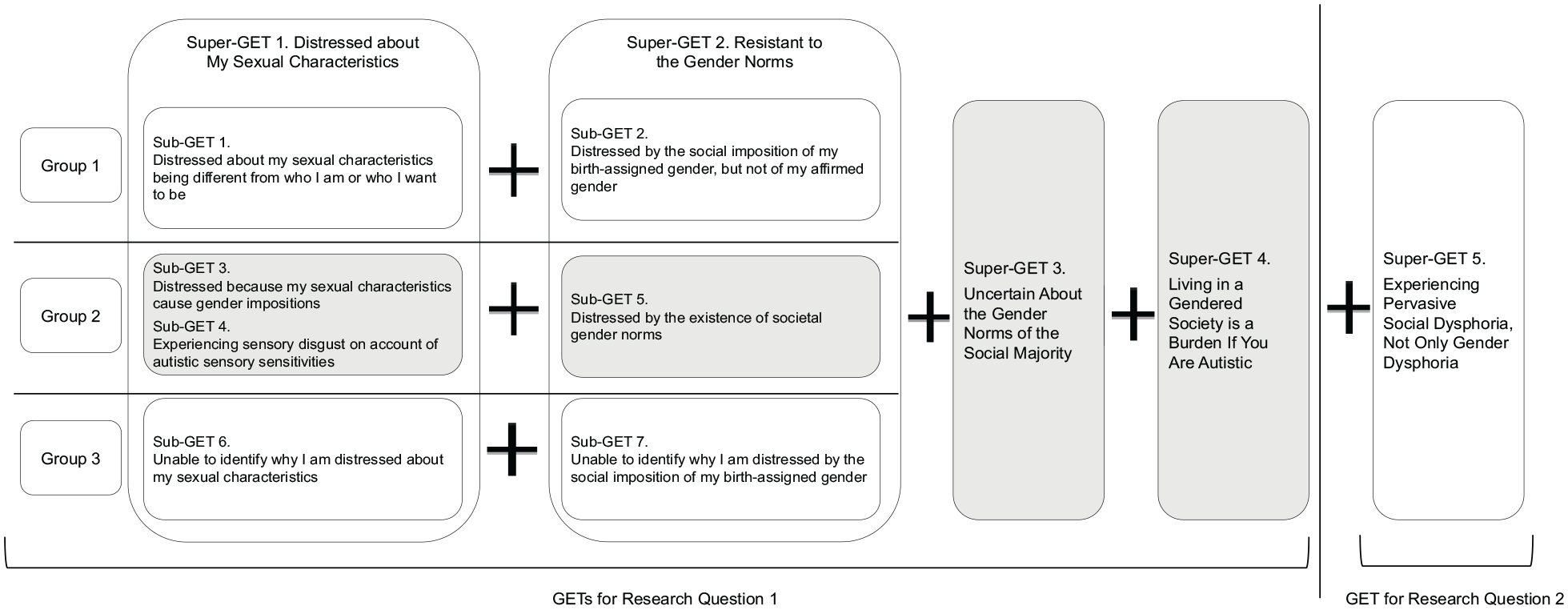
Generated themes.
Finally, member check interviews were conducted to assess validity. The final number of participants representing each GET was also confirmed. For the number of participants for each GETs, see the Results and Discussion section and Supplementary Appendix F.
Community involvement
As participatory co-design mechanisms for autism research are still being developed in Japan, this study did not involve specific community involvement. However, the research questions arose from discussions with members of the peer-support group facilitated by the first author. In addition, participants actively contributed to the development of the study, for example, through the member check interviews.
Results and discussion
Orientation
This study aimed to describe GD experiences co-occurring with autism from the individual perspectives of autistic transgender participants. Regarding RQ1, the GD experiences of the participants were more diverse than distress related to gender incongruence (APA, 2013), as shown in Figures 1 and 2. Regarding RQ2, from the perspective of participants, the co-occurring phenomenon may be Pervasive Social Dysphoria (PSD: See Figure 3). By exploring their life stories of being autistic in society, we found that participants had accumulated distress over pervasive social norms, which we termed PSD. And as a subset of PSD, there is GD (i.e. the distress over gender norms), as well as other distress related to norms such as social relationships, education, employment, and so on.
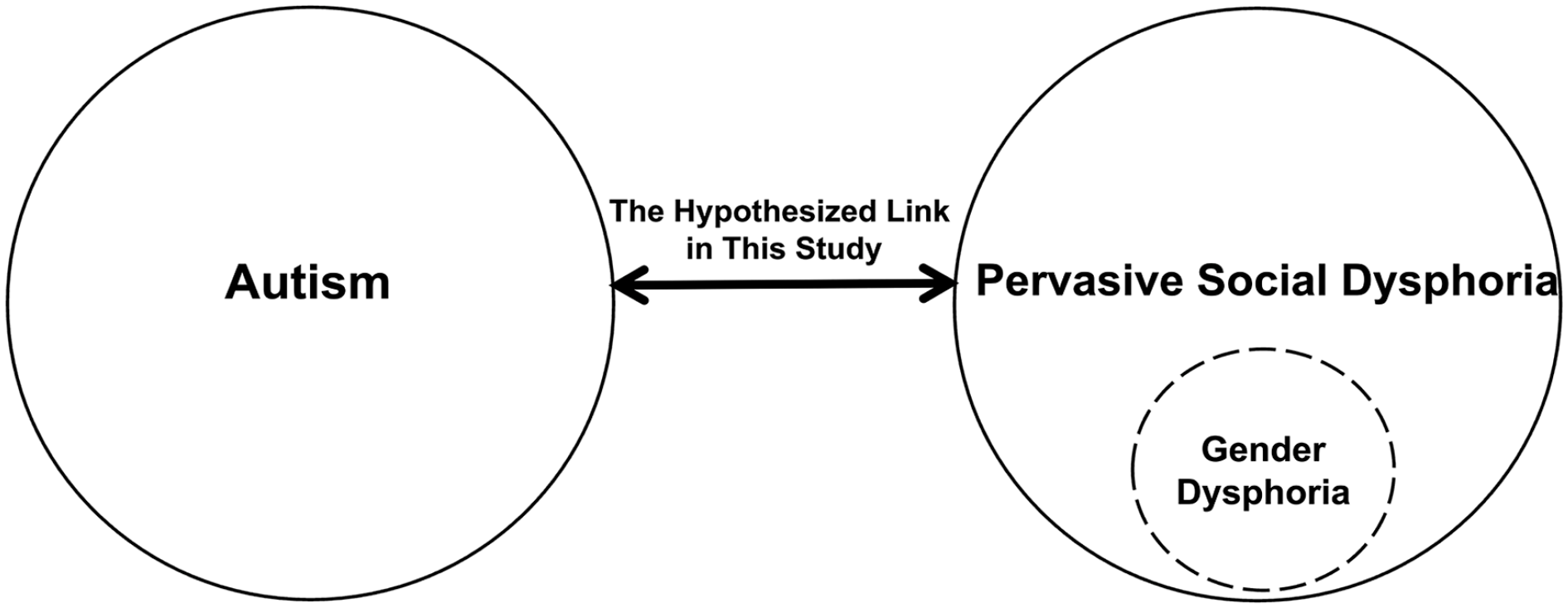
The hypothesized link between autism and pervasive social dysphoria.
To describe these findings, for the outcome of RQ1, we first explain the categorization of participants based on their experience of gender identity. Subsequently, we describe the GD experiences of each group, shared experiences of the three groups. Finally, we explain PSD for the outcome of RQ2.
Participants’ experiences related to gender identity
Although all participants reported distress from being forced to live as their birth-assigned gender, not all had alternative gender identities (Figure 1).
Group 1: with gender incongruence
When asked about their gender identity, eight participants referred to having experienced a strong preference for an alternative gender identity to the birth-assigned gender. We therefore named this group the gender incongruent group. Of them, six participants identified as binary gender, and the other two identified as nonbinary.
Group 2: without gender identity
Five participants reported that they did not have alternative gender identity to the birth-assigned gender. Thus, we termed them the group without gender identity. From an external viewpoint, these participants’ experience of having no gender identity may appear to be identifying as nonbinary, as two participants in Group 1 did. However, their experience differs in that the Group 1 participants had a proactive preference for nonbinary. Meanwhile, being at a loss as to how to explain their transgender experience without a gender identity, they reported that when asked, they would reluctantly choose nonbinary categories. Thus, the high rate of selection of nonbinary categories among the autistic population (e.g. Walsh et al., 2018) may also represent those without gender identity reluctantly identifying as nonbinary.
Group 3: questioning group
Two participants explained that they were unsure. They expressed uncertainty and distrust regarding social ideas of femininity and masculinity because they lacked an objective standard. Consequently, they could not explain their gender identity with these inadequate ideas of femininity and masculinity (“I don’t know if I’m neither male nor female, or if I’m more feminine or masculine than I realize; but I don’t know what it is at all, masculine–feminine,” 14). Furthermore, they were uncertain about their broad sense of self, not only gender (“Moreover, I don’t really have a sense of my identity, who I am,” 15). As a part of questioning who or what they were, they also questioned their gender. Thus, we named them the questioning group.
GD experiences of three groups
All three groups experienced distress regarding their sexual characteristics (i.e. physical dysphoria; superordinate-GET 1) and the gender norms that compelled them to live and behave as their birth-assigned gender (i.e. social dysphoria). Their social dysphoria was of three types: resistance to the gender norms (superordinate-GET 2), uncertainty about the social majority’s gender norms (superordinate-GET 3), and the autistic burden of gender norms (superordinate-GET 4). Of these, physical dysphoria and resistance was experienced differently in each group, whereas uncertainty and burden were common to all (Figure 2).
GD experience of group 1 with gender incongruence
Physical dysphoria (subordinate-GET 1)
Participants in Group 1 experienced distress because their sexual characteristics were different from who they were or wanted to be (see Supplementary Appendix G-1, 2 for supporting quotes). That is, their physical distress was strongly related to their gender incongruence (“My male body parts had been stressing me out, eating away at me. Male development was something truly sickening.”; 3, female).
Resistance to gender norms (subordinate-GET 2)
Participants in Group 1 were distressed by the social imposition of their birth-assigned gender, but not by the imposition of their affirmed gender. Conforming to the gender norms of their affirmed gender felt natural and joyful to them (“Girls who were close to me, well, they gathered and enjoyed dressing me up as a woman, and that was a lot of fun for me too.”; 7, gender-neutral; Supplementary Appendix G-3, 4). In other words, participants in Group 1 found their way of responding to the gender norms, which compel people to live as a man or woman, by acquiring an alternative gender identity. In this respect, they were less resistant to the existence of societal gender norms.
GD experience of group 2 without gender identity
In contrast to Group 1, the participants of Group 2 without gender identity did not experience GD in association with gender incongruence but rather as strong resistance to the existence of societal gender norms, or sensory disgust.
Physical dysphoria (subordinate-GET 3 & 4)
In Group 2, physical dysphoria was caused by two reasons. First, they were not distressed by the sexual characteristics themselves; however, when gender norms are imposed on them because of these sexual characteristics, they become distressed (subordinate-GET 3: “I was only disgusted by my body because others would sexualize it and come on to me,” 12; Supplementary Appendix G-5). In other words, distress regarding gender norms manifests as physical dysphoria. This was also reported by a participant in Group 1(Supplementary Appendix G-6). Second, their autistic sensory sensitivity caused physical distress (subordinate-GET 4; Supplementary Appendix G-7). For example, one participant mentioned intense sensory disgust related to the sexual development (“It was like some messy and disgusting stuff coming my way in my mind and body.”; 9; Supplementary Appendix G-8).
Resistance to gender norms (subordinate-GET 5)
Participants in Group 2 were distressed by the social imposition of gender and were strongly resistant to the gender norms themselves (see also Supplementary Appendix G-9): If you are a man and your gender identity is a woman, I think many people want to be treated as woman. But that means society treats you differently depending on whether you are a man or woman, doesn’t it? I hope all these things become a thing of the past (11).
This resistance to the existence of societal gender norms was more pronounced in Group 2, although it was also mentioned by one participant in Group 1 (Supplementary Appendix G-10). This may be due to Group 1 being able to locate their experiences within existing social gender norms and the framework of the culturally shared story about gender (i.e. the master narrative; Hammack, 2008); whereas Group 2, who lacked an alternative gender identity, could not. As those who are more deviant are more aware of the master narrative (McLean et al., 2017), it is possible that Group 2 were more aware of and resistant to social gender norms themselves.
GD experience of group 3. Questioning group
Physical dysphoria and resistance to gender norms of group 3 (subordinate GET-6 & 7)
Participants in Group 3 were uncertain about their gender identity, and therefore, also uncertain about whether they were gender incongruent. Thus, they could not attribute their distress to their sexual characteristics and their resistance to gender norms to gender incongruence, as Group 1 could. Nor could they find an alternative explanation for their distress, as Group 2 did. In addition, the social hegemonic discourse of GD which assumes gender incongruence (e.g. APA, 2013) made them feel lost, as though they might have an alternative gender identity that they are unaware of (“I am uncomfortable with my male sexual urge; does that mean I can’t accept my gender?,” “I’m obsessed with things that are generally considered feminine. Is it because I feel natural as a woman?,” 14). Thus, the GD experience of Group 3 was characterized by a maze of confusion and of not understanding why they were distressed, which added to their suffering (“It might be hard to have gender incongruence, but it will also be hard if I cannot clearly say that.,” 15; Supplementary Appendix G-11, 12).
Shared experiences of social dysphoria among groups 1, 2, and 3
Uncertain about the gender norms of the social majority (superordinate-GET 3)
Ten participants reported uncertainty about social gender norms that are taken for granted in society. This uncertainty mirrors the uncertainty about the social ideas about femininity and masculinity reported by Group 3 (Supplementary Appendix G-13), and also by participants in Group 1 and 2 (“Like—because the idea of ‘feminine’ is only my own. I don’t know if that is common (with the world),” 1; Supplementary Appendix G-14, 15). As social norms, including gender norms, are shared through communication (Ujiie, 2011), autistic participants with different communication styles may find it difficult to acquire social norms from the communication of the social majority of allistic people. This uncertainty led them to be free of gender norms and to be themselves (“I am autistic, I am queer, and I am proud!,” 1). However, it also caused them confusion and anxiety about whether their behavior was acceptable in society (“I have no idea how people see me,” 4).
Living in a gendered society is a burden for autistic people (superordinate-GET 4)
Fourteen participants stated that living in a society where gender norms governs most aspects of human life is a burden for autistic people. For example, binary gender-based social structures that are not private were uncomfortable for them: I can’t urinate in the men’s urinal, no matter how hard I try. I seem to get really stressed when other people are around, not only in the bathroom. (. . .) I wonder why society is designed on the assumption that it is OK to have people of the same gender together in places like bathrooms or locker rooms. (11)
Another participant described the burden of conforming to male gender norms: If you want to live well as a man, you must be sociable, speak well, be competitive, and, well, men behave in a masculine way and intimidate each other. Simultaneously, you must work, earn money, and have a family. With all that going on, living with a disability like autism can be an overwhelming weight to bear. (7)
Similarly, other participants reported the autistic burden for conforming to gender norms regarding appearance (e.g. male school uniform; Supplementary Appendix G-16), activities at school (e.g. intensive physical education for boys) and parental roles (e.g. the maternal role; Supplementary Appendix G-17). Their accounts suggest that gender norms may make them suffer because they are not inclusive of autistic people. This may be because social norms and communities influence each other through the construction and incorporation of social norms in daily life by community members (Berger & Luckman, 1966), which results in autistic participants experiencing the gender norms constructed by the majority according to their allistic characteristics as burdensome.
Summary of the participants’ diverse GD experiences
We have described how the GD experiences of the participants are more diverse than distress related to gender incongruence. The GD experiences of Group 2 were not related to gender incongruence. In addition, the GD experiences of Group 3 may be unrelated to gender incongruence. Moreover, the shared experiences of uncertainty regarding the social majority’s gender norms and their autistic burden were not caused by gender incongruence but rather by societal gender norms and the way these are shared, which are not inclusive of autistic people.
These diverse experiences of GD cannot be explained within the framework of gender incongruence. In searching for a new framework, it became evident that all the described GD experiences emerged from the social framework of gender norms. Participants’ social dysphoria (superordinate-GET 2, 3, 4) can be attributed to the gender norms that require people to live as their birth-assigned gender in society, regardless of their circumstances and desires. In addition, participants’ physical dysphoria (superordinate-GET 1) was not unrelated to gender norms. Group 2’s distress with gender norms, which manifested as physical dysphoria (subordinate-GET 3), was closely related to the social imposition aspects. Furthermore, Group 1’s physical dysphoria related to gender incongruence (subordinate-GET 1), Group 2’s sensory disgust (subordinate-GET 4), and Group 3’s physical dysphoria associated with confusion (subordinate-GET 6) may not have been directly caused by gender norms but by the personal characteristics of the participants. However, since the participants recognized them as distress over “sexual characteristics,” they were not irrelevant to gender norms. These results suggest the importance of regarding GD as a social phenomenon, emerging from personal factors and gender norms. From these perspectives, we adopted a definition of GD in terms of gender norms, without assuming gender incongruence.
GD as a subset of PSD (superordinate-GET 5)
Regarding RQ2, by examining their life stories as autistic people in society, we found that 14 participants not only accumulated distress over gender norms (i.e. GD) but also pervasive social norms, which we termed Pervasive Social Dysphoria (PSD). Since childhood, participants have been expected to conform to social norms against their wishes that they were uncertain about and were burdensome to them: When I was in primary school, I learnt that there was a mysterious concept of “normal” that was shared by everyone except me, and that if I deviated from it, I would be attacked. When I was attacked, I learnt my norms are different from social norms one by one. (11)
As a result of social sanctions for not being “normal,” they have either been isolated (Supplementary Appendix H1-1, 2) or have masked themselves with confusion (Supplementary Appendix H1-3, 4); and thereby accumulated dysphoria with social norms (Supplementary Appendix H1-5, 6; H2). As they age, they have accumulated dysphoria with pervasive social norms (i.e. PSD) because the shared norms of the community they entered at each developmental stage were different (e.g. the education norm is shared in schools; the labor norm is shared in the workplace). They experience dysphoria with norms regarding social relationships, emotions, education, labor, social identity, age and lifestyle, as well as gender (Supplementary Appendix H2). As a result of having PSD, 11 participants also experienced conflict regarding who they were, with a sense of inferiority (e.g. “I always had this feeling, like ‘why can’t I be normal,’ you know what I mean,” 8; “I feel as if I am not a human being or an alien,” 3), or confusion, as in Group 3. They did not have many opportunities to explore who they were in the context of others because of the social isolation caused by the social sanction of not being “normal” (Mead, 1934).
As described, the participants’ life stories were conceptualized around experiencing PSD and, as a subset of PSD, GD. Therefore, although literature has hypothesized a link between autism and GD through the researchers’ framework of GD, there may be a link between autism and PSD from the participants’ perspective. Meanwhile, as gender norms are influential in society, GD may be more prominent than other social dysphoria associated with PSD. Participants report that gender norms impacted almost all aspects of their life—appearance, mannerisms, communication, activities at home and outside, values, and gendered social structures such as bathrooms (see also reviews on gender development by Ruble et al., 2006). Moreover, other social norms are sometimes structured by gender norms. For example, the labor norm constrains men and women differently as there is a gendered division of labor in modern societies (e.g. Young, 2005). As such, our social life is highly gendered and being a typical person is almost synonymous with being a typical man or woman. Thus, autistic people’s social difficulties may be closely linked to gender norms, as one participant suggested: To tell you the truth, I successfully compensate for my autism by behaving in a gender- neutral manner. I think you can cover it up when others say things like, “That person is socially different, but it’s fine because he’s not a typical man.” (7)
Considered in this way, although the core experience of autistic transgender participants may be PSD, with GD as a subset, because gender norms are influential in society, GD may become more prominent than the distress over other social norms, which appears as a specific link between GD and autism.
Overall discussion
This study aimed to explore the diverse GD experiences of autistic transgender people that have been overlooked in the literature. First, we found their GD experience to be more diverse than distress related to gender incongruence. That is, the concept of GD co-occurring with autism should be expanded to include experiences that are not associated with gender incongruence, such as resistance to the societal gender norms themselves, sensory disgust, uncertainty about social majority gender norms, and autistic burden from gender norms, as reported in this study. Future prevalence studies should investigate which GD experiences co-occur with autism, considering its diversity.
In addition, we suggest that the participants’ diverse GD experiences may not involve gender incongruence and might be better conceptualized with a greater focus on the social imposition of gender norms. Feminist phenomenologist Iris Marion Young stated that historically constructed social gender structures manifest in personal lived experience (Young, 2005). Therefore, exploring personal experience from an internal perspective can elucidate social gender structures (Nakazawa, 2020), as accomplished in this study. Applying this perspective of considering the GD that co-occurs with autism as a social phenomenon, emerging from personal factors and gender norms, we may also need to look for the societal factors influencing the underlying mechanism. To the best of our knowledge, only personal factors have been explored in the existing literature (for reviews, see Shimoyama, 2022; Wattel et al., 2022). For example, some researchers have hypothesized that an extreme male brain is associated with both autism and autistic AFAB’s GD (e.g. Hendriks et al., 2022). Meanwhile, our findings suggest that for autistic people, the imposition of gender norms may be more distressing because these norms and the ways in which they are shared are not inclusive of autistic people, leading to uncertainty and burdening. Because all biological, psychological, and social factors interact to influence gender development (e.g. Hines, 2015), future studies may also need to look for the social factors underlying the link.
Furthermore, we found that the co-occurring phenomenon with autism may be PSD from the participants’ perspective, which should also be investigated in future (Figure 3).
Although this study focused on GD co-occurring with autism, our findings of PSD have implications for understanding the experience of autistic people in society. In the conventional medical paradigm, autistic people are viewed as having a disability, defined as “any limitation or lack of ability to perform an activity in the manner or within the range considered normal for a human being” (World Health Organization [WHO], 1980, p. 143), because of their impairment (i.e. ASD; APA, 2013). However, the participants suggest that it is difficult for them to perform “normally” because the social norms and their manner of sharing are not inclusive of autistic people. In addition, their desires, and circumstances of experiencing uncertainty and burden from social norms were not accepted by society, which led them to develop PSD. One participant described what it is like to live as an autistic person in society as follows: Eh, um, um, the society to me, as far as I can tell, is like an ocean of lava. It has multiple very narrow paths, and it’s like I always must walk a tightrope. I make one little mishap, crash, and next moment I will find myself in the boiling lava chaos. (11)
This finding suggests a divergence in the conceptualization of autism based on the conventional medical paradigm and the perspectives of autistic participants, suggesting the need to affirm the autistic people’s perspectives in autism science (Pellicano & den Houting, 2022).
Implications for support
This study’s findings show that the GD experience of autistic transgender people may be more diverse than expressed in existing literature. Therefore, clinicians need to reflect on their assumption that GD should involve gender incongruence and affirm diverse and unique GD experiences; otherwise, it will limit their understanding and affect the support they provide, even potentially adding to suffering (e.g. Bradford & Syed, 2019). For example, two participants in Group 3 were confused with the hegemonic social discourse of GD that assumes gender incongruence, which does not align with their experience.
In addition, when providing support, it is important to understand that autistic transgender people may experience GD as a subset of PSD. As often discussed in the co-occurrence literature, there is a need to discriminate whether autistic people’s GD is a gender conflict or a general feeling of being different as an autistic person in society (e.g. de Vries et al., 2010). We suggest that autistic transgender people may have both conflicts rather than either, as they have PSD including GD. Thus, support should be provided for both GD and PSD, as support for GD alone may not resolve their conflicts, as also suggested by previous qualitative research (e.g. Cooper et al., 2022). Peer-support groups or counseling may be a useful forum for sharing experiences of PSD and discussing how to cope with social norms. In addition, since PSD occurs when social norms are enforced, alleviating the imposition of social norms in society is essential. As an intervention based on the premise of respecting the well-being of others and oneself, increasing flexibility to deviate from social norms in the community may be helpful.
Strengths and limitations
Although this study is the first to report the diversity of GD experiences and the proposition of GD being a subset of PSD from the perspective of autistic transgender people, it has limitations. First, given its exploratory nature, the validity of our findings require further testing using quantitative methods. Second, the findings should be considered in the Japanese context. As Japan is the eighth strictest in terms of social norms according to a survey of 33 countries (e.g. Pakistan (1st), Ukraine (33rd); Gelfand et al., 2011), the hypothesis of GD as a subset of PSD may vary in validity across countries. Nevertheless, this study confirms the importance of considering the perspectives of autistic transgender people, which are commonly overlooked, and emphasizes the significance of addressing this aspect in future co-occurrence studies and practice.
Supplemental Material
sj-pdf-1-aut-10.1177_13623613241235722 – Supplemental material for Revisiting the Link: A qualitative analysis of the diverse experiences of gender dysphoria as a subset of pervasive social dysphoria co-occurring with autism in Japan
Supplemental material, sj-pdf-1-aut-10.1177_13623613241235722 for Revisiting the Link: A qualitative analysis of the diverse experiences of gender dysphoria as a subset of pervasive social dysphoria co-occurring with autism in Japan by Shoko Shimoyama and Toshihiko Endo in Autism
Footnotes
Acknowledgements
The authors wish to express their deepest gratitude to the participants. They also thank medical professionals and peer-support group facilitators for their support in recruiting participants.
Declaration of conflicting interests
The author(s) declared no potential conflicts of interest with respect to the research, authorship, and/or publication of this article.
Funding
The author(s) disclosed receipt of the following financial support for the research, authorship, and/or publication of this article: Our work was funded by the Sasakawa Scientific Research Grant from the Japan Science Society, by JST SPRING, Grant Number JPMJSP2108, and by The Early-Career Scholar Training Project Grant, Center for Barrier-Free Education, Graduate School of Education, The University of Tokyo.

Supplemental material
Supplemental material for this article is available online.
References
Supplementary Material
Please find the following supplemental material available below.
For Open Access articles published under a Creative Commons License, all supplemental material carries the same license as the article it is associated with.
For non-Open Access articles published, all supplemental material carries a non-exclusive license, and permission requests for re-use of supplemental material or any part of supplemental material shall be sent directly to the copyright owner as specified in the copyright notice associated with the article.
