




Abstract
Several theories have been proposed to explain the presentation of intense interests in autism, including theories based on altered executive functioning, imbalanced reward sensitivity, and mitigating anxiety. These theories have yet to be examined in early childhood, yet knowledge of how intense interests emerge could provide insight into how best to manage intensity and support the many benefits of personal interests. Parents of 33 autistic and 42 non-autistic comparison children aged 3–6 years completed questionnaires to assess attention shifting and inhibitory control, responsiveness to rewards, and anxiety symptoms. Each behavior domain was examined for associations with parent-reported interest intensity. In autistic and comparison children, attention shifting was associated with interest intensity, where children with more difficulties showed more intense interests. In autistic children only, inhibitory control of attention also associated with interest intensity, where children with greater difficulties showed more intense interests. Reward and anxiety symptoms did not associate with interest intensity in either group, or across the sample. These findings suggest that, in early childhood, the presentation of intense interests is related to executive functioning regardless of diagnostic group. Helping children develop executive functioning skills may therefore be useful to assist with managing interest intensity in early childhood.
Lay abstract
Personal interests in autism are a source of joy, pride, and assist with the formation of social relationships. However, highly intense engagement can also interfere with other activities including activities of daily living. Theories have suggested that intense interests relate to executive functioning, reward sensitivity, and anxiety symptoms; but none of these theories have been tested in early childhood. Understanding which behavioral traits relate to intense interests in early childhood could help understand how intense interests may emerge, while also providing clues for how to manage interest intensity and best promote the many benefits of personal interests. We recruited families with autistic and non-autistic children aged 3–6 years. Parents completed questionnaires to assess children’s interest diversity and intensity, executive functioning, reward sensitivity, and anxiety symptoms. We found that for autistic and non-autistic children, greater difficulty shifting attention between activities related to more intense interests. In autistic children only, difficulty with inhibitory control of attention also related to more intense interests. However, reward sensitivity and anxiety symptoms did not relate to interest intensity. Based on these observations, assisting young children with developing executive functioning skills could help with mediating the interference of interests in daily life to ultimately promote the many benefits of personal interests.
Keywords
Introduction
For autistic people 1 , intense interests are a source of joy and pride (Mercier et al., 2000) and can have additional benefit by encouraging socialization (Boyd et al., 2007). However, highly intense engagement also has the potential to interfere with education (Brown & Stanton-Chapman, 2015), and social relationships or activities of daily living (Mercier et al., 2000). Most research to date on intense interests in individuals with autism has focused on late childhood and beyond, despite diagnoses frequently occurring in early childhood (Ofner et al., 2018). Examining behavioral traits that relate to intense interests in early childhood could help illuminate how characteristics of intense interests vary across different developmental stages. Identifying behavioral traits which associate with interest intensity in early childhood also has potential to inform how interference can be mediated. This could ultimately support the benefits and strengths of intense interests in autism, while promoting ongoing social and communication development.
Several theories have been proposed to understand the basis of intense interests; but these theories have yet to be examined together in a single study or considered in early childhood. Previous research has examined a relation between intense interests and executive functioning difficulties (Anthony et al., 2013; Faja & Nelson Darling, 2019), reward responsiveness and reward drive (Cascio et al., 2014; Kohls et al., 2018; Rivard et al., 2018; Schuetze et al., 2019), and anxiety symptoms (Lidstone et al., 2014; Rodgers et al., 2012; Spiker et al., 2012). The first class of theories postulates that difficulties with the executive functioning domains of attention shifting and inhibitory control contribute to intense interests associated with autism. Aberrant attention shifting (also called cognitive flexibility) could make it difficult to shift attention away from interest stimuli, while inhibitory control challenges may make it difficult to resist initiation with interest stimuli. Interest intensity has previously been shown to associate with a global measure of executive functioning in a sample of 7–22 year-olds with autism (Anthony et al., 2013). “Higher order” restricted and repetitive behaviors (including behaviors related to intense interests and insistence on sameness) in participants with autism have also been associated with attention shifting and inhibitory control specifically in samples ranging from late childhood to adulthood (Faja & Nelson Darling, 2019; Mosconi et al., 2009; Schmitt et al., 2019). Executive functions develop across early childhood (Garon et al., 2008) and adolescence into adulthood (Taylor et al., 2013). It is therefore of interest to examine a relation between intense interests and executive functioning at younger ages.
The second class of theories relates to reward processing. Based on Berridge and Robinsons “incentive salience model” (Berridge & Robinson, 1998), it has been postulated that intense interests in autistic people relate to elevated reward responsiveness (feelings of pleasure when a reward is received), reward drive (the motivation to seek out rewards), or both. Neuroimaging studies have reported that autistic participants show elevated reward-related neural responses for interest stimuli (Benning et al., 2016; Dichter et al., 2012; Kohls et al., 2018), although this finding is not consistently reported (Rivard et al., 2018; Schuetze et al., 2019). Behaviorally, autistic participants generally show similar responses to interest stimuli as comparison groups when completing reward-related tasks (Cascio et al., 2014; Harrop et al., 2018; Kohls et al., 2018; Schuetze et al., 2019). Notably, most of the above studies have been performed in adults and adolescents, with only one study recruiting children as young as 8 years (Kohls et al., 2018). Although the literature on reward system alterations in autism is somewhat mixed (for reviews, see Bottini, 2018; Schuetze et al., 2017), investigating associations between intense interests and reward behaviors in early childhood could provide information about how intense interests may emerge. In addition, because intense interests are highly effective rewards (Brown & Stanton-Chapman, 2015; Harrop et al., 2019), the relation between reward measures and interests may change as a function of reinforcement across the lifespan, further emphasizing the importance of considering specific developmental stages.
The final class of theories investigated here relates intense interests to heightened anxiety symptoms. In qualitative interviews, autistic adults report that personal interests can reduce anxious feelings by helping them relax or distracting them from difficulties (Dachez & Ndobo, 2018), while in other contexts interests can induce anxious feelings if high intensity leads to social hardship (Mercier et al., 2000). “Higher order” restricted and repetitive behaviors (including but not limited to intense interests) have been associated with anxiety symptoms in autistic children and adolescents (Lidstone et al., 2014; Rodgers et al., 2012). However, when intense interests were examined independently of other restricted and repetitive behaviors, time spent on interests did not associate with general anxiety symptoms in 7- to 13-year-old autistic children (Spiker et al., 2012). Investigating intense interests for an association with anxiety symptoms in early childhood could have implications for managing anxiety in autistic children.
To understand the behavioral basis of intense interests as an autistic feature in early childhood, we investigated whether interest intensity associates with executive functioning (attention shifting and inhibitory control), reward processing (reward responsiveness and reward drive), or anxiety symptoms in children with autism and a non-autistic comparison group. We hypothesized that interest intensity would be related to attention shifting and inhibitory control, where children with greater executive functioning difficulties in these areas would demonstrate elevated interest intensity. We also expected that interest intensity would be positively associated with reward responsiveness, reward drive, and anxiety symptoms.
Previous work investigating the above theories has compared neural or behavioral responses to interest stimuli between autistic and comparison groups. While some studies used interest stimuli which was individually tailored to participants (Cascio et al., 2014; Kohls et al., 2018; Rivard et al., 2018; Schuetze et al., 2019), others used stimuli thought to represent “general autistic interests,” like computers, vehicles, or trains (Benning et al., 2016; Dichter et al., 2012; Sasson et al., 2012). The selection of “general autistic interest” stimuli has been motivated by observations that, at the group level, autistic individuals were more likely to be interested in “folk physics” (regarding objects and the material world) over “folk psychology” (regarding the social world) (Baron-Cohen & Wheelwright, 1999; Turner-Brown et al., 2011). However, despite these observed group-level trends, it has also been reported that people with autism have similar total number of interests as comparison participants (Anthony et al., 2013; Turner-Brown et al., 2011). In addition, many interests are shared between autistic and non-autistic participants in late childhood (Harrop et al., 2018) and adolescence (Cho et al., 2017). Extending investigations into diversity and overlap of personal interests to early childhood can further inform interpretation of studies using personalized versus generic interest stimuli and can highlight the importance of personalizing interest stimuli when conducting additional research investigating these theories.
Methods
Participants
Thirty-three children with autism aged 3–6 years were recruited through the Owerko Neurodevelopmental Disorder Recruitment Database and community advertisements. All children in the autism group had previous clinician diagnosis. Autistic traits in all children were characterized by completion of the Social Responsiveness Scale–Second Edition (SRS-2, Constantino & Gruber, 2012) by parents. The SRS-2 is a screening measure that asks parents about presentation of behaviors that are consistent with a diagnosis of autism over the past 6 months. One autistic participant scored below the clinical cut-off on the SRS-2 (child’s T-score was <60, Constantino & Gruber, 2012), and diagnosis was confirmed by administration of the Autism Diagnostic Observation Schedule–Second Edition (Lord et al., 2012) by a research-reliable rater. Exclusion criteria for the autism group included a known genetic etiology of autism or history of major head trauma including loss of consciousness for >5 min. Children participated in a separate study that included electroencephalography (EEG) described elsewhere (Espenhahn et al., 2021) and were therefore also excluded if they experienced seizures. Co-occurring conditions in the autism group were reported by parents and included attention-deficit/hyperactivity disorder (N = 5), global developmental delay (N = 3), and global developmental delay coupled with pre-term birth, <28 weeks gestational age (N = 1).
Forty-five non-autistic comparison children in the same age range were recruited via the Healthy Infants and Children Clinical Research Program database (HICCUP) and community advertisements. Children in the comparison group were excluded if they had a history of neurological, psychiatric, or neurodevelopmental disorders; had a history of head trauma including loss of consciousness for >5 min; used psychotropic medications; or were born prematurely (<37 weeks). One comparison participant scored above the clinical cut-off on the SRS-2. The parents of this child noted no medical, neurological, or psychiatric concerns. Considering work highlighting that autism lies on a continuum, with autistic features being detectable in non-autistic samples (Constantino & Todd, 2003), results reported here include this participant. Analyses were confirmed after excluding this participant, which did not change associations between traits and interests, and had minimal impact on trend-level exploratory interest content analysis. The study was approved by the University of Calgary Conjoint Health Research Ethics Board (REB16-0576). All parents provided written informed consent to participate in accordance with the Declaration of Helsinki. The study procedure was explained to children using simple language and pictograms, and children were asked for informal assent to participate when possible. Community members were not involved in the design of this study.
Measures
The following questionnaires were sent to parents by email and were completed at their convenience on an internet-connected computer of their choice. Parents completed:
The Interests Scale (IS, Turner-Brown et al., 2011) to quantify diversity and intensity of children’s interests in the past month. A measure of interest diversity was obtained by completion of the IS Interest Checklist. As part of the checklist, parents identified all current interests of their child from a 38-item list, where each list item represents a different interest area (e.g. machines, music, and playing games with others). Interest diversity was quantified as the total number of checklist categories endorsed as current interests. A measure of interest intensity was obtained using the IS Intensity Rating. To complete the IS Intensity Rating, parents identified their child’s primary interest and answered 7 Likert-type scale questions assessing various aspects of interest intensity including strength of the interest, frequency of engagement, interference with other activities, resistance when interrupted, flexibility, amount of accommodation required, and if the interest involves others. The IS was adapted to a digital format using Alchemer (Boulder, CO, USA).
The Behavior Rating Inventory of Executive Function–Preschool Version (BRIEF-P, Gioia et al., 2003) to quantify the executive functioning domains of attention shifting and inhibitory control over the past 6 months. The BRIEF-P examines multiple areas of executive functioning in children 2–5 years of age, with higher scores on the BRIEF-P indicating greater difficulties with that aspect of executive functioning. Attention shifting was assessed using the BRIEF-P Shift subscale, which included questions like “has trouble changing activities.” Inhibitory control was assessed using the BRIEF-P Inhibit subscale, which included questions like “gets easily sidetracked during activities.” The BRIEF-P was completed by all parents regardless of child age. Choice of administering a version of the BRIEF to some children outside of the normed age range was made to facilitate longitudinal work, as all children would complete the same assessment across timepoints despite aging out by some. In addition, this decision is justified in a research context as clinical decisions will not be made based on these scores. As standardized scores were not available for some participants, we instead manually adjusted scores by running separate linear models for each BRIEF-P measure with age and sex as regressors. Residual scores for attention shifting and inhibitory control measures were used in subsequent analyses. The BRIEF-P was sent to all parents through PARiConnect (Lutz, FL, USA).
The Behavioral Inhibition and Behavioral Approach System–Parent Version (BISBAS, Vervoort et al., 2015) to quantify reward responsiveness and reward drive generally, rather than referencing a specific time period. The Behavioral Approach System (BAS) describes approach behaviors for appetitive or motivating stimuli. Reward responsiveness was assessed using the BISBAS Reward Responsiveness subscale, which included questions like “your child feels excited and full of energy when s/he gets something s/he wants.” Reward drive was assessed using the BISBAS Drive subscale, which included questions like “when your child wants something, s/he usually goes all the way to get it.” The BISBAS was adapted to a digital format and sent to parents using Alchemer (Boulder, CO, USA).
Behavior Assessment System for Children–Third Edition (BASC-3, Reynolds & Kamphaus, 2015) to quantify anxiety symptoms over the past several months. A higher score on the BASC-3 Anxiety subscale indicates that the child tends to display more nervous or fearful behaviors consistent with symptoms of an anxiety disorder, such as “worries about making mistakes.” The BASC-3 Preschool Version was used for children ages 3–5 years, and the BASC-3 Child Version was used for children aged 6 years. To facilitate comparison between children assessed using the Preschool and Child Versions of the BASC-3, T-scores on the Anxiety subscale were used in all analyses. The BASC-3 was emailed to parents through Q-Global (Toronto, ON, CAD).
Demographics and general cognitive ability. Parents additionally completed a brief demographic survey to assess ethnic background, parental education, parental occupation, and language. The highest level of parental education was used as a proxy for socioeconomic status and was rated on a 6-point Likert-type scale ranging from “0 = Did Not Complete High School” to “6 = Professional School Degree ex., Law, Medicine, Ministry.” As this study did not require children to respond verbally in order to participate, full-scale IQ was estimated using the brief version of the Wechsler Nonverbal (WNV) Scale of Ability (Wechsler & Naglieri, 2006), administered in-person. To complete the WNV, children must first pass several demonstration trials to confirm comprehension of the assessment. If children were unable to pass the demonstration trials on the WNV, this portion of testing was not performed.
Statistical analysis
Statistical analyses were performed using SPSS (Version 26.0, IBM Corp, Armonk, NY, USA). Non-parametric tests were used where appropriate, when one sample within-group Kolmogorov–Smirnov tests indicated non-normality. To test our main hypotheses, we ran a series of general linear models (GLMs) that included two executive function measures (attention shifting and inhibitory control), two reward measures (reward responsiveness and reward drive) and one anxiety symptom measure with interest intensity as the outcome. Each model included the behavioral trait of interest (e.g. BRIEF-P Shift residual score), group, a trait by group interaction, and any covariates found to significantly associate with the outcome. Selection of significant covariates was accomplished by correlating age, IQ, and parental education with interest intensity, and by examining if interest intensity was significantly different between sexes. All potential covariates with significant effects (p ⩽ 0.05) would be controlled for in subsequent analyses. All continuous variables were z-scored prior to inclusion in GLMs, and thus standardized beta values are reported. Cohen’s f 2 was calculated to assess effect sizes in GLMs.
Pearson’s (r) or Spearman’s (rs) correlation coefficients were also calculated, depending on normality, to examine the association between interest intensity and each behavioral trait within groups. Uncorrected p-values are reported; however, to address multiple comparisons, the threshold for statistical significance was Bonferroni corrected in GLM and correlation analyses. The executive functioning and reward hypotheses both had two measures; therefore, the threshold for significance was Bonferroni corrected for two comparisons (p ⩽ 0.025). As only one measure was used to assess anxiety symptoms, the threshold for significance was unadjusted (p ⩽ 0.05). In an exploratory analysis, we examined group differences in items from the IS Interest Checklist that parents endorsed as current interests using chi-square tests, with a significance threshold Bonferroni corrected for 38 comparisons (p ⩽ 0.0013).
Results
Participant characteristics
From the 45 children recruited in the comparison group, three were excluded as parents did not complete the IS. The final sample therefore included 33 children in the autistic group and 42 comparison children, aged 3–6 years. IQ data were missing from five autistic children who did not pass the demonstration trials of the WNV, and therefore were unable to complete this measure. BISBAS data were missing from four comparison children whose parents did not complete the measure. These children were excluded from IQ and reward analyses, respectively.
Participant characteristics are summarized in Table 1. There was no significant difference in sex or age between groups. The groups were significantly different in IQ (WNV Full-Scale Score) and, as expected, in total autistic features (SRS-2 Total T). Additional demographic information including children’s ethnicity, the highest level of parental education, estimated family income, and language is summarized in Supplementary Table S1.
Participant characteristics.
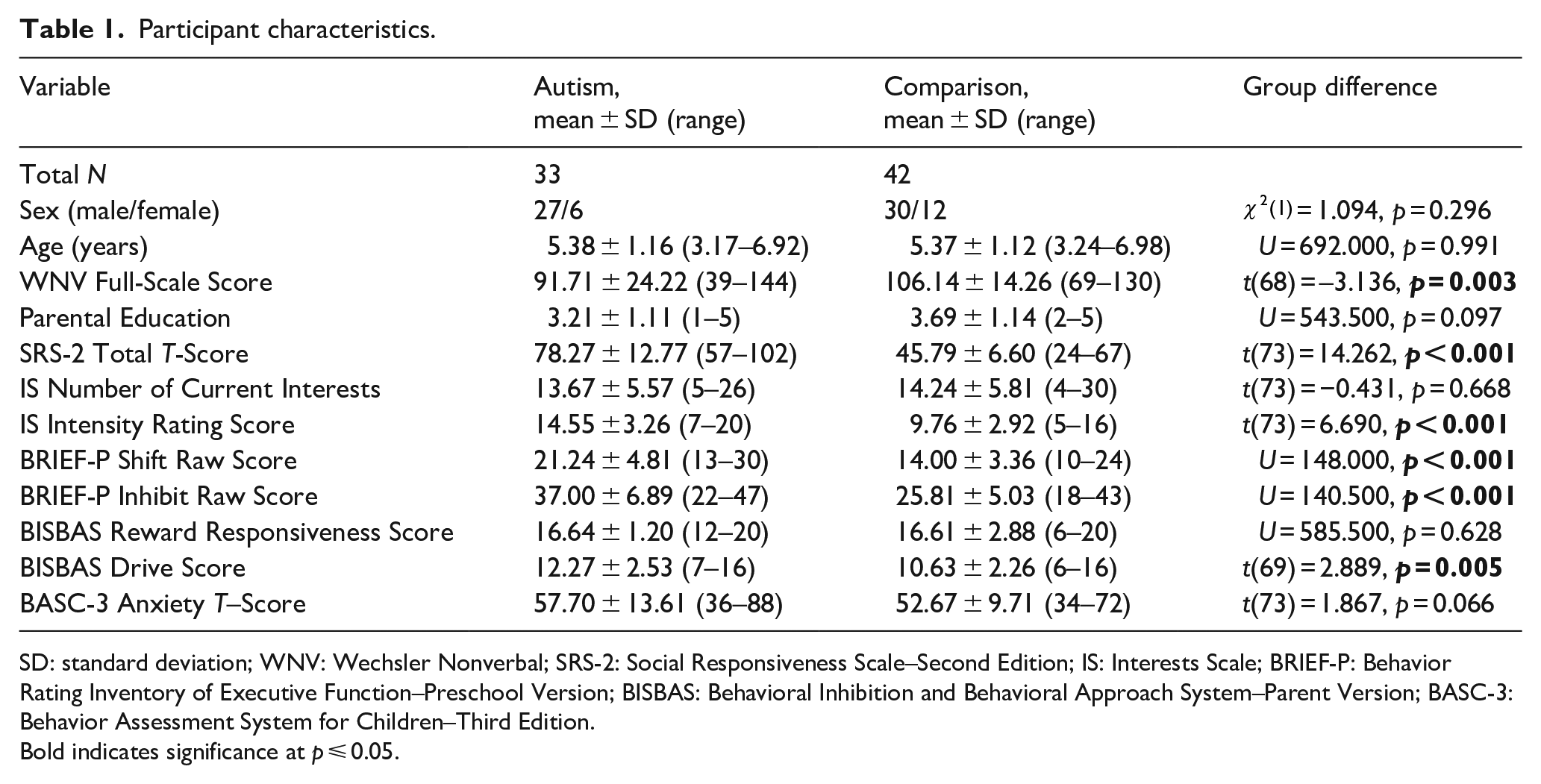
SD: standard deviation; WNV: Wechsler Nonverbal; SRS-2: Social Responsiveness Scale–Second Edition; IS: Interests Scale; BRIEF-P: Behavior Rating Inventory of Executive Function–Preschool Version; BISBAS: Behavioral Inhibition and Behavioral Approach System–Parent Version; BASC-3: Behavior Assessment System for Children–Third Edition.
Bold indicates significance at p ⩽ 0.05.
While the groups did not differ in interest diversity (IS Number of Current Interests), the autism group had higher interest intensity (IS Intensity Rating) than the comparison group. The autism group had greater difficulties (higher BRIEF-P scores) in the domains of attention shifting (BRIEF-P Shift) and inhibitory control (BRIEF-P Inhibit) in addition to elevated reward drive (BISBAS Drive). The groups did not differ in reward responsiveness (BISBAS Reward Responsiveness) or anxiety symptoms (BASC-3 Anxiety T).
Interest intensity and demographic measures
Age, IQ, and parental education were examined for associations with interest intensity across the whole sample. Interest intensity did not associate with age (rs = −0.026, p = 0.826), IQ (r = −0.121, p = 0.320), or parental education (rs = −0.193, p = 0.097). In addition, there were no differences in interest intensity between sexes (t(73) = 0.097, p = 0.923). Therefore, age, IQ, parental education, and sex were not included as covariates in further analyses.
Interest intensity and executive functioning, reward, and anxiety symptoms
GLM results across hypotheses are summarized in Table 2. Examining executive functioning hypotheses, in the attention shifting model, interest intensity was positively associated with attention shifting difficulties (higher BRIEF-P Shift residual scores), but there was no interaction with group. In the inhibitory control model, interest intensity was not associated with inhibitory control and there was no inhibitory control by group interaction. Within-group correlations are summarized in Figure 1 and show that greater attention shifting difficulties significantly associated with higher interest intensity in the comparison group, and associated at trend level (i.e. not reaching the corrected significance threshold of p ⩽ 0.025) in the autism group (p = 0.026). When examining inhibitory control, greater difficulties significantly associated with higher interest intensity in the autism group only.
GLM results.
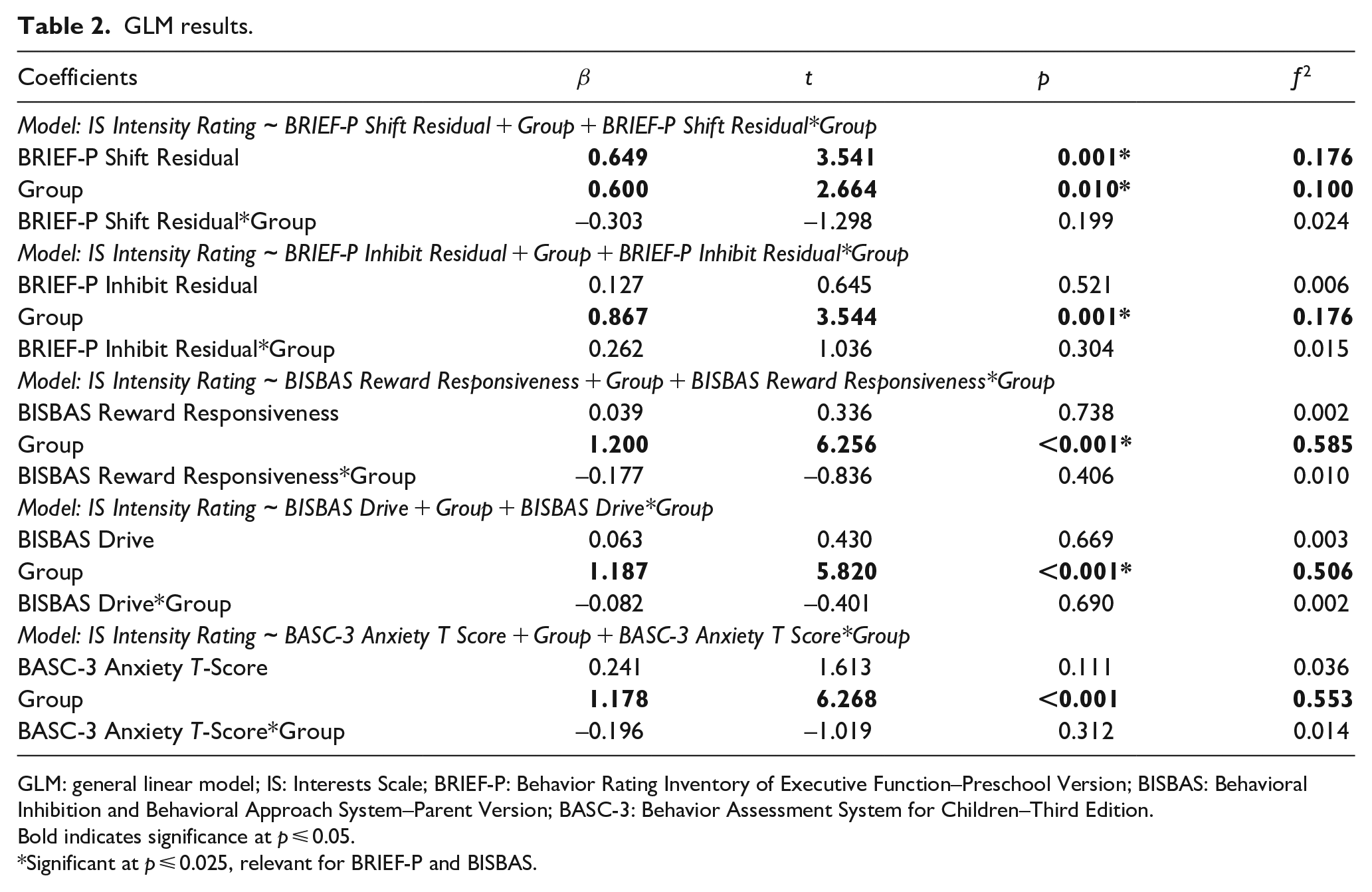
GLM: general linear model; IS: Interests Scale; BRIEF-P: Behavior Rating Inventory of Executive Function–Preschool Version; BISBAS: Behavioral Inhibition and Behavioral Approach System–Parent Version; BASC-3: Behavior Assessment System for Children–Third Edition.
Bold indicates significance at p ⩽ 0.05.
Significant at p ⩽ 0.025, relevant for BRIEF-P and BISBAS.
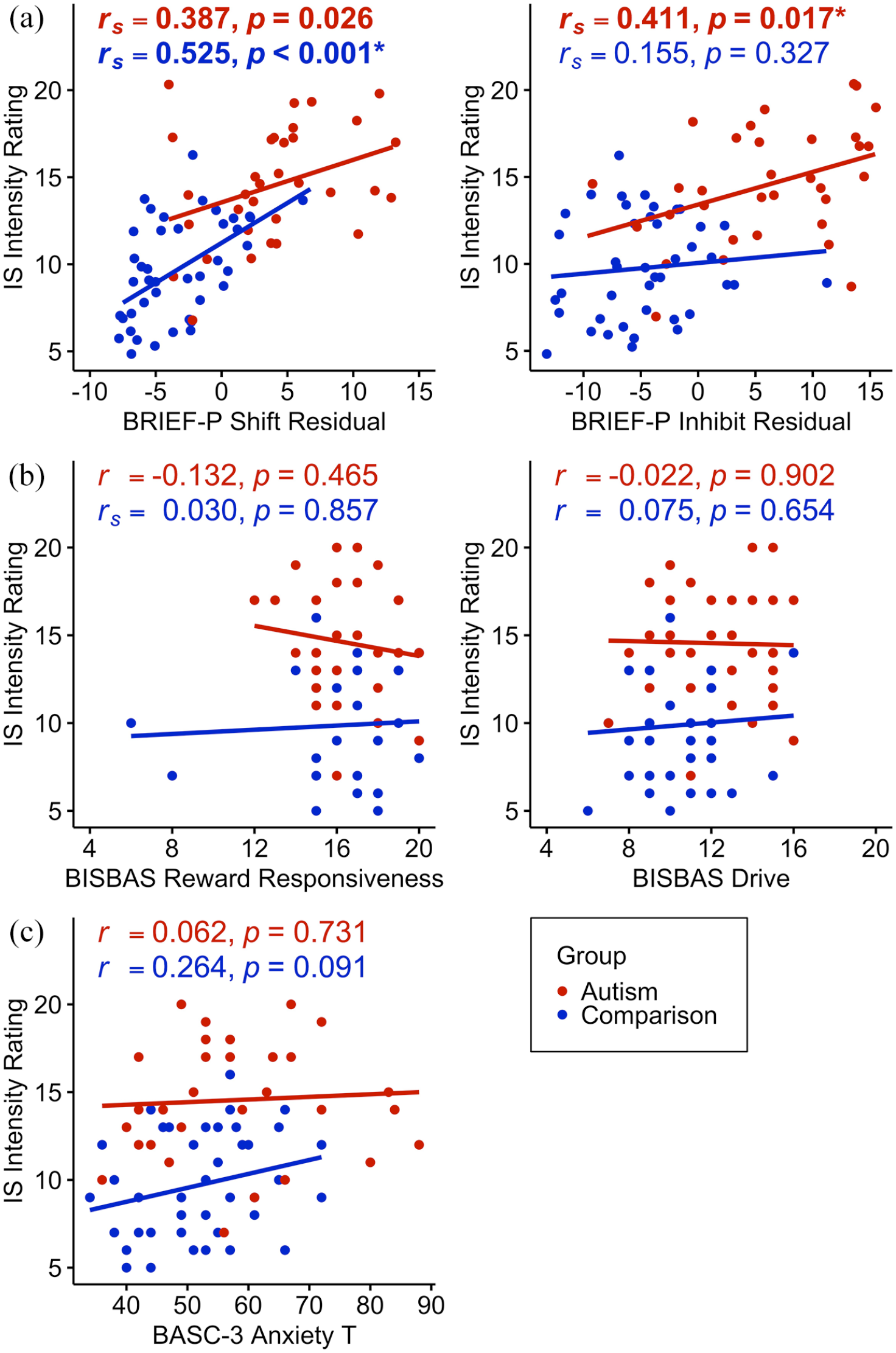
Associations between Interest Intensity and Executive Functioning, Reward, and Anxiety Symptoms. (a) Interest intensity significantly associated with attention shifting difficulties in the comparison group and at trend-level in the autism group. Interest intensity additionally associated with attention shifting in the across-groups GLM. Interest intensity significantly associated with inhibitory control difficulties in the autism group only. Interest intensity did not associate with inhibitory control in the across groups GLM. (b) Interest intensity did not associate with reward responsiveness or reward drive in either group. (c) Interest intensity did not associate with anxiety symptoms in either group.
Examining reward hypotheses, Table 2 shows that interest intensity was not associated with reward responsiveness or reward drive. Figure 1 shows that neither reward responsiveness nor reward drive correlated with interest intensity in either group. Visualization of BISBAS Reward Responsiveness scores in Figure 1 identified two potential outliers that were confirmed by calculating quartiles using Tukey’s inclusionary hinge definition. The results of GLM and correlation analyses were unaffected when these outliers were excluded.
Examining the anxiety hypothesis, Table 2 shows that interest intensity did not associate with anxiety symptoms. Figure 1 shows that anxiety symptoms also did not correlate with interest intensity in either group. Excluding the comparison participant who scored above the SRS-2 clinical cut-off did not change any GLM or correlation results.
Interest content
We conducted an exploratory interest content analysis of group differences in current interests between autistic and comparison children. Significant group differences in current interests were observed for 7 out of 38 IS Interest Checklist categories and are summarized in Table 3. A significantly higher proportion of parents in the autism group endorsed the category Sensations (i.e. child seeks sensations or sensory experiences), while a significantly higher proportion of parents in the comparison group endorsed the Playing Games with Others and Arts/Crafts categories as current interests of their child. At trend level (i.e. not reaching the corrected significance threshold of p ⩽ 0.0013), the autism group also preferred Music and Object Motions while the comparison group preferred Sports and Reading and Writing. When excluding the comparison participant who scored above the SRS-2 cut-off, the category Item (i.e. attachment to a comfort item) became significantly preferred by the autism group at trend-level (χ2(1)= 3.918, p = 0.048) and Reading and Writing fell above trend-level significance (χ2(1)= 3.452, p = 0.063).
Proportion of children currently interested in IS Interest Checklist categories.
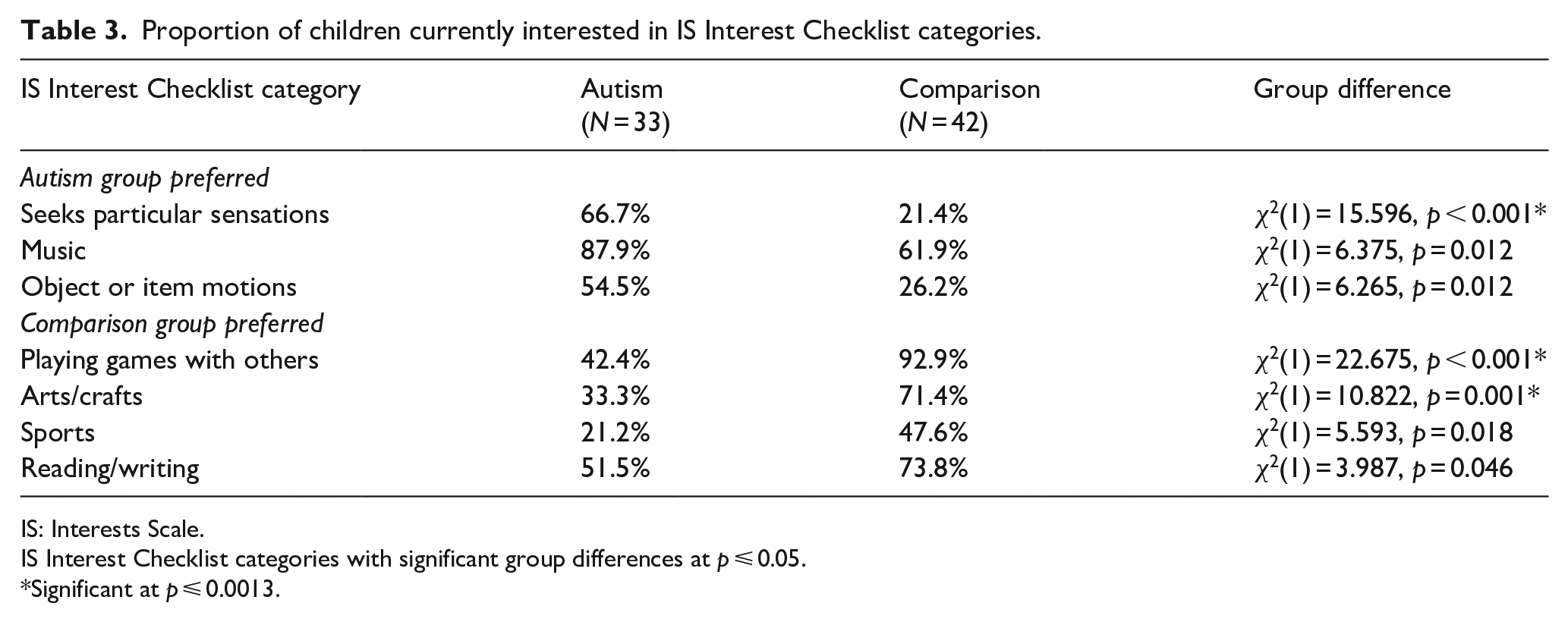
IS: Interests Scale.
IS Interest Checklist categories with significant group differences at p ⩽ 0.05.
Significant at p ⩽ 0.0013.
Interestingly, we observed no group differences for several categories that are typically considered to be prominent autistic interests. There was no group difference for the categories Machines (χ2(1)= 1.245, p = 0.265), Vehicles (χ2(1)= 2.018, p = 0.155), and Computers (χ2(1)= 0.001, p = 0.977). Several social interests also did not differ between groups including the People (χ2(1)= 0.737, p = 0.391) and Language (χ2(1)= 0.122, p = 0.727) categories. Interest Checklist categories without significant group differences are fully summarized in Supplementary Table S2.
Discussion
This study examined interest intensity in early childhood in relation to multiple behavioral traits. We observed a significant association between interest intensity and attention shifting for children in both groups, where children with more difficulties shifting their attention demonstrated higher interest intensity. In the autism group only, we also observed an association between interest intensity and inhibitory control, where autistic children with greater inhibitory control difficulties demonstrated higher interest intensity. Reward responsiveness, reward drive, and anxiety symptoms were not associated with interest intensity either within or across groups.
Executive functioning differences are commonly reported in autism, including reports of superior and reduced performance in specific domains, with attention shifting being suggested as one area of particular difficulty (for review, see Demetriou et al., 2019). An association between intense interests and executive functioning difficulties, which are both highly prevalent, is perhaps unsurprising as the Diagnostic and Statistical Manual of Mental Disorders (5th ed.; DSM-5) defines intense interests as “highly restricted, fixated interests that are abnormal in intensity or focus” (American Psychiatric Association [APA], 2013), which has clear parallels with attention shifting difficulties. Interestingly, in early childhood, we found that a significant association between interest intensity and attention shifting difficulties was also present in non-autistic children. We additionally observed an association between interest intensity and inhibitory control in children with autism only, suggesting that multiple executive functioning domains may contribute to the presentation of intense interests in autism during early childhood. While an association between interest intensity and inhibitory control was present in the autism group only, this should be interpreted with caution as inhibitory control and the inhibitory control by group interaction were not significant in the GLM. Observing an association in the autism group only could have been due to greater variability in inhibitory control abilities in autism, which may have provided greater power to detect a subtle association.
A relation between interest intensity and attention shifting and inhibitory control has also been observed in autistic individuals during late childhood (7–12 years) (Faja & Nelson Darling, 2019), and an association between interest intensity and a global measure of executive function was reported in a sample with autism ranging from late childhood to adulthood (7–22 years) (Anthony et al., 2013). While an association between interest intensity and executive function has been observed in discrete samples of varying age, without longitudinal work it remains unclear whether the nature of this association changes between developmental stages. Furthermore, the evaluation of discrete developmental stages prevents any causal interpretation of these findings. It is currently unclear whether difficulty with early executive functions leads to intense interests, when possessing a strong interest could also contribute to altered development in executive functioning. When considering variation between developmental stages, it would also be of interest to explore additional hypotheses in older samples. For example, the executive functioning domain of generativity/fluency (the ability to spontaneously generate novel ideas) has also been hypothesized to relate to repetitive behaviors in autism (Kenworthy et al., 2009; Turner, 1999). While generativity/fluency cannot be reliably assessed in early childhood via the BRIEF-P (Gioia et al., 2003), this hypothesis could be examined in later childhood using the “Initiate” subscale of the BRIEF (Gioia et al., 2000).
In interviews, autistic adults report that executive functioning supports like creating a schedule for themselves is one tool for managing interference (Mercier et al., 2000). When considering the association between executive functioning and interests in early childhood, executive functioning supports like setting up an external timer or helping children create a schedule (first this, then that) may be beneficial. When considering executive function, performance in individuals with autism is highly heterogeneous (for review, see Demetriou et al., 2019); therefore, children with elevated attention shifting and inhibitory control difficulties may be more likely to experience the negative impacts of interest interference which have been highlighted in interviews by autistic adults (Mercier et al., 2000). Early identification and subsequent support for difficulties with attention shifting and inhibitory control could assist with supporting interests prior to reaching a point of impairment. It is also important to recognize that autistic adults report that interests can be a benefit and strength (Mercier et al., 2000). Therefore, we suggest that targeting executive function could potentially help mitigate the negative influence of interest interference to ultimately support this autistic trait.
We did not observe a relation between interest intensity and reward responsiveness or reward drive characterized by the BISBAS. In our sample, children with autism were not significantly different from comparison children on BISBAS Reward Responsiveness but scored significantly higher on BISBAS Drive, which has also been previously reported in autistic adults (Althaus et al., 2015). However, other work in older children and adults has found no differences in autism for the BISBAS Behavioral Activation System, which is a summation of scores on the BISBAS Drive, Reward Responsiveness, and Fun Seeking subscales (South et al., 2011, 2015). Observing that group differences only present for certain BISBAS subscales highlights the importance of considering distinct reward-related processes in autism. Studies are also conflicted on the degree to which autistic individuals show differences in reward responsiveness compared to reward drive when assessed through behavioral tasks and neuroimaging (for reviews, see Schuetze et al., 2017; Tschida & Yerys, 2021). Together with the literature in older samples, our results suggest that group differences in reward processing subdomains may be age related and longitudinal studies starting in early childhood may help illuminate the contribution of developmental stage to inconsistencies in the literature. As the BISBAS Drive subscale assesses individual motivation to attain rewards, it is notable that this score is decoupled from parent ratings of interest intensity.
There was also no association between interest intensity and anxiety symptoms measured by the BASC-3. This finding was similar to that of Spiker and colleagues, who observed no association between time spent on interests and general anxiety symptoms in 7–13 year-olds with autism (Spiker et al., 2012). Although this previous work found an association between time spent on interests and compulsive ordering behaviors like those in obsessive compulsive disorder (OCD) (Spiker et al., 2012); compulsions were not assessed as part of this study. These results differ to some degree from the literature reporting a positive association between anxiety and insistence on sameness repetitive behaviors (Joyce et al., 2017; Lidstone et al., 2014; Rodgers et al., 2012). These previous studies have included intense interests in the same domain as insistence on sameness repetitive behaviors, which describe adherence to routines or rituals. However, evidence exists suggesting that intense interests should be considered a unique subdomain of repetitive behavior in autism (Lam et al., 2008). Therefore, lack of agreement between our findings and the literature could relate to our specificity in examining intense interests and not a broader subdomain of restricted and repetitive behaviors. Discrepant findings could also be due to difference in age groups sampled between this study and previous literature conducted from late childhood to adolescence (Joyce et al., 2017; Rodgers et al., 2012) or across a wide age range from early childhood to adolescence (Lidstone et al., 2014). Future studies examining relations between anxiety and both intense interests and insistence on sameness behaviors across age groups may help to bridge findings using different populations and measurements. Phenomenological studies have highlighted the importance of context when considering an association between interests and anxiety symptoms. In different contexts, autistic adults experience reduction (Dachez & Ndobo, 2018) and elevation (Mercier et al., 2000) of feelings of anxiety due to interests. Context also varied in adolescence, with interview participants suggesting that coping with anxiety may motivate repetitive behaviors, while other motivators such as being interested or bored were also reported (Joyce et al., 2017). Further suggesting the importance of context, Spiker and colleagues report that autistic children who interact with their interest symbolically (i.e. pretend play and make-believe) have higher general anxiety symptom scores than autistic children who interact with their interests through fact learning/verbal memory (Spiker et al., 2012). Based on this, the authors suggest that only certain types of interests may be related to anxiety in childhood (Spiker et al., 2012). The IS is limited by not assessing how children interact with their interests, but future work could test an association between method of interest interaction and anxiety symptoms in early childhood using a more nuanced assessment. It is worth noting that although elevated anxiety symptoms (Kim et al., 2000) and anxiety disorder diagnoses (Lai et al., 2019) are commonly reported in autism, we did not observe significantly higher BASC-3 Anxiety scores for autistic children in our sample. However, clinically significant anxiety symptoms can manifest in autism during early childhood (Sukhodolsky et al., 2020). Evaluating if interests contribute to or mediate anxiety in highly anxious children across developmental stages is a valuable direction for future studies to assist with mediating anxiety in autism.
In an exploratory analysis, we examined group differences in interest content for autistic and non-autistic comparison children. Children with autism significantly preferred physical sensations and preferred other sensory interests (music and watching object motions) at trend -level. High prevalence of sensory interests in autistic children has been previously reported, which associated with higher social communication deficits and lower adaptive skills (Zachor & Ben-Itzchak, 2014). Given that sensory symptoms are highly prevalent in autism (Ben-Sasson et al., 2009), preference for sensory interests could represent controlled pursuit of sensory experiences when environmental stimuli are over- or under-stimulating. However, it should be noted that an unusual interest in sensory stimuli is considered partial criteria for an autism diagnosis (APA, 2013). Therefore, whether sensory interests are interests per se, or manifestations of sensory processing differences in autism is currently unclear. Previous work classifying interests has suggested that individuals with autism, at the group level, prefer “folk physics” interests describing the mechanical world over “folk psychology” interests describing the social world (Baron-Cohen & Wheelwright, 1999; Turner-Brown et al., 2011). Interestingly, we did not see a significant preference in our sample for folk physics categories like machines, mechanical systems, vehicles, or computers. Despite the group-level trends we observed, our results support previous work which has highlighted substantial overlap in autistic and non-autistic interests (Cho et al., 2017). In addition, there was not a single category which currently interested all children in either group. This suggests that generic stimuli would be insufficient to represent a personal interest across the entire sample in a behavioral or neuroimaging experiment. Therefore, our findings highlight that investigations into intense interests in early childhood should consider diversity of personal interests. In this study, we did not have a sufficient proportion of female participants to perform sex-based interest content analyses. However, previous work has observed that autistic interests follow typical sex patterns in late childhood (Harrop et al., 2018). Investigating sex-based differences in interest content in early childhood is a valuable direction for future work as the field continues to illuminate sex and gender differences in autistic features across developmental stages.
Early childhood is a developmental stage which is typically understudied in autism research due to difficulty with having very young children complete behavioral or neuroimaging tasks. Autistic participants with low IQ scores or co-occurring developmental delays are also typically understudied for similar reasons. Therefore, by using parent report measures in this study, we were able to expand our knowledge of intense interests to a diverse sample of autistic and non-autistic participants in early childhood. Exclusive use of parent report measures to assess primary variables in this study also had several limitations. Executive function, enjoyment of rewards, and anxiety are highly internal processes that could be difficult for parents to objectively rate. Augmenting questionnaire-based assessments in early childhood, which have high ecological validity across daily living, with task-based laboratory measures, which are more direct, has been suggested as a valuable direction for the field to help capture a more nuanced assessment of complex behaviors like executive function (Kenworthy et al., 2008).
Regarding the reward hypotheses, the BISBAS does not examine how reward responsiveness and reward drive differ for various rewarding stimuli (e.g. interest, social, or token rewards). Several researchers have hypothesized that autism is characterized by domain-specific altered responsiveness to social rewards (Chevallier et al., 2012; Kohls et al., 2012), while others have proposed domain-general differences in autism that are observed across reward stimuli types (Bottini, 2018). While it has been reported that young autistic children show altered attentional priority (which could indicate altered motivation) for interest images and social images (Sasson et al., 2008; Vacas et al., 2021), relatively little work has investigated affective responses to rewarding stimuli in young children. Assessing whether affective reward responsiveness varies by reward type in young children with autism, and if differences relate to intense interests, is a valuable area of future study.
When considering the reward and anxiety hypotheses, the sample size of this study may have resulted in insufficient power to detect a subtle association between interests and reward or anxiety. Furthermore, interest stimuli have been associated with neural measures of reward in older individuals with autism (Benning et al., 2016; Dichter et al., 2012; Kohls et al., 2018) and autistic adults have reported in interviews that interests can induce anxiety through social hardship (Mercier et al., 2000). Therefore, these findings in early childhood should not be generalized to older age groups and it would be valuable for future longitudinal work to examine how the relation between intense interests and all behavioral traits may change across development.
Conclusion
Understanding behavioral traits that relate to intense interests in early childhood and beyond could assist autistic individuals and their caregivers with mediating the interfering nature of interests, ultimately allowing the many benefits of intense interests in autism to be best supported. This was one of the first studies to assess multiple theories regarding intense interests in autism in a single sample, and one of the first to examine early childhood. Specifically, we examined how executive functioning, reward sensitivity, and anxiety symptoms relate to interest intensity in 3- to 6-year-old children with and without an autism diagnosis. We found that interest intensity relates to executive functioning difficulties in the domains of attention shifting and inhibitory control, while no relation was observed for reward responsiveness, reward drive, or anxiety symptoms. These results provide evidence for a relation between executive functioning difficulties and intense interests in early childhood. Our results suggest that assisting children with developing executive functioning skills, particularly in the domains of attention shifting and inhibitory control, could potentially help to reduce interest interference.
Supplemental Material
sj-docx-1-aut-10.1177_13623613211064372 – Supplemental material for Autism interest intensity in early childhood associates with executive functioning but not reward sensitivity or anxiety symptoms
Supplemental material, sj-docx-1-aut-10.1177_13623613211064372 for Autism interest intensity in early childhood associates with executive functioning but not reward sensitivity or anxiety symptoms by Kate J Godfrey, Svenja Espenhahn, Mehak Stokoe, Carly McMorris, Kara Murias, Adam McCrimmon, Ashley D Harris and Signe Bray in Autism
Footnotes
Author contributions
K.J.G., C.M.M., A.D.H., and S.B. were involved in conceptualization and design of study. K.J.G., S.E., M.S., K.M., and A.M.C. were involved in data acquisition. K.J.G. performed data analysis. K.J.G., A.D.H., and S.B. were involved in data interpretation. S.B. and A.D.H. were involved in supervision and funding acquisition. K.J.G., S.B., and A.D.H. were involved in writing. All authors were involved in editing. All authors read and approved the manuscript.
Availability of data and materials
The data sets generated and analyzed during this study are available from the corresponding author (K.J.G.) upon reasonable request.
Declaration of conflicting interests
The author(s) declared no potential conflicts of interest with respect to the research, authorship, and/or publication of this article.
Ethics approval and consent to participate
The study was approved by University of Calgary Conjoint Health Research Ethics Board (REB16-0576). Written informed consent in accordance with the Declaration of Helsinki was obtained from the parent/guardian of each child. While children in this cohort were not capable of providing formal explicit assent, we sought informal assent where possible. The informal assent procedure involved describing the study to children using simple language and pictograms. Children were asked directly about willingness to participate. In cases where children with autism were unable to provide informal verbal or non-verbal assent, testing was initiated with parental consent. All participants were monitored for behavioral indicators of dissent to participation. In the rare case when dissent was indicated that portion of the testing protocol was ceased.
Funding
The author(s) disclosed receipt of the following financial support for the research, authorship, and/or publication of this article: This work was supported by the Hotchkiss Brain Institute (K.J.G. and S.B.); University of Calgary URGC (A.D.H. and S.B.); Mathison Centre (S.E.); Canadian Open Neuroscience Platform (S.E.); Owerko Centre (S.E. and Owerko Neurodevelopmental Disorder Recruitment Database).

Supplemental material
Supplemental material for this article is available online.
Notes
References
Supplementary Material
Please find the following supplemental material available below.
For Open Access articles published under a Creative Commons License, all supplemental material carries the same license as the article it is associated with.
For non-Open Access articles published, all supplemental material carries a non-exclusive license, and permission requests for re-use of supplemental material or any part of supplemental material shall be sent directly to the copyright owner as specified in the copyright notice associated with the article.
