



Abstract
This study examines the effectiveness of the PASSION teaching module in improving English language learning outcomes for rural junior high students. Grounded in an ecological systems perspective, the PASSION module, designed to address the unique challenges of remedial instruction in rural schools, integrates diagnostic tools, tailored teaching materials, structured instructional methods, and teacher development programs to support low-achieving students. Over a 3-year period, the module was implemented in three rural schools in H County, Taiwan, with data collected through a convergent mixed-methods approach. Quantitative data revealed significant improvements across four key English competencies, vocabulary, grammar, reading comprehension, and listening comprehension, tracked at six time points. The final year’s performance on the Comprehensive Assessment Program (the national high school entrance exam in Taiwan) also showed a notable reduction in the proportion of students below the competency level of the official assessment standard, compared with the cohort from the previous academic year, as well as a narrowing of the gap with all rural schools in H County. Qualitative insights from interviews with administrators, teachers, and students revealed five key themes: effective placement of students through accurate diagnostics, user-friendly teaching resources for teachers, heightened student engagement, beneficial feedback from peer observations, and increased motivation and achievement among both educators and students. Overall, the study suggests that the PASSION module effectively addresses learning disparities in rural settings, providing teachers with adaptable resources and fostering a highly engaging and positive learning environment that enhances student motivation and academic growth. These findings offer valuable insights for educators, policymakers, and researchers seeking to improve rural education and reduce achievement gaps.
Keywords
I Introduction
In many countries, rural areas are often at risk of academic achievement gaps due to political and economic conditions, as well as transportation challenges (Bonilla-Mejía et al., 2024; Echazarra & Radinger, 2019; Hartman et al., 2022; Thomson, 2010). Such urban–rural achievement disparities are common on a global scale (Echazarra & Radinger, 2019). From the perspective of school learning experiences, the causes of these gaps can be attributed to the following factors: (1) high teacher turnover rates (Carver-Thomas & Darling-Hammond, 2019; McKenzie et al., 2014; Zhu et al., 2020); (2) students’ low academic motivation (Awang et al., 2021; Hardré et al., 2007; S.H. Huang, 2016; Thomson et al., 2020); and (3) the complexity and challenges of implementing differentiated instruction (Chien, 2012; Chouari, 2016; Nawab & Baig, 2011; Smit et al., 2015). Addressing the issue of reducing achievement gaps has long been a concern for educational authorities worldwide. Sung, Tseng, et al. (2014) reviewed efforts by primary educational authorities in the United States, Europe, and Asia, where various educational policies and programs were implemented to reduce achievement gaps. However, most of these initiatives have only managed to prevent the gaps from widening, with limited success in actively closing them, and even evaluating their effectiveness has proven challenging. As a result, there have been calls for evidence-based educational policy-making (Pressley et al., 2004).
Like many other countries, Taiwan faces challenges in recruiting stable teachers to serve in rural areas, an issue that has become a significant concern in education. Nationwide, rural schools account for approximately 31% of all schools, whereas students in rural areas comprise only 4.5% of the total student population, indicating that rural schools are both numerous and generally small in scale (Ministry of Education, 2024). According to a 2023 report by the Ministry of Education (Legislative Yuan, 2023), rural junior high schools showed higher teacher turnover rates (1.26% vs. 0.60% nationally) and a higher proportion of contract teachers (23.85% vs. 15.12%). In Taitung County, where rural schools are most concentrated, contract teachers constitute up to half of the teaching staff, with approximately half lacking formal teaching qualifications (Audit Office of Taitung County, 2020), posing potential risks to instructional quality.
Although rural teachers play an important role in students’ development, current teacher allocation remains insufficient to improve learning outcomes in remote areas. In the 2022 PISA reading assessment, the average score in urban areas was 535, compared with 492 in rural areas: a gap of 43 points. Based on the estimate of the Organization for Economic Co-operation and Development (OECD) that students typically gain about 20 points per year, this gap corresponds to about 2 years of learning (C.C. Tsai, 2024). The Comprehensive Assessment Program (CAP; the national high school entrance exam in Taiwan) (Chao & Sung, 2023; Chao et al., 2024) results likewise show weaker basic academic performance among rural students. In Taitung County (2020–2022), among schools where the proportion of students scoring Below Basic (i.e., the basic competency level of the official assessment standard) in four or more subjects exceeded the county average, 40% were nonrural schools, whereas 75% were rural schools (Audit Office of Taitung County, 2022). In addition, rural junior high graduates exhibit higher retention rates and lower graduation rates in senior high and vocational schools (Lin & Wang, 2017). Overall, these findings highlight the importance of strengthening remedial education in rural areas, particularly in addressing students’ long-term accumulated learning gaps and disadvantaged educational circumstances.
A review of existing remedial teaching programs reveals several shortcomings. First, there is a lack of effective pedagogical methods specifically tailored to the needs of low-achieving students. Taking English as an example, whereas numerous studies on English remedial teaching have been conducted, most of these are aimed at English as a second language (ESL) learners (Amendum et al., 2018; August et al., 2009, 2014; Baker et al., 2016; Calhoon et al., 2007; James, 2014; Linan-Thompson et al., 2003; McElvain, 2010; Olson et al., 2017; Proctor et al., 2007) or English as a foreign language (EFL) learners at high school or university level (Al Ghaithi & Behforouz, 2023; Al Othman & Shuqair, 2013; Eno, 2019; Siddiqui & Alghamdi, 2017; Tawalbeh & Ismail, 2014; Zarei & Yasami, 2016). These learners typically have accumulated considerable practice and experience, making the learning content unsuitable for beginner-level EFL students who have limited exposure to English in their daily lives. To better support EFL beginners, it is essential to first assess their initial language abilities and then provide materials and learning activities tailored to their specific needs. This targeted approach helps low-achieving students catch up and reintegrate smoothly into the standard curriculum for their grade level.
Second, teachers in rural areas lack systematic instructional support. To help them tackle the unique challenges of rural education, a common approach is to adjust teacher training programs (Human Rights and Equal Opportunities Commission [HREOC], 2000) to better prepare preservice teachers for working in rural areas. For example, in Australia, White and Kline (2012) proposed the Renewing Rural and Regional Teacher Education Curriculum (RRRTEC) program, which consists of six modules designed to assist preservice teachers in conceptualizing rural teaching practices. Although this framework offers valuable insights, a comprehensive teacher development program should extend beyond preservice training to provide in-service teachers with systematic, on-site teaching resources (H.L.S. Chen & Yu, 2016; Faubert, 2012). This is especially important in rural remedial teaching, where resources such as student performance diagnostics, collaborative teacher communities, and guidance on adaptive teaching methods can significantly enhance student learning outcomes.
Recognizing the limitations of EFL remedial instruction, building on this ecological systems perspective, this study has developed a teaching support system, the Project of Adaptive Screening, Streaming, and Instruction for Omnidirectional Nurturing (PASSION) teaching module, which includes diagnostic tools, tailored teaching materials and methods for low-achieving students, and rural teacher training programs in an integrated manner. In structurally under-supported learning environments, such as rural contexts, low-achieving students have limited access to learning resources and support for developing English learning motivation (Lamb, 2013). Consequently, low achievement and motivational weakening are likely to form a self-reinforcing cycle, which may, over time, lead to psychological disengagement or even withdrawal from learning (Hardré, 2012). Accordingly, this study prioritizes low-achieving students as the primary targets of intervention, with the aim of disrupting this cycle.
To explore the long-term effect of implementing the PASSION teaching module on the learning outcomes of students in rural areas, this study adopted a convergent design in mixed-methods research (Creswell & Plano Clark, 2018). It examined the effects of a 3-year implementation of the PASSION teaching module in three rural schools in Taiwan, using English as a sample subject. The quantitative data consists of two parts. First, we tracked the performance of participating students across four English skills (vocabulary, grammar, listening comprehension, and reading comprehension) at six different time points during the intervention to assess whether the remedial instruction significantly improves their English proficiency. The second part involved collecting the English subject test results from the CAP, the national high school entrance exam. This study aimed to determine whether the proportion of students Below Basic in the current cohort (2023) is significantly lower than that of the previous cohort (2022) at the same school. For the qualitative data, the study conducted individual interviews to gain in-depth insights into the experiences and perception of the administrative staff, teachers, and students involved in the program’s implementation. These qualitative interview data were cross-referenced with the quantitative findings, providing a more comprehensive perspective on the program’s effectiveness.
II Literature review
1 The EFL achievement gap between rural and urban areas: an ecological systems perspective
Compared with other subjects, the achievement gap in EFL more sensitively reflects inequalities in learning resources across different backgrounds. In many rapidly developing countries, such as Indonesia, Mexico, China, and India, rural areas face significant limitations due to geographic and socioeconomic factors, making it difficult to establish a well-supported language learning environment. As a result, students in urban areas tend to significantly outperform those in rural areas (Khan et al., 2019). Similarly, in Taiwan, schools’ geographical locations create markedly different learning environments. Students from rural areas have long faced challenges related to low socioeconomic status and insufficient educational resources, leading to a pronounced bimodal distribution in English proficiency (W.C. Chang et al., 2004; Chien, 2012). This phenomenon may partly stem from some children receiving high-quality extracurricular tutoring or private lessons arranged by their parents at an early age. Within an ecological analytical framework focused on the overall learning environment in rural areas (Bronfenbrenner, 1995), the disparity is conceptualized as arising from the interplay of macro-, meso-, and microsystem factors that are conditioned by geographical remoteness, as discussed in the following.
a Macro-exosystem level: limited support for EFL motivational development
This level focuses on the out-of-school EFL learning environment that shapes learners’ motivation and access to resources. Some studies attribute substandard English proficiency to low learning motivation. Motivation for second language (L2) learning is considered a driving force that propels learners toward their ideal selves (Dörnyei, 2005) and is shaped by the social environment. Research shows that students in rural areas have significantly lower motivation for L2 learning compared with students in urban areas (Almansour, 2022; Lamb, 2012). Rural children have less access than their urban peers to high-quality extracurricular tutoring or private English lessons from an early age. In many countries, English is regarded as a subject within compulsory education rather than a language used in daily life. Locally, elementary schools typically have only two English classes per week, whereas middle schools offer four or five classes per week. Since most students have little need to use English in their daily lives and rarely encounter English-centered cultures, they may find it difficult to develop motivation to learn the language. Low motivation leads to a lack of engagement in classroom learning, creating a negative cycle that gradually widens the achievement gap in language classes.
b Mesosystem level: teacher turnover and limited professional development
This mesosystem level focuses on the interactions between school operations and teachers within rural contexts. Rural schools are typically staffed by newly recruited, less experienced teachers, and the teacher turnover rate is high (Ho, 2022). In Taiwan, contract teachers comprise as much as 50% of the teaching staff in rural counties such as Taitung, with around 40–50% of these contract teachers lacking a teaching certificate or proof of completion of teacher training programs (National Audit Office, Taitung County Audit Office, 2020). The launch of the 2030 Bilingual Policy Implementation Plan in 2018 (Executive Yuan, 2018) has further highlighted the shortage of English teachers in rural schools. To temporarily alleviate this problem, local governments in rural areas have resorted to hiring cross-disciplinary teachers. Unstable faculty staffing can lead to adaptation challenges for students (Sutcher et al., 2019) and result in a lack of continuity in curriculum planning and instructional design (Sun et al., 2023).
Many teachers working in rural schools, particularly those who are inexperienced or teaching across disciplines, may have a strong need for capacity building. However, the geographic isolation of these areas often creates challenges for teachers’ professional development. Although authorities offer various up-to-date training resources, inconvenient transportation in rural areas and heavy workloads often discourage teachers from participating (Y.K. Hsu & Chen, 2007). In addition, the limited number of faculty in small schools hinders the formation of collaborative communities for lesson preparation. These mesosystem-level conditions may interact with macro-exosystem-level resource inequalities and shape teachers’ instructional capacities at the classroom level.
c Microsystem level: challenges in implementing differentiated remedial English instruction
Rural schools serve students with highly diverse backgrounds, so the most effective approach is to use differentiated instruction to meet their varied needs (Chien, 2012). In addition, since the proportion of low-achieving students is higher in rural areas, teachers must also possess remedial teaching skills that go beyond conventional methods (H.L.S. Chen & Yu, 2016). However, implementing remedial and differentiated instruction in rural schools presents significant challenges. Teachers with limited resources or experience often struggle to effectively conduct English lessons in regular classrooms, partly due to constraints originating from the mesosystem level. These instructional challenges may be further compounded by underdeveloped L2 learning motivation among many low-achieving students, which is shaped by broader macro-exosystem conditions that exert indirect yet pervasive influences.
2 Challenges of EFL remedial instruction in rural Taiwan and developing the PASSION module
Schools in Taiwan commonly implement government-imposed Remedial Instruction Programs to help disadvantaged students rebuild their basic academic skills (K-12 Education Administration, Ministry of Education, 2022). The content and teaching methods for English remedial courses are planned by individual teachers. However, despite the relatively well-structured planning of the overall learning support system, limitations remain in addressing English remedial instruction in rural schools. Grounded in a bioecological analytical framework and identified limitations in existing EFL remedial instruction, this study proposes the PASSION teaching module, designed with the following strategies.
a Support for remedial teachers in adaptive EFL instruction
Teachers conducting remedial instruction should avoid relying on traditional classroom teaching methods. Instead, they should prioritize identifying students’ emotional and cognitive needs and work on reshaping students’ perceptions of the classroom. EFL learners with limited learning experience often feel discouraged when faced with challenging content. Research has shown that students’ learning experiences play a critical and complex role in regulating their anticipated effort (Y.H. Tseng, 2021). Therefore, it is essential for teachers to create motivating learning experiences and opportunities for students. However, designing effective EFL remedial instruction requires teachers to possess specialized knowledge in English language teaching. Teachers must be able to comprehensively plan differentiated instruction in terms of process, content, and product (Chien, 2012) to enhance both students’ motivation and learning outcomes. One way to support this process is to provide teachers with adaptive instructional resources that facilitate instruction informed by diagnostic assessment results.
b Systematic teaching materials and corresponding teaching methods for EFL beginners
A review of existing research on English remedial teaching at the elementary and secondary levels indicates a predominant focus on isolated language skills, often treating phonics (H.T. Chang, 2017), vocabulary (Fisser et al., 2013; Hung et al., 2015), and grammar (Lo et al., 2004) as separate learning objectives. It did not exploit the interdependence of these skills in fostering language comprehension and development (French & O’Brien, 2008; Hu et al., 2022; Jeon & Yamashita, 2014). For instance, a strong foundation in phonics supports the efficient retrieval of word pronunciation, contributing to fluent reading (Ehri et al., 2001). Similarly, the automatization of vocabulary reduces cognitive load, enabling learners to focus more effectively on understanding grammatical structures (Dekeyser, 1997). These findings emphasize the importance of integrating multiple language skills in instruction to maximize learning outcomes.
To address this gap, systematic EFL teaching materials should be designed to facilitate the cumulative application of previously learned phonics and vocabulary knowledge when introducing new grammar patterns. Since EFL beginners may lack opportunities for incidental vocabulary learning and natural language input, this scaffolded approach can ensure a gradual yet comprehensive mastery of essential English skills, providing consistency and coherence in instructional practices.
To help students progressively master the learning content in the classroom, there is a need to develop complementary teaching methods that incorporate effective motivational strategies. Research shows a direct correlation between the use of motivational teaching strategies by EFL teachers and the motivational behaviors exhibited by students in class (T.S. Chang et al., 2023; H.W. Hsu, 2020). Moreover, peer interaction has been found to enhance learning outcomes (Hung et al., 2015; Pladevall-Ballester et al., 2024). In the EFL remedial teaching studies conducted by Hu et al. (2023) and Hu and Hsu (2020), the authors created a learning environment for middle school EFL low achievers aimed at enhancing their cognitive, social, and emotional engagement (Svalberg, 2009, 2018). They designed various gamified instructional activities, complemented by a positive reinforcement system. The findings indicated that the experimental group, which employed these motivation-enhancing strategies, significantly outperformed the control group, which received traditional instruction, in terms of English proficiency. Consequently, this study adopted four types of gamified activities that involved multiple senses: visual games, physical games, fast-paced games, and brain games. In addition, a supplemental reinforcement system was implemented to promote task-oriented engagement (see Hu et al. (2023) for details).
c Long-term, systematic support and on-site teaching resources for remedial teachers
Although Taiwan’s government-funded student teacher program has helped alleviate the shortage of teachers in rural areas (J.L. Huang, 2019), many graduates continue to struggle with the lack of sufficient practical experience and pedagogical competence required for remedial instruction. Moreover, existing experimental studies have largely focused on the effectiveness of short-term interventions (e.g., S.H. Huang, 2016; Y.H. Tseng, 2021), rather than examining how such initiatives can be embedded within sustained professional development systems for on-site teachers. Therefore, the implementation of systematic pedagogical support, supplemented by aligned capacity-building workshops and intensive lesson observation, may help sustain the quality of remedial education while simultaneously supporting teachers’ professional development. By standardizing instructional materials and methods, such a system can reduce teachers’ lesson preparation burdens and enable novice teachers to more rapidly acquire core instructional principles that promote student engagement. Moreover, even in the context of high teacher turnover, a comprehensive support system can ensure instructional continuity by allowing incoming teachers to seamlessly assume responsibility for ongoing remedial programs.
d The research purposes and questions
To address the limitations of fragmented and short-term interventions, the PASSION module was developed as a long-term, ecology-based intervention integrating a systematic set of educational resources, including learning diagnostics, adaptive teaching materials and instructional methods, and ongoing professional development workshops. The effectiveness of the PASSION teaching module was examined through a 3-year implementation in three rural junior high schools in Taiwan. Employing a mixed-methods research design, the study investigated the program’s impact on students’ English learning outcomes and teachers’ instructional practices. Accordingly, the study addresses the following research questions (RQs).
III Method
1 Participants
a Participating students
This study applied 2 inclusion criteria for recruiting participating schools: (1) the schools had to be officially classified as rural by the Ministry of Education; and (2) the school principals and administrative teams had to express willingness to participate in the 3-year study. No additional exclusion criteria were applied. Purposive sampling was used to recruit schools in eastern Taiwan, a region widely regarded as predominantly rural. The research team conducted briefing sessions to invite school principals and administrative teams to participate in the teaching experiment. Following mutual discussions and internal deliberations within the schools, three schools (A, B, and C) located in southern H County were ultimately recruited for the study. Regarding the definition of rural schools, multiple contextual factors contribute to disparities in educational resources. The Ministry of Education of Taiwan (2021) specifies that the classification of rural schools should take into account the following dimensions: (1) transportation accessibility, (2) cultural environment, (3) living conditions, (4) digital connectivity, and (5) socioeconomic status indicators. Based on these criteria, schools are further categorized into three levels: remote schools, special remote schools, and extremely remote schools. These indicators closely correspond to internationally recognized dimensions used to define the levels of rurality (Echazarra & Radinger, 2019; Organisation for Economic Co-operation and Development [OECD], 2025). Among the three participating schools (A, B, and C), transportation accessibility differed substantially, whereas the latter four indicators were largely comparable. Schools A and B are located within walking distance of a railway station served by approximately 15 train services per day and are therefore designated as remote-level schools. By contrast, School C is accessible only by bus, with approximately 19 daily services operating at 1- to 2-hour intervals. Given the critical role of railway access for community connectivity in eastern Taiwan, School C is classified as a special remote school.
Beyond these external environmental differences, the three schools also exhibit distinct internal cultures and leadership orientations. School A places a strong institutional emphasis on sports education, a priority shaped by the principal and administrative team. This focus contributes to lower academic engagement among students, which impacts the effective implementation of the remedial support system.
School B, in contrast, adopts a holistic and strengths-based approach to student development. In addition to academic instruction, the school actively promotes extracurricular programs such as choir, physical education, mother-tongue speech contests, and student research competitions. The principal and director play important roles in fostering a collaborative school culture, with nearly 90% of teachers participating in or becoming familiar with the teaching module. Over time, the module has become embedded in the school’s instructional culture.
School C faces a distinctive set of challenges, most notably its high rate of teacher turnover. Situated between two larger township centers, the school has experienced declining enrollment, as many families opt to enroll their children in schools located in nearby urban fringe areas. In addition, teachers participating in this project often depart after securing full-time positions elsewhere. Together, these factors create a distinctive institutional context for the school’s implementation of the program. In comparison with most rural schools in Taiwan, Schools A, B, and C exhibit smaller student enrollments, higher proportions of Indigenous students, and more constrained transportation access.
In the 112th academic year (2023–2024), the total number of students at Schools A, B, and C were 45, 30, and 55, respectively. National statistics indicate that approximately 25% of rural elementary and junior high schools enroll fewer than 50 students. The proportions of Indigenous students at these three schools were 46.67%, 40%, and 81.82%, far exceeding the national average of 4% and the 19% average reported for rural schools. Although these schools are located in plain areas, they are difficult to access, with public transportation intervals requiring over an hour for each trip. Due to declining birth rates, all three schools face issues of class reductions and teacher surpluses, leading to high teacher turnover and staff instability. For example, in this study, 39% of teachers taught the module for 1 semester, 18% taught it for 2 semesters, and 43% were able to continue teaching it for 3 to 6 semesters. This indicates a considerable variation in the duration of participation. Moreover, the small number of teaching staff and the challenging transportation conditions make it difficult to find substitute teachers, and teachers at these schools have limited opportunities to leave for professional development. Fifty-three students from the three rural junior high schools were recruited as the participants, who enrolled in September 2020 and graduated in June 2023. Among them, 20 students were from School A (12 boys and 8 girls), 8 from School B (3 boys and 5 girls), and 25 from School C (15 boys and 10 girls). Within the first 2 months after enrollment, students underwent their Diagnosis and Certification of English Competency (DCEC). According to the test results, a total of 41 students (22 boys and 19 girls) did not meet the expected proficiency level for their age. In terms of vocabulary performance, 9 students were performing below the third-grade level, 10 were at the third- to fourth-grade level, and 22 were at the fifth- to sixth-grade level. As for grammar performance, 17 students were performing below the third-grade level, 22 were at the third- to fourth-grade level, and 2 were at the fifth- to sixth-grade level. After the three schools had obtained parental and student consent in accordance with the remedial teaching policy, these students were enrolled in the PASSION teaching module (September 2020–June 2023), a remedial program formally approved by the K-12 Education Administration, Ministry of Education, Taiwan. Subsequently, the list of students participating in remedial instruction each semester was determined by the diagnostic test results at the end of the previous semester. Students were assigned to 2 instructional levels based on their DCEC results. Students who achieved a fifth- to sixth-grade level in either grammar or vocabulary were placed in the Foundation 2 class, whereas those performing below this level in both domains were assigned to the Foundation 1 class (see Appendix A for details).
b Participating teachers
A total of 28 teachers from the three schools participated in the program, all of whom were in-school teachers (including full-time, contract, and substitute teachers) who had previously attended training for the PASSION English curriculum. School A had 14 teachers who taught the program, School B had 9 teachers, and School C had 5 teachers.
From 2020 to 2023, individual interviews were conducted during the second semester of each academic year, for a total of three rounds. The interviewees included not only the teachers and students involved in the remedial courses but also the principals and directors from the three schools. In total, there were 6 principals, 4 educational affairs directors, 17 teachers, and 51 students interviewed, resulting in 98 interview sessions overall.
2 Research design
This study employed a convergent design, one of the foundational approaches in mixed-methods research (Creswell & Plano Clark, 2018), to provide a comprehensive evaluation of the intervention’s overall effectiveness. The quantitative component utilized a pre-experimental pretest–posttest design with a single experimental group. The PASSION instructional intervention served as the primary independent variable, whereas testing time, assessments administered on six time points throughout the program, was treated as a within-subject repeated-measures factor used to track changes over time.
This study adopted a pre-experimental one-group pretest–posttest design rather than a quasi-experimental design due to practical constraints. The intervention spanned 3 years, making it difficult to recruit a sufficient number of schools willing to commit to participation. Moreover, the participating rural schools had small class sizes and limited student numbers, rendering further division into experimental and control groups infeasible. In addition, because the study required continuous administration of the DCEC over the 3-year period, recruiting additional schools that could consistently participate and serve as a control group was not feasible in practice.
To address potential threats to validity arising from the absence of a contemporaneous control group, this study included multiple comparison cohorts and convergent qualitative evidence, which together provide partial safeguards against alternative explanations through methodological triangulation (Creswell & Plano Clark, 2018; Greene et al., 1989). Specifically, comparison cohorts of students who received traditional remedial instruction were included: (a) students who graduated from the three participating schools in the previous academic year (2022); and (b) graduates from rural junior high schools in H County across the 2022 and 2023 cohorts. Comparisons of CAP performance between the intervention group and these cohorts were used to strengthen the credibility of the intervention-related outcomes.
Complementing the quantitative evidence, the qualitative data were gathered through semi-structured interviews with various stakeholders. The study followed a grounded theory methodology (Corbin & Strauss, 2007) to systematically guide data collection and analysis. This approach allowed for an understanding of participants’ perceptions and attitudes towards the implementation, particularly concerning its assessment tools, teaching materials and activities, and teacher training program.
3 The PASSION teaching module: example using English subject
To establish an effective remedial framework for reducing the achievement gap for rural students, this study proposes an integrated PASSION teaching module. This instructional support module equips frontline remedial teachers with three interconnected components: diagnostic tools for tailored instruction, teaching materials and methods for low-achieving students, and teacher training programs for improving the quality of teaching. This study specifically focuses on applying the module to the English subject, with further details provided in the following.
a English teaching materials
Since schools in Taiwan have the option to use different versions of English textbooks, the PASSION English curriculum is designed and edited to correspond to each version. This allows teachers to select the appropriate materials according to the textbook version used at their schools. The English teaching materials were developed by the research team using an expert-panel review process. Guided by Taiwan’s national curriculum standards and English learning objectives, including the Standards for Assessing English Learning Achievement for Junior High School Students, the panel established the sequence of instructional content and subsequently adjusted the difficulty level to make it more accessible for target learners. Through multiple rounds of discussion and review, panel members evaluated the appropriateness of these alignments, completing the validation and content analysis of the materials in terms of coverage and relevance.
To boost learning motivation and a sense of achievement, the primary editing principles focus on simplifying and breaking down the learning content into smaller segments. Specifically, the PASSION English curriculum, regardless of the textbook version, consists of 8 units (lessons) per semester, totaling 16 units for the entire academic year. Each unit includes four instructional sections: two simplified English dialogue sections, one simplified reading material section, and one review section, following a cycle of four sections per lesson. Accordingly, this study designs 64 instructional units for remedial teaching over each academic year (64 lessons over 32 weeks). Each lesson typically covers four to six basic vocabulary words and one key grammar pattern, starting at the elementary level to serve as a bridge between previously learned and new material during the junior high school stage.
To implement differentiated instruction for underachieving students, the instructional materials are organized into 2 levels, Foundation 1 and Foundation 2, used in two classes with different levels of English proficiency. Students are assigned to classes based on their DCEC grammar and vocabulary scores (see Section III.1). Appendix A illustrates the differences in learning content between the two levels of the PASSION English curriculum.
b English teaching methods
The PASSION English teaching modules are based on the principled eclectic approach to foreign language teaching (Larsen-Freeman, 2002), integrating various language teaching methods, instructional strategies, and activity designs into a standardized teaching procedure. Each lesson aims to complete one instructional unit, following a sequence of phonics instruction → learning activity → vocabulary instruction → learning activity → grammar pattern instruction → learning activity → reading simplified textbook content, along with corresponding translation. Table 1 provides a structured approach to phonics, vocabulary, and grammar instruction, with specific activities tailored to help students effectively master each type of content. Teachers have the flexibility to adjust the proportion of strategies based on students’ actual needs. Each task lasts 5–10 minutes, depending on the students’ level of mastery. This study employs four main types of games, visual activities, kinesthetic activities, speed-based activities, and brainstorming activities (see Hu et al., 2023), to provide intensive and engaging practice that activates or reinforces target vocabulary. Engaging game-based activities may enhance learners’ attention to target vocabulary, which has been shown to promote vocabulary learning (Liu et al., 2024), while the incorporation of nonverbal visual cues facilitates L2 processing and comprehension (Liu & Tseng, 2024). In addition, the consistent and systematic teaching procedures, along with suggested activities, help reduce the preparation burden for teachers and ensure a stable quality of learning for students.
Teaching activities corresponding to three types of learning content.

c The PASSION teacher development support course
i English teachers’ capacity-building workshop
Each teacher responsible for delivering the PASSION teaching module attended at least one professional development workshop before each semester. The instructors had extensive experience in English teaching and teacher training and were also involved in the development of the PASSION teaching module. The workshop content focused on familiarizing teachers with the use of PASSION English materials, teaching methods, and basic interpretation of diagnostic reports.
ii Intensive lesson observation and discussion
After the teacher development workshop concluded, the research team invited senior consultant teachers to conduct intensive classroom observations and subject-specific exchanges. Each teacher participated in at least one classroom observation per semester. The goal of these observations was to provide teachers with detailed insights into their teaching practices, helping them adjust their instructional strategies and classroom management in real time to enhance the effectiveness of remedial interventions. Feedback was given to the observed teachers immediately after each class, with the aim of encouraging them to refine their teaching approaches based on the feedback while ensuring treatment fidelity.
For teachers participating in this study who had a background in English language teaching, the classroom observations focused on whether they effectively created a language-learning environment, whether students’ language output was sufficient, whether the instructional activities provided appropriate opportunities for student engagement in language learning, and the overall teaching fluency. For teachers without a background in English language teaching, in addition to the aforementioned focus areas, support was also provided to help them acquire relevant knowledge for teaching English, such as phonics rules. Due to space constraints, the complete assessment framework can be found in Appendix B.
4 Assessment tools
a DCEC
In addition to serving as an essential diagnostic tool for the PASSION module, this DCEC was utilized to evaluate the effectiveness of English remedial instruction across four skills: vocabulary, grammar, listening comprehension, and reading comprehension. All four subtests within the DCEC are standardized tests that have incorporated computerized adaptive tests (CAT) technique, demonstrating strong reliability and validity. Three of the four subtests (i.e., vocabulary, grammar, and reading comprehension) have been successfully applied in several studies (Hu & Hsu, 2020; Hu et al., 2022, 2023; Sung, Yang, et al., n.d.).
All four DCEC subtests were developed through a rigorous multistep process. Item development was created and reviewed by a team of experienced English teachers and language-assessment researchers, based on the performance standards and ability indicators specified in the national curriculum standards and English learning objectives for Grades 3–9. Multiple rounds of review were conducted to ensure content quality. Based on the results of large-scale pilot testing, only items that met the fit-statistics criteria were retained in each item bank. Subsequently, simulation analyses were conducted to determine the optimal test length and to ensure adequate reliability. Finally, empirical studies were conducted to examine the reliability and validity of the four finalized subtests (vocabulary, grammar, listening, and reading). Table 2 summarizes the test specifications and key psychometric evidence.
Summary of test specifications and key psychometric evidence for Diagnosis and Certification of English Competency (DCEC).

In terms of criterion-related validity, school English grades and CAP English scores were used as formative and summative criteria, respectively. This use of multiple external indicators is consistent with recommendations that criterion-related validity be examined using both ongoing and standardized outcomes (American Educational Research Association et al., 2014).
b The English subject test of the CAP
The CAP, previously known as the Basic Competence Test (Sung, Chao, & Tseng, 2016; Sung, Huang, et al., 2014; Yeh et al., 2009), is a significant standardized test for high school and vocational school admissions in Taiwan. Each year, approximately 210,000 junior high school graduates participate in the test. The English subject test of the CAP aims to assess students’ English proficiency and learning achievements, with a primary focus on reading and listening skills. The questions are designed in accordance with the Curriculum Guidelines of 12-Year Basic Education, encompassing the language arts learning area and the English proficiency indicators at the junior high school level.
The design of the English subject test for the CAP strictly follows the development process of standardized testing and is supported by rigorous research to establish a question bank. Through the use of common item equating, it ensures that the difficulty level of the test remains consistent each year, while maintaining the reliability and validity of the assessment. The CAP employs a criterion-referenced test, categorizing students’ performance into three levels: A (Proficient), B (Basic), and C (Below Basic), with the following definitions (The Research Center for Psychological and Educational Testing, National Taiwan Normal University, 2014).
Proficient: Indicates that the examinee has thoroughly mastered the knowledge and skills learned in English subject at the junior high school level.
Basic: Indicates that the examinee has acquired the essential academic competencies for English subject at the junior high school level.
Below Basic: Indicates that the examinee has not yet attained the basic academic competencies for English subject at the junior high school level.
Using level-based scoring rather than traditional scale scores provides examinees with more detailed insights into their skill profiles, allowing them to better understand their own learning achievements (Sung, Chou, & Tseng, 2014). Following the annual assessment in May, standard setting is conducted using the Yes/No Angoff method (F.L. Tseng et al., 2015, 2017). This process involves three rounds of discussions among university professors, junior high school teachers, and testing experts, who collaboratively determine the cut scores and item counts that define the boundaries between “Basic” and “Proficient,” as well as “Basic” and “Below Basic” for each subject. Each year, the CAP includes common items, enabling test equating based on these results and allowing for academic performance comparisons across different years.
5 Procedure
The PASSION remedial intervention was conducted over 6 semesters (3 years), with a total of three sessions held every 2 weeks, each lasting 45 minutes. Class times were determined by the participating schools, with most sessions scheduled during the 8th or 9th periods. The process of quantitative and qualitative data collection over these 3 years is outlined in the following (see Figure 1).
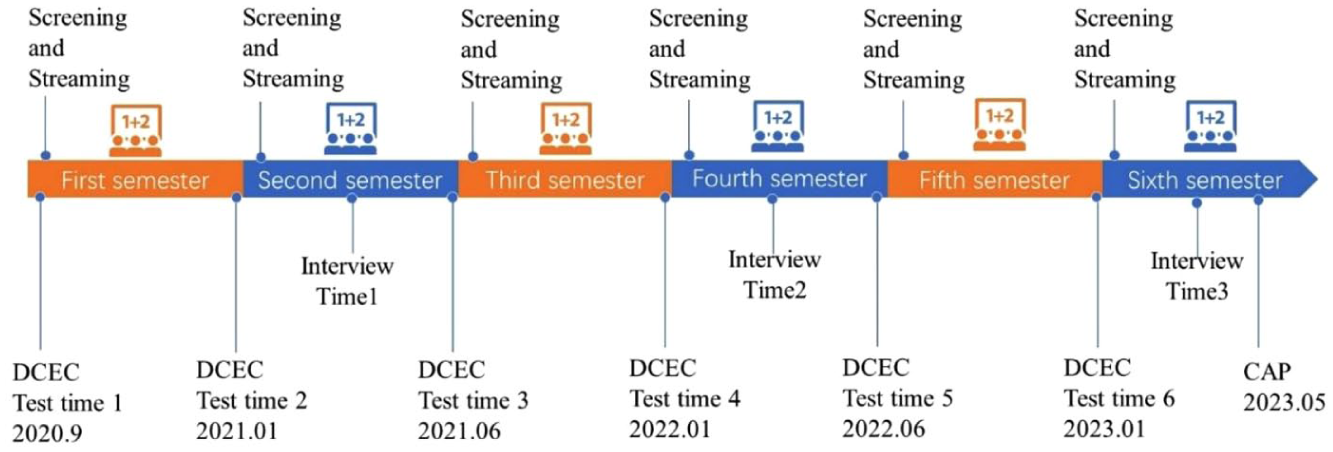
Timeline of quantitative and qualitative data collection during the teaching intervention period.
a Quantitative data collection
At the end of each semester, this study tracked students’ English performance across the four DCEC subtests, resulting in 6 different time points: T1, 2020.09; T2, 2021.01; T3, 2021.06; T4, 2022.01; T5, 2022.06; T6, 2023.01. After each DCEC test, the school’s Academic Affairs Office reviewed the results and placed students who did not meet grade-level standards into appropriate remedial programs (i.e., Foundation 1 or Foundation 2). The DCEC subtests were administered as group sessions in the school’s computer lab, following a fixed sequence of vocabulary, grammar, listening comprehension, and reading comprehension sections, totaling approximately 135 minutes (or three class periods). In addition to continuously tracking students’ academic progress and identifying learning gaps, the test results also contributed to building a comprehensive database of student proficiency.
In May 2023, the participating students took the CAP. One month after the results were released, CAP scores from the three participating schools were obtained directly from the schools, whereas CAP data for rural schools in H County were obtained from the Research Center for Psychological and Educational Testing at National Taiwan Normal University. The research team was affiliated with this Center, and access to these data was authorized through this teaching experiment, which was funded by the K-12 Education Administration, Ministry of Education, Taiwan, and implemented by the Center.
b Qualitative data collection
In this study, an interview was conducted once each academic year during the second semester, utilizing a semi-structured interview format. One week before the interview, researchers provide the interview outline to participants, allowing them ample time to reflect and prepare their responses. The structure of the outline is based on the various components of the PASSION teaching module and is adjusted according to the interviewee’s role, as detailed in Appendix C. Each interview lasts approximately 40 minutes, and all sessions are recorded via audio and video, with transcripts created verbatim to ensure the completeness and accuracy of the data. The interviews are conducted by two researchers from the Research Center for Psychological and Educational Testing at National Taiwan Normal University, one of whom is the second author of this study. Both interviewers are familiar with the operation of the PASSION English course and have extensive experience in both individual and group interviews. During the interviews, they adhered to the interview outline and probed relevant details to ensure consistency across interviews. After each interview, the two researchers engaged in reflective discussions to identify any instances of potential leading questions and to refine their interviewing strategies for subsequent sessions. After each interview, the researchers identify and code descriptions related to the PASSION teaching module. Due to space limitations, the data analysis process is explained in Appendix D.
To reduce researcher bias and strengthen trustworthiness, several strategies were adopted in this study. First, two researchers independently conducted the initial coding and met weekly to discuss and resolve discrepancies until consensus on the extracted categories was achieved. Second, peer debriefing was conducted with another research team member, who reviewed the coding process to ensure that each category was logically related to its corresponding codes and to examine the distinctiveness of each category, while providing suggestions for alternative interpretations. In addition, the categories derived from the coding process were shared with the participants for member checking. The participants confirmed that the categories were consistent with their lived experiences and indicated that no additional categories were needed. Based on this feedback, the two primary analysts refined the structure of the categories and subcategories.
IV Results
1 DCEC performance scores
Table 3 presents the means and standard deviations of the four English proficiency skills of students participating in the PASSION English program across six time points. A repeated-measures analysis of variance (ANOVA) was conducted on students’ DCEC vocabulary, grammar, listening, and reading test scores collected across 6 time points to examine overall changes in EFL proficiency over time. Bonferroni post hoc comparisons were applied to determine significant differences between time points while controlling for Type I error. The results revealed significant differences across time points for all skills (vocabulary test, F (5, 125) = 18.61, p < .001, partial eta-squared (ηp2) = .43; grammar test, F (5, 125) = 9.31, p < .001, ηp2 = .27; listening comprehension test, F (5, 125) = 21.70, p < .001, ηp2 = .48; reading comprehension test: F (5, 125) = 13.38, p < .001, ηp2 = .35). Based on Cohen’s (1988) benchmarks, all effects were in the large range (ηp2 ⩾ .14). Subsequently, a Bonferroni post hoc comparison was performed for each skill. As indicated by Table 3, all subtests showed significant improvement over time, with the most substantial gains typically occurring between T4 and T5 for vocabulary, listening and reading comprehension.
Descriptive statistics for four DCEC subtests and results of mean difference tests.
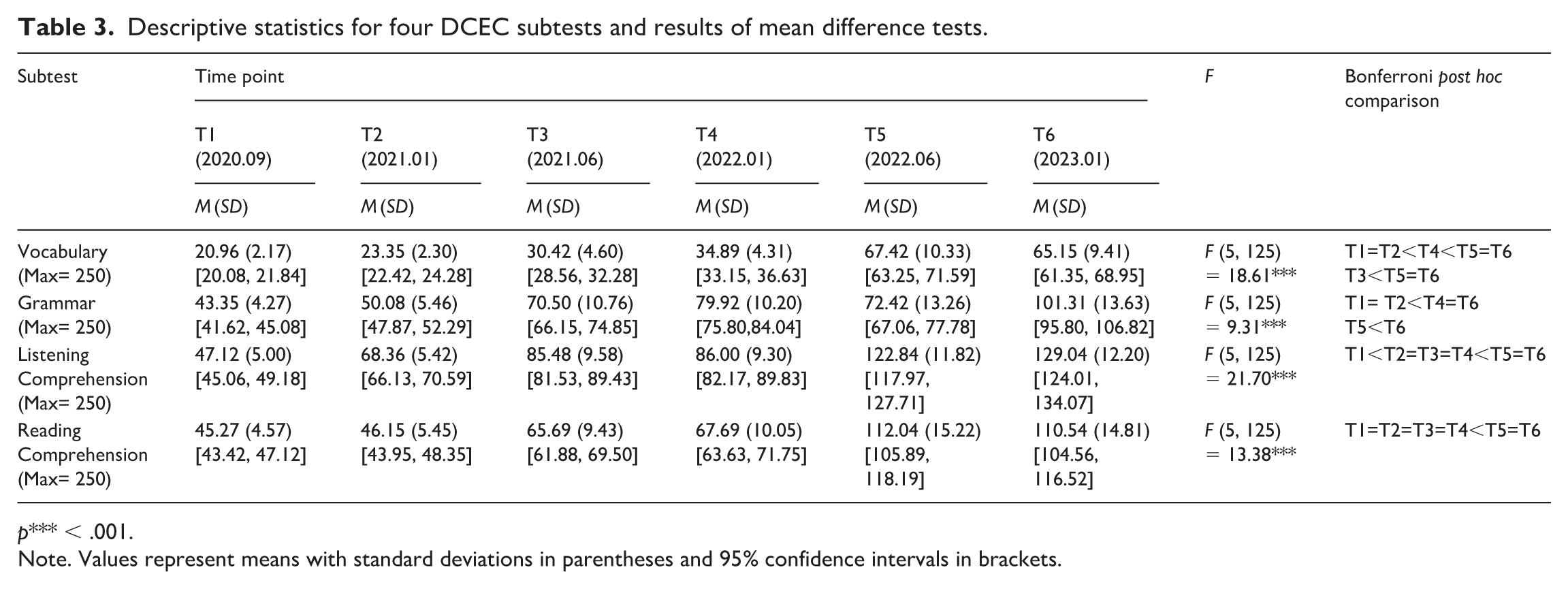
p*** < .001.
Note. Values represent means with standard deviations in parentheses and 95% confidence intervals in brackets.
2 Performance in the English subject of the CAP
To address RQ2, a chi-square test for homogeneity of proportions was conducted to examine whether the proportion of students performing at the Below Basic level in English differed significantly (a) between the 2022 and 2023 cohorts of the three participating schools and (b) between the participating schools and rural schools in H County in 2022 and 2023, respectively. Notably, because CAP examinations are rigorously equated and the difficulty of the English test is comparable across years, comparisons of performance outcomes across cohorts are considered acceptable.
In May 2023, a total of 53 ninth-grade students from three schools who had enrolled in the PASSION program participated in CAP, while in 2022, 63 ninth-grade students from the same schools participated without having taken part in the PASSION program. As indicated by Table 4, the proportion of students performing Below Basic in 2023 was significantly lower at 68% compared with 87% in 2022 (χ2 = 5.29, p < .05).
Chi-square test results comparing the English subject performances in CAP between two student cohorts (2022 and 2023) from participating schools.

p* < .05.
To examine whether the disparity in English subject performance observed in 2022 was attenuated in 2023, this study compared English performance between students from participating schools and rural schools in H County across the two cohorts (Table 5). A significant difference in proficiency distribution was observed in 2022 (χ2 = 5.78, p < .05), with a higher proportion of students in participating schools performing at the Below Basic level (87%) compared with rural schools (72%). In 2023, however, no significant group difference was found (χ2 = 0.54, p = .463), and the Below Basic rates were comparable (68% vs. 74%), indicating that the previously observed gap was no longer statistically evident.
English subject performance on the CAP among participating and rural schools across the 2022 and 2023 cohorts.

p* < .05.
3 Qualitative interview results
Using the grounded theory approach by Corbin and Strauss (2007), five core themes were identified and are explained as follows.
a Accurate diagnostic tools facilitate class placement based on instructional needs and provide insight into students’ current abilities
The PASSION English teaching module provides an efficient diagnostic tool with vertical diagnostic capabilities that can effectively support class placement based on students’ learning needs. For example, a teacher from School A (2023/05/29) mentioned, “I think if we can place students by ability, there will be less disparity in class, and they’ll be able to interact more with each other during explanations or practice.” In addition, a director of academic affairs (director hereafter) from School C (2023/06/27) stated, “With diagnostics, if teachers can identify students’ needs in advance, I can help them progress faster and better address differentiated learning. I can focus on supporting students who are behind to improve their abilities, while advanced students can keep moving forward thanks to the rich and diverse teaching materials.”
b Simple and systematic teaching resources enable teachers to quickly familiarize themselves with teaching procedures and methods, reducing the preparation burden for inexperienced or cross-disciplinary teachers
In rural areas, where teacher turnover is high, the structured teaching process of the PASSION English module helps less-experienced teachers quickly get up to speed and operate it easily. For example, the principal of School A (2023/06/28) mentioned, “When it comes to building capacity, there are really two parts. First, the current teachers already have a good idea of how to handle the classes. Second, for new teachers, even if they’re not originally from this field, the module provides a clear structure so they can grasp the main points of related subjects. They just need a bit of time to digest it.”
A teacher from School B (2023/04/19) also noted, “Thanks to the training sessions, even new teachers know how to use the system. Since the classroom routines follow a regular instructional sequence, students get used to it as well, so a change in teacher doesn’t disrupt things—even with high turnover, new teachers can jump right in and teach in the same way.”
In addition, using corresponding teaching aids such as flashcards can help reduce the lesson preparation burden on teachers in remote areas. For instance, the principal of School A (2023/06/28) mentioned, “This actually provides teachers with simplified teaching materials, allowing them to make minor adjustments based on their students’ learning progress. These adjustments are minimal, really; it’s just about reaching that level. Secondly, with these simplified materials, teachers are able to operate within a professional framework, saving them a lot of effort.”
Similarly, the director of School C (2023/06/27) noted, “With the materials you provided, teachers don’t need to spend as much time preparing for lessons—they can pick it up easily, and students seem to enjoy it as well.” Teacher 1 at School C (2021/04/13) remarked, “The unique feature of these materials is that they’re a tool, but the key lies in the lesson plan design. Your lesson plans actually add a bit of fun to learning, with games to engage the students, and I feel like they really enjoy this part—they’re motivated to learn English. As for the materials, the flashcards are particularly useful; they allow for both reading and visual memory techniques. If we were to prepare this ourselves, it would take a lot of time.”
Furthermore, Teacher 2 at School C (2023/05/06) shared his observations on how the materials and methods enhance learning efficiency. He commented, “When teachers follow the steps laid out in these materials, even lower-achieving students can reach around 80% completion. These students also feel a greater sense of accomplishment in the eighth session (i.e., the remedial class). Then, in regular classes, they are able to form a connection, recalling that ‘Oh, this part was covered in session eight,’ which reinforces their memory. While they may struggle to answer in regular lessons, at least they can keep up with the pace.”
c The learning environment created effectively motivates students to engage in language learning, enhancing both the enjoyment and effectiveness of their studies
Teachers report that the module’s structured teaching process and game-based activities help students feel more familiar with the routine and gain a sense of accomplishment. For example, Teacher 1 from School B (2021/04/19) stated, “The instructional sequence is clearer now, and I think having a predictable teaching routine helps students feel more familiar with the routine. Soon, they no longer find it difficult because they understand the teacher’s approach—starting with games, followed by vocabulary, then sentences. This gives them a greater sense of accomplishment, progressing from games to a simple and well-defined learning process.”
Similarly, Teacher 2 from School B (2023/05/29) observed, “At least within this foundational course, students are very enthusiastic about participating in activities, memorizing vocabulary, and practicing sentence structures. I haven’t seen any signs of them giving up. I find this reassuring—even if I’m not sure about their grades, I can see they are genuinely enjoying learning in English class.”
Lastly, Teacher 1 from School A (2023/05/29) noted the impact of the teaching method on students’ learning strategies: "Personally, I find the flashcards very useful. For instance, when we started practicing vocabulary, the kids relied heavily on those flashcards.”
Some students reported that gamified and activity-based learning helped reduce the sense of boredom they previously felt in class. In addition, some students were able to understand the educational objectives behind these games. For example, Student 1 from School C (2023/05/30) said, “They use games for teaching, which makes the atmosphere more engaging and keeps me from feeling sleepy. If we could apply PASSION’s teaching methods to regular classes, perhaps more people would be interested and wouldn’t end up slumping over and falling asleep.”
Student 2 from School C (2023/05/30) added, "In English class, the teacher brings in activities. . . some of the games involve picking word cards, reading them out loud in English, and spelling them. . . I really like it. It makes English class less rigid and more interesting." These reflections from students suggest that the learning environment created through such methods can motivate them to engage in language learning. Student 3 from School C (2023/05/30) also recognized the learning purpose behind the games: “The teacher gives us handouts—grammar worksheets—and spends one or two sessions teaching vocabulary before moving on to grammar practice. Sometimes we play games, like filling in Chinese or English words on a sheet. It’s fun if you’ve memorized the words. . . sometimes we play games because it motivates you to memorize vocabulary; you need to know the words to play.”
Student 1 from School A (2022/06/17) noted, "In the PASSION program, we play word-search games where you have to find specific words or form them from a set of letters.”
d In situations where it is challenging to build teacher communities, friendly peer observation sessions can provide personalized teaching recommendations, helping teachers identify students’ learning progress and uncover blind spots in their teaching
Some interviewees reported that receiving feedback from observed lessons was helpful. For example, in an interview with Principal A from School A (2023/06/28), they mentioned, “For rural teachers, especially when there’s only one teacher for a subject, this kind of resource is particularly valuable. It allows us to have direct and quick discussions, which I believe is the biggest benefit. . . It’s not just about having materials; there needs to be someone to teach and support. This has a significant impact on us, and it’s especially helpful in small rural schools.”
In addition, Teacher 1 from School C (2021/04/13) stated, “When we’re teaching, we sometimes have blind spots and can’t tell if our method is suitable for the students. Classroom management strategies that may seem effective to a single teacher might not actually work. With another teacher observing, they can later provide feedback on class management and teaching methods, highlighting areas where students struggle to adapt or absorb content. After making adjustments based on this feedback, I found it very helpful.”
e A comprehensive teaching module and support system bring a sense of accomplishment to both rural teachers and students
Some interviewees indicated that the PASSION teaching module had an effect on motivation and emotional engagement. For instance, Director A from School A (2023/06/26) stated, “The student assessments, along with the practice of having experienced teachers or principals from the university (in collaboration with the PASSION Project) come to observe classes and provide immediate feedback, as well as follow-up feedback forms, plus the system for holding exhibitions of learning outcomes—this really gives students in subjects like Chinese, English, and Math, who used to struggle and lack confidence, a strong sense of accomplishment thanks to this program.”
He further mentioned, “PASSION provides a substantial support system. I really think rural teachers are quite exhausted. Honestly, I have to practically beg them to take the eighth period (i.e., the remedial class), and I know how tiring it is for them. But I feel that PASSION offers them real support. Although the teachers are working hard, this program is essential for rural students to receive the support they need for learning. So, it’s about balancing challenges; we provide a lot of teaching resources to prevent teachers from feeling lost or having to do everything on their own.”
Similarly, Director A from School B (2023/06/05) noted, “Whenever I discuss with directors from other schools, I always recommend the PASSION system. This system really takes care of teachers—there’s comprehensive training for teachers beforehand, and the classroom observation sessions are also very supportive. It strengthens teachers’ skills, which, of course, benefits the students greatly.”
V Discussion
Although rural teachers are a key strategic asset in closing learning achievement gaps, they often struggle to make an impact due to a complex set of interwoven factors (Burhan et al., 2024; I.S.J. Chen et al., 2025). The primary challenges include high teacher turnover, low student motivation, and a lack of teaching materials and methods focused on low-achieving students. Drawing on ecological systems perspective (Bronfenbrenner, 1995), this study implemented an instructional support system, the PASSION teaching module, in three rural schools in Taiwan. This module provides teachers with a systematic set of educational resources, including learning diagnostics, adaptive teaching materials and methods, and professional development workshops. To evaluate the impact of the PASSION module (using English as an example), a long-term, 3-year remedial teaching experiment was conducted, utilizing a convergent mixed-method design to verify its effectiveness.
The quantitative results indicate an upward trend in students’ vocabulary, grammar, listening, and reading comprehension test scores across 6 assessment points. Furthermore, compared with the performance of the previous cohort on the English subject of the CAP, the overall proportion of students Below Basic showed a significant decrease. Notably, while an English performance gap between the participating schools and other rural schools in H County was evident in 2022, this gap was no longer observed in 2023, when the PASSION module was implemented. In terms of qualitative results, interviews with various participants can be summarized into 5 themes: (1) diagnostic tools enable data-driven differentiated instruction, (2) teachers quickly familiarize themselves with systematic teaching materials, (3) increased student engagement is observed during classroom activities, (4) personalized feedback from lesson observations enhances teaching strategies, and (5) both teachers and students report a heightened sense of achievement.
Taken together, the quantitative findings establish the effectiveness of the PASSION teaching module in improving learning outcomes, whereas the qualitative findings provide explanatory insight into the processes through which these effects emerged. From an ecological systems perspective, the PASSION module functioned as a mediating structure that reorganized instructional practices within the mesosystem. By embedding diagnostic assessment, structured instructional design, and individualized feedback into routine teaching, the module strengthened teachers’ instructional agency under conditions of contextual constraint, such as high teacher turnover and limited access to professional development. These mesosystem-level supports, in turn, generated downstream effects at the microsystem level, where students experienced more coherent instructional interactions, heightened engagement, and more adaptive achievement-related emotions. The findings thus suggest that strengthening instructional infrastructures at the mesosystem level may represent a critical pathway through which educational interventions mitigate contextual disadvantage.
Some students reported that gamified activities helped reduce their previous sense of boredom in class, which provides insight into quantitative improvements in English proficiency and corroborates prior research (Hu & Hsu, 2020; Hu et al., 2023). Compared with traditional methods, such as having students sit in the classroom listening to lectures and completing grammar drills, engaging them in a series of gamified activities can reduce boredom and encourage active participation. Taken together, our quantitative and qualitative findings align with Dewaele and Li’s (2021) research, which demonstrates the mediating roles of student achievement emotions (enjoyment and boredom) between perceived social interaction and learning engagement. In rural schools, where students’ English learning experiences are largely confined to the classroom, this finding underscores the importance of cultivating a positive classroom environment as a key factor in shaping motivation and effort for rural students (Y.H. Tseng, 2021).
Extending this interpretation to a broader framework of motivational development, the integrated quantitative and qualitative findings of the present study resonate with Lamb’s (2012, 2013) work on English learning motivation across urban and rural contexts. Drawing on Dörnyei’s L2 Motivational Self System, Lamb demonstrated that while the Ideal L2 Self functioned as a salient motivational driver among metropolitan learners, learners in rural contexts relied more heavily on their immediate L2 learning experiences to sustain engagement and achievement. Integrating Lamb’s insights with the present intervention-based evidence, the findings suggest that in rural EFL contexts, where future-oriented self-concepts are less readily formed, instructionally induced positive learning experiences constitute a more proximal and malleable source of motivation. By restructuring classroom practices and enhancing the quality of students’ day-to-day learning experiences, the PASSION module appears to compensate, at least in part, for broader contextual constraints on motivational development. This pattern underscores the theoretical importance of classroom-level interventions as a critical leverage point for sustaining learner engagement in structurally disadvantaged settings.
Numerous studies on remedial English education have proposed a wide array of strategies, yet a systematic solution has not been developed. Most existing research focuses on specific aspects, such as teacher training programs to help pre-service teachers adapt to rural schools (White & Kline, 2012), instructional strategies targeting specific language skills (Abu-Rabia et al., 2013; Hung et al., 2015; Lo et al., 2004; Milliner & Dimoski, 2024; Tawalbeh & Ismail, 2014), and the creation of gamified environments to enhance learning motivation (S.-L. Chen & Liu, 2023; Fisser et al., 2013; Hung et al., 2015; Liao et al., 2024). While these approaches highlight critical components of remedial English education, they fail to comprehensively address the issue of low academic performance among rural students. In response to this gap, this study has established an integrated PASSION teaching module that brings together these previously isolated components. The findings hold greater ecological validity and practical value, making the proposed PASSION teaching module a valuable reference model for practitioners, researchers, curriculum designers, and policymakers. Based on the results of this study, the following specific implications are proposed to reduce the achievement gap in rural education.
Rural schools are often constrained by geographical factors, which hinder teachers’ professional development. In addition, the limited staffing in small schools frequently increases teachers’ workloads. This study found that providing teachers with structured, long-term teaching resources, along with friendly consultation and discussion as professional scaffolding, is a promising solution to improving the teaching quality in rural schools.
Teachers in rural areas often leave due to career development and personal planning reasons, making long-term retention challenging. Considering the high turnover rate, providing standardized teaching materials and methods allows new teachers, whether novice, uncertified, or cross-disciplinary, to quickly adapt. This stability minimizes the negative effect on student learning outcomes due to changes in teaching style or materials.
The diagnostic system used in this study effectively captures students’ academic performance with speed and accuracy. By leveraging AI-based adaptive technology and its diagnostic data, teachers can more effectively implement differentiated instruction. This approach helps improve student learning outcomes at a fundamental level. In addition to the tiered instructional materials designed for low-achieving students in the PASSION module, this study developed fully leveled instructional resources, which were made available at https://srenglish.net/ and provided to higher-performing students after the intervention.
VI Limitations and future research
Although both the quantitative and qualitative findings indicate noticeable improvements and positive changes in students’ English proficiency following participation in the PASSION module, several limitations should be acknowledged. First, the absence of a control group in the single-group pretest–posttest design limits the ability to rule out alternative explanations for the observed gains. Although comparison data from students who received traditional remedial instruction in participating schools in the previous year, as well as from students in rural schools across H County, were included as reference benchmarks, the findings should nevertheless be interpreted with appropriate caution. Future research is encouraged to adopt more rigorous research designs, such as randomized controlled trials (RCTs), expand the range and diversity of participating student populations, and incorporate more carefully leveled instructional materials in order to more robustly examine the causal effects of the module.
Second, a potential limitation lies in the reliance on qualitative self-report data, which may be subject to social desirability bias. Nevertheless, the consistent patterns emerging across participants provide useful insights into changes in motivation. Given that motivational and belief-related processes play a particularly central role in EFL learning contexts (H.L. Hsu & Chen, 2025; Jian et al., 2025; Luan et al., 2023), a more rigorous examination of motivational change is warranted. Future research could incorporate complementary data sources (e.g., classroom observations or standardized motivation assessments) to verify and enrich the interpretation of motivational change.
Third, caution is warranted when interpreting the effects of the program due to the rural and voluntarily participating nature of the sample. Although the PASSION program was primarily implemented in rural contexts, its differentiated instructional materials, pedagogical designs, and diagnostic assessments may also benefit underachieving learners in urban environments. Further empirical validation across diverse educational contexts could therefore strengthen both the practical and theoretical implications of the PASSION module. In addition, because all participating schools volunteered for the program, extending these findings to schools with lower levels of institutional readiness or motivation remains a challenge.
Finally, issues related to scalability and sustainability warrant consideration. To address these challenges, the project has worked in collaboration with local education bureaus to assess rural schools’ support needs and the feasibility of broader implementation, leading to its expansion from junior high schools in southern to northern H County. To ensure fidelity of implementation, teachers are required to complete the project’s professional development workshops prior to system use. In addition, university students and preservice teachers have recently been engaged to provide remote instructional support, thereby helping to reduce teachers’ workload and alleviate shortages of educational resources.
Footnotes
Appendix A: Differences in learning content across various levels of PASSION English materials
As indicated in the following table, both types of remedial materials use the key grammar and sentence structures from the regular curriculum, but they differ in their focus on phonics and vocabulary. The content of “Foundation 1” is primarily centered on phonics, whereas “Foundation 2” focuses more on vocabulary and grammar. Teachers can adjust based on actual needs and experience; for example, when using “Foundation 2” as the primary material, they may supplement with phonics knowledge as needed.
Appendix B: Evaluation framework for lesson observation

| Principles for Designing Instructional Activities | Principles for Classroom Management | Principles for Classroom Assessment |
|---|---|---|
| • Activity design should have clear instructional objectives for achieving learning outcomes. • Tasks that students need to complete through the activity should be well-defined. • Aim to maximize language learning efficiency and effectiveness. • Provide abundant auditory stimulation by using sound to offer language input opportunities for students. • Provide ample visual stimulation through images and videos to help students connect language with real-world contexts. • Offer practice and performance opportunities sequentially for the whole class, in groups, and individually. • Ensure opportunities for active student participation and engagement. |
• Arrange the classroom environment and seating appropriately. • Utilize reward mechanisms effectively. • Ensure a clear system of rewards and consequences. • Manage time effectively. • Maintain good classroom order. • Foster a positive learning atmosphere in the classroom. |
The student possesses the following listening, speaking, reading, and writing skills: • Students should master phonetic rules and pronunciation. • Students should master vocabulary learned. • Students should master the grammar and sentence structures taught. • Students should be able to apply what they’ve learned in relevant contexts. • Students should be able to connect learned content with their personal experiences. |
Appendix C: Interview outline

| Interviewee Roles | Interview Questions |
|---|---|
| 1. School Administrators (Not Involved in Teaching) | 1. Have you observed any changes in teachers at your school after participating in professional development or lesson observation sessions? 2. After participating in this study, has there been any change in the teaching atmosphere at the school? 3. Following this study, have you noticed any differences in how teachers prepare their lessons compared to before? |
1. Please share any specific changes in learning motivation among low-achieving students after the PASSION teaching approach was introduced. 2. How has students’ learning behavior changed after the PASSION teaching approach compared to their previous learning patterns? |
|
1. Which aspects of this study were most helpful? 2. What improvements would you suggest for future implementations of this study? |
|
| 2. Classroom Teachers | 1. How has the diagnostic and streaming support provided by this study impacted your teaching? 2. What specific effects did the professional development workshops have on your teaching practices? 3. Has feedback from classroom observations and subject-specific discussions been beneficial for you as a teacher? 4. How have the teaching materials and resources provided by this project influenced or changed your teaching practices? 5. Do you have any recommendations regarding teaching support and resources? |
1. Please share any specific changes in learning motivation among low-achieving students after the PASSION teaching approach was introduced. 2. How has students’ learning behavior changed after the PASSION teaching approach compared to their previous learning patterns? |
|
1. Which aspects of this study were most helpful? 2. What improvements would you suggest for future implementations of this study? |
|
| 3. Participating Students | 1. How is the PASSION course different from your previous classes? Can you provide an example? 2. How has the PASSION course material helped you? Which part of the material do you like the most? 3. What have you learned from the PASSION course? What was your favorite activity in the course? 4. Have you made academic progress as a result of the PASSION course? In what areas have you improved the most? What do you think contributed to this progress? 5. Is there anything about the PASSION course that you don’t like or think could be improved? |
Appendix D: Interview data analysis process
This study adopted the grounded theory approach proposed by Corbin and Strauss (2007), which uses a systematic hierarchy of categorization and analysis to code and classify real-time data. An optional translated coding table (Theme 2) is provided to illustrate the analytic process. This process includes the following steps.
Through repeated reclassification and in-depth discussion, similar categories were merged. For example, “well-structured materials, easy to use” and “integrated materials, tools, and activities that facilitate student comprehension” were combined into one category, as both focus on instructional materials and tools despite emphasizing different aspects. Ultimately, five core categories were identified, corresponding to the scope of the PASSION teaching module, addressing the central research question: whether systematic instructional support effectively enhances teaching quality and, subsequently, student learning outcomes. The analysts shared the derived categories with the teachers, students, and administrative staff for member checking. Participants confirmed that the categories were consistent with their lived experiences and indicated that no additional categories were necessary.
Acknowledgements
We thank the K-12 Education Administration of the Ministry of Education in Taiwan for providing financial support through the PASSION project.
Data availability statement
The datasets used and/or analyzed during the current study are available from the corresponding author on reasonable request.
Funding
The authors disclosed receipt of the following financial support for the research, authorship, and/or publication of this article: This work was financially supported by National Taiwan Normal University (NTNU) under the PASSION project funded by the K-12 Education Administration of the Ministry of Education in Taiwan.
Ethical approval and informed consent statements
The PASSION project was approved and funded by the K-12 Education Administration, Ministry of Education, Taiwan, as a remedial teaching program. In accordance with the Ministry of Education’s remedial instruction policy, participating schools obtained informed consent from parents, teachers, and students prior to implementation.
