



Abstract
The second-language motivational self system has not only served to explain language learning motivation in a wide range of contexts; it has also offered the potential for guiding motivational interventions in institutional learning contexts in particular. Although multiple studies have trialed interventions designed to train learners in creating powerful visions of their ideal second-language self, such approaches have not only shown varied success, but have either ignored the second-language learning experience component or limited its construct to attitudes to the second-language learning process. In contrast, the current study, adopting a broader conception of the second-language learning experience as second-language autobiographical memory, explored the utility of an English-through-drama program not only as a lens for exploring second-language identity and motivation from a holistic second-language narrative identity perspective, but also as a tool for developing it through self-awareness promotion. Thematic analysis was conducted on the participants’ reflective journal data in response to the program’s three main drama-based task sequences, triangulated by a parallel analysis of the instructor’s reflective journal entries. The program was found to be effective in terms of: (a) clarifying, transforming, and reinforcing the participants’ sense of second-language self; (b) fostering near-peer relatedness and inspiration; and (c) enhancing language learning motivation through (a) and (b), as well as through experiences of novelty and agency.
Keywords
I Introduction
Motivation has been recognized as an essential element in successful second language (L2) learning, especially in English-as-a-Foreign-Language (EFL) settings (Dörnyei, 1994). In such settings, the L2 classroom is responsible for most, if not all, of many learners’ experience of learning and using English. This reality emphasizes the role of the language teacher in harnessing and developing their students’ motivation for learning English. It was Crookes and Schmidt’s (1991) seminal paper that notably foregrounded the unique motivational circumstances of EFL learners. They argued the need for teachers and institutions to apply motivational approaches which align with those circumstances. Their paper sparked a drive in L2 motivation research taking “a more pragmatic, education-centred approach . . . which would be consistent with the perceptions of practising teachers and, thus, be more directly relevant to classroom application” (Dörnyei & Csizér, 1998, p. 204). This research has naturally been sustained by the ongoing theoretical developments in the L2 motivation arena. Given the recent pre-eminence of Dörnyei’s (2005, 2009) L2 motivational self system (L2MSS), it is perhaps not surprising that efforts have been made to apply the framework to enhance language learner motivation (Chan, 2014; Dörnyei & Muir, 2019; Mackay, 2014, 2015; Magid & Chan, 2012; Munezane, 2013; Safdari, 2021; Sampson, 2012; Sato & Lara, 2019). However, apart from Dörnyei and Muir (2019), these intervention studies have focused solely on the ideal L2 self component of the framework. This future self-guide element indeed holds significant motivational potential by virtue of the drive to reduce discrepancy between the ideal L2 self vision and the current or actual L2 self. As with any complex system, however, all parts are interconnected, and studies have in fact demonstrated not only the specific motivational capacity of the L2 learning experience (e.g., Csizér & Kálmán, 2019; Pigott, 2019) but also bi-directional influence between the ideal L2 self and the L2 learning experience component (Gillies, 2023). The current study thus investigates the implementation of an L2MSS intervention program which explores the whole continuum of the participants’ L2 identity and experience: past, present, and future. In doing so, it follows Dörnyei and Ryan’s (2015) proposed embedding of the L2MSS within a holistic L2 narrative identity model.
In contrast to the aforementioned intervention studies, the current study reports on the innovative application of a drama-based L2MSS intervention program. As we will elaborate on below, we believe that drama-based tasks and techniques have much to offer in terms of an L2MSS intervention program. First, L2 narrative identity is based on experience, both real and imagined, and the stories that are woven thereof. Through live action and dialogue, whether scripted or improvised, students as protagonists bring these stories to life within the confines of the classroom; or, put the other way around, it allows the students to escape those confines by entering the world of memory-fueled imagination. Furthermore, through peer interaction and “cross-fertilization,” multiple experiences and visions can be shared and developed. Meanwhile, this identity and motivation work can be conducted hand-in-hand with language learning itself, as the students practice using the L2 both in preparation work and performance work.
Context plays a key role in language learning motivation, and research therein duly demands careful consideration of context (Ushioda, 2014). The current intervention program was thus embedded within an existing undergraduate-level English language course in Japan. The focus of the program on raising the participants’ awareness of their English learning identity and motivation was seen as especially relevant in the broader Japanese undergraduate context. Two issues in particular are acknowledged here: the first is the often-demotivating transition that Japanese students undergo as they progress from secondary to tertiary educational contexts (Carpenter et al., 2009; McVeigh, 2002; Ryan, 2009). The second is the importance of learner identity in this phenomenon, in terms of both social comparisons and learning goal availability. The current study thus attempted to address these issues through the course, and question existing limited and limiting stereotypes of Japanese learners.
Following a review of relevant literature, we introduce the study with a brief outline of salient features of the program, centering around the three main task sequences that were employed as platforms for the expression and exploration of the aforementioned narratives: Playback Theatre (Salas, 2013), Playforward Theatre (our own coinage), and Story of Bilingual Me (our adaptation of Ishii’s [2017] self-portrait genre). Then comes a thematic analysis of the participants’ reflective journal responses to their engagement in these activities. This data is triangulated by analysis of the program leader’s own reflective journal relating to the same task sequences. Taken together, these analyses are used to assess the efficacy of the program in terms of raising the participants’ awareness of their identity and motivation as learners and users of English
II Literature review
In this section we begin by detailing how the L2MSS has been applied in the form of intervention programs designed to enhance language learning motivation specifically through the ideal L2 self dimension. After drawing out the limitations of those interventions, we justify a drama-based intervention by explaining the relevance of a drama-based approach, first to L2 learning generally, and then more specifically to L2 identity and motivation exploration and development. Finally, we briefly lay out the context of language learning motivation in the Japanese EFL context, with specific reference to the L2MSS framework.
1 Applying the L2MSS as a framework for motivational intervention
Not surprisingly, while the L2MSS has been employed as a means of explaining and predicting language learning motivation, its potential as a platform for promoting motivation has not gone unrecognized. Since its inception, a series of studies assessing its potential for enhancing motivation has appeared (e.g., Chan, 2014; Dörnyei & Muir, 2019; Mackay, 2015; Magid & Chan, 2012; Safdari, 2021; Sato & Lara, 2019). The vast majority of these programs have mainly focused on the motivational capacity of the ideal L2 self component. This trend indeed aligns with the general research bias, at least initially, towards exploring that future self-guide, which came at the expense of the L2 learning experience component (Dörnyei, 2019).
While previous intervention programs have demonstrated their effectiveness in enhancing the ideal L2 self vision, this line of research has generally missed the opportunity to treat the L2MSS as an integrated system. In other words, it has failed to harness the motivational potential of the ideal L2 self and L2 learning experience combined. Some L2MSS intervention studies have indeed acknowledged the L2 learning experience, but it has been to a limited extent, focusing mainly on the “side-effects” of ideal L2 self vision enhancement. Mackay (2014, 2015), the first intervention study to include a control group, quantitatively evaluated those effects in terms of changes to attitudes to learning English, level of language anxiety, and also willingness to communicate (WTC). Mackay (2015) also qualitatively assessed any switch in attribution patterns to effort—in other words, from fixed mindset to growth mindset. Among the intervention sample, the quantitative study only showed a significant increase in WTC, while the interview data revealed evidence of an “expanding attributional framework” (Mackay, 2015, p. 321). Sato and Lara (2019) also carried out a quantitative comparison of L2MSS elements pre- and post-intervention. They found an increase in both ideal L2 self and learning experience scores among the intervention group, and suggested that “the learners had a temporary, yet positive, experience in the immediate learning environment, which, in turn, affected their Ideal L2 Self” (p. 301).
In contrast, the current study employed a broader conception of the L2 learning experience and its role, a conception enabled by an L2 narrative identity take on the L2MSS, a perspective first proposed by Dörnyei and Ryan (2015). From this perspective, the L2 learning experience is viewed as L2 autobiographical memory, defined as “a person’s store of memories relating to their sense of language learner self” (Gillies, 2023, p. 2). By thus treating the L2 learning experience as the “past” counterpart of the ideal L2 self vision, a “past self-guide” perhaps, a holistic and fully integrated L2 narrative identity is recognized. This understanding informed the design of the current intervention program, specifically the use of a drama-based approach, thus further differentiating it from previous L2MSS intervention studies.
2 Drama-based teaching approaches in L2 education
Drama has been shown to be well suited to educational purposes in general and has a significant history of use in the L2 classroom. In their survey of recent research into the use of drama approaches in L2 education, Belliveau and Kim (2013) note that drama in language classrooms “draws upon students’ abilities to imitate and express themselves and, if well handled, it should arouse interest and foster personality development” (p. 7).
In terms of actual research into the effects of the application of drama-based approaches within the L2 classroom, it has been found to be effective in a variety of contexts including developing L2 language skills (e.g., Athiemoolam, 2013; El Nady, 2000; Samat, 2010; Shraiber & Yaroslavova, 2016) and increasing learning motivation (e.g., Bournot-Trites et al., 2007; Dicks & LeBlanc, 2009; Samat, 2010). Of most interest and relevance here, though, are two studies where drama methods have been employed to explore and develop a sense of cultural/linguistic identity.
Tschurtschenthaler (2013) conducted a case study of English-as-a third language (L3) high-school students in South Tyrolean Austria to investigate how learning a foreign language affects the learner’s sense of self. To help capture these effects, she collaborated with the students’ EFL teacher to construct a short-term drama-based English curriculum based around thematically arranged role-taking activities. Overall, she found these role-taking activities, combined with subsequent reflection, to be overall effective in stimulating students’ awareness of themselves. Through the noticing of similarities and, more frequently, differences between their own identity and that of the character they have to play, “they negotiate their own ideas of self” (Tschurtschenthaler, 2013, p. 216).
In terms of research design, the current study draws on Tschurtschenthaler’s approach by employing the engagement in, and subsequent reflection on, role-taking activities. The focus of the current study differs, however, in that it seeks to explore not only the reflective and transformative power of drama activities in language learning, but also the existing current and future selves of the participants. Furthermore, the study investigates the experiences and events that they identify as pivotal in shaping their sense of self.
Meanwhile, Pakkar-Hull (2014) experimented with the power of drama, using a specially created piece of theatre-in-education. Her objective was to change attitudes to multilingualism in the UK, and thus open the way for students from different ethnic backgrounds to negotiate “new relationships between their linguistic resources and social identities” (Pakkar-Hull, 2014, p. 252). Pakkar-Hull’s study involves learners struggling with building a learner identity that embraces their whole linguistic repertoire, against an institutional backdrop that promotes monolingualism. As an interesting parallel, the traditional monolingual classroom in the Japanese EFL setting of the current study outwardly promotes multilingualism (or more specifically bilingualism). The struggle in that classroom, however, is often with the social stigma of speaking in the L2 (King, 2014), resulting in aspirational multilingual identities unable to be expressed.
The current study sought to create a space which promotes a participant-centered approach to the planning, constructing, and directing of the drama activities. It sees such empowerment as a key ingredient in two respects: first, it enables identity exploration, encouraging alignment between private and public selves; second, and consequently, it facilitates identity development.
3 Locating language learning motivation intervention in the Japanese context
A recognition of local context is obviously essential to the success of any intervention program. The English language learning motivation of Japanese university students has been a topic of research interest for some time. Two decades ago, Irie (2003) reviewed the extant studies at the time and noted that university students in Japan tended to appreciate the value of English as part of achieving examination and career-related goals, while also expressing interest in “making contact with native speakers of English and visiting their countries” (p. 97). More recently, Kikuchi’s (2019) longitudinal study of four university-level English language learners in Japan concluded that participants found it difficult to motivate themselves to seek out meaningful English- language learning experiences. Features of the proximal learning environment, including university English courses without clear objectives, as well as the often-negative effect of their peers’ and teachers’ motivation, emerged as key influencing factors. Seeking to leverage the affordances of the immediate classroom environment in driving motivation, Murphey et al. (2014) conducted an innovative action research project in which participants in Japanese university English classes were asked to imagine and describe the attributes of “ideal classmates” who would help them in their English language learning. Through a process that the authors describe as “reciprocal idealizing,” learners then internalized these attributes to motivate themselves, with positive behaviors that also motivated their peers. A recent study by Shelton-Strong and Mynard (2020) used confidence-building diaries with Japanese university students, and found that these diaries provided learners with an autonomous means to generate positive emotions and motivation. Examples such as these illustrate powerfully the observation of Irie and Ryan (2014) that the academic study of language learning motivation is most effective when researchers proceed in close alignment with teaching practitioners and the complex and messy realities of authentic learning environments. In a similar vein, we seek—in the present study—to draw on the affordances of the university language class and its participants to generate and socialize motivation through autobiographical narratives realized and shared through drama.
III Research question
What impact did the English-through-drama program have on its participants in terms of raising their awareness of their L2 identity and language learning motivation?
IV Methodology
1 Participants and setting
The English-through-drama program was set in a medium-sized arts and humanities university in central Japan. Enrolled in this 15-week course were 7 Japanese undergraduate learners of English, who had chosen the course as an elective unit. Although established under the auspices of the English Department, the course was available to students from all departments. Indeed, within this cohort, three academic departments were represented: Global Education, English, and School Education (see Table 1 below). In line with the protocol that was approved by the relevant research ethics committee, students were informed of the study and invited to participate only after the course had been completed and grades had been finalized. This was intended to minimize any sense of pressure to participate in the research, particularly given that the first author was the teacher of the course. Participants provided written consent for a range of documents, audio-recordings and video-recordings generated as part of the course to be analyzed as part of the research process.
Participant background information.
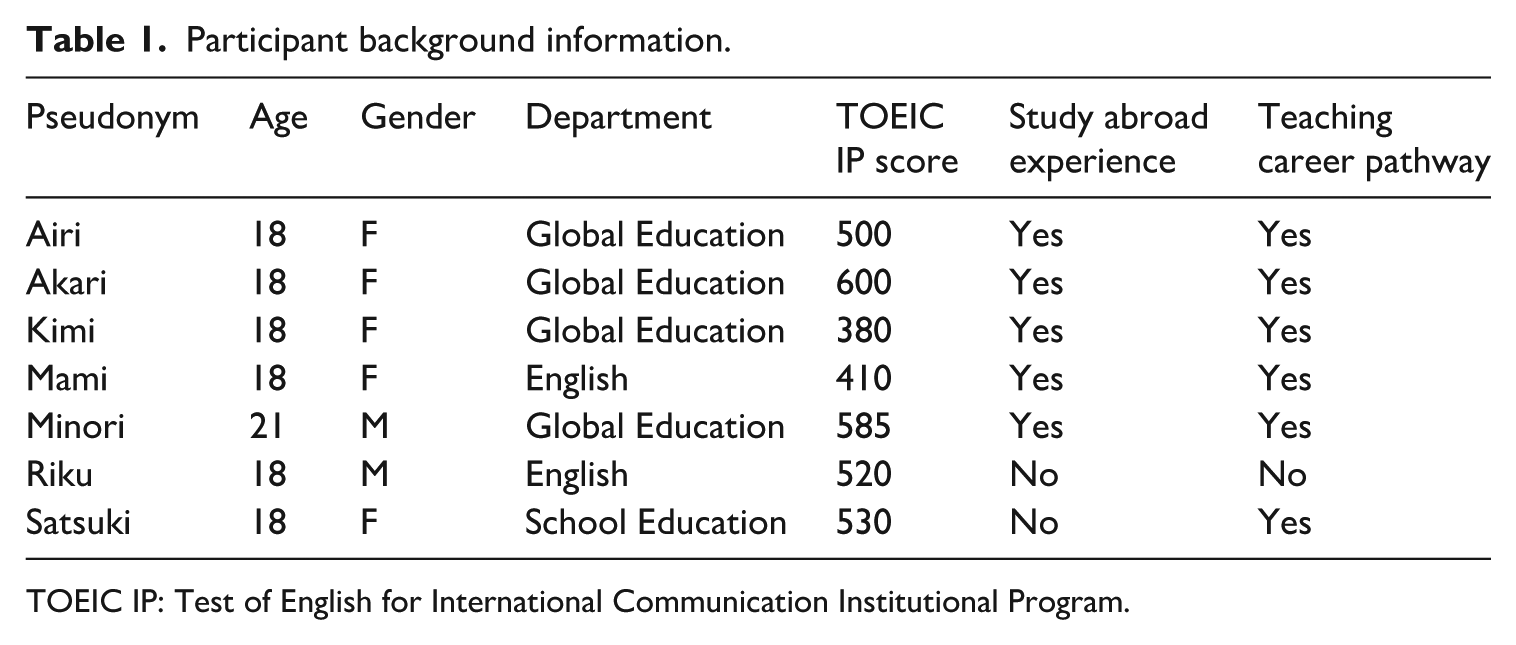
TOEIC IP: Test of English for International Communication Institutional Program.
2 Description of the overall English-through-drama course
Although a major objective of the course was the enhancement of the participants’ capacity to communicate in English via a drama-based pedagogy, the latter approach was also seen as affording a useful focus on motivational and identity-related aspects of learning a foreign language. The course objectives, in short form, were thus published as follows:
Improve your English (speaking, listening, reading, & writing).
Raise self-awareness of your L2 identity.
Enhance your motivation for learning English.
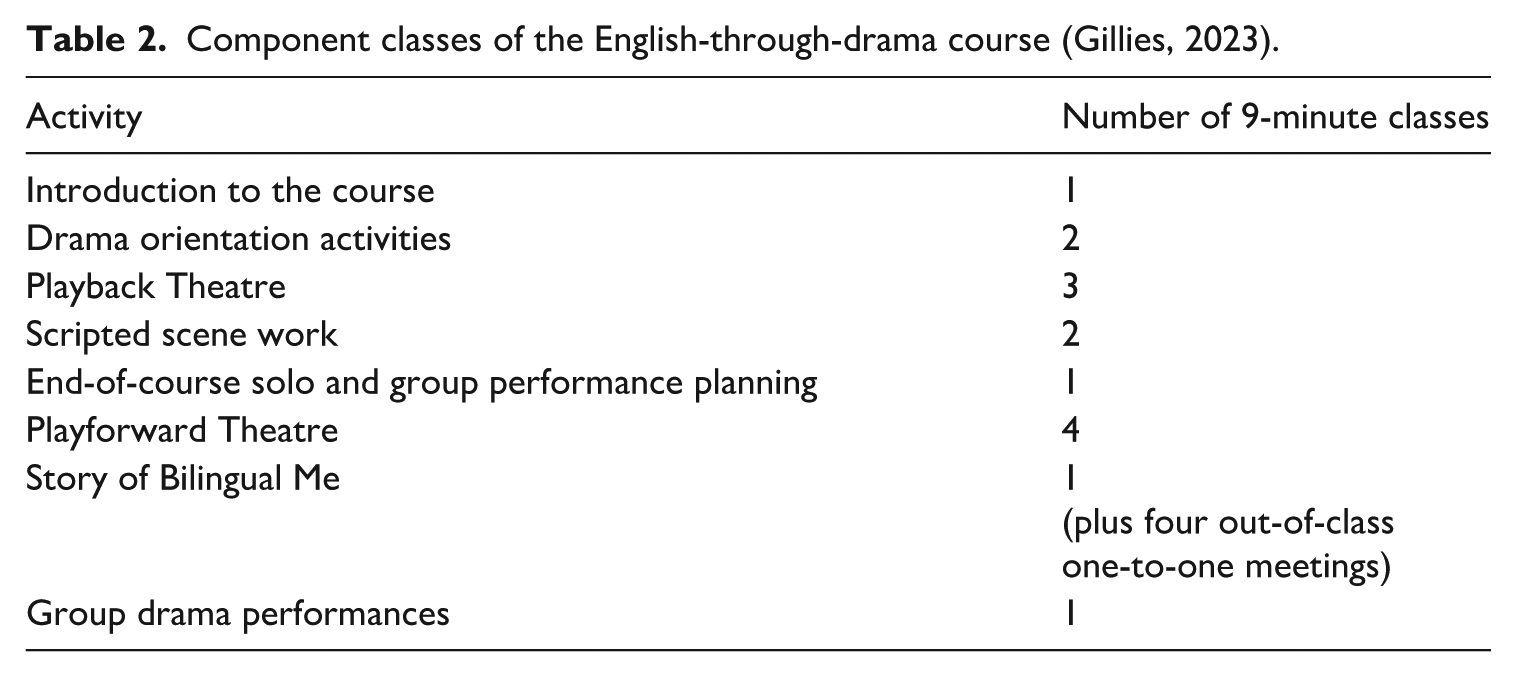
Lasting one semester and meeting once a week, the course began by acclimatizing the students to a drama-based approach to learning, specifically warming-up activities (body and voice work) and an introduction to improvisation. These steps were designed to help the students make the transition to the three main task sequences which are the focus of this paper: Playback Theatre (Salas, 2013), Playforward Theatre (the first author’s adaptation of Playback Theatre), and Story of Bilingual Me (based on Ishii’s [2017] Jigazō, or self-portrait, genre). Table 2 below shows the basic course progression.
Component classes of the English-through-drama course (Gillies, 2023).
3 Description of the three main task sequences under focus
Although an overview of the content of these three dramatic task sequences is provided in Table 3 below, an outline of their shared aims and features is given first. Beyond giving the students personalized and authentic contexts in which to express themselves in English, the further aim was to raise their awareness of both their L2 identity and their motivation, based on the principle that L2 motivation is directly connected with L2 identity: a narrative identity perspective that sees the L2MSS as a process of L2 self-development, and motivation as arising naturally in the aim of realizing one’s full potential as an L2 user. Self-awareness thus plays a crucial role in unlocking the motivational potential of L2 identity.
Overview of main task sequences.
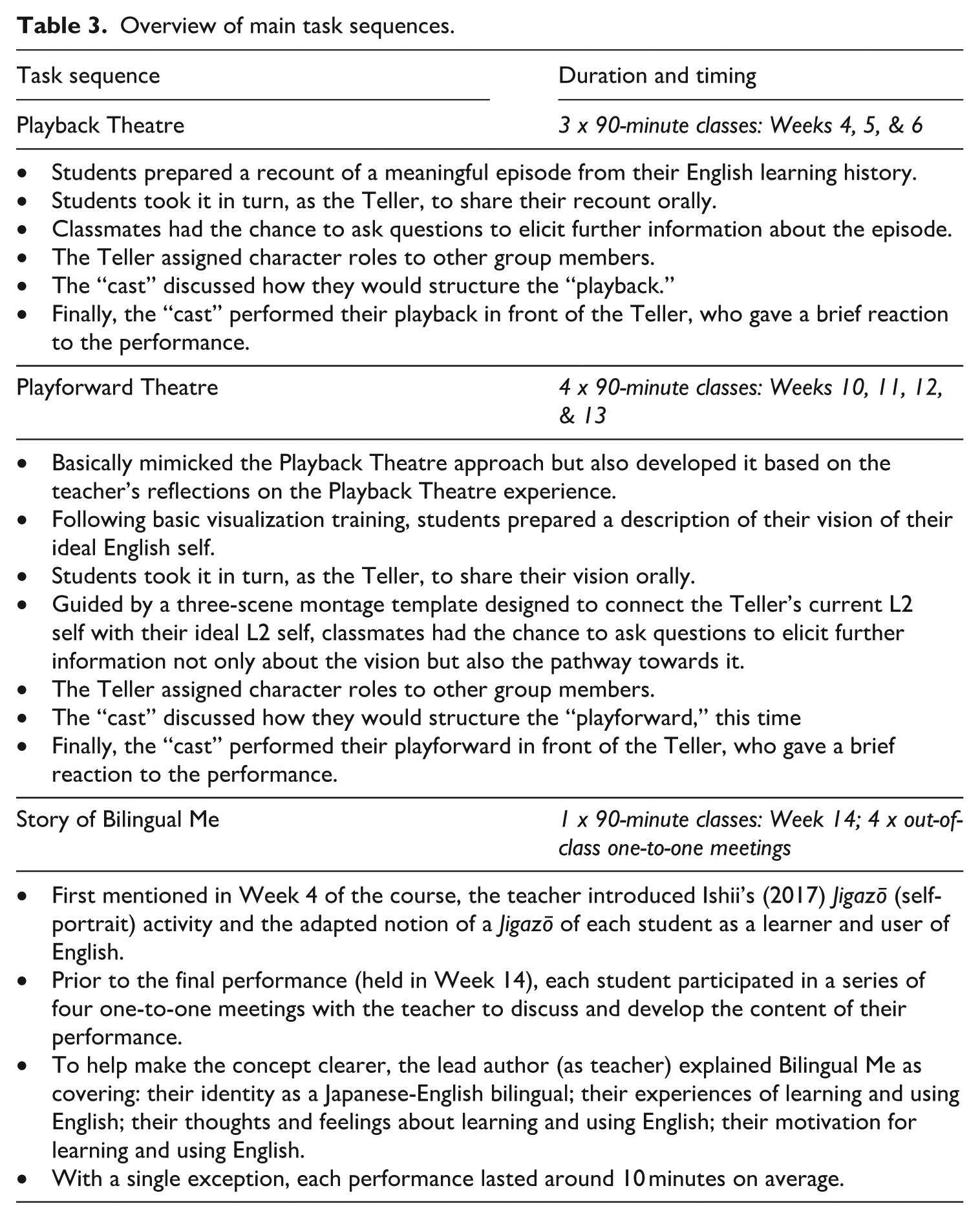
More specifically, all three task sequences were designed to shake up the memories and dreams of the students as L2 users, to use those memories and dreams as dramatic material, and to use that material to develop the L2 narrative identity of the students. An important part of this process is the interpretation and re-interpretation of L2 memories and dreams—a process that happens through the recounting, questioning, and re-enacting of the stories.
Finally, a key feature of all three genres was that they employed the students’ own “stories” as their material. In other words, the students were playing each other for Playback and Playforward, and then finally themselves for the Story of Bilingual Me.
4 Data collection
In order to evaluate the effectiveness of the English-through-drama program in terms of the extent to which it met its L2 identity and motivation related objectives, the following course objects were gathered:
Student background survey responses: Administered to the course participants as a homework assignment following the first meeting of the class, this questionnaire elicited a range of background information, relating to university department, year of study, age, English proficiency (most recent Test of English for International Communication [TOEIC] score), length of English study, experience of study abroad, future career plans, attitude towards English, motivation for learning English, confidence in using English, and experience of, and attitude towards, drama activities.
Students’ reflective journal homework entries reflecting on their participation in the Playback Theatre (Journal 3), Playforward Theatre (Journal 6), and Story of Bilingual (Journal 7) task sequences, as well as a final journal entry on their participation in the course as a whole (Journal 8): Completed as homework assignments following each of the three main task sequences as well as at the conclusion of the course, these entries were designed to raise the participants’ awareness of each task experience and its impact (if any) on them as learners and users of English.
Teacher’s reflective journal entries (Weeks 5, 6, 9, 10, 11, 12, 13): Completed following each class, these journal entries served not only to record the teacher’s impressions and insights from each class, but also to help guide the ongoing development of the course. For the particular focus of the current paper, only the entries relating to the three task sequences were included in the analysis.
5 Data analysis
The various documents listed above were submitted to thematic analytic coding. Whereas the course curriculum served to define the objectives of the course, the students’ reflective journal entries provided evidence of the impact of participation in the three main task sequences. Meanwhile, the teacher’s reflective journal entries added a separate perspective on the same experiences, at least in terms of their in-class manifestation, and thus enabled a degree of triangulation of the data.
The analytical approach employed here was both concept-driven and data-driven. Bearing in mind the study’s primary objective of determining the effectiveness of the English-through-drama course in terms of raising the participants’ awareness of their identity as English learners and users, as well as their motivation for learning English, the coding process began with identifying and sorting references to identity and motivation. At the same time, the exact nature of the identity and motivation related themes was determined by careful exploration of the actual data. These themes were then further sorted axially into distinct themes related to how their experiences of each task sequence affected the participants’ sense of L2 identity and motivation.
V Findings
Three distinct themes emerged from the data analysis: (a) Identity: clarifying one’s sense of self; (b) Relatedness: novelty of near-peer intimacy, and near-peer inspiration; (c) Motivation: interwoven with identity, relatedness, novelty, and agency. The following three sub-sections deal with each of these themes respectively. In doing so, however, each sub-section charts progressions across the three main task sequences, emphasizing the developmental nature of the self-awareness gains during the course. As a prelude, Figure 1 below provides a succinct representation of how each task sequence in turn functioned to enable this self-development process.
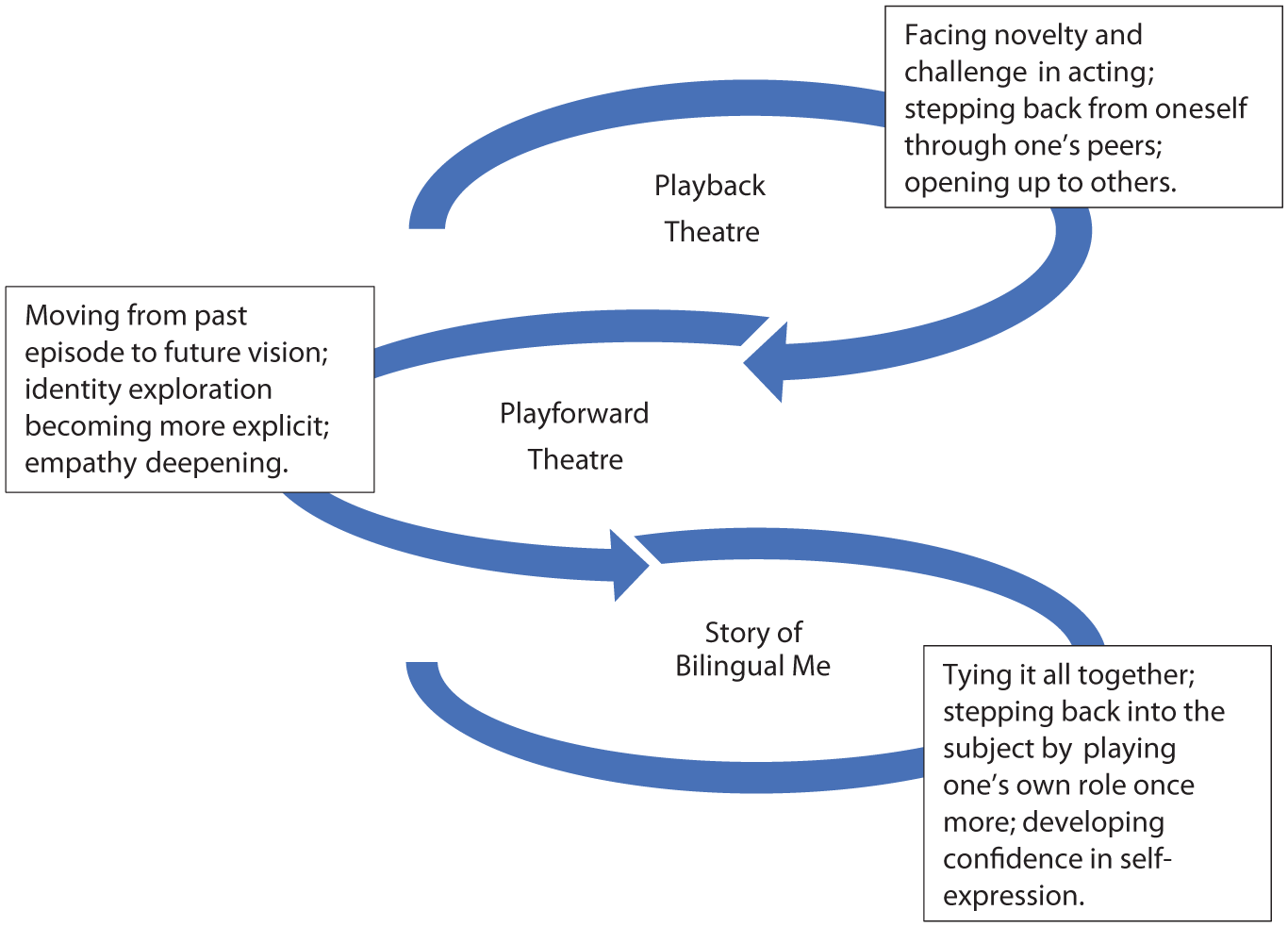
Flow of main task sequence impact.
1 Identity: clarifying one’s sense of self
By foregrounding significant episodes from the learners’ English learning experience, Playback Theatre was seen to achieve two main impacts. First, it reinforced positive aspects of their L2 identity, including having a knock-on effect on their motivation for learning English (Mami, Minori, Riku, Satsuki). Second, it allowed the participants to momentarily step outside their original experiences, and thereby enable reassessment of the memories of those experiences (Airi, Akari, Mami, Minori, Satsuki). Specifically, it broadened the participants’ perspective on the episodes: I got a broad view of things . . . Watching the play based on my story, I had an objective point of view . . . When I was a high school student, I just thought about myself. I just my feeling, because I didn’t have inner place of mind. Relatively, when I saw the playing, I understood my teacher’s passion. I could see things from different angles. I became to respect her strongly than ever. (Satsuki)
Transitioning to Playforward Theatre was found to further deepen L2 identity awareness, in this case by clarifying the participants’ ideal L2 self visions (Airi, Akari, Kimi, Mami, Minori, Riku, Satsuki): By thinking about “my” future, it became a chance to put my vague future dream in order. I had never thought about my future so specific, also I had never expressed it in words . . . I had thought I still do not have to think about my future dream, but through this activity, I thought it is close unexpectedly. (Airi)
Moreover, Playforward Theatre was also seen to relate back to and build upon Playback Theatre in terms of the task reminding them of a powerful past episode (Airi, Kimi). Here, Kimi reported feeling reminded of the genesis of her ideal L2 self as well as the path toward it: “By doing this activity, I could know why I want to be teaching Japanese in foreign country and what is important for my dream again” (Kimi).
This process of self-awareness raising was seen to culminate, more than simply chronologically, in the Story of Bilingual Me task engagement. This task tied together the past, present, and future dimensions of the participants’ L2 narrative identity. First, it further clarified their visions of their ideal L2 self, as well as the steps toward that vision (Airi, Akari, Kimi, Mami, Minori, Riku, Satsuki). Second, it transformed their sense of their current L2 self, the figurative fulcrum between L2 autobiographical memory and the ideal L2 self vision (Akari, Kimi, Mami, Satsuki). Third, it allowed them to express themselves more authentically, more naturally (Kimi, Mami, Minori, Riku, Satsuki): Through this activity, I was able to face real myself. Also, I found what should do for my future. I felt that it’s important for my life to make use of my strengths. This activity became my treasure and good experience! Thank you! (Mami) I used to say “I want to study English.” But now, I want to say “I want to learn English.” (Satsuki) I could show real me, not imitation. (Riku)
2 Relatedness: novelty of near-peer intimacy, and near-peer inspiration
Reflecting the essentially collaborative nature of all three task sequences, relatedness emerged across multiple dimensions in the data. Entering the first task sequence, Playback Theatre, relatedness aligned with novelty: This activity marked the first time the participants had shared their personal narratives as L2 learners and users. Not only did the novelty add energy to engagement, but the overall experience helped to break down barriers between the participants (Airi, Akari, Mami, Minori, Riku, Satsuki). It also laid the foundations for the subsequent task sequences in terms of “unmarking” L2 narrative identity as a topic of discussion: “We haven’t not known each other. But telling own English experience is rare. Listening to other’s is rare, too. So threw this activity, we became closer” (Satsuki).
With Playforward Theatre, this developing relatedness intersected with both identity and motivation—in other words, the drive for self-development. This took the form of near-peer comparison, or more specifically near-peer role-modeling (Airi, Akari, Kimi, Mami, Satsuki). Airi, for example, expressed how hearing and then being involved in the re-enactment of her classmates’ ideal L2 self visions elicited not only a sense of admiration but an ensuing drive to emulate those learners’ efforts: “I was motivated to study for my future dream through this activity because I thought ‘Everyone experienced such things and they are doing hard to realize their dream! I must study harder!’.”
This sense of intimacy between the participants culminated in the Story of Bilingual Me, and was widely reported by them (Akari, Kimi, Mami, Riku, Satsuki). This task sequence arguably posed the greatest challenge to their self-confidence: It required them to stand up in front of their classmates and share an honest and personal narrative of themselves as learners and users of English. Again, identity intersected with relatedness in that the breaking down of barriers and feeling of acceptance afforded the participants the confidence to express themselves more fully and authentically: After my showing, some friend said to me that my performance was good and I was very happy. Because, it was first time that express myself like this in front of everyone and there were little fear to show real myself. But, everyone accepted me and I was appreciated them and I thought I want to show myself like this with confidence. Through this activity, we could close more and I thought I was happy to meet everyone who improves each other. (Kimi)
As with the preceding task sequences, participants also reported how this growing rapport and the exchange of personal experiences and dreams was a source of empathy (Satsuki, Minori, Kimi) and stimulation (Akari, Minori, Kimi). While it fostered peer admiration (Airi, Kimi), a couple of participants also compared their own live monologue performance unfavorably to that of their peers (Airi, Akari).
3 Motivation: interwoven with identity, relatedness, novelty, and agency
The previous two themes have already demonstrated motivation as being interwoven with other elements of the three dramatization task experiences—primarily identity and relatedness, but also novelty and agency. At the same time, just as the identity theme was less evident in the students’ reflections on Playback Theatre but became more prominent from Playforward Theatre onward, the same was true for the motivation theme.
While limited to only two participants’ reports (Kimi, Mami), the rediscovery feature of Playback Theatre motivated the participants in two main ways. For one student, a positive memory—a successful episode from their English learning experience—reinforced their current motivation. For the other, a more ambivalent memory—an occasion where their English ability was found wanting when it really mattered—brought back a sense of frustration which converted into motivation: I did teller. It was fun, too . . . I haven’t seen my experience is performed and I remembered then emotion. It was very nobel and fun. This time, I looked back on my past and remembered the emotion of then. My story was English experience that I felt frustrated in England. I remembered my past and I thought I was conceited that I can English then. I thought I have to study English more again. (Kimi)
Playforward Theatre was also presented as having a motivating influence. First, through relatedness it fostered near-peer role-modelling (Airi, Akari, Kimi, Mami, Satsuki), as noted in section 2 above, even just as a sense of competition or admiration (Airi, Akari, Kimi): “By doing this activity, I motivated to learn English because everyone had good dreams” (Akari).
Moreover, Playforward enabled clarification of the participants’ ideal L2 self vision (Airi, Minori, Kimi, Satsuki). In Satsuki’s case, the mere crystallization of an appealing vision provided the direction and impulse for learning forthwith: It helped me to imagine my future. I couldn’t see my clear future before this play forward theater. I strongly thought I want to be like this in the future. I was bit anxious thinking about my future. However, I can now imagine ideal me, so I decided to work hard to be her.
Finally, the Story of Bilingual Me task sequence provoked a mix of reflections related to its motivational influence. For some, the process of L2 self-inquiry further reinforced the clarity and power of their ideal L2 self vision (Airi, Minori, Satsuki): I noticed that all I have to do is all I can do. I still cannot imagine my journey clearly, but I can see the way in front of me. So, I will keep going, and get closer to ideal me little by little. (Minori)
For others (Akari, Mami, Riku), it provided a fresh perspective on their L2 identity, which in turn triggered a fresh motivational impulse. Akari, for instance, reported overcoming her L2 inferiority complex, the legacy of her transition from the “small pond” of her high school to the “big pond” of English-proficient students at university (“I found it false pride. My English skill was not good at all”). Through discussing her L2 identity and experiences in the one-to-one meetings leading up to her Story of Bilingual Me performance she was instead able to feel inspired by her classmates, and thus motivated to emulate them (“All I have to do is catch up with them. They make me motivated”). This effect was no doubt facilitated by building positive rapport with her English-through-drama classmates through the overall course.
For Mami, meanwhile, a previously hidden perspective came to light, and with it a suppressed desire. This circles back to her earlier identity-related comment about being “able to face my real self.” This realization gave her the confidence and motivation to express herself more authentically in English: Until now, I wasn’t able to tell my opinion, so I preceded others idea. But, while I recalled my experience of using English. I thought that learning and using English are related to express my idea and feeling actively . . . I want to express my feelings with English. And, it motivate me to study English deeply.
Mami’s “real self,” hidden within her English learning experience of studying abroad in Canada, had been able to overcome an initial anxiety and engage with her host family and others in English. She had coded this experience as evidence of English enabling her to express her inner self more easily than her first language (L1). Participation in the Story of Bilingual Me task sequence had not only revived that autobiographical memory but also afforded her the chance to validate that memory with further evidence, and thus fuel further English learning.
VI Discussion
The findings from the current study demonstrated the effectiveness of the project’s drama-based L2MSS intervention program in terms of L2 narrative identity development. Through self-reflection and expression, all three task sequences raised awareness of L2 self. Overall, this “journey” helped the participants make sense of their language learning/using past, present, and future. Each sequence fed into the next. The significant episodes recalled in Playback Theatre helped to reinforce and energize the visions elicited in Playforward Theatre. These memories and projections were then reviewed and interwoven in the Story of Bilingual Me task sequence, consolidating the participants’ insights, reinforcing intentions emerging from those insights, and nesting all within a deeper sense of overall bilingual self. The findings therefore support those of previous L2MSS intervention studies showing how ideal L2 self vision training can not only develop that vision but also unlock its motivational capacity (e.g., Magid & Chan, 2012; Safdari, 2021). At the same time, they demonstrate an important dynamic between the ideal L2 self vision and the L2 learning experience: As L2 autobiographical memory, this experience continuously informs the ideal L2 self vision, planting not only ideas (e.g., the idea of being a language teacher) but also images (e.g., images of one’s own language teacher at work in the classroom) ready to be edited into that vision.
This process as a whole had added impact simply because these learners had never been afforded the opportunity to engage in any deconstruction and exploration of their language learning experience, nor the direction in which it is headed. Indeed, the relatedness facet of all three task sequences played a not insignificant role in their impact. Sharing their own experiences, and indeed their own visions, as well as the emotions tied up inside both these mental arenas, can add validation and promote self-esteem and agency. At the same time, gaining access to the same inner realities of their peers can inspire and motivate learners, providing accessible near-peer role-models. In other words, there is a cross-fertilization at work here, representing the influence of group L2 learning experience and ideal L2 self vision on individual member vision generation. This finding adds direct support to Murphey et al.’s (2014) theory of reciprocal idealizing. It also adds greater specificity to the amplified sense of relatedness among the participants reported by Mackay (2015), which she referred to as “a positive and mutually supportive group atmosphere” (p. 319). Likewise, it helps explain Sampson’s (2012) observation of “the empowerment students felt due to the social-interactive nature of activities” (p. 328). While it may be tempting to view an intervention program as a purely top-down causal process, the importance of the individual contributions found here, and their near-peer exchange, reminds us that the relationship between program and participant should be reciprocal in nature.
Another important factor behind the success of the current program may have been its timing, in terms of its participants having just entered university. As Thorsen et al. (2020) point out, “It is in the phases of self-revision that coincide with educational transitions that measures designed to enhance students’ ideal L2 selves might be most effective” (p. 596). As well as being young adults with the greater part of their life ahead of them, all seven participants were still adjusting to a new educational environment. Successfully negotiating university entrance exams had automatically “entered the rear-view mirror” of their L2 identity. This “scene change” therefore raised questions about alternate goals and roles for English in the next phase of their lives.
VII Limitations
Several limitations of the current study should be addressed alongside these findings. First, being a case study, the findings are necessarily limited in their generalizability by the small sample size and the unique combination of features of this specific setting. At the same time, this limitation provides an exciting impetus for replication studies in a broader international range of L2 classroom settings.
Second, while the combined role of teacher-as-researcher has its advantages in terms of allowing easy access to the research setting, established relationships with the participants, and, overall, a richer understanding of both elements, there are always risks inherent in taking on two roles side-by-side. Apart from the very practical challenge of managing the extra workload, there are also validity and ethical considerations (Galloway, 2016). In the current case study, certain steps were taken to mitigate these challenges. First, while the first author was embedded in the research setting, he conferred regularly with the second author, who was based outside Japan, at each stage of the ongoing project. This relationship thus allowed a healthy balance of subjectivity and objectivity. Second, recognizing the risk of the power status associated with the teacher role (especially in terms of awarding grades) unduly influencing the students’ decision to participate in the research project, the students were only invited to participate following the submission of their course grades. This strategy also aligned with the fact that the data set was primarily a working component of the English-through-drama course, rather than an external imposition upon the students.
Finally, returning to the benefits of insider research, and more specifically the teacher-as-researcher, we see vindication in Banegas and Consoli’s (2020) call for practitioner-researchers to “embrace, and even capitalise on, such student–teacher synergies” (p. 178). They point to the transformative effect of these synergies upon both sides of the relationship, not only in the specific research context but more generally as well, through a resonating effect.
VIII Conclusion and pedagogical implications
The current study followed the devising and implementation of a novel L2MSS intervention program in a Japanese undergraduate EFL setting. Building upon previous intervention studies, the current program applied an L2 narrative identity perspective and used a drama-based approach to enable seven Japanese undergraduate students to explore their identities as learners and users of English. Participants’ engagement in the program served to: (a) clarify, transform, and reinforce the participants’ sense of L2 self; (b) foster near-peer relatedness and inspiration; and (c) enhance language learning motivation through (a) and (b), as well as through experiences of novelty and agency.
To now lay out the pedagogical implications of the findings of this paper may seem somewhat redundant. This paper has indeed already provided an explanation of the drama-based task sequences in terms of their rationale and their procedure. This account has been followed by evidence of their effectiveness according to the specified objectives of the English-through-drama program. However, we would nonetheless like to close this paper by emphasizing the value of a drama-based program in the language classroom, especially given its versatility—its ability to meet multiple needs at the same time: language related, motivation related, and L2 narrative identity related. Drama work takes language use (and, by extension, language learning) as a function of motivation, and motivation as a function of narrative identity. In other words, communication is seen as purposeful, and ultimately serving the protagonist’s identity management. Through harnessing of the imagination, drama work enables this meaningful use of the L2 to happen in diverse contexts beyond the four walls of the classroom. Through group-based collaboration, drama work makes meaningful use of the L2 a conduit for fostering peer empathy, inspiration, and support. Through engagement in improvisation activities, drama work develops the self-confident spontaneity and agency that smooths the way to meaningful use of the L2. In short, drama work can promote L2 self-development at every level.
Footnotes
Acknowledgements
The authors gratefully acknowledge the contributions of the anonymous participants to this research. They are also grateful for the feedback received from reviewers on an earlier version of this paper.
Funding
The authors disclosed receipt of the following financial support for the research, authorship, and/or publication of this article: This research was supported by an Australian Government Research Training Program (RTP) Scholarship (Hamish Gillies).
Ethics
This research was approved by the Macquarie University Human Research Ethics Committee (Reference 52022515640096). Permission was also obtained from the institution where the data collection occurred.
Consent to participate
As per the approved study protocol, participants provided written consent to participate. This included consent to publish findings from the data in de-identified form.
