




Abstract
As many students worldwide receive second language (L2) English private tutoring (EPT) that shadows school curricula, examining student perceptions of it is essential to understanding their L2 learning. From the L2 Motivational Self perspective, students’ ideal L2 self, ought-to L2 self and L2 learning experience are linked to student enjoyment of EPT. This study explores these links via analysis of survey responses of 2,216 Secondary Six (Grade 12) students who attended a company’s L2 EPT lectures in Hong Kong. Most of these students (80%) enjoyed EPT. They were more likely to enjoy EPT if they perceived more financial resources in their families, attended schools taught in Chinese (students’ first language), had internalized instrumental goals, liked English, were not influenced by advertisements to attend EPT, attended face-to-face tutoring (rather than video tutoring), had a specific tutor, or liked their EPT tutor more than their English teacher. This study offers theoretical implications and directions for further research in EPT and L2 motivation.
Keywords
I Introduction
Many students learn a second or foreign language primarily at school and have little exposure to the target language in their daily life (Bacon-Shone, Bolton, & Luke, 2015; Nunan, 2003), so they often seek extra learning opportunities outside school, particularly through private tutoring (Yung, 2015b; Saito, Dewaele, Abe, & In’nami, 2018). Private tutoring, also known as shadow education, is a paid service that students use to supplement their learning of academic subjects outside school and outside school hours (Bray, 2009). Modes of private tutoring include one-to-one, small group, and online tutoring, though the least expensive and most popular one is lecture-style tutoring or cram schooling (Chou, 2017; Yung & Bray, 2017; Zhan et al., 2013). Around the world, private tutoring for English language learning is ubiquitous (e.g. in Japan, see Dierkes, 2010; in England, see Ireson & Rushforth, 2011; in China, see Kwok, 2010; in Bangladesh, see Mahmud & Bray, 2017; in South Korea, see Park, Byun, & Kim, 2011; in Hong Kong, see Zhan et al., 2013). Despite the global popularity of English private tutoring (EPT), few studies have examined students’ perceptions of it (notably whether they enjoy it) or antecedents of these perceptions.
Enjoyment is defined as ‘the sense of satisfaction and reward generated from the activity and/or the outcome of activity’ (Ainley & Hidi, 2014, p. 206). This important part of second language (L2) learning and communication (Dewaele & MacIntyre, 2016) has recently gained attention in second language acquisition (SLA) research otherwise dominated by studies of negative emotions such as anxiety (Dewaele, Witney, Saito, & Dewaele, 2017; Jin & Zhang, 2018). As students’ L2 learning can occur outside school in private tutoring, their enjoyment of L2 private tutoring may aid L2 learning, so determining the factors that influence it may improve understanding of L2 learning (Lai, Zhu, & Gong, 2015; Nunan & Richards, 2015; Reinders & Benson, 2017). In particular, students’ L2 enjoyment can facilitate greater engagement in an L2 activity, superior L2 learning outcomes, greater social support, and higher personal confidence (Dewaele et al., 2017; MacIntyre & Gregersen, 2012). Further, students’ enjoyment of learning can enhance their aspirational future L2 performance or ideal L2 self (Dörnyei, 2009), which reinforces and motivates L2 learning (Saito et al., 2018). As students who enjoy L2 learning at school show higher L2 performance (Jin & Zhang, 2018), those who enjoy L2 learning during tutoring might also show higher L2 performance.
In line with the recent shift toward positive emotions in SLA research and the increasing focus on shadow education, this study addresses the intersection of both issues by exploring (1) whether students enjoy EPT and (2) the factors that influence their EPT enjoyment. Based on Dörnyei’s (2009) L2 Motivational Self System (L2MSS), we theoretically propose and empirically test a model of student enjoyment of EPT via surveys of 2,216 Secondary Six (Grade 12) students enrolled in L2 EPT courses in a large tutorial company in Hong Kong. Our findings will enrich the literature on positive emotions in SLA and shadow education, and offer theoretical implications and directions for further research.
II L2 motivational self system
This exploratory study adopts Dörnyei’s (2009) L2MSS theoretical framework for analysing L2 learners’ motivational dispositions from a self perspective (Dörnyei & Ryan, 2015; Liu & Thompson, 2018). L2MSS builds on possible selves theory (Markus & Nurius, 1986), self-discrepancy theory (Higgins, 1987) and L2 motivation research. L2MSS consists of three components: ideal L2 self, ought-to L2 self, and L2 learning experience. The ideal and ought-to L2 selves are the two future self-guides with features that are compatible with constructs in other motivational theories such as self-determination theory (Deci & Ryan, 1985) and the socio-educational model (Gardner, 2010; Gardner & Lambert, 1972; see Figure 1). Meanwhile, the L2 learning experience is conceptualized at a different level from the two future self-guides (Dörnyei, 2009; Sugita McEown, Noels, & Chaffee, 2014).
The ideal L2 self represents a person that an L2 learner would like to become in the future (e.g. a competent L2 speaker). This self includes traditional integrative motives (e.g. becoming part of the L2 community) and internalized instrumental motives (e.g. self-identified goal of developing a satisfactory career) in the socio-educational model (Gardner, 2010). Instrumentality is the pragmatic utility of learning the L2 (Dörnyei, 2009). In this construct, the instrumentality has a promotion focus (i.e. aiming at success instead of avoiding failure), such as learning English to facilitate professional achievement (e.g. desired job opportunities, You & Dörnyei, 2016). As learners engage in L2 learning for its own sake rather than because of external pressure (Nishida, 2013; Sugita McEown et al., 2014), the ideal L2 self is highly correlated with intrinsic motivation (Deci & Ryan’s [1985] self-determination theory).
The ought-to L2 self consists of the attributes that an L2 learner believes he/she should have, to meet the expectations of others (e.g. parents, teachers, peers) or to avoid negative consequences. This instrumentality has a prevention focus, such as avoiding punishment or unsatisfactory school results. Such learners are motivated extrinsically, and the instrumentality is mostly external rather than internalized (Dörnyei, 2009; Sugita McEown et al., 2014).
The L2 learning experience involves learners’ situated ‘executive motives’ as related to their immediate experience (Dörnyei, 2009; Dörnyei & Ryan, 2015). It is learners’ interactions with the immediate learning environment, including school (e.g. the teacher, medium of instruction or MOI, the curriculum), family (e.g. family financial background), or tutoring (e.g. tutors, mode of tutoring).
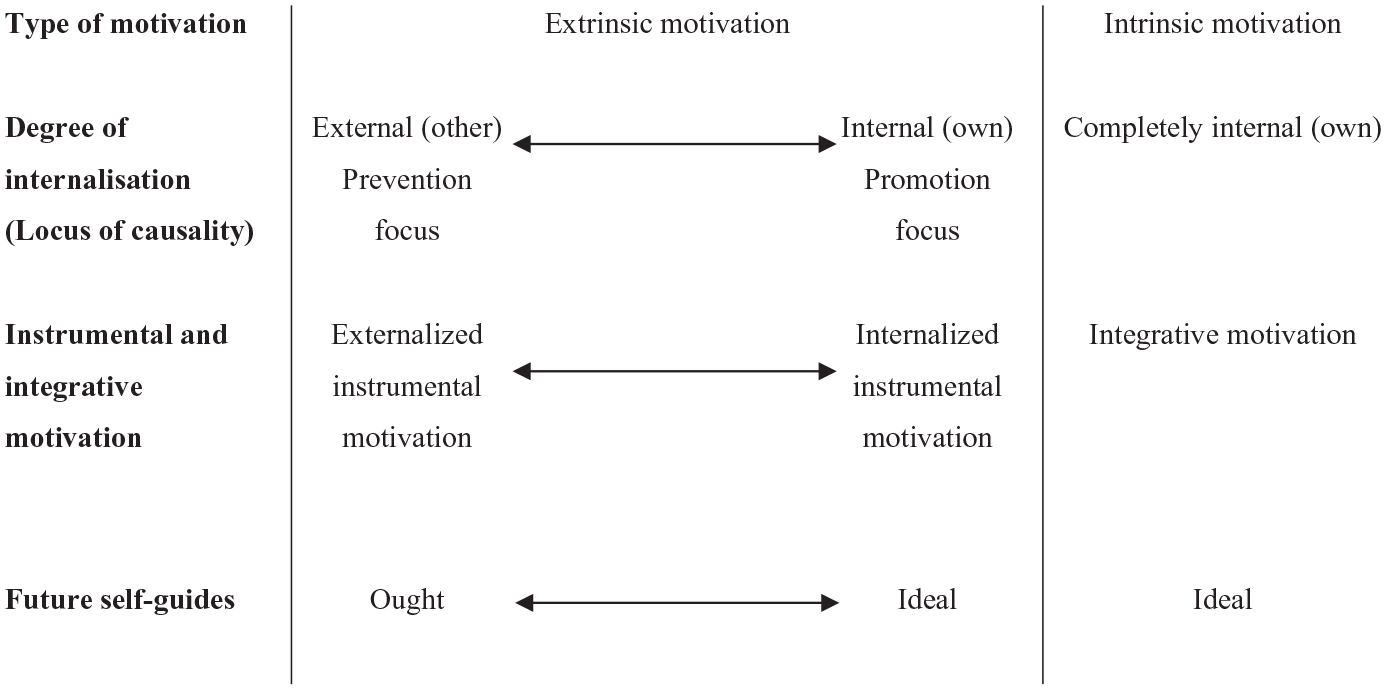
A taxonomy of human motivation and future self-guides.
III Motivation and enjoyment in English private tutoring
Secondary school students enroll in EPT for various reasons, which can reflect their different motivational orientations. These different types of motivation form their ideal L2 self, ought-to L2 self, and L2 learning experience, which might affect whether they enjoy EPT.
1 Ideal L2 self
According to L2MSS and self-determination theory, students with a greater interest in English are expected to enjoy learning English more, compared to other students (Dörnyei, 2009; Noels, 2009; Ryan & Deci, 2017). Students who enjoy L2 learning more than other students do often have a more vivid ideal L2 self-image, which may help them enjoy the extra exposure to English during EPT lessons (Dörnyei, 2009; Nishida, 2013). Students who are interested in the L2 (i.e. intrinsic motivation, Ryan & Deci, 2017) often have sustainable positive emotions during their language learning (Dewaele et al., 2017; Lake, 2013), so they might enjoy learning L2 across contexts, including EPT.
When students want to integrate into an English-speaking community, they often learn English with high integrative motivation (Gardner, 2010), and tend to engage in and enjoy English learning activities with an ideal L2 self, according to L2MSS (Dörnyei, 2009). In this globalized world, such cultures are not necessarily based in English-speaking countries since English is often a lingua franca for authentic communication (Nunan, 2003). As ‘students’ education increasingly opens up their horizon onto the global world beyond China, [it brings] about an increasing appreciation of Global English,’ which exemplifies internalized instrumental motivation (You & Dörnyei, 2016, p. 517). Thus, learners who learn English with the purpose of communicating with speakers of English as a lingua franca in daily life often have an ideal L2 self and enjoy learning English more. In the Hong Kong EPT context, tutors and students call this English use for authentic communication ‘real English’, in contrast to the English used on examinations (Yung, 2015b). Among students receiving EPT, most seek high English examination results, but some Hong Kong students want to learn ‘real English’ for authentic communication, particularly when their schoolteachers do not help them to do so (Yung, 2019). Also, many tutors in cram schools identify themselves not only as examination experts but also as language professionals who can enhance students’ English proficiency (Yung & Yuan, 2020).
When learners internalize this instrumental motivation into their value system, they form an ideal L2 self, according to L2MSS (Dörnyei, 2009). Such internalized instrumental motivation can include the aspiration of becoming a top student via outstanding school results (i.e. enhancing self-esteem), getting a better job in the future (which might entail doing business with foreigners in English, giving a public speech in English) and so on (Dörnyei, 2009). Such instrumental motivation has a promotion focus pertaining to the learner’s personal goals to become successful (Taguchi, Magid, & Papi, 2009).
Considering the three aspects of ideal L2 self in L2MSS (i.e. intrinsic motivation, integrative motivation, and internalized instrumental motivation), we propose the following set of hypotheses:
Hypothesis 1a: Students who like English more than other students do are more likely to enjoy EPT.
Hypothesis 1b: Students who enroll in EPT to learn English for authentic communication are more likely than other students to enjoy EPT.
Hypothesis 1c: Students with greater internalized instrumental motivation (want to be top student or have a better job) than other students are more likely to enjoy EPT.
2 Ought-to L2 self
Learners motivated to learn English via an ought-to L2 self often have higher extrinsic motivation, external instrumentality, or anxiety, according to L2MSS (Dörnyei, 2009; Noels, 2009). Past studies have shown that many students enroll in EPT to attain adequate grades in high-stakes university entrance examinations (e.g. Chung, 2013; Yung, 2015b). Unlike students who are motivated to academically outperform other students at school (i.e. internalized instrumental motivation, e.g. aiming to become top students, with a promotion focus and an ideal L2 self), those motivated by examination grades are usually extrinsically motivated with less internalized instrumentality, thereby showing a stronger ought-to L2 self (Dörnyei, 2009; Ryan & Deci, 2017). In particular, weaker students whose English falls short of the class standard often have higher anxiety and attend EPT courses to avoid the negative consequences of poor performance (Bray, 2009; Yung, 2019). Similarly, when students perceive that studying hard and attending EPT lessons are obligations to fulfill the expectations of others (e.g. parents and schoolteachers), this external instrumental motivation (Carless, 2011; Watkins, 2009) reflects an ought-to L2 self. Moreover, due to low passing rates on high-stakes public examinations and low university admission rates, those who do not receive EPT may feel disadvantaged – especially when many friends and classmates receive EPT – thereby fostering external motivation and peer pressure-driven ought-to L2 selves.
The societal context of a student might affect the relationships described above, according to Hofstede’s cultural values theoretical framework (de Mooij & Hofstede, 2010). In the US and other Western countries, students who are motivated by external goals (e.g. family and other external influences) view learning English as an instrumental means to achieve them (extrinsic motivation) and tend to be less interested in learning English as its own internal goal (intrinsic motivation, Ryan & Deci, 2017). Unlike individualistic, Western countries however, collectivist societies such as Hong Kong and other East Asian countries value group goals over individual goals. Students in these countries are more attentive to other’s concerns and hence are more likely to interpret external influences as caring rather than intrusive, in contrast to students who value autonomy in individualistic societies (Chiu, Chow & McBride-Chang, 2007). Within a caring group that supports one another’s interests, a student is more likely to also be intrinsically motivated (Chiu & McBride-Chang, 2006). Hence, many students in Asia, including those in Hong Kong, have both high extrinsic motivation and high intrinsic motivation, both of which are linked to superior learning outcomes (e.g. Chiu & Chow, 2010; Chiu & Zeng, 2008; d’Ailly, 2003; You & Dörnyei, 2016), and might be linked to L2 enjoyment.
Hypothesis 2: Among East Asian students, those with greater extrinsic motivation (by other people, external standards, grades, fear of disadvantage) are more likely than other students to enjoy EPT.
Tutorial advertisements can also contribute to ought-to L2 selves via extrinsic motivation and learning anxiety (Dörnyei, 2009). Many tutorial companies in Hong Kong promote their courses and market their tutors as examination experts and celebrities (Koh, 2016; Yung & Yuan, 2020). These advertisements typically highlight the importance of good examination results and convey anxiety-provoking messages, such as the low passing rate on public examinations and the small percentage of students admitted to university each year (see, for example, Figure 2). Hence, these advertisements may serve as external sources of motivation that aim to foster students’ extrinsic motivation and anxiety. If tutorial advertisements drive students to subscribe to EPT courses, they are motivated by ought-to L2 selves and thus might enjoy EPT less. Hence, we propose the following.
Hypothesis 3: Students who are more motivated by advertisements to enroll in EPT than other students are less likely to enjoy EPT.

An advertisement of a large tutorial company.
3 L2 learning experience
Students’ different experiences in L2 learning at home, school, or tutorial classes might also affect their enjoyment of EPT, according to L2MSS theory (Dörnyei, 2009). Students from higher socioeconomic status (SES) families can afford more educational resources, such as private tutoring services; in this richer learning environment, children have more learning opportunities and can capitalize on them to learn more (resource provider theory; Chiu & Chow, 2010). Past studies show the importance of how students perceive their family’s financial situation. As students often do not know the actual financial situation of their families, they rely on signals from their parents’ financial behaviors (Ansong et al., 2018). Parents who spend money on educational resources such as tutors highlight their strong financial commitment to their children’s learning and suggest further social rewards and incentives for higher learning outcomes (Chiu & McBride-Chang, 2006). In contrast, children who do not receive educational products or services from their parents might perceive their family as (1) lacking sufficient financial resources for future schooling or (2) placing little value on schooling, both of which can reduce motivation to learn (Ansong et al., 2018). Hence, family environments with more resources that support children’s learning might enhance their enjoyment of learning, whether at school or during tutoring.
Hypothesis 4: Students who perceive superior family finances are more likely to enjoy EPT, compared to other students.
The MOI of a school might influence EPT enjoyment via differences in English competence, instructional familiarity, understanding, or motivation, according to L2MSS theory (Dörnyei, 2009). In Hong Kong, the large majority of students studying the local school curriculum are fluent in Chinese (>90% speak Cantonese) but far fewer are fluent in English, so most tutors use Chinese MOI, even in EPT courses (Yung, 2015b; Yung & Bray, 2017). As students attending Chinese MOI schools often have weaker English competencies than those in English MOI schools (Lo & Lo, 2014), the former are more accustomed to tutors’ instruction in Chinese. Students in Chinese MOI schools are more familiar with Chinese MOI instruction than other students and might understand it more easily or feel more motivated, so they might learn more and enjoy EPT more. Conversely, students in English MOI schools who are less familiar with Chinese MOI might feel less motivated, learn less, and enjoy EPT less than students in Chinese MOI schools.
Hypothesis 5: Students in Chinese MOI schools are more likely than students in English MOI schools to enjoy EPT.
In Hong Kong’s mandatory universal education system (Education Ordinance, 2003), students must attend school, whereas tutorial classes are not required. Schoolteachers and tutors often cover similar academic content in their teaching, so students can readily compare their relative effectiveness. Although students who dislike their teacher cannot easily change teachers, those who dislike their tutor can choose a different tutor, according to rational choice theory (Bray & Kobakhidze, 2015; Kroneberg & Kalter, 2012). Hence, students will often find a tutor that they like more than their teacher. As instructors are central to students’ L2 learning experiences (Dörnyei, 2009), students who perceive their English teacher as teaching badly or like their English tutor more than their English teacher might enjoy EPT more than other students do.
Hypothesis 6a: Students who perceive their teacher as teaching badly are more likely than other students to enjoy EPT.
Hypothesis 6b: Students who like their tutor more than their teacher are more likely than other students to enjoy EPT.
The mode of tutoring can also affect student enjoyment of EPT. Students can attend face-to-face lectures or video-recorded ones, in which students access the tutor’s instruction and teaching materials on television and/or screen (Yung & Bray, 2017). As videos are usually less costly than live lectures, poorer students might be more likely than richer students to utilize video tutoring. Compared to live, three-dimensional tutoring, two-dimensional video tutoring provides less sensory stimulation and less direct human interaction to capture students’ attention (less social presence), which can reduce their motivation to learn (social presence theory, Richardson & Swan, 2003). Although students can ask their own questions during live tutoring, they cannot do so during video tutoring, which can reduce their learning opportunities, autonomy, or learning motivation (Yung, 2015b). Hence, students who attend video tutoring might be less likely than students who attend live tutoring to enjoy EPT.
Hypothesis 7: Students enrolled in video tutoring are less likely than those enrolled in face-to-face tutoring to enjoy EPT.
IV The present study
To address the seven hypotheses above, this exploratory study examines enjoyment of one type of EPT (cram schooling) among students in Hong Kong. By drawing on L2MSS, we examine whether students’ ideal L2 selves (intrinsic, integrative and internalized instrumental motivations), ought-to L2 selves (extrinsic motivation and advertisements) and L2 learning experience (family finances, MOI at school, tutors and mode of tutoring) are linked to EPT enjoyment. Also, past studies suggest that gender and self-efficacy might be linked to enjoyment of language learning, so we also include both in our explanatory model to reduce omitted variable bias (Kennedy, 2008).
V Method
1 Participants and context
This exploratory study is part of a larger, year-long study involving various stakeholders (students, tutors, parents and schoolteachers). As the first author knows one of the owners of a tutorial company, we recruited student customers from that company through convenience sampling. This company, with 16 cram schools, is one of the six leading tutorial companies in Hong Kong (Synovate, 2011; Yung & Yuan, 2020). It offers lecture-style tutoring for a wide range of subjects in both face-to-face and video modes. For EPT, the teaching materials, course outlines, and content in all six tutorial companies are similar to both the Hong Kong curriculum and the standardized public English language examination. Compared to regular English lessons in schools, EPT in cram school has bigger classes and is usually more examination-oriented (Yung, 2019). Teaching is largely tutor-centered, so tutor-student or student-student interaction is minimal. A regular tutorial course runs for the whole academic year. Students attend a tutorial lesson which typically lasts for one hour and 15 minutes once a week. They pay a tuition fee of approximately HKD500 (USD64) for four lessons each month (Yung, 2015b). As lecture-style tutoring is far less expensive than small-group tutoring or one-to-one private tutoring, most parents and students in Hong Kong choose lecture-style tutoring (Zhan et al., 2013). Students can choose their tutor as well as the tutorial mode; video-recorded classes are generally less expensive than face-to-face ones and thus are more popular.
The participants of the current study were 2,216 (1,272 female and 944 male) L2 learners of English in Hong Kong. These participants enrolled in the EPT lecture courses covering the Hong Kong Secondary Six curriculum. Secondary Six students were targeted because they were in their final secondary school year and were preparing for the university entrance examination.
2 The instrument
The survey elicited participants’ reasons for enrolling in EPT courses, their demographic background information, and whether they enjoyed EPT. Some questions were adapted from studies investigating Hong Kong secondary school students’ reasons for receiving private tutoring (Bray & Kwo, 2015; Zhan et al., 2013). Two senior scholars in comparative education and language education reviewed and approved this instrument, and earlier studies showed expected, significant relationships (e.g. family SES and EPT, EPT and student grades, see Yung, 2015a, 2015b; Zhan et al., 2013), all of which support this instrument’s validity. As these participants’ first language was Chinese, the questionnaire was written in Chinese to enhance their understanding of the survey questions.
The survey included a dichotomous question of whether they enjoyed EPT (outcome variable), demographic questions (explanatory variables) and a question about their reasons for participating in EPT with 15 sub-questions (explanatory variables). In this exploratory study examining a broad range of influences on enjoyment of EPT, we deemed broader coverage of diverse aspects to be more important than local precision, so we measured many constructs with only one question each. For each single question, we chose the question that best reflected the underlying construct (Yung, 2015b, 2019), as indicated by the highest factor loading in a factor analysis (Joreskog & Sorbom, 2018). A construct measured with only one question might have greater measurement error than a construct measured with multiple questions. As greater measurement error from a single measure raises the likelihood of non-significant results, we have less confidence in our non-significant results (false negative; Kennedy, 2008), but we retain confidence in our significant results.
Family variables: Students rated their family financial background on a six-point Likert scale of ‘poor’ (1) to ‘rich’ (6).
School variables: School MOI allowed four options: Chinese, English, both, or other.
Gender: Participants were asked for their gender (male or female).
Motivations: Students indicated whether they participated in EPT due to intrinsic motivation (‘because I like English’, responses: yes vs. no). Also, they rated their current English self-efficacy on a six-point Likert scale, from ‘very bad’ (1) to ‘very good’ (6). Using yes versus no responses, students indicated whether they enrolled in EPT because of integrative motivation (‘I think it can let me learn real English’, ‘I can know the culture of other countries’), internalized instrumental motivation ( ‘I can get a better job in the future’, ‘I want to be a top student although my English is not bad’), extrinsic motivation (‘my parents, schoolteacher or people around me want me to’, ‘I think my English is below the standard of my class’, ‘I want to get a higher grade in public exam’, ‘I would be disadvantaged if I didn’t’), ‘advertisements’, ‘my schoolteacher teaches badly’, or ‘I like my tutor more than my schoolteacher’.
Tutoring: Students indicated the number of years in which they did EPT, whether it was online (or face-to-face), and their tutor’s name (Ethan, Ken or Roy, all pseudonyms).
3 Procedure
Prior to data collection, the first author’s affiliated institution granted ethical approval. Informed consent was obtained from the person-in-charge of the tutorial company, the three tutors, and students participating in this study. The questionnaires were distributed to the students enrolled in Secondary Six EPT courses offered by these tutors. They were administered at the end of the first month in the academic year (i.e. September) in the 16 tutorial centers across Hong Kong. In face-to-face live classes, the tutors explained the study to their students and administered the questionnaires. In the video-recorded classes, tutors instructed their teaching assistants to administer the questionnaires. One tutor made a short video explaining the study and played it to his students before the video lesson. Teaching assistants were available to address questions.
4 Data analysis
For discrete outcomes (e.g. enjoyed EPT vs. did not enjoy EPT), ordinary least squares regressions can bias the standard errors, so we used a Logit regression to model them correctly (Kennedy, 2008) via the Eviews statistical software (Startz, 2015). We entered the sets of variables (

The probability of the outcome Enjoy_EPTi of student i is its expected value via the Logit or Probit link function (F) of the overall mean β. First, we entered a family attribute: reported family financial background, which tests Hypothesis 4 (
Then, we added school variables: Chinese MOI, which tests Hypothesis 5 (
An alpha level of .05 was used for all analyses. Testing many hypotheses increases the likelihood that at least one of them incorrectly rejects a null hypothesis (false positive). To reduce the likelihood of false positives, we used the two-stage linear step-up procedure, which outperformed 13 other methods in computer simulations (Benjamini, Krieger, & Yekutieli, 2006). To facilitate reader understanding of the results, we converted the logit regression coefficients to odds ratios (Kennedy, 2008). With 2,216 students, statistical power exceeded 0.99 for an effect size of 0.1 (Konstantopoulos, 2008).
VI Results
1 Summary statistics
Among these 2,216 students, 80% enjoyed EPT lessons. Also, 57% of participants were female, 58% attended Chinese MOI schools (42% English MOI schools), and 57% enrolled in video EPT lessons. These participants averaged less than one year of prior tutoring (M = 0.96 years).
As for the participants’ reasons for subscribing to EPT courses, few were motivated by their ideal L2 selves, as only 14% did so because they liked English, 15% wanted to learn English for authentic communication, 20% wanted to be a top student, and 44% were motivated by better future jobs. Many of these students were motivated by their ought-to L2 selves; notably, 85% sought higher grades, 12% were fulfilling the expectations of others (e.g. parents and teachers), 35% felt that they fell short of classmates’ English standard, and 21% did not want to feel disadvantaged for not attending EPT. Only 5% reported that advertisements influenced their choice. As for L2 learning experience, 22% attended EPT because they perceived that their schoolteachers were teaching badly. Also, 16% liked their tutors more than schoolteachers, and 11% did so because they could choose their tutors but not their schoolteachers. Only 6% were motivated by tutors’ use of Chinese MOI in the lessons; for summary statistics, see Tables 1 and 2.
Summary statistics by variable (n = 2,216).
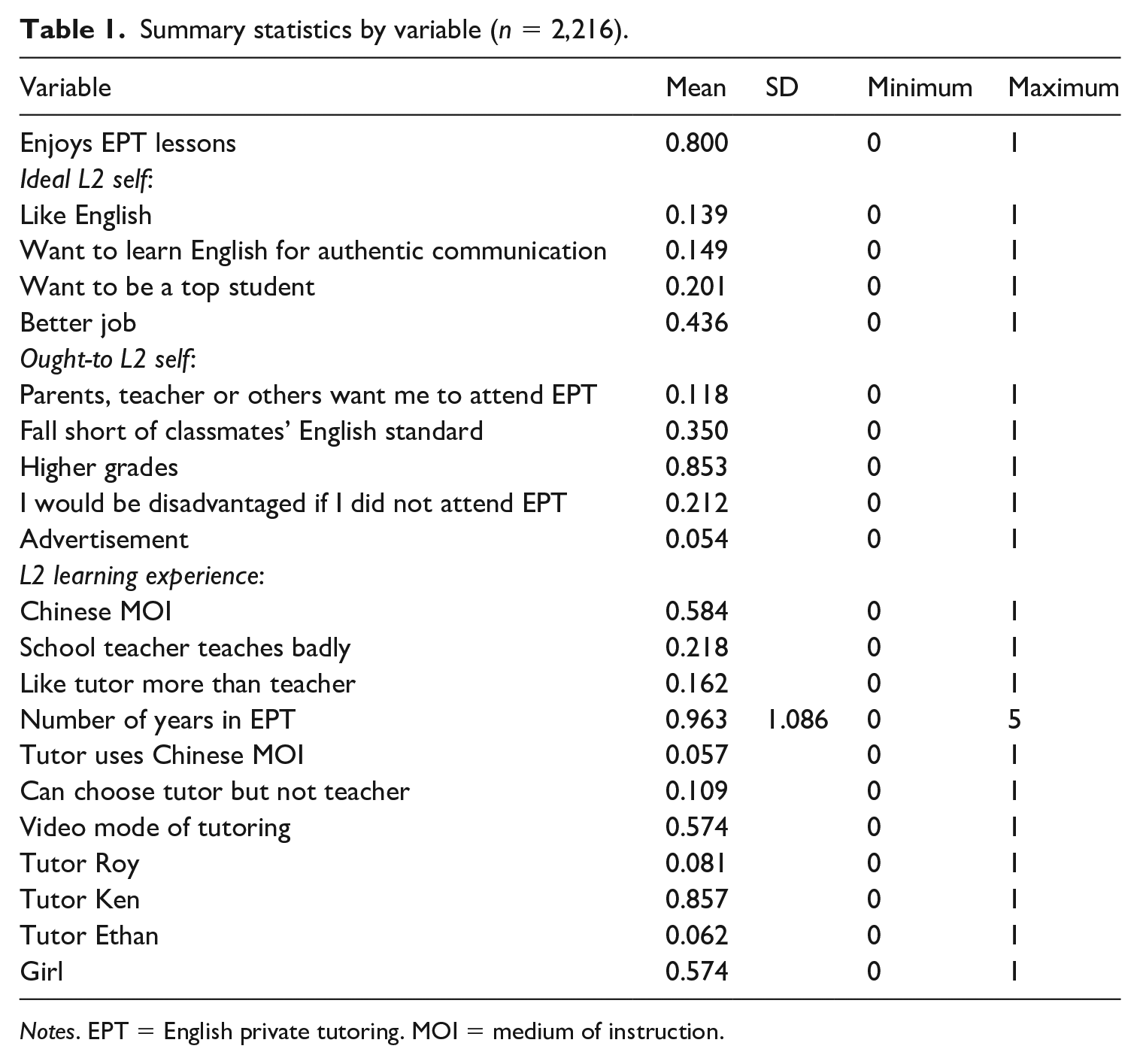
Notes. EPT = English private tutoring. MOI = medium of instruction.
Summary statistics: Percentage responses at each value (n = 2,216).
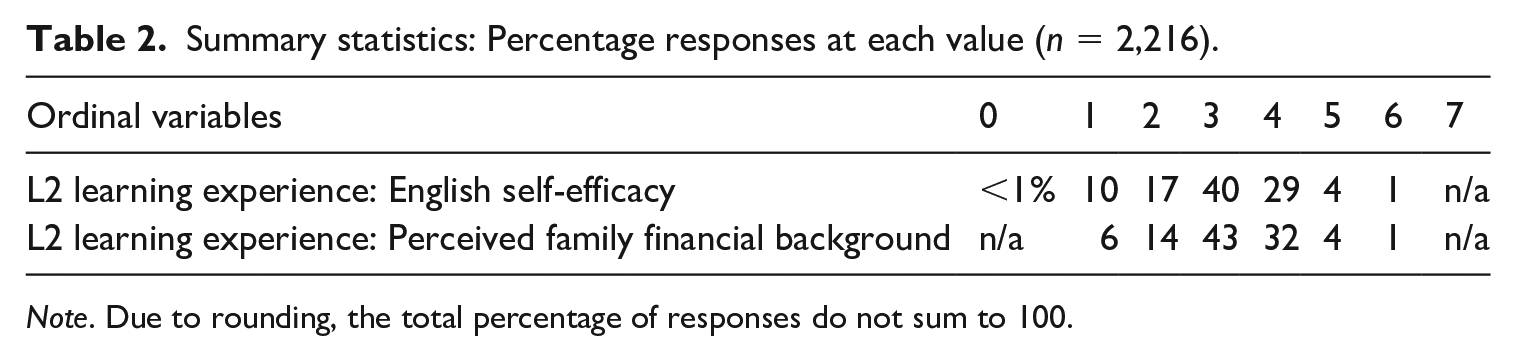
Note. Due to rounding, the total percentage of responses do not sum to 100.
2 Explanatory models
Students’ ideal L2 self, ought-to L2 self, and their L2 learning experience (family, school and tutoring attributes) were linked to EPT enjoyment (see Table 3 and Figure 3). All results discussed below describe first entry into the regression, controlling for all previously included variables. Ancillary regressions and statistical tests are available upon request.
Summary of five logistic regression models modeling student enjoyment of English private tutoring (EPT) lessons: Binary logit regressions (n = 2,216).
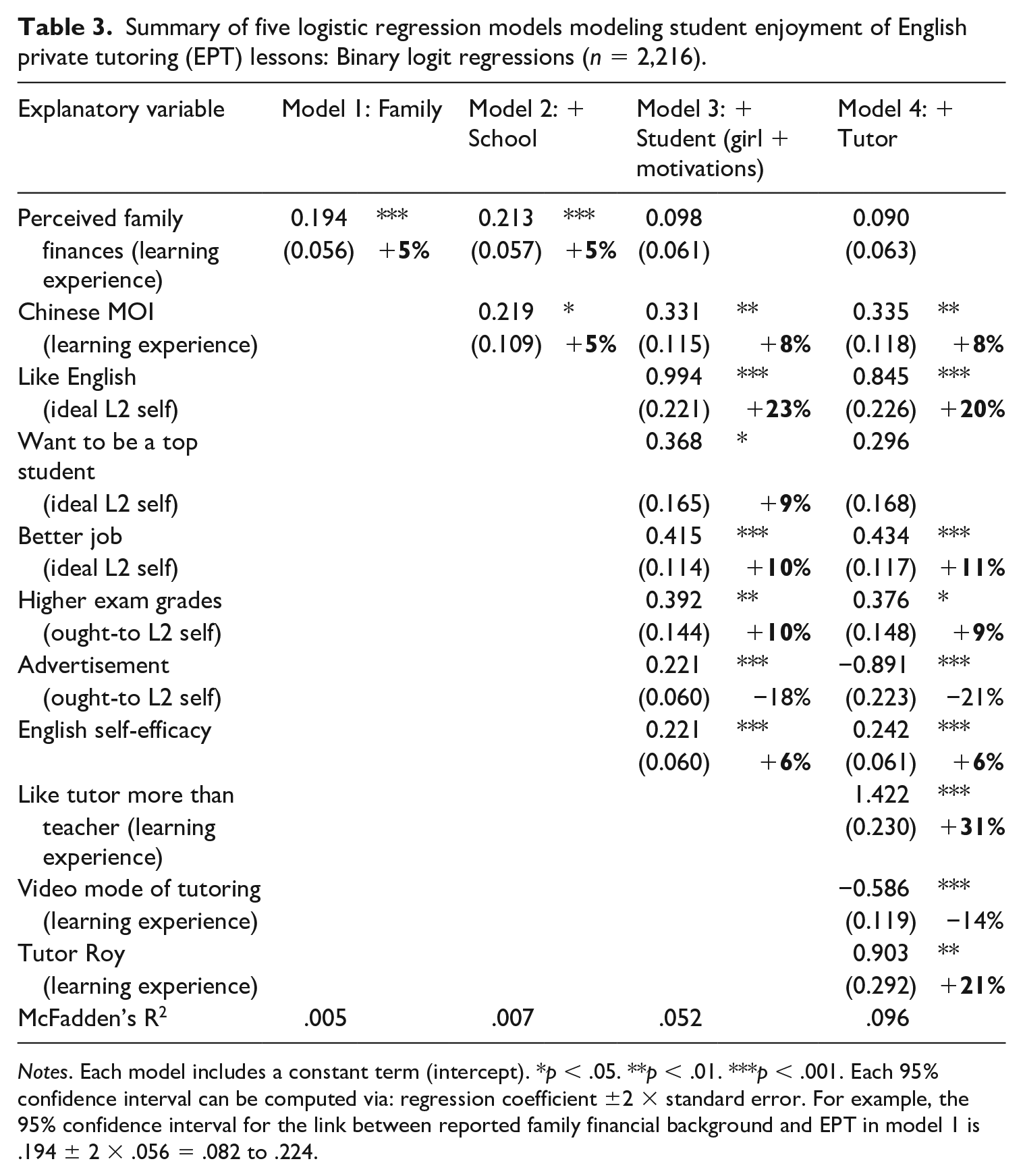
Notes. Each model includes a constant term (intercept). *p < .05. **p < .01. ***p < .001. Each 95% confidence interval can be computed via: regression coefficient ±2 × standard error. For example, the 95% confidence interval for the link between reported family financial background and EPT in model 1 is .194 ± 2 × .056 = .082 to .224.
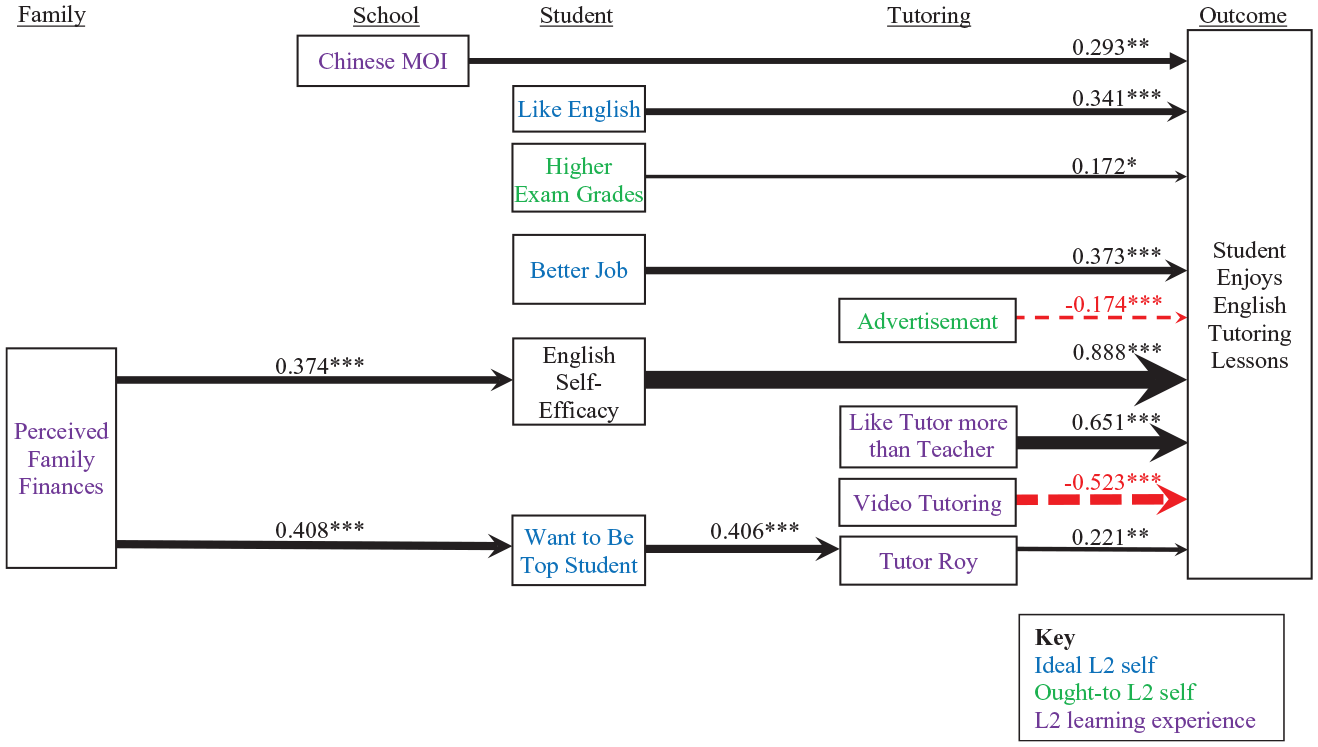
Path diagram of student enjoyment of English private tutoring lessons with standardized coefficients.
a Ideal L2 self
Students who attended EPT because they were interested in English were more likely to enjoy EPT lessons (+23%, supporting Hypothesis 1a; 23% = odds ratio of regression coefficient 0.994; see Table 3, model 3). Also, those who attended EPT because they wanted to be a top student or wanted a better job were also more likely to enjoy EPT lessons (+9%, +10%, respectively, supporting Hypothesis 1c, 9% = odds ratio of 0.368; 10% = odds ratio of 0.415; see Table 3, model 3). However, the results did not support integrative motivation Hypothesis 1b (authentic English communication).
b Ought-to L2 self
Students who wanted higher exam grades were more likely to enjoy EPT lessons (+10%; supporting Hypothesis 2; see Table 3, model 3). In contrast, students influenced by advertisements to attend tutoring were less likely than other students to enjoy EPT lessons (–18%; supporting Hypothesis 3; see Table 3, model 4). Other variables and interactions were not significant. Notably, the results did not support Hypothesis 2 (motivated by parents, etc.; fall short of classmates’ English; or concern about being disadvantaged).
c L2 learning experience
Students with one level higher perceived family financial background were 5% more likely to enjoy EPT lessons, supporting Hypothesis 4 (see Table 3, model 1). Students who attended a Chinese MOI school were 5% more likely to enjoy EPT lessons, supporting Hypothesis 5 (see Table 3, model 2).
The results also showed significant mediation. The link between perceived family financial background and enjoying EPT was mediated 46% by English self-efficacy (z = 4.26; p < .001). Furthermore, the link between perceived family financial background and enjoying EPT was mediated 6% by wanting to be a top student (z = 3.54; p < .001).
Tutoring variables were also linked to enjoying EPT lessons. Students who liked their tutor more than their teacher were more likely than other students to enjoy EPT (+31%, supporting Hypothesis 6b; see Table 3, model 4). However, the results did not support Hypothesis 6a (teacher teaches badly). Students participating in video tutoring were less likely than other students to enjoy EPT lessons (–14%, supporting Hypothesis 7). Also, students whose tutor was Roy were more likely than other students to enjoy EPT lessons (+21%). Moreover, the link between wanting to be a top student and enjoying EPT was mediated 11% by liking the tutor more than the teacher (z = 2.77; p < .01).
VII Discussion
Complementing studies of student enjoyment of English teaching in school classrooms, this exploratory study examined how the ideal and ought-to L2 selves and individual and contextual variables related to L2 learning experience were linked to enjoyment of one type of EPT (cram schooling) among students attending tutorial classes in one company in Hong Kong. Surprisingly, most of these students (80%) enjoyed EPT, even though few of them attended EPT because of their interest in English (14%). Moreover, students with greater intrinsic motivation, internalized instrumental motivation, or extrinsic motivation were more likely to enjoy EPT. However, students who were motivated by advertisements were less likely to enjoy EPT. Furthermore, students who perceived better family finances, attended Chinese MOI schools, liked their tutor more than their teacher, or had a specific tutor were more likely to enjoy EPT. In contrast, students who attended video tutoring were less likely to enjoy EPT. These results shed light on our understanding of how student motivations and contextual variables are linked to enjoyment of EPT.
1 Student motivations
In this study of Hong Kong students, the intrinsic motivation and self-efficacy results are consistent with those in Western countries, but the internalized instrumental and extrinsic motivation results are not. Among these students, those with greater intrinsic motivation than others were more likely to enjoy EPT, consistent with the view that such students possess strong ideal L2 selves and are intrinsically motivated to learn English (Dörnyei, 2009; Nishida, 2013). This result is also consistent with studies showing that students with greater intrinsic motivation are more likely to enjoy learning in school and show superior learning outcomes across academic subjects in most countries (Chiu & Chow, 2010; Chiu & Zeng, 2008).
Unlike the US, students with greater internalized instrumental motivation (e.g. have better job, be a top student) or extrinsic motivation (e.g. higher public exam score) were more likely to enjoy EPT (i.e. possessing both ideal and ought-to L2 selves), consistent with results in 19 other countries (Chiu & Chow, 2010). These results are consistent with the view that students in collectivist societies such as Hong Kong value group goals over individual goals, are more attentive to others’ concerns, and thus tend to interpret them as caring rather than intrusive, in contrast to students in individualistic societies, such as the US, who value autonomy more (Chiu & Zeng, 2008; Chiu et al., 2007; d’Ailly, 2003; You & Dörnyei, 2016).
In contrast, students who were influenced by tutorial advertisements to attend EPT were less likely to enjoy it. These students were likely less interested in attending EPT or appreciated its utility less, but were attracted by the ubiquitous advertisements (Koh, 2016). This result is consistent with the view that such advertisements contribute to learning anxiety (Yung & Yuan, 2020). Such anxiety may contribute to a kind of ought-to L2 self which can hardly be internalized to an ideal L2 self or support EPT enjoyment.
The relationship between integrative motivation (i.e. using English for authentic communication and knowing the culture of other countries) and EPT enjoyment was not significant. This result echoes the findings from previous studies (e.g. Sugita McEown et al., 2014).
2 Family
Several contextual variables in students’ L2 learning experiences were also linked to students’ enjoyment of EPT. Students who perceived their family to be richer than other families were more likely than others to enjoy EPT lessons. This finding is in line with resource provider theory (Chiu & Chow, 2010). High SES families provide more learning resources and social support than low SES families, thereby creating more learning opportunities on which their children can capitalize for superior English learning outcomes (Bai, Chao & Wang, 2019; Chiu & Klassen, 2009) and greater English learning enjoyment. This finding is also consistent with past studies showing that students who were concerned about high tuition fees relative to their parents’ wages were more likely to worry about financially burdening their family, and therefore less likely to enjoy paid EPT (Ansong et al., 2018; Destin, 2017).
Greater perceived family wealth is linked to both high English standards and aiming to be a top student, suggesting that perception of more family financial resources is related to higher expectations. This result is consistent with past studies showing that high SES parents have high status and often serve as role models for their children, so these students often have higher expectations than other students (Lareau, 2011). These students with higher expectations often have higher academic expectations, such as a higher standard of English performance (Gofen, 2009). Moreover, such students often seek to outcompete classmates, with a promotion focus (i.e. ideal L2 self), for example, to be the top student in their class (Bratti, Checchi, & Filippin, 2011).
3 School
Students enrolled in Chinese MOI schools were more likely than other students to enjoy EPT lessons. This result is consistent with the views that students in Chinese MOI schools with typically poorer English skills than students in English MOI schools (Lo & Lo, 2014) were more familiar with the Chinese MOI tutoring, understand it more easily, or feel more motivated. Although local students who study in English MOI schools can understand Chinese, they may not be as familiar with learning English in Chinese MOI. For these reasons, these Chinese MOI students might have enjoyed EPT more than English MOI students did.
4 Tutoring
Tutor versus teacher preference, specific tutor, and video tutoring were linked to students’ EPT enjoyment. Students who enrolled in EPT because they enjoyed their tutors more than their English teachers at school were more likely to enjoy EPT. This finding further reinforces the view that instructors (whether teacher or tutor) play an important role in students’ learning enjoyment. The teacher versus tutor comparison result might also reflect a conflict between mainstream schooling and private tutoring, especially when EPT follows the curriculum in mainstream schools (shadowing; Bray, 2009). Future studies can test whether students who compare tutors with their schoolteachers and enjoy EPT more than their school lessons are less motivated than others to learn at school.
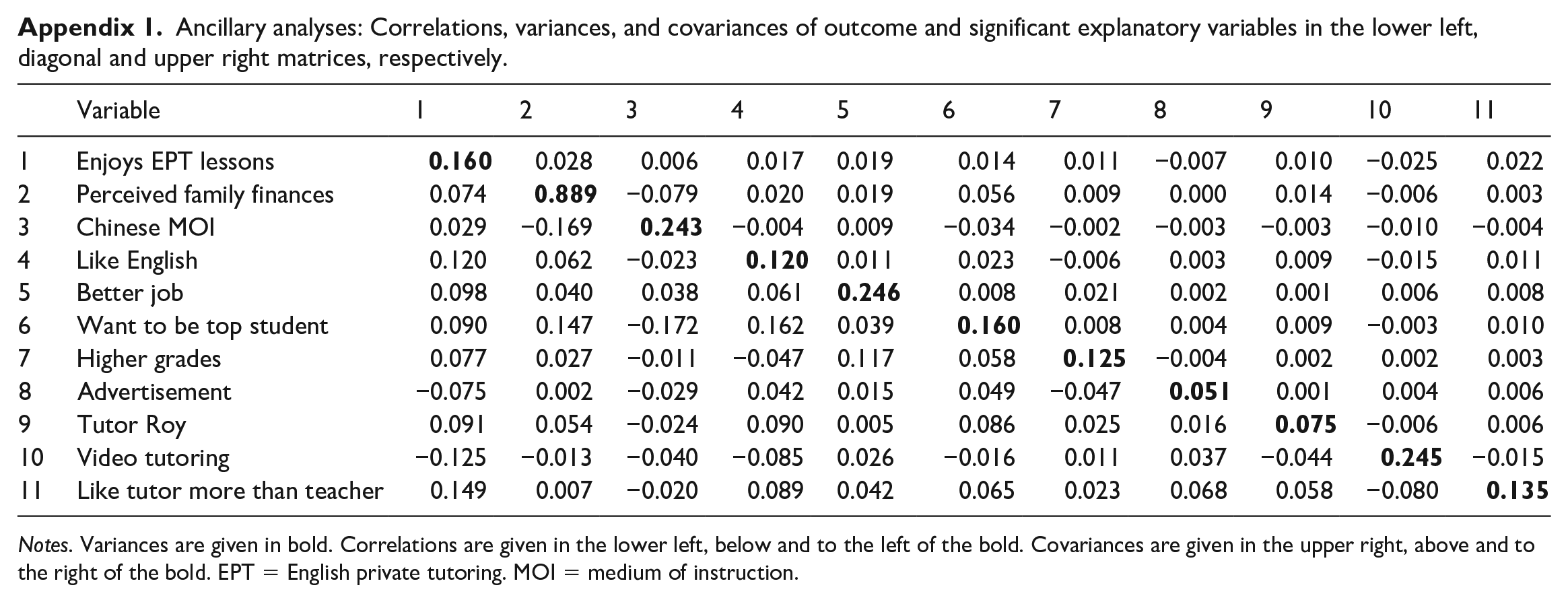
These results also showed that students with higher expectations, specifically aiming to be a top student, often liked their tutor more than their teacher. This result is consistent with past studies showing that students with higher expectations of themselves also have higher expectations of their instructors (Lareau, 2011). In this tutorial context, we speculate that these students with high expectations might exert more effort into successfully finding a superior tutor; indeed, these students were slightly more likely to have the tutor Roy (r = .09), which was correlated with EPT enjoyment (see correlation–covariance matrix in Appendix 1). Future research can further examine the underlying mechanisms for the above phenomena.
Moreover, our finding shows that students in one tutor’s (Roy’s) classes enjoyed EPT lessons more than those in other tutors’ classes. This result highlights the importance of specific tutors. Like effective teachers (e.g. Dewaele et al., 2017; Saito et al., 2018), tutors can have superior teaching strategies and styles, which can stimulate students’ enjoyment of EPT. Hence, our finding extends this relationship between instructors and student intrinsic motivation in schools in past studies, to contexts outside of school, tutorial classes in this case.
Additionally, students enrolled in face-to-face live tutorial classes enjoyed EPT more than those in video tutorial classes. This result is consistent with those of past studies showing that video tutoring provides less sensory stimulation and direct human interaction than face-to-face tutoring (less social presence), which reduces student’s motivation to learn (e.g. Richardson & Swan, 2003).
VIII Conclusions and implications
Grounded in the L2MSS theoretical framework in combination with cultural values theory, resource provider theory, rational choice theory, and social presence theory; this study explores whether secondary students enjoy EPT and the factors that influence their EPT enjoyment. The results show that most of these students (80%) enjoyed EPT. They were more likely to enjoy it if they perceived more financial resources in their families, attended schools taught in Chinese, had internalized instrumental goals, liked English, were not influenced by advertisements to attend EPT, attended face-to-face tutoring rather than video tutoring, had a specific tutor, or liked their EPT tutor more than their English teacher. Given the global popularity of EPT, the dearth of L2 research on positive emotions compared to negative emotions, and the potential of EPT for superior engagement in L2 activities, learning outcomes, social support, and individual confidence, this exploratory study contributes to the expanding literature in shadow education and SLA research. Specifically, these findings contribute toward a comprehensive theory of EPT by showing how several diverse factors might influence EPT enjoyment, which can be further tested in future studies.
This study suggests three possible theoretical implications. Dewaele and MacIntyre (2016, p. 216) argue that ‘the conceptualization of positive emotion in SLA has lagged behind theoretical developments in other areas’ such as motivation and learner autonomy. This study therefore contributes to SLA research by illuminating the antecedents of student enjoyment in an out-of-school L2 learning activity prevalent in many contexts of English as a second language (ESL) and English as a foreign language (EFL).
This study has also expanded the use of L2MSS in SLA research. Our results show how students’ ideal L2 selves, ought-to L2 selves and L2 learning experiences (e.g. Hong Kong, family, school, tutoring) can help explain EPT enjoyment, suggesting the importance of including both motivations and contexts in a comprehensive theory of L2 motivation such as L2MSS. Moreover, many results of the current study echo those from empirical studies of mainstream schooling, suggesting that theories such as the socio-educational model (Gardner, 2010), goal theory (Covington, 2000), self-determination theory (Ryan & Deci, 2017), resource provider theory (Chiu & Chow, 2010) and L2MSS (Dörnyei, 2009) apply to both school and tutoring contexts. Also, including these significant explanatory variables in future studies can reduce omitted variable bias in the results of the statistical analyses (Kennedy, 2008).
The link between the perception of family’s superior financial resources and EPT enjoyment raises the issue of whether perceived financial resources might psychologically influence students’ L2 learning experience. This theoretical link is consistent with past studies showing that inadequate financial resources can place a psychological burden on students and reduce their intrinsic motivation and enjoyment of learning (Ansong et al., 2018; Destin, 2017). Future studies can examine the extent to which educational inequalities created by learning activities involving family expenditures such as private tutoring might account for this phenomenon.
Our findings suggest that tutoring services differ significantly with respect to tutoring mode and the specific tutor. Although video tutoring costs less than face-to-face tutoring, the participants in this study enjoyed the latter more. Also, study participants whose tutor was Roy were more likely than other participants to enjoy EPT. In this regard, future studies may compare the features and quality of different modes of tutoring, and explore how preferred tutors might train their less preferred colleagues in tutorial companies in order to increase their likeability.
As these students with greater interest in a subject than others often learn more of it and outperform others on examinations, tutors who raise their tutees interest in English might yield superior exam performance. Furthermore, although students in ESL/EFL contexts are typically motivated strongly by ought-to L2 selves and enroll in EPT mainly to pass or do well in their examinations (You & Dörnyei, 2016; Yung, 2019), many also demand interesting lessons from their tutors and schoolteachers (Yung, 2020). Further studies can therefore explore which motivation-enhancing activities tutors (and schoolteachers) might employ to increase students’ interest in learning English and enhance their ideal L2 selves (Saito et al., 2018), ultimately increasing their L2 enjoyment through multiple future L2 selves and L2 learning experience. This is particularly important for tutors because they need to attract new students rand retain existing tutees to sustain their business.
As these students who were influenced by tutorial advertisements enjoyed EPT courses less, future studies can test whether parent-child discussions about different reasons for participating in tutoring might enhance a child’s motivation and help them enjoy EPT more. As past studies of tutorial advertisements (e.g. Kozar, 2015; Yung & Yuan, 2020) mostly focused on their genre features and the projected images of tutors, determining the impact of tutorial advertisements on student EPT enrollment requires further studies.
This exploratory study has a limited sample and limited measures. As this sample only includes students in their last year of secondary school from one company in one city, future studies can collect data from students of different ages, attending tutorials in multiple companies, and living in diverse geographical regions. As each construct is measured with only one question, future studies can use multiple measures and multilevel structural equation modeling to reduce measurement error (greater measurement error from a single measure raises the likelihood of false negatives, but we retain confidence in our significant results, Kennedy, 2008).
Footnotes
Appendix
Ancillary analyses: Correlations, variances, and covariances of outcome and significant explanatory variables in the lower left, diagonal and upper right matrices, respectively.
| Variable | 1 | 2 | 3 | 4 | 5 | 6 | 7 | 8 | 9 | 10 | 11 | |
|---|---|---|---|---|---|---|---|---|---|---|---|---|
| 1 | Enjoys EPT lessons |
|
0.028 | 0.006 | 0.017 | 0.019 | 0.014 | 0.011 | −0.007 | 0.010 | −0.025 | 0.022 |
| 2 | Perceived family finances | 0.074 |
|
−0.079 | 0.020 | 0.019 | 0.056 | 0.009 | 0.000 | 0.014 | −0.006 | 0.003 |
| 3 | Chinese MOI | 0.029 | −0.169 |
|
−0.004 | 0.009 | −0.034 | −0.002 | −0.003 | −0.003 | −0.010 | −0.004 |
| 4 | Like English | 0.120 | 0.062 | −0.023 |
|
0.011 | 0.023 | −0.006 | 0.003 | 0.009 | −0.015 | 0.011 |
| 5 | Better job | 0.098 | 0.040 | 0.038 | 0.061 |
|
0.008 | 0.021 | 0.002 | 0.001 | 0.006 | 0.008 |
| 6 | Want to be top student | 0.090 | 0.147 | −0.172 | 0.162 | 0.039 |
|
0.008 | 0.004 | 0.009 | −0.003 | 0.010 |
| 7 | Higher grades | 0.077 | 0.027 | −0.011 | −0.047 | 0.117 | 0.058 |
|
−0.004 | 0.002 | 0.002 | 0.003 |
| 8 | Advertisement | −0.075 | 0.002 | −0.029 | 0.042 | 0.015 | 0.049 | −0.047 |
|
0.001 | 0.004 | 0.006 |
| 9 | Tutor Roy | 0.091 | 0.054 | −0.024 | 0.090 | 0.005 | 0.086 | 0.025 | 0.016 |
|
−0.006 | 0.006 |
| 10 | Video tutoring | −0.125 | −0.013 | −0.040 | −0.085 | 0.026 | −0.016 | 0.011 | 0.037 | −0.044 |
|
−0.015 |
| 11 | Like tutor more than teacher | 0.149 | 0.007 | −0.020 | 0.089 | 0.042 | 0.065 | 0.023 | 0.068 | 0.058 | −0.080 |
|
Notes. Variances are given in bold. Correlations are given in the lower left, below and to the left of the bold. Covariances are given in the upper right, above and to the right of the bold. EPT = English private tutoring. MOI = medium of instruction.
Funding
The author(s) received no financial support for the research, authorship, and/or publication of this article.
