



Abstract
Guided by sociocultural theory, this single-case narrative inquiry views language assessment literacy development as a process of language assessment concept formation and examines how a teacher’s language assessment concepts were formed, what sociocultural elements mediated those concept formations, and how the focal teacher emotionally experienced those concept formations. To fulfill these aims, approximately 15 hours of audio and video data were collected from a novice Vietnamese teacher of English as a foreign language via interviews, classroom observations, and verbal reports. The data were transformed into narrative vignettes which were then subject to directed content analysis guided by sociocultural theory’s notions of concept and perezhivanie. The study found that teacher assessment concept formation was a long, complex, and ongoing process involving various sociocultural mediators. Notably, the mediation of sociocultural factors was not direct but refracted through the participant’s evolving perezhivanie. Furthermore, empirical concepts derived from the focal teacher’s practical assessment experiences played a more significant role than scientific concepts originating from formal instruction and academic literature. Finally, the study has demonstrated the role of emotions in mediating assessment concept formations. Drawing on these findings, the study argues that language teacher education programs need to integrate best language assessment practices, leverage student teachers’ empirical experiences, and utilize teacher educators’ responsive mediation to support teacher language assessment literacy development.
Keywords
I Introduction
Language teachers often dedicate substantial time and effort to assessment (Cheng & Fox, 2017). This partly explains why teacher language assessment literacy (LAL), often defined as teachers’ assessment knowledge, skills, and understanding of underlying assessment principles (Fulcher, 2012; J. Lee & Butler, 2020), has received increased scholarly interest (Chang et al., 2024; Gan & Lam, 2022, 2024). The expanding literature on this topic has revealed generally inadequate levels of teacher LAL across contexts (Chang et al., 2024; Crusan et al., 2016; Gan & Lam, 2024; Lam, 2019; Sun & Zhang, 2022; Vogt & Tsagari, 2014) and the poor quality of assessment education (Gan & Lam, 2024; Lam, 2015; Tsagari, 2016). Nevertheless, only a small number of studies have investigated the complex developmental trajectories of teacher LAL (Gan & Lam, 2024; Xu, 2017; Yan & Fan, 2021; Yan et al., 2018) over an extended timeframe, particularly from the perspective of teachers themselves (Scarino, 2013). Moreover, although the existing literature has revealed the influence of experience, context, self-reflection, apprenticeship, theoretical knowledge, and personal beliefs on teacher LAL development (Chang et al., 2024; Gan & Lam, 2024; Kremmel & Harding, 2020; Levi & Inbar-Lourie, 2020; Scarino, 2013; Vogt & Tsagari, 2014), few studies have examined the interactions of these factors (e.g., how context and experience jointly shape teacher LAL development) (Yan & Fan, 2021; Yan et al., 2018). Given the state of the teacher LAL literature, this paper argues that further research into teacher LAL developmental trajectories and the interplay of influencing factors is essential because such research could inform more effective assessment training and education programs (Scarino, 2013; Taylor, 2013; Yan & Fan, 2021).
This study, in response to the above-identified needs, aims to examine the process of LAL development from the emic perspective of a novice Vietnamese English-as-a-foreign-language (EFL) teacher called Phan. The narrative inquiry research design has been adopted to explore the focal participant’s LAL development over an extended period and her subjective experiencing of this process. Additionally, the study has employed a sociocultural theoretical framework inspired by Vygotsky’s ideas, particularly his writings on perezhivanie (lived experience) and concept, to analyze the complex interplay of theory, experience, and context in teacher LAL development. To lay the foundation for the current study, a brief review of teacher LAL studies will be presented in the next section.
II Literature review
Numerous attempts have been made to define LAL (e.g., Fulcher, 2012; Inbar-Lourie, 2008; Kremmel & Harding, 2020; J. Lee & Butler, 2020; Levi & Inbar-Lourie, 2020; Scarino, 2013; Taylor, 2013). Based on the existing LAL definitions, this study views LAL as a complex, multidimensional construct that includes general assessment and language assessment competencies (Inbar-Lourie, 2008), disciplinary and interpretive knowledge (Scarino, 2013), theoretical understanding, and practical skills, as well as an awareness of the social impact of assessment (Fang & Yu, 2023; Kremmel & Harding, 2020; J. Lee & Butler, 2020).
Research on teacher LAL has primarily focused on investigating the LAL levels of teachers, the quality of language assessment training courses, and teachers’ training needs. Regarding the first area, numerous studies have revealed the limited LAL levels of teachers (e.g., Chang et al., 2024; Lan & Fan, 2019; Sun & Zhang, 2022; Vogt & Tsagari, 2014). Concerning the quality of language assessment courses, teachers were found to receive inadequate pre-service training for their current jobs (Chang et al., 2024; Vogt & Tsagari, 2014). Specifically, pre-service assessment training tended to be too theoretical (Lam, 2015) and did not sufficiently address topics such as alternative assessment and assessment for learning (Tsagari, 2016), portfolio-based assessment, and relating classroom assessment to international frameworks (Chang et al., 2024). As for teachers’ needs, they were generally enthusiastic about receiving more assessment training, but this must be of practical use (Fulcher, 2012; Yan et al., 2018) and relevant to their instructional contexts (Vogt et al., 2020). Nevertheless, there have been surprisingly few studies that examine the process of teacher LAL development (Gan & Lam, 2022, 2024) despite the repeated acknowledgment of the developmental nature of LAL (Fang & Yu, 2023; Levi & Inbar-Lourie, 2020). From the few existing publications on LAL development, there have emerged interesting findings about the developmental pathways of teacher LAL and the sociocultural factors involved.
1 Developmental trajectories of teacher LAL
It has been argued that LAL development does not simply involve acquiring assessment knowledge and skills but is a dynamic process (Yan & Fan, 2021) lasting the whole professional life (Inbar-Lourie, 2008).
The complexities of this process have been examined by Levi and Inbar-Lourie (2020), Harding and Brunfaut (2020), Xu (2017), Yan and Fan (2021), and most recently by Gan and Lam (2024). Whereas Levi and Inbar-Lourie (2020) restricted their investigation of teacher LAL development within an assessment course, Harding and Brunfaut (2020) offered a six-year account of teacher LAL developments through narrative inquiry and positioning analysis. Nevertheless, as the authors have acknowledged, their study could not offer a detailed description of changes in teacher LAL and the underlying factors (Harding & Brunfaut, 2020). Moreover, issues such as whether LAL developments occur in stages and how these stages are related have not been tackled by Harding and Brunfaut (2020).
These unanswered questions have been addressed by Xu (2017), who examined the developmental pathways in the classroom assessment literacy of four novice EFL teachers in China over 3 years. This study has uncovered three distinct phases in LAL development, with teachers moving from simply acquiring practical assessment techniques to gaining an awareness of the teaching–assessment connection and finally mastering the skill of conducting assessments on the fly for immediate instructional improvement. Nevertheless, this three-phase model may give the impression that this process unfolds linearly and smoothly as opposed to recent arguments about its complexities (Scarino, 2013).
Meanwhile, while acknowledging the idiosyncratic nature of LAL development, Yan and Fan (2021) observed common patterns among their participating teachers and proposed a “bottom-up, iterative” model (p. 238) whereby teachers become more assessment-literate by drawing on local resources to solve local assessment matters. Although Yan and Fan’s model (2021) is indeed innovative and sophisticated, its representation of LAL development as “bottom-up” (Yan & Fan, 2021, p. 238) may suggest that LAL development is a unidirectional process (which might not be the authors’ intention).
More recently, Gan and Lam (2024) investigated how a novice university English teacher, Rachel, developed her LAL over one academic year. Although Gan and Lam (2024) offer a vivid description of Rachel’s steady progress from simply imitating her former teachers’ practices to growing her conceptual knowledge and finally initiating her assessment innovations, their depiction of LAL development has yet to overcome the issues with Xu’s (2017) and Yan and Fan’s (2021) models. In other words, Gan and Lam’s (2024) description may (contrary to the authors’ intentions) convey that LAL development overall occurred smoothly, linearly, and unidirectionally.
2 Sociocultural factors influencing teacher LAL development
Various studies have highlighted the sociocultural nature of teacher LAL development and demonstrated the influence of factors such as context, experience, self-reflection, apprenticeship, theoretical knowledge, and personal beliefs (e.g., Chang et al., 2024; Gan & Lam, 2024; Hill & Ducasse, 2022; Kremmel & Harding, 2020; Levi & Inbar-Lourie, 2020; Scarino, 2013; Yan & Fan, 2021).
The influence of the social context on LAL development has been well-recognized (Fang & Yu, 2023; Gan & Lam, 2024; Levi & Inbar-Lourie, 2020; Vogt & Tsagari, 2014). As an example, East Asian teachers have been found to prioritize knowledge and skills related to high-stakes standardized testing in their LAL development because of their exam-oriented educational systems (Fang & Yu, 2023; Gan & Lam, 2024). However, there are noticeable differences in how context has been operationalized in the literature. For instance, Levi and Inbar-Lourie (2020) refer to “assessment ecology” (p. 179) when explaining the impact of high-stakes exams on teacher-generated tests and performance tasks, whereas Yan et al. (2018) define context as “larger educational, social, cultural, political, and historical factors that collectively form the assessment culture in a particular context” (p. 159). Meanwhile, Vogt et al. (2020), after critiquing the overlapping categorization of context in Yan et al. (2018), have proposed a three-level framework consisting of “macrolevel (national/regional),” “meso-level (institution),” and “micro-level (classroom)” (p. 390).
Experience, represented as a form of practical knowledge (Vogt & Tsagari, 2014) derived from social interactions and cultural contexts, is another contributing factor frequently mentioned in the LAL development literature. However, it remains debatable whether more experienced teachers are more assessment-literate than their less experienced counterparts. For example, Chang et al. (2024) have found no significant relationship between years of teaching experience and Taiwanese high school teachers’ LAL test results. Interestingly, Sun and Zhang (2022) have discovered that what matters more to LAL development is language assessment experiences rather than general teaching experience. It is also worth noting that many LAL studies lack a clear articulation of what experience constitutes. A notable exception is Yan et al. (2018), who operationalize experience as “individual teachers’ background, training, and experience in language teaching and assessment (e.g., prior experience in assessment training and item writing)” (p. 159). However, Yan’s et al. (2018) placement of both teachers’ hands-on learning and formal education under the same category of experience may risk blurring the important distinction between teachers’ interpretive and theoretical knowledge (Scarino, 2013).
In addition to context and experience, some LAL studies underscore the role of social interactions and the role of teachers as agentive and reflective beings within their professional communities. For instance, Yan and Fan (2021), along with Harding and Brunfaut (2020), illustrate how novice teachers can effectively develop their LAL through collaborations with experienced language testing experts. Moreover, teachers’ capacity to reflect critically on their experiences is considered a core component of assessment literacy by Cowie and Cooper (2017), Scarino (2013), and Willis et al. (2013). Gan and Lam (2024) further corroborate this view, viewing teacher agency and reflection as crucial contributors to LAL development.
Nonetheless, few studies have accounted for the interplay of different LAL development mediators. A pioneering attempt to examine the interaction between context and experience is Yan et al. (2018), who have found that teachers’ experiences mediate the influence of context and give rise to their LAL. Likewise, the interaction of interpretive and theoretical knowledge, despite both being considered essential LAL components (Kremmel & Harding, 2020; Taylor, 2013), is also under-researched. One standout example is Scarino (2013), who argues that theoretical knowledge and personal beliefs do not exist as two divisible components but are tightly integrated in teacher LAL.
Another notable gap in the literature is the limited attention to the role of emotions in teacher LAL development, despite the growing recognition of the affective dimension in the broader field of language teaching and learning (De Costa et al., 2019). This does not mean that emotions are entirely absent from accounts of teacher LAL development. In fact, Harding and Brunfaut (2020) describe their participants’ “sense of shared enthusiasm at the beginning of the project” and “sense of frustration with barriers” (p. 78). Therefore, it would be more accurate to argue that there has been a paucity of research that systematically explores the role of emotions in teacher LAL development.
A plausible approach to address the aforementioned gaps, I would argue, is to ground this teacher LAL development study in sociocultural theory (SCT), which offers sophisticated analytical tools to account for the integration of interpretive and theoretical knowledge, and the interplay of context and experience, as well as the affective dimension in teacher LAL development. A brief introduction to this theoretical framework is provided in the next section.
III Theoretical framework
As previously indicated, this study has adopted SCT, which draws on the works of Vygotsky, who views higher mental functions not simply as the result of cognitive processes within the brain but instead as “the internalized result of social interactions” (Vygotsky, 1981, p. 147). Moreover, the internalization of social interactions is mediated by artefacts, both physical and symbolic (Vygotsky, 1978). Mediation is a core concept in SCT and can be understood as the “involvement of a third factor (mediator) into the interaction between two objects, events, or persons” and even “between concepts” (Kozulin, 2018, p. 23). Although Vygotsky (1978) divides the mediator into physical tools and symbolic signs, the boundary between physical tools and symbolic signs may not always be clear-cut (Kozulin, 2018). Given this, most contemporary SCT studies often opt for more generic terms such as “mediators” or “mediational means.” Likewise, this study will refer to objects, activities, and people that contribute to the focal teacher’s LAL development collectively as mediational means or mediators.
Although Vygotsky frequently referred to children in his writings due to his specialization in child psychology, he also sought to develop robust methodological approaches for general psychological research. Consequently, like Lantolf and Swain (2019), I argue that SCT can be used to analyze both children’s and adults’ mental development, including teacher LAL development. Additionally, SCT comprises numerous analytical tools, many of which have not yet been fully developed (Kozulin, 1995). As a result, SCT-informed researchers are often required to select the SCT analytical tools most pertinent to their studies and then decipher the divergent and even contested interpretations of those tools. For this study, concept and perezhivanie have been selected to analyze the synergy of interpretive and theoretical knowledge in teacher LAL and the individual–social environment and emotion–cognition interactions respectively. More information about these two SCT analytical tools is presented below.
1 Concept
One SCT analytical tool relevant to this project is concept, which is “a complex and genuine act of thought that cannot be taught by drilling” (Vygotsky, 1986, p. 149). For Vygotsky (1986), concepts are word meanings and should not be confused with words which are their verbal representations, although words do play the crucial role of mediating the performance of concepts. One key feature of concepts is that they exist in a system consisting of “higher” and “lower” concepts (Vygotsky, 1986, p. 202). Developing this Vygotskian idea further, Esteve et al. (2021) categorize concepts into superordinate and subordinate ones according to “their greater or lesser extension and level of abstraction” with “superordinate core concepts embed[ding] related subordinate core concepts, which, in turn, consist of hierarchically lower elements” (p. 18).
A concept in SCT can be divided into an empirical or scientific concept, depending on whether it is formed empirically (i.e., based on a person’s empirical experiences) or theoretically (i.e., via formal instruction or disciplinary knowledge) (Kozulin, 1995). Although empirical concepts (also known as spontaneous or everyday concepts) are “saturated with experience” (Vygotsky, 1986, p. 193), they cannot be used “freely and voluntarily” and to “form abstractions” (pp. 148–149). By contrast, scientific concepts (also known as academic or non-spontaneous concepts) are “conscious and deliberate” (Vygotsky, 1986, p. 194), yet their weaknesses include “excessive abstractness and detachment from reality” (pp. 148–149). Nevertheless, empirical and scientific concepts are “related and constantly influence each other” and exist as “parts of a single process: the development of concept formation” (Vygotsky, 1986, p. 157). As such, Vygotsky’s (1986) notion of concept, particularly his view on the dialectical relationship between empirical and scientific concepts, is suited to analyzing the synergy of interpretive and theoretical knowledge in teacher LAL (Kremmel & Harding, 2020; Scarino, 2013; Taylor, 2013).
For this study, Vygotsky’s (1986) notion of concept implies that teacher LAL development could be reconceptualized as a sociocultural process of language assessment concept formation. Although a similar reconceptualization of LAL development has been adopted by Kao (2023), there are two key differences between this paper and Kao (2023). First, whereas this paper aims to understand this process, Kao (2023) takes a more interventionist approach and investigates the potential of concept-based instruction in promoting teacher LAL. Second, whereas Kao (2023) focuses only on the cognitive side of LAL development and makes little reference to the role of context in this process, this study examines both the affective and intellectual dimensions of LAL development as well as the individual–social environment interaction. This has been possible thanks to the study’s utilization of Vygotsky’s perezhivanie, which will be elaborated on in the next section.
2 Perezhivanie
Perezhivanie (a Russian term often translated as lived experience) has been a source of increased interest and debate among SCT scholars (Veresov & Fleer, 2016).
There have been two distinct approaches to interpreting perezhivanie. On the one hand, Blunden (2016), starting with the etymology of the term (pere-: over, zhivat: to live), takes a phenomenological approach and argues that perezhivanie (plural perezhivaniya) involves both an experience and the “working over” or “processing” of the experience (p. 277). On the other hand, Veresov and Fleer (2016) and Veresov and Mok (2018) focus more on perezhivanie as a unit of analysis to explore how the environment affects children’s psychological development. Since this study aims to reveal the mediators of teacher LAL development, including experiential and contextual factors, it has primarily adopted the latter view of perezhivanie—that is, as a unit of analysis for the influence of the environment on teacher LAL development. Two important features of this special unit of analysis are regularly mentioned in the literature. First, perezhivanie acts as “a refracting prism” via which the social environment influences an individual’s development (Veresov & Fleer, 2016, p. 325). As Vygotsky (1994, p. 340) puts it,
it is not any of the factors in themselves (if taken without reference to the child) which determines how they will influence the future course of his development, but the same factors refracted through the prism of the child’s perezhivanie.
Notably, this mediation is a refraction rather than a reflection (i.e., an exact copy) (Veresov & Mok, 2018), and the prism itself is also a dynamic, constantly evolving entity (Golombek & Doran, 2014). Second, also related to its first feature as the prism between the environment and the individual, perezhivanie is a unit where both individual and contextual features are represented (Vygotsky, 1994). Thus, perezhivanie emphasizes the subject’s emic interpretation of experience rather than the outsider’s etic perspective (Blunden, 2016; Veresov & Mok, 2018).
While regarding perezhivanie mainly as a unit of analysis for the influence of the environment on human consciousness, this study also acknowledges the phenomenological interpretation of the term as mentioned above. Accordingly, this study has adopted an increasingly common interpretation of perezhivanie as a unity of cognition and emotion (Golombek & Doran, 2014; Johnson & Worden, 2014; Lantolf & Swain, 2019; Veresov & Fleer, 2016). Cognition in this paper refers to the intellectual or cognitive dimension of teacher thinking; hence, it is similar to the frequently cited definition of teacher cognition as “what teachers think, know and believe” (Borg, 2003, p. 81). Nevertheless, different from Borg (2003), cognition in this case always exists in a dialectical relationship with emotion in the perezhivanie unity. In other words, this study seeks the mediators of LAL development in both the intellectual and affective dimensions in line with Vygotsky’s (1986) observation that “behind every thought, there is an affective-volitional tendency which holds the answer to the last why in the analysis of thinking” (p. 252).
IV Methods
This study has adopted narrative inquiry, a qualitative approach that uses participants’ stories to understand their lived experiences (Barkhuizen, 2022). This methodological approach has been chosen because it enables the examination of a phenomenon over an extended period (teacher LAL development in this case), accounts for multiple levels of research contexts, and privileges the research participant’s subjective interpretation of their experience (Barkhuizen, 2022; Harding & Brunfaut, 2020). Whereas the original narrative inquiry involved three participants, the current paper focuses on only one teacher (Phan) so that her narratives can be presented in their entirety and complexities in line with the principle of narrative inquiry (Barkhuizen, 2022).
1 Research questions
This single-case narrative inquiry draws on Vygotsky’s (1986) notions of concept and perezhivanie and views teacher LAL development as a sociocultural process of language assessment concept formation. It examines how the language assessment concept formation process unfolded for the participating teacher (Phan), what sociocultural factors mediated this process, and how Phan emotionally experienced this process.
In other words, this study aims to answer the three following research questions:
How were the focal teacher’s language assessment concepts formed?
What sociocultural elements mediated those concept formations?
How did the focal teacher emotionally experience those concept formations?
It is worth reiterating that the term “concept” in the research questions above is used in a Vygotskian sense, encompassing both disciplinary and interpretive knowledge, also referred to as scientific and empirical concepts in section III (Theoretical framework). Additionally, within SCT, a concept is not merely a unit of theoretical knowledge but a tool for thinking and doing (Johnson & Golombek, 2020); hence, an SCT language assessment concept integrates theoretical understanding with practical skills in language assessment. In this way, the term “concept” as used in this study aligns with the complex, multidimensional nature of the term “literacy” in the widely accepted definitions of LAL as outlined in Section II (Literature review).
2 Data collection
The study was conducted in Vietnam, a Southeast Asian country which places a high value on—but has gained only modest achievements in—foreign language education (Ngo, 2021). Vietnam has been selected as the research context because this nation is under-represented in the LAL literature, being absent from recent reviews of language assessment literacy (e.g., Gan & Lam, 2022). The research was conducted at a Vietnamese foreign language specializing institution called Multilingua University (MU) (pseudonym) and involved one novice EFL teacher (Phan), to whom I was introduced via a former colleague. At the time of data collection, Phan was in her second year of teaching English courses to undergraduate Teaching English to Speakers of Other Languages (TESOL) students at MU, having previously graduated with distinction from the same program. She was also enrolled in the university’s master’s in TESOL program but found this program too theoretical and, hence, not applicable to her teaching.
Prior to data collection, I sought ethics approval from my university’s ethics committee and obtained informed consent from Phan and her students. The data collection process lasted approximately 3 months, from September to December 2019, and generated over 15 hours of audio and video data. An overview of the data collection procedure is summarized in Figure 1, while a detailed breakdown of audio and video data sources is provided in Table 1.
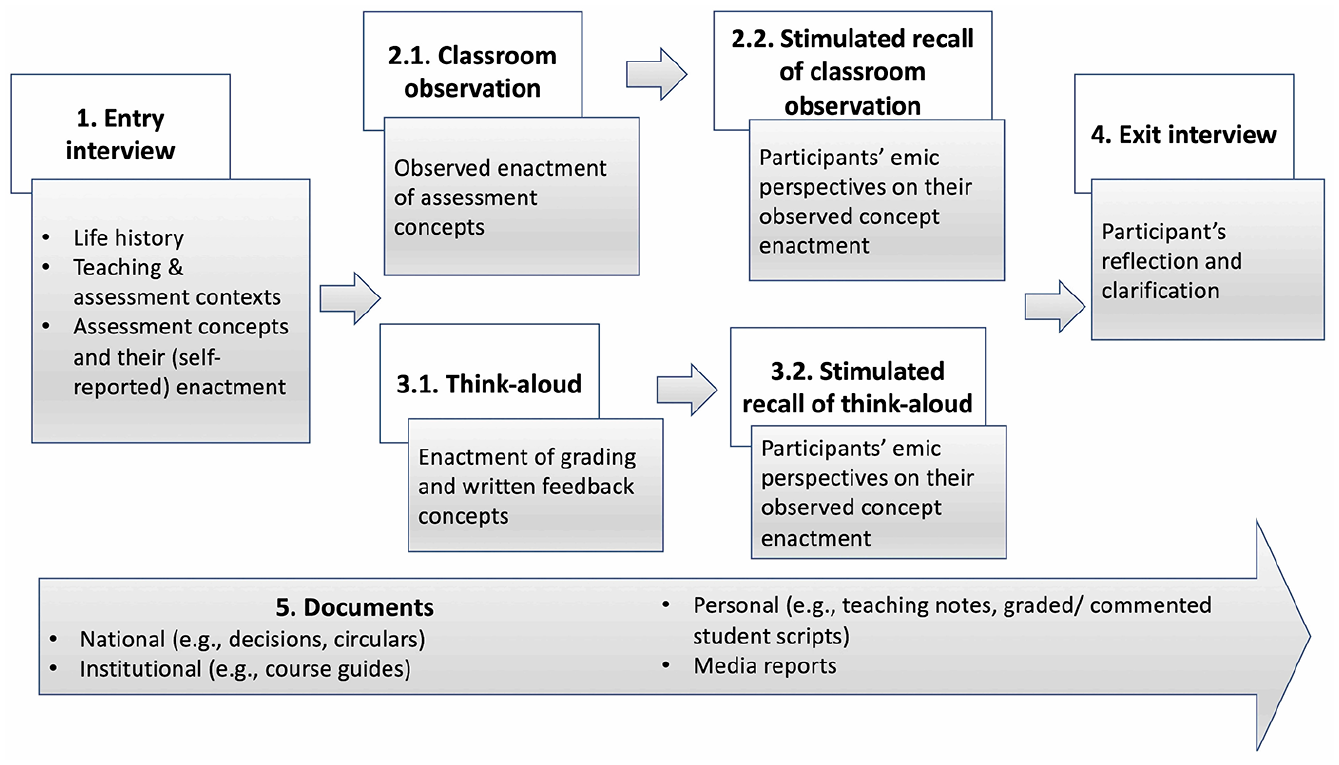
Data collection procedure.
Breakdown of audio and video data sources.
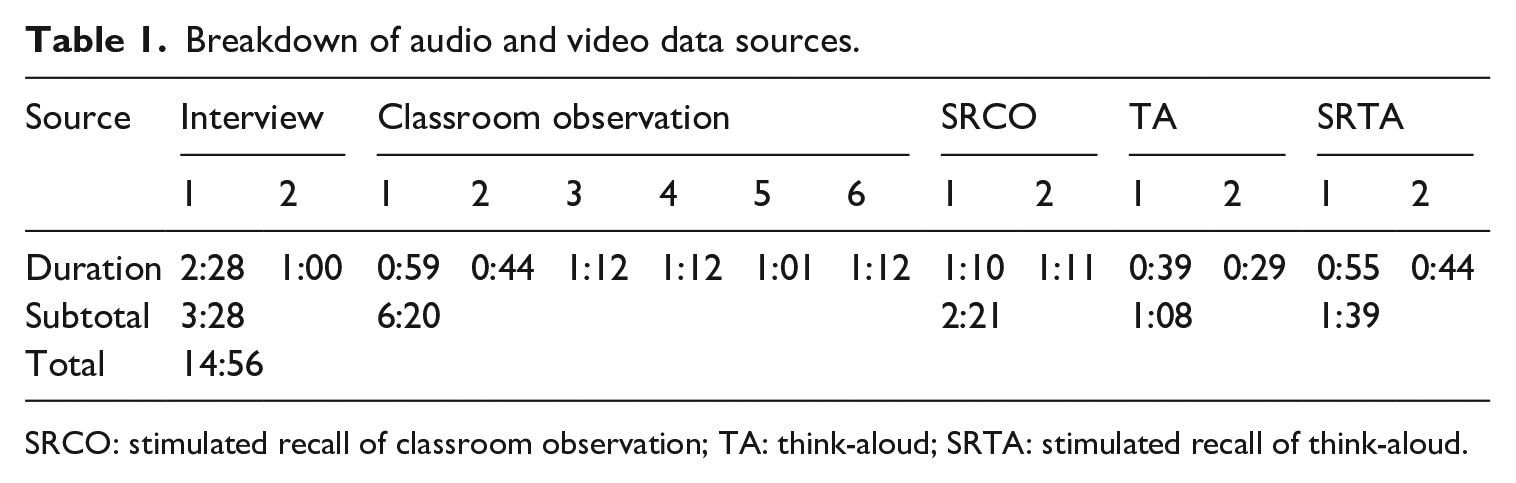
SRCO: stimulated recall of classroom observation; TA: think-aloud; SRTA: stimulated recall of think-aloud.
As seen from Figure 1, the data collection process started with a semi-structured entry interview which elicited in-depth information about Phan’s lived experiences of LAL development (see extracts of interview schedules in the supplementary material). Subsequently, six weekly video-recorded observations were carried out to capture the participant’s classroom assessment practices. All observation sessions were conducted based on an observation schedule which drew my attention to prominent categories of classroom assessment events as described in Hill and McNamara (2012) and McMillan (2018), including embedded formative assessment, summative-based formative assessment, and summative assessment. Following Phan’s preferences, I observed her reading–writing class comprising 25 first-year TESOL majors. This reading–writing class was part of the Academic English I (AE 1) course, aiming to help students achieve academic English skills at Level B1 on the Common European Framework of Reference (CEFR) scale. The six classroom observations were followed by two stimulated recall-of-classroom-observation sessions to gain deeper insights into Phan’s thoughts and emotions underlying her observable behavior (Merriam & Tisdell, 2016). During the two stimulated recall sessions, Phan was shown and asked to comment on selected video extracts which represented the most common assessment activities in her class and/or showed her strong (both positive and negative) emotions.
In addition to the classroom observations and stimulated recall of classroom observations, I administered two think-aloud sessions in which Phan vocalized her thoughts and feelings while grading and providing written feedback on her students’ writing. Each think-aloud session was followed by a stimulated recall of think-aloud session which explored Phan’s justification for her observed grading and written feedback practices. Finally, I administered an exit interview to explore Phan’s reflection on her LAL development over the semester and clarify any issues emerging from previous data collection sessions. All interviews and verbal reports (i.e., think-aloud and stimulated recall) were conducted in Vietnamese, the participant’s first language (L1), to reduce her cognitive load; however, the participant was also encouraged to code-switch whenever she used terms which could not be easily translated into Vietnamese. Throughout the process, I referred to various documents to obtain further contextual information and triangulate the other data sources. The documents used in this case included policy documents from government agencies, and institutional documents such as course guides and textbooks, as well as personal documents such as student scripts and Phan’s marking notes.
It should be noted that the study derived a major part of its data from the stimulated recall of classroom observations, but there was a noticeable time lapse between the actual classroom observations and the follow-up stimulated recall sessions. Admittedly, this has limited the accuracy (or veridicality) of recall (Gass & Mackey, 2016) but seemed hard to avoid given the non-interventionist nature of this narrative inquiry. However, heeding the advice of Gass and Mackey (2016), I offered the participant strong stimuli (i.e., video recordings), followed a carefully designed protocol, and focused on the narratives underlying her behavior which were stored in her long-term memory and hence less prone to attrition.
3 Data analysis
This study combined narrative analysis which aims to “collect descriptions of events and happenings and synthesize or configure them by means of a plot into a story or stories” with analysis of narratives which seeks to “analyse them [stories] with paradigmatic processes . . . result in descriptions of themes” (Polkinghorne, 1995, p. 12). By integrating these two analytical approaches, this paper not only offers a vivid account of one teacher’s LAL development but also uncovers themes and patterns that can contribute to the LAL literature. In practice, the analysis process consisted of three phases.
Initially, I transcribed audio and video files verbatim in MAXQDA, a software package that assists qualitative data analysis. To preserve the richness of multimodal data, I transcribed both oral speech and physical or non-verbal modes such as gesture, posture, gaze, and facial expression. All 14 transcripts, totaling over 126,000 words, were then sent to Phan, who approved them without requesting any modifications. In the second phase, restorying, I applied the narrative coding approach (Clandinin & Connelly, 2000) to construct narrative vignettes concerning the participant’s LAL development. Specifically, I coded all data sources, using classroom-based assessment (CBA) concepts (e.g., formative, summative, feedback, scoring/grading, standard, and standardized testing) which are mentioned in frequently cited CBA sources such as Hill and McNamara (2012) and McMillan (2018) (see Figure 2). Considering the affective dimension of perezhivanie and following Johnson and Worden (2014) and Golombek and Doran (2014), I also applied emotion coding (Saldaña, 2016) to the data excerpts where the focal teachers expressed strong emotions, using general emotion labels such as disappointed, excited, or hurtful, many of which came directly from the participants’ discourse.
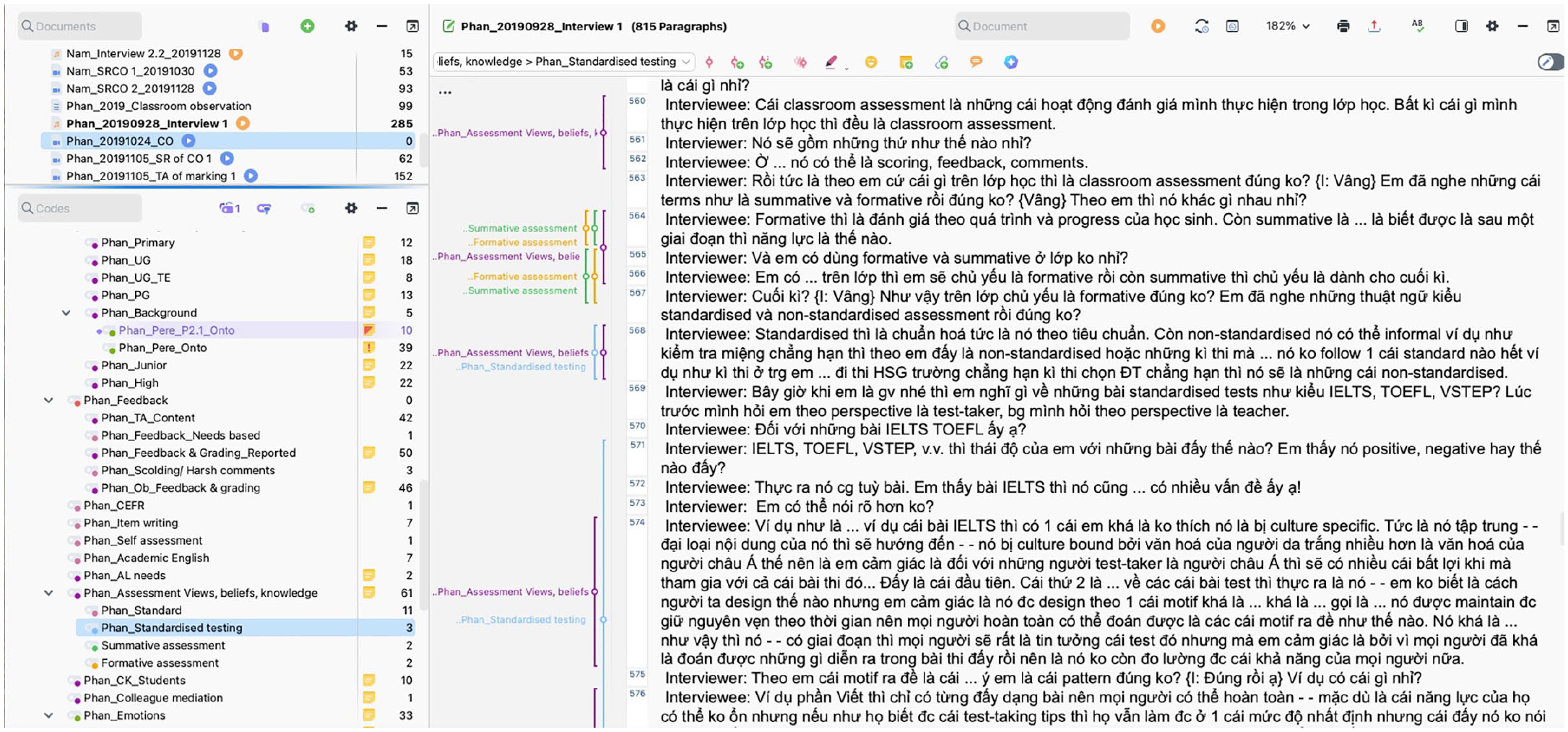
Sample narrative coding of data in MAXQDA.
Afterwards, I considered both lists of codes (i.e., CBA codes and emotion codes) and created a list of prominent assessment concepts for Phan. Prominent assessment concepts here refer to those that featured repeatedly in the participant’s discourse or assessment practices and/or triggered her strong emotions. Due to the space constraints of this paper and to offer the depth of analysis required by narrative inquiry, I focused only on summative/formative assessment and feedback. In the next step, I retrieved and meticulously read all the excerpts associated with each prominent assessment concept from the four main data sources (interviews, observations, verbal reports, and documents). I then created a series of narrative vignettes to reveal the formation of each focal assessment concept. Each narrative vignette has “a narrative, story-like structure that preserves chronological flow and that normally is limited to a brief time span, to one or a few key actors, to a bounded space, or to all three” (Miles et al., 2014, p. 81). Once completed, the narrative vignettes were returned to Phan for feedback and approval before being subject to thematic analysis.
In the final stage, I applied directed content analysis (Hsieh & Shannon, 2005), a theory-informed analytical approach, to the narrative vignettes in search of the answers to the three research questions. This analysis, which I will refer to as sociocultural analysis due to its grounding in SCT, involved several steps. First, I followed a dual coding strategy, where codes such as Theo. Gen. _Course (i.e., theoretical generalization from coursework) and Emp. Gen._Reflection (i.e., empirical generalization from continuous personal reflection) were applied to narrative excerpts that showed the route of teacher assessment concept development (see Figure 3 for a sample of my sociocultural/ content analysis). Concurrently, codes such as negative or positive and mediating or non-mediating were utilized with narrative extracts concerning Phan’s emotions. Instead of terms such as moderating and non-moderating, mediating and non-mediating were used as code labels as they align with the terminology and principles of SCT, which this study adopted. In this context, “mediating” signifies that the associated emotion likely contributed to Phan’s concept formation. To explicitly link Phan’s emotions and other sociocultural factors to concept formations, I used the Memo function in MAXQDA to record specific information such as how the empirical generalization occurred and what concept a particular emotion mediated. Moreover, to enhance the credibility of these links, I utilized the Hyperlink function to connect narrative excerpts with the original data sources (i.e., interviews, observations, verbal reports, and documents) which provided deeper insight into the possible mediators of concept formation. Finally, I engaged in member checking by sharing my draft analyses with Phan and inviting her to evaluate the accuracy of my interpretations to further validate the findings.
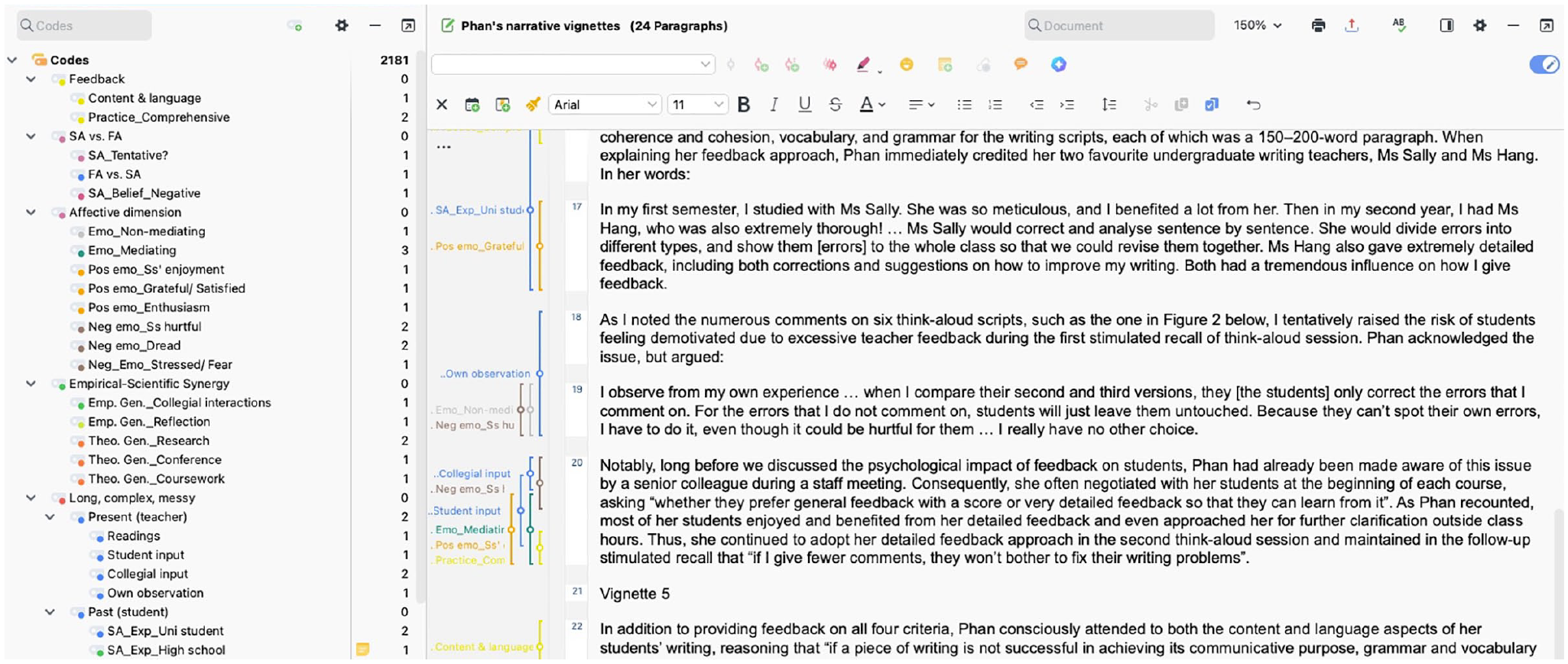
Sample sociocultural/content analysis of narrative vignettes in MAXQDA.
An important point to clarify is this study’s approach to determining the mediating factors of the focal teacher’s LAL development. Like Maxwell (2019), this qualitative study adopted Miles and Huberman’s (1994) process approach to causality, which aims to “identify mechanisms” behind the LAL development process by examining “the temporal dimension, showing clearly what preceded what, either through direct observation or retrospection” (p. 147). In practice, this approach involved juxtaposing and chronologically arranging all the events and factors that contributed to Phan’s LAL development, thereby establishing the causal links.
4 Trustworthiness and wakefulness
Various measures were taken to improve the study’s trustworthiness (Lincoln & Guba, 1985) or its credibility, transferability, dependability, and confirmability as well as my wakefulness as a narrative inquirer, which refers to “a constant, alert awareness of risks, of narcissism, of solipsism, and of simplistic plots, scenarios, and unidimensional characters” (Clandinin & Connelly, 2000, p. 182). First, data triangulation was achieved through the four data sources (interviews, classroom observations, verbal reports, and documents). Second, I maintained a close and effective working relationship, inviting Phan to check all transcripts, narratives, and directed content analyses. Third, as a narrative inquirer, I fully acknowledge that my subjectivity cannot be eliminated from this study; hence, I have aimed at a high degree of transparency. For this purpose, I kept an audit trail (Lincoln & Guba, 1985) in the form of research memos that detailed the major “decision points” in the study (Merriam & Tisdell, 2016, p. 259) to account for the arrival of findings and interpretations.
V Findings
Following the conceptualization of teacher LAL development as a language assessment concept formation process, this section is organized around Phan’s most prominent assessment concepts, namely formative/summative assessment and feedback.
It is important to note that the absence of other assessment concepts in this section does not imply that Phan lacked knowledge of them; rather, it indicates that these concepts were not as prominent in Phan’s collected data as the focal concepts discussed below.
The findings on Phan’s language assessment concept formation are reported in two ways: narratively (i.e., in the form of narrative vignettes) and thematically (i.e., as responses to the three research questions) in two subsections entitled narrative vignettes and sociocultural analysis respectively.
1 Narrative vignettes
a Formative/summative assessment
Vignette 1
During the first interview, I invited Phan to share her English assessment experiences as a school student, but she admitted not recalling much except for her time at high school. As Phan revealed, she attended the English specializing program of her city’s most prestigious high school, and her English classes there did not follow the mainstream curriculum. Instead, her teacher (Ms An) focused mostly on selecting the best students for an elite team to attend the national competition for excellent students. Phan still distinctly remembered that Ms An frequently ordered copies of the latest exam preparation books and instructed all students to complete two or three tests each week. To motivate Phan and her classmates, Ms An would administer tests with items directly taken from those exam books every week and use test results to rank her students. With a dreadful look on her face, Phan recounted:
She [Ms An] would do that [rank students] for every test . . . It was heartbreaking because . . . I felt some of my classmates were really sad because they were always at the bottom of the class. Even the top students . . . were also shaken because they didn’t know how well they would do. Then we would sit . . . stressed . . . shaken every time she started announcing the ranks . . . the whole class fell silent . . . in a state of fear. (Phan’s interview 1)
Vignette 2
After an extensive talk about Phan’s language and assessment experience, we started discussing her understanding of key assessment concepts, starting with the general concept of assessment. In her attempt to define assessment, Phan brought up the formative versus summative assessment distinction. In her own words:
Assessment means . . . to assess the learner’s overall competence. It includes many methods . . . many different stages . . . many different approaches, such as formative assessment and summative assessment. Normally, I see that people tend to focus on . . . summative assessment, but I think . . . I believe it [summative assessment] is not as effective as formative assessment in assessing the student’s learning process. (Phan’s interview 1)
When I asked Phan to elaborate on her understanding of the differences between formative and summative assessment, she continued:
Formative is to assess throughout the [learning] process and the student’s progress, while summative is . . . to identify what the [student’s] competence is after a period [of instruction]. In class, I mainly use formative [assessment]. Summative [assessment] is mainly for end-of-term [tests]. (Phan’s interview 1)
I followed this by asking Phan: “So where do these assessment beliefs come from?” Without hesitation, she responded: “It was what I learned in the [assessment] course. Then I compare this with the [language skill] courses I used to take in the fast-track program . . . then the courses I’m teaching now. They all follow the same philosophy” (Phan’s interview 1).
Vignette 3
As my data collection ended, I again elicited Phan’s view on the best approach to assessing her students’ language abilities in our exit interview. Intriguingly, the concepts of formative and summative assessment also emerged in her response:
I think it’s best to combine summative and formative assessment to have a comprehensive view of students’ ability. For me, I find formative assessment more important than summative because . . . formative [assessment] is for their own good. Summative [assessment] . . . it’s more like to summarise results. So . . . I don’t mean it’s not important. It is, but not as important as the other. (Phan’s interview 2)
“How did you come to form that view?” I probed further. “It has always been my belief,” Phan replied. Yet, after a short while, she mentioned a conference on assessment for learning she had attended a month before the interview and acknowledged how it partly reinforced her view on the importance of formative assessment.
b Written feedback
Vignette 4
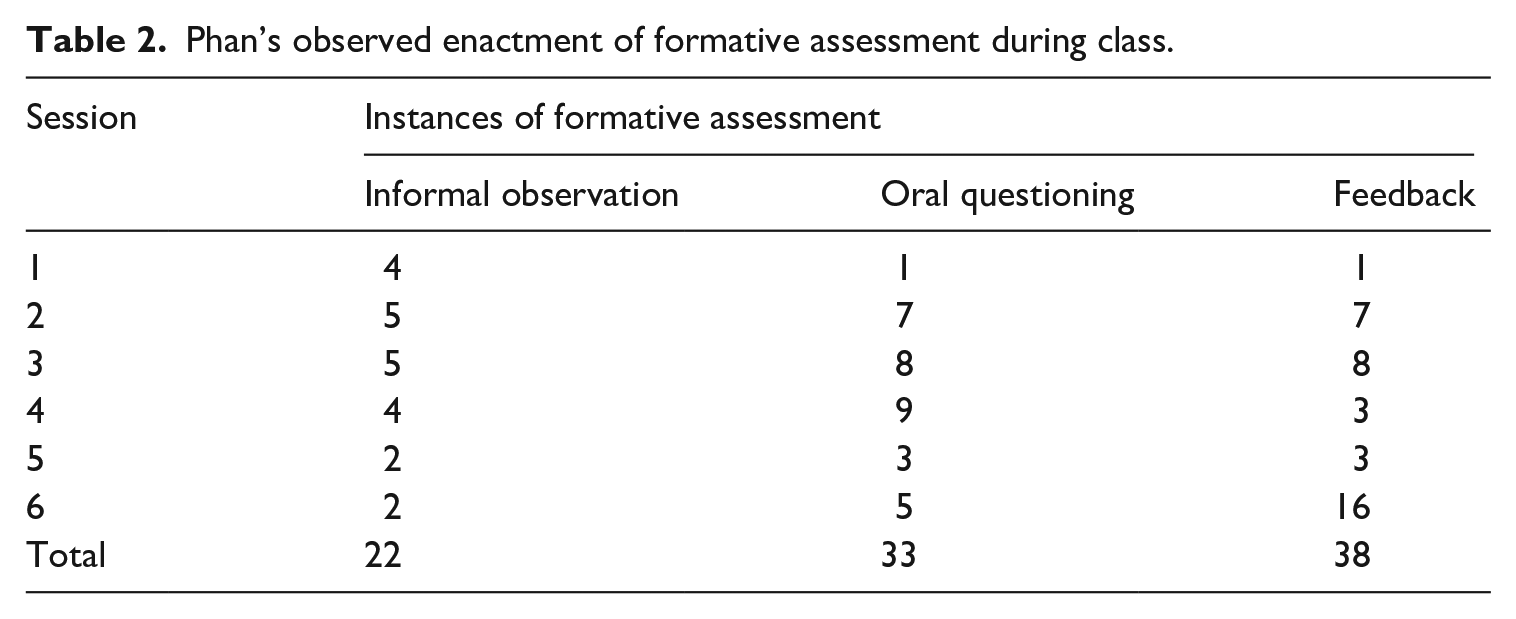
I invited Phan to reflect on her own assessment practices as we neared the end of the entry interview by asking: “What are your strengths in assessment?” She paused momentarily and then responded: “My strengths . . . I’m not sure. Probably feedback, because I am very enthusiastic about giving feedback.” Indeed, Phan’s enthusiasm for providing feedback was evident during the 6 classroom observations, where 38 instances of oral feedback were recorded (see Table 2).
Phan’s observed enactment of formative assessment during class.
Likewise, Phan’s commitment to giving detailed written feedback on students’ writing could be observed during the two think-aloud sessions (see Table 3).
Focus of Phan’s written feedback.
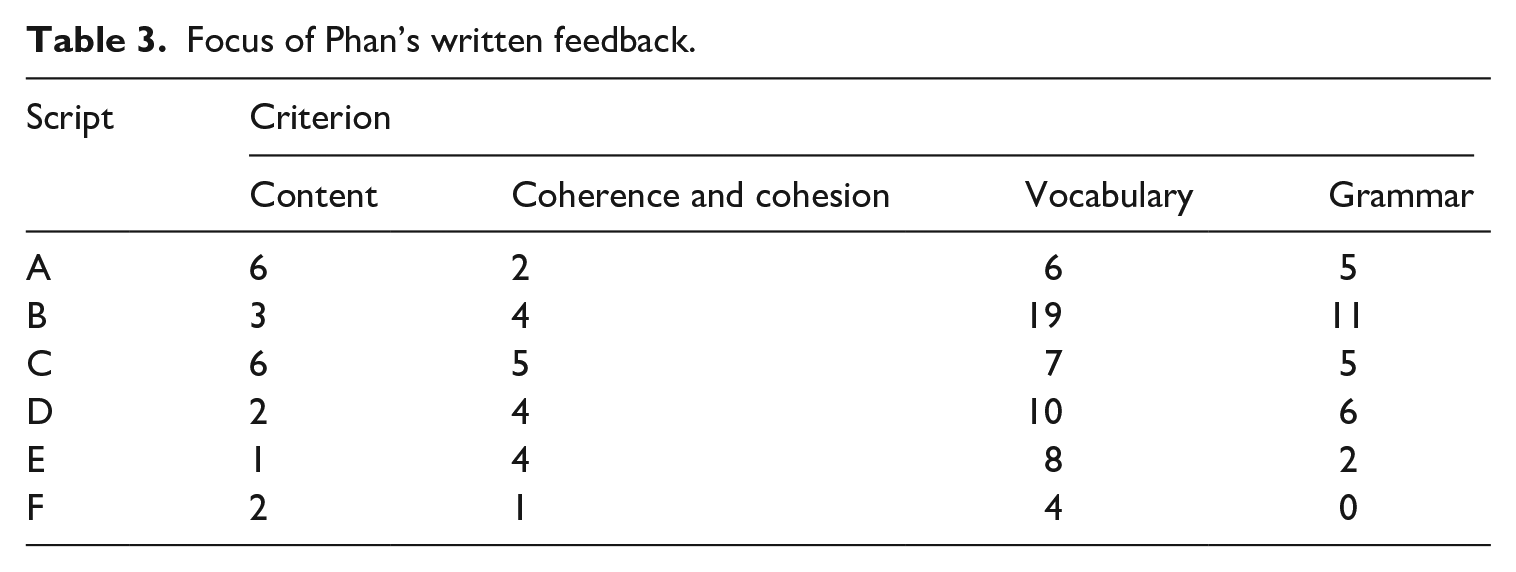
As can be seen in Table 3, Phan provided substantial feedback on content, coherence and cohesion, vocabulary, and grammar for the writing scripts, each of which was a 150–200-word paragraph. When explaining her feedback approach, Phan immediately credited her two favorite undergraduate writing teachers, Ms Sally and Ms Hang. In her words:
In my first semester, I studied with Ms Sally. She was so meticulous, and I benefited a lot from her. Then, in my second year, I had Ms Hang, who was also extremely thorough! . . . Ms Sally would correct and analyse sentence by sentence. She would divide errors into different types, and show them [errors] to the whole class so that we could revise them together. Ms Hang also gave extremely detailed feedback, both corrections and suggestions. Both had a tremendous influence on how I give feedback.
As I noted the numerous comments on six think-aloud scripts, such as the one in Figure 4 below, I tentatively raised the risk of students feeling demotivated due to excessive teacher feedback during the first stimulated recall of think-aloud session. Phan acknowledged the issue but argued:
I observe from my own experience . . . when I compare their second and third versions, they [the students] only correct the errors that I comment on. For the errors that I do not comment on, students will just leave them untouched. Because they can’t spot their own errors, I have to do it, even though it could be hurtful for them . . . I really have no other choice.

A sample of Phan’s feedback.
Notably, long before we discussed the psychological impact of feedback on students, Phan had already been made aware of this issue by a senior colleague during a staff meeting. Consequently, she often negotiated with her students at the beginning of each course, asking “whether they prefer general feedback with a score or very detailed feedback so that they can learn from it.” As Phan recounted, most of her students enjoyed and benefited from her detailed feedback and even approached her for further clarification outside class hours. Thus, she continued to adopt her detailed feedback approach in the second think-aloud session and maintained in the follow-up stimulated recall that “if I give fewer comments, they won’t bother to fix their writing problems.”
Vignette 5
In addition to providing feedback on all four criteria, Phan consciously attended to both the content and language aspects of her students’ writing, reasoning that “if a piece of writing is not successful in achieving its communicative purpose, grammar and vocabulary don’t count.” “What caused you to think so?” I asked during our second stimulated recall of think-aloud session. Phan promptly responded:
It’s partly because I read some research . . . it’s also because of several end-of-term marking occasions with my colleagues . . . I was paired with Mr Vu [a senior colleague], and he gave me some tips for marking. He told me that, generally, a writing script was successful if it had a good flow. Certainly, both language and content played a part in creating that flow, but . . . I think my students have more problems with ideas. That’s why I focus on content. (Phan’s stimulated recall of think-aloud 2)
The research Phan mentioned above was an article by Montgomery and Baker (2007), whose study investigated “how much local and global written feedback teachers give, how their self-assessments and students’ perceptions of this feedback coordinate, and how well teachers’ self-assessments match their actual performance” (p. 82). As Phan explained, she came across this article while searching for the reading material for the Research Methods course in her master’s program. “So, the master’s program is definitely useful for your job?” I asked when listening to Phan elaborating on how she found Montgomery and Baker (2007). She agreed but still maintained: “Only to a certain extent. The in-class time was not very useful. I find it much more useful to sit at home and look for things myself.”
2 Sociocultural analysis
a How were the focal teacher’s language assessment concepts formed?
The above vignettes have demonstrated that teacher language assessment concept formation is a long, complex, and even messy process, as argued by Vygotsky (1986). In this way, the study has provided a more nuanced understanding of teacher LAL development and complemented previous studies such as Xu (2017) and Gan and Lam (2024), whose depiction may inadvertently suggest rather linear developmental trajectories.
Specifically, Phan’s formative assessment concept might have started forming during her undergraduate period, particularly thanks to her language assessment course, as shown in Vignette 1, but this view was sustained and developed thanks to her continued reflection on the language skills courses she had taken as a student and taught as a teacher, and a recent conference on formative assessment (Vignette 3). Notably, the classroom observation data indicates that in line with her self-report, Phan frequently enacted all three forms of embedded formative assessment, namely informal observation, oral questioning, and feedback (McMillan, 2018) across the six observed sessions (see Table 2). In contrast, Phan’s animosity towards summative assessment could have surfaced when she was in secondary school and was constantly exposed to stressful test preparation and humiliating test result communication, as shown in Vignette 1. Finally, Phan’s remark on the benefits of combining summative and formative assessment in the exit interview (Vignette 3) suggests that her concept formation was far from over, and her view of summative assessment had become more nuanced.
A similar pattern can also be observed in Phan’s concept of feedback. Vignettes 4 and 5 have demonstrated that for Phan, feedback was a complex and multifaceted concept whose formation could be traced back to her undergraduate language learning experiences. Moreover, within Phan’s concept of feedback, there emerged other subordinate concepts, such as detailed feedback (Vignette 4), and content versus language feedback (Vignette 5). Regarding Phan’s detailed feedback concept, this is arguably equivalent to the comprehensive feedback concept which refers to the practice of teachers responding to all errors in student writing (I. Lee, 2019). Phan’s detailed feedback concept might initially form due to her positive experiences with the feedback approaches of her favorite writing teachers, Ms Sally and Ms Hang. Phan’s belief in the superiority of detailed feedback was then strengthened by her teaching experience as she noticed that students could not correct the errors left untouched by their teacher. As she became aware of the psychological downsides of detailed feedback following a senior colleague’s advice, her enactment of the detailed feedback concept became more nuanced, leading her to ask for students’ preferences. However, as Phan perceived her students’ reactions to her detailed feedback as positive, her belief in the benefits of this approach was reinforced. By contrast, Phan’s content versus language feedback concepts (Vignette 5) apparently formed when she was already a teacher, owing to a collaborative grading session and the article on feedback by Montgomery and Baker (2007). Unlike the detailed feedback concept, it was hard to delineate the stages in the formation of Phan’s content versus language feedback concepts from the data although it could be argued that both collegial interactions and academic literature influenced her content versus language feedback concepts.
b What sociocultural elements mediated those concept formations?
It can be argued that Phan’s conception formations were jointly mediated by various sociocultural factors derived from her empirical experience and the scientific literature. In other words, the synergy of empirical and scientific concepts was responsible for Phan’s LAL development, although empirical concepts appeared to play a more dominant role.
As an example, Phan was formally introduced to the formative and summative assessment concepts during her undergraduate language assessment course, but her understanding of these concepts was also due to her own reflection on the language skill courses she attended and taught. The synergy of empirical and scientific concepts in Phan’s formation of formative and summative assessment concepts might explain why Phan frequently used formative and summative assessment in her responses even when not prompted. However, Phan’s concept formation was not without problems as she relied far more heavily on empirical generalization (i.e., her self-reflection on practical assessment experiences). As an example, Phan saw the main difference between summative and formative assessment as their timing rather than the purposes of assessment as often indicated in the literature (e.g., McMillan, 2018).
Similarly, Phan’s detailed feedback concept was, on the one hand, strongly mediated by her empirical experience or, more precisely, social interactions, initially with her two favorite teachers and then with her MU colleagues and students. Nevertheless, the absence of scientific concepts in her detailed feedback concept formation led to Phan referring only to the affective downsides of comprehensive feedback and not to the cognitive problems which have also been well documented (I. Lee, 2019).
Unlike the detailed feedback concept, Phan’s content versus language feedback concepts were formed based on both her empirical experiences and her interpretation of a scientific artefact, the article by Montgomery and Baker (2007). Notably, collegial interactions and this academic article did not directly lead to Phan’s focus on ideas or global issues in students’ writing, but their influence was mediated by her reflection upon her students’ writing problems. This explains why Mr Vu, Phan’s senior colleague, mentioned both language and content in his marking tips; nevertheless, Phan decided to focus more on the latter. Likewise, the academic article (Montgomery & Baker, 2007) was refracted through Phan’s perezhivanie, so its influence on her feedback concept diverged from the authors’ original intentions. Although Montgomery and Baker (2007) aim to compare “teachers’ self-assessments of their written feedback” with “students’ perceptions of this written feedback” and “the actual written feedback given” (p. 83), Phan credited this article with motivating her to focus more on content problems in her students’ writing. Interestingly, despite the influence of this particular article on her feedback concept, Phan continued to dismiss the value of her postgraduate education, especially the in-class experience.
c How did the focal teacher emotionally experience those concept formations?
The vignettes also suggest that emotions were pervasive in the formation of Phan’s formative and summative assessment concepts. In fact, Phan’s attempt to relate her own experiences to the scientific concepts introduced in the bachelor’s assessment course was a testament to her strong interest in these assessment concepts. Likewise, Phan took the initiative to attend a conference on assessment for learning outside MU, which indicated her serious commitment to gaining an appropriate understanding of the formative assessment concept. Additionally, Phan’s positive feelings about her undergraduate courses in the fast-track program arguably contributed to her favorable view of formative assessment, whereas her stressful experience with test preparation during high school evidently played a part in developing her negative perspective on summative assessment.
In a similar vein, Phan’s feedback concept formation was imbued with emotions, both positive and negative. On the positive side, Phan was generally enthusiastic about giving feedback. Moreover, her positive feelings about her two favorite teachers’ feedback, which Phan expressed with words and phrases such as “extremely thorough,” “detailed,” and “really benefited,” arguably led her to adopt a similar comprehensive feedback approach. Meanwhile, her awareness that her extensive corrections could be “hurtful” motivated Phan to offer her students a choice of receiving “detailed” or “general” feedback.
VI Discussion, implications, limitations, and contributions
Guided by SCT, this study views LAL development as a process of language assessment concept formation and examines how the focal teacher’s language assessment concepts were formed, what sociocultural elements mediated those concept formations, and how the participant emotionally experienced those concept formations. The study found that teacher assessment concept formation was a long, complex, and rather messy process involving the synergy of empirical and scientific concepts. Notably, empirical concepts derived from the focal teacher’s practical assessment experiences played a more significant role than scientific concepts originating from formal instruction and academic literature. More importantly, the mediation of sociocultural factors on teacher LAL development was not direct but refracted through the participant’s evolving perezhivanie. Finally, the study has demonstrated the role of emotions in mediating assessment concept formations. The two most significant themes arising from the finding, namely the synergy of empirical and scientific concepts and the affective dimension of teacher LAL development, will be discussed further below. Subsequently, I will propose a sociocultural model of teacher LAL development and outline the study’s limitations and contributions.
1 The empirical–scientific basis of teacher LAL development
The current research has found that the focal teacher’s assessment concepts were largely based on empirical concepts derived from her learning, teaching, and assessment experiences, with some traces of scientific concepts from formal education and academic literature. Hence, this study has corroborated earlier works by Vogt and Tsagari (2014), Yan et al. (2018), Yan and Fan (2021), and Gan and Lam (2024), all of whom assert the experiential nature of teacher LAL. Nonetheless, this paper offers a more nuanced understanding of how experience influences LAL development.
First, this study highlights that experience does not impact LAL development directly but is refracted through each teacher’s individual and constantly evolving perezhivanie. Put simply, this means the influence of each experience depends on the individual teacher’s subjective interpretation of that experience, and this interpretation is subject to further changes as the teacher acquires and integrates new experiences into their perezhivanie (Golombek & Doran, 2014). Arguably, a similar argument can also be made for scientific concepts. As shown in Vignette 5, the refraction of scientific concepts seemed evident in the participant’s (re)interpretation of Montgomery and Baker’s (2007) article as the supporting evidence for her content-focused feedback.
Second, this paper reveals how experience interacts with disciplinary knowledge to form teacher LAL. For example, Phan was first introduced to the scientific concepts of formative and summative assessment in her undergraduate assessment course. Nevertheless, it was due to her integration of these scientific concepts with the empirical concept of summative assessment (formed out of her extensive test-taking and test preparation experiences) and the empirical concept of formative assessment (generalized from her undergraduate assessment experiences) that Phan was able to form her own concepts of formative and summative assessment. This empirical–scientific synergy resonates well with the idea of teacher LAL as a unity of interpretive and theoretical knowledge advocated by Scarino (2013) and offers a more balanced bidirectional alternative to the unidirectional “bottom-up” model such as Yan and Fan (2021, p. 238).
Looking beyond SCT, the findings that LAL development involves the integration of scientific and empirical concepts which are refracted through the teacher’s constantly evolving perezhivanie have confirmed the role of reflection in LAL development (Cowie & Cooper, 2017; Gan & Lam, 2024; Scarino, 2013; Willis et al., 2013). The role of reflection may partly explain the previous contradictory findings on the relationship between the number of teaching years and LAL levels as observed by Sun and Zhang (2022) and Chang et al. (2024). In other words, this study suggests that teacher LAL levels are more closely related to teachers’ ability to reflect and learn from their previous learning and teaching experience rather than the number of teaching years per se.
One pedagogical implication of the above-mentioned theoretical understanding is that it is crucial to harness the empirical–scientific concept synergy to develop teacher LAL. Specifically, best assessment practices should be incorporated into language courses for teachers (especially in the EFL context) so that (student) teachers can generalize from their assessment experiences and form proper empirical concepts which “must have reached a certain level” for the teacher “to be able to absorb a related scientific concept” (Vygotsky, 1986, p. 194). Concomitantly, language assessment courses should leverage (student) teachers’ empirical concepts so that the introduced scientific concepts are not overly abstract and disconnected from classroom realities (Vygotsky, 1986).
2 The affective dimension of teacher LAL development
This study draws on Vygotsky’s (1994) concept of perezhivanie as a cognition–emotion unity to examine both the intellectual and affective dimensions of teacher LAL development. Hence, it complements previous works where the role of emotions was referred to but not discussed in depth (e.g., Harding & Brunfaut, 2020). Likewise, this study also supplements other SCT-guided studies on teacher LAL development, such as Kao (2023), who focuses solely on the intellectual dimension of this process.
In addition, building on the SCT’s view of tensions as a source of development (Veresov & Mok, 2018), the current study has demonstrated the potential of negative emotions in mediating LAL development (such as the influence of Phan’s stressful experience with test preparation during high school on the development of her summative assessment concept). This finding resonates with other Vygotsky-inspired empirical studies, such as Golombek and Doran (2014) and Johnson and Worden (2014), where affective tensions are considered potential growth points. It should be emphasized that these negative emotions signal only the potential, and, without proper responsive mediation from teacher educators (Johnson & Golombek, 2020), there is no guarantee that teacher LAL can develop.
Finally, by highlighting the affective dimension of teacher LAL development, this study argues for promoting teachers’ ability to cope with and benefit from emotionally charged situations. This could be achieved by implementing training programs to develop teachers’ emotional intelligence or “a person’s capacity to recognise and deal with one’s own and others’ emotions in an effective manner, to handle interpersonal relationships empathetically using emotional information to guide thinking and behaviour” (King et al., 2020, p. 290). Nevertheless, from an SCT perspective, such initial training should not substitute teacher educators’ responsive mediation to teachers’ affective dissonance (Johnson & Golombek, 2020).
The study has some limitations. As a single-case narrative inquiry, the current study’s findings cannot be generalized to a wider population in a statistical sense. Instead, this study embraces another form of generalization often associated with qualitative research, namely naturalistic generalization. Stake (1995) defines naturalistic generalizations as “conclusions arrived at through personal engagement in life’s affairs or by vicarious experience so well constructed that the person feels as if it happened to themselves” (p. 85). By providing a detailed and rich account of the participant’s background and experience, this study allows readers to evaluate the extent to which the findings may be relevant to their own contexts. Another issue is that there was no comparison between Phan’s LAL at the beginning and the end of the study. However, this comparison was not possible because the current study adopted narrative inquiry to account for the participant’s LAL development over an extended timeframe (i.e., from when she was a school student to the time of data collection when she was a university lecturer). Although this life history approach does not provide a concrete measure of LAL development over a well-defined period, it offers a complex description and explanation of this process, thereby enriching the existing LAL literature.
Regardless of its limitations, this study has made several contributions to current discussions on LAL. First, although the two theoretical tools, perezhivanie and concept, have been utilized by other researchers—for example, Kao’s (2023) use of concept and concept-based instruction—the current study is arguably among (if not) the first to employ both concept and perezhivanie to operationalize the role of context, experience, and the unity of interpretive and theoretical knowledge. This innovative theoretical approach holds potential for not only LAL research but also other topics in language teaching. Second, this study has focused on Vietnam, an under-represented context, hence extending the geographical scope of LAL literature.
Supplemental Material
sj-docx-1-ltr-10.1177_13621688251352285 – Supplemental material for A sociocultural analysis of teacher language assessment literacy development: Stories from a novice Vietnamese English-as-a-foreign-language teacher
Supplemental material, sj-docx-1-ltr-10.1177_13621688251352285 for A sociocultural analysis of teacher language assessment literacy development: Stories from a novice Vietnamese English-as-a-foreign-language teacher by Xuan Minh Ngo in Language Teaching Research
Footnotes
Acknowledgements
The author would like to thank his former supervisors, Dr Paul Moore and Associate Professor Noriko Iwashita, and his examiners, Professor Karen Johnson and Professor Karin Vogt for their thorough feedback on his PhD thesis, on which the current article is based. The author is also grateful to the editors and reviewers of Language Teaching Research for their constructive comments on the previous versions of the article.
Data availability statement
The data that support the findings of this study are available on request from the corresponding author. The data are not publicly available due to privacy or ethical restrictions.
Funding
The author disclosed receipt of the following financial support for the research, authorship, and/or publication of this article: This research was supported by a University of Queensland’s Research Training Scholarship, UQ’s School of Languages and Cultures (SLC) Research Support and Conference Funding schemes, and a Duolingo English Test Doctoral Award.
Ethics approval statement
This study was approved by the University of Queensland Humanities and Social Sciences, Low & Negligible Risk Ethics Subcommittee (approval number 2019001862).

Supplemental material
Supplemental material for this article is available online.
References
Supplementary Material
Please find the following supplemental material available below.
For Open Access articles published under a Creative Commons License, all supplemental material carries the same license as the article it is associated with.
For non-Open Access articles published, all supplemental material carries a non-exclusive license, and permission requests for re-use of supplemental material or any part of supplemental material shall be sent directly to the copyright owner as specified in the copyright notice associated with the article.
