



Abstract
In 2020, Donald Freeman revisited his influential 1998 work on the knowledge base of language teachers. He argued for a necessary reexamination of language teachers in today’s context. This reevaluation, according to him, is crucial to create new interpretations of the knowledge base that accurately reflect the changes driven by the field and work over the years. Attending to this call, this study explores the core pedagogical content competencies that Korean in-service secondary-school English teachers require in their job using a complex dynamic systems lens. Data were collected through semistructured interviews with 15 in-service English language teachers and 15 language-teacher educators. The findings indicate that in-service teachers require a complex and dynamic ensemble of core pedagogical knowledge, skills, and abilities to perform well in their public-school classroom. The findings of this study build upon previous conceptualizations of the language-teacher knowledge base and contribute to a more nuanced and situated understanding of the pedagogical content competencies that in-service teachers require in their professional role.
Keywords
I Introduction
In the last century, cultural and economic globalization has significantly accelerated the global spread of English as an international language (Yazan, 2018). Consequently, English language education has seen a surge in countries where English is not the primary language of communication. Conservative estimates suggest that approximately 80% of such teachers worldwide are second language (L2) users of the language (Braine, 2010; Canagarajah, 2005). This marks a departure from earlier times when English language teachers were predominantly first language (L1) users of English from Global North countries (Howatt & Widdowson, 2004). Although the setting of language teaching and learning has drastically changed, with most language teaching and learning around the world now taking place in foreign language (FL) contexts, conceptualizations of what teachers need to know and be able to do to teach a language, the language-teacher knowledge base (see Freeman & Johnson, 1998), have been largely based on data collected from L1 speakers of the language in Euro-American L2 teaching contexts. This has led to many teacher education programs worldwide adopting Western-based (Euro-American) methodologies and standards (Wang & Hill, 2011), which Yep (2007) refers to as practices of the center, that reinforce concepts of L1 speaker ideals. Due to a contextual mismatch between the content in such programs and the local needs of L2-user English teachers in FL contexts, much of what teachers learn fails to be applied in their classroom (Chowdhury & Le Ha, 2014; Ilieva, 2010; Inoue & Stracke, 2013). There is a growing demand worldwide to rethink the language-teacher knowledge base and to provide new conceptualizations that consider the local contextual needs of teachers which can lead to more practical and relevant professional development programs in these settings and, by extension, more effective and contextually appropriate instruction for L2 learners.
As little work has been done to look at the pedagogical knowledge (PK), skills, and abilities L2-user English teachers require in their local teaching context, this study aims to contribute to this gap by examining the core competencies required by Korean in-service public secondary-school English language teachers. Similar to leading edge work in this topical area, this study expands on previous conceptualizations of the language-teacher knowledge base, which have mainly focused on the static disciplinary knowledge teachers require, by exploring these teachers’ core pedagogical content competencies (knowledge, skills, and abilities) from a complex dynamic systems theory (CDST) lens (Hiver, 2022; Smit et al., 2022; Yuan & Yang, 2022). This particular lens aligns with recent field developments in which language teaching is fully acknowledged as situated and dynamic (see Gao, 2019; Hiver, 2021; Johnson, 2019; Larsen-Freeman, 2015, 2018).
This study makes important contributions to the field as the core pedagogical content competency descriptive profile that is identified in this study stimulates the rethinking of the language-teacher knowledge base not only in South Korea but also in additional English teaching and learning contexts. Furthermore, the descriptive profile can be used as a point of reference by multiple stakeholders toward the development of more contextually relevant and useful language-teacher education programs.
II Literature review
1 Language-teacher knowledge base
Understanding what teachers need to learn and develop to succeed in the profession has been an important topic of study since the inception of language-teacher education programs (Faez & Valeo, 2012). Early scholarship in second language-teacher education placed a focus predominantly on subject matter knowledge and, therefore, what teachers needed to learn and develop was commonly referred to as the language-teacher knowledge base (Freeman, 2016). As Johnson (2009) explains, a language-teacher knowledge base is important as it defines what it means to be a professional teacher in this field. It also sets the standards for teaching licenses and credentials and differentiates between those who are qualified for a language-teaching position and those who are not. It further separates those who can simply speak the language from those who are able to teach it.
From the 1960s the subdiscipline of second language acquisition (SLA) established itself as a legitimate area of study. During this period the language-teacher knowledge base was thought to consist of disciplinary knowledge in the areas of linguistics and psychology (Freeman, 2016). Since the field of language teaching was grounded in psychological and linguistic theory, structural approaches to language teaching that focused on oral practice through pattern drilling and behavior conditioning, such as the audiolingual method (Brooks, 1964), were the norm. As Brown (2007) describes, the habit formation techniques promoted by behavioral psychologists and the descriptive analysis of languages presented in structural linguistics during this period were a close match with the audiolingual method in which mimicry and repetitive pattern practice are foundational concepts. With the widespread influence of behavioral psychology and structural linguistics, elements of how to teach the L2 (methodology) were a nonexistent part of teaching knowledge (Freeman, 2016). Instead, it was believed that L2 teachers simply needed to know language content (i.e., syntax, morphology, and phonology) and how learners acquire that content (i.e., with insights from SLA).
During the 1970s, largely impacted by the communicative movement, there was a shift in the language-teacher knowledge base from a focus on disciplinary knowledge to knowledge of language-teaching pedagogy. During this time teacher knowledge was largely focused on knowing how to implement specific methodological directions and the accompanying pedagogical choices (Freeman, 2016). Underlying each method was a specific view of language itself and how it was learned. Consequently, teachers needed the capacity to think about language and how it was learned in order to match their own views and values to an appropriate methodology. Thus, a teacher’s knowledge base included the teacher having knowledge of various teaching methodologies and what they entail as well as competencies to enact them in their teaching context.
From the early 1980s, language teaching began to be characterized as something that is situated and interpretive in nature. As Golombek (1998) outlined, this new characterization of teaching brought with it the implications that language-teacher knowledge is self-constructed by teachers through classroom experience. Previously, language-teacher education focused on prescribing research-based knowledge to teachers rather than treating them as self- or cocreators of their own knowledge and thus contributing through classroom experiences to their knowledge construction. Work on the language-teacher knowledge base in the 1980s began to situate knowledge in “. . .the work of individual teachers with their students in specific classrooms” (Freeman, 2016, p. 185). This period was greatly influenced by the work of Shulman (1987) who argued that teachers require both PK (knowledge of the best practices for teaching) as well as content knowledge (CK; deep understanding of the content one is teaching) to perform well in the classroom. PK is a term that has been widely used to refer to knowledge of how to teach that is applicable across various classroom subjects (Mulholland, 2015). To differentiate teaching knowledge that is general in nature with subject-specific teaching knowledge, the terms general pedagogical knowledge (GPK; often used synonymously with PK) and pedagogical content knowledge (PCK) have often been used. As Shulman (1987) describes, GPK refers to “those broad principals and strategies of classroom management and organization that appear to transcend subject matter” (p. 8). Day and Conklin (1992) further expanded on Shulman’s description to include things such as general knowledge of teaching beliefs, strategies, techniques, and practices. In the context of L2 teaching, PCK refers to specific knowledge related to language teaching which may include things such as knowledge of teaching the four skills, principles of language development, and instructional techniques and practices (Shulman, 1987; Day & Conklin, 1992). Of special interest to Shulman (1987) was PCK which he perceived to be the intersection between content and pedagogy where educators must strive to locate their practice. He argued that the knowledge base of teaching more generally lies in a teacher’s PCK, in their capacity to “transform the content knowledge he or she possesses into forms that are pedagogically powerful and yet adaptive to the variations in ability and background presented by the students” (Shulman, 1987, p. 15).
Teachers’ knowledge base from the mid-1990s onward was situated within the act of teaching and focused on teacher cognition and making sense of how what teachers know, believe, and think shape what they do (Borg, 2003; Kubanyiova, 2014; Kubanyiova & Feryok, 2015). Research in this area contributed to the reconceptualization of understanding how teachers do the work that they do (Johnson, 2009). It also contributed to framing knowledge of teaching as emerging from teaching experiences and interaction with stakeholders such as learners, parents, and administrators. Similar arguments form the basis of more recent proposals for practice-based pedagogical preparation (see, e.g., Forzani, 2014; Gotwalt, 2023; Peercy & Troyan, 2017). Thus, useable knowledge in teaching was viewed as requiring knowledge about oneself as a teacher, the content to be taught, the learners, the classroom, and the contexts in which teaching is delivered.
From the late 1990s to present, research on the language-teacher knowledge base has tended to focus on understanding how and why language teachers do what they do. This movement was largely influenced by scholars such as Richard Day who began calling for a case study approach to teacher education which would involve the analysis and discussion of real classroom cases and generating teachers’ knowledge from close examination of real-life teaching examples (Day, 1993). Other scholars, such as Richards and Nunan (1990), emphasized the importance of second language-teacher education providing opportunities for teachers to “acquire the skills and competencies of effective teachers and to discover the working rules that effective teachers use” (p. 15). The work of Freeman and Johnson (1998) was also influential in the reconceptualization of the knowledge base of language-teacher education through their work-driven argument where “the actual work of classroom teaching ought to define what language teachers needed to know” (Freeman, 2020, p. 5). The proposition that is central to the language-teacher knowledge base framework that they proposed was “who teaches what to whom, where” (Freeman & Johnson, 1998, p. 405).
In more recent years, the term knowledge-for-teaching has emerged in the discussion of the language-teacher knowledge base (Freeman, 2016). Knowledge-for-teaching was first conceptualized in mathematics. In 2008, Deborah Ball and her colleagues set out to define the knowledge base for mathematics teachers by trying to answer the question: “What do teachers need to know and be able to do in order to teach effectively?” (Ball et al., 2008). Answering this question placed the emphasis on the knowledge needed in, and for teaching, rather than just on the teachers themselves. It also placed an explicit focus on actions that teachers needed to competently perform. Ball et al. (2008) proposed that mathematics teachers’ knowledge required a combination of subject matter knowledge and PCK. When applied to language teaching, subject matter knowledge includes awareness and command of the target language, and PCK includes knowledge of second language learners and learning, teaching methods, and content and curriculum. These concepts remain prominent in the conceptualization of language-teacher knowledge at present.
2 Noted issues with previous language-teacher knowledge base conceptualizations
One issue with conceptualizations of the language-teacher knowledge base that have been presented over the years is that they are mainly derived from research conducted in inner circle countries (Kachru, 1985) (i.e., countries where English served as the mother tongue of the teachers’ under investigation) rather than expanding circle countries (i.e., countries where English is recognized as a lingua franca and is widely studied as a FL but has no special administrative status) (Holliday, 1994; Howatt & Widdowson, 2004; Kachru, 1985). As Canagarajah (2005) and Kubota (2020) discuss, this may be a result of local knowledge from the minority community (i.e., expanding circle countries) being perceived and treated as inferior or unreliable in nature compared with global knowledge of the majority community (i.e., inner circle/Global North countries). Such Euro-American standards were seen as practices of the center (Yep, 2007) and were therefore used at the inception of many teacher education programs as the basis for curriculum development. This has led to teachers’ having difficulty enacting what they have learned in these programs in their classroom due to local contextual differences in educational systems and culture, as well as personal differences in beliefs and values (Johnson, 2009; Ogilvie & Dunn, 2010; Peacock, 2009). As a result, such programs often fail to foster adequate knowledge and competencies for language teachers who are L2 speakers of English to prepare themselves for their required teaching role and accompanying duties within their own local context. Hence, it has been posited that teachers would benefit from professional development that is contextually relevant (i.e., situated in their current or future teaching setting), job-embedded (i.e., situated in the work they do or will do) and suited to their individual teaching needs and goals (Binnie & Wedlock, 2022; Putnam & Borko, 2000).
Another major issue that has been noted with conceptualizations of the language-teacher knowledge base to date is the predominant focus on domains of disciplinary knowledge to the detriment of action-related competencies (Kubanyiova, 2014; Richards & Nunan, 1990). Accordingly, most language-teacher education programs place their focus on developing teacher-learners’ knowledge in areas of psycholinguistics, sociolinguistics, discourse analysis, language description, and language teaching and testing methodology (Crandall, 2000). Thus, most language-teacher education involves preparation in the theoretical foundations of language teaching approaches, methods, and procedures with significantly less time spent connecting and applying what is being learned to actual classroom settings (Johnson & Freeman, 2001). Furthermore, the knowledge that teachers acquire has often been treated as static knowledge, a fixed body of professional knowledge that teachers acquire, rather than dynamic knowledge that is continuously evolving and adapting to different teaching environments, student characteristics, and external factors (Kind & Chan, 2019; Wang & Zhan, 2023). Under these assumptions, many language-teacher education programs operate on the belief that teachers can be front-loaded or equipped at the beginning of their careers with all the knowledge they will need for their entire teaching lives (Freeman, 1993). However, this type of front-loading has resulted in teachers developing a great deal of declarative subject knowledge of the field but not much usable procedural knowledge that is transferred into practical classroom skills (Freeman & Johnson, 1998). Furthermore, as previously mentioned, the knowledge that teachers gain is often drawn from global north, second language teaching contexts that may not have direct relevance to teacher-learners’ local teaching circumstances.
In recent years, there have been calls to move from a transmissive approach to teacher education to a more transformative approach (see Boylan et al., 2023) which encourages teachers to critically reflect on their practices, challenge their preexisting beliefs, and adopt innovative strategies. Transformative professional learning empowers individual teachers by promoting a culture of continuous learning and adaptability which is essential for teachers to navigate the complexities of contemporary L2 classrooms (Hiver et al., 2021b).
3 New conceptualizations of the language-teacher knowledge base
Freeman (2020) argues that to revolutionize language-teacher education it is necessary to scrutinize, and even move away from, basic concepts relied on in the past to build the language-teacher knowledge base. He calls for a zero-based conceptual approach to the language-teacher knowledge base in which it is assumed that there is no carryover from previous conceptualizations and where further (re)examination is conducted to formulate new proposals of what the language-teacher knowledge base consists of. A zero-based approach may give researchers a tabula rasa from which new conceptualizations of the language-teacher knowledge base emerge from the work teachers do in their specific teaching context.
Recent scholarship emphasizes the situated and dynamic nature of language teaching in which the things teachers need to learn and develop to succeed in their role are largely influenced by their background (e.g., L1 or L2 speaker status) and their teaching context (see Farrell, 2015; Hiver et al., 2021a; Johnson, 2019; Larsen-Freeman, 2016). Accordingly, what is crucial to the advancement of the field of language education, especially in FL contexts, is a more contextualized, nuanced understanding of what constitutes the knowledge base of language teachers situated in a specific context at a specific time (Kumaravadivelu, 2012) and a move away from the uncritical adoption of golden global standards (i.e., standards that are perceived to be relevant to all language teachers in all teaching contexts).
III Current study
Building on the work of Freeman and Johnson (1998), and Freeman’s (2020) call for a zero-based approach to the language-teacher knowledge base, this study explores teachers’ needs at the local level in South Korea in hopes of contributing to a more nuanced and contextualized understanding of what constitutes the knowledge base of language teachers. This study reports a subset of findings (Whitehead, 2022) related to the core pedagogical content competencies—knowledge, skills, and abilities related specifically to language teaching—Korean in-service secondary-school teachers of English require in their professional role. For this exploratory qualitative study, a phenomenological approach was taken to allow the researcher to draw from participants’ lived experience to gain fresh insights into the core pedagogical content competencies of these teachers (Creswell & Poth, 2016). To strengthen the credibility of the findings and mitigate research subjectivity, data were drawn from interviews with two stakeholder groups to triangulate perspectives and overcome noted limitations of including a single sample group’s perspective, or a single data collection strategy (Patton, 2002).
In addition, in line with Cochran et al. (1993) who argue that the term knowledge is too static and that PCK should be viewed as continuous and evolving, the more inclusive term competencies was adopted in this study to encompass knowledge (the knowledge of facts and information) as well as core competencies (skills and abilities) that go beyond conventional knowledge. Another important gap this study aims to address is that historically, teachers’ knowledge, skills, and abilities have been treated as static end goals and targets that should be mastered by a teacher. In line with current advances in the field, this study adopted a CDST perspective (see, e.g., Hiver, 2022; Larsen-Freeman, 2018) of teachers’ core competencies. As Hiver (2022) describes, the foundation of CDST-informed research lies in adopting a systems perspective and asserting that the human and social reality operates on the principles of interconnectivity, where every element holds significance, and adaptability, where change is constant. Findings related to the following research question are presented in this study.
RQ1. What core pedagogical content competencies (knowledge, skills, and abilities) emerge as part of the Korean in-service English language-teacher knowledge base?
IV Methodology
1 Participants
This exploratory qualitative study employed purposive, criterion sampling to enlist 15 Korean English teachers currently employed in public secondary schools, as well as 15 language-teacher educators. The objective of collecting data from these two related groups was to examine the subject matter from the perspectives of two key stakeholder groups. The credibility of the findings was enhanced through data triangulation from these two participant groups, which helped to address the recognized constraints associated with relying on a single group’s perspective or a single data collection method (Patton, 2002).
To participate in this study, Korean English teachers were required to meet the following criteria:
(1) currently employed as English teachers in public secondary schools in South Korea; and
(2) at least 2 years of full-time experience after completing their pre-service teacher education.
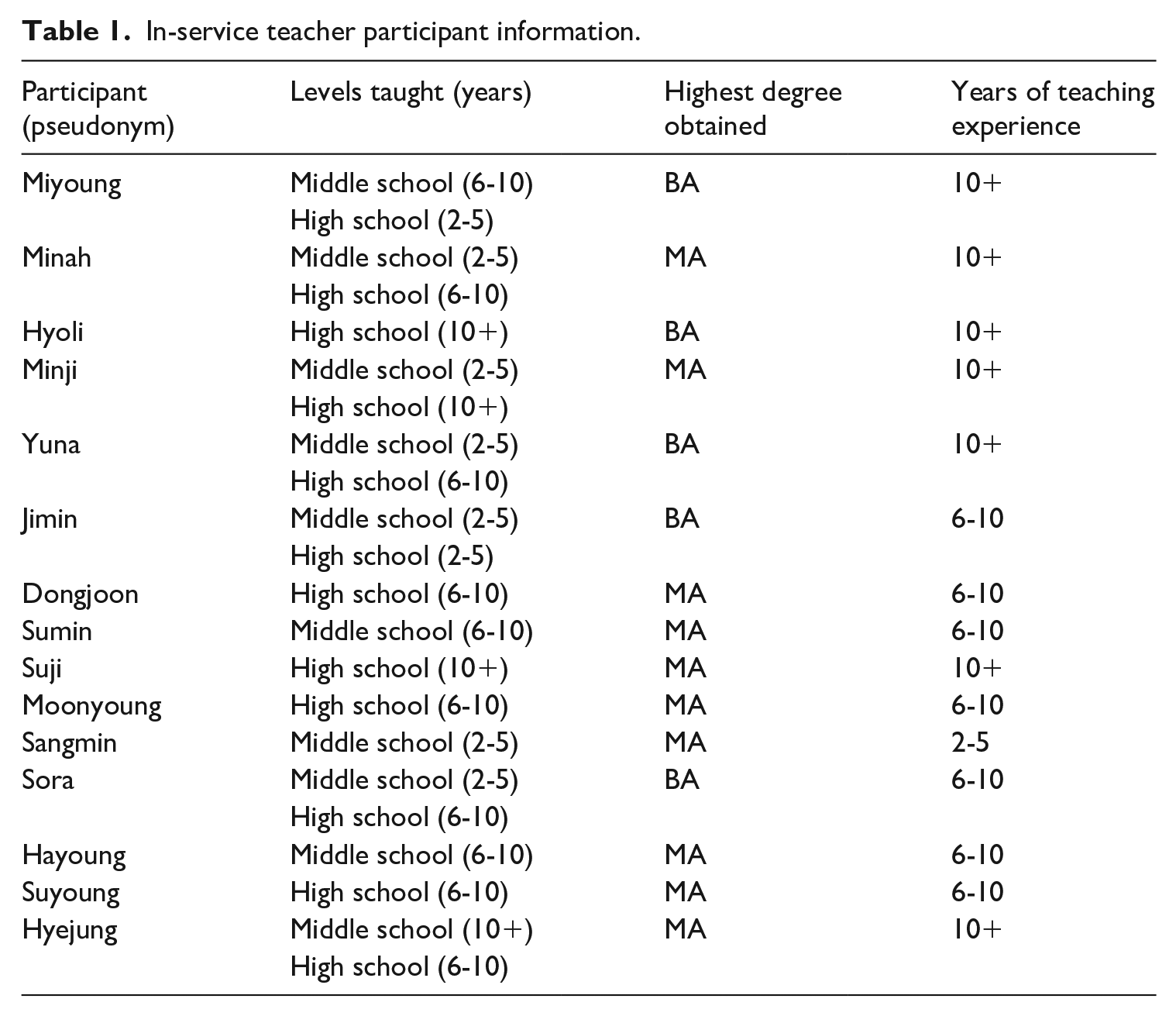
These requirements were implemented to ensure that participants could provide knowledgeable insights into the core pedagogical content competencies they require by drawing from their classroom experiences. More information about the participating in-service teachers is provided in Table 1.
In-service teacher participant information.
The participants in the language-teacher educator group were required to have:
(1) held a professional teaching position involved in the preparation, education, and development of Korean in-service secondary-school English teachers; and
(2) at least 2 years of direct experience educating these language teachers.
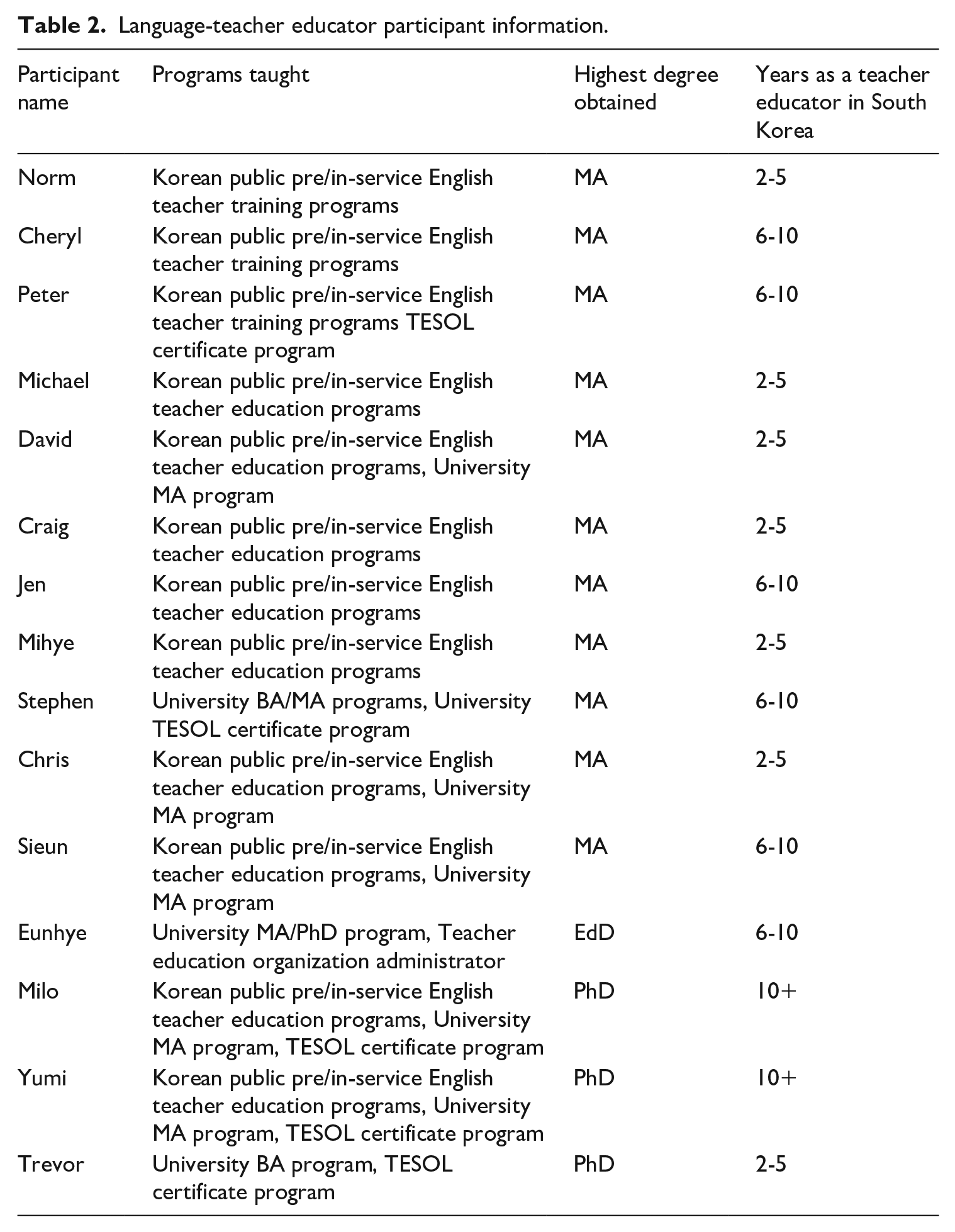
These requirements were implemented to select a group of teacher educator participants who could draw from their experiences both working with and observing in-service teachers’ classroom practices. As a result of these criteria, the language-teacher educator sample group included individuals working in university undergraduate and graduate school programs, public teacher training institutes, and teacher certification programs. Further details about the language-teacher educator participants can be found in Table 2. It is worth noting that all the MA and PhD level programs that these participants were involved in were related to TESOL.
Language-teacher educator participant information.
2 Data collection procedures and analysis
Following IRB approval, data were collected through semistructured interviews with the 15 in-service teachers and 15 teacher educators. Following the suggestion of Lune and Berg (2017) a total of four pilot interviews (two with in-service teachers and two with teacher educators) were conducted prior to formal data collection to ensure that the interview questions (see Appendixes A and B) were both valid and reliable in eliciting data relevant to the research questions of this study. Minor adjustments were made to the wording of some questions for clarity purposes, and additional possible follow-up, probing questions were added to ensure enough detail was being elicited under each category. Following these minor revisions, formal data collection procedures commenced. Interviews ranged from 45 to 90 minutes and were recorded using either a smartphone recording application for face-to-face interviews or an audio recording tool if the interviews were conducted via video call. Respecting participants’ cultural and linguistic background, they were provided the choice to interact in either Korean or English, However, all participants primarily used English, reverting to Korean when they could not recall or express a concept in English. In such instances, the primary researcher, who has intermediate proficiency in Korea, translated these words into English during the transcription process.
Consistent with Corbin and Strauss (2015), the interviews were conducted to the point of theoretical saturation in which categories were well developed and no new or relevant data seemed to be emerging. It was found that the theoretical point of saturation for the in-service teacher interviews seemed to be reached by the 10th interview; however, an additional five interviews were conducted to ensure that this was the case as well as to collect additional data which could provide richer details into any emergent trends and strengthen the reliability of the data. For the teacher educator interviews, the saturation point appeared to be reached at the 12th interview, however, an additional three interviews were conducted for the same reasons stated previously.
In accordance with the interview analysis procedures proposed by Tracy (2019), verbatim transcriptions were generated for each interview. The initial transcription process involved the individual uploading of each audio file from the interviews to otter.ai, followed by multiple reviews and amendments to ensure an accurate representation of the verbal exchanges.
All the transcription files were subsequently imported into NVIVO 12 for further analysis which involved inductive coding procedures as described by Saldaña (2021) and Tracy (2019). During the primary-cycle coding, the participants’ responses were scrutinized and compared for similarities and differences and then categorized into general descriptive categories. In-service teachers’ interview data resulted in 118 descriptive codes relating to core competencies, whereas first-cycle coding of the teacher-educator interview data resulted in a total of 79 descriptive codes.
In the secondary-cycle coding, the aim was to generate focused codes. Per Saldaña (2021), these codes are intended to explain, theorize, and synthesize the data in relation to the research questions of the study, thereby helping to organize the data into emerging themes. In this stage of data analysis, descriptive codes were revisited and cross-analyzed for similarities. During this process, the descriptive codes were organized under the main themes of knowledge, skills, and abilities. The combining of descriptive codes into focused codes resulted in three subthemes being identified under the main theme of knowledge, two subthemes being identified under the main theme of skills, and four subthemes being identified under the main theme of abilities. Detailed findings related to these main themes and subthemes are presented in the following section.
V Findings
As presented in the literature review, historically what teachers need to learn and develop in order to succeed in their profession has often been presented in terms of knowledge. Building on Day and Conklin’s (1992) definition of PCK, defined as specific knowledge related to language teaching, this study adopted the term pedagogical to reflect data related to the act of teaching more generally, and content to relate to the specific act of language teaching. As mentioned previously, the term competencies was chosen to represent both knowledge (the knowledge of facts and information) and core competencies (skills and abilities) that go beyond conventional knowledge. Thus, pedagogical content competencies refer to the subject specific knowledge, skills, and abilities required by these language teachers: in the case of this study, specifically South Korean public secondary-school teachers of English.
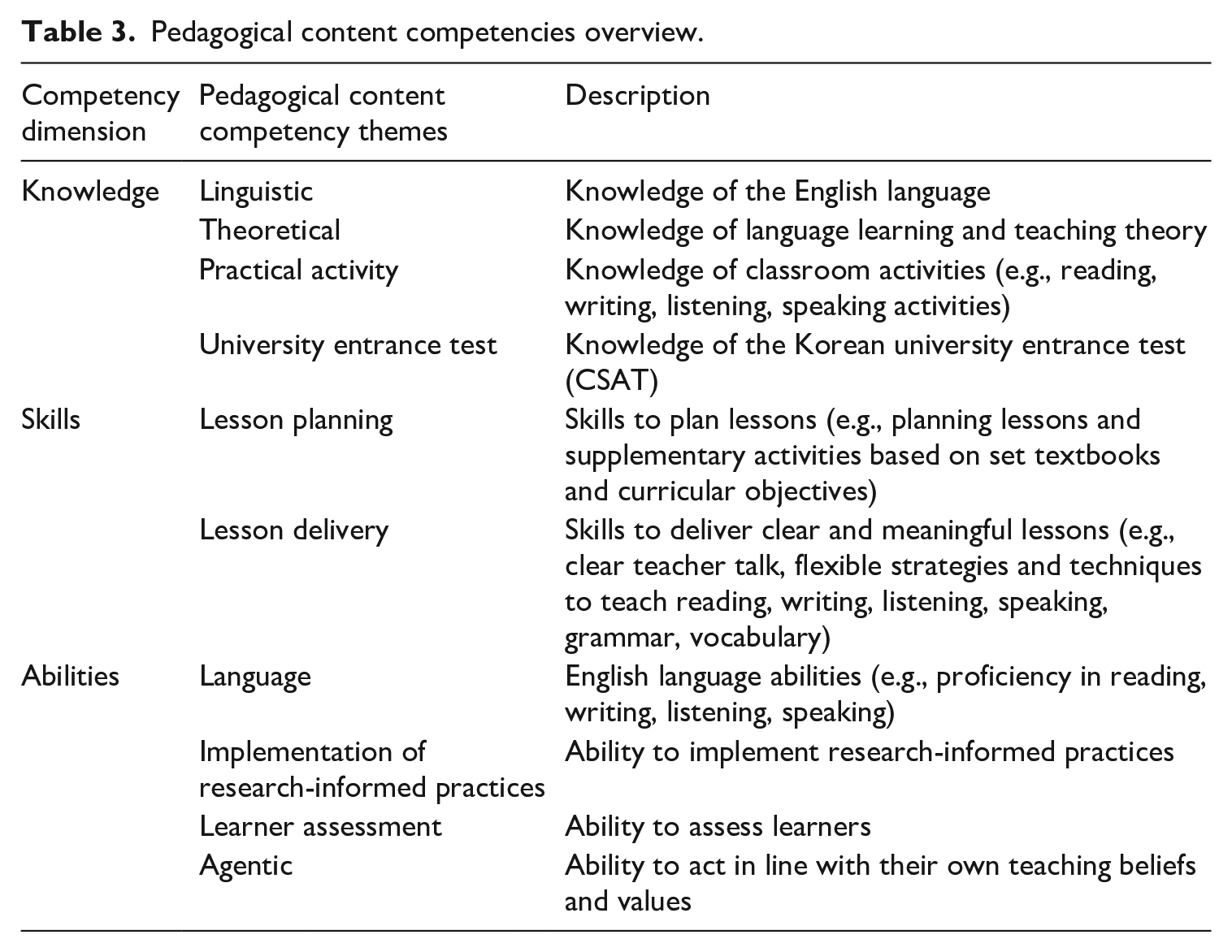
To further clarify between skills and abilities, in this study, skills are defined as learned behaviors in which one becomes expert over time, while abilities refer to the capacity for an individual to perform certain behaviors at a more fundamental level. To develop skills, one must first have the ability to perform those skills at a basic level and, therefore, we can think of skills as abilities put into action in which one has become proficient. For example, we can think of ability and skill in terms of creating a PowerPoint presentation for class. Most teachers have the capacity to create a PowerPoint (i.e., put content into a PowerPoint presentation—ability), but this is quite different from being good at it (i.e., using animations, making it well-organized, and visually appealing—skill). Table 3 provides an overview of the core pedagogical content competency themes—competencies related specifically to English language teaching—that were identified in the data.
Pedagogical content competencies overview.
In the following, the findings of this study are presented under each of these core pedagogical content competency themes and subthemes in turn. For ethical considerations of anonymity, pseudonyms are used in place of participants real names in the following section. Respecting participants’ own words and wanting the data to speak for itself to reduce researcher subjectivity, all interview excerpts are presented verbatim and have not been edited. Excerpts from Korean in-service secondary-school English teacher participants are identified after each quote with the label “T” for teacher, whereas teacher educators are identified with the label “TE.” It is important to note that although the following sections present the findings under headings of core themes data and subthemes, the data does not fit neatly into these categories and, therefore, overlapping features across the themes and subthemes are present. Thus, these categories should be considered as permeable since fluidity and cross-thematic relationships exist amongst them.
1 Knowledge
A Linguistic knowledge
Knowledge of the English language itself, how it is structured (grammar, syntax, morphology), what things mean (lexical knowledge, semantics), how it sounds (phonology), and how it is used (pragmatics), was the most commonly reported PCK perceived to be required by in-service teachers mentioned by all in-service teacher participants (N = 15) as well as all teacher educators (N = 15). As one teacher educator participant noted: Firstly, you need a basic content knowledge that’s what the purpose of having your teaching major is that you’re bringing content knowledge. (Michael, TE)
Considering the contextual demands and expectations of language teachers in South Korea, the need for extensive knowledge about English vocabulary and grammar was prevalent in the in-service teacher data. As one teacher (Hayoung) explained, the importance for in-service teachers to have knowledge about vocabulary and grammar is rooted in the focus on preparing students for the high-stakes university entrance exam: the College Scholastic Ability Test (CSAT). In order to teach what they are expected to teach and present content accurately they need to be knowledgeable in these two areas.
Maybe I need many linguistic knowledge for vocabulary, and how to teach efficiently for students. And for grammar, my students really need them for the university entrance exam and also school exam. (Hayoung, T)
B Practical activity knowledge
Along with linguistic knowledge, all teachers also mentioned the need to have knowledge of practical classroom activities related to what they are teaching. As Hayoung expressed, I think theoretical things are important, but not only philosophy, but also many useful practical real activities teachers need. (Hayoung, T)
Though both high- and middle-school teachers mentioned the need for knowledge of practical activities, many high-school teachers mentioned that they rarely utilized that knowledge since they were expected to follow traditional teaching approaches to prepare their students for the university entrance test. They felt that having a small bank of activities that could be used with the test preparation material would be most useful in their context.
Middle-school teachers, who all reported being less affected by university entrance preparation pressure teaching in middle school compared to high school, expressed the need for knowledge of activities related to the development of reading, writing, listening, speaking, and grammar. Teachers shared that having knowledge of practical research-informed activities gave them options when planning and conducting lessons and could be used and repeated as needed. When interviewing Sora, she explained the following with reference to the speaking sections of her textbook: The textbook has 10 lessons. So, if I have 10 ideas, it’s best because I can use all different ideas for each lesson. But if I have five ideas, it’s okay still because I can repeat, and they will not recognize it. (Sora, T)
As in-service teachers may find themselves in both middle- and high-school teaching contexts over their years of service, it is important that they have knowledge of various proficiency-based activities related to the development of reading, writing, listening, speaking, and grammar, as well as activities that can be used in conjunction with CSAT preparation as long as that remains the main focus in high-school English language classrooms.
C University entrance test knowledge
Another area of PCK which was brought up by all the in-service teachers, was knowledge of the university entrance test as it largely affects what and how they teach in their classroom. These effects were most strongly felt by high-school teachers. Teachers such as Minah expressed the need to know the structure of the test and the types of questions students will be required to answer. This is to develop mock tests that mimic the CSAT, which has been the standard test preparation practice in South Korea for many decades.
Teacher should be familiar with the CSAT style question format. As long as we follow the format of that question, we are safe and students feel safe either and nobody will complain. (Minah, T)
In addition to having knowledge about the structure and content of the CSAT, two teachers mentioned the importance of having knowledge about how to score well on the CSAT in order to pass test-taking tips and strategies on to their learners. Teachers felt that by sharing knowledge of how to approach different questions and by sharing tips on how to come up with the correct answers, students can obtain a higher score on the exam. As long as English is included in the CSAT, this type of knowledge will remain crucial for secondary-school English teachers in this context.
D Theoretical knowledge
The importance of theoretical knowledge was also widely mentioned in the data by both teachers (n = 6) and teacher educators (n = 8). Specifically, this refers to the importance for teachers to be knowledgeable about SLA and language-teaching pedagogy.
Relating to SLA knowledge, participants in both groups specifically mentioned the importance of English language teachers being knowledgeable about how second or additional languages are learned so that they can make informed pedagogical decisions. As Minah stated: Knowledge is very important, they should learn the pedagogical basis based on the theory and logic then they can be a good teacher. (Minah, T)
However, teacher educators such as Yumi expressed that they felt teachers did not need to have a deep understanding of various theories but rather an understanding of the key principles of second language development.
I think that they have to know the key points that how people learn language and they have to know what is important in language learning, but they don’t have to learn like SLA theory, that is not very important who did this or who did that. (Yumi, TE)
The majority of teacher educators felt that by understanding the key aspects of how individuals develop their second language, teachers can better understand the background and rationale behind language teaching principles and practices. However, they felt that going into too much depth would not benefit teachers’ classroom practices.
In addition to knowledge of SLA, knowledge of language-teaching pedagogy was commonly mentioned in both in-service teacher and teacher educator interview data. Teacher educator, Trevor, discussed how linking learning theories to language-teaching pedagogy can help teachers to understand the roots of their practice: I’m saying that the sort of the foundational knowledge, the background knowledge, is about learning theories and as you said that sort of like further back more at a foundational level and then yeah, the next step would be about learning about learning teaching methodologies and how each these different teaching methodologies maybe relate to these different learning theories. (Trevor, TE)
In-service teachers also commonly mentioned that having a great deal of linguistic knowledge and fluency but lacking knowledge about language-teaching pedagogy often results in poor lessons. Minah vividly recalled times when she observed teachers with high levels of fluency struggling to teach the language due to a lack of pedagogical expertise: I’ve watched many native English teachers . . .and they were very of course, they are native speakers of English. They are very fluent in English, but they don’t know how to teach English. 10 years ago, I remember a teacher just walked in the classroom and then talk very quietly and just gave out the worksheet and do it that was all . . .so I feel that oh this is not a teaching even the person is English fluent English speaker. He doesn’t know anything about teaching because he doesn’t have any basic knowledge about teaching. So, teacher required language teaching knowledge, I think very important to become a good teacher. (Minah, T)
When talking about language-teaching pedagogy knowledge, teacher educators commonly expressed the need for teachers to understand key principles of a variety of approaches, methods, and techniques to have a bank of knowledge from which they can draw their own eclectic pedagogical practices. Overall, from the data related to theoretical knowledge, knowledge of SLA combined with knowledge of language-teaching pedagogy is viewed as crucial as this knowledge guides teachers in better understanding their teaching practice options and making research-informed choices when planning and conducting lessons.
2 Skills
Within this theme, references to core competencies required by in-service teachers relate to teaching-specific aptitude to competently perform specific language-teaching-related actions at a high level of expertise on an ongoing basis. Under this theme, the following two subthemes emerged: lesson planning skills and lesson delivery skills.
A Lesson planning skills
Pedagogical content skills related to lesson planning were the most highly referenced by both teachers (N = 15) and teacher educators (N = 15) with every participant referencing skills related to the preparation of language teaching lessons. These skills included working with textbooks to organize and plan lessons, adapting content and materials to meet class needs, and creating supplementary materials for lessons.
It was noted by both teachers and teacher educators that since most lessons are based on textbooks, teachers need to have skills to work with those textbooks and plan and organize lessons around the set content and objectives. Some teacher educators mentioned that in their experience they noticed many in-service teachers tended to follow the contents of the book step by step rather than using the book as a guide to plan their lessons. As teacher educator Jen mentioned: I think a lot of them just follow the book. I don’t think that, in general, they do a lot of lesson planning, I do think they just follow the book. They should be able to, you know, use the book, but then be able to go beyond it. (Jen, TE)
To go beyond the book, eight teacher educators expressed that teachers need the skills to critically evaluate the reason and purpose for the content and activities included in them. In addition, these same teacher educators felt that teachers need the skills to set lesson goals and selectively choose activities and content that they feel will be most beneficial in helping learners meet those goals. Furthermore, three teacher educators also mentioned the importance of teachers having the lesson planning skills to think beyond a single lesson at the curricular level and understand the connection and flow of multiple lessons spanning over days, weeks, or even months.
B Lesson delivery skills
All teachers (N = 15) and teacher educators (N = 15) mentioned the need for in-service teachers to be skilled at delivering clear and meaningful English reading, writing, listening, speaking, grammar, and vocabulary lessons to students since they are required to cover all of these aspects of language learning in their language teaching role. Similar to conventional ideas of teaching methodology, the pedagogical content skills needed to do this require teachers to be well versed in a variety of up-to-date, evidence-based language teaching methods and practices. However, expanding upon conventional ideas, participants emphasized that for teachers to deliver lessons well they also must have the skills and flexibility to combine different teaching strategies and techniques they can adapt to the moment-to-moment needs of the class. As teacher educator Stephen stated, It is crucial that teachers have the skills to combine methods, strategies, and techniques. It takes time to be to be familiar with those kinds of eclectic way of teaching. (Stephen, TE)
Although the necessity of an eclectic set of delivery skills was noted as extremely important, David mentioned that in his experience as a teacher educator and working and observing countless in-service teachers, he felt that there is a general lack of uniqueness and variety in practice as well as little utilization of sound up-to-date, evidence-based practices. He mentioned that most teachers he has worked with and observed tended to base their practices on their past experiences as students. Thus, teachers today tend to commonly adopt the practices of their former teachers who were more teacher-centered and utilized grammar translation and audiolingual approaches. In their interviews, some teachers explicitly mentioned trying to replicate what their former teachers did in their current classroom. When Hyejung was discussing how she formed her teaching practices, she stated the following: I basically depend on my experience. When I was in high school, I had to do almost the same things. I thought, oh, my teaching style, cannot overcome or go further from my experience in my past teachers, I continuously I imagine my high school English teachers. (Hyejung, T)
Without developing practices based on strong pedagogical research-based roots some teacher educators felt that these teachers cannot be considered as possessing the necessary pedagogical content delivery skills to deliver effective lessons.
Furthermore, to deliver lessons effectively, skills related to teacher talk were mentioned by four in-service teachers and six teacher educators. These individuals expressed the need for teachers to be skilled at monitoring and managing their language to make the instructions and explanations easy for their students to understand. As Jihyeon stated, Delivering clear instruction is most important skill for the language teachers. Some of the teachers who deliver instruction unclearly make students confused with what they have to do. And that makes students confused, frustrated, and demotivated. (Jihyeon, T)
Although many teacher educators mentioned the need for teachers to be skilled at using English in the classroom, many of the in-service teachers explained that they must be skilled at making their teacher talk clear and comprehensible in whatever language a teacher is communicating in whether that is the students’ L1 (Korean) or L2 (English). As Yuna mentioned while reflecting on her classroom environment, In classrooms in Korea, the English teachers don’t speak English much in classroom but anyway, in any language, it has to be simple, it has to be clear. (Yuna, T)
3 Abilities
Data that were categorized under this thematic heading relate to teachers’ capacities to perform language-teaching-related behaviors at a basic level. As mentioned previously, these language-teaching-specific abilities differ from skills in that they are not seen to require the same level of performance and expertise. Rather, possessing the potential to perform these acts at a rudimentary level was noted as sufficient by participants. The subthemes that emerged under the theme pedagogical content abilities include language abilities, implementation of evidence-based practices ability, learner assessment abilities, and agentic ability.
A Language abilities
Abilities under this subtheme refer to a teacher’s proficiency in English. More specifically, this includes their capacity to competently use the language by understanding written and spoken input and producing written and spoken output. Language abilities also include the capacity to accurately interpret and translate between English and Korean.
All 30 participants referenced the importance of a teachers’ English language ability. While some (n = 5) argued that a teacher needs to reach an advanced level of English proficiency (the more advanced the better), all participants that stated they agreed that an advanced level does not necessarily equate to a nativelike proficiency or fluency. In line with Milo’s comment below, a low advanced level on the American Council on the Teaching of Foreign Languages (ACTFL) descriptors or a C1 level on the Common European Framework (CEFR) reference levels was stated as a good target for Korean English teachers: I think it might be something like a C1 Common European level or on you know, on the ACTFL it would be like an advanced low. So, someone who can competently function in the language and with a little bit of planning and effort on their part, teach good lessons. (Milo, TE)
Although two teachers and three teacher educators felt that it is better for teachers to have an advanced level of proficiency regardless of the students they are teaching, others argued that this is not always necessary. The other 13 teachers and 12 teacher educators stated that teachers only need to be proficient enough in English to allow them to fully understand and deliver the content that they are required to teach. As Hyejung and Craig stated: I guess then they have to, how can I say, they have to know enough English to understand the content they’re teaching at least. (Hyejung, T) You don’t need a huge amount of English to teach but you need to know what you know well. (Craig, TE)
Speaking with Chris, he mentioned the idea of a proficiency threshold that teachers need to reach in order to teach well that is dependent on the level of content and level of the students being taught: There must be a threshold at some point where if they don’t hit that threshold then they have a hard time. I think if you’re going to teach more advanced level classes, your level probably has to be a little bit higher as well to go with the level of students. I mean, obviously, they have to be able to produce the classroom target language in the chapters. (Chris, TE)
This heavy focus on how (well) teachers use English in their classroom instruction has also been explored elsewhere in the English-for-teaching (Freeman et al., 2015) framework. As these and other data excerpts show, a teacher’s choice of language or how effectively they use the language in their instruction can help or hinder learners’ involvement in the language classroom. It is clear that many of our participants acknowledged these notions, specifically related to knowing how to use English in the classroom to reach specific teaching and learning outcomes, as an important part of teachers’ knowledge base.
Relating to teachers having English abilities that allow them to understand and teach the content of their lessons clearly and accurately to students, all the in-service teachers explained that in the current situation teachers mainly focus on reading and analyzing texts. Due to this narrow focus, most teachers expressed that they used very little English for communicative purposes in their classrooms. Thus, teachers, especially those in high-school settings, felt it is most important for them to be highly proficient in reading primarily and to be able to interpret and translate what they are reading into the students’ L1. As Hyejung explained, Frankly, speaking, I don’t think I have a lot of opportunity to speak in English at school. So, my speaking proficiency doesn’t need to be higher because I have no opportunity to speak in English at school and I don’t teach speaking. So, it’s a little bit embarrassing but reading proficiency is the most important to teaching English in Korea in my opinion. Basically, the teachers need to have enough ability to understand the text and translation. (Hyejung, T)
B Implementation of evidence-based practices ability
Another pedagogical content ability that was referenced by 12 in-service teachers and 11 teacher educators was the ability of teachers to implement teaching practices that are informed by the findings of cutting-edge theory and research-based evidence. This entails being able to put theoretical knowledge into practice as well as being able to justify their pedagogical practice through reference to key research-based principles of language teaching and learning. In David’s interview, he described the consequences of haphazardly using methods, practices, and techniques: If you start teaching by whatever method works, wham bam, slam it together, put some duct tape on it then eventually, I mean, you can build a whole entire building off of that, but it’s not the most structurally sound. (David, TE)
However, 10 teachers and five teacher educators also mentioned that gaining knowledge of theory and research findings by itself is also not enough. These data show that teachers need to be able to practically apply the theory to their teaching and understand why certain pedagogical practices work or do not work in order to develop contextually relevant pedagogy. As teacher educator Jen mentioned, Theories are important, but if you don’t know how to apply them then it doesn’t do anything. Knowing how to apply them or decide what works, would work, like being able to, I guess, to think critically about it and go, well, this, you know, this will work, or this won’t work and why. (Jen, TE)
To develop the ability to implement evidence-based practices in their classroom, Stephen expressed that teachers need to be able to critically reflect on theories and practices they learn and think about how they can adapt them to work in their setting rather than adopting them as is. The reason for this is that many theories and practices may not match a teacher’s classroom context and, therefore, may be met by a variety of contextual obstacles and constraints. Because the classrooms they are being adopted into can differ in many ways (i.e., culturally, physically, cognitively, and educationally) from the context they were originally designed for, such theories and practices may not be applicable in the same manner for these specific learners in this specific teaching situation.
C Learner assessment abilities
Another important ability that was mentioned by all in-service teachers and five teacher educators was learner assessment literacy: the ability to assess learners’ development formatively and summatively and create valid and reliable tests with clear and accurate testing questions. As all of the in-service teachers expressed, the Korean education system is test-driven, and scores hold important significance to the future of their students. Therefore, they posited that language teachers need to possess the abilities to create valid and reliable test questions to ensure a fair and accurate assessment of what is being tested. Lacking these abilities can result in unfair scoring, and complaints from students, parents, and other stakeholders. Suyoung explained that We usually have to make this final test and midterm examinations, so we take charge about this for example 25 midterm exam questions. I think the teachers need the assessment skill kind of validity reliability practicalities. Sometimes it’s serious problems if we don’t think about that seriously elements about the assessment. (Suyoung, T)
Thus, in line with Suyoung’s quote, to work within the current system and be prepared for future changes in learner assessment, it is important for language teachers to have the ability to construct and implement several types of formal and informal assessment tasks that are valid, reliable, and research-informed.
D Agentic ability
Another ability that was prominent in the data was the ability to work within the constraints of the system but at the same time teach in line with one’s own educational beliefs and values about language education. All teachers that were interviewed articulated that they wanted to teach English for communicative purposes and to help learners understand the target language and communicate with people all over the world. However, all 15 teachers also expressed that various contextual factors pressured them to abandon their personal language education philosophy and follow external stakeholders’ expectations of how they should be teaching based on traditional teaching norms within the country. These norms are rooted in the history of South Korean education being test-driven and highly competitive. Since language education remains this way at present, many teachers and teacher educators explained that they are obligated to teach to tests and focus on preparing students for the CSAT. As Suji stated: The original purpose of the language is communication. So, with the language, I will be able to communicate with other people. But my teaching style doesn’t help learners can speak with other people they just read and comprehend then that’s all, but they cannot communicate with the other people. As a language teacher I think I failed to achieve my goals, because it’s not an appropriate way to teach language. (Suji, T)
Although teachers expressed that they wanted to follow their own pedagogical beliefs and values in their language teaching practices, Sora explained that deviating from the norm of traditional expectations can result in teachers being ostracized or heckled by the students, the principal, and parents: So, a lot of it has to do with the system and how the system views certain things and how you should be within the system. And if you’re outside of that normal routine then people think you’re different or look negatively. (Sora, T)
All participants, in-service teachers and teacher educators included, felt that language-teacher practices are largely constrained by the design and focus of the high-stakes university entrance exam. They felt that for language teaching practices in the country to shift focus from testing to fostering learners’ communicative competence on a wide scale, change to the current testing system is essential. Since teachers cannot avoid the contextual pressures (i.e., testing washback) and must work within constraints of the educational system, many teachers reported feelings of helplessness in following their own communicative values and beliefs when teaching the language. However, all 15 teacher-educator participants emphasized that teachers need to balance meeting system requirements and stakeholder expectations with staying true to their own philosophy of language teaching and learning. As Trevor explained, I think many teachers lack the ability to finesse their way around stakeholders’ expectations. I think they need to find a way to balance their own teaching philosophy what they want to do in the classroom with some criticism that they might be getting from administration or other teachers and some resistance that they might get from the students when trying new ways of teaching. They also must have some ability to convince their students that this is a good thing and the way that they’re trying to teach will be effective and to trust them. (Trevor, TE)
While our data suggest these abilities are important, we should also acknowledge that it may not be easy for teachers who are constantly being pressured by administrators, parents, and students to deviate from the status quo.
VI Discussion
The findings of this study and the core competencies that were identified, although preliminary, not only expand upon previous conceptualizations of the language-teacher knowledge base (e.g., Freeman & Johnson, 1998; Richards & Nunan, 1990; Shulman, 1987) but also hold important implications for language-teacher education programs, especially in contexts such as South Korea. The competencies that emerged in this study go beyond static knowledge and include a large focus on knowledge-for-teaching and what teachers need to be able to do in their classroom; something that Freeman (2020) has noted as a crucial movement forward in language teacher education. Furthermore, aligning with Kumaravadivelu’s (2012) concept of particularity, the competencies that emerged are specific to in-service English language teachers in South Korea, and therefore, directly reflect the context that they work within. Some examples are competencies related to CSAT knowledge, planning lessons related to their required public-school textbooks, and using Korean as a language of instruction in the classroom. Such competencies directly reflect the context that these teachers work within which is of significant importance because they pinpoint what is actually needed in their context to perform well in their job. This specificity is quite different from other conceptualizations of the language-teacher knowledge base or language teachers’ competencies to date which have, for the most part, been drawn from Euro-American research on L1 speaking teachers (Kubota, 2020; Yep, 2007) and are often overgeneralized to all language teachers regardless of background or teaching setting (Allwright, 2003). This is not to say that teachers should completely avoid drawing from knowledge and research from Global North contexts but rather, there should be a critical merging of global outlooks with local considerations to provide relevant and useful teacher education in these local settings (e.g., Hiver & Nagle, 2024).
Another important finding in this study was that under the main theme of core pedagogical content competencies, multiple interrelated and overlapping competencies were identified across the subthemes of knowledge, skills, and abilities. Thus, from the data, it seems that to develop some of the core pedagogical skills and abilities, specific core PK may first be required (e.g., lesson planning, implementing research-informed practices, and learner assessment). In other words, knowledge must be put into practice (enacted) to develop abilities, and abilities require repeated practice to develop into skills. Though not a central part of this study’s theoretical framework, similar arguments form the basis for a practice-based pedagogical preparation paradigm (see, e.g., Forzani, 2014; Gotwalt, 2023; Peercy & Troyan, 2017). This conceptualized process of knowledge-integrated ability and skill development progression is illustrated in Figure 1.
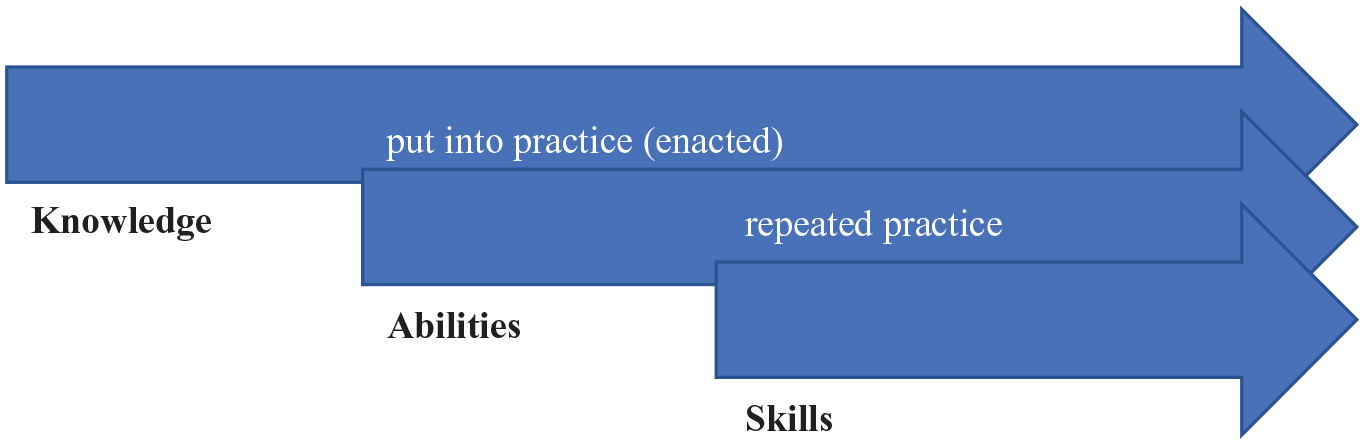
Knowledge integrated ability and skill development.
Applying this conceptual model to lesson planning, for example, might entail the following: in order to plan effective L2 lessons, teachers need to first develop core linguistic, theoretical, and research-informed practical activity knowledge. Drawing on this knowledge, they can then begin to develop their ability to plan lessons. However, to become skilled at lesson planning, one must continuously repeat this process over an extended period of time while incorporating knowledge of their previous experiences.
However, skills may also be developed through behavioral mimicry and habit, which some teachers mentioned, and these may not require much core knowledge. An example of this would be in the skill of lesson delivery where a teacher may be successful by simply imitating the behavior and activities of other teachers they have seen and experienced. This is what Lortie (1975) refers to as the apprenticeship of observation, and can often lead to novice teachers uncritically adopting, and imitating the behaviors and actions of the teachers who they have been taught by. The same applies to core abilities where the development of some abilities may require specific knowledge to develop (e.g., implementation of research-informed practices), whereas other abilities may be attained by copying what one has seen others do, or through trial and error (e.g., the ability to be agentic).
The notion of core skills and practices, emerging from our data analysis, has parallels in the literature on high-leverage teaching practices (HLTPs). HLTPs represent impactful pedagogic practices that are seen as necessary for accomplishing particular L2 instructional goals and for facilitating language learners’ development (Davin & Troyan, 2015; Glisan & Donato, 2017, 2021). However, rather than procedural routines and deliberate practices (e.g., provide targeted corrective feedback) that are implemented more or less uniformly across time and place, abilities such as research-informed practices are indeed informed by instructed language learning research insights but they are equally sensitive to particular contexts of learning and emerge from the localized purposes of L2 education (e.g., Kubanyiova & Crookes, 2016; Peercy et al., 2022). As they emerged from our findings, research-informed practices require teachers to critically reflect on theories and assess empirical evidence they are exposed to about pedagogy in relation to their values and to think about how they can adapt these to work in their setting. As such, core abilities provide teachers with the means to know “what to do in the particular moment of an educational encounter” (Kubanyiova, 2020, p. 5).
Core knowledge as part of a language teacher’s core competencies may also relate to a teacher’s core skills and abilities (e.g., linguistic knowledge and language abilities); however, some knowledge may exist independently of both and not be factored into a teacher’s actions (e.g., some theoretical knowledge that teachers have learned but do not use). Thus, different from previous conceptualizations of the language-teacher knowledge base, a teacher’s core competencies can be conceptualized as consisting of core knowledge, skills, and abilities that are interconnected and overlapping as represented in the following figure.
As in Figure 2, the findings of this study can be viewed through a complex dynamic systems lens in which language teachers’ core pedagogical content competencies, consisting of knowledge, skills, and abilities, are considered as fluid, dynamic constructs that flow in and amongst one another rather than as static entities (Cochran-Smith et al., 2014; Davis & Sumara, 2012; Gao, 2019; Kubanyiova, 2020). Different competencies may be called upon by teachers in different arrangements at different times as needed to perform the teaching tasks and duties required of them (Johnson & Golombek, 2020). These core competencies should also be considered as open to change and continually evolving in order to adapt to new circumstances as they emerge. As mentioned by the participants in this study, the core competencies that a teacher possesses in middle school may qualitatively change in a high-school context (e.g., practical activity knowledge versus CSAT knowledge) and vice versa. On this basis, and in line with Cochran et al.’s (1993) argument that teachers’ knowledge should be viewed as continuous and evolving, the attainment of core pedagogical content competencies should not be seen or treated as final, static goals, but rather as fluid, dynamic constructs that are framed by one’s teaching context (see Kind & Chan, 2019; Wang & Zhan, 2023). Consequently, one’s competency in each of these areas may become stronger or weaker depending on how often they are being engaged.
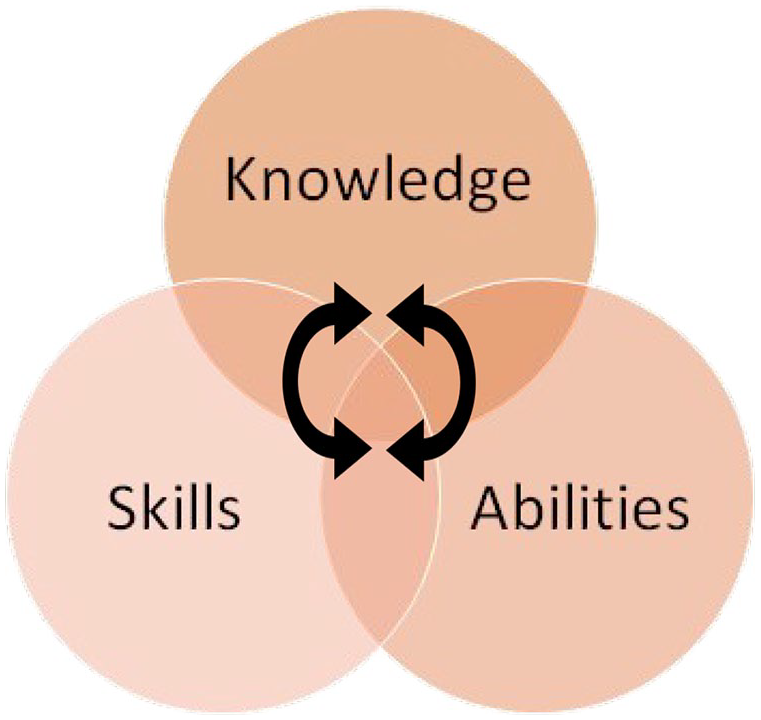
Interrelated nature of teachers’ knowledge, skills, and abilities.
Due to the dynamic nature of these competencies, our findings suggest that they are not something that can be front-loaded at the beginning of a teacher’s career as teachers can progress or regress to an earlier or less developed state over time and place. Thus, the range of pedagogical content competencies that were identified in this study should be conceptualized as areas these teachers would benefit in developing and maintaining at different levels over the course of their teaching career driven primarily by their teaching context and situation.
VII Conclusion
Overall, the core pedagogical content competencies highlighted by the participants in this study are essential for in-service teachers to be able to perform well in their public secondary-school English teaching role in South Korea. This has important implications for Korean preservice teachers and in-service secondary-school English teachers in South Korea as they can refer to this framework as a bottom-up guide to consider areas they may need to further develop: something that Binnie and Wedlock (2022) have previously advocated for. For in-service teachers, it provides a framework that they can use to reflect on themselves and their current core pedagogical content competency levels and raise awareness of their strengths and limitations in relation to the knowledge, skills, and abilities required in their professional role. Through increased awareness of these core pedagogical content competencies and critical reflection of current levels of development in each competency, both pre- and in-service teachers may be able to set specific development goals for themselves that can contribute to them being more ready to enter the profession or better able to perform in the job they are currently doing.
In addition, in response to the arguments presented by Binnie and Wedlock (2022) and Putnam and Borko (2000), preservice and in-service teacher education program developers and teacher educators in South Korea could utilize this framework to design curricula and courses that address the real-life needs of current or future teachers. As Kumaravadivelu (2012) argues, for language-teacher education in FL contexts to properly prepare teachers, approaches are needed that cater to the knowledge, skills, and abilities required by teachers within their specific teaching setting. Therefore, for teacher education programs within the country to prepare teachers who are able to perform well given the specific job demands of Korean in-service secondary-school language teachers, fostering the core pedagogical content competencies that were identified in this study may be beneficial for the overall aims of these programs and these courses.
Although this study’s findings cannot be generalized due to its qualitative nature and its specific focus on the South Korean context, the implications extend to a wider context of FL teaching settings in other parts of the world. In line with what Freeman (2020) has called attention to, it seems crucial that teacher education programs move away from a focus on static PK and trying to front-load teachers at the beginning of their careers with all the knowledge and skills they will need (Johnson & Golombek, 2020). In order to build core pedagogical content competencies that can adapt to the complexities teachers face in the classroom, more transformative approaches (see Boylan et al., 2023) to language-teacher professional development should be taken which encourage teachers to critically reflect on their current context and practices, challenge their beliefs, and work toward the adoption of up-to-date research-informed practices. Furthermore, teacher education programs should include more focus on practical abilities and skills required in the job; a movement from a focus on knowing, to a focus on doing. Furthermore, there needs to be a recalibration of the practices of the center (Yep, 2007), where the local context in which language-teacher learners work is (re)centered. Therefore, more local research is needed in FL settings that looks at the core pedagogical content competencies language teachers in that specific context require to perform well in their local teaching role.
In conclusion, it is imperative that we transition from relying on static universal standards or end goals for the language-teacher knowledge base. Instead, we should collaboratively develop a more nuanced and dynamic understanding of the specific needs of different teachers (core competencies), tailored to specific contexts and temporal demands. Thus, moving forward, it is important for any conceptualizations of a language-teacher knowledge base to be context-specific and be drawn from the competencies required in teachers’ local teaching context to provide L2 teachers with professional development programs that are relevant to their actual classroom setting.
Footnotes
Appendix A: Semistructured interview schedule for in-service teachers
Knowledge, skills, and abilities (core competencies):
Can you tell me about a language teacher in Korea that you have been taught by or observed that you felt was a good teacher?
Thinking about your current role and responsibilities, what sort of skills do you feel you need as a language teacher? (Probe with: pedagogically, linguistically, other)?
Thinking about your current role and responsibilities, what knowledge do you feel is useful or necessary as a language teacher? (Probe with: theoretical, pedagogical, linguistic, other)
Is there anything else that teachers need to be able to do to fulfil their roles as language teachers?
Appendix B: Semistructured interview schedule for teacher educators
Knowledge, skills, and abilities (Core competencies):
From your experience, what sort of skills do you feel are essential for Korean in-service secondary teachers of English?
What knowledge (theoretical, pedagogical, linguistic, other) do you feel is useful or necessary for Korean in-service secondary teachers of English?
Thinking about your own experience as a teacher-learner as well as a teacher educator, what knowledge (theoretical, pedagogical, linguistic, other) do you feel may be unnecessary or not useful?
Can you tell me about a Korean in-service secondary teacher of English that you taught or observed that you felt was a good teacher?
Funding
The author(s) received no financial support for the research, authorship, and/or publication of this article.
