



Abstract
Language learner attitudes have been linked to motivation, willingness to communicate, and attainment in second language (L2) learning research. Yet, explorations of learner attitudes remain scarce, especially concerning learners’ perspectives on the language instruction they receive in schools. To contribute to a more complete picture of L2 English instruction, we gathered data from 2,721 adolescent learners of English in German, Norwegian, and Polish schools through the English Language Teaching (ELT) Survey. Our measures of attitudes included summarized ratings of classes, semantic differentials, and responses to a reflective scale, all of which we subjected to inferential analyses. To explore the reasons behind learners’ attitudes towards L2 English instruction, we supplemented quantitative data with qualitative insights and interpreted attitudinal differences in the three countries. Although the evaluations of English lessons appeared relatively positive, participants’ perceptions of their L2 English instruction were largely unfavourable. English lessons were most often labelled monotonous by students learning in German and Polish schools. This remains in stark contrast to earlier findings on learners’ attitudes to English as a school subject from various countries. At the same time, our analyses revealed statistically significant differences across the three countries, with students in Norwegian schools being the most enthusiastic about their L2 English classes, and students in Polish schools being the most critical. These differences were largely parallel to the variation in participants’ self-assessment of attainment in English and, to some extent, their most recent marks in English. In the process of a reflexive thematic analysis, we identified five main themes illustrating explicit criticism related to a narrow scope of teaching methodologies, limited opportunities for communication, lack of real-life relevance, teacher-related challenges, and little emotional-motivational support. These qualitative insights allowed us to explain reasons behind learners’ generally negative attitudes. Our findings highlight the need to consider learners’ voices in research on attitudes to L2 instruction.
Keywords
I Introduction
This article discusses learner attitudes towards second language (L2) English classes in German, Norwegian, and Polish secondary schools, based on findings from 2,721 adolescents collected from the English Language Teaching (ELT) Survey: our inventory of learners’ perspectives on L2 English instruction (see supplemental material). By triangulating quantitative data with qualitative insights, we also explore the reasons behind learners’ attitudes towards L2 English instruction and interpret attitudinal differences in the three countries. While English is commonly seen as a lingua franca (Sifakis, 2019), and its predominance is a global phenomenon (Jenkins et al., 2018), ELT practices and their perceptions differ considerably, also across European countries (Briggs et al., 2018). Reasons for this include disparate curricula, diverse teaching and learning resources and the role of digital technologies, as well as varying historical and political contexts (Schurz & Coumel, 2023). Against this backdrop, we set to investigate how L2 English learners experience their English lessons in German, Norwegian, and Polish secondary schools, which represent differing educational systems. Moreover, we intend to counter some common perceptions of ELT in the three countries involved in the study. For instance, according to Byram (2010, p. 318), the ‘common perception’ of ELT in Norway seems to be that ‘language teaching is successful’, mostly because ‘the learning of English happens more outside school than within’ rather than due to the effectiveness of instruction at schools. Not supported by robust empirical evidence, this claim illustrates that the perception of foreign language education in specific countries may be informed by certain preconceptions and, possibly, suffer from bias. Our study thus aims to identify and explain the similarities and differences in English as a foreign language (EFL) learners’ attitudes across three different European countries that are relatively homogeneous in terms of the conceptual equivalence of attitudes (Watkins & Van Aalst, 2014). At the same time, we seek to explore the domain of learners’ attitudes by linking them to the experienced aspects of EFL curricula (Adamson & Morris, 2014).These, while strikingly similar in some respects concerning their range of topics, communicative focus, and inclusion of intercultural competence as an educational objective, also show pronounced differences in other domains. In Germany, apart from emphasizing the importance of fostering functional communicative competence, educational standards for English specifically address intercultural communicative competence, text and media competence, language awareness, and language learning competence (KMK, 2012, p. 12). Although federal states have considerable autonomy, the competence orientation in German educational standards is prevalent. This notwithstanding, digital competence was only systematically integrated in curricula with the publication of a national strategy paper (KMK, 2016) on the basis of European digital competence frameworks.
The current Norwegian curriculum (LK20, Udir.no) is the third instantiation of LK06, known as the Knowledge Promotion, introduced in 2006, revised in 2013, and ultimately reformed in 2020. Two of the three core areas (communication and language learning) have been consistent throughout, but the third area was changed in 2020 from culture, society and literature to working with texts in English. The term ‘text’ has a broad meaning here and includes all kinds of digital texts, such as oral and graphic texts, as well as podcasts and films. This shift also involves moving from a focus on the Anglo-American culture, society, and literature to a more intercultural focus on global English. Digital competence was implemented in 2006 as an integral part of reading and writing competencies, and has therefore held a central place in education with schools introducing computers and tablets into the language classrooms from 2006 onwards.
Amended in a major educational system reform, the Polish curriculum (Ministerstwo Edukacji Narodowej, 2019) focuses on specific language content rather than the development of learners’ competencies. It thoroughly discusses the topics to be covered in classes as well as the learning objectives. The latter mainly refer to knowledge of grammatical and lexical linguistic means of expression as well as requirements in terms of comprehension and production of English utterances. Also, whereas it prompts instructors to use authentic English materials, the curriculum explicitly recommends books, visual aids, CDs and video players in the equipment section, all of which can be considered traditional (if not largely obsolete) teaching resources. Moreover, similarly to the German educational guidelines reported above (KMK, 2012), the Polish curriculum also appears to have neglected digital skills in language education across all educational stages (Kodzis, 2021).
Regarding the exposure to English in the three countries, English is both ubiquitous and common in Norway – so much so that the status of English is often considered to be somewhere between ‘foreign language’ and ‘second language’ (Rindal & Brevik, 2019). This is a key difference compared to Germany and Poland, where English is not as prominent in everyday language use. As regards the onset of L2 English instruction in schools, learners in Norway start to learn English from the first grade (aged 5 or 6 years). In Poland, pupils start foreign language classes (English – 99% according to Eurostat data) at the age of 7 years. Additionally, the curriculum recommends that modern languages be taught in kindergartens as well (Ministerstwo Edukacji Narodowej, 2019). This remains in contrast to the German context, where English mostly starts as a subject in the third grade, at the age of 8–9 years (Böttger, 2021). To recap, this article investigates ELT in Germany, Poland, and Norway due to their distinct differences in curricular guidelines, teaching materials, and the role of digitalization, as well as similarities related to the role of English as an obligatory institutional school subject within a European context.
Since we believe that ‘excluding the voice of students from research leads to an incomplete picture of the educational system’ (Bloemert et al., 2020, p. 429), our study subscribes to the second-order perspective of learning research (Watkins & Van Aalst, 2014). Learners’ perceptions are therefore the focal point of our investigation, and learners themselves are the central data source as they are given the opportunity to state their opinions (Bloemert et al., 2020, p. 433). More specifically, we focus on adolescents’ evaluations of their L2 English instruction in secondary schools, addressing three research questions:
• Research question 1: How do secondary school students evaluate their L2 English lessons in German, Norwegian, and Polish schools?
• Research question 2: What are secondary school learners’ attitudes towards their English lessons in Germany, Norway, and Poland?
• Research question 3: How do adolescent learners’ attitudes relate to their accounts of L2 English instruction?
As the literature review in Section II shows, no study to date has compared and contrasted the attitudes towards L2 English classes expressed by secondary school learners across three countries. Filling this gap, we aim to initiate worldwide explorations of learner perceptions of their foreign language classes through the ELT Survey.
II Attitudes towards L2 English instruction
Although the ways in which language learners think about their L2 lessons and how they feel about them have a huge impact on their motivation and willingness to communicate (Yashima et al., 2004), attitudes remain a largely unrecognized characteristic among individual differences in L2 learning (Dörnyei & Ryan, 2015; R. Ellis, 2015). While complex and not easily explained, the concept of an ‘attitude’ has been defined by Eagly and Chaiken (1993, p. 1) as ‘a psychological tendency that is expressed by evaluating a particular entity with some degree of favor or disfavor’. An attitude thus involves a component of judgement influenced by both the individuals’ prior knowledge and external information (Albarracín et al., 2005). According to a commonly accepted classification (Artamonova, 2020; Gallois et al., 2007), attitudes are composed of cognitive, affective, and behavioural constituents. Gallois et al. (2007) explain that the cognitive component refers to the beliefs and thoughts about a particular object, the affective component is the emotional valence associated with the object towards which an attitude is held, and the behavioural component refers to the predisposition to behave in a way that reflects one’s beliefs. For instance, the cognitive dimension can include learners’ perception of the usefulness of English, the affective dimension can relate to the extent to which learners like the target language and its cultural manifestations, and the behavioural dimension can refer to learners’ participation (or lack thereof) in L2 English classroom activities (Artamonova, 2020).
While investigations of L2 learning attitudes originate from psychological approaches to study bi- and multilingualism (Lambert et al., 1960), the construct was also addressed by foreign language learning (FLL) researchers (see, for instance, the Foreign Language Attitude Survey; De García et al., 1976). However, the fragmented nature of both frameworks and findings on L2 learning attitudes primarily stems from the oversight of considering attitudes as a distinct psychological variable that characterizes language learners. This could be due to their proximity to beliefs and affective reactions, the fact that both attitudes and beliefs are latent (Krosnick et al., 2005), and the complex relationship between attitudes and behaviour (Jackson et al., 1996). Moreover, while there is consensus on the structure of attitudes, that is, their cognitive, conative (behavioural), and affective components, as outlined above, research on attitudes tends to focus on affect (Garrett, 2010). In this vein, the claim that L2 learning motivation ‘involves an attitudinal component’ (Gardner, 1985, p. 60), has been echoed in research multiple times (Dörnyei & Csizér, 2002; Gardner & MacIntyre, 1991). However, it is the empirical evidence linking attitudes to L2 performance (Petrides, 2006) and even L2 proficiency (Clément & Kruidenier, 1985; Mantle-Bromley, 1995) that is the main source of our interest in secondary school learners’ attitudes towards their English lessons. Some of the most recent findings suggest that L2 learning attainment is, indeed, largely affected by learners’ attitudes as these directly influence their willingness to learn and motivation to improve (Artamonova, 2020; Mašić & Bećirović, 2021). Due to the link between L2 attitudes and performance, we trust that addressing questions such as ‘What do you think of your English lessons?’ or ‘How do you feel about them?’ should take centre stage in the context of L2 learning research.
Importantly, as noted by Garrett (2010, p. 21), ‘attitudes can function as both input into and output from social action’ in L2 learning. For the latter, attitudes are learned so that they are represented in memory (Albarracín et al., 2005). Indeed, language learners’ attitudes show significant relationships with those displayed by their parents (Bartram, 2006a), broadly understood families (San Isidro & Lasagabaster, 2022), and peers (Bartram, 2006b). Some attitudes, particularly those towards the L2 itself, are believed to be subject to change (Garrett, 2010). While such an understanding of attitudes complies with the assumptions of complex dynamic systems theory (Larsen-Freeman, 2020), the psychological tradition, which is more relevant to the present study, posits that attitudes are relatively stable and linked to meaningful objects or events (Gallois et al., 2007). An example of such events are L2 English lessons, which are the focus of our study.
III Studies on L2 learning attitudes
Investigations of L2 learning attitudes vary in several aspects including their (1) geographical focus, (2) participants (i.e. school learners vs. university students), and (3) specific focus areas of attitudinal studies. First, concerning the geographical focus, some studies concentrate on one specific country – for instance, Bosnia (Mašić & Bećirović, 2021), Germany (Nikolova, 2011), or Poland (M. Ellis, 2019) – while others involve cross-country comparisons (e.g. Littlewood, 2001). Some also provide a comprehensive insight into learner attitudes towards different school subjects, as is the case in the Global Education Census Report (Cambridge Assessment International Education, 2018). Second, in terms of participants, studies on L2 attitudes typically focus either on secondary school learners (e.g. Scheffler et al., 2017) or university students (e.g. Artamonova, 2020). Third, whereas the scope of L2 learning attitude research is truly diverse, due to the complexity of the construct of learner attitudes (see Section II), many studies focus on investigating the potential link between learner attitudes and L2 attainment (e.g. Artamonova, 2020; Clément & Kruidenier, 1985; Mantle-Bromley, 1995; Mašić & Bećirović, 2021; Yashima et al., 2004). Given the broad and comparative perspective of this study, this section reviews relevant findings from previous studies, including cross-cultural investigations, particularly those that include Germany, Poland, and Norway.
An example of internationally oriented research that focuses on learners’ perception of the importance of English as well as their attitudes towards English as a subject is the previously mentioned Global Education Census Report (Cambridge Assessment International Education, 2018). Based on insights from participants from over 100 countries, it revealed that English was the second most liked subject after maths, being the favourite subject for 38% of all students considered. In an international study of potential differences between L2 learners from collectivist and individualist cultures, Littlewood (2001) investigated attitudes to L2 English instruction at tertiary level across eleven different countries in Asia and Europe (including Germany but excluding Norway and Poland). Insights from 2,656 participants were gathered in four categories: working in groups, speaking out in class, authority, and the nature and strength of their motivation. It was found that most learners questioned the authority structure involved in ELT, preferred active involvement in the learning process, and held positive attitudes towards cooperative work. Interestingly, it was reported that cross-country and cross-cultural differences were not as substantial as the range of individual variation within each country or culture. In a more recent comparative study, Busse (2017) investigated the differences in 2,255 students’ attitudes towards English and other European languages in four European countries: Bulgaria, Germany, the Netherlands, and Spain. She found that students considered English important and that their attitudes towards it depended on both instruction-related factors and external factors, such as its status as a global language and its relevance to the labour market.
Since this article discusses learner attitudes towards English lessons in secondary schools in Germany, Norway, and Poland, earlier studies investigating L2 learners’ attitudes in these countries are particularly relevant. When it comes to Germany, the KESS study (‘Kompetenzen und Einstellungen von Schülerinnen und Schülern’, i.e. competencies and attitudes of learners), conducted with a large cohort of 4,405 L2 English learners, focused on L2 English attainment and learner attitudes towards ELT. It revealed that English was considered one of the most important subjects by a vast majority (nearly 75%) of its participants, who reported overly positive attitudes towards L2 English classes (Nikolova, 2011). Among the items of the inventory used, only one statement, ‘I look forward to English lessons’, specifically addressed attitudes towards English lessons as such, with 47.5% of male and 57.2% of female participants agreeing or partly agreeing with this. Strikingly, this finding also indicates that approximately half of the learners demonstrate (rather) negative attitudes towards ELT. Based on insights from both school (n = 268) and university (n = 716) L2 English learners, Beckmann (2016) found that participants from both groups had more positive attitudes to L2 English compared to other foreign languages and preferred speaking, followed by listening comprehension as skills developed during their classes. It was posited that classroom instruction was the main determinant of L2 English learning attitudes.
Rather than focusing on learners’ overall attitudes towards L2 English learning, previous research on Norwegian learner attitudes addressed specific aspects of ELT. For instance, an investigation of L2 pronunciation choices showed that American English was preferred over other varieties, although some learners expressed their preference for a neutral variety rather than a standard variety (Rindal, 2014). Studies of Polish L2 English learners’ attitudes are scarce, yet with a notable exception. In an investigation of beliefs and attitudes about language learning, M. Ellis (2019) interviewed 480 lower secondary school learners of English, who she asked to describe and reflect on their ideal English lesson. She found that coursebook-based work and exercises dominated in ELT across Poland and that learners were missing active engagement in general as well as a more active use of English, and a greater variety of teaching methods. Finally, in a study which is particularly relevant to ours because of its geographical focus, Scheffler et al. (2017) investigated 400 L2 English learners’ attitudes to first language (L1) use in ELT in Poland and Norway. It was found that although Polish and Norwegian English classes did not differ considerably in terms of L1 use, learners did, when it comes to learning at home. This notwithstanding, learners’ general attitudes towards L2 English instruction were beyond the scope of that study.
Other investigations of L2 English learners’ attitudes across different countries include such diverse studies as one addressing parental influence on language learners’ beliefs in Germany, France, and the Netherlands (Bartram, 2006a), and attitudes about language learning and use held by Erasmus students in Italy (Borghetti & Beaven, 2017). A particularly relevant study in terms of research interests is the FLAGS survey, an instrument developed for measuring foreign language attitudes and goals in Spanish secondary schools (n = 83) (Cid et al., 2009), in which one of the four attitudinal factors examined was ‘Attitudes towards instruction’. However, since the aim was to validate the research instrument, genuine findings related to attitudes were not presented.
Our aim is to contribute to bridging the research gap on attitudes to English lessons, and not merely discuss the goodness criteria for the instrument used (see Section IV.2), but also to actually present and discuss cross-country comparisons of L2 learners’ attitudes towards learning English in German, Norwegian, and Polish secondary schools (see Sections V and VI). Whereas the ELT Survey’s scope is broad, as it may be used in accounting for learners’ experiences concerning the inclusion of different texts, media, and teaching approaches or topics in ELT, this article focuses on items investigating learners’ attitudes towards their classes, first, operationalized as ratings and descriptors, and second, investigated by means of a reflective scale. This is reflected in the two research questions around which the present article is centred (see Section I).
IV Method
1 Participants
Participants in the study were 2,721 L2 English learners, adolescents and young adults (16–18 years old), living in Germany (NGER = 497), Norway (NNOR = 189), and Poland (NPL) = 2,035, where
Participants’ schools in Germany, Poland, and Norway.
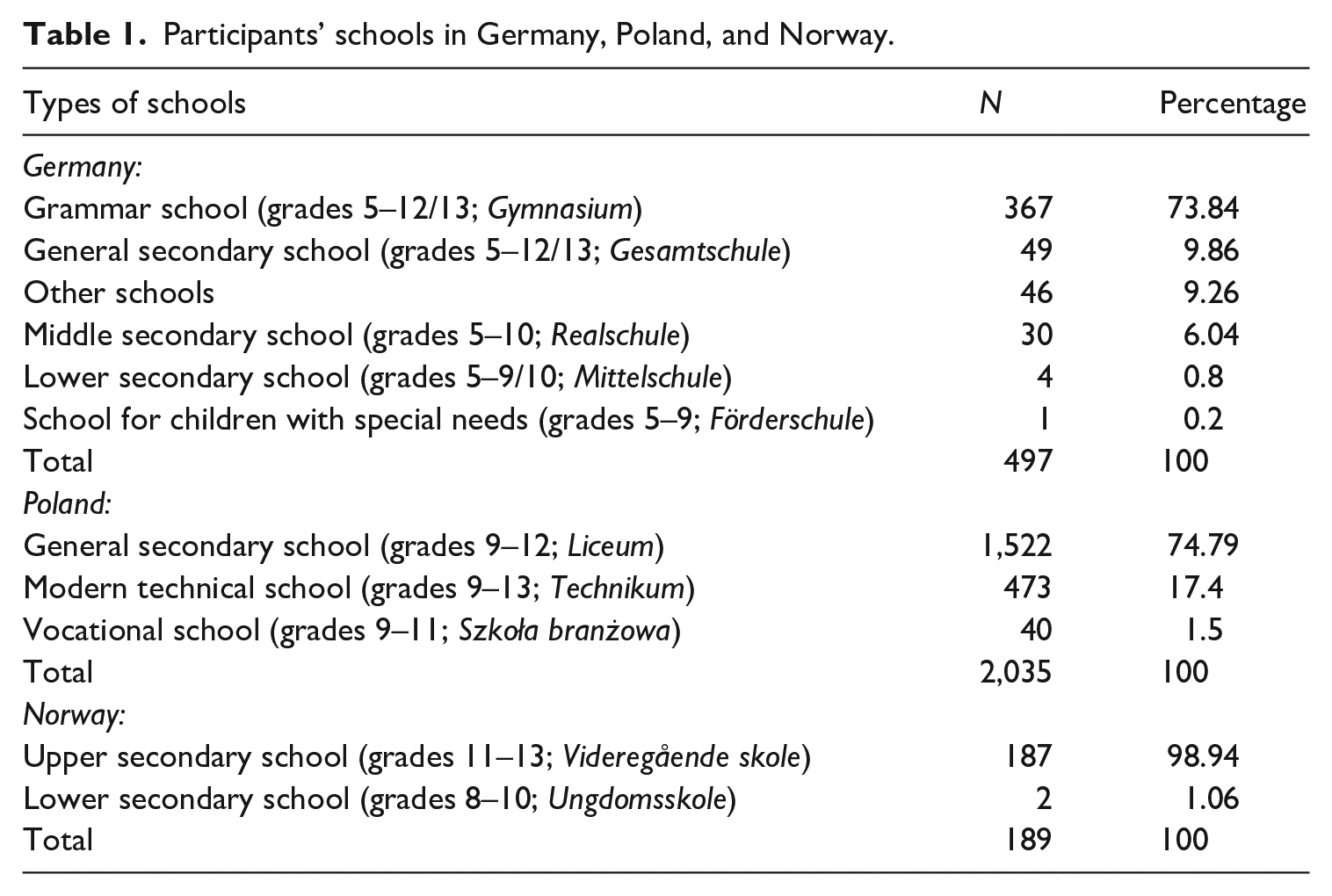
Nearly 21% of participants in Germany, 14% in Poland, and as many as a third in Norway reported speaking another language at home (in addition to German, Polish, and Norwegian respectively). The most frequent additional home languages included English, Polish, and Russian in the German cohort, English, Urdu, and Arabic in the Norwegian cohort, and English, German, and Ukrainian in the Polish cohort. Participants’ level of attainment in L2 English was operationalized twofold: as self-assessment of their overall proficiency in English, ranging from 6 (lowest) to 1 (very good) for the students in Germany and 1 (lowest) to 6 (excellent) for the students in Poland and Norway, reflecting the marking system in each educational system, and as the last mark in English on the most recent school certificate, following the same scales. Data collected from students in Germany was subsequently recoded for analytical purposes. Most students from Germany considered themselves very good (34.6%) or good (38.6%) at English (‘excellent’ not being an option), while most students in Poland self-rated their proficiency in English as very good (35.2%) or good (32.4%), and participants in Norway considered themselves to be excellent (42.4%) or very good (39%) in English. These values strongly corresponded to the reported school marks, as confirmed by the value of the Spearman’s rank correlation: ρ(2719) = .78, p < .01. Table 2 contains descriptive statistics of participants’ self-assessments and their most recent marks in L2 English. Whereas significant differences were found in terms of both self-assessment and participants’ reported marks in L2 English across the German, Norwegian, and Polish schools, as shown by results of the Kruskal–Wallis tests: H1 (2, n = 2,721) = 259, p < .001; H2(2, n = 2,721) = 166, p < .001), and the overall effect sizes were medium (ε21 = .095; ε22 = .061), the results of pairwise comparisons were not entirely parallel overall. A series of post-hoc Mann–Whitney U tests revealed that whereas in terms of self-assessment, participants differed significantly across all pairwise comparisons (WGER- Norwegian = 4.33; p = .006; WGER-POL = –17.64; p < .001; WNOR-POL = 16.59; p < .001), the differences in the reported marks in English were only statistically significant between students learning in Germany and Poland (W = –14.86; p < .001), and Norway and Poland (W = 12.35; p < .001), but the differences between the German and Norwegian students’ marks did not reach statistical significance (W = 2.97; p = .09). In sum, our participants varied across the three countries to a greater extent when it comes to self-assessment than their reported marks in English.
Participants’ self-assessment and marks in L2 English.
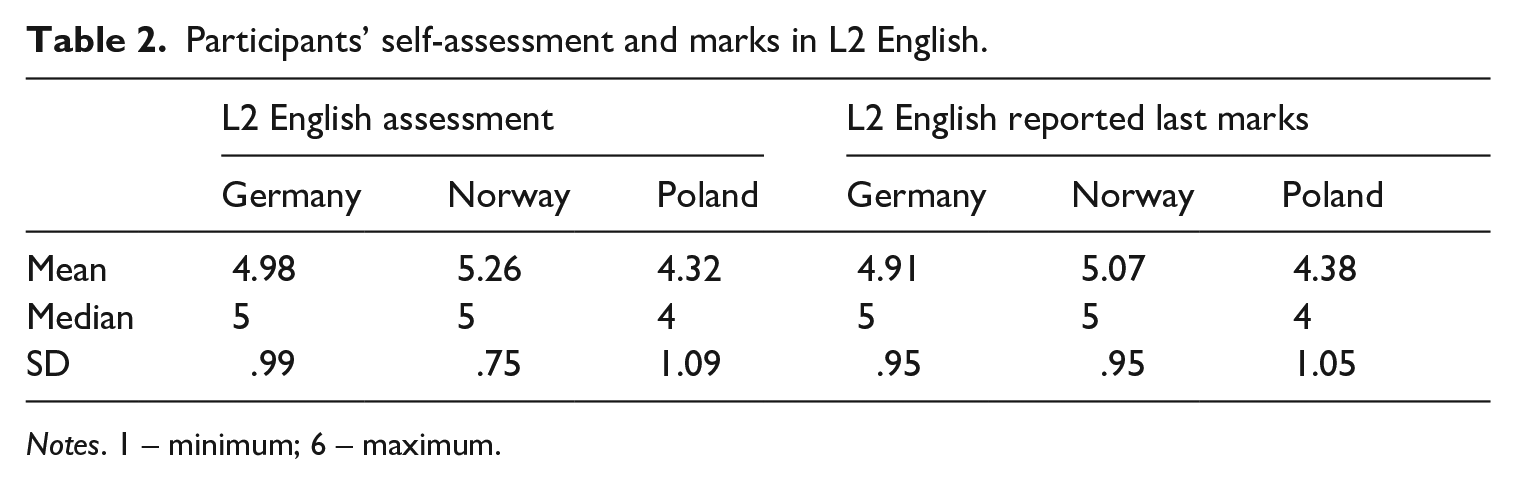
Notes. 1 – minimum; 6 – maximum.
2 The ELT Survey as an instrument measuring L2 learning attitudes
As previously mentioned, the ELT Survey (see supplemental material) is a comprehensive online inventory, and it was designed to assess adolescent learners’ attitudes, experiences, and expectations of L2 English classes. It also includes demographical questions on age, gender, school type, and languages used at home, and provides participants with optional opportunities to self-assess their overall attainment in L2 English and report their most recent marks in English on a voluntary basis (see Section IV.1). The development of the ELT Survey relied on best-practice guidelines for questionnaires in applied linguistics (Dörnyei & Dewaele, 2022; Dörnyei & Taguchi, 2009) as well as the goodness criteria for psychometric tests (Urbina, 2014). Given the specificity of our target group, we paid particular attention to the linguistic comprehensibility of the items by avoiding complex terminology and sentence structures, and aimed for a clear structure of the questionnaire by grouping questions that cover similar topics (Cohen et al., 2018; Moosbrugger & Brandt, 2020). The initial version of the inventory was developed in English and subsequently translated into German, Norwegian, and Polish. Aware of the challenges involved in translating research instruments (Dörnyei & Taguchi, 2009), we employed a modification of the ‘Translation/Back-Translation’ technique (Behling & Law, 2000) to achieve equivalence on a semantic, conceptual, and normative level.
Proficient speakers of the target languages independently translated the text from English into Norwegian and Polish, and then back again. They discussed any discordant words and phrases until an agreement was reached among them. Specifically, in the construction of the scale of attitudes, used in the present study to answer research question 2, we relied on earlier work by Cid et al. (2009) and Dörnyei and Taguchi (2009). After completing the translation process, we piloted the survey with six adolescents (i.e. two from Germany, Poland, and Norway each), focusing particularly on the comprehensibility and completeness of the developed items, as described by Cohen et al. (2018). In terms of length, we shortened the questionnaire, so as not to exceed the 30-minute completion limit (Dörnyei & Taguchi, 2009).
The questionnaire was made available online in Germany (first), then Norway and Poland, and advertised on social media websites. Those who voluntarily decided to participate had a chance of winning a voucher of 20 euros. Several measures were taken to ensure that ethical standards were maintained by obtaining informed consent, allowing participants to skip questions, maintaining anonymity throughout the survey, and avoiding content that could possibly harm our participants (Cohen et al., 2018). In the final part of the survey, we offered to share the findings with our participants and left contact email addresses in each country covered by the study for possible questions.
In order to provide answers to research question 1, we analysed two corresponding items of the ELT Survey: First, we provided our participants with the following adjective labels as descriptors of their L2 English classes: motivating, interesting, boring, monotonous, important for my future, relevant, fun, exciting, annoying, stressful, demotivating, easy, and challenging. Second, we asked them to rate their L2 English classes overall, allowing them to choose from five options, ranging from ‘very bad’ to ‘very good’. To answer research question 2, we asked our participants to provide their responses to a six-item reflective scale measuring their attitudes towards their L2 English classes. These six items, partly based on previous studies by Cid et al. (2009), Artamonova (2020), and Dörnyei and Taguchi (2009), include statements such as ‘I really enjoy learning English’ and ‘I like the atmosphere of my English classes’ (ELT Survey item Q19). In order to account for its reliability, we calculated the Cronbach’s alpha (α) coefficient, which amounted to .9, thus indicating a very good internal consistency of the scale. In line with standards for FLL research (Phakiti et al., 2018; Plonsky, 2013, 2014), we also accounted for the validity of the scale by calculating bivariate item-total Spearman correlations, checking their significance against the p-value adjusted by the Bonferroni correction (p = 0.008) and the critical values of the Spearman rank correlation (n = 2,721; ρ = 0.05). Table 3 shows the values of the item-total correlations for each item of the reflective scale, all of which exceed the critical value.
Item-total correlations for the reflective attitudes scale (ELT Survey item Q19).

In order to ensure data and method triangulation, we also gathered qualitative insights from the participants of our study, which let us identify the reasons behind their attitudes towards L2 English classes (research question 3). To that end, we analysed participants’ comments on their English classes, which they provided in response to an open-ended question about what constitutes a good English lesson for them. More specifically, as the attitudes towards L2 English classes were found to be predominantly negative (see Section V), we focused on 317 learners’ comments involving criticism of L2 English instruction in each of the three countries covered by our investigation. According to the guidelines for mixed-method research (Onwuegbuzie & Collins, 2017), we relied on purposive, nested sampling in this strand of our investigation by analysing the answers involving criticism only, and employed the sequential approach to data analysis by formulating research question 3 only after research question 1 and research question 2 had been answered. Therefore, the data informing our responses to research question 3 did not serve for cross-country comparisons of language learners’ attitudes.
3 Analytical procedures
The analytical procedures involved in providing answers to research question 1 included the Chi-Square Test of Independence, which was used to determine whether there was an association between participants’ country of residence and the characteristics attributed to English classes, with H0 assuming no association, and H1 assuming otherwise. In addition, Cramer’s coefficient of association (V) was computed to account for the effect size per each attribute. Similarly, the Kruskal–Wallis test was applied to determine the existence of statistically significant differences between informants in different countries on their overall ratings assigned to English lessons, with Mann–Whitney U tests used as post-hoc tests. H0 assumed no significant relationship between the ratings and country of residence, while H1 assumed otherwise. This was supplemented with computing the epsilon-squared (ε2) as a measure of effect size. Parallel procedures were implemented for comparing participants’ overall attitudes towards their English classes for the reflective scale used to provide answers to research question 2. These analyses were computed in jamovi and SPSS28.
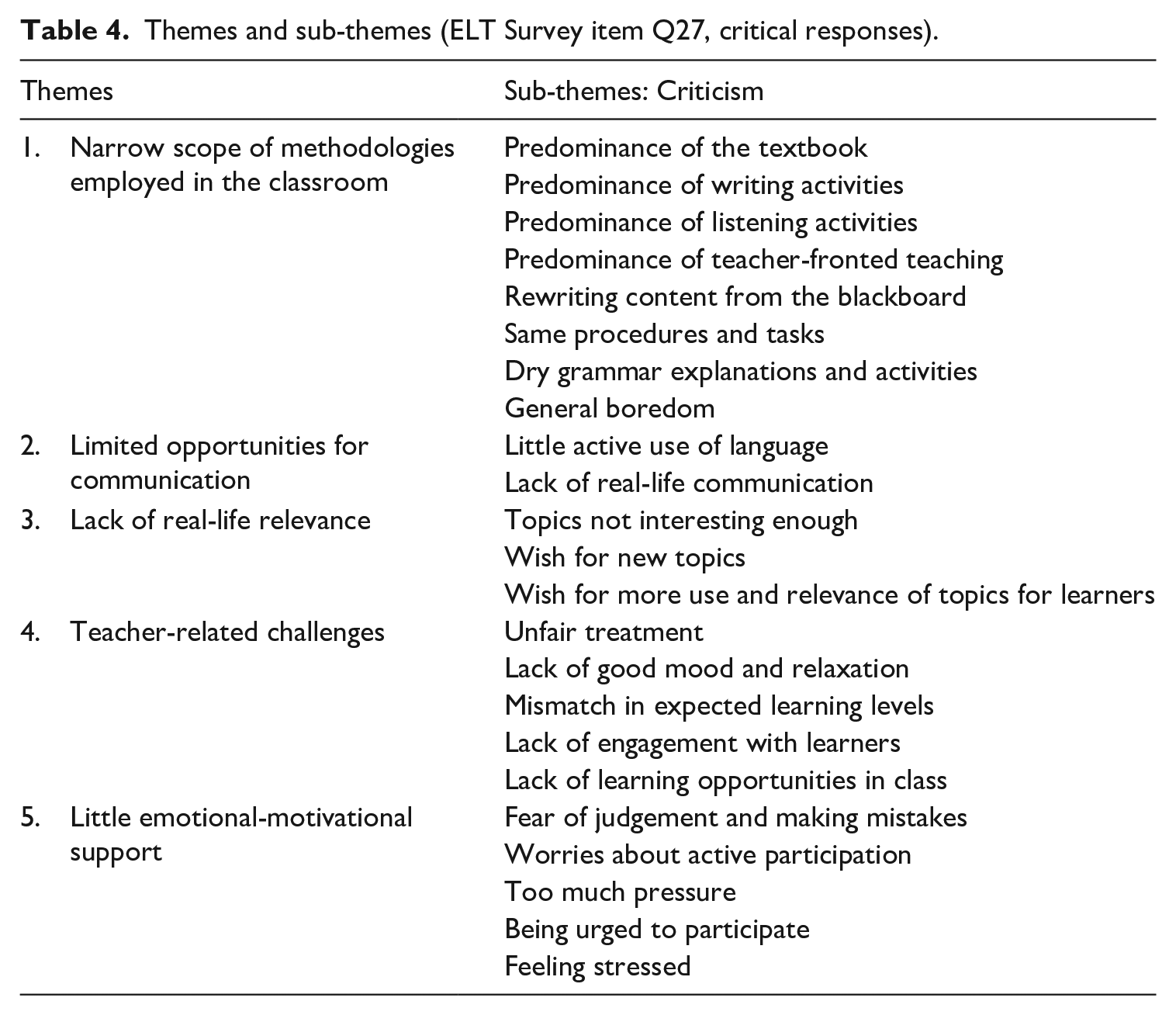
With respect to research question 3, we conducted a reflexive thematic analysis (TA; Braun & Clarke, 2022) of the qualitative data (see Section IV.2) using MAXQDA to identify potential causes for the predominantly negative attitudes towards L2 English classes among German, Norwegian, and Polish adolescents. In the analytic process, we followed the six phases suggested by Braun and Clarke (2006, 2022). In the first phase, to familiarize ourselves with the dataset, each of the authors read participants’ answers to the open-ended question twice. This helped us identify the areas of criticism as well as initially reflect on potential similarities and differences between participants from the three cohorts. Our reflections were deepened in the process of translating participants’ responses into English. In a process of joint discussion, we ultimately identified all responses that included a form of criticism towards L2 English instruction and selected these for qualitative analysis. In the second phase, we sought to identify codes corresponding to research question 3, focusing on the aspects of L2 English instruction towards which participants expressed their disapproval. The third phase involved discussing the preliminarily generated codes in an attempt to identify shared patterns across the dataset. This led to the collation of all coded data. In the fourth phase, we developed and reviewed the themes. This allowed us to refine, define, and name final themes in the fifth phase, as shown in Table 4. In the process of generating the sub-themes, the clarity of our dataset prompted us to use our codes as initial sub-themes. The sixth step involved a collaborative writing process in which we summarized our findings and illustrated selected data extracts to provide an insight into learners’ responses (see Section V).
Themes and sub-themes (ELT Survey item Q27, critical responses).
As asserted in Section IV.2, this strand of our study solely relied on responses including explicit criticism on L2 English instruction in an open-ended item (Q27 in the ELT Survey) and these encompassed a total of 20 responses from the German cohort, 23 from the Norwegian cohort, and 274 from the Polish one. These numbers correspond to the overall number of 479 (German), 185 (Norwegian), and 2,035 (Polish) responses to the open-ended question from each of the cohorts respectively. Yet, in the following sections we abstain from reporting frequencies since, as put by Braun and Clarke (2022, p. 141), ‘(m)uch qualitative data collection renders the use of simple counts problematic’. Furthermore, following our reviewers’ recommendations, rather than establishing comparisons across participants’ countries of L2 English education, we oriented our TA towards informing our response to research question 3, exploring the relationship between participants’ attitudes towards L2 English classes and their accounts of L2 English instruction.
V Results
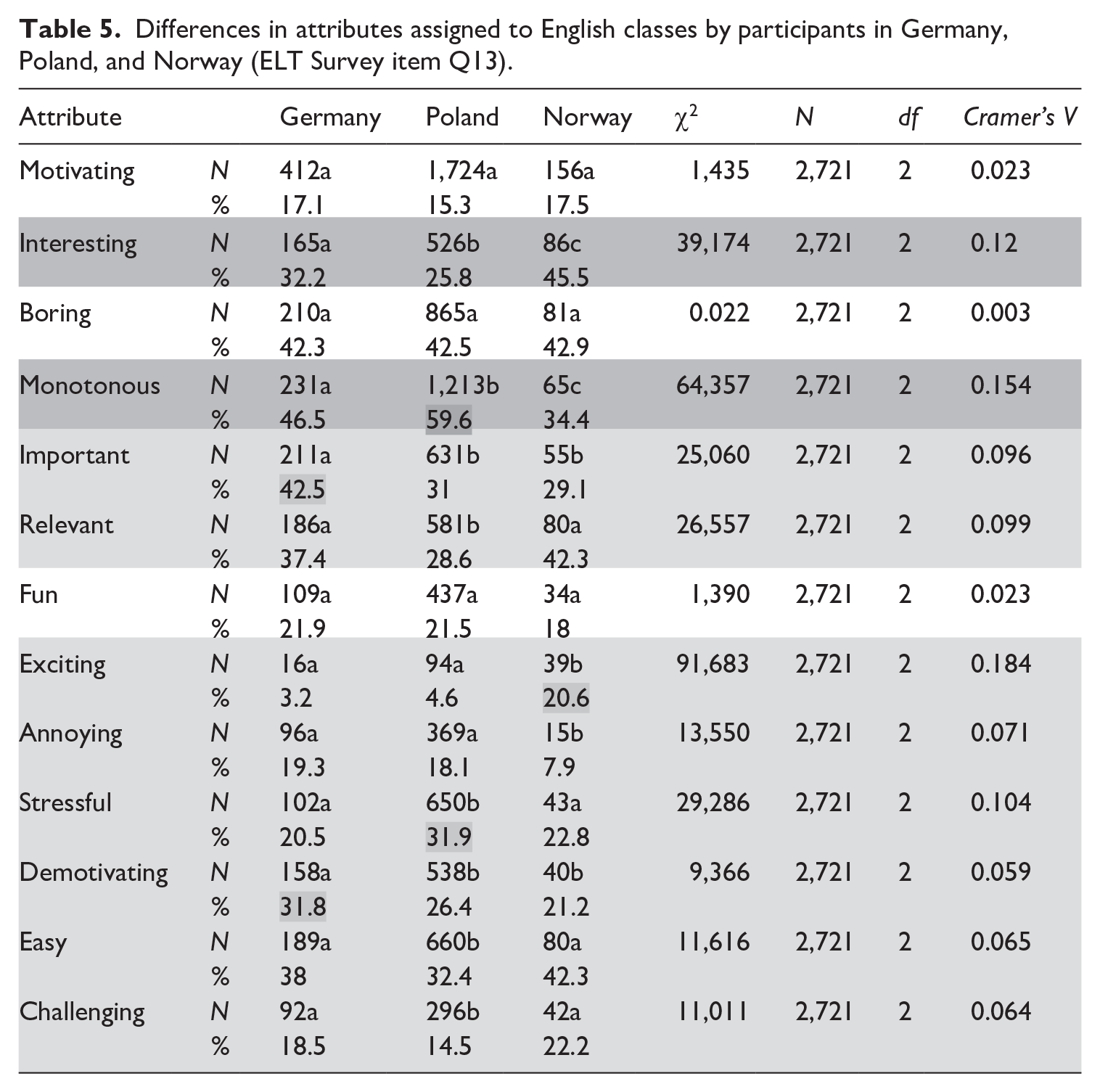
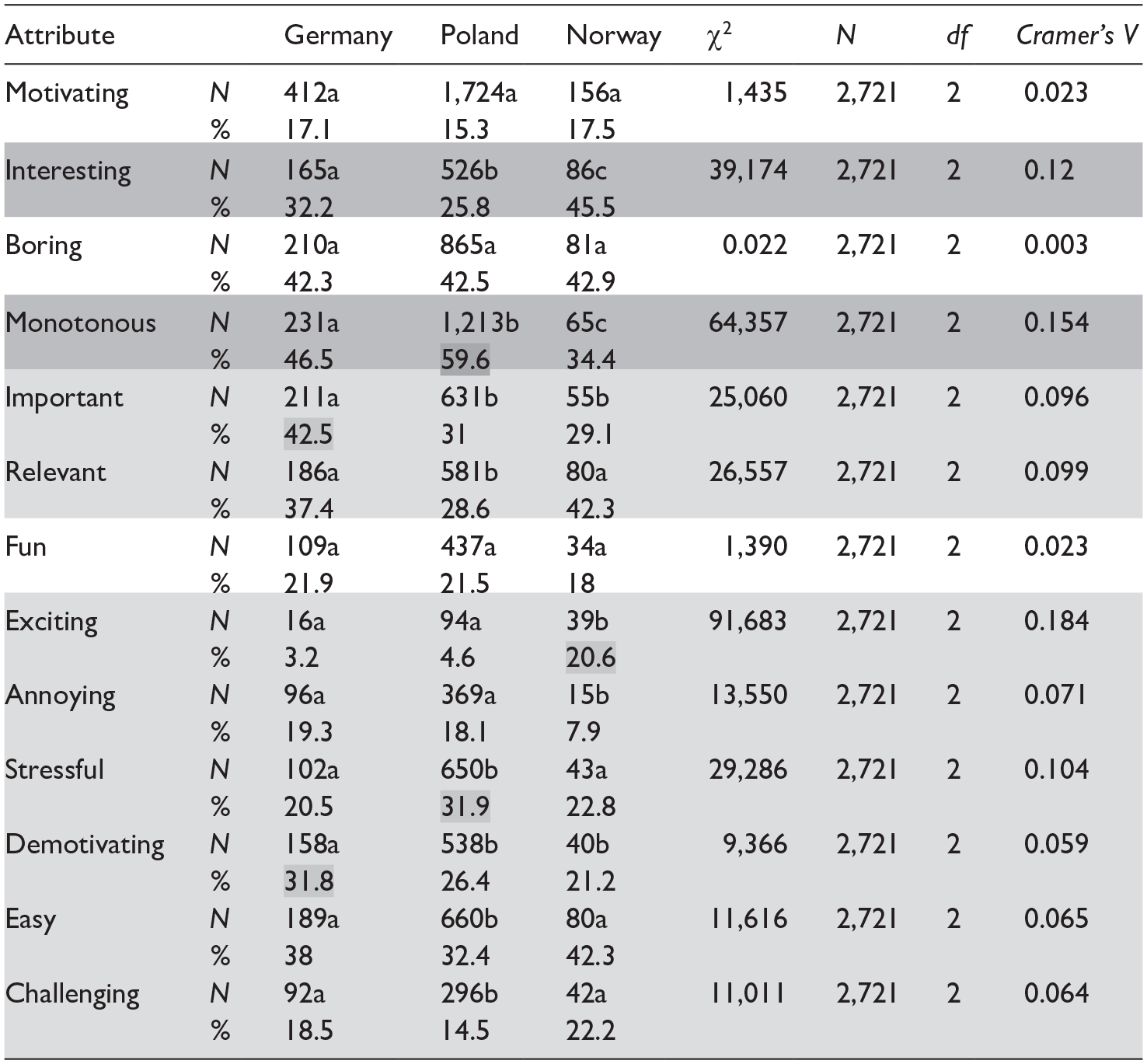
Regarding research question 1, according to the insights from the ELT Survey, the investigated secondary school students across all three countries tended to exhibit negative attitudes towards their L2 English classes. They most often found their English lessons to be boring (more than 42% of participants in each cohort) and monotonous (approximately 60% of L2 English learners in Polish schools, nearly 50% in German schools, and more than a third in Norwegian schools). Descriptors such as motivating and challenging were rarely indicated (15%–17% and 14%–22%, respectively, depending on the country), and so was exciting (3%–20%). Detailed results for all descriptors can be found in Table 5. This notwithstanding, our analyses revealed some major differences across the countries involved in the study. First, the negative perceptions were stronger in the German and Polish cohorts, while the informants from Norway also considered their English lessons to be interesting (45.5%), relevant (42.3%), apart from regarding them as boring and easy (both between 42 and 43%) at the same time. The chi-square test of independence revealed that the relations between holding several opinions about English classes and participants’ country of residence were statistically significant (N = 2,721; p-values adjusted by the Bonferroni correction for multiple tests < .05), while no differences were found for three attributes, that is, motivating, boring, and fun (see Table 5). The most notable differences existed in viewing the lessons as interesting (ranging from 25.8% in Poland to 45.5% in Norway) and monotonous (from 34.4% in Norway to 59.6% in Poland). Also, L2 English learners in German schools considered their English classes significantly more important for their future, yet more demotivating; those from Poland considered their English lessons significantly less relevant, more stressful, less easy, and more challenging; and participants from Norway deemed them more exciting and less annoying.
Table 5 also contains detailed information on the differences across participant cohorts, with dark shading indicating significant differences across all three cohorts and light shading indicating significant differences between two of them. As indicated by the Cramer’s V values, the effect sizes should be considered low. The letters a, b, and c complementing the numbers are used to illustrate which cohorts differ significantly: same letters (e.g. a, a, a) denote a lack of statistical significance while different letters (e.g. a, b, c) denote statistical significance.
Differences in attributes assigned to English classes by participants in Germany, Poland, and Norway (ELT Survey item Q13).
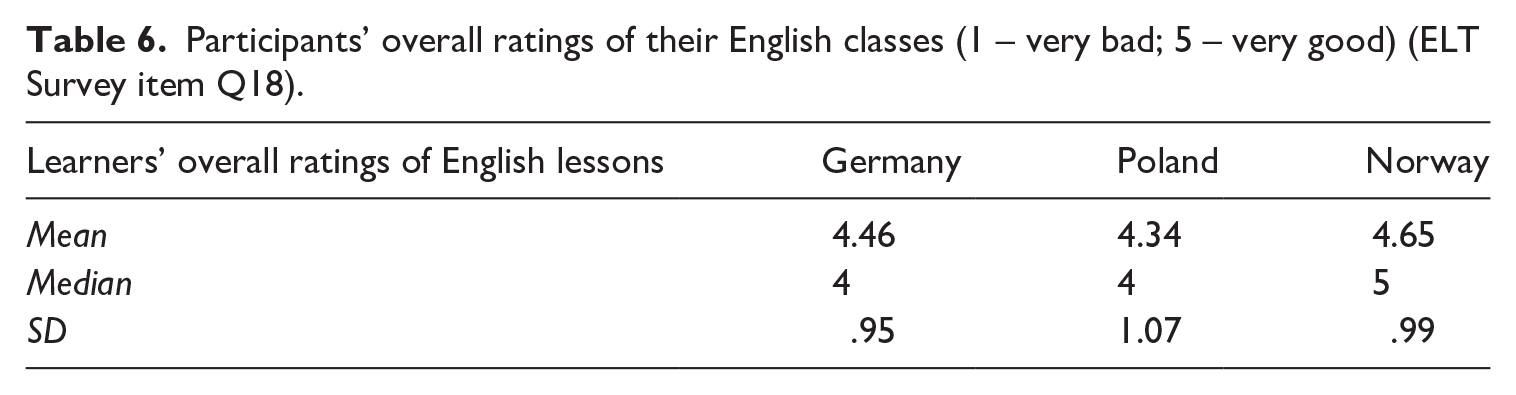
When asked to rate their English lessons on a Likert-scale (1 = very bad, 5 = very good) our participants assessed them differently in the three countries, as indicated by the Kruskal–Wallis test results (H(2) = 20.047; p < 0.01). In terms of pairwise comparisons, the Mann–Whitney U test revealed that students learning in Germany and Norway rated their classes significantly more highly than those from Poland (UGER-PL = 92.77; p = 0.042; UPL-NOR = 231.16; p < 0.01). No significant differences in this respect were found between participants from Germany and Norway (UGER-NOR = –138.39; p = 0.1) and the effect size was negligible, with an ε2 value amounting to 0.07. Table 6 contains relevant descriptive statistics for overall L2 English lessons ratings.
Participants’ overall ratings of their English classes (1 – very bad; 5 – very good) (ELT Survey item Q18).
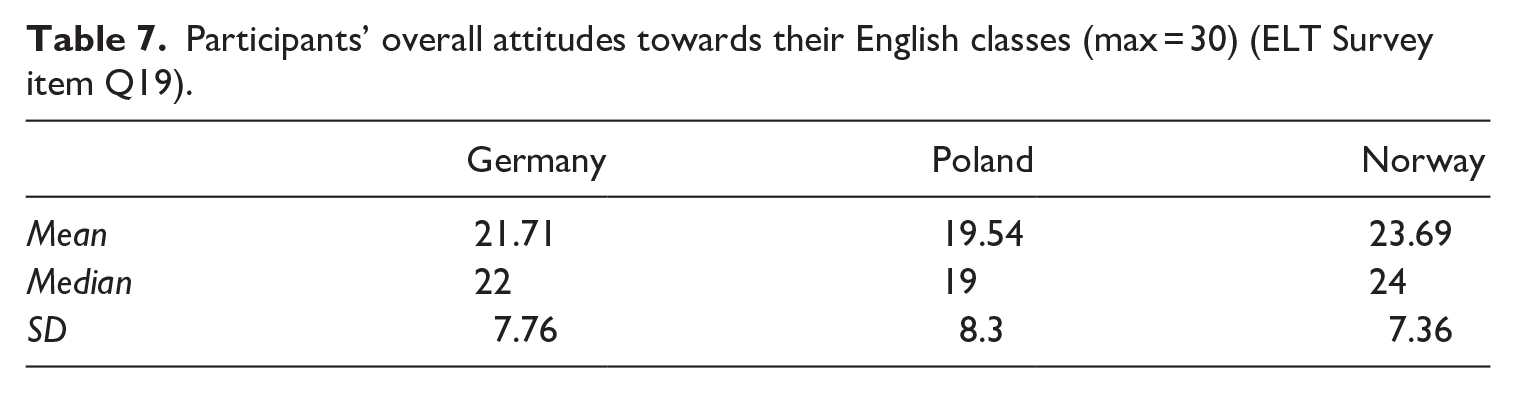
The above outcomes correspond to the findings relevant to research question 2 from the reflective scale on attitudes, ranging, in terms of favourability from 65% on average in the Polish cohort to 79% in the Norwegian one (for descriptive statistics, see Table 7). Here, the Kruskal–Wallis test results confirmed statistically significant differences across participants from schools in Germany, Poland, and Norway (H(2) = 67.09; p < 0.01). The effect size was low (ε2 = 0.02). In parallel to previous pairwise comparison results, the attitudes towards English classes were generally less favourable among participants from Poland than among their German and Norwegian counterparts, as shown by the Mann–Whitney U test results (UGER-PL = 213.91; p < .01; UPL-NOR = –401.99; p < 0.01). At the same time, statistically significant differences existed between the German and Norwegian cohorts (UGER-NOR = –188.08; p = .01), with Norwegian students’ attitudes being overall more optimistic than their German counterparts.
Participants’ overall attitudes towards their English classes (max = 30) (ELT Survey item Q19).
In the process of TA (Braun & Clarke, 2006, 2022), we investigated the criticism of L2 English instruction in German, Norwegian, and Polish secondary schools expressed by participants in their accounts of a good English class. We identified five major themes, as illustrated in Table 4, which we discuss below. As mentioned in Section IV.3, we only refer to a selection of the subthemes focusing on the central findings that indicate potential reasons for learners’ primarily negative attitudes. While our TA aimed to unveil the reasons behind learners’ largely negative attitudes towards their L2 classes, due to the imbalance in the sizes of the three cohorts under investigation, we refrain from making direct comparisons between them and focus on within-group patterns. The data set can be found in supplemental material.
Theme 1: Narrow scope of methodologies
The investigated students predominantly complained about a lack of methodological variety in L2 English classes, criticizing a narrow focus on specific language subsystems or skills, and pointing to a poor level of diversity in learning activities. Concerning the sub-theme same procedures and tasks, participants’ responses revealed multiple instances of criticism. Learners’ call for a greater variety was evident in the following responses to the question enquiring about a good English class: ‘not only writing texts’ (GER, 88); ‘a varied English class where we don’t just do the same thing’ (NOR, 4768); ‘equal focus on different activities (listening, reading, writing) – not just conversation in English’ (PL, 1089); ‘not just grammar, but also pronunciation, listening, reading, and writing’ (PL, 1803). For some learners, grammar practice seemed particularly overwhelming, as they expressed their dissatisfaction with ‘dry grammar explanations’ and juxtaposed it with their willingness to engage in other aspects of language learning instead of ‘doing grammar for hours’ (PL, 3234). This lack of variety also prompted participants to report feelings of boredom, as in the following excerpts: ‘very easy for it [the class] to get boring’ (NOR, 4861); ‘some lessons are really boring’ (PL, 2482). Participants’ negative attitudes towards L2 English classes were related to their course instructors’ overreliance on textbooks. This was particularly strongly voiced by the adolescents learning English in Polish schools, in whose instances of criticism directly addressed the predominance of textbooks, and many expressed the desire to use ‘more than just the student’s book and exercises’ (PL, 1197). Participants’ overall desire for methodological variety and their longing for enjoyable classes was aptly phrased by one learner (PL, 2700) who expressed their expectations as follows: More studying through entertainment – we used to play Kahoot or Quizlet in primary school and these lessons were exciting, which allowed us to remember a lot through play – in the secondary school I miss it, classes are more rigid and structured.
Theme 2: Limited opportunities for communication
The desire to experience real-life communication in English and a reported lack thereof were evident among learners in Polish and German schools. Participants referred to little active use of language in the classroom. Some specifically pointed to a limited amount of time allocated for using the target language in communicative activities, and expressed their desires for more communication, answering the question about what makes a good English class: ‘more talking’ (GER, 300); ‘when we learn to speak more’ (PL, 3288). At the same time, it needs to be asserted that criticism concerning limited opportunities for communication was virtually non-existent in the data collected from participants learning English in Norwegian schools.
Theme 3: Lack of real-life relevance
Criticism regarding the topics present in ELT was evident in multiple learners’ responses across all three countries, highlighting a lack of interesting topics and a desire for new and more relevant issues to be addressed in L2 English classes. Instances of criticism within the single sub-theme topics not interesting enough, indicate that the topics addressed in English lessons were, at least to a certain extent, not engaging, and they failed to reflect learners’ lifeworlds. One participant in Norway explicitly commented that ‘the topics are boring’ (NOR, 5060). As far as the two remaining subthemes, wish for new topics and wish for more use and relevance of topics for learners are concerned, participants in all countries consistently expected the thematic focus in ELT to shift and become more learner-centred. This was represented by a demand for ‘topics which are for the youth, e.g. social media’ (PL, 2475), and classes in which it is possible to ‘learn something useful which I can use in everyday conversations’ (PL, 1443).
Theme 4: Teacher-related challenges
Teacher-related challenges mainly concerned pedagogical aspects such as how teachers treat learners, how they engage with them, and which learning opportunities they provide in class. Negative teacher appraisals include two sub-themes: lack of good mood and relaxation and lack of engagement with learners, which were the most commonly brought up issues. Learners reported significant deficiencies in terms of positive, facilitative atmosphere as well as the level of teacher engagement in the classroom. Concerning the lack of good mood and relaxation, participants expressed the following wishes: ‘the teacher does not continuously complain about students, but helps them if they are not capable of doing a task’ (PL, 1978); ‘the teacher doesn’t shout at anyone that he or she is ignorant’ (PL, 2323). Strikingly, such wishes were absent in the insights from the German and Norwegian cohorts, and although the imbalance in the number of participants may have influenced this, we believe it needs to be reported. Inappropriate expectations and inaccurate level of challenge were criticized in all three countries. Some learners from Poland also expressed their wishes for a good English class in which ‘the teacher tries to match the class to students’ level’ (PL, 2482). In this respect, similar expectations were common in the remaining cohorts, as visible in the short comments: ‘vocabulary is not at a university level which I don’t know’ (GER, 327); ‘not too much information at once’ (NOR, 4764).
Theme 5: Little emotional-motivational support
Criticism related to insufficient emotional-motivational support largely referred to feelings of fear and experiences of stress in L2 English classes. References to insufficient emotional support were found in insights from participants in all three countries. Some learners feared being judged and longed for ‘not worrying about whether I’ve raised my hand too infrequently or made stupid mistakes’ (GER, 60). Others reported strong negative emotions, among which anxiety was most common. This was evident in one comment from a Norwegian student, who considered a good class one ‘that I can avoid crying about’ (NOR, 4796). In a similar vein, stress was experienced by learners of English in Poland as references to the sub-themes feeling stressed, fear of judgement and making mistakes, and too much pressure were made. Examples of expectations of a good class included ‘not stressed all the time during class’ (PL, 1584); ‘when I don’t experience the stress’ (PL, 1260), ‘not under the pressure of marks and unannounced tests’ (PL, 1766). These findings relate to the fourth theme, teacher-related challenges, underscoring learners’ desire for a relaxing environment of L2 English instruction that does not put an emotional strain on them.
VI Discussion
In relation to research question 1, addressing adolescents’ assessment of their English lessons, the most frequent labels attached to English classes were boring and monotonous. Not a single positive adjective was ticked by more than 45.5% of any of the studied cohorts, which was the case of ‘interesting’ in the Norwegian group. At the same time, participants from Poland were consistently more critical in their choice of attributes that they assigned to their English classes than their German and Norwegian counterparts. A similar pattern was found in participants’ overall ratings of their English classes, which were significantly lower in the Polish cohort than in the German and Norwegian ones. At the same time, and quite in contrast to the selected attributes, participants rated their English lessons relatively highly, that is, above 4 out of 5, regardless of their country of residence.
Concerning research question 2, which focused on L2 learners’ attitudes towards English classes, findings based on responses to the reflective scale revealed that participants exhibited moderate favourability, from 65% on average in the Polish cohort to 79% in the Norwegian one. Whereas these results cannot be seen as overwhelmingly positive, particularly in the context of education (65% interpreted as a school grade barely corresponds to a pass), we also found that the investigated learners differed significantly. Attitudes towards L2 English classes were generally less favourable among participants from Poland compared to their German and Norwegian counterparts while learners in Norway exhibited more optimistic attitudes overall compared to learners in Germany.
According to the outcomes of the TA conducted to inform research question 3, adolescent learners of English in Poland, Norway, and Germany consistently pointed to insufficient methodological variety in their English classes, which tended to focus on specific language subsystems (grammar in the first place, particularly in Poland) or skills. Pertinently, many students found their classes boring due to repetitive tasks and overreliance on textbooks. Furthermore, they expressed a desire for more engaging and interactive activities. L2 English learners in Poland and Germany also reported insufficient opportunities for real-life communication in English and wished they spent more time communicating. At the same time, students across all countries were critical about the topics discussed in their L2 English classes, which many considered uninteresting and irrelevant. They called for more engaging and youth-relevant topics, such as social media, and practical content applicable in everyday conversations. Negative appraisals of teachers were present in all three countries, especially concerning the lack of a positive classroom atmosphere and insufficient teacher engagement. Issues such as inadequate demands and a mismatch in expected learning levels were common across all countries, but expressed more strongly in Poland. Also, some participants in the three countries experienced anxiety and suffered from stress in their classes and expressed a need for a more supportive and less pressured learning environment.
In general, the analysis highlights a strong call for diverse, communicative, relevant teaching methodologies, along with better emotional and motivational support for learners. Our findings indicate that adolescent learners in Germany, Norway, and Poland, tend to hold negative attitudes towards their L2 English lessons, which stands in stark contrast to the findings of previous studies (see Section III). This is particularly worrying since they also seem to recognize the importance of their English classes overall. Both the prevalence of negative adjectives used for describing English lessons and the predominance of the theme narrow scope of methodologies in the TA indicate that curricular issues and instructional procedures may be at stake rather than learners’ attitudes towards the English language as such.
The choice of predominately negative descriptors, such as ‘boring’ and ‘monotonous’ (research question 1) indicates a lack of engagement in today’s English classes, and more so in Poland and Germany than in Norway. This is corroborated by learners’ insights provided as responses to the open-ended question, where boredom, resulting from lack of variety, was identified as a prominent subtheme in the TA (research question 3). According to the latter, one reason behind this is the frequent use of textbooks and the repetition of similar types of activities in L2 English lessons. These outcomes bear striking resemblance to M. Ellis’s (2019) observations (see Section III), confirming a rather gloomy picture of L2 English instruction in Poland, largely dominated by coursebook-based exercises, reading practice, and explicit grammar instruction, and underlying learners’ desire for change towards more active engagement through discussions, group work, and games (M. Ellis, 2019, p. 34). Importantly, the differences in national curricula, outlined in Section I, are likely to contribute to the disparities in learners’ attitudes towards ELT. In particular, learner-centredness along with a greater focus on communicative competence, firmly present in the Norwegian national L2 English framework, are likely to positively boost learner engagement and foster proactive attitudes while reducing inhibitive classroom dynamics (Rogers, 2014). In contrast to traditional teacher-centred approaches, such frameworks also enable secondary school students to take ownership of the language learning process, thus diminishing the likelihood of their disengagement (Wiśniewska, 2013). Moreover, recent empirical evidence links the development of digital competencies, also recognized in the Norwegian, rather than the Polish and German, curriculum, to increased teaching effectiveness and improved learner engagement (Cao et al., 2023).
The finding that the attitudes towards L2 English classes were less favourable in the German and Polish cohorts than in the Norwegian one (research question 2) may indicate that the perception of Norwegian ELT is relatively more engaging. This is corroborated by one of the outcomes of the TA: Norwegian learners did not complain about limited opportunities for communication and were relatively less critical of the relevance of topics covered in ELT. This notwithstanding, we need to acknowledge that the imbalance in participant numbers across the three countries may have resulted in some limitations in the reported findings. The perception of L2 English classes in Norway as relatively more learner-centred and interactive naturally prompts reflection about the design of the curriculum and considering the incorporated topics as aligned to a greater extent with learners’ interests than those discussed in Germany and Poland. Hence, to some extent, our results underscore the findings reported by Scheffler et al. (2017), which labelled ELT in Norway as more content-oriented, compared to a more language-focused ELT in Poland. In this vein, a greater focus on the actual content rather than linguistic means and language-focused activities may result in more positive attitudes towards ELT. Learners’ negative appraisals of English lessons regarding their potential for creating interest (Wiśniewska, 2013), particularly in Poland and Germany, might also be linked to the scarcity of engaging learning content in ELT, firmly present in their expressed wishes for more interesting, relevant, and new topics in ELT. Such an explanation is corroborated by the outcomes of a recent study conducted in Germany in a group of adolescents on the potential use of controversial and taboo topics in English lessons, which revealed their absence in language education accompanied by a high level of interest in them (Summer & Steinbock, 2023). In light of these findings, inclusion of more engaging and relevant content could potentially increase learners’ interest and thus contribute to more positive attitudes towards ELT. However, achieving this requires not only a bottom-up approach driven by students’ interest, but also a top-down commitment to curricular reform at the national level, as advocated by Richards (2017), emphasizing the importance of integrating culturally relevant and meaningful content in language education.
Apart from the methodological and curricular aspects discussed above, differences in attitudes towards L2 English may also be attributed to cultural factors including the status of teachers in the respective countries. This corroborates Littlewood’s findings (2001), according to which attitudes to L2 English classes may vary even among students whose cultural backgrounds are similar, and originate from regional and international differences in the status of English teachers or the training they had received. These, in turn, are reflected in the teachers’ willingness to invest time and effort in incorporating innovative teaching practices, such as those involving the use of digital technologies or interactive tasks. As posited by Artamonova (2020), attitudes to L2 English lessons are also linked to learners’ assessment of these since attitudes directly affect motivation, which in turn is likely to affect learning outcome and grades. Hence, it is tempting to link overall more positive attitudes to higher assessment, which is, to some extent, the case of our participants. The relatively more positive attitudes to L2 English in Norwegian learners, compared to their German and Polish counterparts, correspond to their better self-assessments and self-reported marks in English (see Section IV.1), statistically significant for the Norwegian and Polish cohorts.
All in all, the reported findings in this article suggest that while learners recognize the importance of learning English, their choice of negative adjectives as descriptors of L2 English lessons highlights the need for more engaging approaches and content, particularly in Poland and Germany. While some of the reasons for the largely negative attitudes are not fully discernible from the analysis of the data presented in this article, future research should strive to identify the connections between learners’ attitudes and specific aspects of L2 English instruction. This understanding is crucial when analysing cross-cultural disparities in attitudes towards L2 English classes, as these are likely to be reflected in disparities in L2 English proficiency.
VII Conclusions
In an effort to amplify the voices of L2 English learners, the present study explored their evaluations of ELT in secondary schools from a comparative perspective, focusing on three European countries: Germany, Norway, and Poland. The ELT Survey was used to collect data as an inventory designed for learners to provide accounts of their L2 English classes. Our major aim was to inform L2 researchers and educators about current learner perceptions of ELT to identify potential areas that require improvement and contribute to ensuring high quality and engaging foreign language teaching and learning practices.
Strikingly, unlike previous studies (e.g. Nikolova, 2011), our study revealed that learners’ attitudes towards L2 English classes were far from favourable. We also detected considerable differences in learners’ attitudes towards L2 English classes across the three cohorts of learners in German, Norwegian, and Polish schools. Since the investigated learners tended to attribute their L2 English with negative rather than positive descriptors, most frequently ‘monotonous’ and ‘boring’, we believe further research is necessary to further explore the reasons of such evaluations so as to counteract them through improved teacher training as well as adequate curricular changes. At the same time, we recognize the potential benefits of benchmarking from those L2 English classrooms towards which learners exhibit relatively more positive attitudes – in our case: classrooms in Norwegian secondary schools. As such, the range of the observed disparities between Norway and Poland, for instance, legitimizes the need for international cooperation of educators and researchers who share the context of English taught as a foreign rather than second language, which provide a research-informed basis for curricular guidelines and teacher training courses on a global scale. Finally, our study complements previous research on the role of interest in foreign language learning (e.g. Dewaele & Dewaele, 2018; Wiśniewska, 2013) as it empirically supports linking interest and attitude as variables both affecting learners’ engagement (Renninger & Hidi, 2015).
The present study is not free from limitations. First, whereas the participant numbers in each of the cohorts were sufficient to run statistical tests and reveal significant differences, we hoped for a greater participation rate, particularly in Germany and Norway, and a greater rate of completion. While the participation rate in the case of Poland does reflect the number of the population of the country, we feel that in case of the Norwegian and German cohorts the gratification opportunity could have been insufficient to encourage adolescents to complete the survey. In addition, the TA focusing on explicit criticism of L2 English classes enabled us to provide a more comprehensive picture of potential reasons for learners’ rather negative attitudes towards ELT. Although our dataset was imbalanced, the TA enabled us to identify several themes, offering important insights into learners’ negative attitudes, which stem, among others, from the narrow scope of methodologies, limited opportunities for communication, and non-engaging topics. Further qualitative insights are needed to understand the reasons behind these attitudes. In this regard, we plan to follow up on the current study by reporting the results of a qualitative investigation on how learners in Germany, Norway, and Poland describe the ideal English teacher (Q26). Finally, we believe the scope of the investigation can be broadened in two main ways: (1) by adopting a longitudinal approach that compares the perspectives of learners, university students, and adult learners – as done by Kormos & Csizér (2018) in their study on English learning motivation – and (2) by expanding the participant pool to other countries. To facilitate this, we have made the ELT Survey accessible on the OSF platform in four languages (English, German, Norwegian, and Polish), with the possibility for researchers to translate it into other languages.
Footnotes
Acknowledgements
We would like to thank our colleagues in Bamberg (Regina Grund, Claudia Schnellbögl, Michelle Zirkel), Poznań (Marta Janachowska-Budych, Kamil Długosz, Dorota Owczarek, Danuta Wiśniewska), and Agder (Mariette Aanensen) for their support in developing this survey. Thanks also go to Julia Schwerin and Laura Stolle for their assistance in collecting the data, to Lukas Sönning for his advice on the statistical analyses, and to Valentin Werner for his comments on the final draft. Finally, we are grateful to all participants of this survey for providing us with valuable insights into their experiences of L2 English instruction.
Funding
The author(s) disclosed receipt of the following financial support for the research of this article: The ELT Survey was funded by the Staatsministerium für Wissenschaft und Kunst “Internationalisierung 2.0” at the University of Bamberg, Germany in 2022. The publication of this article was supported by the University of Bamberg.
Consent to participate
Informed consent was obtained from all the participants in this study.

Data availability statement
The raw data supporting the conclusions of this article will be made available by the authors without undue reservation.