



Abstract
This study investigates the relative online effects of structured-input practice on the acquisition of English passive and active sentences. The main purpose of this study is to compare native and non-native processing of English active and passive sentences. Non-native Chinese first language (L1) learners (26 participants) received structured-input instructional treatment on the target feature under investigation. After instruction, accuracy and response-time effects of the instructional efforts were measured using a self-paced reading test adopted to measure participant’s processing behaviours on passive and active verb forms. The native learners (17 participants) provided a baseline for comparisons. The main findings from this online study revealed that non-native participants were not statistically different, after receiving the structured-input treatment, from the native participants in terms of correctly processing sentences containing English active and passive constructions.
Keywords
I Introduction
1 The role of formal language instruction
The role of formal instruction has been widely debated in second language acquisition research. According to VanPatten (forthcoming) ‘instruction in L2 [second language] research can be operationalized in various ways, but all involve external attempts to induce acquisition’. The debate around the relative effects of formal language instruction on the rate of acquisition has mainly focused on whether instruction per se might influence language development, neglecting the fundamental question of how it might interact with language development processes. One possible way of researching the causes of the effects instruction is to look at the interaction between instruction to which L2 learners are exposed to and the way they process input.
In addition, much of classroom research investigating the role and effects of formal language instruction has been biased towards the use of offline tests to measure explicit knowledge (VanPatten et al., 2019). This methodological limitation has paved the way for the need for researchers to use online testing to measure more in-depth processing and implicit knowledge, which is qualitatively different from explicit knowledge (VanPatten & Smith, 2022).
Research on the effects of processing-instruction and structured-input practice (see review later in this article) has addressed the importance to investigate how formal language instruction makes a difference in L2 learners’ processing of language input (Wong, 2024). VanPatten (1996, 2015a) has argued that there are universal strategies used by L2 learners to process input. Input does not automatically enter L2 learners’ mind/brain during exposure for two main reasons: (1) L2 learners have limited capacity of processing information; (2) L2 learners filter input through processing strategies such as the Primacy of Meaning Principle and the First Noun Principle (VanPatten, 2015a). Scholars investigating the role of processing-instruction and structured-input practice (Benati, 2021; Lee, 2015; VanPatten, 1996) have argued that structured-input activities are a type of pedagogical intervention which are effective in assisting L2 learners in the correct processing and interpretation of linguistic features in the input. Structured-input activities have proven effective in providing L2 learners with an opportunity to process syntactic features, such as English passive constructions, more effectively and therefore provide a direct route for L2 learners to convert the input to intake (VanPatten, 2015b).
2 The processing of non-canonical word-order sentences
Syntactic structures such as passive constructions are sometimes misinterpreted because of the use of the First Noun Principle (VanPatten, 2004, 2015a). VanPatten (2020, p. 12) stated that ‘learners tend to process the first noun or pronoun they encounter in a sentence as the subject’. The First Noun Principle (FNP) represents a default universal processing strategy adopted by L2 learners to assign subject and object roles to the nouns they encounter in a sentence, to know who did what to whom. The main element responsible for L2 learners’ syntactic processing seems to be the order in which grammatical elements are presented in a sentence. In a canonical order sentence, by allocating the role of subject to the first noun such as Jane kissed John, L2 learners comprehend this sentence successfully. However, adopting the same processing order, they will fail to interpret a non-canonical order sentence such as the passive sentence John was kissed by Jane. In this case, L2 learners misprocess and misinterpret the meaning of the sentence, understanding it to be John who kissed Jane. The misprocessing (misassigning roles) and subsequent misinterpretation of the meaning would lead to acquisitional delays (e.g. processing of syntax for example) as demonstrated in several empirical studies (Lee, 1987; Lee & Malovrh, 2009; LoCoco, 1987; Simonsen, 2020; Tight, 2012; VanPatten & Houston, 1998).
Empirical research conducted to attenuate the effects of the FNP by employing processing-instruction and structured-input practice has shown positive results in moving L2 learners away from relying on the FNP. Processing instruction is a pedagogical intervention developed by VanPatten (1996) to alter L2 learners incorrect processing strategies and encourage more optimum ones (VanPatten, 1996). In his original study, VanPatten first applied processing instruction in the case of a Spanish word-order-based processing problem (VanPatten & Cadierno, 1993). Processing-instruction research has demonstrated that it is an effective intervention to replace the reliance of L2 learners on canonical word order to interpret sentences that represent non-canonical. Processing instruction has been shown to be effective across various second languages and linguistic structures such as English passives (Uludag & VanPatten, 2012), French causatives (VanPatten & Wong, 2004), Japanese passive (Hikima, 2011), and Spanish passives (Lee, 2015).
Lee and Benati (2013) provided empirical evidence of the effects of processing instruction in circumventing the FNP and facilitating the accurate processing of English passive sentences. Processing instruction is successful in altering L2 learners’ reliance to the first noun to understand the agent in passive sentences. Lee and Doherty (2019) compared native and non-native processing of active and passive sentences in Spanish. Accuracy and response time were measured in a paired picture-matching online task. After receiving processing instruction, the non-native speakers showed no significant difference from the native speakers in accuracy and response time. The behaviour of the non-native participants became more native-like after exposure to processing instruction. Benati (2021) explored the effects of structured input on the acquisition of Italian passive forms using a picture-selection eye-tracking task to measure accuracy and eye-movement patterns while they were processing auditory sentences. Results of this study indicated that the structured-input group achieved significantly higher accuracy scores, revealing that structured-input training causes a change in learners’ eye-movement patterns.
3 The role of structured-input practice
Structured-input practice aims to improve how L2 learners process and interpret grammatical structures, rather than teaching grammatical rules. L2 learners do not internalize the grammatical rules they are taught simply because such rules do not reflect how language is processed and internalized (VanPatten & Rothman, 2014). Structured-input activities improve L2 learners’ ability to parse syntactic structures correctly, such as by facilitating the correct processing of the subject and the object in a sentence.
Processing instruction is a pedagogical intervention developed by VanPatten (1996) to alter L2 learners incorrect processing strategies and encourage more optimum ones. In processing instruction (2015b), there are three main components: (1) L2 learners are given explicit information about a grammatical form or structure; (2) L2 learners are given explicit information about how the default use of a processing principle (e.g. word order) might negatively affect their processing; (3) L2 learners are exposed to structured-input activities. Structured-input activities are of two types: referential and affective. Referential activities are those for which there is a right or wrong answer and for which the learner must rely on the targeted grammatical form to obtain the meaning. Affective structured-input activities are those in which learners express an opinion, belief, or some other affective response and are engaged in processing information about the real world. During structured-input activities, L2 learners do not receive any explanation about the target form, no specific feedback on their responses, and they do not engage in any output practice. Structured-input activities manipulate the input in particular ways to ensure L2 learners make accurate processing of forms/structures. Structured-input activities enhance L2 learners’ accurate interpretation of language input by circumventing processing strategies such as the FNP (VanPatten, 1996).
Structured-input practice is the key component in processing instruction, in helping L2 learners make correct interpretation of sentences or discourse containing syntactic structures (Benati, 2021). The effectiveness of structured input has been positively assessed through interpretation tests (offline tests), production tests (sentence- and discourse-level tasks), eye-tracking, and self-paced reading online tests.
4 The effects of structured-input practice
a Measuring offline effects
VanPatten and Oikkenon (1996) originally investigated the relative effects of structured input on the acquisition of Spanish direct object pronouns. The main findings of this study showed that structured practice was the causative factor in the positive results generated by processing instruction in both the sentence-level interpretation and productions tests. Sanz (2004) provided further evidence in support of the effects of structured-input activities on the acquisition of Spanish direct object pronouns using sentence-level tests (interpretation and production) and discourse-level tests (production). Several other scholars (Benati, 2004a, 2004b; Farley, 2004; Lee & Benati, 2007; Wong, 2004) generalized the original findings to other languages and linguistic features (Italian future-tense forms, Italian adjectives agreement, Spanish subjective, French negative + indefinite article, Arabic gender agreement, Japanese past-tense markers). Benati and Batziou (2017, 2019) explored the discourse and long-term effects of structured input on the acquisition of English causative forms. In both experimental studies, structured input alone was sufficient to improve learner’s performance on both interpretation and production discourse tests containing English causative forms. The overall findings indicate that structured-input activities alone are effective and sufficient to improve language processing. Both referential and affective structured-input activities were included in the instructional treatment used in the present study.
b Measuring online effects
To investigate the effectiveness of structured-input activities, online measurements were used to measure moment-by-moment language processing. Wong and Ito (2018) compared changes in processing patterns between L2 learners receiving structured input and traditional instruction on the acquisition of the French causative. A dichotomous scene selection eye-tracking task was used to measure eye-movement patterns and accuracy in picture selection while learners were processing auditory sentences. The results from this study indicated that the structured-input group gained higher scores for accuracy than the traditional-instruction group. A change in eye movement was also observed in learners after the processing-instruction training, but not after the traditional-instruction training. Benati (2020a) contrasted the effects of structured input and traditional instruction on the acquisition of English causative passive forms. The eye-tracking task used in this study measured online effects of the two treatments. The main results of this study indicated that the structured-input group was more accurate than the traditional group in accurately processing the target forms. The structured-input training did have a positive effect on learners’ eye movement patterns. The examination of the gaze patterns suggests that the structured-input training changed participants’ processing mechanism for the target structure. Benati (2020b) measured the effects of the same two instructional treatments on the acquisition of English passive forms. Results echoed the previous ones, in that the structured-input group outperformed the traditional-instruction group in accurately processing passive English constructions. The structured-input training was also successful at causing a positive and relevant change in participants’ eye-movement patterns. These effects lead to an immediate change in incremental sentence comprehension patterns. Chiuchiu and Benati (2020) measured the relative effects of structured input and textual enhancement on the acquisition of the Italian subjunctive of doubt. A self-paced reading test was used to measure sensitivity to violations and accuracy in sentence interpretation containing subjunctive forms. Results from this online study showed that only the structured-input group improved from the pre-test to the post-test on both behaviours observed. Benati (2022) further investigated online effects of structured input and structured output on the acquisition of English passive constructions. The self-paced reading test used in this study is a more reliable measurement of accuracy of response and reading time. The main findings from this experimental study confirmed the positive effects of structured input in facilitating correct processing of the target feature.
II Motivation and research questions of the study
Classroom-based studies investigating the role structured input have unequivocally indicated that the causative factor for the positive results obtained by this pedagogical intervention is that structured-input activities have positive and durative effects on the interpretation, production, and processing of a variety of target forms, and structures across several romance and non-romance languages. The role of structured input is to facilitate language processing of linguistic features affected by processing problems such as the processing on non-canonical word-order sentences. Structured-input activities lead to a significant improvement in interpreting input containing the target linguistic feature (Benati, 2023). This has been investigated adopting sentence and discourse-level interpretation tests and online tests such as self-paced reading and eye-tracking.
This study attempts to measure the effectiveness of structured-input activities in processing English passive forms using an online self-paced reading test. Most of the previous research comparing the instructional effects of this pedagogical intervention on the acquisition of English passive forms has used offline pencil-and-paper tests (e.g. Lee & Benati, 2013).
The present study builds upon the research conducted on the structured-input framework and seeks to investigate the acquisition of English passive constructions using a self-paced reading to measure participants’ cognitive processing behaviours before and after they are exposed to the instructional treatment. The main aim of the present study is to address weather L2 learners become more native-like after receiving structured-input practice. This is a different question than the ones addressed by previous structured-input research.
Two research questions were formulated in this study:
• Research question 1: Do L2 learners exposed to structured-input treatment on English passive and active sentences improve the capacity to interpret these forms as measured by accuracy of response?
• Research question 2: Do L2 learners exposed to structured-input treatment on English passive and active sentences improve the capacity to interpret these forms as measured by response time?
III The study
1 Participants
Participants included first language (L1) speakers of Chinese learning English. They were enrolled in the first semester of an intermediate-level English course at a British university. They were all volunteers. The original pool consisted of 44 participants reduced to 26 (female = 15; male = 11) as they went through a series of filters. The main criteria used for participants to be included in the final data pool were:
Participants’ learning was limited to classroom instruction.
Participants had no previous experience or linguistic knowledge of the target feature. They had no extracurricular formal contact with English.
What level of scores were obtained in the pre-test. Only participants who scored lower that 60% on the active and passive sentences in the pre-test could be included.
Participants had to complete all the phases of the experiment (pre-self-paced reading test, instructional period, and post-self-paced reading test).
Information was obtained through the administration of a profile questionnaire. The questionnaire also included items on visual impairments, hearing impairments, language disability, and learning disability. The participants reported not having any visual impairments or disabilities. In the end, 26 Chinese-L1–English-L2 learners (aged 20–23 years old) participated to the study and signed a consent form for ethical approval. There were 17 native-speaker participants (aged 21–23 years old). They were all English–Chinese bilinguals (female = 9; male = 8) and volunteered for this experiment. Most of them had a professional job or were studying for a Masters programme in the same university where data for this study were collected.
2 The target linguistic feature
The target feature in this study was the English passive form. This is a syntactic structure that is affected by the FNP (VanPatten, 2015a). As previously noted, due to the canonical word order (subject–verb–object), L2 learners process, by default, the first noun they are exposed to in a sentence as the subject of that sentence. Using this default processing strategy will lead L2 learners to process non-canonical sentences inaccurately. To resolve this processing problem, structured-input activities were used as the instructional treatment in this study.
3 Instructional material (structured-input treatment)
One packet of instructional material was developed for this study. Particularly in the case of vocabulary, activities were constructed to ensure that it contained high frequency, familiar words (e.g. car, hair, boy, girl). The instructional group was exposed to 50 target items in total through 10 structured-input activities (6 referential and 4 affective structured-input activities) in aural and written form. During the instructional treatment, participants received only feedback on the correctness of their performance (e.g. yes, or no, correct, or incorrect). No additional feedback or information about the target structure was provided. The group did not receive explicit information in relation to the target feature. Instruction was delivered through one 70-minute online training session. The instructional group used a laboratory to work on computers to complete their instructional training through the online program. The group moved to a separate space to complete the self-paced test. The set of material for the structured-input online program was developed by the researcher and followed the guidelines on the creation of structured-input activities presented by Lee and VanPatten (2003) and Farley (2005). Both referential (6) and affective activities (4) were used. Referential structured-input activities were designed to encourage the participants to parse sentences in the target form correctly. For example, participants were asked to listen to sentences and to choose one of the options provided (picture pairings; see activity sample in Figure 1, adapted from Lee & Benati, 2013). They were encouraged to process the grammatical markers (passive constructions) to establish ‘who is doing the action’ and to interpret the sentence correctly.

Sample of referential structured-input activity.
Affective structured-input activities (see sample in Figure 2) were used to ensure that L2 learners: (1) parse the target linguistic feature while at the same time interpreting its meaning; (2) interpret the linguistic feature by expressing agreement or disagreement with the content expressed in the input sentences. Structured-input activities were developed to push L2 learners to focus on the target feature (English passive sentences) to get meaning. L2 learners in this group, were not asked to produce sentences containing the target feature. They were always engaged in processing input sentences, so that they could interpret the meaning of the sentence correctly. The input in these activities (referential and affective) is structured or manipulated in particular ways to push L2 learners to become dependent on form/structure to get meaning and/or privilege the form or structure in the input so that L2 learners have a better chance of processing it. No opportunities to produce sentences containing the target feature was given.
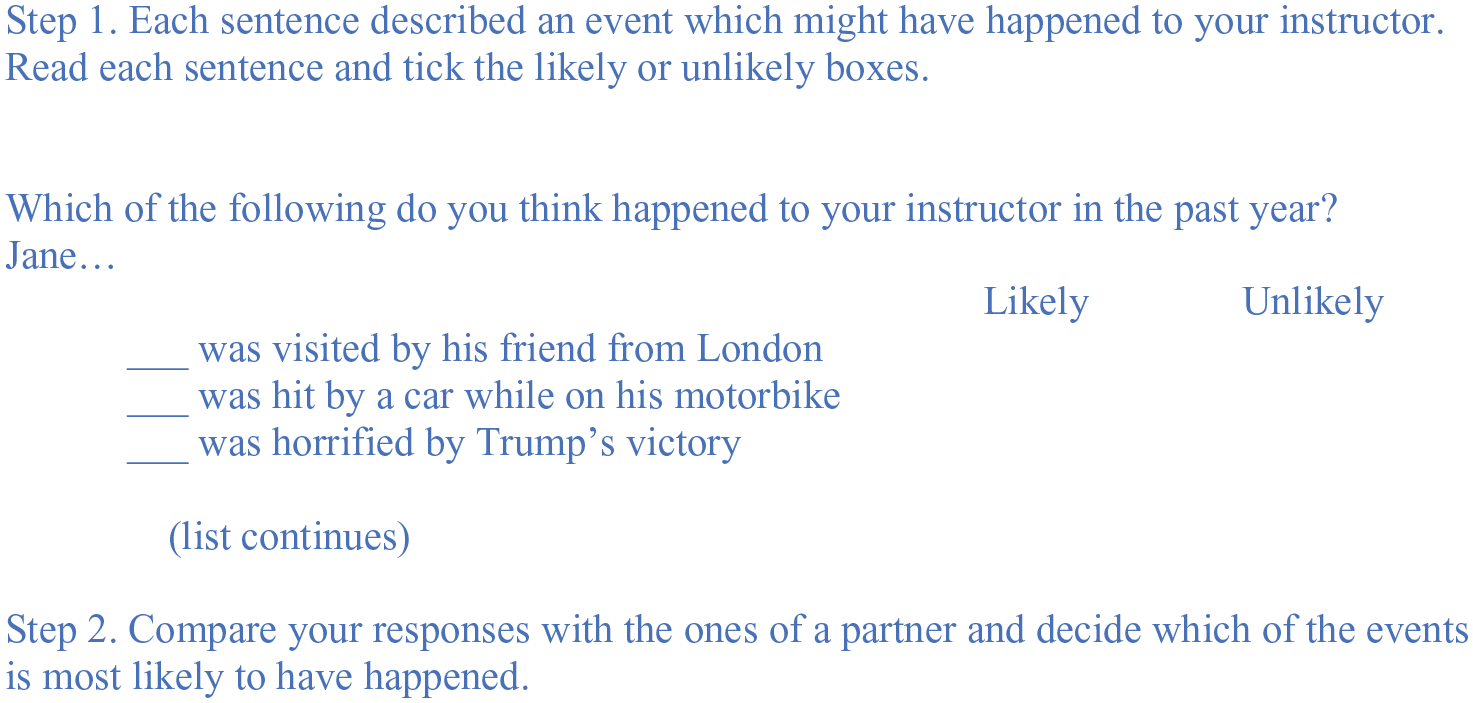
Sample of affective structured-input activity.
4 Assessment procedures
Participants received their self-paced reading pre-tests via computer five days before the beginning of the treatment. The tests were piloted to make sure they were at the same level of difficulty. They received their post-tests immediately after instruction. The similarity between the treatment materials and the testing allowed for target-appropriate processing. How quickly individuals respond in the pre-test and in the post-test is fundamental in determining a participant’s change in their processing behaviour. Participants’ reaction time is calculated in milliseconds and provides an insight into the processing route each experimental group undergoes when reacting to a stimulus in a pre- and post-test framework. The analysis of times can inform researchers of the mechanisms involved in L2 language processing. A higher or lower reaction time can reveal a different grade of engagement at the level of mental operations. When comparing pre-test results to post-test results, a shorter reaction time may reveal that a pedagogical intervention is more effective and captures the participants’ implicit knowledge of the language. Due to the nature of the test, made up of brief and easy stimuli and focusing on comprehension, in a self-paced reading test, participants are not expected to rely on their explicit knowledge.
In the present study, participants were asked to read from a slide (first slide) and complete the test individually. E-prime (2.0) was used to develop the test. Each test contained 10 passive and 10 active sentences (used as distracters) and singular nouns in agent/patient roles. They were also animate and concrete. Like in the case of interpretation tests generally used in processing-instruction research, the self-paced reading test contained 20 items in total (e.g. Benati, 2022; Malovrh et al., 2020). A different set of verbs were utilized in the two test batteries. The distracters (10 items) were used to obscure the critical items under investigation and to minimize task effects.
The instruction received by participants consisted mainly in informing them how to use the buttons to reveal the parts of the sentences. They had to press the space bar to disclose the next part of the sentence on a computer screen and, once the last part of the sentence had been displayed, a further press of the space bar would display the next part. For example, participants would see the following sentence on the screen: The boy was kissed by the grandfather.
The sentence was presented part by part in this fashion after pressing the designed button: The boy ——– ——– ——– ——–
After pressing the space bar, the second part would be shown, and so on: ——– was ——– ——– ——–
Every subsequent press of the bar would reveal the next parts. After each press, the software recorded the reading time for that part. Once the last part of the sentence had been displayed, a further press of the space bar would display a slide with paired images (see Figure 3). Participants were asked to indicate (by hitting keyboard A or B) which picture matched better the interpretation of the sentence read. There was an equal number of correct A and B answers. The self-paced test was not time-limited, and participants went through the experiment at their own pace. They were reminded to read the sentences silently, without articulation (vocal or sub-vocal).
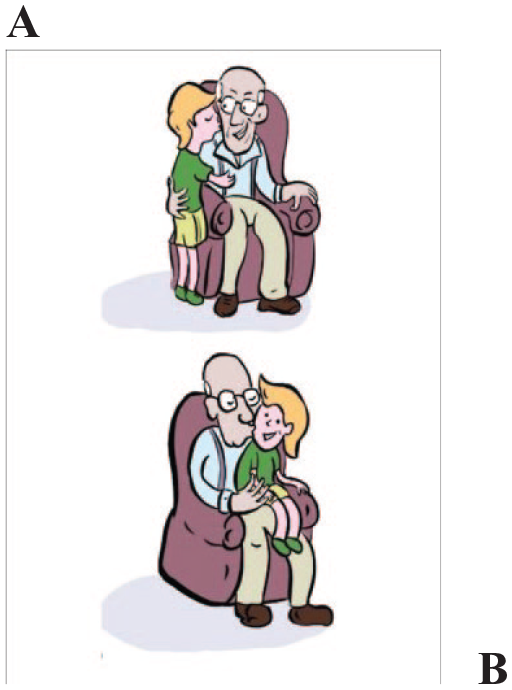
Self-paced reading test: Paired images.
5 Procedure
This study measured the online effects of one instructional treatment (structured input) using a pre-test and post-test instructional model. Self-paced reading pre-tests were administered to the two groups (native and non-native) five days prior to the beginning of the experiment. Post-tests immediately after the end of the instructional treatment consisted of 70 minutes instruction in total received from a computer online programme. Tests were delivered to the group after a brief training session consisting of practical instructions in Chinese on how to complete the tests (for an overview of the study, see Table 1). The main purpose of this warm-up activity was to ensure that participants could become familiar with the test, sequence of the self-paced reading, the types of images and how to indicate their interpretation. Participants took tests individually on one of the computers available in a designed laboratory. Participants were informed about the duration, phases and anonymous data-storing procedure of the experiment.
Overview of the study.

IV Results
This study investigates the effects of structured input (independent variable) and test performance (dependent variable). Self-paced reading is a computer-mediated research tool used to measure participants’ reading times during sentence comprehension (Keating & Jegerski, 2015). As previously stated, participants in this study sat in front of a computer screen and had to press a button to revel different words/parts of a sentence. A self-paced reading test was adopted in this study to measure reading times (accuracy), and response time in picture selection. ANOVAs were used to compare the performance of the native and non-native groups on the self-paced reading tests. The present study investigates the effects of verb type (active vs. passive) and test time (pre-test vs. post-test) on both groups (native vs. non-native) in relation to accuracy, and response time.
1 Accuracy data
The descriptive statistics for accuracy scores on pre-test and post-test for the non-native group and the ones for the native group are displayed in Table 2. A two-way repeated ANOVA was conducted for the non-native group with time (pre-test, post-test) and verb type (active, passive) as the two main factors. The results of the statistical analysis showed a significant two-way interaction between time and verb type [F(1, 26) = 11.386, p < .001)]. Two separate one-way repeated measures ANOVAs to explore this interaction and identified significant simple effects between pre-test and post-test mean accuracy scores for active verbs [F(1, 26) = 17.269, p < .005)] and for passive verbs [F(1, 26) = 21.248, p < .001)] were carried out.
Descriptive statistics for accuracy data for non-native group (verb type and time) compared with native group.

Two separate one-way ANOVAs to isolate the pre-test and post-test scores for the non-native group were conducted. The main results indicated a statistically significant difference between mean accuracy scores by verb type (active, passive) at pre-test [F(1, 26) = 33.179, p < .005)] and at post-test [F(1, 26) = 4.179, p < .001)]. In relation to the native group, the one-way ANOVA with verb type as a variable (active, passive) found a statistically significant difference [F(1, 17) = 5.482, p < .001)]. To compare groups at each time point, a two-way ANOVA was carried out at pre-test with group (non-native speakers, native speakers) and verb type (active, passive) as variables. This analysis showed a statistically significant two-way interaction at pre-test [F(1, 43) = 13.120, p < .001)].
Two separate one-way ANOVAs demonstrated a significant difference between non-native speakers and native speakers for both active [F(1, 43) = 7.252, p < .004)] and passive verbs [F(1, 43) = 19.154, p < .001)]. The same procedure was used for post-test scores using the native speaker’s pre-test values, and found no significant interaction [F(1, 43) = 1.174, p = .642)]. Using two separate one-way ANOVAs, no significant differences between non-native speakers and native speakers was found for both active [F(1, 43) = 1.131, p = .126)] and passive verbs [F(1, 43) = 1.122, p = .075)]. The main results obtained in the accuracy scores indicate that native and non-native speakers were significantly more accurate with active over passive sentences.
The non-native speakers benefitted from instruction such that accuracy significantly increased on both active and passive sentences. The non-native speakers were significantly more accurate with active over passive sentences even after instruction. The non-native speakers’ accuracy on both active and passive sentences, after instruction, reached the native speaker level.
2 Response-time data
The descriptive statistics carried out on correct responses are displayed in Table 3. A two-way repeated measures ANOVA for the non-native group with time (pre-test, post-test) and verb type (active, passive) as variables was used. No significant interaction between time and verb type was found [F(1, 26) = 3.148, p = .431)]. Separate one-way repeated measures ANOVAs found a significant difference between pre-test and post-test mean response time on active verbs [F(1, 26) = 41.369, p < .001)] and for passive verbs [F(1, 26) = 44.2458, p < .001)].
Descriptive statistics (Response-time data, ms) for non-native (verb type and time) compared with native group.

Two separate one-way ANOVAs were used to isolate the pre-test and post-test scores for the non-native group and found a statistically significant difference between correct answer selection mean response time by verb type (active, passive) at pre-test [F(1, 26) = 224.416, p < .001)] and post-test [F(1, 26) = 312.235, p < .001)]. A one-way ANOVA for the native speakers group with verb type (active, passive) as a variable was used. The analysis found a significant difference on correct answer selection mean response time [F(1, 17) = 445.237, p < .001)].
To compare groups at each time point, we carried out a two-way ANOVA at pre-test with group (non-native speakers, native speakers) and verb type (active, passive) as variables and did not find a statistically significant interaction at pre-test [F(1, 43) = 3.230, p = .268)]. Two separate one-way ANOVAs found significant differences between non-native speakers and native speakers for both active [F(1, 43) = 47.442, p < .001)] and passive verbs [F(1, 43) = 49.168, p < .001)]. This procedure was repeated at post-test, using the native pre-test values, and found a statistically significant two-way interaction [F(1, 43) = 1.241, p = .758)]. The two separate one-way ANOVAs, yield significant differences between non-native and native group for both active [F(1, 43) = .821, p = .776)] and passive verbs [F(1, 43) = .432, p = .945)]. These results indicate that both the native and non-native group were significantly faster to select the correct answer for active over passive sentences.
The non-native group benefitted from instruction such that correct-answer-selection response time significantly decreased on both active and passive sentences. The non-native speakers were significantly faster to select the correct answer for active over passive sentences even after instruction. The non-native speakers’ correct-answer-selection response time on both active and passive sentences, after instruction, reached the native speaker level.
V Results
1 Summary of results
The two questions of the present study were as follows:
• Research question 1: Do L2 learners exposed to structured-input treatment on English passive and active sentences improve the capacity to interpret these forms as measured by accuracy of response?
• Research question 2: Do L2 learners exposed to structured-input treatment on English passive and active sentences improve the capacity to interpret these forms as measured by response time?
The main findings from this study provide enough evidence to offer an answer to research question 1. Non-native participants improved their accuracy in the interpretation of passive sentences in English after instruction. Regarding research question 2, the results that response time decreased for non-native group clearly indicate that L2 learners in this instructional group are becoming better processors. The structured-input instructional training had an impact at improving participants’ response time in selecting the correct pictures after reading passive sentences. The non-native group increased in their ability to interpret sentences containing the target feature. L2 learners in the structured-input group processed input in a more effective way than they would if they had been unable to circumvent the effects of wrong processing strategy described in the FNP.
2 Interpretation and discussion of the results
The main results of this study revealed a very consistent pattern. There was a processing cost associated with passive sentences and verb forms in both native and non-native processing. After receiving the structured input, non-native participants became more accurate in their responses, and were quicker to interpret sentences containing subject/object roles.
The pre-test sentence interpretation mean scores showed that the non-native participants’ accuracy was low on passive constructions (35%) but much higher on active constructions (86%), and that the difference was significant. The native participants’ results also showed a significant difference between accuracy on passive (83%) and active sentences (94%). The degree of difference was greater for the non-native participants.
These findings align with those of previous research that native participants usually show a high level of accuracy on passive sentences but are not perfect (Kim & Kim, 2013; Lee & Doherty, 2019). The differences in accuracy might be explained in two ways: (1) the non-native group lacked knowledge of the target form and regularly relied on a word-order–based processing strategy. These findings mirror the ones of previous research on L1 acquisition of English passive (Slobin, 1966); (2) the native group did not pay enough attention or lost focus of the few items they misinterpreted. The non-native participants’ correct-answer-selection mean response time was significantly faster for active over passive sentences on the pre-test. They showed a similar sensitivity to sentence type than the native speakers did. The native participants, however, responded faster than the non-native participants did on the pre-test on both active and passive sentences. Although these learners showed sensitivity to verb form before instruction, the structured-input instructional treatment brought about changes.
The results from this study show that structured input effectively improved the non-native’s accuracy at interpreting both active (91%) and passive (82%) sentences. This result confirms that of previous research on the effects of structured input on the acquisition of English passive constructions (Benati, 2020a, 2020b). The main results from this study showed that the non-native participants’ post-test scores were not significantly different from the native speaker scores on either active (94%) or passive (83%) sentences. This finding is novel as previous structured-input research has not included a native comparison group. Interestingly, interpreting passive sentences is more difficult for both native and non-native participants; they are more accurate with actives than passives even after the non-native participants received the structured-input treatment. After receiving structured-input practice, instructed non-native speakers performed to the same level of accuracy as native speakers when processing active and passive sentences.
The instructional structured-input treatments also affected the non-native participants’ correct-answer-selection response time. Their response times were significantly faster after instruction on both the active and passive sentences although their response times were still faster for active over passive sentences. The native participants were also faster responding to active than passive sentences. Although the native participants responded faster than the non-native ones did on the pre-test on both active and passive sentences, the post-test times showed a different result. There was no difference in answer selection response times between the native and the non-native participants on the post-test. Structured input effectively brought the non-native participants’ answer selection response times to the level of a native speaker. The faster response time reflects that processing active and passive sentences became more efficient after instruction and suggests that the non-native became more confident with their thematic role assignments in the sentences they read.
The pre-test results support the claim that the participants aligned the semantic role of agent with the grammatical role of subject and aligned the subject argument with preverbal position (Lee, 2017). The improved post-test accuracy scores show that the effects of instruction are to dissolve, disestablish, or destabilize both the alignment of semantic and grammatical roles and the alignment of the subject argument with preverbal position. The instruction provided positive evidence of sentences in which roles and position aligned (active sentences) but, importantly, it provided positive evidence of sentences in which roles and position did not align (passive sentences). In other words, structured-input practice pushed the non-native not to interpret sentences through the frame of canonical word order with its canonical alignment of semantic/grammatical roles and position (VanPatten, 1996, 2004, 2015a, 2020).
3 Pedagogical implications
In relation to the role and effects of structured-input practice, the main results from the data collection in this study indicate the following:
• Structured input is a successful pedagogical intervention at providing L2 learners with the ability to process language input more accurately and effectively. In the case of this study, L2 learners receiving structured input do not rely on the FNP when they need to interpret sentences containing English passive constructions.
• Structured-input practice ensures that L2 learners make appropriate syntactic parsing. It is the nature of structured-input practice that makes the difference in this case as it trains L2 learners at interpreting a form correctly.
• Structured-input practice ensures that L2 learners intake better input for further processing. The results from this online study demonstrate that structured input facilitated in depth processing of data (the syntactic structure under investigation) assisting the development of underlying knowledge among L2 learners. Structured-input practice alone was successful in improving non-native’s performance to the same level of accuracy as native speakers when processing active and passive sentences.
The positive effects of structured-input practice measured by an online test contribute to the current discussion around the role of instruction in second language acquisition (VanPatten et al., 2019). In structured-input activities, the input is manipulated in particular ways to push learners to become dependent on form and structure to get meaning. Structured-input practice pushes L2 learners to abandon their inefficient processing strategies and adopt more optimal ones.
Structured-input practice seems to speed up acquisition rate of a particular linguistic feature, in this case English passive constructions. Despite some psycholinguistic constraints to limit its role, it is successful at improving accuracy in interpretation. Related to this point is the fact that the current study contributes to the current trend of research in structured input measuring moment-by-moment processing through online testing.
The traditional emphasis on explicit grammatical instruction and rule practice has often overlooked the cognitive aspects of L2 acquisition, potentially hindering learners’ natural progression in language learning. This approach, prevalent in many educational contexts, has sometimes conflicted with the inherent order through which learners naturally acquire language, aiming for quicker results at the expense of deeper understanding. The insights from the present study advocate for a shift in pedagogical focus towards enhancing learners’ implicit knowledge base, suggesting that language instructors should pivot away from predominantly explicit learning models and assessments.
This research highlights the importance of instructional materials that are thoughtfully created materials that better facilitate the acquisition of linguistic forms. Effective classroom materials, as suggested by this study, are those that not only engage learners but also strategically guide their attention to crucial grammatical structures, thereby supporting the internalization of these forms. The implications of this study extend beyond individual classroom practices to inform broader educational strategies and material development. By acknowledging and addressing the cognitive processes underlying language acquisition, educators can enhance the efficacy of language instruction, promoting a more natural and sustained learning progression. This approach not only aligns with learners’ cognitive development but also paves the way for more effective and meaningful language-learning experiences.
VI Limitations and conclusions
The researcher is aware of several limitations in this study. The sample size of the data collection is relatively small. A bigger size in terms of participants would have increased the validity of this study, and this is certainly a matter for future studies. The lack of a delayed post-test is a second main limitation of the present study. Future research should measure whether accuracy scores in interpretation and response would decrease when measured by a delayed post-test.
The study did not use a control group as the effects of structured input on the non-native participants were compared to the native participants’ performance. Future research measuring the effects and role of structured-input practice should continue to incorporate a native-speaker comparison group and expand the database to include different languages and linguistic features to generalize the original findings from the present study. In addition, online studies on the effects of structured-input practice should measure separate or combined effects of referential and affective activities, as this study only measured full structured-input practice (e.g. combination of referential and affective).
Future research measuring the relative effects of structured-input activities would need to address secondary effects by measuring if learners who receive training in one type of processing strategy for one specific form transfer the use of that strategy to other forms without further exposure to structured-input activities. Possible effects of individual differences need to be investigated within the structured-input research framework. Would any individual or combination of individual factors (e.g. motivation, attitude, working memory capacity) have measurable effects on the positive results generated by structured-input activities?
The results of the present study lead to the following conclusions. Structured input alone without any explicit information component is effective at improving non-natives’ accuracy in thematic role assignment. Non-native participants, after instruction, are able to reach native-like levels of accuracy and speed in selecting correct responses.
Footnotes
Acknowledgements
My gratitude goes to all the participants of this study for their collaboration. A special thanks to colleagues and reviewers who read this article and provided valuable comments and suggestions for improvement. The usual caveat of responsibility (my alone) applies.
Funding
The author received no financial support for the research, authorship, and/or publication of this article.
