



Abstract
While researchers in the second language (L2) field often consider that L2 anxiety determines subsequent L2 achievement, an emerging line of research suggests that language skills better predict L2 anxiety. This viewpoint has yet to be experimentally evaluated, and thus it motivated the present study. Two groups of university language students enrolled in the Department of English as an L2 were followed over one semester at three time points while taking a general university course unrelated to language learning. The experimental group received extra instruction (course unrelated) designed to expand their L2 vocabulary knowledge, including strategies for learning and using new vocabulary in real-life contexts over the whole semester. A typical teaching method was delivered to the control group. The conditional dual-domain latent growth curve modeling (LGCM) with grouping variable as a covariate was used to study the possible effect of the intervention on the trajectory of language anxiety and vocabulary knowledge. Results indicated that teaching vocabulary knowledge to the experimental group led to an increase in their L2 vocabulary achievement. In turn, the increase in L2 vocabulary significantly reduced students’ L2 anxiety. Notably, this reduction in anxiety was attributed solely to the improvement in vocabulary achievement, as teachers did not employ any anxiety-controlling strategies. In contrast, the control group showed no significant changes in L2 vocabulary knowledge or L2 anxiety, which aligns with typical observations in standard learning settings. Findings from the present experimental study support the idea that increasing students’ L2 achievement (e.g. vocabulary) through providing practical resources, strategies, and opportunities for using the language (even with minor errors) can reduce their L2 anxiety. According to our findings, using language-enhancing strategies, rather than anxiety-reducing ones, can more effectively help reduce L2 anxiety.
Keywords
I Introduction
Language anxiety is one of the most recognized and researched factors of affect in second language (L2) research (Griffiths & Soruç, 2020; Nakamura, 2023). The field has placed a special focus on language anxiety from both conceptual and empirical perspectives to understand its association with language learning processes (Horwitz, 2001). Horwitz (2001) defined language anxiety as a complex of thoughts, feelings, and behaviors related to classroom language learning. Horwitz (2010) argued that ‘anxiety would inhibit the learning and/or production of a second language’ (p. 154). Advocates of Horwitz’s perspective claim that L2 anxiety is a negative predictor of language achievement (e.g. Botes et al., 2020; Saito et al., 1999; Teimouri et al., 2019; Zhang, 2019). They mainly came to this causal conclusion based on cross-sectional data, including data from meta-analyses. A recent critical review argues against relying solely on cross-sectional research to draw causal inferences and advocates for the use of longitudinal and experimental data (Alamer, 2025).
In fact, language anxiety has not exclusively been viewed as a negative predictor of L2 achievement. Rather, an evolving line of research hypothesizes that L2 anxiety is a consequence of weak language aptitude and language skills (Alamer & Lee, 2024; Alamer et al., 2023; Almusharraf & Bailey, 2023; Chan et al., 2025; Li et al., 2024; Sparks, 2022, 2025; Sparks & Alamer, 2022, 2023, 2024; X. Zhao et al., 2024). From this perspective, language anxiety is not a cause of lower L2 achievement, but rather a consequence of students’ low first language (L1) and L2 skills. As a matter of fact, ‘Horwitz conceded that poor L1 skills could lead to anxiety in some language learners’ (Horwitz, 2010, p. 164).
A long line of evidence has supported this position with findings obtained from longitudinal perspectives illustrating that, for example, differences in L2 anxiety are strongly related to differences in L1 achievement, even several years prior to engaging in L2 study (Sparks, 2022). Only recently, longitudinal analyses revealed that although L2 achievement and anxiety are negatively correlated at a given time point, L2 achievement predicts a subsequent decrease in anxiety (i.e. higher levels of achievement predicted lower scores on language anxiety), not the other way around (Alamer & Lee, 2024; Alamer et al., 2023; Chan et al., 2025; Li et al., 2024). These results have paved the way for refreshing the thinking about the causal relationship between L2 anxiety and L2 achievement.
It is important for the L2 field to evaluate the causal relationship between L2 achievement and individual differences by means of longitudinal data and experimental investigation to determine, for example, whether increasing L2 language skills can decrease language anxiety (Alamer, 2025). The findings from interventions regarding the direction of causality hold the potential to enhance teaching methodologies in L2 classrooms (Alamer et al., in press). Accordingly, the present study aims to explore the impact of a teaching approach that focuses on increasing students’ vocabulary knowledge for reducing students’ language anxiety. To obtain richer results, we adopted the LGCM method (specifically the conditional dual-domain LGCM), which builds on the property of structural equation modeling (SEM; Alamer & Alrabai, 2023; Kruk et al., 2022; Newsom, 2023).
II Literature review
1 L2 anxiety research: The classic view
The classic view of L2 anxiety posits that it hinders language learning and prevents learners from reaching their full potential in achieving higher levels of L2 proficiency (Horwitz, 2001; Saito et al., 1999). Proponents of this view argue that success in L2 teaching (and learning) hinges on reducing students' anxiety. Following this approach, several researchers have conducted systematic reviews of the anxiety literature and meta-analyses that examine the relationship between L2 anxiety and L2 achievement. For example, Teimouri et al. (2019) performed a meta-analysis that included 97 studies from 23 countries and claimed strong evidence for both the negative effects of L2 anxiety on L2 achievement (r = −.39) and the moderating effects of nonlinguistic variables, e.g. age, educational context, self-perceived L2 competence, target language. Zhang (2019) investigated the L2 anxiety-L2 achievement relationship using 55 independent samples with over 10,000 participants and reported evidence for the negative effects of anxiety on L2 achievement (r = −.34) as well as the moderating effects of anxiety type, e.g. listening vs. reading, age, lexical similarity. In his study, the anxiety-performance correlation was found to be stable across L2 proficiency levels. Botes et al. (2020) performed a meta-analysis of the relationship between L2 anxiety and the Foreign Language Classroom Anxiety Scale (FLCAS) with a large sample of 14,000+ participants and reported a negative relationship between anxiety and several types of L2 achievement (ranging from r = −.26 to −.53). Unlike the previous meta-analyses reported above, Botes et al. (2020) found that only one variable, the type of institution, significantly moderated the relationship between L2 anxiety and L2 achievement. In their systematic review of the L2 anxiety literature from 1960–2018, Oteir and Al-Otaibi (2019) concluded that anxiety is responsible for lower scores in L2 achievement and proficiency, a finding consistent with those reported by other language anxiety researchers.
All of the aforementioned studies found negative relationships between language anxiety and various aspects of L2 achievement, including vocabulary knowledge. Although the results of these meta-analyses were derived from numerous studies, the data employed in these meta-analyses are inherently cross-sectional, as anxiety and L2 measures were collected from the same time point. This, unfortunately, prevents claims about causation. Alamer (2025) has pointed out that it remains infeasible to draw conclusions about causal inference between L2 anxiety and language achievement using cross-sectional data, even if the data originates from a meta-analysis. In fact, one would argue for the opposite direction, i.e. that language achievement predicts L2 anxiety. We discuss this view next.
2 The new view: Higher achievement as a negative predictor of anxiety
Around 2021, 1 a new and alternative perspective in L2 anxiety research emerged via Alamer and Lee (2024) longitudinal study that employed a cross-lagged panel analysis/model (CLPM). First, this line of research builds on early work by Richard Sparks and associates who argued that L2 anxiety largely stems from students’ perceived or actual proficiency in their L1 achievement and their L2 aptitude (Sparks, 2022, 2025; Sparks & Alamer, 2022, 2023; Sparks & Ganschow, 2007; Sparks et al., 2018). That is, learners with weak L1 skills and L2 aptitude are likely to report higher levels of anxiety than students with stronger language skills when start learning an L2, suggesting that language-related skills precede L2 anxiety. Horwitz herself acknowledged the validity of this perspective (Horwitz, 2010). An empirical example of this line of research was reported by Sparks and Alamer (2022) who examined the impact of students’ L1 achievement in elementary school on their L2 anxiety after several years when they studied a L2 in high school. The authors considered the mediating effects of L2 aptitude and L2 achievement in the relationship between L1 achievement and L2 anxiety. Following students over 10 years, they found the impact of L1 skills on L2 anxiety was fully mediated by L2 achievement and L2 aptitude, suggesting the long-term effect of L1 skills on L2 anxiety is better recognized via these mediators. Further, the authors found that the effect of L2 achievement on L2 anxiety was direct and substantial. These findings were found to be invariant across different ages and gender.
Second, this new view on L2 anxiety calls for longitudinal investigations to understand the interplay between L2 anxiety and L2 achievement (Alamer & Lee, 2024; Alamer & Sparks, 2025; Alamer et al., 2023; Chan et al., 2025; Hamada & Takaki, 2022; Li et al., 2024; Liu & Dong, 2023; Nakamura, 2023; Sparks & Alamer, 2024). When measured simultaneously, L2 anxiety is expected to be negatively correlated with L2 achievement. However, this cross-sectional result alone cannot establish a causal relationship. If anxiety and L2 achievement present a negative correlation at a specific point in time, this finding indicates an association, but not a causal relationship. If one argued that anxiety affects achievement, another would argue for the opposite direction (i.e. achievement affects anxiety). A key longitudinal investigation in this matter was conducted by Sparks and Alamer (2024), who investigated the long-term impact of three variables—L2 anxiety, L2 aptitude, and L1 achievement—on the growth of L2 reading achievement over three years of L2 study. To investigate the long-term impact, they used the conditional LGCM method. Interestingly, the authors found that anxiety did not predict the growth of L2 reading achievement, while L2 aptitude and L1 achievement did. Since L2 anxiety did not predict L2 achievement, the findings opened the door to investigating the possibility of a reverse directionality—L2 achievement predicts reduced anxiety. A similar conclusion was found L2 writing achievement as only L1 writing, but not anxiety that predicted students’ achievement (see Alamer & Sparks, 2025).
Alamer and Lee (2024) have explored the directional relationship between L2 anxiety and L2 achievement over three time points. They employed cross-lagged panel analysis, a special case of SEM that allows for the examination of bidirectional causal relationships between the variables. This analysis is unique as it assesses not only if anxiety predicts achievement, but also whether achievement influences anxiety, allowing for the data to unfold naturally. L2 achievement and L2 anxiety were measured at three times points over four months. Alamer and Lee’s (2024) results showed that L2 achievement predicts anxiety, not the other way round, suggesting the importance of L2 development to reduce anxiety when studying an L2. A key finding of their study was that to engage their students in L2 learning, teachers should provide optimally challenging L2 material and teach language skills, rather than trying to reduce students’ anxiety directly.
Several studies have adopted this new approach to investigate the causal relationship using longitudinal analysis and advanced statistical methods (e.g. Alamer & Sparks, 2025; Alamer et al., 2023; Li et al., 2024; Liu & Dong, 2023; X. Zhao et al., 2024). For example, using a model comparison technique, Hamada and Takaki (2022) assessed two competing structural models to determine which model was supported by their data. Their first model examined the position that anxiety is a predictor of L2 reading proficiency and that L2 reading proficiency acts as a mediator of L2 achievement. The second model postulated that L2 achievement is a predictor of L2 reading proficiency and that L2 reading proficiency acts as a mediator of L2 anxiety. Model comparison criteria supported the second model, suggesting that language achievement is better conceptualized as a predictor of anxiety, not the other way around. Furthermore, Almusharraf and Bailey (2023) have also applied SEM methodology among Saudi students of English. The authors tested a structural model where scores of readings and listening on Test of English for International Communication (TOEIC) were used as explanatory variables of Foreign Language Classroom Anxiety Scale (FLCAS) and L2 writing anxiety. Their findings showed that TOEIC and self-reported FL proficiency negatively explained levels on FLCAS and L2 writing anxiety. Li et al. (2024) replicated the results of Alamer and Lee (2024) by following Chinese-speaking students of English as an L2 over three time points. At all time points, Li et al. (2024) found that negative emotions, such as anxiety, did not predict L2 achievement. Instead, they found that achievement negatively predicted subsequent anxiety from Time 1 to Time 2 and from Time 2 to Time 3, reinforcing the notion that higher achievement reduces anxiety over time.
Although these studies provided valuable insights about how achievement longitudinally and negatively predicted later anxiety, none employed an experimental research design. Therefore, it remains unclear from an experimental perspective whether interventions aimed at improving students’ L2 achievement effectively reduce their anxiety.
3 The teachers role
Very few experimental studies have examined the L2 achievement-L2 anxiety relationship. Among these investigations is a study by Alrabai (2015), who applied an experimental design in which teachers implemented strategies thought to be effective in reducing learners’ L2 anxiety. A pre-test and post-test approach was used with an eight-week gap between the two time points. The study found that students’ overall anxiety substantially decreased, which appeared to support the validity of the teaching strategies. However, it is possible that the effectiveness of the strategies might have been due to strategies that were postulated to be anxiety-controlling but instead may have been motivational in nature, raising the question of whether motivational strategies were confounding variables for the decrease of anxiety. For example, teachers in Alrabai’s (2015) study were asked to ‘demonstrate proper teaching behavior to [the] students’, ‘increase students’ self-confidence’, and ‘help students establish specific and realistic goals for learning English’ (p. 173). It is safe to conceptualize these strategies as motivational techniques rather than anxiety-reducing ones. Thus, it is conceivable to argue that confounding strategies played a role in reducing students’ anxiety (see also Alrabai & Alamer, 2022).
In a more recent study, Alrabai (2022) implemented an experimental design based on the positive psychology perspective to investigate the effect of anxiety-controlling and motivation-promoting strategies used by L2 teachers to increase students’ motivation and lower their anxiety. The findings showed that the anxiety-controlling strategies had a trivial effect on reducing language anxiety, but substantially improved language motivation. Alrabai (2022) explained these counterintuitive results by speculating that ‘motivation was more positively responsive to emotion-regulation teaching than anxiety’ (p. 11). However, it remains unclear whether teaching students’ language skills, such as vocabulary knowledge, can contribute to reducing their anxiety about learning the L2. The present study attempts to address this important issue. Similar results were further reported in Alrabai and Alamer (2024).
4 Vocabulary knowledge
There is a consensus in the literature that both general and academic vocabulary knowledge is important for language learning and academic success (see, for example, Alamer et al., 2024; Nagy & Townsend, 2012; Stanovich, 2000). Research has also shown that learners’ vocabulary knowledge is associated with their language proficiency and that learners’ depth of vocabulary is able to predict their oral and written L2 proficiency (Milton & Treffers-Daller, 2013; Qian & Lin, 2020). Other researchers have reported that poor L2 vocabulary acquisition is the primary impediment in the development of secondary level students’ L2 reading and listening skills (Sparks, 2022, 2025; Sparks et al., 2018). Other research has found that vocabulary knowledge is negatively associated with L2 anxiety (Izadi & Zare, 2016). For the present study, vocabulary knowledge was selected because learning vocabulary has been found to be an essential part of mastering the L2 as strong correlations between higher knowledge of vocabulary and various measures of language proficiency have been consistently reported in the L2 literature (Schmitt, 2010).
III Purpose of the study and research questions
In this experimental study, we examined whether a teaching method that aims at increasing students’ vocabulary knowledge in English as an L2 would be beneficial in lowering their language anxiety compared to students who were taught by a traditional method that did not target vocabulary learning (we expand on this method in a later section). To better understand the effect of the intervention on the experimental group compared to the control group, we apply the dual domains LGCM (Alamer & Alrabai, 2023; Elahi Shirvan et al., 2022; Kruk et al., 2022; Newsom, 2023). The research question for the present study is as follows:
• Does direct teaching of L2 vocabulary knowledge, and the subsequent increase in vocabulary knowledge, decrease students' L2 anxiety?
IV Method
1 Participants
The participants for the present quasi-experimental study were Saudi undergraduate students of English as an L2 who were enrolled in the Department of English at a public Saudi university in 2022. The students’ first language is Arabic, and they were learning English as a second language. Admission to this university include students’ high school grades and performance on the Saudi General Aptitude Test (GAT). Normally, undergraduates who desire to enroll in the Department of English must complete a foundation year (Level 1) before they can enter the main program. Students had to have taken and passed a placement exam developed by the university to ensure that their English levels allowed them to enter the department. Thus, participants’ English levels were similar (relatively pre-intermediate level) as confirmed by their teachers, although no record of the students’ scores was available to determine their exact English level. Both groups were enrolled in the department’s Study Skills course during the intervention. Participants were ages ranged from 18–20 years (M = 18.55, SD = .42).
Two teachers and 143 participants were selected from four classes of the foundation year of the Study Skills course. Two classes taught by one teacher formed the experimental group (n = 66) while the remaining two classes, taught by another teacher, served as the control group (n = 77). The two groups followed the same course syllabus, which centered on topics and skills crucial for recent university enrollees. The topics for the course included how to meet university expectations, manage study difficulties, use time management, and utilize personal and university resources. Other first-semester courses addressed foundational language skills such as reading, writing, and grammar. Vocabulary learning was not covered in a dedicated course during this semester. The medium of instruction of this course was English as it is part of the Department of English program.
When the four classes were determined, the function of each group was selected randomly so that each group could have been the experimental or control group. The participants were nested within their classes; thus, a convenience sampling strategy was used. Students were given the freedom to withdraw at any time point as participation in the study was not related to their course; nevertheless, no withdrawals were recorded. In the experimental group nine participants failed to participate in the three occasions while in the control group, eight participants failed to participate in the three occasions. The missing values over the three time points were accounted for by the full information maximum likelihood (FIML) method. An ethical approval was obtained from the board of the Department of English at the university.
2 Procedure and experiment
The present study adopted a quasi-experimental approach across three time points. Time 1 data were collected during the first week of the semester, Time 2 data at the ninth week, and Time 3 at the seventeenth week (end of the semester). The gap between Time 1 and Time 2, and Time 2 and Time 3 was eight weeks. The investigation consisted of two conditions, an experimental condition and a control condition. All participants were invited to complete an online questionnaire before the end of the class and the instructors emphasized that participation was completely voluntary. The same procedures were used at Time 2 and Time 3.
The control group (two classes) was taught by a teacher who used the university’s standard teaching curriculum for the Study Skills course. Conversely, the experimental group (two classes) was taught by a teacher who, in addition to the standard teaching approach, used an additional teaching component that focused on improving students’ vocabulary knowledge (the vocabulary teaching techniques are found in Appendix A). Both teachers held the same qualification (Ph.D.) and had similar teaching experiences and social backgrounds. The teachers were informed that the research goal was to collect data about students’ psychological and linguistic variables over the 17 weeks of the course without mentioning the experiment.
Following established L2 vocabulary teaching practices (Oxford, 2017; Schmitt, 2010) and expert advice, we trained the experimental group's teacher to deliver content and discuss topics known to enhance L2 vocabulary acquisition including vocabulary learning strategies, recourses, and possible ways to practice the newly learned vocabulary. The teacher received foundational training in implementing these strategies and weekly guidance on techniques that prioritized vocabulary learning. For each week, the instructor encouraged the students to use the newly learned vocabulary and apply the words in different life settings. The teaching techniques are included in Appendix A.
The teacher in the experimental group regularly reminded the students throughout the 17 weeks about the importance of vocabulary knowledge for their success in language learning and highlighted the importance of using new words whenever possible, especially in real life situations. At the same time the teacher made a clear statement that the vocabulary knowledge component was not part of the course they are currently studying (i.e. Study Skills). No mention was made to students in either the experimental or control condition about the vocabulary knowledge test that would be administered at the end of the class at the three time points. To promote autonomous involvement, students were informed at the time the vocabulary test was administered that the vocabulary test scores would not contribute to their overall course grade.
3 Measures
The following measures were administered to both groups at the same time points (e.g. when the experimental group completed the Time 1 questionnaire, the control group completed the same questionnaire during the same week). The measures at the three time points were repeated. The measures used were as follows.
a Language anxiety
To measure students’ levels of L2 anxiety, the recently validated short version of the Foreign Language Classroom Anxiety Scale (S-FLCAS) modified by Botes et al. (2022) was administered. This scale consists of eight items representing the unidimensional aspects of language anxiety. The scale is designed to measure the general concept of anxiety that is specific to learning a foreign language. Items are rated on a five-point Likert-type scale, ranging from 1 (strongly disagree) to 5 (strongly agree). An example item is as follows: ‘Even if I am well prepared for L2 class, I feel anxious about it.’ Consistency of reliability (i.e. Cronbach’s alpha) is reported in Table 1. The S-FLCAS items are presented in Appendix B. This measure was administered at Times 1, 2, and 3.
Descriptive statistics and correlation of the study variables.
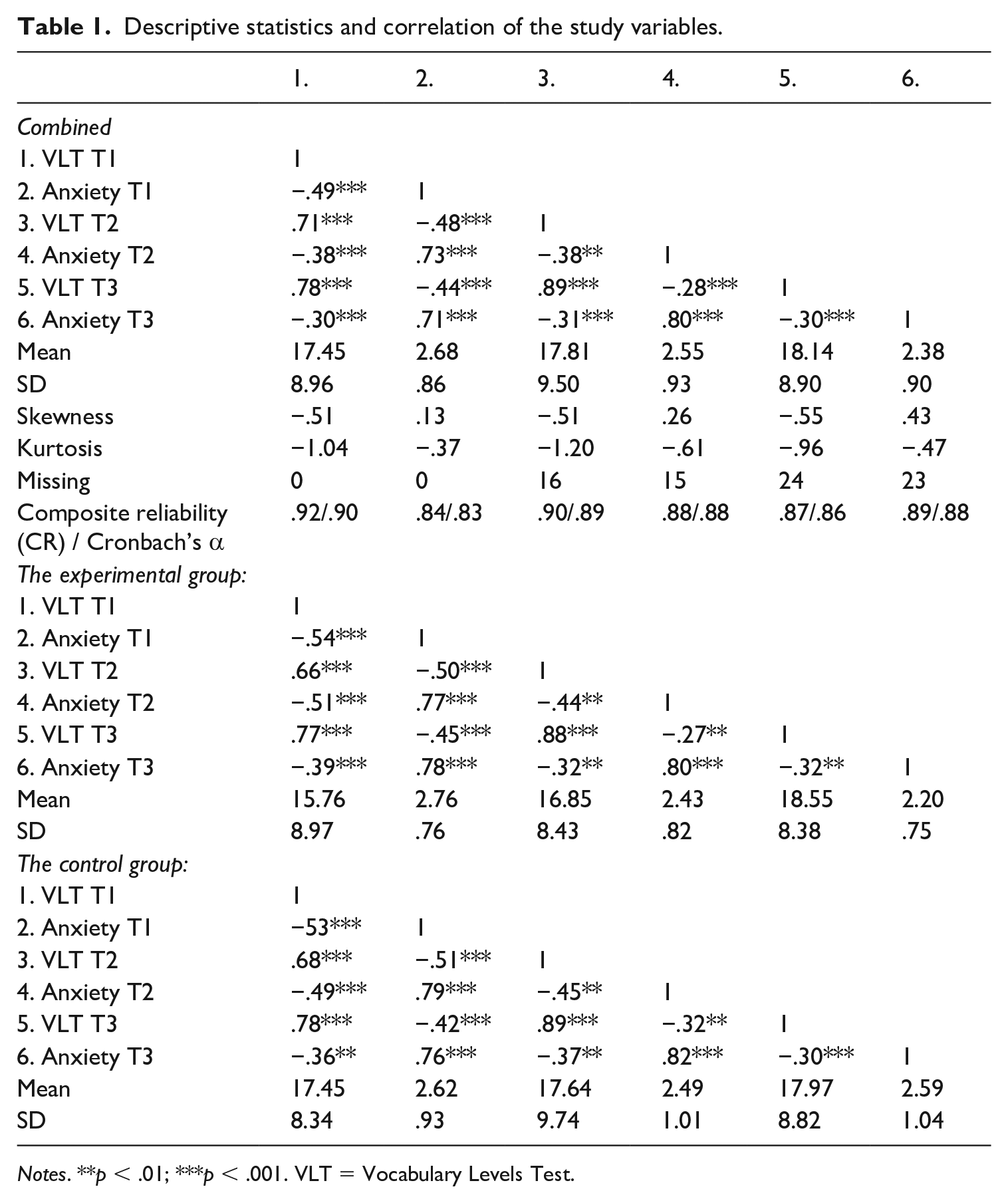
Notes. **p < .01; ***p < .001. VLT = Vocabulary Levels Test.
b Vocabulary levels test
To measure of vocabulary achievement, the Vocabulary Levels Test (VLT; Schmitt et al., 2001) was used. This instrument measures English vocabulary knowledge as an L2. VLT provides a profile of knowledge at various frequency levels. The present study adopted the 3,000-word level test because it was seen as most appropriate for the present sample, i.e. Level 1 students. The instrument has a structure according to which each level consists of 30 questions. The questions are divided into 10 groups, each containing six words, with three correct answers and three incorrect ones. Participants were instructed to choose the correct vocabulary word for each definition. Three of the words were the correct definitions and three words were foils. An example of one item included the following words – copy, event, motor, pity, profit, tip – and the following definitions – end or highest point, this moves a car, and thing made to be like another. The 3,000-word level test consisted of a total of 30 correct answers, thus, the maximum score is 30 and the minimum score is 0. Students were awarded one point for each correct match and zero points for each incorrect match, i.e. there was no penalty for incorrect responses. The complete VLT 3,000-word level measure can be found in Schmitt et al. (2001) and Schmitt (2010). This measure was administered at Times 1, 2, and 3. A set of example items is provided in Appendix B. Previous studies have demonstrated the validity of the measure through an item response theory approach (see Webb et al., 2017). For our study, we reported reliability estimates in Table 1.
4 Statistical analysis
a Latent Growth Curve Modeling (LGCM)
Going beyond first-generation techniques to assess changes over time (such as ANOVA) and adopting approaches based on the properties of SEM (Alrabai & Alamer, 2024; Newsom, 2023), we chose to use LGCM. Some advantages of using the LGCM in analysing the differences between the control and experimental group include the inclusion of the intercept as it allows the variance to vary (i.e. it controls for heterogeneity (Breitsohl, 2019) and dealing with missing data in an excellent manner (Collier, 2020).
LGCM is capable of detecting changes in the variables over time by modeling two latent variables, the slope and the intercept (Collier, 2020; Elahi Shirvan et al., 2022; Newsom, 2023). The slope reflects individual change (increase or decrease) over time, while the intercept reflects interindividual differences in the first time point. The intercept is fixed to 1 in the analysis to control for interindividual differences (or the lack of differences), while the slope is fixed to time points (0, 1, and 2) to estimate plausible changes. LGCM requires at least three time points, which was satisfied in our analysis. The standard LGCM assesses only one variable, but it can be extended to include two different variables in one integrated model. In such a case one speaks of dual domain LGCM (see, for example, Alamer & Alrabai, 2023). In this study, we used the dual domain LGCM to study the trajectory of both VLT and anxiety in one model. The dual domain LGCM assesses the trajectories for vocabulary achievement (expressed by VLT) and L2 anxiety (expressed by S-FLCAS).
LGCM can be useful in experimental studies when a grouping variable (experiment vs conditional) is included as a covariate in the model. This is called a conditional LGCM. In our conditional dual domain LGCM, we regressed the intercept and slope of L2 anxiety and vocabulary achievement on the grouping variable (referred to as group effect). In this grouping variable, the control group was coded as 0 and the experimental group was coded as 1. Specifically, we estimate four paths from the grouping variable to the slope and the intercept of L2 anxiety and vocabulary achievement (see Figure 1). If the effect from the grouping variable is significant, we conclude that this is due to the group differences (e.g. if the effect is positive, then it is due to being in the experimental group because they were coded as 1 relative to the control group who were coded as 0). We hypothesize that the grouping effect should be positive on the slope of L2 anxiety and vocabulary achievement. Following Hancock and French (2013), a statistical power analysis was conducted for our LGCM given the sample size and number of occasions to ensure the validity of the statistical conclusion. Our simulation check indicated an adequate sample size for the analysis. In our case, we simulated our LGCM condition in Mplus 8.10, using a power of .80 as a benchmark. With an anticipated effect size of .25 for the grouping effect, the minimum required sample size was 128, which was satisfied in the empirical data. Given that this is an experimental study, a larger sample size may pose practical limitations and empirical challenges. For instance, it could increase the likelihood of unobserved heterogeneity within the same group, potentially leading to biased estimates (Breitsohl, 2019).
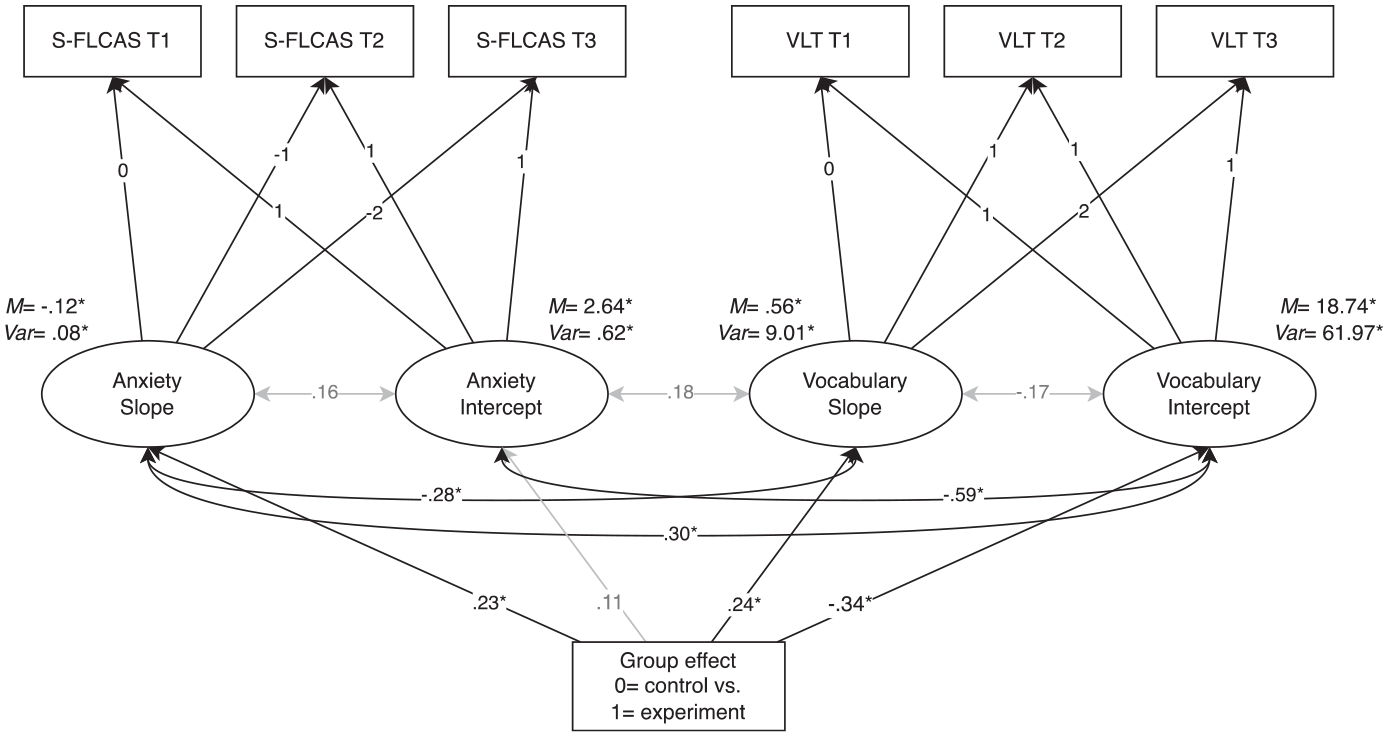
The conditional dual domain latent growth curve modeling (LGCM) of the two variables.
b Assessing the LGCM
Global and local assessments are needed in any SEM model including the LGCM. For the global assessment, different goodness-of-fit indices are reported and evaluated. First, we examined the chi-square statistic, χ2. We also considered goodness-of-fit indices based on additional indices that are reasonably independent of sample size such as RMSEA with its 90% confidence interval, CFI, TLI, and SRMR. Following Hu and Bentler (1999), CFI and TLI values in the region of .90 to .95 indicate a satisfactory to good fit to the data, respectively. Both RMSEA and SRMR should be equal to or lower than .07 or .05, respectively, to show acceptable and good model fits. The analyses were conducted using JASP 0.18 software (JASP Team, 2023). The robust to standard errors maximum likelihood estimation (MLR) was selected to account for any possible non-normality in the data. As indicated earlier, there was a trivial decline in response rate over the three time points and FIML was used to account for missing values. A check for outliers such as careless responses and extreme values were taken, and no concerns were observed in the data.
V Results
Table 1 presents descriptive statistics, including means, standard deviations, and zero-order correlations for the experimental and control groups, and also for the combined groups.
1 The assessment of conditional dual domain LGCM
Before testing the LGCM, we examined the factorial validity of the constructs involved in the assessment through a comprehensive CFA. The results showed that the model fits the data approximately (i.e. χ2 = 140.39, df = 347, p < .001, CFI = .96, TLI = .92, SRMR = .05, RMSEA = .08 [RMSEA 90% CI = .05, .12]). Thus, we continued with the main analysis. The results of the conditional dual domain LGCM of both anxiety and vocabulary achievement shown in Figure 1 illustrate that the model fits the data well (model fit indices are presented under the model). It can be seen that the mean of the intercept of vocabulary achievement was M = 18.74 and that the variance was significant (Var = 61.97, p < .001). This indicates that students in the two groups were significantly variant in vocabulary knowledge at the first time point. The LGCM explicitly estimates this variance and accounts for it. Turning to the slope of vocabulary achievement, it can be seen that the mean change across the two groups is M = .56 and this increase is significant (p = .02). Moreover, students in the two groups were different in their vocabulary growth (Var = 9.01, p = .01). This result is an indication that some heterogeneity is observed in the data, i.e. the fact that we have two different groups. The correlation between the slope and intercept was negligible (r = −.17, p = .74) which indicates there was (or is?) no relationship between the growth and the initial levels of the vocabulary. With regards to the growth and stability of anxiety, findings show that the intercept of the anxiety was M = 2.64 and that the variance was significant (Var = .62, p < .001). This result indicates that students in the two groups were significantly variant in the first time point. Turning to the slope factor, it can be seen that the mean change across the two groups is M = –.12 and this increase was significant (p < .001). Moreover, students were different in their decrease in anxiety (Var = .08, p = .02). This result is an indication that some heterogeneity is observed in the data, i.e. the fact that we have two different groups. The correlation between the slope and intercept was negligible (r = .16, p = .38), which suggests no relationship between the growth and the initial endorsement of the language anxiety measure.
Beside the within factor correlation, between factor correlations are of interest in the dual domain LGCM. Our results show that anxiety slope was correlated significantly with vocabulary slope (r = −.28, p = .02) implying that increases in vocabulary achievement over time is associated with decrease of anxiety over time. In addition, the anxiety slope was correlated with vocabulary intercept (r = −.59, p < .001) indicating that students who started with lower vocabulary scores exhibited greater decrease in anxiety over time. Similarly, the anxiety intercept was negatively correlated with vocabulary intercept indicating (r = −.59, p < .001) that students with higher levels of vocabulary achievement at Time 1 have reported lower scores in anxiety at the same time point. Other correlations were non-significant in the dual domain LGCM.
Of particular interest is the effect of the grouping variable on the intercept and slope on vocabulary achievement and anxiety. Starting with vocabulary achievement, the analysis shows that the grouping variable significantly affects its intercept (β = –.34 p = .004) meaning that the two groups were different in anxiety at the beginning of the intervention. In addition, the grouping variable appeared to have a significant impact on the slope factor (β = .24 p = .03), which indicates that the experimental group has a positive impact on the growth of vocabulary achievement. Put simply, being in the experimental group has a significant impact on the growth of vocabulary achievement. This result can also be confirmed by inspecting Table 1 as the growth of vocabulary achievement is more noticeable among the experimental group. With regards to anxiety, the analysis shows that anxiety level did not affect the intercept (β = .11 p = .26), meaning that the two groups were relatively similar in anxiety at the beginning of the intervention. This finding can also be confirmed by inspecting Table 1, which shows that the control group started at M = 2.62 (SD = .93) while the experimental group started at M = 2.76 (SD = .76). Furthermore, the grouping variable showed a significant impact on the slope factor (β = –.23 p = .03), which indicates that language anxiety among the experimental group decreased significantly over time. Put simply, being in the experimental group had a significant impact on the decrease of language anxiety over time. This result can also be confirmed by inspecting Table 1, which shows that the decrease in language anxiety achievement is more noticeable among the experimental group.
Visual presentations of the interaction of the trajectory of L2 anxiety as well as L2 vocabulary achievement are also illustrated in Figures 2 and 3, respectively. The diagrams visualize and confirm the results reported in the dual domain LGCM.
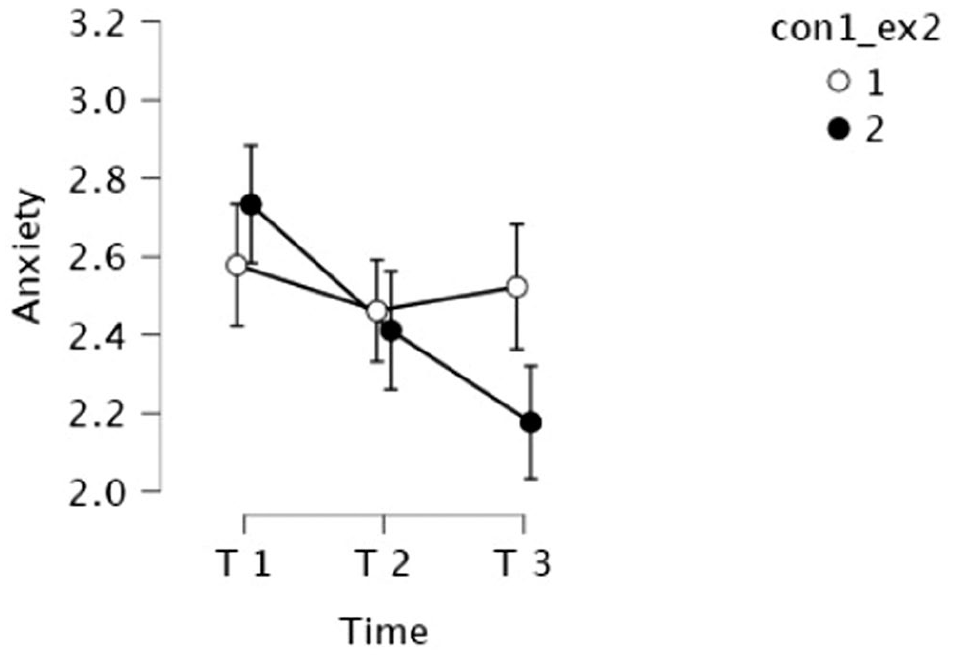
The trajectory of second language (L2) anxiety between the two groups.
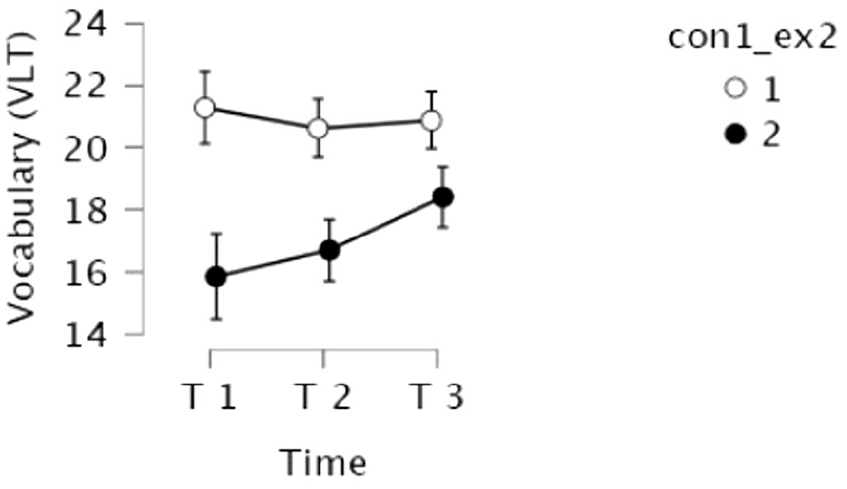
The trajectory of second language (L2) vocabulary between the two groups.
VI Discussion
Most of the cross-sectional studies (including meta-analysis reports) on language anxiety have adopted the perspective that anxiety negatively affects and influences L2 achievement (Oteir & Al-Otaibi, 2019; Botes et al., 2020; Horwitz, 2001, 2010; Saito et al., 1999; Teimouri et al., 2019; Zhang, 2019). However, a contemporary view initiated around 2021, which fundamentally started in 1991 with the work of Richard Sparks’ co-authors, does not align with this perspective. Unlike the traditional view, the contemporary view suggests that language achievement (both L1 and L2) precedes L2 anxiety and not the other way around (e.g. Alamer & Lee, 2024; Alamer et al., 2023; Almusharraf & Bailey, 2023; Chan et al., 2025; Hamada & Takaki, 2022; Li et al., 2024; Liu & Dong, 2023; Sparks, 2025; Sparks & Alamer, 2022, 2023, 2024, 2025; Zhao et al., 2024). The present study aimed at examining the perspective that increasing students’ L2 achievement (expressed by vocabulary achievement) can decrease their L2 anxiety (measured as the specific anxiety learners experience when using or learning the L2). To the best of our knowledge, this is the first study to investigate this matter experimentally. Methodologically, our study is also the first experimental study in the L2 field to employ the advanced statistical method of LGCM to precisely examine the effectiveness of an experiment. We maintain that LGCM, but not ANOVA, provides richer results in experimental research design (Breitsohl, 2019; Newsom, 2023). For example, we found no relationship between the intercept (initial level) of L2 anxiety and its slope (i.e. its decrease over time). This indicates that students may follow different trajectories for anxiety, regardless of their initial scores or assigned conditions. The same was true for vocabulary achievement as there was no relationship between the intercept and slope of vocabulary achievement. Nonetheless, the relationship between anxiety and vocabulary achievement slope was negative, suggesting that an increase in vocabulary achievement is associated with a decrease in anxiety. This finding aligns with previous studies (Alamer & Lee, 2024; Li et al., 2024).
Our research question asked whether improving students’ L2 vocabulary knowledge would decrease their feelings of anxiety about the L2. The answer to this question was positive. The results showed that a teaching approach which explicitly attempted to increase students’ vocabulary knowledge in the target language was effective in reducing students’ levels of anxiety over time. The first evidence that our experiment achieved its objective is drawn from the observation that vocabulary levels of the experimental group increased significantly over time as indicated by the LGCM. Hence, the teaching method that sought to increase the skills necessary for expanding L2 vocabulary knowledge delivered a positive effect on students’ vocabulary achievement. Consequently, we anticipated that due to the increase in vocabulary achievement, students’ sense of anxiety (as measured by S-FLCAS) would be decreased. Our conjecture was also confirmed through the LGCM analysis as language anxiety of the experimental group decreased significantly compared to the control group. It should be noted that there was no explicit treatment to decrease students’ anxiety in control group; hence, the decreased anxiety among the experimental group can be said to be attributed to their increased vocabulary knowledge. This is not a surprising result given the argument that language achievement predict anxiety established in the literature (Alamer & Lee, 2024; Almusharraf & Bailey, 2023; Chan et al., 2025).
Furthermore, the idea that language achievement precedes anxiety was supported by results showing that the growth in vocabulary knowledge and a corresponding decrease in anxiety were observed exclusively among the experimental group. However, the control group demonstrated no significant growth in L2 vocabulary knowledge or decrease in language anxiety. We surmise that the stability in the control group’s vocabulary knowledge and language anxiety over time may reflect the natural trajectory when there is no specific intervention for treating language anxiety or improving vocabulary knowledge.
These results lend support to the notion that stronger achievement in the L2, in this case vocabulary knowledge, may be important for the prediction of language anxiety, not the other way around (Alamer & Lee, 2024; Almusharraf & Bailey, 2023; Hamada & Takaki, 2022; Liu & Dong, 2023; Sparks, 2025). These results also support previous findings which have shown that language achievement precedes language anxiety (Sparks & Alamer, 2022, 2023). The results may also suggest a new direction for researchers when investigating language anxiety in L2 learning. As explained earlier, previous experimental studies (e.g. Alrabai, 2015) have applied teaching strategies that are motivational in nature which show an impact on increased motivation but less impact on decreased anxiety. As such, the findings provide a new and counterintuitive perspective whereby researchers who are concerned with reducing language anxiety might start by adopting teaching methods that attempt to increase students’ language skills in the L2. The findings of the present study showed that an instructor’s focus on improving students’ language skills, specifically vocabulary knowledge, may be important because it can decrease feelings of anxiety and promote proficiency in the language at the same time.
1 Educational implications
The traditional perspective on anxiety implies that educators should deal with students’ anxiety about the language by creating a cheerful, intimate, and relaxed classroom environment (e.g. Griffiths & Soruç, 2020; Horwitz, 2001, 2010; Saito et al., 1999). Although this strategy might provide temporary relief, it is superficial and does not address the underlying problem of anxiety. In contrast, longitudinal and rigorous exploratory studies have suggested that avoiding language learning opportunities, which is a symptom of language anxiety, may instead be an issue of low language skills (e.g. Alamer & Lee, 2024; Li et al., 2024; Sparks & Alamer, 2022, 2023, 2024, 2025; Sparks et al., 2018). Our findings, based on an experimental design, complement these longitudinal studies and are the first in the field to provide new insights for L2 educators who want to reduce students’ language anxiety and facilitate language proficiency. In essence, the findings of this study indicate that L2 teachers should prioritize enhancing students’ language proficiency over anxiety-reduction strategies. The results suggest that when the instructors apply strategies that target students’ L2 vocabulary knowledge directly, their language anxiety may decrease over time. This is an interesting and new finding because teachers may be able to reduce students’ language anxiety without explicitly implementing anxiety-reduction techniques. We suggest that L2 teachers could apply language-promoting methods such as directly teaching skills necessary to speak, comprehend, read, and write the L2 and also encouraging students to engage in language activities that are relevant to them both culturally and educationally, thus increasing their exposure to the vocabulary and other language skills in the L2. At the same time, language teachers can help students to consider the idea that any anxiety they may have for language learning can be diminished by increasing their vocabulary knowledge and language skills in the L2. Based on the results of this experimental study, L2 teachers can be more confident that teaching the language skills necessary for successful L2 achievement is likely to improve language achievement, which then helps to decrease language anxiety without the need to use anxiety-reduction techniques. Here, we do not imply that creating a relaxed classroom environment is an ineffective strategy. Instead, our findings show that teaching language skills can foster a dynamic and creative learning environment.
2 Limitations
Although the present study provides important conceptual and empirical contributions to the L2 field, it is not without limitations. First, the study did not use a comprehensive range of language skills – such as grammar, pronunciation, reading, and writing – as measures of L2 achievement. Including additional aspects of L2 achievement could provide further insights, not only for reducing language anxiety but also for enhancing overall L2 proficiency. Second, students’ initial levels of anxiety were different across the two groups. Although the LGCM controls for such variation by allowing the intercept to be different across the groups, it would be better for the research findings to have equivalent groups at the starting point. Third, the present study did not account for other confounding variables that could further clarify the trajectory of language anxiety and vocabulary knowledge. For example, including variables such as students’ L2 aptitude and/or L1 achievement could shed additional light on variables that confound the measurement of language anxiety (see, for example, Sparks, 2025). Fourth, we had two instructors for our study: one for the experimental group and another for the control group. Consequently, we cannot claim that the selection process was entirely random, and factors related to the instructors, such as their attitudes, were not controlled in this study.
VII Conclusions
Overall, the present experimental study makes a noteworthy contribution to the study of language anxiety and offers a new understanding of the potential causal impact of increasing L2 achievement for decreasing language anxiety. Anxiety researchers typically do not recommend teaching language skills directly. Instead, they often suggest strategies to mitigate students' sense of anxiety, assuming the root issue lies with anxiety itself rather than language skills. In our view, it is the development of language skills that plays the most critical role, as improving these skills can, in turn, lead to a reduction in anxiety. Contrary to the classic belief that anxiety affects achievement, our experimental findings show that it is achievement that reduces anxiety and not the other way around. To our knowledge, this is the first study to conduct this type of investigation on the topic of language anxiety. Methodologically, it is also the first to implement the LGCM in experimental research in the field of language learning, allowing other researchers to benefit from this study as a practical example. The dual-domain LGCM provided vivid details (by controlling for the heterogeneous variance) for the differences both within- and between-persons in the trajectories of the variables. We encourage future researchers to consider these new findings and investigate further the association between language anxiety and language learning from this new perspective.
Footnotes
Appendix A
Appendix B
Funding
The author(s) disclosed receipt of the following financial support for the research, authorship, and/or publication of this article: This work was supported by the Deanship of Scientific Research, Vice Presidency for Graduate Studies and Scientific Research, King Faisal University, Saudi Arabia [Grant No. KFU250364].
Statement for informed consent
A letter of consent was included at the beginning of the questionnaire of the study. The university board approved the study proposal and granted permission to collect the data.

Data availability
The data cannot be shared for ethical considerations.