



Abstract
While language anxiety is known to be a strong predictor of the second language (L2) achievement for decades, there has been a relative lack of empirical attention to establishing which one – anxiety or achievement – influences the other. The present study, based on a cross-lagged panel analysis, examined the causal relationships between language anxiety and L2 achievement, each of which was measured at three times points across 17 weeks. The results supported the directional relationship from L2 achievement at Time 2 to language anxiety at Time 3 while the opposite directional relationship from language anxiety at Time 2 to L2 achievement at Time 3 was not supported. Thus, our results suggest that language achievement precedes anxiety and not the other way round. The moderation analysis further sheds light on the importance of the earlier L2 achievement in the development of anxiety later on, by understanding learners’ motivational profiles. That is, learners with high autonomous motivation and high achievement at Time 1 exhibited a further decrease in anxiety at Time 3. On the other hand, learners with high autonomous motivation but low achievement showed a higher level of anxiety at Time 3. Overall, the present study makes a noteworthy contribution to one of the most debatable issues in the field and concludes with some practical implications for L2 educators.
Keywords
I Introduction
Language anxiety is a multi-faceted phenomenon, influencing as well as influenced by a range of learners’ perceptions, attitudes, and beliefs. Anxiety that is defined as a ‘feeling of tension and apprehension’ (MacIntyre & Gardner, 1994, p. 284) can be intensified when learning a second language in particular. In fact, it is possibly the most extensively studied variable in second language (L2) research (Teimouri et al., 2019). Factors known to be related to L2 language anxiety include self-perception, beliefs about learning, and feelings about the use of language (Horwitz, 1986). Language anxiety also tends to affect various aspects of the L2 learning processes and outcomes such as communication and production (MacIntyre & Gregersen, 2012), vocabulary acquisition (Gardner et al., 1992), speaking (Oflaz, 2019), willingness to communicate (Alrabai, 2014), cognitive processing (MacIntyre & Gardner, 1994), self-esteem, and self-perception about language proficiency (Alamer & Almulhim, 2021). L2 learners with heightened anxiety may lack the motivation to engage with the language and ultimately avoid using the language (Mercer et al., 2012). Many studies of L2 motivation tended to explain L2 achievement by incorporating how language anxiety and motivation affect each other to facilitate or hinder the learning processes (Alamer & Lee, 2019; Gardner et al., 1992; Sparks et al., 2009; Woodrow, 2006).
However, as noted in recent meta-analyses (Botes et al., 2020; Teimouri et al., 2019; Zhang, 2019) researchers in the L2 domain should consider novel theoretical, empirical, and analytical approaches to precisely determine the directionality of the cause and effect between the two variables. Although the vast body of research relied on cross-sectional correlational analyses to conclude the causal directionality, none of them provided clear account of the casual relationship. As such the major aim of the present study is to empirically investigate whether language anxiety leads to decrease in L2 achievement, or perhaps L2 achievement leads to decrease in language anxiety over time, or they affect each other in both ways through time. We additionally investigated the role of motivation as a mediator in the emerging causal relationships.
1 Anxiety and achievement in the L2 learning contexts
As mentioned above, the negative association between language anxiety and language achievement is fairly well established in L2 research literature. A recent meta-analysis study conducted by Botes et al. (2020), based on an overall sample size of 14,128 and the k = 99 effect sizes across different L2 language settings for English (N = 12,002), Turkish (N = 589), French (N = 276), Arabic (N = 233), and Spanish (N = 210), reported the correlations of r = −.26 for speaking, r = −.34 for reading, r = −.47 for writing, and r = −.53 for listening, as well as r = −.39 for general academic ability, with language anxiety. The finding is in agreement with the anxiety–achievement association in other empirical studies (cf, Lee & Stankov, 2018). Perhaps a more pertinent point to the present article is the concern expressed by Botes et al. (2020) and many others in the past (Sparks & Ganschow, 1993, 2007; Teimouri et al., 2019), about the directionality of the association between language anxiety and achievement. Despite the scholarly debate of nearly 30 years, the issue of which one comes first – anxiety or achievement – is largely unresolved with each side claiming the importance of one over the other. Even meta-analyses are not particularly useful in this regard because researchers have been inferring causality based on correlational analysis (MacIntyre, 2017). This critical issue has led MacIntyre (2017) to call for robust investigations ‘to help clarify causal connections between language anxiety and performance’ (p. 23). Similar call was made by other researchers as well. For example, Teimouri et al. (2019) encouraged researchers to utilize advanced statistical procedures and ‘go beyond bivariate relations’ (p.19). The present study responds to these calls and investigates longitudinally how language anxiety and achievement are causally related using Structural Equation Modeling (SEM) approach, particularly, by using Cross-lagged Panel (CLP) analysis.
2 Language anxiety as a manifestation of language learning difficulties
A group of researchers indicate that individual differences in affective disposition and anxiety are not as important as the language learning aptitude in language learning, whether it is a native or second language, and thus, anxiety is seen as the result from the language learning difficulties and not the way around (Sparks, 2016; Sparks & Ganschow, 1993, 1995, 2007; Sparks et al., 2018, 2019). An influential study that highlighted the importance of cognitive process and achievement rather than affective disposition such as attitudes, motivation, and anxiety includes Sparks and Ganschow (1995) as they found that the general language aptitude typically manifested in the native language learning processes is the primary source of inefficiency in L2 learning as well. The concept that anxiety is a result of the learners’ cognitive deficits (not the other way around) is expressed in the Linguistic Coding Difference Hypothesis (LCDH) proposed by Sparks and his colleagues (Sparks & Ganschow, 1993, 1995, 2007; Sparks et al., 2018).
In their early studies on language anxiety, Sparks and Ganschow found that secondary and postsecondary level students with lower L2 anxiety measured based on the Foreign Language Classroom Anxiety Scale (FLCAS; Horwitz, 1986) exhibited stronger L1 skills and higher L2 aptitude measured based on Modern Language Aptitude Test (MLAT; Carroll & Sapon, 1959) but lower L2 achievement than students with higher anxiety (Ganschow & Sparks, 1996; Ganschow et al., 1994; Sparks et al., 1997). In a 10-year study, Sparks and Ganschow (2007) followed students from 1st–10th grades and explain that studies that assess students’ language anxiety may be indeed measuring their perceptions of their language learning skills. In addition to the L1 skills measures, that MLAT was also administered in 9th grade. To evaluate this hypothesis the researchers assessed students over time on different variables including their native language skill (from grade 1 to 4), and foreign language achievement, later on. Interestingly, Sparks and Ganschow (2007) found that language anxiety was substantially and negatively associated with students’ native language skills (which were obtained several years before they encountered the language class). Another important finding was that L2 anxiety on the FLCAS was negatively correlated with students’ L1 skills in 1st grade, 8 years before they enrolled in their first FL course, adding to the claim that the FLCAS is measuring students’ L1 skill levels, their (accurate) self-perceptions of their language ability, or both. This finding is important and has never been refuted, or explained, by L2 anxiety researchers. Instead, it has been ignored.
Furthermore, it was noticed that L2 proficiency test was moderately and strongly related to students native language variables across the 4 grades measures (in one instance L2 proficiency was strongly correlated with Written Spelling Test at r = .81, p < .01 indicating that around 66% overlap is found between the variables). Thus, language abilities are said to represent a confounding (third) variable in research findings claiming that anxiety plays a major and negative role in predicting L2 proficiency and achievement. Similar findings were obtained in subsequent longitudinal studies (Sparks et al., 2013, 2018, 2019). The researchers demonstrated that students’ language anxiety appeared to be a proxy for students L1 skills, L2 aptitude, and L2 achievement. Building on emeprical evidence, Sparks and associate highlighed the importance of teaching language skills as they appear far more important than the effort to develop strategies to reduce anxiety symptoms.
3 Language anxiety as ‘cause’ of language learning difficulties
A bulk of the L2 research, however, also supports the notion that anxiety can affect learners’ language achievement. According to MacIntyre (2017), experimental research indicated that language anxiety is only a consequence of differences in L2 proficiency. This claim seems to be obvious, but learning context is crucial to consider when examining the dynamics of language anxiety–performance relationship (MacIntyre, 2017). A recent, systematic review by Oteir and Al-Otaibi (2019), which was based on more than 40 studies carried out between 1960 and 2018, concludes that anxiety is a negative predictor of language achievement and emphasised pedagogical implications that may mitigate the learners’ language anxiety. Similar conclusion has been made based on correlational analyses in different learning settings. Zhang (2019) found in his meta-analysis study among the sample of more than 10.000 participants that the overall correlation between language anxiety and achievement was −0.34, p < 0.01. Because the negative correlation remained significant across different language levels the author postulated that ‘the role of anxiety should not be ignored even when proficiency improves’ (p. 14). Teimouri et al. (2019) and Zhang (2019) also came to the same point in their meta-analysis and concluded that language anxiety is a negative predictor of language achievement. However, it is important to note here that correlational analyses (particularly cross-sectional ones) cannot provide a claim about causality between the variables (Collier, 2020). Hence, meta-analytical findings are useful in understanding the strength of the relationship between the variables but they do not guarantee cause and effect.
As such, researchers arguing for the effect of language anxiety on L2 achievement tend to underscore the importance of the learning environment and the development of a range of strategies that may reduce learners anxiety, such as providing a relaxed classroom atmosphere, using themes and topics that can address students’ interest, and enhancing a feeling of group identity (Al-Hoorie & Hiver, 2020; Alrabai, 2014, 2015; Horwitz, 2001, 2010). Nonetheless, a valid question remained unresolved: does language anxiety affect language achievement over time, or perhaps it is the other way round? Put differently, can we conceptualize language achievement as a derive for lowering language anxiety over time? Conceptual and pedagogical applications would be at variance if, for example, we observe that language achievement decreases later feelings of language anxiety.
4 Learners’ motivational profile as a potential moderator between L2 achievement and language anxiety
Learners’ motivation is often studied in conjunction with the anxiety–achievement relationship. Some researchers argue that learners’ motivation (positive) and anxiety (negative) may be defined as one dimension with each on the opposite sides representing the general feelings about learning of the particular domain or task (Lee & Stankov, 2018). Motivation is negatively associated with anxiety and both often related to L2 achievement (Alamer & Almulhim, 2021; Alamer & Lee, 2019; Mercer et al., 2012; Sparks et al., 2009; Sparks & Ganschow, 2007; Woodrow, 2006). In the L2 achievement-motivation research, two types of motivational profiles autonomous motivation and controlled motivation have been recognized within the Self-determination Theory (Ryan & Deci, 2017). Autonomous motivation in language learning refers to personal volition when choosing to engage in the learning task because it is inherently pleasant, enjoyable, and interesting (i.e. intrinsic orientation) or it is personally valuable and important to self-development (i.e. identified orientation). Both intrinsic and identified motivational profiles are considered to form a general factor, called autonomous motivation (Alamer & Al Khateeb, 2021; Alamer & Lee, 2019; Litalien et al., 2015; Mouratidis et al., 2018; Oga-Baldwin et al., 2017). Controlled motivation, on the other hand, reflects one’s motivation when driven by external factors and pressures. Learners may choose to learn the language because of the demands of the society or job opportunities, or to avoid guilt and shame (i.e. introjected orientation), or to obtain a reward or to avoid punishment (i.e. external orientation). Introjected and external orientations tend to form a higher-order factor, which has been labelled as controlled motivation (Alamer, 2022; Alamer & Lee, 2019; Litalien et al., 2015; Mouratidis et al., 2018; Oga-Baldwin & Nakata, 2017; Ryan & Deci, 2017). Previous research showed that controlled motivation has been found to inhibit long-term optimal language learning process (Alamer, 2021; Oga-Baldwin et al., 2017) and negatively associated basic psychological needs and positively with language anxiety (Alamer & Almulhim, 2021).
A recent study by Alamer and Lee (2019) emphasized the interrelationship between anxiety and motivation, in understanding the learners’ L2 achievement. Their motivational process model included major psychological factors related to L2 achievement such as anxiety, motivation, emotions, and goal-setting attitude. The study found that autonomous motivation and controlled motivation were the mediators in the relationship between language anxiety and L2 achievement, supporting the notion that both motivation and anxiety need to be examined together to better understand how L2 learners may achieve their learning goals. Also, Alamer and Almulhim (2021) have investigated the robustness of motivation variables to predicts different types of anxiety. The researchers found that perceived competence negatively predicted various types of anxiety including psychological, achievement, and general language anxiety, while perceived autonomy did not predict any types of anxiety.
II The present study
The purpose of the present study is two-fold. First, it aims to determine the causal precedence of the relationship between anxiety and achievement, by employing an advanced statistical technique, CLP analysis. This method was chosen because previous studies tend to rely on statistical analyses that do not suggest the causal directional relationship (e.g. correlation, regression, t-tests, and ANOVA). However, CLP analysis better fits this purpose (Kline, 2016). The second objective is to explore a role that autonomous and controlled motivation may play in the anxiety–achievement relationship over time. The latter is explored by carrying out a moderation analysis, which also includes the testing of the main effect of achievement in predicting the learners’ anxiety. Thus, the results may shed light on how the learners’ achievement may impact their language anxiety over time.
III Methods
1 Participants and procedure
The participants of this study were Saudi undergraduate students enrolled in the Department of English at a public university in Saudi Arabia (N = 226 with 64% of males and 36% of females). Their ages ranged from 18 to 20 years (M = 19.1, SD = 0.33). Students’ first language is Arabic and they were learning English as a second language. A convenience sample strategy was used and the data for the present study were collected at three-time points. Participants of the present study were at their first grade of the English language program. The admission of this university includes students’ high school grades, and the Saudi General Aptitude Test (GAT). Typically, all students who want to study in the Department of English in this university had to pass a foundation year before they can enter the main program. Those who could not make it through are given the choice to transfer to another major that do not require a foundation year (usually majors taught mainly using the L1). Participants of this study have been exposed to English previously in both the foundation year as well as elementary and secondary school (collectively, it is estimated that these participants have exposure to English for at least seven years). Students can use English in places other than the university (for example, for practice purposes) such as in shopping centres. Generally, students would attend this university to get a Bachelor in English language and translation. After graduation students can find jobs in different sectors in the country but they mainly become English language teachers in both public and private schools. In their first grade, students usually take L2 courses such as Reading, Writing, Listening, and Speaking, but they can take other L1 courses as well, and thus students courses are taught in both L1 and L2. However, in this research only L2 courses scores have been obtained.
Data collection took place in 2019. Specifically, Time 1 data collection was carried out at the beginning of the Fall semester (Week 2) and Time 2 data collection towards the end of the same semester (Week 12). Finally, Time 3 data collection was conducted at the beginning of the following Spring semester (Week 2 which is 17 weeks after the first measurement point and 7 weeks from the second time point). A total of 17 weeks was deemed sufficient to observe changes that may occur in the students’ English achievement and language anxiety among the participants. The participants were given the online survey which included the demographic information questions and a measure of anxiety, three times. 41 students did not complete the survey in the second wave, and 25 students who did not participate in the third wave, resulting in a total sample size of N = 160. Cases with the incomplete data (largely in T2 and T3) were computed using multiple imputation method in the analysis.
2 Measures
a Language anxiety
The 10-item scale assessing language anxiety (Gardner, 2010) was employed in this study. The items had a 5-point Likert-type response format, ranging from 1 (strongly disagree) to 5 (strongly agree) and were designed to collect self-report about language anxiety that may occur during the language learning situations (an example item: ‘I never feel quite sure of myself when I am speaking in our English class’). The reliability of the scale at Time 1 was Cronbach’s α = .88 for this study’s sample. Correlations among the three-time points which can be taken as test-retest reliability ranged between .73 and .78, indicating satisfactory consistency over time.
b English as the second language (L2) achievement
The data of the students’ English as the second language (L2) achievement was obtained by the official university records of their scores in four language skill domains: listening, speaking, reading, and writing. Each of these language skill domains was taught as separate courses in the English Department. The four courses use the Unlock English language course books developed by The University of Cambridge (Ostrowska et al., 2021). Unlock is a five-level academic skills course that targeted language skills development for students in an academic context and combines carefully scaffolded exercises, a comprehensive approach to critical thinking. The course levels are designed to cover each Common European Framework of Reference for Languages (CEFR) level and each level in the series consists of four language domains: listening, speaking, reading, and writing that targeted a specific CEFR level (e.g. Level 1 targeted A1, and Level 2 targeted A2) with an exception for ‘Unlock Basic Skills’ which targeted pre-A1 level and is not used in the Department course plan. Participants of the present research, study these books starting from Level 1 toward Level 4. In each of these levels, teachers use Unlock for the four courses (listening, speaking, reading, and writing) as the textbooks.
Moreover, Unlock provides a test bank that teachers can pick from to examine their students and reliably evaluate their progress (for example tests, see Appendix 2). For instance, the reading test can be a passage that is followed by 10 questions. To assess their writing competency, students may be required to re-order seven sentences into a five-sentence paragraph that starts with a topic sentence, then has supporting sentences, and ends with a concluding sentence. Thus, two sentences should not be used. In the listening test, students may be required to listen to a clip, taken from the same source, followed by questions such as underlining the stressed syllable and true or false-based questions. With regards to the speaking test, students may be given a topic to think about along with two to three opening questions such as: what are the reasons for this? Students have one to two minutes to think about the topic and take notes. Teachers assess students on their monologic speaking on five criteria: students’ ability to speak about the topic, pronunciations, using grammar accurately, using vocabulary accurately, use a range of grammar and vocabulary. Teachers are required to pick from the test banks provided by the Unlock teacher’s book to best fit their students’ level (for example tests, see Appendix 2). In this way, none of these tests (except for speaking test) required subjective judgement on the part of the scorer. Each language domain test has 5 marks, and thus the maximum mark for the summated score across listening, speaking, reading, and writing was 20 at each of the assessment points.
The research participants were asked for the consent to allow their language scores to be used for the research purpose; three students who did not consent and their data were not used for this study.
c Autonomous and controlled motivation
The scales of autonomous and controlled motivation in L2 learning used in Alamer (2022) were employed in this study (see Appendix 1). There was a total of 20 items with 10 items for autonomous motivation (an example item: ‘I enjoy learning English’) and 10 items for controlled motivation (an example item: ‘I want to get better marks in the English course’). All items had a 5-point Likert-type response format ranging from 1 (strongly disagree) to 5 (strongly agree). The Cronbach of autonomous motivation at Time 1 was α = .86 while the test-retest reliability (i.e. correlations among the three-time points) was somewhat medium, between .51 and .49. One reason of this result might be attributed to the expected fluctuation of individuals’ motivation over time (Ryan & Deci, 2017). The Cronbach of controlled motivation at Time 1 was α = .87 while the test-retest reliability was reasonably strong, ranging between .72 and .75.
3 Statistical analysis
We first assessed the measurement model that involved autonomous motivation, controlled motivation, and language anxiety through the confirmatory factor analysis (CFA) method. To evaluate the model, several fit indices were considered: Comparative Fit Index (CFI), a Bollen’s Incremental Fit Index (IFI), Root Mean Square Error of Approximation (RMSEA), and Standardized Root Mean Residual (SRMR). It is suggested CFI and IFI values in the region of .90 as acceptable, but CFI and IFI values above .95 indicate good fit depending on model complexity and sample size (Hair et al., 2019). The recommended RMSEA and SRMR values are around .07 although larger values can be acceptable when other indices show a good model fit (Hair et al., 2019).
Second, a cross-lagged panel (CLP) analysis was considered. It is a statistical method that allows the testing of the directional relationship between two or more variables measured over time (Kline, 2016). Figure 1 shows a CLP analytic approach that was employed in this study. The strength of the path coefficient indicates relative importance of the variable while controlling for the variances on the same variable present in the model between different time points (i.e. d1a, d1b, d2a, and d2b in Figure 1). The paths with the double-arrows (c1, c2, and c3 in Figure 1) represent the covariance between the two variables measured at the same time points, and they are called unlagged relationships (c1, c2, and c3 in Figure 1). Unlagged relationships demonstrate how language anxiety and L2 achievement are related to each other at a given time point.
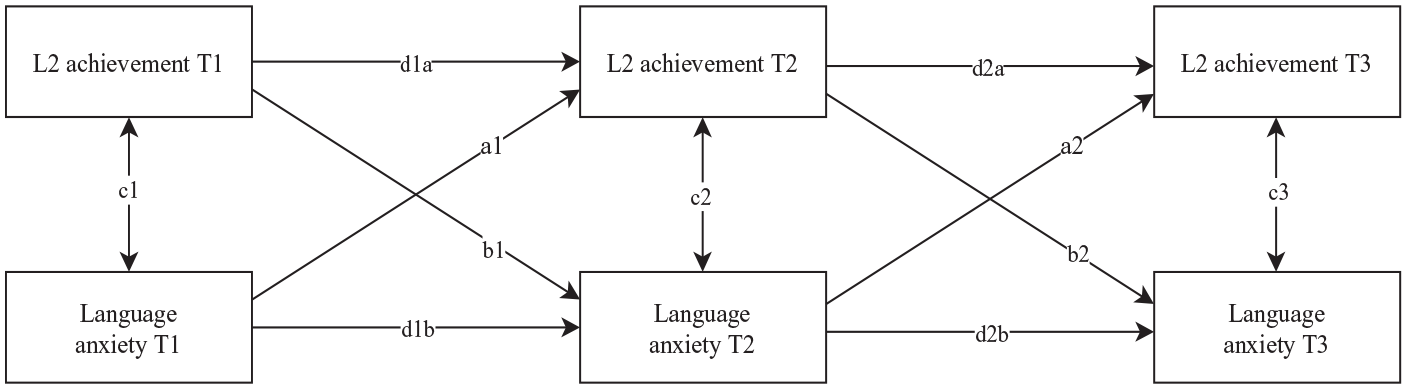
A representation of the hypothesised cross-lagged relationships between language anxiety and L2 achievement.
The main focus of CLP modelling is, however, to find out about the strengths of the auto-lagged relationships (i.e. a1, b1, a2, and b2 in Figure 1). These one headed-arrows represent the effect that one variable has on the other over time. For example, if the path coefficient of b1 (i.e. L2 achievement at T1 affecting language anxiety at T2) was to be stronger than the path coefficient of a1 (i.e. language anxiety at T1 affecting L2 achievement at T2), a conclusion can be made that the data supports the directional relationship from achievement to anxiety (as opposed to anxiety to achievement). Further, the effect of the same variables is re-examined in the next time point (i.e. T3), by comparing the cross-lagged paths of a2 and b2 to substantiate the evidence that the observed relationship is stable over time. Thus, if the b1 coefficient is stronger than that of a1, and the b2 coefficient is stronger than a2, it can be concluded that the learners’ past achievement in L2 may determine how they feel about their L2 learning. Alternatively, the reciprocal effect between anxiety and achievement can be claimed if the compared cross-lagged path coefficients were not different from each other. Further, in the absence of statistically significant cross-lagged path coefficients, no casual effect between language anxiety and L2 achievement can be claimed. Similar to the CFA, the model fit indices are employed to assess the adequacy of the CLP path model to the data (Kline, 2016).
The other main statistical analysis employed in this study is the moderation analysis. Moderation analysis was conducted using Jamovi 1.1 software. Its main feature is to evaluate the extent to which a third variable (e.g. motivation) can change the size of or even the directionality of the relationship between two variables (L2 achievement and language anxiety). Two types of motivational profile variables – autonomous and controlled motivation – were employed as the potential moderators.
The following hypotheses are formed to guide our analysis and associated inferences.
Hypothesis 1. Students’ achievement as well as autonomous motivation will be negatively associated with their language anxiety. Specifically, the learners with high autonomous motivation coupled with high achievement would demonstrate low anxiety. On the other hand, the learners with high autonomous motivation, but coupled with low achievement, would still exhibit high anxiety.
Hypothesis 2. Students’ achievement, but not controlled motivation, will be associated with their language anxiety. Specifically, the learners with low controlled motivation coupled with low achievement would exhibit high anxiety, and the learners with low controlled motivation, coupled with high achievement, would exhibit low anxiety. In other words, learners with high achievement will exhibit low anxiety regardless of the level of controlled motivation.
IV Results
Table 1 presents descriptive statistics (means and standard deviations) and zero-order correlations of the study variables. An examination of the data distribution has been carried out by assessing the skewness and kurtosis values using the (+2, −2 guideline) suggested by Collier (2020). The results show that the data did not violate these cut-off values. Therefore, we used maximum likelihood (ML) estimation in both the measurement and CLP analyses. The analyses were conducted using SPSS Amos 24 software. Bootstrapping using 1000 samples was taken to provide the 95% confidence intervals for model parameters.
Descriptive statistics and correlation of the study variables.
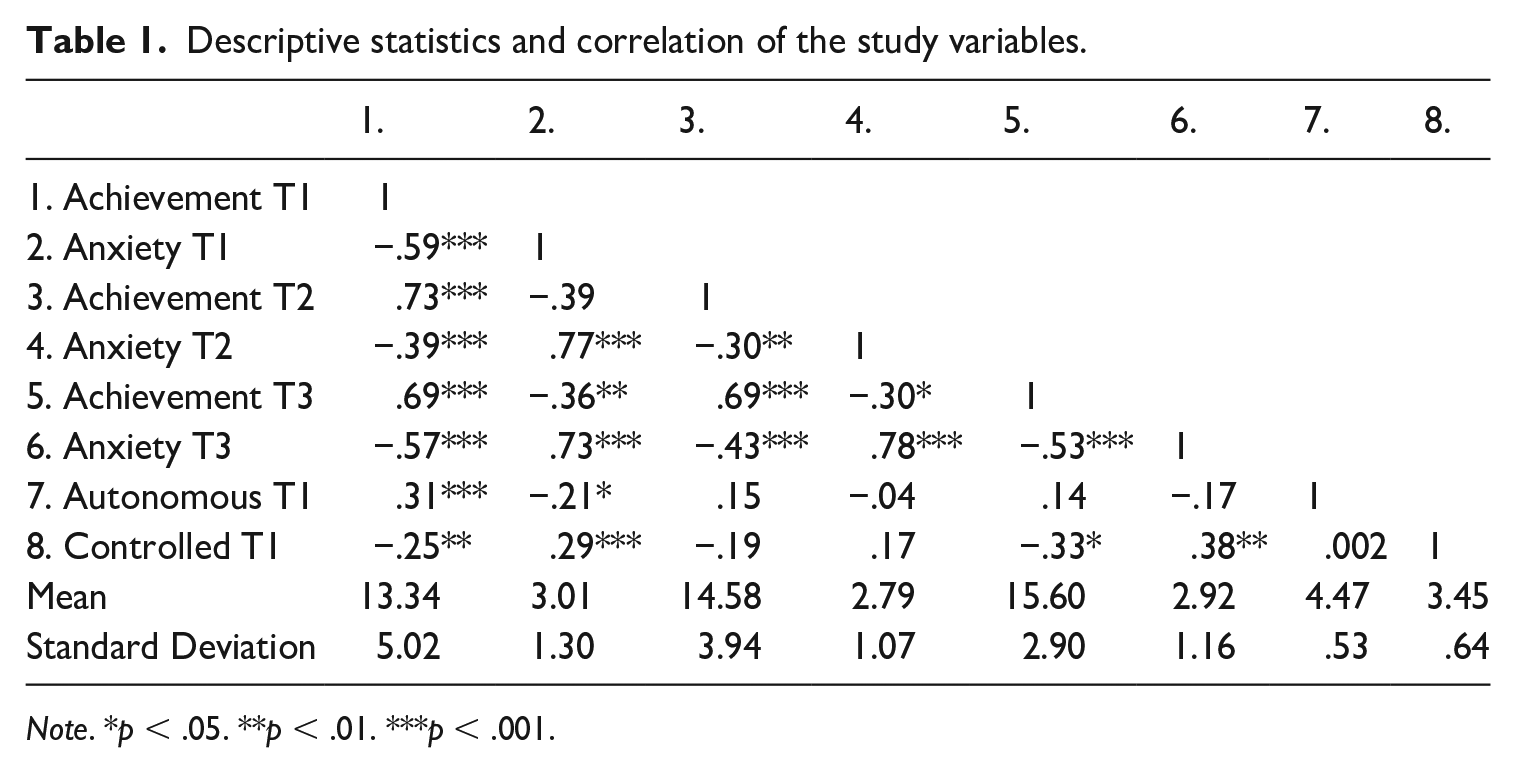
Note. *p < .05. **p < .01. ***p < .001.
The measurement model of the constructs involved in the study appears to fit the data adequately as indicated by the goodness-of-fit indices (χ2 = 638.35, df = 86, p = .02, CFI = .94, IFI = .95, RMSEA = .06, RMSEA 90% CI [.03, .09], SRMR = .10). Evaluating the CLP model indicates that the correlations between language anxiety and L2 achievement at all three time points were statistically significant, and showing moderate strength of associations in the expected direction (i.e. negative): r = −.59, p < .001 at Time 1, r = −.30, p < .01 at Time 2, and r = −.53, p < .001 at Time 3. Students’ achievement scores at Times 1, 2, and 3 were all moderately strongly and positively correlated with each other, as expected, r = .63, p < .001 between Time 1 and Time 2; and r = .69, p < .001 between Time 1 and Time 3; and r = .69, p < .001 between Time 2 and Time 3. Students’ anxiety appears to be fairly stable over time as well, showing the strong positive correlations of r = .77, p < .001 between Time 1 and Time 2; r = .78, p < .001 between Time 2 and Time 3; and r = .73, p < .001 between Time 1 and Time 3. Given these ranges of correlations, it appeared that the anxiety that the students felt throughout the terms was slightly more stable than their achievement results. These observed correlations were within the expected range; moderately strong negative correlations between anxiety and achievement, and fairly strong positive correlations across different time points within the anxiety and achievement measures.
The results that were most pertinent to this study, are the cross-lagged (i.e. time-lagged) paths between anxiety and achievement. Our data revealed that learners’ language anxiety measured at the initial point (Time 1) was not strongly associated with L2 achievement at the mid-point (10 weeks later at Time 2, r = –.21) or the final-point in time (17 weeks later at Time 3, r = −.36). This suggests that anxiety in the earlier stage of learning did not contribute to students’ achievement later. On the other hand, the learners’ language achievement measured at Time 1 was more strongly associated with their anxiety at the later points: Time 2, r = −.39 and Time 3, r = −.57. This suggests that achievement in the earlier stage of learning may have contributed to students’ anxiety in the later stage of learning.
1 The cross-lagged panel model results
The results of the cross-lagged path model are presented in Figure 2. The model fits the data well with the model evaluation indices showing: χ2 = 36.07, df = 4, p < .05; CFI = .95; IFI = .98; RMSEA = .22, RMSEA 90% CI: [.16, .29]; SRMR = .04. A fairly substantial amount of the variances was explained by the model, with R2 = .64 and R2 = .76 for L2 achievement and language anxiety, respectively, at Time 2; and R2 = .75 and R2 = .82 for L2 achievement and language anxiety, respectively, at Time 3. Of particular interest are the auto-lagged path coefficients. The two auto-lagged paths between Time 1 and Time 2 showed that L2 achievement at Time 1 did not predict language anxiety at Time 2 (β = .10, p > .05), nor did language anxiety at Time 1 predict L2 achievement at Time 2 (β = .06, p > .05). However, the students’ L2 achievement at Time 2 predicted language anxiety at Time 3 negatively (β = −.25, p < .01) while the cross-lagged path coefficient from anxiety at Time 2 to achievement at Time 3 was rather weak and not statistically significant (β = −.10, p > .05). Overall, the cross-lagged path model suggested that (a) there was no statistically significant short-term directional effect from either anxiety to achievement or from achievement to anxiety, at the beginning of the learning processes. However, (b) the only directional effect was observed at Time 3 which was from L2 achievement at Time 2 to anxiety at Time 3.
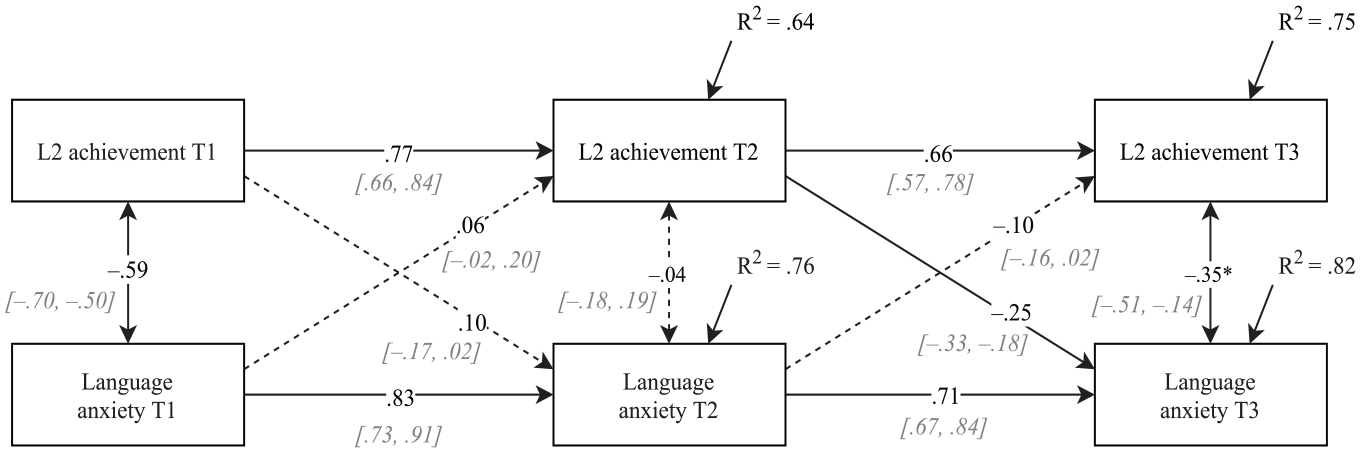
The cross-lagged panel model of language anxiety and achievement at three time points.Note: Italic and gray values are the 95% confidence interval.
2 The moderator analysis results
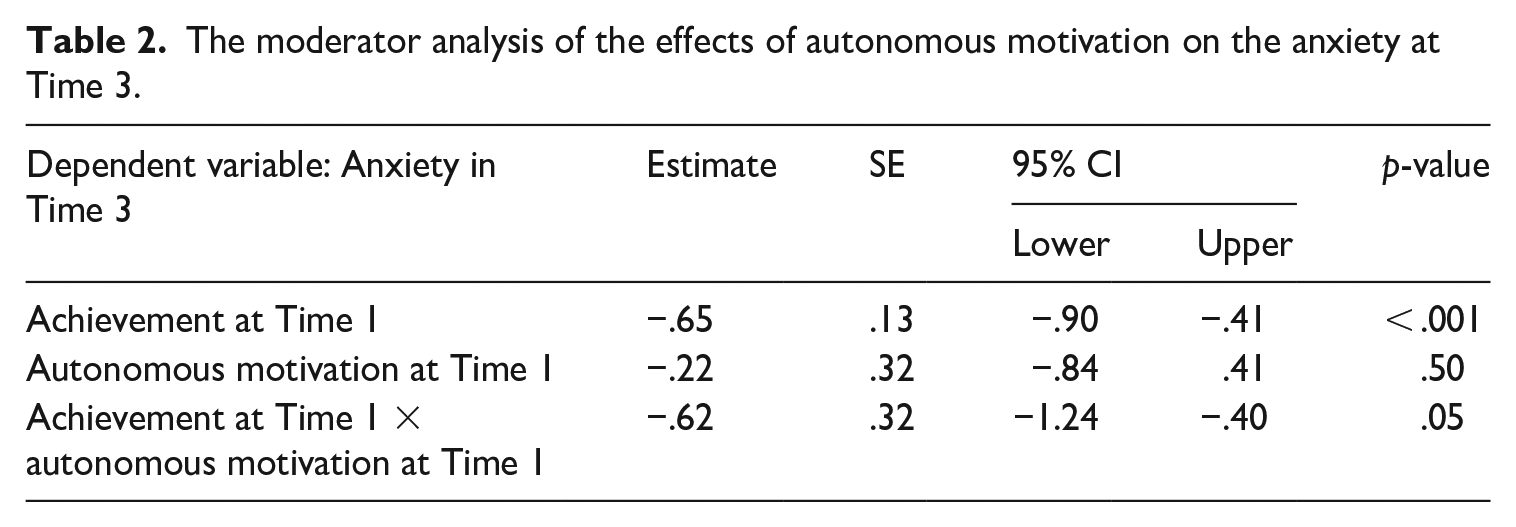
In the next step, moderator analysis was conducted with autonomous motivation and controlled motivation as potential moderators in the anxiety–achievement relationship. Since the previous analysis showed that past L2 achievement affects learners’ anxiety later on, we used L2 achievement at Time 1 as the independent variable and language anxiety at Time 3 as the dependent variable, and learners’ autonomous motivation at Time 1 as a moderator of the anxiety–achievement relationship. The results of the moderator (interaction) effect via are presented in Table 2. It shows that L2 achievement at Time 1 was a statistically significant, negative predictor of language anxiety at Time 3 (b = −.65, p < .001). In contrast, learners’ autonomous motivation appeared to have no effect (b = −.22, p > .05) on language anxiety. However, the interaction term of L2 achievement × autonomous motivation showed a statistically significant moderating effect (b = −.62, p = .05). That is, the relationship differed between L2 achievement at Time 1 and language anxiety at Time 3, depending on learners’ autonomous motivation at Time 1 (see Figure 3). That is, highly autonomously motivated learners showed a low level of language anxiety at Time 3 (i.e. an average of 1.5 out of the 5-point scale) only when they also had high scores on L2 achievement at Time 1. Those whose autonomously motivation was high but achievement was low, their anxiety was much higher (i.e. an average of 4.0 out of the 5-point scale). Further, those with a low level of autonomous motivation showed a moderate level of anxiety (i.e. an average of around 3.2) regardless of whether their achievement was high or low at Time 1.
The moderator analysis of the effects of autonomous motivation on the anxiety at Time 3.
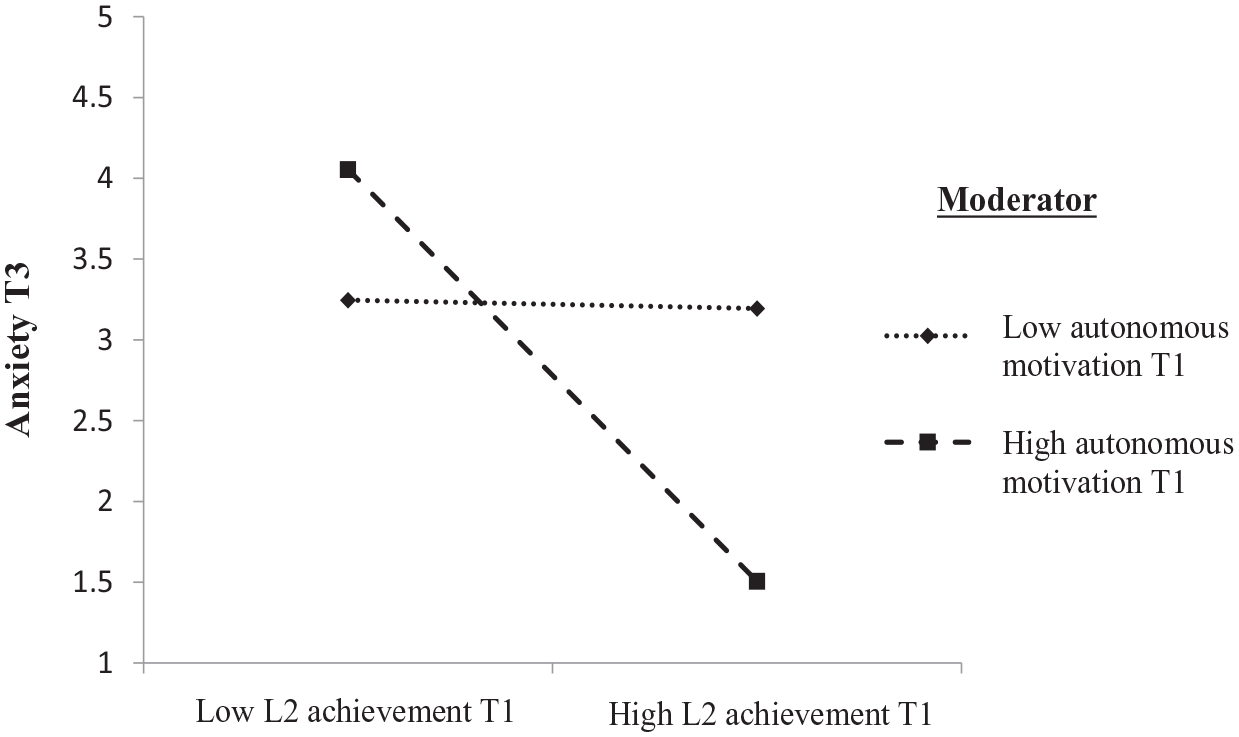
The slope analysis of the moderation effects of autonomous motivation on the anxiety and achievement relationship.
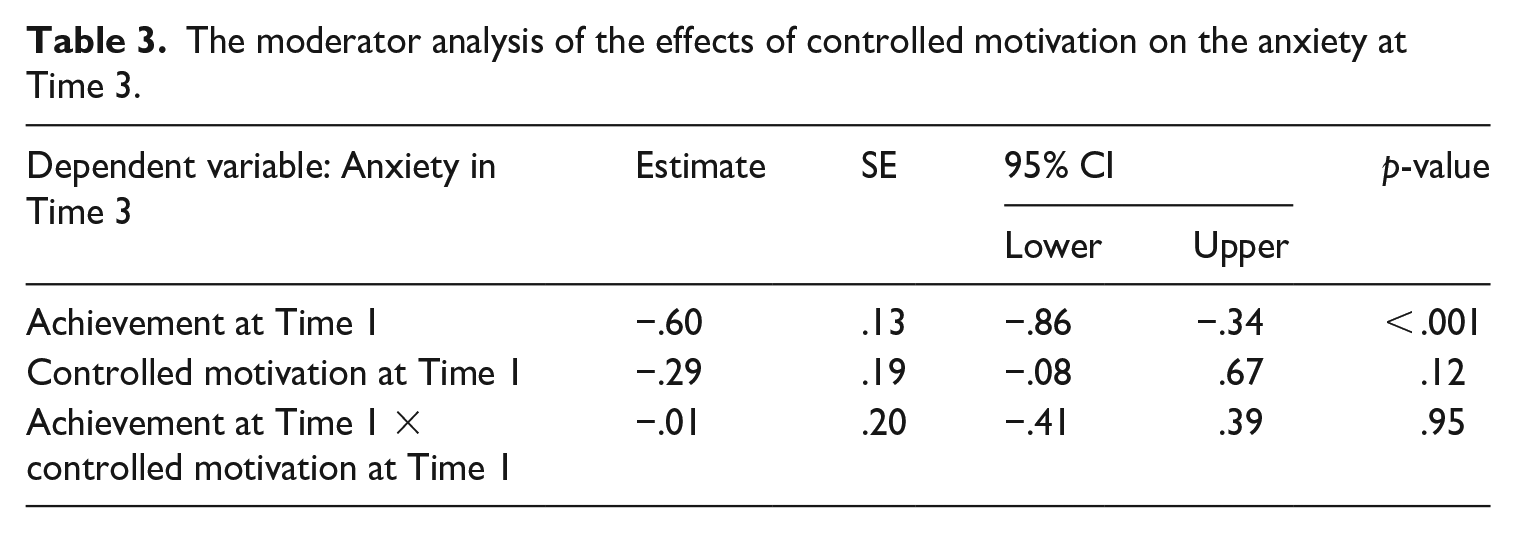
A similar, moderator analysis was conducted for the controlled motivation as a potential moderator in the relationship between L2 achievement at Time 1 and language anxiety at Time 3. The students’ controlled motivation at Time 1 was associated with language anxiety at Time 3; its moderator effect was not statistically significant either (see Table 3). As Figure 4 shows, the effect (i.e. slope) of achievement at Time 1 on anxiety at Time 3 was fairly consistent for the two groups of learners with low or high levels of controlled motivation. Overall, there was no main effect or interaction effect of controlled motivation concerning L2 achievement and anxiety. The students with a high-level of achievement but a low-level of controlled motivation demonstrated a relatively lower-level of anxiety (see Figure 4).
The moderator analysis of the effects of controlled motivation on the anxiety at Time 3.
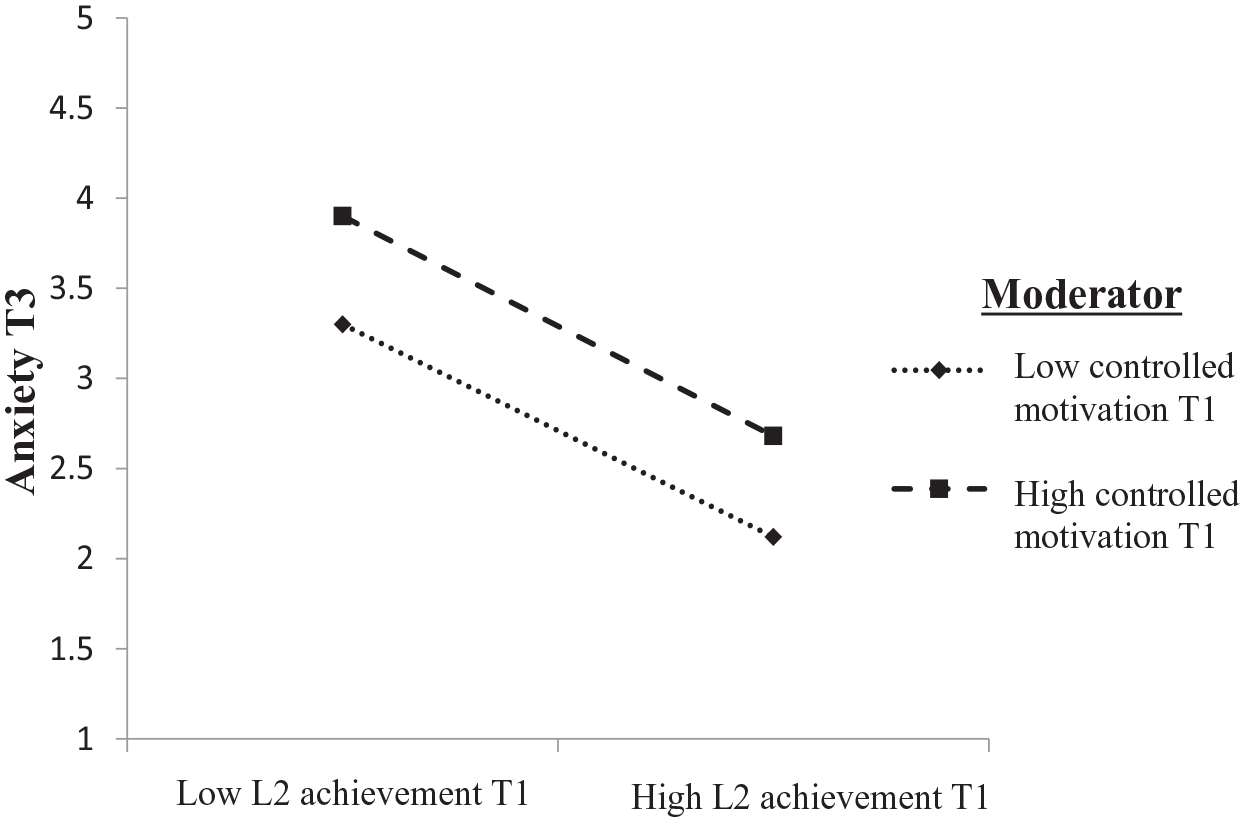
The slope analysis of the moderation effects of controlled motivation on the anxiety and achievement relationship.
V Discussion
The primary purpose of the present study was to examine the directional causality in the relationship between language anxiety and achievement in L2. Our data showed that L2 achievement and language anxiety measured at the same time point were negatively correlated with each other, as many previous studies have demonstrated (Alrabai, 2014, 2015; Botes et al., 2020; Gardner, 2010; Gardner et al., 1992; Horwitz, 2001, 2010; Macintyre, 1995; MacIntyre & Gregersen, 2012; Teimouri et al., 2019; Zhang, 2019). Our study further investigated the cross-lagged effects and showed that there was stronger evidence suggesting the impact of the learners’ achievement in the earlier time point on their anxiety later on, supporting the notion of higher achievement leading to decrease in anxiety rather than anxiety potentially leading to a low-level of achievement. Thus, our results suggest that language achievement precedes anxiety and not the other way round.
Previous studies have made a strong implication that learners’ feeling of anxiety may ultimately lead to their low achievement in L2 learning (Alrabai, 2014, 2015; Gardner, 2010; Gardner et al., 1992; Horwitz, 2001, 2010; Macintyre, 1995; MacIntyre & Gregersen, 2012). While it does intuitively make sense that students who may experience anxiety when learning the language may more likely to avoid the learning opportunity and engagement with the learning tasks, and not being able to perform well in the language assessment, our analysis, taking the longitudinal perspective, did not support the longer-term effect of language anxiety on the learners’ achievement. Instead, our data showed the significant effect from achievement (at Time 2) to language anxiety (at Time 3). It should be noted that the classmates and the teachers/professors are the same from T2 and T3. Therefore, although Time 3 is a new semester, no substantial changes occur for most if not all students.
The effect of the early achievement on learners’ later feelings of anxiety, may be explained by the Linguistic Coding Difference Hypothesis (LCDH) proposed by Sparks and his colleagues (Sparks & Ganschow, 1993, 1995, 2007; Sparks et al., 2018). The authors argue that the learners’ experiences in learning L1 (and possibly the L2), cognitive functioning and achievement would influence their anxiety when performing the related tasks of L2 and that highly L2 anxious learners may feel that way due to the difficulties with the language tasks across both L1 and L2 domains.
Acquiring a second language (L2) requires sustained effort and continuous practices of spoken and written forms of the language. The effort that students may put in to develop the L2 skills and to attain a degree in English as a second language may be seen as an important undertaking for themselves. They need to be persistent and dedicated in the learning process, attending language lessons, completing assignments, planning for different language tasks, working collaboratively in group settings, and studying for the course exams. Thus, it is likely that the students’ intense and longer-term dedication along with good assessment results may have reduced their anxiety later in the program. In addition, the Saudi society increasingly expects the university graduates to be proficient with English – spoken and written. Therefore, although learning and mastery of English is not a necessarily high-stakes situation, it is increasingly desired and demanded at workplaces. Most university graduates would feel some levels of expectations and associated psychological stress to be as good as they can be in acquiring, demonstrating, and improving their English.
Overall, our data showed that the longer-term effect of achievement on anxiety was observed after 17 weeks of the initial assessment. Thus, it is possible that the students’ anxiety and achievement may have been relatively stabilized over the short time. The initial L2 achievement’s comparatively weaker influence on the mid-point language anxiety could be due to the nature of language anxiety which is relatively stable and slow to change over time (MacIntyre, 2017; MacIntyre & Gregersen, 2012; Zhang, 2019).
1 The learners’ motivational profile in understanding the anxiety–achievement relationships
The secondary purpose of this study was to explore the moderating role of autonomous motivation and controlled motivation in strengthening or weakening the association between language anxiety and L2 achievement over time. Our moderator analysis results show that autonomous motivation (but not controlled motivation) played its role as a moderator in the anxiety–achievement relationship. That is, the learners with a high-level of achievement and a high-level of autonomous motivation demonstrated an anxiety level that was lower than that of those with a high-level of achievement and a low-level of autonomous motivation (the group averages of the anxiety of 1.5 versus 3.2). Thus, the results imply the importance of both achievement and autonomous motivation in understanding the decrease in students’ language anxiety. Most important, endorsement of autonomous motivation allowed learners to further diminish their future language anxiety. These results support previous studies which claimed that autonomous motivation is important for positive learning outcomes and managing anxiety during learning (Alamer & Lee, 2019; McEown, Noels, & Chaffee, 2014; McEown, Noels, & Saumure, 2014; Mercer et al., 2012; Oga-Baldwin & Nakata, 2017; Ryan & Deci, 2017). These results support the dynamic approach of the role of language anxiety in language learning development (MacIntyre, 2017) and showed that achievement is interacting with autonomous motivation in determine the levels of fluctuation in language anxiety over time.
Some of the core characteristics of learners with autonomous motivation, such as having a sense of enjoyment, developing interest for the sake of learning, and perceiving personal values in learning, may have contributed to feeling less anxious in the learning process. The present study demonstrated that recognizing the learners’ motivation type may be crucial in understanding how their achievement results may or may not influence how they feel about language learning.
2 Educational implications
It is conceivable that students with high language anxiety in language learning would try to avoid the situation and opportunities for further learning of related tasks. The present study data revealed that perhaps it is more relevant to make concerted efforts for direct teaching and learning of the language itself rather than focusing on addressing language anxiety itself. As strongly suggested by Sparks and his associates, L2 learners with a low level of L1 language achievement may perceive their language skills as weak and then feel anxious about their future learning in L2. When the learners’ language achievement becomes stronger in L1, their levels will likely be transferred to their L2. Consequently, because of their steady progress in the L2, anxiety levels may become more manageable and possibly decrease over time.
L2 educators may develop a wide range of teaching and learning platforms (e.g. online, offline), introducing different ways to use the language (e.g. based on a smartphone or social media), or emphasizing more practical ways to interpret and use the language itself (e.g. using blogs, travel logs, movies, or drama). Teachers may explain to their students that feeling anxious when learning a new language is a normal process and anxiety itself does not necessarily determine their future language achievement outcomes (Sparks & Ganschow, 1995). Further, letting the students know that language anxiety may be reduced if they gain more skills and confidence in using the language may also contribute to the appreciation for the language learning process, and overcoming learning difficulties, and lowering anxiety during the learning. In turn, students may feel the responsibility for not only the learning processes (i.e. engaging in and practicing the language) but also for managing and reducing the potential anxiety that comes with the learning processes. Teachers may also develop a range of assessment tools (through a short survey, observation, focus group discussion) to measure and monitor students’ self-awareness, self-concept, task challenges, and anxiety in L2 learning with the aim to improve learners’ achievement and attitudes towards L2. Our recommendations for students’ L2 learning described above were mostly directed to the roles of teachers and school/university systems. However, teacher training on various learning strategies described above will need to be co-created with ‘ground-level’ stakeholders (teachers and students) and implemented locally, to observe any sustainable outcomes to come to fruition at the local classroom or school/university level.
VI Limitations and conclusions
It is never a straightforward task to demonstrate a causal relationship over time. One can expect that learning environment and teachers (Alamer & Almulhim, 2021) or instructional design and learning activities (Al-Hoorie & Hiver, 2020) may play an important role in the management of student anxiety during the language learning process. For operational or practical reasons many other potentially relevant contextual factors including those mentioned above were not included in the current study. Further, although the time gap of 17 weeks might have been sufficient, a longer time gap could have been implemented (such as over a few years) especially to document student anxiety and perception of the language learning at the time of their degree completion.
Overall, the present study makes a noteworthy contribution to one of the most debatable issues in the field; the causal relationship between language anxiety and the achievement of the L2. The present study went beyond simple correlation analyses and applied more advanced techniques to answer questions about directionality between the variables with the hope of providing a clearer picture of the directionality. Generally, the findings of this research suggest the longer-term effect of language achievement on reducing language anxiety, and thus, language achievement precedes anxiety and not the other way round. Also, the study clarified the role of learners’ motivational profiles on the achievement–anxiety relationship over time, such that when higher achievers students are autonomously motivated they would show an additional decrease in feeling about anxiety through time. But when these autonomously motivated students do not progress in the language courses they would exhibit greater signs of anxiety over time.
Footnotes
Appendix 1
Self-Determination Theory of Second Language Subscale (SDT-L2).
Appendix 2
Examples of the four language domain tests representing students’ achievement.
Acknowledgements
This work was supported by the Deanship of Scientific Research, Vice Presidency for Graduate Studies and Scientific Research, King Faisal University, Saudi Arabia [Grant No. 2787].
Funding
The author(s) received no financial support for the research, authorship, and/or publication of this article.
